American Bison
Status Survey and Conservation Guidelines 2010
Edited by C. Cormack Gates, Curtis H. Freese, Peter J.P. Gogan, and Mandy Kotzman
2.1
Palaeobiology and Phylogeny
Bison have existed in various forms for more than 2,000,000 years (Danz 1997; McDonald 1981). Early forms originated in Asia and appear in Villafranchian deposits, and in the early fossil record in India, China, and Europe (Guthrie 1990; Shapiro
et al. 2004). Bison occupied Eurasia about 700,000 years ago then moved across the Bering Land Bridge into Alaska during the middle Pleistocene 300,000–130,000 years ago (Illinoin Glaciation; Marine Oxygen Isotope Stages (MIS) 8 to 6 (Shapiro
et al. 2004). All Siberian and American bison shared a common maternal ancestor about 160,000 years ago (Shapiro et al. 2004). Fossil evidence indicates there was a single species, or at least a similar large-horned form with variable species/sub-species designations, the steppe bison, Bison priscus, throughout Beringia (Guthrie 1990).
Chapter 2
History of Bison in North America
Lead Authors:
Ben A. Potter, S. Craig Gerlach, and C. Cormack Gates,
Contributors:
Delaney P. Boyd, Gerald A. Oetelaar, and James H. Shaw
Villafranchian:
a major division of early Pleistocene
time, named for a sequence of terrestrial sediments
studied in the region of Villafranca d’Asti, an Italian
town near Turin. This was a time when new mammals
suddenly appeared.
holarctic:
a term used by zoologists to delineate
much of Eurasia and North America, which have been
connected by the Bering land bridge when sea levels
are low during glacial periods.
Pleistocene:
Ice Age. A division of geological
time; epoch of the Quaternary period following the
Pliocene. During the Pleistocene, large areas of the
northern hemisphere were covered with ice and there
were successive glacial advances and retreats.
Beringia:
a 1,000 mile wide ice-free grassland
steppe, in Asia and North America linked together by
the “Bering Land Bridge” when sea levels were low.
Animals traveled in both directions across this vast
steppe, and humans entered the Americas from what
is now Siberia.
Glacial periods:
There have been at least four major
ice ages. The present ice age began 40 million years
ago with the growth of an ice sheet in Antarctica.
Since then, the world has seen cycles of glaciation
with ice sheets advancing and retreating on 40,000-
and 100,000-year time scales. The most recent
glacial period ended about ten thousand years ago.
Marine isotopic stages (MIS):
alternating warm and
cool periods in the Earth’s ancient climate, deduced
from oxygen isotope data reflecting temperature
curves derived from data from deep sea core
samples.
Ural Mountains:
a mountain range that runs roughly
north and south through western Russia. They are
sometimes considered as the natural boundary
between Europe and Asia.
Plate 2.1 Skull of Bison priscus, Yukon Canada. Photo: Cormack Gates.
Steppe bison probably reached their maximum distribution and abundance during the last glacial period (Wisconsinan, 100,000– 12,000 years B.P.; MIS 2-4 and 5a-d). These are the typical bison fossils found in the Yukon and Alaska during that period. Steppe bison had relatively long hind legs, similar to the European bison (B. bonasus), and large horns with tips curved back, and a second hump (Guthrie 1990). Analysis of ancient mitochondrial DNA (mtDNA) (Shapiro et al. 2004) suggests that Late
Bison moved south into the grasslands of central North America when the ice sheets retreated at the beginning of the Sangamon Interglacial (MIS 5e) 130,000-75,000 years B.P. (MacDonald 1981), evolving there into a large form, B. latifrons. This giant bison possessed a horn span of more than two metres and was abundant in the central continent during the Sangamon Interglacial. It underwent a gradual reduction in body size and horn span (Guthrie 1980; van Zyll de Jong 1993). During the subsequent Wisconsin Glaciation (110,000-12,000 years B.P.; MIS 2-4 and 5a-d), Beringian and southern populations became separated as the Laurentide continental ice sheet extended into western Canada from 20,000-13,000 years B.P. (Burns 1996; Wilson 1996). Geographic separation had profound biological, taxonomic, and evolutionary effects. Southern bison evolved into distinctive phenotypes (van Zyll de Jong 1993) and separate mtDNA clades. All modern American bison now belong to a single clade that is distinct from Beringean bison, with a most recent common ancestor between 22,000 and15,000 years B.P. (Shapiro et al. 2004). This interpretation is consistent
Phenotype: Observable physical or biochemical
characteristics of an organism. Phenotype
is determined by both genetic makeup and
environmental influences.
Clade: A biological group (taxa) that share features
inherited from a common ancestor.
Holocene: A geological period, which began
approximately 11,550 calendar years B.P. (about
9600 BC) and continues to the present. It has been
identified with MIS 1 and can be considered an
interglacial in the current ice age.
Phylogenetics: The study of evolutionary relatedness
among groups of organisms.
Glacial maximum: The time of maximum extent of
the ice sheets during the last glaciation (the Würm
or Wisconsin glaciation), approximately 20,000
years ago.
Taphonomic processes: The transition of the
remains, parts, or products of organisms in soil, e.g.
the creation of fossil assemblages through burial.
Taxonomy: The science of classification of
organisms. Nomenclature is the system of naming
organisms in relation to their phylogeny.
with complete separation between northern and southern populations at the time of the last glacial maximum (20,000-18,000 years B.P.).
Data presented by Shapiro et al. (2004) and Wilson et al. (2008) support the hypothesis that modern bison are descended from populations that occurred south of the ice sheet before the Last Glacial Maximum. Southern bison underwent rapid
in situ evolution during the early Holocene from B. antiquus to an intermediate form B. occidentalis, then to the modern form
B. bison (Wilson et al. 2008). When the continental ice sheets began to melt, bison invaded the emerging ice-free corridor from the south where thawing and melting occurred first. Colonisation from Beringia was limited (Shapiro et al. 2004). Overlap between northern and southern bison occurred in the vicinity of the Peace River in north-eastern British Columbia where northern bison were present by 11,200-10,200 years B.P. (Shapiro et al. 2004), and southern forms of bison were present 10,500 years B.P. Molecular research by Shapiro et al. (2004) indicates that all modern bison are descended from populations living south of the ice sheet before the Last Glacial Maximum. The two modern North American subspecies (plains bison and wood bison) diverged by about 5,000 years ago (Gates et al.
2001; van Zyll de Jong 1986). The wood bison (B.b. athabascae) was the most recent variant to occur in Alaska, the Yukon and Northwest Territories and the plains bison (B.b. bison) is the most recent southern variant of the North American species (van Zyll de Jong 1993 Stephenson et al. 2001). Small-horned bison similar to wood bison also occurred in northern Eurasia during the Holocene (Flerov 1979; Lazarev et al. 1998; van Zyll de Jong 1986, 1993). Although the European bison (B. bonasus) is morphologically similar to and readily interbreeds with the American bison, they form distinctly different clades based on mtDNA sequences of the 273 bp-long fragment of cytochrome b gene (Prusak et al. 2004). This is consistent with geographic separation between these two species starting during the mid-Pleistocene and before reverse-dispersal occurred from North America to Siberia.
2.2
Original range
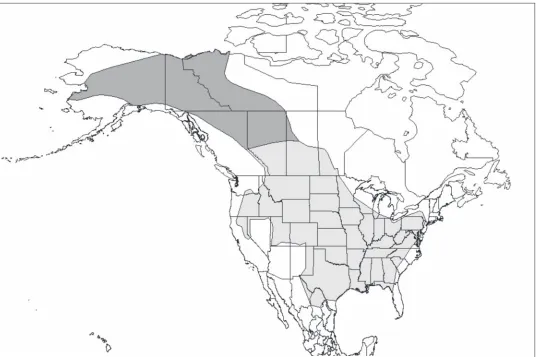
Modern bison originally ranged across most of North America (Figure 2.1). Plains bison were most abundant on the Great Plains, but also radiated eastward into the Great Lakes region, over the Allegheny Mountains toward the eastern seaboard, northward as far as northern New England, and then south into Florida; westward, they were found in Nevada and parts of the Great Basin, the Cascade and Rocky Mountains northward to mid-Alberta and Saskatchewan prairie lands, and further south along the Gulf of Mexico into Mexico (Danz 1997; Reynolds et al. 1982). There are records of bison occurring at surprisingly high elevations in mountainous regions, particularly along the Front Range of the Rocky Mountains (Fryxell 1928; Kay and White 2001; Meagher 1986). Evidence also indicates that bison inhabited areas of the Greater Southwest, including Arizona, New Mexico, and northern Mexico, areas not generally recognised as within the original range of plains bison (Truett 1996). Whether apparent or real, bison scarcity in the American Southwest is usually attributed to a combination of insufficient water and grass and human hunting (Truett 1996). The original range of wood bison includes northern Alberta, north-eastern British Columbia, a small area of north-western Saskatchewan, the western Northwest Territories, Yukon, and much of Alaska (Stephenson et al. 2001). More recent research incorporating
Figure 2.1 Original ranges of plains bison and wood bison. Recreated by Boyd (2003) based on van Zyll de Jong (1986) and Stephenson et al. (2001).
oral narratives of aboriginal people in Alaska, Yukon, and Northwest Territories, in combination with archaeological and palaeontological records, demonstrates that wood bison were present in the Yukon and Alaska within the last two centuries, and that these areas are within the original range of the subspecies (Lotenberg 1996; Stephenson et al. 2001).
2.3
Abundance
Historical and archaeological records demonstrate that plains bison thrived on the grasslands of the Great Plains (Malainey and Sherriff 1996; Shaw and Lee 1997). Explorers, settlers, and Euroamerican hunters described enormous herds of plains bison, with population estimates ranging from 15 to 100 million (Dary 1989; Shaw 1995). In the 1890s, naturalist Ernest Thompson Seton posited the widely accepted estimate for American bison at 60 million (Dary 1989; McHugh 1972; Roe 1970; Shaw 1995).
from domestic livestock (horses, cattle, sheep) and wild horses also played a role in reducing bison numbers (Flores 1991; Isenberg 2000). Furthermore, because bison provided sustenance for North American aboriginals and commodities for their barter economy, the elimination of bison was viewed by Euroamericans as the most expedient method to subjugate the Native Americans and force them onto reserves, making way for agrarian settlement and continued western development (Danz 1997; Geist 1996; Isenberg 2000; Mayer and Roth 1958). To this end, the U.S. government unofficially supported the slaughter of bison by providing ammunition and supplies to commercial buffalo hunters (Mayer and Roth 1958). Although an overt political policy to decimate bison was never formally established, the Canadian and U.S. governments capitalised on widespread hunger among aboriginal communities caused by the near extirpation of bison as a means to subjugate and control the aboriginal population (Geist 1996; Stonechild and Waiser 1997). By the late 19th Century it was estimated that there were fewer than 1,000 remaining bison in North America (Hornaday 1889; Seton 1927). Wood bison were concentrated in northern Alberta and the Northwest Territories, and plains bison were scattered in isolated groups across the Central Great Plains and, notably, in what is now Yellowstone National Park (YNP).
2.5
Early recovery
As the great herds diminished, there was some public outcry, but few laws were enacted to protect the bison (Danz 1997). Most early plains bison conservation efforts happened through the independent actions of private citizens. Prominent figures in the conservation movement included James McKay and even unwarranted assumptions, and arbitrary population
attributions (Shaw 1995). Regardless, there is little doubt that prior to Euroamerican settlement, plains bison numbered in the millions, and probably even in the tens of millions (Shaw 1995).
Wood bison were not as numerous as plains bison owing to limited habitat, although they did inhabit a vast region of the boreal forest in north-western North America (Gates et al.
2001c). Soper (1941) estimated the total wood bison population in 1800 to be 168,000, an estimate that was highly speculative. The Soper estimate is based on the number and distribution of wood bison existing in Wood Buffalo National Park (WBNP) during the 1930s, with some fuzzy extrapolation from the WBNP density to the presumed area of the original wood bison range. The estimate did not account for regional variability in habitat availability. Furthermore, Stephenson et al. (2001) documented a considerably larger original range than Soper (1941). Therefore, wood bison may have been more numerous than estimated by Soper.
2.4
Extirpation
Continental bison numbers declined dramatically and rapidly following European settlement. Specific regional impacts on numbers, distribution, and abundance are recorded in many historical accounts and references (e.g., Dary 1974). Large-scale seasonal migrations of both the northern and southern plains bison herds may have temporarily masked their decline, although by the late 1800s it was obvious that the American bison population had been decimated and was in serious decline (Krech 1999). Commercial hunting by Euroamericans and some Native North Americans for meat and hides was a primary cause (Hornaday 1889; Isenberg 2000). The
American military quietly approved illicit market hunting on federally protected tribal lands in the northern and southern plains. Other factors included indiscriminate slaughter for sport and recreation. Sport hunting was exacerbated by the westward push of colonization from the east and across the prairies with the implicit and explicit approval of politicians and military leaders anxious to resolve the food supply side of the so-called “Indian problem.” (Danz 1997; Dary 1989; Hewitt 1919; Isenberg 2000; McHugh 1972).
Environmental factors, such as regional drought, introduced bovine diseases, and competition
Charles Alloway (Manitoba), Charles Goodnight (Texas), Walking Coyote (Montana), Frederick Dupree (South Dakota), Charles J. Jones (Kansas), and Michel Pablo and Charles Allard (Montana) (Coder 1975; Danz 1997; Dary 1989; Geist 1996). Their efforts to establish herds from the few remaining bison secured the foundation stock for most contemporary public and private plains bison herds. Formed in 1905, the American Bison Society (ABS) pressed Congress to establish several public bison herds at Wichita Mountains National Wildlife Refuge, the National Bison Range (NBR), Sully’s Hill National Game Preserve (SHNGP), and Fort Niobrara National Wildlife Refuge (Coder 1975; Danz 1997). National parks in both the U.S. and Canada also figured prominently in bison recovery efforts (Danz 1997; Ogilvie 1979).
Once plains bison were protected from hunting (beginning in the 1870s), their numbers increased considerably, doubling between 1888 and 1902. By 1909, the subspecies was considered safe from extinction (Coder 1975). Initially sparked by nostalgia and reverence for the animal, motivations for bison recovery became increasingly driven by their commercial value (Yorks and Capels 1998). By 1970, there were 30,000 plains bison in North America, with approximately half in public herds located in national parks, wildlife refuges, and state wildlife areas, and half in private herds (Shaw and Meagher 2000). As reviewed in chapter 7, the number of plains bison currently is more than 20,500 in 62 conservation herds, while the number under commercial propagation is about 400,000.
The wood bison population fell to a low of 250 animals at the close of the 19th Century, then slowly grew to 1,500-2,000 by 1922 owing to the enforcement of Canadian laws enacted to protect the animal (Gates et al. 2001c; Soper 1941). In 2008, there were about 10,870 wood bison in 11 conservation herds (Chapter 7).
2.6
Cultural Significance
Few species enjoy a history as rich in archaeology,
palaeontology, story and legend, oral and documentary history as the American bison. Nor is there another North American species for which the cultural and political significance of an animal is so great. For thousands of years various forms and populations of bison have coexisted with humans in North America, providing sustenance and shaping human social and economic patterns, and influencing national history and international political relationships. Although a comprehensive review of human-bison interactions from the colonisation of North America to recent times is encyclopaedic in scope, a brief summary and discussion is provided here.
Bison were important in the subsistence economies of the first Beringian colonisers of the western hemisphere, and later figured prominently, but differentially, in Palaeo-Indian, Archaic,
and subsequent North American cultural horizons and traditions. Bison were economically and culturally important throughout most of North America, including interior Alaska, Yukon and Northwest Territories, but they were particularly significant for groups living in the Great Plains, from north-central Texas to southern Alberta. Various forms of bison have been identified as key subsistence resources in the Palaeolithic of north-eastern Asia, forming part of a megafaunal complex adapted to the steppe-tundra of Late Pleistocene northern Eurasia and Beringia, along with mammoths and horses (Guthrie 1990). While bison remains are commonly found in Siberian archaeological sites, standard zooarchaeological methods (Ermolova 1978) indicate they do not appear to have contributed greatly to subsistence. By comparison, reindeer, mammoths, and horses are relatively abundant in Siberian archaeological sites. Bison seem to have played a more important role in North American archaeological complexes. In Alaska, there is empirical evidence from numerous archaeological complexes spanning 12,000 to 1,000 years B.P. that links bison with cultural traditions using conservative,
Palaeo-Indian:
(12,000-6,000 B.P.) A group of Late
Pleistocene–Early Holocene cultures associated
with the colonisation of central North America.
While their subsistence economies are debated,
many archaeologists consider them to be big game
hunting specialists (including mammoth).
Folsom:
(11,000-10,200 B.P.) A Palaeoindian
culture, characterised by very high mobility and
specialised bison hunting.
Archaic:
(6,000-2,300 B.P.) A group of Middle
Holocene cultures characterised by broad spectrum
foraging (i.e., subsisting on a wide variety of big and
small game, fish, shellfish, and plant foods). They do
not have permanent villages or agriculture.
Plains Woodland:
(2,300-1,000 B.P.) A group of
Late Holocene cultures characterised by
semi-permanent villages, horticulture (maize and beans)
in addition to hunting and gathering.
burial or destruction through erosion) (Artz 1996; Walker 1992). Some evidence indicates that during this period bison and people concentrated their activities in localised refugia, such as river valleys (Buchner 1982). Throughout North America, there was a general shift to mixed foraging economies based on more locally abundant resources, with bison playing a much smaller role except in specific areas of the Great Plains.
After 2,000 years B.P., archaeological records for the North American grasslands show evidence of widespread human occupation and regional specialisation in habitat use (Manning 1995; Speth 1983). The so-called Plains Woodland complexes showed local patterns of adaptation represented as widespread networks of cultural interactions that linked the eastern
woodlands, and perhaps even the Greater Southwest, to the grasslands through trade and religious or ceremonial interactions (Frison 1991). Technologies shifted again to include bows and arrows, pottery and distinctive regional ceramic traditions. Much later, the use of horses formed the basis for the mounted, efficient microblade technology (Holmes and Bacon
1982; Potter 2005; 2008). Microblades are small elongate sharp stone blades inserted into pieces of bone or wood to make composite tools (Guthrie 1983).
Bison played a key role in Palaeo-Indian, Archaic, and later economies in North America, particularly in the Great Plains. While some have questioned early Palaeo-Indian dependence on bison and other large-bodied ungulates (Grayson and Meltzer 2002), other studies show a clear pattern of specialised large mammal hunting during the Late Pleistocene and Early Holocene in North America (Hofman and Todd 2001; Waguespack and Surovell 2003). Although there are disagreements as to whether Early Palaeo-Indians should be classified as specialised big-game hunters or broad-spectrum foragers, bison evidently played an important role in their subsistence economies. A recent survey by Waguespack and Surovell (2003) reported that 52% of 35 Early Palaeo-Indian components (Clovis, 11,300-10,900 years B.P.) included bison remains. With the extinction of the mammoth and other Pleistocene megafauna, bison became a greater economic focus for late Palaeo-Indian complexes (Folsom and others present during the Early Holocene). Changes in projectile point forms have been linked to specialisations for bison hunting (Stanford 1999). In particular, Folsom complex adaptations have been linked to intensive bison hunting (Amick 1996). Communal bison hunting probably played an important role in seasonal aggregations of
Palaeo-Indian populations, with human groups combining to hunt and then dispersing into smaller groups in relation to seasonal bison migrations (Kelly and Todd 1988).
On the Great Plains, the Holocene Climatic Optimum or Altithermal (about 7,500 years B.P. in mid-latitude North America) resulted in warmer and drier conditions and increased seasonality. Climate change apparently limited bison abundance and geographic distribution, and induced human adaptations to new climatic and ecological conditions (Sheehan 2002; but see Lovvorn et al. 2001). Human populations adjusted primarily by developing new economic strategies, termed “Archaic” by North American archaeologists. Adaptations involved new technologies such as ground stone for processing a variety of plant foods, and incorporating a more diverse array of smaller game and plants into the subsistence economy. During this period, some portions of the Great Plains appear to have been abandoned entirely by people (Meltzer 1999). However, the dearth of sites could also be explained by taphonomy (deep
nomadic “Plains Indian Culture” observed by European explorers and missionaries at first contact (Duke 1991; Wedel 1959). Native North Americans, during, and even after the Plains Woodland tradition, lived in larger more permanent villages. They depended on maize, bean, and gourd horticulture to name some of the most important domesticates, with winter dependence on deer and seasonal movements in the fall and spring to take advantage of migrating bison herds (Wilson 1987). This pattern is well represented ethnographically in the Middle Missouri Region. Groups like the Siouxan-speaking Mandan and Hidatsa, and the Caddoan-speaking Pawnee and Arikara, with the Wichita and others, were scattered along major Prairie rivers and tributaries like the Loup, Lower Loup, Canadian, and Washita, as far south as Nebraska, Kansas, and Oklahoma (Weltfish 1965). Large kill events, such as those represented at the Head-Smashed-In site in Alberta, generally did not occur until very late in the history of bison hunting on the Plains, and are represented from the Late Archaic and later periods (Byerly et al. 2005). The shift in hunting strategies may have been a response to increasing herd sizes, introduction of bow and arrow, and/or changes in social organisation (Driver 1990; Reeves 1990; Walde 2006).
With increased resolution and clarity afforded by ethnohistoric and ethnographic investigations, human-bison interactions among historic native peoples are better described and documented than for the late Pleistocene and Holocene. Bison continued to be the preferred game for many native North American cultures, especially on the Great Plains and Prairies, providing food, clothing, shelter, and tools (Geist 1996; Roe 1970). Sustained by bison and plant resources, many native groups likely affected densities of other large herbivore species (Kay et al. 2000; Martin and Szuter 1999). In addition to significant ecological relationships, the bison was a central element in oral tradition, rituals, dances, and ceremonies of native peoples of the Plains (Wissler 1927), and it remains symbolically important in the cultural traditions of many native Tribes to this day.
The arrival of Europeans in North America, after 1492, resulted in significant changes in human-bison interactions, and changed the fabric of Native American life forever. Introduced diseases such as smallpox decimated indigenous human populations (Crosby 1986), and altered subsistence, settlement, demography, and social organisation for many different groups. Bison hunting by native people was seasonal in nature. Bison were incorporated into a broad spectrum of plant and animal procurement activities (Holder 1970; Isenberg 2000). Bison provided the economic basis for stable, resilient land use regimes and social systems. However, effects of Native American warfare and raiding during the historic period disrupted and destabilised these land use and social systems. The spread of horses into Great Plains aboriginal economies by the 1750s, and increasing commoditisation of bison products
caused by the emergence of a European commercial market for wildlife products by the 1820s, contributed to the near extinction of the bison (Flores 1994; Isenberg 2000:27). Native peoples traded bison hides for Euro-american commodities, with the market in bison robes reaching a peak in the 1840s. Hide hunters began to significantly participate in the market hunting of plains bison in the 1850s, and by the 1890s had decimated the herds. Even bones were cleaned for sale to the eastern fertilizer market, an activity that continued to 1906 (Dary 1974).
Numerous native North American tribes manage bison on native and tribal lands, but cultural, social and spiritual relationships with this animal are changing. For many Native Americans there is still a strong spiritual and symbolic connection, but for others it is the potential commercial value of bison that is most important. For still others, it is the pragmatic use of bison for food, and the relationship between local control over food production and land, food security, tribal sovereignty, and decreasing reliance on outside sources for food and commodities that is emerging as a topic of concern, and a theme underlying tribal decision-making.
It is not just the relationship between Native Americans and bison that is changing, but the role of bison in the overall North American food system is changing as well. The North American perspective is shifting from the view that bison are an artifact from the past to be viewed as such in parks and preserves, to one that sees bison as a dynamic component of the American diet. Along with a new vision for a healthy ecological and genetic future for the American bison, food system researchers, food system enthusiasts, and the
biomedical research community envision a new role for bison in the American diet. This role elevates the animal to priority over industrially raised beef and pork, and secures for it a place as the healthy alternative to a fatty, sugar-based diet that already has significant health impacts in terms of increased rates of cardiovascular disease, colorectal and other forms of cancer, and diabetes. Free-range bison meat is higher in omega-3 fatty acids than are grain-fed animals, perhaps even as high as wild salmon and other cold water fish species, and it is also high in conjugated linoleic acid, a fat-blocker and anti-carcinogen with the potential to reduce the risk of cancer, diabetes, and obesity. The extent to which bison can be produced efficiently and in healthy ways that do not further degrade ecosystems and ecosystem services, and marketed as a healthy food at an affordable price, will perhaps be the tipping points for how important bison become in a future American food system.