DEMOGRAPHIC RESEARCH
VOLUME 31, ARTICLE 3, PAGES 71–104
PUBLISHED 3 JULY 2014
http://www.demographic-research.org/Volumes/Vol31/3/ DOI: 10.4054/DemRes.2014.31.3
Research Article
Do co-residence and intentions make a
difference? Relationship satisfaction in married,
cohabiting, and living apart together couples in
four countries
Tsui-o Tai
Janeen Baxter
Belinda Hewitt
This publication is part of the Special Collection on “New Relationships from a Comparative Perspective,” organized by Guest Editors Anne-Rigt Poortman and Belinda Hewitt.
© 2014 Tsui-o Tai, Janeen Baxter & Belinda Hewitt.
This open-access work is published under the terms of the Creative Commons Attribution NonCommercial License 2.0 Germany, which permits use, reproduction & distribution in any medium for non-commercial purposes, provided the original author(s) and source are given credit.
1 Introduction 72
2 Background 73
2.1 Living apart together relationships 73
2.2 Union type and relationship satisfaction 75
2.3 Macro-institutional context 77
3 Methods 79
3.1 The sample 79
3.2 Dependent variable 81
3.3 Independent variables 81
3.3.1 Relationship type 81
3.3.2 Controls 82
3.4 Analytic strategy 83
4 Results 84
4.1 Descriptive results 84
4.2 Regression results 86
5 Discussion 92
6 Acknowledgments 95
References 96
Do co-residence and intentions make a difference?
Relationship satisfaction in married, cohabiting, and living apart
together couples in four countries
Tsui-o Tai1 Janeen Baxter2 Belinda Hewitt3
Abstract
BACKGROUND
A large body of research has compared relationship satisfaction and quality in cohabiting versus married relationships. Despite increased recognition of couples in living apart together (LAT) relationships, very little research has examined the experiences of couples in LAT relationships compared to co-residential unions.
OBJECTIVE
Our aim is to develop knowledge about the experiences of different union types by investigating relationship satisfaction of people in LAT, cohabiting, and marital relationships. We differentiate those with intentions to marry for cohabiters, and those with intentions to marry or live together in LAT relationships. We also examine differences by gender and country.
METHODS
Using data from Wave 1 of the Generations and Gender Survey in France, Germany, Australia, and Russia (n = 9,604), OLS regressions are estimated to investigate a) differences in relationship satisfaction across relationship types, and b) across countries.
RESULTS
Married people have the highest levels of relationship satisfaction. People in non-marital unions with intentions to marry or live together are significantly more satisfied than those without marriage or cohabitation intentions. Those in LAT relationships with no intentions to live together have the lowest levels of relationship satisfaction. There is evidence of cross–national variation with differences in relationship satisfaction by
union type most pronounced in Australia and Russia. Gender differences are found with women reporting lower levels of relationship satisfaction than men.
CONCLUSIONS
LAT relationships are qualitatively different to co-residential unions. It is important to further develop our understanding of the experiences of couples in these relationships.
1. Introduction
Relationship formation has undergone profound changes in many western nations over the last several decades. The new patterns are characterized by a decline in lifelong marriage and an increasing number and complexity of non-marital relationships. These include de facto cohabitations and non-residential partnerships, such as couples living apart together (LAT), where people identify as being in an intimate relationship but not living with their partner (Duncan and Phillips 2010; Heuveline and Timberlake 2004; Kiernan 2004; Sobotka and Toulemon 2008). These changes highlight the importance of examining variations in relationship experiences and outcomes, such as relationship satisfaction, across union types.
A large and growing body of research is devoted to explaining differences in relationship stability, quality, and satisfaction for de facto cohabiters (henceforth referred to as cohabiters) compared to married couples (Brown 2003; Brown and Kawamura 2010; Liefbroer and Dourleijn 2006). Findings from these studies show higher levels of relationship satisfaction amongst married couples compared to cohabiters, although this varies depending on the marital intentions of cohabiters, with cohabiters intending to marry showing fewer differences in wellbeing compared to married couples (Brown 2003). Less attention has been paid to LAT relationships. Moreover, little research has considered relationship outcome variations amongst different types of LAT relationships, such as those who plan to live together and those who do not. As with cohabiters, relationship intentions of LAT couples are likely to influence relationship satisfaction (Rhoades, Stanley, and Markman 2012).
virtually indistinguishable from marriage, exhibit fewer differences in relationship satisfaction between marital and cohabiting couples than countries with less normative and institutional support for non-marital unions (Wiik, Keizer, and Lappegård 2012).
In this paper we aim to fill some of the gaps in the literature concerning relationship satisfaction across union type and institutional setting. We use data from the Generations and Gender Survey (GGS) to investigate relationship satisfaction across union type in four countries, Australia, Germany, France and Russia. We chose these countries because they encompass three broad policy regime types: liberal (Australia), conservative (France and Germany) and post-socialist (Russia). This allows an investigation of variations in relationship satisfaction across different institutional contexts because the GGS provides comparable measures across these four countries on key dependent and independent variables. There is already considerable research on LAT couples in the Scandinavian context (Karlsson and Borell 2005; Levin 2004; Levin and Trost 1999) providing insight into relationship quality in social democratic regimes. Our research examines patterns across other regime types.
Our examination extends existing research on relationship satisfaction in several ways. First, we investigate whether relationship satisfaction differs across a wider range of union types than previous research including those in marital, cohabitating and LAT relationships. Second, we investigate the importance of commitment to the relationship by differentiating cohabiters who plan to marry from those who do not, and LAT couples who plan to live together or marry compared to those who do not. Third, we examine gender differences in relationship satisfaction by union type. Fourth, we compare these differences across four countries, Australia, Germany, France and Russia, with varying institutional contexts and differing levels of support for non-marital unions.
2. Background
2.1 Living apart together relationships
due to constraints arising from housing availability, employment opportunities in different geographical locations, or family circumstances, such as caring for elderly parents.
For the purposes of the current analyses we do not distinguish among LAT couples in terms of preferences or motivations for living apart together, but we do distinguish, as discussed below, those who intend to marry or live together in the future and those who do not. And we examine variations in relationship satisfaction according to a range of indicators of life course stage such as age, home ownership, relationship duration, previous relationship status, and presence of children. Of course, it should also be noted that other relationship types such as cohabiting and married couples will also encompass a broad range of couples with varying motivations for living together, varying relationship histories and at varying life course stages.
A growing body of research is starting to examine the prevalence, characteristics, and outcomes of couples in LAT relationships. These studies indicate that LAT couples comprise a substantial minority of couple relationships in many western societies. Duncan and Phillips (2010) report that about 10% of adults in the UK are living in a LAT relationship, with similar figures reported for the US, Australia, and other European countries (Kiernan 2000; Reimondos, Evans, and Gray 2011; Strohm et al. 2010).The proportion of individuals in LAT relationships is high amongst younger age groups, and the never married. But there is also evidence that LAT relationships are relatively common amongst older age groups in some countries, particularly for divorced and widowed people, who may desire an intimate partnership whilst also retaining a high degree of autonomy (Karlsson and Borell 2002). It has also been suggested that LAT unions will become more common over time. Social and demographic forces such as the ageing of the population, increased life expectancy, increasing education and employment opportunities for women potentially leading to greater difficulties for couples to pursue career opportunities in the same geographical location, and high divorce rates may all contribute to a greater prevalence of LAT relationships in the future (Duncan and Phillips 2010; Haskey and Lewis 2006; Levin 2004).
children, more likely to have higher levels of education, and less likely to be religious than cohabiters and married couples (Duncan and Phillips 2010; Reimondos, Evans, and Gray 2011). However, it is likely that these differences may be due to the age and cohort profile of LAT couples compared to other relationship types such as cohabitation or marriage.
2.2 Union type and relationship satisfaction
There are a number of reasons why we might expect relationship satisfaction to vary across union type. First, individuals with differing characteristics may be more or less likely to form certain kinds of unions, and these characteristics may, in turn, lead to variations in levels of relationship satisfaction. For example, individuals who hold more traditional views about marriage may be more likely to marry than to cohabit, and may report higher levels of relationship satisfaction than other groups as a result of their beliefs. On the other hand, individuals who are older and previously married with established housing and preferences for staying in their current neighborhood may be more likely to enter LAT relationships than to relocate to a new household in a different setting (Karlsson and Borell 2002). Thus, as discussed below, it is important to control for a range of individual, household, and contextual differences in order to isolate the association between union type and relationship satisfaction.
relationships differentiated according to whether they plan to live together or marry in the future. LAT’s who plan to live together may be more committed to their relationship, and hence more satisfied, than those who do not plan to live together.
Second, some individuals may be forced into certain kinds of relationships due to circumstances beyond their control and consequently may experience lower levels of relationship satisfaction. For example, couples may have to live apart due to employment opportunities that necessitate different geographical locations at certain stages of a career. Or couples with very low economic resources may be forced to live apart, perhaps in their parental home, because they have insufficient resources to acquire joint housing (Blossfeld and Drobnič 2001). In some cases, a lack of economic resources to afford a wedding ceremony may lead couples to cohabit rather than marry (Manning and Smock 2002). In each of these cases, we expect lower relationship satisfaction for those who are cohabiting or living apart compared to those who are married.
A third reason for variations in relationship satisfaction across relationship types may be the experience of living in a particular kind of relationship. For example, marriage may provide greater levels of relationship satisfaction than other kinds of relationships if it is experienced as secure, long-term and normatively appropriate compared to cohabiting, which may be experienced as more fragile, short-term and less normatively sanctioned. Similarly, living apart together may result in lower levels of relationship satisfaction due to long periods of time apart, particularly for those who would prefer to be living together. On the other hand, if living apart together is motivated by a desire for greater freedom and independence, LAT couples may experience higher levels of relationship satisfaction than those in co-residential relationships.
cohabiting men if they experience additional burdens of domestic work without long-term financial security and shared economic resources.
2.3 Macro-institutional context
We argue that the macro context is likely to influence both the prevalence of certain kinds of unions as well as subjective outcomes, such as relationship satisfaction, within these union types. Economic security, as a foundation for family formation, has been found to affect union formation individually and at a societal level (Kalmijn 2007). Previous studies show that getting a stable job is positively associated with entry into marriage for both men and women (Oppenheimer, Kalmijn, and Lim 1997; Sweeney 2002) while non-marital partnerships may be a response to economic uncertainty (Huston and Melz 2004). Housing constraints are another obstacle to union formation and childbearing. Housing shortages partially explain the rise in LAT partnerships in Southern European and post socialist countries (Sobotka and Toulemon 2008). As personal and societal economic security facilitates the formation and stability of long-term unions, it is expected that marriage might be further postponed when there is a high level of unemployment or low housing affordability.
Post socialist countries have some of the highest levels of unemployment, job insecurity, and housing deprivation (Nesporova 2002; Norris and Shiels 2007). According to the World Development Indicators database (World Bank 2012), in 2004, the overall unemployment rates in Poland and Slovakia were 18% and 19% respectively. Russia and the Czech Republic, on the other hand, had moderate levels of unemployment. In Western European countries, the overall unemployment level was between 4% and 10%. Australia, the US, and other liberal countries usually have lower unemployment rates. Eastern European countries also experience the severest housing deprivation including poor housing conditions, housing shortages, and drastically increasing housing prices. For instance, in 2008, the ratio of housing price to income was 4.7 in Russia (Michigami 2011). That means that the middle-class household’s annual income for almost five years equals the price of a new dwelling.
gender attitudes. Other English-speaking countries, including Australia, the US, the UK, and Canada, have intermediate to high levels of cohabitation, out-of-wedlock childbearing, marital dissolution, and female labor force participation (Batalova and Cohen 2002; Chandola, Coleman, and Hiorns 2002; Fuwa and Cohen 2007; Heuveline and Timberlake 2004; World Bank 2012). In these countries where non-marital unions are more prevalent and accepted, it is reasonable to expect that the difference in relationship quality between married couples and those in other unions may be less pronounced.
Post socialist countries, on the other hand, are very diverse. Due to the legacy of communism, female labor force participation tends to be high. However, post socialist countries tend to have relatively conservative attitudes toward cohabitation and gender roles and more traditional divisions of domestic labor. Therefore, non-marital cohabitation, extramarital childbearing, and divorce remain uncommon, although research is indicating increasing trends in these areas in Russia, Estonia, Latvia, and Hungary (Fuwa and Cohen 2007; Gerber and Berman 2009; Sobotka and Toulemon 2008). This suggests that differences in relationship satisfaction across union type in post-socialist countries may be even more pronounced, with those in non-marital unions reporting the lowest levels of satisfaction.On the other hand, given the prevailing lack of acceptance of cohabiting relationships in post-socialist countries, we might also expect that people in LAT relationships could have higher levels of relationship satisfaction because they are not contravening societal norms of living together outside of marriage.
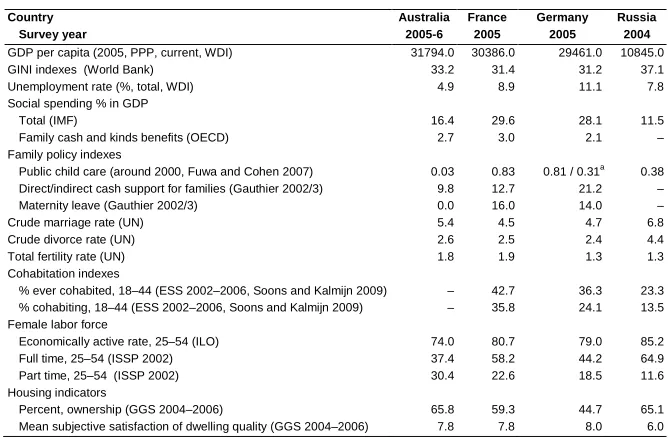
In this paper, we focus on Australia, France, Germany, and Russia. These countries, often grouped in liberal (Australia), conservative (France and Germany), and post socialist country types (Russia), provide divergent social and economic contexts and allow us to observe and compare how structural factors moderate the impact of union types on relationship satisfaction (Deacon 1992; Esping-Andersen 1999; Fajth 1999; Gauthier 2002/3). Table 1 illustrates some characteristics for these countries between 1999 and 2006. In terms of economic development, Russia has the lowest GDP per capita and the least egalitarian income distribution. All countries show high levels of female labor force participation, but a large proportion of women work part time in Australia and Germany compared to the other two countries. France and Germany allocated 29% of GDP to social spending in 2005 and also provide extensive paid maternity leave and generous family allowances. Australia only recently introduced a paid parental leave scheme in 2011.
marriage and gender roles. Finally, different housing systems have evolved in the four countries (Lawson and Milligan 2007; Norris and Shiels 2007). France has a well-developed public housing system, whereas home ownership and a private rental sector dominate the market in Australia and Germany. Russians have encountered the severest housing deprivation problems.
Table 1: Contextual characteristics by country
Country Australia France Germany Russia
Survey year 2005-6 2005 2005 2004
GDP per capita (2005, PPP, current, WDI) 31794.0 30386.0 29461.0 10845.0
GINI indexes (World Bank) 33.2 31.4 31.2 37.1
Unemployment rate (%, total, WDI) 4.9 8.9 11.1 7.8
Social spending % in GDP
Total (IMF) 16.4 29.6 28.1 11.5
Family cash and kinds benefits (OECD) 2.7 3.0 2.1 –
Family policy indexes
Public child care (around 2000, Fuwa and Cohen 2007) 0.03 0.83 0.81 / 0.31a 0.38 Direct/indirect cash support for families (Gauthier 2002/3) 9.8 12.7 21.2 –
Maternity leave (Gauthier 2002/3) 0.0 16.0 14.0 –
Crude marriage rate (UN) 5.4 4.5 4.7 6.8
Crude divorce rate (UN) 2.6 2.5 2.4 4.4
Total fertility rate (UN) 1.8 1.9 1.3 1.3
Cohabitation indexes
% ever cohabited, 18–44 (ESS 2002–2006, Soons and Kalmijn 2009) – 42.7 36.3 23.3 % cohabiting, 18–44 (ESS 2002–2006, Soons and Kalmijn 2009) – 35.8 24.1 13.5 Female labor force
Economically active rate, 25–54 (ILO) 74.0 80.7 79.0 85.2
Full time, 25–54 (ISSP 2002) 37.4 58.2 44.2 64.9
Part time, 25–54 (ISSP 2002) 30.4 22.6 18.5 11.6
Housing indicators
Percent, ownership (GGS 2004–2006) 65.8 59.3 44.7 65.1
Mean subjective satisfaction of dwelling quality (GGS 2004–2006) 7.8 7.8 8.0 6.0
Notes: Data sources: World Development Indicators (World Bank 2012); All the GINIs Dataset (World Bank 2010); Government Finance Statistics (International Monetary Fund 2004, 2005, 2006); OECD Social Expenditure Database (OECD 2012); UN Demographic Yearbook (UN 2012); ILO Labour Statistics (ILO 2012); International Social Survey Programme Family and Changing Gender Roles III (ISSP 2002); Generation and Gender Survey Wave 1 (United Nations 2014). a: 0.81: East Germany; 0.31: West Germany.
3. Methods
3.1 The sample
nationally representative samples on topics including fertility, partnership, household composition, economic activity, housing, wellbeing, and attitudes by means of face-to-face interviews with individuals. The respondents provided information on themselves, their residential and residential partners, other household members, and non-residential family members.
We selected Australia, France, Germany, and Russia (2004–2006) for the study because these countries had comparable data available, but also a variety of institutional contexts. Analysis was limited to coupled heterosexual respondents who were either legally married, cohabiting, or living apart together. Same-sex respondents were excluded from the analyses because there were only a few cases (n=102) and it is likely that homosexual and heterosexual couples are motivated to form different types of relationships and have different relationship outcomes due to uncontrolled factors (e.g., marital law). In addition, the selection of the analytic sample accommodates the following considerations. First, non-marital relationships, such as cohabitation, are uncommon among older adults (Brown and Booth 1996). Our preliminary analyses show that only about 10% of coupled respondents older than 55 were in a cohabiting or LAT relationship. Second, unlike marital unions, most non-marital unions end (through marriage or dissolution) within several years (Bumpass and Sweet 1989; Heuveline and Timberlake 2004). A study by Heuveline and Timberlake (2004) shows that the estimated median cohabitation spell of never-married women in 11 countries is 2.4 years. Considering relationship satisfaction as partially a function of duration, some previous studies restricted analyses to both marital and non-marital couples in relationships of 10 years or less (e.g., Brown 2003; Nock 1995). On the other hand, international studies suggest the relatively high prevalence and longer duration of non-marital cohabitation in European countries such as France and Sweden (Köppen 2011; Sobotka and Toulemon 2008). For example, a study by Köppen (2011) shows that about 50% of French women born between 1975 and 1980 still cohabited with their partners after eight years of non-marital cohabitation. Also, the GGS data show that almost 20% of cohabiters without marriage plans reported their cohabitation spell to be 15 years or longer. Given the concerns with the low incidence of non-marital unions among older respondents and prolonged non-marital relationships in some European countries, we selected respondents between 18 and 55 years of age and in unions of no more than 15 years. There were 11,145 respondents who fit our inclusion criteria.
that the exclusion of the 543 respondents will lead to biased estimates. The remaining 671 missing cases from all of the four countries did not answer, refused to answer, or answered “do not know” to the question on relationship satisfaction. Finally, we excluded respondents with missing data on key independent variables (n=327). Our final analytical sample comprised 4,058 men and 5,546 women. Australia had the smallest sample (n= 771 men and 948 women), while Russia had the largest (n=1,421 men and 1,875 women).
For robustness checks, we conducted additional analyses with multiple imputation methods and the results were similar to the results we presented here (results available on request). However, data imputation is considered an appropriate strategy when observations are missing at random (MAR) or missing completely at random (MCAR) (Acock 2005). Given our limited knowledge of the respondents with missing data, we decided to exclude missing values from our final models, with the exception of missing values on the respondent’s and partner’s education. We have a more detailed discussion on the coding of missing values on education in Section 3.3.2.
3.2 Dependent variable
Our dependent variable, relationship satisfaction, is measured by the question “How satisfied are you with your relationship with your partner/spouse?” Responses range from completely unsatisfied (0) to completely satisfied (10). We did not include other measures to assess relationship quality, such as disagreements between couples or the intention of breaking-up, because these variables are not available for all four countries.
3.3 Independent variables
3.3.1 Relationship type
to marry somebody/ your partner during the next 3 years?”, and “Do you intend to start living with a partner/your partner during the next 3 years?”
3.3.2 Controls
We control for several other factors found to be important for relationship formation and satisfaction. Longer union duration is also found to lower satisfaction for both married and cohabiting couples (Brown and Booth 1996; Nock 1995). Relationship duration, coded in years, was constructed from the difference between the survey year and the year when the respondent started the current relationship. The measurement of relationship duration, however, differs between residential and non-residential couples. The GGS consolidated duration item measures the time span in which a residential couple lived together and the time span from when a non-residential couple started their relationship. To investigate the non-linear changes in relationship satisfaction over the relationship course (Wiik, Keizer, and Lappegård 2012), duration, the respondent’s age, and their squares are added to the models. Although middle-aged and older individuals are more likely to have longer relationships, the correlation between age and duration was not high (r=0.4, p<.001, n=9,604). The partner’s age was not included because the deletion of cases without information on partner’s age removed the majority of Australian LAT relationships from the analyses.
Economic factors, such as employment status and education, are also important for relationship satisfaction. Dual-earner arrangements might lead to more work-family conflicts and increase the tension in relationships, although wives’ earnings contribute to the economic wellbeing of families and may lead to higher relationship satisfaction (Perry-Jenkin, Repetti, and Crouter 2000). Work status was included as a series of dummy variables indicating whether the respondent and their partner were: 1 = employed (i.e., employed or self-employed, on maternity, parental or childcare leave, helping family member in a family business or a farm, military or social service, and pension workers), 2 = unemployed, or 3 = not in the labor force (i.e., in school or in vocational training, ill or disabled for a long time or permanently, retired, looking after the home or family, and other).
deletion or imputation could lead to biased estimates. We therefore added a “missing/unclear” category to our education variables for these cases. Because both respondent and partners education were included in our models, we tested them for collinearity; they were not highly correlated (r=0.36, n=9,604).
Health status was measured using the respondent’s subjective health status, ranging from very bad (=1) to very good (=5). It should be noted that Australia’s health scale measure ranged from excellent to bad and therefore this was recoded to be consistent with the responses categories in the other countries. We also differentiated between respondents who had experienced a previous cohabiting or marital relationship (coded 1) from those who had no previous cohabiting or marital relationships. This measure of previous relationships excluded LAT relationships, because the Australian relationship history data did not include LAT relationships.
We include measures of attitudes toward gender roles and family life as previous research has found these are important for relationship satisfaction (Amato and Booth 1995; Amato and Rogers 1999; Wilcox and Nock 2006). Two items were included: “It is all right for an unmarried couple to live together even if they have no interest in marriage.” and “If a woman earns more than her partner, it is not good for the relationship.” The response categories for the two variables were inconsistent across the four countries, and the variables were dichotomized to harmonize the measures where more liberal responses were scored 1, with a referent of traditional attitudes.
Previous research has shown that the presence of children can have a negative impact on relationship satisfaction (Brown 2003; Brown and Booth 1996; Glenn and McLanahan 1982; Stanley and Markman 1992; Willetts 2006). A dummy was included for the presence of dependent children aged <14 (1 = yes) in the respondent’s household, including biological, step, and adoptive children with current or previous partners. Housing tenure was measured as a binary variable (home owner=1). Subjective satisfaction with current dwellings ranged from not satisfied at all (=0) to completely satisfied (=10). We included this measure, as variations in satisfaction with housing may be related to motivations for living apart together versus co-residential unions. Finally, country dummies were included to examine variations in relationship satisfaction across the four countries.
Information on race/ethnicity and religious affiliations was missing for Australian respondents and therefore these variables were excluded from the analyses.
3.4 Analytic strategy
countries. Second, we estimated a series of ordinary least squares regression models. The distribution of relationship satisfaction is highly skewed to the left, which violates assumptions of normality, linearity, and equal distances between satisfaction categories. In additional analyses, we estimated ordered logit models. The results for key predictors including union type and country dummies were generally similar to those based on linear regression estimation (results available on request) and our final analyses were conducted using OLS regressions.
Two main models were estimated. The first model examined the associations between relationship type and relationship satisfaction, controlling for country, individual and household characteristics. In the second model, we examined country differences in the effects of union type on relationship satisfaction by including interaction terms between country and union type in the models. For this analysis we used Germany as the reference group. The analyses were conducted separately for men and women. Additional models including gender interactions for all covariates were estimated to test for significance in any estimated gender differences.
4. Results
4.1 Descriptive results
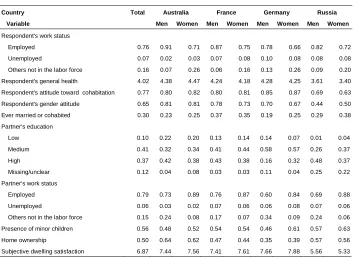
Table 2 reports descriptive statistics for individual and couple level characteristics. On average respondents reported scores of 8 or higher on a 10-point scale, indicating high levels of satisfaction with their relationships. Interestingly, Russian women reported the lowest levels of relationship satisfaction, with an average of 7.63. French, German, and Russian men reported higher levels of satisfaction than their female counterparts (p<.05), while there were no significant differences between Australian men and women.
cohabit. Compared to the other three countries, LAT unions without marriage or cohabitation plans were more common in Russia.
The average union durations ranged from 5.6 to 7.3 years. Women in France, Russia, and Australia had higher levels of educational attainment than women in Germany. On average, 77% and 65% of the respondents reported liberal views about cohabitation and gender roles, although Russian respondents reported the most conservative attitudes. About 19% to 38% of respondents had experienced at least one marital or cohabiting relationship prior to their current partnership. Home ownership was more common in Australia than in other countries. Russian respondents were the least satisfied with their present dwellings (5.3–5.6 out of 10).
We also provide results for means on all variables across union type (see Appendix). As expected, cohabiters and those in LAT relationships had shorter union spells than married couples. Compared with married and cohabiting respondents, those in LAT relationships reported the lowest levels of employment, home ownership, and employed partners. On average, cohabiters had lower educational attainment and reported less traditional attitudes toward cohabitation and gender roles than married or LAT respondents.
Table 2: Individual and household characteristics: means by country and gender
Country Total Australia France Germany Russia
Variable Men Women Men Women Men Women Men Women
N 9604 771 948 810 1264 1056 1459 1421 1875
Relationship satisfaction 8.33 8.10 8.15 8.61 8.44 8.83 8.67 8.48 7.63
Legally married 0.53 0.54 0.54 0.46 0.42 0.54 0.63 0.57 0.54
Cohabiting with intention to get married 0.12 0.19 0.17 0.13 0.13 0.09 0.08 0.13 0.11
Cohabiting without intention to get married 0.11 0.04 0.04 0.16 0.21 0.11 0.12 0.07 0.10
LAT with intention to marry or live together 0.16 0.20 0.19 0.19 0.19 0.17 0.11 0.14 0.13 LAT without intention to marry or live
together 0.08 0.04 0.05 0.06 0.06 0.09 0.06 0.09 0.12
Duration 6.33 5.59 5.61 6.54 6.35 6.51 7.34 6.13 6.18
Respondent's age 33.45 35.50 33.71 35.19 33.49 34.55 33.72 32.08 31.89
Respondent's education
Low 0.11 0.18 0.22 0.12 0.13 0.09 0.12 0.08 0.05
Medium 0.48 0.46 0.36 0.50 0.41 0.57 0.58 0.53 0.42
High 0.37 0.36 0.42 0.37 0.46 0.27 0.24 0.33 0.46
Table 2: (Continued)
Country Total Australia France Germany Russia
Variable Men Women Men Women Men Women Men Women
Respondent's work status
Employed 0.76 0.91 0.71 0.87 0.75 0.78 0.66 0.82 0.72
Unemployed 0.07 0.02 0.03 0.07 0.08 0.10 0.08 0.08 0.08
Others not in the labor force 0.16 0.07 0.26 0.06 0.16 0.13 0.26 0.09 0.20
Respondent's general health 4.02 4.38 4.47 4.24 4.18 4.28 4.25 3.61 3.40
Respondent's attitude toward cohabitation 0.77 0.80 0.82 0.80 0.81 0.85 0.87 0.69 0.63
Respondent's gender attitude 0.65 0.81 0.81 0.78 0.73 0.70 0.67 0.44 0.50
Ever married or cohabited 0.30 0.23 0.25 0.37 0.35 0.19 0.25 0.29 0.38
Partner's education
Low 0.10 0.22 0.20 0.13 0.14 0.14 0.07 0.01 0.04
Medium 0.41 0.32 0.34 0.41 0.44 0.58 0.57 0.26 0.37
High 0.37 0.42 0.38 0.43 0.38 0.16 0.32 0.48 0.37
Missing/unclear 0.12 0.04 0.08 0.03 0.03 0.11 0.04 0.25 0.22
Partner's work status
Employed 0.79 0.73 0.89 0.76 0.87 0.60 0.84 0.69 0.88
Unemployed 0.06 0.03 0.02 0.07 0.06 0.06 0.08 0.07 0.06
Others not in the labor force 0.15 0.24 0.08 0.17 0.07 0.34 0.09 0.24 0.06
Presence of minor children 0.56 0.48 0.52 0.54 0.54 0.46 0.61 0.57 0.63
Home ownership 0.50 0.64 0.62 0.47 0.44 0.35 0.39 0.57 0.56
Subjective dwelling satisfaction 6.87 7.44 7.56 7.41 7.61 7.66 7.88 5.56 5.33
4.2 Regression results
differences, German respondents were the most satisfied with their relationships, followed by their French, Australian, and Russian counterparts.
Figure 1: Observed relationship satisfaction mean scores by union type and country: men’s reports
Figure 2: Observed relationship satisfaction mean scores by union type and country: women’s reports
0 1 2 3 4 5 6 7 8 9 10
Australia France Germany Russia
Legally married
Cohabiting w/ intention Cohabiting w/o intention LAT w/ intention
LAT w/o intention
0 1 2 3 4 5 6 7 8 9 10
Australia France Germany Russia
Legally married
Cohabiting w/ intention
Cohabiting w/o intention
LAT w/ intention
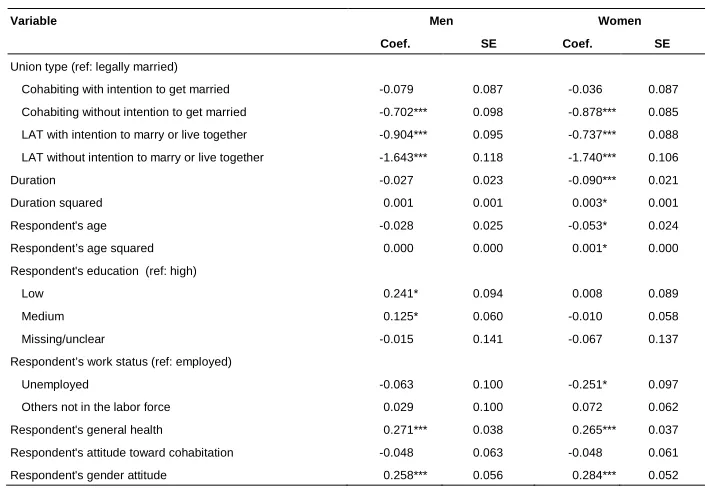
In Table 3 we present the multivariate ordinary least squares regression models predicting relationship satisfaction separately for men and women. All things being equal, compared to married respondents, all non-marital couples except for cohabiters with marriage plans were significantly less satisfied with their relationships (p<.001). Additional analyses (results not shown) showed that there was no significant difference in satisfaction levels between cohabiters without marriage plans and LAT respondents with plans to marry or live together and that LAT respondents without plans to marry or live together were the least satisfied compared to their counterparts in other types of unions (all differences significant at p< .001).
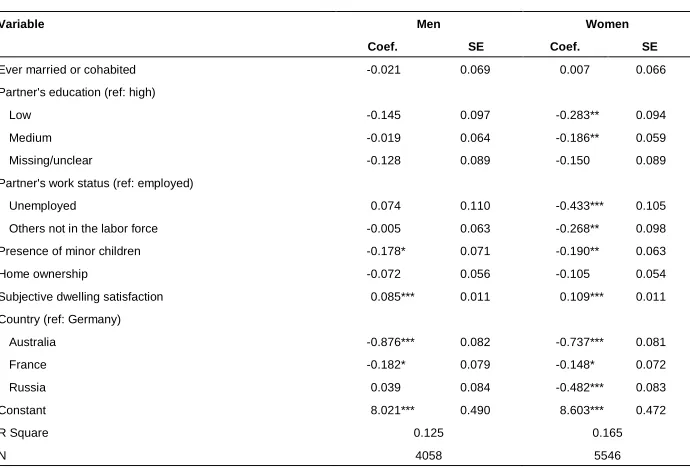
As expected, country context was also important for explaining variations in levels of relationship satisfaction. Compared to Germans, Australian and French respondents reported lower levels of satisfaction (p<.001 and p<.05 respectively). Additional analyses (results not shown) show that Australian men and women were less satisfied with their relationships than their German, French, and Russian counterparts (all differences at p< .001). Russian women scored lower than German women (p<.001), but there were no significant differences in satisfaction levels between Russian and German men.
Table 3: OLS regression models for relationship satisfaction
Variable Men Women
Coef. SE Coef. SE
Union type (ref: legally married)
Cohabiting with intention to get married -0.079 0.087 -0.036 0.087
Cohabiting without intention to get married -0.702*** 0.098 -0.878*** 0.085
LAT with intention to marry or live together -0.904*** 0.095 -0.737*** 0.088
LAT without intention to marry or live together -1.643*** 0.118 -1.740*** 0.106
Duration -0.027 0.023 -0.090*** 0.021
Duration squared 0.001 0.001 0.003* 0.001
Respondent's age -0.028 0.025 -0.053* 0.024
Respondent’s age squared 0.000 0.000 0.001* 0.000
Respondent's education (ref: high)
Low 0.241* 0.094 0.008 0.089
Medium 0.125* 0.060 -0.010 0.058
Missing/unclear -0.015 0.141 -0.067 0.137
Respondent’s work status (ref: employed)
Unemployed -0.063 0.100 -0.251* 0.097
Others not in the labor force 0.029 0.100 0.072 0.062
Respondent's general health 0.271*** 0.038 0.265*** 0.037
Respondent's attitude toward cohabitation -0.048 0.063 -0.048 0.061
Table 3: (Continued)
Variable Men Women
Coef. SE Coef. SE
Ever married or cohabited -0.021 0.069 0.007 0.066
Partner's education (ref: high)
Low -0.145 0.097 -0.283** 0.094
Medium -0.019 0.064 -0.186** 0.059
Missing/unclear -0.128 0.089 -0.150 0.089
Partner's work status (ref: employed)
Unemployed 0.074 0.110 -0.433*** 0.105
Others not in the labor force -0.005 0.063 -0.268** 0.098
Presence of minor children -0.178* 0.071 -0.190** 0.063
Home ownership -0.072 0.056 -0.105 0.054
Subjective dwelling satisfaction 0.085*** 0.011 0.109*** 0.011
Country (ref: Germany)
Australia -0.876*** 0.082 -0.737*** 0.081
France -0.182* 0.079 -0.148* 0.072
Russia 0.039 0.084 -0.482*** 0.083
Constant 8.021*** 0.490 8.603*** 0.472
R Square 0.125 0.165
N 4058 5546
Note: Significance-level (two-tailed): * p<.05, **p<.01, ***p<.001.
satisfaction is based on the fact that people with higher levels of education tend to have better employment prospects, income, and health which are mostly controlled in our analyses (Amato and Booth 1997; Brown 2003; Farley 1996; Wiik, Keizer, and Lappegård 2012).
Similar to previous findings, respondents with better health had higher levels of relationship satisfaction, although the causal direction is not clear here. Both men and women who held less traditional gender views reported more satisfaction with their relationships. The presence of young children in the household reduced the level of relationship satisfaction for both men and women. Housing satisfaction increased relationship satisfaction, although homeownership was not associated with relationship satisfaction.
Finally, additional models including gender interactions for all covariates (results not shown) show that women reported lower levels of relationship satisfaction than men (p<.001). Russian women were significantly less satisfied with their relationships (p<.001) than Russian men. In addition, women with non-working partners also reported lower levels of satisfaction than their male counterparts (p<.05). In contrast to our expectations, we did not find significant gender differences in relationship satisfaction by union type. In other words, the differences in satisfaction between married respondents and those in the four non-marital unions were patterned in the same way for men and women. Other explanatory variables, including the respondent’s health, gender attitudes and employment status, and the presence of children in the household, had similar impacts on relationship satisfaction for men and women.
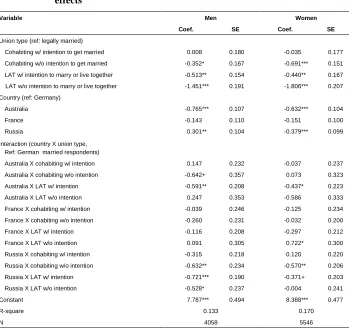
Table 4: OLS regression models for relationship satisfaction with interaction effects
Variable Men Women
Coef. SE Coef. SE
Union type (ref: legally married)
Cohabiting w/ intention to get married 0.008 0.180 -0.035 0.177
Cohabiting w/o intention to get married -0.352* 0.167 -0.691*** 0.151
LAT w/ intention to marry or live together -0.513** 0.154 -0.440** 0.167
LAT w/o intention to marry or live together -1.451*** 0.191 -1.806*** 0.207
Country (ref: Germany)
Australia -0.765*** 0.107 -0.632*** 0.104
France -0.143 0.110 -0.151 0.100
Russia 0.301** 0.104 -0.379*** 0.099
Interaction (country X union type, Ref: German married respondents)
Australia X cohabiting w/ intention 0.147 0.232 -0.037 0.237
Australia X cohabiting w/o intention -0.642+ 0.357 0.073 0.323
Australia X LAT w/ intention -0.591** 0.208 -0.437* 0.223
Australia X LAT w/o intention 0.247 0.353 -0.586 0.333
France X cohabiting w/ intention -0.039 0.246 -0.125 0.234
France X cohabiting w/o intention -0.260 0.231 -0.032 0.200
France X LAT w/ intention -0.116 0.208 -0.297 0.212
France X LAT w/o intention 0.091 0.305 0.722* 0.300
Russia X cohabiting w/ intention -0.315 0.218 0.120 0.220
Russia X cohabiting w/o intention -0.632** 0.234 -0.570** 0.206
Russia X LAT w/ intention -0.721*** 0.190 -0.371+ 0.203
Russia X LAT w/o intention -0.528* 0.237 -0.004 0.241
Constant 7.787*** 0.494 8.388*** 0.477
R-square 0.133 0.170
N 4058 5546
Notes: Net of other predictors including duration, the respondent’s age, education, work status, health, attitude toward cohabitation and gender attitude; ever married or cohabited; partner's education and work status; the presence of minor children, home ownership and subjective dwelling satisfaction.
Significance-level (two-tailed): +p<.01, * p<.05, **p<.01, ***p<.001
general, German respondents reported higher levels of relationship satisfaction than Australians, French respondents, and Russian women. Our results also imply that the effect of union type on relationship satisfaction is moderated by national context. Relative to German couples, the differences in satisfaction between married respondents and cohabiters without marriage plans or LAT respondents were more substantial in Australia and Russia. Finally, as the bivariate analyses revealed, Russian women in LAT relationships with intentions of marriage or living together were more satisfied than Russian women in cohabiting relationships with no intentions of marriage. This is consistent with the expectation that perhaps in countries where unmarried cohabitation is viewed negatively, those in LAT relationships may feel less societal pressure. Or it may be that intentions to marry are associated with greater relationship satisfaction amongst women in these LAT relationships, as this may indicate a stronger commitment to their relationship and the expectation of relationship stability.
5. Discussion
This paper examined variations in relationship satisfaction across union type and country. Demographic changes in patterns of union formation, combined with more liberal views and greater institutional support for non-marital relationships, provide more choices for union formation across many countries. Choice of union type may occur in response to institutional, couple, and individual factors. Relationship satisfaction is likely to be associated with these factors, as well as relationship experiences.
We have four core findings. First, relationship satisfaction varies according to both relationship type and intentions. On the whole, married respondents were the most satisfied and LAT respondents were the least satisfied, while cohabiters fell roughly in between these two groups. This provides broad support for the view that higher levels of relationship commitment, as measured by intentions, legal status, and co-residence, are related to higher levels of relationship satisfaction. However, there were some variations in these patterns by relationship intentions of cohabiters and LAT respondents. In accordance with previous research on the significance of commitment in cohabiting unions (e.g., Brown and Booth 1996; Wiik, Berhhardt, and Noack 2009), both cohabiting men and women planning to marry were as satisfied with their relationship as married couples. We also find that LAT men and women with marriage or cohabitation plans were as satisfied as cohabiters without marriage plans. Overall, those in LAT relationships who did not expect to marry or live with their partner within three years reported the lowest levels of relationship satisfaction.
Of course the discussion above implies that married couples are the most committed of all relationship types, a reasonable assumption given their willingness to commit to a legal partnership. But arguably the increasing incidence of marital separation and greater access to divorce may challenge this assumption. Previous research suggests that married couples also vary in terms of their intentions to stay married. Therefore, married couples may be heterogeneous in the same way as non-marital couples. Union types mask a range of variations and similar to the argument made by Duncan and Phillips (2010: 132), it is important not to confuse changing union type with changing union experiences.
contribution from women’s employment, as indicated by high levels of relationship satisfaction.
Australians were also less satisfied with their relationships than their German counterparts. Less comprehensive family policies and marginal social housing provisions might be important factors here. Finally, Germans’ higher levels of satisfaction are mainly driven by the reports of married respondents and those in LAT relationships with cohabitation plans (results not shown). Although France and Germany are often grouped in the same cluster of conservative countries, in general, Germany has a higher level of religiosity and more traditional family values (Soons and Kalmijn 2009). Its family policies also support a traditional division of labor (Esping-Andersen 1999; Gauthier 2002/3).
Third, we also find country differences in the association between union type and relationship satisfaction, showing some support for the view that countries with high levels of support for non-marital unions have the smallest differences in relationship satisfaction across union types. Germany and France were similar here, with few significant differences between these countries in levels of relationship satisfaction across union type. On the other hand, there was evidence that both Russia and Australia differed significantly from Germany with lower levels of relationship satisfaction amongst some non-marital unions compared to married respondents in Russia and Australia. As outlined above, both Australia and Russia have low levels of institutional support for non-marital unions and this may explain the low levels of relationship satisfaction amongst these non-traditional union types. A lack of cultural, political, and social support for intimate partnering outside of marriage may be associated with lower levels of relationship satisfaction for couples who live in non-traditional relationships through personal choice or circumstances beyond their control.
relationships. The greatest variation by gender was observed in Russia, where Russian women report much lower relationship satisfaction than Russian men, and lower levels than men and women in all other countries. As noted above, there are country specific reasons relating to social norms and changing political and economic structures.
Our paper has a number of limitations. First. we only examined data for four countries, which excludes possibilities for multilevel analyses. Second, due to data limitations, measures of income, earnings, partner’s age, and religiosity are not included in the analyses. We are thus only able to include the spouse’s educational attainment and work status. Third, our data are cross-sectional and therefore we are unable to disentangle issues of cause and effect or selection and endogeneity. Although we control for a number of potentially confounding variables in our analyses, we are unable to examine whether high levels of relationship satisfaction lead to entry into different kinds of relationships or vice versa. Fourth, there is debate amongst family scholars about whether LAT relationships are equivalent to other forms of marital and non-marital partnerships, or whether they are a stage in the dating relationship and are more akin to dating couples (Duncan and Phillips 2010). However, as noted above, there is undoubtedly a great deal of variation within each of the categories investigated here, including married couples. In addition, unlike some previous studies, we are able to differentiate those in LAT relationships according to future intentions, thus presumably controlling some of these variations.
Despite these limitations, our paper provides important new information about variations in relationship satisfaction across union type, gender, and country context. In particular we have added to understanding about experiences within LAT relationships, a union type that has only recently begun to gain attention from family scholars. Further research that explores these patterns in a broader range of countries, as well as analyses using longitudinal data that enables issues of endogeneity to be controlled, will enhance our understanding of these issues further.
6. Acknowledgements
This research results from collaboration between members of the Relations-Cross-Nations (RCN)-network. RCN meetings have been supported by: (a) a grant from Utrecht University within the University of California-Utrecht University Collaborative Grant Program (2009), (b) an RFP-grant from the Population Association of America (2010/11), (c) a grant from the Spanish Ministry of Science (2010), and (d) grants from the Swiss National Science Foundation and FORS (2011).
References
Acock, A.C. (2005). Working with missing values. Journal of Marriage and Family 67: 1012–1028. doi:10.1111/j.1741-3737.2005.00191.x.
Amato, P.R. and Booth, A. (1995). Changes in gender role attitudes and perceived marital quality. American Sociological Review 60(1): 58–66.
doi:10.2307/2096345.
Amato, P.R. and Booth, A. (1997). A generation at risk: Growing up in an era of family upheaval. Cambridge, MA: Harvard University Press.
Amato, P.R. and Rogers, S.J. (1999). Do attitudes toward divorce affect marital quality? Journal of Family Issues 20(1): 69–86. doi:10.1177/019251399020001004. Batalova, J.A. and Cohen, P.N. (2002). Premarital cohabitation and housework: couples
in cross-national perspective. Journal of Marriage and Family 64: 743–755.
doi:10.1111/j.1741-3737.2002.00743.x.
Baxter, J. (2005). To marry or not to marry: marital status and the household division of labor. Journal of Family Issues 26(3): 300–321. doi:10.1177/0192513X04270
473.
Baxter, J., Hewitt, B., and Haynes, M. (2008). Life course transitions and housework: Marriage, parenthood, and time on housework. Journal of Marriage and Family 70: 259–272. doi:10.1111/j.1741-3737.2008.00479.x.
Bernard, J. (1972). The future of marriage. New Haven, CT: Yale University Press. Blossfeld, H.-P. and Drobnič, S. (2001). Careers of couples in contemporary societies:
from male breadwinner to dual earner families. Oxford: Oxford University Press.
Brown, S.L. (2003). Relationship quality dynamics of cohabiting unions. Journal of Family Issues 24(5): 583–601. doi:10.1177/0192513X03024005001.
Brown, S.L. and Booth, A. (1996). Cohabitation versus marriage: A comparison of relationship quality. Journal of Marriage and Family 58(3): 668–678.
doi:10.2307/353727.
Brown, S.L. and Kawamura, S. (2010). Relationship quality among cohabitors and marrieds in older adulthood. Social Science Research 39: 777–786.
Budig, M. and England, P. (2001). The wage penalty for motherhood. American Sociological Review 66(2): 204–225. doi:10.2307/2657415.
Bumpass, L.L. and Sweet, J.A. (1989). National estimates of cohabitation. Demography 26: 615–625.
Chandola, T., Coleman, D.A., and Hiorns, R.W. (2002). Heterogeneous fertility patterns in the English-speaking world. Results from Australia, Canada, New Zealand and the United States. Population Studies 56(2): 181–200.
doi:10.1080/00324720215929.
Cherlin, A. (2009). The marriage-go-round: the state of marriage and the family in America today. New York: Alfred A. Knopf.
Deacon, B. (ed.). (1992). The New Eastern Europe: Social policy past, present and future. London: Sage Publications.
Duncan, S. and Phillips, M. (2010). People who live apart together (LATs)―how different are they? The Sociological Review 58(1): 112–134.
doi:10.1111/j.1467-954X.2009.01874.x.
Esping-Andersen, G. (1999). Social foundations of postindustrial economies. Oxford: Oxford University Press. doi:10.1093/0198742002.001.0001.
Fajth, G. (1999). Social security in a rapidly changing environment: the case of the post-communist transformation. Social Policy & Administration 33(4): 416–436.
doi:10.1111/1467-9515.00161.
Farley, R. (1996). The new American reality: Who we are, how we got here, where we are going. New York: Russell Sage Foundation.
Fuwa, M. and Cohen, P.N. (2007). Housework and social policy. Social Science Research 36: 512–530. doi:10.1016/j.ssresearch.2006.04.005.
Gauthier, A.H. (2002/3). Family policies in industrialized countries: Is there convergence? Population 57: 447–474. doi:10.2307/3246635.
Gerber, T.P. and Berman, D. (2010). Entry to marriage and cohabitation in Russia, 1985–2000: Trends, correlates, and implications for the second demographic transition. European Journal of Population 26: 3–31.
doi:10.1007/s10680-009-9196-8.
Glenn, N.D. and McLanahan, S. (1982). Children and marital happiness: A further specification of the relationship. Journal of Marriage and the Family 44:63–72.
Gornick, J.C. and Meyers, M.K. (eds.). (2009). Gender inequality: Transforming family divisions of labor. London: Verso.
Gupta, S. (1999). The effects of transitions in marital status on men’s performance of housework. Journal of Marriage and the Family 61(3):700–711.
doi:10.2307/353571.
Haskey, J. and Lewis, J. (2006). Living-apart-together in Britain: Context and meaning. International Journal of Law in Context 2(1): 37–48.
doi:10.1017/S1744552306001030.
Heuveline, P. and Timberlake, J.M. (2004). The role of cohabitation in family formation: the United States in a comparative perspective. Journal of Marriage and Family 66: 1214–1230. doi:10.1111/j.0022-2445.2004.00088.x.
Huston, T.L. and Melz, H. (2004). The case for (promoting) marriage: the devil is in the details. Journal of Marriage and Family 66: 943–958.
doi:10.1111/j.0022-2445.2004.00064.x.
International Labour Organization. (2012). Labour Statistics. http://laborsta.ilo.org/. International Monetary Fund. (2004). Government Finance Statistics Yearbook.
Washington DC: International Monetary Fund.
International Monetary Fund. (2005). Government Finance Statistics Yearbook. Washington DC: International Monetary Fund.
International Monetary Fund. (2006). Government Finance Statistics Yearbook. Washington DC: International Monetary Fund.
International Social Survey Programme. (2002). Family and changing gender roles III.
http://zacat.gesis.org/webview/index.jsp?object=http://zacat.gesis.org/obj/fStudy
/ZA3880%20.
Kalmijn, M. (2007). Explaining cross-national differences in marriage, cohabitation, and divorce in Europe, 1990–2000. Population Studies 61(3): 243–263.
doi:10.1080/00324720701571806.
Karlsson, S.G. and Borell, K. (2002). Intimacy and autonomy, gender and ageing: Living apart together. Ageing International 27(4): 11–26.
doi:10.1007/s12126-002-1012-2.
Karlsson, S.G. and Borell, K. (2005). A home of their own. Women’s boundary work in LAT-relationships. Journal of Aging Studies 19: 73–84. doi:10.1016/j.jaging.
Kiernan, K. (2000). European perspectives on union formation. In: Waite, L.J., Bachrach, C., Hindin, M., Thompson, E., and Thornton, A. (eds.). The ties that bind: Perspectives on marriage and cohabitation. New York: Aldine De Gruyter: 40–58.
Kiernan, K. (2001). The rise of cohabitation and childbearing outside marriage in Western Europe. International Journal of Law, Policy and the Family 15: 1–21.
doi:10.1093/lawfam/15.1.1.
Kiernan, K. (2004). Redrawing the boundaries of marriage. Journal of Marriage and Family 66: 980–987. doi:10.1111/j.0022-2445.2004.00068.x.
Köppen, K. (2011). Marriage and cohabitation in western Germany and France. [Ph.D. Thesis]. Rostock, Germany: University of Rostock and the Max Planck Institute for Demographic Research.
Lawson, J. and Milligan, V. (2007). International trends in housing and policy responses. AHURI Final Report No. 110. Melbourne, Australia: Australian Housing and Urban Research Institute.
Levin, I. (2004). Living apart together: A new family form. Current Sociology 52(2): 223–240. doi:10.1177/0011392104041809.
Levin, I. and Trost, J. (1999). Living apart together. Community, Work & Family 2(3): 279–294. doi:10.1080/13668809908412186.
Liefbroer, A.C. and Dourleijn, E. (2006). Unmarried cohabitation and union stability: Testing the role of diffusion using data from 16 European countries. Demography 43(2): 203–221. doi:10.1353/dem.2006.0018.
Manning, W.D. and Smock, P.J. (2002). First comes cohabitation and then comes marriage? A research note. Journal of Family Issues 23(8): 1065–1087.
doi:10.1177/019251302237303.
Michigami, M. (2011). Comparison of affordability of Russian and Japanese housing markets. Far Eastern Studies 10: 25–57.
Motiejunaite, A. and Kravchenko, Z. (2008). Family policy, employment and gender-role attitudes: A comparative analysis of Russia and Sweden. Journal of European Social Policy 18(1): 38–49. doi:10.1177/0958928707084453.
Nock, S.L. (1995). A comparison of marriages and cohabiting relationships. Journal of Family Issues 16(1): 53–76. doi:10.1177/019251395016001004.
Norris, M. and Shiels, P. (2007). Housing inequalities in an enlarged European Union: Patterns, drivers, implications. Journal of European Social Policy 17(1): 65–76.
doi:10.1177/0958928707071893.
Oppenheimer, V.K., Kalmijn, M., and Lim, N. (1997). Men’s career development and marriage timing during a period of rising inequality. Demography 34(3): 311– 330. doi:10.2307/3038286.
Organization for Economic Co-operation and Development. (2012). OECD stat extracts. http://stats.oecd.org/.
Perry-Jenkins, M., Repetti, R.L., and Crouter, A.C. (2000). Work and family in the 1990s. Journal of Marriage and the Family 62: 981–998.
doi:10.1111/j.1741-3737.2000.00981.x.
Reimondos, A., Evans, A., and Gray, E. (2011). Living-apart-together (LAT) relationships in Australia. Family Matters 87: 43–55.
Rhoades, G.K., Stanley, S.M., and Markman, H.J. (2012). A longitudinal investigation of commitment dynamics in cohabiting relationships. Journal of Family Issues 33(3): 369–390. doi:10.1177/0192513X11420940.
Roseneil, S. (2006). On not living with a partner: unpicking coupledom and cohabitation. Sociological Research Online 11. http://www.socresonline.org.uk/ 11/3/roseneil.html. doi:10.5153/sro.1413.
Samarina, O. (2001). The social protection of women and family policy in contemporary Russia. Problems of Economic Transition 44(1): 72–80.
Smock, P.J. (2000). Cohabitation in the United States: An appraisal of research themes, findings, and implications. Annual Review of Sociology 26:1–20.
doi:10.1146/annurev.soc.26.1.1.
Sobotka, T. and Toulemon, L. (2008). Changing family and partnership behaviour: Common trends and persistent diversity across Europe. Demographic Research 19(6): 85–138. doi:10.4054/DemRes.2008.19.6.
Stanley, S.M. and Markman, H.J. (1992). Assessing commitment in personal relationships. Journal of Marriage and the Family 54(3): 595–608.
doi:10.2307/353245.
Stanley, S.M., Rhoades, G.K., and Markman, H. J. (2006). Sliding versus deciding: Inertia and the premarital cohabitation effect. Family Relations 55: 499–509.
doi:10.1111/j.1741-3729.2006.00418.x.
Stanley, S.M., Whitton, S.W., and Markman, H.J. (2004). Maybe I do: Interpersonal commitment and premarital or nonmarital cohabitation. Journal of Family Issues: 25(4): 496–519. doi:10.1177/0192513X03257797.
Strohm, C.Q., Seltzer, J.A., Cochran, S.D., and Mays, V.M. (2010). “Living apart together” relationships in the United States. Demographic Research 21(7): 177– 214. doi:10.4054/DemRes.2009.21.7.
Sweeney, M.M. (2002). Two decades of family change: the shifting economic foundations of marriage. American Sociological Review 67(1): 132–147.
doi:10.2307/3088937
UNESCO (2012). International standard classification of education.
http://www.uis.unesco.org/Education/Pages/international-standard-classificati
on-of-education.aspx.
United Nations (2014). Generations and Gender Programme. http://www.ggp-i.org/. United Nations (2012) Demographic yearbook. http://unstats.un.org/unsd/demographic/
products/dyb/dyb2.htm.
Wiik, K.A., Bernhardt, E., and Noack, T. (2009). A study of commitment and relationship quality in Sweden and Norway. Journal of Marriage and Family: 71: 465–477. doi:10.1111/j.1741-3737.2009.00613.x.
Wiik, K.A., Keizer, R., and Lappegård, T. (2012). Relationship quality in marital and cohabiting unions across Europe. Journal of Marriage and Family 74: 389–398.
doi:10.1111/j.1741-3737.2012.00967.x.
Wilcox, W.B. and Nock, S.L. (2006). What’s love got to do with it? Equality, equity, commitment and women’s marital quality. Social Forces 84(3): 1321–1345.
doi:10.1353/sof.2006.0076.
Willetts, M.C. (2006). Union quality comparisons between long-term heterosexual cohabitation and legal marriage. Journal of Family Issues 27(1): 110–127.
World Bank. (2010). All the Ginis dataset. http://econ.worldbank.org/WBSITE/ EXTERNAL/EXTDEC/EXTRESEARCH/0,,contentMDK:22301380~pagePK:6
4214825~piPK:64214943~theSitePK:469382,00.html.
World Bank. (2012). The World Development Indicators. http://data.worldbank.org/
data-catalog/world-development-indicators.
Appendix: Individual and household characteristics: Means by
country and union type
Country Australia France Germany Russia
Variable Married Cohabit LAT Married Cohabit LAT Married Cohabit LAT Married Cohabit LAT
N 929 374 416 898 661 515 1484 518 513 1814 683 799
Relationship
Satisfaction 8.29 8.42 7.49 8.71 8.46 8.23 8.87 8.75 8.35 8.34 7.91 7.31
Duration 8.21 3.19 1.93 9.40 5.25 2.73 9.20 4.69 2.93 8.23 4.47 2.92
R's age 36.27 32.37 32.52 35.46 32.46 34.05 35.76 33.22 30.03 31.87 33.73 30.70
Female 0.56 0.53 0.56 0.59 0.65 0.60 0.62 0.58 0.47 0.56 0.58 0.59
Respondent's education
Low 0.19 0.25 0.18 0.11 0.14 0.13 0.11 0.10 0.11 0.05 0.11 0.06
Medium 0.35 0.44 0.48 0.43 0.47 0.46 0.60 0.57 0.51 0.45 0.53 0.46
High 0.46 0.31 0.33 0.46 0.39 0.41 0.28 0.25 0.19 0.43 0.30 0.43
Missing/unclear 0.00 0.00 0.01 0.00 0.00 0.00 0.01 0.08 0.19 0.07 0.06 0.05 Respondent's
work status
Employed 0.81 0.83 0.75 0.85 0.80 0.70 0.76 0.69 0.60 0.81 0.74 0.67
Unemployed 0.02 0.04 0.04 0.07 0.08 0.10 0.05 0.14 0.13 0.07 0.11 0.09
Others not in
the labor force 0.18 0.13 0.21 0.08 0.12 0.20 0.19 0.18 0.27 0.12 0.15 0.24 Respondent's
general health 4.46 4.40 4.40 4.23 4.19 4.17 4.23 4.25 4.39 3.50 3.42 3.53 Respondent's
attitude toward
cohabitation 0.74 0.92 0.88 0.70 0.93 0.85 0.80 0.97 0.93 0.56 0.79 0.75
Respondent's
gender attitude 0.82 0.84 0.78 0.77 0.78 0.67 0.66 0.77 0.68 0.48 0.50 0.42 Ever married or
cohabited 0.20 0.27 0.31 0.24 0.36 0.56 0.17 0.31 0.29 0.19 0.56 0.49
Partner's education
Low 0.19 0.24 0.22 0.14 0.15 0.12 0.10 0.11 0.10 0.02 0.04 0.02
Medium 0.33 0.40 0.30 0.42 0.48 0.38 0.59 0.59 0.50 0.35 0.37 0.23
High 0.42 0.28 0.46 0.43 0.34 0.42 0.29 0.22 0.18 0.43 0.35 0.44
Missing/unclear 0.07 0.09 0.02 0.01 0.02 0.08 0.02 0.08 0.22 0.20 0.24 0.31 Partner's work
status
Employed 0.84 0.81 0.76 0.89 0.85 0.69 0.79 0.73 0.61 0.84 0.76 0.74
Unemployed 0.02 0.04 0.04 0.04 0.07 0.09 0.05 0.12 0.06 0.06 0.09 0.05
Others not in
the labor force 0.13 0.15 0.20 0.07 0.08 0.22 0.16 0.15 0.33 0.10 0.15 0.22 Presence of
minor children 0.70 0.38 0.18 0.81 0.49 0.14 0.77 0.35 0.11 0.85 0.46 0.17
Home ownership 0.78 0.48 0.42 0.64 0.37 0.22 0.48 0.22 0.21 0.60 0.50 0.53 Subjective
dwelling