IRANIAN JOURNAL OF DIABETES AND OBESITY, VOLUME 7, NUMBER 2, SUMMER 2015 45
The Effect of Eight Weeks Pilates Exercise on Testosterone and Sex
Hormone Biding Globulin (SHBG) in Women with Type 2 Diabetes
Nasibe Zolfaghari1, Mohammad Faramarzi2, Mohammad Afkhami-Ardekani3*,
Akbar Azamian jazi2, Arezoo Afkhami-Ardekani4, Saeedah Jam Ashkezari5
Introduction
iabetes is the most common disease all over the world (1). This is an important and the most crucial health issues for the entire human beings (2). According to the World Health Organization there were 436 million people suffering from diabetes in 2011 and this number will be
doubled in 2030(3). The prevalence of diabetes in population older than30of Yazd province is %14.52(4).
Regular physical activity plays an important role in the management of type2diabetes especially for hyperglycemic control, cardiovascular function improvement, increase
D
1. Masters of Sport Sciences Shahrekord University, Sharekord, Iran.
2. Associate professor of Sport Sciences, Sharekord University, Shahrekord, Iran 3. Professor of Internal Medicine, Endocrinology and Metabolism, Diabeties Research Center, Shahid Sadoughi University of Medical Sciences, Yazd, Iran.
4. Medical Student of Tehran University of Medical Sciences, Tehran, Iran.
5. Researcher, Diabetes Research Center, Shahid Sadoughi University of Medical Sciences, Yazd, Iran.
*Correspondence:
Mohammad Afkhami-Ardekani, Professor of Internal Medicine, Endocrinology and Metabolism, Diabeties Research Center, Shahid Sadoughi University of Medical Sciences, Yazd, Iran.
Email: [email protected]
Tel: (98) 353 728 0217
Received: 02 December 2015
Accepted: 12 February 2016
Published in March 2016
Abstract
Objective: The aim of this study was to determine the effect of 8 weeks Pilates exercises on testosterone and sex hormone binding globulin (SHBG) of women with type 2diabetes.
Materials and Methods: This study was conducted in Shahid Sadoughi University Hospital. This clinical trial performed on 24 type 2 diabetes women. Twenty four patients divided in 2 groups randomly, included Pilates exercises group (n=12) and control group (n=12).The height, weight, fat percentage, body mass index (BMI), FBS, HbA1C, SHBG and total testosterone were measured before and after intervention. Kolmogorov-Smirnov and student test was use to analyze inter and intra group differences by SPSS 16 software.
Results: Total patients that completed this study were twenty four. Mean±SD of age, weight, height and body mass index of patients was 47.92±0.76 years, 74.03±3.56 kg, 157.33±4.8cm, and 30.09±1.37 km2, respectively.
Body weight, BMI and Waist hip ratio (WHR) decreased significantly in intervention group (P-value:0.02). Testosterone decreased (P-value:0.01) and SHBG in Pilates exercises group (P -value:0.01) increased significantly in comparison with control group.
Conclusion: Body weight, BMI, WHR and the fat percentage in experimental group decreased significantly. The increase of SHBG and decrease of testosterone in experimental group are related to the decrease of BMI and WHR due to Pilates exercise.
Keywords: Type 2 diabetes, SHBG, Pilates exercise
IRANIAN JOURNAL OF DIABETES AND OBESITY, VOLUME 7, NUMBER 2, SUMMER 2015 46
of insulin sensitivity, body fat reduction, and blood pressure control. Regular physical activity causes significant reduction of glycosylated hemoglobin (HbA1c) as well as hyperlipidemia (5).
Physical activity increased insulin sensitivity and stimulate the uptake of glucose in skeletal muscle through glucose transporter type 4,
also known as GLUT4 (6,7).
Although the functions of beta cells and insulin resistance are the basic factors for developing type2 diabetes, other parameters such as testosterone and sex hormone binding globulin (SHBG) may be important (8). The studies on both men and women have shown that higher level of SHBG leads lower risk of complication in diabetic patients (9).
There is a significant inverse relationship between SHGB levels and the weight and body mass index (BMI) (10).Many studies show that physical exercises in obese women increase the levels of SHBG (11,12).
Pilates exercises is an exercise program that encourages thought to control the muscles (13). This is an emphasis on the ability of muscle posture to keep the balance of the body and improvement of spine. This exercise program is done in static (standing, sitting, and lie down) positions without jumping or taking a distance (14). Pilates exercises include
stretch-strength exercises done in the
movement domain of the hinge with controlled speed, focus, and deep breathes. There is no need for especial equipment and it can be done in mattress for people with normal stamina (15-18).
Pilates exercises cause reduction of fat mass and fat percentage without changing the whole body weight (19).
The aim of this study was evaluation of the effect of 8 weeks Pilates exercise on testosterone and SHBG in type 2 diabetic women.
Materials and Methods
This study was conducted in Shahid Sadoughi University Hospital. This clinical trial performed on 24 type 2 diabetes women.
Twenty four patients divided in 2 groups randomly, included Pilates exercises group (n=12) and control group (n=12).
The samples of the research were the women suffering from type2 diabetes. They were referred to Shahid Sadoughi Hospital. Among them 24 volunteer women were chosen randomly after an interview and checking their medical history. This study approved by medical ethics committee of Shahr-e-kord University. Inform consent was obtained from all participants. The samples were randomly divided in two groups namely the experimental group (those who received the Pilates exercises) and control group, each group included 12 patients. The inclusion criteria were being female, type2diabetes according to the medical document, age between 40 to 55 years old, fasting blood sugar (FBS) between 150 to 250 mg/dl with the glycated hemoglobin (HbA1C) between 7 to 10.5 percent. The exclusion criteria were suffering from psychological or chronic diseases, having regular physical exercises in the last 3 months, cardiovascular diseases, uncontrolled arrhythmia, sever high blood pressure, and complication of diabetes such as diabetic foot or nephropathy.
The height was measured by Secastadiometer made in Germany. The weight was measured
by digital scales made in Iran with the
sensitivity of 0.01 Kg without shoe. The thickness of skin fat measured by Harpendencaliper made in Germany. The caliper was put in one-centimeter distance from the finger. All the measurements were written in millimeter and taken from right side of the body. Then the numbers of under skin fat thickness of triple head, iliac, and thigh were put in Jackson and Polak equations. The body density was calculated with Jackson formula at first and then fatness percentage was estimated (20).
Physical exercising protocol
In this exercising protocol the experimental group exercised three days a week for75 minutes each time. The total number of sessions was 24. The exercises began with
IRANIAN JOURNAL OF DIABETES AND OBESITY, VOLUME 7, NUMBER 2, SUMMER 2015 47
basic level and gradually continued up to the point that the samples could control their spines in different postures. In each session, in addition to previous exercises, new exercises were introduced. This could encourage the patients and keep the difficulty level of the exercises. The speed of progress was in such a way that the patients were told to continue their exercise until they find it painful. Those exercises that were difficult or painful for the patients were modified. The degree of pain or exercise pressure measured by Borg perceive of pressure scale (20). At the beginning of each session the postures (including pelvis and spine) were checked, breathing and standing were controlled (about five min), strength
exercises were done based on the coach
explanations (about 10 min), Pilates exercises (about 40 min), and at the end of each sessions the patients came back to their normal positions (about five min). The exercises started at a low intensity and got more difficult gradually. Some new exercises were introduced in each session (21). The variables were measured one day before pre-test and one day after the last session.
Biochemical
variables
measurement
method
The samples were taken from 7 A.M to 8 A.M after 12 hours of fasting in sitting position. The blood was centrifuged at the temperature of 4c. The serum was kept at -80 c after separation till laboratory analysis. Blood glucose was measured by enzymatic method using Hitachi 902 auto analyzer.
The level of total testosterone and SHBG were determined using Elisa method by diagnostic biochemkate made in Canada. Sensitivity in measuring SHBG was %1 ng per ml.
Testosterone was measured using radio inovaci with the sensitivity of %22 ng per ml. In this study the height, weight, fat percentage, BMI, FBS, HBA1C, SHBG and total testosterone measurement were done before and after intervention. The normal distribution was tested by Kolmogorov-Smirnov.T student test was used to analyze inter and intra group differences by SPSS 16 software.
Results
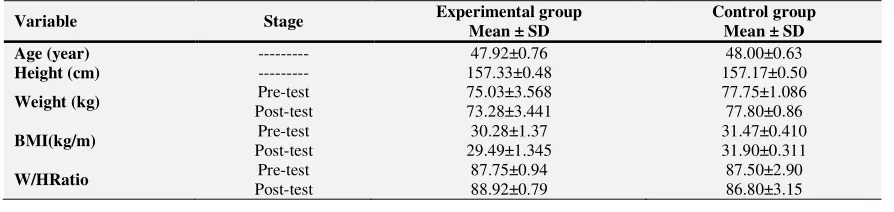
Total patients that completed this study were twenty four. Mean age of patients was 47.92± 0.76 years. Weight, height and body mass index of patients that completed this study was 74.03 ±3.56 kg, 157.33 ±4.8 cm, and 30.28 ±1.37 km2, respectively. Body weight, BMI and WHR decreased significantly in intervention group (P-value:0.02) (Table 1). Testosterone decreased (P-value:0.01) and SHBG increased significantly in Pilates exercises group (P-value:0.01).It was also indicated that SHBG increased significantly in the experimental group compared with control group. The amount of testosterone in experimental group comparing to the control group is shown in table 2. The data related to the inter group amount of FBS was not changed significantly but we experienced significant reduction of FBS amount in experimental group after Pilates exercise period (-28.08±0.824) (P-value<0.001). HbA1Cin control group did not change during the exercise period but experienced a significant reduction in experimental group (-0.92±0.004) (P-value <0.003). According to theanalysis of variance results, Pilates exercises were significant factors in reducing of HbA1C. The amount of fat did not reduce
Table 1. Anthropometric features of the samples at the before and after the study
Variable Stage Experimental group
Mean ± SD
Control group Mean ± SD
Age (year) --- 47.92±0.76 48.00±0.63
Height (cm) --- 157.33±0.48 157.17±0.50
Weight (kg) Pre-test Post-test
75.03±3.568 73.28±3.441
77.75±1.086 77.80±0.86 BMI(kg/m) Pre-test
Post-test
30.28±1.37 29.49±1.345
31.47±0.410 31.90±0.311 W/HRatio Pre-test
Post-test
87.75±0.94 88.92±0.79
87.50±2.90 86.80±3.15
IRANIAN JOURNAL OF DIABETES AND OBESITY, VOLUME 7, NUMBER 2, SUMMER 2015 48
significantly in control group but the reduction was significant in experimental group (-0.36+-0.005) (P
-value <0.05) (Table 2).
Discussion
The present study showed 8-week Pilates exercises increase SHBG and decrease testosterone in diabetic women. After 8 weeks Pilates exercise the SHBG levels increased %13.33 in the experimental group. The results are in accordance to study done by Monninkhof et al. Their study showed that physical exercises have significant increase of SHBG levels (22). Chan et al suggested that increasing the level of physical exercises causes an increase in the SHBG in menopause women. There is an inverse relationship between body weight SHBG and SHBG levels (23,24).
Body weight, BMI, and WHR of the experimental group significantly reduced in the present study so it seems that SHBG in the experimental group is related to the reduction of body weight and BMI. On the other hand it shows insulin level and decrease fat mass can reduce SHBG (25).
Conclusion
The results of this study showed the positive effects of Pilates exercises that causeincrease SHGB levels and decrease free testosterone in diabetic women.
Acknowledgment
We thank gratefully Yazd Diabetes Center and Laboratory Imam Hossain for their enthusiastic comment and facilities.
References
1. Azizi F, Hatami H, Janghorbani M. Epidemiology and Communicable disease control in iran. Tehran: Eshtiagh publication 2000;32(In Persian).
2. Morowatisharifabad M, Rouhanitonekaboni N. Perceived Severity and Susceptibility of Diabetes Complications and its Relation to Selfcare Behaviors among Diabetic Patients.Journal of Armaghanedanesh 2007;12(3):59-68 (In Persian). 3. center [document on the Internet]. Geneva; 2011
[cited27may2012]. Available From:
http//www.who.int/media center/ fact sheets/ Fs312/en/index.html.
4. Mohammadi M, Rashidei M, Afkhami-Ardekani M. Risk factors of type 2diabetes. Journal of ShahidSadoughi University of Medical Sciences 2011;19(2):266-80. (In Persian).
5. Mohammadzadeh SH, Rajab A, Mahmoodi M, Adili F. Assessment of effect of applying the
transtheoretical model to physical activity on health indexes of diabetic type 2 patients. Medical Science Journal of Islamic Azad University 2008;1:21-7 (In Persian).
6. Larijani B, Zahedi F. Epidemiology of diabetes Mellituse in Iran. Irainian journal of diabetes &Lepid Disorders, 2002;1:1-8.
7. Ceddia RB, Somwar R, Maida A, Fang X, Bikopoulos G, Sweeney G. Globular adiponectin increases GLUT4 translocation and glucose uptake but reduces glycogen synthesis in rat skeletal muscle cells, Diabetologia 2005;48:132-9.
8. Afkhami-Ardekani M, Borgian J, Mohiti-Ardekani J, Chiti Z, Rashidi M, Azod L. The Evaluation of Serum Level of Testosterone and Sex Hormone-Binding Globulin in Men with Type 2 Diabetes. Iranian Journal of diabetes and Obesity 2010;2(1):12-5.
Table2. Physical and physiological data in two groups of patients
Variable Stage Experimental group Mean ± SD
Control group Mean ± SD
Fat (%) Pre-test
Post-test
17.67±0.477 17.31±0.472
18.15±0.412 18.12±0.402 FBS (mg/dl) Pre-test
Post-test
162.33±12.409 134.25±11.585
141.25±14.888 149.83±12.508
HbA1c (%) Pre-test
Post-test
7.45±0.165 6.53±0.169
7.37±0.126 7.48±0.079 Testosterone (ng/ml) Pre-test
Post-test
65.01±6.64 50.83±3.28
75.33±3.57 75.50±3.44 SHBG( ng /ml) Pre-test
Post-test
68.17±8.97 81.50±11.17
54.17±5.36 53.08±5.13
IRANIAN JOURNAL OF DIABETES AND OBESITY, VOLUME 7, NUMBER 2, SUMMER 2015 49 9. Hammes A, Andreassen TK, Spoelgen R, Rila J,
Hubner N, Schulz H, et al. Role of endocytosis in cellular uptake of sex steroids. Cell 2005;122:751-62.
10. Chan MF, Dowsett M, Folkerd E, Bingham S, Wareham N, Luben R, Welch A, Khaw KT. Usual Physical Activity and Endogenous Sex Hormones in Postmenopausal Women: The European Prospective Investigation into Cancer– Norfolk Population Study. Cancer EpidemiologyBiomarkers and Prevention. 2007;16(5):900-5.
11. Eric L. Ding, Yiqing Song.Sex Hormone–Binding Globulin and Risk of Type 2 Diabetes in Women and Men. N Engl J Med. 2009;361(12):1152-63. 12. Coyle YM. Physical activity as a negative modulator
of estrogen-inducedbreast cancer. Cancer Causes Control. 2008;19:1021-9.
13. Caldwell K, Harrison M, Adams M, Triplett NT. Effect of Pilates and taijiquan training on self-efficacy, sleep quality, mood, and physical performance of college students. J Bodyw Mov Ther 2009;13(2):155-63.
14. Mete S, Milert A. Joseph Pilates' method and possibilities of its application in physiotherapy. Medical Rehabilitation 2007;11(2) 27-36.
15. Kloubec JA. Pilates for improvement of muscle endurance, flexibility, balance, and posture. J Strength Cond Res2010;24(3):661-7.
16. Muscolino JE, Cipriani S. Pilates and the ''powerhouse''. Journal of Bodywork and Movement Therapies 2004;8:122-30.
17. Rogers K, Gibson AL. Effects of an 8-week mat Pilates training program on body composition, flexibility, and muscular endurance. Med Sci Sport Exercise 2006;38:279-80.
18. B Anderson, P Marin, L Lisser. Testostrone concentration in women and men with NIDDM.1994;17(5):405-11
19. Ferreira C, Carraiho A. Effects of three months of pilates-based exercise in women on body composition. Medicine and Science in Sports and Exercise 2009;41(5):16-7.
20. Jackson AS, Pollock ML. Generalized equations for predicting body density of men. Br J Nutr
1978;40:497-504.
21. Ali Zamani S., Ghasemi GHA, Karimi A, Salehi H. The effects of pilates exercises on pain and general health of patients suffering from Chronic backache, Sport medicine. Journal of Research in Rehabilitation Sciences, 2011;7(10):117-25. 22. Monninkhof EM, Velthuis MJ, Peeters PHM, Twisk
JWR, Schuit AJ. Effect of Exercise on Postmenopausal Sex Hormone Levels and Role of Body Fat: A Randomized Controlled Trial. J ClinOncol.2009;27:4492-9.
23. McTiernan A, Wu L, Chen C, Chlebowski R, Mossavar-Rahmani Y, Modugno F, Perri MG, et al. Relation of BMI and physical activity to sex hormones in postmenopausal women.Obesity 2006;14(9):1662-77
24. Chan MF, Dowsett M, Folkerd E, Bingham S, Wareham N, Luben R, Welch A, Khaw KT. Usual Physical Activity and Endogenous Sex Hormones in Postmenopausal Women: The European Prospective Investigation into Cancer–Norfolk Population Study. Cancer Epidemiology Biomarkers and Prevention. 2007;16(5):900-5. 25. Ganguly NK, Medappa N, Srivastava VK. Estrogen
and breast cancer. ICMR Bulletin. 2003;33(2):1-25.