RESEARCH ARTICLE
The effect of early bilingualism on auditory temporal processing
ability using time-compressed Persian speech test
Ensiyeh Rahmani1, Farnoush Jarollahi1*, Agha Fatemeh Hosseini2, Mahnaz Soleymani1
1
- Department of Audiology, School of Rehabilitation Sciences, Iran University of Medical Sciences, Tehran, Iran
2
- Department of Biostatistics, School of Health, Iran University of Medical Sciences, Tehran, Iran
Received: 7 Jan 2015, Revised: 1 Feb 2015, Accepted: 16 Feb 2015, Published: 25 Mar 2015
Abstract
Background and Aim: Bilingualism is an important phenomenon with different effects on each aspect of language processing. Auditory temporal processing is a major component of the auditory processing ability. Since bilingual and monolingual individual’s brain process are different, and no studies have yet been conducted on the effect of temporal processing on speech recognition performance of Azeri-Persian bilinguals, the purpose of the present study is the comparison of auditory temporal processing between Persian monolinguals and early Azeri-Persian bilinguals.
Methods: In this cross-sectional study, the Persian version of time compressed speech test was performed with monosyllabic words in three compression rates of 0, 40 and 60 percent in the most comfortable level in each ear, separately. The subjects were 36 Persian monolinguals and 36 Azeri-Persian bilinguals aged from 18 to 30 and were analyzed based on languages’ compression rate and ear factors. Results: The speech recognition scores (SRS) in both groups were decreased by increasing compression rate and a significant difference
was shown between mean SRS of the two studied groups (p<0.0001). There was no
significant difference between three
compression rates by the ear (p>0.05).
Conclusion: In compression rate of 40 percent, bilingual group had lower speech recognition ability in comparison with monolingual group. In addition, there was more significant difference when compression rate increases from 40 to 60 percent.
Keywords: Bilingualism; auditory processing; speech recognition
Introduction
A bilingual is an individual who uses two languages in daily life systematically and even if not equally proficient in both languages, has adequate proficiency in second one [1]. In general, bilingual individuals are categorized into three groups and based on Harley’s
categorization, early bilinguals are the
individuals that acquire second language between 4 and 7 years of age [1]. Research shows that there is a difference between the first and the second language processing in bilingual population, as bilingual individual does not access contextual information in second language, like a native, particularly in adverse listening environments [2]. Since speech production ability of early bilingual individuals in second language is similar to native *
individuals, it may be assumed that speech and auditory perception and production abilities of the two groups are identical, however, different studies show otherwise. Therefore, more understanding of similarities and differences between the two populations (monolinguals and bilinguals) in term of auditory processing ability is particularly important [3].
The major component of the auditory
processing ability is auditory temporal
processing [4]. Auditory temporal processing is auditory system ability to process changes in acoustic signal over time [4]. Auditory temporal processing is recognized as a basic skill for auditory perception of verbal and non-verbal sounds, music perception, rhythm, pitch discrimination, duration and phonemes [5]. Few studies have examined auditory processing ability and particularly auditory temporal processing ability of bilingual individuals [1]. In a study by Stuart et al. the performance of
speech recognition of Mandarin-English
listeners was evaluated using stationary and non-stationary noise in each version of the test. The results of their study indicated that bilingual subjects performed significantly better in first language than second language in presence of both kinds of noises [6]. In another study, Hapsburg and Pena on 20 subjects with normal hearing showed poorer performance in bilingual group in presence of the noise, while there was no statistically difference between the two groups in quiet [7]. Based on the evidence, it seems that bilingual individuals need more quality of signal in their second language to access to the level of the performance equal to monolingual individuals [7,8,9]. One of the ways of evaluating temporal processing ability is time compressed speech test (TCST) [10]. TCST is one of the most frequent monaural low-redundancy speech tests (MLRST) that has been used by many researchers [10,11].
Multilingualism is a prevalent phenomenon in Iran and it is not limited to a determinate and specific region [12]. About 24% of Iran's population speaks Azeri (a dialect of Turkish). Since this language in comparison with Persian is quite different in terms of phonetic, syntactic,
and grammatical structure [1,12] and probably the processing characterizations of these two populations are different [12]; evaluation of the effect of Azeri-Persian bilingualism on different aspects of language processing is important. In TCST, because of the temporal compression of the stimuli, auditory temporal processing ability as one of the most important characterizations of auditory processing is evaluated well. Consequently, considering the use of the speech stimuli, evaluation of temporal processing by following the same approach would result in a more realistic assessment. Also, evaluating of the speech perception in second language in adverse conditions is very important in a world where learning of the second language or even the third language is increasing [13]. Since no study has engaged in the effect of temporal processing on speech recognition performance of Azeri-Persian bilinguals, thus, the purpose of the present study was the comparison of auditory temporal processing between Persian-language monolinguals and early Azeri-Persian bilinguals by TCST.
Methods
The present cross-sectional study was
performed in the Audiology Clinic at School of Rehabilitation Sciences, Iran University of Medical Sciences. 36 Persian monolingual subjects and 36 Azeri-Persian bilingual subjects aged from 18-30 (mean, 22.63 SD=1.98) participated in this study. Both groups had normal hearing sensitivity in PTA test (<20dBHL, based on ANSI, 1996), and normal middle-ear function, based on American
Speech-Hearing Language Association
were Azeri-speaking. All participants were randomly selected among students from Iran University of Medical Sciences and entered in the study after signing written consent. This study was approved by the Committee of Ethics of Iran University of Medical Sciences (93/د/105/1777).
The following description was given to eligible participants for TCST: “This test is easy and quite safe. In this test the words are presented separately to each ear and after hearing each word you should write it down in a specific form”. Before performing the test, the output of the lap top was calibrated by sound level meter (SLM). Then, stimuli were presented via a CD player through lap top and Genius earphones, Hs-500 x model (made in China), in the most
comfortable level (MCL) in each ear,
separately. It should be noted that in the present study, for all subjects, 65 dB HL, as the most comfortable level, was ideal. The most comfortable level was set based on the report of the participants through presentation of five words for their introduction about the test. In this survey, the speech recognition scores (SRS)
of both groups were measured with
monosyllabic words in three compression rates of 0, 40 and 60%, in each ear, separately. There were 2 lists of monosyllabic words for all three compression rates, separately, (one list for the right ear and another one for the left ear), therefore, a total of six lists was used. These lists selected from Mosleh et al. monosyllabic word lists which the materials were recorded by a male talker. Since there were 25 words per list, after performing the test, the number of
correct responses was multiplied by 4 in each presentation and expressed in percentage as the participant’s final score [10].
Statistical analysis was performed through SPSS19. Kolmogorov-Smirnov test was used to verify the normal distribution of the data. t-test and Mann-Whitney U test were conducted to compare means of speech recognition scores between groups of monolinguals and bilinguals, based on normal or abnormal distribution of data, respectively. The mean of scores between three compression rates were compared using Friedman test. Wilcoxon test was used to compare the scores of two ears. Significance level was set at p<0.05.
Results
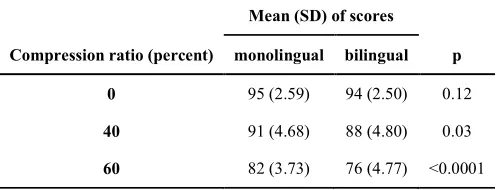
Results showed that the speech recognition scores (SRS) of both groups were decreased by increasing compression rate (p<0.0001). Mean and the standard deviation of the speech recognition scores and compression rates are shown in Table 1.
The distribution of data was not normal in compression rate of 0%, and to this compression rate there was no significant difference between monolinguals and bilinguals (p>0.05). However,
the data were normally distributed in
compression rates of 40 and 60% (p>0.05) and to these rates there was a significant difference in mean scores between the two groups. That is, bilingual group have lower speech recognition scores in comparison with monolinguals (p<0.05). The results are shown in detail in Table 1.
Statistical analysis showed no significant Table 1. Mean and standard deviation of time-compressed speech scores presented as an average of
two ears’ scores at three compression rates of 0, 40 and 60% in monolingual and bilingual subjects
Mean (SD) of scores
Compression ratio (percent) monolingual bilingual p
0 95 (2.59) 94 (2.50) 0.12
40 91 (4.68) 88 (4.80) 0.03
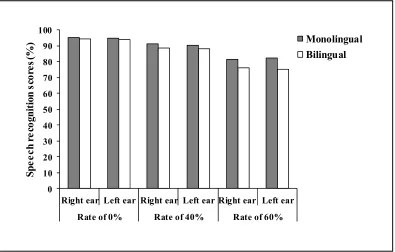
difference in mean speech recognition scores in three compression rates between the right and the left ears (p>0.05). Fig. 1 shows a comparison of the SRSs of the two ears in three compression rates in monolingual and bilingual groups.
Discussion
In the present study, in both groups of listeners, SRS changed by changing compression rate from 0 to 60% which associates with previous studies [14]. In current study, SRS was decreased by increasing compression rate. In a study by Beasely et al. in order to examine the effect of the temporal compression on the performance of the auditory discrimination, monosyllabic words were presented with five rates of the temporal compression, from 30 to 70% in steps of 10% and with a mode without compression, in 96 adults with normal hearing. The results showed gradual decrease in the recognition ability of NU-6 monosyllabic words by progressive increase of the compression rate
from 30 to 70% [15]. For interpreting the effect of the compression rate on SRSs, according to statements of Lazzaroni and Calearo, negative effect of speed increments in the speech presentation at a determined range can be negated by more utilization from intrinsic
redundancy. However, at the higher
compression rates, greater stimulus intensity is required to improve SRS [8,10]. Since in this study, the level of presentation of stimulus was stable, it is expected that SRSs decrease by increasing compression rate.
At each three compression rates in the present study, there was superior SRS in Persian-language group in comparison with Azeri-Persian group. This difference was significant at 40 and 60% compression. In addition, the difference of SRS of two groups increased by increasing compression rate, as the difference between the two groups was more significant at rate of 60% compared to rate of 40%. This result is in agreement with other similar studies, for example, Rosenhouse et al. compared Fig. 1. The comparison of time-compressed speech scores of two ears at three compression rates of 0,
40 and 60% in monolingual and bilingual subjects.
0 10 20 30 40 50 60 70 80 90 100
Right ear Left ear Right ear Left ear Right ear Left ear
Rate of 0% Rate of 40% Rate of 60%
S
p
e
e
c
h
r
e
co
g
n
it
io
n
s
co
re
s
(%
) Monolingual
bilinguals’ perception of Arabic and Hebrew
speech (as first and second language,
respectively) and reported the effect of speech
rate (temporal compression) on word
recognition ability in each two languages. All bilinguals were evaluated with the presentation of the 22 sentences at a slow rate as well as fast rate. They had to recognize target word. Similar to the present study, their results showed that word recognition was more comfortable at slow rate in comparison with fast rate in each two languages. Also, their perception of Arabic words (first language) was better than Hebrew (second language) [8].
The significant difference observed between the two groups in compression rates of 40 and 60% could be explained according to following reasons. Based on Kuhl et al. at six months after birth, in order to analyze the language, human's central auditory nervous system converts to a special network structure for categorization of the phonemes of the language in which the person is exposed to. By this special network structure, acoustic signals that are parts of features of first language will be perceived easier than the second language [16]. Previous studies have shown that during exposure to a second language in adverse listening conditions, bilinguals show lower performance than monolinguals. This lower performance happens
because in these conditions extrinsic
redundancy is reduced and subjects have to use more up-down resources; therefore, it is believed that they perform poorer in their second language [6,7,8]. Wingfield states that fast speech requires more cortical resources (up-down) for processing, and a lot of information must be processed in a limited time. Thus, it is expected that bilinguals' performance would be poorer in comparison with monolinguals in compression rates of 40 and 60%.This decreasing level of the performance will become more relevant by hardening the listening conditions, because in this condition more resources from cortical is required [8]. Thus, there would be more differences between the two groups by increasing the compression rate from 40 to 60%. According to Hapsburg
and Pena, the reason for different performance of the two groups is the bilinguals’ use of their both lexicons [7]. Therefore, this group spends more time for processing of words in both languages that are active most of the time. Therefore, it seems that the simplicity of the word recognition test and the test being less time consuming in compression rate of 0%, are the reasons that bilingualism does not affect the test results; however, if the test is conducted in compression rate of 40 and 60%, bilingualism will affect the results.
Since TCST evaluate temporal processing ability, it can be concluded that bilinguals have lower temporal processing ability in comparison with monolinguals. Various similar studies that used words as test stimuli showed this difference between the two groups clearly [6,7]. The results of this study were inconsistent with the results of Sanayi et al. that used Gap in Noise (GIN) test to evaluate auditory temporal processing ability of Turkish-Persian bilingual subjects and Persian monolinguals. Their results showed no significant difference between performances of the two groups [17]. In GIN test, distinguishing silent intervals between broadband noise and word recognition is not required. In fact, the test stimuli are not sufficiently challenging. Probably, broadband stimulus is the simplest stimulus that can be used for detection of the interval and cannot differentiate between the two groups [17]. Convincing evidence denote that encoding temporal information begins from cochlear nucleus to auditory cortical. It seems, temporal processing depends on cerebral and inter-hemisphere processing, although the processes of the brainstem and under-cortical structures support appropriate processing [4]. On the other hand, as the hearing thresholds of all participants were in normal range, it seems that the reason of the difference in temporal processing ability between Persian and Azeri-Persian groups should be researched in higher auditory centers [1].
the results are consistent with previous studies [11,15]. In one study by Rabelo and Schochat there was no notable difference between the scores of both ears, too [11]. In general, there is
no reported notable advantage between
performance of right and left ear in monaural studies [15]. Though the left hemisphere is the dominant hemisphere for language processing, in TCST, due to the presence of monaural stimuli and activation of ipsilateral and contralateral paths, the effect of preference of right ear on left ear (similar to some dichotic stimuli [15]) is negated [10,11].
Investigating the effect of this factor on each aspects of auditory processing is important due to the limited knowledge about complex effects of bilingualism [1,2,3]. Therefore, it is necessary to evaluate other temporal processing features of bilinguals, that is, temporal ordering, temporal integration and temporal masking. Other tests must be used to obtain exact and comprehensive information about processing procedures of this group. Also, since about a quarter of Iran’s population are Azeri-Persians,
examining auditory temporal processing
including speech stimuli in Azeri-Persian bilinguals using Azeri and Persian versions of the tests are suggested.
Conclusions
In the present study, there was a significant difference between the scores of monolingual and bilingual individuals (except for 0% rate).Therefore, based on the results of this study, Azeri-Persian individuals have lower temporal processing ability in comparison with Persian-language group.
Acknowledgments
This research is supported by grant No. 93/د/320/585 from Iran University of Medical Sciences (IUMS) and emerged from E. Rahmani’s MSc. dissertation.
REFERENCES
1. Omidvar S, Jafari Z. Assessment of Temporal Resolution Ability between Monolingual and Bilingual
Young Adults. Advances in Cognitive Science. 2012;13(4):49-50. Persian.
2. Golestani N, Rosen S, Scott SK. Native-language benefit for understanding speech-in-noise: the contribution of semantics. Bilingualism language and cognition. Biling (Camb Engl). 2009;12(3):385-92.
3. Rogers CL, Lister JJ, Febo DM, Besing JM, Abrams HB. Effects of bilingualism, noise, and reverberation on speech perception by listeners with normal hearing. Applied Psycholinguistics. 2006;27(3):465-85.
4. Shinn JB. Temporal processing and temporal patterning tests. In: Chermak GD, Musiek FE, editors. Handbook of (central) auditory processing disorders: vol. 1: auditory neuroscience and diagnosis. 1st ed. San Diego:
Plural Publishing INC; 2007. p. 231-52.
5. Frederigue-Lopes NB, Bevilacqua MC, Sameshima K, Costa OA. Performance of typical children in free field auditory temporal tests. Pro Fono. 2010;22(2):83-8. Portuguese.
6. Stuart A, Zhang J, Swink S. Reception thresholds for sentences in quiet and noise for monolingual English and bilingual Mandarin-English listeners. J Am Acad Audiol. 2010;21(4):239-48.
7. von Hapsburg D, Peña ED. Understanding bilingualism and its impact on speech audiometry. J Speech Lang Hear Res. 2002;45(1):202-13.
8. Shi LF, Farooq N. Bilingual listeners perception of temporally manipulated English passages. J Speech Lang Hear Res. 2012;55(1):125-38.
9. Banai K, Lavner Y. Perceptual learning of time-compressed speech: More than rapid adaptation. PloS one. 2012;7(10):e47099.
10. Jafarlou F, Jafari Z, Kamali M, Jeddi Z. The impact of compression rate and sex on the results of time compressed speech test. Audiol. 2013;22(2):47-54. Persian.
11. Rabelo CM, Schochat E. Time-compressed speech test in Brazilian Portuguese. Clinics (San Paulo). 2007;62(3):261-72.
12. Kormi-Nouri R, Shojaei R-S, Moniri S, Gholami A-R, Moradi A-R, Akbari-Zardkhaneh S, et al. The effect of childhood bilingualism on episodic and semantic memory tasks. Scand J Psychol. 2008;49(2):93-109. 13. Lecumberri MLG, Cooke M, Cutler A. Non-native
speech perception in adverse conditions: A review. Speech Communication. 2010;52(11-12): 864-86. 14. Krishnamurti S. Monaural low redundancy speech tests.
In: Chermak GD, Musiek FE, editors. Handbook of (central) auditory processing disorders: vol. 1: auditory neuroscience and diagnosis. 1st ed. San Diego: Plural Publishing INC; 2007. p. 193-205.
15. Beasley DS, Schwimmer S, Rintelmann WF. Intelligibility of time compressed CNC monosyllables. J Speech Hear Res. 1972;15(2): 340-50.
16. Zhang J, Stuart A, Swink S. Word Recognition by English Monolingual and Mandarin-English Bilingual Speakers in Continuous and Interrupted Noise. CJSLPA. 2011;35(4).322-42.