R E S E A R C H
Open Access
Environmental perceptions as mediators of the
relationship between the objective built
environment and walking among
socio-economically disadvantaged women
Delfien Van Dyck
1,2*, Jenny Veitch
3, Ilse De Bourdeaudhuij
2, Lukar Thornton
3and Kylie Ball
3Abstract
Background:Women living in socio-economically disadvantaged neighbourhoods are at increased risk for physical inactivity and associated health outcomes and are difficult to reach through personally tailored interventions. Targeting the built environment may be an effective strategy in this population subgroup. The aim of this study was to examine the mediating role of environmental perceptions in the relationship between the objective environment and walking for transportation/recreation among women from socio-economically disadvantaged neighbourhoods.
Methods:Baseline data of the Resilience for Eating and Activity Despite Inequality (READI) study were used. In total, 4139 women (18–46 years) completed a postal survey assessing physical environmental perceptions (aesthetics, neighbourhood physical activity environment, personal safety, neighbourhood social cohesion), physical activity, and socio-demographics. Objectively-assessed data on street connectivity and density of destinations were collected using a Geographic Information System database and based on the objective z-scores, an objective destinations/connectivity score was calculated. This index was positively scored, with higher scores representing a more favourable environment. Two-level mixed models regression analyses were conducted and the MacKinnon product-of-coefficients test was used to examine the mediating effects.
Results:The destinations/connectivity score was positively associated with transport-related walking. The perceived physical activity environment mediated 6.1% of this positive association. The destinations/connectivity score was negatively associated with leisure-time walking. Negative perceptions of aesthetics, personal safety and social cohesion of the neighbourhood jointly mediated 24.1% of this negative association.
Conclusion:For women living in socio-economically disadvantaged neighbourhoods, environmental perceptions were important mediators of the relationship between the objective built environment and walking. To increase both transport-related and leisure-time walking, it is necessary to improve both objective walkability-related characteristics (street connectivity and proximity of destinations), and perceptions of personal safety, favourable aesthetics and neighbourhood social cohesion.
Keywords:Physical activity, Adults, GIS, Physical environment
* Correspondence:[email protected]
1Research Foundation Flanders, Egmontstraat 5, 1000 Brussels, Belgium 2
Department of Movement and Sports Sciences, Ghent University, Watersportlaan 2, 90000 Ghent, Belgium
Full list of author information is available at the end of the article
Background
Despite the well-known benefits of engaging in sufficient physical activity (i.e. at least 150 minutes of moderate-to-vigorous physical activity per week) [1], large proportions of adults living in developed countries are insufficiently ac-tive. Ecological models of physical activity behaviour [2,3] emphasize the importance of studying correlates on mul-tiple levels–individual, social, physical environmental and policy. Furthermore, ecological models posit that corre-lates are behaviour-specific, so research should focus on specific physical activity behaviours. Determining the most pertinent correlates of both walking for leisure and walk-ing for transport is important to inform effective interven-tions aimed at increasing these behaviours. Environmental correlates may be particularly relevant as their implemen-tation can have immediate, population-wide, benefits.
Physical or built environmental attributes related to walkability (i.e. high street connectivity, mixed land use, high residential density) have been consistently associated with active transportation in adults [4,5]. Mixed evidence has been found on the role of these traditional walkability characteristics in explaining leisure-time physical activity [6-8]. Whilst it is likely that the environment is still a rele-vant factor in promoting these behaviours, other physical environmental attributes like access (i.e. availability and proximity) to recreation facilities or neighbourhood aes-thetics (e.g. presence of trees, absence of litter, attractive scenery) may be more essential in influencing leisure-time walking and moderate-to-vigorous physical activity [9].
It is particularly important to examine the contribution of the physical environment to explain physical activity in individuals with low educational levels or those living in socio-economically disadvantaged neighbourhoods and in women of childbearing age (18–46 years). These popu-lation subgroups are at increased risk for physical inactiv-ity and associated outcomes including overweight or obesity [10,11]. Furthermore, it is known that individuals living in low-income neighbourhoods are difficult to reach through personally tailored interventions [12] and that women with children possibly have strong barriers to-wards physical activity (e.g. lack of time, lack of energy, childcare issues) [13]. Thus, targeting the physical envir-onment might be a more effective strategy for achieving behaviour change in these target groups.
To assess environmental characteristics related to neigh-bourhood walkability, both objective and self-report meas-urement methods can be used. Reports of the level of concordance between the objective and perceived environ-ment have been mixed [14-16], so it remains unclear how strong the agreement between both types of measures is. Furthermore, it is possible that objectively measured high-walkable environments, characterized by high residential density, mixed land use and high street connectivity and typically situated in city centres, induce some negative
environmental attributes, like crime- and traffic-related safety problems, poor-maintained buildings and litter. A previous Belgian study confirmed this hypothesis, showing that adults living in objectively-assessed high walkable neighbourhoods perceived more aesthetic-related prob-lems, pollution, crime and less overall safety than those living in low-walkable neighbourhoods [17].
It remains unknown how a mix of positive and nega-tive environmental characteristics may affect physical ac-tivity and whether these associations work directly or indirectly (mediations). Several theoretical frameworks, like the ecological models [2,3] and the ENrG framework [18] emphasize the importance of examining cognitive factors (e.g. intrapersonal factors, environmental percep-tions) as potential mediators of the relationship between the objective physical environment and physical activity. However, until now these potential mediators have rarely been included in public health research. One previous Canadian study found evidence of clustering of environ-mental characteristics: adults living in a high-walkable neighbourhood with few green spaces did more active transportation than those living in a low-walkable neigh-bourhood with many green spaces [19]. This suggests that walkability characteristics are of overriding import-ance to explain transport-related walking. To our know-ledge, no other studies have examined these clustered associations, nor the mediating effects of environmental perceptions in explaining the relationship between the objective environment and physical activity. Examining these mediating effects can help to better understand the relationship between the objective/perceived envir-onment and physical activity and can help to identify which factors to focus on when developing programs to optimize the built environment.
Based on the shortcomings in the current literature, the aim of the present study was to examine the mediating ef-fects of specific environmental perceptions in the relation-ship between objective environmental characteristics and walking for transportation/recreation in women from socio-economically disadvantaged neighbourhoods. The current study focused on walking, because this is the most common and accessible type of physical activity in adults having documented health benefits [20] and because the impact of the neighbourhood environment is supposed to be strongest for walking [4].
Methods
neighbourhoods. Baseline data collection took place be-tween August 2007 and January 2008. The study proto-col was approved by the Deakin University Human Research Ethics Committee, the Victorian Department of Education and the Catholic Education Office.
Procedure and participants
Participants were randomly selected using the electoral roll (registration is compulsory for Australian citizens) from 40 rural and 40 urban socially and economically dis-advantaged suburbs in Victoria, Australia. To select the 80 READI suburbs, all suburbs in Victoria were categorized into low-, middle- or high-disadvantage tertiles, using the Australian Bureau of Statistics’Socio-economic Index for Areas (SEIFA). The SEIFA is an area-based measure of socio-economic disadvantage, constructed from the popu-lation census [22]. Suburbs in the lowest SEIFA tertile that had populations of≥1200 people and were located within 200 km of Melbourne, formed the READI suburb selec-tion pool. In total, 50 women aged 18–45 years from each suburb were selected (or, where there were fewer than 150 women in this age range living in the suburb, all women within the age range were selected).
In total, 11940 women living in these suburbs were posted a survey, assessing a broad range of factors that might influence women’s lifestyle choices associated with obesity risk. Two reminder letters (10 days and 20 days after initially mailing the survey) were sent to those who did not return their survey [23]. Of the surveys distrib-uted, 861 were returned as undeliverable and 17 were returned from individuals who were not eligible (e.g. men). In total, 4934 completed surveys were returned (45% response rate). Of these 4934 women, 571 were ex-cluded because they no longer lived in a READI suburb, nine were excluded because they were not within the de-sired age range (18–46 years), three were excluded be-cause the survey was not completed by the person it was addressed to, and two subsequently requested to be withdrawn from the study. Because physical activity was examined as an outcome measure in the present study, only women who were not pregnant at the time of the survey were included in the analyses. Applying this ex-clusion criterion led to a final sample of 4139 women. The mean number of participants per suburb was 52 (SD: 9), ranging from 29 to 72 across suburbs.
Measures
Objectively-assessed physical environment
Data on the spatial location of amenities within a 2 km pedestrian road network buffer [24] around each partici-pant’s residence were collected using multiple secondary sources including online directories, commercially avail-able datasets, and state and local government spatial datasets. These data were mapped using a Geographic
Information System (GIS) (ArcGIS 9.3). Characteristics of density of physical activity/food related destinations and street connectivity were assessed, because these walkability-related characteristics have previously been shown to be associated with walking among adults [7]. To assess the density of physical activity/food related destinations, the number of fast food restaurants (e.g. Pizza Hut, McDonalds, Nandos, Subway), supermarkets (major chain, other supermarkets and green grocers), sports facilities (gym/leisure centres and public swim-ming pools) and playgrounds within the 2 km buffer were counted. Z-scores were calculated for each separate destination and all z-scores were summed to obtain an overall ‘destinations’ score. Street connectivity was de-fined as the number of three- or more-way intersections within the 2 km buffer and a standardized z-score was calculated [25]. Finally, the objective ‘ destinations/con-nectivity’ z-score was calculated by summing z-scores for density of physical activity/food related destinations and street connectivity.
Perceived environment
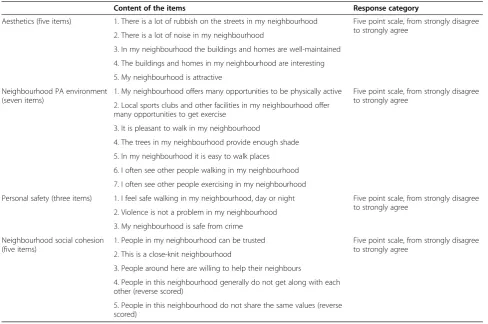
Existing measures were used to assess perceptions of aesthetics (mean of five items, Cronbach’s alpha = 0.74), the neighbourhood physical activity environment (mean of seven items, Cronbach’s alpha = 0.80), personal safety (mean of three items, Cronbach’s alpha = 0.85) [26] and social cohesion of the neighbourhood (mean of five items, Cronbach’s alpha = 0.83) [27]. The different scales, items and response categories are presented in Table 1.
Self-reported physical activity
Self-reported physical activity was collected using the long version of the International Physical Activity Ques-tionnaire (IPAQ-L). The IPAQ is suitable for use in adults aged 15–69 years, has excellent test-retest reliabil-ity properties (pooled r = 0.81) and acceptable validreliabil-ity (mean ρ= 0.30) when compared with accelerometer-based physical activity [28]. Frequency (number of days in the last seven days) and duration (hours and minutes per day) of physical activity in different domains (work, transportation, recreation and household) were assessed. Minutes/week of different types of physical activity were calculated by multiplying frequency with duration. Only min/week of walking for transportation and min/week of leisure-time walking were used in the present analyses.
Socio-demographic covariates
postgraduate), employment status (employed: including full-time work and part-time work; unemployed: including those unemployed/laid off, keeping house/raising children, full time study and retired), smoking status (yes; no), mari-tal status (married/in a relationship; alone, including sepa-rated, divorced, widowed; and never married), number of children (none; one or more) residential location (urban; rural) and BMI were collected. Only those vari-ables that correlated significantly with transport-related and/or leisure-time walking were included as covariates in the statistical analyses. Consequently, age, educational level, employment status, smoking status and marital sta-tus were included as covariates in all analyses.
Statistical analyses
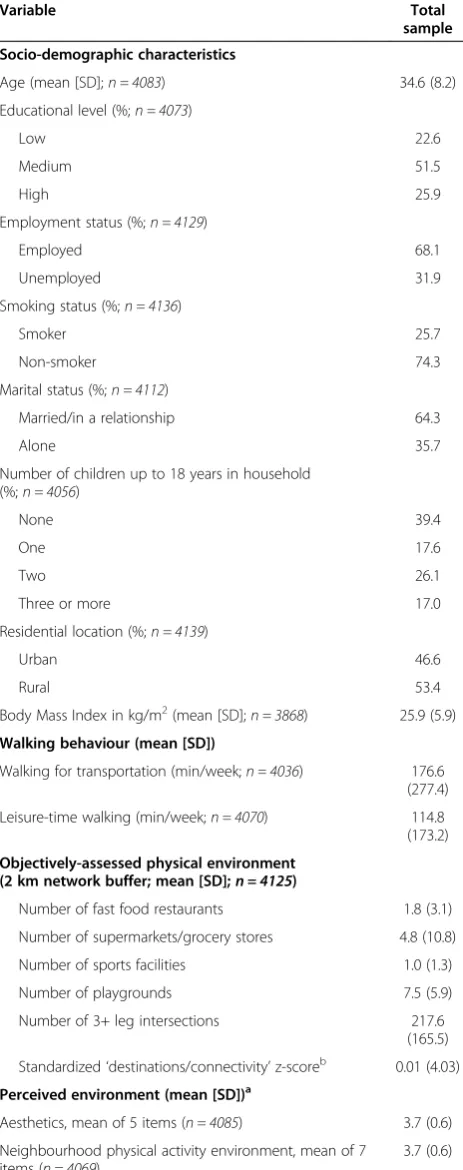
Analyses were conducted using SPSS 19.0. The walking variables were positively skewed, therefore, the square root of the original variables was used in the analyses to improve normality. Raw data were used to calculate the descriptive statistics, shown in Table 2.
In all analyses, clustering of participants at suburb level was taken into account by conducting multilevel analyses (mixed models analyses in SPSS taking into ac-count two levels: level 1 = individual; level 2 = suburb).
In the first stage of the analyses, the main associations be-tween the objective physical environment (destinations/ connectivity z-score) and the outcome measures (walking for transportation and leisure-time walking) (τ), were tested. Then, in a second stage, the mediating role of different en-vironmental perceptions on these associations was tested using the product-of-coefficients test of MacKinnon and colleagues [30]. This specific test was used as it provides greater statistical power than other commonly used mediat-ing methods [31]. The test includes (1) estimatmediat-ing the ef-fects of the destinations/connectivity z-score on potential mediators (perceived aesthetics, physical activity environ-ment, personal safety, and social cohesion of the neighbour-hood) by regressing the potential mediators onto the z-score (α-coefficients); (2) estimating the independent ef-fect of the potential mediators on the physical activity out-come (transport-related walking or leisure-time walking) by regressing the outcome onto the destinations/connectivity z-score and the potential mediators (β-coefficients); (3) computation of the product of the two coefficients (αβ), representing the mediated effect. The statistical significance of the mediated effect was estimated by dividing the product-of-coefficient by its standard error. Moreover, the proportion mediated was calculated by dividing the
Table 1 Construction of the items and scales to assess the perceived physical environment
Content of the items Response category
Aesthetics (five items) 1. There is a lot of rubbish on the streets in my neighbourhood Five point scale, from strongly disagree to strongly agree
2. There is a lot of noise in my neighbourhood
3. In my neighbourhood the buildings and homes are well-maintained
4. The buildings and homes in my neighbourhood are interesting
5. My neighbourhood is attractive
Neighbourhood PA environment (seven items)
1. My neighbourhood offers many opportunities to be physically active Five point scale, from strongly disagree to strongly agree
2. Local sports clubs and other facilities in my neighbourhood offer many opportunities to get exercise
3. It is pleasant to walk in my neighbourhood
4. The trees in my neighbourhood provide enough shade
5. In my neighbourhood it is easy to walk places
6. I often see other people walking in my neighbourhood
7. I often see other people exercising in my neighbourhood
Personal safety (three items) 1. I feel safe walking in my neighbourhood, day or night Five point scale, from strongly disagree to strongly agree
2. Violence is not a problem in my neighbourhood
3. My neighbourhood is safe from crime
Neighbourhood social cohesion (five items)
1. People in my neighbourhood can be trusted Five point scale, from strongly disagree to strongly agree
2. This is a close-knit neighbourhood
3. People around here are willing to help their neighbours
4. People in this neighbourhood generally do not get along with each other (reverse scored)
5. People in this neighbourhood do not share the same values (reverse scored)
product-of-coefficient (αβ) by the total main effect of the destinations/connectivity z-score on the respective outcome measure (τof first stage of analyses). For all analyses, 95% confidence intervals (CI) were reported.
Results
Socio-demographic characteristics, descriptive statistics of the physical activity behaviour of the sample, as well as objective and perceived physical environmental char-acteristics are presented in Table 2. Participants walked on averaged 176.6 (SD: 277.4) min/week for transporta-tion, and 114.8 (SD: 173.2) min/week for recreation. Transport-related walking ranged from 118.9 (SD: 207.4) min/week to 283.3 (SD: 275.6) min/week across suburbs, while leisure-time walking ranged from 54.1 (SD: 68.2) to 187.9 (SD: 233.9) min/week.
Main effects of the destinations/connectivity z-score on the outcome measures (τ)
In the total study sample, the destinations/connectivity z-score was positively associated with walking for transpor-tation (β[SE] = 0.16 [0.04]; CI = 0.09, 0.23) and negatively associated with leisure-time walking (β[SE] =−0.09 [0.03]; CI =−0.16, -0.02).
Associations between the destinations/connectivity z-score and potential mediators (α-coefficients)
Theα-coefficients are presented in Tables 3 and 4. The ob-jective destinations/connectivity z-score was negatively as-sociated with perceived aesthetics (CI =−0.03, -0.01), personal safety (CI =−0.05, -0.03) and social cohesion of the neighbourhood (CI =−0.03, -0.01), while it was posi-tively related to the perceived physical activity environment (CI = 0.001, 0.02). So, for all potential mediators, β -coefficients were calculated.
Associations between potential mediators and the outcome measures (β-coefficients)
The results for transport-related walking are shown in Table 3. After taking into account the destinations/ connectivity z-score, the perceived physical activity en-vironment (CI = 0.52, 1.42) and personal safety (CI = 0.08, 0.69) were positively associated with walking for
Table 2 Socio-demographic sample characteristics, walking behaviour and objective/perceived physical environmental characteristics
Variable Total
sample
Socio-demographic characteristics
Age (mean [SD];n = 4083) 34.6 (8.2)
Educational level (%;n = 4073)
Low 22.6
Medium 51.5
High 25.9
Employment status (%;n = 4129)
Employed 68.1
Unemployed 31.9
Smoking status (%;n = 4136)
Smoker 25.7
Non-smoker 74.3
Marital status (%;n = 4112)
Married/in a relationship 64.3
Alone 35.7
Number of children up to 18 years in household (%;n = 4056)
None 39.4
One 17.6
Two 26.1
Three or more 17.0
Residential location (%;n = 4139)
Urban 46.6
Rural 53.4
Body Mass Index in kg/m2(mean [SD];n = 3868) 25.9 (5.9)
Walking behaviour (mean [SD])
Walking for transportation (min/week;n = 4036) 176.6 (277.4)
Leisure-time walking (min/week;n = 4070) 114.8 (173.2)
Objectively-assessed physical environment (2 km network buffer; mean [SD];n = 4125)
Number of fast food restaurants 1.8 (3.1)
Number of supermarkets/grocery stores 4.8 (10.8)
Number of sports facilities 1.0 (1.3)
Number of playgrounds 7.5 (5.9)
Number of 3+ leg intersections 217.6
(165.5)
Standardized‘destinations/connectivity’z-scoreb 0.01 (4.03)
Perceived environment (mean [SD])a
Aesthetics, mean of 5 items (n = 4085) 3.7 (0.6)
Neighbourhood physical activity environment, mean of 7 items (n = 4069)
3.7 (0.6)
Table 2 Socio-demographic sample characteristics, walking behaviour and objective/perceived physical environmental characteristics(Continued)
Personal safety, mean of 3 items (n = 4099) 3.2 (1.0)
Social cohesion of the neighbourhood, mean of 5 items (n = 4122)
3.3 (0.6)
SDstandard deviation.
a
positively scored on a 5-point Likert scale (1–5).
b
destinations/connectivity z-score = z-fast food
transportation. Aesthetics (CI =−0.12, 0.80) and social cohesion of the neighbourhood (CI =−0.22, 0.73) were not related to the outcome measure.
In relation to leisure-time walking (Table 4), perceived aesthetics (CI = 0.15, 0.94), the physical activity environ-ment (CI = 1.05, 1.82), personal safety (CI = 0.19, 0.71) and social cohesion of the neighbourhood (CI = 0.19, 1.00) showed a positive association after taking into ac-count the objective destinations/connectivity z-score.
Mediated effects of environmental perceptions on the associations between the destinations/connectivity z-score and the outcome measures (αβ-coefficients)
The perceived physical activity environment (6.1%; CI = 0.001, 0.02) mediated the association between the object-ive destinations/connectivity z-score and walking for transportation (Table 3). A suppression effect for personal safety was found; which indicates that including this medi-ator strengthened the association between the destina-tions/connectivity z-score and transport-related walking.
Perceived aesthetics (12.0%; CI =−0.02, -0.001), personal safety (20.0%; CI =−0.03, -0.006) and social cohesion of the neighbourhood (13.3%; CI =−0.02, -0.003) mediated the as-sociation between the destinations/connectivity z-score and
leisure-time walking (Table 4). For the perceived physical activity environment, a suppression effect was found. The multiple mediation model showed that the joint mediating effect of all environmental perceptions was significant (CI =−0.04, -0.001) and that 24.4% of the association between the destinations/connectivity z-score and leisure-time walking was mediated by all mediators together. This proportion is lower than the sum of the propor-tions mediated by separate mediators because of the signifi-cant correlations between different mediators (correlation coefficients ranging from r = 0.38 to r = 0.55, all p < 0.001).
Discussion
The present study revealed several direct and mediating associations between the objective physical environment and different types of walking among Australian women living in socio-economically disadvantaged neighbour-hoods. After controlling for socio-demographic covariates, the objective score including measures of density of phys-ical activity/food related destinations and street connectiv-ity, was positively associated with walking for transport. Previous research consistently found a positive relation-ship between walkability-related environmental charac-teristics and active transportation in adults [4,5]. The
Table 3 Regression analyses for possible mediators of the associations between the destinations/connectivity score and walking for transportation
Possible mediators α(SE) 95% CI forα β
(SE) 95% CI forβ αβ
(SE) 95% CI forαβ
Proportion mediated (%)
Aesthetics −0.02 (0.005) −0.03, -0.01 0.34 (0.23) −0.12, 0.80
Physical activity environment 0.01 (0.004) 0.001, 0.02 0.97 (0.23) 0.52, 1.42 0.01 (0.005) 0.001, 0.02 6.1
Personal safety −0.04 (0.007) −0.05, -0.03 0.38 (0.16) 0.08, 0.69 −0.02 (0.007) −0.03, -0.002 S
Neighbourhood social cohesion −0.02 (0.004) −0.03, -0.01 0.26 (0.24) −0.22, 0.73
SEstandard error,CIconfidence interval,Ssuppression effect. All significant associations are presented in bold font.
Notes:α–coefficients were estimated by regressing the potential mediators onto the destinations/connectivity z-score;β-coefficients were estimated by regressing walking for transportation onto the destinations/connectivity z-score and potential mediators;αβ-coefficients represent the mediated effect; all possible mediators were positively scored (higher score = better perceptions); all analyses were controlled for individual-level age, smoking status, marital status, employment status and educational level.
Table 4 Regression analyses for possible mediators of the associations between the destinations/connectivity score and leisure-time walking
Possible mediators α(SE) 95% CI
forα β
(SE) 95% CI forβ αβ
(SE) 95% CI forαβ
Proportion mediated (%)
Aesthetics −0.02 (0.005) −0.03, -0.01 0.54 (0.20) 0.15, 0.94 −0.01 (0.005) −0.02, -0.001 12.0
Physical activity environment 0.01 (0.004) 0.001, 0.02 1.44 (0.20) 1.05, 1.82 0.01 (0.006) 0.002, 0.03 S
Personal safety −0.04 (0.007) −0.05, -0.03 0.45 (0.13) 0.19, 0.71 −0.02 (0.006) −0.03, -0.006 20.0
Neighbourhood social cohesion −0.02 (0.004) −0.03, -0.01 0.60 (0.21) 0.19, 1.00 −0.01 (0.005) −0.02, -0.003 13.3
Total multiple model −0.02 (0.01) −0.04, -0.001 24.4
SEstandard error,CIconfidence interval,Ssuppression effect. All significant associations are presented in bold font.
objective destinations/connectivity score was negatively associated with leisure-time walking. We are unaware of previous studies reporting negative associations between walkability-related features and leisure-time walking in adults. Hitherto, previous findings have been inconsistent with results ranging from positive associations to no sig-nificant associations [4,7,32,33]. However, no prior studies have examined these relationships among women living in socio-economically disadvantaged neighbourhoods, so the present findings could be specific for this population subgroup.
The mediating analyses presented in this paper helped to explain the negative association between the objective destinations/connectivity score and leisure-time walking. Living in an environment with high street connectivity and many destinations nearby was related to having positive perceptions of the physical activity environment, but also with perceiving poor aesthetics, low personal safety and low social cohesion of the neighbourhood. In total, 24.4% of the negative association between the ob-jective destinations/connectivity score and leisure-time walking was explained by these negative perceptions. The present findings confirm the hypothesis that high (objective) walkability is not necessarily accompanied by positive perceptions of related environmental attributes [17]. Furthermore, it seems that these negative percep-tions might outweigh the importance of walkability-related characteristics to explain specific behaviours like leisure-time walking. Living in a poor-connected neigh-bourhood with few destinations nearby, but perceiving high safety and favourable aesthetics may be more benefi-cial for leisure-time walking than living in an objectively well-connected environment with many destinations.
To explain transport-related walking, favourable object-ive street connectivity and density of destinations, in com-bination with positive perceptions of the physical activity environment seem to be of overriding importance, even when poor aesthetics and low personal safety were per-ceived. For transport-related walking, the present findings are in line with the results of McCormack and colleagues [19], who suggested that walkability characteristics are more important to explain active transportation than other environmental features, like the availability of green spaces.
When considering the mediating effects in more detail, it seems that objective walkability-related characteristics (i.e. density of destinations and connectivity) are directly associated with transport-related walking, while the rela-tionship with leisure-time walking is more complex. A possible explanation for this finding could be that leisure-time walking is a type of physical activity that is con-sciously practiced, and governed by choice rather than necessity [3,34,35]. Probably adults, and more specifi-cally women living in socio-economispecifi-cally disadvantaged
neighbourhoods, do not want to walk for recreation in an environment that is aesthetically unappealing, unsafe and has a low level of social cohesion. Because transport-related walking is rather governed by necessity, it is plausible that negative perceptions of neighbourhood social cohesion, personal safety and aesthetics will not prevent women living in socio-economically disadvan-taged neighbourhoods from walking for transportation.
Perceived personal safety and aesthetics have been previ-ously related to leisure-time walking, while the perceived physical activity environment has been associated with ac-tive transportation [4,5,36]. Consequently, although the direction of some of the mediating effects was surprising, the mediating effects of these attributes per se were not unexpected. However, an important novelty of this study is the mediating effect of neighbourhood social cohesion. To our knowledge, the role of neighbourhood social cohe-sion to explain the relationship between the physical en-vironment and physical activity has not been studied previously. The mediating effect identified here is a key finding for future research because social cohesion has been identified as an important factor positively related to neighbourhood satisfaction and overall physical and men-tal health [37-39]. Therefore, from a broader health per-spective, it is necessary to further clarify these associations and to find out how feelings of social cohesion among women and other residents living in high-walkable envi-ronments can be improved.
Acknowledging the cross-sectional study design and the need for confirmation of causal relationships, it seems that to increase both transport-related and leisure-time walking, it is necessary to find an optimal balance between several environmental attributes. Walkability-related characteris-tics, perceptions of personal safety, favourable aesthecharacteris-tics, high neighbourhood social cohesion and possibly other fea-tures that were not included in this study should be opti-mally balanced in order to support walking. Other physical and social environmental perceptions (e.g. social support, perceived accessibility of facilities) should be included as possible mediators in future studies. This may help to fully understand the indirect nature of the relationship between objective physical environmental characteristics and walk-ing for different purposes in socio-economically disadvan-taged women.
perceived measures were used to assess the neighbour-hood physical environment. The objective neighbourneighbour-hood environment was assessed with individualized network buffers, giving a better representation of the actual envir-onment than buffers measured through the car network. Finally, environmental perceptions were assessed using a validated questionnaire and two specific physical activity domains were assessed using a validated questionnaire and examined independently.
Besides these strengths, some limitations need to be ac-knowledged. The most important study limitation was the cross-sectional design, which ruled out the possibility of determining causality. Second, because the response rate was lower than 50% a selection bias towards more moti-vated women may have been present. Third, women who had moved from the suburbs included in the study were excluded from the analyses because no GIS data could be linked to their addresses. As these women have a less stable location, it might be that mainly the most socio-economically disadvantaged women were over-represented in this group and potentially excluded from the analyses. Fourth, only women between 18 and 46 years were in-cluded, so the present results cannot be generalized to a broader population of adult women living in socio-economically disadvantaged neighbourhoods. Finally, be-cause the IPAQ was used to assess physical activity, it remains unclear if the transport-related and leisure-time walking actually took place in the neighbourhood in which the women lived. To clarify this, future studies should in-clude objective measurement methods like Global Posi-tioning Systems (GPS) [24].
Conclusion
The present study showed that objective physical environ-mental attributes related to street connectivity and prox-imity of destinations are positively associated with walking for transportation. This positive association is mainly a direct association, independent on how women perceive the environment. Nonetheless, objectively-assessed street connectivity and proximity of destinations are negatively related to leisure-time walking. This negative association can be explained by the mediating effects of perceived per-sonal safety, aesthetics and neighbourhood social cohe-sion. Based on these findings, an important message can be formulated for intervention developers and urban plan-ners. It seems that for women living in socio-economically disadvantaged neighbourhoods, a focus on objective envir-onmental characteristics (street connectivity, proximity of destinations) should be accompanied by a focus on im-proving safety, aesthetics and social cohesion of the neigh-bourhood, in order to affect both transport-related and leisure-time walking and to achieve larger health effects in the long-term.
Competing interests
The authors declare that they have no competing interests.
Authors’contributions
DVD conducted the statistical analyses and drafted the manuscript. KB coordinated the data collection. JV, LT, IDB and KB participated in the interpretation of the data, helped to draft the manuscript and revised the manuscript for important intellectual content. All authors read and approved the final manuscript.
Acknowledgements
The READI study was funded by the Australian National Health and Medical Research Council (ID 374241). Delfien Van Dyck is supported by the Research Foundation Flanders (FWO; post doctoral research mandate). Kylie Ball is funded by a NHMRC Principal Research Fellowship (ID1042442).
Funding
Lukar Thornton is funded by an Alfred Deakin Postdoctoral Research Fellowship and Jenny Veitch is supported by a NHMRC Early Career Research Fellowship (ID: 1053426).
Author details
1Research Foundation Flanders, Egmontstraat 5, 1000 Brussels, Belgium. 2Department of Movement and Sports Sciences, Ghent University, Watersportlaan 2, 90000 Ghent, Belgium.3Centre for Physical Activity and Nutrition Research, School of Exercise and Nutrition Sciences, Deakin University, 221 Burwood Highway, Burwood, Victoria 3125, Australia.
Received: 4 March 2013 Accepted: 11 September 2013 Published: 19 September 2013
References
1. Garber CE, Blissmer B, Deschenes MR, Franklin BA, Lamonte MJ, Lee IM, for the American College of Sports Medicine,et al:Quantity and quality of exercise for developing and maintaining cardiorespiratory, musculoskeletal, and neuromotor fitness in apparently healthy adults: guidance for prescribing exercise.Med Sci Sports Exerc2011,43:1334–1359.
2. Sallis JF, Cervero R, Ascher WW, Henderson K, Kraft MK, Kerr J:An ecological approach to creating active living communities.Ann Rev Publ Health2006,
27:14.1–14.26.
3. Sallis JF, Owen N, Fisher EB:Ecological models of health behavior. In
Health behavior and health education: theory, research and practice.Edited by Glanz K, Rimer BK, Viswanath K. San Francisco: Jossey-Bass; 2008:465–486. 4. Saelens BE, Handy SL:Built environment correlates of walking: a review.
Med Sci Sports Exerc2008,40:S550–S566.
5. Van Holle V, Deforche B, Van Cauwenberg J, Goubert L, Maes L, Van de Weghe N, De Bourdeaudhuij I:Relationship between the physical environment and different domains of physical activity in European adults: a systematic review.BMC Public Health2012,12:807. 6. Owen N, Humpel N, Leslie E, Bauman A, Sallis JF:Understanding
environmental influences on walking: review and research agenda. Am J Prev Med2004,27:47–76.
7. Bauman AE, Reis RS, Sallis JF, Wells JC, Loos RJF, Martin BW, for the Lancet Physical Activity Series Working Group:Correlates of physical activity: why are some people physically active and others not?Lancet2012,380:258–271. 8. Van Dyck D, Cerin E, Conway T, De Bourdeaudhuij I, Owen N, Kerr J, Cardon
G, Frank LD, Saelens BE, Sallis JF:Perceived neighborhood environmental attributes associated with adults’recreational physical activity: findings from the USA, Australia and Belgium.Health Place2013,19:59–68. 9. Gebel K, Bauman AE, Petticrew M:The physical environment and physical
activity: a critical appraisal of review articles.Am J Prev Med2007,32:361–369. 10. Ball K, Brown W, Crawford D:Who does not gain weight? Prevalence and
predictors of weight maintenance in young women.Int J Obes2002,
26:1570–1578.
11. King T, Kavanagh AM, Jolley D, Turrell G, Crawford D:Weight and place: a multilevel cross-sectional survey of area-level social disadvantage and overweight/obesity in Australia.Int J Obes2006,30:281–287.
13. Evenson KR, Aytur SA, Borodulin K:Physical activity beliefs, barriers, and enablers among postpartum women.J Womens Health (Larchmt)2009,12:1925–1934. 14. Ball K, Jeffery RW, Crawford DA, Roberts RJ, Salmon J, Timperio AF:
Mismatch between perceived and objective measures of physical activity environments.Prev Med2008,47:294–298.
15. McGinn AP, Evenson KR, Herrin AH, Huston SL, Rodriguez DA:Exploring associations between physical activity and perceived and objective measures of the built environment.J Urb Health2007,84:162–184. 16. Dewulf B, Neutens T, Van Dyck D, De Bourdeaudhuij I, Van de Weghe N:
Correspondence between objective and perceived walking times to urban destinations: influence of physical activity, neighbourhood walkability, and socio-demographics.Int J Health Geogr2012,11:43. 17. Van Dyck D, Cardon G, Deforche B, De Bourdeaudhuij I:Do adults like
living in high-walkable neighborhoods? Associations of walkability parameters with neighbourhood satisfaction and possible mediators. Health Place2011,17:971–977.
18. Kremers SPJ, de Bruijn G, Visscher TLS, van Mechelen W, de Vries NK, Brug J:
Environmental influences on energy balance-related behaviors: a dual-process view.Int J Behav Nutr Phys Act2006,3:9.
19. McCormack GR, Friedenreich C, Sandalack BA, Giles-Corti B, Doyle-Baker PK, Shiell A:The relationship between cluster-analysis derived walkability and local recreational and transportation walking among Canadian adults.Health Place2012,18:1079–1087.
20. Manson JE, Hu FB, Rich-Edwards JW, Colditz GA, Stampfer MJ, Wilet WC, Speizer FE, Hennekens CH:A prospective study of walking as compared with vigorous exercise in the prevention of coronary heart disease in women.N Engl J Med1999,341:650–658.
21. Ball K, Cleland V, Salmon J, Timperio AF, McNaughton S, Thornton L, Campbell K, Jackson M, Baur LA, Mishra G, Brug J, Jeffery RW, King A, Kawachi I, Crawford DA:Cohort profile: the Resilience for Eating and Activity Despite Inequality (READI) study.Int J Epidemiol. in press. 22. Australian Bureau of Statistics:Census of Population and Housing:
Socio-Economic Indexes for Areas (SEIFA).Canberra (AUST): ABS; 2003.
23. Dillman DA:Mail and telephone surveys: the total design method.New York: Wiley; 1978.
24. Thornton LE, Pearce JR, Kavanagh AM:Using Geographic Information Systems (GIS) to assess the role of the built environment in influencing obesity: a glossary.Int J Behav Nutr Phys Act2011,8:71.
25. Grasser G, Van Dyck D, Titze S, Stronegger W:Objectively measured walkability and active transport and weight-related outcomes in adults: a systematic review.Int J Public Health. in press doi:10.1007/s00038-012-0435-0. 26. Mujahid MS, Diez Roux AV, Morenoff JD, Raghunathan T:Assessing the
measurement properties of neighborhood scales: from psychometrics to ecometrics.Am J Epidemiol2007,165:858–867.
27. Sampson RJ, Raudenbush SW, Earls F:Neighborhoods and violent crime: a multilevel study of collective efficacy.Sci1997,277:918–924. 28. Craig CL, Marshall AL, Sjöström M, Bauman AE, Booth ML, Ainsworth BE,et
al:International physical activity questionnaire: 12-country reliability and validity.Med Sci Sports Exerc2003,35:1381–1395.
29. Trost SG, Owen N, Bauman AE, Sallis JF, Brown W:Correlates of adults’ participation in physical activity: review and update.Med Sci Sports Exerc
2002,34:1996–2001.
30. MacKinnon DP, Lockwood CM, Hoffman JM, West SG, Sheets V:
A comparison of methods to test mediation and other intervening variable effects.Psychol Methods2002,7:83–104.
31. MacKinnon DP, Fairchild AJ, Fritz MS:Mediation analysis.Ann Rev Psychol
2007,58:593–614.
32. Parra DC, Hoehner CM, Hallal PC, Ribeiro IC, Reis R, Brownson RC, Pratt M, Simoes EJ:Perceived environmental correlates of physical activity for leisure and transportation in Curitiba, Brazil.Prev Med2011,52:234–238. 33. Van Dyck D, Cardon G, Deforche B, Giles-Corti B, Sallis JF, Owen N, De
Bourdeaudhuij I:Environmental and psychosocial correlates of accelerometer-assessed and self-reported physical activity in Belgian adults.Int J Behav Med2011,18:235–245.
34. De Bourdeaudhuij I, Teixeira PJ, Cardon G, Deforche B:Environmental and psychosocial correlates of physical activity in Portuguese and Belgian adults.Publ Health Nutr2005,8:886–895.
35. Saelens BE, Sallis JF, Frank LD:Environmental correlates of walking and cycling: findings from transportation, urban design, and planning literatures.Ann Behav Med2003,25:80–91.
36. Wendel-Vos W, Droomers M, Kremers S, Brug J, van Lenthe F:Potential environmental determinants of physical activity in adults: a systematic review.Obes Rev2007,8:425–440.
37. Modie-Moroka T:Does level of social capital predict perceived health in a community? A study of adult residents of low-income areas of Francistown, Botswana.J Health Popul Nutr2009,27:462–476. 38. Wen M, Fan J, Jin L, Wang G:Neighborhood effects on health among
migrants and natives in Shanghai, China.Health Place2010,16:452–460. 39. Almedom AM:Social capital and mental health: an interdisciplinary
review of primary evidence.Soc Sci Med2005,61:943–964.
doi:10.1186/1479-5868-10-108
Cite this article as:Van Dycket al.:Environmental perceptions as
mediators of the relationship between the objective built environment and walking among socio-economically disadvantaged women. International Journal of Behavioral Nutrition and Physical Activity 201310:108.
Submit your next manuscript to BioMed Central and take full advantage of:
• Convenient online submission
• Thorough peer review
• No space constraints or color figure charges
• Immediate publication on acceptance
• Inclusion in PubMed, CAS, Scopus and Google Scholar
• Research which is freely available for redistribution