Assessing the relative potential ecological impacts
and invasion risks of emerging and future invasive
alien species
James W.E. Dickey1, Ross N. Cuthbert1, Michael Rea1, Ciaran Laverty1,
Kate Crane1, Josie South1,2, Elizabeta Briski3, Xuexiu Chang4, Neil E. Coughlan1,
Hugh J. MacIsaac4, 5, Anthony Ricciardi6, Gillian E. Riddell1,
Meng Xu7, Jaimie T.A. Dick1
1 Institute for Global Food Security, School of Biological Sciences, Queen’s University Belfast, MBC, 97 Lisburn Road, Belfast, Northern Ireland, BT9 7BL, UK 2 South African Institute for Aquatic Biodiversity (SAIAB), Private Bag 1015, Grahamstown 6140, South Africa 3 GEOMAR, Helmholtz-Zentrum für Ozeanforschung Kiel, Düsternbrooker Weg 20 , 24105 Kiel, Germany 4 School of Ecology and Environmental Sciences, Yunnan University, Kunming 650091, PR China 5 Great Lakes Institute for Environmental Research, University of Windsor, Windsor, ON N9 B 3P4, Canada 6 Redpath Museum, McGill University, 859 Sherbrooke Street West, Montreal, QC H3A 0C4, Canada 7 Pearl River Fisheries Research Institute, Chinese Academy of Fishery Sciences/Key Laboratory of Recreational Fisheries, Ministry of Agriculture, Guangzhou 510380, China
Corresponding author:James W.E. Dickey ([email protected])
Academic editor:T. Blackburn | Received 20 July 2018 | Accepted 18 September 2018 | Published 19 October 2018
Citation: Dickey JWE, Cuthbert RN, Rea M, Laverty C, Crane K, South J, Briski E, Chang X, Coughlan NE, MacIsaac HJ, Ricciardi A, Riddell GE, Xu M, Dick JTA (2018) Assessing the relative potential ecological impacts and invasion risks of emerging and future invasive alien species. NeoBiota 40: 1–24. https://doi.org/10.3897/neobiota.40.28519
Abstract
Invasive alien species (IAS) cause myriad negative impacts, such as ecosystem disruption, human, animal and plant health issues, economic damage and species extinctions. There are many sources of emerging and future IAS, such as the poorly regulated international pet trade. However, we lack methodologies to predict the likely ecological impacts and invasion risks of such IAS which have little or no informa-tive invasion history. This study develops the Relainforma-tive Impact Potential (RIP) metric, a new measure of ecological impact that incorporates per capita functional responses (FRs) and proxies for numerical responses (NRs) associated with emerging invaders. Further, as propagule pressure is a determinant of in-vasion risk, we combine the new measure of Pet Propagule Pressure (PPP) with RIP to arrive at a second novel metric, Relative Invasion Risk (RIR). We present methods to calculate these metrics and to display
the outputs on intuitive bi- and triplots. We apply RIP/RIR to assess the potential ecological impacts and invasion risks of four commonly traded pet turtles that represent emerging IAS: Trachemys scripta scripta, the yellow-bellied slider; T. s. troostii, the Cumberland slider; Sternotherus odoratus, the common musk turtle; and Kinosternon subrubrum, the Eastern mud turtle. The high maximum feeding rate and high attack rate of T. s. scripta, combined with its numerical response proxies of lifespan and fecundity, gave it the highest impact potential. It was also the second most readily available according to our UK surveys, indicating a high invasion risk. Despite having the lowest maximum feeding rate and attack rate, S. odoratus has a high invasion risk due to high availability and we highlight this species as requiring monitoring. The RIP/RIR metrics offer two universally applicable methods to assess potential impacts and risks associated with emerging and future invaders in the pet trade and other sources of future IAS. These metrics highlight T. s. scripta as having high impact and invasion risk, corroborating its position on the EU list of 49 IAS of Union Concern. This suggests our methodology and metrics have great potential to direct future IAS policy decisions and management. This, however, relies on collation and generation of new data on alien species functional responses, numerical responses and their proxies, and imaginative measures of propagule pressure.
Keywords
ecological impacts, functional response, invasive alien species, numerical response, pet propagule pressure, relative impact potential, relative invasion risk, risk assessment
Introduction
abundance of one or more native species, and invasion risk, which combines impact with likelihood of establishment, for emerging and potential future invaders (Dick et al. 2017b).
Comparative functional responses (CFRs) have been successful in characterising damaging IAS and have proven predictive for those without invasion impact history (Dick et al. 2014, 2017b). CFR can also take into account a wealth of context-de-pendencies and interactive effects, such as dissolved oxygen levels (Laverty et al. 2015), habitat complexity (Wasserman et al. 2016), temperature (Xu et al. 2016; Cuthbert et al. 2018), higher order predators (Barrios-O’Neill et al. 2014) and presence of parasites (Laverty et al. 2017b). However, despite the many advantages of the CFR methodology, the impacts of a consumer on resources (e.g. predator on prey) will clearly be the prod-uct of these per capita effects and the population response of the consumer (i.e. the nu-merical response (NR); Solomon, 1949). A simpler proxy for NR is the abundance of a species, which has recently been combined with CFR into the Relative Impact Potential (RIP) metric to successfully predict invader ecological impact (Dick et al. 2017b).
RIP might prove particularly valuable for the study of IAS emerging from the pet trade, with global trade of freshwater turtles in particular a pressing problem (Nori et al. 2017). For example, Trachemys scripta elegans (the red-eared slider) appears both on the EU List of IAS of Union concern and the IUCN’s 100 Worst Invasive Species list, having invaded 73 countries (García-Díaz et al. 2015; Capinha et al. 2017) and living on every continent except Antarctica (Rödder et al. 2009). This species was once widely traded due to its small size as juveniles, ease of maintenance, relative afford-ability (Teillac-Deschamps et al. 2009) and, remarkably, the global craze of Teenage Mutant Ninja Turtles (Somma et al. 2009a). Upon release, T. s. elegans has been shown to compete with native turtles for food and basking habitat (Cadi and Joly 2003; Pearson et al. 2015). We thus urgently require methods to predict the impacts of these and similar potential IAS that currently lack both invasion history and invasion range population abundance data.
prop-agule pressure is a major determinant of invasion risk (Briski et al. 2012) and possibly impact (Ricciardi and Cohen 2007), we further modify the RIP biplots of Laverty et al. (2017b) to include propagule pressure on a third axis (i.e. triplots) to give a com-bined measure of Relative Invasion Risk (RIR). Using these metrics, we investigate the relative potential ecological impacts and invasion risks of four commonly traded freshwater turtles: two Trachemys scripta subspecies that have recently been added to the EU list of 49 IAS of Union Concern, namely T. s. scripta, the yellow-bellied slider
and T. s. troostii, the Cumberland slider; as well as Sternotherus odoratus, the common
musk turtle and Kinosternon subrubrum, the Eastern mud turtle, both of which are also widely available in the pet trade.
Methods
Study species
Trachemys scripta scripta, T. s. troostii, Sternotherus odoratus and Kinosternon subrubrum
originate from North America and are sold around the world (Polo-Cavia et al. 2011), with T. scripta and S. odoratus being amongst the most commonly imported turtle species into the UK and Ireland (García-Díaz et al. 2014). Their longevity and lack of predators and competitors mean that, even if current environmental conditions prevent reproduction in some of their introduced ranges, there is the potential for ecological impact and invasion risk. This may be exacerbated if climate change and/or adaptation leads to these populations becoming viable (Bugter et al. 2011).
T. s. scripta and T. s. troostii can live for 36 years (Frazer et al. 1990) and
reproduc-tion is expected to be similar to T. s. elegans, with females laying up to five clutches per year, with between 2 and 23 eggs in each clutch (Somma et al. 2009a). Sternotherus
odoratus can live for 30 years (Bugter et al. 2011), with females laying 2 to 4 clutches
per year, with between 1 and 9 eggs per clutch (Somma and Fuller 2009). Kinosternon
subrubrum can live for 46 years (Frazer et al. 1990) and females tend to lay between 1
and 3 clutches per year, with 1 to 6 eggs per clutch (Somma et al. 2009b).
Animal collection and maintenance
quarantined for one week prior to experiments. During this period, no illness or deaths were recorded and the animals were fed daily with commercial floating turtle food (JBL, Germany). Before experimental FR trials, all turtles were starved for 24 hours to standardise hunger levels. Focal prey, the amphipod crustacean Gammarus pulex
(15–17mm body length; unparasitised), upon which all turtle species were observed to feed readily and represents a general prey item, were collected from the Minnowburn River, N. Ireland (N54.546, W5.594) two days before the experiments and acclima-tised to the experimental temperature.
FR procedure
Experiments were performed 22 February–27 April 2016. Experimental tanks (250 mm × 120 mm × 90 mm) with 30 mm of substrate at 16 °C were supplied with prey 15 minutes prior to the turtles being introduced. Prey densities were 2, 4, 8, 16, 32, 64, 128, 256 (n = 6 per experimental group). For each turtle species, individuals were randomly selected and assigned to a random prey density and allowed to feed for thirty minutes. Controls were performed for each prey density (n = 3 each) with the same experimental conditions but in the absence of turtle predators, to quantify prey mortality for any other reasons.
Statistical methods
Data were analysed using R version 3.2.3. (R Core Team 2015). Logistic regression of the proportion of prey killed as a function of prey density was used to discern func-tional response types (see Juliano 2001). Where a significant negative first order linear coefficient was detected, a Type II response was ascribed; conversely, a Type III form was considered when a significant positive first order linear coefficient was followed by a significant negative second order coefficient (Juliano 2001). Rogers’ random predator equation for non-replacement of prey was applied to estimate values of ‘h’ (handling time) and ‘a’ (attack rate):
Ne=N0(1–exp(a(Neh–T))) (1)
Metrics and measures
Relative Impact Potential (RIP) was originally developed using population abundance/ density/biomass as a proxy for the consumer numerical response (NR: Dick et al. 2017b), but in certain situations such data are lacking, as, for example, with potential future invasions by turtles and other potential IAS. Since our metrics are comparative rather than absolute, we substituted the NR with other life history measures of the in-vaders that may influence impact. Here, we thus propose three other alternative proxies for the numerical response:
(1) Lifespan (L). With temperatures in many temperate regions high enough for
tur-tles to survive in the wild for many years, but as yet too low to facilitate reproduction (Teillac-Deschamps et al. 2009; but see Standfuss et al. 2016), lifespan offers a proxy multiplier of per capita effects (when other proxies such as abundance are not avail-able), giving a metric quantifying the ecological impact that a species may exert over space and time. Thus, Impact Potential utilising lifespan data (IPL) is:
IPL = FR × L (2)
where FR is the functional response (estimated maximum feeding rate, 1/h, from equa-tion 1) and L is maximum lifespan (Table 1);
(2) Fecundity (F). Where reproduction of the turtles occurs or may occur in future,
fe-cundity offers another proxy multiplier of per capita effects, since reproductive output is clearly an element of the true numerical response. Thus, Impact Potential utilising fecundity data (IPF) is:
IPF = FR × F (3)
where FR is as above and F is the product of clutch size and number of clutches per annum (Table 1);
(3) Lifetime fecundity (LF). Where suitable data are available, a third proxy for the
numerical response may be constructed as the product of maximum lifespan and fe-cundity, that is lifetime fecundity (LF), as this captures both reproductive output per bout and over time and thus Impact Potential is:
IPLF = FR × LF (4)
functional response curve, giving insights into the critical population level impact that a consumer can exert at low resource densities (Dick et al. 2014). Thus, Impact Poten-tial utilising attack rate and lifespan data (IPL) is:
IPL = a × L (5)
and with fecundity data is:
IPF = a × F (6)
and with lifetime fecundity:
IPLF = a × LF (7)
In addition, to enter the propagule pressure argument to measure overall invasion risk, we qualify each IP equation with Pet Propagule Pressure (PPP). We propose two PPP methods. First, we quantified the availability of the four species on a local (i.e. Northern Ireland, NI) level via a survey of twenty pet shops between the 31 January and 1 March 2017 (Suppl. material 1: Table S1; PPP values as per Table 1). PPP in this context is calculated as follows:
PPP (NI) = Np/Tp (8)
where Pet Propagule Pressure (Northern Ireland, NI) is a function of the propor-tional availability of each species across pet shops (Np) and the total number of pet shops surveyed (Tp).
The second version of PPP involved a survey of online classified advertisements (Suppl. material 2: Table S2; PPP values as per Table 1). A major advantage of this method is that each advertisement represents an unwanted pet, a key feature of pet releases into the wild. This second survey was conducted on 21 November 2017 and used two websites, www.preloved.co.uk and www.pets4homes.co.uk. Search terms of Table 1. Numerical response proxies of lifespan, fecundity and lifetime fecundity, plus Pet Propagule Pressure (PPP; see Text and Table 3) for our study turtle species. Pet Propagule Pressure (Northern Ireland, NI) is a function of the proportional availability of each species across pet shops and the total number of pet shops surveyed and PPP (Great Britain, GB) is the proportional availability of the four species based on online classified advertisements and the total number of online advertisements surveyed.
Turtle Lifespan (L) (maximum
years) Ref.
Fecundity (F)
(eggs per year) Ref.
Lifetime fecundity (LxF)
Pet Prop. Press. (PPPNI)
Pet Prop. Press. (PPPGB) T. s. scripta 36 Frazer et al. 1990 115 Somma et al. (2009a) 4140 0.05 0.1
T. s. troostii 36 Frazer et al. 1990 115 Somma et al. (2009a) 4140 0.00 0.05
S. odoratus 30 Bugter et al. 2011 36 Somma and Fuller (2009) 1080 0.30 0.39
‘terrapin’ and ‘turtle’ were used for both websites and screenshots were taken of each advertisement claiming to be selling our study species. Using the location of the seller and the screenshot images, we prevented the double-counting of advertisements. The PPP values were calculated as follows:
PPP (GB) = Na/Ta (9)
where PPP (Great Britain, GB) is the proportional availability of the four species based on online classified advertisements (Na) and the total number of online advertisements surveyed (Ta).
By incorporating these two measures of propagule pressure, the Impact Potential (IP) equations (equations 2–7) can incorporate both risk of introduction and its eco-logical consequences to become Invasion Risk (IR):
IRL = FR × L × PPP (10)
IRF = FR × F × PPP (11)
IRLF = FR × LF × PPP (12)
IRL = a × L × PPP (13)
IRF = a × F × PPP (14)
IRLF = a × LF × PPP (15)
We present biplots to illustrate Relative Impact Potential (equations 2–7) and triplots for Relative Invasion Risk (equations 10–15) of the four turtle species to give visual representations of relative ecological impact and invasion risk (see Suppl. mate-rial 3, 4 for R scripts, and Suppl. matemate-rial 5 for associated .csv file).
Results
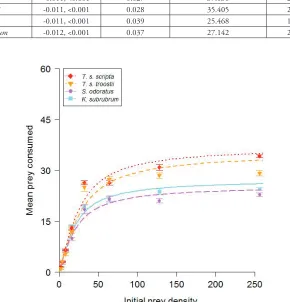
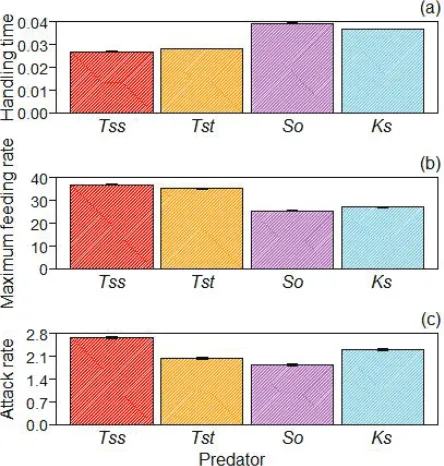
Prey survival in control treatments was 98–100%, therefore mortality during FR experi-ments was attributed to predation, which was also directly observed. Type II functional responses were observed for all turtle species (Table 2; Figure 1). Handling times were lowest and, hence, maximum feeding rates were highest, for the two T. scripta subspecies, with the order T. s. scripta > T. s. troostii > K. subrubrum > S. odoratus (Fig. 2a, b). T. s.
scripta had the highest attack rate, S. odoratus the lowest and T. s. troostii and K.
Figure 1.Functional responses of T. s. scripta, T. s. troostii, S. odoratus and K. subrubrum towards G. pulex prey. Values are mean ±SE.
Table 2. First order terms calculated from logistic regression to denote functional response type across all predator treatments. The significant negative first order term values across all four turtles indicate Type II functional responses for each predator. Handling time (h), maximum feeding rate (1/h) and attack rate (a) parameter mean estimates (bootstrapped, n = 30), derived using Rogers’ random predator equation (eqn 1).
Predator First term, P Handlingtime, h Maximum feeding rate, 1/(G. pulex consumed h
per 30 mins) Attack rate, a
T. s. scripta -0.011, <0.001 0.027 37.036 2.678
T. s. troostii -0.011, <0.001 0.028 35.405 2.038
S. odoratus -0.011, <0.001 0.039 25.468 1.847
K. subrubrum -0.012, <0.001 0.037 27.142 2.314
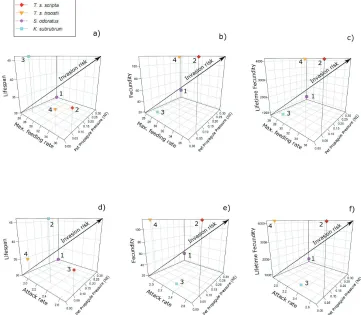
The numerical response proxy values are given in Table 1 and the IP and IR values in Table 3. Impact Potential (IP) scores using maximum feeding rate (see Tables 2, 3) with all three numerical response proxies were higher for T. s. scripta and T. s. troostii relative to K.
subrubrum and S. odoratus (equations 2–4; Table 3; Fig. 3a–c). However, when attack rate
was used with lifespan, the IP score was highest for K. subrubrum, closely followed by T. s.
scripta and T. s. troostii and then S. odoratus (equation 5; Table 3; Fig. 3d). If we consider
fecundity and lifetime fecundity, IP was again highest for T. s. scripta and T. s. troostii
Figure 2. Parameter estimates (±SE) of: a handling time h b maximum feeding rate 1/h c attack rate a, for bootstrapped (n = 30) Type II functional response curves of T. s. scripta (Tss), T. s. troostii (Tst), S. odoratus (So) and K. subrubrum (Ks) towards G. pulex prey.
Table 3.Impact Potential (IP) and Invasion Risk (IR) calculations, whereby: IP(FR) = Maximum feed-ing rate (FR) × NRproxy i.e. lifespan (L), fecundity (F) or lifetime fecundity (LF); IP(a) = Attack rate (a) × NRproxy; IR(FR) = IP(FR) × Pet Propagule Pressure (PPP); IR(a) = IP(a) × PPP. PPPNI (Northern
Ireland) is a function of the proportional availability of each species across pet shops and the total number of pet shops surveyed and PPPGB (Great Britain) is the proportional availability of the four species based
on online advertisements and the total number of advertisements surveyed.
IPL(FR) IPF(FR) IPLF(FR) IPL(a) IPF(a) IPLF(a)
T. s. scripta 1,333.30 4,259.14 153,329.04 96.41 307.97 11,086.92
T. s. troostii 1,274.76 4,072.15 146,597.40 73.37 234.37 8,437.32
S. odoratus 764.04 916.85 27,505.44 55.41 66.49 1,994.76
K. subrubrum 1,248.53 488.56 22,473.58 106.44 41.65 1,915.99
UsingPPPNI IRL(FR) IRF(FR) IRLF(FR) IRL(a) IRF(a) IRLF(a)
T. s. scripta 66.66 212.96 7,666.45 4.82 15.40 554.35
T. s. troostii 0 0 0 0 0 0
S. odoratus 229.21 275.05 8,251.63 16.62 19.95 598.43
K. subrubrum 62.43 24.43 1,123.68 5.32 2.08 95.80
Using PPGB IRL(FR) IRF(FR) IRLF(FR) IRL(a) IRF(a) IRLF(a)
T. s. scripta 133.33 425.91 15,332.90 9.64 30.80 1,108.69
T. s. troostii 63.74 203.61 7,329.87 3.67 11.72 421.87
S. odoratus 297.98 357.57 10,727.12 21.61 25.93 777.96
Figure 3. Biplots showing Relative Impact Potential of T. s. scripta, T. s. troostii, S. odoratus and K. sub-rubrum towards G. pulex prey. Impact potential calculated as a product of maximum feeding rate and lifespan (a), fecundity (b) and lifetime fecundity (c); then attack rate and lifespan (d), fecundity (e) and lifetime fecundity (f). Impact increases from bottom left to top right.
Pet Propagule Pressure (PPP) of each species was similar in both the Northern Ireland (NI) and Great Britain (GB) surveys, with respective orders of S. odoratus > T.
s. scripta = K. subrubrum > T. s. troostii and S. odoratus > T. s. scripta > T. s. troostii > K.
subrubrum (see Table 1 and details of the two surveys are outlined in Suppl. material 1:
Table S1 and Suppl. material 2: Table S2).
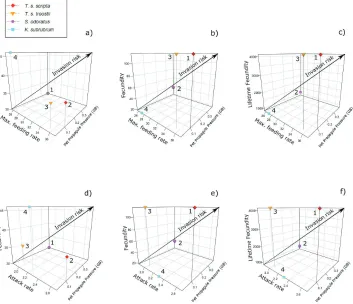
For all six of the NI Relative Invasion Risk (RIR) triplots, values were highest
for S. odoratus, with the order S. odoratus > T. s. scripta > K. subrubrum > T. s. troostii
across all derivations of RIR (equations 10–15; Table 3; Fig. 4a–f). For the GB RIR triplots, the order using both lifespan calculations was S. odoratus > T. s. scripta >
T. s. troostii > K. subrubrum (Fig. 5a, d), but for all other RIR metrics, the order was
T. s. scripta > S. odoratus > T. s. troostii > K. subrubrum (equations 10–15; Table 3;
Fig. 5b, c, e, f).
Discussion
introduction, establishment and spread of alien turtles could have marked top-down impacts on aquatic fauna in freshwater ecosystems. We predict that T. s. scripta and
T. s. troostii will have the greatest ecological impacts. The two T. scripta subspecies
were shown to have the highest maximum feeding rates, with T. s. scripta and K.
sub-rubrum shown to have the highest attack rates, an indication of impact at low prey
densities. T. s. scripta displayed a “perfect storm” of highest maximum feeding rates and highest attack rates, suggesting potential for significant impacts upon freshwater invertebrate communities.
ties of species and, indeed, competition theory was heavily based on the “functional resource-utilisation responses” of plants (see Tilman 1977; Dick et al. 2017a). While the use of comparative FRs in assessing inter-specific competition amongst animal taxa has been slow in its adoption, we foresee development of this method and our metrics to assess ecological impact through competition, as occurs between alien and native turtles (Cadi and Joli 2003; Polo-Cavia et al. 2011).
The Impact Potential (IP) and Invasion Risk (IR) metrics, plus our illustrative bi- and triplots giving Relative IP and Relative IR, retain the benefits of CFR, but bolster these per capita measures with proxies for the numerical response (NR), that is, the consumer population response. Emerging invaders may lack NR data and have no data for their abundances/densities/biomass in potential invasion regions. With these latter NR proxies not available, we hence require alternatives and use lifespan, fecun-dity and lifetime fecunfecun-dity as comparative multipliers of per capita effects. The result-ing impact potentials were subsequently combined with values for our two versions of Pet Propagule Pressure (PPP) to give Invasion Risk (IR), which assesses which species are currently the most likely candidates for introduction, combined with potential impact. Using these approaches, we determined that T. s. scripta and T. s. troostii have the highest RIP, but the more commonly traded S. odoratus has the greatest RIR and thus should be of great concern. Our approach illustrates the potential use of com-binatorial metrics to guide policy and intervention and exploits inherent life-history traits of invaders with their feeding impacts and their likelihood of introduction.
The use of maximum lifespan as a numerical response proxy offers a readily avail-able multiplier of per capita effects. With reproduction by these turtles not yet pos-sible in most temperate regions, the longer the species survive in the wild, the greater the ecological impact that will accrue. One caveat is the combination of unfamiliar climate, flora and fauna, combined with invader naiveté, which could alter the esti-mations of lifespan should these species be released into the wild. A caveat exists for lifetime fecundity too, as fecundity does not remain constant over the course of a life-time. However, as our metric is comparative and all species should be equally affected, such reductions may not affect predictions of relative ecological impact. Here, using lifespan, we find that T. s. scripta and T. s. troostii had the highest impact potentials on the maximum feeding rate biplot, while K. subrubrum and T. s. scripta had the highest and second highest impacts on the attack rate biplot. However, as illustrated by Dick et al. (2017b), it is maximum feeding rate combined with NR proxies that give highest success in ecological impact prediction and hence we conclude here that T. s. scripta
and T. s. troostii will have the greatest ecological impacts as invaders.
Our second NR proxy, fecundity, defined as the number of offspring born over a given period of time (Lamb et al. 2009), can be a key determinant of whether or not an introduced population establishes and subsequently persists (Pöckl 2007). The inability to reproduce in northern European climates has dampened the impact of T.
scripta elegans, but where this barrier to reproduction does not apply, this and other
introduced reptiles have strong impacts (Kraus 2015). Our biplots illustrate the two T.
feeding rate and attack rate of T. s. scripta indicative of higher impact at both high and low prey densities. Our third NR proxy, lifetime fecundity, clearly distinguished the
two T. scripta subspecies from the other turtles, with T. s. scripta having the greatest
potential impact.
Our novel Relative Invasion Risk (RIR) triplots used Pet Propagule Pressure (PPP) to give a third dimension for invasion risk assessment. The first PPP calculations are based on a survey of 20 pet shops, ranging from small independent traders to UK-wide chains across Northern Ireland (NI). This offered vital data on which species are currently being sold in the NI pet trade and, by proxy, which species are likely candidates for future release and escape (Bugter et al. 2011). Pet shop availability has previously been used as an indicator of propagule pressure (Rixon et al. 2005; Gertzen et al. 2008), but the combination of this measure with impact potential allows users to counteract the shortcomings of propagule pressure for invasion risk prediction on its own (Dick et al. 2017a). Our survey found that S. odoratus was the most readily available of the four, with K. subrubrum and T. s. scripta featuring rarely. T. s. troostii, acquired for the study in the prior year, was not found in the survey. From all six of the triplots, the prevalence of S. odoratus in NI gave it the highest RIR of the four species, with all of the NR proxies and both maximum feeding rate and attack rate parameters.
T. s. scripta came second to S. odoratus in all contexts with the exception of attack
rate-lifespan, for which K. subrubrum had the second highest RIR.
The second measure of PPP was derived from online classified advertisements for unwanted pet turtles in GB and showed a similar result to that of the NI pet shop survey, with S. odoratus again found to be much more available than the other three turtle species. S. odoratus had the highest RIR for the lifespan calculations, but T. s.
scripta, found to be twice as common in GB as it was in NI, had the highest RIR when
fecundity and lifetime fecundity were taken into account. Trachemys scripta troostii was also more available than in the prior NI survey and, as a result, poses a greater risk in GB. Monitoring needs to occur in the future as changes in supply and demand will lead to the study species shifting their relative availabilities (Kitowski and Pachol 2009) and, as a result, RIR. Indeed, this novel metric illustrates the need to reduce propagule pressure driven by the pet trade and private holdings of such species.
Gertzen et al. (2008) cited size and aggression as major reasons for fish releases and similarly ownership difficulty was found to be a key determinant for establish-ment success of exotic reptiles (Fujisaki et al. 2010; García-Díaz et al. 2015). T. scripta
spp. have been shown to be aggressively territorial (Polo-Cavia et al. 2011), with males reaching sizes of up to 24 cm and females 29 cm (van Dijk et al. 2011). Though smaller, S. odoratus still reach 14 cm (van Dijk 2015) and K. subrubrum 12 cm (van Dijk 2011). The likelihood of outgrowing their tanks, combined with longevity and their use in religious ceremonial release (Liu et al. 2013), suggests that all four are likely candidates for release.
de-termination (TSD). Species with TSD II, female-male-female, might have an inva-sion advantage, producing females at both cool and warm temperatures with males at intermediate temperatures (Ewert et al. 1994). S. odoratus has TSD II, with the lowest pivotal temperature at 20–21 °C (Bugter et al. 2011), whereas the T. scripta subspecies exhibit TSD Ia, male-female, with the sole pivotal temperature of 29–29.5 °C (Wib-bels et al. 1998). However, potential to adapt to local thermal conditions (Zhao et al. 2015) and maternal behaviour buffering environmental conditions (Jackson 1988) highlight the need for effective monitoring across Europe.
The Relative Impact Potential metric, in its original form (Dick et al. 2017b), was based on the total response equation, i.e. the product of functional and numerical responses. With the complexity of calculating numerical responses well documented, using proxies of population abundance, density or biomass has been suggested (Dick et al. 2017b). In situations where such data are lacking, or inappropriate, such as when a species has no invasion history and using native population abundance could be misleading, there is a need to find other numerical response proxies. While we addressed longevity and fecundity, alternatives exist, for example, climatic similarity between native and potential invaded ranges (Filz et al. 2018), age of sexual maturity, embryological development time and number of generations per year (Grabowski et al. 2007). Further, embryonic development and hence key life history traits can be affected by toxicants (Zi et al. 2018), with the potential for such effects to vary amongst invaders and natives. We also highlight the potential for alternative proxies for propagule pressure, with the two methods applied here appropriate for species already available in the pet trade of the recipient area, but of limited use for those yet to arrive. We open the metric to alternative sources such as the US Law Enforcement Management Information System (LEMIS) database which records live wildlife imports and exports (Fujisaki et al. 2010; García-Díaz et al. 2015; Tingley et al. 2016) or studies from the native range that assess survivability during transit in hostile conditions, e.g. ship ballast water (Gollasch et al. 2000). With no likely single predictor of invasion risk, we propose that combining functional responses with proxies for numerical responses, plus propagule pressure, offers an effective three-pronged assessment that spans the invasion process.
Conclusion
Using our impact potential metric, the turtle warranting management priority is
Tra-chemys scripta scripta. While uncertainty surrounds the ability and timeframe of all
four turtles to adapt to more temperate climates, the potential for high relative clutch size, high feeding rate on a locally abundant prey, large body size and aggression to ward off potential competitors and predators, mean the likelihood of establishment and ecological impact of T. s. scripta is high. However, the widespread availability of S.
odoratus, combined with a wide range of habitats, TSDII reproduction and the same
Invasion Risk (RIR) triplots highlight this as a species that would otherwise have been overlooked solely on the basis of Comparative Functional Response (CFR) and Rela-tive Impact Potential (RIP) studies.
With the pet trade likely to continue to be the main driver of any turtle species arriv-ing, either by release or escape, knowing the species being imported into local pet shops and being sold by owners, is of vital importance. For that reason, the RIR triplots, which combine IP data with a measure of propagule pressure (i.e. PPP), offer an informative way of prioritising potential invasive species for management interventions. Going for-ward, there is vital need for regular surveys and for assessing the potential impact and risks of newly arrived specimens. With some turtle species encountered in both PPP surveys that were not investigated in this study, what we have provided is an avenue for further research and a starting point for the compilation of a user-friendly database of potential pet shop invaders to help decision-makers worldwide to assess IAS impact and invasion risk. More broadly, in terms of future research and management directions, there is a need for compilation of data on alien species functional responses, that is, exist-ing and new data similar to those collated for biocontrol agents. We also need better esti-mates of numerical responses, as this latter measure is the gold standard for providing the total response and hence impact of invaders (see Dick et al. 2017b). Further, where our numerical response proxies are used in metrics, more ground-truthing of their predictive capacities is required, although this may only come with new invasions and monitor-ing of their actual impacts. Propagule measures also need more careful and imaginative derivations and examined for actual performance against real invasions.
Acknowledgements
JTAD, MR, CL, KC, JS and GR conceived the study, performed the experiments and produced initial results; JWED and RNC conducted statistical analyses; JWED, RNC and JTAD prepared the initial manuscript, led by JWED. AR, HJM, NEC, MX, XC and EB contributed vital input to the development of concepts. All contributed to pro-duction of final manuscript and gave approval for publication. JWED supported by In-land Fisheries IreIn-land (IFI), RNC by Department for the Economy Northern IreIn-land, NEC by Environmental Protection Agency (EPA), EB by Alexander von Humboldt Sofja Kovalevskaja Award and HJM and TR by NSERC Discovery grants. Thanks also to the Natural Environment Research Council (NERC). The authors would like to give credit to Pablo García-Díaz for insightful, constructive comments that improved the quality of the manuscript.
References
not an invasive intermediate predator. Journal of Animal Ecology 83: 693–701. https:// doi.org/10.1111/1365-2656.12155
Bolker BM (2008) Emdbook: ecological models and data in R. Princeton University Press, Princeton.
Booth DT (2006) Influence of incubation temperature on hatchling phenotype in reptiles. Physiological and Biochemical Zoology 79: 274–281. https://doi.org/10.1086/499988 Briski E, Bailey SA, Casas-Monroy O, DiBacco C, Kaczmarska I, Levings C, MacGillivary ML,
McKindsey CW, Nasmith LE, Parenteau M, Piercey GE, Rochon A, Roy S, Simard N, Vil-lac MC, Weise AM, MacIsaac HJ (2012) Relationship between propagule pressure and col-onization pressure in invasion ecology: a test with ships’ ballast. Proceedings of the Royal Society B: Biological Sciences 279: 2990–2997. https://doi.org/10.1098/rspb.2011.2671 Bugter RJF, Ottburg FGWA, Roessink I, Jansman HAH, van der Grift EA, Griffioen AJ (2011)
Invasion of the turtles? Exotic turtles in the Netherlands: a risk assessment. Wageningen UR. https://www.researchgate.net/publication/254832959
Cadi A, Joly P (2003) Competition for basking places between the endangered European pond
turtle (Emys orbicularis galloitalica) and the introduced red-eared slider (Trachemys scripta
elegans). Canadian Journal of Zoology-Revue Canadienne De Zoologie 81: 1392–1398.
https://doi.org/10.1139/Z03-108
Capinha C, Seebens H, Cassey P, García-Díaz P, Lenzner B, Mang T, Moser D, Pyšek P, Röd-der D, Scalera R, Winter M, Dullinger S, Essl F (2017) Diversity, biogeography and the global flows of alien amphibians and reptiles. Diversity and Distributions 23: 1313–1322. https://doi.org/10.3897/neobiota.39.22002
Colautti R, Parker JD, Cadotte MW, Pyšek P, Brown CS, Sax D, Richardson D (2014) Quan-tifying the invasiveness of species. NeoBiota 21: 7–27. https://doi.org/10.3897/neobio-ta.21.5310
Courchamp F, Langlais M, Sugihara G (1999) Cats protecting birds: modelling the meso-predator release effect. Journal of Animal Ecology 68: 282–292. https://doi.org/10.1046/ j.1365-2656.1999.00285.x
Cuthbert RN, Dick JTA, Callaghan A, Dickey JWE (2018) Biological control agent selec-tion under environmental change using funcselec-tional responses, abundances and fecundities; the Relative Control Potential (RCP) metric. Biological Control 121: 50–57. https://doi. org/10.1016/j.biocontrol.2018.02.008
Dick JTA, Alexander ME, Jeschke JM, Ricciardi A, MacIsaac HJ, Robinson TB, Kumschick S, Weyl OLF, Dunn AM, Hatcher MJ, Paterson RA, Farnsworth KD, Weyl OLF, Richardson DM (2014) Advancing impact prediction and hypothesis testing in invasion ecology using a comparative functional response approach. Biological Invasions 16: 735–753. https:// doi.org/10.1007/s10530-013-0550-8
Dick JTA, Alexander ME, Ricciardi A, Laverty C, Downey PO, Xu M, Jeschke JM, Saul W-C, Hill MP, Wasserman R, Barrios-O’Neill D, Weyl OLF, Shaw RH (2017a) Functional responses can unify invasion ecology. Biological Invasions: 19: 1667–1672. https://doi. org/10.1007/s10530-016-1355-3
HJ, Xu M, Ricciardi A, Wasserman RJ, Ellender BR, Weyl OLF, Lucy FE, Banks PB, Dodd JA, MacNeil C, Penk MR, Aldridge DC, Caffrey JM (2017b) Invader Relative Impact Po-tential: a new metric to understand and predict the ecological impacts of existing, emerging and future invasive alien species. Journal of Applied Ecology 54: 1259–1267. https://doi. org/10.1111/1365-2664.12849
Ewert M, Jackson DR, Nelson CE (1994) Patterns of Temperature-Dependent Sex Determina-tion in Turtles. The Journal of Experimental Zoology 15: 3–15. https://doi.org/10.1002/ jez.1402700103
Filz KJ, Bohr A, Lötters S (2017) Abandoned Foreigners: is the stage set for exotic pet reptiles to invade Central Europe? Biodiversity and Conservation 27: 1–19. https://doi.org/10.1007/ s10531-017-1444-3
Frazer NB, Whitfield Gibbons J, Greene JL (1990) Life Tables of a Slider Turtle Population. In Whitfield Gibbons, J (Ed.) Life History and Ecology of the Slider Turtle. Smithsonian In-stitution Press, Washington, 183–200. http://srelherp.uga.edu/SliderBook/sliderbook.htm Fujisaki I, Hart KM, Mazzotti FJ, Rice KG, Snow S, Rochford M (2010) Risk assessment of
potential invasiveness of exotic reptiles imported to south Florida. Biological Invasions 12: 2585–2596. https://doi.org/10.1007/s10530-009-9667-1
García-Díaz P, Ross JV, Ayres C, Cassey P (2015) Understanding the biological invasion risk posed by the global wildlife trade: Propagule pressure drives the introduction and establish-ment of Nearctic turtles. Global Change Biology 21: 1078–1091. https://doi.org/10.1111/ gcb.12790
García-Díaz P, Ross JV, Ayres C, Cassey P (2014) Data from: Understanding the biological invasion risk posed by the global wildlife trade: propagule pressure drives the introduction and establishment of Nearctic turtles. Dryad Digital Repository. https://doi.org/10.5061/ dryad.dc66k
Gertzen E, Familiar O, Leung B (2008) Quantifying invasion pathways: fish introductions from the aquarium trade. Canadian Journal of Fisheries and Aquatic Sciences 65: 1265– 1273. https://doi.org/10.1139/F08-056
Gollasch S, Lenz J, Dammer M, Andres H-G (2000) Survival of tropical ballast water organ-isms during a cruise from the Indian Ocean to the North Sea. Journal of Plankton Research 22: 923–937. https://doi.org/10.1093/plankt/22.5.923
Grabowski M, Bacela K, Konopacka A (2007) How to be an invasive gammarid (Amphipoda: Gammaroidea) – Comparison of life history traits. Hydrobiologia 590: 75–84. https://doi. org/10.1007/s10750-007-0759-6
Jackson DR (1988) Reproductive Strategies of Sympatric Freshwater Emydid Turtles in North-ern Peninsular Florida. Bulletin of the Florida State Museum Biological Sciences 33: 113– 158. https://www.researchgate.net/publication/36889528
Juliano SA (2001) Nonlinear curve fitting: predation and functional response curves. In: Scheiner SM, Gurevitch J (Eds) Design and analysis of ecological experiments. Oxford University Press, Oxford, 178–196.
Kitowski I, Pachol D (2009) Monitoring the trade turnover of Red-eared terrapins (Trachemys
scripta elegans) in pet shops of the Lublin region, East Poland. North-Western Journal of
Kraus F (2015) Impacts from Invasive Reptiles and Amphibians. Annual Review of Ecol-ogy, Evolution, and Systematics 46: 75–97. https://doi.org/10.1146/annurev-ecol-sys-112414-054450
Kulhanek SA, Ricciardi A, Leung B (2011) Is invasion history a useful tool for predicting the impacts of the world’s worst aquatic invasive species? Ecological Applications 21: 189–202. https://doi.org/10.1890/09-1452.1
Lamb RJ, MacKay PA, Migui SM (2009) Measuring the performance of aphids: fecundity ver-sus biomass. The Canadian Entomologist 141: 401–405. https://doi.org/10.4039/n09-014 Laverty C, Dick JTA, Alexander ME, Lucy FE (2015) Differential ecological impacts of in-vader and native predatory freshwater amphipods under environmental change are revealed by comparative functional responses. Biological Invasions 17: 1761–1770. https://doi. org/10.1007/s10530-014-0832-9
Laverty C, Brenner D, McIlwaine C, Lennon JJ, Dick JTA, Lucy FE, Christian K A (2017a) Temperature rise and parasitic infection interact to increase the impact of an invasive spe-cies. International Journal for Parasitology 47: 291–296. https://doi.org/10.1016/j.ijpa-ra.2016.12.004
Laverty C, Green KD, Dick JTA, Barrios-O’Neill D, Mensink PJ, Médoc V, Spataro T, Caffrey JM, Lucy FE, Boets P, Britton JR, Pegg J, Gallagher C (2017b) Assessing the ecological impacts of invasive species based on their functional responses and abundances. Biological Invasions 19: 165–1665. https://doi.org/10.1007/s10530-017-1378-4
Liu X, McGarrity ME, Bai C, Ke Z, Li Y (2013) Ecological knowledge reduces religious release of invasive species. Ecosphere 4: art21. https://doi.org/10.1890/ES12-00368.1
Nori J, Tessarolo G, Ficetola GF, Loyola R, Di Cola V, Leynaud G (2017) Buying environmen-tal problems: The invasive potential of imported freshwater turtles in Argentina. Aquatic Conservation: Marine and Freshwater Ecosystems 27: 685–691. https://doi.org/10.1002/ aqc.2715
Padilla DK, Williams SL (2004) Beyond ballast water: Aquarium and ornamental trades as sources of invasive species in aquatic ecosystems. Frontiers in Ecology and the Environment 2: 131–138. https://doi.org/10.1890/1540-9295(2004)002[0131:BBWAAO]2.0.CO;2 Pearson SH, Avery HW, Spotila JR (2015) Juvenile invasive red-eared slider turtles negatively
impact the growth of native turtles: Implications for global freshwater turtle populations. Biological Conservation 186: 115–121. https://doi.org/10.1016/j.biocon.2015.03.001 Piria M, Copp G, Dick JTA, Duplić A, Groom Q, Jelić D, Lucy FE, Roy HE, Sarat E, Simonović
P, Tomljanović T, Tricarico E, Weinlander M, Adámek Z, Bedolfe S, Coughlan NE, Davis E, Dobrzycka-Krahel A, Grgić Z, Kırankaya SG, Ekmekçi FG, Lajtner J, Lukas JAY, Kout-sikos N, Mennen GJ, Mitić B, Pastorino P, Ruokonen TJ, Skóra ME, Smith ERC, Šprem N, Tarkan AS, Treer T, Vardakas L, Vehanen T, Vilizzi L, Zanella D, Groom Q (2017) Tackling invasive alien species in Europe II : threats and opportunities until 2020. Man-agement of Biological Invasions 8: 273–286. https://doi.org/10.3391/mbi.2017.8.3.02 Pöckl M (2007) Strategies of a successful new invader in European fresh waters: Fecundity and
reproductive potential of the Ponto-Caspian amphipod Dikerogammarus villosus in the
Austrian Danube, compared with the indigenous Gammarus fossarum and G. roeseli.
Polo-Cavia N, López P, Martín J (2011) Aggressive interactions during feeding between na-tive and invasive freshwater turtles. Biological Invasions 13: 1387–1396. https://doi. org/10.1007/s10530-010-9897-2
R Core Team (2016) R: A Language and Environment for Statistical Computing. R Founda-tion for Statistical Computing, Vienna. https://www.R-project.org/
Raghavan R, Dahanukar N, Tlusty MF, Rhyne AL, Krishna Kumar K, Molur S, Rosser AM (2013) Uncovering an obscure trade: Threatened freshwater fishes and the aquarium pet markets. Biological Conservation 164: 158–169. https://doi.org/10.1016/j.biocon.2013.04.019 Rayner MJ, Hauber ME, Imber MJ, Stamp RK, Clout MN (2007) Spatial heterogeneity of
mesopredator release within an ocean island system. Proceedings of the National Academy of Sciences of the United States of America 14: 20862–20865. https://doi.org/10.1073/ pnas.0707414105
Ricciardi A, Cohen J (2007) The invasiveness of an introduced species does not predict its im-pact. Biological Invasions 9: 309–315. https://doi.org/10.1007/s10530-006-9034-4 Ricciardi A, Hoopes MF, Marchetti MP, Lockwood JL (2013) Progress toward understanding
the ecological impacts of non-native species. Ecological Applications 83: 263–282. https:// doi.org/10.1890/13-0183.1
Rixon CAM, Duggan IC, Bergeron NMN, Ricciardi A, MacIsaac HJ (2005) Invasion risks posed by the aquarium trade and live fish markets on the Laurentian Great Lakes. Biodi-versity and Conservation 14: 1365–1381. https://doi.org/10.1007/s10531-004-9663-9 Rödder D, Schmidtlein S, Veith M, Lötters S (2009) Alien invasive slider turtle in unpredicted
habitat: A matter of niche shift or of predictors studied? PLoS ONE 4: E7843. https://doi. org/10.1371/journal.pone.0007843
Seebens H, Blackburn TM, Dyer E, Genovesi P, Hulme PE, Jeschke JM, Pagad S, Pyšek P, van Kleunen M, Winter M, Ansong M, Arianoutsou M, Bacher S, Blasius B, Brockerhoff EG, Brundu G, Capinha C, Causton CE, Celesti-Grapow L, Dawson W, Dullinger S, Economo EP, Fuentes N, Guénard B, Jäger H, Kartesz J, Kenis M, Kühn I, Lenzner B, Liebhold AM, Mosena A, Moser D, Nentwig W, Nishino M, Pearman D, Pergl J, Rabitsch W, Rojas-Sand-oval J, Roques A, Rorke S, Rossinelli S, Roy HE, Scalera R, Schindler S, Štajerová K, Tokar-ska-Guzik B, Walker K, Ward DF, Yamanaka T, Essl F (2018) Global rise in emerging alien species results from increased accessibility of new source pools. Proceedings of the National Academy of Sciences 115: E2264–E2273. https://doi.org/10.1073/pnas.1719429115 Solomon ME (1949) The Natural Control of Animal Populations. The Journal of Animal
Ecol-ogy 18: 1–35. https://doi.org/10.2307/1578
Somma LA, Foster A, Fuller P (2009a) Trachemys scripta troostii. USGS Nonindigenous
Aquatic Species Database, Gainesville, FL. https://nas.er.usgs.gov/queries/FactShzieet. aspx?speciesID=1263 [Accessed 28 February 2017]
Somma LA, Foster A, Fuller P (2009b) Kinosternon subrubrum. USGS Nonindigenous
Aquatic Species Database, Gainesville, FL. https://nas.er.usgs.gov/queries/FactSheet. aspx?SpeciesID=1267 [Accessed 28 February 2017]
Somma LA, Fuller P (2009) Sternotherus odoratus. USGS Nonindigenous Aquatic Species
Standfuss B, Lipovšek G, Fritz U, Vamberger M (2016) Threat or fiction: is the pond slider
(Trachemys scripta) really invasive in Central Europe? A case study from Slovenia.
Conser-vation Genetics 17: 557–563. https://doi.org/10.1007/s10592-015-0805-2
Teillac-Deschamps P, Lorrillière R, Servais V, Delmas V, Cadi A, Prévot-Julliard A (2009) Man-agement strategies in urban green spaces: Models based on an introduced exotic pet turtle. Biological Conservation 142: 2258–2269. https://doi.org/10.1016/j.biocon.2009.05.004 Tilman D, Clark M, Williams DR, Kimmel K, Polasky S, Packer C (2017) Future threats to bi-odiversity and pathways to their prevention. Nature 546: 73–81. https://doi.org/10.1038/ nature22900
Tingley R, Mahoney PJ, Durso AM, Tallian AG, Morán-Ordóñez A, Beard KH (2016) Threat-ened and invasive reptiles are not two sides of the same coin. Global Ecology and Biogeog-raphy 25: 1050–1060. https://doi.org/10.1111/geb.12462
van Dijk PP (2011) Kinosternon subrubrum. http://www.iucnredlist.org/details/163435/0
[Ac-cessed 4 May 2017]
van Dijk PP (2015) Sternotherus odoratus. http://www.iucnredlist.org/details/163450/0
[Ac-cessed: 4 May 2017]
van Dijk PP, Harding J, Hammerson GA (2011) Trachemys scripta. http://www.iucnredlist.org/
details/22028/0 [Accessed 4 May 2017]
Wasserman RJ, Alexander ME, Weyl OLF, Barrios-O’Neill D, Froneman PW, Dalu T (2016) Emergent effects of structural complexity and temperature on predator-prey interactions. Ecosphere 7: E01239. https://doi.org/10.1002/ecs2.1239
Wibbels T, Cowan J, LeBoeuf R (1998) Temperature-dependent sex determination in the
red-eared slider turtle, Trachemys scripta. The Journal of Experimental Zoology 281: 409–16.
https://doi.org/10.1002/(SICI)1097-010X(19980801)281:5<409::AID-JEZ6>3.0.CO;2-S Xu M, Dick JTA, Ricciardi A, Fang M, Zhang C, Gu D, Mu X, Luo D, Wei H, Hu Y (2016)
Warming mediates the relationship between plant nutritional properties and herbivore func-tional responses. Ecology and Evolution 6: 8777–8784. https://doi.org/10.1002/ece3.2602 Zhao B, Chen Y, Lu HL, Zeng ZG, Du WG (2015) Latitudinal differences in temperature
ef-fects on the embryonic development and hatchling phenotypes of the Asian yellow pond
turtle, Mauremys mutica. Biological Journal of the Linnean Society 114: 35–43. https://
doi.org/10.1111/bij.12400
Supplementary material 1
Table S1. The locations of the 20 pet shops surveyed across Northern Ireland
Authors: James W.E. Dickey, Ross N. Cuthbert, Michael Rea, Ciaran Laverty, Kate Crane, Josie South, Elizabeta Briski, Xuexiu Chang, Neil E. Coughlan, Hugh J. Ma-cIsaac, Anthony Ricciardi, Gillian E. Riddell, Meng Xu, Jaimie T.A. Dick
Data type: occurence
Copyright notice: This dataset is made available under the Open Database License (http://opendatacommons.org/licenses/odbl/1.0/). The Open Database License (ODbL) is a license agreement intended to allow users to freely share, modify, and use this Dataset while maintaining this same freedom for others, provided that the original source and author(s) are credited.
Link: https://doi.org/10.3897/neobiota.40.28519.suppl1
Supplementary material 2
Table S2. Summary of the GB online survey outlining which of the four species of turtle was being sold
Authors: James W.E. Dickey, Ross N. Cuthbert, Michael Rea, Ciaran Laverty, Kate Crane, Josie South, Elizabeta Briski, Xuexiu Chang, Neil E. Coughlan, Hugh J. Ma-cIsaac, Anthony Ricciardi, Gillian E. Riddell, Meng Xu, Jaimie T.A. Dick
Data type: species data
Copyright notice: This dataset is made available under the Open Database License (http://opendatacommons.org/licenses/odbl/1.0/). The Open Database License (ODbL) is a license agreement intended to allow users to freely share, modify, and use this Dataset while maintaining this same freedom for others, provided that the original source and author(s) are credited.
Link: https://doi.org/10.3897/neobiota.40.28519.suppl2
Supplementary material 3
R Script Biplot Creation
Authors: James W.E. Dickey, Ross N. Cuthbert, Michael Rea, Ciaran Laverty, Kate Crane, Josie South, Elizabeta Briski, Xuexiu Chang, Neil E. Coughlan, Hugh J. Ma-cIsaac, Anthony Ricciardi, Gillian E. Riddell, Meng Xu, Jaimie T.A. Dick
Data type: statistical data
Copyright notice: This dataset is made available under the Open Database License (http://opendatacommons.org/licenses/odbl/1.0/). The Open Database License (ODbL) is a license agreement intended to allow users to freely share, modify, and use this Dataset while maintaining this same freedom for others, provided that the original source and author(s) are credited.
Supplementary material 4
R Script Triplot Creation
Authors: James W.E. Dickey, Ross N. Cuthbert, Michael Rea, Ciaran Laverty, Kate Crane, Josie South, Elizabeta Briski, Xuexiu Chang, Neil E. Coughlan, Hugh J. Ma-cIsaac, Anthony Ricciardi, Gillian E. Riddell, Meng Xu, Jaimie T.A. Dick
Data type: statistical data
Copyright notice: This dataset is made available under the Open Database License (http://opendatacommons.org/licenses/odbl/1.0/). The Open Database License (ODbL) is a license agreement intended to allow users to freely share, modify, and use this Dataset while maintaining this same freedom for others, provided that the original source and author(s) are credited.
Link: https://doi.org/10.3897/neobiota.40.28519.suppl4
Supplementary material 5
Outlining RIP and RIR data
Authors: James W.E. Dickey, Ross N. Cuthbert, Michael Rea, Ciaran Laverty, Kate Crane, Josie South, Elizabeta Briski, Xuexiu Chang, Neil E. Coughlan, Hugh J. Ma-cIsaac, Anthony Ricciardi, Gillian E. Riddell, Meng Xu, Jaimie T.A. Dick
Data type: statistical data
Copyright notice: This dataset is made available under the Open Database License (http://opendatacommons.org/licenses/odbl/1.0/). The Open Database License (ODbL) is a license agreement intended to allow users to freely share, modify, and use this Dataset while maintaining this same freedom for others, provided that the original source and author(s) are credited.