First record of Aequorea macrodactyla (Cnidaria,
Hydrozoa) from the Israeli coast of the eastern
Mediterranean Sea, an alien species
indicating invasive pathways
Gur A. Mizrahi1, Eli Shemesh1, Leen van Ofwegen2, Dan Tchernov1
1 Leon H. Charney School of Marine Sciences, University of Haifa, Israel 2 Naturalis Biodiversity Centre, the Netherlands
Corresponding author:Gur A. Mizrahi ([email protected])
Academic editor:E. García-Berthou | Received 14 July 2014 | Accepted 23 April 2015 | Published 23 July 2015
http://zoobank.org/A2518CB9-0929-44AF-9D01-BDAD901D2AB6
Citation: Mizrahi GA, Shemesh E, van Ofwegen L, Tchernov D (2015) First record of Aequorea macrodactyla (Cnidaria, Hydrozoa) from the Israeli coast of the eastern Mediterranean Sea, an alien species indicating invasive pathways. NeoBiota 26: 55–70. doi: 10.3897/neobiota.26.8278
Abstract
The species of Aequorea attract much scientific interest as they contain the unique Green Fluorescent Protein (GFP). In this work we describe for the first time the discovery of a hydrozoan jellyfish belonging to the genus Aequorea from the Israeli eastern Mediterranean that contains and exhibits fluorescent protein. Find-ing Aequorea macrodactyla (Brandt, 1835) in the eastern Mediterranean indicates that changes are occurring in the gelatinous fauna of this area. This hydromedusa is known in the seas adjoining the Mediterranean though most of its records are more than four decades old. We examined and identified the newly discovered Israeli Aequorea species by combining two phylogenetic systems, traditional morphological phylogeny and molecular phylogenetics. The molecular identification determined that the species is A. macrodactyla but with minor genetic differences in the mtDNA 16S gene marker. A 1% difference between the Israeli and the Japanese A. macrodactyla was demonstrated, which suggests that the genetic difference between the Israeli and the Japanese population is small but existent. Invasive pathways for this jellyfish were examined by phylogenetic and taxonomic relationships with similar Cnidaria. The results indicate introduction from the Indo-Pacific as invasive pathway, probably by human transportation, and the discovery of A. macrodactyla
in the eastern Mediterranean Sea could be interpreted as part of the changes in marine biota as a result of cumulative effects of anthropogenic and global changes that affect the eastern Mediterranean basin.
Copyright Gur A. Mizrahi et al. This is an open access article distributed under the terms of the Creative Commons Attribution License (CC BY 4.0), which permits unrestricted use, distribution, and reproduction in any medium, provided the original author and source are credited.
Keywords
Aequorea macrodactyla, hydromedusa, gelatinous fauna, phylogenetic markers, migration of jellyfish, Lessepsian migration, anthropogenic changes
Introduction
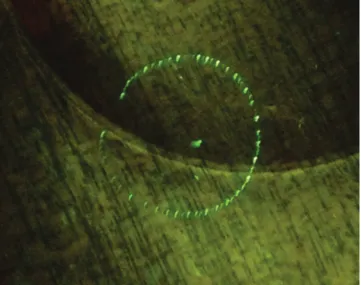
The class Hydrozoa, or the superclass Hydrozoa as suggested by Bouillon and Boero (2000), consists of typical carnivores which are considered to be among the most im-portant planktonic and benthic predators (Bouillon et al. 2006). They prey on fish eggs, fish larvae, some marine invertebrates, and on different sizes of planktonic animals (Frost et al. 2012; Laakmann and Holst 2014). The class contains approximately 3800 species worldwide (Schuchert 2014). Aequorea macrodactyla (Brandt, 1835) (Fig. 1) belongs to the family Aequoreidae Eschscholtz, 1829 and is one of the 27 accepted species of the genus Aequorea Péron & Lesueur, 1810 (Schuchert 2014). Aequorea victoria (Mur-bach & Shearer, 1902) is the most studied species from this genus. For the first time bioluminescence and biofluorescence were described in a jellyfish and green fluorescent protein (GFP) was discovered (Shimomura et al. 1962) in this species. This discovery enabled the utilization of fluorescent protein (FP) in science and medicine and at-tracted scientific attention to the unique ability of this genus. Aequorea macrodactyla is the second species of jellyfish that has been studied for its bioluminescence and GFP, and is used for commercial products (Xia et al. 2002). In this work we present for the first time a hydrozoan jellyfish belonging to the genus Aequorea (Fig. 1A) that contains and exhibits fluorescent protein (Figs 1B, 2) in the Israeli eastern Mediterranean basin. Since the discovery of GFP more than fifty years ago (Shimomura et al. 1962) nearly two hundred natural GFP-like fluorescent proteins (FPs) have been described and the FP became an important tool in biological research (Chudakov et al. 2010; Hunt et al. 2012). By using the term “jellyfish” we include the medusa stage of the scyphomedusae from the class Scyphozoa and the hydromedusae from the class Hydrozoa.
Aequorea macrodactyla is a common hydroidomedusa found in the warmer waters of the coastal region of the East China Sea (Xia et al. 2002). Kramp (1956) claimed that
hydro-graphic conditions and climate are the most determining factors in temporal distribu-tion of jellyfish. They found some Aequorea spp. but not Aequorea macrodactyla. Turan et al. (2011) report the presence of Aequorea globosa Eschscholtz, 1829 for the first time near the coast of Iskenderun Bay in the northeastern Mediterranean and they suggest ship-mediated transport as probable vector. A year later in 2012, Mamish et al. (2012) observed Aequorea globosa near the coast of Syria and considered its appearance an indicator of climate change in the eastern Mediterranean marine environment. Gravili et al. (2013) published a comprehensive review to update the diversity poll of species of what is known as a non-Siphonophora Hydrozoa (NSH) in the Mediterranean, which are traditionally studied as a separate group as their polyp and/or medusa stage is distinctive in global distributions (Kramp 1961; Kramp 1965). In this recent work
A. macrodactyla was absent from the lists of Mediterranean species but mentioned as being present in neighboring areas: the Gulf of Eilat, the Gulf of Aden and the Red Sea (Gravili et al. 2013). The online Encyclopedia of Life shows more up to date informa-tion for the locainforma-tions of A. macrodactyla but the specimen closest to the Mediterranean comes from the Indian Ocean dated 23.7.2007 (Encyclopedia of Life 2014).
Boero and Bouillon (1993) state in their study that the fauna of Mediterranean hy-dromedusae contains 346 species and consists of 19.5% endemic species. The majority, as much as 72.5%, of the Mediterranean species is present in the Atlantic, as well as dis-tributed worldwide, and it can be considered an Atlantic species that could have entered the Mediterranean Sea through the Strait of Gibraltar after the Messinian Salinity Crisis (MSC), also referred to as the Messinian Event. Only 8% are considered Indo-Pacific and these are mainly restricted to the eastern Mediterranean basin. Twenty years later Gravili et al. (2013) presented more or less the same picture for non-siphonophoran hydrozoan fauna distribution in the Mediterranean Sea. From the 400 species they recorded, as much as 68% originate from the Atlantic Ocean, 20% are endemic to the Mediterranean, 8% are Indo-Pacific and the other 4% are defined unclassifiable.
hydro-zoans allow them to be useful markers (McFadden et al. 2011; Zheng et al. 2014). The COI is known as the main metazoan barcoding marker, although in hydrozoans the COI gen has scarcely been employed because of the difficulties involved in amplifying DNA fragments using standard primers (Cantero et al. 2010; Schuchert 2010).
The 16S rDNA has been widely accepted for hydrozoan barcoding purposes and is widely used to resolve phylogenetic questions within the Hydrozoa and has been shown as a better marker for barcoding. It is considered to be a gene that is much easier to amplify and is more available in the GenBank database (Cantero et al. 2010; Moura et al. 2011; Laakmann and Holst 2014; Zheng et al. 2014).
By using both methods in this work, molecular phylogenetics sequences as dis-tance-based methods for the evaluation of genetic distances within and between spe-cies and morphological spespe-cies identification, we anticipated improved accuracy in the taxonomic classification for this new discovery of the Israeli eastern Mediterranean
Aequorea species.
Materials and methods
Aequorea macrodactyla (Brandt, 1835), known also as Mesonema macrodactyla Brandt, 1835 was collected near the Israeli shore line at two different locations during the summer of 2013. The first group of specimens was collected in Sdot Yam, GPS posi-tion: 32°29'35"N, 34°51'48"E, on 16.6.2013, with an umbrella diameter of 65 mm to 75 mm. Three other groups of A. macrodactyla specimens were found and collected at different sites in the Bay of Haifa, GPS general position: 32°52'N, 35°01'E, on 19.12.2013, with an umbrella diameter ranging between 75 mm to 80 mm. A total of 23 specimens were taken to the laboratory for further identification. Finding A. mac-rodactyla concentrations in two different places at a distance of approximately 55 km from each other and half a year apart indicates that this hydromedusa is established in the region. For the species identification of the Israeli Aequorea, two phylogenetic sys-tems were combined: traditional morphological phylogenetics and molecular phyloge-netics. Morphological identification was executed according to Mayer (1910), Kramp (1956, 1961, 1965), Russell (1970), Bouillon et al. (2004) and Bouillon et al. (2006).
Samples from the collected jellyfish were processed immediately in situ, excising sample cuts from the animals and starting with DNA extraction. Total genomic DNA was extracted using the Wizard® SV Genomic DNA Purification System kit (Pro-mega). Other samples were preserved in situ in 95% ethanol for further processing in the laboratory. Throughout the work, care was taken to use sterilized tools and con-tainers, and gloves were worn. The genetic classification was done by matching DNA sequences to global and local data to achieve the most accurate species identification for the sampled specimens (Bayha et al. 2010; Pett et al. 2011).
itself was prepared using the Promega kit for Polymerase chain reaction and sequencing (PCR) amplification and diluted to a final concentration of 2 ng/µL. DNA quality was assessed by running samples on 1% agarose gels. All amplifications were carried out in a T100™ Thermal Cycler (BIO-RAD) using GoTaq® Green Master Mix (Promega). PCR products were purified using the Wizard® SV Gel and PCR Clean-Up System (Promega). The sequencing of the specimens was performed by HyLabs sequencing service (Israel).
For the analyses, the sequences were processed and aligned with BioEdit version 7.2.5 (Hall 1999), ClustalX (Larkin et al. 2007), RAxML (Silvestro and Michalak 2012), Nucleotide composition and analyzed with MEGA6. Each phylogenetic tree was processed with MEGA 5.2 and MEGA 6 tools in order to select the best and most appropriate evolutionary phylogenetic model (Tamura et al. 2013).
Results
Systematics
Class HYDROZOA Owen, 1843
Order LEPTOTHECATA Cornelius, 1992 Family AEQUOREIDAE Eschscholtz, 1829
Genus Aequorea Péron & Lesueur, 1810
Fig. 1A
Aequorea macrodactyla (Brandt, 1835)
Morphological description. The freshly collected jellyfish were observed carefully in the lab by using: Nikon SMZ100 Binocular, Nikon AZ100 Binocular with DS-Ri1 camera, and Zeiss Imager microscope M2. All specimens have a biconvex lens umbrella (central disc is lens-shaped) of around 20 mm thick and 65 mm to 80 mm in diameter. The stomach is shallow with a diameter of a little less than half of the umbrella, around 30 mm to 38 mm (Fig. 1A). There is an average of 32 straight radial canals (Fig. 1B) and the gonads are linear on both sides of each radial canal (Fig. 1C). The jellyfish have between 10–20 broad marginal tentacle bulbs (Fig. 1A) each with abaxial keel (Fig. 1D). The identification of Aequorea spp. can be confusing mainly due to their considerable variability, and misidentification has occurred in the past (Kramp 1965). The amount of radial canals and tentacles, and the shape of the bases of the marginal tentacles are of great importance and the key to distinguish morphologically between other similar jellyfish belonging to the genus Aequorea, for example Aequorea pensilis
and Aequorea macrodactyla that bear a close resemblance one to another. The marginal bulb should be determined in order to distinguish between similar species of Aequorea
the marginal tentacles that continue the radial canal. Also it is evident (Fig. 1C) that some radial canals end as marginal bulbs but did not develop tentacles and should be considered as non-tentacular marginal bulbs or rudimentary bulbs (Fig. 1D), which is a characteristic phenomenon of the Aequorea macrodactyla. In Figure 1C we can see the position of the gonads surrounding the radial canal. The color of the radial canal, the endoderm of the lips and the tentacle bulbs present a milky color as other parts are mostly transparent.
Genetic identification
Table 1. Data of Aequorea macrodactyla nucleotide Sequence Database, submission to the European Nucleotide Archive.
Eukaryota; Metazoa; Cnidaria; Hydrozoa; Hydroida; Leptomedusae; Aequoreidae; Aequorea
Accession#: HG964642. 16-JUN-13 Aequorea macrodactyla, partial 16S rRNA gene (Fig. 3) Latitude = 32°29'N,
Longitude = 34°52'E Israel. East Mediterranean coast. Sdot Yam
Primer forward name 16S F756 Forward sequence CCGTGATAAAGTAGCATAATCAC Primer reverse name 16S R755 Reverse sequence AATATTACCCTGTTATCCCTACGG Accession#: HG964638. 16-JUN-13 Aequorea macrodactyla partial 28S rRNA gene (Fig. 4) Latitude = 32°29'N,
Longitude = 34°52'E Israel. East Mediterranean coast. Sdot Yam
Primer forward name 28S F834 Forward sequence GAGACCGATAGCGAACAAGTACCGTG Primer reverse name 28S R833 Reverse sequence AGAGTTTCCTCTGGCTTCACCCTACTC Latitude = 32°52'N,
longitude = 35°01'E Israel. East Mediterranean coast. Haifa bay
Primer forward name COI F754 Forward sequence TATGATTATAMGAYTGGAACTATCAGG Primer reverse name COI R755 Reverse sequence GTYAACAACATGGTWATYGCCCCAGC
Figure 2. Localization of the Green fluorescent protein (GFP) in the margin of the umbrella in the Israeli
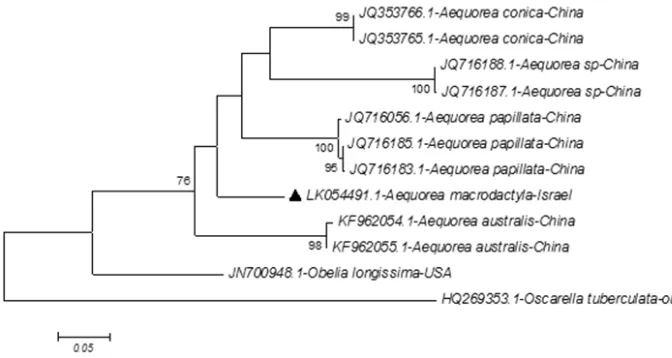
show that the Israeli A. macrodactyla specimens belong to one group as presented in the following phylogenetic trees (Figs 3, 4, 5) under the reference number HG964642, Figure 3. Evolutionary tree for Israeli Aequorea macrodactyla by mtDNA 16S marker compared with other members of Aequorea. Molecular phylogenetic analysis by Maximum Likelihood Method, an evo-lutionary tree based on partial sequences of 354 base pairs (bp) mitochondrial DNA (mtDNA) marker 16S. The black triangle represents the local A. macrodactyla jellyfish of the Mediterranean according to the DNA molecular sequence acquired in this work. The outgroup for this tree is represented by Hydra polymorphus and H. vulgaris. The test of phylogeny is by Bootstrap method and the number of bootstrap replications is 1000. For the taxon name we used the NCBI GenBank reference number.
which is the National Center for Biotechnology Information (NCBI) GenBank refer-ence number as received from the European Nucleotide Archive (ENA).
The evolutionary history was inferred by using the Maximum Likelihood Method based on the Tamura 3-parameter model (Tamura 1992). The tree with the highest log likelihood (-1506.2803) is shown. The percentage of trees in which the associated taxa clustered together is shown next to the branches. The initial tree for the heuristic search was obtained by applying the Neighbor-Joining method to a matrix of pairwise distances estimated using the Maximum Composite Likelihood (MCL) approach. A discrete Gamma distribution was used to model evolutionary rate differences among sites (5 categories (+G, parameter = 0.3008)). The tree is drawn to scale, with branch lengths measured in the number of substitutions per site. The analysis involved 13 nucleotide sequences. Codon positions included were 1st+2nd+3rd+Noncoding. All positions containing gaps and missing data were eliminated. There were a total of 350 positions in the final dataset. Evolutionary analyses were conducted in MEGA6 (Ta-mura et al. 2013).
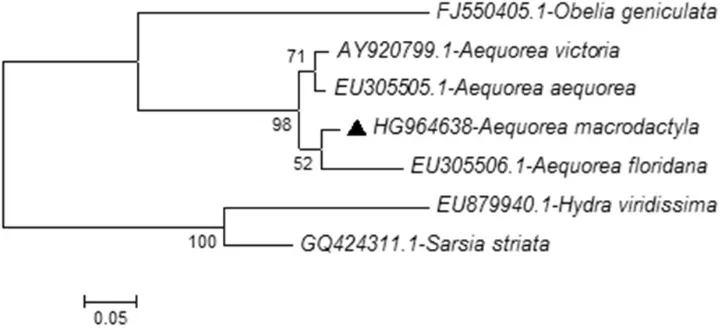
The tree is based on partial sequences of 691 base pairs (bp) mitochondrial cy-tochrome c oxidase subunit I (COI) with other family members from the same class. The outgroup is the Porifera, Oscarella tuberculata. The test of phylogeny is by Boot-strap method and the number of bootBoot-strap replications is 1000. The reference number used in this figure represents the NCBI GenBank reference number followed by the taxon name.
The evolutionary history was inferred by using the Maximum Likelihood method based on the General Time Reversible model (Tamura 1992). The tree with the highest log likelihood (-2473.0463) is shown. A discrete Gamma distribution was used to mod-el evolutionary rate differences among sites (5 categories (+G, parameter = 0.4266)). The tree is drawn to scale, with branch lengths measured in the number of substitutions per site. The analysis involved 12 nucleotide sequences. Codon positions included were 1st+2nd+3rd+Noncoding. All positions containing gaps and missing data were
eliminat-ed; there was a total of 618 positions in the final dataset (Tamura et al. 2013).
All tree model parameters were estimated by RAxML GAMMA model of rate heterogeneity, ML estimates of alpha-parameter GAMMA Model parameters were estimated up to an accuracy of 0.1 log Likelihood units, Alignment Patterns = 188, DataType = DNA, Substitution Matrix = GTR, and alpha = 0.300374 (Silvestro and Michalak 2012).
Discussion
The Mediterranean Sea is undergoing a dramatic change in biota as a result of biogeo-graphical alterations and ecological changes (Monegatti and Raffi 2001; Monegatti and Raffi 2010; Zenetos et al. 2010; Vermeij 2012), and the East Mediterranean ex-periences even more changes in biota since the opening of the Suez Canal and fast urbanization along the Israeli Mediterranean coast (Galil et al. 2013). To better un-derstand this ongoing process, it is essential to be familiar with the existing gelatinous fauna in the Mediterranean Sea and to document newly discovered jellyfish and exist-ing ones, so that this important information can be utilized and provide us with the possibility to improve the management of our contributions to the changes in the sea. In this work we utilize phylogenetic and taxonomic relationships with similar Cnidaria to examine if the newly recorded species of Aequorea is an immigrant and if so, what constitutes the direction of its invasive pathways and speed of migration (migration vector), or if this species is local (Zenetos et al. 2012; Katsanevakis et al. 2014).
For the species identification of the Israeli Aequorea, two phylogenetic systems were combined: traditional morphological phylogenetics and molecular phylogenetic tools. Morphology: shape of the umbrella, position of the gonads, number of radial canals, and the morphology of the marginal bulbs show that the newly found Israeli hydrozoan belongs to the genus of Aequorea and we were able to identify this species as Aequorea macrodactyla according to the above described characteristics with some minor differences. The identification was made according to the description of this species from other sources (Mayer 1910; Kramp 1956; Kramp 1965; Russell 1970; Bouillon et al. 2006; Gul and Gravili 2013) and the genetic results, which will be discussed further on, support our identification (Fig. 3).
(mtDNA) marker 16S (Fig. 3), which is a widely used DNA marker for Hydrozoa; this marker has the most widely available data in the GenBank (Laakmann and Holst 2014). The result, based on partial sequences of 354 base pairs, presented in Fig. 3, sup-ports the morphological results that Aequorea of the East Mediterranean Sea appears to be Aequorea macrodactyla. The evolutionary tree (Fig. 3) presents all Aequorea species by 16S gen available in the NCBI GenBank (Geer et al. 2010) and it is clear that the Israeli and Japanese Aequorea macrodactyla are related and different from all other Aequorea
species presented in this tree (Fig. 3). Furthermore there is a difference in identity of 1% between the two Aequorea macrodactyla as shown by the results of 16S nucleotide, using basic local alignment search tool (blast). The Israeli Aequorea macrodactyla population shows negligible differences inside the four locally collected groups. 16S mtDNA gene exhibits a very low rate of mitochondrial nucleotide substitution, especially in Cnidaria, where it exhibits a considerably lower rate than in other invertebrates. The rate of sub-stitution for 16S mtDNA in Cnidaria is 10–20 times lower than in vertebrates (Govin-darajan et al. 2005). The 1% identity difference between the Israeli and the Japanese
A. macrodactyla can be an indication of a significant difference between these two A. macrodactyla groups, but more worldwide data is required to resolve this issue.
The evolutionary tree resulting from mitochondrial cytochrome c oxidase subunit I (COI) for the Israeli Aequorea macrodactyla based on partial sequences of 691 base pairs (Fig. 4) and the evolutionary tree resulting from nuclear Ribosomal DNA 28S (rDNA) gene based on partial sequences of 679 base pairs (Fig. 5) strengthen the previ-ous results from the 16S gene (Fig. 3) for the evolutionary locations of Aequorea macro-dactyla among other existing Aequorea species. In this publication, we provide available sequences for COI and 28S genes and supply a basis for future reference regarding the use of COI and 28S gene markers.
This work emphasizes the importance of using a combination of the two phylo-genetic systems especially when one tries to identify fragile and delicate creatures like members of the Aequorea spp. Our results show an average of 32 radial canals in the Israeli A. macrodactyla. Mayer (1910) wrote that there are 60 to 100 or more radial ca-nals, Kramp (1965) stated that the “numbers of radial canals and tentacles are of great importance” but he presents average numbers of radial canals from 31 to 102, which is closest to our findings. However Kramp (1956) determines that the A. macrodactyla
in the eastern Mediterranean Sea could be interpreted as part of the change in marine biota resulting from the cumulative effects of anthropogenic and global changes that affect the eastern Mediterranean basin. Finding a new species could be explained by the sudden proliferation of a rare indigenous species that up until that point was eva-sive and stayed out of sight. It is possible that this species flourished as a consequence of changes in the environment that created more favorable conditions. The other possi-bility, which is more widely accepted, is that they are new immigrants introduced from the Atlantic or the Indo-Pacific, or are Indo-Pacific immigrants that arrived through the Suez Canal as Lessepsian immigrants (Plan 2010).
To deal with these important questions, whether Aequorea macrodactyla has been an evasive hydromedusa that kept a low profile or whether this is a new invasion by a non-indigenous species, we examined three DNA markers (Table 1): mitochondrial DNA (mtDNA) marker 16S (Fig. 3), mitochondrial cytochrome c oxidase subunit I (COI) marker (Fig. 4), and Ribosomal DNA 28S (rDNA) genes (Fig. 5). The results from marker 16S (Fig. 3) suggest that the genetic differences between the Israeli and the Japanese population are small but existent, and can be interpreted as a normal di-vergence within a population. As the Israeli A. macrodactyla population was collected from different places and at different times and demonstrated very little genetic diver-sion without any distinctive variance at all, we suggest that the local A. macrodactyla
are not native to the East Mediterranean and should be considered a new immigrant jellyfish; we propose that the jellyfish from the Far East is the source of the Israeli East Mediterranean Aequorea macrodactyla.
The arrival of A. macrodactyla to the East Mediterranean could be explained by one of two possibilities, either Lessepsian migration or human transportation. Lessepsian migration is not a well-defined term and we propose to define it as successful migra-tion of marine creatures from one side of the Suez Canal to the other, coming through the Suez Canal either step by step, swimming or even using local transportation (Por 1971) as long as the Canal enabled this immigration. For example, a hydromedusa arriving from the Arabian Sea to the Mediterranean by ballast water cannot be con-sidered a Lessepsian migrant but should be defined as an anthropogenic migrant by means of human transportation. Human transportation is a means for the marine crea-ture to immigrate to a new location, regardless of the transportation route: at present this appears to be the main path of introduction of a species (Gravili et al. 2013). As we compare our A. macrodactyla with the existing data one can assume that either one of the immigration options presented here is possible.
To summarize this discussion, we suggest that this jellyfish is an immigrant that used ship transportation from the Indo-Pacific to the Mediterranean, which is sup-ported by the high DNA similarity with the Japanese (Xia et al. 2002) Aequorea mac-rodactyla (Fig. 3) and by the lack of other evidence or reliable information for this jellyfish existing in the Red Sea in recent years.
In this paper we emphasize the dynamic process in the East Mediterranean ma-rine fauna as a significant part of the ecosystem’s change in natural balance and as a result the introduction of a new species and change in the biodiversity. Moreo-ver, genetic tools were utilized as a means for distinguishing and examining newly recorded species to determine whether this is a native species or an immigrant. As we pointed out, global information is limited, more work should be carried out, especially in the East Mediterranean as the marine habitat and its fauna are changing rapidly. The results indicating Indo-Pacific migration could be interpreted as part of the change in marine biota as a result from the cumulative effects of anthropogenic and global changes that affect the eastern Mediterranean basin (Duarte 2014; Tsik-liras and Stergiou 2014).
References
Bayha KM, Dawson MN, Collins AG, Barbeitos MS, Haddock SH (2010) Evolutionary re-lationships among scyphozoan jellyfish families based on complete taxon sampling and phylogenetic analyses of 18S and 28S ribosomal DNA. Integr Comp Biol 50(3): 436–455. doi: 10.1093/icb/icq074
Boero F, Bouillon J (1993) Zoogeography and life cycle patterns of Mediterranean hydrome-dusae Cnidaria. Biological Journal of the Linnean Society (March) 483: 239–266. doi: 10.1111/j.1095-8312.1993.tb00890.x
Bouillon J, Boero F (2000) The hydrozoa: A new classification in the light of old knowledge. Thalassia Salentina 24: 3–45.
Bouillon J, Medel MD, Pagès F, Gili JM, Boero F, Gravili C (2004) Fauna of the Mediterranean Hydrozoa. Scientia Marina 68(S2): 5–438. doi: 10.3989/scimar.2004.68s25
Bouillon J, Gravili C, Pagès F, Gili J, Boero F (2006) An introduction to Hydrozoa. Mémoires du Muséum National d’Histoire Naturelle 194.
Cantero ALP, Sentandreu V, Latorre A (2010) Phylogenetic relationships of the endemic Ant-arctic benthic hydroids (Cnidaria, Hydrozoa): What does the mitochondrial 16S rRNA tell us about it? Polar Biol 33(1): 41–57. doi: 10.1007/s00300-009-0683-5
Cartwright P, Evans NM, Dunn CW, Marques AC, Miglietta MP, Schuchert P, Collins AG (2008) Phylogenetics of hydroidolina (Hydrozoa: Cnidaria). Journal of the Marine Bio-logical Association of the UK 88(8): 1663–1672. doi: 10.1017/S0025315408002257 Chudakov DM, Matz MV, Lukyanov S, Lukyanov KA (2010) Fluorescent proteins and
their applications in imaging living cells and tissues. Physiol Rev 90(3): 1103–1163. doi: 10.1152/physrev.00038.2009
new insights on the evolution of some problematical taxa. Journal of the Marine Biological Association of the UK 88(8): 1673–1685. doi: 10.1017/S0025315408001732
Duarte CM (2014) Global change and the future ocean: A grand challenge for marine sciences. Frontiers in Marine Science 1: 63. doi: 10.3389/fmars.2014.00063
Erpenbeck D, Breeuwer J, Soest Rv (2005) Implications from a 28S rRNA gene fragment for the phylogenetic relationships of halichondrid sponges (Porifera: Demospongiae). J Zool Syst Evol Res 43(2): 93–99. doi: 10.1111/j.1439-0469.2005.00306.x
Frost JR, Denda A, Fox CJ, Jacoby CA, Koppelmann R, Nielsen MH, Youngbluth MJ (2012) Distribution and trophic links of gelatinous zooplankton on Dogger Bank, North Sea. Mar Biol 159(2): 239–253. doi: 10.1007/s00227-011-1803-7
Galil B, Gertman I, Gordon N, Herut B, Israel A, Lubinevsky H, Rilov G, Rinkevich B, Tibor G, Tom M (2013) Biodiversity monitoring along the Israeli coast of the Mediterranean - activities and accumulated data. IOLR Report H19.
Geer LY, Marchler-Bauer A, Geer RC, Han L, He J, He S, Liu C, Shi W, Bryant SH (2010) The NCBI BioSystems database. Nucleic Acids Res 38 (Database issue): D492–6. doi: 10.1093/nar/gkp858
Govindarajan A, Halanych K, Cunningham C (2005) Mitochondrial evolution and phyloge-ography in the hydrozoan Obelia geniculata (Cnidaria). Mar Biol 146(2): 213–222. doi: 10.1007/s00227-004-1434-3
Goy J, Lakkis S, Zeidane R (1991) Les meduses Cnidaria des eaux libanaises. Annales de l’Institut Oceanographique 672: 99–128.
Gravili C, Di Camillo CG, Piraino S, Boero F (2013) Hydrozoan species richness in the Mediter-ranean Sea: Past and present. Mar Ecol 34: 41–62. doi: 10.1111/maec.12023
Gruenthal K, Acheson L, Burton R (2007) Genetic structure of natural populations of California red abalone (Haliotis rufescens) using multiple genetic markers. Mar Biol 152 (6): 1237–1248. doi: 10.1007/s00227-007-0771-4
Gul S, Gravili C (2013) Aequorea pensilis (Cnidaria: Hydrozoa) bloom and first record from Pakistan coast (North Arabian Sea). Marine Biodiversity Records 6: e131. doi: 10.1017/ S1755267213001085
Hall TA (1999) BioEdit: A user-friendly biological sequence alignment editor and analysis program for windows 95/98/NT. 41: 95–98.
Hunt ME, Modi CK, Aglyamova GV, Ravikant D, Meyer E, Matz MV (2012) Multi-domain GFP-like proteins from two species of marine hydrozoans. Photochemical & Photobio-logical Sciences 11(4): 637–644. doi: 10.1039/c1pp05238a
Katsanevakis S, Coll M, Piroddi C, Steenbeek J, Ben Rais Lasram F, Zenetos A, Cardoso AC (2014) Invading the Mediterranean Sea: biodiversity patterns shaped by human activities. Marine Ecosystem Ecology 1: 32. doi: 10.3389/fmars.2014.00032
Kramp PL (1956) Medusae of the Iranian gulf. Videnskabelige Meddelelser Fra Dansk Naturhistorik Forening 118: 235–242.
Kramp PL (1961) Synopsis of the Medusae of the World. Journal of the Marine Biological Association of the United Kingdom 40: 7–382. doi: 10.1017/S0025315400007347 Kramp PL (1965) The hydromedusae of the Pacific and Indian Oceans. Compt. rend. séan.
Laakmann S, Holst S (2014) Emphasizing the diversity of North Sea hydromedusae by combined morphological and molecular methods. J Plankton Res 36(1): 64–76. doi: 10.1093/plankt/fbt078
Larkin MA, Blackshields G, Brown NP, Chenna R, McGettigan PA, McWilliam H, Valentin F, Wallace IM, Wilm A, Lopez R, Thompson JD, Gibson TJ, Higgins DG (2007) Clustal W and clustal X version 2.0. Bioinformatics 23(21): 2947–2948. doi: 10.1093/bioinformatics/btm404 Lunt D, Zhang D, Szymura J, Hewltt O (1996) The insect cytochrome oxidase I gene: Evo-lutionary patterns and conserved primers for phylogenetic studies. Insect Mol Biol 5 (3): 153–165. doi: 10.1111/j.1365-2583.1996.tb00049.x
Mamish S, Durugham H, Al Masri MS (2012) First record of Aequorea globosa Eschscholtz, 1829 (Cnidaria: Hydrozoa) in the coast of Syria. Mediterranean Marine Science 13(2): 259–261. doi: 10.12681/mms.306
Mayer AG (1910) Medusae of the World. Carnegie Inst. Washington. Vol 2: 332–333. McFadden CS, Benayahu Y, Pante E, Thoma JN, Nevarez PA, France SC (2011) Limitations of
mitochondrial gene barcoding in octocorallia. Molecular Ecology Resources 11(1): 19–31. doi: 10.1111/j.1755-0998.2010.02875.x
Mills CE (2001) Jellyfish blooms: are populations increasing globally in response to chang-ing ocean conditions? In Jellyfish Blooms: Sprchang-inger Netherlands, Ecological and Societal Importance, 55–68.
Monegatti P, Raffi S (2001) Taxonomic diversity and stratigraphic distribution of Mediter-ranean pliocene bivalves. Palaeogeogr, Palaeoclimatol, Palaeoecol 165(3): 171–193. doi: 10.1016/S0031-0182(00)00159-0
Monegatti P, Raffi S (2010) The Messinian marine molluscs record and the dawn of the Eastern Atlantic biogeography. Palaeogeogr, Palaeoclimatol, Palaeoecol 297(1): 1–11. doi: 10.1016/j.palaeo.2010.06.023
Moura CJ, Cunha MR, Porteiro FM, Rogers AD (2011) The use of the DNA barcode gene 16S mRNA for the clarification of taxonomic problems within the family Sertulariidae (Cnidaria, Hydrozoa). Zool Scr 40(5): 520–537. doi: 10.1111/j.1463-6409.2011.00489.x Pett W, Ryan JF, Pang K, Mullikin JC, Martindale MQ, Baxevanis AD, Lavrov DV
(2011) Extreme mitochondrial evolution in the ctenophore Mnemiopsis leidyi: Insight from mtDNA and the nuclear genome. Mitochondrial DNA 22(4): 130–142. doi: 10.3109/19401736.2011.624611
Plan MA (2010) The Mediterranean sea biodiversity: State of the ecosystems, pressures, impacts and future priorities. Palaeogeography, Palaeoclimatology, Palaeoecology 297(1): 37–53. Por F (1971) One hundred years of Suez Canal a century of Lessepsian migration: Retrospect
and viewpoints. Syst Biol 20(2): 138–159. doi: 10.2307/2412054
Richardson AJ, Bakun A, Hays GC, Gibbons MJ (2009) The jellyfish joyride: Causes, con-sequences and management responses to a more gelatinous future. Trends in Ecology & Evolution 24(6): 312–322. doi: 10.1016/j.tree.2009.01.010
Russell FS (1970) Hydromedusae. family: Aequoridae. Fiches d’identification du zooplancton. Conseil International pour l’Exploration de la Mer, Kopenhagen, 128.
Schuchert P (2010) The European athecate hydroids and their medusae (Hydrozoa, Cnidaria): Capitata part 2. Revue Suisse De Zoologie 117(3): 337–555.
Schuchert P (2014) World hydrozoa database. http://www.marinespecies.org/hydrozoa Schultz J, Maisel S, Gerlach D, Muller T, Wolf M (2005) A common core of secondary structure
of the internal transcribed spacer 2 (ITS2) throughout the eukaryota. RNA 11(4): 361–364. doi: 10.1261/rna.7204505
Shimomura O, Johnson FH, Saiga Y (1962) Extraction, purification and properties of aequor-in, a bioluminescent protein from the luminous hydromedusan, Aequorea. Journal of Cel-lular and Comparative Physiology 59(3): 223–239. doi: 10.1002/jcp.1030590302 Silvestro D, Michalak I (2012) raxmlGUI: A graphical front-end for RAxML. Organisms
Di-versity & Evolution 12(4): 335–337. doi: 10.1007/s13127-011-0056-0
Tamura K (1992) Estimation of the number of nucleotide substitutions when there are strong transition-transversion and G+C-content biases. Mol Biol Evol 9(4): 678–687.
Tamura K, Stecher G, Peterson D, Filipski A, Kumar S (2013) MEGA6: Molecular evolu-tionary genetics analysis version 6.0. Mol Biol Evol 30(12): 2725–2729. doi: 10.1093/ molbev/mst197
Tsikliras AC, Stergiou KI (2014) Mean temperature of the catch increases quickly in the Medi-terranean Sea. Mar Ecol Prog Ser 515: 281–284. doi: 10.3354/meps11005
Turan C, Gürlek M, Yağlıoğlu D, Seyhan D (2011) A new alien jellyfish species in the Medi-terranean Sea-Aequorea globosa Eschscholtz, 1829 (Cnidaria: Hydrozoa). Journal of the Black Sea/Mediterranean Environment 17(3): 282–286.
Vermeij GJ (2012) The tropical history and future of the Mediterranean biota and the West African enigma. J Biogeogr 39(1): 31–41. doi: 10.1111/j.1365-2699.2011.02601.x Wörheide G, Erpenbeck D (2007) DNA taxonomy of sponges-progress and perspectives. J
Mar Biol Assoc UK 87(06): 1629–1633. doi: 10.1017/S0025315407058274
Xia N, Luo W, Zhang J, Xie X, Yang H, Li S, Chen M, Ng M (2002) Bioluminescence of
Aequorea macrodactyla, a common jellyfish species in the east China sea. Marine Biotech-nology 4(2): 155–162. doi: 10.1007/s10126-001-0081-7
Zenetos A, Gofas S, Verlaque M, Çinar Melih Ertan, Garcia Raso JE, Bianchi CN, Morri C, Azzurro Ernesto, Bilecenoglu M, Froglia C, Siokou I, Violanti D, Sfriso A, San Martín Peral Guillermo, Giangrande A, Katagan T, Ballesteros E, Ramos Esplá Alfonso Ángel, Mastrototaro F, Ocaña O, Zingone A, Gambi MC, Streftaris N (2010) Alien species in the Mediterranean Sea by 2010. A contribution to the application of European Union’s Ma-rine Strategy Framework Directive (MSFD). Part I. Spatial distribution. Mediterranean Marine Science 11(2): 381–493. doi: 10.12681/mms.87
Zenetos A, Ballesteros E, Verlaque M (2012). Alien species in the Mediterranean Sea by 2012. A contribution to the application of European Union’s Marine Strategy Framework Direc-tive (MSFD). Part 2. Introduction trends and pathways. Mediterranean Marine Science 13(2): 328–352. doi: 10.12681/mms.327
Zheng L, He J, Lin Y, Cao W, Zhang W (2014) 16S rRNA is a better choice than COI for DNA barcoding hydrozoans in the coastal waters of China. Acta Oceanologica Sinica 33(4): 55–76. doi: 10.1007/s13131-014-0415-8