R E S E A R C H
Open Access
Spatial accessibility of primary health care
utilising the two step floating catchment area
method: an assessment of recent improvements
Matthew R McGrail
1,2*Abstract
Background:The two step floating catchment area (2SFCA) method has emerged in the last decade as a key measure of spatial accessibility, particularly in its application to primary health care access. Many recent ‘improvements’to the original 2SFCA method have been developed, which generally either account for distance-decay within a catchment or enable the usage of variable catchment sizes. This paper evaluates the effectiveness of various proposed methods within these two improvement groups. Moreover, its assessment focuses on how well these improvements operate within and between rural and metropolitan populations over large geographical regions.
Results:Demonstrating these improvements to the whole state of Victoria, Australia, this paper presents the first comparison between continuous and zonal (step) decay functions and specifically their effect within both rural and metropolitan populations. Especially in metropolitan populations, the application of either type of distance-decay function is shown to be problematic by itself. Its inclusion necessitates the addition of a variable catchment size function which can enable the 2SFCA method to dynamically define more appropriate catchments which align with actual health service supply and utilisation.
Conclusion:This study assesses recent‘improvements’to the 2SFCA when applied over large geographic regions of both large and small populations. Its findings demonstrate the necessary combination of both a distance-decay function and variable catchment size function in order for the 2SFCA to appropriately measure healthcare access across all geographical regions.
Keywords:Spatial accessibility, Primary health care, Rural health, Access to health care, Service catchments, Medical geography
Introduction
Access to health care is widely accepted internationally as a key goal in meeting the health needs of individuals [1-4]. However, assessing the extent to which adequate access to health care services is achieved is difficult be-cause there is no single agreed definition of access [5-8]. Healthcare access is such a complex concept that Norris and Aiken [9] went as far as to state that “It is as if everyone is writing about‘it’[access] but no one is saying what‘it’is”.
A fundamental problem of defining access is its status as both a noun and a verb [10], thus healthcare access can refer both to the potential for use as well as the act of using healthcare. Furthermore, access is multidimen-sional with specific access barriers covering a range of spatial and aspatial dimensions [11-13], making it diffi-cult to operationalise. Health service planners have tended to adopt Penchansky and Thomas’[13] five main dimensions of access–specifically availability, accessibil-ity, affordabilaccessibil-ity, accommodation and acceptability. As a result, healthcare access indicators vary immensely, and may be capturing but not limited to the availability of care, the ability to get to and pay for available care, or the act of seeking and utilising available care. One com-mon approach to evaluating access to health care is Correspondence:[email protected]
1Gippsland Medical School, Monash University, Northways Road, Churchill,
VIC 3842, Australia
2Centre of Research Excellence in Rural and Remote Primary Health Care,
Gippsland, Australia
through measuring spatial accessibility [10,14-16]. Spatial accessibility provides a summary measure of two important and related components of access - firstly the volume of services provided relative to the population’s size and secondly the proximity of services provided relative to the location of the population. This paper fo-cuses on one such measure of spatial accessibility, the two-step floating catchment area (2SFCA) method and evaluates its many recent‘improvements’.
Background
Spatial accessibility and the two-step floating catchment area (2SFCA) method
The accurate measurement of spatial accessibility to health care is problematic chiefly because there is sel-dom any predetermined assignment or single pathway between individuals and specific health care services. That is, in most western societies individuals are free to access health care wherever and from whomever they choose. Thus an assessment of available services relative to the needs of the population specific to a local area is challenging. This is especially true for primary health care services, the key facilitator of access within most international health care systems [17,18], which co-exist in a network of overlapping catchments ‘competing’for the population’s utilisation of their services.
The two-step floating catchment area (2SFCA) method, pioneered by Luo and Wang [11,15,19], emerged from a background in which the shortcomings of existing measures of spatial accessibility were readily apparent. In particular, fundamental weaknesses of provider- or physician-population ratios (PPRs) are well-recognised [10,14,15], which fail to include both cross-border movement between boundaries and distance decay within boundaries, but most significant is their re-striction to using fixed geographical or administrative boundaries such as counties or postcodes. The 2SFCA method builds upon the framework of PPRs, but instead uses floating catchment areas which overlap, thereby en-abling the modelling and measurement of ‘real-life’ healthcare access behaviour with unrestricted utilisation. The size of the catchment is determined by a choice of maximum travel time (or distance), where all services (or populations) within that catchment are considered accessible and equally proximate to that particular popu-lation (or service), whilst all locations outside of the catchment are not accessible.
The process for calculating the 2SFCA method is rela-tively straightforward. Step 1 of the 2SFCA method deter-mines what populations (k) of size Pkare located within the catchment of each service provider (j) of volume Sj, thus defining the provider-to-population ratio Rjwithin a service catchment (that is, the potential service demand). Step 2 then ‘allocates’ these service ratios to the population by
determining which services (j) are located within the catch-ment of each population (i), and aggregating the Step 1 (Rj) scores to calculate a location’s access (Ai). The only decision required in applying the 2SFCA method is the catchment size (dmax), which is then applied at both Steps 1 and 2. This method has been utilised in this form or with minor modifications only, within the last six years by many differ-ent studies [20-31].
Step 1: For each service (j), Rj= Sj/ P
k∈{djk <dmax}Pk Step 2: For each population (i), Ai=
P
j∈{dij <dmax}Rj The following assumptions are made regarding appli-cation of the 2SFCA method:
Service providers are represented by their geocoded organisational address (latitude, longitude).
Aggregating service counts to some administrative boundary (e.g. town, county, postcode) will simplify its computation, but can greatly reduce its sensitivity to small-area discrimination.
Population (aggregated) groups are represented through a single location (centroid, usually geometric or population-weighted), based on some larger administrative boundary. Usage of smaller areal units enables more accurate small-area measurement of ‘local’access, but also greatly increases computation complexity.
Population-provider proximity (d) is measured as time or distance separation (point-to-point) through some transport network (roads, public transport). Euclidean distance can also be used to approximate proximity; however, this results in a moderate loss of accuracy.
Whilst the greatest strength of the 2SFCA method is it overcomes the restriction of using only pdefined re-gional boundaries, this improvement alone does not ad-dress two major weaknesses still apparent in its framework. Firstly, distance-decay is assumed to be neg-ligible within a catchment, something which is clearly not the case in large geographical regions where popula-tions are widely dispersed, and catchments therefore are quite extensive. Secondly, catchments are assumed to be the same size for all populationsandfor all services.
Over the past five years, several authors have devel-oped methodological ‘improvements’ to address these weaknesses characterising the 2SFCA method. This paper assesses these improvements to the 2SFCA method by evaluating their effectiveness when applied to primary health care access. Moreover, this assessment will focus on how well these improvements operate within and between rural, regional and metropolitan populations over large geographical regions. Health pol-icies are mostly applied at national or state levels which require methodologies to work across diverse and large geographies. However, to date most 2SFCA method
improvements have been demonstrated only within small or localised areas.
Improvement 1–addition of distance decay function
Without the addition of a distance decay function, there is widespread agreement that the 2SFCA method is deficient [32-35]. Its omission is equivalent to accepting that dis-tance (or time) is a negligible barrier within a catchment, an unlikely scenario for geographically large countries and given our use of a maximum catchment of 60 minutes in this paper. Within aservice catchment (Step 1), distance-decay omission means that any service is equally likely to be delivering services to both populations very close by and those up to the catchment boundary (60 minutes). Within a population catchment (Step 2), distance-decay omission means that individuals are equally likely to be accessing services from both nearby and up to the catch-ment boundary (60 minutes). Whilst omission of both of these may be acceptable for a small scale model in a densely populated area (such as within major cities), it is clear that a distance-decay function is crucial in sparsely populated (rural) areas where problems associated with poor access to health care services are known to be a major factor contributing to the poorer health status of population in these areas [36,37].
Currently there is little empirical evidence to guide the choice of one decay function over another. Wang [38] defined six different distance-decay functions, where the crude 2SFCA method is defined by its use of a binary discrete function with no decay within a catchment and complete decay outside of a catchment. Luo & Qi [34] developed what they called the‘enhanced’2-step floating catchment area (E2SFCA) method, where catchments are broken into 3 discrete zones (0–10 minutes; 11–20 minutes; 21–30 minutes) with constant weightings (w<=1) applied to the accessibility within each zone. Subsequently, some authors have accepted the E2SFCA method as the new‘standard’2SFCA method [21,32,39], whilst Wan et. al. [40] extended this approach by adding a 30–60 minutes zone. Drawing on Wan and the Gaussian distribution [40,41], two sets of weightings are tested in this paper for these four time barrier zones, re-lating to either fast or slow decay:
Fast step-decay: weightings (w) = 1, 0.60, 0.25, 0.05
Slow step-decay: weightings (w) = 1, 0.80, 0.55, 0.15.
In applying this zonal or step approach to large geo-graphical areas, the key criticism remains - specifically that accessibility weightings are equal within each zone and there is a sudden step (drop) at the edge of each zone [32,33], something which does not match real util-isation behaviour. Resultantly, many authors have devel-oped distance-decay functions which are smoother and
continuous in their decay [32,35,42,43]; however without any empirical evidence, it is unclear which function is the most appropriate to use [38]. This paper tests one such continuous weighting function:
Continuous decay: weightings (w) = 1 for the first 10 minutes, w = 0 for more than 60 minutes, and w = ((60-d)/(60–10))^1.5 for distance/time (d) between 10 and 60 minutes.
Previous testing suggested 1.5 was an appropriate weight-ing factor [35], though higher values such as 2 would achieve a quicker decay rate. Figure 1 shows the relative weightings of the three decay functions to be tested.
Improvement 2–addition of variable catchment size
function / variable inclusion of distance decay
One feature of applications of the 2SFCA method by dif-ferent authors is their choice of difdif-ferent catchment sizes, with those in metropolitan settings generally using signifi-cantly smaller catchment sizes than for rural settings. Metropolitan and rural regions have very different settle-ment patterns, meaning that the appropriate catchsettle-ment size for different regions is likely to vary greatly. Despite this, to date only two research groups have investigated the use of a variable catchment size function or the related variable inclusion of a distance decay function [35,44], with each using very different methods for defining their population and service catchment sizes.
Variablepopulationcatchment size (Step 2) is concep-tually simple – individuals can travel further (or have a higher likelihood of travelling further) to access health-care if nearby services do not meet their needs [45]. In metropolitan areas, services and populations are densely located so that, typically, most individuals will access services in close proximity because their requirements are met. In contrast, rural services are more dispersed, so that rural populations commonly access services be-yond their immediate community. McGrail and Hum-phreys [46] modelled this rural/metropolitan distinction by limiting population catchment sizes to those contain-ing the nearest 100 services (up to a maximum of 60 minutes, with a minimum catchment of 10 minutes). Similarly, Luo and Whippo [44] defined a minimum population catchment size of 10 minutes; however their approach was very different as a result of incrementally increasing the population catchment size (up to a max-imum of 60 minutes) until a minmax-imum provider-to-population ratio (1:3500) is reached.
of up to 60 minutes; however in metropolitan-fringe set-tings the effect of this approach will be most noticeable because the capping of 100 nearest services will vary greatly. Luo’s approach does not distinguish between geo-graphical settings; rather its effect is dependent on the local access level with populations modelled as only travel-ling further if their local access is below a minimum level.
Variableservicecatchment size (Step 1) is conceptually more difficult, with three broad scenarios defining differ-ent catchmdiffer-ent areas requiremdiffer-ents: (1) Metropolitan ser-vices provide access mostly to only their local neighbourhood; (2) Services in metropolitan-fringe areas or larger rural communities will frequently serve popula-tions located well beyond the local community; (3) In contrast, services in small rural communities are gener-ally not providing access for populations in larger nearby communities, who have adequate access within their im-mediate community.
McGrail and Humphreys proposed a method for variably applying distance decay at Step 1 across all regions, based on differentiating local population distributions [35]. Their four sequential rules (Table 1) are broadly designed to fol-low the three scenarios described in the previous paragraph and enable the 2SFCA method to dynamically determine
where distance-decay should be applied (and thus reduce the size of the population being served).
Luo and Whippo [44] took a much simpler approach to defining service catchments by increasing its size in-crementally (starting at 10 minutes) until the catchment population reaches 500,000 (note: for this paper, 250,000 or 250K was considered a more appropriate size, and tested henceforth). It is clear that Luo’s approach will have minimal or no effect on service catchments in sparsely populated (rural) areas, where the catchment population will be significantly less than 250K.
Methods
Study area and data requirements
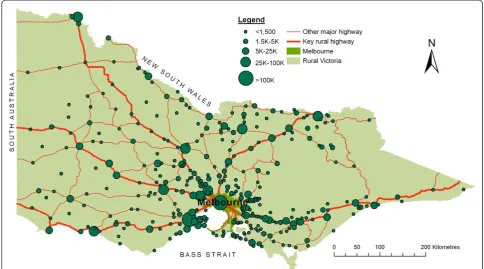
To evaluate the 2SFCA method improvements, access scores are calculated using general practitioner (GP) ser-vice data in the state of Victoria, Australia (see Figure 2). Victoria has a total area of 227,000 square kilometres and 2011 population in excess of 5½ million (of which some 35% reside outside of its major city of Melbourne). Firstly, population size and location data were obtained from the 2006 national census, using the smallest geo-graphical unit of ‘collection districts’ (CDs) which contain an average population of approximately 500
Table 1 McGrail and Humphrey’s rules to define the variable application of distance-decay to service catchments (Step 1)
Rule Explanation Outcome
1. Population within 10 minutes of the service Initial (local neighbourhood) catchment without distance decay No decay
2. Population linked to their nearest 25 services Services likely to provide access to populations (beyond 10 minutes) that have few alternative options
No decay
3. Population <5000and< 0.5 population of the Service town
Services in larger towns likely to provide access to significantly smaller nearby populations, but not vice-versa
No decay
4.All other scenarios Services less likely to provide access to populations as distance increases. Decay Figure 1Decay function (weighting) versus distance (minutes).
residents. Secondly, lists of GP locations (street address) and full-time equivalence counts were obtained from the Medical Directory of Australia (2006 records), a dataset which is updated every six months and promoted as being over 99% accurate and over 90% complete. Thirdly, proximity between geo-coded GP locations and population (CD) centroids was calculated using road networks and the ‘Closest Facility’ tool of the Network Analysis module of ArcView 9.1, with travel time imped-ance captured by combining road section lengths and approximate section travel speeds. Based on the notion of the ‘golden hour’ rule [47,48], a maximum catchment size of 60 minutes was used, and bordering data up to one catchment in width, from the neighbouring states of New South Wales and South Australia, were also included to take account of cross-border access at the edges of the study area.
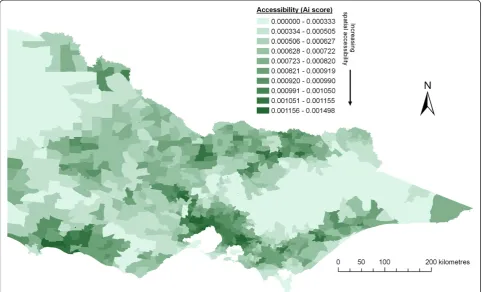
Resultant access scores were calculated using the ori-ginal (crude) 2SFCA method in combination with tested improvements as previously described. As a baseline com-parison, Figure 3 shows the results of applying Luo and Wang’s crude 2SFCA method across the whole state of Victoria, that is, before the inclusion of any ‘ improve-ments’. All access scores are assessed against a five-level community population size scale, which align closely with natural break points of primary care service provision in Australia [49,50]. Specifically, these are: (1) very small rural: <1,500 residents (none or limited GP services within
community); (2) small rural: 1,500–4,999 residents (nar-row choice of GP services within community); (3) medium rural: 5,000–24,999 residents (moderate choice of GP ser-vices within community); (4) large rural: 25,000–99,999 residents (wide choice of GP services within community); (5) metropolitan: >100,000 residents.
Results
Outcomes: improvement 1–addition of distance decay
function
function has strengthened the association between both large populations and increased access, and between small populations and decreased access.
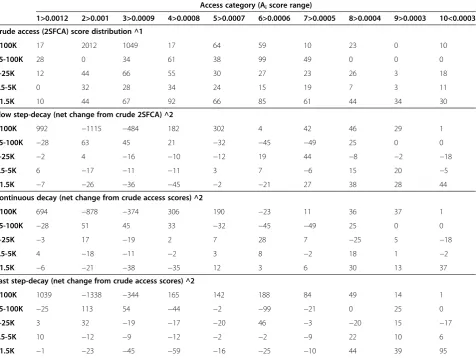
The three distance-decay functions revealed only minor differences to the change of access scores in Table 2 across the four rural groupings, though it must be noted these are net population changes and don’t ne-cessarily apply to the same geographic regions. In par-ticular, there is a high correlation for changes between the slow step-decay and continuous decay functions. Figure 1 shows that these functions have similar shapes thus their level of similarity in resultant access scores is not altogether surprising. Closer assessment reveals a slight bias towards higher access scores in rural popula-tions using the continuous function, which is likely due to its slower decay beyond 30 minutes. Specific to the fast step-decay function, two moderate differences are observed. Firstly, in the smallest rural group (<1.5K) there is a considerable increase in the size of the poorest access group. This occurs because as distance-decay is applied more quickly (at Step 2), populations who are required to travel further to access distant services are affected most and thus their access scores decrease most. The second noticeable difference in rural popula-tions is a small increase in the two highest access cat-egories (1st and 2nd). This occurs because a faster
distance-decay (applied at Step 1) causes decreased de-mand from distant populations (that is, it decreases the denominator in Equation 1), the result of which is inflated access scores.
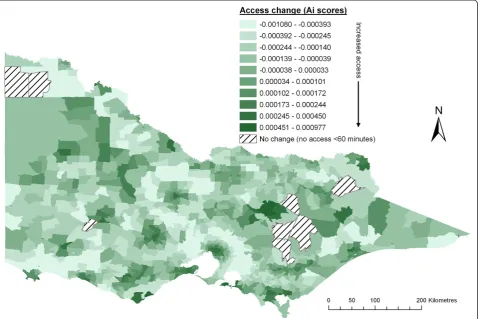
The introduction of a distance decay function has had the greatest effect (population size) within metropolitan centres (>100K). This is largely explained by the crude 2SFCA method allocating most metropolitan populations to only the 2nd and 3rd access categories. After applying any one of the distance-decay functions, the highest access category has increased greatly (694K–1039K), mostly at the expense of the 2ndaccess category whilst the 4thand 5thcategories have increased significantly (142K– 306K) at the expense of the 3rdaccess category. Meanwhile, the lowest 5 access categories for metropolitan populations have all increased slightly, with the fast step-decay func-tion seeing the largest increase in poorer access scores. Notably, Figure 4 demonstrates a very strong geographical pattern within metropolitan Melbourne, with the largest access gains located in the geographical centre whilst the largest losses are all located in the outer-urban / rural-fringe areas with a clear concentric pattern of decreasing ‘access’from the centroid to the metropolitan-fringe. This suggests that with the addition of distance-decay function, the 2SFCA method is now largely measuring ‘choice’ in metropolitan areas. In the next section, which assesses the Figure 3Results from applying the crude 2SFCA method across all of Victoria.
addition of a variable catchment size function, the slow step-decay function has been included.
Outcomes: improvement 2–addition of variable
catchment size function / variable inclusion of distance decay
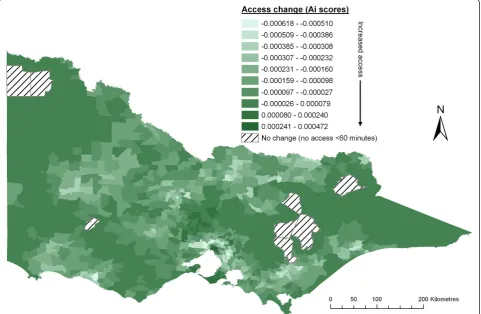
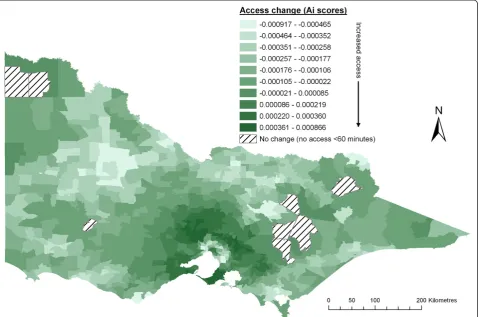
Figures 5 and 6 respectively show the change to access scores across different geographic regions with the addition of either Luo’s or McGrail’s variable catchment size function. Outcomes from applying these functions are further summarised across five population size groupings in Table 3 and many differences between these functions are apparent.
Arguably the greatest need for a variable catchment size function is within metropolitan-fringe areas. It was seen in Figure 4 that the resultant change from applying a
distance-decay function alone in these areas was consist-ently decreasing access scores moving out from the city centre to metropolitan-fringe populations. This is chiefly because the 2SFCA method, prior to adding a variable catchment size function, models metropolitan-fringe loca-tions as being ‘swamped’ by inner-metropolitan popula-tions travelling out to these fringe (and nearby rural) locations, guaranteeing their lower access scores. Both functions (Luo’s and McGrail’s) rectify this problem to varying degrees. McGrail’s Step 1 distance-decay function rules (Table 1) have reversed much of the drop in access scores in metropolitan-fringe areas, though its validity is difficult to assess. Luo’s simpler approach too increases ac-cess in many metropolitan-fringe areas, but is less effective for two reasons. Firstly, their constant use of a 250K ser-vice catchment ensures metropolitan-fringe populations
Table 2 Distribution of crude access (2SFCA) scores and resulting change of access scores with the addition of three different distance-decay functions, by population size
Access category (Aiscore range)
1>0.0012 2>0.001 3>0.0009 4>0.0008 5>0.0007 6>0.0006 7>0.0005 8>0.0004 9>0.0003 10<0.0003 Crude access (2SFCA) score distribution ^1
>100K 17 2012 1049 17 64 59 10 23 0 10
25-100K 28 0 34 61 38 99 49 0 0 0
5-25K 12 44 66 55 30 27 23 26 3 18
1.5-5K 0 32 28 34 24 15 19 7 3 11
<1.5K 10 44 67 92 66 85 61 44 34 30
Slow step-decay (net change from crude 2SFCA) ^2
>100K 992 −1115 −484 182 302 4 42 46 29 1
25-100K −28 63 45 21 −32 −45 −49 25 0 0
5-25K −2 4 −16 −10 −12 19 44 −8 −2 −18
1.5-5K 6 −17 −11 −11 3 7 −6 15 20 −5
<1.5K −7 −26 −36 −45 −2 −21 27 38 28 44
Continuous decay (net change from crude access scores) ^2
>100K 694 −878 −374 306 190 −23 11 36 37 1
25-100K −28 51 45 33 −32 −45 −49 25 0 0
5-25K −3 17 −19 2 7 28 7 −25 5 −18
1.5-5K 4 −18 −11 −2 3 8 −2 18 1 −2
<1.5K −6 −21 −38 −35 12 3 6 30 13 37
Fast step-decay (net change from crude access scores) ^2
>100K 1039 −1338 −344 165 142 188 84 49 14 1
25-100K −25 113 54 −44 −2 −99 −21 0 25 0
5-25K 3 32 −19 −17 −20 46 −3 −20 15 −17
1.5-5K 10 −12 −9 −12 −2 −2 −9 22 10 6
<1.5K −1 −23 −45 −59 −16 −25 −10 44 39 95
All figures within the table are‘000s.
^1: These values represent the size (‘000s) of the population with these access scores. Row totals correspond to the total Victorian population residing in the 5 population size groups.
continue to‘swamp’nearby rural services. Secondly, their function which expands the population catchment only until a minimum access level (<1:3500) is reached is prob-lematic because in nearby rural areas it is highly likely that local populations can and will choose to travel a little fur-ther into metropolitan-fringe areas to access services. Thus the‘real’access score should be larger in these areas than their function allows.
In all rural population groups, Table 3 shows that Luo’s approach has reduced access levels for more of the popu-lation compared to McGrail’s approach. For example, in 5-25K rural towns Luo’s model has increased a net total of 126K into the lowest 6 access categories (<0.0008) whilst the comparative net movement in McGrail’s model to the same 6 access categories is 59K. This pattern is consistent in all five population size groupings, to various degrees and is predominantly due to Luo’s use of the population catchment size minimum PPR rule (>1:3500 as applied to Step 2), whilst their Step 1 rule has virtually no effect in rural areas. Interestingly, the opposite application occurs in McGrail’s model with their rule of limiting the popula-tion catchment to the nearest 100 services (as applied to Step 2) having virtually no effect in rural areas, whilst their Step 1 rules (Table 1) greatly affect rural access scores.
Visually, changes in rural access scores are quite differ-ent using either Luo’s (Figure 5) or McGrail’s (Figure 6) approach. Closer investigation of Figure 6 (McGrail’s approach) reveals that many areas showing the largest decrease in access accord directly with areas of largest increase in access in Figure 4. That is, for many areas there is a direct ‘correction’ from first applying the distance-decay function, then adding the variable catch-ment size function. This is explained by the Step 1 rules (Table 1) which purposefully aim to improve the deter-mination of when, or if, the distance-decay function should be applied. Resultant access changes from Luo’s approach (Figure 5) have no apparent relationship to the distance-decay function (Figure 4).
Discussion
This paper has critically evaluated current and recent work by a number of different researchers who have devel-oped new methodologies aimed at improving the 2SFCA method. Generally, these improvements aim to address one of two deficiencies of Wang and Luo’s original (crude) 2SFCA method: (1) accounting for distance decay within a catchment; and (2) enabling variable catchment sizes or variable application of distance-decay.
Figure 4Change after addition of slow step distance decay function (compared to crude 2SFCA method).
To date, most 2SFCA method improvements relate to the addition of a distance-decay function, with a general acceptance that its omission is highly problematic. This paper provides the first evidence of the effect of applying one of three related distance-decay functions, and most significantly their application across large geographic regions of both rural and metropolitan populations. Des-pite some criticisms of the step-decay function having a sudden drop in access at the edge of each zone, these results showed relatively minor differences when com-paring the continuous and slow-zone functions, particu-larly in more sensitive rural areas. A continuous-decay function may intuitively be preferable to a step-decay function, but it is difficult to define an appropriately shaped function that matches ‘real’ behaviour of the population (chiefly because of poor empirical evidence for health care seeking behaviour). Figure 1 suggests that the decay weighting of the tested continuous function may be too slow, particularly for a distance barrier of 30–60 minutes. In contrast, the consequence of choos-ing a faster step-decay function in rural areas has (per-haps wrongly) increased the proportion of low-access scores within small rural areas (<25K) and somewhat
increased the proportion of high access scores in larger rural areas (25-100K).
Importantly, the application of any distance-decay func-tion without the simultaneous use of a variable catchment size function creates a strong concentric pattern of high to low access scores out through metropolitan-fringe and into nearby rural areas. This ‘overcorrection’ in metropolitan-fringe areas can be rectified by adding a vari-able catchment size function, so that more realistic move-ments of these populations are captured in the modelling. Furthermore, it is not clear that distance / time barriers are viewed consistently by all populations within different geographical settings, thus it is questionable whether the same distance-decay function would apply to all. For ex-ample, residents in isolated and vastly settled areas are likely to have a higher ‘tolerance’ of travelling further to access services versus residents in closely settled or largely populated areas.
Figure 6Change after addition of McGrail and Humphreys’variable catchment size function (compared to crude 2SFCA method with slow step-decay).
Table 3 Resultant change of access scores with the addition of two different variable catchment size functions, by population size
Access category (Aiscore range)
1>0.0012 2>0.001 3>0.0009 4>0.0008 5>0.0007 6>0.0006 7>0.0005 8>0.0004 9>0.0003 10<0.0003 Luo and Whippo’s approach (net change from crude access scores with slow-step decay)^1
>100K −250 −600 −521 127 −74 255 624 326 125 −11
25-100K 0 −63 −79 −55 67 67 34 29 0 0
5-25K −10 −47 −44 −25 21 46 13 17 28 1
1.5-5K −6 −9 −6 −11 −13 5 32 0 1 7
<1.5K −3 −15 −29 −30 −38 1 18 34 32 29
McGrail and Humphreys’approach (net change from crude access scores with slow-step decay)^1
>100K −406 −480 −313 201 363 452 185 37 −29 −11
25-100K 0 −35 −47 39 31 8 29 −25 0 0
5-25K −10 −41 −18 9 41 6 −16 14 10 4
1.5-5K −6 −7 −15 7 −6 10 11 13 −8 0
<1.5K −2 −11 −17 −14 7 4 −13 2 13 30
All figures within the table are‘000s.
^1: The base (comparison) model is a crude 2SFCA method with the addition of a slow step-decay function. These values represent the net population change (‘000s) within each population size group to the corresponding access scores following the addition of each distance-decay function. Negative values indicate a net drop in the number of residents with access scores in that category. All row totals equal 0.
minimum 10 minutes), whilst Luo’s method limits ser-vice catchments (applied at Step 1) to the nearest 250K residents (or minimum 10 minutes). Both of these approaches have full effect in metropolitan areas, no ef-fect in rural areas and varying efef-fect in metropolitan-fringe and nearby rural areas. Luo’s use of a minimum accessibility rule to define population catchment sizes (applied at Step 2) is problematic in how effectively it adjusts access scores. This was most apparent in metropolitan-fringe areas, where access scores were sig-nificantly lower using Luo’s method, but it is arguable whether these populations would readily travel a small distance further to access metropolitan-based services areas, and so their access scores have been capped in-appropriately. McGrail’s approach to service catchments (applied at Step 1) does not use a single size for all populations, unlike Luo’s constant use of 250K, but in-stead defines a set of four rules which account for neigh-bouring populations and service competition. Whilst these rules attempt to better match ‘real’supply behav-iour, further independent assessment is required.
The key limitation to this study is the lack of available empirical data on ‘real’ health service access behaviour and its relationship to geography. The 2SFCA method requires assumptions of catchment size, distance-decay and the variable application of these across metropolitan and rural populations; however, to date most applications of the 2SFCA method have not been verified against em-pirical access behaviour data. An additional related limita-tion is that it’s not known whether this paper’s findings (based on the state of Victoria, Australia) readily translate to other geographical settings and countries.
Most academic papers describing methodological developments or improvements such as those for the 2SFCA method underestimate the importance of the specifics of the geography under consideration. One of the difficulties of calculating spatial accessibility is mod-elling across vastly different population densities and dispersions. A key strength of the 2SFCA method is that it can be readily applied to both metropolitan and rural populations. However, this‘flexibility’can also be one of its weaknesses when applied simultaneously across all geographies. Catchment size or distance-decay rules that readily apply in densely populated areas generally don’t apply in sparsely populated areas, and vice-versa. For this reason, the inclusion of a variable catchment size methodology, which is missing from the new standard E2SFCA method, is vital to the wider application of the 2SFCA method to health policies relating to healthcare access and primary health care service provision. This paper has provided further evidence relating to the in-clusion and choice of both a distance-decay function as well as a variable catchment size function, highlighting in particular that large scale applications of the 2SFCA
method require closer attention to their defining of population and service catchments.
Competing interests
There are no competing interests.
Acknowledgements
The research reported in this paper is a project of the Centre of Research Excellence (CRE) in accessible and equitable primary health service provision in rural and remote Australia funded by the Australian Primary Health Care Research institute, which is supported by a grant from the Commonwealth of Australia as represented by the Department of Health and Ageing. The information and opinions contained in it do not necessarily reflect the views or policy of the Australian Primary Health Care Research Institute or the Commonwealth of Australia (or the Department of Health and Ageing). I would also like to acknowledge the invaluable support from Emeritus Professor John Humphreys, Monash University School of Rural Health.
Received: 18 September 2012 Accepted: 6 November 2012 Published: 16 November 2012
References
1. United Nations General Assembly:The universal declaration of human rights. [http://www.un.org/en/documents/udhr/index/html].
2. Grad FP:The preamble of the constitution of the World Health Organization.B World Health Organ2002,80:981–984.
3. Department of Health and Aged Care:Reforming the Australian health care system: the role of government. Canberra: DHAC; 1999.
4. President’s Commission for the study of ethical problems in medicine and biomedical and behavioral research:Securing access to health care: The ethical implications of differences in the availability of health services. Washington DC: President's Commission; 1983.
5. Aday LA, Andersen RM:Equity of access to medical care: a conceptual and empirical overview.Med Care1981,19:4–27.
6. Rogers A, Flowers J, Pencheon D:Improving access needs a whole systems approach.Br Med J1999,319:866–867.
7. Ansari Z:A review of literature on access to primary health care.Aust J Prim Health2007,13:80–95.
8. Gulzar L:Access to health care.J Nurs Scholarship1999,31:13–19. 9. Norris TL, Aiken M:Personal access to health care: a concept analysis.
Public Health Nurs2006,23:59–66.
10. Guagliardo MF:Spatial accessibility of primary care: concepts, methods and challenges.Int J Health Geogr2004,3:3.
11. Wang F, Luo W:Assessing spatial and nonspatial factors for healthcare access: towards an integrated approach to defining health professional shortage areas.Health Place2005,11:131–146.
12. Khan AA, Bhardwaj SM:Access to health care: a conceptual framework and its relevance to health care planning.Eval Health Prof1994,17:60–76. 13. Penchansky R, Thomas JW:The concept of access: definition and
relationship to consumer satisfaction.Med Care1981,19:127–140. 14. McGrail MR, Humphreys JS:Measuring spatial accessibility to primary care
in rural areas: improving the effectiveness of the two-step floating catchment area method.Appl Geogr2009,29:533–541.
15. Luo W, Wang F:Measures of spatial accessibility to health care in a GIS environment: synthesis and a case study in the Chicago region.Environ Plann B2003,30:865–884.
16. Langford M, Higgs G:Measuring potential access to primary healthcare services: the influence of alternative spatial representations of population.Prof Geogr2006,58:294–306.
17. World Health Organisation:Declaration of Alma-Ata, International conference on primary health care; Alma-Ata, USSR. Geneva: WHO; 1978. 18. Starfield B, Shi L, Macinko J:Contribution of primary care to health
systems and health.Milbank Q2005,83:457–502.
19. Luo W:Using a GIS-based floating catchment method to assess areas with shortage of physicians.Health Place2004,10:1–11.
20. Bagheri N, Benwell GL, Holt A:Primary health care accessibility for rural Otago:“a spatial analysis”. Online: Health Care Inform Rev; 2006. 21. Brown SR:Are Oklahoma city residents ok? A socio-spatial analysis of
22. Langford M, Higgs G, Radcliffe J, White S:Urban population distribution models and service accessibility estimation.Comput Environ Urban2008,
32:66–80.
23. McLafferty S, Wang F:Rural reversal? Rural–urban disparities in late-stage cancer risk in Illinois.Cancer2009,115:2755–2764.
24. Ngui AN, Apparicio P:Optimizing the two-step floating catchment area method for measuring spatial accessibility to medical clinics in Montreal. BMC Health Serv Res2011,11:166.
25. Mao K, Li M, Huang Q, Chen C, Hu W, Chen D:Evaluation of spatial accessibility to town and rural in a GIS environment: a case study of Dachang county, 19th International Conference on Geoinformatics. Shanghai, China: Institute of Electrical and Electronics Engineers (IEEE); 2011.
26. Roeger LS, Reed RL, Smith BP:Equity of access in the spatial distribution of GPs within an Australian metropolitan city.Aust J Prim Health2010,
16:284–290.
27. Yang D-H, Goerge R, Mullner R:Comparing GIS-based methods of measuring spatial accessibility to health services.J Med Syst2006,30:23–32. 28. Cervigni F, Suzuki Y, Ishii T, Hata A:Spatial accessibility to pediatric
services.J Commun Health2008,33:444–448.
29. Liu Y, Wong SY, Jin T:Equality of spatial access to primary health services for Singapore’s baby boomers.Asian Popul Stud2009,5:171–188. 30. Bell S, Wilson K, Bissonnette L, Shah TI:Access to primary health care: Does
neighborhood of residence matter?Ann Assoc Am Geog2012, In Press. 31. Bissonnette L, Wilson K, Bell S, Shah TI:Neighbourhoods and potential
access to health care: The role of spatial and aspatial factors.Health Place
2012,18:841–853.
32. Dai D, Wang F:Geographic disparities in accessibility to food stores in southwest Mississippi.Environ Plann B2011,38:659–677.
33. Langford M, Fry R, Higgs G:Measuring transit system accessibility using a modified two-step floating catchment technique.Int J Geogr Inf Sci2012,
26:193–214.
34. Luo W, Qi Y:An enhanced two-step floating catchment area (E2SFCA) method for measuring spatial accessibility to primary care physicians. Health Place2009,15:1100–1107.
35. McGrail MR, Humphreys JS:The index of rural access: an innovative integrated approach for measuring primary care access.BMC Health Serv Res2009,9:124.
36. Macinko J, Starfield B, Shi L:Quantifying the health benefits of primary care physician supply in the United States.Int J Health Serv2007,37:111–126. 37. Gorey KM, Luginaah IN, Holowaty EJ, Fung KY, Hamm C:Associations of physician supplies with breast cancer stage at diagnosis and survival in Ontario, 1988 to 2006.Cancer2009,115:3563–3570.
38. Wang F:Measurement, optimization and impact of health care accessibility: a methodological review.Ann Assoc Am Geog2012,
102:1104–1112.
39. Zhan Q, Wang X, Sliuzas R:A GIS-based method to assess the shortage areas of community health service—Case study in Wuhan, China, 2011 International Conference on Remote Sensing, Environment and Transportation Engineering (RSETE). Nanjing, China: Institute of Electrical and Electronics Engineers (IEEE); 2011.
40. Wan N, Zhan FB, Zou B, Chow E:A relative spatial access assessment approach for analyzing potential spatial access to colorectal cancer services in Texas.Appl Geogr2012,32:291–299.
41. Wan N, Zou B, Sternberg T:A 3-step floating catchment area method for analyzing spatial access to health services.Int J Geogr Inf Sci2012,
26:1073–1089.
42. Schuurman N, Berube M, Crooks VA:Measuring potential spatial access to primary health care physicians using a modified gravity model.Can Geogr2010,54:29–45.
43. Dai D:Black residential segregation, disparities in spatial access to health care facilities, and late-stage breast cancer diagnosis in metropolitan Detroit.Health Place2010,16:1038–1052.
44. Luo W, Whippo TL:Variable catchment sizes for the two-step floating catchment area (2SFCA) method.Health Place2012,18:789–795. 45. Humphreys J, Mathews-Cowey S, Weinand HC:Factors in accessibility of
general practitioners in rural Australia.Med J Aust1997,166:577–580. 46. McGrail MR, Humphreys JS:A new index of access to primary care
services in rural areas.Aust NZ J Pub Health2009,33:418–423. 47. Billi JE, Pai C-W, Spahlinger DA:The effect of distance to primary care
physician on health care utilization and disease burden.Health Care Manage R2007,32:22–29.
48. Lerner EB, Moscati RM:The golden hour: scientific fact or medical“urban legend”?Acad Emerg Med2001,8:758–760.
49. Humphreys JS, McGrail MR, Joyce CM, Scott A, Kalb G:Who should receive recruitment and retention incentives? Improved targeting of rural doctors using medical workforce data.Aust J Rural Health2012,20:3–10. 50. McGrail MR, Humphreys JS:Geographical classifications to guide rural
health policy in Australia.Aust NZ Health Policy2009,6:28.
doi:10.1186/1476-072X-11-50
Cite this article as:McGrail:Spatial accessibility of primary health care utilising the two step floating catchment area method: an assessment of recent improvements.International Journal of Health Geographics2012
11:50.
Submit your next manuscript to BioMed Central and take full advantage of:
• Convenient online submission
• Thorough peer review
• No space constraints or color figure charges
• Immediate publication on acceptance
• Inclusion in PubMed, CAS, Scopus and Google Scholar
• Research which is freely available for redistribution
Submit your manuscript at www.biomedcentral.com/submit