Structural Studies of Some Borate Glasses Using
Spectroscopy Technique
L. Balu1, R. Amaravel2 and R. Ezhil Pavai2
1Govt. Arts College,
C. Mutlor, Chidambaram, Tamil Nadu, INDIA. 2Department of Physics,
Annamalai University,Annamalainagar-608 002, Tamil Nadu, INDIA. email:[email protected].
(Received on: November 5, 2016)
ABSTRACT
Glass samples with composition 70B2O3 – (30-x)Bi2O3 – xMnO2 (where
x=5, 10, 15, and 20mol%), have been synthesized by conventional melt quench technique. The amorphous nature of the glass samples was confirmed by XRD measurement. The density of the samples has been measured using relative measurement method. The analysis of FTIR spectra of the samples depicts that the glass network is built up of BO3 and BO4 units. Introduction of MnO2 into the glass
matrix leads to the conversion of BO3 trigonal units into BO4 tetrahedral units, which
results a decrease in the degree of disorder in the glass network and makes the glasses more stable. Thermal stability of the glass samples was measured using DTA.
Keywords: X-ray diffraction, FTIR spectroscopy, DTA.
1. INTRODUCTION
The influence of manganese ions on optical, magnetic and electrical properties of various inorganic glasses system has been under extensive investigation in recent year10,11. A commendable work on the structural role of manganese ions in Bi2O3 based glass system has been carried out by (Ardelean, I. 2005)12. Bismuth borate glasses are great in potential for their industrial and technological applications, infrared transmitting materials or as active medium of Raman fiber optical amplifiers and oscillators13.
In this investigation we report on detailed analysis of spectroscopic and thermal analysis of ternary B2O3-Bi2O3-MnO2glass system. The x-ray diffraction is used to study the glassy nature of the samples. Infrared (IR) transmission spectra have been studied for obtaining the structural information of these glasses. The thermal behavior of the prepared glass were studied by differential thermal analysis (DTA) and correlated with their structure.
2. EXPERIMENTAL PROCEDURE
2.1. Glass Preparation
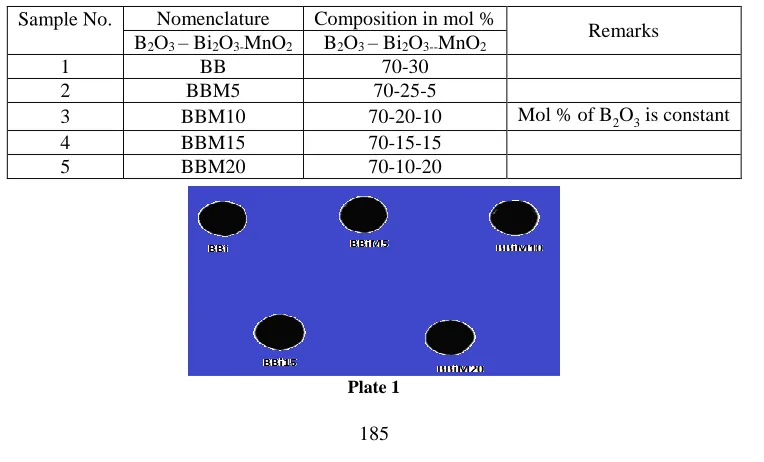
60B2O3-(40-x)Bi2O3-xMnO2 (where x= 0, 5, 10, 15 and 20 mol%) glasses were prepared using melt-quenching technique. The Analytical reagent grade powders of boron trioxide (B2O3), bismuth oxide (Bi2O3) and manganese oxide (MnO2) were mixed in the appropriate composition. The powders were mixed thoroughly and then melted in a silica crucible for 3 hours in muffle furnace at 1010 ºC. The melt was poured into a brass mould to form samples of dimensions 10mm diameters and 6mm thickness. Glass samples were annealed at 475 ºC for 2 hours to avoid the mechanical strain developed during the quench process. Then the furnace was switched off and glass was allowed to cool gradually to room temperature. Nomenclature and composition in mol% are given in Table1 and the photograph a given in plate1.
Table 1 Nomenclature and composition of glasses
Sample No. Nomenclature Composition in mol %
Remarks B2O3 – Bi2O3-MnO2 B2O3 – Bi2O3--MnO2
1 BB 70-30
2 BBM5 70-25-5
3 BBM10 70-20-10 Mol % of B2O3 is constant
4 BBM15 70-15-15
5 BBM20 70-10-20
3. RESULTS AND DISCUSSION
3.2 XRD
The amorphous nature of the glass samples is confirmed by X-ray diffraction technique. No sharp peaks are observed in X-ray diffraction patterns, which are a sign of amorphous materials.
Fig. 1. (a)X-ray diffractogram of BBM5 and BBM20 glasses
3.3 FTIRStudy
The infrared spectra of 70B2O3 – (30-x) Bi2O3 –xMnO2 glasses are recorded at room temperature in the frequency range between 4000 and 400cm-1 as shown in Figs. 2. The observed bands along with their vibrational assignments of samples have been tabulated in Table 2. The obtained broad bands may confirm the amorphous nature of the studied glass samples and are in agreement with XRD.
The well-known characteristic band (at 806 cm-1) of vitreous B
2O3 is assigned to the symmetric stretching vibrations of the boroxol rings. The peak at 806 cm-1 is found missing in the FTIR spectra of BBM glass, which indicates the absence of boroxol rings in the glass network. The addition of Bi2O3 to B2O3 breaks these rings and hence consists of only BO3 and BO4 groups (15). In BBM glass.512 Bi-O bonds in BiO6 units. The band at 702 cm-1 is assigned to the B-O-B bending vibrations of BO
3 groups16.The broad band at 1032 cm-1 is due to B-O bond stretching of BO
Fig. 2. FT-IR spectra of BBM glasses with different concentrations of MnO2
Table 2. Band positions and their corresponding assignments of infrared spectra of BBM glass system Wavenumber cm-1 Assignment
~1384 Asymmetric stretching of B-O of trigonal BO3
~1032 B-O stretching of BO4 tetrahedra
~702 Bending vibrations of B-O-B linkage ~512 Bi-O bonds in BiO6 units.
~488 Vibration of metal cations such as Mn2+
4. THERMAL BEHAVIOUR OF BBiM5 and BBiM20 GLASSES
4.1 Differential thermal analysis
(i) BBiM5 and BBiM20 glasses
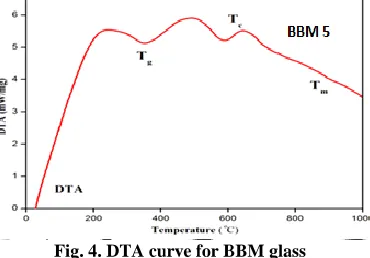
Figs.3 and 4 show the differential thermal analysis curve for BBiM5 and BBiM20 glasses. The DTA curve exhibits a small endothermic hump at lower temperature in the glass samples (BBM5 and BBM20), which are characteristic of glass transition temperature (Tg) region followed by a single exothermic peak at high temperature and is characteristic of crystallization temperature (Tc). The exothermic peak is followed by endothermic peak, which is characteristic of the melting temperature (Tm).
Fig. 4.1 DTA curve for BBM20 glass
Glass transition temperature is one of the fundamental properties related to the viscosity of the glass and considerably dependent on the composition of the glass. The values of Tg, Tc and Tm increases from 333 ºC to 370 ºC, 646 ºC to 721 ºC and 878 ºC to 921 ºC with the introduction of MnO2 into BBM glass matrix respectively. The increase in the values of Tg, Tc and Tm implies that the number of bridging oxygen increases. The increasing values of Tg, Tc and Tm indicates favors for the formation of bridging oxygen in the present glass system. The glass stability factor and Hruby’s parameter values of BBiM20 glass are stable when compared BBiM glass.
Table 3. Values of glass transition temperature, crystallization temperature, melting temperature, thermal stability and Hruby’s parameter of various glass samples
Name of the sample
Glass transition temperature (◦C)
Crystallization temperature (◦C)
Melting temperature
(◦C)
Thermal stability
(S)
Hruby’s parameter
(Kg1)
BBM5 333 646 878 313 0.611
BBM 20 370 721 921 412 0.743
5. CONCLUSION
The conclusions drawn from these studies for BBM glass system are summarized below: (i) X-Ray diffraction pattern shows the amorphous behaviour of the prepared samples. (ii) FT-IR confirmed the existence of trigonal and tetrahedral borate groups with an
establishment of Bi-O bonds in [BiO6] units.
(iii)The thermal stability of the investigated glass systems increase with the addition of MnO2 content. The stability of the glasses is in the order of BBM5< BBM20.
REFERENCES
1. Li, C. and Q. Su, Action of co-dopant in electron- trapping materials: The case of Sm3+ in Mn2+ activated zinc borosilicate glasses. Appl. Phys. Lett., 85(12): 2190-2192 (2003). 2. Ahmad, F., E. Hassan Aly, M. Atef and M.M. Elokr, Study the influence of zinc oxide
3. Marzouk M.A., F.H. ElBatal, W.H. Eisa and N.A. Ghoneim, Comparative spectral and shielding studies of binary borate glasses with the heavy metal oxides SrO, CdO, BaO, PbO or Bi2O3 before and after gamma irradiation, J. Non-Cryst. Solids, 387(1):155-160 (2014).
4. Gurinder Pal Singh, Parvinder Kaur, Simranpreet Kaur, Deepawali Arora, Prabhjot Singh and D.P. Singh, Density and FT-IR studies of multiple transition metal doped borate glass.
Materials Physics & Mechanics, 14: 31-36.
5. Mazurin O.V., Glass properties: Compilation, evaluation and prediction. J. Non-Cryst. Solids, 351(12-13): 1103-12 (2005).
6. Rama Sundari G., D.V. Sathish, T. Raghavendra Rao, Ch. Rama Krishna,Ch. Venkata Reddy & R.V.S.S.N. Ravikumar, Characterization of Fe3+ doped mixed alkali zinc borate glasses-Physical and spectroscopic investigations, J. Non-Cryst. Solids, 365(1): 6-12 (2013).
7. Margaryan, A., J.H. Choi and F.G. Shi, Spectroscopic properties of Yb3+ in heavy metal contained flurophosphates glasses. Appl. Phys. B, 78: 409-413 (2004).
8. Van Die, A., A.C.H.I. Leenaers, G. Blasse and W.F. Van Der Weg, Germanate glasses as hosts for luminesences of Mn2+ and Cr3+. J. Non-Cryst. Solids, 99: 32-44 (1988).
9. Lee, J.D., Concise inorganic chemistry. Blackwell Science, Oxford, (1996).
10. Studies on ternary Li2SO4-Li2O-P2O5 glasses, J. Non-Cryst. Solids, 243, 251-267 (1999). 11. Mackenzie, R.C. (edn.) 2, Academic Press, London. (1969).
12. Ardelean, Simona Cora and Dorina Rusa, EPR and FT-IR spectroscopic studies of Bi2O3 -B2O3-CuO glasses. Physica B, 403: 3682-3685 (2008).
13. Young Han Kim, Mi Young Yoon, Eun Jung Lee and Hae Jin Hwang, Effect of SiO2/B2O3 ratio on Li ion conductivity of a Li2O-B2O3-SiO2 glass electrolyte. Journal of Ceramic
processing Research., 13(1): 37-41 (2012).
14. Ardelean, I., Simona Cora and V. Ioncu, Structural investigation of CuO-Bi2O3-B2O3 glasses by FT-IR, Raman and UV-VIS spectroscopies. J. Optoelect. & Advan. Mater., 85: 1843-1847 (2006).
15. Rupesh Kumar A., T.G.V.M. Rao, N. Veeraiah and M. Rami Reddy, Optical and Dielectric Properties of Mn2+ & Co2+:B
2O3-ZnO-MgO Glasses Opt. Mater., 35(3): 402-406 (2013). 16. Lakshmi Kumari, J., J. Santhan Kumar and Sandhya Cole, Spectral investigations on V2+ ion doped in CaO-SrO-Na2O-B2O3 glass systems. J. Non-Cryst. Solids, 357: 3734-3739 (2011).
17. Gopi Sharma, Kulwant Singh, Manupriya, Shaweta Mohan, Harvinder Singh and Sukhleen Bindra, Effects of gamma irradiated on optical and structural properties of PbO-Bi2O3-B2O3 glasses. Radiation Physics & Chemistry, 75: 959-966 (2006). 18. Manisha Pal, Baishakhi Roy and Mrinal Pal, Structural characterization of borate glasses