Curriculum 1. Civil and Environmenta
l Engineering
Merzari Fabio
Hydrothermal Processes Applied
to Sludge Reduction
Doctoral School in Civil, Environmental and Mechanical Engineering
Doctoral Programme in Civil, Environmental and
Mechanical Engineering
HYDROTHERMAL PROCESSES
APPLIED TO SLUDGE REDUCTION
Supervisors
PhD Candidate
Prof. Eng. Andreottola Gianni
Merzari Fabio
Prof. Eng. Fiori Luca
Abstract
Conventional Activated Sludge (CAS) systems have been widely imple-mented to treat wastewater. CAS systems produce huge amounts of waste sludge and its subsequent treatment represents up to 65 % of the operational costs of Waste Water Treatment Plants. The nal disposal of sludge is usually performed by landlling or incineration, involving severe environmental issues. In order to reduce sludge amount, many studies have been conducted, developing new technologies. One of these tech-nologies is HydroThermal Carbonisation (HTC), where sludge is heated up to 180-250 at water vapour pressure producing a solid product en-riched in carbon for dierent possible exploitations. The aim of this work is to apply HTC to dierent kinds of sludge such as thickened sludge, digested sludge and dewatered sludge and compare the behaviour of the solid and liquid phases produced by the process. For the purpose, exper-imental tests were performed at dierent operating conditions in a lab batch reactor capable to withstand high pressure (140 bar) and tempera-ture (300 ). In order to compare the HTC products of the dierent kinds of sludge, the hydrochars from HTC at dierent operative conditions were characterized in order to explore possible application of hydrochar and HTC process water.
Contents
0 Research Object and Thesis outline 1
0.1 Research Object . . . 1
0.2 Thesis Outline . . . 1
1 Hydrothermal Carbonisation of Sewage Sludge. A Re-view 3 1.0 Abstract . . . 3
1.1 Introduction . . . 4
1.2 Characterization of Sewage Sludge . . . 5
1.3 Hydrothermal Carbonization Process: Properties of water, chemistry, kinetics and operative parameters . . . 6
1.3.1 Properties of Water . . . 6
1.3.2 Chemistry . . . 7
1.3.3 Kinetics . . . 9
1.3.4 Operative Parameters . . . 12
1.3.4.1 Temperature . . . 12
1.3.4.2 Pressure . . . 12
1.3.4.3 Residence Time . . . 13
1.3.4.4 pH . . . 13
1.3.4.5 Solid Load . . . 14
1.3.4.6 Feedstock Composition . . . 14
1.3.4.7 Other Parameters . . . 15
1.3.5 Hydrothermal Carbonisation Plants . . . 15
1.4 Hydrothermal Carbonization Products . . . 18
1.4.1 Solid Product - Hydrochar . . . 18
1.4.1.1 Nutrients . . . 22
1.4.1.2 Heavy Metals . . . 23
1.4.2 Liquid Product . . . 23
1.4.3 Gasseous Product . . . 25
1.5 Hydrochar Applications . . . 27
1.5.1 Energetic Applications . . . 27
1.5.3 Soil Improvement . . . 28
1.5.4 Adsorbent . . . 29
1.6 Energy Assessment . . . 29
1.7 Conclusions . . . 30
2 Methane Production from Process Water of Hydrother-mal Carbonisation of Sewage Sludge. A Review 41 2.0 Abstract . . . 42
2.1 Introduction . . . 42
2.2 Hydrothermal Carbonisation (HTC) of Sewage Sludge . . 44
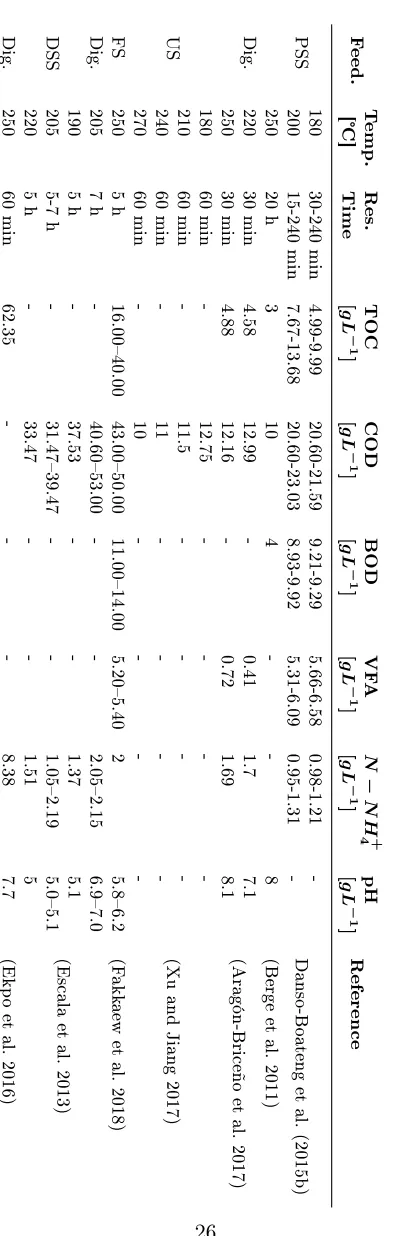
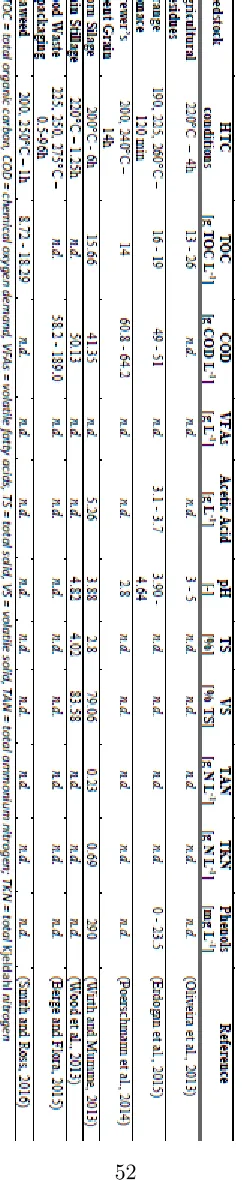
2.3 Characterization of HTC Process Water . . . 48
2.4 Valorisation of HTC process water through anaerobic di-gestion and its challenges . . . 50
2.4.1 AD Inhibitors . . . 55
2.4.1.1 pH . . . 55
2.4.1.2 VFAs and Alkalinity . . . 55
2.4.1.3 Free Ammonia . . . 56
2.4.1.4 Macro-Nutrients . . . 57
2.4.1.5 Heavy Metals . . . 57
2.4.1.6 Toxic Organic Compounds . . . 58
2.4.2 AD inoculum . . . 59
2.4.3 AD Reactors . . . 60
2.4.4 AD Temperature . . . 60
2.4.5 AD Organic Loading Rate (OLR) . . . 62
2.4.6 Biogas Production from HTC Process Water . . . 62
2.4.6.1 Bio-Methane Potential (BMP) Tests and Methane Yield . . . 63
2.4.6.2 Theoretical BMP (BMPth) . . . 67
2.4.6.3 AD Performance as a Function of HTC Process Conditions . . . 68
2.4.6.4 Kinetics Considerations . . . 69
2.5 Energy Assessments . . . 70
2.6 Economic Assessments . . . 71
2.7 Conclusions . . . 74
3 Hydrothermal Carbonisation of Biomass: Design of a Bench-Scale Reactor for Evaluating the Heat of Reaction 93 3.0 Abstract . . . 94
3.1 Introduction . . . 95
3.2 Materials and methods . . . 96
3.2.1 Experimental apparatus . . . 96
3.2.2 Experimental campaign and procedure . . . 98
CONTENTS
3.3 Results and discussion . . . 102
3.4 Conclusions . . . 105
4 Hydrothermal Carbonisation as a Thermal Treatment Strat-egy for Sewage Sludge Management 109 4.0 Abstract . . . 110
4.1 Introduction . . . 110
4.2 Material and Methods . . . 112
4.2.1 Feedstock Characterization . . . 114
4.2.2 Hydrothermal Carbonization and Product Analysis 115 4.3 Result and Discussion . . . 116
4.3.1 Product Distribution and Characterization as a Func-tion of Sludge Type and Treatment . . . 118
4.3.2 Distribution of Phosphorous and Nitrogen: Poten-tial for Use as Soil Amendment . . . 120
4.3.3 Energy Yield and Oxidative Reactivity: Potential for Use as Solid Fuel . . . 121
4.3.4 Dewaterability . . . 126
4.3.5 Further Considerations . . . 126
4.4 Conclusions . . . 127
5 Anaerobic Biodegradability of Hydrothermal Converted Sewage Sludge 139 5.0 Abstract . . . 139
5.1 Introduction . . . 140
5.2 Material and Methods . . . 141
5.2.1 Analytical methods . . . 141
5.2.2 Hydrothermal Conversion and Product Analysis . . 141
5.2.3 BioMethane Potential (BMP) tests . . . 142
5.3 Results and discussions . . . 145
5.4 Conclusions . . . 150
List of Figures
1.1 a traditional WWTP scheme. . . 6 1.2 possible hydrochar formation pathways of HTC of sewage
sludge. . . 7 1.3 kinetic model scheme. . . 9 1.4 Van Krevelen diagram and its variation due to HTC process. 18 1.5 an explanation of the improved dewaterability of sludge. . 22 1.6 energy balance of hydrochar production by means of HTC. 30 2.1 diagram of anaerobic digestion process. . . 53 2.2 comparison between A) traditional sludge management and
B) a new possible scenario coupling AD and HTC. . . 73 3.1 HTC reactor. . . 97 3.2 Labview interface that allows the measurement of
temper-ature, pressure, residence time and electric consumptions. 97 3.3 typical HTC prole Temperature and its Electrical
Con-sumption. . . 99 3.4 P&ID of the experimental apparatus and technical
draw-ings of the HTC reactor. . . 101 3.5 energy consumption measured at 220 and 3hwith agave
pulp, OFMSW, sludge and water. . . 103 3.6 Heat of reaction in function of time computed at 220
and 3 hwith agave pulp, OFMSW and sludge. . . 105
4.1 schematic of wastewater treatment plant in Trento, Italy identifying three sludge samples (Thickened Pipe 3; Di-gested Pipe 4; Dewatered Pipe 5) used in the present work. . . 113 4.2 product distribution from hydrothermal carbonization of
thickened, digested, and dewatered sludge. . . 118 4.3 nutrient product balance resulting from hydrothermal
4.5 thermal analysis of oxidation at 10° min−1 of selected
sludge samples carbonized for 30 minutes at the given tem-perature, DTG compared to oxidation of IL. No. 6 Coal. . 125 4.6 sludge and hydrochar dewaterability. . . 126 5.1 schematic of wastewater treatment plant in Trento, Italy
List of Tables
1.1 literature review of main operative parameters of HTC of dierent kind of sludge. . . 16 1.2 literature review of dierent kind of sludge treated by means
of HTC process. . . 17 1.3 literature review of reactor type and volume utilised in
order to apply HTC of sewage sludge. . . 19 1.4 literature review of hydrochar characterisation from HTC
of sewage sludge. . . 21 1.5 dierent legislations concerning bio-solid and composting. 24 1.6 literature review of HTC liquid characterisation associated
with references of Table 1.4. . . 26 2.1 chemical composition and properties of untreated primary
and secondary sludge and digested sludge. . . 46 2.2 chemical composition and properties of HTC process water
from dierent kinds of sludge. . . 51 2.3 chemical composition and properties of HTC process water
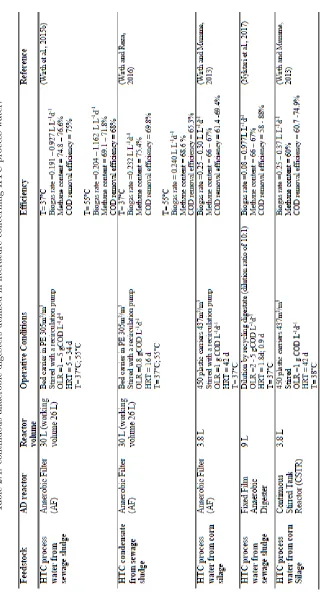
from a selection of dierent kinds of biomasses. . . 52 2.4 continuous anaerobic digesters utilized in literature
con-cerning HTC process water. . . 61 2.5 summary of literature results concerning the valorisation
of HTC process water from dierent kinds of sludge. . . . 64 2.6 summary of literature results concerning the valorisation
of HTC process water from dierent kinds of biomass. . . 65 3.1 Hydrochar, liquid and gas yields for the tests performed. . 102 3.2 Heats of reaction, ultimate and proximate analyses, higher
heating values of raw dry biomasses and hydrochars. . . . 104 4.1 feedstock characteristics of thickened, digested, and
dewa-tered sludge. . . 117 4.2 process yields and product characteristics of hydrothermal
Chapter 0
Research Object and Thesis
outline
This Chapter gives the aim and the relevance of the study, providing also the thesis structure.
0.1 Research Object
The rst objective was to design, construct and test a Hydrothermal Car-bonisation reactor for research purposes that can be used to assess the suitability of the Hydrothermal Carbonisation technology. In order to treat sewage sludge and other waste biomass. The Hydrothermal Car-bonisation reactor was designed in accordance with standard technical requirements for vessel under internal pressure in order to ensure proper functionality and safe operation, and it was equipped with a power me-ter for electrical consumptions in order to evaluate heat of reaction of Hydrothermal Carbonisation process. The second aim was to study the products of Hydrothermal Carbonisation of sewage sludge, namely hy-drochar and the Hydrothermal Carbonisation liquor, in order to charac-terize and valorise them through circular economy concept involving the formation of products from waste, namely sewage sludge, which nowadays is produced in huge amounts.
0.2 Thesis Outline
Chapter 1
Hydrothermal Carbonisation
of Sewage Sludge. A Review
This Chapter is a review on Hydrothermal Carbonisation process and its application for sewage sludge treatment. This chapter assesses also the application of the produced hydrochar and its energy balance.
Hydrothermal Carbonisation of Sewage Sludge. A
Review
Fabio Merzari, Gianni Andreottola, Luca Fiori
Department of Civil, Environmental and Mechanical Engineering, Uni-versity of Trento, via Mesiano 77, 38123, Italy
1.0 Abstract
Hydrothermal Carbonisation (HTC) has recently emerged as a promis-ing technology for sustainable sludge minimization and solid products valorisation, but no systematic review has been reported to date. HTC of sewage sludge was study for many dierent purposes: as a way to produce a new clean biofuel, as soil improver, as an adsorbent and as a source of phosphorous that is not renewable raw material. The aim of this work is to assess the application of the produced hydrochar and its energy balance in order to apply the circular economy concept generating a valuable product from a waste in a sustainable way.
1.1 Introduction
Conventional activated sludge (CAS) systems have been widely imple-mented to treat municipal wastewaters producing a signicant amount of waste sludge. Its treatment represents up to 65 % of the operational costs of wastewater treatment plants (WWTPs) (Ferrentino et al. 2016). Many technologies have been developed in order to minimize the nal sludge disposal. Among these processes, HydroThermal Carbonisation (HTC) has emerged as a promising technology for ecient sludge minimization and relevant products valorisation (He et al. 2013). While other ther-mochemical processes such as pyrolysis and gasication, requires drying as pre-treatment, HTC takes place in water and is therefore well suited for wet organic waste, such as sludge, requiring lower temperature com-pared with pyrolysis and gasication. HTC produces a sterile, stable, enriched in carbon and energy material, namely hydrochar, that could be used as renewable biofuel, as soil amendment, as adsorbent in soil or water remediation and it could be produced in a sustainable way from several wet organic waste streams (Berge et al. 2013; Parshetti et al. 2013; Titirici et al. 2015). Another important advantage of HTC is the result-ing reduction of mass and volume of the initial waste biomass, involvresult-ing less disposal space, but, nowadays, research on HTC is more focused on the production of value-added products from waste stream (Berge et al. 2013). HTC process is carried out by heating biomass up to 180 250 in a suspension with water under saturated pressure for several hours, converting biomass into hydrochar, which can be easily separated from the HTC process wastewater due to its reduced polarity of surface, which increases consequently the dewaterability (Funke and Ziegler 2010; Basso et al. 2016; Lucian and Fiori 2017). Numerous studies focused on the characterization of hydrochar, which is biologically sterilized and exhibits a moderate caloric value, highly aromatic structures and meso-porous textures (He et al. 2013). The derived chars can be utilized as renewable biofuels (He et al. 2013; Parshetti et al. 2013; Kim et al. 2014; Zhao et al. 2014; Peng et al. 2016), as soil amendments to improve soil quality (Danso-Boateng et al. 2012; Zhang et al. 2014; Breulmann et al. 2017; Yue et al. 2017), as adsorbents (Alatalo et al. 2013; Saetea and Tip-payawong 2013), as a tool for CO2 sequestration due to the signicant
1.2. CHARACTERIZATION OF SEWAGE SLUDGE
thermal energy required by the process, because a substantial amount of water per unit of mass of dry feedstock is treated (Lucian and Fiori 2017). To the best knowledge of the authors, no systematic review has been reported to date on the valorisation of sewage sludge by means of HTC. In the present review the current state of the art on HTC process waters is discussed, emphasizing the importance of HTC operating pa-rameters, as well as the possible limits. In addition, future directions for HTC research in this eld are outlined.
1.2 Characterization of Sewage Sludge
Figure 1.1: a traditional WWTP scheme.
1.3 Hydrothermal Carbonization Process:
Prop-erties of water, chemistry, kinetics and
oper-ative parameters
Operative parameters and, as a consequence, the properties of water at dierent states, such as ion product, density, dielectric constant and hy-drogen bonding, aect the yields of gas, liquid and solid products of hydrothermal biomass conversion (Jin et al. 2014), so in this section op-erative parameters, the properties of water and the main reaction mech-anisms are briey summarized.
1.3.1 Properties of Water
The ion product Kw, that is the product betweenH+ andOH−
concen-trations, at environmental conditions is10−14mol2kg−2and increases up
to 10−11mol2 kg−2 at 300 at constant pressure involving an
enhance-ment of acid and base catalysed reaction (Brunner 2014; Jin et al. 2014). The ion product Kw is aected by water density following Eq.1.3.1:
logKw=A+
B T +
C T2 +
D T3 +
E+F T +
G T2
logρ (1.3.1)
Where T is temperature in K, ρ is density in g cm−3 and A−G are
parameters. Water density decreases from 1 g cm−3 at environmental
conditions to 0.8g cm−3 at 300 . It is not clear if water density aects
reaction mechanisms, especially at higher temperature where water den-sity drops to 0.15 g cm−3 at 450 , only varying the ion product (Jin et
HTC CHEMISTRY
this property of water is dened as the ratio between the permittivity of a substance and the permittivity of vacuum; the dielectric constant of water at environmental conditions is 78.5 involving the use of water as solvent for polar substances. Increasing the temperature, dielectric con-stant drops reaching values of 44 at 150 , 35 at 200 , 27 at 250 and 20 at 300 , that are similar compared with dielectric constant of organic solvent, such as methanol (dielectric constant of methanol is 33 at 25 ), involving that water could be used as organic solvent (Jin et al. 2014). On the contrary, increasing temperature and accordingly decreasing wa-ter density, the hydrogen bonding becomes weaker and less persistent suggesting that molecules of water could participate as a catalyst or as a source of hydrogen for some reaction steps (Jin et al. 2014).
1.3.2 Chemistry
The main HTC reaction mechanisms are hydrolysis, dehydration, de-carboxylation (and decarbonylation), condensation - polymerization, and aromatization (Funke and Ziegler 2010; Libra et al. 2011; Volpe and Fiori 2017; Volpe et al. 2018; Fang et al. 2018). In Funke and Ziegler (2010) it is stated that these reaction mechanisms can occur in parallel and their development is aected by the initial biomass; furthermore, the reaction pathway is not completely known and understood yet. Figure 1.2 pro-vides a possible hydrochar formation pathways during HTC of sewage sludge.
Figure 1.2: possible hydrochar formation pathways of HTC of sewage sludge (He et al. 2013; Wang et al. 2018).
Hydrolysis is one of the major reactions of hydrothermal conversion and can happen both in acid and base catalysed reactions leading to the cleavage of mainly ester and ether bonds of the macromolecules. There are three possible reaction paths: acid hydrolysis where the formation of conjugated acid leads to bond cleavage; base hydrolysis where hydroxyl ion cleaves O bridge; water catalysed reaction that involvesH2O
involves lowering the H/C and O/C ratios of the initial biomass and it is generally explained by elimination of hydroxyl groups (Funke and Ziegler 2010; Jin et al. 2014). Concerning decaboxylation and decarbonylation, hydrothermal treatment causes a partial elimination of carboxyl groups. As showed in Eq.1.3.2, carboxyl and carbonyl groups degrade, above 150 , yieldingCO2 andCO, respectively (Funke and Ziegler 2010; Jin et al.
2014).
HCCOH →H2+CO2
HCCOH →H2+CO (1.3.2)
Berge et al. (2011) proposed the stoichiometric reaction described in Eq.1.3.3 where digestate is converted mainly in char, dissolved organics andCO2. Following Eq.1.3.3, the same authors computed the heat of
re-action of HTC of digestate and they found a value of -0.75M J kg−f eedstock1 ,
comparable with -1 M J kgf eedstock−1 associated with the heat of reaction
of cellulose treated by means of HTC process (Libra et al. 2011).
Digestate→char+dissolved organics+CO2
H1.77O0.47N0.14S0.01→0.40CH1.67O0.21N0.063S0.01+
+0.60CH1.8O0.64N0.20S0.001+ 6.5×10⁻⁶CO2
(1.3.3)
Dehydration, decarboxylation and decarbonylation reactions lead to the creation of unsaturated fragments of bio-macromolecules that could be highly reactive and join together mainly by condensation polymeriza-tion, process in which two molecules react involving the loss of a molecule of water mainly (Funke and Ziegler 2010). At high temperature and pressure aromatisation can occur leading to the formation of aromatic structures and the presence of these structures can involve a decrease in carbon content of hydrochar (Funke and Ziegler 2010). Other possible mechanisms that can occur in HTC process are: demehylation, where phenol join a cathecol-like structure leading to the removal of a methyl group; transformation reactions that can occur when there are some sta-ble compounds with a crystalline structure and oligomer fragments that do not hydrolyse and consequently polymerisation can't occur; pyrolytic reactions (above 200 ) where biomacromolecules carbonise because they precipitate with condensing fragments, so contact withH2O can't occur;
HTC KINETICS
the energy released progressively increases with stronger carbonization and, correspondingly, the atomic ratios H/C and O/C decrease. Glob-ally, de-oxygenation occurs: the oxygen is released in the form of carbon dioxide (CO2) - decarboxylation - and water (H2O) - dehydration.
De-oxygenation is important because it reduces the polarity of the hydrochar surface, which increases consequently the dewaterability of the produced hydrochar.
1.3.3 Kinetics
In recent years, many studies have focused on how HTC process pa-rameters aect the characteristics of hydrochar. Baratieri et al. (2015) suggested a simple kinetics model for HTC of grape marc based on a two-step reaction mechanism: the initial feedstock (A) forms an interme-diate product (B) that partially converts to the nal product C, namely hydrochar. The model takes also into account other two reactions in par-allel in order to consider the formation of gaseous products. The model lacked in considering the organics present in the HTC liquid phase, so Lucian et al. (2018) proposed a new kinetic model for HTC of grape marc. Figure 1.3 shows the scheme used in the kinetics model which describes the reaction pathways of HTC.
Figure 1.3: kinetic model scheme (Lucian et al. 2018).
(Funke and Ziegler 2010; Lucian et al. 2018). Decarboxylation and de-carbonylation involve the elimination of CO2 and CO and are modelled
through reaction 2. In the end, liquid compounds resulting from hydrol-ysis could generate small gaseous molecules, mainlyCO2 (reaction 4), or
back - polymerize and condense as a solid phase (reaction 5) as already stated (Lucian et al. 2018). The kinetics parameters ki in Figure 1.3 are
the kinetics constants of the ve reactions and are expressed through the Arrhenius equation Eq.1.3.4:
ki =k0,ie−
Ea,i
RT i= 1, ...,5 (1.3.4)
The kinetics model is a system of non-linear dierential equations expressed in Eq.1.3.5:
∂CB
∂t =−k1CB−k2CB−k3CB
∂CL
∂t =k1CB−k4CL−k5CLn
∂CG1
∂t =k2CB
∂CHC1
∂t =k3CB
∂CG2
∂t =k4CL
∂CHC2
∂t =k5CLn
(1.3.5)
Wheretis the reaction time andCB,CL,CG1,CHC1,CG2 andCHC2
are the molar concentration expressed inmol L−1of carbon respectively
in Biomass, Liquid phase, Gas 1, primary hydrochar (HC1), Gas 2 and secondary hydrochar (HC2). The carbon molar concentration in compo-nent X (CX), is expressed in Eq.1.3.6:
CX =
nC,X
(VB+VW) (1.3.6)
Where nC,X are the moles of carbon in component X and term
VB +VW is the sum of the volumes in L of biomass as received and
distilled water added to the system. An error function F(ki, n), where
herenis the reaction order of reaction 5, is expressed in Eq.1.3.7 and has
as input variables experimental data (apex: exp) obtained at dierent HTC reaction times and the corresponding data computed by the model (apex: mod). The subscript j refers to the various reaction times at
which experimental data are available. F(ki, n) was thus minimized in
order to get the kinetics parameterski and n(Lucian et al. 2018).
F(ki, n) = Pj
C
exp
S,j −CS,jmod
+ C exp
L,j −CL,jmod
+ + C exp
G,j −C
HTC KINETICS
Specic studies on HTC of sewage sludge reaction kinetics were also conducted (Danso-Boateng et al. 2013). In particular, in Danso-Boateng et al. (2013) the authors studied a kinetic model for HTC of primary sewage sludge and faecal waste, taking into account the inuence of reac-tion temperature and time using a rst-order reacreac-tion rate and Arrhenius equations to model the solids decomposition kinetics. The reaction rate is function of temperature and solids content, while temperature aects the degree of conversion to hydrochar. The initial reacting solids depen-dence on the reaction rate can be expressed as a rst-order dierential rate equation Eq.1.3.8.
−r= dmt
dt =k mt (1.3.8)
that leads to Eq.1.3.9 through separation and integration.
−lnmt
m0
=k t (1.3.9)
wherer is the reaction rate,mt is the mass of hydrochar at reaction
time (t), m0 is the initial mass of solids at initial conditions, both
ex-pressed on a dry weight basis, k is the reaction rate constant (min−1),
andtis the reaction time (min). In terms of reactant conversion Eq.1.3.10
can be expressed:
X= mt−m∞
m0−m∞ (1.3.10)
where X is the conversion of faecal solids to hydrochar, m∞ is the
equilibrium mass of solids (or hydrochar) over timet=∞. So the
varia-tion ofX in function of the time can be expressed in Eq.1.3.11:
dX
dt =−k X (1.3.11)
The solution of Eq.1.3.11 leads to Eq.1.3.12:
X(t) =ek t (1.3.12)
The temperature aects the degree of conversion (Y) to hydrochar
(at equilibrium) which is expressed in Eq.1.3.13.
Y = mt
m0
×100 (1.3.13)
Arrhenius equation was used to express the correlation between tem-perature and reaction rate (Eq.1.3.14).
where, A is the pre-exponential factor (min−1), E is the activation
energy (J mol−1), R is the gas constant (8.314 J mol−1 K−1), and
T is the temperature (K). Danso-Boateng et al. (2013) computed the
kinetic parameters, namely activation energy and pre-exponential factor: the activation energy for faecal waste was 77.8 kJ mol−1 and its
pre-exponential factor was 1.5×10⁷ min−1, while the activation energy for
primary sludge was 70.4 kJ mol−1 and its pre-exponential factor was
4.0×10⁶ min−1. The higher activation energy of faecal waste compared
with primary sludge involves a higher temperature required to initiate the decomposition of faecal waste to produce hydrochar than that required for primary sludge.
1.3.4 Operative Parameters
The main parameters of HTC are: temperature, pressure, residence time, pH, feedstock composition and biomass to water ratio (b/w) (Basso et al. 2013).
1.3.4.1 Temperature
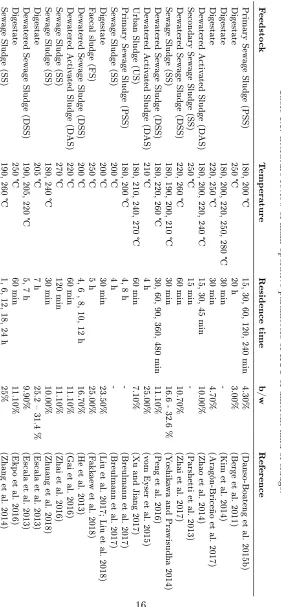
Temperature represents the most inuence parameter of HTC process: high temperatures lead to higher reaction aecting directly the kinet-ics of the reactions and determining water properties leading to ionic reactions mainly in the subcritical region (Funke and Ziegler 2010; Niza-muddin et al. 2017; Wang et al. 2018). Moreover, temperature aects directly the number of initial feedstock compounds that can be hydrol-ysed (below 180 carbonization occurs with diculty). In the end, increasing temperature leads to an enhancement in carbon content of the hydrochar and consequently its energy content and caloric value, while the hydrochar yield general decreases: increasing temperature enhances dehydration and the decarboxylation reaction rate, so consequently the O/C and H/C ratios involving the enhancement of carbon content of the hydrochar (Basso et al. 2013; Nizamuddin et al. 2017; Wang et al. 2018). Moreover, higher temperatures lead to increasing liquid and gasses yields, involving a decrease of hydrochar yield due to the degradation of part of the char produced (Basso et al. 2013). Table 1.1 reports a literature re-view of applied temperature of HTC of dierent kind of sludge ranging from 180 to 280 .
1.3.4.2 Pressure
HTC OPERATIVE PARAMETERS
pressure simultaneously to reactants with a lower number of moles, in-volving a decreasing reaction rate of dehydration and decarboxylation reactions. Pressure is mostly considered to be an indirect parameter of the process, because it is strongly dependent on the temperature and, in order to develop HTC, pressure should be such that to maintain water in the liquid phase: if a close system is heated above 100 contains biomass and water, the resulting pressure will be higher than the satu-rated vapour pressure due to the formation of gasses as a consequence of decarboxylation, so water is maintained at liquid state (Basso et al. 2013; Funke and Ziegler 2010; Nizamuddin et al. 2017). In the end, pres-sure aects strongly investment costs for prespres-sure equipment (Funke and Ziegler 2010).
1.3.4.3 Residence Time
The residence time is interesting especially for practical processing design and strongly aects thermal and energy consumptions. It usually ranges between some minutes and several hours and aects process severity. Many authors reported that increasing residence time of the HTC pro-cess generally results in a higher carbon content of the hydrochar and, consequently, higher caloric value of the solid product. Moreover, in many works it is stated that residence time also reduces the yield of the hydrochar, promoting the formation of higher quantities of water solu-ble compounds (Basso et al. 2013; Funke and Ziegler 2010; Nizamuddin et al. 2017; Wang et al. 2018). In Wang et al. (2018) it is stated that long residence time can lead to the polymerization of fragments solved in the liquid phase involving the formation of secondary hydrochar with a poly - aromatic structure. Residence time aects strongly secondary hydrochar formation, especially for lignocellulose feedstock, because dis-solved monomers required extensive polymerization. On the other hand, temperature aects the behaviour of non-dissolved monomers, so resi-dence time allows the control of the degree of polymerization of the sol-uble monomers during the process (Wang et al. 2018). Table 1.1 reports a literature review of applied residence time of HTC of dierent kind of sludge ranging from 15minup to 24 h.
1.3.4.4 pH
the inuence on decarboxylation or condensation polymerization is not known yet (Basso et al. 2013). The addition of acids has an inuence on the kinetics of the reaction as well as on the reaction conditions. Weakly acid conditions promote the overall rate of the HTC and increase the car-bon yield as well as carcar-bon content of the hydrochar. In the end, acids and alkali can be added and used as a catalyst during HTC, involving an increase in H+ or OH− concentration that leads to elevated ionic
strength, promoting the reaction rate or the desired reaction pathway (Wang et al. 2018).
1.3.4.5 Solid Load
The solid load is the ratio of biomass to water dened in Eq.1.3.15. A high b/w can promote a lower overall residence time, by increasing the rate at which the concentration of monomers is raising, which allows an earlier polymerization (Funke and Ziegler 2010).
b
w =
massdry biomass
massbiomass moisture+massadded water (1.3.15)
In Wang et al. (2018) it is stated that high b/w values lead to partly polymerization due to the incomplete hydrolysis of macromolecules. In the end, high b/w required more thermal energy and a long residence time in order to hydrolyse polymers and produce enough monomers in order to reach equilibrium and nally precipitate as hydrochar (Wang et al. 2018). Table 1.1 reports a literature review of applied b/w of HTC of dierent kind of sludge ranging from 3 % up to above 30 %.
1.3.4.6 Feedstock Composition
HTC OPERATIVE PARAMETERS
1.3.4.7 Other Parameters
Heating rate is another operative parameter that could aects the HTC process: heat and mass transfer limitations can decrease with high heat-ing rate and, as a consequence, the time for secondary reactions of the intermediate products is reduced (Wang et al. 2018). Another parameter that aects HTC process is the use of catalysts: hydrolytic agents or cat-alysts can improve the hydrolysis rate. Catcat-alysts dier according to the hydrolysis process employed. In Nizamuddin et al. (2017) it is stated that acid catalysts are the most eective for hydrolysis, while basic catalysts inhibit the formation of hydrochar and promote the formation of liquid oil. In the end, the use of catalyst can lead to a reduction in terms of
N Ox converting into nitrogen and water (Nizamuddin et al. 2017).
1.3.5 Hydrothermal Carbonisation Plants
Table 1.3 reports a literature review of reactor type and volume utilised in order to apply HTC of sewage sludge: the reactor are all at lab scale with volumes that range between 75mLand 25Land work only in batch
condition. There are also some companies, such as TerraNova Energy and
AV A−CO2, which apply HTC of sewage sludge at pilot scale in the
or-der of some thousand tons for year, and their reactor work in continuous or semi-continuous mode. Recently, TerraNova Energy has constructed a full scale plant in China treating 14 thousand tons of sludge for year. In the TerraNova Energy plant sludge is pre-processed in order to obtain particle size optimal for feeding the continuous reactor. Under pressure, the sludge ows through a winding tube connected to a heat exchanger in a contrary ow to the HTC product leaving the reactor in a parallel tube. Oil is used as the heat recovery agent. When sludge enters the reactor it is preheated to near reaction temperature and pressure (200 , > 20bar).
The sludge is also mixed with a catalyst or additive, and fed into the con-tinuous reactor. A mixer ensures a homogeneous mixture and char parti-cles slowly sink to the bottom of the tank, from where they are released through the heat exchanger. The process ends with mechanical dewater-ing and possible post-treatment (http://terranova-energy.com/en/). In the AV A−CO2 plant the sludge is preheated in a designated mixing
tank by combining sludge with both high and low pressure (recycled) steam as well as recycled process liquid. The slurry is transferred to one of several batch reactor tanks upon reaching reaction conditions (220-230 , > 22bar). Reactions in the reactor tanks is facilitated by means of
be recovered in order to preheat sludge.
1.4 Hydrothermal Carbonization Products
The products resulting from HTC process are a solid phase enriched in carbon, namely hydrochar, a liquid phase with many organic compounds dissolved and a small quantity of gas mostly composed of CO2, with
traces of CO,CH4, H2 (Basso et al. 2015; Basso et al. 2016) and N H3
Danso-Boateng et al. (2015b).
1.4.1 Solid Product - Hydrochar
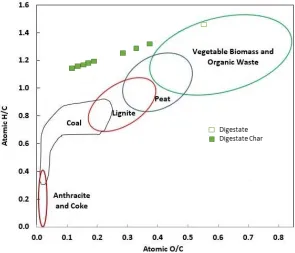
Hydrochar is the solid phase, with H/C and O/C ratios lower than the original feedstock and its elemental composition is similar to lignite or sub-bituminous coal as showed in Figure 1.4.
Figure 1.4: Van Krevelen diagram and its variation due to HTC process from Mumme et al. (2011).
densication and higher heating value because most of the carbon of ini-tial feedstock remains within the hydrochar up to 80 %, if compared with liquid and gases products (Basso et al. 2013). In Libra et al. (2011) is stated that the hydrochar could have a HHV ranging between 28.9 and 29.3M J kg−1, corresponding to an increase of 1.50 - 1.71 of heating value
of the original biomass, while, as reported in Table 1.4, the HHV of hy-drochar from sludge can reach value just above 20M J kg−1at maximum.
An explanation of the lower HHV compared with hydrochar from other feedstock is the high ash content, especially for stabilised sludge where the organic matter is converted into biogas through anaerobic digestion or carbon dioxide through aerobic digestion. Indeed, the hydrochar can have lower HHV compared with initial feedstock comparing Table 1.2 and Table 1.4; however, computing the carbon content and the HHV in dry ash free basis, it is possible to observe that carbon content and HHV increase compared with the initial sludge as expected from HTC process. Concerning other characteristics of the hydrochar, in Table 1.4 it is pos-sible to observe that, in general, at increasing temperature and residence time ASH and V M tends to decrease, on the other hands FC tends to
slightly increase. In some works ASH content reach values above 70 %
leading to low HHVs also at high severity process conditions. In the end, hydrogen, nitrogen, oxygen and sulphur concentrations decrease at higher severity process conditions, leading to lower SOx and N Ox emissions if
hydrochar will be used as biofuel.
HTC PRODUCTS
the end, just below 50 % after 50 minutes. Similar values were found by Escala et al. (2013): treating stabilised sludge at 205 for 7 h the nal moisture content after dewatering was 48 %, while treating not stabilised sludge at same conditions the nal moisture content after dewatering was 30 %. In the end, Kim et al. (2014) studied the dewaterability of sludge
Figure 1.5: an explanation of the improved dewaterability of sludge (Yoshikawa and Prawisudha 2014).
after HTC treatment in term of capillary suction time (CST) that is an indirect measurement of the dewaterability of sludge: the test provides a quantitative measure (in seconds) of how readily sludge releases water. Kim et al. (2014) found that the CST of raw sludge was 72.03 s, while
after the hydrothermal treatment, the CST of the hydrochar decreased to 15.35 s, 10.9 s, and 10.15sat 180 , 220 , and 250 , respectively.
The CST results conrmed that the physical structure of the sludge was converted.
1.4.1.1 Nutrients
In general, the phosphorous content in the hydrochar tends to increase with the severity of the process (Breulmann et al. 2017; Ekpo et al. 2016; Escala et al. 2013; Sun et al. 2013), while nitrogen content of the hydrochar slightly decreases as report in Table 1.4. Concerning other nu-trients such as N aand K, they always decrease signicantly after HTC
process, due to their high solubility in water since they are rst group metals (Breulmann et al. 2017; Danso-Boateng et al. 2015b; Escala et al. 2013; Liu et al. 2017; Parshetti et al. 2013; Sun et al. 2013). Con-cerning second group metals, instead, there is not a clear trend, so the concentration ofCaandM gcan both slightly increase (Breulmann et al.
HTC PRODUCTS
1.4.1.2 Heavy Metals
Table 1.5 reports compost limits in dierent countries since nowadays there isn't a legislation concerning hydrochar. Many countries haven't a limit forAs, but in general HTC lead to a decreasing ofAsconcentration
(Breulmann et al. 2017; Escala et al. 2013; Zhang et al. 2014). Concerning
Cd, the limit in general is low and it seems that HTC slightly increases Cd concentration, so the initial concentration in the sludge strongly
af-fects the use of hydrochar as soil improver (Breulmann et al. 2017; Escala et al. 2013; Zhang et al. 2014; Liu et al. 2018). Similar behaviour forCr,
where HTC slightly increasesCr concentration, so the initial
concentra-tion in the sludge strongly aects the use of hydrochar as soil improver (Breulmann et al. 2017; Escala et al. 2013; Zhang et al. 2014; Liu et al. 2018; Xu and Jiang 2017). Concerning Cu, the limit in general is not
low and it seems that HTC both increases (Breulmann et al. 2017; Es-cala et al. 2013; Zhang et al. 2014; Liu et al. 2018) and decreases Cu
concentration (Parshetti et al. 2013; Xu and Jiang 2017). Similar dis-course forP b: some authors found that HTC increases P bconcentration
(Breulmann et al. 2017; Escala et al. 2013; Zhang et al. 2014; Liu et al. 2018), other stated thatP bconcentration decreased (Sun et al. 2013; Xu
and Jiang 2017). ConcerningHg, the limit is very low and it seems that
HTC slightly increasesHgconcentration or doesn't aect it, so the initial
concentration in the sludge strongly aects the use of hydrochar as soil improver as forCd(Breulmann et al. 2017; Escala et al. 2013; Liu et al.
2018). ConcerningN i, the limit is not low and it seems that HTC slightly
increasesN iconcentration or doesn't aect it, only Parshetti et al. (2013)
found thatN iconcentration decreased, so the initial concentration in the
sludge strongly aects the use of hydrochar as soil improver (Breulmann et al. 2017; Escala et al. 2013; Liu et al. 2017; Liu et al. 2018). In the end,Znconcentration has high limit, but also here a clear trend of HTC
wasn't found: some authors found thatZnconcentration increased after
HTC (Breulmann et al. 2017; Escala et al. 2013; Zhang et al. 2014; Liu et al. 2018; Sun et al. 2013) other stated thatZnconcentration decreased
(Parshetti et al. 2013; Sun et al. 2013; Xu and Jiang 2017).
1.4.2 Liquid Product
HTC PRODUCTS
as reaction severity increases as reported in Table 1.6 and in Basso et al. (2015); also the b/w strongly aects the nal TOC or COD of the HTC liquid, because higher solid load involves higher amount of organic compounds that can be solubilised. In order to increase the overall en-ergy balance, many studies focused on the anaerobic valorisation of HTC liquor (Aragón-Briceño et al. 2017; Fakkaew et al. 2018; Danso-Boateng et al. 2015a; Wirth et al. 2015).
Danso-Boateng et al. (2015b) reported also a detailed list of some organic compounds found in the HTC process water: acetic acid, ben-zene acetic acid, butanoic acid, pentanoic acid and propanoic acid were present in all their samples and they stated that these acids were pro-duced from decomposition hydrolysis of the sludge. Alkenes, phenolic and aromatic compounds were also detected suggesting that hydrolysis, dehydration, decarboxylation, condensation, polymerisation, and aroma-tisation were occurred. Danso-Boateng et al. (2015b) reported also that several Maillard products such as aldehydes, furans, pyrroles, pyrazines, and pyridines were identied in liquid phase.
1.4.3 Gasseous Product
During HTC-process, a small amount of gas is released, 2-11 % weigh (Berge et al. 2011) and is mainly composed byCO2 with traces of CO,
CH4, H2 and N H3 (Danso-Boateng et al. 2015b). The carbon present
1.5. HYDROCHAR APPLICATIONS
drothermal treatment, al sulphur compounds decreased, while aldehydes, light aromatic compounds and organic acids slightly increased involving decreasing discomfort due to malodorous.
1.5 Hydrochar Applications
Fang et al. (2018) gives a complete list of hydrochar potential appli-cation for dierent kind of feedstock. The main appliappli-cations are: soil amendment in order to improve fertility and allow carbon sequestration; energetic applications, or as biofuels or as capacitor; low cost adsorbent by means of activation; sanitation and medical applications. In the fol-lowing sections the applications of hydrochar produced from sludge are briey summarised.
1.5.1 Energetic Applications
One of the main applications of HTC-coal is to use it as a combustible. The majority of the studies on hydrothermal carbonization were directed to recover energy from the waste biomass (Kim et al. 2014; Parshetti et al. 2013; Zhai et al. 2017). The HHV of hydrochar can be signicantly increased compared to the original feedstock. On the other hand, HHV values of hydrochar produced from sludge hardly reach values above 20 21 M J kg−1 as reported in Table 1.4. Yoshikawa and Prawisudha
(2014) stated that increasing reaction temperature, HHVs of hydrochar can slightly decrease due to dissolved solids that have signicant caloric value. In order to overcome the problem, it is possible to use faecal sludge instead of water for other lignocellulosic biomass (Koottatep et al. 2016). However there are various options in which hydrochar can be used as a combustible: combustion plants, combined heat and power plants, cement and steel factories, mono-combustion plants for sewage sludge, gasication. Among other advantages, the HTC process permits also to obtain homogeneous hydrochar, suitable for co-combustion with coal (Zhai et al. 2017) leading also to lowerSOx andN Oxemissions due
to the removal of N and S from sludge by means of HTC process (He
gasication of the hydrochar exhibited high hydrogen concentration and yield as well as high heating value, and gasication eciency. In the end, Fakkaew et al. (2018) proposed an energy storage application: the hydrochar produced from faecal sludge could be processed further to make it suitable for use as an electrodes in batteries.
1.5.2 Sanitary and Medical Application
HTC in general sterilises the initial feedstock due to the high temper-ature and pressure, some authors have worked with microwave HTC in order to sterilise sludge (Afolabi et al. 2017), but hydrochar can also remove Escherichia coli (Fang et al. 2018). Fluorescent quantum dots produced from hydrochar are an emerging form of medical imaging for detection of disease at the cellular level (Fang et al. 2018). Another im-portant application of HTC is the removal of pharmaceutical compounds (vom Eyser et al. 2015): most of the investigated compounds were re-moved or at least their concentrations reduced during the HTC process. Remaining residuals of pharmaceuticals in hydrochar after HTC were re-ported. Compared to sewage sludge, enhanced phenazone concentrations were detected in hydrochar. HTC process lead to high removal of Ibupro-fen carbamazepine, bezabrate, Ibupro-fenobric acid, metoprolol, propranolol, clarithromycin, roxithromycin and erythromycin.
1.5.3 Soil Improvement
Another application of hydrochar is its use as water and ion binding com-ponent to improve soil quality (Libra et al. 2011). The use of hydrochar as a soil conditioner is reported to have positive eects on soil fertility and can be used for carbon sequestration (Libra et al. 2011; Danso-Boateng et al. 2015b). In general, Phosphorous precipitates at HTC conditions, and, typically, hydrochar from sewage sludge is rich of P,N,N a,K,M g and Ca, providing many nutrients in order to improve soil fertility, although
1.6. ENERGY ASSESSMENT
1.5.4 Adsorbent
One important application eld for chars is adsorption, especially for wa-ter remediation. Hydrochars can be activated to increase their pore size and surface area. Thanks to their increased adsorption capacity, acti-vated carbons can be used to adsorb a large variety of contaminants from water or soil. In general, the activation can be physical or chemical (Fang et al. 2018). Physical activation is carried out with activating agents such asCO2 or steam at above 800 . Chemical activation is carried out by
mixing the hydrochar with chemical activating such asKOH or H3P O4
and heating the mixture at various temperatures in an inert environment (Fang et al. 2018). Fakkaew et al. (2018) measured BET surface area and total pore volume of dried initial faecal sludge and of the produced hydrochar: the authors stated that the HTC process enhances the BET surface area and the total pore volume of the produced hydrochar. The same authors found also mean pore diameters of the produced hydrochar (mesopores), meaning that hydrochar can adsorb large-sized molecules such as sugar and heavy metals, as well as small-sized molecules such as micropollutants. As a consequence, the produced hydrochar is a potential adsorbent for removing heavy metals and micropollutants from wastew-ater. The adsorption ofCuusing the modied HTC as an absorbent was
studied by Koottatep et al. (2017).
1.6 Energy Assessment
A promising application of HTC is for the treatment of sewage sludge from a waste water treatment plant (WWTP) but energy assessment are necessary. Escala et al. (2013) compared a scenario where sewage sludge is dried and incinerated in a combustion plant, with a scenario where the sewage sludge is hydrothermally carbonized, mechanically dewatered and then incinerated. The authors found that around 10 % of energy and up to 75 % of the cost for waste management can be saved per year with the application of HTC. Furthermore, it could improve theCO2 balance
with the standard sludge treatment (mechanical dewatering and thermal drying). In order to increase overall energy balance, also the conguration including the anaerobic digestion of sewage sludge, followed by the HTC of digestate and the anaerobic digestion of the HTC process water and hydrochar, must be considered. Aragón-Briceño et al. (2017) found that the overall energy produced for units of feedstock was 19.77, 18.88, and 17.96M J kg−1at HTC temperature of 160, 220, and 250 , respectively
coupling HTC of sludge with anaerobic digestion of HTC process water.
Figure 1.6: energy balance of hydrochar production by means of HTC (Zhao et al. 2014).
1.7 Conclusions
1.7. CONCLUSIONS
References
Afolabi, Oluwasola O.D., M. Sohail, and C.L.P. Thomas (2017). Charac-terization of solid fuel chars recovered from microwave hydrothermal carbonization of human biowaste. In: Energy 134, pp. 7489. issn: 0360-5442. doi: https://doi.org/10.1016/j.energy.2017.06. 010. url: http://www.sciencedirect.com/science/article/pii/ S0360544217310022 (cit. on p. 28).
Alatalo, Sara-Maaria, Eveliina Repo, Ermei Mäkilä, Jarno Salonen, Esa Vakkilainen, and Mika Sillanpää (2013). Adsorption behavior of hy-drothermally treated municipal sludge & pulp and paper industry sludge. In: Bioresource Technology 147, pp. 7176. issn: 0960-8524. doi: https : / / doi . org / 10 . 1016 / j . biortech . 2013 . 08 . 034. url: http : / / www . sciencedirect . com / science / article / pii / S0960852413012637 (cit. on p. 4).
Aragón-Briceño, C., A.B. Ross, and M.A. Camargo-Valero (2017). Eval-uation and comparison of product yields and bio-methane potential in sewage digestate following hydrothermal treatment. In: Applied En-ergy 208, pp. 13571369. issn: 0306-2619. doi: https://doi.org/10. 1016/j.apenergy.2017.09.019. url: http://www.sciencedirect. com/science/article/pii/S0306261917313028 (cit. on pp. 16, 17, 19, 25, 26, 28, 30).
Baratieri, Marco, Daniele Basso, Francesco Patuzzi, Daniele Castello, and Luca Fiori (2015). Kinetic and thermal modeling of hydrother-mal carbonization applied to grape marc. In: Chemical Engineer-ing Transactions 43, pp. 505510. issn: 22839216. doi: 10 . 3303 / CET1543085. url: http://www.scopus.com/inward/record.url? eid=2-s2.0-84946098124%5C&partnerID=tZOtx3y1 (cit. on p. 9). Basso, Daniele, Daniele Castello, Marco Baratieri, and Luca Fiori (2013).
Hydrothermal carbonization of waste biomass: progress report and prospects. In: 21th European Biomass Conference and Exhibition -Copenhagen (DK) (cit. on pp. 8, 1214, 20, 23, 28).
Basso, Daniele, Francesco Patuzzi, Daniele Castello, Marco Baratieri, Elena Cristina Rada, Elsa Weiss-Hortala, and Luca Fiori (2016). Agro-industrial waste to solid biofuel through hydrothermal carbonization. In: Waste Management 47. Biowaste to Fuel, pp. 114121. issn: 0956-053X. doi: https://doi.org/10.1016/j.wasman.2015.05.013. url: http : / / www . sciencedirect . com / science / article / pii / S0956053X15003645 (cit. on pp. 4, 18).
REFERENCES
issn: 0960-8524. doi: https://doi.org/10.1016/j.biortech. 2015.01.118. url: http://www.sciencedirect.com/science/ article/pii/S0960852415001388 (cit. on pp. 18, 20, 25).
Berge, Nicole D., Claudia Kammann, Kyoung Ro, and Judy Libra (2013). Environmental Applications of Hydrothermal Carbonization Tech-nology: Biochar Production, Carbon Sequestration, and Waste Con-version. In: Sustainable Carbon Materials from Hydrothermal Pro-cesses. Ed. by Maria-Magdalena Titirici. Wiley. Chap. 8, pp. 295 340. isbn: 9781118622179. doi: 10.1002/9781118622179.ch8. url: http://doi.wiley.com/10.1002/9781118622179.ch8 (cit. on p. 4). Berge, Nicole D., Kyoung S. Ro, Jingdong Mao, Joseph R. V. Flora, Mark A. Chappell, and Sunyoung Bae (2011). Hydrothermal Car-bonization of Municipal Waste Streams. In: Environmental Science & Technology 45.13. PMID: 21671644, pp. 56965703. doi: 10.1021/ es2004528. eprint: https://doi.org/10.1021/es2004528. url: https://doi.org/10.1021/es2004528 (cit. on pp. 8, 16, 17, 19, 25, 26).
Breulmann, Marc, Manfred van Aerden, Roland A. Müller, Elke Schulz, and Christoph Fühner (2017). Process conditions of pyrolysis and hydrothermal carbonization aect the potential of sewage sludge for soil carbon sequestration and amelioration. In: Journal of Analytical and Applied Pyrolysis 124, pp. 256265. issn: 0165-2370. doi: https: //doi.org/10.1016/j.jaap.2017.01.026. url: http://www. sciencedirect . com / science / article / pii / S0165237016304223 (cit. on pp. 4, 16, 17, 22, 23).
Brunner, Gerd (2014). Chapter 8 - Processing of Biomass with Hy-drothermal and Supercritical Water. In: HyHy-drothermal and Supercrit-ical Water Processes. Ed. by Gerd Brunner. Vol. 5. SupercritSupercrit-ical Fluid Science and Technology. Elsevier, pp. 395509. doi: https://doi. org/10.1016/B978-0-444-59413-6.00008-X. url: http://www. sciencedirect.com/science/article/pii/B978044459413600008X (cit. on p. 6).
Danso-Boateng, E., R.G. Holdich, S.J. Martin, G. Shama, and A.D. Wheatley (2015a). Process energetics for the hydrothermal carbon-isation of human faecal wastes. In: Energy Conversion and Man-agement 105, pp. 11151124. issn: 0196-8904. doi: https://doi. org / 10 . 1016 / j . enconman . 2015 . 08 . 064. url: http : / / www . sciencedirect . com / science / article / pii / S0196890415008183 (cit. on pp. 25, 29).
apenergy.2013.04.090. url: http://www.sciencedirect.com/ science/article/pii/S030626191300408X (cit. on pp. 11, 12). Danso-Boateng, E., R.G. Holdich, A.D. Wheatley, S. Martin, M.
So-hail(Khan), and D.E. Gyi (2012). A toilet system based on hy-drothermal carbonization. In: Proceedings of the Second Interna-tional Faecal Sludge Management conference (FSM2), Durban, South Africa, October 29-31 2012, 6 pp. url: https://dspace.lboro.ac. uk/dspace-jspui/handle/2134/11289 (cit. on p. 4).
Danso-Boateng, E., G. Shama, A.D. Wheatley, S.J. Martin, and R.G. Holdich (2015b). Hydrothermal carbonisation of sewage sludge: Ef-fect of process conditions on product characteristics and methane pro-duction. In: Bioresource Technology 177, pp. 318327. issn: 0960-8524. doi: https://doi.org/10.1016/j.biortech.2014.11.096. url: http : / / www . sciencedirect . com / science / article / pii / S0960852414017106 (cit. on pp. 1619, 22, 25, 26, 28).
Ekpo, U., A.B. Ross, M.A. Camargo-Valero, and P.T. Williams (2016). A comparison of product yields and inorganic content in process streams following thermal hydrolysis and hydrothermal processing of microalgae, manure and digestate. In: Bioresource Technology 200, pp. 951960. issn: 0960-8524. doi: https://doi.org/10.1016/j. biortech.2015.11.018. url: http://www.sciencedirect.com/ science/article/pii/S0960852415015448 (cit. on pp. 16, 17, 19, 22, 26).
Escala, M., T. Zumbühl, Ch. Koller, R. Junge, and R. Krebs (2013). Hy-drothermal Carbonization as an Energy-Ecient Alternative to Es-tablished Drying Technologies for Sewage Sludge: A Feasibility Study on a Laboratory Scale. In: Energy & Fuels 27.1, pp. 454460. doi: 10.1021/ef3015266. eprint: https://doi.org/10.1021/ef3015266. url: https://doi.org/10.1021/ef3015266 (cit. on pp. 16, 17, 19, 22, 23, 26, 28, 29).
Fakkaew, Krailak, Thammarat Koottatep, and Chongrak Polprasert (2018). Faecal sludge treatment and utilization by hydrothermal carboniza-tion. In: Journal of Environmental Management 216. Sustainable waste and wastewater management, pp. 421426. issn: 0301-4797. doi: https : / / doi . org / 10 . 1016 / j . jenvman . 2017 . 09 . 031. url: http : / / www . sciencedirect . com / science / article / pii / S0301479717308939 (cit. on pp. 16, 17, 19, 25, 26, 28, 29).
REFERENCES
com/science/article/pii/S1226086X17304458 (cit. on pp. 7, 27 29).
Ferrentino, Roberta, Michela Langone, Fabio Merzari, Laura Tramonte, and Gianni Andreottola (2016). A review of anaerobic side-stream reactor for excess sludge reduction: Congurations, mechanisms, and eciency. In: Critical Reviews in Environmental Science and Tech-nology 46.4, pp. 382405. doi: 10.1080/10643389.2015.1096879. eprint: https://doi.org/10.1080/10643389.2015.1096879. url: https://doi.org/10.1080/10643389.2015.1096879 (cit. on p. 4). Funke, Axel and Felix Ziegler (2010). Hydrothermal carbonization of biomass:
A summary and discussion of chemical mechanisms for process engi-neering. doi: 10.1002/bbb.198 (cit. on pp. 4, 7, 8, 10, 1214, 25). Funke, Axel and Felix Ziegler (2011). Heat of reaction measurements for
hydrothermal carbonization of biomass. In: Bioresource Technology 102.16, pp. 75957598. issn: 0960-8524. doi: https://doi.org/10. 1016/j.biortech.2011.05.016. url: http://www.sciencedirect. com/science/article/pii/S0960852411006559 (cit. on p. 8). Gai, Chao, Mengjun Chen, Tingting Liu, Nana Peng, and Zhengang Liu
(2016). Gasication characteristics of hydrochar and pyrochar de-rived from sewage sludge. In: Energy 113, pp. 957965. issn: 0360-5442. doi: https://doi.org/10.1016/j.energy.2016.07.129. url: http : / / www . sciencedirect . com / science / article / pii / S0360544216310507 (cit. on pp. 16, 17, 27).
He, Chao, Apostolos Giannis, and Jing-Yuan Wang (2013). Conversion of sewage sludge to clean solid fuel using hydrothermal carboniza-tion: Hydrochar fuel characteristics and combustion behavior. In: Applied Energy 111, pp. 257266. issn: 0306-2619. doi: https:// doi.org/10.1016/j.apenergy.2013.04.084. url: http://www. sciencedirect . com / science / article / pii / S0306261913003887 (cit. on pp. 4, 7, 16, 17, 19, 27).
Jin, Fangming, Yuanqing Wang, Xu Zeng, Zheng Shen, and Guodong Yao (2014). Water Under High Temperature and Pressure Condi-tions and Its ApplicaCondi-tions to Develop Green Technologies for Biomass Conversion. In: Application of Hydrothermal Reactions to Biomass Conversion. Ed. by Fangming Jin. Berlin, Heidelberg: Springer Berlin Heidelberg, pp. 328. isbn: 978-3-642-54458-3. doi: 10.1007/978-3-642-54458-3_1. url: https://doi.org/10.1007/978-3-642-54458-3_1 (cit. on pp. 68).
url: http : / / www . sciencedirect . com / science / article / pii / S0016236114003512 (cit. on pp. 4, 16, 17, 19, 22, 27).
Koottatep, Thammarat, Krailak Fakkaew, Nutnicha Tajai, and Chongrak Polprasert (2017). Isotherm models and kinetics of copper adsorp-tion by using hydrochar produced from hydrothermal carbonizaadsorp-tion of faecal sludge. In: Journal of Water Sanitation and Hygiene for Development 7.1, pp. 102110. doi: 10.2166/washdev.2017.132. url: http://washdev.iwaponline.com/lookup/doi/10.2166/ washdev.2017.132 (cit. on p. 29).
Koottatep, Thammarat, Krailak Fakkaew, Nutnicha Tajai, Sangeetha V. Pradeep, and Chongrak Polprasert (2016). Sludge stabilization and energy recovery by hydrothermal carbonization process. In: Re-newable Energy 99, pp. 978985. issn: 0960-1481. doi: https : / / doi.org/10.1016/j.renene.2016.07.068. url: http://www. sciencedirect . com / science / article / pii / S0960148116306838 (cit. on p. 27).
Li, Liang, Joseph R.V. Flora, Juan M. Caicedo, and Nicole D. Berge (2015). Investigating the role of feedstock properties and process conditions on products formed during the hydrothermal carbonization of organics using regression techniques. In: Bioresource Technology 187, pp. 263274. issn: 0960-8524. doi: https://doi.org/10.1016/ j.biortech.2015.03.054. url: http://www.sciencedirect.com/ science/article/pii/S0960852415003867 (cit. on p. 5).
Libra, Judy A et al. (2011). Hydrothermal carbonization of biomass residuals: a comparative review of the chemistry, processes and appli-cations of wet and dry pyrolysis. In: Biofuels 2.1, pp. 71106. doi: 10.4155/bfs.10.81. eprint: https://doi.org/10.4155/bfs.10.81. url: https://doi.org/10.4155/bfs.10.81 (cit. on pp. 7, 8, 20, 24, 28).
Liu, Tingting, Yanchuan Guo, Nana Peng, Qianqian Lang, Yu Xia, Chao Gai, and Zhengang Liu (2017). Nitrogen transformation among char, tar and gas during pyrolysis of sewage sludge and corresponding hy-drochar. In: Journal of Analytical and Applied Pyrolysis 126, pp. 298 306. issn: 0165-2370. doi: https://doi.org/10.1016/j.jaap.2017. 05.017. url: http://www.sciencedirect.com/science/article/ pii/S0165237017302048 (cit. on pp. 16, 17, 19, 22, 23).
REFERENCES
Lucian, M., G. Piro, and L. Fiori (2018). A novel reaction kinetics model for estimating the carbon content into hydrothermal carbonization products. In: Chemical Engineering Transactions 65, pp. 379384. issn: 22839216. doi: 10.3303/CET1865064 (cit. on pp. 9, 10). Lucian, Michela and Luca Fiori (2017). Hydrothermal Carbonization
of Waste Biomass: Process Design, Modeling, Energy Eciency and Cost Analysis. In: Energies 10.2. issn: 1996-1073. doi: 10.3390/ en10020211. url: http://www.mdpi.com/1996- 1073/10/2/211 (cit. on pp. 4, 5).
Merzari, F., M. Lucian, M. Volpe, G. Andreottola, and L. Fiori (2018). Hydrothermal carbonization of biomass: Design of a bench-Scale re-actor for evaluating the heat of reaction. In: Chemical Engineer-ing Transactions 65.2011, pp. 4348. issn: 22839216. doi: 10.3303/ CET1865008 (cit. on p. 8).
Metcalf&Eddy (2003). Wastewater Engineering - Treatment and Reuse. McGraw-Hill, (cit. on p. 5).
Mumme, Jan, Lion Eckervogt, Judith Pielert, Mamadou Diakité, Fabian Rupp, and Jürgen Kern (2011). Hydrothermal carbonization of anaer-obically digested maize silage. In: Bioresource Technology 102.19, pp. 92559260. issn: 0960-8524. doi: https://doi.org/10.1016/ j.biortech.2011.06.099. url: http://www.sciencedirect.com/ science/article/pii/S0960852411009266 (cit. on p. 18).
Nizamuddin, Sabzoi, Humair Ahmed Baloch, G.J. Grin, N.M. Mubarak, Abdul Waheed Bhutto, Rashid Abro, Shaukat Ali Mazari, and Brahim Si Ali (2017). An overview of eect of process parameters on hy-drothermal carbonization of biomass. In: Renewable and Sustain-able Energy Reviews 73, pp. 12891299. issn: 1364-0321. doi: https: //doi.org/10.1016/j.rser.2016.12.122. url: http://www. sciencedirect . com / science / article / pii / S1364032116311674 (cit. on pp. 12, 13, 15).
Parshetti, Ganesh K., Zhengang Liu, Akshay Jain, M.P. Srinivasan, and Rajasekhar Balasubramanian (2013). Hydrothermal carbonization of sewage sludge for energy production with coal. In: Fuel 111, pp. 201210. issn: 0016-2361. doi: https : / / doi . org / 10 . 1016 / j . fuel . 2013 . 04 . 052. url: http : / / www . sciencedirect . com / science/article/pii/S0016236113003530 (cit. on pp. 4, 16, 17, 19, 22, 23, 27).
url: http : / / www . sciencedirect . com / science / article / pii / S0016236116001964 (cit. on pp. 4, 16, 17, 19, 27).
Saetea, Pannarai and Nakorn Tippayawong (2013). Recovery of Value-Added Products from Hydrothermal Carbonization of Sewage Sludge. In: ISRN Chemical Engineering 2013, pp. 16. issn: 2090-861X. doi: 10.1155/2013/268947. url: https://www.hindawi.com/archive/ 2013/268947/ (cit. on p. 4).
Sun, X.H., H. Sumida, and K. Yoshikawa (2013). Eects of Hydrother-mal Process on the Nutrient Release of Sewage Sludge. In: Inter-national Journal of Waste Resources 3.2. issn: 2252-5211. doi: 10. 4172/2252-5211.1000124 (cit. on pp. 22, 23, 28).
Titirici, Maria-Magdalena, Axel Funke, and Andrea Kruse (2015). Chap-ter 12 - Hydrothermal Carbonization of Biomass. In: Recent Ad-vances in Thermo-Chemical Conversion of Biomass. Ed. by Ashok Pandey, Thallada Bhaskar, Michael Stöcker, and Rajeev K. Suku-maran. Boston: Elsevier, pp. 325352. isbn: 978-0-444-63289-0. doi: https : / / doi . org / 10 . 1016 / B978 - 0 - 444 - 63289 - 0 . 00012 - 0. url: http : / / www . sciencedirect . com / science / article / pii / B9780444632890000120 (cit. on p. 4).
Titirici, Maria-Magdalena, Arne Thomas, and Markus Antonietti (2007). Back in the black: hydrothermal carbonization of plant material as an ecient chemical process to treat the CO2problem?. In: New J.
Chem. 31 (6), pp. 787789. doi: 10 . 1039 / B616045J. url: http : //dx.doi.org/10.1039/B616045J (cit. on p. 4).
Volpe, Maurizio and Luca Fiori (2017). From olive waste to solid bio-fuel through hydrothermal carbonisation: The role of temperature and solid load on secondary char formation and hydrochar energy proper-ties. In: Journal of Analytical and Applied Pyrolysis 124, pp. 6372. issn: 0165-2370. doi: https://doi.org/10.1016/j.jaap.2017.02. 022. url: http://www.sciencedirect.com/science/article/pii/ S0165237016308415 (cit. on pp. 7, 9).
Volpe, Maurizio, Jillian L. Goldfarb, and Luca Fiori (2018). Hydrother-mal carbonization of Opuntia cus-indica cladodes: Role of process parameters on hydrochar properties. In: Bioresource Technology 247, pp. 310318. issn: 0960-8524. doi: https://doi.org/10.1016/j. biortech.2017.09.072. url: http://www.sciencedirect.com/ science/article/pii/S0960852417316371 (cit. on p. 7).
REFERENCES
Wang, Tengfei, Yunbo Zhai, Yun Zhu, Caiting Li, and Guangming Zeng (2018). A review of the hydrothermal carbonization of biomass waste for hydrochar formation: Process conditions, fundamentals, and physic-ochemical properties. In: Renewable and Sustainable Energy Reviews 90, pp. 223247. issn: 1364-0321. doi: https://doi.org/10.1016/ j . rser . 2018 . 03 . 071. url: http : / / www . sciencedirect . com / science/article/pii/S1364032118301618 (cit. on pp. 7, 1215). Weber, Bernd, Ernst A. Stadlbauer, Elmar Schlich, Sabrina Eichenauer,
Juergen Kern, and Diedrich Steens (2014). Phosphorus bioavailabil-ity of biochars produced by thermo-chemical conversion. In: Journal of Plant Nutrition and Soil Science 177.1, pp. 8490. issn: 14368730. doi: 10.1002/jpln.201300281 (cit. on p. 4).
Wirth, Benjamin, Touq Reza, and Jan Mumme (2015). Inuence of di-gestion temperature and organic loading rate on the continuous anaer-obic treatment of process liquor from hydrothermal carbonization of sewage sludge. In: Bioresource Technology 198, pp. 215222. issn: 0960-8524. doi: https://doi.org/10.1016/j.biortech.2015.09. 022. url: http://www.sciencedirect.com/science/article/pii/ S0960852415012936 (cit. on p. 25).
Xu, Xiwei and Enchen Jiang (2017). Treatment of urban sludge by hy-drothermal carbonization. In: Bioresource Technology 238, pp. 182 187. issn: 0960-8524. doi: https://doi.org/10.1016/j.biortech. 2017.03.174. url: http://www.sciencedirect.com/science/ article/pii/S096085241730456X (cit. on pp. 16, 17, 19, 23, 26). Yoshikawa, Kunio and Pandji Prawisudha (2014). Sewage Sludge
Treat-ment by Hydrothermal Process for Producing Solid Fuel. In: Applica-tion of Hydrothermal ReacApplica-tions to Biomass Conversion. Ed. by Fang-ming Jin. Berlin, Heidelberg: Springer Berlin Heidelberg, pp. 385409. isbn: 978-3-642-54458-3. doi: 10.1007/978- 3- 642- 54458- 3_15. url: https://doi.org/10.1007/978-3-642-54458-3_15 (cit. on pp. 16, 17, 19, 20, 22, 25, 27).
Yue, Yan, Yong Yao, Qimei Lin, Guitong Li, and Xiaorong Zhao (2017). The change of heavy metals fractions during hydrochar decompo-sition in soils amended with dierent municipal sewage sludge hy-drochars. In: Journal of Soils and Sediments 17.3, pp. 763770. issn: 1614-7480. doi: 10.1007/s11368-015-1312-2. url: https://doi. org/10.1007/s11368-015-1312-2 (cit. on p. 4).
biortech.2016.06.085. url: http://www.sciencedirect.com/ science/article/pii/S0960852416309026 (cit. on pp. 16, 17, 19). Zhai, Yunbo, Chuan Peng, Bibo Xu, Tengfei Wang, Caiting Li,
Guang-ming Zeng, and Yun Zhu (2017). Hydrothermal carbonisation of sewage sludge for char production with dierent waste biomass: Ef-fects of reaction temperature and energy recycling. In: Energy 127, pp. 167174. issn: 0360-5442. doi: https : / / doi . org / 10 . 1016 / j.energy.2017.03.116. url: http://www.sciencedirect.com/ science/article/pii/S036054421730508X (cit. on pp. 16, 19, 27, 29).
Zhang, J.H., Q.M. Lin, and X.R. Zhao (2014). The Hydrochar Charac-ters of Municipal Sewage Sludge Under Dierent Hydrothermal Tem-peratures and Durations. In: Journal of Integrative Agriculture 13.3, pp. 471482. issn: 2095-3119. doi: https : / / doi . org / 10 . 1016 / S2095-3119(13)60702-9. url: http://www.sciencedirect.com/ science/article/pii/S2095311913607029 (cit. on pp. 4, 16, 17, 19, 23).
Zhao, Peitao, Yafei Shen, Shifu Ge, and Kunio Yoshikawa (2014). En-ergy recycling from sewage sludge by producing solid biofuel with hy-drothermal carbonization. In: Energy Conversion and Management 78, pp. 815821. issn: 0196-8904. doi: https://doi.org/10.1016/ j.enconman.2013.11.026. url: http://www.sciencedirect.com/ science/article/pii/S0196890413007474 (cit. on pp. 4, 16, 17, 19, 29, 30).
Chapter 2
Methane Production from
Process Water of
Hydrothermal Carbonisation
of Sewage Sludge. A Review
This Chapter is a review on the anaerobic biodegradability of Hydrother-mal Carbonisation process wastewater produced from the application of Hydrothermal Carbonisation of sewage sludge and other feedstocks. This chapter was submitted at Critical Reviews in Environmental and Science Technology journal on 22th February 2018, accepted with major revision and it is under review.
Methane Production from Process Water of
Hy-drothermal Carbonisation of Sewage Sludge. A
Review
Valorising sludge through hydrothermal
carboni-sation
Fabio Merzari, Michela Langone, Gianni Andreottola, Luca Fiori
2.0 Abstract
Hydrothermal carbonisation (HTC) has recently emerged as a promising technology for sustainable sludge minimization and solid products valori-sation. Nevertheless, a not negligible amount of process water remains as by -product, containing organic compounds which solubilize during the process (10 63 gCOD L−1). Its valorisation through anaerobic
diges-tion (AD) has been assessed, but no systematic review has been reported to date. The main parameters, which inuence the valorisation of HTC process water through AD, are initial feedstocks characteristics, nutrients concentration, HTC process temperature and residence time, inoculum acclimation to toxic compounds and its buer capacity. Experiences re-ported in the literature proved that HTC applied to sewage sludge at 180 - 200 at residence times in the range 60 - 90 min could be a good compromise between hydrochar production and valorisation, hydrochar dewaterability, biogas production from AD of process water and energy consumption.
Keywords: Anaerobic digestion; Hydrothermal carbonisation; Process water; Sewage sludge.
2.1 Introduction
Conventional activated sludge (CAS) systems have been widely imple-mented to treat municipal wastewaters. CAS systems produce a signi-cant amount of waste sludge, mainly composed of water and putrescible organic matter. Its subsequent treatment, which includes thickening, con-ditioning, dewatering, stabilisation, eventually drying and nal disposal, represents up to 65 % of the operational costs of wastewater treatment plants (WWTPs) (Ferrentino et al. 2018). In Italy, the production of sludge reached about 1100 million kg (dry substance) in 2010
2.1. INTRODUCTION
also as the sludge line) have the objective to reuse sludge after its pro-duction for improving: i) biogas propro-duction in anaerobic digestion (AD) (Bougrier et al. 2006; Langone et al. 2015; Mancuso et al. 2017), ii) sludge dewaterability (Neyens and Baeyens 2003), and iii) resource re-covery (i.e. nutrients, heavy metals, biofuels, biochar, hydrogen, syngas, biooil, biodiesel, proteins, bioplastics, biosorbents, etc.) (Tyagi and Lo 2013). Methods integrated in the sludge line are receiving increasing at-tention to pursue of a circular economy approach, like AD, incineration and co-incineration, gasication, pyrolysis, wet air oxidation, supercriti-cal wet oxidation, hydrothermal liquefaction and hydrothermal carboni-sation (Tyagi and Lo 2013). Among these processes, hydrothermal car-bonisation (HTC) has emerged as a promising technology for ecient sludge minimization and relevant products valorisation (He et al. 2013). HTC process is realized by applying elevated temperatures (180 250 ) to organic feedstock in suspension with water under saturated pressure for several hours, converting organic feedstock into a carbonaceous prod-uct (named char or hydrochar), which can be easily separated from the HTC process water later. Numerous studies focused on the characteriza-tion of hydrochar, which is biologically sterilized and exhi