The Thirty-Third AAAI Conference on Artificial Intelligence (AAAI-19)
Active Learning of Multi-Class Classification Models from Ordered Class Sets
Yanbing Xue, Milos Hauskrecht
Department of Computer ScienceUniversity of Pittsburgh [email protected], [email protected]
Abstract
In this paper, we study the problem of learning multi-class classification models from a limited set of labeled exam-ples obtained from human annotator. We propose a new ma-chine learning framework that learns multi-class classifica-tion models from ordered class sets the annotator may use to express not only her top class choice but also other competing classes still under consideration. Such ordered sets of compet-ing classes are common, for example, in various diagnostic tasks. In this paper, we first develop strategies for learning multi-class classification models from examples associated with ordered class set information. After that we develop an active learning strategy that considers such a feedback. We evaluate the benefit of the framework on multiple datasets. We show that class-order feedback and active learning can reduce the annotation cost both individually and jointly.
Introduction
In recent years, the world has witnessed remarkable increase in the number and quality of classification models built from data. One important factor contributing to this progress and improvement is the amount of labeled data instances avail-able to train these models. However, this improvement may not be possible when the original data are unlabeled and when the labels are obtained through additional human an-notation effort. To alleviate this problem, we study various ways of reducing the annotation effort, while keeping the quality of the classification models built from data high. Our specific focus in this work is on construction of multi-class classification models.
Multi-class classification models are typically learned from annotated data in which every data instance is asso-ciated with one class label indicating the top class choice assigned to it by a human annotator. However, human anno-tators can often express and provide additional information about the top class and its relation to other class choices. For example, when the instance is not a clearcut case, there are other likely class choices the annotator may have in mind. Associating multiple competing classes with one instance is common in various diagnostic tasks. For example, in med-ical domain, a list of competing diagnostic classes is re-ferred to as a differential diagnosis. Briefly, given the
fea-Copyright c2019, Association for the Advancement of Artificial Intelligence (www.aaai.org). All rights reserved.
tures (symptoms, observations, etc.) of a patient, the physi-cian considers not only the leading diagnosis (class), but also other alternative diagnoses (classes) that are possible and may fit the patient’s case. The gist of our approach is to uti-lize such information to learn multi-class classifiers. More specifically, apart from the top class label for each data in-stance, we let the annotator provide also information about other alternative classes, and express these in terms of the ordered set of classes representing the descending priorities (or confidence) in these classes.
To translate this idea into a working framework we first develop and present a new multi-class support vector clas-sifier method that lets us incorporate the ordered class set (OCS) information into the model learning process. Since data instances may not be initially labeled, we then ex-plore active learning strategies to further reduce the anno-tation effort. Briefly, active learning (Lewis and Gale 1994; Settles 2010; Roy and McCallum 2001) helps us reduce the number of examples necessary to train a high quality clas-sifier by repeatedly identifying and annotating the data in-stance with the greatest potential to improve the quality of the classification model. The effectiveness of active learn-ing is, however, highly dependent on the instance-selection strategy, and such a strategy is highly related to the format of the labels in the data. Hence, the instance-selection strat-egy for ordered class set feedback may not be a straightfor-ward modification of strategies for a single class feedback. In this paper, we develop a new active learning strategy that considers ordered class set feedback. Specifically, our active learning strategy calculates the expected prediction change for an unlabeled instance by calculating and combining the estimate of the prediction change for the different OCSs one can assign to the instance. Since the estimate of the expected change requires one to repeat the retraining by consider-ing each unlabeled instance, we propose new approximation strategies that reduce the running time of the estimate.
Related Work
In this section, we briefly review literature related to our work. We divide it to three different topics: learning with auxiliary information, multi-class support vector machine, and active learning.
Learning with auxiliary information
Learning with auxiliary class information is a relatively new approach for improving classification learning process. In general, auxiliary class information covers additional infor-mation provided by a human annotator related to the class choice. The idea of learning with auxiliary class tion is based on a simple premise: auxiliary class informa-tion can often be provided by human annotators at an in-significant cost when compared to the cost of instance re-view and label assessment. Perhaps the most intuitive format is a probabilistic score, which has been explored in context of binary classification problems. The probabilistic score indicates the confidence with which the annotator believes the class label is true. The problem of learning classifica-tion models from auxiliary probabilistic scores was formu-lated first by (Nguyen, Valizadegan, and Hauskrecht 2011a; 2011b; 2013). The authors developed a method that focuses on the pairwise orderings among all data examples, which is robust against the noise in human’s probabilistic score esti-mate (Juslin, Olsson, and Winman 1998; Griffin and Tversky 1992; O’Hagan et al. 2007). This method learns a parametric model trying to satisfy the constraints from pairwise order-ings among all data examples. The approach has been tested on data based on electronic health records (Hauskrecht et al. 2013; 2016) and lead to improved sample efficiency com-pared to binary class feedback. A probabilistic score ob-tained by averaging labels from multiple annotators (with potential disagreements) was explored by (Thiel 2008). This work, however, does not consider any noise. More recent ap-proaches for building classification models from probabilis-tic label feedback include a non-parametric approach based on the Gaussian process regression by (Peng and Wong 2014; Peng, Wong, and Yu 2014) and an ordinal regres-sion approach with a reduced set of constraints by (Xue and Hauskrecht 2017b).
All of the above works show that additional label-related information can improve model learning in binary classifi-cation settings. This raises the following questions: are there other formats of auxiliary class-related information one can use for training the models, and, is it possible to use such an information in multi-class classification problems? In this work, we investigate auxiliary class-related information expressed in terms of the ordered class set (OCS), which makes sense in multi-class classification scenario. Basically, an OCS defines an ordered subset of classes that represent choices that are likely (considered) for labeling the instance and their priority. An OCS may vary in size and includes classes that are considered to be viable class alternatives. Classes not in the OCS are considered to be unimportant or negligible. For example, in a four-class scenario, the OCS
h3,4iindicates that the annotator believes class 3 to be the most likely and class 4 to be the second most likely choice,
while other two classes 1 and 2, are unimportant. The prob-lem of learning multi-class classification models from OCS is a new open problem. In this paper, we first propose a multi-class classifier that learns from OCS in addition to class labels. That is, each data instance is associated with an OCS likely classes in descending order. In the experiments section we show that our class-order multi-class classifier substantially reduces the number of instances one needs to label when compared to existing multi-class classifiers based only on the top class label.
Multi-class support vector machine
Multi-class support vector machine (MCSVM) was first pro-posed by (Vapnik 1998; Weston et al. 1999). Basically, for aK-classification problem, MCSVM trains K one-vs-rest binary classifiers inoneoptimization problem that consist of the sum of the regularization term and the penalty for slack variables of all the K one-vs-rest classifiers is min-imized jointly. Compared with previous methods, one-vs-rest, that trainsKone-vs-rest classifiers independently and, one-vs-one, that trains K(K2−1) one-vs-one classifiers in-dependently, MCSVM achieves higher performance espe-cially when the labeled data are limited. Recently, (He et al. 2012) proposed an approximate multi-class support vec-tor machine (AMSVM) approach that reduces the number of constraints one has to satisfy via averaging. Compared with the original MCSVM, AMSVM uses an approximation that relaxes the constraints by only enforcing the comparison on projections between the labeled class and the average of all other classes. With such an approximation, AMSVM signif-icantly reduces the number of constraints it needs to solve while still reaching performance comparable to MCSVM.
In this work, we first show how to adapt AMSVM to in-corporate OCS. Then, we design and implement an active learning strategy that is compatible with the new AMSVM with OCS.
Active learning
mod-els and selects the unlabeled instance on which the modmod-els disagree the most. The models in the committee can be ac-quired from different training sets via, for example, boot-strapping all data instances (Breiman 1996). The limitation of query-by-committee is a potential bias introduced by the trained models.
Other more sophisticated querying strategies estimate the expected change in the model the specific query may lead to. Briefly, the strategy calculates the change in the model due to an unlabeled instance being assigned to one of the possible labels and weights the change by an estimate of its probability. The first expectation-based querying strategy is expected model change(EMC) (Tong and Koller 2000; Settles, Craven, and Ray 2008). The model change is mea-sured in terms of the change of the model parameters. How-ever, a big change of the parameters does not necessarily im-ply a big change in model’s predictions. Therefore, this strat-egy typically overestimates the “informativeness” of each unlabeled instance. Theexpected error reduction(Roy and McCallum 2001) measures the change based on the general-ization error when an unlabeled instance is assumed labeled. More recently, expected performance change (EPC) (Xue and Hauskrecht 2017a) has been proposed for binary clas-sifiers with auxiliary Likert-scale information. Such a strat-egy measures the change in the Likert-scale prediction due to labeling.
Recent active learning work focuses on more sophisti-cated querying strategies that go beyond standard instance-based label-oriented queries. For example, active group learning(AGL) (Luo and Hauskrecht 2018a; 2018b) con-structs queries for subpopulations (groups of examples) the human annotator labels with class proportions. The advan-tage of the approach is that multiple instances are labeled jointly with just one query. Another approach isstructural query-by-committee(SQBC) (Tosh and Dasgupta 2018). It is a generalization of the query-by-committee (QBC) strat-egy (Seung, Opper, and Sompolinsky 1992), that attempts to learn the best structure defined on some spaceX by con-structing queries that represent a snapshot of the most un-certain part of the structure that is then either confirmed or corrected via human feedback.
In this work, we propose to use the OCS to improve the learning. An open question is how to combine it with tive learning. To address the problem, we propose a new ac-tive learning strategy based on the expected model change (EMC) that is compatible with the multi-class classifiers with OCS. Briefly, when adding an unlabeled instance and a possible OCS, it calculates the change in the ordering duced by all one-vs-rest classifiers over all unlabeled in-stances. We propose several techniques and approximations to accelerate the retraining of the models and to reduce the number of ordered class set assignments. In experiments, we show our active learning strategy can substantially reduce the number of examples it needs to query.
Methodology
In this part, we develop an active learning framework that builds a multi-class classification model by actively query-ing an annotator who provides feedback to the framework by
assessing instances with OCS. We start by first defining and formalizing the problem of learning from OCS in a multi-class settings. After that, we present an algorithm for learn-ing the multi-class classification model from such feedback. Second, we show how this algorithm can be included in the active learning framework that aims to improve the model by wisely selecting the examples to be assessed next. The criterion used to choose from among unlabeled candidate instances is based on the highest expected change in OCS. Since the calculation of the expected change in OCS is non-trivial, we present our solutions to the following problems: (1) how to model the distribution of OCS for calculating the expected change, and (2) how to speed up training via incre-mental solver when adding one unlabeled instance and an OCS.
Multi-class classifier with ordered class sets (OCS)
Problem Our objective is to learn a multi-class classifier f : X → Y, where X ∈ Rd is the input space and
Y ={1,2, . . . , K}represents possible (mutually exclusive) classes one can assign to an example. Standard way to learn such a model is to use input-output pairs hxi, yii. In this
work we learn from the input-OCS pairshxi, Sii, where the
input xi is associated with the ordered class set (or OCS)
Si reflecting the annotator’s class preferences. The ordered
class setSiis formed by a non-empty subset of classes
defin-ingY. Please note that the information in the input-OCS pair subsumes the information provided in the standard input-output data format. Briefly, we assumeyi=Si1, that is, the class label yi is identical to the first class in ordered class
setSi. In generalSimay contain any number of classes: an
ordered set of only one class only indicates the annotator’s top class choice; an ordered set of all K classes indicates the annotator provides the complete ordering of all alterna-tive classes. For example, in a 4-class setting, an OCSh3,2i
indicates this data instance most probably belongs to class 3, then class 2 and is not likely to belong to any other class. Since the class label is identical to the first class in the OCS, the output (class label) of this instance should be 3.
Formally, in the AMSVM with kclasses, k binary SVMs f1(·), f2(·), . . . , fk(·)are trained jointly. For every labeled
instancehxi, yii, we try to assure the projectionfyi(xi)of
the class labelyishould be greater than the average
projec-tion k−11P
j6=yifj(xi). The optimization of AMSVM can
be formalized as:
min
W,Ξ
1 2
k
X
l=1
wTl wl+C N
X
i=1 ξi
(wyi−
1 k−1
X
j6=yi
wj)Tφ(xi)≥1−ξi; (1)
whereyiis the class label ofxiandφ(·)is the projection of
kernel space.W ={w1,w2, . . . ,wk}are parameters of the
kbinary one-vs-rest classifiers.N is the number of labeled instances.Ξ ={ξi ≥0}i= 1,2, . . . , N are the slack
vari-ables for each constraint. For prediction, the class with the highest projection value is selected as the predicted class. As shown in (He et al. 2012) the performance of AMSVM is of-ten comparable to the standard multi-class SVM (MCSVM).
AMSVM with ordered class sets (OCS) Next we show how we can combine AMSVM with ordered class set (OCS). One straight forward solution to incorporate OCS to the framework is to enforce the pairwise ordering for each pair of classes for each data instance; that is, the ordering of a pair of classes should conform to their ranking in the OCS. However, such intuition suffers from high time complex-ity: K(K2−1) constraints are derived for each labeled data instance, one for each pair of classes. Therefore, the total number of constraints of this intuition is thus O(K2N). To reduce the time complexity, we instead incorporate the OCS via constraints derived from the ordinal regression (Chu and Keerthi 2005). The gist of the approach is that, for every data instance, we split the classes in its OCS into two subsets: a ”higher” subset and a ”lower” subset. Each class in the “lower” subset must satisfy one of the two conditions: (1) it is not included in the OCS, or (2) if in the OCS, it comes after all the classes from the higher subset. In other words, each class in the “higher” subset should have higher priority than all the classes from the “lower” subset in their projections. If such condition is guar-anteed, we may enforce that the average projection of the “higher” subset is higher than the average projection of the “lower” subset. Since there are at most (K −1) splits of “higher” and “lower” subsets for each labeled instance and each split corresponds to one constraint, the total number of constraints is reduced toO(KN). Formally, for every la-beled instancehxi, Siiandj ∈ {1,2, . . . ,|Si|}, the “higher”
subset can be constructed as{Si1, Si2, . . . , Sij}, whereSij
indicates the jth class in Si, and the “lower” subset
con-sists of all other classes. Then the goal is to try to enforce the average projection 1jP
a∈{Si1,Si2,...,Sij}fa(xi) of the
“higher” subset should be greater than the average projection 1
k−j
P
b /∈{Si1,Si2,...,Sij}fb(xi)of the “lower” subset.
There-fore, the optimization of AMSVM with OCS can be
formu-lated as:
min
W,Ξ
1 2
k
X
l=1
wTlwl+C N
X
i=1
|Si| X
j=1 ξij
(1 j
X
a∈{Si1,...,Sij}
wa−
1 k−j
X
b /∈{Si1,...,Sij}
wb)Tφ(xi)
≥1−ξij
;
(2)
whereSiis the OCS ofxiandφ(·)is the projection of
ker-nel space.W ={w1,w2, . . . ,wk}are parameters of thek
binary one-vs-rest classifiers. N is the number of labeled instances. Ξ = {ξij ≥ 0} for all i = 1,2, . . . , N and
j = 1,2, . . . ,|Si| index the slack variables for each con-straint. For prediction, the class with the highest projection value is selected as the predicted class. Please notice the pre-diction from our AMSVM with OCS is still a class label.
Active learning with OCS
The next challenge is to embed the above multi-class classi-fier with OCS in a compatible active learning strategy. The core of any active learning strategy is a schema to select ex-amples to be queried next. In this work, we propose and experiment with a strategy called expected model change that measures the potential of an unlabeled data instance to change the model by estimating its impact on predictions. In this section, we first show how the expected model change of an unlabeled instance can be calculated by considering all OCS of this instance. After that we tackle two related prob-lems: (1) how to obtain the probability of a specific OCS, and (2) how to measure the change of the model given an unlabeled instance and one of its OCS.
Expected model change (EMC)
LetfL denotes a multi-class classification model trained on
all currently labeled data. Our objective is to assess how much impact the annotation of a currently unlabeled exam-plex0 with an OCS can make. Let∆(fL,x0)be a measure of this impact. In this work, we assess the impact in terms of the expected model change and an unlabeled instance with the highest expected model change is selected for the label-ing first. We define the expected model change for the OCS feedback as:
∆(fL,x0) =
X
S0∈S
P(S0|x0)δ(fL,fL∪hx0,S0i) (3)
change three quantities defining it need to be estimated: (1) the probabilityP(A0|x0)of each unordered class setA0, (2) the conditional probabilityP(S0|A0,x0)for each OCSS0 given its corresponding unordered class setA0, and (3) the model changeδ(fL,fL∪hx0,S0i). We present our solutions to these next.
Estimating the probability of an unordered class set The first quantity to be estimated is the probabilityP(A0|x0) for each unordered class setA0. We approximate this quan-tity with the help of an auxiliary multi-label logistic regres-sion modelgLwe train on the data annotated with OCS. The modelgLmaps instances to a class vector of sizek indicat-ing whether a class should be included in the unordered class set or not. We define the output of a multi-label classifier as zi=gL(xi) =MTφ(xi). The inputxiof this model is a
d-dimensional feature vector of a data instance, and the output ziis a class vector of sizekindicating whether a class should
be included in the unordered class set or not.M is ad×k matrix of parameters of this model, andφ(·)is the projec-tion of the kernel space. The training ofgLis also intuitive: an OCS can be converted into a class vector naturally. If a class is included in the OCS, then the corresponding scalar of this class in the class vector is 1, otherwise the scalar is−1. After converting the OCS of each labeled instance, we will take the feature vector and class vector of each la-beled instance for training. In this paper, we use an improved multi-label logistic regression model by (Xu, Tao, and Geng 2018). Basically, this multi-label logistic regression consid-ers the topological information of the feature space: the data instances close to each other are more likely to share the same class vector. Formally, the optimization of the model parameterM can be formalized as follows:
min
M N
X
i=1
||MTφ(xi)−zi||2+
λX
ij
tij||MT[φ(xi)−φ(xj)]||2 (4)
wherexi andzi are the feature vector and class vector.tij
is the topological information between xi and xj. tij =
exp(−||xi−xj||2
2 )ifxj is among the nearest neighbors ofxi, andti,j = 0 otherwise.λis the parameter trading off the
two terms. The number of nearest neighbors is also tunable. After obtaining the optimal parameterMˆ from the optimiza-tion, the estimate ofAˆ0ofA0can be obtained from the pre-dicted class vectorzˆ0= ˆMTφ(x0).
Estimating the conditional probability of an OCS The second quantity to be estimated when calculating the expected model change is the conditional probability P(S0|A0,x0)of each OCSS0given the corresponding un-ordered class set A0 and an unlabeled instance x0. Al-though it is hard for us to directly estimateP(S0|A0,x0), the class-wise conditional probabilityP(c|A0,x0)of a sin-gle class c ∈ A0 can be estimated directly by applying
a soft-max function: P(c|A0,x0) =
exp(wT cφ(x0)) P
i∈A0exp(w
T iφ(x0)). Since each OCSS0∼A0is a permutation of the unordered
class setA0, the conditional probabilityP(S0|A0,x0)can be constructed from the class-wise conditional probability P(c|A0,x0) for all c ∈ A0 the same way we construct the probability of a permutation. Formally, the probability P(S0|A0,x0)can be constructed as:
P(S0|A0,x0) =
|S0|
Y
i=1
P(S0i|A0,x0)
1−Pi−1
j=1P(S0j|A0,x0) (5)
whereS0iindicates theith probable class inS0.
It seems the conditional probabilityP(S0|A0,x0)is per-fectly calculated. However, there is an inevitable fact: each S0is a permutation of its corresponding unordered class set A0. This indicates that, given an unordered class setA0, the number of OCS S0 such that S0 ∼ A0 is actually |A0|!. Considering relation betweenδandδ0explained in Formula (7), we also need to enumerate all unlabeled data instances to calculate the OCS change of S0 ∼ A0. Therefore, the time complexity of EMC for a given unlabeled data instance x0isO(U|A0|!), whereU is the number of unlabeled data instances. Clearly, it is intractable to calculate the condi-tional probabilityP(S0|A0,x0)for all the OCSS0 ∼ A0. To reduce the number of OCS to enumerate, a straightfor-ward method is to do random sub-sampling over all the OCS S0∼A0. However, such a method introduces another prob-lem: is such a sub-sample a “good” approximation of all OCSs S0 ∼ A0? That is, is the EMC obtained using this sub-sample similar to the EMC obtained by considering all OCSsS0∼A0? To solve this problem, we propose the fol-lowing sub-sampling scheme: first, we create two random sub-samples T00 andT000 over all the OCSS0 ∼ A0 such that: (1)S0∈T00 ⇒S0∼A0andS0∈T000⇒S0∼A0. In other words, bothT00 andT000only contains the OCS whose corresponding unordered class set isA0. (2)T00 ∩T000 =∅, and (3)|T00|=|T000|=mwheremis a small number. Then, we define an instance-wise EMCκ(fL,x0,xu, T00)of the un-labeled instancex0on an arbitrary unlabeled instancexuand
a sub-sample setT00whereS0∈T00 ⇒S0∼A0as follows:
κ(fL,x0,xu, T00) =
1 Z
X
S0∈T00
P(S0|A0,x0)δ0(fL,fL∪hx0,S0i,xu) (6)
where u ∈/ L and T00 only contains the OCS whose corresponding unordered class set is A0. Z =
P
S0∈T00P(S0|A0,x0)is the partition function. δ
0 reflects
the OCS change observed on a specific unlabeled example xuand its output OCS. The relation betweenδandδ0is
ex-plained in Formula (7).
Clearly, the instance-wise EMC is similar to the EMC in Formula (3) while considering only one unlabeled instance xuand a certain unordered class setA0. If bothT00 andT000 are “good” approximations for all OCSsS0 ∼A0, then the instance-wise EMC κ(fL,x0,xu, T00)andκ(fL,x0,xu, T000) on both sub-samples should be approximately equal to each unlabeled instance xu. In other words, the quantity
the mean of this quantity is 0. If thet-test does not reject the hypothesis, we may consider bothT00 andT000as “good” approximations over all the OCSS0∼A0, and takeT00∪T000 as the sub-sample over all the OCSS0∼A0and only con-siders the OCSS0 ∈ T00∪T000. The conditional probability P(S0|A0,x0)of the OCSS0∈T00∪T000should also be nor-malized to exclude the OCS not in the sub-sampleT00∪T000; otherwise, we increase mand repeat the scheme until the t-test does not reject the hypothesis. By applying the sub-sampling technique above, the time complexity of EMC for a given unlabeled data instancex0is reduced toO(U m).
Approximating the OCS change of an instance The third important quantity to be estimated is the OCS-related model change δ(fL,fL∪hx0,S0i). We calculate the model change by observing and assessing changes in the ordered class sets (OCSs) assigned for each unlabeled examplexu, i
by modelsfLandfL∪hx0,S0i. More formally, we express the model change as:
δ(fL,fL∪hx0,S0i) =
X
xu
δ0(fL,fL∪hx0,S0i,xu) (7)
whereδ0reflects the OCS change observed on a specific un-labeled examplexuand its output OCS.
The OCS change can be easily measured as the absolute ranking change on allkclasses ofxu. Formally, we define
a function rank(f,x, c)which returns the ranking of classc in the outputf(x) = {f1(x), f2(x), . . . , fk(x)}. Therefore,
the OCS changeδ0(fL,fL∪hx0,S0i,xu)can be calculated as
Pk
i=1||rank(fL,xu, i)−rank(fL∪hx0,S0i,xu, i)||. However, such estimation is not perfect: it assumes all thekclasses contribute equally to the change. This is however inconsis-tent with the fact: the changes of classes on higher rank-ings should be emphasized. For example, if the class on the first ranking changes, the predicted class label will also change. To address this problem, we introduce Discounted Cumulative Gain (DCG) (J¨arvelin and Kek¨al¨ainen 2002). Briefly, DCG discounts the change of a class over a log expression of its ranking, which understates the changes of classes on lower rankings. Formally, the OCS change δ0(fL,fL∪hx0,S0i,xu)with DCG can be calculated as:
δ0(fL,fL∪hx0,S0i,xu) =
k
X
i=1
||rank(fL,xu, i)−rank(fL∪hx0,S0i,xu, i)|| log2[1 +rank(fL,xu, i)]
(8)
Experiments and results
We test our approach on synthetic and real-world data. The two synthetic datasets are built from two UCI multi-class classification datasets where the OCSs are simulated; the three real-world datasets contain OCS that are assessed by human annotators and are extracted directly.
Experimental settings
The two synthetic OCS datasets are generated from UCI Vehicle Silhouettes and Optical Digits datasets. We do this
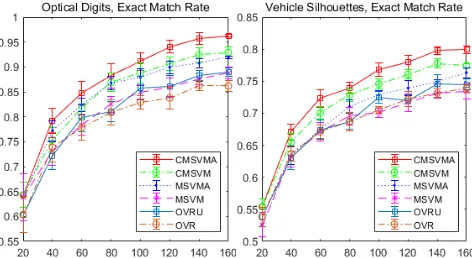
Figure 1: Performance (exact match rate) on two synthetic datasets in experiments.
by taking13 of data instances in these datasets to train an AMSVM with class labels only. After training, we apply the trained AMSVM to every instance in the remaining23 of the dataset, and calculate the probabilitity distribution of all its classes via soft-max function. We generate the OCS for the instance by ordering the classes in terms of their probabil-ity and by excluding those classes that fall below probabilprobabil-ity 0.05. In the OCS experiments we use only the 23of data that consists of the original feature vectors and the correspoding (calculated) OCS.
The real-world datasets consists of two Million Song datasets (CD1 and CD2) (Bertin-Mahieux et al. 2011) and one Face Sentiment dataset (Mozafari et al. 2012). Each Mil-lion Song dataset consists of a collection of songs. In each dataset, the feature vector of each instance contains the tim-bre information of this song, the OCS of each instance con-tains one or two classes indicating the genre that this song likely belongs to. Please notice that each song can only be-long to one genre, and the OCS of this song just indicates the competing choices of genres. In Face Sentiment data, the feature of each instance is a128×120gray-scale image of a facial expression, where we extract 256 features using a convolutional neural network. The class label of each in-stance indicates the sentiment of facial expression. However, each image is annotated by 9 human annotators. Therefore, we may sort the classes according to their vote numbers in the descending order, and take the ordered set of classes as the OCS for each instance. The basic properties of two syn-thetic datasets and three real-world datasets are summarized in Table 1.
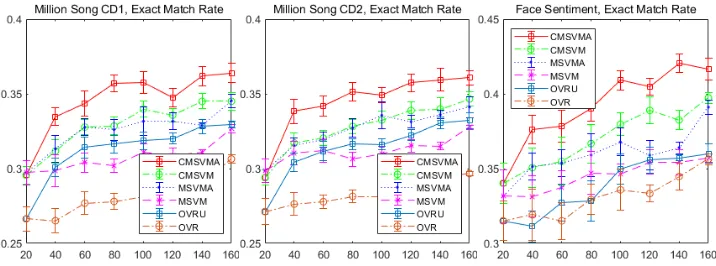
Figure 2: Performance (exact match rate) on three real-world datasets in experiments.
Dataset Name # of Instances # of Features # of Classes Size of OCS
Vehicle Silhouettes 946 18 4 Simulated
Optical Digits 5620 64 10 Simulated
Million Song CD1 35409 90 13 1∼2
Million Song CD2 89073 90 15 1∼2
Face Sentiment 584 256 4 1∼4
Table 1: Properties of all datasets in experiments.
1), and (5) our multi-class classifier trained with ordered class sets (OCS) but without active learning (examples are picked randomly). The details of all methods in the experi-ments are as follows:
OVR:kone-vs-rest binary classifiers trained independently, one for each class; The instances to be labeled next are selected ran-domly; (kis the number of classes in the dataset, sic passim.)
OVRU:kone-vs-rest binary classifiers trainedindependently, one for each class; The instances to be labeled next are selected using least confident uncertainty sampling (Settles, Craven, and Fried-land 2008) active learning strategy;
MSVM: Approximate multi-class SVM (AMSVM) wherek one-vs-rest binary classifiers are trainedjointly, one for each class; The instances to be labeled next are selected randomly;
MSVMA: Approximate multi-class SVM (AMSVM) wherek one-vs-rest binary classifiers are trainedjointly, one for each class; The instances to be labeled next are selected using our EMC active learning strategy;
CMSVM: Our multi-class classifier incorporated with OCS where k one-vs-rest binary classifiers are trained jointly, one for each class; The instances to be labeled next are selected randomly;
CMSVMA: Our multi-class classifier incorporated with OCS wherekone-vs-rest binary classifiers are trainedjointly, one for each class; The instances to be labeled next are selected using our EMC active learning strategy.
All data sets are split (before the training) into the train-ing and test set (ustrain-ing 23 and 13 of all data instances). We evaluate the performance of the different methods by calcu-lating the exact match rates (EMR) all the classifiers achieve on the test data. Exact match rate calculates the ratio of data instances for which the prediction is identical to its class la-bel, over all data instances. The learning considers the train-ing data only, and the EMR is always calculated on the test set. We also repeat the splitting and learning steps 24 times.
The average EMR (Y-axis) of different classifiers on two synthetic datasets and three real-world datasets regarding in-creasing sizes (X-axis) of the training sets is reported in Fig-ure 1 and FigFig-ure 2 respectively.
Experimental results
Figure 1 and Figure 2 show the benefit of our multi-class classifier trained with OCS and our EMC active learn-ing strategy on two synthetic datasets and three real-world datasets both individually and jointly:
Effect of incorporating OCS: On all the datasets, CMSVM
outperforms MSVM and OVR; CMSVMA outperforms
MSVMAandOVRU. These two groups of comparisons show our multi-class classifier trained with the OCS improves the learning performance when compared with models that use only class label information at the same training size.
Effect of EMC strategy: Also, on all the datasets,CMSVMA
outperformsCMSVM;MSVMAoutperformsMSVM. These two groups of comparisons show our EMC active learning strategy improves the performance of the multi-class models compared with models that select next exmples randomly. Again the results are matched at the same training data size.
Effect of combining OCS and EMC: Overall, on all the datasets, the modelCMSVMA, which is the combination of our multi-class classifier incorporated with OCS and our EMC active learning strategy, achieved the highest perfor-mance. This supports and confirms the effectiveness of our multi-class classifier trained with with OCS and our EMC active learning strategy.
Conclusion
and can help us to reduce the annotation efforts. In this work, we proposed a new framework for learning multi-class clas-sification models from human feedback that utilizes OCS and a novel active learning strategy: expected model change (EMC) that matches the OCS labels. Our results show that our learning framework (1) is able to learn more efficiently and from a smaller number of labeled instances than existing methods (2) is better than models that rely on OCS or active learning individually.
Acknowledgements
The work presented in this paper was supported by NIH grants R01GM088224 and R01LM010019. The content of the paper is solely the responsibility of the authors and does not necessarily represent the official views of NIH.
References
Bertin-Mahieux, T.; Ellis, D. P.; Whitman, B.; and Lamere, P. 2011. The million song dataset. InProceedings of the 12th International Conference on Music Information Retrieval (ISMIR 2011). Breiman, L. 1996. Bagging predictors. Machine Learning
24(2):123–140.
Chu, W., and Keerthi, S. S. 2005. New approaches to support vector ordinal regression. InProceedings of the 22nd international conference on Machine learning, ICML ’05, 145–152. New York, NY, USA: ACM.
Griffin, D., and Tversky, A. 1992. The weighing of evidence and the determinants of confidence.Cognitive Psychology24(3):411 – 435.
Hauskrecht, M.; Batal, I.; Valko, M.; Visweswaran, S.; Cooper, G. F.; and Clermont, G. 2013. Outlier detection for patient moni-toring and alerting. Journal of Biomedical Informatics46(1):47 – 55.
Hauskrecht, M.; Batal, I.; Hong, C.; Nguyen, Q.; Cooper, G. F.; Visweswaran, S.; and Clermont, G. 2016. Outlier-based detection of unusual patient-management actions: An icu study. Journal of Biomedical Informatics64:211 – 221.
He, X.; Wang, Z.; Jin, C.; Zheng, Y.; and Xue, X. 2012. A sim-plified multi-class support vector machine with reduced dual opti-mization.Pattern Recognition Letters33(1):71 – 82.
J¨arvelin, K., and Kek¨al¨ainen, J. 2002. Cumulated gain-based eval-uation of ir techniques.ACM Trans. Inf. Syst.20(4):422–446. Juslin, P.; Olsson, H.; and Winman, A. 1998. The calibration issue: Theoretical comments on suantak, bolger, and ferrell. Organiza-tional Behavior and Human Decision Processes73(1):3–26. Lewis, D. D., and Gale, W. A. 1994. A sequential algorithm for training text classifiers. InProceedings of the 17th ACM Interna-tional Conference on Research and Development in Information Retrieval, 3–12. Dublin, IE: Springer Verlag, Heidelberg, DE. Luo, Z., and Hauskrecht, M. 2018a. Hierarchical active learning with group proportion feedback. InProceedings of the Twenty-Seventh International Joint Conference on Artificial Intelligence, IJCAI-18, 2532–2538. International Joint Conferences on Artificial Intelligence Organization.
Luo, Z., and Hauskrecht, M. 2018b. Interactive structure learning with structural query-by-committee. InProceedings of the 2018 European Conference on Machine Learning (ECML 2018). Mozafari, B.; Sarkar, P.; Franklin, M. J.; Jordan, M. I.; and Madden, S. 2012. Active learning for crowd-sourced databases. CoRR
abs/1209.3686.
Nguyen, Q.; Valizadegan, H.; and Hauskrecht, M. 2011a. Learn-ing classification with auxiliary probabilistic information. InIEEE International Conference on Data Mining, 477–486.
Nguyen, Q.; Valizadegan, H.; and Hauskrecht, M. 2011b. Sample-efficient learning with auxiliary class-label information. In Pro-ceedings of the Annual American Medical Informatics Association Symposium, 1004–1012.
Nguyen, Q.; Valizadegan, H.; and Hauskrecht, M. 2013. Learn-ing classification models with soft-label information. Journal of American Medical Informatics Association.
O’Hagan, A.; Buck, C.; Daneshkhan, A.; Eiser, R.; Garthwaite, P.; Jenkinson, D.; Oakley, J.; and Rakow, T., eds. 2007. Uncertainty judgements Eliciting experts’ probabilities. John Wiley and Sons. Peng, P., and Wong, R. C.-W. 2014. Selective sampling on prob-abilistic data. InSIAM International Conference on Data Mining, 28–36.
Peng, P.; Wong, R. C.-W.; and Yu, P. S. 2014. Learning on proba-bilistic labels. InSIAM International Conference on Data Mining, 307–315.
Roy, N., and McCallum, A. 2001. Toward optimal active learn-ing through sampllearn-ing estimation of error reduction. In Brodley, C. E., and Danyluk, A. P., eds.,Proceedings of the 18th Interna-tional Conferenceon on Machine Learning, 441–448. Williams College,Williamstown, MA, USA: Morgan Kaufmann.
Settles, B.; Craven, M.; and Friedland, L. 2008. Active learning with real annotation costs. InProceedings of the NIPS workshop on cost-sensitive learning, 1–10.
Settles, B.; Craven, M.; and Ray, S. 2008. Multiple-instance active learning. InAdvances in Neural Information Processing Systems, 1289–1296. MIT Press.
Settles, B. 2010. Active learning literature survey. Technical report. Seung, H. S.; Opper, M.; and Sompolinsky, H. 1992. Query by committee. InProceedings of the Fifth Annual ACM Workshop on Computational Learning Theory, 287–294. Pittsburgh, Pennsylva-nia: ACM Press.
Thiel, C. 2008. Classification on Soft Labels Is Robust against Label Noise. Berlin, Heidelberg: Springer Berlin Heidelberg. 65– 73.
Tong, S., and Koller, D. 2000. Active learning for parameter esti-mation in bayesian networks. InAdvances in Neural Information Processing Systems, 647–653. MIT Press.
Tosh, C., and Dasgupta, S. 2018. Label enhancement for label distribution learning. InProceedings of the 32nd Conference on Neural Information Processing Systems (NIPS 2018).
Vapnik, V. N. 1998.Statistical Learning Theory. New-York: Wiley. Weston, J.; Gammerman, A.; Stitson, M.; Vapnik, V.; Vovk, V.; and Watkins, C. 1999. Support vector density estimation.
Xu, N.; Tao, A.; and Geng, X. 2018. Hierarchical active learn-ing with proportion feedback on regions. InProceedings of the 27th International Joint Conference on Artificial Intelligence (IJ-CAI 2018).
Xue, Y., and Hauskrecht, M. 2017a. Active learning of classifi-cation models with likert-scale feedback. InSIAM International Conference on Data Mining, 28–35.
Xue, Y., and Hauskrecht, M. 2017b. Efficient learning of classifi-cation models from soft-label information by binning and ranking.