The Thirty-Third AAAI Conference on Artificial Intelligence (AAAI-19)
Multi-Precision Quantized Neural
Networks via Encoding Decomposition of
{
-1,+1
}
Qigong Sun, Fanhua Shang, Kang Yang, Xiufang Li, Yan Ren, Licheng Jiao
Key Laboratory of Intelligent Perception and Image Understanding of Ministry of Education,International Research Center for Intelligent Perception and Computation, Joint International Research Laboratory of Intelligent Perception and Computation, School of Artificial Intelligence, Xidian University, Xi’an, Shaanxi Province, 710071, China
Abstract
The training of deep neural networks (DNNs) requires inten-sive resources both for computation and for storage perfor-mance. Thus, DNNs cannot be efficiently applied to mobile phones and embedded devices, which seriously limits their applicability in industry applications. To address this issue, we propose a novel encoding scheme of using{−1,+1}to decompose quantized neural networks (QNNs) into multi-branch binary networks, which can be efficiently imple-mented by bitwise operations (xnorandbitcount) to achieve model compression, computational acceleration and resource saving. Based on our method, users can easily achieve differ-ent encoding precisions arbitrarily according to their require-ments and hardware resources. The proposed mechanism is very suitable for the use of FPGA and ASIC in terms of data storage and computation, which provides a feasible idea for smart chips. We validate the effectiveness of our method on both large-scale image classification tasks (e.g., ImageNet) and object detection tasks. In particular, our method with low-bit encoding can still achieve almost the same performance as its full-precision counterparts.
Introduction
Deep Neural Networks (DNNs) have been successfully ap-plied in many fields, especially in image classification, ob-ject detection and natural language processing. Because of numerous parameters and complex model architectures, huge storage space and considerable power consumption are needed. Furthermore, with the rapid development of chip technology, especially GPU and TPU, the computing power has been greatly improved. In the rapid developing era of deep learning, researchers use multiple GPUs or computer clusters to contribute to the exploration of complex prob-lems. Nevertheless, the energy consumption and limitation of computing resources are still significant factors in indus-trial applications, which are generally ignored in scientific research. In other words, breathtaking results of many DNNs algorithms under the condition of applying GPUs lag behind the demand of industry. DNNs can hardly be applied in mo-bile phones and embedded devices (as typical industrial ap-plications) directly due to their limited memory and
calcula-Copyright c2019, Association for the Advancement of Artificial Intelligence (www.aaai.org). All rights reserved.
tion resources. Therefore, the compression and acceleration of networks are especially important in future development and commercial applications.
In recent years, many solutions have been proposed to improve the energy efficiency of hardware, achieve model compression or computational acceleration, such as net-work sparse and pruning (Hassibi and Stork 1993; Wen et al. 2016; Han et al. 2015), low-rank approximation (Den-ton et al. 2014; Jaderberg, Vedaldi, and Zisserman 2014; Tai et al. 2015), architecture design (Howard et al. 2017; Sandler et al. 2018; Luo et al. 2018), model quantization (Hubara et al. 2017; Rastegari et al. 2016; Lin, Zhao, and Pan 2017), and so on. Network sparse and pruning can dra-matically reduce the redundant connections, and thus re-duce the computational load in the inference process with-out large accuracy drop. Tai et al. (2015) used low-rank tensor decomposition to remove the redundancy in the ker-nels which can be as a generic tool for speeding up. Since there is some redundant information in the networks, the most direct approach of cutting down those information is to optimize the structure and yield small networks (Ioffe and Szegedy 2015; Iandola et al. 2016). For example, Howard et al. (2017) proposed to use bitwise separable convolu-tions to build light networks for mobile applicaconvolu-tions. Most of those networks still utilize floating-point number rep-resentations (i.e., full-precision values). However, Gupta et al. (2015) discussed that the representation of the full-precision weights and activations in networks is not neces-sary during the training of DNNs, and a nearly identical or slightly better accuracy rate may be obtained under lower-precision representation and calculation.
neural networks (BNNs) (Hubara et al. 2016) is the most efficient strategy at present. This strategy uses bitwise op-erations (xnorandbitcount) to replace full-precision matrix multiplication, and results 58×faster and 32×memory sav-ing in CPU (Rastegari et al. 2016). As discussed in (Liang et al. 2017), it has a higher acceleration ratio on FPGA, which can speed up to about 705×in the peak condition compared with CPU and is 70×faster than GPU. In particular, they quantized activation values and weights to bits and used bit-wise logic operations to achieve extreme acceleration ratio in inference process, but they could suffer significant perfor-mance degradation. However, most models were proposed for a fixed precision, and cannot extend to other precision models. They may easily fall into local optimal solutions and suffer from slow convergence speed in training process.
The representation capability of binary parameters is in-sufficient for many practical applications, especially for large-scale image classification (e.g., ImageNet) and regres-sion tasks. In order to address various complex problems and take full advantage of bitwise operations, Lin, Zhao, and Pan (2017) used the linear combination of multiple binary parameters{-1, +1} to approximate full-precision weights and activations. Therefore, the complex full-precision ma-trix multiplication can be decomposed into some simpler operations. This is the first time to use binary networks for image classification on ImageNet. Guo et al. (2017) and Xu et al. (2018) used the same technique to accelerate the train-ing of CNNs and RNNs. In addition, those methods not only increase the number of parameters many times, but also in-troduce a scale factor to transform the original problem into an NP-hard problem, which naturally makes the solution dif-ficult and high complexity.
In order to bridge the gap between low-bit and full-precision and apply to many cases, we propose a novel encoding scheme of using {−1,+1} to easily decompose trained QNNs into multi-branch binary networks. Therefore, the inference process can be efficiently implemented by bit-wise operations (xnorandbitcount) to achieve model com-pression, computational acceleration and resource saving. Thus, our encoding mechanism can improve the utilization of hardware resources, and achieve parameter compression and computation acceleration. In our experiments, we not only validate the performance of our method for image clas-sification on CIFAR-10 and large-scale datasets, e.g., Ima-geNet, but also implement object detection tasks. The ad-vantages of our method are summarized as follows:
• We can directly use the high-bit model parameters to ini-tialize a low-bit model for faster training. Hence, our net-works can be trained in a short time, and only dozens of times fine-tuning are needed to achieve the accura-cies in our experiments. Of course, we can get better per-formance if we continue training the network. Thus, our multi-precision quantized networks can be easily popular-ized and applied to engineering practices.
• We propose a range of functions (called MBitEncoder) to decompose activations (for example, we can useM func-tions to get the state{−1,+1}ofMencoded bits), which are used for inference computation. Therefore, those
de-composed bits can be directly used in network computa-tion without other judgments and mapping calculacomputa-tions.
• After the process of decomposition, instead of storing all encoding bits in data types, e.g., char, int, float or double, the parameters can be individually stored by bit vectors. Thus, the smallest unit of data in electronic equipments can be reduced to 1-bit from 8-bit, 16-bit, 32-bit or 64-bit, which raised the utilization rate of resources and com-pression ratio of the model. Then the data can be encoded, calculated and stored in various encoding precisions.
Related Work
QNNs can effectively implement model compression, even to 32×memory saving. Many researchers are focusing on the following three classes of methods: quantification meth-ods, the methods of optimization in training process and ac-celeration computation in inference process.
Quantification methods play a significant role in QNNs, and determine the state and distribution of weights and acti-vation values. Gupta et al. (2015) used the notation of integer and fractional to denote a 16-bit fixed-point representation, and proposed a stochastic rounding method to quantify val-ues. Vanhoucke, Senior, and Mao (2011) used 8-bit quan-tization to convert weights into signed char and activation values into unsigned char, and all the values are integer. For multi-state quantification (8-bit to 2-bit), linear quantization is usually used in (Hubara et al. 2017; Wang et al. 2018; Zhuang et al. 2018). Besides, Miyashita, Lee, and Mur-mann (2016) proposed logarithmic quantization to represent data and used bitshift operation in log-domain to compute dot products. For ternary weight networks (Li, Zhang, and Liu 2017), the weights are quantized to {−∆∗,0,+∆∗},
where∆∗ = 0.7·E(|W|). In (Zhu et al. 2017), the posi-tive and negaposi-tive states are trained together with other pa-rameters. When the states are constrained to 1-bit, Hubara et al. (2016) applied the sign function to binarize weights and activation values{-1, +1}. In (Rastegari et al. 2016), the au-thors also used{−α∗,+α∗} to represent the binary states,
whereα∗= 1nkWkl1.
knowledge distillation techniques, which use high-precision teacher network to guide low-precision student network to improve network performance. In addition, some networks as in (Guo et al. 2017; Lin, Zhao, and Pan 2017) use the linear combination of binary values to approximate the full-precision weights and activation values. They not only in-crease the number of parameters many times, but also intro-duce the scale factor to transform the original problem into an NP-hard problem, which naturally makes the solution dif-ficult and high complexity. Xu et al. (2018) used the two valued search tree to optimize the scale factor and achieved better performance in the language model by using the quan-tized recurrent neural networks.
After quantizing, weights or activation values are repre-sented in a low-bit form, which has the potential of accel-eration computation and memory saving. Because the hard-ware implementation has a certain threshold, many schol-ars have avoided considering their engineering accelera-tion. This is also an important reason for hindering indus-trial promotion. The most direct quantization is to convert floating-point parameters into their fixed-point (e.g., 16-bit, 8-bit), which can achieve hardware acceleration for fixed-point based computation (Gupta et al. 2015; Vanhoucke, Se-nior, and Mao 2011). When the weight is extremely quan-tized to the binary weight {-1, +1} as in (Courbariaux, Bengio, and David 2015) or ternary weight {-1, 0, +1}
as in (Li, Zhang, and Liu 2017), the matrix multiplication can be transformed into full-precision matrix addition and subtraction to accelerate computation. Especially when the weight and activation values are binarized, matrix multi-plication operations can be transformed into highly effi-cient logical and bitcounting operations (Hubara et al. 2016; Rastegari et al. 2016). Guo et al.; Lin, Zhao, and Pan (2017; 2017) used a series of linear combinations of{-1, +1}to ap-proach the parameters of full-precision convolution model, and then converted floating point operations into multiple binary weight operations to achieve model compression and computation acceleration.
Multi-Precision Quantized Neural Networks
In this section, we use the multiplication of two vectors to introduce the novel encoding scheme of using {−1,+1}to decompose QNNs into multi-branch binary networks. In each branch binary network, we use -1 and +1 as the basic elements to efficiently achieve model compression and for-ward inference acceleration for QNNs. Different from fixed-precision neural networks (e.g., binary, ternary), our method can yield multi-precision networks and make full use of the advantage of bitwise operations to accelerate QNNs.
Model Decomposition
As the basic computation in most neural network layers, ma-trix multiplication costs lots of resources and also is the most time consuming operation. Modern computers store and pro-cess data in binary format, thus non-negative integers can be directly encoded by{0, 1}. We propose a novel decompo-sition method to accelerate matrix multiplication as follows: Letx= [x1,x2, ...,xN]T andw= [w1,w2, ...,wN]T be two
vectors of non-negative integers, wherexi,wi∈ {0,1,2, ...}
fori= 1,2, ..., N. The dot product of those two vectors can be represented as follows:
xT·w= [x1,x2, ...,xN][w1,w2, ...,wN]T (1) =
N X
n=1
xn·wn. (2)
All of the above operations consist ofN multiplications and(N−1)additions. Based on the above{0, 1}encoding scheme, the vectorxcan be encoded to binary form using
M bits, i.e.,
x= [
z }| { c1Mc1M−1...c11,
z }| { c2Mc2M−1...c21, ...,
z }| {
cNMcNM−1...cN1]T. (3)
Then the right-hand side of (3) can be converted into the following form:
c1M c2M · · · cNM
c1M−1 c2M−1 · · · cNM−1
..
. ... · · · ...
c1
1 c21 · · · cN1
= cM
cM−1 .. . c1 , (4) where
xj = M X
m=1
2m−1·cjm, cjm∈ {0,1}, (5)
ci = [c1i,c 2 i, ...,c
N
i ]. (6)
In such an encoding scheme, the number of represented states is not greater than2M. In addition, we encode another vector wwithK-bit numbers in the same way. Therefore, the dot product of the two vectors can be computed as fol-lows:
xT ·w= N X
n=1
xn·wn (7)
= N X n=1 M X m=1
2m−1·cnm !
·
K X
k=1
2k−1·dnk ! (8) = M X m=1 K X k=1
2m−1·2k−1·cm·dTk. (9) From the above formulas, the dot product is decomposed intoM×Ksub-operations, in which every element is 0 or 1. Because of the restriction of encoding and without using the sign bit, the above representation can only be used to encode non-negative integers. However, it’s impossible to limit the weights and the values of the activation functions to non-negative integers.
In order to extend encoding space to negative integer and reduce the computational complexity, we propose a new en-coding scheme, which uses{-1, +1}as the basic elements of our encoder rather than{0, 1}. Except for the difference of basic elements, the encoding scheme is similar to the rules shown in the formula (5), and is formulated as follows:
xi= M X
m=1
w
1w
2w
Encoder
x
x
1x
2y
1y
2y
3y
4w
1w
2w
1w
2+
* 1
* 2 * 2
* 4
* 1/9
Encoder Decoder
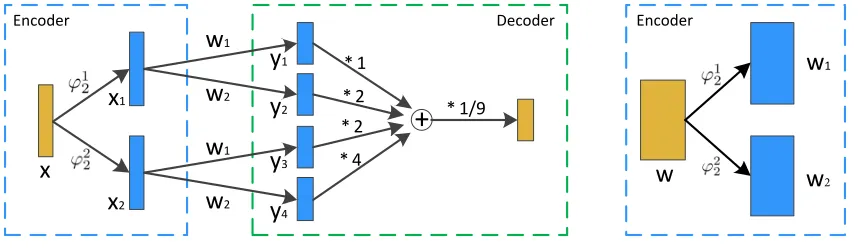
Figure 1: Architecture of fully connected layer by 2-bit encoding. We use 2BitEncoder (ϕ1
2(x)andϕ22(x)) to encode input data and weights in Encoder part and sum over those four results by fixing scale factors to achieve the final output in Decoder part.
whereM denotes the number of encode bit, that can repre-sent2M states. At this time, we can use multiple bitwise op-erations (xnorandbitcount) to effectively achieve the above vector multiplications. This operation mechanism is suitable for all vector/matrix multiplications.
In neural networks, matrix multiplication is the basic computation in both the fully connected and convolution layers. Based on the above decomposition mechanism of vector multiplication, we propose the following model de-composition method for quantized networks. We first use 2-bit encoding for fully connected layer as an example to introduce the mechanism of our model decomposition, the details are shown in Figure 1.xis the input data and wis the weight matrix. Here, we suppose the bias does not ex-ist. We define an ”Encoder” that can be used in the 2BitEn-coder function (ϕ12(·)andϕ22(·)), which will be described in the next section, to encode input data. For example,xcan be encoded by x1 ∈ {−1,+1}N and x2 ∈ {−1,+1}N, where x2 represents high bit data and x1 represents low bit data. These variables meet the following formula:x =
x1+ 2x2. In the same way, the weightwcan be converted intow1 ∈ {−1,+1}M×N andw2 ∈ {−1,+1}M×N. Af-ter cross multiplications, we get four inAf-termediate variables
{y1, y2, y3, y4}. Each multiplication can be considered as a binarized fully connected layer, whose elements are -1 or +1. This decomposition can result multi-branch layers, thus we call it as Multi-Branch Binary Networks (MBNs). For instance, we decompose the 2-bit fully connection operation into four branches binary operations, which can be acceler-ated by bitwise operations, and then sum over those four re-sults by fixing scale factors to achieve the final output. This operation mechanism can be suitable for all vector/matrix multiplications. In addition to fully connected layers, con-volution and deconcon-volution layers are also suit for neural networks.
M-bit Encoding Functions
As an important part in neural networks, activation functions can enhance the nonlinear characterization of networks. In our proposed model decomposition method, encoding func-tion plays a critical role and can encode input data to multi-bits (-1 or +1). Those numbers represent the encoding of
input data. For some other QNNs, several quantization func-tions have been given. However, it is not clear that what’s the affine mapping between quantized numbers and encode bits. In this part, a list ofM-bit encoding functions are proposed to produce the element of each bit that follows the rules for encoding data.
Table 1: Activation functions to limit input data to a fixed numerical range.
T anh(x) =ex−e−x
ex+e−x HT anh(x) =
+1, x >1 x, −16x61
−1, −16x
Sigmoid(x) = 1
1+e−x HReLU(x) =
+1, x >1 x, 06x61 0, x60
Before encoding, the data should be limited to a fixed numerical range. Table 1 lists four activation functions.
HT anh(·) brings the range of input data to [-1, +1], and it consists with sign function to achieve binary encoding of weights and activations (Hubara et al. 2016; Liang et al. 2017). Since the convergence of SGD obtained by us-ing ReLU(·) is faster than other activation functions, we propose a new activation function HReLU(·)that retains the linear characteristics in the specific range and limits the range of input data to [0, 1]. Different from general activa-tion funcactiva-tions menactiva-tioned above, the output of ourM-bit en-coding function defined below should beMnumbers, which is -1 or +1. Those numbers represent the encoding of input data. Therefore, the dot product can be computed by the for-mula (9). In addition, at the above described experimental condition, when we use 2-bit to encode the data x and con-strain to [-1, 1], there are 4 encoded states, as shown in Table 2. The affine mapping between quantized real numbers and their encoded states is given in the following table.
2/3 1/3 1/3 2/3
-1 -2/3 -1/3 0 1/3 2/3 1 -1
1
0
-1 1
0
-1 1
0
-1 1
0
-1 1
-1 -5/7 -3/7 -1/7 1/7 3/7 5/71 -1 -5/7 -3/7 -1/7 1/7 3/7 5/7 1 -1 -5/7 -3/7 -1/7 1/7 3/7 5/7 1
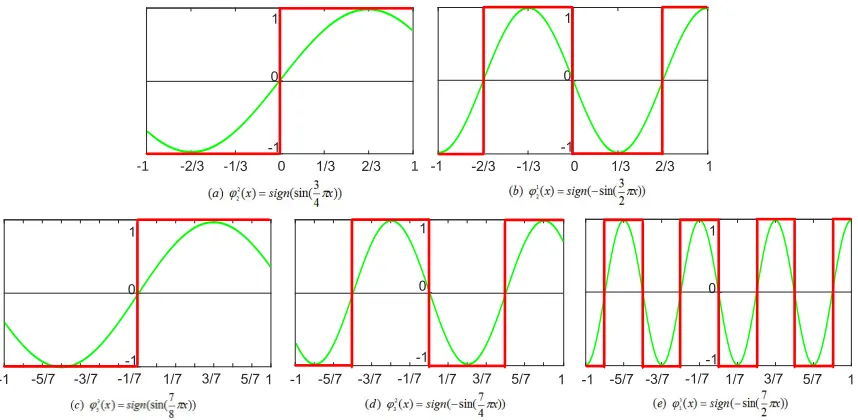
Figure 2: Encoding functions. (a) and (b) denote the encoding functions of the second bit and the first bit of 2BitEncoder. (c), (d) and (e) denote the encoding functions of the third bit, the second bit and the first bit of 3BitEncoder.
Table 2: Quantized real numbers and their Encoded states.
Quantized numbers -1 -1/3 1/3 1
Encoded states {-1,-1} {-1,1} {1,-1} {1,1}
tiply its scale factor to get the final result, shown as1/9in Figure 1. Figure 2 shows the illustration of 2-bit and 3-bit encoding functions, we can see that those encoding func-tions are required periodic, and each function has different periods. Naturally, we apply trigonometric functions as the basic encoder functions, which are signed as red lines. Af-ter all, we use sign function to hard divide to -1 or +1. The mathematical expression can be formulated as follows:
2BitEncoder(x) = (
ϕ2
2(x) :sign(sin( 3 4π·x)),
ϕ1
2(x) :sign(−sin( 3 2π·x)),
(11)
whereϕ1
2(x)denotes the encoding function of the first bit (xi
1) of 2BitEncoder, andϕ22(x)represents the encoder func-tion of the second bit (xi2) of 2BitEncoder. The periodicity is obviously different from others because it needs to denote more states.
Networks Training
QNNs face the problem that the derivative is not defined, thus traditional gradient optimization methods are not ap-plicable. Hubara et al. (2016) presented the HTanh func-tion to binary quantize both weights and activafunc-tions, and also defined the derivative to support back-propagation (BP) training process. They used the loss computed by binarized parameters to update full precision parameters. Similarly, Rastegari et al. (2016) also proposed to update the weights
with the help of the second parameters. Bengio, L´eonard, and Courville (2013) discussed that using STE to train net-work models containing discrete variables can obtain faster training speed and better performance.
Multi-Branch Binary Networks Training
Generated by the decomposition of QNNs, MBNs need to useM-bit encoding functions to get the elements of each bit, which can be used by more efficient bitwise operations to re-place arithmetic operations. We take the 2-bit encoding as an example to describe the optimization method of MBNs. The sign function of the encoder makes it difficult to implement the BP process. Thus, we approximate the derivation of the encoder function with respect toxas follows:
∂ϕ2 2(x)
∂x =
3
4πcos( 3
4πx), −16x61
0 otherwise, (12)
∂ϕ1 2(x)
∂x =
−3
2πcos( 3
2πx), −16x61
0 otherwise. (13)
Besides activations, all weights of networks also need to be quantized to binary values. We retain the real-valued weightwand binarized weight wb in the training process, and applywb to compute loss and gradient, which is used to updatew.wis constrained between -1 to +1 to avoid ex-cessive growth. Different from weights, the binary function for wis not needed for the encoding function and directly defined as follows:
Binarize(x) =sign(HT anh(x)). (14)
byHT anh(x), and it can also speed up the convergence. The parameters of the whole network are updated byAdam
(Kingma and Ba 2014) in the condition for differentiability.
Quantized Networks Training
The above training scheme is proposed to optimize bi-nary networks, which can be converted into multi-state net-works. However, this converter can produce many times more parameters than the original network. If we optimize the binarized network, it may easily fall into local opti-mal solutions and face slow convergence speed. Based on the affine mapping between quantized numbers and fixed-point integers, we can directly optimize the quantized net-work and then use multi-branch binary operations in infer-ence process. There are two quantization schemes usually applied in QNNs (Hubara et al. 2016; Zhou et al. 2016; Miyashita, Lee, and Murmann 2016), named linear quanti-zation and logarithmic quantiquanti-zation. Due to the requirement of our encoding mechanism, linear quantization is used to quantize networks, and is defined as follows:
qk(x) = 2 <(2
k−1)(x+1 2 )>
2k−1 −
1 2
!
, (15)
where < · > denotes the rounding operation, which can quantize a real number x∈ [−1,+1] to a certainty state. We call it a hard ladder function, which can segment in-put codomain to multi-states. Table 2 lists the four states that quantized by formula (15). However, the derivative of this function is almost zero everywhere, it cannot be used in training process. Inspired by STE, we use the same tech-nique to speed up computing process and yield better perfor-mance. We use the loss computed by quantized parameters to update full precision parameters. Note that for our encod-ing scheme with low-precision quantization (e.g., binary), we useAdamto train our model, otherwise stochastic gradi-ent descgradi-ent is used.
Experiments
Many scholars are devoted to improving the performance (e.g., accuracy and compression ratio) of QNNs, while very few researchers have studied their engineering accelera-tion, which is an important reason for hindering industrial promotion. Therefore, we mainly focus on an acceleration method, which is especially suitable for engineering ap-plications. In this section, we compare the performance of our method with BWN (Courbariaux, Bengio, and David 2015), BNN (Hubara et al. 2016), XNOR-Net (Rastegari et al. 2016), TWN (Li, Zhang, and Liu 2017), and ABC-Net (Lin, Zhao, and Pan 2017) for image classification tasks on CIFAR-10 and ImageNet, and object detection tasks on Pas-cal VOC2007/2012 datasets.
Image Classification
CIFAR-10:CIFAR-10 is an image classification benchmark dataset, which has 50000 training images and 10000 test-ing images. All the images are 32×32 color images repre-senting airplanes, automobiles, birds, cats, deer, dogs, frogs, horses, ships and trucks.
We validated our method by different bit encoding schemes, in which activations and weights are equally treated, that is, both of them use the same bit-encoding. Ta-ble 3 lists the results of our method and several state-of-the-art models mentioned above. Here we use the same network architecture as in (Courbariaux, Bengio, and David 2015; Hubara et al. 2016) except for the encoding functions. We useHTanh(·)as the activation function and employAdam
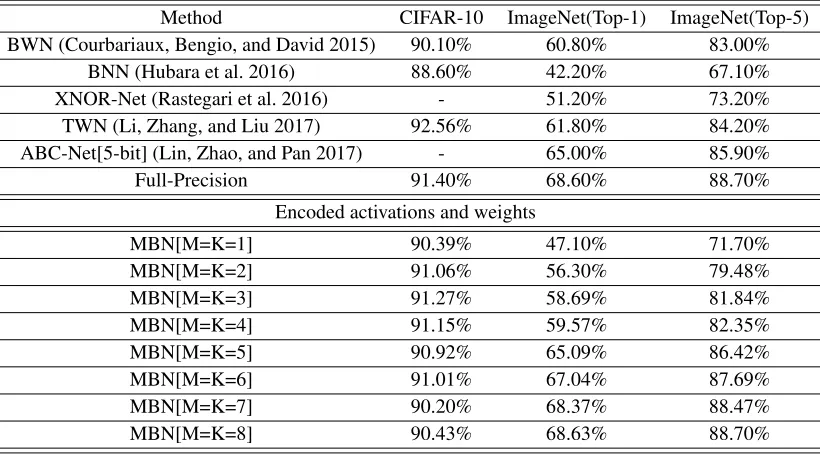
to optimize all parameters of the network. From all the re-sults, we can see that the representation capabilities of 1-bit and 2-1-bit are completely enough for small-scale datasets, e.g., CIFAR-10. Our method with low-precision encoding achieves nearly the same classification accuracy as high pre-cision and full-prepre-cision models, while we can attain∼16×
memory saving compared with its full-precision counterpart. When activations and weights are constrained to 1-bit, our network structure is similar to BNN (Hubara et al. 2016), and our method yields even better accuracy mainly because of our proposed encoding functions.
ImageNet: We further examined the performance of our method with different bit encoders on the ImageNet ILSVRC-2012 dataset (Russakovsky et al. 2015). This dataset consists of 1K categories images, and has over 1.2M images in the training set and 50K images in the validation set. We use Top-1 and Top-5 accuracies to report the classifi-cation performance. For large-scale training sets (e.g., Ima-geNet), it usually costs plenty of time and requires sufficient computing resources for classical full-precision models. It will be more hard to train quantized networks, thus the ini-tialization of parameter values is particularly important. In this paper, we presentHReLU(·)as the activation function to constraint activations. In particular, the full-precision model parameters activated byReLU(·)can be directly used as ini-tialization parameters for our 8-bit quantized network. Af-ter a little number of fine-tuning, 8-bit quantized networks can be well-trained. Similarly, we use the 8-bit model pa-rameters as the initialization papa-rameters to train 7-bit quan-tized networks, and so on. There has a special case, if we useHReLU(·)and 1BitEncoder function to encode activa-tions, all the activations will be constrained to +1. Here, we useHTanh(·)as the activation function for 1-bit encoding. Note that we use SGD to optimize parameters when en-coding bit is not less than 3, and the learning rate is set to 0.1. When the encode bit is 1 or 2, the convergent speed of
Adamis faster thanSGD, as discussed in (Hubara et al. 2016; Rastegari et al. 2016).
simultane-Table 3: Classification accuracies of Lenet on CIFAR-10 and ResNet-18 on ImageNet.
Method CIFAR-10 ImageNet(Top-1) ImageNet(Top-5) BWN (Courbariaux, Bengio, and David 2015) 90.10% 60.80% 83.00%
BNN (Hubara et al. 2016) 88.60% 42.20% 67.10%
XNOR-Net (Rastegari et al. 2016) - 51.20% 73.20%
TWN (Li, Zhang, and Liu 2017) 92.56% 61.80% 84.20% ABC-Net[5-bit] (Lin, Zhao, and Pan 2017) - 65.00% 85.90%
Full-Precision 91.40% 68.60% 88.70%
Encoded activations and weights
MBN[M=K=1] 90.39% 47.10% 71.70%
MBN[M=K=2] 91.06% 56.30% 79.48%
MBN[M=K=3] 91.27% 58.69% 81.84%
MBN[M=K=4] 91.15% 59.57% 82.35%
MBN[M=K=5] 90.92% 65.09% 86.42%
MBN[M=K=6] 91.01% 67.04% 87.69%
MBN[M=K=7] 90.20% 68.37% 88.47%
MBN[M=K=8] 90.43% 68.63% 88.70%
Table 4: Comparison with different encoding bits for object detection.
Method Full-Precision MBN[M=K=8] MBN[M=K=6] MBN[M=K=5]
mAP 0.6392 0.6351 0.6131 0.5423
ously. Although BWN and TWN can obtain little higher ac-curacies than our method with 1-bit quantization model, our method obtains more speedup, and the speedup ratio of ex-isting methods such as BWN and TWN is limited to∼2×. Due to limited and fixed expression ability, existing meth-ods (such as BWN, TWN, BNN, XNOR-Net) can not sat-isfy higher precision requirements. In particular, our method can provide 64 available encoding choices, and hence our encoded networks with different encoding precisions have different speedup ratios, memory requirements and experi-mental precisions.
Object Detection
We also use the trained ResNet-18 with the Single Shot MultiBox Detector (SSD) framework (Liu et al. 2016) to validate object detection, in which the coordinate regression task coexists with classification tasks. The normally regres-sion task has higher requirement on value preciregres-sion, there-fore the application of object detection presents a new chal-lenge for QNNs.
In this experiment, our model is trained on the VOC2007 and VOC2012 train/val set, and tested on the VOC2007 test set. ResNet-18 with the SSD framework (Liu et al. 2016) is used as the basic network. Here we use the trained model parameters in ImageNet classification to initialize SSD net-work parameters, after dozens of times fine-tuning the re-sults are listed in Table 4. We use Mean Average Preci-sion (mAP) as the criterion to evaluate the performance of
our model. It is clear that our method with 8-bit encod-ing scheme can yield very similar performance as its full-precision counterpart. When we use 6-bit to encode parame-ters, the evaluation index dropped by 0.0261. If the number of encode bits is constrained to 5, the performance of this task has visibly deteriorated, while our method can achieve
∼5×memory saving.
As the attempt in object detection tasks, our method yields good performance on the SSD framework. Similarly, it can be applied to other frameworks, e.g., R-CNN (Girshick et al. 2014), Fast R-CNN (Ren et al. 2015), SPP-Net (He et al. 2014) and YOLO (Redmon et al. 2016).
Discussion and Conclusion
{
0, 1
}
Encoding and
{
-1, +1
}
Encoding
As described in (Zhou et al. 2016), there exists an affine mapping between quantized numbers and fixed-point inte-gers. The quantized numbers are usually restricted to the closed interval [-1, +1]. For example, the mapping is for-mulated as follows:
xq= 2 2M−1x
{0,1}−1, (16)
product can be formulated as follows:
xq·wq = 4
(2M −1)(2K−1)x
{0,1}·w{0,1}−
2 2M−1x
{0,1}− 2
2K−1w
{0,1}+ 1. (17)
The right-hand side of (17) is a polynomial, which has four terms. And each term has its own scaling factor. The com-putation ofx{0,1}·w{0,1}can be accelerated by bitwise op-erations, however, the polynomial and scaling factor will in-crease the computational complexity.
For our proposed quantized binary encoding scheme (i.e.,
{−1,+1}), the product of two numbers is defined as xq·wq = 1
(2M−1)(2K−1)x
{−1,1}·w{−1,1}, (18)
wherex{−1,1} andw{−1,1}denote the fixed-point integers encoded by -1 and 1. Obviously, compared with the above encoding of{0,1}, the product can be more efficiently cal-culated by using our proposed encoding scheme.
Linear Approximation and Quantization
As described in (Lin, Zhao, and Pan 2017; Guo et al. 2017; Xu et al. 2018), the weightwcan be approximated by the lin-ear combination ofKbinary subitems{w1,w2, ...,wK}and wi ∈ {−1,+1}N, which can replace arithmetic operations with more efficient bitwise operations. In order to obtain the combination, we need to solve the following problem
min
{αi,wi}Ki=1
w−
K X
i=1
αiwi
2
, w∈RN. (19)
When this approximation is used in neural networks,wican be considered as model weights. However, the scale factor
αi is introduced in this approximation, and such a scheme also expands the parameters K times. Therefore, this ap-proximation can convert the original model to a complicated binary network, which is hard to train (Li et al. 2017) and easily falls into local optimal solutions.
For our method, we use the quantized parameterswq to approximatewas follows:
w≈ 1
2K−1w
q, w∈[−1,1]N, (20) wherewqis a positive or negative odd number, and its abso-lute value is not larger than2K−1. Different from the above linear approximation, our method can achieve the quantized weights, and directly get the corresponding encoding ele-ments. Thus, our networks can be more efficiently trained via our quantization scheme than the linear approximation.
Conclusions
In this paper, we proposed a novel encoding scheme of us-ing{-1, +1}to decompose QNNs into multi-branch binary networks, in which we used bitwise operations (xnor and
bitcount) to achieve model compression, computational ac-celeration and resource saving. In particular, we can use the
high-bit model parameters to initialize a low-bit model and achieve good results in various applications. Thus, users can easily achieve different encoding precisions arbitrarily ac-cording to their requirements (e.g., accuracy and speed) and hardware resources (e.g., memory). This special data stor-age and calculation mechanism can yield great performance in FPGA and ASIC, and thus our mechanism is a feasible idea for smart chips. Future works will focus on improv-ing the hardware implementation and chip technology, and exploring some ways to automatically select proper bits for various network architectures (e.g., VGG and ResNet).
Acknowledgments
This work was partially supported by the State Key Pro-gram of National Natural Science of China (No. 61836009), Project supported the Foundation for Innovative Research Groups of the National Natural Science Foundation of China (No. 61621005), the National Natural Science Foundation of China (Nos. U1701267, 61871310, 61573267, 61502369, 61876220, 61876221, 61473215, and 61571342), the Fund for Foreign Scholars in University Research and Teaching Programs (the 111 Project) (No. B07048), the Major Re-search Plan of the National Natural Science Foundation of China (Nos. 91438201 and 91438103), the Program for Che-ung Kong Scholars and Innovative Research Team in Uni-versity (No. IRT 15R53), and the Science Foundation of Xi-dian University (No. 10251180018). Fanhua Shang is the corresponding author.
References
Bengio, Y.; L´eonard, N.; and Courville, A. 2013. Estimat-ing or propagatEstimat-ing gradients through stochastic neurons for conditional computation. arXiv preprint arXiv:1308.3432. Courbariaux, M.; Bengio, Y.; and David, J.-P. 2015. Bi-naryconnect: Training deep neural networks with binary weights during propagations. InNIPS, 3123–3131.
Denton, E. L.; Zaremba, W.; Bruna, J.; LeCun, Y.; and Fer-gus, R. 2014. Exploiting linear structure within convo-lutional networks for efficient evaluation. InNIPS, 1269– 1277.
Girshick, R.; Donahue, J.; Darrell, T.; and Malik, J. 2014. Rich feature hierarchies for accurate object detection and se-mantic segmentation. InCVPR, 580–587.
Guo, Y.; Yao, A.; Zhao, H.; and Chen, Y. 2017. Network sketching: Exploiting binary structure in deep CNNs. In
CVPR, 4040–4048.
Gupta, S.; Agrawal, A.; Gopalakrishnan, K.; and Narayanan, P. 2015. Deep learning with limited numerical precision. In
ICML, 1737–1746.
Han, S.; Pool, J.; Tran, J.; and Dally, W. J. 2015. Learning both weights and connections for efficient neural networks. InNIPS, 1135–1143.
He, K.; Zhang, X.; Ren, S.; and Sun, J. 2014. Spatial pyramid pooling in deep convolutional networks for visual recognition. InECCV, 346–361.
Howard, A. G.; Zhu, M.; Chen, B.; Kalenichenko, D.; Wang, W.; Weyand, T.; Andreetto, M.; and Adam, H. 2017. Mo-bilenets: Efficient convolutional neural networks for mobile vision applications. arXiv preprint arXiv:1704.04861. Hubara, I.; Courbariaux, M.; Soudry, D.; El-Yaniv, R.; and Bengio, Y. 2016. Binarized neural networks. InNIPS, 4107– 4115.
Hubara, I.; Courbariaux, M.; Soudry, D.; El-Yaniv, R.; and Bengio, Y. 2017. Quantized neural networks: Training neural networks with low precision weights and activations.
Journal of Machine Learning Research18(1):6869–6898. Iandola, F. N.; Han, S.; Moskewicz, M. W.; Ashraf, K.; Dally, W. J.; and Keutzer, K. 2016. Squeezenet: Alexnet-level accuracy with 50x fewer parameters and < 0.5 mb model size.arXiv preprint arXiv:1602.07360.
Ioffe, S., and Szegedy, C. 2015. Batch normalization: accel-erating deep network training by reducing internal covariate shift. InICML, 448–456.
Jaderberg, M.; Vedaldi, A.; and Zisserman, A. 2014. Speed-ing up convolutional neural networks with low rank expan-sions. arXiv preprint arXiv:1405.3866.
Kingma, D. P., and Ba, J. 2014. Adam: A method for stochastic optimization.arXiv preprint arXiv:1412.6980. Li, H.; De, S.; Xu, Z.; Studer, C.; Samet, H.; and Goldstein, T. 2017. Training quantized nets: A deeper understanding. InNIPS, 5811–5821.
Li, F.; Zhang, B.; and Liu, B. 2017. Ternary weight net-works. InICLR.
Liang, S.; Yin, S.; Liu, L.; Luk, W.; and Wei, S. 2017. FP-BNN: Binarized neural network on FPGA.Neurocomputing
275.
Lin, D.; Talathi, S.; and Annapureddy, S. 2016. Fixed point quantization of deep convolutional networks. InICML, 2849–2858.
Lin, X.; Zhao, C.; and Pan, W. 2017. Towards accurate binary convolutional neural network. InNIPS, 345–353. Liu, W.; Anguelov, D.; Erhan, D.; Szegedy, C.; Reed, S.; Fu, C.-Y.; and Berg, A. C. 2016. SSD: Single shot multibox detector. InECCV, 21–37.
Luo, J.-H.; Zhang, H.; Zhou, H.-Y.; Xie, C.-W.; Wu, J.; and Lin, W. 2018. ThiNet: Pruning CNN filters for a thinner net. IEEE Transactions on Pattern Analysis and Machine Intelligence.
Mishra, A., and Marr, D. 2017. Apprentice: Using knowl-edge distillation techniques to improve low-precision net-work accuracy.arXiv preprint arXiv:1711.05852.
Miyashita, D.; Lee, E. H.; and Murmann, B. 2016. Convolu-tional neural networks using logarithmic data representation.
arXiv preprint arXiv:1603.01025.
Polino, A.; Pascanu, R.; and Alistarh, D. 2018. Model com-pression via distillation and quantization. arXiv preprint arXiv:1802.05668.
Rastegari, M.; Ordonez, V.; Redmon, J.; and Farhadi, A. 2016. XNOR-Net: Imagenet classification using binary con-volutional neural networks. InECCV, 525–542.
Redmon, J.; Divvala, S.; Girshick, R.; and Farhadi, A. 2016. You only look once: Unified, real-time object detection. In
CVPR, 779–788.
Ren, S.; He, K.; Girshick, R.; and Sun, J. 2015. Faster R-CNN: Towards real-time object detection with region pro-posal networks. InNIPS, 91–99.
Russakovsky, O.; Deng, J.; Su, H.; Krause, J.; Satheesh, S.; Ma, S.; Huang, Z.; Karpathy, A.; Khosla, A.; Bern-stein, M.; et al. 2015. Imagenet large scale visual recog-nition challenge. International Journal of Computer Vision
115(3):211–252.
Sandler, M.; Howard, A.; Zhu, M.; Zhmoginov, A.; and Chen, L.-C. 2018. MobileNetV2: Inverted residuals and linear bottlenecks. InCVPR, 4510–4520.
Tai, C.; Xiao, T.; Zhang, Y.; Wang, X.; et al. 2015. Convolu-tional neural networks with low-rank regularization. arXiv preprint arXiv:1511.06067.
Tang, W.; Hua, G.; and Wang, L. 2017. How to train a com-pact binary neural network with high accuracy? In AAAI, 2625–2631.
Vanhoucke, V.; Senior, A.; and Mao, M. Z. 2011. Improv-ing the speed of neural networks on CPUs. In Proc. Deep Learning and Unsupervised Feature Learning NIPS Work-shop, volume 1, 4.
Wang, P.; Hu, Q.; Zhang, Y.; Zhang, C.; Liu, Y.; Cheng, J.; et al. 2018. Two-step quantization for low-bit neural net-works. InCVPR, 4376–4384.
Wen, W.; Wu, C.; Wang, Y.; Chen, Y.; and Li, H. 2016. Learning structured sparsity in deep neural networks. In
NIPS, 2074–2082.
Xu, C.; Yao, J.; Lin, Z.; Ou, W.; Cao, Y.; Wang, Z.; and Zha, H. 2018. Alternating multi-bit quantization for recurrent neural networks. arXiv preprint arXiv:1802.00150.
Zhou, S.; Wu, Y.; Ni, Z.; Zhou, X.; Wen, H.; and Zou, Y. 2016. DoReFa-Net: Training low bitwidth convolutional neural networks with low bitwidth gradients. arXiv preprint arXiv:1606.06160.
Zhou, A.; Yao, A.; Guo, Y.; Xu, L.; and Chen, Y. 2017. In-cremental network quantization: Towards lossless cnns with low-precision weights.arXiv preprint arXiv:1702.03044. Zhu, C.; Han, S.; Mao, H.; and Dally, W. J. 2017. Trained ternary quantization. InICLR.