77
Volume-4, Issue-4, August-2014,
ISSN No.: 2250-0758
International Journal of Engineering and Management Research
Available at:
www.ijemr.net
Page Number: 77-81
Routing Protocols of MANET: Simulation & Analysis
Sharandeep Kaur1, Shailesh Pathak2
1,2JCDM College of Engineering, Sirsa, Haryana, INDIA
ABSTRACT
In this paper, we describe a simulation and analysis study of Wireless network in routing protocols using MANET. AODV (Ad-Hoc On-Demand Distance Vector Routing ) Self-configuring network of mobile routers connected by wireless links .In Black hole attack on AODV no of nodes a malicious node acts like a Black hole, dropping all data packets passing through it as like matter and energy disappears . At the advanced type of AOMDV protocol are used AOMDV (Ad-Hoc On-Demand Multiple Routing) - a multipath extension to AODV multiple loop-free and link-disjoint paths. AOMDV Protocols as better than AODV. The simulation result AOMDV protocols packet data send energy consumption and at a same time so many packet deliveries. Simulation the AODV and AOMDV different nodes create network area scenarios in perl script. The process is AODV packet send to source to destination when the Black hole Attack on AODV. These are different parameter are calculate Throughput, PDR (Packet Delivery Ratio), and measured the End to End delay on different network scenarios. Measure the protocols with different packet size and calculate the Energy Consumption. This work will be done with help of the ns-2 simulator (Network Simulator 2.34).
Keywords--- Ad-Hoc On-Demand Distance Vector
Routing (AODV), Ad-Hoc On-Demand Multiple Routing (AOMDV) , ns-2 simulator, MANET
I.
INTRODUCTION
Wireless network refers to any type of computer network that is wireless. In the wireless network, electromagnetic waves are used to connect two devices in the network instead of some physical media. The absence of physical wires makes this kind of network very flexible. It also reduces the installation and maintenance cost of the network. Mobile Ad-hoc Networks (MANETs) is an infrastructure less wireless network in which nodes do not required any base station for communication amongst them. Each node acts as router between source and destination. The nodes are free to move in any direction independently making the topology dynamic. MANETs has various applications (1) in military application for decision making in the battlefield and rescue operations, (2) in public application such as conferencing and disaster relief. The paper of concentrate on energy consumption of two Reactive protocols AODV and DSR, as they are most
widely used routing protocol, under stochastic traffic (Pareto traffic with shape 2.5). Energy consumption is mainly the total energy consume by all nodes active in transmission and reception process [1]. The authors of paper [2] the nodes find a path to the destination node using routing protocols. However, due to security vulnerabilities of the routing protocols, mobile ad hoc networks are unprotected to attacks of the malicious nodes. In this paper [1] Simulation of AODV and AOMDV protocols for 50 nodes and Black hole attack on AODV. [2] Calculate the packet delivery ratio (PDR) and End to End Delay in between the wireless networks. [3] Measure throughput of the different networks Scenarios. [4] Measure the protocols with different packet size and calculate the Energy Consumption. These are performed using ns-2 (network simulator) 2.34.
The paper is distributed as follows. In section 2 we have discuss AODV, and the enhancement of the AOMDV as shows on better than AODV. Black Hole Attack on AODV Section 3 gives the details of Present work as simulation and Analysis. The simulation results are shown in section 4. At the last section 5 describe conclusion and future scope.
II.
MANET ROUTING PROTOCOLS
The routing concept basically involves, two activities: firstly, determining optimal routing paths and secondly, transferring the information groups (called packets) through an inter-network. The later concept is called as packet switching which is straight forward, and the path determination could be very complex. Following section describe AODV and AOMDV.
2.1 Ad-Hoc on-Demand Distance Vector Routing: The
78
2.2 Ad-Hoc On-Demand Multiple Routing: A mobile
ad hoc On-Demand multiple routing (AOMDV) network is a mobile, multi-hop wireless network that does not reply on any preexisting infrastructure. Mobile ad hoc networks are characterized by dynamic topologies due to uncontrolled node mobility, limited and variable shared wireless channel bandwidth, and wireless devices Constrained by battery power [6].One of the key challenges in such networks is to design dynamic routing protocols that are efficient, that is, consume less overhead.
2.3 Black Hole Attack on AODV: In this attack, a malicious node acts like a Black hole, dropping all data packets passing through it as like matter and energy disappears from our universe in a black hole. If the attacking node is a connecting node of two connecting components of that network, then it effectively separates the network in to two disconnected components [5]. The route of collecting multiple RREP messages and thus hoping multiple redundant paths to the destination node. The sender node broadcasts RREQ to its neighbors and once this RREQ reaches the destination, it replies with a RREP with last packet sequence number.
III.
PRESENT WORK AS
SIMULATION & ANALSIS
The Simulation & Analysis results were obtained using network simulator NS-2 version 2.34. The simulation parameters used to produce the simulation suite for this work are presented and explained as follows:
A scenario size is chosen as 1100m x 1000 m square because square area does not discriminate one direction of motion like rectangular area do. The transmitter range of IEEE 802.11 nodes in ns-2 is 250m [11] and this is maximum possible distance between two mobile nodes. They cannot communicate with each other beyond this. The source-destination pairs are spread randomly over the network. The number of source-destination pairs and the packet sending rate in each pair is varied to change the offered load in the network. Traffic sources are CBR (continuous bit-rate). Each node starts its journey from a random location to a random destination according to the speed parameter specified in the scenarios. Once the destination is reached, another random destination is targeted after specified pause. Simulations are run for 100 simulated seconds for 50 nodes. For fairness, identical mobility and traffic scenarios are used across protocols. The selected Parameter are varied using saddest
In present study we have AODV protocols of 50 nodes, Black hole attack on AODV and the same as the AODV in the advanced AOMDV protocols of 50 nodes using the security of network. The different networks scenarios are different parameter are calculate End to End delay, throughput and PDR, Energy Consumption.
3.1 Throughput: No. of Packets send by network v/s No. of packets generated by source.
3.2 End to End delay: The average time it takes a data packet to reach the destination. This includes all possible
delays caused by buffering during route discovery latency, queuing at the interface queue. This metric is calculated by subtracting time at which first packet was transmitted by source from time at which first data packet arrived to destination.
Avg. EED=S/N
Where S is the sum of the time spent to deliver packets for each destination, and N is the number of packets received by the all destination nodes.
3.3 Packet Delivery Ratio (PDR): Packet delivery ratio is defined as the ratio of data packets received by the destinations to those generated by the sources. Mathematically, it can be defined as:
PDR= S1÷ S2
Where, S1 is the sum of data packets received by the each destination and S2 is the sum of data packets generated by the each source.
3.4 Energy Consumption: Energy efficiency is a way of
managing and restraining the growth in energy consumption. Something is more energy efficient if it delivers more services for the same energy input, or the same services for less energy input. The energy is converted in joules, as given in [3], using following equations:
Transmitted Energy
Tx Energy = (330*5*Packet Size)/2x106 (1) Receiving Energy
Rx Energy = (230*5*Packet Size)/2x106 (2)
Equations (1) and (2) are used to calculate the total energy consumption during transmission and reception. The total energy consumed by all nodes involved in transmission and reception is calculated using equation (3).
Total energy consumed = Initial Energy – Energy left (3)
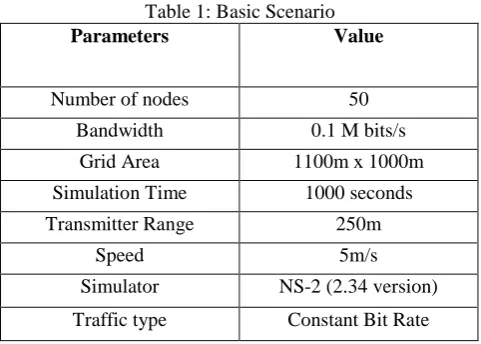
The basic scenario parameters are listed in table 1.
Table 1: Basic Scenario
Parameters Value
Number of nodes 50
Bandwidth 0.1 M bits/s
Grid Area 1100m x 1000m
Simulation Time 1000 seconds
Transmitter Range 250m
Speed 5m/s
Simulator NS-2 (2.34 version)
79
IV. RESULTS
The AODV protocols, Black Hole Attack on AODV, AOMDV protocols graphically under the basic scenario and by varying the selected parameter, following result was observed.
AODV giving the traffic and scenario parameters, the network simulator will draw the topology and will show the topology in the animation area of the network animator. The topology with respect to AODV protocol when simulation just started and simulation is in progress respectively. When describes trace file for all the 50 nodes with maximum connections of 20. The trace file contains the sent packets and the received packets with the simulation times along with instantaneous inter-node connections.
Black Hole Attack on AODV In this scenario network using 50 nodes. Node 1 is the malicious node. When Node 1 broadcasts the RREQ message for Node 5, Node 5 immediately responds to Node 1 with an RREP message that includes the highest sequence number of Node 18, as if it is coming from Node 18. Node 1 assumes that Node 18 is behind Node 5 with 1 hop and discards the newly received RREP packet come from Node 5. Afterwards Node 1 starts to send out its data packet to the node trusting that these packets will reach Node 5 but Node 18 will drop all data packets. In a Black Hole Attack, after a while, the sending node understands that there is a link error because the receiving node does not send TCP ACK packets. If it sends out new TCP data packets and discovers a new route for the destination, the malicious node still manages to deceive the sending node. If the sending node sends out UDP data packets the problem is not detected because the UDP data connections do not wait for the ACK packets. In black hole attack on AODV no of nodes 1 node, 5 nodes, 18 nodes.
AOMDV the network simulator will draw the 50 nodes topology and will show the topology in the animation area of the network animator. The topology with respect to AOMDV protocol when simulation just started and simulation is in progress. AOMDV protocols with maximum connections of 20. The trace file contains the sent packets and the received packets with the simulation times along with instantaneous inter-node connections. The AOMDV protocols as better then performance AODV protocols. The no. of packet sending rate same as that time.
4.1 Calculate the Throughput
Figure (a) shows the throughput by AODV, Black hole attack on AODV, AOMDV. No. of Packets send by network v/s No. of packets generated by source. These value of different networks as shows in figure (a). The transmitted during time interval specified parameter in seconds while these are packet type is CBR. If the corresponds to a reception source to destination nodes. The Result of graph value AODV and Black hole attack on AODV as compare higher than AOMDV. The throughput depends on the simulation parameters regarding data generation and request for delivery. It can be observed that the three protocols have the different throughput.
Figure (a): AODV, Black hole attack on AODV, AOMDV throughput
4.2 Calculate Packet Delivery Ratio (PDR)
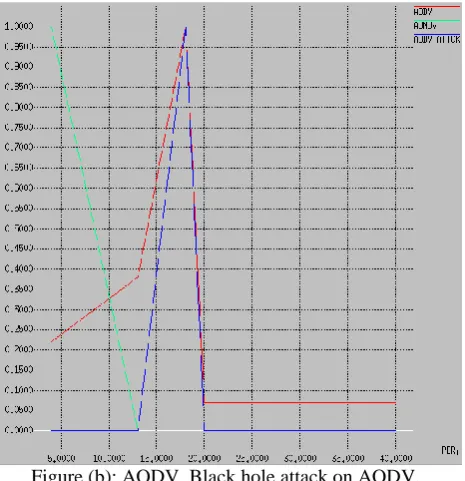
The figure (b) shown as the graph of (PDR) Packet delivery ratio is defined as the ratio of data packets received by the destinations to those generated by the sources. The packet type uses is TCP network scenarios. The no. of 50 nodes results as shows in graph these are different protocols between the different paths selected. At the results of simulation in graph value are not equal. The AOMDV protocol in this process less then time consumption at the source or destination and thus delivery packet but the both are AODV and Black hole attack on AODV as show in figure PDR is greater than AOMDV as shows the results.
80
4.3 Calculate End to End Delay
Figure (c): AODV, Black hole attack on AODV, AOMDV End to End Delay
Figure (c) shows the End to END Delay graph presents the delay taken by the three routing protocols during the simulation period 50 number nodes of frames for all scenarios. The transmitted during time interval specified parameter in seconds. The packet type use CBR Traffic. The maximum output same three network scenarios as shown in graph. AODV, Black hole attack on AODV and AOMDV delay between value shows on table 2 differences. The source to destination command value three are not equal.
Table 2: End to END Delay
AODV AOMDV Black hole
attack on AODV 104.8979 93.2808 116.0288
4.4 Energy Consumption
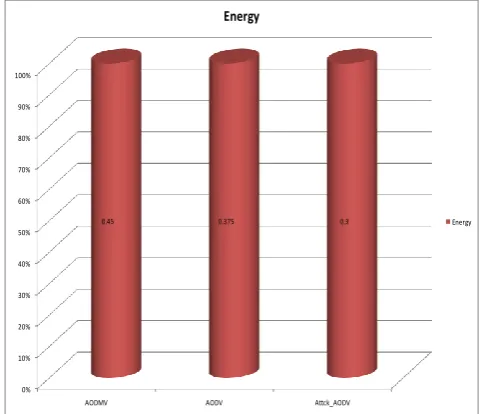
Figure(d) shows the Energy Consumption in Route request (RREQ), route reply (RREP), route error (RERR) and route delete (DELETE) are the routing control packets while Request to Send (RTS), Clear to Send (CTS) and acknowledgement (ACK) are the MAC control packets. The result shows that the energy consumed mainly due to receiving process AODV, Black hole attack on AODV and AOMDV irrespective of the traffic model. The result shows that AOMDV performed better than AODV if energy consumption only due to routing packets is considered.
Figure (d): AODV, Black hole attack on AODV, AOMDV Energy Consumption
4.5 Total Energy Consumption
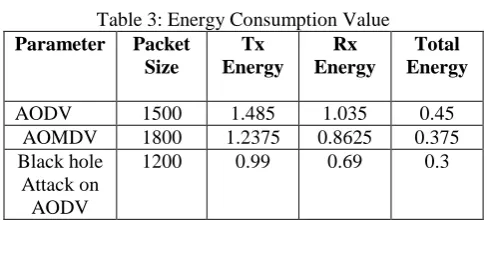
Graphically Figure (e) shows under the basic scenario and by varying the selected parameters, following result was observed. The total energy consumed (Joules) by all the nodes when speed is varied as 0 m/s equivalent to static network, 1 m/s – MANET with human walking, 5 m/s – with cycle speed, 10 m/s – with motor cycle speed, 15 m/s – with car speed and 25 m/s – with car speed on empty road. The energy consumption is mainly due to receiving process. The transmitting energy is more with CBR traffic as compared with CBR traffic for AODV, Black hole attack on AODV, AOMDV value shows on table 3.
Figure (e): AODV, Black hole attack on AODV, AOMDV Total Energy Consumption
0% 10% 20% 30% 40% 50% 60% 70% 80% 90% 100%
AODMV AODV Attck_AODV 0.45 0.375 0.3
Energy
81
Table 3: Energy Consumption ValueParameter Packet
Size
Tx Energy
Rx Energy
Total Energy
AODV 1500 1.485 1.035 0.45
AOMDV 1800 1.2375 0.8625 0.375 Black hole
Attack on AODV
1200 0.99 0.69 0.3
V.
CONCLUSTON AND FUTURE
WORK
This work is to investigate the success of proposed intrusion detection system against black hole attack in AODV for MANET. The analysis of proposed system is done in ns-2. Security is the primary issue in every network. Intruders in the network can degrade the overall performance of network. To Study carefully each and every aspect of these above said protocols such as AODV, AODV with Black hole attack and AOMDV in MANET. This work proposes system a black hole attack in AODV. The conclusions made after the simulation. In this project we have studied the performance analysis of the routing protocols i.e. AODV, AOMDV using ns-2 simulator from the various authors described in the above 802.11 network. In future we want to take other protocols for energy comparison. Another thing that could be considered for future work is to implement and test the proposed system in a real ad hoc network environment.
REFRENCES
[1] Dhiraj Nitnaware, Ajay Verma, “Energy Evaluation Of Two On Demand Routing Protocol Under Stochastic Traffic” 978-1-4244-2746-8/08/$25.00©2008IEEE 2008 [2] Impact of Topology Control and Traffic Models Performance on Mobile Ad Hoc Wireless Routing Protocol (Lawal Bello, Panos Bakalis,) 978-1-4673-5836-1//11/$26.00 ©2011 IEEE
[3] Analysis of QoS parameter in AODV a DSR in mobile Ad Hoc networks (Liliana Enciso Quispe and Luis Mengual Galan,).
[4] An Optimized Ad-hoc On-demand Multipath Distance Vector (AOMDV) Routing Protocol(YuHua Yuan, HuiMin Chen, and Min Jia) 0-7803-9132-2/05/$20.00 ©2005 IEEE.
[5] Mitigation of Black hole for AODV (Ad hoc On Demand Distance Vector) (Ms. Bhumi Jani1, Prof. Hitesh Patel2, © 2013, IJCSMC All Rights Reserved) [6] Ad hoc on-demand multipath distance vector routing Mahesh K. Marina1,and Samir R. Das Wirel. Commun. Mob. Comput. 2006; 6:969–988
[7] Preventing Cooperative Black Hole Attacks in Mobile Ad Hoc Networks Simulation Implementation and Evaluation (Hesiri Weerasinghe and Huirong Fu, Member of IEEE) International Journal of Software Engineering and Its Applications Vol. 2, No. 3, July, 2008
[8] M. X. Cheng, M. Cardei, X. Cheng, L. Wang, Y. Xu, and D.-Z. Du, “Topology control of ad hoc wireless networks for energy efficiency,” Proc. IEEE, vol. 53, pp. 1629–1635, Dec. 2004.
[9] A Survey on Energy Efficient Routing Techniques in Wireless Sensor Networl< (Md. Atiqur Rahman*, Shahed Anwar**, Md. I1eas Pramanik*, Md. Ferdous Rahman) January 27 - 30. 2013 ICACT2013, ISBN 978-89-968650-1-8
[10] L. Hu, “Topology control for multi hop packet radio networks,” Proc. IEEE, vol. 41, pp. 1474–1481, Oct. 1993
[11] “On Energy-efficient Self-organizing Routing for Wireless Mobile Networks”(Melody Moh#, Rashmi Kukanur, Xuquan Lin, and Subhankar Dhar*) San Jose State University, San Jose 95192, CA, USA
[12] “Towards efficient opportunistic communications: a hybrid approach” (Ranjana Pathak_y, Peizhao Huy, Jadwiga Indulska_y, Marius Portmann_y and Wee Lum Tan), 2013
[13] “Comparative Analysis of Reactive MANET Routing Protocols Under the Traffic of TCP” VEGAS with Mobility Considerations (Razia Nisar Noorani). 978-1-4244-5632-1/09/$26.00 ©2009 IEEE
[14] J. Broch., “A Performance Comparison of Ad-Hoc MultiHop Wireless Networks Routing protocols”, IEEE/ACM MOBICOM, Oct 1998
[15] Charles E. Perkins and Elizabeth M. Royer,“Performance Comparison of Two On-Demand Routing Protocols for Ad Hoc Networks”, IEEE Personal Communication, February 2001.
[16] Network Simulator, ns-2,http://www.isi.edu/nsnam/-ns/
[17] . http://www.isi.edu/nsnam/ns/tutorial/