Abdel et al. World Journal of Pharmaceutical and Life Sciences
ISOLATION, PARTIAL CHARACTERIZATION AND ANTIMICROBIAL ACTIVITY OF
A FLAVONE FROM SUDANESE
CORIANDRUM SATIVUM
L.(APIACEAE)
LEAVES
Abdel Karim M.1*, Haga S.1, Kamal M. S.1 and El-Hafez M.2
1Sudan University of Science and Technology, Faculty of Science (Sudan). 1University of Sheikh Badri, Faculty of Pharmacy (Sudan). 2
King Khalid University, Faculty of Science and Arts, Dept. of Chemistry (Saudi Arabia).
Article Received on 05/03/2019 Article Revised on 26/03/2019 Article Accepted on 16/04/2019
INTRODUCTION
Due to their diverse bioactivity, phytochemicals potentially contributed to drug design and drug development. Indeed medicinal plants may better be described as "the sleeping giant of pharmaceutical industries". Bioactive plant constituents have a wide array of activities against a panel of bacteria, fungi, brine shrimp larvae and several enzymes. In underdeveloped communities, where modern medicines are beyond affordability, ethnomedicine plays a vital role in primary health care.
Coriandrum sativum L. (Apiaceae) is an annual herbaceous plant growing up to 25-60cm in height. It is one of the oldest species used by humans.[1] The plant is indigenous to the Mediterranean region, but now cultivated worldwide for its commercial importance.[2] Seeds of Coriandrum sativum are used to flavor various foods and seed essential oil(which mainly contains monoterpenes and monoterpenoids).[3] is commonly used in creams, surfactants, emulsions and lotions.[1] Two varieties of Coriandrum sativum are known; Coriandrum
sativum var. microcarpum and Coriandrum sativum var.
Alef. These subspecies differ in fruit shape and oil content.[2]
Coriandrum sativum fruits have been used traditionally against indigestion, rheumatism, joint pains and worms,[4] while seed extracts are used in ethnomedicine to relief anxiety, convulsions and insomnia[5].Seeds are also used against dyspepsia, diarrhea, stomachic and gastritis.[6] Wichti[7] reported the use of seeds against intestinal parasites, while Leung and Foster[8] claimed strong lipolytic activity. The leaves are used traditionally as spasmolytic, digestive, carminative and lactogogue.[9] Pharmaceutical sudies demonstrated the antimicrobial,[10,11] antioxidant,[4] hepatoprotective,[12] antihistaminic,[13] hypochlesterolemic and hypotensive[14] properties of Coriandrum sativum.
MATERIALS
Plant material
The leaves of Coriandrum sativum were collected from a forest reserve around Nyala western Sudan. The plant was identified and authenticated by direct comparison with herbarium sample. The plant material was shade - dried at room temperature and finally powdered.
Bacterial isolates - Gram +ve:
Bacillus subtilis and Staphylococcus aureus.
World Journal of Pharmaceutical and Life Sciences
WJPLS
www.wjpls.org
SJIF Impact Factor: 5.088*Corresponding Author: Abdel Karim M.
Sudan University of Science and Technology, Faculty of Science (Sudan).
ABSTRACT
Coriandrum sativum L. (Apiaceae) is an annual herbaceous plant growing up to 25-60cm in height. It is one of the oldest species used by humans. The plant is indigenous to the Mediterranean region, but now cultivated worldwide for its commercial importance. This study was carried out to investigate the major flavonoid of Coriandrum sativum leaves and to assess the antimicrobial activity of the isolated flavonoid. The flavonoids were extracted with ethanol and the crude extract was purified by paper chromatography where a flavonoid (compound I) was isolated. The structure of this compound has been partially characterized by some spectral tools (UV, IR and 1HNMR). In the antimicrobial assay, compound I showed significant antibacterial against Pseudomonas aeruginosa, Bacillus subtiles and Candida albicans. It exhibited moderate activity against Staphylococcus aureus, Escherichia coli and the fungal species Aspergillus niger.
- Gram -ve
Escherichia coli, Pseudomonas aeruginosa
- Fungal strains
Candida albicans, Aspergillus niger
-Media for G+ve bacteria
Macconkey agar is used as media for G+ ve bacterial growth:
Peptone from casein 17.0g Peptone from meat 3.0g Sodium chloride 5.0g Lactose 10.0g Bile salt mixture 1.5g Neutral red 0.03g Crystal violet 0.001g Agar 13.5g
-Media for G-ve bacteria Muller –Hinton agar.
- Media for fungi
Sabouraud Agar (oxoid, England) is used as media for fungal growth:
Meat Peptone 5.0g Casein Peptone 5.0g Dextrose 40.0g Agar 15.0g
Distilled water to 1000ml
Equipments
Infrared spectra were obtained in potassium bromide (KBr) discs using a Perkin-Elmer, FTIR, spectrophotometer model 1600-Jasco. A UV spectrophotometer (Shimadzu model UV240) was used for UV spectra; The 1HNMR spectrum was obtained on a Joel- Nuclear Magnetic Resonance (NMR) spectrophotometer, (Brucker AC-250) operating at 500 MHz.
Solvents
Analytical grade solvents were used. Methanol used for spectrophotometric analysis was purchased from Merck, Germany. DMSO-d6 was used as solvent and TMS as
internal standard.
Methods
Extraction of flavonoids
Powdered plant material (1Kg) was macerated with 95% ethanol for 72h. at room temperature. The extract was filtered and the solvent was removed in vacuo. The dried extract was stored at 5oC for further work.
Paper chromatography
The ethanolic extract of Coriandrum sativum was applied on Whatman 3mm paper (46×57 cm) and run in
Antimicrobial activity
The antimicrobial activity was evaluated using well diffusion bioassay. An inoculum suspension was swabbed uniformly to solidify and then allowed to dry for 5 min. Holes of 6 mm in diameter were made in the seeded agar. Aliquots of test sample (100 mg/ml) were added into each well on the seeded medium and allowed to stand on the bench for 1 h for proper diffusion and thereafter incubated at 37oC for 24 h-for bacteria – and for four days at 25oC for fungi. The resulting inhibition zones were measured in millimeters (mm).The assays were repeated in duplicates and the concurrent values were taken. The activity is expressed as less active, if the zone of inhibition is 9-12 mm, moderate 13-17 mm and high if greater than 18 mm.
RESULTS AND DISCUSSION
Using paper chromatography, the ethanolic extract of Coriandrum sativum leaves was fractionated to give a flavonoid - compound I. The IR spectrum showed: ν (KBr) 3330(OH), 2927 (C-H, alkane), 1610 (C = O), 1525, 1448(C = C, aromatic), 1205 (C-O, ether).
Thus compound I is evidently not a catechin or anthocyanin due to the absence of a carbonyl stretching. flavans and anthocanins do not possess a carbonyl function.
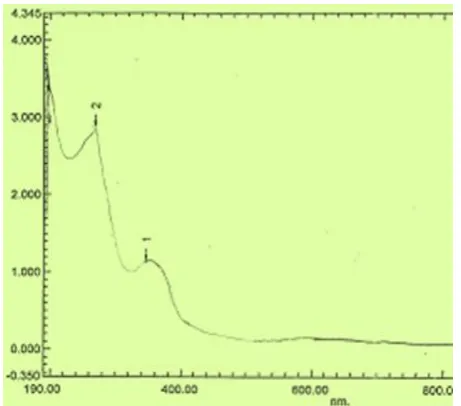
The UV spectra of most flavonoids consist of two major absorption bands appearing at: 230-290 nm (called band II) and the other in the range 300-400nm (called band I). The appearance of both bands is a characteristic feature of: flavones, flavonols, chalcones and aurones. However, the appearance of a single absorption band (band II) is a distinctive feature of: flavanones, isoflavones, dihydroflavonols and dihydrochalcones. The latter are characterized by saturation at C2-C3 linkage.
Fig. 1: UV spectrum of compound A.
The appearance of both bands (I and II) in the spectrum suggests effective conjugation between the two aromatic rings(A and B) and compound I is probably (i)a flavone, (ii)flavonol,(iii) chalcone or(iv) aurone.
O
O O
O
OH
Flavone Flavonol
O
O
Aurone Chalcone
O
Chalcones have a dominant band I absorption and this is not the case with the spectrum of compound I. Also it is known that aurones absorb at λmax 400- 500 nm.
Flavonols absorb at λmax 358 -390 (band I), while flavones absorb in the range: 304 – 356 nm. Hence compound I which gave λmax(MeOH) 234, 345nm is a
flavone.
The UV shift reagent – sodium methoxide – can detect the presence of 3- and 4` - OH functions in the nucleus of flavonoids by inducing a blue shift. However, the sodium methoxide spectrum of compound I(Fig. 2) did not exhibit a bathochromic shift indicating absence of 3- and 4`-OH groups.
Fig. 2: Sodium methoxide spectrum of compound I.
Very useful structural features are also gained by employing UV shift reagents: sodium acetate and aluminum chloride. Sodium acetate is diagnostic of a 7-OH where a bathochromic is observed when the sodium acetate spectrum is recorded. No bathochromic shift was observed in the sodium acetate spectrum of compound I (Fig .3) indicating absence of a 7 – OH function.
Fig. 3: Sodium acetate spectrum of compound I.
Aluminum chloride is an extremely useful complexing agent which can detect 3-, 5-OH as well as ortho- dihydroxy systems.
The complexes formed by ALCl3 with the 4-keto group
O
O
OH
OH
O AL cl cl
O
O
O
O AL
cl
cl
4,5- complex 4`,5`-complex
The aluminum chloride spectrum (Fig.4) failed to reveal a bathochromic shift indicating absence of 3-, 5- OH groups and catechol systems.
Fig. 4: Aluminium chloride spectrum of compound I.
The above spectral data of compound I suggests the following:
-The absence of a 3- and 4`- OH groups (sodium methoxide spectrum).
-The absence of a 7-OH group (sodium acetate spectrum).
-The absence of 3- and 5-OH groups and catechol systems (aluminium chloride spectrum).
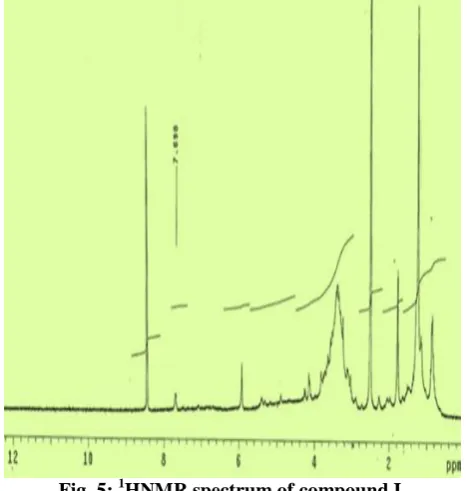
The 1HNMR spectrum of compound I (Fig.5) gave δ(ppm): 1.35(assigned for a methyl group); 3.40(methoxyl); 5.95,7.75 and 8.45(aromatic protons).
Fig. 5: 1HNMR spectrum of compound I.
On the basis of the above spectral data the following partial structure was proposed for compound I:
O
O
OCH3
CH3
Compound I.
Table 1: Antimicrobial activity of compound I.
Organism
Inhibition growth zone diameter (MIZD) Compound I(100mg/ml)
Bacillus subtiles 17
Staphylococcus aureus 16
Escherichia coli 15
Pseudomonas aeruginosa 18
Aspergillus niger 15
Candida albicans 18
Organism Ampicilin (40mg/ml)
Bacillus subtiles 15
Staphylococcus aureus 30
Organism Gentamycin(40mg/ml)
Escherichia coli 22
Pseudomonas aeruginosa 21
Organism Clotrimazole(30mg/ml)
Aspergillus niger 22
Subtiles and Candida albicans. It exhibited moderate activity against Staphylococcus aureus, Escherichia coli and the fungal species Aspergillus niger. Ampicilin, gentamycin and clotrimazole were used as positive controls, while DMSO has been used as negative control.
REFERENCES
1. Coskuner Y, Karababa E, Physical properties of coriander seeds (Coriandrum sativum L.). J. Food Engin., 2007; 80(2): 408-416.
2. Small E. "Culinary Herbs", Ottawa. NRC Research Press, 1997; 219-225.
3. Bhuiyan NI, Begum J, Sultana M., Chemical composition of leaf and seed essential oil of
Coriandrum sativum L.from Bangladesh.
Bangladesh J. Pharmacol., 2009; 4: 150-153. 4. Wangensteen H, Samuelsen AB, Malterud KE.,
Antioxidant activity in extracts from coriander. Food Chem., 2004; 88: 293-297.
5. Emamghoreishi M, Heidari-Hamedani GH., Effect of extract and essential oil of Coriandrum sativum seed against pentylenetetrazole-induced seizure. Pharm. Sci., 2008; 7(2): 1-10.
6. Platel K, Srinivasan K., Digestive stimulant actions of spices: a myth or reality? Indian J. Med. Res., 2004; 119: 167-179.
7. Wichtl M., "Coriandri fructus. Herbal Drugs and Phytopharmaceuticals", CRC Press, Boca Raton, FL, 1994; 159-160.
8. Leung AY, Foster S. "Coriander. Encyclopedia of Common Natural Ingredients", New York. John Wiley and Sons Inc., 1996; 193-194.
9. Eikani M., Golmohammad F., Rowshanzamir S., Subcritical water extraction of essential oils from coriander seeds (Coriandrum sativum L.). J. Food Eng., 2007; 80(2): 735-740.
10. Silva, F., Ferreira, S., Duarte, A., Mendonça D.,I., Domingues, F.C., Antifungal activity of Coriandrum sativum essential oil, its mode of action against
Candida species and potential synergism with
amphotericin B. Phytomed., 2011; 19(1): 42-47. 11. Silva, F., Ferreira, S., Queiroz, J.A., Domingues,
F.C., Coriander (Coriandrum sativum L.) essential oil: its antibacterial activity and mode of action evaluated by flow cytometry, J. Med. Microbiol., 2011; 60(10): 1479-1486.
12. Sreelatha S, Padma PR, Umadevi M., Protective effects of Coriandrum sativum extracts on carbon tetrachloride-induced hepatotoxicity in rats. Food Chem. Toxicol., 2009; 47(4): 702-708.
13. Eguale T, Tilahun G, Debella A, Feleke A, Makonnen E., In vitro and in vivo anthelmintic activity of crude extracts of Coriandrum sativum against Haemonchus contortus, J. Ethnopharmacol., 2007; 110: 428-433.