556
Copyright © 2011-15. Vandana Publications. All Rights Reserved.
Volume-5, Issue-2, April-2015
International Journal of Engineering and Management Research
Page Number: 556-563
Prototype Smart Grid Implementation and Field Trials for Load
Monitoring and Sharing using two Transformers
S. Rauf1, N. Khan2
1,2
______________________________________________________________________________
Department of Electrical Engineering, COMSATS Institute of Information Technology, Park Road, Islamabad, PAKISTAN
ABSTRACT
In term SmartGrid the word “smart” refers to intelligence or self-thinking capability and “grid” to electric hardware infrastructure between power plants and consumers. World is now moving towards intelligent smart technologies, integration of these smart technologies into existing grid will enhance the efficiency, reliability and outage in terms of power generation, safety and investment with remarkable influence. Smart grid provides bi-directional power flow with Integration of distributed generation to national grid with interference of Advance Metering Infrastructure (AMI), which allow self-healing capability against faults and power thefts. GSM based circuit breakers control and manage the overload switching remotely from either grid or from consumer end. Microcontrollers are programmed to handle the on-peak and off-peak hours more precisely with integration of solar hybrid distributed generation to national grid using smart meters. Intelligent Load Sharing of Transformers with Auto Protection & GSM Monitoring works to overcome the entire basic requirement regarding Distribution System Protection more efficiently and also prevents issues of stability, power factor and system reliability.
Keywords— Electric Energy, Power Theft, Smart Meter, Power Distribution System, Advanced Metering Infrastructure
I.
INTRODUCTION
Electric system for delivering power is considered to be the most sophisticated way ever built. It consists of proper network includingcables, power lines, structured
towers, distribution transformers,and relays and
switchingcircuits integrated in a specific way. Since 1960, the computers are used which control and monitor the flow of power. Quality, efficiency and service of products are the result of the sensing devices such as actuators, CT, PT
which are further calibrated with control devices for further actionsusing smart grid state [1].
By sensing, continuous monitoring, excessive control and feedback; existing dump grid system becomes smart with self-healing, self-thinking and self-controlling capability. It permit new ways of utilize distributed generation into existing grid with intense reliability and stability with proper transmission, storage and distribution. It ensures efficient, reliable and optimized system towards the consumer end with much relaxing tariff and mitigation with atmospheric changes. Old system based upon 1940’s technologiesalongwith the new distribution system added in 1980’s forvthe increasing demand side load, resulted in congestion in transmission system. On the other side new advanced technologies are getting popular to cope the problem, effective use of renewable energy can resolve the issue positively.These realistic factsgreatly encourages the need of a Smart Grid to resolve the energy crisis [2].
557
Copyright © 2011-15. Vandana Publications. All Rights Reserved.
SmartGrid, in an electrical engineeringtechnology, is like a new machine in remote village. It is a novel vision but not strange to 21st century power professionals. Conventional electric grids have long been using telemetry, power line communications, remote terminal unit (RTU), digital energy meter, microwaves and supervisory control & data acquisition (SCADA) systems. Hence, the concept of smart grid has emerged, encompassing the cyber-physical infrastructure including wide-area monitoring, bi-directional power flow and communication facilities [3].
Electrical energy management (EEM) has reached specific concern in the twenty- first century due to its contribution to economic development and environmental advancement. It has as a logical outcome and the planning of varieties of initiatives that could be deployed to reduce energy consumption. EEM may be performed on the Supply Side (SS) or Demand Side (DS). The power supply side executes production and delivery of electric power. It is also responsible for supplying sufficient electric power at the acceptable standards and high level of reliability. Electrical energy has become a scarce resource in developing countries due to its vast demand. The electricity generated should be utilized efficiently to meet the demand of countries. This improves the reliability of the power supply system [4].
In this regard, electrical energy management (EEM) is the cheapest action that can support the growing electricity demand and allows Distributed generation (DG) for newly generating plans. Solar PV DG can be used to overcome the energy shortage on supply side and on demand side at consumer end, different strategies can be adopted to manage the load such as direct load control, utility can switch off the load directly when required through remote device. The utility provides advance notice to the customer for switching off their secondary load through mobile smart message service before disconnecting directly through remote devices, such as wireless circuit breakers operated by wifi, zigbee or GSM devices. Smart energy meters are used for controlling the use of load. Each house is allowed a limited use of load up to some Kilo watts, if someone exceeds their limit then that consumer will be cut off from existing grid. Rest of the system will be not be affected.
Power factor improvement has also been considered as one of the load management (LM) actions. Correcting PF brings the demand saving on the demand side and improves the reliability of the power supply by installing a capacitor bank for power factor correction. It will help utility to combine traditional and new technologies which will provide real-time new ways to control the flow of electric power from grid to consumers. Digital meters already give consumers capability to monitor their power use and hopefully induce power saving measures. This will enhance the grid stability and load management[5].
II.
SMART GRID IMPLEMENTATION
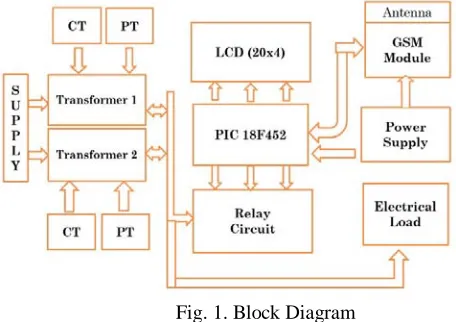
Experimental Implementation of smart techniques are extremelybeneficial to reduce the problem of existing dump grid, converting it into intelligent and self-decisive grid by continuous monitoring through GSM based configured CT and PT at demand side, which gives live load monitoring to both customer and utility suppliers as shown in Fig.1.
Fig. 1. Block Diagram
Consumer receive load details on their cell phones after intervals, during short fall period. They can themselves switch off the auxiliary devices within specified time or it will be shut down automatically to stabilize the priority load, which could be done by installing GSM based circuit breakers at customer side,these circuit breakers will be helpful for controlling and managing load from grid remotely for live load management techniques. Simultaneously integration of distributed generation also helps to cope the problem of load shedding. Sharing the load on two transformers during peak hours will improve the effect of interrupt tripping from grid.
III.
SMART LOAD SHARING OF TWO
TRANSFORMERS
558
Copyright © 2011-15. Vandana Publications. All Rights Reserved.
technology has evolved during the last few years. Energysmart meter is used to calculate the power usage and send it to the grid remotely or locally. The power consumption reading can be transmitted to the grid through a number of ways but we have relied on GSM technology over here.
Power supply required for making a prototype has the input voltage of 220V and output voltage for this power supply measures 12V (AC) or +5V (DC). Likewise the current rating for the step-down Transformer (220V – 12V) is 1A. Some other components of the power supply are bridge rectifier (2W08), a heat sink (LM7805) and two capacitors for filtration of signals of capacity 470µF and 100µF.
Simple 1:1 ratio transformers (220V in & 220V out) are used to avoid the a-synchronism but any other turn ratio for transformers may also be adopted with the expense of synchronism. The current rating of each of the transformers is 1A. So the maximum power supplying capability of each transformer is 220VA.
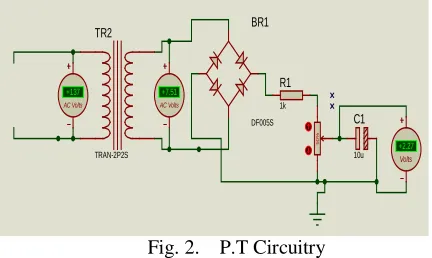
Potential transformers are such instrument transformers that are used to measure the voltage for metering devices. These transformers are essentially step-down transformers. [4] The specifications of P.Ts used for prototype include a bridge rectifier that converters 220V AC to 12V DC supply with the help of a step-down transformer [6]. The output voltage for the P.Ts can be calibrated according to the metering device and output voltage calibrated for the prototype is 2.20V DC as shown in Fig.2. R1 1k 5 0 % C1 10u TR2 TRAN-2P2S AC Volts +7.51 BR1 DF005S Volts +2.27 AC Volts +137
Fig. 2. P.T Circuitry
Current transformers are such instrument transformers that are used to measure the current for metering devices. These transformers are essentially step-up transformers. C.Ts areconnected in series with the load in Fig.3. The specifications of C.T used for prototype include a step-down transformer with current rating of 0.45A and a half wave rectifier, a capacitor and a variable resistor to calibrate the output current. The calibrated current at the output of the C.T is 100mA. [7]
4 3 % C1 10u TR2 TRAN-2P2S AC Volts +12.0 D1 1N4001 R2 10k C1(1) I=8.84164e-006
Fig. 3. Current Transformer circuitry
Switching circuits comprise of relays that are used for protection of system as well as shifting of load between the transformers. The specifications of switching circuits defined in this paper include six relays (12V each), six opto couplers (PC817), transistors (C945), diodes (1N4001) and connectors as shown in Fig.4.
A K C E 1 2 4 3 U1 PC817 R1 330R U1(C) R2 4.7K R3 10K Q1 BC547 D1 LED-BIGY R4 1K D2 1N4001 R4(2) L1 12V RL1 12V
Fig. 4. Switching circuits
559
Copyright © 2011-15. Vandana Publications. All Rights Reserved.
First, switch on the AC supply form the outlet andturn on the GSM module using a mobile charger. Turn the load (e.g. 100W) ON for transformer1 and note the values for voltage, current, power, units and price for units displayed on the LCD. Now increase the load (e.g. to 220W, that is max. limit for transformer1) and note all the parameters’ values. Further increase of load over transformer1 will cause the shifting of load from transformer1 to transformer2. With the delay of 30 sec, all these measured vales will be sent via GSM to the cell phone of the consumer.
Secondly, with the increase of load again over the transformer2, the values of all parameters will be changed on LCD and new observations will be sent via GSM to the consumer. As soon as the load is increased from rate capacity of both transformers, whole system will be tripped by the switching circuit to avoid any hazardous situation as shown in flow diagram in Fig.6.
Fig. 6. Flow Diagram
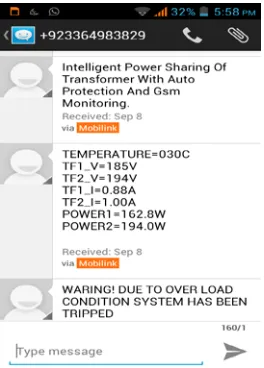
Reclosing of the system will be checked by switching circuit for 4 to 5 times, that whether the overload system has been removed or not, if removed, resume the system to normal running mode. Alert message will be displayed on consumer’smobile phone as shown in Fig. 7.
560
Copyright © 2011-15. Vandana Publications. All Rights Reserved.
IV.
SMART ENERGY METER WITH
LOAD MANAGEMENT
TECHNIQUES.
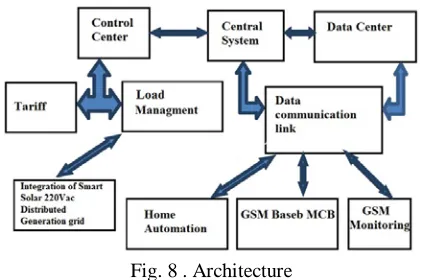
The electric energy meter measures as well as records the electrical power energy consumed over time by an electrical appliance. Energy meter has two types, they can be based on electromechanical or electronics, and they can be used in domestic, industrial or commercial environment. However, electromechanical meters have been in use for a very long time but electronic meters start to appear on screen in an electrical metering scene very late. Electromechanical meters have many problems such as technical, social and management. The technical problems in electromechanical meter are due to the moving parts, which cause wear and tear or damage its magnetic component whose operation largely depends on prevailing temperatures. These problems are converted into errors, these errors degrade the working as well as reliability and accuracy of the meter over time. The manual meter reading of electromechanical meter for the aim of billing faces many social and management problems. Smart metering is a topic that has come to the limelight in the past few years. The promises shown by the smart metering in Europe, USA and other countries show that this concept if correctly implemented can show better results. Many countries in Europe have installed these meters and benefitting from the enhanced technology and performance associated with it. Smart energy metering includes the installment of such a meter which takes the regular readings, total calculation and complete response to data which is spent by the customer. The architecture of the smart meter is shown on Fig 8. "Energy smart meter" has the following characteristics:
• Total record of usage of electricity in real-time or near-time and electricity can be created locally such as photovoltaic cells.
• These meters provide the opportunity to read the
values both locally and remotely on demand; remote restraint of the output through the meter by cutting the electricity of the customer in the extreme cases.
• Interconnection of ground-based systems and
devices such as distributed generation
• This meter has many additional features which
make it better than the electromechanical meter.
Fig. 8 . Architecture
The 'intelligence' of the meter is integrated in the electricity meter. It has three significant utilities:
Calculate the usage of electricity, cut off the electricity supply of customer remotely and control the maximum power depletion. The need of smart metering arose due to power shortage, electricity theft, the mistakes committed by the meter readers and the increasing complaints by the power consumers. Smart metering evolved with the progress made by the electronics industry and development of microcontrollers with greater processing power. Smart Metering has been successfully implemented in certain countries. The details are described later.
Smart Metering technology has been implemented by many countries while many are trying to implement it.The largest installation of energy smart meters in the world was commenced by a company called EnelSpA, which has more 27 million customers in Italy. From 2000 to 2005 EnelSpA mounted smart energy meters to its whole customer’s base. These energy smart meters are completely electronic and are linked with all sort of communications on both directions, having capabilities to calculate and manage advanced power, incorporated, and a solid-state design. There is also disconnecting switches which are controlled by softwares. By using standards-based power line technology this system communicate over low voltage power lines.
561
Copyright © 2011-15. Vandana Publications. All Rights Reserved.
installed at the end of February 2010. British Gas wasmainly used in new installation, and it installed approximately 2 million meters at the end of 2012. The Company was approximately installing on average one thousand (1,000) new smart meters per day.
According to Department of Energy & Climate Change UK that installation of these meters cost round about £12billion. Due to these smart meters, the profit is more than 42 percent- £6.80billion -which came from customers because their energy requirements was reduced alongwiththe low-tax facility. Earnings of supplier are about £7.16billion and it also included £2.87billion output because they have no concerns with meter readers inquiries and also consumer’s payments of 1.58billion. As lot carbon is saved, it is also beneficent for operators of the networks and Britain PLC.
The American Council of Economy Energy-Efficient has about 36 different types of domestic smart meters and response programs. Mainly we will discuss these terms in smart meters. Finally, in order to increase savings, smart meters must be used with home appliances and this program will involve, empower and inspire people. For marketing purpose industry and technical people should create awareness among others for the use of smart meter so that they use energy efficiently.
Pakistan has been facing a severe power shortage for a couple of years. The Pakistani government is working on harnessing the untapped renewable energy resources of the country. In addition to this, smart metering is being tested in some parts of the country and has shown great results. In Lahore Smart Meters were installed as a testing project in Delhi Gate, Shadbagh and Shadman region. The sources were told by the LESCO that electricity mugging and losses fell abruptly from 12% to 2.7% in Shadman and Shadbagh and from 14% to 4.8% in Delhi Gate, after the installation of new smart energy meters on approximately 145 industrialized, nearly 50 domestic and 156 commercial connections. According to the sources from LESCO, the project cost is only about Rs6.5 million but saved tens of millions of rupees [8]. The total project cost is estimated at $5.5 billion, with funding to be provided in four tranches by the DISCOs, the ADB and other investors. Tranche 1 funding of $252 million from the ADB has recently been approved and the DISCOs will contribute $75 million.
Key challenges facing Pakistan’s power sector are a shortage of generation capacity and increasing constraints in the transmission and distribution systems due to inadequate maintenance and demand growth, resulting in regular system outages and supply interruptions to customers. System losses average 20 percent in 2006, ranging from 39 percent in the worst case to 10 percent in the best case.
An electric energy meter is a device which is used to measure the amount of electricity used by a residence, industry, or any other electrical device. These meters are
then used to make billing units, typically one being the kilowatt hour [kWh] [9].
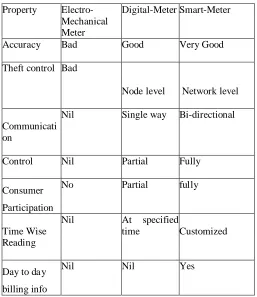
In 1880, electric energy was used commercially for the very first time, suddenly the need to bill the consumers for the use of electric energy became an important device same as an existing gas meter during that time, rather than a fixed amount each month based on number of lamps. Some of the experimental type meters were also developed. The first person to work on electromechanical meter was Thomas Edison.Electric meter works by measuring Instantaneous voltage and Instantaneous current. Power is then calculated in watts by taking product of these two quantities. Instantaneous voltage is calculated in volts and then the current is calculated in amperes and after that, the product of these two gives the instantaneous electric power in watts. This power is then integrated with time to finally calculate energy utilized. (Kilowatt-hours joules). Different type of meters have different features as shown in Table.I.
Table. I.
COMPARISION OF DIFFERENTR METERS
Property Electro- Digital-Meter Smart-Meter
Mechanical Meter
Accuracy Bad Good Very Good
Theft control Bad
Node level Network level
Communicati on
Nil Single way Bi-directional
Control Nil Partial Fully
Consumer No Partial fully
Participation
Time Wise
Nil At specified
time Customized
Reading
Day to day Nil Nil Yes
billing info
562
Copyright © 2011-15. Vandana Publications. All Rights Reserved.
by their little negligence. This is what our aim was, torelieve the user.
Furthermore, users always find it difficult to get an average overview of their usage as they are not aware of their increasing or decreasing consumption which may result in an increased per unit cost. In our manual system, officials cannot keep all the users aware of these facts, though these facts are user friendly and convincing for the user. Keeping them informed would result in limited usage of this power consumption. Thus, load management is a real big issue and is clearly not handled properly. In order to cope up with these problems we decided to use the benefits of a Smart meter that communicates continuously with the grid end and advises the users to economically use power and save them from the pain of manual meter reading. Just consider for a while, how pleasant a life would be without load shedding. This is really a life that is independent of the secondary power sources like UPS, generators, etc.
Following are the key features of our smart energy meter.
• Power Factor Calculation and Display
• Voltage Measurement and Display
• Current Measurement and Display
• Frequency Measurement and Display
• Two way communication with the grid based on
GSM
• Load Management Control
The main problem of our country is power shortage. Due to power shortage we have to face severe amount of load shedding. In our project we are trying to give a solution to avoid load shedding until the problem of power shortage is resolved. In our solution we limit the load of every consumer mean every consumer is able to use certain amount of power. So power is equally distributed. When the consumer crosses its load limit its connection has been tripped automatically and connection remain tripped until the consumer switch off the extra load connected in the system. By applying this scheme we do not have to see the demand of our country instead we see toward the power produced by our country and then make a scheme to distribute this power as per requirements of various areas.
V.
SMART WIRELESS REMOTE
CIRCUIT BREAKER
[20]
Smart wireless circuit breakers are designed for remotely switchingof priority based devices. These MCB’s are controlled through programmed based controller which sends signals for switching through remote location to specific device for load management. Each MCB is installed at remote location on each device. Using GSM module integrated with MCB switching could be done at
any location of the world. It can be switched from any of GSM based mobile phone or GSM based device, integrated with any programmed based controller.
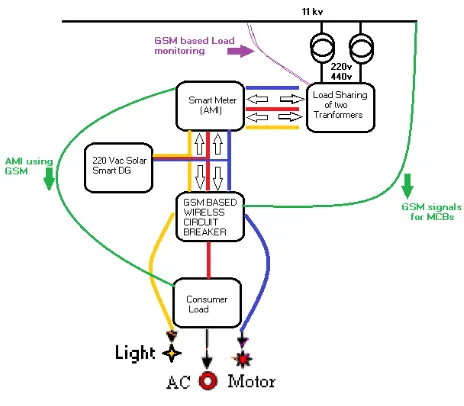
In our system microcontroller is programmed so as to manage the load flow, send signal to any of device which is overloading the system.Both Smart energy meter and Smart transformer load sharing device is integrated with wireless MCB, which is installed at utility side. Generation side of distributed solar generation is also controlled by wireless MCB. Final diagram for smart grid based live load shedding scheme is illustrated in Fig.9.
Fig .9. Block Diagram
VI.
CONCLUSIONS
563
Copyright © 2011-15. Vandana Publications. All Rights Reserved.
REFERENCES
[1] Shea, John. "Book reviews [8 books reviews]",
IEEE Electrical Insulation Magazine, 2011.
[2]
[3] http://arxiv4.library.cornell.edu
[4]
[5] Ewald F. Fuchs. "Analyses and Designs Related
to Renewable Energy Systems", Power Conversion of Renewable Energy Systems, 2011
[6] http://www.ijettjournal.org
[7] Ali, Syed Shahbaz, MadihaMaroof, and
SidrahHanif. "Smart energy meters for energy conservation & minimizing errors", 2010 Joint International Conference on Power Electronics Drives and Energy Systems & 2010 Power India, 2010.
[8]