Vol. 14, No. 3, 2017, 371-377
ISSN: 2279-087X (P), 2279-0888(online) Published on 11 October 2017
www.researchmathsci.org
DOI: http://dx.doi.org/10.22457/apam.v14n3a3
371
Annals of
On Regular Generalized B
#-Closed Sets
V.Vijaya Priya1 and T.Indira2
Department of Mathematics
Seethalakshmi Ramaswami College, Trichy, India.
1
E-mail: [email protected]
2
Corresponding author. E-mail: [email protected]
Received 24 July 2017; accepted 19 August 2017
Abstract. The aim of this paper is to introduce a new class of sets called rgb#-closed sets and examine the basic properties of rgb#-closed sets.
Keywords: b#-closed set, gb#-closed set, rgb#-closed set.
AMS Mathematics Subject Classification (2010): 54A05
1. Introduction
In topology and related branches of mathematics, a topological space may defined as a set of points, along with a set of neighbourhoods for each point, satisfying a set of axioms relating points and neighbourhoods. The definition of a topological space relies only upon set theory and it is the most general notion of a mathematical space that allows for the definition of concepts such as continuity, connectedness and convergence. Other spaces such as manifolds and metric spaces are specilizations of topolgical spaces with extra structures or constraints. Being so general, topological spaces are a central unifying notions and appear in virtually every branch of modern mathematics. The branch of mathematics that studies topological spaces in their own right is called general topology.
In 1970, Levine [8] introduced the concept of generalized closed set. In 1986 and later in 1996 Andrjivic [2,3] gave new types of open sets in topological spaces called b-open sets. Motivated by these papers, Al-Omari et al. [1] introduced and studied the concept of generalized b-closed sets in topological spaces and thereafter, in various papers Indira et al. [4,5,6,7] introduced different types open and closed sets and analyzed their properties. Recently, Parameswari et al. [9] introduced notions of b#-open sets and b#-closed sets by taking equality in the definitions of b-open sets and b-closed sets. Vithya et al. [10] introduced the notion of generalized b#-closed sets and discussed the properties of such sets. In this paper the notion of regular generalized b#-closed set is introduced and their basic properties are discussed.
Throughout this paper X denotes a topological space on which no separation axiom is assumed. For any subset A of X, cl(A) denotes the closure of A and int(A) denotes the interior of A in X.
2. Preliminaries
V.Vijaya Priya and T.Indira
372
(i) b-open if A ⊆ cl(int(A)) ∪ int(cl(A)) and b-closed if cl(int(A)) ∩ int(cl(A)) ⊆ A. (ii) b#-open if A = cl(int(A)) ∪ int(cl(A)) and b#-closed if A = cl(int(A)) ∩ int(cl(A)). (iii) semi-open if A ⊆ cl(int(A)).
(iv) regular open if A = int(cl(A)). (v) a p-set if cl(int(A)) ⊆ int(cl(A)).
(vi) π-open if A is a finite union of regular open sets. (vii) semi pre-open if A ⊆ cl(int(cl(A))).
(viii) pre-open if A ⊆ int(cl(A)).
Definition 2.2. A subset A of a space X is called
(i) generalized closed (briefly g-closed) if cl(A) ⊆ U whenever A ⊆ U and U is open. (ii) generalized semi-pre-regular-closed (briefly gspr-closed) if spcl(A) ⊆ U whenever
A ⊆ U and U is regular open.
(iii) π-generalized semi-pre-closed (briefly πgsp-closed) if spcl(A) ⊆ U whenever A ⊆ U and U is π-open.
(iv) π-generalized pre-closed (briefly πgp-closed) if pcl(A) ⊆ U whenever A ⊆ U and U is π-open.
(v) generalized pre-regular-closed (briefly gpr-closed) if pcl(A) ⊆ U whenever A ⊆ U and U is regular open.
(vi) regular weakly generalized closed (briefly rwg-closed) if cl(int(A)) ⊆ U whenever A ⊆ U and U is regular open.
(vii) regular generalized b-closed set (briefly rgb-closed) if bcl(A) ⊆ U whenever A ⊆ U and U is regular open.
(viii) π-generalized b-closed set (briefly πgb-closed) if bcl(A) ⊆ U whenever A ⊆ U and U is π-open.
(ix) regular generalized closed set (briefly rg-closed) if cl(A) ⊆ U whenever A ⊆ U and U is regular open.
(x) π-generalized closed set (briefly πg-closed) if cl(A) ⊆ U whenever A ⊆ U and U is π-open.
(xi) generalized b#-closed (briefly gb#-closed) if b#cl(A) ⊆ U whenever A ⊆ U and U is open.
Theorem 2.3. [9] Let A be a subset of a space X. Then
(i) scl(A) = A ∪ int(cl(A)). (ii) pcl(A) = A ∪ cl(int(A)). (iii) spcl(A) = A ∪ int(cl(int(A))). (iv) αcl(A) = A ∪ cl(int(cl(A))).
Theorem 2.4. [9] Let A be a subset of a topological space X. Then cl(int(A)) ∩
int(cl(A)) ⊆ bcl(A) ⊆ b#cl(A).
On Regular Generalized b#-closed Sets
373
3. rgb#-closed sets and their properties
Definition 3.1. Let X be a space. A subset A of a space X is called regular generalized
b#-closed (briefly rgb#-closed) if b#cl(A) ⊆ U whenever A ⊆ U and U is regular open.
Example 3.2. Let X = {a ,b ,c} with the topology τ = {X , φ , {a} ,{b}, {a ,b}}. In this topological space the subset {a, b} is rgb#-closed.
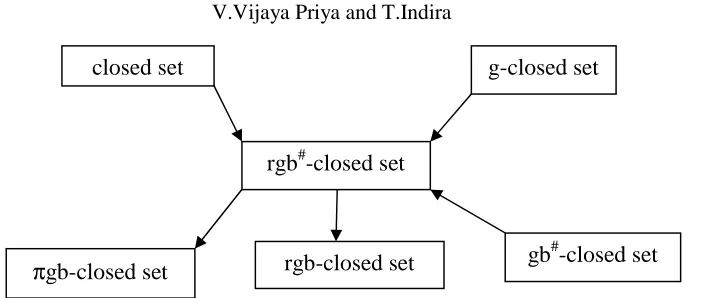
Theorem 3.3. Every closed set is rgb#-closed.
Proof: Let A be any closed set in X such that A ⊆ U where U is regular open. Then b#cl(A) ⊆ cl(A) = A ⊆ U. Therefore b#cl(A) ⊆ U. Hence A is rgb#-closed.
Remark 3.4. The converse of the above theorem is not true as seen from the following
example.
Example 3.5. Let X = {a ,b ,c} with the topology τ = {X , φ ,{a} ,{b}, {a ,b}}. In this topological space the subset {a ,b} is rgb#-closed but not a closed set.
Theorem 3.6. Every gb#- closed set is rgb#-closed.
Proof: Let A be any gb#- closed set in X such that A ⊆ U where U is regular open. Since every regular open set is open, U is open. Since A is gb#-closed, b#cl(A) ⊆ U. Hence A is rgb#-closed.
Remark 3.7. The converse of the above theorem is not true which is shown in the
following example.
Example 3.8. Let X = {a , b , c} with the topology τ = {X , φ , {a} , {b}, {a , b}}. In this topological space the subset {a , b} is rgb#-closed but not b#- closed.
Theorem 3.9. If A is rgb#- closed set, then A is rgb- closed.
Proof: Let A be any rgb# closed set in X. Let A ⊆ U where U is regular open. Since A is rgb#-closed, b#cl(A) ⊆ U. Since bcl(A) ⊆ b#cl(A), bcl(A) ⊆ U. Therefore, bcl(A) ⊆ U and U is regular open. Hence A is rgb- closed.
Theorem 3.10. If A is rgb#-closed set, then A is πgb-closed.
Proof: Let A be any rgb#- closed set in X. Let A ⊆ U where U is π-open. Since every π-open set is regular open, U is regular open. Since A is rgb#-closed, b#cl(A) ⊆ U. Since bcl(A) ⊆ b#cl(A), bcl(A) ⊆ U. Therefore, bcl(A) ⊆ U and U is π-open. Hence A is πgb-closed.
Theorem 3.11. If A is g-closed, then A is rgb#-closed.
Proof: Let A be any g-closed set in X such that A ⊆ U and U is regular open. Since every regular open set is open, U is open. Also b#cl(A) ⊆ cl(A) ⊆ U. Therefore, b#cl(A) ⊆ U and U is regular open. Hence A is rgb#- closed.
V.Vijaya Priya and T.Indira
374
Figure 1: relation between rgb#-closed sets and other sets
Theorem 3.12. Suppose A is a p-set and rgb#-closed. Then A is gpr-closed.
Proof: Let A be any p-set and rgb#-closed. Then cl(int(A)) ⊆ b#cl(A).
Let A ⊆ U. Suppose U is regular open. Since A is rgb#-closed, b#cl(A) ⊆ U. Therefore, cl(int(A)) ⊆ U. This implies that A ∪ cl(int(A)) ⊆ U. Therefore pcl(A) ⊆ U and U is regular open. Hence A is gpr-closed.
Theorem 3.13. Suppose A is a p-set and rgb#-closed. Then A is gspr-closed.
Proof: Let A be any p-set and rgb#-closed. Then cl(int(A)) ⊆ b#cl(A). Let A ⊆ U. Suppose U is regular open. Since A is rgb#-closed, b#cl(A) ⊆ U. Therefore, cl(int(A)) ⊆ U. Since every regular open set is open, int(cl(int(A))) ⊆ int(U) ⊆ U,. This implies that A ∪ int(cl(int(A))) ⊆ U , because A ⊆ U. Therefore spcl(A) ⊆ U and U is regular open. Hence, A is gspr-closed.
Theorem 3.14. Suppose A is a p-set and rgb#-closed. Then A is rwg-closed.
Proof: Let A be any p-set and rgb#-closed. Then cl(int(A)) ⊆ b#cl(A). Let A ⊆ U. Suppose U is regular open. Since A is rgb#-closed, b#cl(A) ⊆ U. Therefore, cl(int(A)) ⊆ U and U is regular open. Hence A is rwg-open.
Theorem 3.15. Suppose A is a p-set and rgb#-closed. Then A is πgp-closed.
Proof: Let A be any p-set and rgb#-closed. Let A ⊆ U. Suppose U is π-open. Since every π-open set is regular open, U is regular open.
Since A is a p-set, cl(int(A)) ⊆ b#cl(A). Since A is rgb#-closed, b#cl(A) ⊆ U. This implies that cl(int(A)) ⊆ U. Hence A ∪ cl(int(A)) ⊆ U. Therefore pcl(A) ⊆ U and U is π-open. Hence, A is πgp-closed.
Theorem 3.16. Suppose A is a p-set and rgb#-closed. Then A is πgsp-closed.
Proof: Let A be any p-set and rgb#-closed. Let A ⊆ U. Suppose U is π-open. Since every π-open set is regular open, U is regular open. Since A is a p-set, cl(int(A)) ⊆ b#cl(A). Since A is rgb#-closed, b#cl(A) ⊆ U. This implies that cl(int(A)) ⊆ U. Since every regular open set is open, int(cl(int(A))) ⊆ int(U) ⊆ U. Since A ⊆ U, A ∪ int(cl(int(A)) ⊆ U,. Therefore spcl(A) ⊆ U and U is π-open. Hence A is πgsp-closed.
The Figure 2 gives the relation between p-set and rgb#-closed sets with other sets.
rgb#-closed set
g-closed set closed set
gb#-closed set rgb-closed set
On Regular Generalized b#-closed Sets
375
Figure 2: Relation between p-set and rgb#-closed sets with other sets
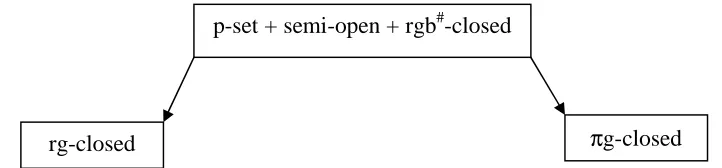
Theorem 3.17. Suppose A is a p-set that is semi-open and rgb#-closed. Then A is rg-closed.
Proof: Let A be any p-set, semi-open and rgb#-closed. Since A is a p-set, cl(int(A)) ⊆ b#cl(A). Since A is semi-open, A ⊆ cl(int(A)). This implies that A ⊆ b#cl(A). Since b# -closed sets are -closed, cl(A) ⊆ b#cl(A). Since A is rgb#-closed, cl(A) ⊆ U. Therefore A is rg-closed.
Theorem 3.18. Suppose A is a p-set which is semi-open and rgb#-closed. Then A is π g-closed.
Proof: Let A be any p-set, semi-open and rgb#-closed. Let A ⊆ U. Suppose U is π-open. Since every π-open set is regular open, U is open. Since A is a p-set, cl(int(A)) ⊆ b#cl(A). Since A is semi-open, A ⊆ cl(int(A)). This implies that A ⊆ b#cl(A). Since b# -closed sets are -closed, cl(A) ⊆ b#cl(A). Since A is rgb#-closed, cl(A) ⊆ U. Therefore A is πg-closed.
The Figure 3 gives the relation between p-set, semi open and rgb#-closed sets with other sets.
Figure 3: Relation between p-set, semi open and rgb#-closed sets with other sets
Theorem 3.19. If A is rgb#-closed, then b#cl(A) – A contains no non-empty regular closed set.
p-set + rgb#-closed
gspr-closed gpr-closed set
πgsp-closed set
πgp-closed set rwg-closed set
p-set + semi-open + rgb#-closed
V.Vijaya Priya and T.Indira
376
Proof: Let F be any regular closed set in X such that F ⊆ b#cl(A) – A . This implies that F ⊆ b#cl(A) ∩ Ac. This implies that F ⊆ b#cl(A) and F ⊆ Ac. Then A ⊆ X – F. Since A is rgb#-closed and X – F is regular open, b#cl(A) ⊆ X – F. That is F ⊆ b#cl(A).
Hence, F ⊆ (X – b#cl(A)) ∩ (b#cl(A)). Therefore, F is empty.
Theorem 3.20. Let A be a rgb#-closed set in X and B be such that A ⊆ B ⊆ b#cl(A). Then b#cl(B) – B contains no non empty regular closed set in X.
Proof: Let A be any rgb# closed set in X. Since B ⊆ b#cl(A), b#cl(B) ⊆ b#cl(A). Since A is rgb#-closed, b#cl(A) = A. Therefore b#cl(B) – B ⊆ b#cl(A) – A. Since b#cl(A) – A contains no non empty regular closed set, b#cl(B) – B contains no non empty regular closed set.
Theorem 3.21. Let A be a rgb#-closed set. Then b#cl(A) = A if and only if b#cl(A) − A is regular closed.
Proof: If b#cl(A) = A, then we have b#cl(A) − A = φ which is regular closed.
Conversely, suppose b#cl(A) − A is regular closed. Then by theorem 3.19, b#cl(A) − A does not contains any non-empty regular closed set. Since b#cl(A) − A is regular closed, b#cl(A) − A = φ.
Since A ⊆ b#cl(A), it follows that b#cl(A) = A.
4. Conclusion
In this paper, we introduced the regular form of generalized b#-closed sets, studied their properties and established the relationship with other sets.
Acknowledgement. The authors are grateful to the anonymous reviewers for their comments to improve the presentation of the paper.
REFERENCES
1. A.Al-Omari and Md.Noorani, Generalized b-closed sets, Bull. Malays. Math. Sci. Soc., 32 (1) (2009) 19-30.
2. D.Anrijevic, On semi-preopen sets, Mat. Vesnik, 38 (1) (1986) 24-32. 3. D.Anrijevic, On b-open sets, Mat. Vesnik, 48(1-2) (1996) 59-64.
4. T.Indira and K.Rekha, Applications of *b-open sets and **b-open sets in topological spaces, Annals of Pure and Applied Mathematics, 1(1) (2012) 44-56.
5. T.Indira and S.Geetha, Alpha closed sets in topological spaces, Annals of Pure and Applied Mathematics, 4 (2) (2013) 138-144.
6. T.Indira and N.Meenakumari, r*g*-closed sets in topological spaces, Annals of Pure and Applied Mathematics, 6 (2) (2014) 125-132.
7. T.Indira and N.Meenakumari, Weakly *g closed sets in topological spaces, Annals of Pure and Applied Mathematics, 8 (1) (2014) 67-75.
On Regular Generalized b#-closed Sets
377
9. R.Usha Parameswari and P.Thangavelu, On b#-open Sets, International Journal of Mathematics Trends and Technology, 3(5) (2014) 202-218.