
Development and validation of uv spectroscopy method for simvastatin in pH 6.8 phosphate buffer
5
0
0
Full text
(2) Srikakulapu Prasanthi,. et al / Int. J. of Pharmacy and Analytical Research Vol-4(1) 2015 [16-20]. early and rate limiting step in cholesterol biosynthesis[5]. Simvastatin is rapidly absorbed from the gastrointestinal tract after oral administration but undergoes extensive. first-pass metabolism in the liver. It is inactive lactone prodrug and hydrolyzed in the gastrointestinal tract to the actives of hydroxy derivative.. Structure of simvastatin Several methods were reported for the determination of SIM individually in plasma samples by HPLC[6] with simvastatin acid[7][8][9] and with metoprolol[10] by LCMS/MS. The available methods are used either for the determination of SIM individually or for determination of these analytes along with it metabolites or with other drugs. The aim of our work was developed a simple, sensitive, rapid, economical and validated analytical method for the quantification of SIM in pH 6.8 phosphate buffer. Present work focuses on the development of rapid and simple analytical method for quantification of SIM respectively. Further this method was applied for Invitro dissolution studies. The developed method may also be expected to provide a support for carrying out of the dissolution studies.. the drug simvastatin. Dimethylsulphoxide (DMSO), potassium dihydrogen phosphate and sodium hydroxide were purchased from Loba chemie Pvt.Ltd. Mumbai. The chemicals and the reagents used for the analysis of the work is of the analytical grade. Simvotin® tablets of 10 mg manufactured by Ranbaxy are chosen for the estimation of drug content by this developed method.. MATERIALS AND METHODS. 1mL of primary standard stock solution was diluted up to 10 mL in a volumetric flask using DMSO as a solvent to get 10 μg/mL solution.. PREPARATION OF PRIMARY STANDARD STOCK SOLUTION Accurately weighed 10 mg of simvastatin and transferred into 100 mL volumetric flask and the volume was made up to the mark with DMSO to get 100 ug/mL solution.. PREPARATION OF SECONDARY STANDARD STOCK SOLUTION. INSTRUMENTS USED The work was performed by using UV-Visible single beam spectrophotometer of Aquamateplus i.e., from Thermo scientific corporation. The absorption spectra analysis for the reference and test solutions were carried out in a quartz cell of the measured length of 1 cm over the specific λ max at 200-400nm. pH meter of ELICO® Li 120 was used for measuring of pH of the prepared pH 6.8 phosphate buffer.. DETERMINATION OF λ MAX 1 mL of secondary standard stock solution was diluted up to 10 mL in a volumetric flask using pH 6.8 phosphate buffer as a solvent to get the 1 μg/mL solution. Spectrum of this solution was run from 200400nm range in UV spectrophotometer. λ max of simvastatin was found at 233nm.. CHEMICALS USED PROCEDURE FOR CONSTRUCTION OF CALIBRATION CURVE. Simvastatin was received from the Mylan pharmaceuticals, Hyderabad as the gift sample. The drug received was having the accurate purity of 99.99% w/w and was used for the analysis without the purification of. Aliquots of 0.1, 0.2, 0.3, 0.4, 0.5, 0.6, 0.7 and 0.8 mL were withdrawn from above prepared 1µg/ml of drug. www.ijpar.com. ~ 17~.
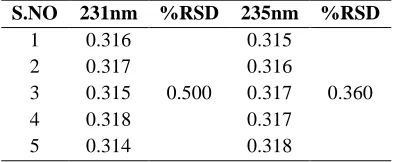
(3) Srikakulapu Prasanthi,. et al / Int. J. of Pharmacy and Analytical Research Vol-4(1) 2015 [16-20]. solution and diluted to 10 mL in 10 mL volumetric flask with pH 6.8 phosphate buffer so as to get 0.01, 0.02, 0.03, 0.04, 0.05, 0.06, 0.07, 0.08 μg/ mL Absorbance of. each solution was measured by UV spectrometer at 233 nm using pH 6.8 phosphate buffer as blank.. STUDY OF LINEARITY. equipment etc.The present work was performed bythe change of analyst. Then nearly same results were obtained which are similar to that of first analyst.. An aliquot of concentration of 0.01-0.08 μg/mL were prepared and absorbance were measured as per the developed method to confirm the linearity[10][11]. The calibration curve was constructed for the obtained absorbance values of simvastatin and its concentrations at λ max of 233nm and linearity was evaluated by linear regression equation. The slope intercept and correlation coefficient values are recorded.. ASSAY OF SIMVASTATIN IN MARKETED PRODUCT Simvotin 10 tablets manufactured by Ranbaxy laboratories limited was selected and analyzed for simvastatin using the newly developed and validated method. 0.03µg/mL of simvastatin was taken as a reference standard solution. 10 tablets were accurately weighed and powdered equivalent to average weight of tablet was accurately weighed and transferred to 100mL DMSO. 1 mL of this solution was diluted up to 10 mL in a volumetric flask using pH 6.8 phosphate buffer as a solvent and blank. From this 0.3 mL was withdrawn and diluted to 10 mL in 10 mL volumetric flask with pH 6.8 phosphate buffer. Absorbance of this solution was measured by UVspectrometer at 233 nm.. PRECISION The precision[11][12] of the assay was determined by repeatability and reported as %RSD. For this 0.03μg/mL concentration was taken and measured six times in a day and same was measured in the next day. The %RSD was calculated.. ACCURACY The accuracy of method was evaluated through standard addition method [11][12]. In this known amount of standard simvastatin was added in pre-analysed sample. This was done for 0.03 μg/mL concentration taking it as a 100% for three times. It was done for 80%, 100% & 120% and the recovery studies were performed and finally the %RSD was calculated.. RESULTS AND DISCUSSION A simple, selective, accurate, precise spectroscopic method for estimation of simvastatin in bulk and pharmaceutical dosage form has been developed and validated. The linearity range was in the concentration range of 0.01-0.08µg/ mL (r2=0.999). it indicated that the concentrations of simvastatin had good linearity. The assay of simvastatin was found to be 98.56%. it indicated that by the precision of method was confirmed by the repeatable analysis of solution. The % RSD was found to be 0.631 and 0.771% respectively for intra and interday precision. It indicated that method had good precision. The procedure for accuracy was repeated for 3 times by taking 0.03µg/ mL as 100%. The recovery was calculated for 80%, 100% and 120%. The % RSD was found to be 1.157%. Because the % RSD were below 2 the method developed is highly accurate and,precise.. ROBUSTNESS It is a study of small but deliberate variations in method parameters[11][12] such as absorption maxima,pH and ratio of mobile phase solvents. In this present work the absorption maxima was decreased and increased by 2nm and carried the process for 0.03 μg/mL solution for 6 times. The %RSD was calculated.. RUGGEDNESS It is the study[11][12] of degree of reproducibility of test results obtained by the variety of conditions like different analysts, reagents, laboratories, days,. www.ijpar.com. ~ 18~.
(4) Srikakulapu Prasanthi,. et al / Int. J. of Pharmacy and Analytical Research Vol-4(1) 2015 [16-20]. Figure 1: Calibration curve of simvastatin in pH 6.8 phosphate buffer. Calibration curve of simvastatin in pH 6.8 phosphate buffer Absorbance. y = 9.975x + 0.021 r² = 0.999. 0. 0.02. 0.04. 0.06. 0.08. 0.1. Concentration(μg/ml). TABLE 1: PRECISION OF DEVELOPED METHOD S.No 1 2 3 4 5 6. Intraday precision 0.382 0.383 0.380 0.386 0.385 0.386. % RSD 0.631. Inter day precision 0.377 0.378 0.375 0.382 0.381 0.382. % RSD 0.771. TABLE 2: ACCURACY DATA OF DEVELOPED METHOD Conc. (μg/mL) 0.03. Spike level. Mean absorbance. Amount found ( mg). % Recovery. Total Mean % RSD. 98.88. Mean % RSD 0.334. 80%. 0.582. 0.0534. 0.03 0.03. 100% 120%. 0.645 0.711. 0.0594 0.0655. 98.66 98.78. 0.806 0.168. 0.436. TABLE 3: ROBOUSTNESS OF DEVELOPED METHOD S.NO 1 2 3 4 5. 231nm 0.316 0.317 0.315 0.318 0.314. %RSD. 0.500. CONCLUSION The proposed method is simple, accurate, precise,specific and selective for estimation of simvastatin in bulk and pharmaceutical dosage forms.. 235nm %RSD 0.315 0.316 0.317 0.360 0.317 0.318 The method is economical, rapid and do not require any sophisticated instruments in contrast to chromatographic method. Hence it can be effectively applied for routine analysis of simvastatin in bulk and marketed formulation.. www.ijpar.com. ~ 19~.
(5) Srikakulapu Prasanthi,. et al / Int. J. of Pharmacy and Analytical Research Vol-4(1) 2015 [16-20] Atmakuru (Gunturu),Andhra Pradesh, India for providing necessary facilities to carry out the research work.. ACKNOWLEDGEMENTS The authors like to acknowledge the staff and management of the Nirmala College of Pharmacy,. REFERENCES [1] Websitehttp://www.drugbank.ca/drugs/ DB00641 [2] US Pharmacopoeia, The United States Pharmacopoeial Convention, Inc.: Rockville. pp, 599(2007). [3] D.K.Ellison, W.D.Moore, C.R.Petts, Analytical profiles of drug substances and excipients. Academic press. Inc, 359 (1993). [4] K.D.Tripathi, Essentials of Medical Pharmacology. Jaypee Brothers Medical Publishers (P) Ltd,614 (2008). [5] H.P.Rang, M.M.Dale, J.M.Ritter, R.J.Flower, Rang and Dale’s Pharmacology. ChurchillLivingstone Elsevier, 324 (2008). [6] L. Tan, L.L. Yang, X. Zhang, et al., Determination of simvastatin in human plasma by high performance liquid chromatography, Se Pu 18 (2000) 232-234. [7] M.Jamal, Z. Ouyang, M.L. Powell, Direct injection LC-MS-MS method for high throughput simultaneous quantification of simvastatin acid in human plasma, J. Pharm.Biomed. Anal.15(2000) 323-340. [8] N. Zhang, A. Yang, J.D. Rogers, et al., Quantitative analysis of simvastatin and itsβ-hydroxy acid in human plasma using automated liquid-liquid extraction based on 96-well plate format and liquid chromatographytandem mass spectrometry, J. pharm. Biomed. Anal 34 (2004) 175-187. [9] B.Barret J. Huclova, V.BorkeDohalsky, Et al., Validated HPLC-MS-MS method for simultaneous determination of simvastatin and simvastatin hydroxyl acid in human plasma, J. Pharm. Biomed. Anal. 41(2006) 517-526. [10] P.S.Selvan, T.K. Pal, Chromatography tandem mass spectrometry method for simultaneous quantification of metrolol succinate and simvastatin in human plasma. Biomed. Anal. 49 (2009)780-785. [11] ICHQ2A, Text on validation of analytical procedures, International Conference onHarmonization tripartite guidelines (1994). [12] P.D. Sethi, Quantitative analysis of drugs in pharmaceutical formulations by Third Edition (1997) Vol.1, CBS publishers pg no:51-64.. www.ijpar.com. ~ 20~.
(6)
Figure
Related documents
In [8, Proposition 3.13], it is proved that if M has dcc condition on its socle submodules, then every irreducible closed subset of Spec s ( M ) (with second classical Zariski
In this work, we try to (1) understand the emotional information in ECG signals for the six basic and universal emotional states worked by Ekman et al., (happiness, sadness,
These involved an 83-year-old man where metastatic tumor presented 10 years after primary treatment; a 52- year- old woman with a growing mass at the base of her ton- gue
Case presentation: We report the case of thrombotic thrombocytopenic purpura in a 30-year-old primigravida white woman in week 28 of pregnancy that had a rapidly deteriorating
Figure 4 shows theoretically the strategy taken in optimising the filling of the polder system for maximum peak discharge capping. Two important objectives to attain the highest
Bar graph (d): The bar chart showing the lesion area of brains of sham-operated, peanut oil treated ischemic and C.oil post-treatment ischemic group at 5 hrs. Data are expressed
the expression of PGE synthases in inflamed gingival tissue from patients with periodontitis, finding the protein expression of the isoforms mPGES-1, mPGES-2 and cPGES, as well
