http://dx.doi.org/10.3765/sp.6.9
Embedded scalars
∗Bart Geurts University of Nijmegen
Bob van Tiel University of Nijmegen
Submitted 2012-06-26 / Accepted 2012-08-07 / Revisions received 2012-12-26 /
Corrections requested2013-01-19/Final version received 2013-01-24/Published
2013-10-01
Abstract For over a decade, the interpretation of scalar expressions under embedding has been a much debated issue, with proposed accounts ranging from strictly pragmatic, on one end of the spectrum, to lexico-syntactic, on the other. There has been some confusion as to what exactly the controversy is about, and we argue that what is at stake is the division of labour between pragmatic and truth-conditional mechanisms. All parties to the debate agree that upper-bounded construals of scalar expressions are variously caused by conversational implicatures and truth-conditional narrowing, but whereas Griceans argue that the former mechanism is the main cause, convention-alists point to the latter, assuming as a matter of course that the source of truth-conditional narrowing lies in linguistic convention; on this view, narrowing is either a lexical or a syntactic phenomenon. Since researchers’ introspective judgments tend to agree with the theories they advocate, a number of experimental studies have recently tried to shed light on this issue. In this paper, we review the experimental record, and argue that the extant data favour a pragmatic account.
Keywords:scalar implicatures, quantification, typicality
Introduction
Well before “Logic and conversation” went into print (Grice 1975), Cohen (1971)pointed out a problem with Grice’s account of conversational implica-ture: occasionally, what would appear to be a conversational implicature is observed in an embedded position — which is a contradiction in terms, since conversational implicatures can only be derived on the basis of a full-blown speech act. The debate about this issue continues until the present day, and in recent years has homed in on the interpretation of scalar expressions under embedding. To explain what is at stake, consider the following example:
(1) Julius believes that some of the goats are happy.
An utterance of this sentence may give rise to the inference that, according to the speaker, Julius believes that not all the goats are happy. This inference involves two layers of belief:
(2) BelS(BelJ(¬(all the goats are happy)))
The problem is that, if we treat this as a regular case of scalar implicature, the outcome will be somewhat weaker:
(3) BelS(¬BelJ(all the goats are happy))
(Note that (2) entails (3), but not vice versa.) Here is how the inference in (3) comes about. Upon hearing(1), the addressee reasons as follows:
i. Could it be the case that, for all the speaker knows, Julius believes that all the goats are happy, i.e.BelS(BelJ(all the goats are happy))?
ii. Presumably not, for then the speaker would have said, “Julius believes that all the goats are happy.” Hence, ¬BelS(BelJ(all the goats are happy)).
iii. It seems reasonable to suppose that the speaker is competent with respect to the proposition thatBelJ(all the goats are happy). That is,
eitherBelS(BelJ(all the goats are happy)) or BelS(¬BelJ(all the goats are happy)).
iv. If so, it follows thatBelS(¬BelJ(all the goats are happy)) (= (3)).
This particular problem was noted by Landman (1998), who used it to argue for a wholesale departure from the Gricean party line. Landman’s cause was joined by Chierchia (2004), who threw in some problem cases of his own devising, with scalar expressions occurring in the scope of dis-junctions, factive verbs, and existential indefinites. The challenge posed by Landman and Chierchia provoked a flurry of Gricean responses bySauerland (2004),van Rooij & Schulz (2004), Horn (2006,2009),Spector (2006), Rus-sell (2006), andGeurts (2009,2010). This round in the debate showed that, prima facie impressions notwithstanding, Landman’s and Chierchia’s alleged counterexamples can be accounted for within a Gricean framework, after all. To illustrate, in a context in which (1) is uttered, it is likely to be common ground that either Julius believes that all the goats are happy or believes that not all the goats are happy; or more succinctly:
(4) BelJ(all the goats are happy)∨BelJ(¬(all the goats are happy))
Taken together with the implicature in (3), this assumption entails (2)(van Rooij & Schulz2004,Russell2006,Geurts2009,2010). On this analysis, Land-man’s reading of(1)doesn’t require a local upper bound on the interpretation ofsome. Rather, it follows from an ordinary quantity implicature provided (4) is part of the common ground.
The Gricean strategy for dealing with Landman and Chierchia’s obser-vations is to proceed case by case: while all their examples can be treated in a principled manner (as we just illustrated for belief sentences), there is no common cure. Put otherwise, on the Gricean account, all “embedded implicatures” are special in some way or other; they are rare and there is no uniform explanation for their occurrence in the scope ofbelieve,or, and so on. This is an important point, for the central tenet of the critics of the Gricean programme is that upper-bounded construals of scalar expressions occur across the board, be they embedded or not. Put otherwise, anti-Griceans see a continuity between embedded and non-embedded contexts that Griceans cannot accept.
speak of “upper-bounded construals” of scalar expressions, or UBCs for short, whenever we wish to remain neutral on the underlying mechanisms. A UBC may be either an implicature or a truth-conditional effect, and it is only in the latter case that it can occur in the scope of, e.g., a conditional, a quantifier, or negation.
1 What the debate isnot about
With the first volley of problem cases cleared out of the way, the anti-Griceans changed tack, and shifted their focus to examples like the following (all from Chierchia, Fox & Spector2012):
(5) a. If you take saladordessert, you pay $20; but if you takeboththere is a surcharge.
b. Exactly three students didmostof the exercises; the rest did them
all.
c. It is not just that youcanwrite a reply. Youmust.
Oddly enough, however, advocates of the Gricean programme have been perfectly happy to concede thatthesedata cannot be accounted for in terms of conversational implicature (e.g.,Horn1989,2006,2009,Geurts2009,2010, Geurts & Pouscoulous2009). In fact, none of the data mustered byChierchia, Fox & Spector (2012) in their broadside attack on Gricean pragmatics are particularly worrisome for the defenders of that view. So what, if anything, is the current debate about?
In the debate between Griceans and their critics, there has been an un-fortunate misunderstanding on the part of the latter. The misunderstanding is that, for those of us who prefer to take the Gricean approach, there is no way to account for the data in (5). Not true. Whatis true is that there is no way of explaining these data in terms of honest-to-Grice conversational implicatures. But that just means they must be something else. It is part and parcel of the Gricean view that there are two routes for a scalar expression to arrive at a UBC. One is by way of a quantity implicature; the other, by way of truth-conditional narrowing (which, as we will presently see, can be construed in pragmatic terms, as well). So in (5c)canmeans “can but not must”, and the same, mutatis mutandis, for (5a) and (5b). Crucially, such embedded UBCs are always marked, as the examples in (5) illustrate.
is one point the critics of the Gricean programme have glossed over. Another is thatthis assumption is common ground between the parties in the debate. That’s right: there is a broad consensus that the dual-mechanism view is correct.1Fox (2007)is exceptionally lucid on this point, but evenChierchia,
Fox & Spector (2012), who mount a hard-nosed defence of truth-conditional UBCs, admit in a footnote that in some cases quantity implicatures must be appealed to (Chierchia, Fox & Spector2012: note35). Everybody agrees, for example, that in some contexts, an utterance of (6) will merely imply that the speaker doesn’t know whether Barney took all the strawberries:
(6) Barney took some of the strawberries.
This inference, which is weaker than the usual BelS(¬(Barney took all the
strawberries)), cannot be explained as a case of truth-conditional narrowing by any theory, and therefore has to be a quantity implicature, as Chierchia et al. concede.
2 What the debateis about
Given that there is a broad consensus about the mechanisms underlying UBCs of scalar expressions, what is the controversy about? As discussed at length byGeurts (2010), there are two main issues. One concerns the aetiology of truth-conditional narrowing: what is its underlying cause? This question has given rise to a variety of answers, running a gamut of potential sources ranging from the lexicon via syntax to pragmatics. However, thus far there has been hardly any discussion of the relative merits of the various approaches. Instead, the debate has focused on the second question, which concerns the division of labour between implicature and truth-conditional narrowing. According to the critics of the Gricean approach, truth-conditional narrowing applies across the board, and therefore we should expect to observe UBCs all over the place, regardless of whether scalar expressions are embedded or not. By contrast, on the Gricean view, while scalar implicatures cannot be embedded by their very nature, truth-conditional narrowing is a marked option, and therefore embedded UBCs are predicted to be exceptional. As emphasised byIppolito (2010), this has been the main issue in the literature
on so-called “embedded implicatures”, and it is what the bulk of this paper is about.
In order to get a proper perspective on the ensuing discussion of experi-mental evidence, which is our main concern, this section elaborates on both issues, though it may be useful to keep in mind that our chief topic is the sec-ond one, viz. the division of labour between implicature and truth-csec-onditional narrowing.
2.1 What underlies truth-conditional narrowing?
This question has been answered in three markedly distinct ways, two of which are quite similar in spirit in that they share the presupposition that narrowing is a linguistic phenomenon; we therefore lump them together under the “conventionalist” label. The third view is pragmatic.
• Conventionalist
• Lexicalist
Levinson (2000),Chierchia (2004), Storto & Tanenhaus (2005) • Grammatical
Chierchia (2006),Fox (2007), Chierchia, Fox & Spector (2012)
• Pragmatic
Horn (2006,2009),Noveck & Sperber (2007), Geurts (2009, 2010)
Technically as well as conceptually, the lexicalist approach is the simplest, the idea being that scalar expressions come with an upper-bounded meaning by default:somejust means “some but not all”, where the “not all” part is cancellable. The grammatical approach to narrowing is rather more convo-luted, and of a more recent vintage. It is based on the idea that a scalar expression may acquire a UBC by sitting in the scope of a covert syntactic operator whose meaning is essentially that of overtonly. When in the scope of this covert operator, somewill be interpreted, in effect, as “only some”, and thus come to exclude “all”.
The pragmatic view on truth-conditional narrowing is quite different. It is based on the observation that, in general, the occurrent meaning of a word does not coincide with its dictionary meaning, but is modulated by contextual factors.2 This process may produce all sorts of meanings, 2See, e.g.,Nunberg (1978,1979),Sag (1981),Bosch (1984),Bartsch (1987),Recanati (1986,2004),
and occasionally the occurrent meaning of a word will be more specific than its dictionary meaning. In some cases, this narrowing may proceed quite smoothly, because world knowledge alone suffices to steer the hearer towards a specific interpretation. In many other cases, however, narrowing must be helped along by contrastive stress, as in the following examples fromGeurts (2010:186):
(7) a. When hedrinks, he DRINKS. b. Julius isn’trich: he’s RICH.
c. Cleo didn’topenher handbag: she made anincisionon the side.
None of these examples can plausibly be accounted for in conventionalist terms, for in each case, the occurrent meanings of the key expressions are heavily dependent on the context. According to the pragmatic view, this holds for truth-conditional narrowing across the board, including the examples in (5), which are the mainstay of the recent conventionalist critique of the pragmatic approach to UBCs.
Though the bandwidth of theories of narrowing is considerable, as we have just seen, and it is important to realise that there is more than one game in town, in the following pages we will confine our attention to the conven-tionalist account, since this is the one advocated by critics of the Gricean approach to scalars: as we will presently see, the key issue in the experimental literature on embedded UBCs is whether or not truth-conditional narrowing is a freely available option in any syntactic position, as conventionalist accounts predict.
2.2 The division of labour between narrowing and implicature
Let’s develop the main positions on embedded UBCs a bit further by fo-cusing on an example over which opinions are strongly divided (Geurts & Pouscoulous2009):
(8) All the squares are connected with some of the circles.
An utterance of (8) may give rise to the following inference:
(9) Not all the squares are connected with all of the circles.
(10) All the squares are connected with some but not all of the circles (and therefore none of the squares are connected with all of the circles).
However, the Gricean account predicts that this reading is available only marginally, and needs to be forced, e.g., by contrastive stress onsomein(8).
By contrast, according to the conventionalist doctrine, UBCs “occur sys-tematically and freely in arbitrarily embedded positions.”3On this view, in
the context of a sentence like(8),some will receive a truth-conditional UBC by default, and hence this sentence will normally be read as being equivalent with (10).
This default is accounted for in different ways, depending in part on how the question about the origin of UBCs is answered. If some is held to be lexically ambiguous between “at least some” and “at least some but not all”, it may be stipulated that the latter reading is the default, or alternatively, it may be stipulated that UBCs are preferred under such-and-such circum-stances, e.g., when a scalar expression doesn’t occur in a downward-entailing environment (Landman1998,2000, Chierchia2004). If, on the other hand, a grammar-based version of conventionalism is adopted, another approach is called for.Chierchia (2006)suggests that wheneveronly-insertion leaves us with several parses to choose from, the one with the strongest meaning is preferred, and various ways of fleshing out this idea are canvassed by Chierchia, Fox & Spector (2012). In the case of(8)this theory, too, predicts that (10)is the preferred reading. More generally, conventionalist theories agree that, at least in upward-entailing environments, there is a preference for interpreting embeddedsome, in effect, as “some but not all”, even if they disagree about how the construal and the preference come about.
According to our intuitions, none of the following inferences would go through under normal circumstances:
(11) a. All the villagers own rabbits or chickens.
6
;None of them own both.
b. At least200of the villagers own rabbits or chickens.
6
;At least200of them don’t own both.
c. Only six of the villagers own rabbits or chickens.
6
;Only six of the villagers own rabbits or chickens but not both.
However, conventionalist theories generally predict that (11a) and (11b) should hold by default, and at least some of them predict this for (11c) as well. In (11a,b), or occurs in an upward-entailing environment, and therefore most conventionalist theories concur that an embedded UBC of the disjunction should be preferred; i.e.or should be read exclusively, as meaning “or but not and”. In (11c),or occurs in a non-monotone environment (i.e., it is neither up-ward nor downup-ward entailing), and in such cases a bias toup-wards an exclusive reading ofor is predicted by at least some variants of conventionalism.
In the remainder of this paper, we will discuss experimental evidence for and against the predictions that UBCs of scalar expressions are freely avail-able in (a) upward-entailing contexts (§§3-5) and (b) non-monotone contexts (§6). We will see that neither prediction is borne out by the data.
All the squares are connected with some of the circles.
2 true 2 false
Figure1: Experimental item used byGeurts & Pouscoulous (2009).
3 Experimental evidence against conventionalism
(12) a. All the squares are connected with some of the circles. (=(8)) b. There is more than one square that is connected with some of the
circles.
c. There are exactly two squares that are connected with some of the circles.
Each of these sentences was paired with a picture for which the sentence’s standard and conventionalist construals yielded conflicting truth values. For example, when interpreted according to the conventionalist canon, the sentence in Figure1, i.e. (12a), fails to match the depicted situation, because one of the squares is connected to all the circles, but the sentence is true on its standard reading.
G & P’s findings were as univocal as they get: not a single one of their participants’ responses agreed with conventionalist predictions. For example, participants invariably gave a positive response in the case of (12a) (Figure1), and the same held, mutatis mutandis, for the other conditions, regardless of whether they were upward entailing or merely non-downward-entailing.
These findings robustly fail to confirm what G & P call “mainstream con-ventionalism”: a range of theories which predict that scalar expressions preferably receive an upper-bounded construal in upward-entailing environ-ments and perhaps in non-downward-entailing environenviron-ments generally. Since these predictions weren’t borne out by their results, G & P went on to test a weaker version of conventionalism, which refuses to deal with the ambigui-ties it begets, and doesn’t make any predictions about which construal is the preferred one. According to this minimal variety of conventionalism, each of the sentences in (12) has several readings on any given occasion, but it is for pragmatics to decide which is the right one.4
Obviously, in its most austere form, minimal conventionalism fails to make any predictions at all: the claim that, e.g., (13a) may or may not be read as (13b) cannot be falsified.
(13) a. All the squares are connected with some of the circles.
b. All the squares are connected with some but not all of the circles.
In order for the theory to have at least a modicum of empirical bite, auxiliary assumptions will have to be made. One hypothesis that naturally comes to mind is that speakers are able todetect the readings that are characteristic of the conventionalist approach. That is to say, even if speakers don’t prefer to hear (13a) as synonymous with (13b), it is reasonable to expect them to realise that the latter sentence expresses a possible construal of the former. If this auxiliary hypothesis is adopted, minimal conventionalism predicts that, in a situation that falsifies (13b), native speakers should judge that (13a) is ambiguous between a true reading and a false one. This prediction was tested in a further experiment byGeurts & Pouscoulous (2009).
For this experiment, G & P used the same materials as in the verification study discussed above, but added a third response option: participants were invited to choose between “true”, “false”, and “could be either”. According to minimal conventionalism, participants should have a preference for the last option in the upward-entailing conditions, and perhaps in non-downward-entailing conditions generally. In order to assess whether participants can cope with this type of task in the first place, G & P included a number of control sentences which were genuinely ambiguous; an example is (14), which can be read as (14a) or (14b):
(14) There are green circles and squares.
a. There are green circles and there are squares. b. There are green circles and there are green squares.
The main finding of this study was that, whereas ambiguous controls were recognised as such in70% of the cases, the corresponding rate for the non-downward-entailing sentences was 6%, while for the upward-entailing sen-tences it was0%. On a further5% of the non-downward-entailing trials, partic-ipants gave a true/false response that was consistent with a conventionalist construal. In raw numbers, only9out of88responses were consistent with minimal conventionalism. Moreover, all but one of these “positive” (or better: non-negative) responses were associated with exactly two: between them, upward-entailingallandmore than oneprompted a conventionalist response ononetrial only.
in line with a conventionalist construal. In our opinion, this isvery strong evidence against the continuity hypothesis endorsed by conventionalists: embedded and unembedded scalars are interpreted quite differently.
4 Conventionalist objections
Geurts and Pouscoulous’s experiments have been discussed and criticised by Clifton & Dube (2010), Ippolito (2010), Sauerland (2010), and Chemla & Spector (2011). It would take us too far afield to consider all the issues raised by these authors, so in the following we will confine our attention to what we take to be the main bones of contention. To begin with, we considerChemla & Spector’s (2011)complaint that the pictures used in Geurts and Pouscoulous’s experiments were “difficult to decipher”:
Consider the example depicted in Figure1again. The crucial bit of information for the present purposes is that the square on top of the picture is connected with all the circles, hereby falsi-fying the [embedded UBC]. On purely introspective grounds, we find this information pretty hard to extract, and participants may either miss it or ignore it altogether. (Chemla & Spector
2011:365)
This is a curious objection. For one thing, the pictures used by Chemla and Spector in their own experiment (cf. Figure4below) were, if anything, more complex than Geurts and Pouscoulous’s. For another, it is easily shown that the participants in Geurts and Pouscoulous’s experiments had no problems parsing pictures like the one in Figure1. First, had there been problems in this respect, they should have manifested themselves also in the filler and control items used by Geurts and Pouscoulous. Nothing in their data suggests that this may have been the case. Secondly, on the conventionalist view, the preferred reading of (15a) is (15b):
(15) a. All the squares are connected with some of the circles.
b. All the squares are connected with some but not all of the circles.
27students the same question in a classroom setting. 25of our informants agreed, without any hesitation, that the sentence is false. Since none of the participants in Geurts and Pouscoulous’s experiments judged (15a) to be false, in the same situation, there is a stark contrast here. Apparently, pictorial complexity was not an issue in these studies.
Another objection raised by Chemla and Spector has to do with relevance:
We speculate that another reason why the local reading might have been particularly hard to detect in Geurts and Pous-coulous’ task, even if it existed, is that the pictures they used failed to make the local reading sufficientlyrelevant. (Chemla & Spector2011:365)
We fail to see why the pictures in a verification task should be held responsi-ble for selecting a suitaresponsi-ble reading, but that is as it may be, for in the present context, relevance is a red herring. In the first experiment discussed above, Geurts and Pouscoulous tested the claim that embedded scalars receive a UBC by default; in the second experiment, the hypothesis under consideration was that, even if they are not preferred, embedded UBCs are sufficiently salient to be detectedunder neutral conditions. In either case, relevance is quite simply irrelevant.
The third and last objection we would like to consider takes its inspiration from the so-called “Principle of Charity”, which was first formulated by Wilson (1959), and popularised byQuine (1960)andDavidson (1973). In the philosophical literature, the Charity Principle has taken on many different forms, but for our purposes, the most relevant one is the following, which is the hearer’s counterpart toGrice’s (1975)Quality Maxim:
(16) Principle of Charity
Try to interpret the speaker’s utterance in such a way that it is true.
One way of trying to save the conventionalist account in the face of Geurts and Pouscoulous’s data is by arguing that something akin to the Principle of Charity masks the unattested reading according to which(15a)conveys (17b) rather than merely the weaker (17a):
(17) a. ∀x[Sx→ ∃y[Cy∧Rxy]] (literal meaning)
(Chemla & Spector 2011:366) suggest that “in some cases where a sentence is ambiguous between two readings R1and R2, where R2asymmetrically entails R1, naive subjects are not even aware of an ambiguity.” However, even if this claim were true, it would not be sufficient to block the reading in (17b). If we want to argue that the availability of the reading in (17a) suppresses (17b) as a candidate interpretation, something like the following principle should hold with sufficient generality:
(18) Preference for Truth
If a sentence is ambiguous between two readings R1and R2, where R2
asymmetrically entails R1, then naive subjects will only perceive reading R1.
“Preference for Truth” is the name Chemla and Spector use to refer to (or rather hint at) a Charity-like principle which they don’t define. (18) is an attempt to capture what they need. If this principle could be motivated on independent grounds, then it might explain why sentences like(15a)don’t seem to license embedded UBCs. However, unlike the Charity Principle, its false friend in (18) is not plausible at all; for it is glaringly false to suppose that, in general, stronger readings are rendered inaccessible by the avail-ability of weaker competitors. This fact is nicely illustrated by some of the control sentences in Geurts and Pouscoulous’s ambiguity experiment, like (14), for example, which was recognised as ambiguous by 77% of Geurts and Pouscoulous’s participants;5more counterexamples are easy enough to
find.6 Furthermore, it is just as false to suppose that, in the case of scalar
expressions, UBCs are systematically suppressed by weaker readings. Chemla and Spector themselves expressly deny that this is so, even going so far as to suggest that “there is an overall preference for deriving [UBCs], indepen-dently of considerations of logical strength.” (p.366) Though this is a pretty wild exaggeration, as the experimental record fails to support a general bias
5Surprisingly, Chemla and Spector claim (pp.366-367), contrary to fact, that none of Geurts and Pouscoulous’s control sentences were ambiguous between stronger and weaker construals. 6In his review of our paper forS&P, Larry Horn mentions the following cases in which a stronger reading is preferred over a weaker one, or there is at least a palpable ambiguity between the two:
• Quantifier scoping: “Everyone didn’t solve the problem.” • Neg-raising: “I don’t think they’ll survive.”
• Lexical: “He’s drinking again.” [alcohol or liquids]
for UBCs (seeGeurts2010for extensive discussion), there can be no doubt that, in unembedded contexts at least, scalar expressions give rise to UBCs often enough, which proves that they are not systematically suppressed by the availability of weaker readings. In short, (18) is untenable as a general principle and yields obviously incorrect predictions for quantity implicatures, in particular. So this turns out to be a cul-de-sac.
Sauerland (2010)suggests another way in which something similar to the Principle of Charity might serve to reconcile conventionalism with the facts. He appeals to a principle proposed byMeyer & Sauerland (2009), which goes as follows:
(19) Truth Dominance
Whenever an ambiguous sentence S is true in a situation on its most accessible reading, we must judge sentence S to be true in that situation. (Meyer & Sauerland2009:140)
The accessibility rider is of course crucial. What is the “most accessible reading” of our running example?
(20) All the squares are connected with some of the circles.
According to the particular version of conventionalism favoured by Sauerland, the strongest interpretation of (20) involves a covert only-operator whose focus is some; on this construal, the sentence is read, in effect, as (17b). Sauerland hypothesises that this reading is less accessible than the literal meaning of (20) precisely because it involves an additional (covert) operator, and thus Truth Dominance blocks the reading in(17b).
Sauerland’s account runs into the same problems as Chemla and Spec-tor’s. First, since in Sauerland’s version of conventionalism, regular quantity implicatures always require more silent operators than literal meanings, his analysis entails that quantity implicatures should be systematically sup-pressed even in the simplest cases:
(21) Some of the nurses are snoring.
;Not all the nurses are snoring.
evidence for Truth Dominance is tenuous at best.7On the contrary, it is clear
that, if it is not circular to begin with, then like Chemla and Spector’s Prefer-ence for Truth, the principle proposed by Meyer and Sauerland rules out of court all manner of ambiguities that are readily observable (see note6).
The Principle of Charity enjoins the hearer to try and interpret the speaker’s utterances in such a way that they are true. It is entirely plau-sible that, in general, hearers abide by this principle, but there is nothing in it to suggest that hearers will fail to detect an interpretation if there is another reading that is weaker or more accessible (whatever that may mean). The principles postulated by Chemla and Spector and Meyer and Sauerland are ad hoc as well as false, and therefore ill-suited for explaining away the experimental evidence presented by Geurts and Pouscoulous.
5 The conventionalist counterevidence and its problems
In the foregoing, we examined various attempts at reinterpreting Geurts and Pouscoulous’s findings so as to bring them in line with conventionalist predictions. These attempts were found wanting. In this section, we turn
7Meyer & Sauerland (2009) postulate this principle in order to explain why the German sentence in (i) can only be interpreted as (ia), while the reading in (ib) goes undetected, even though many accounts of scope taking predict that it exists:
(i) Nur only
Maria Mariaacc
liebt loves
jeder.
everybodynom
a. ∀y[y=m↔ ∀xLxy] (only>every)
b. ∀x∀y[y=m↔Lxy] (every>only)
Meyer and Sauerland assume, plausibly enough, that readings which mirror surface scope are more accessible than readings that don’t. Therefore, (ia) is the most accessible interpretation of (i), and since (ib) is logically stronger than (ia), Truth Dominance predicts that it must be suppressed.
But now consider the following variation on (i): (ii) Nur
only Maria Mariaacc
liebt loves
niemand. nobodynom
to two studies which claim to provide experimental evidence in favour of a conventionalist treatment of UBCs: one byClifton & Dube (2010), the other byChemla & Spector (2011). To set the stage for the upcoming discussion, let us briefly recap what is at issue.
As explained in §2, the debate between Gricean and non-Gricean theories is not about the question of whether embedded UBCs exist or not; it is agreed that they do. The real issue is whether or not there are intrinsic differences between embedded and non-embedded occurrences of scalar expressions. In a Gricean framework, there is a profound difference between (22a) and (22b): while the first sentence can be interpreted, in effect, as expressing that some but not all of the girls were sick, it cannot be thus interpreted when in the scope of a quantifier, as in (22b), unless the speaker uses marked means to force this interpretation, as in (22c):
(22) a. Some of the girls were sick.
b. Every morning, some of the girls were sick. c. Every morning,someof the girls were sick.
On a conventionalist view, by contrast, there is a single mechanism that generates UBCs in all these sentences. This is not to say that, on such a view, we should expect to find the same rates of UBCs for each of these sentences, but it would be most inconvenient if we observed elevated rates of UBCs for (22a) and no embedded UBCs at all for (22b).8 Since this is exactly what
Geurts and Pouscoulous found, their data are a major embarrassment for orthodox conventionalists.
As discussed in §1, cases like (22c) do not separate the Gricean sheep from the conventionalist goats, since in these cases a contrastive interpretation is forced, and the two bovid species agree that these may be instances of truth-conditional narrowing. This is an important point, because we will argue that in the experiments to be discussed in the following, contrast was always a key factor. Hence, our first point will be that these experiments have no bearing on the debate between Griceans and conventionalists. Furthermore, and this will be our second point, for the most part these experiments fail to provide evidence for embedded UBCs of any kind, be they marked or not. Rather, what they show is that scalar expressions give rise to typicality effects.
5.1 The best shape (Clifton & Dube2010)
In their experiment, Clifton & Dube (2010) used a multiple-choice task to probe the interpretation of scalar items: instead of asking for truth-value judgments, as in Geurts and Pouscoulous’s study, participants were presented with four situations and invited to select the one that was best described by a given sentence. The critical items came in two versions, one of which is illustrated in Figure 2. In this version, participants were given a choice between the following response options:
i. a picture that verified the literal meaning of the target sentence (with-out an embedded UBC);
ii. a picture that verified the literal meaning of the sentence as well as an embedded UBC;
iii. “both”; iv. “neither”.
Please indicate which shape is best described by the sentence below: All the squares are connected to some of the circles.
Clifton & Dube
Please indicate which shape is best described by the sentence below
All/Each of the squares are connected to some of the circles.
Version1. Figure used where B option illustrated the strengthened interpretation
Version2. Figure used where neither option illustrated the strengthened interpretation
Figure 3 Illustration of figures used in Experiment2
the non-strengthened, ‘logical,’ interpretation. Indeed, this option was cho-sen significantly more often than option B, t(71) = 2.13, p < .05, 95% CI of difference: (.01, .42).
Trials on which neither design honored the strengthened interpretation received a substantially increased number of option ‘D’ ("neither") interpreta-tions, which are consistent with a strengthened interpretation of the scalar, t(71) = 4.39, p < .001, 95% CI of the difference: (.10, .26). Version 2 also produced substantially more choices of option ‘A’ than option ‘B,’t(71) =4.15, p < .001, 95% CI of the difference (.11, .31), which is further reflected in a significant increase in the probability of choosing the A figure from Version1
to Version2,t(71) =5.13,p< .001,95% CI of the difference: (.15, .34). However, the most-frequent choice was option ‘C,’ “both," the interpretation that is consistent with the non-strengthened interpretation (vs. option A: t(71) =
2.74,p< .01,95% CI: (.07, .43)).
Clifton & Dube
Please indicate which shape is best described by the sentence below
All/Each of the squares are connected to some of the circles.
Version1. Figure used where B option illustrated the strengthened interpretation
Version2. Figure used where neither option illustrated the strengthened interpretation
Figure3 Illustration of figures used in Experiment2
the non-strengthened, ‘logical,’ interpretation. Indeed, this option was cho-sen significantly more often than option B, t(71) = 2.13, p < .05, 95% CI of difference: (.01, .42).
Trials on which neither design honored the strengthened interpretation received a substantially increased number of option ‘D’ ("neither") interpreta-tions, which are consistent with a strengthened interpretation of the scalar, t(71) = 4.39, p < .001, 95% CI of the difference: (.10, .26). Version 2 also produced substantially more choices of option ‘A’ than option ‘B,’t(71) =4.15, p < .001, 95% CI of the difference (.11, .31), which is further reflected in a significant increase in the probability of choosing the A figure from Version1
to Version2,t(71) =5.13,p< .001,95% CI of the difference: (.15, .34). However, the most-frequent choice was option ‘C,’ “both," the interpretation that is consistent with the non-strengthened interpretation (vs. option A: t(71) =
2.74,p< .01,95% CI: (.07, .43)).
both neither
A B C D
Figure2: Experimental item used byClifton & Dube (2010).
The second version was similar to the first, except that neither picture verified the embedded UBC. Instead, one picture was identical to the A-picture in Figure 2, while in the other picture, every square was connected to every circle.9 Hence, there were three different pictures altogether: in each case, 9Clifton and Dube also varied the universal quantifier betweenallandeach. Here, we only
discuss the results forall; the data foreachwere not significantly different.
every square was connected to at least some of the circles, and in addition one of the following applied:
P1: No square was connected to all circles.
P2: Some though not all squares were connected to all circles. P3: Every square was connected to every circle.
Response options P1 P2 P3 “both” “neither”
Version1 39 3 n.a. 57 1
Version2 n.a. 28 6 50 17
Table1: Percentages of choices for each option inClifton & Dube’s (2010)experiment.
Data points claimed as evidence for embedded UBCs are shaded.
The results are shown in Table 1. In both versions of the critical trials, the third option, “both”, was chosen in the majority of cases. In the first version, the P1-picture (= B in Figure2) was a good second, and the remaining options were almost completely ignored. In the second version, the P2 -picture (= A in Figure 2) came in second, but in this version there was a substantial minority in favour of “neither”. As indicated in Table 1, C & D assume, without argument, that these results prove that their participants preferred an embedded UBC in a significant number of cases. They claim that this interpretation prevailed in39% and17% of the trials, respectively. If this conclusion were justified, the experiment wouldn’t support the view that embedded UBCs are preferred, but at least it would show that they happen.
C & D’s experimental design raises a number of issues. First, there was a marked asymmetry between the pictorial A- and B-options, on the one hand, and the verbal C- and D-options, on the other. This asymmetry may have had an effect on the participants’ responses. For example, since the pictures were more salient than the verbal options, it is possible that there was a bias towards the A/B-options.
depending on whether it is taken to imply that both pictures are good; or it could be construed as “Don’t know”. Mutatis mutandis, the same holds for the “neither” response.
Thirdly, C & D’s task presupposes that the target sentence has a preferred interpretation; for if it hadn’t, it is not clear what participants should do. Consider the trial in Figure2again and imagine a participant who manages to construe the target sentence both ways and has no distinct preference for either. How is she to decide between various options? By flipping a coin? In sum, C & D’s experimental design was not of the cleanest, and hence their findings are equivocal, at best.
Apart from these methodological reservations, it is quite evident that contrast played a key role in C & D’s experiment: participants had to choose between a limited range of options and the differences between the two versions of critical trials show that this had a significant effect. Hence, we could grant C & D that they found some embedded UBCs, chalk them up to contrastive construals, and go home. We could, but we’re not going to do that. Instead, we will argue that the most parsimonious interpretation of C & D’s data is that they didn’t find embedded UBCs ofany kind, marked or unmarked.
One of the most striking aspects of C & D’s data is that the three pictures they used line up along a gradient: of the three, P1is judged to fit the target sentence best, followed by P2, which in its turn is followed by P3. This gradient cannot be accounted for by supposing, as C & D do, that embedded UBCs were occasionally preferred, for though this would explain why P1did better than P2and P3, it would not explain why P2received more votes than P3. Rather, we believe that the gradient is best explained by assuming that it is entirely due to a typicality effect.
The proposed diagnosis predicts that if we applied C & D’s paradigm with materials that are standardly used to demonstrate typicality effects, the pattern of results should mirror C & D’s. In order to test this prediction, we conducted the following experiment. We presented 26 native speakers of Dutch with items like the one in Figure 3, which had the same layout as in C & D’s study. In our case, the target sentence was (the Dutch equivalent of) This is a bird, and the two pictures showed one very typical and one rather untypical member of the class. The pattern of responses was the same as with the corresponding items in C & D’s experiment: while “both” was chosen
Please indicate which picture is best described by the sentence below: This is a bird.
both neither
A B C D
Figure3: Critical item used in the typicality experiment.
Now the key observation is the following. It is clear that the reason why a substantial number of our participants voted for the robin is that it is a more typical bird than the ostrich. However, it patently does not follow that these participants interpreted the target sentence, This is a bird, as meaning that the individual in question is a robin. It is a well-known fact that typicality and class-membership are different things. An ostrich may be an atypical bird, but it is doubtlessly a bird. Perhaps the most striking illustration of the dissociation between typicality and class-membership is offered by mathematical concepts like “even number”. Experimental evidence shows that this concept, too, has typicality structure: two is the most typical even number (Armstrong, L. R. Gleitman & H. Gleitman 1983). But clearly, it would be nonsense to say that the preferred interpretation of (23) is that there are two tulips in the vase:
(23) The number of tulips in the vase is even.
should like to emphasise that our argument doesn’t hinge on that. For, on the one hand, we believe it is intuitively plausible that the gradient in C & D’s data is a typicality effect, and on the other hand, our avian study proves that we can set up an experiment with the same design as C & D’s that yields the same pattern of responses, which is best explained in terms of typicality, and typicality alone.
Summing up, there are two main problems with C & D’s argument. One is that their experiment suffers from various design flaws, which undermine the conclusions they would like to draw. The other is that their data are better explained in terms of typicality than in terms of embedded UBCs. In the following we will argue that the same holds forChemla & Spector’s (2011) study.
5.2 Degrees of truth (Chemla & Spector 2011)
InChemla & Spector’s (2011)study, participants were presented with a rating task. Every item displayed a picture and a sentence, and participants had to indicate, on a continuous scale, how “true” or “appropriate” the sentence was, as a description of the picture. The critical sentence in C & S’s experiment was:
(24) Every letter is connected to some of its circles.
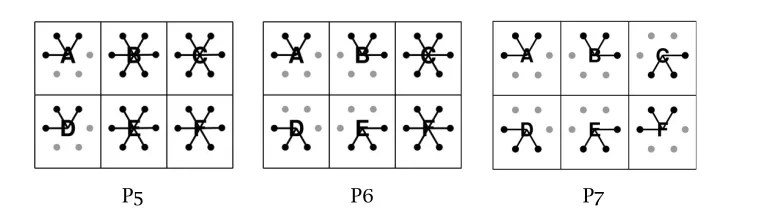
This sentence was displayed with seven different pictures, three of which are shown in Figure4. In each picture, a letter was connected with either all (A), none (N), or some but not all (M) of the circles surrounding it (“M” for “Mixed”). To illustrate, in Figure4, P5contains two M-cases and four A-cases, while P6contains four M-cases and two A-cases.
judged equally false.26 This shows that participants’ answers are influenced by the number of items satisfying the predicate: if there are more items satisfyingP, participants rate the sentence ‘Eachx P(x)#
higher (even though the sentence remains false as long as not all xs satisfyP).
Similarly, when the literal meaning of the sentence is true, the more
strongverifiers there are, the higher the sentence is rated. In particular, the successive differences between WEAK-2, WEAK-4 andSTRONG are all significant.27
4.4.7 An alternative interpretation: graded judgments as typicality
judgments On the face of these results, the following hypothesis
might seem plausible: the rating of each condition is driven mainly by
Figure 8 Illustrative examples of sub-conditions of the FALSE condition for the ‘some’
sentence: no letter satisfies the predicate (FALSE-0), two letters satisfy the predicate (FALSE-2), or four letters satisfy the predicate (FALSE-4).
Figure 9 Illustrative examples of the sub-conditions of theWEAKcondition for the ‘some’
sentence: two letters satisfy the strengthened predicate (WEAK-2) or four letters satisfy the strengthened predicate (WEAK-4).
26The Friedman rank test (testing non-parametrically the null hypothesis that allFALSE
sub-conditions are judged the same) yields a significant outcome both for ‘some’ (v2(2)¼20,p< .001)
and for ‘or’ (v2(2)¼17,p< .001). The relevant pairwise differences are significant (all but one at the
levelp< .005).
22 of 42 Experimental Embedded Scalar Implicatures
at Radboud University on April 19, 2011
jos.oxfordjournals.org
Downloaded from
judged equally false.26 This shows that participants’ answers are influenced by the number of items satisfying the predicate: if there are more items satisfyingP, participants rate the sentence ‘Eachx P(x)#
higher (even though the sentence remains false as long as not all xs satisfyP).
Similarly, when the literal meaning of the sentence is true, the more
strongverifiers there are, the higher the sentence is rated. In particular, the successive differences between WEAK-2, WEAK-4 andSTRONG are all significant.27
4.4.7 An alternative interpretation: graded judgments as typicality judgments On the face of these results, the following hypothesis might seem plausible: the rating of each condition is driven mainly by
Figure 8 Illustrative examples of sub-conditions of the FALSE condition for the ‘some’
sentence: no letter satisfies the predicate (FALSE-0), two letters satisfy the predicate (FALSE-2),
or four letters satisfy the predicate (FALSE-4).
Figure 9 Illustrative examples of the sub-conditions of theWEAKcondition for the ‘some’
sentence: two letters satisfy the strengthened predicate (WEAK-2) or four letters satisfy the
strengthened predicate (WEAK-4).
26The Friedman rank test (testing non-parametrically the null hypothesis that allFALSE sub-conditions are judged the same) yields a significant outcome both for ‘some’ (v2(2)¼20,p< .001) and for ‘or’ (v2(2)¼17,p< .001). The relevant pairwise differences are significant (all but one at the levelp< .005).
22 of 42 Experimental Embedded Scalar Implicatures
at Radboud University on April 19, 2011
jos.oxfordjournals.org
Downloaded from
Representative examples of pictures corresponding to each of these conditions are given in Figure 4. The entire set of pictures used to instantiate these conditions in the experiment is described in Appendix 2.1.
4.2.2 Downward-entailing environments Both localist and globalist theoreticians agree that the embedded SIs in downward-entailing environments are, at best, marginal.15
For instance, when scalar items are embedded in the scope of ‘No’ as in (12) or (13), it is uncontroversial that the potential ‘local’ readings Figure 4 Illustrative examples of the images used to illustrate the different conditionsFALSE, LITERAL, WEAKandSTRONGfor the test sentence (8): ‘Every letter is connected with some of its circles’. We also reported below each image whether the literal (Lit), global (Glob) and local (Loc) readings are true (T) or false (F).
15An environmentuisdownward-entailingif it licenses inferences from supersets (e.g. ‘salmon’) to
subsets (e.g., ‘smoked salmon’): ‘u(salmon)’ entails ‘u(smoked salmon)’. This can be seen as a generalized notion of negativity: ‘John didn’t eatsalmon’ entails ‘John didn’t eatsmoked salmon’. Upward-entailingness (UEness) is the reversed notion (the inference should be in the other direction, as in ‘John ate smoked salmon’ entails ‘John ate salmon’) and non-monotonicity describes environments that are neither DE nor UE.
Emmanuel Chemla and Benjamin Spector15 of 42
at Radboud University on April 19, 2011
jos.oxfordjournals.org
Downloaded from
P5 P6 P7
Figure4: Pictures used inChemla & Spector’s (2011)study.
P1 P2 P3 P4 P5 P6 P7
Number of N-cases 6 4 2 0 0 0 0
Number of A-cases 0 0 0 6 4 2 0
Number of M-cases 0 2 4 0 2 4 6
Mean rating 0 12 24 44 63 73 99
Table2: All pictures used in critical items inChemla & Spector’s (2011)experiment,
with their mean ratings (%).
Table2gives the mean ratings for the experimental items in C & S’s study. In their interpretation of these data, C & S focus their attention on the contrast between the P5- and P6-conditions, on the one hand, and the P7-condition, on the other. Since P7was the only picture that verified the target sentence with an embedded UBC, and its rating was significantly higher than those of the P5- and P6-items, which verified the sentence without an embedded UBC, C & S infer that their results support the existence of embedded UBCs. The obvious problem with this claim is that it accounts for part of the data only: like Clifton and Dube, C & S have a much richer data set than their experimental hypothesis can account for.
The astute reader will already see where we’re heading, but before we go there, let us first make a few preliminary points. For starters, C & S’s experimental instructions were verbose and less than fully coherent. Clocking in at well over 400words (which would amount to about one page in this journal), they began by announcing that participants were to decide whether given sentences were true or false, but then this alethic dichotomy was qualified by the claim that, occasionally, target sentences “will not be clearly true or clearly false”, and henceforth the true/false terminology gave way to a variety of epithets, including (more or less) “natural”, “appropriate”, and even “true/appropriate”. (Chemla & Spector2011: 392) In short, C & S’s instructions defy a straightforward construal, and there is no saying whether their participants achieved a consensual interpretation at all.
C & S presented their critical items in one continuous series, not bothering to use fillers to disguise the purpose of the experiment. These two features could have facilitated and even invited comparisons between items. If that is what happened, how could contrastiveness have affected C & S’s results? One possibility that suggests itself is that participants judged the key sentence less appropriate for a given picture only if they had previously encountered a better instance. To test this hypothesis, we compared participants’ ratings in the P5- and P6-conditions preceding any P7-items with the same conditions occurring after participants had seen one or more P7-items. Sure enough, P5- and P6-items received higher ratings prior to P7, and the mean rating of the P6-items preceding P7 was statistically indistinguishable from that of the P7-items, both being close to100%.
P5 P6
Trials in C & S’s experiment following P7 63 73
Trials in C & S’s experiment preceding P7 78 96
Our replication 93 100
Table3: Mean ratings (in %) for conditions P5and P6in C & S’s experiment and our
partial replication.
In order to corroborate this finding, we conducted a partial replication of C & S’s experiment, in which we left out P7entirely, and P5and P6were the only critical pictures. After three warm-up items, each participant saw the target sentence with either P5or P6. In this experiment, there was no difference at all between the P5- and P6-conditions and C & S’s P7-condition (Table 3). Therefore, what C & S present as the main effect in their data, and the keystone in their case for embedded UBCs, is an experimental artifact; more precisely, it is a contrast effect. First appearances notwithstanding, C & S’s experiment is not very different from Clifton and Dube’s.
As in the case of Clifton and Dube’s, we claim that C & S’s data, too, are best explained in terms of typicality, and that this provides us with an explanation that obviates the need for postulating embedded UBCs. Now, C & S admit that some of the regularities in their data may be due to typicality effects, but they argue that, even if they are, embedded UBCs are still needed:
underly-ing metric be? More specifically, what kind of situations must be counted as “prototypical” instances of the sentence? As far as we can see, one should conclude that the best instances of the sentence among our various pictures are the ones used in the condition that receives the highest rating [i.e., P7] We would thus be led to conclude that the best instances of the sentence are those that make the [embedded UBC] true. But it is hard to see how this could be so if the local reading did not correspond to a salient reading of the sentence [...] So the “typ-icality interpretation”, as far as we can see, would support our conclusion that the [embedded UBC] exists. (Chemla & Spector
2011:381-382)
To see why this is a non sequitur, recall from §5.1that, even though two is the prototypical even number, (25) does not imply in any way that there are two tulips in the vase:
(25) The number of tulips in the vase is even.
Or in C & S’s words: there is no “salient reading” of (25) which says that there are two tulips in the vase. Similarly, if among C & S’s pictures, P7 is the best instance of (24), then it does not follow that this sentence has a salient reading according to which no letter is connected to all of its circles. So C & S’s argument is invalid.
Still, it remains to be seen how we can account for the typicality effects associated with multiply quantified sentences in a way that fits C & S’s data. The following analysis is developed in detail byvan Tiel (to appear), so we will confine ourselves to the key ideas, starting with a concrete example. Imagine11situations (s0, . . ., s10), each of which contains 10circles. In every sn,ncircles are black, and the remaining circles are white. How well does any sn fit the following statements?
(26) a. Every circle is black.
b. Some of the circles are black.
Mean
rating
1 2 3 4 5 6 7
0 1 2 3 4 5 6 7 8 9 10
Number of black circles
Figure5: Mean ratings for (26a) ( ) and (26b) ( ) in situations consisting of ten
circles, up to ten of which were black, while the rest were white.
Clearly, both sentences induce a distinctive prototype structure on the set
{s0, . . ., s10}; that is to say, an ordering in terms of similarity to a “best case”.
Whereas for (26a),s10 is the prototype, the best instances of (26b), according
to van Tiel’s informants, are the situations in the middle region of the graph. In addition to similarity to a prototype, speakers’ judgments are influenced by the sentence’s truth value: situations in which a sentence is true received significantly higher ratings than situations in which it is false. This explains whys10is the unique prototype for (26a): it is the only situation in which that
sentence is true.
In van Tiel’s analysis, these observations are captured as follows. Letϕbe
a quantified sentence andsa situation consisting of a number of individuals
{x0, . . ., xn}, each of which instantiateϕ’s predicateP to a greater or lesser
degree.τP(x)andτϕ(s)are numerical values that reflect how wellxands
instantiate P andϕ, respectively. For universal sentences,τϕ(s) could be
analysed simply as the mean of the typicality values of the individuals in the contextual domain:
(27) τϕ(s):=
P
τP(xi)
|s| , where s= {x0, . . ., xn}and 0≤i≤n
whereas the situation with only one white circle received a significantly lower rating for (26a) than the prototype, there was almost no difference between the situations with one black circle and none. This observation can modelled by weighing the typicality values of the individual instances in such a way that lower typicality values carry more weight than higher ones, which can be done simply by taking the harmonic instead of the arithmetic mean:
(28) τϕ(s):=
|s| P
τP(xi)−1
, wheres= {x0, . . ., xn}and 0≤i≤n
Van Tiel shows that, for a very broad range of values for its free parameters, this analysis yields a strong correlation with the ratings he obtained for(26a) when paired with situations consisting of black and white circles.
For existential sentences, van Tiel proposes a coarse-level analysis that ab-stracts away from the typicality values of the individuals a situation consists of:
(29) τϕ(s):=1−dϕ(s)2+vϕ(s)
Here, dϕ(s) is the distance between s and the prototype situation, which
according to van Tiel’s informants was the situation consisting of an equal number of black and white circles.vϕ(s)is a function ofϕ’s truth value ins,
which can vary according to how strongly truth is hypothesised to influence typicality judgements. Hence, (29) is a straightforward implementation of the observation thatτϕ(s)is determined by its similarity to the prototype and ϕ’s truth value in s. This analysis, too, fits the observed pattern of ratings quite well for a very broad range of values forvϕ(s).
Armed with the analyses in (28) and (29), we return to Chemla and Spec-tor’s experiment. As discussed at the beginning of this section, C & S pre-sented sentence (30) paired with seven pictures (P1, ..., P7) containing six letters (`1, . . ., `6), each of which was connected to all, none, or some but not
all of the circles surrounding it (Table2):
(30) Every letter is connected to some of its circles. (=(24))
According to the analysis in (28), the typicality value of any picture P is a function of the typicality values of its letters with respect to the predicate
(31) ... is connected to some of its circles.
(32) τ(30)(P)=
6 P
τ
(31)(`i)
−1,1≤i≤6
The typicality analysis of existential sentences in(29)entails the following:
(33) Whenever`is connected to none of its circles,`0 is connected to all of
its circles, and`00is connected to some but not all of its circles, then τ(31)(`) < τ(31)(`0) < τ(31)(`00).
(32) and (33) constrain, but don’t fix, the possible ratings associated with P1, ..., P7, and in order to determine how well these constraints capture C & S’s data, van Tiel ran a Monte Carlo simulation, which involved generating
5,000triplets of values satisfying the constraint in (33). For each triplet, (32) was used to compute the predicted typicality value for each of P1, ..., P7, and then the means of these values were compared with the mean ratings C & S found for these situations. The correlation was remarkably close to1
(r =.995, p < .001). Hence, van Tiel’s typicality model fits C & S’s findings
almost perfectly, and unlike C & S’s own proposal, it accounts for the data practically without remainder.
To sum up: C & S’s data exhibit the kind of gradient pattern that, even by their own admission, calls for an explanation in terms of typicality. Nev-ertheless, C & S insist that a small part of this pattern proves the existence of embedded UBCs. We have seen that C & S’s argument cuts no ice: their findings can be fully accounted for by a typicality model that is entirely motivated on independent grounds, which obviates the need for embedded UBCs.
6 Non-monotone environments
Thus far, we have confined our attention to sentences in which a scalar expression occurs in an upward-entailing context; in this section, we turn to non-monotone environments:
(34) There was only one key that fit some of the locks.
On some versions of the conventionalist account, (34) should “systematically and freely” give rise to the following reading:
≡ One key fit some but not all of the locks, and all the others fit either none or all of the locks.
Is this reading available in principle? Sure it is. We only have to apply con-trastive stress tosome:
(36) There was only one key that fitsomeof the locks.
Is this reading freely available? No: it evidently needs to be forced. That, at any rate, is our intuition, and it was supported by Geurts and Pouscoulous’s data. In the study reviewed in §3, they presented sentence (37) with the pictures in Figure6:
(37) There are exactly two circles that are connected with some of the squares.
Whereas the picture on the left makes the sentence true on the critical reading, the picture on the right makes it false. Geurts and Pouscoulous’s first experiment robustly failed to corroborate conventionalist predictions: participants’ truth-value judgments contradicted the predicted reading on every single trial. In their ambiguity study, Geurts and Pouscoulous found
Figure6: Pictures used by Geurts and Pouscoulous with sentence (37). Note that, with
an embedded UBC forsome, the picture on the left verifies this sentence, while the
picture on the right falsifies it.
uncomfortably close to nothing when compared to the 70% rate at which bona fide ambiguities were detected in control items.
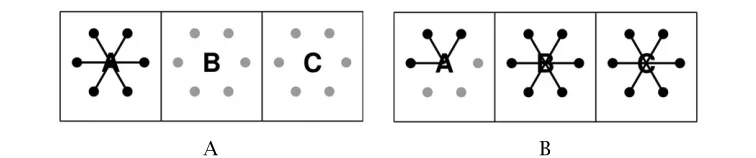
As one might expect, Chemla and Spector claim that their participants did much better. Figure7shows two of the critical pictures in C & S’s second experiment; the target sentence was the French equivalent of:
(38) There is exactly one letter connected with some of its circles.
C & S report that, in the critical condition, in which (38) was paired with the B-picture in Figure7, the sentence received an average rating of73%, which causes them to leap to the conclusion that there may be ageneralpreference for deriving UBCs, be they embedded or not (Chemla & Spector2011: 387).
5.4
Predictions
In non-monotonic contexts, localist theories predict that the local reading exists, while globalist theories cannot derive this reading. Moreover, in the
LOCALcondition, the local reading is true, while all the readings predicted
by globalist theories are false. Hence, in theLOCALcondition (see Figure 11 for an example), globalist theories predict that the sentence is plainly false, while localist theories predict that the sentence has a true reading.
5.5
. Results and interpretation
5.5.1 Preliminary technical remarks We lost 15% of the responses in target conditions for technical reasons (see footnote 18). See section 4.4.1 for more details about the reported statistical analyses.
5.5.2 Main result: the local reading exists Figure 12 reports the mean ratings of the target items grouped according to which interpretation is true: none, local only, literal only, all. All pairwise differences are significant, except for theLOCALvs.LITERALconditions in the case of
‘or’.33 (The relevant Wilcoxon tests for ‘some’: FALSE vs. LITERAL: W¼126,p< .005,LITERALversusLOCAL:W¼109,p< .05,LOCAL
Figure 11 Illustrative examples of the images used to illustrate the different conditionsFALSE,
LITERAL,LOCALandALLfor the test sentence (21): ’Exactly one letter is connected with some of its circles’. We also reported below each image whether the literal (Lit), global (Glob) and local (Loc) readings are true (T) or false (F).
386 Experimental Embedded Scalar Implicatures
at Radboud University on June 3, 2012
http://jos.oxfordjournals.org/
Downloaded from
5.4
Predictions
In non-monotonic contexts, localist theories predict that the local reading exists, while globalist theories cannot derive this reading. Moreover, in the
LOCALcondition, the local reading is true, while all the readings predicted by globalist theories are false. Hence, in theLOCALcondition (see Figure 11
for an example), globalist theories predict that the sentence is plainly false, while localist theories predict that the sentence has a true reading.
5.5
. Results and interpretation
5.5.1 Preliminary technical remarks We lost 15% of the responses in target conditions for technical reasons (see footnote 18). See section 4.4.1 for more details about the reported statistical analyses.
5.5.2 Main result: the local reading exists Figure 12 reports the mean ratings of the target items grouped according to which interpretation is true: none, local only, literal only, all. All pairwise differences are significant, except for the LOCALvs.LITERAL conditions in the case of ‘or’.33 (The relevant Wilcoxon tests for ‘some’: FALSE vs. LITERAL:
W¼126,p< .005,LITERALversusLOCAL:W¼109,p< .05,LOCAL
Figure 11 Illustrative examples of the images used to illustrate the different conditionsFALSE, LITERAL,LOCALandALLfor the test sentence (21): ’Exactly one letter is connected with some of its circles’. We also reported below each image whether the literal (Lit), global (Glob) and local (Loc) readings are true (T) or false (F).
33On a per item analysis, this difference does come out significant : U¼32 (n
1¼4,n2¼8),p<
.005.
386 Experimental Embedded Scalar Implicatures
at Radboud University on June 3, 2012
http://jos.oxfordjournals.org/
Downloaded from
A B
Figure7: Pictures used by Chemla and Spector with sentence (38). Note that, with
an embedded UBC forsome, the picture on the left falsifies this sentence, while the
picture on the right verifies it.
Apart from the fact that this conclusion would be premature even if C & S’s evidence was sound, it is doubtful that the evidence they presentissound. To begin with, the same worries we voiced about C & S’s first experiment apply in this case, too: the instructions were the same, hence susceptible to the same criticism (cf. §5.2), and as in the first experiment, the target sentence was shown over and over again to a small number of participants (n=16), with
no fillers between critical items. In short, it’s almost as if C & S’s experiment was designed to cause interactions between items. We have seen that this is what happened in their first experiment, and we will see that it happened in their second experiment, too.
In addition to potential contrast effects between items, it is evident that there was a salient contrast within the B-picture in Figure 7, too, and it is not hard to see how this might explain the high rating C & S obtained for this particular item. Given that, in this picture, there is a striking visual contrast between the leftmost letter and the other two, and given that the predicate of (38) is unequivocally verified by the left-most letter, informants
were invited to interpret that letter as the one the author of (38) had in mind, and construe the predicate accordingly; that is, interpret it in such a way that it was falsified by the remaining letters.10 Put otherwise, we maintain that the
visual contrast in the B-picture provoked a contrastive interpretation of the predicate of the target sentence. If this is correct, C & S’s data have no bearing on the debate between Gricean and conventionalist theories of embedded UBCs.
In a sense, C & S seem to agree with this assessment. Recall from §4that C & S complained that Geurts and Pouscoulous’s pictures were “difficult to decipher” (p.365), and one of the virtues they claim for their own materials is that they are better in this respect. Now compare C & S’s pictures in Figure7
with Geurts and Pouscoulous’s pictures in Figure 6. If C & S’s claim is that the latter are more complex than the former, then it is debatable at best. However, if C & S’s claim is that their pictures forced the reading they were after, while Geurts and Pouscoulous’s didn’t, then we fully agree. But in that case there is no issue.
Our diagnosis of C & S’s main finding is that it is driven by a salient visual contrast in the B-picture in Figure 7. This assumption entails that if the contrast is reduced, the picture’s rating should follow suit. In order to test that prediction, we conducted an experiment with materials that were nearly identical to C & S’s (Table 4), but in which high-contrast and low-contrast critical items were presented to different groups of participants. The crucial difference between the high-contrast and low-contrast pictures was that in the former but not the latter, there was a stark visual contrast between one letter, which unequivocally verified the predicate of the target sentence in (39), and the remaining letters.
(39) Exactly one letter is connected to some of its circles.
Questionnaires for54participants were posted on Amazon’s Mechanical Turk. All participants saw the same experimental items, with one exception only: whereas for half of the participants (Group A), sentence (39) was paired with the low-contrast picture (LoCon) in Table4, for the other half (Group B), the same sentence was presented with the high-contrast picture (HiCon), i.e. C & S’s B-picture. The remaining three items were the same for both groups;