Physics Matters Workbook Volume 2 53 © 2007 Marshall Cavendish International (S) Pte Ltd
Build your understanding!
Attempt the following questions on your own or in a group setting.
1. Complete Table 16.1 below on the types of charges produced on different materials by friction.
!Table 16.1
Materials Positive charge Negative charge
Perspex ruler rubbed with woollen duster Polythene strip rubbed with
woollen duster
Ebonite rod rubbed with fur
2. Figure 16.1 below shows a negatively charged polythene strip brought near a suspended pith ball.
(a) If the pith ball moves away from the approaching polythene strip, what can you conclude about the type of charge on the pith ball? Give a reason.
(b) If the pith ball moves towards the approaching polythene strip, can we conclude that it is positively charged? Why?
(a)
(b)
(c)
negatively charged polythene strip bent glass rod
wooden stand
pith ball
Worksheet 16A
Static Electricity
For topics
16.1 Electrostatics
16.2 Insulators and Conductors
"Figure 16.1
perspex duster
duster polythene
fur ebonite
The pith ball is negatively charged since like charges repel.
No. The pith ball can be neutral (or uncharged) since an uncharged body can be attracted by
induction.
J72PHYS WB_SE_Vol 2 • 16.indd 53
54 Static Electricity © 2007 Marshall Cavendish International (S) Pte Ltd 3. A student is given the following apparatus:
• Two uncharged perspex strips • Two uncharged polythene strips • Woollen duster
• Thread to suspend a strip so that the strip is horizontal and free to move
Describe, with the help of suitable diagrams, how the student can show that two negatively charged insulators repel each other. (Note: The student need not use all the apparatus listed above.)
4. Figure 16.2 shows two metal spheres mounted on portable insulating supports. A student is given a glass rod and a piece of silk. Without allowing the glass rod or silk to touch either sphere, describe, with the help of diagrams, how the student can charge the two spheres with equal but opposite charges. Use the space below and on the next page for your answer.
!Figure 16.2
[Note to teachers: Students should follow the four main steps in the textbook Section 16.2, with diagrams for each step containing labels and charges on the objects indicated clearly.]
Rub the two polythene strips with the woollen duster. The two polythene strips will be negatively charged. Suspend one of the strips horizontally and bring the other strip near it. The suspended strip is observed to move away, showing that two negatively charged insulators repel each other.
[Note to teachers: Students should draw at least one diagram showing a polythene strip suspended on a string defl ected away from the other strip, and arrows to show the repulsion clearly. Suitable labels for the objects should also be included and the charges on the strips should be indicated.
J72PHYS WB_SE_Vol 2 • 16.indd 54
Physics Matters Workbook Volume 2 55
© 2007 Marshall Cavendish International (S) Pte Ltd
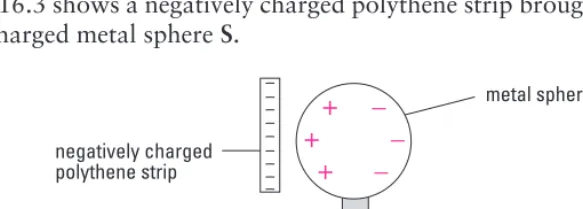
5. Figure 16.3 shows a negatively charged polythene strip brought near (but not touching) an uncharged metal sphere S.
(a) Indicate on Figure 16.3 above the charge distribution (if any) on the metal sphere S.
(b) With the strip remaining in position, the further end of the metal sphere S is touched momentarily by a hand. Describe what happens.
(c) The negatively charged strip is now removed. In the space below, draw a diagram of the metal sphere S showing its fi nal charge distribution.
!Figure 16.3
Check your understanding
!
"
Have you understood that electrostatic charging by rubbing involves the transfer of electrons?!
"
Can you describe experiments that show electrostatic charging by induction? negatively chargedpolythene strip
metal sphere S
insulating stand
On touching the sphere, the negative charges (electrons) on the sphere fl ow to the earth.
+ –
+
–
+ –
J72PHYS WB_SE_Vol 2 • 16.indd 55
56 Static Electricity © 2007 Marshall Cavendish International (S) Pte Ltd
+ + + + + + +
X
plate X
+ + + +
!Figure 16.4
!Figure 16.5
Challenge yourself!
Attempt the following questions on your own. You are advised to spend no more than the time indicated.
1. X is a light metal ball suspended by a nylon thread. When a positively charged rod is placed near it, X is attracted to the charged rod as shown in Figure 16.4. What are the charges present on X?
A Negative C Negative or neutral
B Positive D Positive or neutral ( )
2. A conducting sphere is suspended by a cotton string. It is placed between two metal plates. One plate is earthed and the other is connected to a high-voltage supply. The sphere is then displaced to the position as shown in Figure 16.5.
(a) Explain why the sphere moves towards and touches plate X momentarily when it is released.
(b) Explain why the sphere then moves away from plate X after touching it.
C
This is because the sphere is attracted to the positively charged plate by induction.
The sphere becomes positively charged by the plate and is then repelled by the plate because it
has the same charge.
J72PHYS WB_SE_Vol 2 • 16.indd 56
Physics Matters Workbook Volume 2 57
© 2007 Marshall Cavendish International (S) Pte Ltd
3. An experiment to show charging by induction uses a metal sphere mounted on an insulated support. The sphere is initially uncharged and is shown in Figure 16.6.
(a) A negatively charged rod is brought near the sphere, as shown in Figure 16.7.
(i) State and explain the movement of electrons in the sphere that occurs as the rod is brought near.
(ii) On Figure 16.7, draw the charges on the metal sphere.
(b) The metal sphere is now touched at point A by a wire connected to the earth, as shown in Figure 16.8. On Figure 16.8, draw the charges on the metal sphere.
(c) The wire connected to earth is removed. Then the negatively charged rod is also removed, as shown in Figure 16.9. On Figure 16.9, draw the charges on the metal sphere.
(d) The support is made from an insulator. State one material that may be used to make the support.
(Nov04/P2/Q7) metal sphere
insulated support
negatively charged rod
– – –
wire connected to the earth negatively charged rod
A
– – –
!Figure 16.6 !Figure 16.7
!Figure 16.8
!Figure 16.9
The electrons are repelled by the negatively charged rod to the surface further away from the
rod. This is because the electrons are negatively charged, and like charges repel. +
+
+ –
––
+
+
+ –
––
+
+ +
Rubber [Note to teachers: any suitable material that is a poor electrical conductor would be correct.]
J72PHYS WB_SE_Vol 2 • 16.indd 57