Volume 4, Issue 6, 2017, pp. 174-182 Available online at www.jallr.com ISSN: 2376-760X
* Correspondence: Banafsheh Alaie, Email: alaie.b20 gmail.com © 2017 Journal of Applied Linguistics and Language Research
The Effect of problem-Solving Tasks on the Iranian
Intermediate EFL Learners’ Speaking Skill
Yousef Bakhshizsdeh
Associate professor, Chabahar Maritime University, Iran
Banafsheh Alaie *
MA Student, Chabahar Maritime University, Iran
Abstract
Speaking has been the main point of interest for many researchers because it is the foremost important skill by which learners are judged. Since speaking is learned through instruction, it has always needed an appropriate method of teaching. The present study made an attempt to investigate the effect of utilizing problem-solving tasks as an approach to teaching and learning the second language on the improvement of speaking skill. In this experimental research, two intact groups of 21intermediate EFL learners in English language institute were involved. The participants were given a TOEFL (PBT) general proficiency test to ensure their level as intermediate at the outset. Two groups were randomly assigned to the control and experimental groups and then, an FCE pre-test of speaking skill was administered to both groups to ensure their homogeneity prior to treatment. Consequently, two groups were instructed for 18 sessions (two months) with different approaches. The control group was taught using the audio-lingual method of teaching and the experimental group was taught using problem-solving tasks. Finally, a post-test of speaking was administered to both groups to assess their speaking ability at the end of research. To compare the participants’ speaking ability in the experimental and control groups an independent-samples t-test was conducted. The data analysis showed that the experimental group outperformed on improving their speaking skills post-test compared to the control group. The results showed that utilization of problem-solving tasks has a significant effect on improvement of learners' speaking proficiency.
Keywords: speaking proficiency, problem-solving tasks, proficiency
INTRODUCTION
ability to communicate in the target language is not a goal of foreign language instruction. Since GTM was not very effective in preparing students to use target language communicatively, some new methods such as Direct Method and Audio-lingual Method became popular. The Direct Method brings attention to the direct meaning conveyance in the target language utilizing of demonstration and vital aids, without any recourse to the students' native language. The purpose in this method is communication. Students should be encouraged to speak as much as possible. The Audio-lingual method is also oral-based approach. Pattern practice, preventing learners from making errors, learning how to use language to communicate was basic features of ALM. Speech is very essential to language than the written form. By starting of ALM, it seems that a revolution occurs in teaching methodology and speaking became a fancy skill in all approaches. (Brown, 2007)
When speaking was regards as the most important skills, working on the details of speaking skills started, and the researchers elaborated on many aspects of speaking. One issue in this area was making learners' better communicator with different proficiency. It was a sensitive matter because communication in many situations is a need, and no one can expect learners postpone this need to the time that they became fully proficient in the target language. On the matter of the importance of speaking, it has stated that:
“Among all four skills(listening, speaking, reading and writing), speaking plays the most important roles: people who know a language are referred as to speakers of that language as if speaking consists of all other types of knowledge and learners are mainly interested in learning to speak.” (Ur, 1991, p.120)
Speaking requires learners to activate their knowledge and then to produce a message. Most of the method and approaches to language teaching ignored the essential factors of learning such as learners' needs, attitude, engagement, and motivation. Teachers try to improve speaking skill utilizing a range of teaching approach, method, strategies, and classroom activities. One of the approaches that can be helpful in this way is teaching/learning through utilization of problem-solving tasks. Problem-solving tasks invite learners to offer advice and recommendations on problems ranging from the general to specific. There are many topics that naturally lend themselves to problem-solving tasks. These ideas have been proposed by teachers in different countries, teaching different ages and in a wide range of social contexts. Problem-solving is defined as:
“problem-solving is using existing knowledge and skills to address an unanswered question or troubling situation, while Problem-based learning is an approach to instruction in which students acquire new knowledge and skills while working on a complex problem similar to those in the outside world”. (Ormond, 2006, pp.111-121).
Do problem –solving tasks have any effect on the improvement of speaking ability? REVIEW OF THE RELATED LITERATURE
During the late twentieth century, some language acquisition researchers were conducted. Several studies led to this result: the basic idea has gotten backward; it means that people cannot learn the pieces of the language, and then later put them together to make a conversation. Instead, like infants acquiring their first language, people learn language by interacting with other people. This realization has several interesting implications, if people learn language by interacting, then learners should interact during lessons. As the result, a new method arises which called communicative language teaching (CLT). As Richards (2006) asserts CLT had developed the notion of communicative competence. Communicative competence which refers to the ability to use language correctly and appropriately can be acquired through the four skills. Speaking is at the heart of second language learning, it plays an important role in communicative competence. Consequently, it is necessary that language teachers’ pay more attention to teaching speaking instead of leading learners to pure memorization and also providing a rich environment where meaningful communication takes place is desired.
SPEAKING SKILL
Nunan (2003) defines speaking as consisting of systematic verbal utterances that are produced and conveyed meaning. Speaking in a second language now occupies a particular position all over the history of language learning and teaching, particularly in the two recent decades has it initiated to emerge as a branch of learning, teaching, and testing.
Teaching speaking may sound a simple process, while difficulties in finding and performing techniques and methods which meaningfully can help learners, even teachers, to master this skill, seems to display language proficiency and competency of the learners. Teaching speaking involves utilizing a wide variety of activities, tasks, physical conditions, supportive environment, effort, time, energy on the side of the teacher, motivational factors, and so on to be taken into consideration. Consequently, it is necessary that language teachers’ pay more attention to teaching speaking instead of leading learners to pure memorization and also providing a rich environment where meaningful communication takes place is desired. Various speaking activities help learners to develop basic interactive skills. These activities have two benefits: firstly making students more active in the learning process and secondly, making their learning more meaningful and fun for them. In the 1970s and 1980s, a new approach to language teaching called Communicative Language Teaching (CLT). CLT drew on a functional model of language (Holliday’s) and a theory of communicative competence (Hyme’s).In fact, CLT is not a uniform approach.
authenticity, acceptability, and adaptability and instead, we are exhorted to embrace Task-based language teaching as a more appropriate model. Closely related to CLT are a great number of concepts that have, like task-based language teaching. It should be noted that according to Brown (2007) there are two viewpoints in this term. One viewpoint is that these terms are simply expressions for the latest fads/trends in language teaching and are then relatively meaningless. Another viewpoint considers them as reasonable attempts to label current concerns and recent developments within the framework, as overlapping and confusing as these concerns sometimes are. The later perspective seems to be one of the most important perspectives within the CLT framework.
TBLT is an approach that is designed based on a collection of tasks not an ordered list of linguistic items. It draws on experiential and humanistic traditions and reflects on changing conceptions of language itself (Nunan, 2001). Based on SLA research findings, TBLT argues that in order to acquisition happen, attention to meaning rather than form, negotiation with another speaker and motivation created by real-world relevance should be emphasized (Cook, 2003). In TBI, where meaning is primary, authenticity and language acquisition and development are important issues (Skehan, 1996). It involves learners in completing meaning and there is overwhelming evidence that in order to be able to use language, learners should be engaged in meaning.
PROBLEM-SOLVING TASKS
In turning to the concept of ‘task’, the first thing is to define the term itself. The term ‘task’ has been defined in a variety of ways. There are many different definitions of tasks. A communicative task is “a piece of classroom work which involves learners in comprehending, manipulating, producing, or interacting in the target language while their attention is principally focused on meaning rather than form. The task should also have a sense of completeness, being able to stand alone as a communicative act in its own right”. (Nunan, 1989,p.10)
The task should also have a sense of completeness, being able to stand alone as a communicative act in its own right. Tasks point learners beyond the forms of language alone to real-world contexts. Tasks especially contribute to communicative goals. Their elements are precisely designed and not simply randomly thrown together. Their purposes are exactly specified so that you can obviously determine the success of one task over another. Tasks involve learners, at some level, in authentic problem-solving activity.
of social contexts. As previously defined,” problem-solving is using existing knowledge and skills to address an unanswered question or troubling situation, while Problem-based learning is an approach to instruction in which students acquire new knowledge and skills while working on a complex problem similar to those in the outside world (Ormond, 2006,p. 111-121). Mayer and Wittrock (2006, p. 287) defines "problem-solving as a cognitive process directed at achieving a goal when no solution method is obvious to the problem solvers".
This definition consists of four parts. Problem-solving is cognitive, i.e., problem-solving occurs within the problem solver’s cognitive system and can only be inferred from the problem solver’s behavior. Problem-solving is a process, i.e., problem-solving involves applying cognitive processes to cognitive representations in the problem solver's cognitive system. Problem-solving id directed, i.e., problem-solving is guided by the problem solver's goals. Problem-solving is personal, i.e., problem- solving depends on knowledge and skill of the problem solver.
Problem-solving tasks can provide rich discussion if learners have already aforethought some ideas to share. They will benefit from time to think beforehand; they can then get to grips the problem and work out possible solutions and how to express them. In some cases, there may be a suitable website or pamphlet that gives some useful background information. It means it is often best to introduce the topic and do a relevant priming phrase in a previous lesson, explaining the nature of the problem and telling learners that the task will be to discuss and agree on a solution to this problem. Obviously, learners are more likely to become engaged if the problem is the local one that affects them or one that is within their own experience, and one that they feel confident talking about. Solving problems effectively requires students to identify, define and solve problems using logic, as well as lateral and creative thinking. In the process, students arrive at a deep understanding of the topic area and construct new knowledge and understanding on which they are able to make decisions.
PROBLEM-SOLVING TASKS AND SPEAKING SKILL
Many researchers pointed out that applying problem-solving activities in the language classroom is very useful in creating an attractive learning environment for learners. Oradee (2012) conducted a study of comparing English speaking skill using three communicative activities: discussion, problem-solving, and role-playing. She pointed out the effects of using these communicative activities in language classroom in Thai context. The results of her study revealed a positive role of using communicative activities in developing English speaking skill.
METHOD
To conduct this study, a quantitative method was selected. Since it was not possible for the researcher to randomly select the participants for the study, this research is quasi-experimental.
Participants
The participants of the current study were 42, both male and female. All of them were the Iranian EFL intermediate learners learning English as L2 language at a private English language Institute in Sharekord and were native speakers of Persian. All the participants had had the same exposure to English language learning before the experiment. These two groups were randomly assigned to the experimental and control groups.
Instruments
In conduction the first research question, the following instruments were used:
Administrations of TOEFL (PBT) general proficiency test to ensure participants were all intermediate EFL learners.
Administration of FCE Speaking proficiency pre and post-tests.
Teaching speaking using audio-lingual method in the classroom for control group Teaching speaking using problem-solving tasks in the classroom for experimental
group
Using SPSS statistics software was to compare the results of the pre-tests and the post-tests prior to and after the experiment.
Procedure
This study selected two intact groups each of which was formed, 21 learners. Then, a PBT TOEFL test was administered to ensure their level of proficiency as the intermediate. Next, FCE pre-test of speaking skill was carried out to both groups before the study to ensure both groups equivalence and homogeneity. After that, two groups were instructed for 18 sessions (two months) with different approaches. The control group received traditional instruction with a little communicative opportunity to practice speaking skills. They experienced the instruction of ALM. Another group experienced problem-solving tasks. They have to find solutions to various types of problem. After two months and at the end of the experiment, a speaking post-test was administered to both groups.
RESULTS AND DISCUSSION
This study aimed to investigate whether utilization of problem-solving tasks improves intermediate EFL learners’ speaking proficiency. The quantitative analyses of the collected data were calculated with the aid of SPSS software. The standard probability of p<.05 was used so as to determine the significance throughout the study.
the participants' language proficiency and homogeneity, TOEFL general proficiency test and FCE speaking pre-test were applied. The estimated language proficiency means of all the participants amounted to 433.6905, which put them as intermediate learners. The FCE speaking pre-test was administered as the main pre-test to both the control and treatment groups to be used as a base for comparing the results of the pre-test with the results of the post-test in gauging any possible effect of utilizing problem-solving tasks on the students' speaking ability.
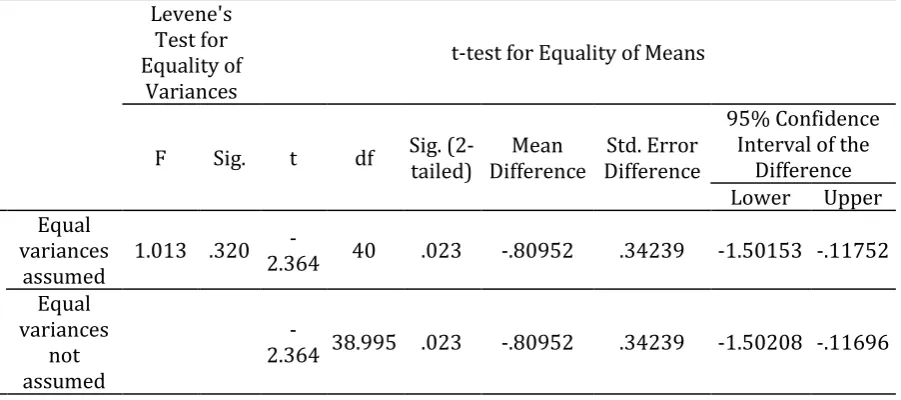
Descriptive statistics of the participants' scores on FCE speaking proficiency pre-test with regard to the experimental and control groups and result of independent-samples t-test are presented in Tables 1 and 2.
Table1. Descriptive statistics for the results of FCE speaking pre-test
VAR00002 N Mean Std. Deviation Std. Error Mean
VAR00001 1 2 21 21 13.8571 14.6667 1.19523 1.01653 .26082 .22183
Table 2.Independent-samples t-test results for the FCE pre-test of the treatment and
control groups
As it is shown in tables 1 and 2, there was not a significant difference in the scores for the control group (1) (M = 13.87, SD = 1.19) and the experimental group (2) (M = 14.66, SD = 1.01); t (40) = -2.3, P = 0.23.
Since the P-value is greater than 0.05 (0.23 > 0.05), the results indicate that there was no statistically significant difference between experimental and control groups regarding their listening skill before the study. In other words, experimental and control groups were relatively at the same level of proficiency in listening skill and therefore they were homogeneous in their listening comprehension ability prior to the study.
After treatment when the experiment was carried out, all participants in both groups were given an FCE speaking post-test. An inspection of the mean scores showed that there
Levene's Test for Equality of
Variances
t-test for Equality of Means
F Sig. t df Sig. (2-tailed) Difference Mean Difference Std. Error
95% Confidence Interval of the
Difference
Lower Upper
Equal variances
assumed 1.013 .320
-2.364 40 .023 -.80952 .34239 -1.50153 -.11752
Equal variances
not assumed
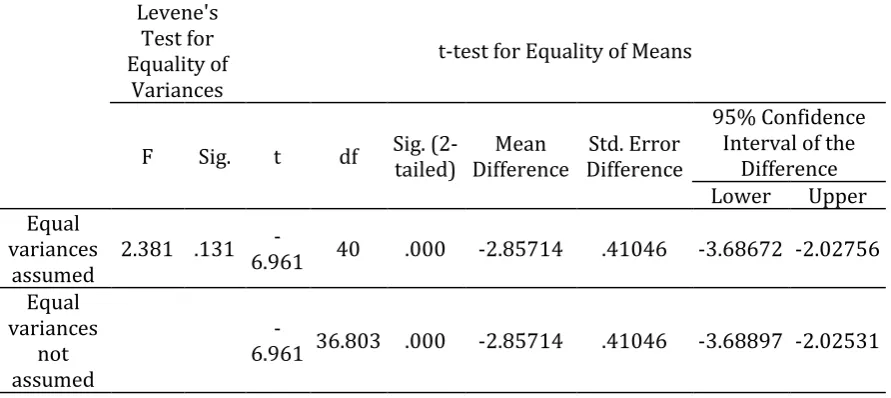
was a considerable difference between the treatment group and the control group in terms of overall speaking performance. Descriptive statistics of the participants’ scores on FCE speaking post-test with regard to the experimental and control groups and the result of t-test are presented in Tables 3 and 4.
Table 3. Descriptive statistics for the results of FCE speaking post-test
VAR00002 N Mean Std. Deviation Std. Error Mean
VAR00001 1 2 21 21 14.0952 16.9524 1.51343 1.11697 .33026 .24374
Table 4. Independent-samples t-test results for the FCE post-test of both groups
Levene's Test for Equality of
Variances
t-test for Equality of Means
F Sig. t df Sig. (2-tailed) Difference Mean Difference Std. Error
95% Confidence Interval of the
Difference
Lower Upper
Equal variances
assumed
2.381 .131 6.961 - 40 .000 -2.85714 .41046 -3.68672 -2.02756
Equal variances
not assumed
-6.961 36.803 .000 -2.85714 .41046 -3.68897 -2.02531
Tables 3 and 4 show that in speaking post-test there was a significant difference in the scores for the control group(1) (M = 14.09, SD = 1.51) and the experimental group (M = 16.95, SD = 1.11); t (40) =-6.9 ,P = 0.000
Hence wise, it can be surely said that there were statistically significant differences between the experimental and control groups on the post- test in overall speaking in favor of the experimental group. The results revealed that utilization of problem-solving tasks can really promote participants’ ability in speaking proficiency.
CONCLUSION
ability to solve problems in a range of learning contexts is essential for the development of knowledge, understanding, and performance. Requiring students to engage with complex, authentic problem solving encourages them to use content knowledge in innovative and creative ways and promotes deep understanding.it is essential to provide students with a variety of problem-solving tasks so that they will be able to cope with different situations in a real life. Speaking problem-solving tasks make the classroom cheerful and dynamic, and applying problem-solving tasks increase motivations towards learning to speak.
REFERENCES
Brown, H. D. (2007). Teaching by principles: An interactive approach to language pedagogy (3rd Ed.). Cambridge: Cambridge University Press.
Cook, G. (2003). Applied linguistics. Oxford: Oxford University Press.
Fadilah, F. (2015). Teaching speaking using problem-solving activities. IAIN Salatiga Open Journal System, 1-79.
Hidayat, A. R. (2008). Teaching speaking skill using the problem-solving method at the class tenth of SMA BINA MUDA CICALENGKA. Group, 40.
Kumaravadivelu, B. (2006). Learner perception of learning tasks. ITL-International Journal of Applied linguistics, 152(1), 127-149.
Mayer, R. E., & Wittrock, R. C. (2006). Problem-solving. In P. A. Alexander & P. H. Winne (Eds.), Handbook of educational psychology (2nd Ed, pp. 287-304). Mahwah, NJ: Erlbaum.
Nunan, D. (1989). Designing tasks for the communicative classroom. New York, Cambridge University Press.
Nunan, D. (2001). Second language teaching and learning. Tehran: Ma'arefat.
Nunan, D. (2003). Learner strategy training in the classroom: action research study. In J.Richards. , & W. Renandya (Eds.), Methodology in language teaching: an anthology of current Practice (pp. 121-143).Cambridge: Cambridge University Press.
Nunan, D. (2004). Task-based language teaching. Cambridge: Cambridge University Press. Oradee, T. (2012). Developing speaking skills using three communicative activities (discussion, problem-solving, and role-playing). International Journal of Social Science and Humanity, 2(6), 533.
Ormond, J.E. (2006). Essentials of educational psychology. Pearson Merrill Prentice Hall: Press Publications.
Richards, J. C. (2006). Communicative language teaching today. New York: Cambridge University Press.
Skehan, P. (1996). A framework for the implementation of task-based instruction. Applied linguistics, 17(1), 38-62.