VOLUME 38, ARTICLE 32, PAGES 879
,
896
PUBLISHED 7 MARCH 2018
http://www.demographic-research.org/Volumes/Vol38/32/ DOI: 10.4054/DemRes.2018.38.32
Descriptive Finding
Estimating mortality from external causes using
data from retrospective surveys: A validation
study in Niakhar (Senegal)
Gilles Pison
Bruno Masquelier
Almamy Malick Kante
Cheikh Tidiane Ndiaye
Laetitia Douillot
Géraldine Duthé
Cheikh Sokhna
Valérie Delaunay
Stéphane Helleringer
© 2018 Gilles Pison et al.
This open-access work is published under the terms of the Creative Commons Attribution 3.0 Germany (CC BY 3.0 DE), which permits use, reproduction, and distribution in any medium, provided the original author(s) and source are given credit.
1 Introduction 880
2 Methods 882
2.1 Study context and reference data 882
2.2 Validation study of survey data on deaths from external causes 882
3 Data analysis 883
4 Results 885
5 Discussion 889
6 Acknowledgments 890
Estimating mortality from external causes using data from
retrospective surveys: A validation study in Niakhar (Senegal)
Gilles Pison1 Géraldine Duthé6
Bruno Masquelier2 Cheikh Sokhna7
Almamy Malick Kante3 Valérie Delaunay5
Cheikh Tidiane Ndiaye4 Stéphane Helleringer3
Laetitia Douillot5
Abstract
BACKGROUND
In low- and middle-income countries (LMICs), data on causes of death is often inaccurate or incomplete. In this paper, we test whether adding a few questions about injuries and accidents to mortality questionnaires used in representative household surveys would yield accurate estimates of the extent of mortality due to external causes (accidents, homicides, or suicides).
METHODS
We conduct a validation study in Niakhar (Senegal), during which we compare reported survey data to high-quality prospective records of deaths collected by a health and demographic surveillance system (HDSS).
RESULTS
Survey respondents more frequently list the deaths of their adult siblings who die of external causes than the deaths of those who die from other causes. The specificity of
1 Laboratoire d’Éco-anthropologie et ethnobiologie (UMR 7206 MNHN-CNRS-Paris Diderot), French
Museum of Natural History, Paris, France and French Institute for Demographic Studies, Paris, France. Email:[email protected].
2 French Institute for Demographic Studies, Paris, France and Centre for Demographic Research, Louvain
University, Louvain-la-Neuve, Belgium.
3 Bloomberg School of Public Health, Johns Hopkins University, Baltimore, USA. 4 United Nations Population Fund, Moroni, Comores.
5 Unité mixte de recherches Lped, Institut de recherches pour le développement, Marseille, France. 6French Institute for Demographic Studies, Paris, France.
survey data is high, but sensitivity is low. Among reported deaths, less than 60% of the deaths classified as due to external causes by the HDSS are also classified as such by survey respondents. Survey respondents better report deaths due to road-traffic accidents than deaths from suicides and homicides.
CONCLUSIONS
Asking questions about deaths resulting from injuries and accidents during surveys might help measure mortality from external causes in LMICs, but the resulting data displays systematic bias in a rural population of Senegal. Future studies should 1) investigate whether similar biases also apply in other settings and 2) test new methods to further improve the accuracy of survey data on mortality from external causes.
CONTRIBUTION
This study helps strengthen the monitoring of sustainable development targets in LMICs by validating a simple approach for the measurement of mortality from external causes.
1. Introduction
Reducing mortality due to external causes (e.g., accidents, suicides, or conflict-related deaths) figures prominently in the agenda for sustainable development. For example, halving global deaths and injuries from road-traffic accidents is one of the targets of the third Sustainable Development Goal (SDG) on ensuring healthy lives and promoting wellbeing. There is thus a strong need for accurate statistics on deaths due to external causes to 1) track progress toward the achievement of the SDGs and 2) evaluate the effectiveness of prevention initiatives and programs (Lagarde 2007).
between these sources (Carpenter, Fuller, and Roberts 2013), with estimates of a conflict’s death toll routinely varying by orders of magnitude (Heuveline 2015).
Nevertheless, national levels and trends of mortality from external causes in LMICs are currently extrapolated from these partial data sources (Naghavi et al. 2017; Sanghavi, Bhalla, and Das 2009). The resulting estimates may be unreliable because they may omit some deaths, or inaccurately reclassify deaths attributed to unknown causes as injury-related (Bhalla and Harrison 2015). In studies of the global burden of disease (Naghavi et al. 2017), estimates of mortality from external causes are also frequently adjusted to ensure that they are consistent with other mortality estimates (e.g., deaths from infectious diseases). Errors in the measurement of other causes of death may further confound estimates of deaths due to external causes.
Improving the measurement of road-traffic mortality and other accidental deaths in LMICs thus requires collecting accurate and nationally representative data on deaths from external causes. There are ongoing efforts to strengthen CRVS systems (AbouZahr et al. 2015), but they mainly focus on birth registration and will have limited impact on our ability to measure causes of death in the next 15 years. Sample registration systems that include the collection of VA data are currently being established but only in a very limited number of countries (Kabadi et al. 2015; Mudenda et al. 2011).
2. Methods
2.1 Study context and reference data
We conduct a validation study of survey data on mortality from external causes. We use data from the Niakhar health and demographic surveillance system (HDSS) in Senegal (West Africa) as reference. HDSS are populations in which vital events (e.g., births, deaths) are recorded continuously during periodic household visits (Pison 2005). Each recorded death is also investigated by verbal autopsy (VA), i.e., a postmortem interview with caregivers of the deceased. VA data is highly accurate in identifying deaths from external causes (Baiden et al. 2007; Chandramohan et al. 1994, 1998).
In Niakhar, after a baseline census, data on births, deaths, marriages, and migrations are collected from household informants during regular household visits (Delaunay et al. 2013). Each recorded death is investigated using VA. Two clinicians then review VA data and attribute a probable cause using codes of the international classification of diseases. The most frequent external causes of death recorded in the Niakhar HDSS are falls, suicides, road accidents, fire, and burning (Guyavarch et al. 2010).
The Niakhar HDSS constitutes a high-quality reference dataset on mortality from external causes, but it has limitations. First, some external causes of death (e.g., war deaths) are not represented in this dataset. If such deaths are more (or less) precisely reported during surveys than other accidents and injuries, our study may misrepresent the accuracy of survey-based estimates in other settings. Second, despite the high accuracy of VA data about mortality from external causes, HDSS data does not constitute a gold standard. It may still misclassify some external causes of death as nonexternal, and vice versa.
2.2 Validation study of survey data on deaths from external causes
In 2013, we conducted a survey of adult mortality among the Niakhar HDSS population. Our goal was to compare survey reports of adult deaths among the siblings of a respondent to prospective HDSS records of the survival of these siblings.
In total, 1,189 respondents were asked to list their maternal siblings by birth order and report their survival statuses, ages, and, if deceased, ages at death and dates of death. For siblings who had died at ages 12 and older, respondents also answered a) whether their siblings died after being injured, b) whether the injuries were due to accidents, suicides, homicides, wars, or natural disasters, and c) the circumstances that lead to the injuries (e.g., whether they were due to collisions with motor vehicles).
We test two adult mortality questionnaires: (1) the standard DHS questionnaire and (2) the siblings’ survival calendar (SSC). The SSC incorporates supplementary interviewing techniques to limit omissions of siblings and uses an event history calendar to improve reports of dates and ages. The SSC improves the completeness and accuracy of data on all-cause adult mortality and maternal mortality (Helleringer et al. 2014; Helleringer et al. 2015). Exploratory analyses suggest that the SSC might also improve some aspects of the reporting of deaths from external causes, but the differences we observe are only marginally significant (see Discussion). In this paper, we thus pool data from the two questionnaires.
3. Data analysis
Two types of reporting errors affect survey data on deaths from external causes. First, selective omissions happen when the likelihood of reporting siblings’ deaths depends on their causes of death. For example, a respondent may list their deceased brother if he died during a car accident but not if he died from HIV/AIDS. Second, misclassifications occur when respondents correctly list the deaths of their siblings but misstate the circumstances of their deaths. For example, a respondent may mistakenly state that their sister, who died after falling from a window, did not die from an injury or accident. Selective omissions and misclassifications may bias estimates of the proportion of adult deaths that are attributable to external causes (PEC hereafter). For example, if respondents do not list 10% of their siblings whose deaths are due to external causes vs. 20% of their siblings whose deaths are due to other causes, the PEC will be overestimated.
Second, we measure the extent of selective omissions, i.e., whether the probability of listing a deceased sibling during the survey varies by cause of death (external vs. other). Third, we measure misclassifications in survey reports of deaths from external causes. We define the sensitivity of survey data as the proportions of respondents correctly stating the cause of reported deaths among respondents in sibships with deaths from external causes. We define the specificity of survey data as the proportions of respondents correctly stating the cause of reported deaths among respondents in sibships with only deaths from nonexternal causes. We calculate 95% confidence intervals around each of these estimates after a logit transform (so that the endpoints lie between 0 and 1). We use Student’s t-distribution (with degrees of freedom equal to the number of observations minus 1) to determine the critical values of the confidence intervals. We obtain estimates of each proportion (as well as its standard error and confidence interval) using the svy command in Stata 14. In this setup, we consider the selection of sibships as our first sampling stage and the selection of respondents within sibships as our final sampling stage. This allows adjusting standard errors and confidence intervals for the clustering of survey reports in sibships with several respondents.
Fourth, we use estimates of these parameters to evaluate bias in survey estimates of the PEC using the following formula:
PEC = π × R × Se + (1 − π) × R × Sp, (1)
in whichPEC is the survey estimate of the PEC,π is the true value of this proportion,
R is the probability that respondents will list their sibling who died from external causes,R is a similar probability for siblings who died from other causes, andSe and
Sp are the sensitivity and specificity of survey data in classifying death from external causes, respectively. We explore how much variations in each of the reporting parameters (R ,R ,Se, andSp) in Equation (1) affect bias in survey estimates of the PEC. We thus let each of these parameters vary between the lower and upper bounds of its confidence interval, and we recalculate thePEC for each level of that range.
Finally, to explore whether some external deaths may be more likely to be omitted or misclassified during surveys, we compare the circumstances of deaths recorded by the HDSS between ‘false negatives’ and ‘true positives.’ False negatives are instances in which survey respondents do not classify deaths as due to external causes when the HDSS does so, whereas true positives are instances in which both respondents and the HDSS attribute the deaths to external causes.
4. Results
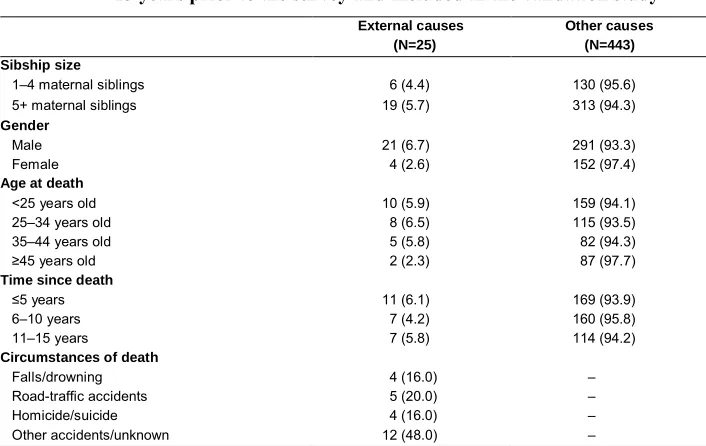
There are 468 deaths of persons aged 12 years or older during the 15 years before the survey. Twenty-five of these deaths (5.5 %) could be attributed to external causes on the basis of HDSS data (Table 1). The PEC is higher for males than for females (6.7% vs. 2.6%).
Table 1: Characteristics of deaths recorded by the Niakhar HDSS during the 15 years prior to the survey and included in the validation study
External causes (N=25)
Other causes (N=443) Sibship size
1–4 maternal siblings 6 (4.4) 130 (95.6)
5+ maternal siblings 19 (5.7) 313 (94.3)
Gender
Male 21 (6.7) 291 (93.3)
Female 4 (2.6) 152 (97.4)
Age at death
<25 years old 10 (5.9) 159 (94.1)
25–34 years old 8 (6.5) 115 (93.5)
35–44 years old 5 (5.8) 82 (94.3)
≥45 years old 2 (2.3) 87 (97.7)
Time since death
≤5 years 11 (6.1) 169 (93.9)
6–10 years 7 (4.2) 160 (95.8)
11–15 years 7 (5.8) 114 (94.2)
Circumstances of death
Falls/drowning 4 (16.0) –
Road-traffic accidents 5 (20.0) –
Homicide/suicide 4 (16.0) –
Other accidents/unknown 12 (48.0) –
The survey data is affected by selective omissions of deaths (Table 2). Among respondents whose siblings died of external causes according to HDSS, 34 out of 35 report a death at ages 12 or older (97.1%). The proportion is lower (497 out of 567, 87.7%) among respondents whose siblings died of nonexternal causes (p=0.087).
Table 2: Selective omissions of adult deaths during survey interviews by sibship composition
Sibships with adult deaths from external causes
Sibships with adult deaths from other causes
p-value Reported/ expected % (95% CI) Reported/ expected % (95% CI)
All deaths 34/35 97.1
(82.8, 99.6)
497/567 87.7
(84.3, 90.4)
0.087
Male deaths 31/32 96.9
(81.4, 99.6)
334/383 87.2
(83.0, 90.5)
0.102
Note: ‘Reported’ refers to the number of respondents who report an adult death among their siblings during the past 15 years; ‘expected’ refers to the number of respondents who are members of sibships in which there are at least one death due to injuries or one death due to other causes in the past 15 years; p-values test the null hypothesis of no difference in proportion of respondents reporting an adult death during the past 15 years between sibships with an injury death and sibships with only noninjury deaths. This p-value is based on aχ test. Standard errors are adjusted for the clustering of respondents within sibships using the svy command in Stata.
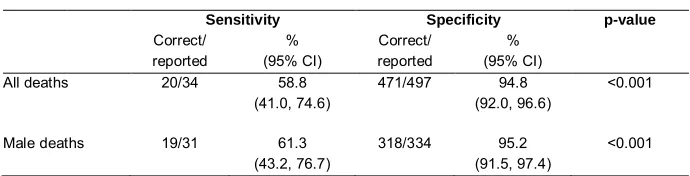
The sensitivity of survey data is low (Table 3): In sibships with a death attributed to external causes by HDSS, 20 out of 34 (58.8%) survey respondents correctly classify the reported death as due to external causes. The specificity of survey data is high: In sibships with only deaths from other causes according to HDSS, 471 out of 497 respondents correctly classify the reported death (94.8%).
Table 3: Sensitivity/specificity of reports of adult deaths collected during survey interviews
Sensitivity Specificity p-value
Correct/ reported % (95% CI) Correct/ reported % (95% CI)
All deaths 20/34 58.8
(41.0, 74.6)
471/497 94.8
(92.0, 96.6)
<0.001
Male deaths 19/31 61.3
(43.2, 76.7)
318/334 95.2
(91.5, 97.4)
<0.001
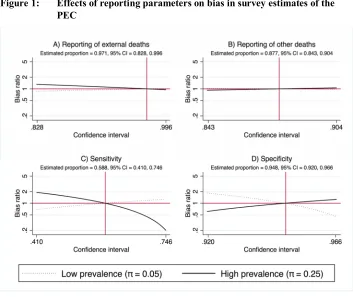
Selective omissions during surveys as measured in this study (Figures 1a and 1b) have limited impact on bias in PEC estimates. But the sensitivity/specificity of survey data (Figures 1c and 1d) could modify our inferences about the PEC. For example, in settings with low prevalence of deaths from external causes, survey estimates of the PEC are significantly affected by small variations in the specificity of survey data, but this is not the case in contexts with high prevalence of such deaths (Figure 1d).
Figure 1: Effects of reporting parameters on bias in survey estimates of the PEC
Notes: In these figures, the bias ratio is derived from calculations using Equation (1). Specifically, it is defined as (1) the difference between the PEC calculated for a specific value of the parameter of interest (within its confidence interval) and the true value of π (either 0.05 or 0.25) divided by (2) the difference between the PEC calculated for the point estimate of that parameter and the true value of π. A bias ratio > 1 indicates that the bias is larger for that value of the parameter than it is for the point estimate of that parameter. A value less than 1 indicates the opposite. The dotted vertical line represents the estimate of this parameter, as reported in Tables 2 and 3. The horizontal dotted line represents a bias ratio of 1.
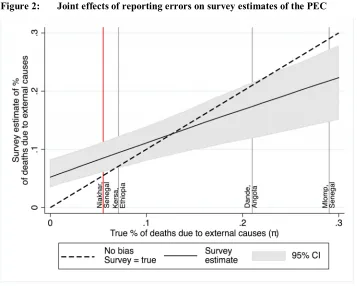
When the true PEC is below approximately 13%, survey data overestimate the PEC (Figure 2), but in populations in which the true PEC is above 13%, survey data underestimate the PEC.
Figure 2: Joint effects of reporting errors on survey estimates of the PEC
Note: The dotted black line represents the 45-degree line, in which the reported proportion of deaths due to external causes is equal to the hypothesized true proportion of deaths due to external causes in the population. The solid line represents the expected survey estimate based on Equation (1) and estimates of the reporting parameters. Its confidence interval is calculated from 500 draws from the distributions of these reporting parameters. The distance between the dotted line and the expected survey estimate (solid line) measures the extent of bias in survey estimates of the PEC. For reference, the solid red line at 0.055 represents the proportion of deaths due to external causes in the study sample according to the HDSS. Other vertical lines represent estimates of the PEC among adults (aged 15–49 years old) in other HDSS in other LMICs. The estimate from Kersa (Ethiopia) is described in the following references (Ashenafi et al. 2017; Assefa et al. 2016). The estimate from Dande (Angola) is described in the following references (Rosario et al. 2016; Rosario et al. 2017). The estimate from Mlomp (Senegal) is described in the following reference (Guyavarch et al. 2010).
five reports in sibships in which adult deaths are due to falls or drownings are true positives, i.e., they are correctly classified as due to external causes by survey respondents.
Table 4: Causes of death among deaths from external causes by reporting statuses during survey
Circumstances of death All By survey reports p-value
False negatives True positives
Falls/drowning 5 (14.3) 1 (6.7) 4 (20.0) 0.069
Road-traffic accidents 5 (14.3) 0 (0.0) 5 (25.0)
Homicide/suicide 6 (17.1) 4 (26.7) 2 (10.0)
Other accidents/unknown 19 (54.3) 10 (66.7) 9 (45.0)
Note: False negatives are deaths that are classified as injury-related by the HDSS but are not classified as such during the survey. True positives are deaths that are classified as injury-related both by the HDSS and the survey. The difference in distribution of causes of death between false negatives and true positives is significant at p<0.1 level according to Fisher’s exact test.
5. Discussion
Adding questions about injuries and accidents to representative surveys conducted in LMICs might help measure mortality from external causes, but the resulting data displays systematic biases. In Senegal, survey respondents are more likely to list the deaths of their adult siblings if they die from external causes. Their reports of the circumstances of deaths have low sensitivity but high specificity in identifying deaths from external causes.
As a result, the accuracy of survey data in estimating mortality from external causes likely varies across populations. In populations in which such causes account for less than 13% of deaths, survey data yields estimates of the proportion of deaths due to external causes that are too high. In populations in which deaths from external causes are more common (>13%), survey data under-estimates this proportion. The accuracy of survey-based estimates may further depend on the types of injuries and accidents that are most prevalent in a population. Survey respondents accurately report road-traffic accidents, falls, and drowning but under-report or misclassify stigmatized causes of death, such as suicides and homicides.
accompanied by injuries. Third, the Niakhar HDSS population may not be representative of other populations in LMICs. Some external causes of death are not represented in this setting. In part because it is a rural population with limited road-traffic, its inhabitants may also better recall car accidents than inhabitants of urban areas where such events are more common. Finally, because of long-term HDSS activities, Niakhar residents may be better informed about causes of death than members of other populations.
Methodological research is needed in several areas to improve the accuracy of survey data on mortality from external causes. New questions should be developed that better capture the diversity of accidents and injuries. More confidential interview techniques should be tested to improve the sensitivity of survey data, in particular as it relates to the reporting of stigmatized causes of death, such as suicides and homicides. Techniques such as audio computer-assisted self-interviewing (Mensch et al. 2008) or voting methods, for example, have helped reduce social desirability biases in the reporting of other sensitive behaviors (e.g., sexual risk taking). They may have similar effects on the reporting of under-reported violent deaths.
Strategies to further improve the specificity of survey data are also needed, since estimates of the PEC are affected by this parameter in settings in which mortality from external causes is low. The siblings’ survival calendar tested as part of this study (Helleringer et al. 2014) might represent one such strategy: In exploratory analyses, it displayed higher specificity than the DHS questionnaire (97.2 vs. 92.2%, p = 0.06). Such improved survey instruments should be validated in additional LMIC populations. This will permit establishing whether results from this study are generalizable beyond the Niakhar HDSS and/or better describe heterogeneity in reporting behaviors across LMICs. Finally, new statistical models (e.g., Bayesian models) that incorporate prior information on data accuracy should be adopted for the estimation of mortality from external causes.
6. Acknowledgments
References
Abegaz, T., Berhane, Y., Worku, A., Assrat, A., and Assefa, A. (2014). Road-traffic deaths and injuries are under-reported in Ethiopia: A capture–recapture method. PLoS One 9(7): e103001.doi:10.1371/journal.pone.0103001.
AbouZahr, C., de Savigny, D., Mikkelsen, L., Setel, P.W., Lozano, R., Nichols, E., Notzon, F., and Lopez, A.D. (2015). Civil registration and vital statistics: Progress in the data revolution for counting and accountability. Lancet 386(10001): 1373–1385.doi:10.1016/S0140-6736(15)60173-8.
Ashenafi, W., Eshetu, F., Assefa, N., Oljira, L., Dedefo, M., Zelalem, D., Baraki, N., and Demena, M. (2017). Trend and causes of adult mortality in Kersa Health and Demographic Surveillance System (Kersa HDSS), Eastern Ethiopia: Verbal autopsy method.Population Health Metrics 15(1): 22. doi:10.1186/s12963-017-0144-2.
Assefa, N., Oljira, L., Baraki, N., Demena, M., Zelalem, D., Ashenafi, W., and Dedefo, M. (2016). HDSS profile: The Kersa Health and Demographic Surveillance System. International Journal of Epidemiology 45(1): 94–101.doi:10.1093/ije/ dyv284.
Baiden, F., Bawah, A., Biai, S., Binka, F., Boerma, T., Byass, P., Chandramohan, D., Chatterji, S., Engmann, C., Greet, D., Jakob, R., Kahn, K., Kunii, O., Lopez, A.D., Murray, C.J., Nahlen, B., Rao, C., Sankoh, O., Setel, P.W., Shibuya, K., Soleman, N., Wright, L., and Yang, G. (2007). Setting international standards for verbal autopsy. Bulletin of the World Health Organization 85(8): 570–571.
doi:10.2471/BLT.07.043745.
Bhalla, K. and Harrison, J.E. (2015). GBD–2010 overestimates deaths from road injuries in OECD countries: New methods perform poorly.International Journal of Epidemiology 44(5): 1648–1656.doi:10.1093/ije/dyv019.
Carpenter, D., Fuller, T., and Roberts, L. (2013). WikiLeaks and Iraq Body Count: The sum of parts may not add up to the whole: A comparison of two tallies of Iraqi civilian deaths.Prehospital and Disaster Medicine 28(3): 223–229.doi:10.1017/ S1049023X13000113.
Chandramohan, D., Maude, G.H., Rodrigues, L.C., and Hayes, R.J. (1998). Verbal autopsies for adult deaths: Their development and validation in a multicentre study. Tropical Medicine and International Health 3(6): 436–446.
doi:10.1046/j.1365-3156.1998.00255.x.
Delaunay, V., Douillot, L., Diallo, A., Dione, D., Trape, J.F., Medianikov, O., Raoult, D., and Sokhna, C. (2013). Profile: The Niakhar Health and Demographic Surveillance System. International Journal of Epidemiology 42(4): 1002–1011.
doi:10.1093/ije/dyt100.
Etcheson, C. (2005). After the killing fields: Lessons from the Cambodian genocide. Westport: Praeger.
Guyavarch, E., Pison, G., Duthé, G., Marra, A., and Chippaux, J.-P. (2010). Mortality due to external causes in three rural areas of Senegal. European Journal of Population/Revue européenne de Démographie 26(4): 483–505. doi:10.1007/ s10680-010-9213-y.
Hagopian, A., Flaxman, A.D., Takaro, T.K., Esa Al Shatari, S.A., Rajaratnam, J., Becker, S., Levin-Rector, A., Galway, L., Hadi Al-Yasseri, B.J., Weiss, W.M., Murray, C.J., and Burnham, G. (2013). Mortality in Iraq associated with the 2003–2011 war and occupation: Findings from a national cluster sample survey by the University Collaborative Iraq Mortality Study. PLoS Medicine 10(10): e1001533.doi:10.1371/journal.pmed.1001533.
Helleringer, S., Pison, G., Masquelier, B., Kante, A.M., Douillot, L., Duthe, G., Sokhna, C., and Delaunay, V. (2014). Improving the quality of adult mortality data collected in demographic surveys: Validation study of a new siblings’ survival questionnaire in Niakhar, Senegal. PLoS Medicine 11(5). doi:10.1371/ journal.pmed.1001652.
Helleringer, S., Pison, G., Masquelier, B., Kante, A.M., Douillot, L., Ndiaye, C.T., Duthe, G., Sokhna, C., and Delaunay, V. (2015). Improving survey data on pregnancy-related deaths in low- and middle-income countries: A validation study in Senegal. Tropical Medicine and International Health 20(11): 1415– 1423.doi:10.1111/tmi.12583.
Hicks, M.H., Dardagan, H., Guerrero Serdan, G., Bagnall, P.M., Sloboda, J.A., and Spagat, M. (2011). Violent deaths of Iraqi civilians, 2003–2008: Analysis by perpetrator, weapon, time, and location. PLoS Medicine 8(2): e1000415.
doi:10.1371/journal.pmed.1000415.
Kabadi, G.S., Geubbels, E., Lyatuu, I., Smithson, P., Amaro, R., Meku, S., Schellenberg, J.A., and Masanja, H. (2015). Data resource profile: The sentinel panel of districts: Tanzania’s national platform for health impact evaluation. International Journal of Epidemiology 44(1): 79–86.doi:10.1093/ije/dyu223. Lafta, R., Al-Shatari, S., Cherewick, M., Galway, L., Mock, C., Hagopian, A., Flaxman,
A., Takaro, T., Greer, A., Kushner, A., and Burnham, G. (2015). Injuries, death, and disability associated with 11 years of conflict in Baghdad, Iraq: A randomized household cluster survey.PLoS One 10(8): e0131834.doi:10.1371/ journal.pone.0131834.
Lagarde, E. (2007). Road traffic injury is an escalating burden in Africa and deserves proportionate research efforts. PLoS Medicine 4(6): e170. doi:10.1371/journal. pmed.0040170.
Masquelier, B., Reniers, G., and Pison, G. (2014). Divergences in trends in child and adult mortality in sub-Saharan Africa: Survey evidence on the survival of children and siblings. Population Studies 68(2): 161–177. doi:10.1080/00324 728.2013.856458.
Mensch, B.S., Hewett, P.C., Gregory, R., and Helleringer, S. (2008). Sexual behavior and STI/HIV status among adolescents in rural Malawi: An evaluation of the effect of interview mode on reporting.Studies in Family Planning 39(4): 321– 334.doi:10.1111/j.1728-4465.2008.00178.x.
Mikkelsen, L., Phillips, D.E., AbouZahr, C., Setel, P.W., de Savigny, D., Lozano, R., and Lopez, A.D. (2015). A global assessment of civil registration and vital statistics systems: Monitoring data quality and progress. Lancet 386(10001): 1395–1406.doi:10.1016/S0140-6736(15)60171-4.
Naghavi, M., Abajobir, A.A., Abbafati, C., Abbas, K.M., Abd-Allah, F., Abera, S.F., et al. (2017). Global, regional, and national age–sex specific mortality for 264 causes of death, 1980–2016: A systematic analysis for the Global Burden of Disease Study 2016. Lancet 390(10100): 1151–1210. doi:10.1016/S0140-6736(17)32152-9.
Obermeyer, Z., Murray, C.J., and Gakidou, E. (2008). Fifty years of violent war deaths from Vietnam to Bosnia: Analysis of data from the World Health Survey Programme. British Medical Journal 336(7659): 1482–1486. doi:10.1136/ bmj.a137.
Phillips, D.E., Lozano, R., Naghavi, M., Atkinson, C., Gonzalez-Medina, D., Mikkelsen, L., Murray, C.J., and Lopez, A.D. (2014). A composite metric for assessing data on mortality and causes of death: The vital statistics performance index.Population Health Metrics 12: 14.doi:10.1186/1478-7954-12-14. Pison, G. (2005). Population observatories as sources of information on mortality in
developing countries. Demographic Research 13(13): 301–334. doi:10.4054/ DemRes.2005.13.13.
Rosario, E.V., Costa, D., Timoteo, L., Rodrigues, A.A., Varanda, J., Nery, S.V., and Brito, M. (2016). Main causes of death in Dande, Angola: Results from verbal autopsies of deaths occurring during 2009–2012. BMC Public Health 16: 719.
doi:10.1186/s12889-016-3365-6.
Rosario, E.V.N., Costa, D., Francisco, D., and Brito, M. (2017). HDSS profile: The Dande Health And Demographic Surveillance System (Dande HDSS, Angola). International Journal of Epidemiology 46(4): 1094–1094g. doi:10.1093/ ije/dyx072.
Sanghavi, P., Bhalla, K., and Das, V. (2009). Fire-related deaths in India in 2001: A retrospective analysis of data. Lancet 373(9671): 1282–1288. doi:10.1016/S01 40-6736(09)60235-X.
Wang, H., Dwyer-Lindgren, L., Lofgren, K.T., Rajaratnam, J.K., Marcus, J.R., Levin-Rector, A., Levitz, C.E., Lopez, A.D., and Murray, C.J. (2012). Age-specific and sex-specific mortality in 187 countries, 1970–2010: A systematic analysis for the Global Burden of Disease Study 2010. Lancet 380(9859): 2071–2094.
doi:10.1016/S0140-6736(12)61719-X.
Zureick-Brown, S., Newby, H., Chou, D., Mizoguchi, N., Say, L., Suzuki, E., and Wilmoth, J. (2013). Understanding global trends in maternal mortality. International Perspectives on Sexual and Reproductive Health 39(1): 32–41.