University of New Orleans University of New Orleans
ScholarWorks@UNO
ScholarWorks@UNO
University of New Orleans Theses and
Dissertations Dissertations and Theses
Spring 5-17-2013
Ritual Process
Ritual Process
Kevin A. Baer
University of New Orleans, [email protected]
Follow this and additional works at: https://scholarworks.uno.edu/td
Part of the Art Practice Commons, Contemporary Art Commons, Fine Arts Commons, Interdisciplinary
Arts and Media Commons, Modern Art and Architecture Commons, Other Arts and Humanities Commons, and the Theory and Criticism Commons
Recommended Citation Recommended Citation
Baer, Kevin A., "Ritual Process" (2013). University of New Orleans Theses and Dissertations. 1606.
https://scholarworks.uno.edu/td/1606
This Thesis is protected by copyright and/or related rights. It has been brought to you by ScholarWorks@UNO with permission from the rights-holder(s). You are free to use this Thesis in any way that is permitted by the copyright and related rights legislation that applies to your use. For other uses you need to obtain permission from the rights-holder(s) directly, unless additional rights are indicated by a Creative Commons license in the record and/or on the work itself.
Ritual Process
A Thesis
Submitted to the Graduate Faculty of the University of New Orleans
In partial fulfillment of the Requirements for the degree of
Master of Fine Arts in
Fine Arts
by
Kevin Baer
B.F.A. Santa Clara University, 2005
ii
iii
Dedication
iv
Acknowledgement
v
Table of Contents
List of Figures ... vi
Abstract ... vii
Introduction ...1
Process ...2
The Relic ...6
Time ... 10
Death ... 11
Decay ... 13
Ritual ... 20
Thesis Exhibition – Ritual Process ... 24
Conclusion ... 30
Bibliography ... 31
vi
List of Figures
Figure 1. Giovanni Anselmo, Untitled (Eating Structure) ...2
Figure 2. Melt / Emerge ...3
Figure 3. Melt / Emerge (Drip Paintings) ...5
Figure 4. Burn / Decay ...8
Figure 5. Burn / Decay ...9
Figure 6. Reincarnation ... 15
Figure 7. Reincarnation ... 15
Figure 8. Reincarnation ... 16
Figure 9. Tetrahedrons ... 17
Figure 10. Tetrahedrons ... 18
Figure 11. Tetrahedrons ... 18
Figure 12. Tetrahedrons ... 19
Figure 13. Erosion / Decay ...21
vii
Abstract
My art is a means for investigating the passage of time, the decay of physical things, and the truth of mortality. I explore these concepts through process-oriented sculptures that emphasize ritual and material. The process is communicated with the creation of relics, often existing as drawings or the remains of degenerated sculptures. These relics bear witness to the process. I focus on themes of temporal change and death because they remain central to our metaphysical and physical existence. I see a diminished reverence for the power of death in our culture, and through my work I aim to pay homage to death while offering viewers an experience of “being present,” a deeper awareness of our existence in time. The mindfulness I speak of is an
awareness of life’s temporal nature. My intention is to evoke an awareness of mortality giving rise to feelings of gratitude and humility.
1
Introduction
The process of decay, the essence of mortality, and the passage of time are the
conceptual themes that permeate my art practice. These concepts are interrelated and
often times inform each other, but when discussing my conceptual framework, two
discourses emerge: first, expressions of time and its passing; and second, the nature of
death and decay.
Before a meaningful discussion of the relevance of these themes and the ways I
investigate them in my work, I must first further explore the concept of the passage of
time, the temporal nature of our existence, and how time relates to our understanding of
the world around us. Our experience is rooted in a present moment that is constantly
flowing by, never to return again, existing through memory and physical traces that are
left behind. The ephemeral essence of life is central to certain conceptions of its
meaning. It is the idea at the heart of the Japanese aesthetic concept of Wabi-sabi; a
special kind of beauty found in something intrinsically related to its fragility. Focused on
transience, Wabi-sabi is the beauty of the “imperfect, impermanent, and incomplete.”1 Time and its passage have been articulated and recorded since humankind’s earliest epochs. Our planet’s relation to the Sun, Moon, and stars is the primary basis
for the human comprehension of time. The earliest calendars, and those of today, have
been based on these celestial paths.
Time is a fundamental part of the physical laws that govern the world around us.
Time is a key component of all theories that attempt to explain the creation and lifespan
of the universe itself. Astrophysicist Stephen Hawking describes something about the general theory of relativity: “Space and time are now dynamic quantities: when a body moves, or a force acts, it affects the curvature of space and time – and in turn the
structure of space-time affects the way in which bodies move and forces act. Space
and time not only affect but also are affected by everything that happens in the universe.”2
This quote illustrates the argument that time and space are profoundly
intertwined.
1 Koren, Leonard, Wabi-sabi for Artists, Designers, Poets and Philosophers (Point Reyes, California: Imperfect Publishing, 1994), 7.
2
2
Process
I communicate the passage of time through process-oriented sculptures. This
requires clarification. All art making involves a process; drawing, painting, sculpture,
printmaking, photography, even writing develops in a temporal fashion, and involves
many steps, techniques, and revisions. The point of divergence here is that in many
artworks, traces of the art-making are, of course, evident and important, but the process
is not primary. Instead, the resulting, finished piece is what is important for the viewer.
In my work, the process of making the art is central to understanding the art. I want the
viewer to consider and envision my process, bringing focus to the act of the art making.
The work involves process and time in another way. My pieces are rarely
stagnant. Melting ice, dripping and cooling wax, and eroding casted salt forms are
some of the examples of the shifting processes active in my art. By witnessing the
piece changing and progressing through time, the viewer is made more aware of the
passage of time and his or her own movement through time.
Figure 1. Giovanni Anselmo, Untitled (Eating Structure), 1968 Granite, twine, head of lettuce
3
Penone, Luciano Fabro and others used common, humble, and “poor” materials like ice,
tree branches, fabric, and stone to communicate the broader universal forces that
permeate beyond the gallery walls. Systems such as time and gravity are at the center
of these Arte Povera works. The physical forms are merely subjects for broader
hypothesis. A piece often referred to as Eating Structure by Giovanni Anselmo
(Figure 1) wherein a square of granite is held aloft under the pressure of a copper wire
and a gradually shriveling head of lettuce. The piece employs simple means to illustrate
gravity and the passage of time. Giovanni Lista, a critic who wrote extensively about many Arte Povera artists, elaborates, “Anselmo moves from the abstract to the
particular in order to make the abstract graspable. Time in his work is not historical but biological and geological.”3
A pivotal work in my practice was a process-oriented, sculpture based project
titled Melt / Emerge(Figure 2) It represented the first time I used a truly temporal
material such as melting ice and an early representation of the passage of time, through
the progression and life span of the large frozen sculptural object. It was an initial
interest in ice as a both the decayed and the agent of decay that began the project. Ice
can hold things in stasis and preserve them. Ice also tears down forests and carves out
mountains.
Figure 2. Melt / Emerge, 2011, digital photograph, 30” x 48”
3
4
The sculpture began to take shape with the selection of a cluster of tree roots,
suspended and frozen within an angular cube of ice thirty inches across and twenty-four
inches tall. The roots were meant to emerge as the ice encasing them melted away. I
used tree roots because I was interested in their organic qualities, as well as the
concept that they are the vascular core of the tree. The work of Andy Goldsworthy also
inspired my use of natural, organic materials. The artist shares some insight into his approach in a passage from an interview, in which he states, “Movement, change, light,
growth, and decay are the life-blood of nature, the energies that I try to tap through my
work. I want to get under the surface. When I work with a leaf, rock, stick, it is not just that material in itself, it is an opening into the process of life within and around it.”4
A search for a deeper awareness of this “process of life” is why I chose actual organic
material. I painted the wooden viscera white in order to abstract it, transforming into an
object with multiple meanings. They became like bones or a skeletal structure trapped
within the square of ice.
I pigmented the ice with black ink. The resulting glistening opacity produced a
sense of mystery and material uncertainty. The ink also gave the dripping water the
ability to act as mark maker on pieces of paper that I placed beneath the suspended ice. The resulting “Drip Paintings” are art objects used to communicate something to the
viewer about the process of Melt / Emerge after it has occurred.
I manifested the archetypal concepts of decay and the passage of time through
the large, melting form of ice. I completed the process of submerging the root cluster in
black water, placing it in a freezer, suspending the frozen block, observing,
photographing, and filming its melting multiple times. I began to see the melting time of
each individual block as a life-span, an existence with a beginning and an end.
Melt / Emerge employed a strategy that has continued in my approach to art
making, multi-faceted projects with many points of intended viewer contact. For
example, in Melt / Emerge, there was the actual suspended melting ice sculpture itself, as well as photographs, “Drip Paintings,” and the exposed, blackened roots that stand
4
5
as witnesses to the past process. The multiple art objects are different remnants of a
single project.
The final photographs are some of the most powerful communicators of the
process. The limited perspective of a photograph aided a sense of mystery about the
object presented. If encountered in person, suspended before the viewer, he or she
could get a better sense of the melting ice block by moving in for a closer look, walking
around it, listening to it, or even touching it and smelling it. But that is not an option with
the photograph. One cannot gain any more information than what he or she sees in the
frame of the image; it remains more elusive. I am interested in this mystifying quality of
the photograph and have continued to investigate this strategy in my work.
The camera also manipulates time. Shining black droplets sit frozen in space
just moments after having escaped the massive melting block. We see a static image,
but through our recognition of the droplets and our knowledge of ice, we the viewers
understand the object in the photograph as dripping and melting and visualize the
melting process. This process of visualizing what has occurred is crucial to my
approach.
Figure 3. Melt / Emerge (Drip Paintings), 2011, ink on paper, 30” x 22”
The “Drip Paintings” (Figure 3) are images on paper created by the repeated
dripping of the ink and water from the melting ice block suspended above. This is not
6
melting ice. The paintings were an effort to represent gravity, time and the natural
patterns as expressed in the interactions between the pigment, the water and the paper.
The piece Melt / Emerge continued as part of an exhibition at the UNO St.
Claude Gallery entitled “2 – D / 3 – D,” investigating these definitions and a multi-media
approach. The art objects displayed for the viewer as Melt / Emerge were quite
different than what I intended when I began the project. Initially I was anticipating the “Drip Paintings” and the actual dripping block would be most effective visual
representations. What, in turn, was displayed for the show was the mysterious frontal
photograph of the dense, dripping black mass of ice beside a simple shelf displaying the
stained, weathered root cluster. A photographic scene of the beginning and a physical
object that lasted through to the end were used to communicate the whole of the
process.
The Relic
I refer to the result of the art-making process, the physical art object, as the relic.
The relic is an object that has survived the past and maintains a power or perhaps even knowledge of past events. Reliquaries – e.g. saintly remains and small bones of
martyrs displayed in exquisitely crafted glass cases - are a precedent. Ashes gathered
after the burning of paper sculptures, images formed by the melting and dripping of ice
and ink, or portraits of objects as they once were before the artistic process of decay
are the relics I create. An approach that utilizes the relic has two defining aspects: a
process or ritual that is performed by the artist and not directly seen by the viewer, and
the communication of the past event through a remaining art object.
The idea of the relic, as it pertains to my practice, has beginnings in the relics
and reliquaries of Medieval Christianity. When traveling through Europe with my family
as a child, I visited some of the Christian churches in France and got a chance to see
venerated remains in person. These relics had a physical connection to saints and
martyrs, often being a part of their once living bodies. Through this very direct,
corporeal connection to what was perceived to be a holy figure, these remains were
7
they belonged. The manner in which they were presented also struck me. Housed in
ornate chambers of gold and glass, resting atop delicate velvet pillows, these seemingly
commonplace bones and bodily fragments took on a resonant power and energy. The
elevation that results from a deliberate and sacred presentation of an object fascinates
me.
Relic is an archaic, outmoded term that has associations with a more ancient
time. I am interested in looking to cultural practices that came before Modern or
Post-Modern art history. It is my intent to create work that serves more of a spiritual function
as opposed to an intellectual or academic function. This spiritual function is primarily
expressed in the individual cathartic experience of creating the work. However it is my
hope that my art can serve a spiritual purpose for the viewer as well by serving as a
mechanism for meditation upon decay and loss.
A more contemporary art precedent can be found in Chinese artist Cai Guo-Qiang’s practice. The artist works with gunpowder creating temporal moments of
explosive action that live on as photographs and videos of the performance. Many
times there is a resulting art object that remains to bear witness to the process, existing
as works on paper that have been singed and burned by the combusting gunpowder. Yasushi Kurabayashi, a Japanese critic and writer, elaborates on Cai Guo-Qiang’s
gunpowder explosions and their results:
A process that encompasses the eternal transformation of matter...The moment opens up at a point without time nor space, where visible and invisible, existence and non-existence, are connected, the spiritual, material and the cosmos
synchronize, metamorphose, and become integrated. There seems to be an extinguishment of time, the explosion taking place both in an instant and in eternity...5
The process and documentation of Cai Guo-Qiang produces art objects that
speak about the past.
5 Kurabayashi Yasushi, “What is ‘Open System?’-To Identify It With Artists’ Works” in Mito Annual ’94: Open
8
Figure 4. Burn / Decay, 2011, digital photograph, 20” x 30”
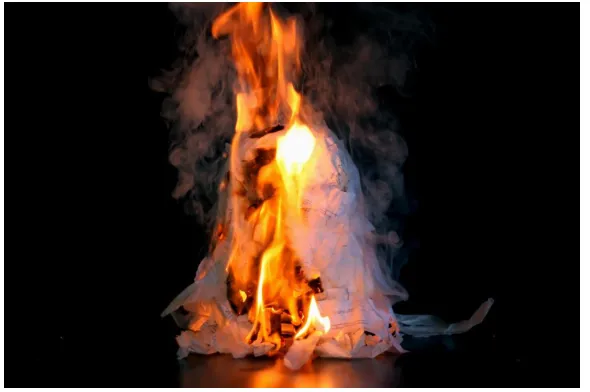
I explored the idea of reliquaries and the representation of decay in the piece
Burn / Decay (Figure 4). For this piece I created sculptural objects that were to be
burned and photographed. I presented the images later with the ashes of the burnt
forms. The title is meant to reflect the principal act of burning and the symbolic relation
of the destructive act to inevitable physical death and destruction.
With Burn / Decay I returned to an interest in a very elemental material,
something that seemed essential and simple, yet retained a sense of mystery.
Previously, ice was the vehicle for decay; here I wanted to further my understanding of
fire and its remainder, ash.
The process that was central to the piece had two stages: the initial construction
of the paper forms and the burning, photographing and collection of ashes of those
forms. I constructed three paper sculptures that were about a foot tall from torn
sections of original drawings. A rounded, ghostly form was made of pages from my mother’s sketchbook, a second from my father’s architectural drawings, and the third
from torn sheets of my own old drawings. The forms had a bodily reference, but were
essentially surrogates for the body.
The careful choice for the source of the paper carried much of the conceptual
weight in Burn / Decay. It is with the choice to look inward, to focus my mind and my art
on the inevitable destruction of my parents and myself and the destruction of the
9
and resonance. Through the conception and completion of this project, I was forced to
ritualistically perform and reflect upon the symbolic destruction of my mother, father,
and myself. It was a humbling experience and I felt a sense of loss burning and
destroying drawings that signified our labors. The viewer, on the other hand, has no
personal connection to the burned drawings and it is unlikely he or she would look at the
photograph of the burning paper form and reflect upon the death of their father.
However, I do mean for the viewer to perceive a more general expression of destruction
and loss communicated through the burning.
The gesture of destruction found inspiration in Buddhist thought. I did not want to
destroy these drawings created through the efforts of people I love. It is this connection
to, and desire for, things that is the source of suffering. Author Carl Olson elaborates in
his text The Different Paths of Buddhism: “A basic reason that life is suffering is that we think we can satisfy our self or ego.” He continues, “This attempt to grasp onto
something permanent and call it our self is futile, from the Buddha’s perspective, because reality is much too dynamic, fluid, and changing for this to happen.”6
An attempt at lessening my attachment to my sense of individual self is at the
heart of the artistic gesture behind Burn / Decay. The ritualized burning was also an
expression of the temporal nature of life that is important in Buddhism.
Figure 5. Burn / Decay, 2011, ashes of burned drawings, wood, and paint, 40” x 20” x 10”
6
10
The display of Burn / Decay consists of a photograph of a burning paper form
and a waist high rectangular pedestal with three shallow graves housing the ashen
remains of the burned paper (Figure 5). I wanted to represent something of the energy
or wonder of life, as signified by the paper form active and rippling with flames, in
contrast to the still, quiet and unremarkable piles of ash.
My treatment and placement of the ash bestowed significance upon them. They
are housed in a pedestal that is informed by a Minimalist vocabulary as well as that of
funerary structures and grave stones. Conceptually linked to reliquaries, the
presentation of the ashes was meant to elevate and venerate the physical remains of
the paper sculptures. The ashes lay exposed to the viewer, not behind Plexiglas. The
vulnerability of the exposed ashes highlights their fragile nature.
Time
Why create art about time? With the multitude of ideological and conceptual
paths that lay before contemporary artists, why is a thematic exploration of the passage
of time relevant? It is because I believe we must include the fourth dimension (time) in
any genuine investigation of our lives and the way we experience the universe. One
encounters things in this world, including artworks, in four dimensions. An object has
height, width, depth and duration, a movement and path through time. It is my opinion
that for an artwork to have validity in describing or meditating upon life and our
experience in this world, it must include the element of time.
The concept of time in visual artworks is also rooted in art history. As Robert Smithson describes in a statement from his many writings on the importance of time’s
presence in artwork:
When a thing is seen through the consciousness of temporality, it is changed into something that is nothing. This all-engulfing sense provides the mental ground for the object, so that it ceases being a mere object and becomes art. The object gets to be less and less but exists as something clearer.7
7
11
Smithson’s well known work Spiral Jetty, constructed in 1970, is simply a
massive spiral of basalt rocks on the shore of the Great Salt Lake. When Spiral Jetty is “seen through the consciousness of temporality”, the spiral formation becomes art and
yields insight about the natural environment, emerging from the lake in times of drought
and lying submerged during periods of normal rainfall. Earth work and land artists such
as Smithson choose an approach that includes temporal change, often occurring
outside gallery and museum walls.
My artistic dialogue with time is partially grounded in personal experience. Witnessing the gradual decline of my grandmother’s health during many nursing home
visits when I was a child was a formative event. I was very young, but even then I was
aware that she was not going to recover or get better. Hers was a slow decline to an
end with only one possible outcome. The universal power and certainty of time made
an impact on me even then.
I am interested in creating art that changes and unfolds over time. I choose to
emphasize an approach of destruction and transformation because I see the gradual
disintegration of material things as an essential reality.
Death
Time is ultimately linked with death. My personal experience of the finite nature
of human life includes witnessing the continued deterioration and passing of my
grandmother. I believe the temporal and fragile nature of life is fundamental to its value.
Within the framework of mortality, time is experienced in life spans and the singular
moments of transition; like birth and death. All living things will die. Every person that
encounters my art will also eventually encounter death. I see death as being universal. The concept of something being “universal,” (an experience shared by all people)
is a path fraught with land mines in terms of twentieth-century Postmodern treatments
and the triviality of the concept in contemporary art. In the realm of art where cultural
experience and art historical context are so varied and complex, assumptions and
12
pursuit of death in my art practice. Focusing upon the shared certainty of death, I seek
to convey a feeling of a collective human mortality. A feeling of unification resulting
from contemplation about the universality of death is one of my primary reasons for
creating art focused on death.
I am aware that the range of cultural, religious, and historical beliefs about the
nature of death is vast and worthy of a lifelong research unto itself, yet few can dispute
the significance of a concept of death and the destruction of the physical self. As we
are instructed in Hagakure, a book created in 18th century Japan containing instructions in the philosophy and the code of the way of the samurai, “Meditation on inevitable death should be performed daily.”8
This meditation on death issignificantly influenced by Buddhist thought and a connection between suffering and a sense of the self or “I”. The idea of “Nirvana”, a
cessation or extinguishing of the Self and the enlightenment and peace that result from
this awakening, is an essential subject of my metaphysical inquiry. An awareness of
inevitable death yields humility and lessens the ego, giving way to an increased
understanding of the interconnection of life.
I have mentioned the breadth and depth of the notion of death, but I firmly
believe there is a contemporary cultural relevance for such a conversation to continue.
There is a loss of understanding and a distance from death in contemporary American
culture. Violence is omnipresent with a lack of remorse or respect for life. We are
disconnected from the killing and processing of our animal food sources. The practice
of retirement-home isolation and the allocation of care-giver responsibilities are
symptoms of a disconnection with death and mortality. A dulled awareness of death’s power, and life’s subsequent precious nature, breeds short-sided thinking and a selfish,
greedy world view. It is relevant for a contemporary artist to make work about mortality
and death because a cultural reaffirmation of a reverence for death is necessary.
An everyday ambivalence toward death can be seen in the sad reality of road kill.
Earlier in human history, we would have eaten most animals we had the opportunity to
kill. Today we accidentally kill animals on our way to the grocery store.
8
13
I am creating a series of worksthrough a process of gathering road kill, using
their dead forms to create an image, and re-locating the decaying animals to a more
natural environment in hopes of returning their bodies and nutrients to the soil. These
works on paper are created by scattering powdered charcoal and chalk over the bodies,
resulting in a stenciled image. I intend this series to be an act of bearing witness.
These pieces are not communicating through a language of symbols or painted
allegories. Instead I used the actual bodies, the actual decaying organic matter. The
paper often holds hairs and small droplets of blood as direct connections to the dead
animals.
A lack of respect for death and, conversely, life, is revealed in the trampled
bodies of Wal-Mart shoppers, scrambling for Black Friday shopping promotions. This is
the lack of awareness I speak of.
In contrast, what does awareness look like? The vanitas painting tradition, its
primary examples coming from northern Europe in the 16th and 17th centuries, is
focused on expressing the inevitability of death and the temporal nature of life. Through
the creation of still life paintings laden with symbols like skulls, melting candles, or
rotting fruit, we the viewer are reminded of our brief time on this earth. The creation and
contemplation of vanitas paintings is an example of an active awareness of death.
Decay
Decay is central to my art practice. A slow, measured breaking down is a
principal component of my method. The idea of decay on a universal scale is contained
within the notion of entropy. Entropy understood as:
“... the degree of disorder of a system. It is a matter of common experience that disorder will tend to increase if things are left to themselves. A precise statement of this idea is known as the second law of thermodynamics. It states: ‘The
entropy of an isolated system always increases, and that when two systems are joined together, the entropy of the combined system is greater than the sum of the entropies for the individual systems.’”9
9
14
A biological definition of decay is rot and decomposition. Decay is profoundly
tied to mortality and death. Decay is the physical, visual evidence of cellular
degeneration, the breaking down of tissues and the approach of death.
The visual language of decay is one of bending and cracking, sagging and
crumbling. Eva Hesse created sculptures that possess a vocabulary of decay. Hesse’s
post-minimal forms of deteriorating latex and wilting fiberglass are powerful illustrations of this idea. An excerpt from an analysis of Hesse’s sculpture Laocoon (1966)
describes this visual vocabulary of decay: “Abstract, limp coils hang lifelessly. Her forms are remnants of life, carapaces, they evoke death without pity.”10
Hesse created
sculptures that communicate a sense of death and decay through organic, sagging forms. Her work does not, however, feel overly emotional or melodramatic. Hesse’s
reliance on repetition, the grid and simplicity of form (all characteristics present in Minimalism) maintains a certain sense of neutrality; suggesting a “death without pity.”
Many times I employ sculptural processes that have an end result of decay.
Often I utilize a process that has a beginning, goes through a progression of decay and
deterioration, finally ending when the sculpture object has melted away or turned to ash.
In Reincarnation I wanted to focus on a process that was more cyclical, rather than
linear. I was interested in communicating the notion of a multi-generational cycle,
where the present generation is dematerialized, then reconstituted to form the future
generation. Melting wax became the material that seemed to best communicate these
ideas. A central characteristic of wax is its ability to become liquid when heated,
solidifying and reforming when cooled, making it ideal to convey a process of
transformation and reformation.
I proceeded to construct a controlled heating and melting mechanism as well as
a sculptural trough to receive the dripping wax. The molten wax dripped into a
pentagonal pit lined with black silicone that was placed directly beneath the melting
apparatus (Figure 6). The molten wax would collect and cool at the bottom of the pit,
10
15
re-forming into a white mass, ready to begin the process over again; a present self
transforming to give way to a future self.
Figure 6. Reincarnation, 2012, wood, paint, black silicone, and paraffin wax, 1’ x 3’ x 3’
It was my initial plan to present the wax melting cycle in process: the viewer
would walk into the room, smell the hot wax, and see the heated copper surface
dripping melted wax into the black pit below. However, I eventually settled on a
presentation revealing not the melting action, but the two static ends of the spectrum: an
intact wax shape, waiting to be melted (Figure 7) and the dark pentagonal pit, spattered
with the dripped wax from previous meltings like powdered snow, filled with a recently
cooled wax form (Figure 8).
16
Figure 8. Reincarnation, 2012, wood, paint, black silicone, and paraffin wax, 1’ x 3’ x 3’
I felt this staging revealed much of the material quality of the process and the
formal beauty and intrigue that the wax possesses. I intended to suggest the material
transformation of the wax: its heating, melting, dripping, spattering, cooling and
re-solidifying. I also sought to describe something of the cyclical nature of things through
the wax melting cycle as metaphor for reincarnation and rebirth. This is echoed by the
title of the piece.
The choice to pull back and reveal only parts of the process continues to be a
significant aspect of my method. The viewer witnesses the results of the process, but not the event itself. One must rely on his or her mind’s eye to see the process occur.
The viewer imagines what the melting may have looked like, reflecting upon his or her
experience with wax and how he or she has seen it melt before. There is a relation to
memory and time in this way of viewing that aligns with my conceptual interests. If a
viewer witnesses the process occurring directly in front of them, he or she will see the
wax melting and the sculpture changing in the present. If a viewer sees only trace
elements or indexes of the process, he or she will visualize the process and rely on
memory and experiences from the past. This connection between time, memory and
visualization is part of why I often represent the larger art making ritual with fragments.
My reliance on simple geometric forms is motivated by a desire to express a
certain neutrality. Regular, minimal forms carry less specific, cultural, or historical
17
less weighted by any specific context, they are more universal. These were the seeds
that developed into the site-specific sculptural installation entitled Tetrahedrons.
Figure 9. Tetrahedrons, 2012, ice, sugar glass, concrete and chalk, installation – 1’ x 7’ x 7’
Three equal tetrahedrons consisting of different materials comprised the piece
(Figure 9). One of the tetrahedrons was formed of ice, one from cooked sugar glass
and the third from concrete. The forms were presented on the ground, seven feet apart,
in a triangle formation.
It is partly due to this variable nature of reproduction, with multiple manifestation
and shifting modes of originality, that I often use casting as a sculptural technique. I
sought to investigate something more about the inherent properties and qualities of
different materials with Tetrahedrons. The different associations and possible dialogues
that can occur from grouping different materials together in identical forms were
important.
One of the reasons I am interested in the approach of using multiples made from
different materials is the focus upon the materials that occurs with this shift. The focal
point then becomes the material essence of the object as the viewer considers what
18
Figure 10. Tetrahedrons, 2012, ice, and chalk, 1’ x 1’ x 1’
The artwork Tetrahedrons was essentially about different materials and different
rates of physical decay and corrosion. The first object was made of ice (Figure 10).
The tetrahedron of ice deteriorated quickly, within a few hours, establishing it as having
the shortest existence. The second triangular mass was made of sugar (Figure 11).
Figure 11. Tetrahedrons, 2012, sugar glass, and chalk, 1’ x 1’ x 1’
Often referred to as sugar glass, it is simply comprised of granulated sugar and
corn syrup heated to a very high temperature, caramelized and hardened. The sugar
was susceptible to the melting heat of sunrays and eroding rain drops. Insects and
19
Figure 12. Tetrahedrons, 2012, concrete, and chalk, 1’ x 1’ x 1’
The third cast form was concrete (Figure 12). Concrete can be initially
understood as a permanent, fixed material. But ancient ruins and crumbling
architectural triumphs of the past quickly remind us that even the most enduring of
human construction materials will fall to pieces over time. I used concrete as the far
end of the spectrum, something that seems permanent, but like all things, yields to erosion through time’s passing.
Tetrahedrons existed as part of a group exhibition emphasizing ephemeral art,
presented in the context of a roofless warehouse space in New Orleans, overgrown with
grass and open to the sky. I was excited about the unexpected, raw, non-institutional
site. I created the piece specifically for that site, embracing the exposure to the
elements to activate the piece.
I also meant the composition of the piece to speak through a language of ritual
sites. The tetrahedrons placed directly on the ground in a triangle whose scale
anticipates human interaction is an example of this. Each cast object was framed within
a circle of crushed chalk to give visual emphasis as well as convey a sense of occult
ceremony.
I am interested in the visual language of black magic and the occult, or at least its vernacular conception. Occult, from the Latin word “occultus,” meaning hidden or
secret, relates to knowledge of the paranormal. There is a connection between the
conceptual focus on mortality and a visual language of the macabre and the occult.
Like occult ritual, my art process hopes to reveal a glimpse of the realm of death and
20
This influence of the occult and the supernatural is also a personal fascination.
Art is about communication and it is essential for the viewer to be able to enter into a
discourse with the piece, but art is also about a deeply personal and individual
expression. My interest in the macabre expresses itself in my love for heavy metal
music and horror films. The dialogue of decay, death and the occult that is present in
my practice is rooted in broader conceptual concerns as well as a very genuine
personal interest and curiosity.
Ritual
Repetition is important to both the process and content of the work. I frequently
repeat a process or artistic act multiple times, which results in a series of objects I
display for the viewer. This repetition is closely tied to the concept of ritual and a
relation to time. Doing something slowly, many times, and with great care yields a sort
of mental quiet and reflection upon the passage of time. This mental quiet can be
related to meditation or a practice of sustained concentration and contemplation.
I continue to explore the very direct integration of myself into the art-making
process. To focus on ephemeral works and make process primary is a deliberate
conceptual choice. When building the elements for Erosion / Decay, I considered
different methods for suspending or holding the tetrahedrons over the splashing water.
The decision to simply kneel over the splashing cube in a prayer-like position holding
the salt forms in my hands for the duration of their erosion was the most logical and
direct solution. This approach situated my presence and my physical self squarely in
the middle of the process; it could not happen without me.
Again, the language I choose is important. To refer to the act of art making as
ritual implies certain spiritual and metaphysical intentions. I feel the word ritual
emphasizes the process and the human action of the artwork. The elements and
objects that are used in and created by the process are important, but it is this
21
Complex technical challenges and the use of sound are at the heart of the piece
Erosion / Decay. I consciously embraced my personal history to guide decisions I made
in the process of creating the artwork. In addition, I became more interested in the
performative ritual event of the art making and my role in that ritual.
Figure 13. Erosion / Decay, 2012, salt and calligraphy ink, 6” x 40” x 10”
Erosion / Decay featured two distinct elements: a grouping of small tetrahedrons
cast from salt (Figure 13) and a squat sculptural cube that generated low frequency
music, splashing water from a vibrating plastic membrane stretched across its top
(Figure 14). Splashing water from the bouncing surface deteriorated and eroded the
cast salt forms.
Figure 14. Erosion / Decay, 2012, wood, plastic, paint, ink and speakers, 2’ x 2’ x 2’
A goal of abstraction and simplification of form motivated the choice of the
tetrahedron. The tetrahedron also represented the singularity of the human vessel.
The use of salt, a material our bodies need to live and one which can kill us, relates to
22
geometry and relation to human architecture. In the crumbling salt shape I see the decay of the human body as well as the inevitable crumbling of man’s buildings.
With Erosion / Decay I sought to better understand decay through the erosion of
cast objects with the gradual splashing of water. Erosion is truly one of the most dominant entropic forces in nature. A clear example is Arizona’s Grand Canyon, its
depths carved out over eons by the energy of the Colorado River.
Here I relied not on the surging rapids of a river to cause erosion, but on a
controlled pool of water, sent splashing and jumping by the vibrations of sound from
speakers. I used speakers and the element of sound in a few pieces prior to Erosion /
Decay, but with this piece I got closer to what truly attracted me to sound: expressing
the physical power of sound through the manipulation of physical materials.
I was attracted to the rhythmic patterns resulting from the use of music, as
opposed to a more dissonant, random soundtrack. Low-frequency filters altered the
track giving rise to a rumbling, less musical sound. I did not want the viewer to be
distracted by lyrical content or musical tone when viewing the splashing cube. I filtered
and subdued the music to remove these elements. The low-frequency sound achieved
a more visceral and trance-like reaction.
Even though most of the instrumentation and singing could not be clearly heard
in the sound present in Erosion / Decay, the music used throughout the repeated
procedure of the piece could have been many things, yet it felt important for it to be
something relevant to both me and the conceptual message of the work. The album
The Way of All Flesh by French heavy metal band Gojira became the fifty-six minute,
forty-two second unit of measurement for the piece. The repeated process of splashing and erosion was propelled by the rhythm of a contemporary death metal band. Gojira’s
music is a deep, personal inspiration, and is relevant to my work because they too
create art motivated by the significance of death, mortality, and time.
As I developed Erosion / Decay, it became necessary to consider the primary
manifestation of time in the work; the duration of exposure of each salt form to water.
The duration had to be somehow connected to the central themes of an experience of
23
I followed a similar path as with Burn / Decay and looked toward a personal,
familial experience of death. The death of four elder members of my family that have
occurred within my lifetime became the basis for the intervals. The amount of years
since an individual has passed away was converted into a corresponding time in hours.
For example, my Grandmother Vera died ten years ago, and the salt tetrahedron representing her was exposed to the splashing water for one hour. My father’s father,
Grandpa Al, passed away thirty years ago. The salt form linked to him was exposed to
the forces of erosion for three hours.
As I have indicated through the language I am using, these choices resulted in a
noteworthy personification of the abstract tetrahedrons initially chosen for their
impartiality. The cast salt sculptures now had a definite number, age, and identity. This
led to a more emotional and revealing process than I had anticipated. The act of
naming and the projection of emotions for loved ones who have passed away onto the
eroding forms gave me a deep connection to the piece. Throughout the process I
experienced complex emotions of sympathy and sadness, as well as feelings of
calmness and ambivalence.
I have described how the piece Erosion / Decay has been cathartic for me, but
the goal was to establish an emotional connection with the viewer as well. The
personification of the cast salt objects produced an opportunity for the viewer to project
his or her own family history of death onto the work. I created a salt form for my
grandmother and grandfather. Each viewer can imagine their own row of reverent salt
tetrahedrons, and the dead family members they represent.
I think the piece functions within a broader cultural context as a personal ritual of
devotion and meditation in a time and place where sincere acts of ceremony and
mindfulness are rare. I am creating my own version of a ritual that is very much a
contemporary art making process, but aims beyond a Postmodern cynicism. My work
24
Thesis Exhibition – Ritual Process
My process-oriented artwork involves time, but brief interactions or singular
critique based viewings do not allow for the temporal nature of the work to blossom. In
the case of the three week solo exhibition, the work will have the time and space to
develop through the run of the show and the full cycle of decay will be more apparent.
The front gravel yard of the UNO St. Claude Gallery is an opportune site to place
sculptures in a situation where they are exposed to the elements, enabling their process
of decay. As the viewer enters the thesis exhibition, he or she encounters a group of
decaying sculptures. The four sculpture objects are made of cast sugar, each five-sided
urn-like form stands about sixteen inches tall. The piece is intended to welcome the
viewer into a ritual space where singular objects and their relation to each other illicit
thoughts of the mystical and sacred. The piece also serves as a tonal introduction to
the exhibition. The viewer walks through the cluster of melting sculptures to view the
remaining artworks.
The form of the cast sugar glass sculptures is derived from Egyptian Canopic
jars. Much of the piece is inspired by Egyptian funerary practices and a concept of
death as a transition into another plane of existence rather than an ending. Urns used
to house remains after cremation are also a formal influence.
The Canopic jar of sugar is a surrogate for the human body. Another word for
the human body is vessel. I feel this association is relevant. Like the ice block of Melt /
Emerge and the salt tetrahedrons of Erosion / Decay, the cast sugar sculpture object
acts as a vehicle for the observation of disintegration. The sugar glass sculptures will
melt from the sun and erode from rain. Among the insects that land and feed on the sugar, some will die and become entombed within the sculpture object’s surface.
Knowledge of an object’s appearance before it has melted or fallen apart is
necessary to understanding how it has changed over time. To better communicate the
change over time a photograph of a crisp, newly formed sugar vessel is displayed just
inside the gallery. The photograph presents a life-sized image of the sugar sculpture. It
glistens surrounded by an intense white ground with no real point of reference besides
25
exists in relation to high school yearbook pictures or the display of framed portraits at
funerals. It is about an image serving as a documentation of the physical, conceptual,
even spiritual identity of that person. The photograph of the sugar Canopic jar presents
the sculpture at its peak. It appears at its most intact, preserved in a moment, freshly
created before it decays. On the gallery wall is an image of what I see as the
conceptual identity of the sculpture object. Outside of the gallery, in the front gravel
yard, is the physical identity and temporal reality of the sculpture object.
An element I have began emphasizing in recent pieces is the primordial gesture
of mark making. Paint pours and latex sculptures by Lynda Benglis and the visceral,
shamanistic geometric drawings of Richard Serra influence my conceptual framework.
The simple act of scratching a line on a wall has a basis in a pre-historic art history as
well.
I am creating a process based instillation consisting of vertical lines drawn
directly on the gallery wall with burnt match sticks. A full box of three hundred
strike-anywhere matches will be transformed through my artistic actions into a drawing of
three hundred vertical lines etched on the wall. The piece is about a demarcation of the
passage of time. It also exists as a meditative practice of sorts, an activity that is
performed and repeated in order to both focus and calm the mind. The crumbled
remains of each individual burnt match will be scattered about on the gallery floor,
existing as a remainder of the completed process.
I maintain my method of communicating the passage of time and events through
the remnants of the act. Walking in to the gallery the viewer sees the results of a
mark-making ritual etched on the wall, he or she sees the crumbled material of the burnt
matches that were used to articulate the piece days before, and he or she experiences
an essence of my action that occurred in the same space they now inhabit. With this
piece I hope to draw attention to and explore the divide between the actual event and
the imagined event.
I have created a series of works that investigates the actuality of road kill. The
26
dust to create an ethereal stencil-like image where the central void is created by the
physical form of the dead animal. It is mostly a conceptual process piece, but is also
the result of many formal drawing-based decisions.
The images on paper communicate a very ethereal quality. The charcoal and
chalk dust sprinkled upon the surface could be easily disturbed or destroyed. There is a
wide range of subtle grays that occur within the bursting aura of powdered pigment. I
am pleased that the images are abstracted enough beyond the source of the animal
bodies that the resulting image can be seen as many things separate from the
associations with dead animals. However there remains a discernible image of the
animal form.
The piece is meant primarily as an act of bearing witness and paying tribute to
the seemingly peripheral death of the animal. The process is communicated through art
objects of charcoal and chalk on paper, but that is only a part of the whole.
A tragic characteristic of road kill is the obliteration of the remains that occurs
from the continual oncoming traffic. After the image on paper is created, I relocate the animal’s remains to a more natural setting a ways off from the road, in hopes that its
body will return to the environment in a more natural way.
A significant aspect of the piece is the search for the crushed bodies of the
animals. The piece began as a response to my revulsion by the phenomenon of road
kill and has taken the form of a deliberate seeking out and documenting of the event
that has taken place. The act of searching for something I do not want to see has been
significant. To say I have reached an understanding or singular opinion of the wasteful
occurrence of road kill is untrue, but the conceptual and emotional dialogue that goes
on within me in response to witnessing and recording these deaths has deepened.
A piece featured in the thesis exhibition is a process and installation rooted in the formal and conceptual material of another artist’s work. I am attempting to reinterpret
27
The Rothko Chapel is a non-denominational chapel created as a spiritual
sanctuary for meditation and reflection and as the ideal space for a series of massive
canvases created by Mark Rothko specifically for the unique chapel site.
The chapel is a large octagonal space framed by vast walls and ceilings of grey concrete. Rothko’s colossal color field paintings of deep blacks soaked with washy
purples and murky blues cover the walls. The viewing experience is one of feeling both
overwhelmed, even crushed, by the immense black paintings as well as a sensation of
the sublime and a feeling of relaxation that can be compared to sitting on the shore of a
slowly undulating sea.
The distinctive art viewing context of the Rothko Chapel is central to my
investigation. It is often assumed that the “white cube” of the art museum is the ideal art
viewing context. Within the walls of the Rothko Chapel is a different situation. The
Rothko Chapel is not a museum or institutional space founded on intellectual research
and critical examination, but rather a chapel, a ritual space for spiritual and
metaphysical inquiry.
My reaction to Rothko’s paintings and their unique architectural habitat is not a
direct quotation or imitation. The piece is filtered through my experience and my
personal practice of process and the creation of sculptural objects. I was not concerned
with reproducing the Rothko Chapel, I wanted to reinterpret and respond.
While I sat in front of Rothko’s grand paintings the quality of pigment called to
mind dyed fabric. I envisioned large swaths of fabric soaking in black dye. My interest in progression gave way to the reliance on the fabric’s capillary action and increasing
segments of time spent soaking in the dye to create my image. The viewer sees the
color range of blues, purples, yellows, and reds that compose the black dye revealed in
the dyed washes of a large hanging fabric panel that has been soaked in black dye. My reinterpretation of the subtle and surprising range of color in Rothko’s seemingly
monochromatic black paintings is the separation that occurs as black dye soaks through
cotton.
In addition to the austere concrete building and large, subdued paintings of the
Rothko Chapel, were a number of simple wooden benches and individual floor pillows.
28
pillows seemed to embody the meditative and unhurried approach to art viewing I feel
the Rothko Chapel cultivates.
With my translation of the floor pillow, I wanted to express what I see as the true
difficulty of prolonged reflection and meditation. I created a series of four concrete
pillows as signifiers for the challenge of the focused practice that is necessary to
achieve enlightenment. They are displayed surrounding the hanging panel of dyed
fabric encouraging the viewer to sit and reflect upon the piece. However, the rigid,
cracked concrete pillows promise an experience that is uncomfortable and demanding.
The density of the concrete pillows also served as an important material contrast to the
more gentle fabric panel.
I sought to evoke a sense of heaviness with my process-oriented sculptural
response to the Rothko Chapel. The somber tone evoked by the expansive blackness that is at the core of Rothko’s massive paintings was important to convey through my
artistic response. The conceptual approach to art viewing as a meditative and deliberate
exercise is also an important component of what I am interested in investigating.
The piece Five Years of Growth (Partial Removal of Self) revisits the strategy of
destroying something that I am emotionally attached to. My long hair became the
subject and substance of removal and contemplation. I had been growing my hair for a
period of five years and my long hair was something I was proud of and very much
correlated with my identity and how I saw myself. Initially inspired by the removal of hair
by Buddhists entering the monastic discipline this piece is intended to be about self
sacrifice and a negation of physical existence.
The range of historical and cultural context for the ritual treatment of hair is truly
vast. Initially the sea of associations seemed problematic, which historical context was I
trying to align myself with? Was I responding to the chonmage, or top knot, which was
a status symbol of the samurai in feudal Japan? The scalps of human hair related to
the American Indian wars of the 19th and 20th century are a powerful instance of the
cultural significance of hair and its removal. Victorian lockets containing a clipping of a deceased loved-one’s hair is another relevant instance of the emotional and spiritual
29
I ultimately decided that although it is my responsibility to be aware of the milieu
of contextual models, I must create my own hair removal and manipulation ritual. After
cutting the hair, I photographed it in a studio setting. I then created mono prints on
paper by introducing ink to the mass of hair and running it through the printing press.
The swirling coils of hair were eventually suspended within cast spheres of clear resin.
Ultimately I felt that to be valid, I must primarily rely on what felt true to me personally,
an individual interpretation of a ritual practice being the underlying essence of the piece.
The multi faceted manifestation of the artwork is a combination of mono prints on
paper using black acrylic ink and cast resin spheres containing swirling masses of the
removed hair. The prints depict the hair in singular totemic compositions. One print
features the hair in a central circle reminiscent of the oroborous symbol and another
represents the hair in a nest-like mass.
The final part of Five Years of Growth (Partial Removal of Self) is five cast
urethane resin spheres that contain lengths of the hair embedded within them. The
apple-sized spheres vary in quantity of hair preserved inside. The spheres with a small
amount are mostly transparent with a few swirls held inside and the spheres with more
hair are almost completely opaque.
I wanted to use the hair to represent a period of growth and a demarcation of
time. This piece is also an exploration of personal relic making. Within the framework
of this piece I created a number of art objects focused on material that was once a part
of my living self. The final mono prints and cast resin spheres were intended as
communicators of the entire hair growth and removal process.
An indicated in the title, an act of “partial removal of self” is a central motivation
for cutting off of my long hair that I had been proud of and seen as part of my identity.
Another facet of the piece is the expression of the temporary nature of existence.
Like the European vanitas paintings I mentioned earlier. I feel the mono prints and
30
Conclusion
My art practice has become an approach of process-oriented conceptual works
that rely on sculptures, photographs and drawings to serve as relics. These objects
communicate and carry forth the energy and experience of the art making action. They
exist as witness and index of the process.
I aim to evoke something shared by all people, yet by necessity my art must
remain rooted in my personal experience and individual tendencies. An emphasis on
ritual grows out of a desire for my art processes to be personally cathartic. My artistic
practice is an intellectual and cultural investigation but it is also a spiritual and
metaphysical inquiry. The aspect of repetition and use of elemental materials also
operates to fulfill my personal interests.
My hope is that with a sincere personal art practice, the final pieces transcend
their relation to my subjective experience and offer the wider viewing audience an
opportunity for contemplation and insight on the central themes of death, decay and the
passage of time. I want to communicate something universal and I see death as the
universal.
The artwork serves as catalyst for mindfulness by communicating the viewer’s
own mortality. It is my belief that the reflection upon the shared truth of death can
31
Bibliography
Friedman, Terry and Goldsworthy, Andy, Hand To Earth: Andy Goldsworthy, Sculpture 1976-1990, New York, NY: Harry N. Abrams, Inc., 1990.
Flam, Jack, Robert Smithson: The Collected Writings, Berkeley, CA: University of California Press, 1996.
Hawking, Stephen W., A Brief History of Time, New York, NY: Bantam Books, 1988.
King, Magda, A Guide to Heidegger’s Being and Time, Albany, NY: State University of New York Press, 2001.
Koren, Leonard, Wabi-sabi for Artists, Designers, Poets and Philosophers , Point Reyes, California: Imperfect Publishing, 1994.
Krens, Thomas and Munroe, Alexandra, Cai Guo-Qiang: I Want To Believe, New York, NY: Guggeneheim Museum Publications, 2008.
Lippard, Lucy, Eva Hesse, New York, NY: New York University Press, 1976.
Lista, Giovanni, Arte Povera, Milan: Gallery of the Arts, 5 Continents Ed., 2006.
Lumley, Robert, Arte Povera, London: Tate Publishing, 2004.
Meyer, James “The Logic of the Double: On Eva Hesse and Robert Smithson,” ArtForum. Vol. XLVI, No. 6, February, 2008.
Olson, Carl, The Different Paths of Buddhism: A Narrative-Historical Introduction, New Jersey: Rutgers University Press, 2005.
Richet, Pascal, A Natural History of Time, Chicago, IL: The University of Chicago Press, 2007.
Tsai, Eugenie and Butler, Cornelia, Robert Smithson, Los Angeles, CA: The Museum of Contemporary Art, Los Angeles, 2004.
32
Vita
Kevin Baer was born in Denver, Colorado to an architect father and a sculptor mother. After achieving his Bachelor’s Degree at Santa Clara University, he moved to San
Francisco. He worked installing art for galleries and museums in the Bay Area while
creating his own artwork. The artist then moved back to his home town and had a
number of significant exhibitions. After a few years living in Denver, he was accepted
into the MFA program at the University of New Orleans. Kevin now lives in New Orleans with his girlfriend and his cat, receiving his master’s degree in the spring of