C O R R E S P O N D E N C E
Open Access
A New Replicator: A theoretical framework for
analysing replication
István Zachar
1,2*, Eörs Szathmáry
1,2,3Abstract
Background:Replicators are the crucial entities in evolution. The notion of a replicator, however, is far less exact than the weight of its importance. Without identifying and classifying multiplying entities exactly, their dynamics cannot be determined appropriately. Therefore, it is importance to decide the nature and characteristics of any multiplying entity, in a detailed and formal way.
Results:Replication is basically an autocatalytic process which enables us to rest on the notions of formal chemistry. This statement has major implications. Simple autocatalytic cycle intermediates are considered as non-informational replicators. A consequence of which is that any autocatalytically multiplying entity is a replicator, be it simple or overly complex (even nests). A stricter definition refers to entities which can inherit acquired changes (informational replicators). Simple autocatalytic molecules (and nests) are excluded from this group. However, in turn, any entity possessing copiable information is to be named a replicator, even multicellular organisms. In order to deal with the situation, an abstract, formal framework is presented, which allows the proper identification of various types of replicators. This sheds light on the old problem of the units and levels of selection and evolution. A hierarchical classification for the partition of the replicator-continuum is provided where specific replicators are nested within more general ones. The classification should be able to be successfully applied to known replicators and also to future candidates.
Conclusion:This paper redefines the concept of the replicator from a bottom-up theoretical approach. The formal definition and the abstract models presented can distinguish between among all possible replicator types, based on their quantity of variable and heritable information. This allows for the exact identification of various replicator types and their underlying dynamics. The most important claim is that replication, in general, is basically
autocatalysis, with a specific defined environment and selective force. A replicator is not valid unless its working environment, and the selective force to which it is subject, is specified.
Background
An extensive reformation of the replicator definition is needed. There are two main reasons for proposing a more exact definition. First, current definitions and clas-sifications (see, for example, [1-17]) cannot discriminate effectively between gene-like entities (being sufficiently abstract) and organisms, or gene-like entities andsimple autocatalytic cycle intermediates (SACIs; for example, glycolaldehyde in the formose reaction [18]). There is obviously some difference between these entities con-cerning their copying dynamics and exhibited similarity between parent and offspring entities. However, present
definitions usually use indefinite terms such as ‘almost identical’ [3], ‘largely intact structure’ [9], ‘relevant aspects’ [2,5],‘relevantly similar’ [15] and ‘same kind’ [11] (see Griesemer’s comment [[6], p. 73], about vague-ness and the validity of ‘same kind’ [[19], p. S359]). These definitions do not specify the difference exactly, nor do they clearly mark the borders of the entity-space that could be labelled as replicators. Secondly, some cur-rent definitions have been formulated to include only the genes but not the memes (for example [8,9]) or other putative replicators of culture. Memes (the gene-analogue cultural replicators introduced by Dawkins [3,4]), as we refer to them, are cultural traits, that are replicated by copying/imitation (for example, words, concepts, songs, and so on) [20-22].
* Correspondence: [email protected]
1MTA-ELTE Theoretical Biology and Ecology Research Group, Pázmány P
sétány 1/C, H-1117 Budapest, Hungary
Relevant aspects surely count in replication. However, exactly which features are relevant? To what extent should these features be similar to each other? How can these features and amounts be qualified or quantified? In which case are two replicators identical? What changes cause the loss of identity of offspring compared to parents? Since replication is about multiplying an entity in such a way that the resulting entities are simi-lar to parent entities, this question is of utmost impor-tance and the loose terms cited above cannot show the exact nature of the identity.
DNA replication (as the standard replicative system is usually referred to) has specific aspects which may be used as a basis for the definition of replicators: two enti-ties are made using only one and, ideally, they are iden-tical. If the DNA is located in a germline cell, it is potentially the originator of an indefinitely long line of descendants (see germline replicator [4]). However sev-eral aspects of DNA replication do not apply to every (real or putative) replicator. From a strictly chemical point of view Orgel has pointed out that ‘few of the fea-tures of RNA replication are essential for a general replication model’ [[23], p. 204]. Material overlap (understood as a generative method where some physi-cal part of the offspring entity was part of the parental entity earlier), for example, is clearly not a universal necessity of replication. Anything could mediate the information-transmission from parent to offspring; it need not be the parent itself. Cultural traits, if they are considered replicators, would exclude material overlap (see [6]) from the universal features of replication: in case of memes there is undoubtedly no overlap of physi-cal entities.
Nevertheless, specific differences among replicative systems do cause changes in the dynamics of replication. It follows that a universal formalism should focus on the general aspects that do not change our basic concept of replication. Therefore, it is important to formulate the new definition in a general and formal way that clearly describes what is common and what is different among presupposed replicators, and which can include or exclude candidates accordingly. Presupposed replicators are genes, memes, ribozymes and several other candi-dates such as autocatalytic protein nets [24], prions [25], membranes [26-28], chromosomes [3], genomes [3], organelles (for example, plastids [11]), organisms, kin (Dawkins [29] describes the individual, obviously the genome, as a genetic octopus extending to relatives), an so on. [Note that well-discussed candidates (DNA, genes, chromosomes, and so on) are not referenced here due to the large number of publications.]
Earlier definitions are either too narrow (for example [8,9]) or too broad (for example, definitions based on Muller’s multiplication-heredity-variability criteria [12]
or, later, by Maynard Smith [10,30]). The former, by sticking to structure, do not allow the inclusion of memes, while the latter allow the inclusion of, for exam-ple, organisms or even supra-individual entities. The general intuitive requirements that we suggest must be met by replicators (based on present knowledge, existing definitions and personal views), are:
1. Potentially autocatalytic mode of generation. 2. Potentially above-chance similarity between parent and offspring.
3. Ability to pass on some information to offspring. 4. The definition has to include genes and memes, and possibly other entities as well (as it was Dawkins [3] who has introduced the term replicator, it seems reasonable to focus on these two entities he has suggested).
5. The definition must be able to distinguish between multiplying entities: genes, memes, simple chemical cycle intermediates, organisms and higher level entities (for example, kin groups) in a clear and exact way.
The general aspects that have been extracted from most of the present definitions should be considered as the general, vague concept of a replicator. Those com-ponents of present definitions that are proved (or will be proved) not to be necessary (like material overlap), should be left out. Thus, four questions are raised that the new definition should be able to answer clearly:
1. What is the difference between entities such as genes, organisms, SACIs and other reproducing entities?
2. What are copying, heredity and modularity. What part do they play in case of replicators?
3. What is similarity? When can we say that two replicators are identical?
4. What are the common and differing aspects of genes and memes? What is the definition that puts memes and genes into the same box but organisms into a surrounding larger one (this setup of entities follows Dawkins’definition [3,4])?
Results and discussion Multiplication
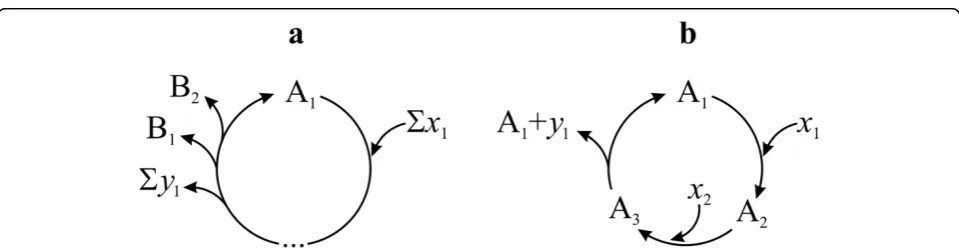
bear almost complete resemblance (with minor statisti-cal fluctuations) to the original (except in volume). The difference between dividing a glass of water and a true autocatalytic cycle lies in the stoichiometry. Without input, a litre of water divided would not give two litres. The‘reaction’cannot be rendered to be cyclic, nor auto-catalysis. Thus, it is necessary that some material is fed into a presupposed autocatalytic cycle (Figure 1).
What is characteristic of an autocatalytic entity or cycle (for example the formose reaction of Figure 2[18]) is that ‘[it] can arise only if there is a pre-existing structure of the same kind in the vicinity’ [11]. This expansion requires some clarification of thesamenessof the original and new entities. It is obvious that if the new‘A’does not resemble enough the old‘A’, then the cycle will not close. However, the two‘A’s can be totally different in, for example, structure, as long as they are functioning suffi-ciently similar to allow the cycle to close. Indeed, a new cell is not exactly the same as the old cell but both have the potential to produce more cells. It is tempting to say here that the parent and offspring must be similar in some‘relevant aspects’, but it just shifts the undefined to a further point that must be reached nevertheless. For the moment, let us just say that the old and new‘A’s must beequivalentin some way, until this equivalence is defined exactly in the following paragraphs.
Pre-existence is also important from the viewpoint of causality. Hodgson and Knudsen [7] stated concerning photocopies that ‘the original is causally implicated in the production of the copy, in the weak sense that with-out the original the copy could not exist’. This simply means that any autocatalytic cycle automatically fulfils causality - that is, that there is no need to explicitly spe-cify it as a criterion of replication.
To conclude, dividing a glass of water is not an auto-catalytic process and, thus, multiplication (based on autocatalysis) requires three specifications: (1) there must be some input of matter (for example, molecules used as building blocks), which is used to create the new entities; (2) parent and offspring must be equiva-lent, that is they must be based on the function of the entity in the cycle; (3) one turn of a cycle should pro-duce more offspring than the number of parents (for example, a regenerated parent and a surplus offspring). Autocatalysis and the equivalence of parent and off-spring entities are closely linked and one cannot be pre-sent without the other. If none of the products of a reaction is functionally identical to the original, then there is no cycle at all.
In order to capture the essence of equivalence, and to decide about whether some structural, functional or informational feature should be the distinctive factor among entities, we must ask the following question: During the lifetime of an entity for whom or what is it relevant to distinguish between non-identical entities? The answer is obviously some selective force. The iden-tification of entities should be based on selection. With-out selecting anything among entities, there is no way to search for the differences among them.
Therefore the following definitions are given:
1.1 Selection is a process, acting on a particular population of entities in a particular environment that sorts entities according to a function of the entities. It can be thought of as a single sorting event, during which some entities cease functioning while others persist and can be iterated indefinitely. This is based on the definitions of selection by Hull [[9], p. 408] and of sorting by Vrba [[31], p. 117]. 1.2Equivalence: Two entities are equivalent under a particular selective force in a particular environment, if this selection process cannot sort among them better than random. The equivalence of two entities is denoted ase1~e2.
1.3Phenotype is the function of entities selection discriminates about. The phenotype defines the level of selection as well.
The concepts ofselection for(a property) and selection of (objects) given by Sober [[32], p. 99] indicate the
Figure 1An autocatalytic cycle of the formΣxi+ A—①!Σyj
+ 2A (following Gánti’s notation[68]).xiandyjdenote all the necessary input and waste molecules respectively, of one turn of the cycle.
Figure 2A truly autocatalytic cycle: the autocatalytic core of
same setup: selection is a general process that can act without multiplication.
What exactly is the‘relevant aspect’of sameness is quite irrelevant, until the parent and offspring are equiva-lent under a certain selective force. This is what Sterelny et al. [[15], p. 396] tried to capture when they referred to copying as a teleological notion in their definition of replication. To see why this definition of equivalence is effective, let us imagine a population of autocatalytic cycles. The product of the cycle changes to a new entity in order to introduce a new cycle. The original and new cycles can be different, but any difference will only make sense if this difference is expressed at the level of selec-tion. If it is not, then selection will not cause differential survival. Either naturally or artificially, there is a selective force which explicitly discriminates between cycles. Even more striking is the example of triplet-groups: UCA and AGU are completely different codons, although they both code for serine as they are phenotypically identical. Of course, this neutrality is only valid in case of a single or a few selective events, but not necessarily in a larger time-frame where iterated selection might induce evolution (non-trivial neutrality will be discussed later).
These terms can be expressed in a more formal way using equivalence relations (see, for example, [33]). Selection partitions the set of all entities Einto equiva-lence classes. Entities of the same class are identical from the viewpoint of selection. Thus, selection defines an equivalence relation S(or ~) onE. The phenotype is that functionp:E !p(E) for which it is true, that∀e1,
e2 Î E:e1S e2 ⇔p(e1) =p(e2). The phenotype function
thus maps entities to such a set that, if partitioned by the equality relation, has the exact same structure as the partition ofEimplied by the relation S.
In order to deal with the actual multiplication of an entity (growth in number), let us start from a general stoichiometric notation:
xi A yjB .k (1)
In an autocatalytic system (Figure 3)n> 1 elements of the set of products {B1, B2, ..., Bk} are equivalent to A
(where noxi andyjis equivalent to A or any Bk). Ifn=
0 then no Bkis equivalent to A. The reaction cannot be
iterated, since all A-s are used up (that is, it is not a cycle) and A is not multiplied. Iff n≥ 1, the reaction can close to a cycle. Withn = 1 there is no multiplica-tion, but sequential replacement where the overall con-centration of A is constant in time. It can, however, be depleted easily due to potential side reactions. Nonethe-less, the system is capable of processing A any time that it is fed with Σxi and an existing A is already present.
Simple non-autocatalytic cycle intermediates (SNCIs) belong to this class. Finally, if n≥2, then A is an auto-catalytic entity (ngiving the order of the autocatalytic system).
From a dynamical viewpoint the growth rate g of
reproducing entities must be larger than the sponta-neous dissociation rated in order to overcome sequen-tial replacement or depletion (see [[11], p. 33], [34]), otherwise entities would decay with equal or faster rate than they multiply. It is a potential criterion for replicators to be in a stable state long enough to be multiplied at least once (g >d, see Dawkins’ longevity criterion [3]). Although this kinetic requirement is implicitly present in the notion of autocatalysis, if the cycle cannot produce a surplus of A, because the decay ratio (either due to side reactions or due to the reverse reaction of production) is faster than the ratio
of production, the process is effectively not
autocatalytic.
From this viewpoint, multiplying entities with d= 0 andg> 1 would be immortal in the sense that a popula-tion of such replicators would not be depleted at all. A lack of decomposition (mortality) does not exclude selection or even evolution, as Lewontin [[35], p. 1] puts it: ‘Natural selection occurs even when two bacterial strains are growing logarithmically in an excess of nutri-ent broth if they have differnutri-ent division times’- that is,
Figure 3(a) A simple cycle, that can be autocatalytic if B1~ A and/or B2~ A; or non-autocatalytic if B1!~ A !~ B2, where ~ is the
bacteria are practically immortal in the timeframe of the experiment but selection still happens. Szathmáry and Maynard Smith [36] showed that the relative concentra-tions in the case of unlimited resources change just as in the case of a limiting environment, resulting in the extreme dilution of the replicator with the smaller repli-cation rate in the limit.
To summarize: multiplication, as a prerequisite for replication, is simply the phenomenological expression of autocatalysis:
1.4 Multiplication is an autocatalytic process, where some of the products of the process are equivalent to the original entity - that is, functional identity is pre-served (stoichiometricallyn> 1, kineticallyg>d).
The criteria for multiplication are as follows: the entity should be stable long enough to reproduce at least once and the outcome of the process should contain more than one parent-equivalent entities. The similarity necessary for the system to run successively was also defined as an equivalence relation of a parent and an offspring entity under a selective process. Multiplication defined here equals autocatalysis, since there is equiva-lency only where the cycles are autocatalytic. Note that (according to Lewontin [35]) if autocatalytically growing entities exhibit differences in their phenotypes, they are subject to selection - that is, they are units of selection (this will be discussed in detail under the section on Evolution).
Variability
With the equivalence of phenotypes we indirectly intro-duced variability. Two entities may vary in structure sig-nificantly and still be equivalent (due to phenotypes) until selection cannot distinguish them. Hull ([[37], p. 32], following Williams [38]) has pointed out the same relation, although he did not go further than genes:‘two genes are similar enough to count as the same replicator if they react similarly to similar selection pressures’. Again, selective pressure here is understood as it was defined earlier (point 1.1): as a single sorting event. Two genes which are identical from the viewpoint of an immediate sorting event can still have different evolu-tionary potentials.
The problem of variability, similarity and ‘relevant aspects’”was discussed by Aunger [2] (the Queen and British postage stamps example). However, his solution of narrowing the causality clause (and introducing the notion of lineage as a causal linkage) is not satisfactory. Causally linked parent and offspring entities, like origi-nal and replica DNA sequences may still have the same base-order, although they may be differently methylated. From the viewpoint of the protein they code for they are the same, while from the viewpoint of the gene-reg-ulation they are completely different. Even if causality is
present, the similarity of parent and offspring is not obvious. Sterelnyet al. [[15], p. 396] concluded in their replicator definition that‘A fossil of a leaf is not a copy of a leaf’- although there is a causal link. One can say then, that the relevant aspect is the one that is common in parent and offspring - that is, the base order of the DNA. However, this is exactly the part which tends to change during evolution. In Aunger’s Queen and stamps example, the relevant aspect is nothing more than the lat-eral silhouette of the head of the Queen reprinted in each British stamp. The problem with the Queen’s head is not a problem of reproduction: the lateral silhouette does get reproduced from time to time. The difference is the lack of autocatalysis: the depicted head will not induce new cycles producing new heads (and that is why there is no causal link between parent and offspring here).
So if the equivalence relation (defined by selection) is used to decide identity, then what are those changes which shift an entity in the phenotype space to yield a different phenotype? A change that ruins the whole cycle obviously affects the phenotype: the offspring will not be able to function as did the original cycle. How-ever, what if the product of the cycle changes and the cycle can go on? Since heritability has not yet been introduced, let us assume that the change is a one-time fluctuation. Such fluctuations are lost in the next turn and the cycle goes on with the original intermediates.
What happens if the product changes and, due to inheritance, so does the cycle?: a new entity induces a new cycle that can produce the new entity rather than the original. The new and old entities are equivalent if, and only if, their phenotypes are equivalent. Thus, if their replication rates are the same, from the viewpoint of selection, they will be equivalent. What happens if they have the same growth rate, but the old one was an ineffective chemical drug while the new one cures a dis-ease? The selective force in this case is obviously not based on growth rate but on their effect on the given disease and on the grant of the laboratory that has synthesized it.
using the analogues. Holistic replicators in such systems may, therefore, convey one bit of information (presence or absence).
Heredity model
In order to deal with real heritable changes, inheritance must be introduced. Let us start from a simple distinc-tion of replicators. Szathmáry and Maynard Smith [[17], p. 201] have introduced the terms‘unlimited’and‘ lim-ited’ heredity as attributes of replicators:‘Limited
her-editary replicators, owing to their structural
peculiarities, can exist and be replicated in only a few stable states, whereas unlimited hereditary replicators can encode for a practically infinite set of varieties’. Later Szathmáry [[41], p. 2] pointed out an important property of this distinction:‘Limited heredity is context-dependent, since we require that the number of possible types should be smaller than the number of actual indi-viduals present’. Thus, the unlimited/limited attribute is a binary distinction of replicators, depending on two factors of the actual context: the population size (exter-nal) and the quantity of variability that can arise in any one entity (internal).
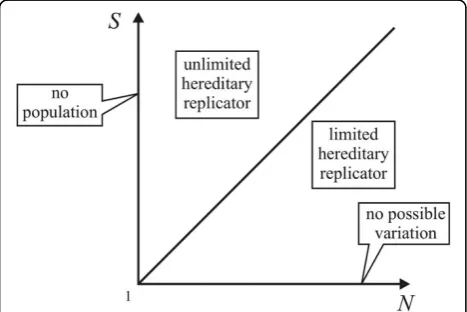
Let Sbe the number of possible different, stable states of an entity and N the number of actual individuals (size of population). The model, therefore, thus depends on these two parameters which (without any assump-tions) can have integer values from one to infinity. Enti-ties can be classified as replicators with limited or unlimited hereditary potential according to S and N (Figure 4).
AtS = 1 there is no variation andN= 1 means there is no population. With N>S the population is larger than the number of possible variants - replicators have a limited hereditary potential. However, if N ≤ S the population is smaller than the possible number of
variants - replicators have unlimited hereditary potential. Since both variables are quantifiable it seems rational to include extremes in the investigation. Following this,S=
1 (especially N = S = 1) can be considered as an
extreme class of replicators, exhibiting exactness - that is, there is no evolutionary potential at all. Note that, at S= 1, there is no stable state of the entity beside its pre-sent state - that is, there can be no variation in this entity. This clearly fits SACIs. In order to prove it, one must assume that an appreciably long DNA chain is an unlimited hereditary replicator, as the population size is smaller than the possible number of types. If we decrease the chain-length below one point (where the number of possible types equals the size of the popula-tion), the oligonucleotide becomes a limited hereditary replicator. If the length is further shortened, ultimately we would end up with a single nucleotide, which would be a SACI (although single nucleotides cannot replicate, due to the weakness of the hydrogen bonds). Thus, it can be stated that if we allow the unlimited/limited dis-tinction among replicators, and think of those of extre-mely limited (or even no) hereditary potential as replicators, we would also have to include SACIs in the group of replicators. This is why Szathmáry [16] has introduced the term ‘holistic (processive)replicator’to denote primarily non-modular autocatalytic cycle intermediates.
The inclusion of SACIs would imply that the term replicator is not the same as unit of evolution (sensu Muller [12] or Maynard Smith [10]), since exact replica-tors are not subjects to evolution (no variability or her-edity - that is, are not genetic systemssensuOrgel [23]). In our opinion, any multiplying entity which fits the multiplication criteria (1.4), but lacks evolvability, could still be considered a replicator: this also agrees with the vast (and growing) experimental chemical literature. Of course, if the cycle consists of multiple exact replicators, there still can be heritable information (for example, presence/absence of specific intermediates). However, that is not a property of the intermediates, but a prop-erty of the cycle as a whole (like the distribution of intermediates).
There are three reasons for this. First, Szathmáry and Maynard Smith [17] have highlighted the fact that there are limited, or even non-hereditary replicators with lim-ited or no evolutionary potential at all, which are part of the same continuum. Secondly, the ideal gene would be an exactly replicating entity if proofreading was faultless (this surely happens quite often), prohibiting short-term microevolution. The third reason follows on from this fact. A diverse population of holistic replicators lacking evolutionary potential still can be the subject of selec-tion. If there is competition, and difference in replica-tion rates, one competitor will possibly wipe out the
Figure 4Domains of theS Nspace.Sis the number of possible
other, even if there is no microevolution occurring. Thus, selection can act on a population of non-evolu-tionary replicators.
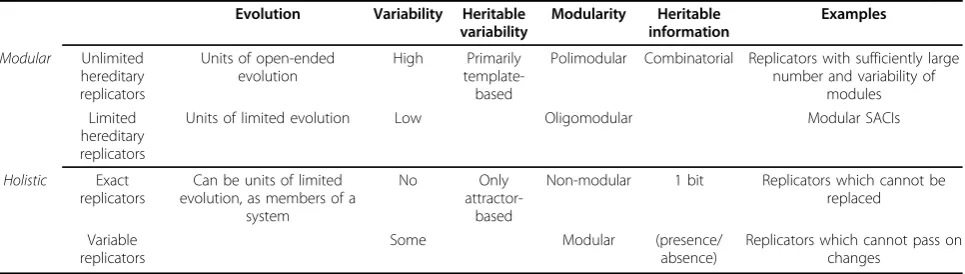
Exact replicators are those which cannot pass on any information (acquired changes) to their offspring. These entities are exactly those described by Orgel [23] as ‘non-informational replicators’(in contrast to informa-tional ones), which are usually non-modular and are not able to hold (biologically important) information. Furthermore, since no information can be changed and inherited by them (as stated by Orgel) they cannot evolve by natural selection. In contrast, those entities that do possess some evolutionary potential are limited or unlimited hereditary replicators with limited or open-ended potential for evolution. This suggests that evolva-ble replicators are a subgroup of replicators. Taevolva-ble 1 summarizes the distinction of replicators based on the hereditary potential.
Nests are non-informational replicators
The very effective distinction of limited and unlimited hereditary replicators [17] implies that SACIs are extre-mely limited-hereditary-replicators: with no heredity at all (or only attractor-based). This is in close relation with what Orgel [[23], p. 203] suggested:‘All replicating systems are, by definition, autocatalytic and all autocata-lytic systems result, in some sense, in replication’. If we compare SACIs with genes (as replicators), we can extract their common and distinctive features: (1) they both have a similarity between parent and offspring; (2) both are autocatalytic; (3) SACIs do not have any herita-ble parts; and (4) similarity in SACIs is not because of copying (there is no information transfer from parent to offspring). The process of copying (matching) is exactly defined under the Heredity section.
Of course, the major difference is in the amount of information SACIs and genes can maintain or transmit. This incorporates the fact that genes do have a heritable part (which, based on evolution, allows a combinatorial
search space), while SACIs usually do not have any information that can be passed on. Of course, even sim-ple molecules may provide information as part of a lar-ger system. The absence or presence of a particular autocatalytic cycle in a cell obviously has serious conse-quences. Furthermore, any novel autocatalytic cycle may propagate to offspring cells, making the change there-fore hereditary. This by no means indicates that any change applied to a SACI (the intermediate of any such cycle) is inherited by its offspring molecules. SACIs, therefore, are non-informational. According to point (4), Dawkins’ copying criteria should be dropped in order that SACIs can be included. Allowing all SACIs to be replicators implies that autocatalytic entities with no heritable part can also be replicators.
The irritating problem here is that this statement completely fits with, for example, bird nests/eyes/ organisms (see [15,42-44]), if we consider such things to be parts of autocatalytic cycles. This is basically true, because the earlier presence of nests/eyes/organ-isms catalyze the reappearance of similar entities in the following generations. Also one cannot deny the fact that, as birds populated Earth, so did nests, in ever-increasing numbers, although they were involved less directly. In one word, nests do fit the multiplica-tion criterion (1.4).
It seems, then, extremely alluring to exclude SACIs from replicators, in order to also get rid of unwanted nests. However, if we follow this line of thinking, we would have to exclude extremes (non-informational replication) from the limited/unlimited hereditary model. We would also lose the possibility of using the same definition for perfectly replicating real evolutionary replicators, or the chemical predecessors of them, with limited or no heredity at all. This seems an unnecessary cut in replicators. On the other hand, we would have to allow, for example, nests to be replicators, which is a strongly debated claim (see [15,42-44]). This is a circular problem that obviously cannot be solved at this point.
Table 1 Advanced classification of replicators according to hereditary potential
Evolution Variability Heritable variability
Modularity Heritable information
Examples
Modular Unlimited hereditary replicators
Units of open-ended evolution
High Primarily template-based
Polimodular Combinatorial Replicators with sufficiently large number and variability of
modules Limited
hereditary replicators
Units of limited evolution Low Oligomodular Modular SACIs
Holistic Exact replicators
Can be units of limited evolution, as members of a
system
No Only
attractor-based
Non-modular 1 bit Replicators which cannot be replaced
Variable replicators
Some Modular (presence/
absence)
Replicators which cannot pass on changes
Maynard Smith and Szathmáry [[11], p. 20] state that: ‘it is important to emphasize that autocatalysis is not the same as replication. For replication, it is not suffi-cient that an Agives rise to twoAs: it is also necessary that, if the Ais replaced byB(or aC or aD), then the cycle should give rise to two Bs (orCs, orDs). In auto-catalysis, there is no variation, and hence no heredity. Autocatalysis is an important first step towards replica-tion, but it is not the whole road’. At this point they defined replication in terms of heredity and variability and any entity lacking these should be excluded from replicators. This statement therefore would exclude not only nests, but SACIs (and non-informational replica-tors) as well from replicators. However, it is not con-trary to their previous statement (SACIs are processive replicators [17]): it is just a slight specification of a term. It is, somehow, a matter of arbitrariness whether or not one considers non-informational replicators to be real replicators. Nonetheless, the problem of the similar-ity between SACIs and nests, and the emerged situation of whether either both or neither of them should be a replicator, is still valid. In order to evaluate this pro-blem, let us turn to autocatalysis again.
Autocatalysis in depth
In order to investigate the problem of nests, it is neces-sary to look at the structure of autocatalytic molecular networks, since they are the most primitive naturally autocatalytic systems, and the lessons drawn will turn out to be fruitful in the subsequent analysis of other sys-tems in this paper.
The autocatalytic core of the formose cycle [18] (Fig-ure 2) is the simplest case and it has the special feat(Fig-ure that it works without enzymatic aid. It is analogous to the reproduction of bacteria or the fission of yeast. An important lesson is that the different molecules in the cycle can be seen as analogous to phases of the lifecycle of a reproducing cell: this is the reason why the cycle can be ignited alternatively by any of these intermedi-ates, just as it is by pure convention that we list the phases of the typical eukaryotic cell’s cycle in the order G1,S,G2, M.
Not all such autocatalytic cycles are as simple as this, however. The (enzymatically catalyzed) reductive citric acid cycle is asymmetric: whereas after one turn all intermediates are doubled and one oxaloacetate is pro-duced differently from the other (Figure 5).
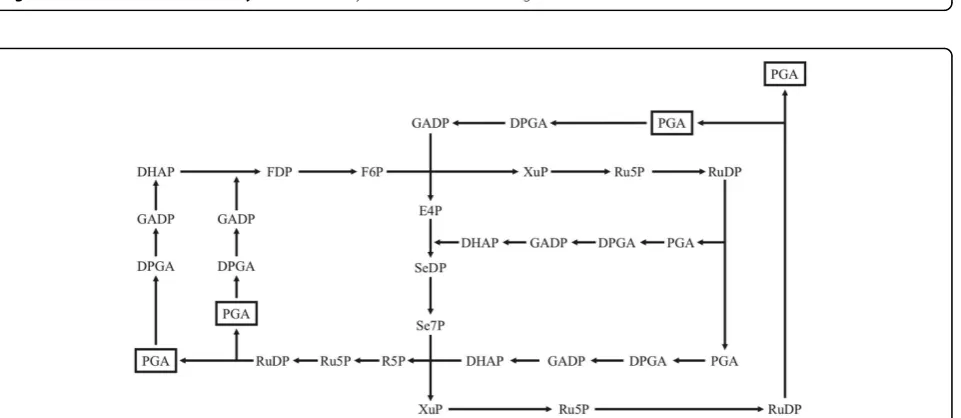
The Calvin cycle is also autocatalytic [45] but it is a complex network of sugar phosphate molecules. The most important feature for us here is that at no stage can it be reduced to one intermediate that could create the whole network: there should be at least two or three molecules present so that all the reactions can com-mence (Figure 6). Thus, it can be somewhat misleading
to say that, for example, 3-phosphoglycerate is a replica-tor: in fact, three molecules of 3-phosphoglycerate form sufficient autocatalytic seed [46]. Therefore, the Calvin cycle, and the formation of PGA, is autocatalytic but the replication ratio of PGA is 4/3 instead of two as in the case of the formose cycle regarding glycolaldehyde.
Gánti [47] postulated that the metabolism of present-day living systems rests on an autocatalytic set of mole-cules that one cannot omit from the system, since all the genes and enzymes fail to contain the relevant che-mical information. This postulate has been proven for all organisms where sufficiently detailed knowledge of metabolism is available [46].
Here a remark is in order. Although, by themselves, such simple molecular replicators are non-informational (similar to a gene with only one allele and perfect accu-racy), in the context of a larger system they carry infor-mation that, as in the case above, cannot be provided by the rest of the system. In fact, the obligate metabolic autocatalysts are part of the‘genome’in the wider sense. Nevertheless, no change applied to such a molecular replicator is inherited in the successive turns of the metabolic cycle, but the presence or absence of such cycles may be inherited in the successive cycles of the cell.
It is instructive to consider autocatalysis of the nucleic acid-protein system from the point of view of structure and evolution. If we assume that there was an RNA world (as many do), then RNA was a true replicator (Figure 7a) and, then, some peptides produced by RNAs appeared that then facultatively aided the replication process (Figure 7b). By now the relationship between genes and enzymes is completely obligatory: none of them can be reproduced without the other (Figure 7c). Hence the only correct statement is that nucleic acids and proteins togetherself-replicate (each is catalytically linked to the other). This does not deny the fact that most of the informational part of the replication rests with the nucleic acids.
The foregoing analysis of metabolic replicator systems helps to clarify the burning issue of whether organs or nests are replicators. It also sheds light on replication, inheritance and niche construction. The clear answer is that by themselves nests or organs are not replicators. Formal stoichiometry of the autocatalytic processes reveals why.
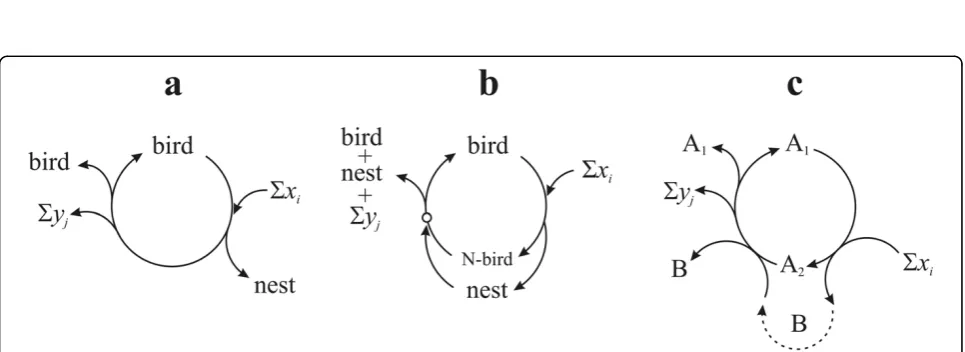
phase in the lifecycle (Figure 8b). It is true that only the N-bird and the nest together can proceed with the‘ reac-tions’, the result of which is the production of at least one new bird, which can also build a nest, and so on. The number of birds and nests multiply with time. Looking at the lifecycle one can say that the bird is one phase of a replicator and {N-bird + nest} is another phase. The informational part in this simple example
rests with the bird, not the nest. These need not be so: if forms of nest are associated with forms of relevant memes, then there is cultural and technological evolu-tion going on at the same time. In this case, it makes sense to regard the nests as extended phenotypes of genes and memes together.
The case becomes stronger in the hypothetical exam-ple when a bird cannot live at all without the nest (of
Figure 5The reductive citric acid cycle. Note the asymmetric branches leading to the two molecules of oxaloacetate.
Figure 6The Calvin cycle. It is clear that it is autocatalytic, but it is also clear that one molecule of 3-phosphoglycerate is not enough to ignite
course, this could only be a derived character from a previous evolutionary stage). This would be analogous to the nucleic acid-protein system.
The same logic clarifies the problem whether or not organs are replicators. Since organs form in a special phase of the lifecycle of organisms, it is arbitrary where one places the beginning of the cycle - the zygote is one autocatalytic seed and the organism with all its organs is another one - ultimately it is the whole lifecycle that is reproduced. This may mean that the eye (and the nest) by itself is not a replicator, but stoichiometry makes the situation clear again, as follows.
The net equation of Figure 8c is:
A1xi2A1 B yj. (2)
The equation indicates that A1 is an autocatalytic
entity and B (as a product) is also increased in time. Thus, a possible autocatalytic seed of the cycle is A1.
(Note that, strictly speaking, one ought to apply cyclic stoichiometry to all these cases.)
Gánti [47] has pointed out that, if such an autocataly-tic cycle is given, any of the intermediates (A1, A2, ...
An) is doubled during one turn, thus both the cycle and
all intermediates are also autocatalytic. Therefore, let us turn the cycle of Figure 8c by 180°, to reflect what hap-pens from the viewpoint of A2(Figure 9).
The basic reactions are unchanged, but the net stoi-chiometric equation, reflecting the autocatalytic nature of A2, is a bit different:
A2 B 2xi 2(A2B)2yj. (3)
This equation indicates that another autocatalytic seed of the same cycle is the {A2, B} set.
If Gánti’s abovementioned statement is correct, both A1 and A2are autocatalytic, although there is one major
difference between them: while A1 can start the cycle on
its own (provided that Σxi is present in the
environ-ment), A2can only initiate the cycle if B is also present.
Thus, while A1is a totally autonomous replicator, A2is
a dependent one, depending on its obligatory partner B.
Figure 7Autocatalytic nucleic acid systems. (a) RNA as a true replicator. (b) proteins (P) appear as side-products of RNA replication, which
facultatively catalyze the formation of the new RNA molecule (dashed arrow). (c) The present (simplified) relationship between genes (DNA) and enzymes (E), which are both obligatory for the other to be autocatalytic.xidenotes all input materials whileyjandzkdenote waste materials.
Figure 8Autocatalytic system of birds and nests. (a) Birds as simple catalysts of nests. No nest is needed to produce new birds. (b) The
nesting bird phase can only continue if there is a nest present (possibly one that was built by the bird, as it is pictured here). Small circle indicates point where a nest is obligatory. (c) Formal version of (b), with A1as the bird, A2the nesting bird and B the nest. Note: Figure 7(b) is
Since B is created as a side product of A, it seems that it is not autocatalytic. However, since A is a cycle, it is always true (disregarding from where the cycle is viewed) that an existing B is required as a catalyst in order to give the cycle one full turn, after which a new B is generated from scratch. Thus, an existing B cata-lysesindirectly (that is, the new B is not created by the original B, there are intermediate steps) the formation of a new B. This is completely independent of the fact whether Bs are needed in stoichiometric amounts or only one B is needed for all steps to be catalyzed in all the parallel cycles, since the total amount of B will be increased; thus, the replication ratio of B will be larger than one. Therefore, since the definition of multiplica-tion (and autocatalysis) fits B, it must be autocatalytic as well, although indirectly.
The strange thing, that the autocatalytic property of B is revealed only in equation (3), is due to the fact that equation (2) informs us only about A1. Equation (3)
deals primarily with A2, but the lucky fact is that the
net equation of the cycle from the viewpoint of B is exactly the same as equation (3). Thus, as equation (3) does not say much about the role of A1, the same way
equation (2) does not say much about A2 or B.
The bottom line is: in cycle A, A1 is an autonomous
replicator (or obligate autocatalyst), while A2 is a
B-dependent replicator and B is anA2-dependent
replica-tor (or facultative autocatalysts). This means that if A1
is the bird, A2 is the nesting bird and B is the nest.
Therefore, that nests can also be regarded as replicators,
although dependent ones only (and still the more important informational part) is ignored in this model. Thus, analysis can reveal the underlying difference between dynamically similarly behaving replicators.
To conclude, it is of utmost importance in order to distinguish between obligateand facultative autocata-lystsof an autocatalytic cycle. The consequence of this distinction is that, while an entity can be reproduced autocatalytically, it may not be enough to start a cycle: phosphoglycerate (PGA) is autocatalytic in the Calvin cycle, but one molecule in itself is not enough to initiate reproduction as it needs at least three molecules of PGA and all its obligatory catalysts. Any component, which can initiate the cycle, forms the autocatalytic seed of the cycle. Thus (according to Figure 8b) birds are indepen-dent replicators, but not nests (or organs): a nest cannot produce one new nest because it cannot start a new cycle on its own. However, as far as a nesting bird is considered as a phase of a replicator, nests must be replicators as well: more precisely, the combination of {nesting bird + nest} form the appropriate autocatalytic seed. In other words, the nest in itself is no less a repli-cator, than DNA without enzymes.
Furthermore, there is a slightly elusive difference between Aiand B: it seems that A1 and A2 aredirectly
involved in creating new A1and A2 entities, while B has
only anindirecteffect on the formation of new Bs. This was captured effectively by Blackmond [[48], p. 386] in the notion of autoinduction:‘autoinduction[is] where a reaction product or side product accelerates the rate of [...] a reaction sequence without directly producing more of itself. Autoinductive processes may exhibit kinetic signatures similar to autocatalytic processes’. If the reaction sequence is autocatalytic and produces more of this catalytic product in focus, then this product behaves the same way as any component of the autoca-talytic cycle. This simply means that any entity, that is not part of a cycle, can only be an indirect autocatalyst piggybacking the host cycle. The only exception is where both A and B are part of their own cycles which are coupled in a hypercycle (pictured in Figure 7c). Of course, the major difference between birds and nests is still the informational criterion, discussed in turn.
Heredity
In order to clarify the difference between informational and non-informational replicators, heredity must be explained. For this some definitions have to be fixed. Copyingshould be defined as a process that can recreate an entity in such a way that any change applied to the original reappears in the new; thus it should be defined in terms ofheredity. Heredity should be defined as the potential to pass on changes, in terms of variability. Also variability (and, thus, heredity and copying) should
Figure 9The same autocatalytic cycle of Figure 8c from the
be defined only formodularentities, since without mod-ules there are no elements of an entity that can change (and be inherited) such that the entity itself is not ren-dered functionless.
Again, it is instructive to begin with the simplest pos-sibilities of information storage in chemical systems [49]. In this context, molecules act as signs. One can store information with the quantity of signs, with the relative proportion of signs and with the fixed geometric arrangement (for example, sequence) of signs. If the stored information, in unaltered or changed form, can be passed on to the progeny, we then have to deal with the phenomenon of inheritance. It is instructive to look at some unconventional examples in order to illustrate the power of these distinctions.
In the simplest chemoton model of Gánti [49], con-sisting of three autocatalytic subsystems (metabolism, template, membrane), the simplest form the template macromolecule consists ofnpieces of monomer V and, thus, it is a homopolymer. The only property that can change is the degree of polymerization (n). It was shown that such a mutation (deletion or insertion) affects the functioning of the whole chemical supersystem (via mass action) in a hereditary manner [50]. We are, there-fore, dealing with a case where the quantity of a chemi-cal sign carries information. If one passes now to a system, analogous to nucleic acids, where one has poly-mers with the structure p(VS)n(WZ)m, and where capital
letters denote different monomer types, then such a template can also carry information with the relative proportionn/(n+m) of signs. Although, in this case, the sequence is also inherited, it is not yet utilized in the system. Sequence becomes important when, for example, such heteropolymers begin to act as enzymes (such as ribozymes).
Let us now look at the case of ‘compositional gen-omes’ and ‘compositional inheritance’, as proposed by Segréet al. in the GARD (graded autocatalytic replica-tion domain) model [51,52]. This immediately connects our discussion to the recent excitement of various abstract and artificial protocells [53]. This field is grow-ing fast. Here we illustrate some of the relevant ques-tions with two protocell models. The GARD model depicts a population of molecular assemblies built of amphiphilic chemical compounds (such as lipids). Assemblies can take the form of micelles or vesicles, but this is not important for the dynamics in question. The building blocks are provided in the medium. Assemblies can grow by incorporating molecules from the medium in a catalyzed (fast) and uncatalyzed (slow) manner. If there arentypes of different building blocks, then one can define a matrixb, specifying to what extent mole-cule Liin the assembly catalyses the incorporation of
molecule Ljinto the assembly (where iandjrun from 1
ton). After reaching a critical size assemblies split into two, so that molecules re-assort into the offspring assemblies at random. Segré et al. [51] noted that, despite the fact that one only has compositions rather than geometrical arrangements of building blocks, some compositions can persist through many generations in a given lineage. These quasi-stable assemblies have been calledcomposomes. The relevant information is thought to be stored in the respective compositional genomes. Somewhat disturbingly, it was also found that, in a line-age, composomes can revert suddenly to any previous state, thus long-term inheritance looked, at the least, questionable.
Vasaset al. [54] have re-analyzed the dynamics of the GARD model from, the viewpoint of population genet-ics. They have firmly put composomes into the category of attractor-based inheritance [40], where the quasi-stable states coincide with internally strongly interacting subsets, via theb matrix, of building blocks. However, there is a snag. Stochasticity in growth and fission gen-erates variation, so that these alternative subsets tend to flip into other subsets (therefore inheritance is not as deterministic, or exact, as in case of template replica-tion). They were able to derive an Eigen equation [55], in which the different species were assemblies with dif-ferent initial compositions. The metastability of the composomes translates into some giant mutation rates (which can even be higher than the exact reproduction rates). Hence, the population cannot respond to direc-tional selection and there is no phylogeny. The dynamics is effectively determined by the b matrix. Alternative substates are not stable enough to give a large number of different, stably heritable states. Con-trast this with the chemoton containing heteropolymer templates without sequence utilization: there the stabi-lity of inheritance is due to covalent bonds and template replication.
Finally, here is the last example from the protocell world. The stochastic corrector model of Szathmáry and Demeter [56] deals with a bag of unlinked genes, the dynamics of which can also be cast in terms of an Eigen equation (where initial gene composition is the relevant species trait). In contrast to the GARD model, a popula-tion of such protocells can respond to direcpopula-tional selec-tion, unless there are too many genes in the protocell (when group selection becomes ineffective and, also, advantageous mutations are diluted out). The reason for this difference is that the genes are stably passed on as units (their monomers cannot segregate from each other), whereas the subsets of compositional genomes are not covalently stabilized entities.
(such as the cell membrane, the mitochondrial and plas-tid membranes, and others) are obligate autocatalysts: there needs to be a piece of specific membrane in place for the membrane to grow while maintaining its iden-tity. This is due to the fact that there are specific import machineries in the different membranes that only pull in cognate macromolecules. The key autocatalytic ponent is that the import machineries also import com-ponents of themselves. One could totally confuse the cell by re-distributing these import machineries among the different membranes, while not touching the genes at all [28]. This is a case of limited heredity that, never-theless, is of high importance for the maintenance of the living world. Of course, the components of the import machineries are informed by genes; but the cor-rect completion of their self-assembly requires an auto-catalytic mechanism that is not in the genes. Occasional losses or gains in the number of different hereditary membranes were critical membrane mutations during the history of the cell [27]. This raises the question: what kind of replicator is a hereditary membrane? The answer has been given by one of the authors:‘There is something peculiar about membrane inheritance. Newly synthesized proteins are recruited on the basis of a very limited aspect of their molecular phenotype, namely the presence of the cognate signal peptide, whose primary sequence is usually not conserved. A template-like effect does play a role in this recognition process (the shape of the membrane receptor and that of the signal peptide of the imported molecule must be sufficiently complemen-tary) but heredity is limited. Genetic membranes are ensemble, phenotypic replicators [...]. They are not attractor based because their identity also requires genes, external to them’[[25], p.1674].
Lastly, the case of prions must be discussed in the light of recent findings. Prions are infectious proteins capable of replicating by forcing their alternate confor-mation (and, therefore, alternate function) on the nor-mal physiological form of the protein (both having the same amino-acid sequence). Originally prions were con-sidered to be simple replicators which were only able to convey one bit of information: normal or infectious con-formation. Later, various other strains were identified possibly with different conformations. Recently Liet al. [58] performed a series of experiments to demonstrate that different selective regimes (for example, the pre-sence or abpre-sence of a prion inhibitor) cause the propa-gation of different prion strains. Therefore, prions have various phenotypes and these phenotypes cause differen-tial survival, rendering them to be units of selection. In order for prions to be units of evolution, it is necessary that mutations appearing in their conformation are sta-bly heritable. Li and co-workers have found that new variants appeared during replication in the prion
population (instead of being there in an initially hetero-geneous population), with an assumed (lower limit of) mutation rate of 10-6/doubling - although they do not exclude the possibility that new variants are identical in conformation, differing in some other factor (for exam-ple, some small cellular RNA determinant associated with the protein). Nevertheless, if any such determinant is passed on to offspring (during infection new determi-nants are associated with the infected proteins), we are dealing with at least limited heredity. Of course, if the conformation is the same, then only the determinants convey the information; while if there are no determi-nants, the protein conformation is solely responsible for the evolution of the various prion strains. It would be interesting to know whether the different strains and substrains can mutate into each other (and with what rate) or whether only the native prion can mutate to infectious conformations. It must be noted, of course, that if there is no supply of native prion proteins via gene expression, no invasive conformation can propa-gate in the population.
What we understood from all the above examples is that heredity must always be a result of copying, and copying is only available in case of modularity. Szathm-áry has stated that for the multiplication of holistic replicators: ‘[...] replication is not template replication (copying) that rests on a modular polymerization of monomers’ [[25], p. 1672]. In case of alternatives of a cycle (see [39]), the intermediates are not copied (being holistic), but the system as a whole may exhibit attrac-tor-based heredity [40].
Only those parts of an entity contribute to heritable information which can inherit changes acquired during the lifetime of the entity. Thus, we call any change heritable that can be passed on to next generation. It is possible that only such changes were gathered dur-ing the existence of the replicator that are not passed on during replication (see DNA methylation, isotope substitutes in a replicator, and such-like). The part that can inherit changes is called the genotype of the replicator. Note that, in case of epigenetic inheritance, the epigenetic information that is inherited is indeed epigenetic, but not epigenotypic -that is, it is part of the abstract genotype of a replicator, more than the genome. To be more general: if there is a heritable somatic information, the genotype of an organism is more than the information in the germline. The exact definitions, therefore, are:
2.2 Heredity: attribute of an entity which can multi-ply a part of it such a way that there is a potential that any change made in the part of the original entity can reoccur in the part of the new entity (the part is the genotype, and the process of multiplica-tion iscopying).
2.3Modularity: attribute of a part of an entity, if this part can acquire changes during the lifetime of the entity in such a way that the entity is not rendered non-functional, nor that will dissociate, and that the new entity is potentially phenotypically equivalent to the original one (the process iscopying).
2.4 Genotype: part of an entity (for example, subset of features) which can potentially pass on changes (acquired during lifetime of entity, incorporated into the said part) to offspring during a multiplication process (the process iscopying).
Note that the definitions refer to equivalence and mul-tiplication defined above (1.2 and 1.4). Modularity in this form fits both heritable and non-heritable changes. Also note that, if there is no heritable variability, there can be no microevolution. Furthermore, the notion of genotypeimplicitly refers tocopying,heredityand modu-larity -for example, the genotype is always modular.
If a variant of a feature is not passed on to offspring during copying, then that variable feature is irrelevant from the viewpoint of information-replication, as it is
not part of the genotype. However, and this is of
extreme importance, any change made to any part of a replicator that is passed on to the offspring is part of its genotype. That is, a changed base in a DNA sequence can be inherited, so it is part of the genotype of the DNA, and ifthe cut tails of mice were to be passed on to offspring then the state of tail would be part of the mouse’s (as a replicator’s) heritable genotype (but, of course, will not be part of its genome). Note that the exact method of copyingthegenotypeis irrelevant: the only important thing is the heritability of changes made to thegenotype. In other words, it is neither the medium nor the method that counts during the transfer of infor-mation, but the fidelity of the transfer.
So far our best candidate for a replicator is the highly abstract genotype; although with this we only pointed to an abstract part of an entity (like the base-sequence of a gene), and not to a real, physically individual entity (the actual DNA molecule). The problem with this approach is that if the replicator equals the abstractgenotypethen the DNA should not be a replicator, since methylation of the backbone or isotope substitutions are not inher-ited in the same process. That is, changes made to the structure are irrelevant from the viewpoint of the mes-sage encoded in the base order (although it may be not irrelevant from the viewpoint of replication). However,
our definition would require that any change acquired should also be inherited. Expanding these terms, one should come to the point that, if the genotype is a part of an entity, copying is a process in which this entity is involved and heredityis an attribute of this entity, then the entity itself must be called the replicator. The (infor-mational) replicator has a genotype that can potentially be copied, thus possessing the attribute of heredity. In this sense, the definition should be formulated as fol-lows:
3.1Abstract replicator: the genotypeof an entity. 3.2Realized replicator: anything that has agenotype.
Note that both 3.1 and 3.2 exclude SACIs, although ultimately exact replicators should be gathered under the term ‘replicator’, as was discussed above. Until that point we will use this working definition, which is in close agreement with Dawkins’[[4], p. 83] definition: ‘I define a replicator as anything in the universe of which copies are made’. Although it induces a new problem, that will be discussed in turn.
Organisms are informational replicators
N order to point out the other problem of the present replicator definitions, let us quote (1) the commonly accepted definition of Hull [[9], p. 408]: the ‘replicator [is] an entity that passes on its structure largely intact in successive replications’and (2) a more recent one from Aunger [[2], p. 73], especially the part about similarity: ‘The copy must be like its source in relevant aspects’. These definitions are indefinite due to the termslargely and relevant. Both are relative and it is not clear to what they refer.
As we have not yet pinpointed the exact difference between true replicators and organisms, it seems reason-able to discover the common features of these entities, just as we did with genes and SACIs. Let us do a simple theoretical test. Consider the case of a simple cell (not-ing that cells are usually not considered to be replica-tors). A cell incontrovertibly passes on some of its structure‘largely intact’to the offspring cell during divi-sion. Also, parent and offspring are similar in ‘relevant aspects’. The obvious objection to this statement would be that a cell cannot pass on every change acquired dur-ing its lifetime - like the full cytoplasm and membrane configuration (for sake of clarity we set aside those exceptions where, for example, membranes can inherit structure (see [59]) and the fact that actually some aspects of the cytoplasm are inherited (see epigenetic inheritance systems [60,61]). Thus, there issome varia-tionin a cell thatcannotbe passed on to offspring cells.
state that, despite copying, there are also variations that are not passed on to offspring. For example, the substi-tution of a carbon atom with an isotope, or a base with a harmless base-analogue, is surely not passed on. Thus, one can see that, in case of genes, there can also be var-iations that are not being passed on. It is obvious that there is no realentity that can pass on itsentire struc-ture during replication, but there may be theoretical considerations based on such abstract entities. However, based on the definition 3.1 above, one should come to the conclusion that, if everything is a replicator that has acopiable genotype, then organisms must also be repli-cators since, for example, asexual individuals make copies of their genomes for their offspring. Here the information in the genome of the organism is the copi-able genotype. It is clear that there must be some differ-ence between RNA replicators and organisms or genes and cells, and we aim to discover this difference.
One solution could be that, in the case of cells (and, in general, of organisms), a new offspring is created not by copying but by development. It is still true, however, that both genes and cells have some part that is inher-ited by copying. In the case of genes it is the base sequence of the gene - in the case of (asexual) cells it is the base sequence of the genome (omitting epigeneti-cally inherited traits). The process that creates the non-copied (non-heritable) part of the new gene, or the new cell, can be anything, it could also be through develop-ment. In the case of cells, development from this view-point is merely the processing of the information that is passed on. This is analogous to the statement that, in the case of a DNA sequence, it is irrelevant what causes the variation that is not passed on to the next genera-tion (for example, methylagenera-tion or any kind of change made to the macromolecule). This means that the potential similarity of the hereditary part of multiplying entities does not depend on the actual way that the non-heritable part is generated. There are, of course, alternative explanations of differences between replica-tors and organisms based on development, but Griese-mer’s reproducer definition [6] fits our concept quite well. He classifies multiplying systems on a material basis [19], while we focus on the informational aspect. The two classifications may cooperate: an entity may acquire its materials from a different source than the template information on the way to assemble the material.
The seemingly massive discrepancy of the absence or existence of development can be tackled somewhat dif-ferently, demonstrating thatdeveloping reproducers(for example, organisms) are not so very different from repli-cators. Imagine that the quantity of the structure created by development during replication (using the inherited part) can vary from entity to entity. It can span from a
considerable amount, as in case of organisms where the whole soma is developed, to nothing, as in case of the idealized gene where hardly anything is developed. Con-sider a replicating DNA where the offspring simply copies and inherits the base-order, but the recreation of, for example, the sugar-phosphate chain is by some kind of primitive development, using mainly the inherited information (as is the case of RNA molecules, which acquire secondary structure by‘using’the information of the base-sequence). Would not it be considered a repli-cator? The bottom line is this: as long as there is a geno-type to copy, the entity incorporating the genotype is a replicator, regardless whether or not development is involved.
Although it is clear that one cannot advance much further with the introduction of development, we can still formulate a few conclusions based on the present position:
1. Any entity increasing in number (be it a cell or a gene) has some similarity to its offspring.
2. There are parts in both real genes and organisms that can inherit acquired changes and parts that can-not; thus both the cell and the DNA can pass on some of their information content and none can pass on its full information content.
3. From the viewpoint of the recreation of the heri-table part, the cause of variation in (and the recrea-tion of) the non-heritable part is irrelevant. Note that the recreation process of the heritable part is copying, while the process recreating the non-herita-ble part cannot be copying, otherwise it would be part of the heritable part.
4. Both cells and genes fulfil the causality criterion (that is, the parent is involved in the creation of the offspring).
Although it seems appealing to use only the first state-ment as a criterion for replication, we have to resist this route, as Griesemer [[19], p. S356] has pointed out: ‘surely replication means more than just [non-zero par-ent-offspring] correlation’. If this were the case then even a divided glass of water or a piece of bread cut into half would be a replicator.
copying’ [[36], p. 556]), some part of it must be devel-oped in order to gain the necessary similarity and to preserve equivalence, while some part of it is obviously stillcopied(the genome, or at least parts of it). By devel-opment, we refer to a process, which primarily does not imply the copying of information, but is the interpreta-tion of informainterpreta-tion which had possibly been copied earlier.
Variability - heredity model
If we accept the expansion that SACIs, organisms or even populations, can be thought of as replicators, a method should be presented that can handle and discri-minate among these multiplying entities based on a gen-eral model.
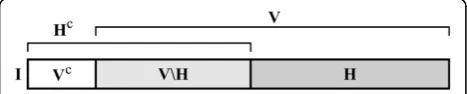
Let the full information content of an entity E be denoted by I. Thus, I can be imagined as the complete set of features of an entity -that is, all those properties which are relevant for the observer. Part of the entity is subject to change during the lifetime of the entity (within-generation change). It is denoted as V⊆ I. V can be imagined as the set of those features that can change state, while the functional identity of the entity is maintained. This calls forth a subset of I that cannot change, Vc. One can think of this as a set of conserva-tive features, which, if changed, renders the whole entity nonfunctional or even causes its decomposition. Furthermore, there is a heritable part of the entity H⊆ I, that can acquire changes and can pass these changes on to the offspring (the genotype). It is pointless to think of heritable parts inside the non-variable part, as non-variable features that cannot pass on variability and that heredity is defined only in case of variability (1.4 and 1.1). Therefore, H⊆ V. Let Ibe the size of I, whileHandV denote the sizes of sets I and H as frac-tions of I, thus 0 ≤H ≤V ≤ 1. Figure 10 gives a basic scheme of the subparts (sets of features) of any replicator.
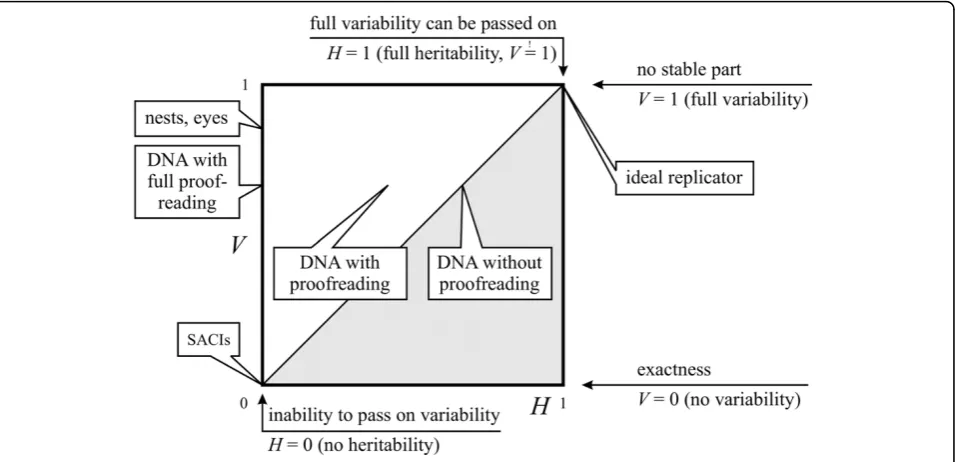
If we consider thatIis unity,Vcan span from 0 to 1, while Hspans only from 0 to V. At V = 0 entities do not have variability or heredity at all (His not defined -it could be, for example, SACIs). At 0 <V =H< 1 are entities with some variability and full heredity. They are capable of passing on every acquired change (sinceV
-H = 0). As a special case, an entity at V= H= 1 can have changes anywhere in its structure (without becom-ing functionless); thus it is a compact entity and can pass on every change (this would be a hypotheticalideal replicator). Note that V<His not possible due to the definition of heredity. Figure 11 shows the distinction of replicators according toVandH(a slightly similar clas-sification was derived by Solé [[63], p. 282], where spa-tial and informational complexities of replicating systems can be paralleled withVandH, respectively).
The model suggests that, if we accept that entities
described by the V H model are all replicators, we
should include SACIs, nests and organisms in the group of replicators. On the other hand, it still allows the exclusion of such entities, given that they are extremes of the complete space. The difference is quantitative, but now we have the factors needed to measure the dif-ference of this variability and heritability.
Examining the model, a statement can be expressed as:exactness is not the same as the inability to pass on variability, although both show exact replication. Exactness is an attribute of a replicator, which cannot have new (acquired) variability to pass on and does not have errors when copying (in general it is varia-tion-free). The inability to pass on variability is an attribute of a replicator that can have variability (acquired or generated), but it cannot pass on any of its variability to the next generation. Neither has a definite genotype. So the two attributes are built of three factors, from which the latter two are only avail-able if the first ability is present:
1. The ability to acquire variability during lifetime (V > 0).
2. The ability to pass on acquired variability during multiplication (part,H> 0).
3. The ability to generate variability during multipli-cation (erroneous copying,μ> 0).
The classification of these replicators is summarized in Table 1.
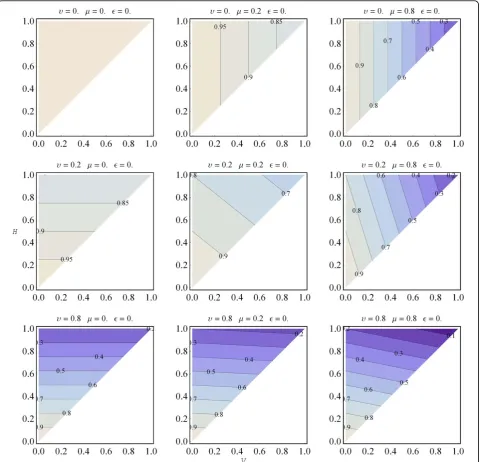
TheV Hmodel can predict the overall structure-simi-larity between parent and offspring - that is, it can pre-dict the quantitative difference between Epand Eo(of
parent and offspring, respectively). For this we have to introduce two more variables:υis the probability that a feature (or a module) of the variable part changes dur-ing a unit of time, andμ is the mutation rate suffered during the replicative process (the probability that a heritable feature is miscopied). Parameterυis the usual number of effective changes acquired in the time period between two replicative processes. The overall similarity S (the total number of identical features) is a distance functionf of parent and offspring entities (taking into
Figure 10 Ordered informational scheme of a multiplying
account only the time spent since the last replication of the parent):
Sf E E( p, o)Ip(1Vp)I Vp(pHp)(1)I Hp p(1)(1)I Hp p.(4)
Ip, Vp and Hp refer to the appropriate parts of Ep.
The first term (Ip (1 - Vp)) is the contribution of
the stable part of the entity to the overall similarity. The second term (Ip (Vp - Hp) (1 - υ)) specifies the
non-changed variable but non-heritable part of the off-spring. The third one (IpHp(1 - υ) (1 -μ)) is the
con-tribution of those modules, that are members of the heritable part and are neither changed during lifetime nor miscopied during replication. The last term (IpHp
υ μ ε) specifies those heritable modules that are chan-ged during the life of the parent and miscopied in such a way that they are backmutated to the original state. The parameter ε gives the probability of this backmutation per module per replication. This depends on the inventory size of the medium the gen-otype uses. If the inventory size is large, then the prob-ability of a changed module mutating back is fairly small, even negligible (ε= 0). If the inventory is small there is a considerable chance (or complete certainty in the case of a binary inventory) that the result of the mutation will be the original one (since mutating an element twice will result the original one). It is obvious that in the case of υ = 0 or μ = 0 the entity can only replicate exactly (that is, it is potentially a replicator, but actually is lacking variability, perhaps due to the
environment). Thus, if I is taken as 1, similarity
depends on five factors: 0≤ {V, H, υ, μ, ε} ≤1 and, by
definition, H ≤ V. Figure 12 shows the change of the similarity surface in case of various (υ, μ) parameter combinations.
The problem, in the case of organisms, is whether they exhibit an overall similarity high enough to count as replicators. This is a quantitative question, as it was pointed out earlier. Preliminarily, we suggest that the distinction between simple replicators (such as genes) and organisms be based mainly on two factors: first, the presence of development; and, secondly, the separation of two parts - one that can be changed and inherited and another that cannot be inherited and is highly stable. Rephrasing this second criterion we see that ideal replicators do not have non-heritable but variable parts. Furthermore, a replicator should minimize the fraction of its non-heritable but variable part (that is: (V - H)!0) if it wants to approximate ideal replication. Therefore, the abstract, ideal replicator should not have any non-heritable variability in itself - and this is suita-ble only for the abstractgenotype, defined in 2.4. The more we loosen this restriction the closer we get to a real gene (that has a very low variability in its stable part, the sugar-phosphate chain) and increasing the (V -H) fraction eventually brings us to (for example, asexual) organisms, where the non-copiable but variable part (the whole soma) is a much larger part of the whole entity than the genome itself (that is a part of the germline).
Classification
As demonstrated, the diverse set of multiplying enti-ties may include various entienti-ties, which, somewhat arbitrarily, can be termed replicators. To overcome
![Figure 1 An autocatalytic cycle of the formnecessary input and waste molecules respectively, of one turn of Σxi + A —①! Σy+ 2A (following Gánti’s notation [68])](https://thumb-us.123doks.com/thumbv2/123dok_us/8913713.1837986/3.595.56.292.510.701/figure-autocatalytic-formnecessary-molecules-respectively-following-ganti-notation.webp)