University of New Orleans University of New Orleans
ScholarWorks@UNO
ScholarWorks@UNO
University of New Orleans Theses and
Dissertations Dissertations and Theses
Spring 5-16-2014
A Mixed-Methods Inquiry into Science Teachers’ Perceptions of
A Mixed-Methods Inquiry into Science Teachers’ Perceptions of
the Effects of Professional Development Experiences on
the Effects of Professional Development Experiences on
Implementation of Research-Based Instructional Practices
Implementation of Research-Based Instructional Practices
Norma D. Felton
University of New Orleans, [email protected]
Follow this and additional works at: https://scholarworks.uno.edu/td
Part of the Curriculum and Instruction Commons
Recommended Citation Recommended Citation
Felton, Norma D., "A Mixed-Methods Inquiry into Science Teachers’ Perceptions of the Effects of Professional Development Experiences on Implementation of Research-Based Instructional Practices" (2014). University of New Orleans Theses and Dissertations. 1795.
https://scholarworks.uno.edu/td/1795
This Dissertation-Restricted is protected by copyright and/or related rights. It has been brought to you by ScholarWorks@UNO with permission from the rights-holder(s). You are free to use this Dissertation-Restricted in any way that is permitted by the copyright and related rights legislation that applies to your use. For other uses you need to obtain permission from the rights-holder(s) directly, unless additional rights are indicated by a Creative Commons license in the record and/or on the work itself.
This Dissertation-Restricted has been accepted for inclusion in University of New Orleans Theses and Dissertations by an authorized administrator of ScholarWorks@UNO. For more information, please contact
A Mixed-Methods Inquiry into Science Teachers’ Perceptions of the Effects of Professional Development Experiences on Implementation of Research-Based Instructional Practices
A Dissertation
Submitted to the Graduate Faculty of the University of New Orleans
in partial fulfillment of the requirements for the degree of
Doctor of Philosophy in
Curriculum and Instruction
by
Norma D. Felton
B.S. Southern University, 1960 M.S Oregon State University 1972 M.T. (ASCP) Charity Hospital, 1974
ii
iii
Dedication
iv
Acknowledgements
I offermy sincere thanks to Dr. Yvelyne Germain-McCarthy for her unwavering professional and personal support and encouragement. Over the years, my admiration for her dedication to the profession deepened as did my feelings that she was not only my major professor but a good friend. She exemplified the meaning of life-long learning and inspired others to do the same. She gave me an opportunity to serve again as LaSIP Site- Coordinator, the most enjoyable and
rewarding job that I have held in my forty-plus years of teaching.
Dr. Patricia Austin, your professionalism and focus on getting it right means more to me than you will ever know. You stepped in late in the development of this dissertation and spent precious time helping me to edit and put it into final form. I never once got the feeling that you felt that dong so was outside your job description or an imposition. Now I know why other students speak so highly of you.
I am eternally grateful to Dr. Claire Thoreson who never doubted that I would complete this journey. Distance in miles translated into phone-calls and e-mails when I needed a consultation on statistical methods. Her gentle advice and encouragement was greatly appreciated and needed. To Dr. Ivan Gill and Richard Speaker, your intense scrutiny and helpful suggestions helped me to make this document better. A special thanks to Dr. Gill for stepping in to serve as major advisor when Dr. McCarthy retired. To other members of the Committee, especially Dr. Judith Kieff, I am thankful to you for granting me the extra time which made this whole process possible.
v
Andrew paid off when the computer or WIFI connection malfunctioned. Carolyn, Tasha and Maria, you were always quick to remind me that I needed to get more sleep.
Through it all, I have kept the faith. I am reminded that I can do all things through Jesus Christ, who strengthens me. (Philippians 4:13)
vi
Table of Contents
List of Figures ... xii
List of Tables ... xiii
Abstract ... xv
Chapter One: Introduction
Purposes of the Study ... 1National Significance of the Problem ... 4
Conceptual Framework Synopsis ... 11
Theoretical Perspectives: Teachers as Adult Learners ... 12
Theoretical Perspectives: Constructivism, Andragogy, Humanism ... 15
Psychological, Physiological and Social Perspectives ... 21
Practical Contexts ... 21
Research Questions, Underlying Assumptions, Hypotheses Research Questions ... 25
Underlying Assumptions ... 25
Null Hypotheses ... 26
Alternative Hypothesis ... 26
Organization of the Study ... 26
Definitions ... 28
Limitations of the Study ... 31
vii
Chapter Two: Review of the Literature
Introduction ... 34
Early Efforts: “Telling is not teaching….Listening is not learning”... 38
The Training Model ... 40
Focus on the Needs of Individual Teachers….More Teacher Input ... 42
The Space Race and New Emphasis on Mathematics and Science ... 42
Schools…. An Important Context for Professional Development ... 43
The Rand Change Agent Study ... 47
The Concerns-Based Adoption Model ... 48
Focusing on Content: Ushering in a New Wave of Educational Reform ... 51
1990’s…A Shift in Focus ... 52
Current Issues That Guide Structuring and Implementation of Professional Development New Roles for Teachers ... 53
The Faces of Systemic Reform ... 54
The Impact of International Studies on Professional Development ... 59
The Standards Movement ... 61
Teacher Learning….Key to Educational Reform ... 64
Teacher Professional Development and Student Achievement ... 68
Research Needs and Future Directions The Promise of Lesson Study ... 71
viii
A Paradigm Shift: New Approaches to Science Teaching and Student Learning
Research-based, Inquiry-Oriented Teaching and Learning ... 75
A Constructivist Approach ... 75
Effects of Teacher Belief Systems on Levels of Classroom Implementation ... 75
Effective Models of Professional Development: How Can We Improve? ... 79
Summary of Chapter 2 ...
88Chapter Three: Methodology
Introduction and Organization of the Chapter ... 93Mixed Methods Research: An Overview ... 94
Design of the Study ... 97
Participants Rationale for Including Individual Interviews and Focus Group Discussions ... 99
Selection and Treatment of Participants ... 100
Instrumentation Development of the Survey: Establishing Validity ... 102
Measurement of Reliability of the Survey Instrument ... 105
Theoretical Basis of Survey: Core Features of Effective Professional Development . 105 Factors Impacting Levels of Classroom Implementation ... 109
Description of the Survey Instrument ... 110
Procedures Conducting Individual Interviews and Focus Group Discussions ... 111
ix
Part II. Overview of Procedures Used to Answer Research Questions ... 113
Descriptions of Procedures Used to Answer Research Questions ... 114
Evaluating Trustworthiness and Monitoring Bias ... 120
Summary of Chapter Three ... 123
Chapter Four Results: Presentation and Analysis of Data
Overview ... 124Participants and Sample Results... 125
Part I. Analysis of Demographic Data: LaSIP vs. Non- LaSIP Teachers ... 126
Part II. Overview of Statistical Procedures used to Answer Research Questions ... 134
Results and Analysis of Survey Data to Answer Research Questions ... 143
Recoding ... 143
Research Question #1 ... 144
Research Question # 2 ... 148
Research Question # 3 ... 152
Research Question # 4 ... 154
Research Question # 5 ... 164
Qualitative Data Analysis and Correlations of QUAL and QUAN Data ... 165
Emergent Themes and Codes from Survey: Open-ended Questions ... 166
Research Question 1 (QUAL) ... 169
Research Question 3 (QUAL) ... 175
Research Question 4 (QUAL) ... 176
x
Chapter Four Summary of Findings
... 182Chapter Five Discussion of Findings, Implications for Practice and
Recommendations
Overview ... 188Discussion of Findings Research Question #1 ... 190
Research Question # 2 ... 191
Research Question # 3 ... 192
Research Question # 4 ... 192
Research Question # 5 ... 194
Support for Theoretical Models in Figure 4 and 4a ... 194
Implications for Practice
Identifying Teacher Needs ... 195Next Generation Science Standards: Implications for Teaching ... 196
The Change Process ... 197
Focusing on Relevant Content ... 198
Role of Principals in the Implementation Process ... 199
Hands-on Science Teaching Requires Added Resources ... 200
Conclusions and Recommendations for Further Study ... 200
Summary of the Study ... 202
xi
Appendices
A. Survey of Teacher Attitudes Toward Change and Classroom
Implementation of Research–Based Strategies ... 235
B. Transcript of Open-ended Survey Questions ... 243
C. Individual Interview Guide ... 249
D. Personal Interview Transcript of KA ... 252
E. KA Personal Interview Quotations and Codes Edited in Atlas.ti ... 262
F. Personal Interview Transcript of VL Quotations and Codes ... 269
G. Focus Group Interview Guide ... 275
H.Focus Group # 1(Suburban School): Quotations and Codes from Transcript... 277
I. Focus Group # 2. (Rural School): Quotations and Codes from Transcript ... 283
J. Statements of Informed Consent Committee for the Protection of Human Subjects 1. Personal Interview Consent Form ... 294
2. Survey Participation Form ... 296
3. Focus Group Consent Form ... 298
4. University Committee for the Protection of Human Subjects in Research ... 300
K. Doctoral Examination Approval Form ... 301
Vita ... 302
xii
List of Figures
Figure Page
1. Conceptual Framework Map ... 11
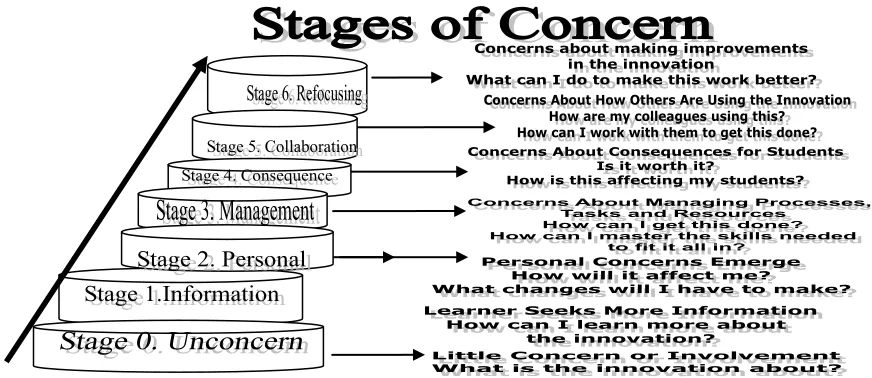
2. The CBAM: Stages of Concern (Adapted from Sweeney (2008) ... 48
3. Adaptation of Integrated Mixed Methods Design ... 98
4. Theoretical Model of Factors Impacting Teachers’ Levels of Classroom Implementation of Research-based Teaching Strategies (RBTS) .... 109
4a. Theoretical Model of Factors Impacting Teachers’ Levels of Classroom Implementation of RBTS Revised) ... 164
5. Flow Chart: Integrated Mixed Methods Data Collection and Analysis ... 119
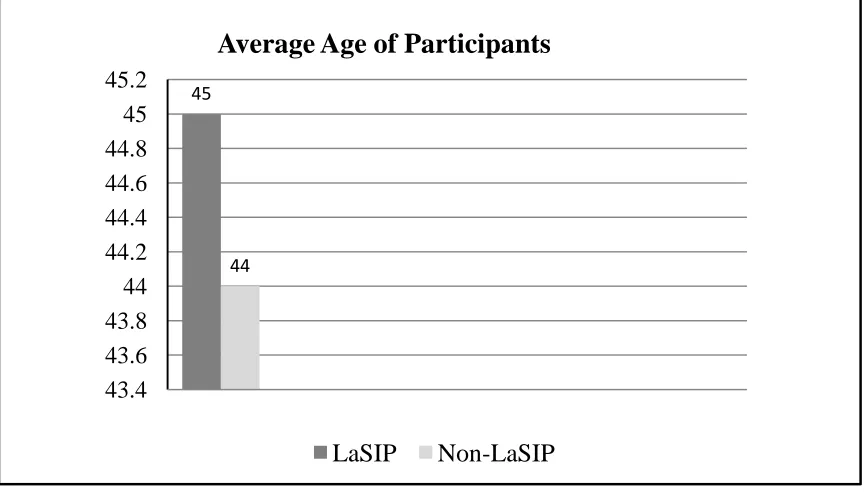
6. Average Age of Participants ... 126
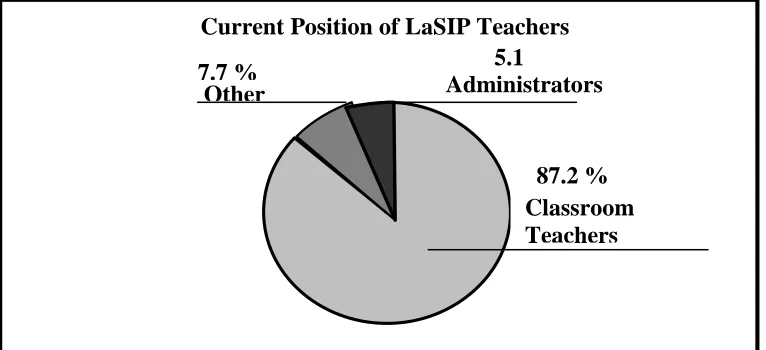
7. Current Teaching Positions of LaSIP Teachers ... 127
8. Current Teaching Positions of non-LaSIP Teachers ... 127
9. LaSIP Teachers’ Areas of Certification ... 128
10. Non-LaSIP Teachers’ Areas of Certification ... 128
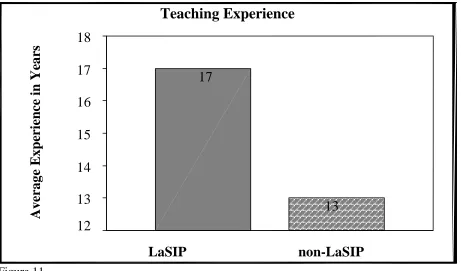
11. Mean Years of Teaching LaSIP vs. non-LaSIP ... 130
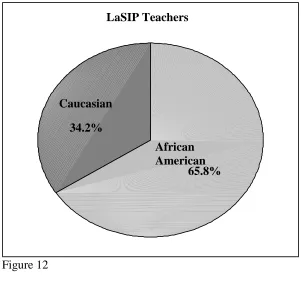
12. Ethnicity of LaSIP Teachers ... 131
13. Ethnicity of LaSIP non-LaSIP Teachers ... 131
14. Types of School Districts: LaSIP Teachers ... 132
15. Types of School Districts: Non-LaSIP Teachers ... 132
16. Gender of non-LaSIP Teachers ... 133
xiii
List of Tables
Table Page
1. Comparison of Qualitative and Quantitative Approaches to Data Collection ... 99
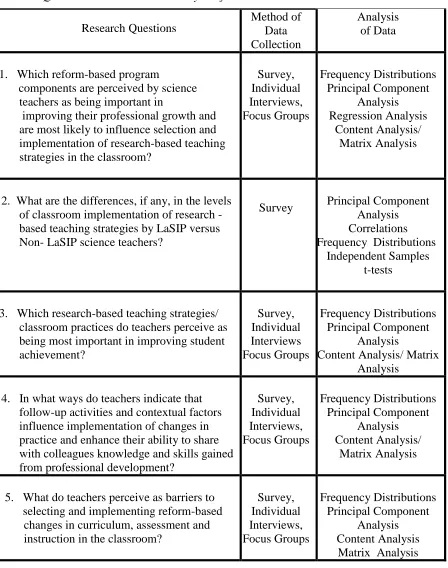
1.1. Research Questions: Collection and Analysis of Data ... 118
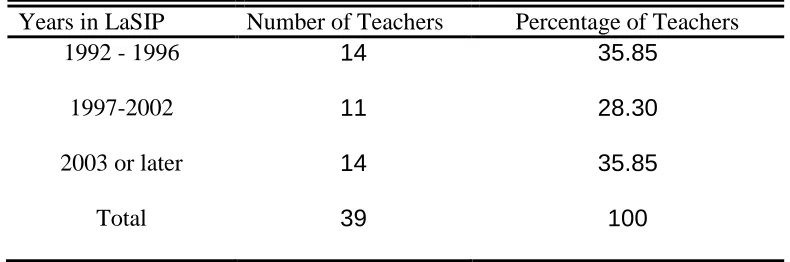
2. Years of Participation in LaSIP ... 129
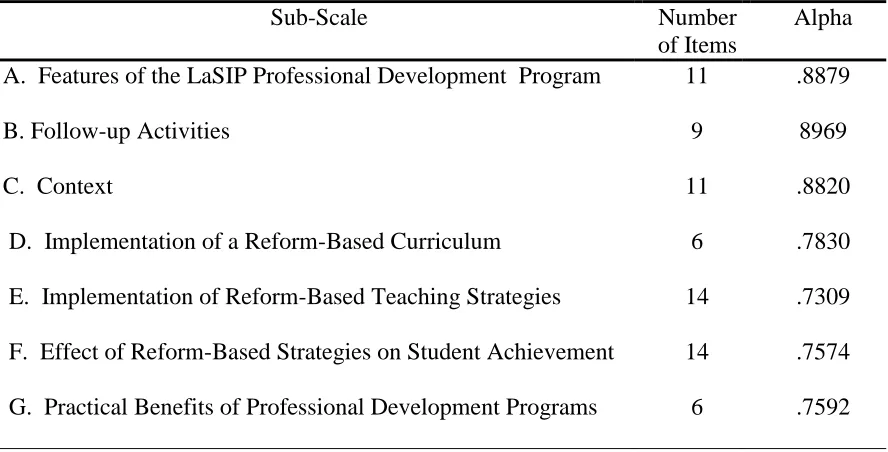
3. Reliability of Survey Subscales ... 135
4. Principal Component Analysis Section A. Features of the LaSIP ... 136
5. Principal Axis Factoring Analysis Section B. Follow-Up ... 137
6. Principal Axis Factoring Analysis Section C. Context ... 138
7. Principal Component Analysis Section D. Implementation of a Reform-based Curriculum ... 139
8. Principal Component Analysis Section E. Implementation of RBTS ... 140
9. Principal Component Analysis Section F. Effect of Implementation of RBTS on Student Achievement ... 141
10. Principal Component Analysis Section G. Practical Benefits ... 142
11. Summary of Frequency Distributions Section A. Features of LaSIP ... 144
12. Linear Regression Analysis Section A. Features of the LaSIP as Predictors for Implementation of RBTS ... 147
13. Frequency of Use of Implementation of Research-based Teaching Strategies: LaSIP Versus non-LaSIP ... 149
14. Independent Samples t-test for Frequency of Use LaSIP versus non-LaSIP ... 151
15. Levene’s Test and Independent Samples t-Test for Implementation of Alternative Assessment ... 152
xiv
17. Summary of Frequency Distributions Section B. Follow-Up ... 155 18. Summary of Frequency Distributions Section C. Context ... 156 19. Summary of Frequency Distributions Section D. Implementation of a Reform-based Curriculum ... 157 20. Summary of Frequency Distributions Section G. Practical Benefits ... 158 21. Linear Regression Analysis Section B. Follow-up versus
Section E. Implementation of RBTS ... 160 22. Linear Regression Analysis Section C. Context Versus Section E. Implementation of RBTS ... 161 23. Linear Regression Analysis Section D (BELREF) versus Section E. Implementation of RBTS ... 162
24. Linear Regression Analysis Section G.(PRACBENE) versus. Section E.
Implementation of RBTS ... 163 25. Rate of LaSIP Participant Responses to Open-ended Questions ... 165 26. Comparative List of Codes Personal Interview, Open-ended Questions and Focus
Group 1 ... 172 27. Comparative List of Codes for Personal Interviews ... 173 28. Comparative List of Codes for Focus Groups 1 and 2 ... 174 29. Features of Professional Development Programs That Influence Implementation .. 175 30. Importance of Context in Implementation of Professional Development ... 177 31. Codes: Barriers to Implementation of Change as Perceived by Focus
xv
Abstract
This was a modified integrated mixed methods study of teachers’ perceptions of factors that influence transfer of research-based teaching strategies into classroom practice. Participants were made up of 66 respondents to a researcher made survey, “Survey of Teacher Attitudes toward Change and Classroom Implementation of Research–Based Strategies”. Respondents were
divided into two groups based on participation in Louisiana Systemic Initiatives Programs (LaSIP): LaSIP, N= 39 and Non-LaSIP, N= 27.
Answers to five research questions were based on analysis of quantitative data from a survey, recorded on a five-point Likert scale and qualitative data from analyses of transcripts of three personal interviews, two focus group discussions and five short-answer questions on the survey. SPSS software version 9 and Atlas.ti version 7 were used in quantitative and qualitative analyses, respectively.
xvi
Analyses of qualitative data supported many of the findings due to quantitative analyses. Additionally, qualitative data provided more in-depth information concerning teacher
perceptions of barriers to implementation such as lack of teacher input into planning and implementation of professional development, and lack of time for in-depth learning during professional development activities.
1
Chapter One
Introduction
“Education is life--not a mere preparation for an unknown kind of future living…The whole of life is learning; therefore, education can have no ending. This new venture is called adult education--not because it is confined to adults, but because adulthood, maturity defines its limits." from Lindeman, E. (1926). The Meaning of Adult Education. New York: New Republic, p. 6.
Purposes of the Study
The purpose of this study is to examine teachers’ perceptions of factors that influence levels of classroom implementation of research-based teaching strategies following participation in a long-term, State Systemic Initiatives (SSI) program. Decades of teacher research studies have been dedicated to explaining and understanding how teachers’ professional development learning experiences impact the teaching process and the strategies teachers employ in the classroom. Much of the inquiry has revolved around efforts to gain insight into “the formerly hidden world” of teaching (Clark, 1995, p. 256). Many of these studies give recognition to the idea that teacher' perceptions and personal knowledge of learning, teaching strategies, students, curriculum
development and school culture influence what they teach and how they teach in response to an innovation in education (Borko & Putnam, 1995; Fullan, 2001).
Teachers, like students, must be able to connect new learning experiences to existing knowledge and beliefs in order to implement experiences encountered in professional
2
There is general agreement amongst researchers that what teachers do in the classroom can have profound effects on what students learn. Furthermore, effective teachers can have a profound influence on student learning even in relatively ineffective schools (Haycock, 1998; Blair, 2000; Beasley and Apthorp, 2010). The idea that teachers control most of what goes on in today’s classroom is indisputable. Teachers are also in unique positions to supply
meaningful insights into the teaching and learning process at the classroom level and can inform providers of their own professional development needs (Smith et al., 2007). Therefore, it was reasonable to explore the features of professional development programs that affect implementation of research-based teaching strategies from the unique perspective of the classroom teacher.
This study also included inquiry into teachers’ perceptions of the importance of research-based teaching strategies in improving student achievement. In a study of 900 school districts, Ferguson (1991), found that teacher expertise accounted for 40% of the variance in student achievement in reading and mathematics. In a later study, Sparks and Hirsh (2000) noted that a growing body of research has shown that improving teachers’ knowledge and teaching skills is essential to improving student performance. The idea that professional development is often the key to student achievement has also been confirmed in other studies (Guskey & Sparks, 1996; Reitzug, 2005; Lumpe, 2010).
3
differences in reported levels of implementation of research-based teaching strategies between teachers who participated in the Louisiana Systemic Initiatives Program (LaSIP), and those who did not.
Many of the teachers who volunteered to participate in this study are former or current participants in the LaSIP, a long-term, professional development model that had its inception in 1992. LaSIP is an integral and ongoing part of the Louisiana education reform efforts that advocate for research-based, content-rich training for teachers in mathematics and science. Projects of the LaSIP have influenced professional development in the state of Louisiana for over two decades. Therefore, teachers’ perceptions of its effectiveness in improving teacher learning and increasing levels of implementation of research-based teaching strategies in the classroom are important.
In spite of extensive efforts to improve schools, there is deep concern, locally, state and nationwide, about the quality of teaching and learning in today’s classrooms. The concerns deepen when the discussions turn to teaching and learning in mathematics and the sciences (Shymansky, 1992; Keys and Bryan, 2001; Keeley, 2005; Loucks-Horsley, Hewson, Love and Stiles, 2010). Although this study was limited in scope, it is hoped that the findings
contributed to the overall data base on teaching and learning and furnished useful insights to professional development providers that help teachers and students move closer to meeting national goals.
4
Mixed methods research is the type of research in which a researcher or team of researchers combines elements of qualitative and quantitative research approaches (for example, the use of qualitative and quantitative viewpoints, data collection, analysis, inferences, and techniques) for the purposes of breadth and depth of understanding and corroboration (p. 123).
A diagram of the study design is included in the methods section. Based on this design, findings from quantitative data collected via a survey was integrated with the findings from qualitative data collected through personal interviews, five open-ended questions in the survey and from focus group discussions.
National Significance of the Problem
For more than two decades, there have been intense efforts to improve teaching and learning in science. The National Science Education Standards (NSES) were developed by the National Research Council (NRC) in 1996 and were quickly embraced by leaders at the LASIP as being vital to reforming science education in Louisiana. The national benchmarks in science were developed by the American Association for the Advancement of Science (AAAS), in the period between 1989 -1998. Both of these publications have had a significant impact on the speed and direction of reform in science education in Louisiana, yet students in Louisiana still lag behind other states in overall student achievement as reported in the National Assessment of Educational Progress (NAEP) in 2009.
National reform efforts continue on other fronts as well. Teachers, students and even parents are being held to higher standards of performance. The “No Child Left Behind” (NCLB) Act, a federal mandate enacted in 2001 by President Bush, had a core demand for “highly
5
touching on every facet of school policy and operation. NCLB required states to develop and put into place standards in science by the 2005-2006 school year. Accordingly, states were required to begin testing science at least once a year in grades 3-5, 6-9 and 10-12 beginning in 2007-2008 (Smith et al, 2007). More recently, Congress enacted the American Recovery and Reinvestment Act of 2009 (ARRA). The ARRA legislation has set goals of “achieving significant
improvement in student outcomes, including making substantial gains in student achievement, closing achievement gaps, improving high school graduation rates, and ensuring that students are prepared for success in college and careers.” (Race to the Top: Executive Summary, p. 2) Both NCLB and ARRA envision classrooms that include teachers who are highly qualified.
These requirements have serious implications for both in-service teachers and
professional development providers. In order to meet the highly qualified requirements in-service teachers must re-train in many instances and professional development providers must offer professional development that meets the requirement of being research-based. Hence, not only are providers required to supply teachers with high quality professional development, they are also required to support their claims concerning program effectiveness with scientific research. The NCLB Act (2001) defines scientifically based research as "research that involves the application of rigorous, systematic, and objective procedures to obtain reliable and valid knowledge relevant to education activities and programs,"(Beghetto, 2003, p. 1)
Accountability for results in student achievement is being demanded at all levels. In
6
frameworks of the National Assessment of Educational Progress (NAEP). In the 1996-2005 science frameworks, the dimension of knowing and doing was organized into three practices, conceptual understanding, science investigation and practical investigation. In the 2009
framework, there are four practices assessed: (1) identifying science principles (2) using science principles (3) using scientific inquiry and (4) using technological design (U. S. Department of Education, 2007).
A review of the National Science Education Standards (NSES) the national benchmarks in science and policy implications in NCLB and ARRA indicate that student achievement and teacher effectiveness are intricately linked. The correlation between teacher effectiveness and student achievement has also been explored by educational researchers, (Guskey & Sparks, 1996; Von Secker & Lissitz, 1999; Von Secker, 2002; Joyce & Showers, 2002;, Yore, Anderson & Shymansky, 2005; Smith, et al., 2007). Thus, it is understandable that considerable funds have been devoted to teacher enhancement programs at the national, state and district levels. This study was devoted to investigating teacher perceptions of one such program. The aim was to provide data that increases insight into factors that influence teacher implementation of research-based instructional practices following participation in professional development, Exploring ways to facilitate implementation of these practices in the classroom is a step toward improving student achievement (Smith, et al., 2007).
The framework for the Next Generation Science Standards (NGSS) was released during the latter part of 2012. Included in the framework are recommendations that professional
development be an integral part of the school-wide improvement process. New teaching and learning standards in science were released in 2013. The NGSS focuses on science, technology,
7
workforce that is capable of competing in a global economy. The new science standards, like previously released science education standards (NRC, 1996) include recommendations for innovative ways to implement research-based curricula, and instruction and assessment aimed at improving teaching and learning.
Although the NGSS will include greater emphasis on technology and engineering, they are not totally new recommendations. For years reform efforts have centered on school-wide
improvement that is research-based (Rosenholtz, 1989; Hammond, 1990; Darling-Hammond & McLaughlin, 1995; Sparks & Hirsh, 2000). School administrators and teachers are required to document research studies that support the activities proposed in school improvement plans. Louisiana’s School Improvement Plan (SIP) template requires that each school’s goals and objectives be aligned with the National Staff Development Council (NSDC) professional
development standards that call for a comprehensive approach to professional development. Training and hiring highly qualified teachers are important objectives of many of the school improvement plans and also the focus of national science reform efforts (NCLB, 2002). Yet, studies indicate that problems persist of too few teachers entering the profession and too many current teachers that are under-qualified (National Commission on Teaching and America Future, 1997).
8
Moreover, the Commission sought to address the need for developing a comprehensive plan for recruiting, preparing, and supporting a national teaching force that can meet 21st-century standards of high educational performance. The Commission issued its major report, What Matters Most: Teaching and America’s Future, in September of 1996. One year later, the Commission released a follow-up report, Doing What Matters Most: Investing in Quality Teaching, which described progress toward its recommendations. In its initial report, the National Commission on Teaching and America’s Future (NCTAF) reported that more than
1. 50,000 people who lack the training required for their jobs enter teaching annually on emergency or substandard licenses.” [Further, in the same study, it was reported that] 2. nearly one-fourth (23%) of all secondary teachers do not have even a college minor in
their main teaching field. This is true for more than 30% of mathematics teachers. 3. Among teachers who teach a second subject, 36% are unlicensed in the field and 50%
lack a minor. (NCTAF, 1996, p 15)
In light of the findings that nearly 25% of the teaching workforce may be under-qualified, there is clearly a need for reform efforts aimed at recruiting and retaining qualified teachers.
Educators now have a substantial base of knowledge on which to build. Research on how to teachand what to teach is being rapidly added to the data base and made accessible to recruits and to teachers already in the workforce. Taking advantage of these advances, implementing research-based teacher training and facilitating intense implementation of this training at the classroom level, can be the engine that drives school reform efforts.
Supovitz and Turner (2000) described professional development efforts as “limited,
9
Spurred on by increased research, the nation’s focus on teaching, and learning and government mandates such as NCLB and ARRA, our knowledge of what works in professional development has evolved into an expanded core of research-based information. Yet, professional
development is often planned and executed without meaningful input from teachers. One of the core beliefs that framed this study is that teachers’ clinical experience, realistic wisdom, their beliefs about education, and assessment of what they need as learners are important factors in their professional growth, (Darling-Hammond, 1990; 1997).
Unfortunately, much of what is taught in professional development programs for in-service teachers is never transferred to the classroom. In fact, studies by Hirsh and Ponder (1991) found that as little as ten percent of what is taught is actually implemented in the classroom. Similar findings are described in Joyce & Showers (1995) as follows:
“In the 1970’s, evaluations of staff development that focused on teaching strategies and curriculum revealed that as few as 10 percent of the participants implemented what they had learned. Rates of transfer were low even for those who had volunteered for the training. Well-researched curriculum and teaching models did not find their way into general practice and thus could not influence students’ learning environments.” (p. 12). Although more enlightened research concerning how teachers learn has been gathered over the years, problems concerning levels of classroom implementation following professional development experiences persist and are reported in other studies (Killion, 2002; Broad and Evans, 2006). For example, the NSDC in its 2010 report on improving teacher learning writes that “the nation is moving backwards in providing the vast majority of teachers with the kind of ongoing, intensive professional learning that research shows has a substantial impact on student learning”.
10
development experiences are implemented in the classroom. Fullan (2001) describes what he calls the “implementation dip”:
“the implementation dip is a natural dip in performance and confidence as one encounters an innovation that requires new skills and new understandings. All innovations should call upon people to question and in some respects to change their behavior and their beliefs — even in cases where innovations are pursued voluntarily.” (Fullan, p. 49).
According to Fullan, this is a natural occurrence following an innovation. How can providers compensate for the “implementation dip” that occurs in teaching behaviors following professional development activities? More importantly, how is the discrepancy explained or understood by teachers in the field?
The gap between teacher training experiences and actual classroom implementation remains in spite of efforts to bring to bear the latest findings of researchers about what works in
professional development (Supovitz & Turner, 2000). Can lack of meaningful input from teachers in addition to weak follow-up activities be contributing factors? Perhaps the examination of teachers’ perceptions of the quality of the training they receive and their perceptions of the factors that enhance or impede their ability to transfer professional development experiences into
classroom practice shed some light on these questions.
Even as many providers strive to increase teacher input into the planning and implementation of professional development, some providers concede that there is no universal model of
11
and other findings this study examined teachers’ perceptions of their professional development experiences from several perspectives as outlined in the descriptions of the conceptual framework.
Figure 1.
Map of Conceptual Framework
Conceptual Framework
Synopsis. The conceptual framework for this study provided lenses through which to examine science teachers’ perceptions of the various features of the LaSIP and their perceptions of the impact of the program on transfer of training to the classroom. Conceptually, teachers are viewed as adult learners whose professional development needs vary. Therefore, professional development was viewed from several perspectives. The conceptual framework included constructivism as the major theoretical perspective.
Contribute to Contribute to Include Include include Include Include Include Include Must be Viewed From Include Lead to With Result in Form the Basis for Form the Basis for Form the Basis for Contribute to Contribute to Lead to PROFESSIONAL DEVELOPMENT Multiple Perspectives Social-Psychological
Theoretical PracticalContexts
Motivation Learning Adult Needs Follow-up Support of Colleagues Administrators Parents Barriers to Change Self-Esteem
Lack of Support from Colleagues Administrators Parents Satisfaction with Status Quo Teacher Resistance CONSTRUCTIVISM Androgogy
Failure to Implement Research-Based Strategies Teacher
Self-Reflection and Dissatisfaction with
the Status Quo Exploration and Bridging Conceptual Change Adaptations Classroom Implementation of Research-Based Strategies Pragmatism/ Progressivism Humanism MAP OF CONCEPT UAL FRAMEWORK Contributed to other theories/ Reflect Elements of
other theories Contribute to Adequate Resources Time Inadequate Resources Lack of Time
12
Equally important to the study were the psycho-social factors such as teachers’ motivation and learning needs and practical contexts such as follow-up and supportive working
environments. The interrelationships among these factors are shown in Figure 1.
The belief underlying the conceptual framework was, that factors addressed teachers’ learning needs properly during professional development could have a positive impact on teachers’ ability to implement research-based strategies in the classroom.
As seen in Figure 1, classroom implementation of professional development experiences is not without inherent barriers. Barriers to implementation include factors such as teacher
resistance to change, satisfaction with the status quo and lack of support from administrators and parents. In order for professional development to have its desired impact on teaching and
learning, it must be based on an understanding of how all of these factors are interrelated. Explanations of the various perspectives are included in the discussions that follow.
Theoretical Perspectives: Teachers as Adult Learners.Understandings and beliefs concerning adult education form the basis for the theoretical framework for this study.
Among the definitions of adult education are those offered by Lindeman (1926) as seen in the opening quote and in Merriam and Brockett (1997, p.8), which states that adult education can be defined as “activities intentionally designed for the purpose of bringing about learning among those whose age, social roles, or self-perception define them as adults."
13
School Improvement Series at the North West Regional Educational Laboratory (NWREL). Some of the research findings are summarized in the paragraphs below.
First and foremost is the premise that adults learn throughout their lives, Lindeman (1926). Butler (1992) goes on to explain that age does not reduce a person’s capacity to learn, although
they may learn at a slower rate. Further Butler posits, adults learn in different ways that include learning from experience and as a result of self-direction. Additionally, learning for adults takes place at different times in their lives, for example middle age or old age. Adults also pursue learning opportunities for varying reasons such as career advancement or following the death of a spouse. As pointed out in these examples, optimal learning for adults takes place when new learning is clearly tied to or built upon past experiences, which clearly connects to constructivist learning theory. Both the psycho-social perspectives and the theoretical perspectives noted in the conceptual map in Figure 1 embrace the notion that adult learners’ stages of development,
whether personal, chronological, or professional, can have a profound effect on learning (Cameron and Pierce, 1994; Candy, 1991; Bruner, 1996).
Practical contexts also play a prominent role in adult learning. It has been reported by some researchers that adult learning tends to be problem-centered and require practical application of what is learned (Knowles, 1980). Additionally, the adult learner establishes ownership of what is learned by selecting new information and deciding how to use it (Merriam and Brockett, 1997). Finally, new learning (See Figure 1) is followed by a period of reflection to facilitate integration, adaptation and application of new knowledge and skills.
14
knowledge concerning their current conceptions of science content and their views on what works in teaching, and learning science.
The extent to which providers acknowledge the characteristics and needs of adult learners can determine the success of implementing innovations at the classroom level (Lieberman, 1995; Loucks-Horsley, Hewson, Love, and Stiles, 1998). Giving teachers some control over the what, why, how, when and where of their learning can remove many of the barriers to implementation of research-based teaching strategies in the classroom and improve attitudes of teachers toward change (Borko, 2004; Caffarella, 2002; Guskey & Yoon, 2009; Hargreaves & Shirley, 2009).
Many teachers are effective practitioners with numerous years of experience. Yet, studies have shown, that teachers spend very little time thinking about the reasons behind what they do in the classroom (Yore, 2001). Moreover, teachers are afforded little time for true reflection on practices during their participation in professional development activities. (Brookfield, 1986; Candy, 1991; Loucks et al., 1990). Therefore, it is often left to professional development providers to examine the conceptual framework that provides the foundation for the content and teaching practices that are offered to teachers. This relegates the role of the teacher to that of a voiceless recipient. Teachers are often ignored in planning and are therefore left to implement programs that are poorly planned without question (Caffarella, 2002). More often than not, these programs do very little to improve teaching and learning (Guskey & Sparks 1996; Smylie, 1992 and Little, 1993). Understandably, very little of what is experienced in this manner is transferred to the classroom (Guskey & Yoon, 2009).
15
the assumptions they make about how students learn directly impacts what and how they deliver instruction in the classroom (Wenglinsky, 2000; Caffarella, 2002; Borko, 2004). Therefore, we should view teachers as adult learners whose perceptions of professional development vary based on their life experiences and self-identified learning needs. Professional development that aims to bring about changes in teachers’ practices should be planned and implemented with these things in mind (Hargreaves, 1997). Teachers hold a philosophy of teaching that influences how they teach and what they teach. Effective professional development programs invest time in developing an understanding of teachers’ philosophical beliefs. Therefore, the conceptual framework includes a focus on the theoretical perspectives of the study described in the passages which follow.
Theoretical Perspectives: Constructivism, Andragogy and, Humanism. In the National Science Education Standards (NSES), constructivism serves as a theoretical basis of teaching and learning. Jerome Bruner (1986; 1990; 1996), was one of the founding fathers of constructivist theory. Bruner’s writings echo themes espoused in the writings of Jean Piaget (1972) and Lev Vygotsky (1978). Bruner, Piaget and Vygotsky espoused views that learners construct new ideas or concepts based upon existing knowledge. They considered learning to be an active process. Therefore, the learner should be able to select and transform information, engage in problem-solving, make decisions, generate hypotheses in order to make sense of the world.
Constructivism was the main theoretical perspective used in the conceptual framework for this study. Constructivism is defined by Candy (1991, p.254) as a “cluster of related
16
theory to practice is perhaps the most obvious reason providers in the Louisiana Systemic Initiatives Program (LaSIP) placed such emphasis on constructivism as a philosophy of teaching and learning in science.
As pointed out earlier, constructivists believe that the learner actively constructs knowledge and is not just a passive recipient of knowledge. The constructivist approach to teaching and learning in science gained prominence in the mid-1980s and generated considerable excitement in efforts to reform science education. Constructivism did not emerge within the field of adult education, but the basic tenets of constructivism have implications that are important in adult education and hence, professional development. Constructivism forms the basis of the following principles for designing effective learning environments:
Adult learners come to class with prior knowledge and experiences. Teachers are not presented with empty vessels in which to pour knowledge or bank slates upon which to write. Instead, teachers should structure learning situations in which the learner interacts with new knowledge in ways appropriate for making connections to their own experiences (Knowles, 1980; Merriam & Brockett, 1997).
According to Brooks & Brooks, (1983) constructivist classrooms should be “organized so that student -to-student interaction is encouraged, cooperation is valued … and students’ freedom to chase their own ideas is abundant.” [In such an environment:] “Students are more likely to take risks and approach [tasks] with a willingness to accept challenges to their current understanding.” (Brooks & Brooks, 1983, p. 10)
17
engaging in complex problem solving situations. Accordingly, constructivist theorists (Fosnot, 1989; 2005) picture learning as an:
interpretive, recursive, building process by active learners interacting with the physical and social world. [Fosnot explained that] “while constructivism is a theory of learning, not a description of teaching, it does have applications for instruction.” Instruction can be put into context and used to activate the learner’s ability to assimilate input from a variety of sources (Fosnot, 1996, p. 29-30).
The establishment of successful learning environments for participants should be based on constructivist philosophy and include opportunities for them to make associations between new learning and previous experiences. Experiential learning is meaningful to adult learners. Professional development providers can assist in the learning process by asking open-ended questions that cause participants to think about how new information relates to their own classroom experiences. These types of questions are most effective when focused on content that is most useful to participants. Using constructivist-based strategies with participants contributes to what Bain (2004) referred to as:
critical learning environments, where instructors ‘embed’ the skills they are teaching in authentic tasks that arouse curiosity, challenge students to rethink assumptions and examine their mental modes of reality. (Bain, 2004, p. 4)
18
observation and experience rather than relying on tradition and authority. In other words Dewey’s was a common sense approach to learning.
Dewey was one of the best known advocates for progressivism in education. He was able to propose educational goals and programs that formed the foundation for a philosophy of education that embodies the major principles of modern day adult education. The progressive movement in education engineered by Dewey and others had profound influence on the works of writers like Lindeman (1926) and Knowles (1980) who were prominent in the field of adult education.
Lindeman was one of the more prominent proponents of progressive adult education. His book is viewed as a standard resource for setting forth the philosophy of contemporary adult education. He espoused the belief that the aim of education was to improve both the individual and society. Accordingly, his concept of adult education leaned heavily on life experiences as pivotal in the learning process. Lindeman explained that as adults work, engage in recreation, shoulder responsibilities of family life or find themselves in situations which demand
adjustments, they will seek education as a means to make those adjustments. Lindeman and Dewey crafted a vision of education in which the teacher is a facilitator of learning… “a guide on the side, rather than a sage on the stage.” Although the phrase is not attributed to either Dewey or Lindeman, it is repeated often by reform-minded providers in describing what is expected in experienced-based science classrooms.
Another school of educational thought that influences the study of adult education and hence, professional development of teachers, is humanism. Humanism is a philosophical world view based on the following assumptions:
19
(2) Human beings are free and autonomous creatures who exercise choice in determining their behavior.
(3) There exists a notion of selfthat has the potential for growth and development and self-actualization and
(4) A person has the responsibility to develop fully and contribute to the good of humanity. (Merriam and Brockett, 1997, p. 40)
Rogers (1969; 1983), translated the humanistic assumptions listed above into educational ideas that shaped contemporary education into a humanistic practice. According to research in the area of adult education,, when humanistic assumptions are applied to adult education, the result is a learner-centered enterprise, based on the belief that adult learners are intrinsically motivated, know their learning needs and are able to make decisions about content, instructional methods, measurement and evaluation of their progress (Merriam and Brockett, 1997, p. 8). It follows that, in such a system, learning is experiential and will not only impact behavior, but attitude and personality as well.
20
In summary, for decades, constructivism has formed the theoretical framework for teaching and learning in science. Today, it remains viable in educational thought and practice as pointed out by the former president of the National Association for Research in Science Teaching (NARST). “A unification of thinking, research, and curriculum development and teacher
education appears now to be occurring under the theme of constructivism.” (Yeany, 1991, p.1) Other researchers agree. As Fensham (1992) asserts, “the most conspicuous psychological influence on curriculum thinking in the sciences since 1980, has been the constructivist view of learning.” [He speaks to the core of constructivism when he notes that it represents certain] “view of learning and embodies psychological theory of how educational beliefs are developed.”
(Fensham, p. 801).
Constructivism describes a view of learning with implications for teaching. In this study constructivism connects theory to practice. Philosophical consideration is important in
understanding teachers’ perceptions of what research-based practices will lead to effective teaching and meaningful student learning. This type of teaching and learning is
student-centered, engages students in problem-solving and encourages questioning behaviors that lead to a deeper understanding of science. Teachers tend to teach the way they are taught. Therefore, it is important that teachers possess philosophical understanding and personal experiences with science that is taught in a constructivist manner in both pre-service and in-service programs. It is reasonable to assume that teachers’ perceptions of levels of implementation of research-based
21
Psychological, Physiological and Social Perspectives.The study of what influences teachers’ perceptions of professional development include psycho-social perspectives in addition to theoretical perspectives. Psychological, physiological and social factors have an impact on teachers’ selection of professional development activities and influence implementation of
innovations in the classroom (Merriam & Brockett, 1997). For example, life changing events such as promotions, reductions in force, marriage, and divorce are cited as psycho-social factors that may impact adult learners. The ways in which teachers respond to these factors often lead to changes in the status quo and hence, motivate teachers to seek educational training. Effective professional providers devote attention to the physical, social and psychological learning
environment when addressing the learning needs of teachers. Comfortable settings, low risks to self-esteem, clear articulation of expectations, balance in presentation of relevant content, and modeling of new and innovative pedagogies are but a few of the factors to be considered when teachers and providers make decisions about professional development (Merriam and Brockett, 1997).
Practical Contexts.Another factor that influences classroom implementation of
22
often emanate from an either or philosophy. Experience has taught that the broad approach recommended by Bybee is what is needed.
One of the most important factors in effective professional development is deliverance of relevant and meaningful content (Desimone, et al, 2002; Garet, et al, 2001; Yoon et al, 2007). Both quality and quantity of content is important to retention. In order for teachers to interpret and apply the content that is learned in professional development, they must be afforded ample time to practice what is learned. Hence, both the relevance of the content and the amount of time devoted to practice impact teachers’ understanding and determine why and how much of
professional development experiences are transferred to the classroom.
Whatever is learned during professional development can be quickly set aside if not reinforced (Cameron and Pierce, 1994). Reinforcement is of particular importance when
instructors or providers are attempting to convince participants to change old practices and adopt new, reform-based approaches to teaching and learning. Modeling and frequent use of the new behavior is necessary to producing lasting change in the classroom.
Transfer of learning is not easy. Whether it is from school to real life or from real life to the classroom, educational experiences of teachers must be designed to foster the transfer of skills, and knowledge to new situations. However, before teachers adopt new teaching strategies, they must first be able to connect past experiences to the new learning. Additionally, they need time to reflect on what they have learned. Professional development experiences can be
deepened through metacognition or “thinking about thinking.’’ Content and pedagogy must be connected to problems or situations encountered in the classroom. Enabling teachers to make these connections result in what Shulman (1987) referred to as “pedagogical content
23
“the most regularly taught topics in one’s subject area, the most useful forms of
representation of those ideas, the most powerful analogies, illustrations, examples,
explanations, and demonstrations-in a word, the ways of representing and formulating the
subject that make it comprehensible to others” (Shulman, 1987, p. 9).
These components, time for reflection, relevant content, and models of pedagogy that are easily transferred to the classroom, are often missing in professional development activities for teachers (Reitzug, 2005).
As pointed out earlier, professional development will be viewed from a constructivist point of view. Transfer of learning is most likely when there is association between the new
information and what the participant already knows. The participant’s ability to make quick use of information taught in a course or activity in a new setting is critical to the transfer process. Therefore, the extent to which professional development experiences are of immediate use in the classroom can have a determinative effect on classroom implementation.
Teachers need continued support as they integrate new “pedagogical content knowledge” into their existing repertoire of skills (Shulman, 1987). Thus, follow-up is critical to successful implementation of professional development. The success of most programs for professional development of teachers rise and fall on the amount and quality of follow-up that is provided, therefore it was included as a critical aspect in the conceptual framework of this study
(Hargreaves, 1994; Lieberman and Miller, 1979; McLaughlin, 1990; Little, 1993).
24
upon returning to the classroom. Barriers to classroom implementation of professional
development experiences may be as simple as teachers’ satisfaction with the status quo or poor past experiences. Other barriers may include lack of support from peers, administrators and parents. Hence, a study of teachers’ perceptions of factors that influence implementation of
professional development experience would not have been complete without examining barriers to implementation as well (McLaughlin, Talbert & Bascia, 1990; Killion & Kaylor, 1991; Lieberman,1995).
Many of the teachers who volunteered to participate in this study were involved in two to four week summer institutes sponsored by the Louisiana Systemic Initiatives Program (LaSIP), and the National Science Foundation (NSF). The institutes partnered with universities in an attempt to offer content-rich course work in combinations with components of job-embedded professional development and follow-up. Course design and instruction were intended to affect changes in the way science is taught by offering in-service teachers relevant, research-based content and teaching strategies. The purposes of this study are to determine science teachers’ perspectives concerning the effectiveness of these efforts in increasing levels of classroom implementation and the teachers’ perceived impact of research-based teaching strategies on student achievement.
The conceptual framework for this study allowed for a view of professional development that is multi-dimensional. Rather than a singular perspective and myopic approach to
25
on collection and analyses of both quantitative and qualitative data. Research findings and conclusions drawn can become part of a larger database on professional development to aid providers in making teachers’ learning experiences more meaningful and easier to implement in the classroom.
Research Questions, Underlying Assumptions and Hypotheses Research Questions:
1. Which reform-based program features are perceived by LaSIP science teachers as being important in improving professional growth and are most likely to influence selection and frequency of implementation of research-based teaching strategies in the classroom? 2. What are the differences, if any, in the levels of classroom implementation of research -
based teaching strategies by LaSIP versus Non- LaSIP science teachers?
3. Which research-based teaching strategies/classroom practices do LaSIP science teachers perceive as being most important in improving student achievement?
4. In what ways do teachers indicate that follow-up activities and contextual factors influence implementation of changes in practice and enhance their ability to share with colleagues knowledge and skills gained from professional development?
5. What do teachers perceive as barriers to implementing research-based changes in curriculum, assessment and instruction in the classroom? Underlying Assumptions:
1. In-service teachers can provide unique insights and perspectives about what is considered effective professional development and the factors that influence levels of
26
2. Teachers’ perceptions of levels of classroom implementation of research-based teaching strategies are positively correlated with their perceptions of factors described in Sections A-D and G of the survey.
3. Teachers who participated in the Louisiana Systemic Initiatives Programs (LaSIP) are more likely to implement research-based teaching practices in the classroom than teachers who do not participate in such programs.
The null hypothesis tested whether there was a significant difference in implementation rates
between the two groups:
Null hypothesis: The difference between the mean summative scale scores of LaSIP trained science teachers and the mean summative scale scores of non-LaSIP teachers is zero.
Alternative hypothesis: The difference between the mean summative scale scores of LaSIP trained science teachers and the mean summative scale scores of Non-LaSIP trained science teachers is not zero.
Organization of the Study
This dissertation consists of five chapters. Chapter One serves as an introduction and is used to set forth the purposes of the study and explain the national significance of the problem. Additionally, the introduction provides an in-depth look at the conceptual framework for the study, sets forth the research questions, hypotheses and assumptions that will guide the study, lists important definitions and describes the limitations of the study.
27
exploration of future directions of professional development related to classroom implementation of research-based teaching strategies..
Research methods used in the study are described in Chapter Three. The study is a mixed-methods inquiry into teachers’ perceptions of factors that influence levels of implementation of
research-based practices following participation in professional development. The design of the study includes both quantitative and qualitative measures of data gathering, data analysis and data interpretation. This chapter also includes a description of the techniques used in selecting participants used in the study. Instrumentation development, validation and reliability
procedures are also described. The methodology section also includes descriptions of proposed statistical tests for validation of hypotheses and answering research questions. The rationale for using a mixed model design and an outline of procedures for conducting individual interviews and focus group discussions are also included.
Results and analysis of data are presented in Chapter Four. This chapter includes
comparisons of self-reported implementation levels among LaSIP and Non-LaSIP teacher groups and correlations of results to program factors supported in the literature such as support and follow-up. Results will also be analyzed to determine teachers’ perceptions of the impact of research-based teaching practices on student achievement. Analysis of findings from focus group discussions and individual interviews are merged with findings from statistical analysis of survey data to support conclusions drawn in the study.
28
Definitions
Adult education. The literature has several definitions for adult education (Knowles, 1980; Houle, 1996). Merriam & Brockett (1997) proposes a succinct definition that captures the sense of meaning needed in this study. They define adult education as: “activities
intentionally designed for the purpose of bringing about learning among those whose age, social rules or self-perception define them as adults,” (p. 8). More broadly, in this study adult
education can be viewed in the context of life-long learning prompted by dissatisfaction with the status quo.
Constructivismis a philosophy of learning that focuses on using content that is connected to students’ prior knowledge to allow them to construct their own understanding of the world they live in as they engage in hands-on, active learning experiences. Meaningful learning takes place as the learner develops rules and mental models to accommodate new experiences. The model for instruction that is emphasized and modeled in LASIP projects requires teachers to encourage students to hypothesize, analyze data, make predictions and engage in collaborative problem solving to answer open-ended questions. Teachers are encouraged to engage in reflective self- assessment of their own progress in acquiring and practicing new skills and to engage in life-long learning (Bruner, 1986, 1990, and 1996).
Follow-upwill be used to characterize support and assistance to teachers in the implementation and application of knowledge and skills in a new context (the classroom); allowing teachers the chance to try new ideas with adequate support and resources.
29
and manipulating objects, wrestling with questions and controversies, or performing
experiments" (Ormrod, 1995, p. 442). Inquiry lessons include activities in which students are allowed to discover and accumulate data, evaluate and understand data and relate their findings to new situations in the classrooms and in real life.
In-service trainingrefers to any educational efforts directed toward enhancing the skills of teachers in the classroom including mandatory, one-shot workshops required by some districts.
Job-embedded professional developmentrefers to organized efforts to improve teacher learning based on situations in every day classrooms. Learning activities take place during teachers’ workday allowing teachers to participate in a continuous cycle of life-long learning as they address real-life problems that derive from teaching. Activities are designed to enhance teachers’ knowledge and skills in the content areas and improve student achievement. (NSDC, 2003; Guskey & Yoon, 2009).
Mixed methodologyan approach to research that combines quantitative and qualitative elements for data collection and evaluation. This approach to study seems appropriate for this study, because investigations of human behavior are not introduced into a sterile laboratory, but rather take place in complex social environments. Therefore, it is more fruitful to use a variety of data collection methods (Tashakkori and Teddlie, 1998) and (Creswell and Plano-Clark, 2007).
30
Research-Based Instructional Strategiesare teaching strategies that are supported by extensive educational research as having a positive impact on student achievement. As defined in NCLB (2002),research-based instructional strategies “are methods and strategies documented by a scientific process describing the quality and merit of the strategies”. The documentation for these teaching strategies is derived from controlled experimental studies, quasi-experimental studies, and meta-analyses of relevant research studies such as those used by Marzano (2000). According to Marzano, Pickering and Pollock (2000), these strategies are effective across all content areas and all grade levels. They further explain that, if used with specific teaching techniques, use of the strategies result in effect sizes that can be easily translated into percentile gains. Examples of these categories of strategies in this study include, identifying similarities and differences, and cooperative grouping.
Transfer of Learning"the effective application by program participants of what they learned as a result of attending an educational or training program.’’ There should be observable changes in the participant's knowledge, skill, or attitudes following participation in professional development activities or programs. (Caffarella, 2002, p. 204).
Triangulationrefers to theuse of several data sources or methods to study the same occurrence or trend. This approach is most often mentioned as the main advantage of using a mixed methods approach.
31
Limitations of the Study
The nature of the study lends itself to certain limitations. Mixed methodologies, though viewed as strength overall, compounds the weaknesses of the individual methods and impose certain limitations. Among the limitations of the study are the following:
Measurement Error. Survey results are subject to errors in measurement. Measurement error results when participants survey responses are not relevant to the specific questions asked, or if incomplete answers to open-ended questions are provided, or if participants fail to follow directions.
Sampling Error. By design,the purposive sampling in the study excludes many LaSIP participants. The survey will be used to collect quantitative and qualitative data only from the people who are included in the sample. Therefore, the degree to which this sample does not represent the general population of LaSIP participants can lead to sampling error.
Non-Coverage Error. Participants in the study are limited to responding science teachers who were former participants in the LaSIP and those teachers presently in the work force in the Greater New Orleans and Greater Baton Rouge Areas that respond to the survey. Other
members of the teaching profession who have participated in professional development activities are not covered by the sample frame and will therefore have no chance of being selected into the sample.
32
Observer objectivity-Personal interviews are an integral part of the data collection for the study. The extent to which the observer knows what to look for and can, to the extent possible, operate in an unbiased manner can make the difference between a defensible study and one that is characterized as one person’s opinion. Because some of the participants were known to the
project co-director, observer objectivity is a potential limiting factor.
Summary of Chapter One.
In spite of considerable funding at both the district, state, and national levels,
many researchers report that professional development for teachers remains fragmented and teachers’ roles in the development and implementation process are marginalized. Yet, there is wide-spread agreement amongst practitioners and researchers alike that teachers are the key to school reform and student achievement.
33
classroom depends on how well we address the professional development needs of teachers from multiple perspectives.
34
Chapter Two
Review of the Literature
“We teach a subject not to produce little living librarians on that subject, but rather to get a student to think ….for himself, to consider matters… to take part in the process of knowledge getting. Knowing is a process not a product.”
Jerome Bruner…Towards a Theory of Instruction
Introduction
This study attempted to determine teachers’ perceptions of the usefulness of professional development experiences in changing and improving their levels of implementation of research-based teaching strategies in the classroom. Professional development for teachers has taken on great urgency in light of lagging student performances in many schools across the United States and cash-strapped budgets in many school districts. In spite of this urgency, professional development for teachers has been characterized by some researchers as being sporadic and fragmented and poorly defined both conceptually and in practice (Reitzug, 2005). The evolving definitions of professional development are indicative of the struggles to describe in explicit terms how school districts and schools must organize and implement professional development in order to increase teacher learning and student achievement (Mizell, 2008).
An initial review of the literature indicates that the terms in-service, staff development and