FEBRUARY 2010 • Number 2
Economic Premise
POVERTY REDUCTION AND ECONOMIC MANAGEMENT NETWORK (PREM)THE WORLD BANK
Impact of the Global Financial Crisis on Migration
and Remittances
Sanket Mohapatra and Dilip Ratha
Remittances sent by international migrants worldwide are an important source of external finance for many developing countries. The global financial crisis has raised fears of a slow-down or even a reversal of migration flows and a consequent decline in remittance flows, especially to low-income coun-tries. In this note, we present recent trends in, and the outlook for, migration and remittance flows for 2010–11.
Historically, remittances have been noted to be stable or even countercyclical, and have tended to rise in times of fi-nancial crises and natural disasters because migrants living abroad send more money to help their families back home. For example, remittance inflows increased to Mexico fol-lowing its financial crisis in 1995, to the Philippines and Thailand after the Asian crash in 1997, and to Central Amer-ica after HurrAmer-icane Mitch in 1998.
Unlike past emerging market crises, however, the current crisis started in the high-income countries and has spread to the developing countries, resulting in a global crisis. Migrant destinations in both the North and South have been affected to varying degrees; and that, in turn, is affecting employment
and income opportunities for migrants. For the first time since the 1980s, remittances to developing countries are estimated to have declined by a modest 6.1 percent in 2009. Unlike pri-vate capital flows, remittance flows have remained resilient through the crisis and have become even more important as a source of external financing in many developing countries.
Recent Trends in Remittances in 2009
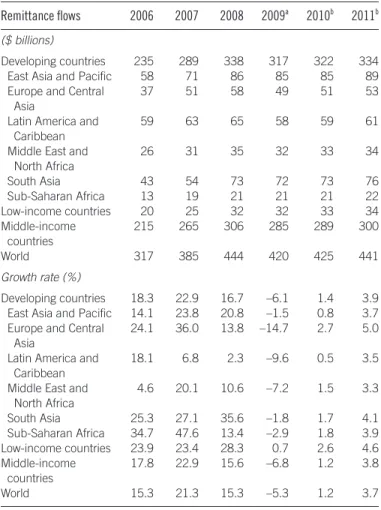
Officially recorded remittance flows to developing countries in 2008 reached $338 billion (see table 1). This is three times as large as overall official development assistance to devel-oping countries, and larger than private capital inflows in many countries. The true size of flows, including unrecorded flows through formal and informal channels, is even larger. For many states, remittances are now the largest and least volatile source of foreign exchange, and for some countries— such as Lesotho, Moldova, Tajikistan, and Tonga—they ex-ceed one third of national income.
Remittances to developing countries are estimated to have declined by 6.1 percent in 2009 as a result of weak job markets in major destination countries. Although new migration has fallen, it is still positive. The stock of international migrants, therefore, has continued to grow and remittances have remained resilient. Going forward, remittance flows to Latin America are expected to recover, whereas those to East Asia and South Asia are likely to slow. Policy responses should involve efforts to facilitate migration and remittances to make these flows cheaper, safer, and more productive for both the sending and the receiving countries.
Public Disclosure Authorized
Public Disclosure Authorized
Public Disclosure Authorized
Public Disclosure Authorized
Based on high-frequency data for the first three quarters of 2009, we estimate that remittance flows to developing countries reached $317 billion in 2009, marking a 6.1 percent decline from 2008. This decline, however, masks significant variation across the developing regions. Remittance flows to South Asia grew strongly in 2008, despite the global eco-nomic crisis; but now there are risks that they may slow down in a lagged response to a weak global economy. East Asia and Sub-Saharan Africa also face similar risks. By contrast, remit-tance flows to Latin America and the Caribbean and to the Middle East and North Africa were weaker than anticipated in 2009; but they appear to have reached a bottom already, with the expectation of a recovery in 2010 and 2011.
Remittance flows to South Asia and East Asia have proved to be stronger than our earlier expectations. Flows to Pakistan increased by 23.9 percent in 2009, and flows to Bangladesh and Nepal increased by 19.4 percent and 13.2 percent, re-spectively (figure 1). Remittance flows to the East Asia and Pacific region were also stronger than expected. In the
Philip-pines, a surge in the last quarter of 2009 increased remit-tances by 5.6 percent (figure 1) as migrants sent money to help their families affected by typhoons Ondoy and Pepeng.1
Remittance flows to countries in the Latin America and the Caribbean region in 2009 show larger declines than were expected earlier. In Mexico, they fell by 15.7 percent in 2009; and flows to El Salvador decreased by 8.5 percent (fig-ure 2). However, the decline in flows appears to be bottom-ing out in most countries across the region. This reflects the fact that the crisis in the United States and Spain (particu-larly in the construction sector)—key destination countries for Latin American migrants—started sooner than the crisis in other parts of the world.
The Europe and Central Asia region is estimated to have experienced the largest decline in remittance flows among all developing regions in 2009, in part because of deprecia-tion of the Russian ruble, relative to the U.S. dollar.
Source: Ratha, Mohapatra, and Silwal (2009).
Note: Remittances are defined as the sum of workers’ remittances, compen-sation of employees, and migrant transfers. For data definitions and the entire data set, see http://www.worldbank.org/prospects/migrationandremittances. a. Estimated.
b. Forecast.
Table 1. Remittance Flows to Developing Countries, 2006–11
Remittance flows 2006 2007 2008 2009a 2010b 2011b
($ billions)
Developing countries 235 289 338 317 322 334 East Asia and Pacific 58 71 86 85 85 89
Europe and Central 37 51 58 49 51 53
Asia
Latin America and 59 63 65 58 59 61
Caribbean
Middle East and 26 31 35 32 33 34
North Africa South Asia 43 54 73 72 73 76 Sub-Saharan Africa 13 19 21 21 21 22 Low-income countries 20 25 32 32 33 34 Middle-income 215 265 306 285 289 300 countries World 317 385 444 420 425 441 Growth rate (%) Developing countries 18.3 22.9 16.7 –6.1 1.4 3.9 East Asia and Pacific 14.1 23.8 20.8 –1.5 0.8 3.7 Europe and Central 24.1 36.0 13.8 –14.7 2.7 5.0
Asia
Latin America and 18.1 6.8 2.3 –9.6 0.5 3.5 Caribbean
Middle East and 4.6 20.1 10.6 –7.2 1.5 3.3 North Africa South Asia 25.3 27.1 35.6 –1.8 1.7 4.1 Sub-Saharan Africa 34.7 47.6 13.4 –2.9 1.8 3.9 Low-income countries 23.9 23.4 28.3 0.7 2.6 4.6 Middle-income 17.8 22.9 15.6 –6.8 1.2 3.8 countries World 15.3 21.3 15.3 –5.3 1.2 3.7 ye a r-o n -y e a r g ro w th ( % ) 50 40 30 20 10 0 Aug. 200 7 Oct . 200 7 Dec . 200 7 Feb. 200 8 Apr. 2008 Jun. 200 8 Aug. 200 8 Oct . 200 8 Dec . 200 8 Feb. 200 9 Apr. 2009 Jun. 200 9 Aug. 200 9 Oct . 200 9 Dec . 200 9 Bangladesh Pakistan Philippines
Figure 1. Remittance Flows to Bangladesh, Pakistan, and the Philippines
Sources: Central banks of the countries represented. Note: Growth of three-month moving average.
ye a r-o n -y e a r g ro w th ( % ) 25 15 5 –5 –15 –25 Jun. 200 7 Aug. 200 7 Oct . 200 7 Dec . 200 7 Feb. 200 8 Jun. 200 8 Aug. 200 8 Oct . 200 8 Dec . 200 8 Feb. 200 9 Apr. 2009 Jun. 200 9 Aug. 200 9 Oct . 200 9 Dec . 200 9 Figure 2. Remittance Flows to Latin America and the Caribbean
Sources: Central banks of the countries represented. Note: Growth of three-month moving average.
Apr. 2008 Dominican Rep. El Salvador Guatemala Honduras Jamaica Mexico Nicaragua
Remittances to the Middle East and North Africa region were also weaker than anticipated. Flows to Egypt (the largest recipient in the region) declined by 15 percent; and to Morocco, they fell by 9 percent in 2009. Sub-Saharan Africa did relatively better, with flows to Nigeria, Kenya, and Uganda showing higher growth or smaller declines than ex-pected. Remittances to Cape Verde declined in U.S. dollar terms in 2009, but were almost flat in local currency terms.
Factors That Affected Migration and Remittance Flows in 2009
The trends in global migration and remittance flows in 2009 appear to have been influenced by the following factors: (1) effects of the economic crisis on migrant stocks, (2) efforts by migrants to cut consumption, and (3) currency effects. These factors are discussed below.
Effect of current crisis on migration stocks and flows
Contrary to popular perception, remittance flows in a given year are not directly related to migration flows during the same year; instead, remittances are sent by almost the entire existing stock of migrants (that is, cumulated flows of mi-grants over the years). In understanding factors that influ-ence the impact of the current crisis on remittance trends, it is helpful to examine the impact of the crisis on the stock of international migrants. The following stock-flow equation for migration is useful in this context:
Mt= (1–d)Mt-1– Rt+ Nt, (Eq. 1) where Mt= new migrant stock, Mt-1= existing stock of mi-grants, Rt= return migration, Nt = new migration, andd is the death rate (plus assimilation rate, as applicable) of mi-grants in the host countries. Equivalently,
DMt= Nt– Rt– dMt-1, (Eq. 2) where DMt is the change in migrant stock. In other words, the change in migrant stock equals new migration net of re-turn migration and deaths (and assimilation) of existing mi-grants.
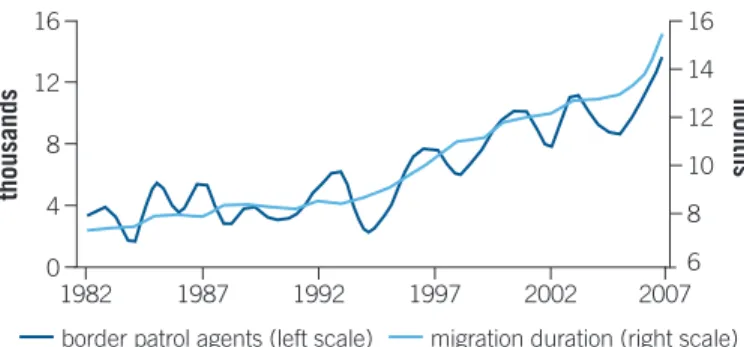
There is little evidence of return migration (Rt)as a result of the financial crisis in Europe and the United States. On the contrary, there are widespread reports that migrants are unwilling to return to their countries of origin, fearing that they may not be able to reenter once they leave because of tighter immigration controls (See Awad [2009], Fix et al. [2009], and Green and Winters [forthcoming]). Data from the Mexican Migration Project show that the duration of migration for Mexican migrants in the United States has in-creased from 8 months in the early 1990s to 15 months
more recently (figure 3). In part, the reluctance to return also reflects the significantly higher incomes that migrants are earning in the rich countries, despite the crisis.
Financial incentives to encourage return migration are also not working as expected in the Czech Republic, Japan, and Spain. In part because of the weak response to financial incentives, Spain and other European countries are now con-sidering stronger immigration restrictions. Anecdotally, em-ployers in the Gulf Cooperation Council (GCC) countries are also offering unpaid leave to migrant workers to encour-age them to return home until the economy recovers; but there appear to be few takers.
New migration flows (Nt)from many countries appear to have been affected by the financial crisis and weak job mar-kets in the destination countries, although flows are still pos-itive.2There has been a large fall in new deployments in
many migrant-sending countries; in Bangladesh, for exam-ple, migration fell by nearly half in 2009, compared with the number of migrants in the previous year. New migration from Poland and other accession countries to the United Kingdom has fallen, and the number of workers from those countries employed in the United Kingdom has plateaued since the start of the crisis.
Developing countries with migrants in the GCC coun-tries, such as Bangladesh, India, Nepal, Pakistan, and the Philippines, have experienced smaller declines in remittance flows. Dubai, which has been worst affected by the crisis, is only one of the seven emirates of the United Arab Emirates; and the only one that does not have oil. The substantial fi-nancial resources and long-term infrastructure development plans of the GCC countries imply that they will continue to demand migrant workers.
Some developing countries are also important destina-tions for migrants—for example, India, Malaysia, the Russian Federation, and South Africa. Resource-rich developing countries, such as the Islamic Republic of Iran, Libya, Nige-ria, and Sudan are also becoming attractive destinations for migrants. It is hard to predict how outward remittances from these destination countries in the South will be affected by
th o u sa n d s 16 12 8 4 0 1982 1987 1992 1997 2002 2007
Figure 3. U.S.-Mexico Border Controls and Mexican Migrants’ Duration of Stay in the United States
Sources: U.S. Department of Homeland Security; Mexican Migration Project.
m o n th s 16 14 12 10 8 6
the crisis, but some interesting cases involving currency ef-fects are discussed below.
Efforts by migrants to cut consumption
Remittances are a small share of migrants’ incomes, and they typically continue to send remittances even when hit by in-come shocks. Interviews with migrants in Dubai suggest that many migrant workers have sent their families back home and have reduced their daily expenditures in response to wage cuts by employers. Migrants are also sharing accom-modations to enable them to send remittances. Many mi-grants who have lost jobs are not leaving; rather, they are taking lower-paying jobs with other employers, and often staying on illegally. There are anecdotal reports of family members sending “reverse remittances” to help migrants.
Currency effects
Exchange rate movement can be an important factor affect-ing the U.S. dollar valuation of remittances. For example, in U.S. dollar terms, remittance flows to the Kyrgyz Republic, Armenia, and Tajikistan declined by 15 percent, 33 percent, and 34 percent, respectively, in the first half of 2009, com-pared with the same period in 2008. However, the Russian ruble lost 25 percent of its value against the U.S. dollar in the first half of 2009, compared with its average value in the same period the previous year. If measured in ruble terms, remittances to the Kyrgyz Republic actually increased 17 percent in the first half of 2009 on a year-on-year basis. In Armenia, the year-on-year fall in ruble terms was only 8 per-cent; and in Tajikistan, it was 10 percent. Similarly, a signif-icant part of the decline in remittance flows to Poland can be explained by the weakening of the British pound against the U.S. dollar.
Exchange rate movements also affect remittances through their impacts on consumption/investment motives. As high-lighted in Ratha, Mohapatra, and Silwal (2009), the depre-ciation of the Indian rupee and the Philippine peso produced a “sale effect” on housing, bank deposits, stocks, and other as-sets back home. Indeed, as the Indian rupee has depreciated more than 25 percent against the U.S. dollar, there has been a surge in remittance flows to India (figure 4). There are signs that a similar surge in investment-related remittance flows is happening in Bangladesh, Ethiopia, Moldova, Nepal, Pak-istan, the Philippines, and Tajikistan.
Outlook for Migration and Remittances in 2010–11
World Bank and International Monetary Fund estimates show that economic growth is beginning to recover after the
global slump that began in 2008. Although recovery will gather pace, according to the forecasts, growth will remain weak in 2010 and 2011, and is unlikely to reach the brisk pace seen before the crisis. In line with this outlook, and based on our methodology of forecasting remittances using a bilateral migration matrix and the World Bank’s forecasts of nominal GDP growth, we have revised our forecasts for remittances. Flows to developing countries are expected to remain almost flat in 2010 (with a modest increase of 1.4 percent) and grow by 3.9 percent in 2011 (table 1). With this sluggish pace of recovery, remittance flows are unlikely to reach the 2008 level even by 2011.
The decline in remittance flows to Latin America and the Caribbean appears to be bottoming out. However, partly be-cause of the large declines in 2009, flows to Europe and Central Asia and to Latin America and the Caribbean by 2011 are unlikely to recover to the pre-crisis levels of 2008. Flows to other developing regions are expected to remain weak in 2010–11. Although the outcome for remittances in 2009 turned out better than expected, the recovery in the coming years is expected to be more shallow.
p e rc e n t 10 9 8 7 6 5 4 3 2 1 0 Dec . 200 6 Mar . 200 7 Jun. 200 7 Sep. 200 7 Dec . 200 7 Mar . 200 8 Jun. 200 8 Sep. 200 8 Dec . 200 8 Mar . 200 9 Jun. 200 9 Sep. 200 9 Dec . 200 9 a. Interest rates
Note: LIBOR = London interbank offered rate.
ru p e e s /U S $ 52 50 48 46 44 42 40 38 Aug. 200 7
b. India exchange rate
Source: Development Prospects Group, World Bank.
Figure 4. Widening Interest Rate Differentials and Exchange Rate Depreciation in India
India policy rate
LIBOR 6-months U.S. policy rate
Dec . 200 7 Apr. 2008 Aug. 200 8 Dec . 200 7 Apr. 2009 Aug. 200 9 Dec . 200 9
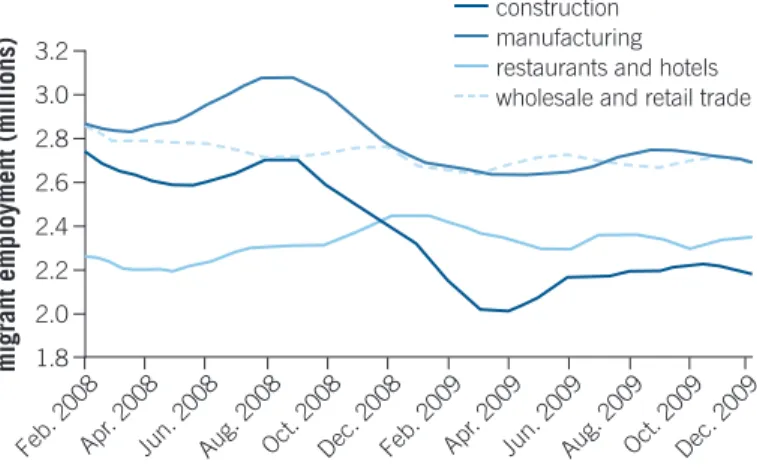
One source of risk to this outlook is that the crisis could last longer than expected. The emerging recovery in con-struction and other sectors in the United States may not be sustained after the effects of the stimulus package wear off. The recovery in construction employment in the United States has been driven in part by a credit to new home buy-ers that has stabilized migrant employment in that sector (figure 5). If this subsidy proves unsustainable, it could have a dampening impact on the housing market. The recovery in migrant employment in construction during the summer may also be seasonal. A slowdown in construction activities in the United States tends to affect remittance flows to Mex-ico with a lag of four to six months (figure 6).
Other migrant-sending countries may also experience a lagged slowdown in remittance flows in response to slowing activities in other destination countries. A deceleration in con-struction activities in the GCC countries may affect
migrant-sending countries in East Asia and South Asia. Although a re-covery in oil prices and fiscal stimulus implemented by GCC governments is likely to help maintain employment levels for existing migrants, new migration flows are unlikely to grow over the next two years. Therefore, remittances from the GCC countries may remain stable, but they are unlikely to grow rapidly for a year or two.
A second source of risk to the outlook presented here is that weak job markets and persistently high rates of unem-ployment in the destination countries may lead to further tightening of immigration controls especially for low-skilled migrants. Many economists are predicting a “jobless” global recovery. The labor market in the United States is expected to remain weak in the medium term, and unemployment rates are expected to remain high. If employment recovers only with a substantial lag to the recovery in economic out-put, then it is likely to have an impact on the employment levels and incomes of migrants—and, in turn, on their ability to send remittances.
A third source of risk is that currency movements are highly unpredictable. If the currencies of receiving countries start appreciating with respect to the U.S. dollar, then the “sale effect” (remittances for investment in cheaper assets) may reverse. This especially applies to India, which experi-enced a surge in such flows during 2008. The abnormal surge in remittances to Bangladesh and Tajikistan during 2007–08 may also prove unsustainable for the same reasons.
Policy Responses
With lower levels of foreign aid and investment likely over the short term, remittances will have to shoulder an increas-ing percentage of local development needs. Unfortunately, the greatest risk to remittance flows does not come from the economic downturn itself; instead, it comes from protec-tionist measures taken by many destination countries, in-cluding those in the developing world. There are risks that more immigration controls to protect native workers might imply a trade-off between protecting native workers from job competition and protecting businesses facing falling rev-enues. In the short term, allowing employers flexibility in hiring and firing decisions may help them cut costs and sur-vive the crisis. In the medium term, that might result in a more sustainable recovery.
Many migrant-sending countries are worried about large return migration prompted by weak job markets in destina-tion countries. Return migradestina-tion in the current crisis appears to be negligible so far; but if it happens, the workers coming back home will return with skills, entrepreneurial energy, and capital (see box 1). These workers should be provided
Jul. 2006 Jun. 200 7 Jul. 2007 Jun. 200 8 Jul. 2008 Jun. 200 9 Jul. 2009 Jun. 201 0 ye a r-o n -y e a r g ro w th ( % ) 35 25 15 5 –5 –15 –25
Figure 6. Correlation between U.S. Construction Sector Activity and Remittances to Mexico
Sources: U.S. Census Bureau; Banco de Mexico.
ye a r-o n -y e a r g ro w th ( % ) 20 0 –20 –40 –60 remittances to Mexico (left scale)
housing starts, four months earlier (right scale)
m ig ra n t e m p lo ym e n t (m il li o n s) 3.2 3.0 2.8 2.6 2.4 2.2 2.0 1.8 Feb. 200 8 Jun. 200 8 Aug. 200 8 Oct . 200 8 Dec . 200 8 Feb. 200 9 Apr. 2009 Jun. 200 9 Aug. 200 9 Oct . 200 9 Dec . 200 9 Figure 5. U.S. Migrant Employment in Construction and Manufacturing
Source: U.S. Census Bureau.
construction manufacturing restaurants and hotels wholesale and retail trade
Apr.
with help in setting up small businesses and reintegrating into their communities, not be made the object of envy or fear of job competition.
To compensate for any reduction in new migration flows, some migrant-sending countries are trying to establish guest worker programs with destination countries. India is negoti-ating mobility partnerships with some European countries. Bangladesh and Nepal are trying to negotiate the continua-tion of immigracontinua-tion quotas with Malaysia and the Republic of Korea, respectively. The Philippines is actively searching for new migrant destinations.
Several countries are beginning to look at facilitating re-mittances in the face of external financing constraints, includ-ing introducinclud-ing incentives to send more remittances through formal channels. For example, Pakistan has introduced a pro-gram that subsidizes remittance service providers for a cer-tain part of their marketing expenses, depending on the volumes transferred. Countries are also trying to facilitate cheaper and faster remittances. One of the potentially cheap-est and quickcheap-est options is money transfer using mobile
phone networks. However, significant regulatory challenges related to anti-money-laundering initiatives and efforts to counter the financing of terrorism remain for cross-border transfers using mobile phone networks.
A standard remittance is a simple financial transaction that—if lightly regulated and processed using modern technol-ogy—can cost as little as 1 percent of the amount transferred. Many remittance providers currently charge fees of more than 10 percent. Reducing remittance costs would require improv-ing competition and transparency in the remittance market, applying a simpler and identical set of regulations across state and national boundaries, and increasing the use of postal networks and mobile phone companies. Exclusive partnership arrangements between money-transfer compa-nies and the postal and banking networks of most countries are a hindrance to competition among firms offering remit-tance services. Sharing of payment platforms with multiple partners should be encouraged.
If funds were transferred through banks and other finan-cial intermediaries, migrants and their beneficiaries would
Box 1. Resilience of Remittance Flows, Relative to Other Types of Flows during the Current Crisis
Despite the prospect of a sharper decline in remittance inflows than anticipated earlier, these flows have remained more resilient than many other types of resource flows (such as private debt and equity flows and foreign direct investment that declined sharply in 2009 as foreign investors pulled out of emerging mar-kets). There are several reasons for the resilience of remittances in the face of economic downturns in host countries:
• Remittances are sent by the cumulated flows of migrants over the years, not only by the new migrants of the last year or two. This makes remittances persistent over time. If new migration stops, then remittances may stop growing over a period of a decade or so. But they will continue to increase as long as migration flows continue.
• Remittances are a small part of migrants’ incomes, and migrants continue to send remittances when hit by in-come shocks.
• Because of a rise in anti-immigration sentiments and tighter border controls, especially in Europe and the United States, the duration of migration appears to have in-creased. Those people staying in the host country are likely to continue to send remittances.
• If migrants do return to their home countries, they are likely to take accumulated savings with them. This may
have been the case in India during the Gulf War of 1990– 91, which forced a large number of Indian workers in the Gulf to return home (Ratha 2003). Also, the “safe haven” factor or “home bias” may cause remittances for invest-ment purposes to return home during an economic down-turn in the host country. Migrants not only bring back savings; they also bring business skills. Jordan’s economy performed better than many observers had expected be-tween 1991 and 1993 because of the return of relatively skilled workers from the Gulf.
• Most high-income remittance source countries in the Or-ganisation for Economic Co-operation and Development have undertaken large fiscal stimulus packages in re-sponse to the financial crisis. This increase in public ex-penditure, if directed to public infrastructure projects, will increase demand for both native and migrant workers. Taylor (2000) has found that public income transfer pro-grams in the United States resulted in increased remit-tances to Mexico: when all other things are equal, immigrant households that received social security or un-employment insurance were more likely to remit than were other immigrant households. Also, documented mi-grants are likely to send more remittances to their families to compensate for a fall in remittances by undocumented migrants.
be encouraged to save and invest. Intermediary banks could also use remittance inflows as collateral to borrow larger sums in international credit markets for local investments.
The development community can leverage remittance flows for development by making them cheaper, safer, and more productive for both the sending and the receiving coun-tries. An “International Remittances Agenda,” as summarized in figure 7, would involve (1) monitoring, analysis and pro-jections, (2) improving retail payment systems through use of better technologies and appropriate regulatory changes, (3) linking remittances to financial access at the household level, and (4) leveraging remittances for capital market access at the institutional or macroeconomic level.
Notes
1. Remittance flows to Haiti are also likely to surge in 2010, in response to the devastating earthquake in January; see http://www.ssrc.org/features/pages/haiti-now-and-next/13 38/1438/.
2. Green and Winters (forthcoming) have examined mi-gration trends during several past crises (in the 1831–1913
period and the Great Depression in the 1930s), and con-clude that host-country economic factors usually were a much stronger determinant of migration than were origin-country factors. Passel and Suro (2005) report a similar find-ing for Mexican migration to the United States in the 1992–2004 period. (See also Hatton and Williamson 2009.) About the Authors
Sanket Mohapatra is an economist and Dilip Ratha is a lead economist in the Development Prospects Group of the World Bank. This note draws on Migration and Development Briefs 8 through 11, published between November 2008 and November 2009 (coauthored with Ani Silwal), http://go.worldbank.org/SS W3DDNLQ0; and on “Dollars Without Borders” by Dilip Ratha, published in Foreign Affairs, October 16, 2009, http:// www.foreignaffairs.com/articles/65448/dilip-ratha/dollars-without-borders. For more information, see the PeopleMove blog at http://peoplemove.worldbank.org.
Figure 7. International Remittances Agenda
1. Monitoring, analysis, projection
•size, corridors, channels •countercyclicality
•effects on poverty, education, health, investment
•policy (costs, competition, exchange
controls 4. Capital market access
•private banks and corporations (securitization)
•governments (diaspora bonds) •sovereign credit rating
Source: Authors’ elaboration. Note: MFI = microfinance institution.
2. Retail payment systems
•payment platforms/instruments •regulation (clearing, settlement,
capital adequacy, exchange controls, disclosure, cross0border arbitration) •anti-money-laundering/countering
financing of terrorism 3. Financial access
•deposit and saving products •loan products (mortgages,
consumer loans, microfinance) •credit history for MFI clients •insurance products
References
Awad, Ibrahim. 2009. The Global Economic Crisis and Migrant Workers: Im-pact and Response. Geneva, Switzerland: International Migration Pro-gramme, International Labour Organization.
Fix, Michael, Demetrios G. Papademetriou, Jeanne Batalova, Aaron Ter-razas, Serena Yi-Ying Lin, and Michelle Mittelstadt. 2009. “Migration and the Global Recession: A Report Commissioned by the BBC World Service.” Migration Policy Institute, Washington, DC. http://www.mi grationpolicy.org/pubs/MPI-BBCreport-Sept09.pdf.
Green, Tim, and L. Alan Winters. Forthcoming. “Economic Crises and Mi-gration: Learning from the Past and the Present.” U.K. Department for International Development, London.
Hatton, Timothy, and Jeffrey G. Williamson. 2009. “Global Economic Slumps and Migration.” Vox EU, http://www.voxeu.org/index.php?q=node/3512.
Passel, Jeffrey S., and Roberto Suro. 2005. “Rise, Peak, and Decline: Trends in U.S. Immigration 1992–2004.” Pew Hispanic Center, Washington, DC. http://pewhispanic.org/files/reports/53.pdf.
Ratha, Dilip. 2003. “Workers’ Remittances: An Important and Stable Source of External Development Finance.” In Global Development Finance 2003: Striving for Stability in Development Finance,chapter 7. Washing-ton, DC: World Bank.
Ratha, Dilip, Sanket Mohapatra, and Ani Silwal. 2009. “Migration and Re-mittance Trends 2003: A Better-Than-Expected Outcome for Migration and Remittance Flows So Far, But Significant Risks Ahead.” Migration and Development Brief 11.
Taylor, J. Edward. 2000. “Do Government Programs ‘Crowd In’ Remit-tances?” Inter-American Dialogue and the Tomas Rivera Policy Institute, Washington, DC.
The Economic Premise note series is intended to summarize good practices and key policy findings on topics related to economic policy. It is produced by the Poverty Reduction and Economic Management (PREM) Network Vice-Presidency of the World Bank. The views expressed here are those of the authors and do not necessarily reflect those of the World Bank. The notes are available at www.worldbank.org/economicpremise.