Market Analysis for the Solar Home
Builder Partnership Program
Final Report
Prepared by: Tetra Tech
Prepared for: We Energies and the We Energies
Renewable Energy Collaborative
December 20, 2011
Market Analysis for the Solar Home Builder
Partnership Program
Final Report
Prepared by: Tetra Tech
Prepared for: We Energies and the We Energies
Renewable Energy Collaborative
December 20, 2011
Prepared by Tetra Tech
Tetra Tech
6410 Enterprise Lane, Suite 300 | Madison, WI 53719
Tel 608.316.3700 | Fax 608.661.5181
TABLE OF CONTENTS
1.
Executive Summary ... 1-1
1.1 Introduction 1-1
1.2 Phase 1 Key Findings and conclusions 1-2
1.2.1 Influence of solar electric on home buyers‘ purchase decisions 1-2 1.2.2 Home builders‘ views and likelihood of incorporating solar in new homes 1-2 1.2.3 Home builders‘ perceptions in other states with more developed markets 1-2 1.2.4 Home buyers‘ awareness and knowledge of solar electric photovoltaic
systems 1-2
1.3 Phase 1 Recommendations 1-3
1.3.1 Education 1-3
1.3.2 Incentives 1-3
1.3.3 Policy Development 1-4
1.4 Phase 2 Key Findings 1-4
2.
Introduction ... 2-1
2.1 Background on the Solar Home builder Partnership Program 2-1 2.2 Characteristics and cost for the solar electric photovoltaic Systems in Programhomes 2-3
2.3 Scope of Work for Wisconsin Solar Market Analysis 2-4
3.
Phase 1 Data Collection Methodology ... 3-1
3.1 In-Depth Interviews 3-1
3.1.1 Solar and Non-solar home buyer in-depth interviews 3-1
3.1.2 Program stakeholder in-depth interviews 3-2
3.1.3 Tim O‘Brien Homes real estate agent in-depth interviews 3-2 3.1.4 Wisconsin solar home builder in-depth interviews 3-2 3.1.5 Other state solar home builder in-depth interviews 3-3 3.1.6 Interview with Niels Wolter, Wisconsin Focus on Energy Renewable
Energy Program 3-4
4.
Phase 1 Key Findings ... 4-1
4.1 Interviews with Solar and Non-Solar Home buyers 4-1
4.1.1 General factors in purchase decision 4-1
4.1.2 Influence of solar electric PV system on purchase decision. 4-1
4.1.3 Operation of the solar electric PV System 4-4
4.1.4 Characteristics of Home buyers Interviewed 4-5
4.2 Interviews with Wisconsin Solar Home builders 4-6
4.2.1 The current market and barriers for solar electric in new homes in
Wisconsin – 4-6
4.2.2 Opinions on factors stimulating growth in the solar market for new homes
in Wisconsin 4-9
4.2.3 What else is still needed to stimulate the market for solar electric PV in
new home construction? 4-10
4.2.4 Lessons learned from the solar home builder partnership program 4-11 4.3 Interviews with Tim O‘Brien Homes‘ Real Estate Agents 4-13 4.3.1 The current market for solar electric in new homes in Wisconsin 4-13 4.3.2 Factors that will stimulate growth in the residential market 4-13 4.3.3 Barriers to growth in the residential solar electric PV market 4-14
iv 4.3.4 Influence of interest in energy efficiency and solar in purchase decisions 4-15 4.3.5 Prospective home buyers‘ reactions to the solar electric photovoltaic
systems 4-17
4.3.6 Real estate agents‘ views about resale with a solar electric PV system 4-18 4.3.7 Real estate agents‘ preparedness to sell solar homes and additional sales
tools needed. 4-19
4.3.8 Final thoughts from the real estate agents 4-19
4.4 Interviews with Solar Home builders in Comparison States 4-20 4.4.1 The solar home markets in the comparison states appear to be more
robust and perceived as growing, in contrast to the market in Wisconsin 4-20 4.4.2 Home buyers in the comparison states are more likely to seek out and
demand solar generation as one of the features of a new home. 4-20 4.4.3 Federal and state incentives are seen as welcome, but not necessary by
builders. 4-21
4.4.4 Environmental considerations are reported to be a strong driver of the
purchase of new homes with solar generation capability 4-21 4.4.5 Solar electric generation capability is widely perceived to add value to a
home. 4-21
5.
Phase 1 Conclusions and Recommendations ... 5-1
5.1 Conclusions 5-1
5.1.1 Solar was a positive feature, but not a primary factor in purchase
decisions for most of the spec solar homes. 5-1
5.1.2 Solar homes attract positive comments and interest from family, neighbors, friends, and colleagues of homeowners, as well as other
builders. 5-1
5.1.3 There is currently not enough demand for builders to construct solar spec
homes in Wisconsin. 5-1
5.1.4 There are several key barriers to growth of the residential new
construction solar market in Wisconsin 5-1
5.1.5 Some factors are expected to stimulate the solar new-home market 5-2 5.1.6 Education is needed for residential home builders, appraisers, real estate
agents, and others in the new home industry. 5-2
5.2 Recommendations 5-3
5.2.1 Education 5-3
5.2.2 Case Studies 5-3
5.2.3 Incentives 5-3
5.2.4 Policy Development 5-4
6.
Phase 2 Comparison of the Energy Use Behavior of Solar and Non-Solar
Households ... 6-5
6.1 Solar Home Systems 6-5
6.2 Utility and Solar Output Data and Data Collection 6-6 6.3 Energy Use Behavior of Solar and Non-solar Households 6-7
6.4 Electricity Supply from the Solar System 6-8
6.5 Solar System Performance 6-9
1. EXECUTIVE SUMMARY
1.1
INTRODUCTION
We Energies partnered with Tim O‘Brien Homes and Neumann Developments to design and implement the Solar Home Builder Partnership Program. Twenty-three ‗spec‘ homes were built in 12 pairs1—one home in each pair featured a 3 kW solar photovoltaic (PV) energy generation system and the other home would be nearly identical in size and layout, but without the solar photovoltaic energy generation system. In some cases the homes were co-located within the same development; in other cases they were in separate near-by locations. A variety of incentives and the federal solar investment tax credit were used to reduce the cost of the solar photovoltaic energy generation system. Prospective home buyers were offered the opportunity to roll the cost of the solar electric photovoltaic system into their mortgage, resulting in an incremental payment of $36 per month for a 30-year fixed rate mortgage at 5 percent interest.
This Project, conducted in two phases as part of We Energies Renewable Energy
Development (RED) Program, was designed to help inform and educate the solar electric PV market in Wisconsin.
The Project identified four key research objectives for Phase 1:
Identify the influence of a solar electric photovoltaic system on home buyers and home builders‘ decision-making processes.
Understand Wisconsin home builders‘ views of solar electric photovoltaic systems and the likelihood that they will incorporate solar electric systems in future home construction.
Document differences in perceptions between home builders in Wisconsin and home builders in other states where the residential solar market is more developed.
Identify strategies to enhance Wisconsin home buyers‘ awareness and knowledge of solar electric technologies and benefits.
The data for the Phase 1 analysis were collected in the spring of 2011 through a series of qualitative in-depth interviews with program stakeholders, buyers of the solar and non-solar homes built for the program, Wisconsin home builders, solar industry experts in Wisconsin, real estate agents who showed and sold the 23 spec homes, and home builders in other states with a more developed solar home market.
Completed in the fall 2011, Phase 2 was an analysis of electricity consumption of the 12 matched pairs of solar and non-solar homes for an eight month duration. We examined the effectiveness of the installed photovoltaic systems, evaluated their performance over time, and compared the energy use behavior of solar and non-solar homeowners. Detailed results of the Phase 2 analysis are provided in Chapter 6.
1
1. Executive Summary
1-2
1.2
PHASE 1 KEY FINDINGS AND CONCLUSIONS
1.2.1
Influence of solar electric on home buyers’ purchase decisions
a. For most home buyers, including those who purchased a solar or a non-solar spec house, the solar electric photovoltaic system was viewed as a positive feature, but was not one of the major factors that drove the purchase decision.
b. Solar home buyers report overwhelmingly positive comments and expressions of interest from family, friends, neighbors, and colleagues regarding their solar home.
1.2.2
Home builders’ views and likelihood of incorporating solar in new homes
a. Wisconsin home builders who are active in the solar market see a lot of consumer interest and potential demand for solar homes, but they report the “economics” are not yet right, so many interested new home buyers eliminate solar when it gets down to budgetary decisions.
b. Wisconsin home builders do not see enough demand to build spec solar homes, but there is growing interest in information about solar homes from Builders‟ Associations. c. Real estate appraisals of the spec solar homes did not currently reflect the investment
required to install a solar electric photovoltaic system. There are still some homeowners‟ associations that prohibit rooftop solar panels in subdivisions.
1.2.3
Home builders’ perceptions in other states with more developed markets
a. Home builders in the comparison states are more knowledgeable in the technology and have fewer misconceptions about the requirements for solar electric generation and the suitability of their climate for residential solar electric photovoltaic systems.
b. Home builders in comparison states are more likely to build entire solar subdivisions or offer solar electric generation as a feature on new homes they build. New homes that do not have a solar electric system are constructed to be „solar ready.‟
c. Home builders in comparison states are less likely than Wisconsin home builders to feel that significant incentives are required to make solar electric installations attractive to home buyers.
1.2.4
Home buyers’ awareness and knowledge of solar electric photovoltaic systems
a. Real estate agents report that a solar home was not on most home buyers‟ list offeatures, even though they were interested when there was an opportunity to see a solar home.
b. Tim O‟Brien Homes and their solar installer report that prospective home buyers had low levels knowledge and asked many unanticipated “practical” questions about the
1. Executive Summary
durability, operation, and maintenance requirements of the solar electric system and the solar panels.
c. Prospective home buyers do not have an accurate perception of the cost of installing a solar electric photovoltaic system, the cost savings, required ongoing maintenance, or the payback.
1.3
PHASE 1 RECOMMENDATIONS
1.3.1
Education
We Energies could consider working with other investor-owned utilities and renewable energy stakeholder groups to increase awareness, reduce the knowledge gap and promote accurate perceptions among key groups, such as buyers, home builders, developers, and other building trade groups. This could include activities such as the following:
a. Sponsor model homes and demonstration projects to showcase new solar electric and renewable energy technology and build awareness for residential applications
b. Develop a resource for home builders and the home building trades with technical information about solar electric systems‟ specifications, requirements, and performance in Wisconsin
c. Develop a resource from the perspective of a home buyer, with information about technologies, costs and benefits, decision points, ongoing operation and maintenance and advice about talking to a builder regarding the addition of a solar electric system. d. Publish results of the performance of the solar electric photovoltaic systems in the
Project to provide actual Wisconsin data and experience
1.3.2
Incentives
We Energies could consider working with Focus on Energy and other investor-owned utilities to identify appropriate incentives to reduce the payback on residential solar electric
installations to encourage continued development of the residential solar market. Incentives, however, need to be applied with care to avoid market dependence.
a. Solar home builders estimate that payback for a residential solar electric photovoltaic system in Wisconsin is 12-16 years2 and the builders we spoke with believe that most home buyers want a payback of 10 years or less.
b. Continuing incentives for solar installations will help to increase the number of solar electric installations and help to encourage new manufacturers to build components, helping to reduce the upfront cost of a residential solar electric system
2
This payback calculation and other comments about the economics of solar photovoltaic systems was accurate at the time of the project. However solar prices have dropped, resulting in a shorter pay-back at the time of this report.
1. Executive Summary
1-4
1.3.3
Policy Development
We Energies could consider working with regulators, the state legislature, and relevant state government agencies to encourage development of statewide policies, including state leadership initiatives and uniform net-metering rules across the State.
a. A state leadership initiative and strategy, such as California‟s Million Solar Roofs Initiative, will signal a long-term commitment to encourage home builders and solar electric PV manufacturers.
b. Simplifying and streamlining the net-metering and interconnection rules and regulations that home builders and the industry have to work with will encourage more builders to enter the solar market and work across service area.
1.4
PHASE 2 KEY FINDINGS
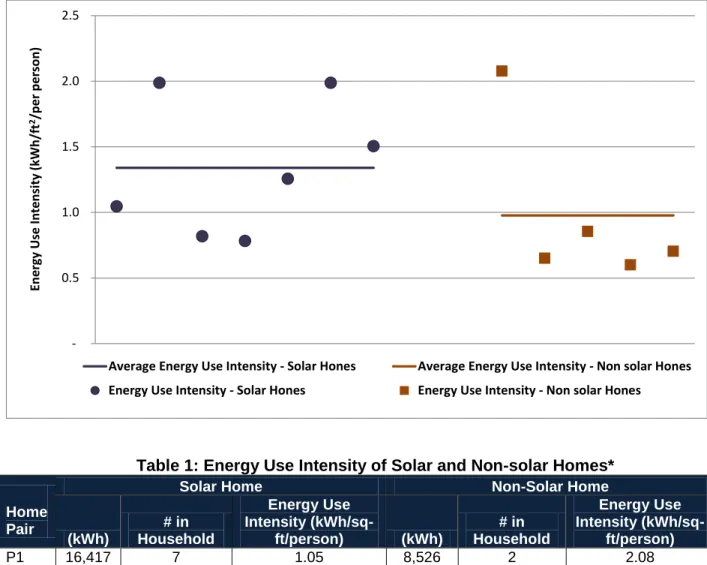
Solar households appear to have higher average energy use intensity than the non-solar home counterparts: For solar households, the average energy use intensity is 1.34 kWh/sq-ft/person based on a sample of seven solar homes. The same measure for non-solar home households is 0.98 kWh/sq-ft/person based on a sample of five households. This finding should be viewed as tentative and interpreted with caution due to small sample sizes of households for both solar and non-solar homes, as well as the short duration (eight months) of the study.
3 kW solar systems supply on average, 37% of the household monthly electricity requirement: Monthly output from twelve solar systems and the monthly electricity consumption from as many households were analyzed for a period of eight months (January 2011 through August 2011). The solar output ranged between 18% and 60% of the total household electricity consumption.
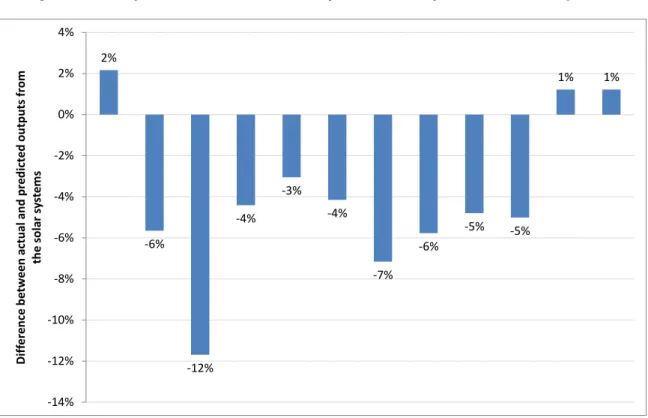
Solar systems are performing as expected: Actual energy output from the solar systems is close to their pre-installation estimates, indicating robustness in the system design and installation. Out of the twelve systems, the average (over eight months) difference between the actual and the predicted outputs for eight systems is within ±5%. Only one system exhibited a difference of more than 10%.
2. INTRODUCTION
2.1
BACKGROUND ON THE SOLAR HOME BUILDER PARTNERSHIP PROGRAM
We Energies‘ goal for this study is to better understand customers‘ and builders‘ perceptions and attitudes toward solar electric power and to be prepared to meet customer demand for information about solar energy options.
As part of this effort to support the development of the solar market, We Energies partnered with Tim O‘Brien Homes, Neumann Developments, and Renewable Energy Solutions (now Solar Innovations) to build 23 new ―spec‖ homes in southeastern Wisconsin. The 23 ―spec‖ homes were built in 12 pairs—one home in each pair featured a 3 kW solar photovoltaic (PV) energy generation system and the other home would be nearly identical in size, layout, and location, but without the solar photovoltaic energy generation system. All 23 homes were built to ENERGY STAR® specifications and exceeding the National Association of Home Builders (NAHB) Green Building criteria for new homes. In most cases, the builder installed the major appliances. Each pair of homes was designed to be comparable in terms of energy use, as much as possible, excluding the differences in characteristics of the homeowners.
As part of the Program, We Energies provided incentives to reduce the cost of the solar photovoltaic energy generation system. These incentives, along with the available Wisconsin Focus on Energy incentives, helped to more closely equalize the construction costs for the home builders between the solar and non-solar homes. The home builder also advised home buyers of the available federal solar investment tax credit for purchasing a home with solar electric generation capability.
All of the 23 homes were built in southeastern Wisconsin in the We Energies‘ service territory. When purchasing a home, buyers agreed to participate in the study, by allowing We Energies to monitor the household energy consumption, so that a comparative analysis could be conducted to identify differences in energy consumption between the solar and non-solar homes.
Table 2.1 shows the characteristics and location of the 12 pairs of new homes constructed for the Solar Home Builder Partnership Program.
2. Introduction
2-2 Table 2.1: Characteristics and Location of Pairs of Homes for Solar Home Builder Partnership Program
Type of
Home
City
Zip Code
County
kW
Home
Design
Sq. Ft. finished
Solar
Kenosha
53142
Kenosha
3.024 2 - Story
2,244
Non-Solar
Kenosha
53142
Kenosha
NA
2 - Story
2,052
Solar
Milwaukee
53224
Milwaukee
2.940 2 - Story
2,195
Non-Solar
Milwaukee
53224
Milwaukee
NA
ranch
2,030
Solar
Waukesha
53186
Waukesha
2.940 2 - Story
2,387
Non-Solar
Waukesha
53186
Waukesha
NA
2 - Story
2,386
Solar
Jackson
53037
Washington 2.940 2 - Story
2,348
Non-Solar
Jackson
53037
Washington
NA
2 - Story
2,348
Solar
Jackson
53037
Washington 3.024
ranch
1,811
Non-Solar
Jackson
53037
Washington
NA
ranch
1,867
Solar
Kenosha
53142
Kenosha
3.024 2 - Story 3,067 (bsmnt)*
Non-Solar
Kenosha
53142
Kenosha
NA
2 - Story
2,125
Solar
Kenosha
53142
Kenosha
3.024 2 - Story
2,113
Non-Solar
Kenosha
53142
Kenosha
NA
2 - Story
2,196
Solar
Waukesha
TBD
Waukesha
3.080
ranch
2,290
Non-Solar
Waukesha
53186
Waukesha
NA
ranch
1,887
Solar
Jackson
53037
Washington 2.940 2 - Story
2,349
Non-Solar
Port Washington
53074
Ozaukee
NA
2 - Story
2,348
Solar
Jackson
53037
Washington 2.940
ranch
1,915
Non-Solar
Jackson
53037
Washington
NA
ranch
1,867
Solar
Jackson
53037
Washington 2.940
ranch
1,915
Non-Solar
Jackson
53037
Washington
NA
ranch
2,247
Solar
Pewaukee
53072
Waukesha
2.940 2 - Story 4286 (bsmnt)*
Non-Solar
Waukesha
53188
Waukesha
NA
2 - Story
2,426
2. Introduction
2.2
CHARACTERISTICS AND COST FOR THE SOLAR ELECTRIC PHOTOVOLTAIC
SYSTEMS IN PROGRAM HOMES
For the Solar Home Builder Partnership Program, 3 kW fixed solar electric photovoltaic systems were installed on each of the 12 ‗solar homes.‘ The 3 kW system was estimated to produce an average of 312 kWh of electricity per month or 3,740 kWh per year.
To reduce the difference in the cost of building the solar and non-solar homes, a variety of available incentives were used. Table 2.2 shows the typical cost of the 3 kW solar electric photovoltaic system installed in the Program homes3.
Table 2.2: Incentives and Net Cost for Solar Electric Photovoltaic System in Program Homes
Costs and Incentives
Amount
Typical System Cost (3 kW)
$24,000.00
WI Focus on Energy rebate ($1.50/kWh)*
(5610.00)
We Energies buy-down ($0.75/kWh)*
(2805.00)
We Energies Cash Back Reward ($2,000/kW)
(6000.00)
30% Federal solar investment tax credit
(taken after other incentives applied)
(-$2,875.50)
**
Net System Cost (3 kW)
$6,709.50
* Based on the estimated annual kWh production of 3,740kWh per year
** Federal solar investment tax credit paid to homeowner, all other incentives paid to the builder
Prospective home buyers were offered the opportunity to roll the cost of the solar electric photovoltaic system into their mortgage. Tim O‘Brien Homes provided analyses that showed that the Net System Cost of $6,700 for a 3 kW (from Table 2.2) would require an increase of $36 per month in the monthly payment for a 30-year fixed rate mortgage at 5 percent interest. The analysis used by Tim O‘Brien Homes showed that in Year 1, the system would generate an average of $33 per month in electricity savings to the homeowner. As the rate per kWh that is charged for electricity increases, the amount of homeowners‘ electricity bill savings will increase. The analysis also noted that in annual terms, the 3,740 kWh of electricity estimated to be generated would offset the typical annual consumption of many household appliances, including a refrigerator, freezer, washing machine, and clothes dryer combined.
3
2. Introduction
2-4
2.3
SCOPE OF WORK FOR WISCONSIN SOLAR MARKET ANALYSIS
There are two phases to the Project. In Phase 1 the Tetra Tech research team used
qualitative in-depth telephone interviews to collect information from home buyers, Wisconsin home builders, home builders in other states with more developed solar home markets, and the Program stakeholders.
The Phase 1 research was designed to help educate and build awareness of the solar electric PV opportunities in Wisconsin. The Project identified five key research objectives:
Phase 1
Identify the influence of a solar electric photovoltaic system on home buyers and home builders‘ decision-making processes
Understand Wisconsin home builders‘ views of solar electric photovoltaic systems and the likelihood that they will incorporate solar electric systems in future home construction
Document differences in perceptions between home builders in Wisconsin and home builders in other states where the residential solar market is more developed.
Identify strategies to enhance Wisconsin home buyers‘ awareness and knowledge of solar electric technologies and development benefits.
Phase 2
Completed in the fall 2011, Phase 2 was an analysis of electricity consumption of the 12 matched pairs of solar and non-solar homes for an eight month duration. We examined the effectiveness of the installed photovoltaic systems, evaluated their performance over time, and compared the energy use behavior of solar and non-solar homes. Detailed results of the Phase 2 analysis are provided in Chapter 6.
3. PHASE 1 DATA COLLECTION METHODOLOGY
3.1
IN-DEPTH INTERVIEWS
In Phase 1, a series of qualitative in-depth interviews were conducted with Solar Home Builder Partnership Program stakeholders, buyers of the solar and non-solar homes built for the program, Wisconsin home builders, and home builders in other states with a more developed solar home market. In total, the following Phase 1 in-depth interviews were conducted by telephone:
Interview Target
Number of Interviews
Solar home buyers 7
Non-solar home buyers 4
Program stakeholders 4
Tim O‘Brien Company real estate agents 3
Wisconsin solar home builders 3
Wisconsin home builder association 1
Wisconsin Focus on Energy solar program expert 1 Solar home builders in other states 4
Total number of interviews 27
A description of the methodology employed to conduct the in-depth interviews with each group is presented below.
3.1.1
Solar and Non-solar home buyer in-depth interviews
A total of 11 in-depth interviews were conducted with buyers of the homes constructed as part of the Program—seven interviews with buyers of the solar homes and four interviews with buyers of non-solar homes. A list of home buyers, along with contact information and address was provided by Tim O‘Brien Homes for twenty-three of the spec homes constructed for the Program. One of the homes with a solar electric photovoltaic system was still being used as a demonstration model and was unsold at the time of the Phase 1 data collection.
The twenty-three home buyers were contacted by telephone and, in some cases, by e-mail (if the home buyer could not be contacted by telephone) and asked to schedule an in-depth interview regarding their decision to purchase their Tim O‘Brien-built home. An incentive of $50 was offered for their participation, in the form of a Visa or MasterCard gift card. All of the
homeowners we were able to speak to agreed to participate in the interview.
The interviews were conducted by telephone and the interviews were taped, with the home buyers‘ permission. Interviews lasted from 20-40 minutes. The home buyers were first asked to describe the general factors involved in their purchase decisions, without specifically asking about the influence of the solar electric photovoltaic system. Solar home buyers were then asked if the solar electric system had an influence on their purchase decision, and generally about their experience operating the solar electric system to date. Non-solar home buyers were asked about their awareness of the availability the solar electric systems on some Tim O‘Brien Homes. If they were aware, they were then asked whether this influenced their purchase decision. Finally, all respondents were asked a series of demographic questions. A complete copy of the Home Buyer In-depth Interview Guide is in Appendix A.
3. Phase 1 Data Collection Methodology
3-2
3.1.2
Program stakeholder in-depth interviews
The following Program stakeholders were interviewed;
Carl Siegrist and Jessica Thibodo-Johnson from We Energies who were instrumental in the design and management of the Program; and
Tim O‘Brien from Tim O‘Brien Homes and Matt Matrise from Solar Innovations (formerly Renewable Energy Solutions) who were responsible for the design, implementation, and management of the Program from the home builder side.
The Program stakeholder interviews asked about perceptions of the solar new home market in Wisconsin, relative to other states, factors that stimulate the market, barriers to market
development in Wisconsin, and objectives and lessons learned to date from the Solar Home Builder Partnership Program. Interviews were scheduled with each of the four stakeholders and conducted by telephone and recorded with their permission. Each interview lasted 30-45
minutes.
A copy of the Program Stakeholder In-depth Interview Guide is provided in Appendix A.
3.1.3
Tim O’Brien Homes real estate agent in-depth interviews
Tim O‘Brien Homes provided the names and contact information for three real estate agents who had been most involved in showing and selling the 23 spec homes. Interviews were scheduled with each of the three real estate agents and conducted and taped with their permission. Each interview lasted 30-35 minutes. These agents worked with Tim O‘Brien Homes and both showed and sold a number of the 23 spec homes built for the Program. The real estate agents were asked for their assessment of the solar home market in Wisconsin, the factors that influenced home buyers‘ purchase decisions for the 23 spec homes, the reaction of home buyers to the solar electric photovoltaic systems, and their level of comfort with selling the solar homes.
A copy of the Tim O‘Brien Homes Real Estate Agent In-depth Interview Guide is provided in Appendix A.
3.1.4
Wisconsin solar home builder in-depth interviews
Interviews were conducted with four Wisconsin home builders who have been active in the construction of new homes with solar electric generation capability. The initial goal of this task was to interview builders who constructed spec solar homes. However, research indicated there were no Wisconsin home builders constructing spec solar homes at this time. The twelve spec solar homes constructed for this Program are among the very few that have been constructed in Wisconsin.
Therefore the interviews focused on builders of solar custom homes. To identify these builders we contacted the Wisconsin Green Building Alliance and received a list of four builders. We also interviewed a representative from the Metropolitan Builders Association in Milwaukee.
3. Phase 1 Data Collection Methodology
The Wisconsin solar home builders were asked about their experience in constructing new homes with solar generation capability, their view of the current state of the solar new home market in Wisconsin, the current barriers to market development, and factors that might
stimulate the market. The four Wisconsin home builder interviews were conducted by telephone and taped with the respondents‘ permission. The interviews lasted 20-30 minutes. A copy of the Wisconsin Solar Home Builder In-depth Interview Guide is in Appendix A.
3.1.5
Other state solar home builder in-depth interviews
Interviews were conducted with well-known solar home builders in four different states—states that were assumed to have a more developed market for solar new home construction than Wisconsin. The goal of these interviews was to compare responses of these home builders with Wisconsin home builders to the same questions.
Based on discussions with We Energies staff, California, Arizona, Colorado, and Massachusetts were selected as the comparison states, using the assumption that the solar home market in each of these states is more developed than the Wisconsin market. Table 3.1 shows a comparison of solar initiatives and incentives available in the comparison states as of March 2011. Table 3.2 shows the average residential electric rate in each state, as of November 2010 from the Energy Information Administration website at the following link:
(http://www.eia.doe.gov/cneaf/electricity/epm/table5_6_a.html) Table 3.1: Characteristics of Comparison States
State Current Solar Initiatives/Incentives Residential Incentive Amount
California California Solar Initiative Based on expected performance Massachusetts Commonwealth Solar II Rebates $8,500
Arizona
Sales tax waived, personal income tax credit, no
property tax adjustment Variable Colorado Residential Renewable Energy Rebate Program $10,000
Wisconsin Focus on Energy - Renewable Energy Incentives Based on rated capacity - 30% max
Table 3.2: Average Residential Electric Rate in Comparison States
State
Ave. Residential Electric Rate (cents per KWh) California 15.20 Massachusetts 14.71 Arizona 10.15 Colorado 10.39 Wisconsin 12.76
To identify solar home builders in each of the four comparison states, we conducted an Internet search of reports, news articles and stories about solar homes in the four states. A prominently mentioned solar home builder was identified and interviewed in each of the four comparison states.
3. Phase 1 Data Collection Methodology
3-4 The interviews with home builders from the comparison states used the same topics—their experience in constructing new homes with solar generation capability, their view of the current state of the solar new home market in their state, the factors that have stimulated the current market, and the current barriers to market development. Interviews were conducted by telephone with the four home builders from the comparison states and taped with their permission. The interviews lasted 20-30 minutes.
A copy of the Other State Solar Home Builder In-depth Interview Guide is in Appendix A.
3.1.6
Interview with Niels Wolter, Wisconsin Focus on Energy Renewable Energy Program
An interview was conducted with Niels Wolter, the Wisconsin Focus on Energy solar market expert to provide background information on the market in Wisconsin and the outlook in Wisconsin and in other comparison states.4. PHASE 1 KEY FINDINGS
4.1
INTERVIEWS WITH SOLAR AND NON-SOLAR HOME BUYERS
A total of 11 interviews were conducted with buyers of the Tim O‘Brien ‗spec‘ homes
constructed as part of the Solar Home builder Partnership Program—seven interviews were conducted with buyers of the solar homes and four interviews were conducted with buyers of the non-solar homes. All of the home buyers sampled and contacted for this study were very cooperative and willing to participate in the 30-45 minute interview.
The detailed findings from the 11 in-depth interviews are discussed below.
4.1.1
General factors in purchase decision
Initially, respondents were asked a series of open-ended questions, with no mention of a solar electric photovoltaic (PV) system, to gauge the relative importance of the solar system among the many different factors that influenced their purchase decision.
a. For most solar home buyers who purchased a spec house, the solar electric PV system was not one of the major factors in their decision to purchase the house.
Two of the solar home purchasers expressed an interest in a solar home prior to the homes being constructed, indicating that the solar system was a primary factor in their purchase decision. The five other solar home buyers purchased a spec home that had already been completed and the solar electric PV system had been installed. For these five spec solar home buyers, the most important factors in their purchase decision were typically the layout, location (including school district), the lot, and the quality of the construction. Four of these buyers of spec solar homes did not mention the presence of the solar electric PV system as one of the most important factors in their purchase decision in an open-ended question. One of the five spec solar home buyers, however, indicated that the solar electric system was a major factor in their purchase decision:
“We looked at this house, and then immediately we were drawn back to it. It all had to do with the solar panel system. If we were going to buy a home, we would rather take our chances in buying something like this than something that isn't solar-panel related. Somebody who's not educated in the solar panel system was interested enough to know that I'd rather have something like this than any other house around me.”
4.1.2
Influence of solar electric PV system on purchase decision.
a. Even though it was not one of the major purchase drivers for four of the spec solar home buyers, the solar electric PV system was viewed as a “plus.”
All of the solar home buyers described the solar electric system as a positive feature of the home they purchased. Even though four spec solar home buyers did not mention the solar electric PV system as one of the most influential factors in their purchase decision (in
response to an open-ended question), all viewed the presence of the solar electric PV system as a ―plus.‖ One respondent said:
4. Phase 1 Key Findings
4-2 “I think the solar is a positive. I think it's an asset. It makes the house more valuable.”
b. For most of the non-solar home buyers who had also viewed a solar home, the solar electric PV system was seen as a positive feature. For these non-solar home buyers, other factors, such as the layout, location, and lot prompted them to purchase one of the non-solar homes.
The non-solar home buyers interviewed all expressed an interest in Tim O‘Brien Homes because of the builder‘s reputation for constructing energy efficient homes. The non-solar homeowners seemed as interested and receptive to solar technology as the solar home buyers. These non-solar home buyers seemed open to the idea of a solar home (when they saw one), but purchased a non-solar home for other reasons. Two of the non-solar home buyers reported their initial interest in looking at one of the Tim O‘Brien model homes was due to the solar electric PV system. In both cases, it seemed that these home buyers might have purchased a solar home if the model they looked at had met their other requirements. According to one respondent, timing was the reason they purchased their non-solar home:
“We actually see [solar electric technology] as a positive; if this home would have been ready and had [a solar electric system] on it, we may have considered it. We needed to [move] now; we didn't want to wait for another house. This one was going to be better than what we had, so we decided if we needed to retrofit later, we could decide then whether we wanted to do wind or solar.”
Other comments from non-solar home buyers included the following:
“I think it would be a positive for sure. You're talking about harvesting your own energy. I wouldn't look down on one. I would have considered one had there been one in [respondent‟s city].”
“I did not know there were solar electric PV homes in the area. I did not know if there was one available for me to look at. I would have been interested in looking at one, especially if it would have been the same design as the home I have now. With respect to the above comment, it should be noted that since pairs of houses (one solar and one non-solar) were constructed in the same specific local area, it may have been the case that the solar home in that area had already been sold or was under construction at the time of the purchase decision.
c. Most of the solar and non-solar home buyers had only minimal level of knowledge of solar technology and how the solar electric PV system. Many of the solar home buyers expressed confidence in the builder as an offset to specific knowledge of the solar electric PV technology.
While most of the solar and non-solar home buyers indicated that they were aware of solar electric technology being used in residential homes, most reported only a very general level of knowledge about solar technology or how the solar electric PV system would function. Two respondents reported conducting research on their own to learn more about the technology before looking at any Tim O‘Brien models, but in the other cases, buyers purchased their
4. Phase 1 Key Findings
homes without knowing much about solar electric technology or the solar electric PV system. One respondent said:
“Nobody really knew a lot about the solar system, except that it offsets your utility bill; for that, it was positive.”
d. Most solar home buyers who purchased spec homes were not aware of the cost of the solar electric PV system or how much the solar electric PV system added to the price of the home they purchased.
One solar home buyer reported that a third party electrical company indicated that the solar electric PV system probably cost about $40,000. Other solar home buyers reported they had not heard anything about the cost of the solar electric PV system. When asked what they thought the solar electric PV system might have cost, most solar home buyers estimated a cost of $10,000-$15,000.
The two solar home buyers who had requested a solar home prior to construction had differing perceptions of the additional cost that the solar electric PV system added to their home. One believed the solar electric PV system added about $20,000 to the cost of the home, while the other believed it added $6,000-$8,000 to the cost of the home.
The solar home buyers who were not aware of the cost of the solar electric PV system were asked what amount, if any, they would have been willing to pay to have the solar electric PV system installed on their new home. Most responded that they would be willing to pay about $10,000 for the solar electric PV system. However, one respondent indicated he would not have been willing to pay an additional amount for the solar electric PV system, without a better explanation of the amount he could expect the solar electric PV system to save him on his electricity bill.
e. Solar and non-solar home buyers generally did not express concerns about the appearance of the solar panels on the roof.
None of the solar home buyers or the non-solar home buyers who had seen one of the Tim O‘Brien Homes with an solar electric PV system felt the solar panels on the roof detracted from the appearance of the house, although some felt that it was preferable to have the panels on the back, so they were not visible from the street. Other respondents felt that the design of the solar panels was much more attractive (lower profile and fitting the contour of the roof) than they had expected.
Several respondents noted that the solar panels are more attractive than a satellite dish, which many people don‘t mind putting on their roofs. One respondent even indicated that the solar panels looked ―cool.‖
“I get people telling us that it looks like a rich home; it adds to it. And you can clearly see them from the road.”
“From the back of the house and looking at it, it looks really great with the solar panels. It looks really nice. I know people probably wonder how it works, and can I get something like that on my house?”
4. Phase 1 Key Findings
4-4
4.1.3
Operation of the solar electric PV System
Most solar home buyers had lived in their new home for less than one year. None of the solar home buyers had lived in a residence with a solar energy system, such as a solar water heater or a solar electric PV system, prior to their current residence. None of the solar home buyers expressed any concerns or complaints about the operation of the solar electric PV system in their home.
a. Solar home buyers did not report any concerns or problems with the operation of the solar electric PV system.
The solar home buyers did not have major reservations about the reliability, maintenance or safety of the equipment. One respondent mentioned a concern about snow hampering the operation of the solar electric PV system. Another indicated uncertainty about what to do in the event of a power outage. However, all solar home buyers expressed a high level of satisfaction with their new home and the solar electric PV system.
b. All solar home buyers report significant savings on their We Energies electricity bills. Solar home buyers report monthly savings ranging from $40 to more than $100. Those respondents who have lived in their homes in both summer and winter reported higher savings in summer, as expected. Following are some comments from solar home buyers regarding their electricity bill savings:
“It absolutely has had an effect; not so much in the winter months, maybe 10% savings, but in summer, it basically cut my bill in half.”
“I would say in this house a normal bill would be about $300 bill in the winter. Ours is $100 to $200.”
c. Solar home buyers report positive comments from family, friends and neighbors regarding the solar electric PV system.
One respondent noted that their family is known as the ―solar people‖ around their
community, and indicated that their solar house is better known than they are at many of the local area shops. Other comments from solar home buyers are as follows:
“When I tell people in my family that we saved at least $40 or more every month on energy bill and the house is nice and warm and feels great, they think that's excellent and wish they had that ability. It's given good conversation, where people are actually starting to think that maybe this is something that they should look into. It's making people think when they see you can do this, maybe I can do this. It's not something that's out there that people are talking about and can't relate to. Now they know people who have an ENERGY STAR home and solar panels. They can see it and ask questions about it; I think they're excited for us.”
“At work, I'm an electrical engineer, and I can't tell you how many conversations I've had with people about solar, where they find out about it, and people I don't know very well. Word gets around, and people are asking me all kinds of questions about solar.”
4. Phase 1 Key Findings
d. Solar home buyers generally perceive that the solar electric PV system will have a positive effect on the resale value of their home, but are not able to quantify the amount. While most solar home buyers feel that the solar electric PV system will increase the resale value of their home, some expressed concerns about the cost of maintenance and upkeep for the solar electric PV system, which could work against an increase in resale value. For these solar home buyers, the costs of maintenance and upkeep are an unknown at this time. Comments about the effect of the solar electric PV system on the resale value of their home included the following:
“It kind of forces [people] to look at the green way of doing things; and I think that they think that it was a smart decision for us to go for a green home over just a regular home that's just being built in an area. It attracts attention. Every single quality about this house is going to be better for resale than one that's next to me.” “I think it would be an extremely good selling point, because in this day and age, when people are trying to save any way they can, when they know that a home, a new home, has all these great amenities and solar panels on top of that to cut energy bills, people are going to think it's great.”
The solar home buyer who expressed some reservations about the potential enhancement to the resale value of the home noted that any added expenditures for maintenance or upkeep might offset a modest decrease in electric bills.
“When we first moved in, we felt like it [the solar electric PV system] was a plus; but with the way the economy is, we don't know if it would be a plus. Seeing we get a third [off of our] utility bill, that's kind of a plus, but with the way that the economy is, I don't know if that would be enough of a plus for somebody to say, “I'd take your house over somebody else's if there were additional expenses.”
4.1.4
Characteristics of Home buyers Interviewed
Table 4.1: Solar Home buyer Characteristics
Year born Highest education level Number in household Annual household income Contributors to household income
Respondent 1 1975 Bachelor's degree 5 $125,000 - $150,000 2 Respondent 2 1969 High school 7 $75,000 - $100,000 1 Respondent 3 1978 Bachelor's degree 5 $100,000 - $125,000 2 Respondent 4 1972 Bachelor's degree 4 $100,000 - $125,000 1 Respondent 5 1983 Advanced degree 2 $175,000 - $200,000 2 Respondent 6 1959 Bachelor's degree 1 $50,000 - $75,000 1 Respondent 7 1980 Advanced degree 2 $125,000 -$150,000 2
4. Phase 1 Key Findings
4-6 Table 4.2: Non-solar Home buyer Characteristics
Year born Highest education level Number in household Annual household income Contributors to household income
Respondent 1 1972 Master's degree 3 $175,000 - $200,000 2 Respondent 2 1981 Bachelor's degree 3 $100,000 - $125,000 2 Respondent 3 1962 Bachelor's degree 4 $125,000 - $150,000 1 Respondent 4 1981 Bachelor's degree 2 $50,000 - $75,000 2
4.2
INTERVIEWS WITH WISCONSIN SOLAR HOME BUILDERS
In-depth interviews were conducted with Tim O‘Brien from Tim O‘Brien Homes and Matt Matrise from Solar Innovations, both stakeholders and partners with We Energies in the Solar Home Builder Partnership Program. In addition, in-depth interviews were conducted with three other Wisconsin home builders currently offering solar homes to customers and the Metropolitan Home Builders‘ Association in Milwaukee.
4.2.1 The current market and barriers for solar electric in new homes in Wisconsin –
a. Currently the market in Wisconsin is stronger than it is generally perceived to be,especially in the nonprofit sector.
The Wisconsin solar home builders believe that the market for solar electric PV systems in Wisconsin is stronger than most industry observers would expect. They report that at national conferences and in discussions with others in the industry, Wisconsin is generally considered an unfavorable market. However, they think the market for solar in Wisconsin is actually flourishing, especially in the nonprofit sector, where they have seen exponential growth in the past few years.
“Interest is strongest in the nonprofit world; that‟s where most of our jobs come from currently. We do solar electric PV for churches and schools. We also do some residential solar jobs, but the nonprofit sector is where the demand for solar is strongest. That is because of available incentives, and intangible benefits, such as environmental and educational. Schools and large congregations are more interested in these types of benefits; when you have a large group of people pushing it, it‟s easier.”
b. While there appears to be a lot of consumer interest and potential demand for solar homes, the “economics” are not yet right, so most interested new home buyers often eliminate solar when it gets down to budgetary decisions.
There is a lot of interest and apparent consumer demand for solar electric systems, but in the final analysis, when it comes down to cost, most customers decide to go with other amenities, such as granite countertops or wood floors, rather than installing a solar electric system. Wisconsin home buyers are reported to be conservative and frugal. Solar is not something people feel they need to have and it is has yet reached a status as a ‗fashionable‘ feature in
4. Phase 1 Key Findings
new homes. Even for those home buyers who are interested in solar, solar is the first thing that gets removed when they look at budgets.
c. The perception in the home builder industry is that the payback for solar is too long for most home buyers, even with available rebates and tax credits.
The general consensus in the industry is that a payback of 7-9 years is the longest period that is acceptable to many home buyers. Once the payback exceeds 10 years, home buyers don‘t see an economic benefit to installing solar electric generation in their home.
Tim O‘Brien Homes believes the current payback for solar is 12 to 16 years, even when accounting for Focus on Energy rebates and the federal solar investment tax credit. The federal solar investment tax credit played a big role in moving people into renewable energy, but other forms of renewable energy are currently viewed as more cost-effective (with a shorter payback) than solar. The builder feels that for the Solar Home Builder Partnership Program, if the We Energies subsidy was removed, geothermal becomes more cost-effective than solar. Tim O‘Brien Homes feels that home builders can demonstrate a payback on natural gas to geothermal of 7-9 years. In Wisconsin, many home builders feel that
geothermal is going to pay back quicker than solar and it‘s something consumers know more about. Once you explain the geothermal system, it is similar to a traditional furnace, which makes home buyers more comfortable than using something like solar which still seems like a new technology.
“The biggest hurdle is the upfront cost; people generally want to do solar, because they know it‟s the right thing to do environmentally. This makes building „green‟ the easiest hurdle. The upfront financial cost is pretty tough; that and education; a lot of people have heard of it, but don‟t know what it does or are a little bit scared of new technology.”
“[For financing in the Solar Home Builder Partnership Program] We looked at it as 3 kW system, we job-costed it around $9,000. Depending upon the type of panels we were buying; later on, the cost was about $8,000; and that‟s taking the We Energies rebate into consideration. With a couple of clients, the only way we could get them to do it was to take the rebate right off the top; we took rebate to help lower the cost basis. Also, in two cases, we actually financed in-house the tax credit portion of the system. When clients got their federal solar investment tax credit back, they paid off the loan at 0% financing. People (or builders) are doing this around the country. We are looking into this, but in a lot of cases, the project is not big enough to offset overhead with leasing systems.”
d. Misperceptions and a lack of knowledge among new home buyers is a barrier to developing the solar market in new homes in Wisconsin.
Wisconsin home builders report there are misunderstandings about how a solar electric photovoltaic system works. One common misperception is that solar is not appropriate for Wisconsin‘s climate. One builder uses Germany as a model, showing that Germany is one of the highest users of solar electric photovoltaic systems in the world, even though they have a similar climate and latitude as Wisconsin. Other misunderstandings include a lack of
knowledge about required maintenance and the durability and life expectancy of the solar electric system components, such as the solar panels.
4. Phase 1 Key Findings
4-8 “Some people shy away from solar because of their concern about what their future expenses might be, such as a 5-8 year timeframe to replace the inverter. People are also concerned about the toughness and warranty of the panels. It appears that people are adding up lifecycle costs in their head. We didn‟t expect this in the beginning and we found people weren‟t willing to pay us for the solar because of future concerns for replacement. These were not people who were driven to solar because of environmental concerns. Among these home buyers there is still a concern about the total cost of solar. It gets back to the discussion about the economic benefits.”
e. Many Wisconsin home builders are reluctant to change the way they have been building houses.
Wisconsin home builders are resistant to venture into solar electric systems. Because it seems to be a relatively unknown area, they are unwilling to change the way they have always built houses. The specialized group of solar home builders currently operating in Wisconsin has sufficient demand for solar homes to keep busy, with custom residential and nonresidential building. However, there has not yet been a sufficient level of home buyer demand to convince builders to move into solar spec home construction.
f. Some Wisconsin builders are not familiar with the improved appearance of the newer solar panels
.
Some Wisconsin builders are concerned that prospective home buyers will view solar panels as detracting from the overall appearance of a new home. There are also restrictions in some subdivisions against rooftop solar panels. However, some builders, such as Tim O‘Brien Homes, report that new improvements in panel design have created a wider array of choices for new homes and home buyers who do not like the look of the older style of panels often end up liking the new cylindrical models.
g. Appraisals of homes with solar electric PV systems often do not reflect the cost of installation
.
Tim O‘Brien Homes reported that appraisals were a continual challenge during the Solar Home Builder Partnership Program. It was rare when an appraisal of one of the solar electric PV homes reflected the cost of installing the solar electric PV system. For appraisers, one of the problems is the lack of ―comparables‖ sold in the same area. Tim O‘Brien Homes reports this was also an issue with geothermal systems. It is a ―catch-22‖ situation where home builders with a commitment to renewable have to discount the systems in order to get more of them built and do a better job of educating clients and other parties, such as appraisers.
h. There is a shortage of solar electric photovoltaic system installers with North American Board of Certified Energy Practitioners (NABCEP) certification in Wisconsin.
The person who installs a solar electric photovoltaic system has to have NABCEP certification in order to get the Focus on Energy rebate and the federal solar investment tax credit. To date, there is a shortage of installers with NABCEP certification. There has also been a greater demand for space in the NABCEP certification courses—currently there are more than four times as many applicants as there are spaces in the local programs.
4. Phase 1 Key Findings
4.2.2
Opinions on factors stimulating growth in the solar market for new homes in
Wisconsin
a. Prices for labor and components for solar electric PV systems are expected to decrease.
Over time, the supply of NABCEP-certified installers will catch up with demand. That will begin to drive down the labor component of solar electric PV systems. In addition, the cost of components, such as panels and inverters will also come down as manufacturing takes place on a larger scale.
b. New larger designs for solar panels enable them to generate more electricity.
Tim O‘Brien Homes are now installing panels that produce 235 watts per panel. On the first trend homes, they installed panels that produced 185 watts per panel.
c. The concept of making new homes “solar ready” is starting to catch on among Wisconsin home builders.
To make a new home solar-ready, it only costs about $250 for conduit and installation. Some builders are also taking into account the positioning of the house on the lot to make future conversion to solar easier. If the house is positioned correctly, and the conduit is installed, the house is essentially solar ready.
d. Federal solar investment tax credits may motivate more manufacturers to build panels and components.
The longer-term availability of tax credits will likely motivate more manufacturers to build panels and components, and more home builders to begin discussing solar with clients.
e. Future energy prices are likely to increase, which will stimulate interest in solar electric technology.
Some home builders and others in the industry believe that future increases in energy prices are going to stimulate an increased interest in solar electric technology among home buyers. Some builders point to an increased interest in solar in new home construction a few years ago when gasoline prices rose significantly.
f. It is not clear whether the driving force for new home construction with solar electric PV systems will come from home builders or consumers and home buyers.
According to one builder, a lot of new home markets are conservative markets. He feels that in these markets the mainstream builders still tend to look at solar as something that‘s going to come and go. They view an uptick in interest or demand as a potentially brief blip.
Especially in today‘s new home market, some builders don‘t expect interest and demand for solar and renewable energy to come back for 10-15 years. There are stories of builders trying to talk customers out of installing solar or geothermal, using incorrect numbers and data to show that the cost-benefit ratio is not favorable.
4. Phase 1 Key Findings
4-10 One builder noted:
“In terms of getting to mainstream market, I think the demand for solar is going to have to be consumer-driven. I just don‟t see builders doing this. Consumers are going to have to bring it up to builders, because builders have a hard enough time selling what they have now.”
On the other hand, one of the Program stakeholders involved in building the solar spec homes reported:
“I did receive some calls from consumers, but more calls from builders (about the spec solar homes). Metropolitan Builders Association drove some builders to call. I had some calls from builders and a developer saying, “I see what Tim‟s done out there, I want to talk about that and see what we could do as well.”
“I‟ve personally talked to ten or more builders that have had interest and I know that some have moved on it. Tim O‟Brien Homes has done the most, but I know there are talks going on at the Metropolitan Builders Association and in their Green Building Council on taking solar electric photovoltaic systems a step further and making it a standard feature that is offered in new home construction.
4.2.3
What else is still needed to stimulate the market for solar electric PV in new
home construction?
a. Incentives are needed to overcome the upfront cost barrier to solar electric PV systems. The combination of federal investment tax credits, rebates from Focus on Energy, and other rebate or incentive programs from electric utilities provides a combined package that could have a significant impact on home buyer decisions.
b. Standardization of interconnection rules between utilities in the State of Wisconsin would help to make solar electric PV systems easier to install.
Standardizing how interconnection rules are applied to govern how solar electric generating systems actually connect to the grid would make it easier for home builders and developers to offer solar electric systems and develop building programs that cut across utility service territories.
c. Education for home builders and home buyers is needed to increase the likelihood that solar electric technology is considered in new home construction.
There are a relatively small number of home builders in Wisconsin who offer custom solar homes. Only one other builder in Milwaukee offers spec solar homes, outside of the Solar Home Builder Partnership Program. Both Tim O‘Brien and Matt Matrise regularly field questions from other builders and developers about solar electric technology. Their perception is that most home builders are not prepared to provide a sufficient amount of information to prospective home buyers if they were asked about a solar electric PV system. Similarly, most home buyers have only a very general level of awareness of solar electric technology.
4. Phase 1 Key Findings
d. Developers need to have someone on staff that is familiar with solar electric technology and can explain the benefits and costs to potential home buyers.
If developers had someone on staff that was familiar with solar electric technology, they could develop a standardized set of options to be offered to home buyers. The options could range from the relatively inexpensive ones, such as making their new home ―solar ready‖ for future installation to more comprehensive options for installing solar electric PV systems. Offering solar options to the features to be selected for a new home would expose more home buyers to the idea and probably result in more installations.
4.2.4
Lessons learned from the solar home builder partnership program
As part of the interviews with Tim O‘Brien (from Tim O‘Brien Homes) and Matt Matrise (from Solar Innovations), we asked them to discuss the lessons they had learned from the Solar Home Builder Partnership Program. In summary, Tim O‘Brien indicated
a. Reactions of prospective home buyers to the solar electric PV systems were almost all positive, but selling solar electric PV homes in the current housing market is difficult. A lot people who visited the model solar electric PV homes thought it was ―cool‖ and
innovative. This seemed to be especially true for people with higher education levels. Most of the time, people were interested, but ultimately were not willing to commit money to it. Tim O‘Brien indicated he would not be confident of being able to sell homes for a higher price because of the solar electric photovoltaic system in the current housing market. When home prices drop, it is harder for people to justify adding the cost of a solar electric photovoltaic system. He feels it could be two to five years before people start actively looking at solar electric PV systems in new construction again.
b. It is important to be able to accurately address home buyers‟ concerns about the maintenance, durability, and cost of maintaining the solar electric PV system. Tim O‘Brien indicated that the Program underscored the need to better anticipate and address the fears and concerns, and lack of understanding about the technology of home buyers. He and Matt Matrise indicated they had not anticipated the number and range of questions, such as ―what happens if a basketball lands on the solar panel?‖ or ―what happens when the panels get covered by snow?‖ or ―who do I call if the solar electric PV system breaks down or doesn‘t function properly?‖ Both felt they got three to five years‘ worth of feedback from home buyers in a condensed 18-month timeframe as a result of participating in this Program.
c. It is important to keep promoting renewable and solar electric technology, even if they aren‟t building many houses in the next few years.
Given the need for increasing home builders‘ and home buyers‘ awareness and knowledge about solar electric technology, it is important that builders such as Tim O‘Brien Homes, who have a long-term commitment to renewable energy, maintain the momentum developed by this program. This will include working the MBA and Green Building Council, networking with
4. Phase 1 Key Findings
4-12 other interested home builders and developers, and helping to provide information and educational materials for home buyers.
“We tried to put [the model solar electric homes] in communities that would be receptive—where you would expect to find $235,000-$300,000 homes. We wanted to give exposure to the product, so we strategically placed them on busy streets and corners. People see them when they are driving around, so we kept a model home or two, so we could demonstrate and talk to people and groups about them.” “We will continue promoting solar electric PV systems for residential new
construction; that‟s one of our market differentiation points. Even if we‟re not going to be building as many [solar electric homes], people still call us wanting feedback and background. We continue to get calls from builders as well—they say they have a client that wants solar electric and they want to know who to contact.” d. We need to improve the education of the real estate sales agents with respect to the
solar electric PV systems.
Matt Matrise indicated that, in retrospect, he may have focused too much on a general overview of solar technology and not enough on the specific features and characteristics of the solar electric photovoltaic system that was installed on the spec homes for the program. There was a lot of information to digest in a single briefing. Matt indicated that he ended up meeting with two of the solar electric PV home buyers to answer questions and give them more information.
There are also a lot of ‗unknowns‘ about how the solar electric photovoltaic system will perform on specific homes and the maintenance and upkeep that is required. It will be
important to capture these types of data, as well as feedback from solar electric homeowners for future sales efforts.
e. There is a need to educate building inspectors, community homeowner associations, and appraisers about the benefits and advantages of solar electric PV systems on residential homes.
There were several cases where community homeowner associations had regulations against rooftop panels. Further, in one metropolitan community, the local building inspector was adamantly against solar. He told the builders ―there is no way I‘m going to allow that.‖ It was eventually approved, but there are likely to be other building inspectors with similar views in Wisconsin.