Cost analysis for high-volume and long-haul transportation
of densified biomass feedstock
Daniela Gonzales, Erin M. Searcy, Sandra D. Eks
ß
iog˘lu
⇑Department of Industrial and Systems Engineering, Mississippi State University, P.O. Box 9542, Mississippi State, MS 39762, United States
a r t i c l e
i n f o
Article history: Received 9 July 2012
Received in revised form 12 December 2012 Accepted 3 January 2013 Keywords: Densified biomass Barge transportation Rail transportation Truck transportation Regression analysis
a b s t r a c t
Using densified biomass to produce biofuels has the potential to reduce the cost of deliv-ering biomass to biorefineries. Densified biomass has physical properties similar to grain, and therefore, the transportation system in support of delivering densified biomass to a biorenery is expected to emulate the current grain transportation system. By analyzing transportation costs for products like grain and woodchips, this paper identifies the main factors that impact the delivery cost of densified biomass and quantifies those factors’ impact on transportation costs. This paper provides a transportation-cost analysis which will aid the design and management of biofuel supply chains. This evaluation is very important because the expensive logistics and transportation costs are one of the major barriers slowing development in this industry.
Regression analysis indicates that transportation costs for densified biomass will be impacted by transportation distance, volume shipped, transportation mode used, and ship-ment destination, just to name a few. Since biomass production is concentrated in the Mid-western United States, a biorefinery’s shipments will probably come from that region. For shipments from the Midwest to the Southeast US, barge transportation, if available, is the least expensive transportation mode. If barge is not available, then unit trains are the least expensive mode for distances longer than 161 km (100 miles). For shipments from the Midwest to the West US, unit trains are the least expensive transportation mode for dis-tances over 338 km (210 miles). For shorter disdis-tances, truck is the least expensive trans-portation mode for densified biomass.
Ó2013 Elsevier Ltd. All rights reserved.
1. Introduction
Several studies focus on the feasibility of increasing renewable energy production in response to the Energy Indepen-dence and Security Act (EISA) of 2007. As stated in the Renewable Fuel Standard (RFS) program, the minimum level of renew-able fuels used in the US transportation industry is expected to increase from 9 billion gallons per year (BGY) in 2008 to 36 BGY in 2022 (EPA, 2012). Renewable energy should supplant conventional fossil fuel use and consequently decrease US dependence on foreign oil. A number of issues make attaining those goals a challenge including the lack of an efficient technology to convert biomass to biofuel, the uncertainty of biomass supply, and the high logistics costs for delivering bio-mass to biorefineries (Petrolia, 2008; Hess et al., 2009).
In order to minimize logistics costs, the production of first generation corn- and soybean-based biofuels has mainly relied on local biomass resources. Raw biomass, such as baled herbaceous biomass, is bulky, aerobically unstable, and has poor flowability properties, all of which pose logistics challenges and increase supply chain costs. In order to minimize
transpor-0965-8564/$ - see front matterÓ2013 Elsevier Ltd. All rights reserved. http://dx.doi.org/10.1016/j.tra.2013.01.005
⇑ Corresponding author. Tel.: +1 662 325 9220; fax: +1 662 325 7012. E-mail address:[email protected](S.D. Eksßiog˘lu).
Contents lists available atSciVerse ScienceDirect
Transportation Research Part A
j o u r n a l h o m e p a g e : w w w . e l s e v i e r . c o m / l o c a t e / t r atation related costs, the traditional supply chain model used by corn-based biorefineries locates biorefineries within an 80 km (50 mile) radius of corn farms (Aden et al., 2002). The limited amount of biomass available within this collection ra-dius does not justify investments in large-scale biorefineries. Consequently, traditional biorefineries have low production capacities and do not benefit from the economies of scale associated with high production volumes (Searcy and Flynn, 2008). This is one of the reasons why biofuels have not been cost competitive with fossil fuels. The production of first gen-eration biofuels has also initiated a nation-wide debate on food versus fuel.
Second generation biofuels utilize agricultural and forest residues, and energy crops as feedstock. Yet, first and second generation biofuels have different properties than conventional fossil fuels, such as high acidity, high moisture content, or high oxygen content. Due to these properties, fuels with a high concentration of ethanol, such as E85, can corrode some types of metal and can make some plastics brittle over time. As a consequence, today’s vehicles cannot run on highly concentrated ethanol blends. Additionally, the pipeline system currently in place for fossil fuel transportation cannot be utilized for trans-porting biofuels. The next generation of biofuels, referred to as drop-in fuels, is expected to overcome those challenges and will become interchangeable with conventional fossil fuels.
However, all types of biobased energy will continue to face biomass feedstock transportation and other logistics chal-lenges, mainly due to physical characteristics of raw biomass. Recent reports published by the Idaho National Laboratory (INL) propose a commodity-based, advanced biomass supply chain design concept to support large-scale production of bio-fuels (Hess et al., 2009; Searcy and Hess, 2010). This design concept is substantially different from the feedstock logistics model utilized by conventional biorefineries and moves preprocessing of raw biomass, e.g., operations such as drying and densification, to earlier stages in the supply chain. Preprocessing increases the bulk density of the material, resulting in a densified, pellet-like product. This paper refers to the product as densified biomass as opposed to pelletized biomass, since the latter is a specific process. Handling and transportation costs for densified biomass are lower than for raw biomass. Thus, using high capacity transportation for long-hauls becomes an option worth investigating. High capacity transportation gives biorefineries the opportunity to increase the biomass collection radius past 80 km (50 miles), and as a consequence, increase biomass availability and reduce feedstock supply risk. A recent study bySearcy and Flynn (2008)indicates that the theoret-ical optimum size for an ethanol plant using corn stover as a feedstock, assuming a yield of 0.32 metric tons per hectare, is approximately 220 million gallons per year (MGY). These results are consistent withWright and Brown (2007), which states that, depending on the conversion technology used, the theoretical optimal size for corn-based ethanol plants is 79 MGY and 240–486 MGY for lignocellulosic-based ethanol plants. Wright and Brown (2007)assume: (a) a typical/average biomass yield per acre, and (b) biomass yield and availability are consistent within the plant-draw radius. Due to very high capital costs compared to conventional biorefineries, advanced biofuel plants should operate at high capacity in order to be econom-ical. The annual biomass processed by such a plant is expected to be 4.7–7.8 million tons annually. This corresponds to receiving 513–852 truck shipments of biomass daily, the equivalent of receiving 120–200 rail cars daily or 9–15 barges daily. In order to supply so much biomass, transportation modes that are economical for shipping large volumes of densified bio-mass over long distances, such as rail and barge, should be utilized. Additionally, using barge and rail does not impact traffic in the communities around the biorefinery and consequently does not raise traffic-safety challenges.
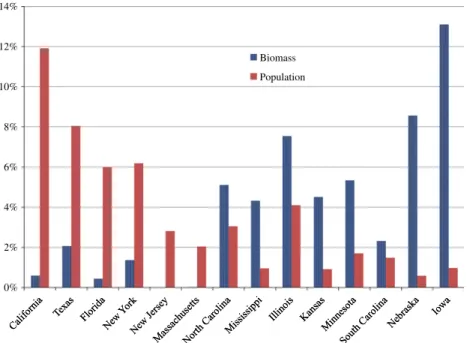
Fig. 1presents the distribution of population and biomass by US states. The figure presents only those 14 states with a big gap between the amount of biomass available and the population size. For example, 12% of the nation’s population lives in California, yet only 0.59% of the available biomass for production of biofuels is found in California. Only 0.97% of the country’s population lives in Iowa, yet 13% of US biomass is available in Iowa.Fig. 1shows that the majority of the population lives in the East and West US; however the majority of the biomass is available mainly in the Midwest and South. As a result, long-haul delivery of biomass or biofuels is needed to satisfy fuel demand.
Locating biorefineries closer to demand rather than supply is not a new concept. Pacific Ethanol, for example, is located closer to demand in California, and Oregan. The company receives shipments of corn by rail from the Midwest. Using high capacity transportation modes such as unit rail and barge, for high-volume and long-haul shipment of biomass results in increased biomass supply at biorefineries. Increases in cost due to the long-haul transportation of biomass should be com-pensated by the savings coming from the economies of scale in biofuel production, savings resulting from shorter transpor-tation distances to deliver biofuel to customers and the reduced risk innate to having access to a larger pool of suppliers.
The goal of this paper is to analyze the impact of rail, truck and barge transportation on transportation costs of densified biomass. The existing literature details transportation-cost analysis for densified biomass in the form of pellets, cubs and bales when shipped by trucks (Sokhansanj and Turhollow, 2004, 2006; Badger and Peter, 2006; Rogers and Brammer, 2009). Literature discussing pipeline transportation (Searcy et al., 2007; Ileleji et al., 2010; Judd et al., 2011), and rail trans-portation of biomass (Mahmudi and Flynn, 2006; Searcy et al., 2007; Bonilla et al., 2009; Sokhansanj et al., 2009; Ileleji et al., 2010; Judd et al., 2011) has also been explored. Rail transportation studies mainly discuss distance-based fuel costs and load/ unload costs per ton of biomass. However, our research suggests that no studies exist on transportation of densified biomass by barge. Our research contributes to the existing literature by providing a thorough analysis of the main factors which im-pact transportation cost for densified biomass in the US through barge and rail. Some of the biggest factors affecting cost include railcar ownership, railway service provider, competition with other transportation modes, and shipment origin and destination. This paper proposes a number of regression equations which can be used to estimate rail transportation costs. These equations are developed using actual tariffs charged by railway companies for products which have similar char-acteristics to densified biomass. This is important because the data set used consist of existing tariffs similar to what biofuels industry will be facing.
The numerical analysis presented below uses transportation cost data available for products with physical characteristics similar to densified biomass, such as grain and woodchips. Our research assumes that, due to similar physical characteristics, loading, unloading, and transportation activities for densified biomass are very similar to these products, and consequently, transportation costs for densified biomass will be affected by the same factors. High capacity transportation and hauling densified biomass over long distances can easily leverage on the existing transportation and handling equipment designed for the well-established grain industry. Rail transportation is expected to be the mode of choice for long distance and high-volume biomass transportation because rail transportation costs are lower than truck transportation costs. Also, because of the rail network is larger and it is easier to access than barge, this paper mainly focuses on rail transportation.
2. Background on transportation of bulk products
Grains in the US are shipped to domestic and foreign markets through barge, rail and truck. Barge is the most cost-effi-cient mode of transportation. Thus, if available, barge is a strong competitor to railroads for long-distance movement of grain. While portions of the Corn-Belt states have suitable access, many other regions where biomass is plentiful do not have navigable waters. The size of rail networks and their easy of access makes rail transportation preferable to barge for long-haul and high-volume shipments of grains. For these reasons, the biomass supply system of the developing biofuels industry should rely on rail transportation; thus, this paper concentrates on analyzing rail transportation costs.
2.1. Rail transportation
The majority of US rail transportation is handled by four Class I railway companies. In the East are Norfolk Southern (NS) and CSXT Corporation, and in the West are Burlington Northern Santa Fe Corporation (BNSF) and Union Pacific Railroad Com-pany (UP) (CBO, 2006). Rail transportation costs are impacted by various factors, including but not limited to government acts and policies, which commodity is transported, and the viability of alternative forms of transportation, whether inter-modal or intrainter-modal.
Rail transportation has a lower per-ton–kilometer cost compared to truck transportation. Rail transportation has an advantage compared to barge transportation due to its ease of accessibility and the rail network’s larger size. Therefore, rail is the transportation mode of choice for long distance and high-volume shipments of bulk products, such as agricultural products. However, the limited capacity of the rail transportation network is a major disadvantage, mainly due to the high investment costs required to build and maintain rail lines and the fact that railroads are privately owned as opposed to, for example, highways constructed and maintained by the government (CBO, 2006). Typically, private companies are reluctant to make capital investments in anticipation of future demand for their services.
In order to improve the productivity of rail lines and increase equipment utilization, railway companies offer lower tariffs for aggregate shipments. Aggregate shipments reduce the number of railcar switching in freight yards and lower the in-tran-sit time and inventory-carrying costs (CBO, 2006). Thus, railway companies can maintain their service level with
signifi-12% 14% 10% Biomass Population 8% 6% 2% 4% 0%
cantly fewer resources. These incentives encourage shippers to use shuttle and unit trains. However, a unit train cannot be loaded and unloaded at every rail ramp, and certain infrastructure requirements should be met to operate them. Usually, the infrastructure necessary to operate a unit rail is built by blenders, refiners, and third-party providers. Infrastructure devel-opments are typically slow due to the high investment requirements and the long process of securing construction permits. Meeting the requirements set by RFS will increase the flow of biomass to biorefineries and the flow of biofuels to markets, and companies could take advantage of the existing railway infrastructure. However, an increase in the number of unit train origins and destinations will still be necessary to facilitate the increased flow in railways.
2.2. Barge transportation
Barge has historically been used to ship agricultural products such as corn, feed grains, sorghum, and soybeans, from the Midwest to the Gulf Port along US agricultural waterways. Exported agricultural products, such as oats, are also transported along these waterways from the Gulf Port to the North. The Mississippi River is the backbone of this system: 86% of all the operating barges move along this river.
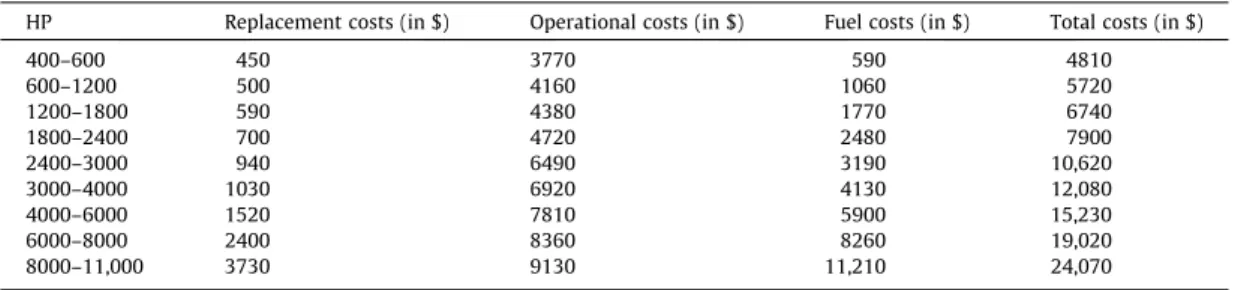
Typically, barges move in groups called tows, which are pushed along by a towboat. The size of a tow is impacted by the number of locks along the river. For example, on the lower Mississippi River, where there are no locks, between 30 and 40 barges are commonly pushed by a single towboat. The weight of the load on a barge depends on the depth of the river where the barge will be. The travel time of barge from its origin to its destination depends on the number of locks along the path, the weight of the load, and most importantly, the horsepower, or HP, of the towboat. TheU.S. Army Corps of Engineers (2002, 2009)provides data about the daily operating costs for towboats with different HP and barges of different types. The main towboat-related costs are replacement costs, daily operating costs, administrative costs, port costs, and crew-related costs, such as wages, fringe benefits, food, and transportation. The main barge-related costs are replacement and administrative costs.Table 1presents the daily operating costs of a towboat as a function of its HP.
The same report by the U.S. Army Corps of Engineers summarizes the daily costs for barges of different dimensions and types, such as an open hopper with dimensions of 1750250120and a covered hopper with dimensions of 1950350120
(2009). Depending on its size, a covered barge can carry between 1500 and 2000 tons of grains. The main cost components considered in the report are administrative and replacement costs. Total daily costs for a covered hopper with dimensions 195035013/140, which operates 330 days a year, are estimated to be $359. Our study uses this number as the operating
cost per barge.
We use the daily cost estimates per towboat presented inTable 1and the daily cost estimates per barge to calculate the daily cost of using one tow with 3000 HP to push 15 barges. Such a tow typically traverses 161 km (100 miles), each day. Our study assumes that each barge carries 1500 tons of densified biomass, and the minimum shipment amount require to use barge is 1400 tons. This is an incentive to send shipments of at least 1400 tons, because the customer pays as if shipping 1400 tons, even for smaller shipments. This data allows us to estimate the cost in $/day of moving one ton of densified bio-mass. We then calculate the total cost, $/ton, for trips of different duration (Table 2).
Other transportation-related costs with barges include penalties charged if agreements are not met. One example is the demurrage charge, incurred if a barge is not loaded or unloaded within the timespan agreed upon.
Agricultural Marketing Services (AMSs), part of the U.S. Department of Agriculture (USDA), publishes weekly reports of the latest volume and price charged for moving grain by barge. Shipping rates, unlike transportation costs, fluctuate from one period to the next. These rates are typically at their lowest in the first and second quarter of the year, and they reach their highest level during and right after the harvesting season due to the increased demand for barge shipments. Barge oper-ators base their prices on the percent-of-tariff system. The institution that used to set tariffs for barges is no longer around. Despite this, rates are still given in percentage of the benchmark tariff set in 1976 (USD, 2010). Each segment of the Missis-sippi River has its own tariff benchmark. Tariffs increase the further north of the Gulf of Mexico shipment originates.
Table 3presents the average barge freight rates charged during the months of April and October 2011 for shipments along the Mississippi River (AMS, 2012). The table also presents the distance in kilometers from an inland port to the mouth of the river in the Gulf Port, according to the U.S. Army Corps of Engineers (U.S. Army Corps of Engineers, 2009). Barge-freight rates depend on the distance traveled.
Table 1
Daily operating costs for a towboat as a function of its horsepower.
HP Replacement costs (in $) Operational costs (in $) Fuel costs (in $) Total costs (in $)
400–600 450 3770 590 4810 600–1200 500 4160 1060 5720 1200–1800 590 4380 1770 6740 1800–2400 700 4720 2480 7900 2400–3000 940 6490 3190 10,620 3000–4000 1030 6920 4130 12,080 4000–6000 1520 7810 5900 15,230 6000–8000 2400 8360 8260 19,020 8000–11,000 3730 9130 11,210 24,070
A shipments of 15 barges pushed by a towboat with 3000 HP would take, on average, 18 days to travel from Minneapolis and St. Paul to Gulf Port and about 7.5 days from Memphis to Gulf Port. Based onTable 3, the freight rate for an 18-day trip is about $13/ton, and the freight rate for a 7.5-day trip is about $5.50/ton. The difference between the values inTables 2 and 3
occurs because Table 2presents the shipper’s costs, while Table 3 presents the market price (the tariffs charged) to customers.
2.3. Truck transportation
Trucks are often used to ship agricultural products despite the fact that the cost per ton and per kilometer traveled by truck is higher compared to rail and barge. The main reasons for using trucks are ease of accessibility, large transportation network, and high transportation network capacity. Different from barge and rail, highway infrastructure is larger and reaches many remote areas where agricultural products are cultivated.
The main source of data on truck rates isAMS (2012). AMS provides weekly reports about grain transportation, which summarize the per kilometer rate charged for a truck load in different regions of the US.Table 4presents the truck rates we use in our analysis. A typical truck load weighs 26 tons.
3. Regression analysis of rail shipment tariffs
Our study uses a stepwise regression analysis to better understand the main factors which impact the tariffs charged by railway companies for single car and unit train shipments. The multi-variable, linear regression models are widely used for prediction and forecasting (Rawlings et al., 1989; Montgomery and Runger, 2011; Montgomery et al., 2012).MacDonald (1987)uses regression analysis of rail rates for agricultural products, such as, corn, soybeans and wheat, to evaluate the im-pact of intramodal competition on rates charged by railway companies.
This study analyzes transportation costs for feed grains and woodchips since these commodities have similar physical characteristics to the densified biomass feedstock. Therefore, estimates of logistics-related costs for these products are a Table 2
Total costs for barge shipments as a function of trip duration. Trip duration (in days)
HP 3 5 8 10 15 20 30
Total costs (in $/ton)
400–600 1.36 2.27 3.62 4.53 6.80 9.06 13.59 600–1200 1.48 2.47 3.95 4.94 7.40 9.87 14.81 1200–1800 1.62 2.69 4.31 5.39 8.08 10.78 16.17 1800–2400 1.77 2.95 4.72 5.90 8.86 11.81 17.71 2400–3000 2.13 3.56 5.69 7.11 10.67 14.23 21.34 3000–4000 2.33 3.88 6.21 7.76 11.64 15.52 23.29 4000–6000 2.75 4.58 7.33 9.16 13.74 18.32 27.49 6000–8000 3.25 5.42 8.68 10.85 16.27 21.69 32.54 8000–11,000 3.93 6.55 10.47 13.09 19.64 26.18 39.27 Table 3
Barge freight rates charged ($/ton) along the Mississippi River.
Port Distance Freight rate
April 2011 October 2011 Minneapolis, MN 3347 NA 32.55 St. Paul, MN 3321 23.57 27.48 Hannibal, MO 2341 19.91 24.08 St. Louis, MO 2100 12.47 17.46 Memphis, TN 1359 10.46 13.03 Table 4
Truck transportation costs per truck load.
Region Distance traveled
40 km (25 miles) 161 km (100 miles) 322 km (200 miles)
National average $3.74 $3.29 $3.18
North central $3.37 $3.15 $3.06
good representation of densified biomass logistics-related costs. Most of the data in this study was collected from CSXT and BNSF websites since these companies are the major transportation service providers for grains (USD, 2010). Details about the regression models we developed appear below.
The data includes tariffs charged per rail-car shipments for several origin–destination points. These tariffs differ by prod-uct type, distance between the origin and destination, type of railcar used, railcar capacity, railcar ownership, and fleet size. In order to keep pace with the unpredictability of fuel costs, railway companies charge a fuel surcharge. Its purpose is to re-cover the incremental fuel costs when fuel prices exceed a threshold fuel price, also known as the strike price.However, the analysis in this paper does not consider fuel surcharges. The type of railcar that is typically used for transporting grain is covered hoppers, and hoppers or gondolas are used for woodchips shipments. The public tariffs used in this study were effec-tive October 2011.
In order to validate our model, we analyzed the residuals and calculated the corresponding mean squared error (MSE) based on (Montgomery and Runger, 2011). The analyzed residuals were found to be normally distributed. By dividing the data into two sets, our research sought to validate the regression equations developed. Initially, we used 70% of the data set to develop the regression equations; then, we validated these regressions using the data remaining. The MSE calculated for all the regression equations presented in this section ranged from 1% to 5%.Table 5presents the list of variables used in the regression equations.
3.1. Single car shipments of grains
CSXT’s website offers the grain-shipment data, which include barley, corn, rye, milo, sorghum, wheat, emmer, millet, and soybeans. We collected data for single car shipments of grains from the Midwest, including Illinois, Indiana, Kentucky, and Ohio, to the Southeast, composed of Alabama, Florida, Georgia and Louisiana, and to the Northeast, including Delaware, Indi-ana, Kentucky, New York, and Pennsylvania, along CSXT rail lines. The total number of tariffs charged per origin–destination of a shipment considered in this analysis is 1165. CSXT uses covered hoppers to ship grains.
Table 6summarizes the regression equations we developed for single car grain shipments by CSXT. The first regression
equation presents the relationship between railway distances and tariffs. Railway distances are one of the most important factors impacting tariffs charged by railway companies. The value of the adjustedR2, at 29%, and thep-value forX1indicate that railway distances are an important factor to consider in determining railcar tariffs. The value of the intercept, $2248, represents the fixed shipment cost charged per rail car, and the coefficient, $1.12, represents the corresponding rate charged per kilometer traveled.
We re-run this regression by considering highway distance between origin–destination points instead of railway dis-tance. We collected highway distances using GoogleMaps. The increase in the value of adjustedR2to 59% and thep-value forX0
1indicate that highway distance between an origin–destination pair better explains the tariffs charged by CSXT than the corresponding railway distance. The study offered similar results from the regression analysis for other products shipped by CSXT. Different from the railway network, the highway network is larger and provides more routing options, so the high-way distance is closer to the geographical distances per origin–destination pair. This is why CSXT pricing schemes rely on geographical distances rather than railway distances. This finding also suggests that transport by truck is a viable competitor to CSXT.
Table 5
Variable declaration.
Definition of dependent variables Y1
CSXT Tariff charged by CSXT per railcar, for single car shipment of grains
Y2
CSXT Tariff charged by CSXT per railcar, for single car shipment of woodchips
Y3
CSXT Tariff charged by CSXT per railcar, for 65-cars unit train shipment of grains
Y4
CSXT Tariff charged by CSXT per railcar, for 90-cars unit train shipment of grains
Y1BNSF Tariff charged by BNSF per railcar, for single car shipment of corn
Y2
BNSF Tariff charged by BNSF per railcar, for unit train shipment of corn
Definition of independent variables X1 Railway distance per shipment
X0
1 Highway distance per shipment
X2 Indicator variable which equals 1 if more than 1 railway company is to deliver a shipment, and equals 0 otherwise
X3 Indicator variable which equals 1 if the railcar is owned by the railway company, and equals 0 otherwise
X4 Indicator variable which equals 1 if the origin of a shipment is located far from an in-land port, and equals 0 otherwise
X5 Indicator variable which equals 1 if the destination of a shipment is far from an in-land port, and equals 0 otherwise
X6 Indicator variable which equals 1 if the capacity allowances are high, and equals 0 otherwise
X7 Indicator variable which equals 1 if the destination of a shipment is in the Southeast US, and equals 0 if the destination of a shipment is in the
Northeast US
X8 Indicator variable which equals 1 if the destination of a shipment is in the Northwest US, and equals 0 if the destination of a shipment is in the
Southwest US
X9 Indicator variable which equals 1 if the number of railcars used by a shipment is more than or equal to 65 cars, and equals 0 otherwise
X10 Indicator variable which equals 1 if the number of railcars used by a shipment is more than or equal to 90 cars, and equals 0 otherwise
We ran a regression to capture the impact that railway ownership has on tariffs. For certain origin–destinations, CSXT uses, for a certain number of kilometers, rail lines owned by smaller, regional railway companies. The adjustedR2, when we include X2 in our model, increased to 61%, and thep-value for both independent variables remained smaller than 0.1%. Tariffs increase by $232, on average, per railcar for shipments that use regional railways. This additional charge is a reflection of CSXT’s payments to other companies for railway rights when using their rail lines.
The value of adjustedR2increases to 66% when railcar ownership is included in the regression. This regression indicates that a shipper is charged, on the average, an additional $321 to use a railcar owned by CSXT.
In order to quantify the impact of barge-transportation availability on the tariffs charged by CSXT, our study develops a regression model usingX4as an independent variable.X4is an indicator variable which equals 1 if the origin of a shipment is located far from an inland port, and equals 0 otherwise. It is important to define the meaning of the term far from an inland port. We performed three regression analysis updating the values ofX4as follows. First,X4was set to 1 for those origin–des-tination data points where the distance from the shipment origin to the closest inland port was more than 161 km (100 miles), and 0 otherwise. Second,X4was set to 1 for those origin–destination data points where the distance from the shipment origin to the closest inland port was more than 201 km (125 miles), and 0 otherwise. Finally,X4was set to 1 for those origin–destination data points where the distance from the shipment origin to the closest inland port was more than 241 km (150 miles), and 0 otherwise.
Our study also experimented with the distance between the destination point of a shipment and the closest inland port by introducing the indicator variableX5. We performed several experiments to define this variable. We first setX5equal to 1 for those origin–destination data points where the distance from the shipment destination to the closest inland port was more than 80 km (50 miles), and 0 otherwise. We re-run the regression for cases when the value ofX5was set to 1 when the dis-tance between the destination of a shipment and the closest inland ports were 161, 241 and 322 km (100, 150 and 200 miles respectively).
We found that the regression in which the value ofX4was set to 1 when the distance from the shipment origin to the closest inland port was more than 161 km (100 miles) and the value ofX5was set to 1 when the distance from the shipment destination to the closest inland port was more than 241 km (150 miles). Adding these variables to the regression model gave the highest value of adjustedR2with a value of 73%.
We also ran a regression which considered the iteration between variablesX4andX5. However, this interaction was not found significant for
a
= 1%, and it was not added to the equation. The results from this regression indicate that barge trans-portation is a valid competitor with rail. Barge becomes a competitor for those shipments where the travel distance from the shipment’s origin to an inland port is fewer than 161 km (100 miles), or the travel distance from the destination point to an inland port is fewer than 241 km (150 miles). The discount received for shipments where the origin is close to an inland port is, on average, $26, and for shipments where the destination is close to an inland port is, on average, $440. These results echo findings fromLaurits (2009, 2010).We also include in the regression equation the indicator variableX6in order to quantify the impact of capacity allowances on tariffs. Adding this variable resulted in an increase of adjustedR2to 75%.
Weekly reports provided byAMS (2012)indicate that the majority of grains shipped to the Southeast US are exported to different international markets. For example, 63% of corn exported is shipped out of the Mississippi Gulf. We ran a regression equation which includes the indicator variableX7in order to quantify the change in tariffs, if any, for shipment destined to the Southeast. The value of adjustedR2for this regression increased to 77%, and thep-value for all the independent variables is smaller than 0.1%. Based on this regression equation, the tariff charged for railcar shipments to the Southeast is, on aver-age, $230 higher as compared to the Northeast. This reflects the higher demand for rail shipment since many Southeast ports serve the international market.
3.2. Single car shipments of woodchips
We collected data about wood chip shipments from the Midwest, including Illinois, Indiana, Kentucky, and Ohio, to the Southeast, focusing on Alabama, Florida and Georgia, along CSXT rail lines. The total number of origin–destination data points used in this analysis is 508.Table 7presents the regression equations developed.
Table 6
Regression equations for single car: grain shipments by CSXT.
Regression equation AdjustedR2
p-Value Y1 CSXT¼2248þ1:12X1 29% 2E 22 Y1 CSXT¼2011þ1:37X01 59% 2E 44 Y1CSXT¼1967þ1:31X01þ232X2 61% 0.1% Y1 CSXT¼1796þ1:31X01þ232X2þ321X3 66% 0.1% Y1 CSXT¼1746þ1:06X01þ211X2þ315X3þ26X4þ440X5 73% 1.0% Y1 CSXT¼1594þ1:12X01þ207X2þ315X3þ55X4þ436X5þ229X6 75% 0.1% Y1CSXT¼1560þ0:99X10þ157X2þ316X3þ69X4þ465X5þ290X6þ230X7 77% 0.1%
We ran a regression to understand the relationship between the tariff charged for railcars owned by CSXT and the high-way distance between the origin and the destination of a shipment. This regression equation indicates that, on average, the tariff charged per kilometer per rail car is $0.81. This equation, compared to the corresponding equation developed for grains, shows that the fixed cost for shipment of woodchips is higher. Some of the reasons for wood chip’s higher costs are its poor flowability and heavy load weight. Compared to other agricultural products (for example soy bean) woodchips have poorer flowability properties which makes loading and unloading shipments more difficult.
We developed a regression equation to estimate the impact of railcar ownership, rail line ownership, and barge compe-tition in relation to the price charged per railcar. The second equation inTable 7indicates that an average of $271 is added to the tariff charged per railcar shipment of woodchips if rail lines owned by regional railways are used; an average of $537 is added to the tariff charged when the railcar is owned by CSXT; an average of $93 is added to the tariff charged when the origin of a shipment is more than 161 km (100 miles) away from an inland port; and an average of $140 is added to the tariff charged when the destination of a shipment is more than 241 km (150 miles) away from an inland port. The two-way inter-actions between variablesX1throughX5were not statistically significant; therefore, these interactions were not added to the equation.
CSXT uses railcars of two different capacities for shipment of woodchips, which include, railcars with less than 6000 cubic feet capacity and railcars with more than 6000 cubic feet capacity. The third equation inTable 7calculates the impact of railcar capacity in tariffs using variableX6, which equals 1 for railcars of capacity less than 6000, and equals 0 otherwise. An average of $310 is added to the tariff charged for using higher capacity railcars.
3.3. Unit train shipments of grain
CSXT provides monetary incentives for shipments that consist of more than 65 railcars, and for shipments that consist of more than 90 railcars. In these cases, a dedicated unit train is used to deliver a shipment from its origin to its destination. To develop the regression equations presented below, we collected data from CSXT website. This data corresponds to grain shipments from the Midwest (Illinois, Indiana, Kentucky, and Ohio) to the Southeast (Alabama, Florida, Georgia and Louisi-ana) and to the Northeast (Delaware, Indiana, Kentucky, New York and Pennsylvania).
The total number of tariffs (per origin–destination of a shipment), collected for grain shipments on 65-cars unit trains, is 1165.Table 8presents the regression equations developed, the corresponding adjustedR2, andp-values for the independent variables.
The total number of origin–destination data points collected for grain shipments on 90-cars unit trains is 672.Table 9
presents the regression equations developed, the corresponding adjustedR2, andp-values for the independent variables.
3.4. Single car shipments of corn
The data used to develop the regression equations presented in this section is available at BNSF’s website. The tariffs col-lected are charged for corn shipments from the Midwest, including Iowa, Minnesota and Nebraska, to the Northwest, such as, Oregon and Washington, and to the Southwest, comprised of Arizona, California, New Mexico, Oklahoma and Texas. Corn is shipped using covered hoppers cars. BNSF lists tariffs charged for single railcar shipments, which represent shipments that consist of fewer than 25 railcars. BNSF lists railcar tariffs for shipments that consist of 25–110 railcars and shipments with 110–120 railcars. We collected data for 15,497 different origin–destinations shipments of fewer than 25 railcars.Table 10
summarizes the regression equations developed. Table 7
Regression equations for single car: wood chip shipments by CSXT.
Regression equation AdjustedR2
(%) p-Value (%) Y2 CSXT¼2968þ0:81X01 30 5E 24 Y2 CSXT¼2431þ0:68X01þ271X2þ537X3þ93:3X4þ140X5 64 0.1 Y2CSXT¼2121þ0:68X01þ271X2þ692X3þ93:3X4þ140X5þ310X6 71 0.1 Table 8
Regression equations for 65-cars unit rail: grain shipments by CSXT.
Regression equation AdjustedR2
(%) p-Value (%) Y3 CSXT¼1588þ1:37X01 63 0.01 Y3CSXT¼1551þ1:37X01þ198X2 69 0.01 Y3 CSXT¼1474þ1:37X01þ207X2þ115X3 70 0.01 Y3 CSXT¼1439þ1:12X01þ196X2þ101X3þ122X4þ421X5 74 0.01 Y3 CSXT¼1338þ1:12X01þ201X2þ107X3þ107X4þ419X5þ227X6 77 0.01 Y3 CSXT¼1325þ0:99X01þ157X2þ130X3þ80X4þ440X5þ263X6þ236X7 79 0.01
The first equation developed presents the relationship between the tariff charged and the distance traveled along BNSF’s rail lines. We also ran a regression where the independent variable was highway distance rather than the railway distance between the origin and the destination of a shipment (the value ofR2decreased). Highway distance, rather than railway dis-tance, can better explain the tariffs charged by CSXT, but this is not the case with BNSF. This can be explained by looking at the railway networks of these two companies. The distances traveled along BNSF lines from the Midwest to the West are longer than the distances traveled along CSXT lines from the Midwest to the East. Therefore, for shipments to the West, using trucks is not cost efficient. Also, BNSF’s rail network is stretched out, compared to CSXT. Thus, the railway distance between the origin and destination of a shipments is close to the corresponding geographical distance. These reasons explain why the railway distance between the origin and destination of a shipment comprises 50% of the tariff charged by BNSF.
Since the two Class I railway companies that serve the West US are BNSF and UP, BNSF tariffs are provided for shipments where the origin and/or destination rail ramp is owned/operated by BNSF. The regression estimates the impact of using ramps owned by other railway companies on the tariffs charged by BNSF. The adjustedR2slightly increases to 51%.
We did not run a regression onX3because BNSF does not provide tariffs for shipper-owned railcars. Thus, all tariffs pre-sented must be for railroad-owned cars. We also did not run a regression onX4andX5since barge shipments from the Mid-west to the West are not an option.
BNSF tariffs depend on the capacity of a railcar. VariableX6equals 1 if the railcar capacity of a shipment is greater than 5000 cubic feet, and equals 0 otherwise. Including this independent variable in the regression equation slightly increased the value of the adjustedR2to 52%, while maintaining thep-values for the independent variables less than 0.01%.
A regression tests the impact of the shipment’s destination on the tariffs charged. AddingX8to the regression equation increases the value of the adjustedR2to 79%. This regression equation suggests that shipping corn from the Midwest to the Northwest is, on average, $1462 cheaper compared to shipping corn to the Southwest. The difference in price could be ex-plained by the flow of shipments to these destinations. The volume shipped to the Southwest destinations is higher because of the higher population there and the existence of international ports.
3.5. Unit train shipments of corn
Similar to CSXT, BNSF provides price incentives to shippers for unit train shipments with 110–120 railcars.Table 11 sum-marizes the results from the regression analysis, which considers the impact of the railcar capacity by includingX6). How-ever, the variable was not found statistically significant.
Table 9
Regression equations for 90-cars unit rail: grain shipments by CSXT.
Regression equation AdjustedR2
(%) p-Value (%) Y4 CSXT¼1185þ1:31X01 58.9 0.01 Y4 CSXT¼1168þ1:31X01þ76X2 59 0.01 Y4CSXT¼1120þ1:31X01þ46X2þ156X3 60 0.01 Y4 CSXT¼1098þ0:99X01þ45X2þ172X3þ71X4þ487X5 68 0.01 Y4 CSXT¼977þ0:99X01þ60X2þ117X3þ82X4þ474X5þ233X6 70 0.01 Y4 CSXT¼497þ1:18X01þ54X2þ127X3þ102X4þ300X5þ222X6þ435X7 72 0.01 Table 10
Regression equations for single car: corn shipments by BNSF.
Regression equation AdjustedR2
(%) p-Value (%) Y1 BNSF¼3140þ0:75X1 50 0.01 Y1BNSF¼3148þ0:75X1450X2 51 0.01 Y1 BNSF¼3050þ0:75X1542X2þ205X6 52 0.01 Y1 BNSF¼2835þ0:81X1426X2þ500X61462X8 79 0.01 Table 11
Regression equations for unit rail: corn shipments by BNSF.
Regression equation AdjustedR2
(%) p-Value Y2 BNSF¼2734þ0:45X1 54 0 Y2 BNSF¼2706þ0:46X1þ224X2 55 0 Y2 BNSF¼2549þ0:58X1þ355X2637X8 71 0
3.6. Lessons learned from regression analysis
The following are some important observations that we made from the regression analysis presented above.
Lesson 1:The main factors which impact the tariffs charged by railway companies are transportation distance and rail line ownership. In all the regression equations presented above, only independent variablesX1andX2were statistically signifi-cant. Collectively, these two variables explain 51–69% of the tariffs charged per rail car shipment.
Lesson 2:Truck transportation is viable competition for CSXT, but this is not necessarily the case for BNSF. The difference can be explained by looking at the railway network for each of these two railway companies. The rail network of BNSF is stretched out; lines to ship from the Midwest to the West US are longer than the distances traveled along CSXT lines from the Midwest to the East. Therefore, for shipments to the West, using trucks is not attractive.
Lesson 3:Barge transportation is viable competition for CSXT shipments from the Midwest to the Southeast US Agricul-tural products move from the Midwest to the Southeast using main agriculAgricul-tural waterways which often run parallel of CSXT rail lines. For this reason, the independent variablesX4andX5, which represent vicinity to inland ports, were found signif-icant in all the regression equations this study developed for CSXT. We did not consider these variables when developing regression equations for BNSF since barge shipment was not an alternative.
Lesson 4:Unit train shipments are cost efficient compared to single car shipments. In Eq.(1)we use variablesX9andX10to show the impact that unit train shipments have on the tariffs charged by CSXT. The value of the adjustedR2for this regres-sion is 80%, and thep-values for the independent variables are less than 0.01%. Based on this regression, the tariff charged per rail car of a unit train shipment with 65–90 railcars is, on average, $310 less than the tariff charged per railcar of a single car shipment. The tariff charged per railcar on a unit train shipment with more than 90 railcars is, on average, $824 less com-pared to the tariff charged per railcar on a single car shipment.
Y3
CSXT¼1654þ1:12X1þ175X2þ193X3þ83X4þ416X5þ278X6310X9514X10 ð1Þ
Lesson 5:Shipments along CSXT rail lines are cheaper as compared to shipments along BNSF rail lines. The regression Eq.
(2)expresses the tariffs charged by railways companies as a function of distance traveled, rail line ownership, and the rail-way company that provides the service. The value of adjustedR2for this equation is 70%, andp-values are less than 0.01% for all the independent variables. This equation indicates that on average CSXT charges $295 less per rail car than BNSF. CSXT tariffs are smaller due to competition with truck and barge shipments (see Lessons 2 and 3).
Y¼2767þ0:75X1þ283X2295X11 ð2Þ
Among the Class I railways, BNSF has the highest fuel surcharges listed in 2007, 2008, and 2009 (IE2, 2010). However, BNSF tariffs are lower compared to other western railway companies (IE2, 2010).
Lesson 6:Tariffs charged by BNSF and CSXT for shipments in the South, including either the Southeast or Southwest, are more expensive than shipments to the North US. This is mainly due to the higher demand for rail service to these destina-tions because of the high-volume shipped from main export ports located in the South.
4. Analysis of transportation costs
This section compares transportation costs based on the transportation mode, transportation distance, the volume shipped and the destination of a shipment. We use the public rail, barge, and truck tariffs which were effective in October 2011, which allows for a fair comparison of tariffs among different modes of transportation.
We analyze transportation costs to the East and West US separately for two reasons. First, barge transportation is not available for shipments to the West. Second, rail transportation tariffs differ. For shipments from the Midwest to the East and Southeast, we compare truck with rail using CSXT and barge. For shipments from the Midwest to the West, we compare truck to rail shipments by BNSF. Figs. 2 and 3 present transportation costs for different distances and modes of transportation.
This study discusses transportation costs for grains in relation to available data. BNSF does not provide tariffs for trans-portation of woodchips, and CSXT only provides tariffs for single car shipments of woodchips. The lack of data for woodchips can be explained by the low, or nonexistent, demand for unit train shipments of woodchips, in particular from the Midwest to the West.
In order to calculate truck transportation costs in dollars per truckload as a function of the distance traveled, our study used the national average rates listed inTable 4. We then calculated the costs per ton of grain shipped considering that semi trucks have a cargo capacity of 26 tons.
Table 3indicates that transportation costs for barge depend on the distance traveled; however, the relationship is not linear. Based on the public tariffs presented in this table, an average tariff per ton shipped equals $1.5 for 161 km (100 miles) traveled. This is the rate we use to build the graphs inFigs. 2 and 3.
The type of rail car considered is a jumbo hopper car, with a cargo capacity of 112 tons. For grains, we use Eq.(3)to esti-mate the cost of a single car shipment by CSXT,(4)to estimate the cost per railcar on a 65-cars unit train operated by CSXT,
(5)to estimate the cost per railcar on a 90-cars unit train operated by CSXT,(6)to estimate the cost of a single car shipment by BNSF, and(7)to estimate the cost per railcar on a 110- to 120-cars unit train operated by BNSF.
Y3 CSXT¼2011þ1:37X 0 1 ð3Þ Y4CSXT¼1588þ1:37X 0 1 ð4Þ Y5 CSXT¼1185þ1:31X 0 1 ð5Þ Y2BNSF¼3140þ0:75X1 ð6Þ Y2BNSF¼2734þ0:45X1 ð7Þ
For woodchips, Eq.(8)estimates the cost of a single car shipment by CSXT.
Y2CSXT¼2968þ0:81X
0
1 ð8Þ
Fig. 2a indicates that for grain shipments from the Midwest to the East, when barge is not an option, truck is the best mode of transportation for distances up to 161 km (100 miles). For longer travel distances, unit trains with 90 cars are more economical. However, when the volume shipped is too small to justify the use of a unit train, then truck is the best alterna-tive for transportation distances up to 282 km (175 miles). For longer distances, single rail car shipments of grain are the most economical choice.
Consider a scenario where barge is a viable alternative for grain shipments from the Midwest to the Southeast, and the quantity shipped is larger than 1400 tons. Assume that the origin and the destination of a shipment are located along the river which is not unreasonable since barge is typically used for shipping grain to export ports in the Southeast, such as New Orleans, and many corn elevators have access to inland ports. If available, barge is always the most economical trans-portation option. 0 5 10 15 20 25 30 35 40 0 100 200 300 400 500
Transportation Costs (in $/ton)
Distance Traveled (in km) Truck CSXT: Single Car
CSXT: Unit Train 65 Cars CSXT: Unit Train 90 Cars Barge
0 5 10 15 20 25 30 35 40 0 100 200 300 400 500
Transportation Costs (in $/ton)
Distance Traveled (in km) Truck CSXT: Single Car Barge
(a) Grains
(b) Wood Chips
Fig. 2.Transportation costs as a function of distance traveled: Midwest to East and Southeast USA.
0 5 10 15 20 25 30 35 40 0 50 100 150 200 250 300 350 400 450 500
Transportation Costs (in $/ton)
Distance Traveled (in km)
Truck BNSF: Single Car BNSF: Unit Train 110 Car
Fig. 2b indicates that to ship woodchips from the Midwest to the East where for which barge is not an option, truck is the best mode of transportation for distances up to 386 km (240 miles). For longer travel distances, single car shipments with CSXT are more economical. However, when it is available, barge remains the most economical transportation mode.
Fig. 3indicates that for grain shipments from the Midwest to the West truck is the best mode of transportation for dis-tances up to 338 km (210 miles). For longer travel disdis-tances, a unit trains with 110 cars is more economical. If the volume shipped does not justify using a unit train, then truck is the best alternative for transportation distances up to 402 km (250 miles). For longer distances, single rail car shipments of grain are most economical.
Transportation costs do depend not only on distance traveled, but also transportation volume. In order to analyze the im-pact of volume and distance on costs we create a number of scenarios. Each scenario corresponds to a particular transpor-tation volume.Table 12presents the scenarios created. We chose our scenarios in such a way that the volume shipped corresponds to either a full truckload, or a unit train load, etc.
Tables 13 and 14present total transportation costs for grains in each scenario using different modes of transportation. These costs are presented as a function of distance traveled. The distances in the tables are close to the breakpoints identified inFigs. 2 and 3, so the impact of transportation distances on costs is easy to see. In these tables, the numbers in red represent the minimum cost per scenario and distance traveled.
Important findings for shipments from the Midwest to the East, derived from the results ofTable 13, include:
If barge transportation is available and the volume shipped justifies the use of a barge (see Scenarios 3–9), then barge is the least expensive transportation mode.
Table 12
Scenario definitions.
Scenario Quantity (in tons) Nr. of trucks Nr. of rail cars Nr. of barges
1 26 1 1 1 2 112 4 1 1 3 1500 58 14 1 4 7280 280 65 5 5 10,080 388 90 7 6 12,320 474 110 7 7 14,560 560 130 10 8 20,160 776 180 14 9 24,640 948 220 17 Table 13
Transportation costs (in $ 1000) based on distance and quantity shipped from the Midwest to East and Southeast.
Scenario Truck distances (in km) CSXT distances (in km) Barge (in km)
145 193 241 322 145 193 241 322 145 322 1 0.3 0.4 0.5 0.6 2.2 2.3 2.3 2.5 1.9 4.2 2 1.4 1.7 2.1 2.7 2.2 2.3 2.3 2.5 1.9 4.2 3 19.4 22.8 28.5 36.7 30.9 31.9 32.8 34.3 2.0 4.5 4 94.2 110.5 138.2 178.1 116.1 120.4 124.7 131.8 9.8 21.8 5 130.5 153.1 191.3 246.6 123.7 129.3 135.0 144.5 13.6 30.2 6 159.5 187.1 233.8 301.4 167.8 174.8 181.8 193.5 16.6 36.9 7 188.5 221.1 276.4 356.2 232.2 240.8 249.3 263.6 19.7 43.7 8 261.3 306.5 383.1 493.8 247.3 258.7 270.0 288.9 27.2 60.5 9 319.0 374.1 467.7 602.7 335.7 349.7 363.6 386.9 33.3 73.9 Table 14
Transportation costs (in $ 1000) based on distance and quantity shipped from the Midwest to West.
Scenario Truck distances (in km) BNSF (in km)
322 483 1083 1672 2755 322 483 1083 1672 2755 1 0.7 1.0 2.2 3.4 5.6 3.4 3.5 3.9 4.4 5.2 2 2.7 4.1 9.2 14.2 23.4 3.4 3.5 3.9 4.4 5.2 3 38.0 56.9 127.7 197.2 325.0 47.3 49.0 55.3 61.4 72.7 4 184.2 276.4 620.0 957.1 1577.1 227.7 219.7 256.6 285.1 337.6 5 255.1 382.7 858.4 1325.3 2183.7 304.2 315.0 355.3 394.8 467.5 6 311.8 467.7 1049.2 1619.8 2668.9 316.6 324.5 354.0 383.0 436.3 7 368.5 552.7 1239.9 1914.3 3154.2 384.2 394.5 433.0 470.8 540.2 8 510.9 766.3 1719.0 2653.9 4373.0 553.2 569.5 630.4 690.1 799.9 9 623.6 935.4 2098.4 3239.5 5337.9 633.2 649.0 708.1 766.1 872.7
If barge transportation cannot be used and the volume shipped justifies the use of a single rail car (see Scenarios 2–9), then rail is the least expensive mode of transportation when the distance traveled is 274 km (170 miles) or longer. For shorter distances, truck transportation is the least expensive option.
If the volume shipped is less than 30 tons, then truck is the least expensive transportation option.
If the volume shipped justifies the use of a unit train of 65 cars (see Scenarios 4–9), then rail transportation is the least expensive mode of transportation for distances longer than 193 km (120 miles).
If the volume shipped justifies the use of a unit train with 90 cars (see Scenarios 5–9), then rail transportation is the least expensive mode of transportation for distances longer than 145 km (90 miles).
Important findings from the results ofTable 14for shipments from the Midwest to the West include:
Truck is the least expensive transportation mode if the distance traveled is up to 322 km (200 miles), regardless of the volume shipped.
If the volume shipped is as much as to 26 tons, a full truckload, then truck transportation is least expensive for distances up to 2414 km (1500 miles).
If the volume shipped justifies the use of a single rail car, then rail transportation is least expensive for distances longer than 402 km (250 miles).
If the volume shipped justifies the use of a unit train, then rail transportation is least expensive for distances longer than 338 km (210 miles).
5. Conclusions
The regression equations presented in this paper identify the main factors that impact the tariffs charged by railway com-panies for high-volume and long-haul shipment of agricultural products that have physical characteristics similar to densi-fied biomass. Some of the most important factors identidensi-fied are distance traveled, quantity shipped, railcar ownership, railway ownership, and shipment destination. These factors collectively explain as many as to 80% of the rail tariffs charged per rail car.
The tariffs charged by CSXT for shipments which are destined to the Southeast US are higher compared to tariffs charged for shipments sent to the Northeast because of higher demand for rail services for shipments to the Southeast. Many ports in the Southeast are also double as the main export points for grains.
The tariffs charged for unit train shipments along the BNSF and CSXT rail lines are less than what’s charged for single car shipments. Railway companies give monetary incentives to customers for high-volume shipments. For example, CSXT aver-agely charges $3.78 less per ton when using a unit train with 65 cars versus a single car shipment. This difference is $7.50 per ton when shipping a unit train with 90 cars. This difference for BNSF is, on average, $4.50 per ton. The biofuels industry could benefit from these monetary incentives by using unit trains for high-volume shipments of biomass. The regression analysis indicates that the tariffs charged by CSXT for the movement of a rail car are smaller than the tariffs charged by BNSF. The tariffs charged by CSXT are smaller due to rail’s competition with truck and barge. The distance a shipment must travel along BNSF rail lines is typically long. Thus, truck transportation is not a viable competition to BNSF.
Barge shipments are more cost efficient compared to truck and rail. These costs depend on the size of a shipment and the trip’s duration. The biofuels industry should take advantage of barge shipments if available. Building biorefineries next to inland ports is one location strategy that could drastically reduce supply chain costs by using barge, rather than truck or rail, for inbound and outbound shipments.
To summarize and contextualize the discussion presented above, this study suggests:
If a biorefinery must locate in the Southeast, then locations close to an inland port are preferable.
If a biorefinery must locate in the Northeast, then locations close to a rail ramp are preferable.
If a biorefinery relies on rail shipments of biomass, then locating to East would result in lower inbound transportation costs compared to the West.
Acknowledgment
This work was supported in part by NSF grant CMMI 1052671 and in part by DOE 36301-01-05. This support is gratefully acknowledged.
References
Aden, A., Ruth, M., Ibsen, K., Jechura, J., Neeves, K., Sheehan, J., Wallace, B., Montague, L., Slayton, A., Lukas, J., 2002. Lignocellulosic Biomass to Ethanol Process Design and Economics Utilizing Co-Current Dilute Acid Prehydrolysis and Enzymatic Hydrolysis for Corn Stover. NREL/TP-510-32438. Golden, Co: National Renewable Energy Laboratory.
AMS, 2012. Grain Transportation Report. Agricultural Marketing Services of the U.S. Department of Agriculture. <http://www.ams.usda.gov/AMSv1.0/ getfile?dDocName=STELPRDC5098844>.
Badger, Phillip C., Fransham, Peter, 2006. Use of mobile fast pyrolysis plants to densify biomass and reduce biomass handling costs—a preliminary assessment. Biomass and Bioenergy 30 (4), 321–325.
Bonilla, David, Whittaker, Carly, 2009. Freight Transport and Deployment of Bioenergy in the U.K. Transport Studies Unit University of Oxford: Working Paper No. 1043.
CBO, 2006. Freight rail transportation: Long-term issues. Congress of the United States, Congressional Budget Office (CBO). <www.cbo.gov/ doc.cfm?index=7021>.
Cen, 2010. U.S. Census Data. <http://2010.census.gov/2010census/>.
EPA, 2012. Renewable Fuel Standard (rfs). U.S. Environmental Protection Agency. <www.epa.gov/otaq/fuels/renewablefuels/index.htm>.
Hess, J., Kenney, K., Ovard, L., Searcy, E., Wright, C., 2009. Uniform-Format Solid Feedstock Supply System: A Commodity-Scale Design to Produce an Infrastructure-Compatible Bulk Solid From Lignocellulosic Biomass. INL/EXT-08-14752. <www.inl.gov/bioenergy/uniform-feedstock>.
IE2, 2010. Review and Analysis of Cron Rail Rates. Informa Economics. The National Corn Growers Association. Memphis, TN. <http://ncga.eweb3.socket.net/ files/pdf/RailRateReportJune2010.pdf>.
Ileleji, Klein E., Sokhansanji, Shahab, Cundiff, John S., 2010. Biofuels from agricultural wastes and byproducts. In: Chapter 7: Farm-Gate to Plant-Gate Delivery of Lignocellulosic Feedstocks from Plant Biomass for Biofuel Production. Wiley-Blackwell, pp. 117–160.
Judd, Jason, Sarin, Subhash C., Cundiff, John S., 2011. Cost Analysis of a Biomass Logistics System. ASABE Meeting Presentation. KDF, 2012. Bioenergy: Knowledge Discovery Framework. U.S. Department of Energy. <https://www.bioenergykdf.net/>.
Laurits, R., 2009. A Study of Competition in the U.S. Freight Railroad Industry and Analysis of Proposals that Might Enhance Competition: Revised Final Report. Christensen Associates, Inc. A Report Prepared for The Surface Transportation Board (STB). <www.stb.dot.gov/stb/docs/CompetitionStudy/ Executive20Summary.pdf>.
Laurits, R., 2010. An Update to the Study of Competition in the US Freight Railroad Industry: Final Report. Christensen Associates, Inc. A Report Prepared for The Surface Transportation Board (STB). <www.stb.dot.gov/stb/docs/CompetitionStudy/Final/January/202010/20Report.pdf>.
MacDonald, James M., 1987. Competition and rail rates for the shipment of corn, soybeans, and wheat. The RAND Journal of Economics 18 (1), 151–163. Mahmudi, H., Flynn, P., 2006. Rail vs truck transport of biomass. Applied Biochemistry and Biotechnology 129 (1), 88–103.
Montgomery, Douglas C., Runger, George C., 2011. Applied Statistics and Probability for Engineers, fifth ed. Wiley.
Montgomery, Douglas C., Peck, Elizabeth A., Vining, Geoffrey G., 2012. Linear Regression Analysis, fifth ed. Wiley Series in Probability and Statistics, Wiley. Petrolia, D.R., 2008. The economics of harvesting and transporting corn stover for conversion to fuel ethanol: a case study of Minnesota. Biomass and
Bioenergy 32 (7), 603–612.
Rawlings, John O., Pantula, Sastry G., Dickey, David A., 1989. Applied Regression Analysis: A Research Tool, second ed. Springer.
Rogers, J.G., Brammer, J.G., 2009. Analysis of transport costs for energy crops for use in biomass pyrolysis plant networks. Biomass and Bioenergy 33 (10), 1367–1375.
Searcy, E., Flynn, P., 2008. The impact of biomass availability and processing cost on optimum size and processing technology selection. Applied Biochemistry and Biotechnology 154, 271–286.
Searcy, E., Hess, J.R., 2010. Uniform-Format Feedstock Supply System Design for Lignocellulosic Biomass: A Commodity-Scale Design to Produce an Infrastructure-Compatible Biocrude from Lignocellulosic Biomass. DRAFT, INL/EXT-10-20372.
Searcy, E., Flynn, P., Ghafoori, E., Kumar, A., 2007. The relative cost of biomass energy transport. Applied Biochemistry and Biotechnology 137 (1), 639–652. Sokhansanj, S., Turhollow, A.F., 2004. Biomass densification – cubing operations and costs for corn stover. Applied Engineering in Agriculture 20 (4), 495–
499.
Sokhansanj, S., Turhollow, A.F., 2006. Economics of producing fuel pellets from biomass. Applied Engineering in Agriculture 22 (3), 421–426.
Sokhansanj, S., Mani, S., Turhollow, A., Kumar, A., Bransby, D., Lynd, L., Laser, M., 2009. Large-scale production, harvest and logistics of switchgrass (Panicum virgatuml.) – current technology and envisioning a mature technology. Biofuels, Bioproducts and Biorefining 3 (12), 124–141.
Matheny-Katz, M., 2002. Barge and Towboat Operating Costs. Federal Interagency Vessel and Shipping Costs Workshop.
U.S. Army Corps of Engineers, 2009. Distances between United States Ports. U.S. Department of Commerce, National Oceanic and Atmospheric Administration. <http://www.nauticalcharts.noaa.gov/nsd/distances-ports/distances.pdf>.
Economics, Informa, 2009. Shallow-Draft/Inland Vessel Operating Costs. Army Corps SDIVOC ReportFY2009.
USD, 2010. Study of Rural Transportation Issues. U.S. Department of Agriculture (USDA). <www.ams.usda.gov/AMSv1.0/ruraltransportationstudy>. Wright, M., Brown, R.C., 2007. Establishing the optimal sizes of different kinds of biorefineries. Biofuels, Bioproducts and Biorefining 1, 191–200.