International Journal of Advanced Research in
Computer Science and Software Engineering
Research Paper
Available online at: www.ijarcsse.com
Software as a Service: Cost Effective Strategic Model to Manage
Cloud Services
Subashis Biswas* Meghdut Roy Chowdhury
Dept of CSE,NSEC Dept of CSE, Techno Kolkata, India Kolkata, India
Abstract— Cloud Computing technology has redefined the utility of modern web-based software. It has amazingly improved data accessibility and has also effectively reduced web-based software development cost. These flaws are evident in the strategies on which they have been designed, developed and deployed. Cloud computing supports a web infrastructure where computing resources are provided as a service over the web. This paper proposes a new model exploring the concept of sharing a common infrastructure and service by top to bottom level business organizations to increase business opportunity while providing isolation and security to end-users. According to this model, several cloud service providers can operate and manage several services each on a single platform. This model facilitates information security and ensures service elasticity. Each and every user of a particular service of a particular software service provider is identified by their unique IP addresses. Also, a particular user can use as many services it requires, from the cloud. This model aims to establish the effectiveness of a strategically impeccable SaaS.
Keywords— Cloud Computing; Service Management; Software as a Service; SAAS; Software Module; Data Exchange;
I. INTRODUCTION
Today is the age of information technology. The facets of work and personal life are moving towards the concept of availability of everything online. IT corporate giants of various countries are immensely investing on this technology to develop state-of-the-art cost-effective SaaS. Understanding this trend, the big and giant web based companies like Google, Amazon, Salesforce.com came with a model named “Cloud Computing “ the sharing of web infrastructure to deal with the internet data storage, scalability and computation. According to the definition by NIST “Cloud computing is a model for on demand network access to a shared pool of configurable computing resources that can be rapidly provisioned and released with minimal management effort or service provider interaction”. Cloud computing is an online service model by which hardware and software services are delivered to customers depending upon their requirements. The cloud computing model proposed here is a cost-effective model which aims to establish the worldwide Design, Development, Implementation, success and popularity of the concept of SaaS. Such a model is expected to be highly beneficial for all types of business organizations- Small or Big. With the advancement of modern society, numerous facets of life are moving online thus making the Internet a virtual human society. This has resulted in the emergence of virtual distributed computing. Cloud computing supports this virtualization; it is the use of computing resources (hardware and software) that are delivered as a service over a network. Not only can cloud computing be used in many application scenarios, it is also preferred by smaller organizations as they reap the benefits of not having to deploy physical infrastructure like file, e-mail servers or storage systems. It has evolved from IT system to public service, from cost-saving tools to revenue generator, and from ISP to telecom. The main types of public cloud computing are Infrastructure as a Service, Platform as a Service, Software as a Service. Software as a Service (SaaS) is a software distribution model in which is the service is available to customers over the Internet and hosted by a service provider or vendors who manage the infrastructure and platform on which the applications run. SaaS is sometimes referred to as “on-demand software” and is usually priced on a pay-per-use basis. Global accessibility and easier administration are the main benefits of SaaS. The current market scenario showcases that with the advancement of SaaS and the benefits that it brings, the economy of traditional software is already on a downhill. The dramatic changes brought in by SaaS as documented in trade journals are that SaaS does not require huge investments on the part of the end user. Instead of bringing in vast transactions at one go, it ensures steady cash flow. However, data security becomes an issue since the users’ data is stored in the vendors’ hardware systems.
II. EXISTING WORK
Cloud computing provides many benefits to users including the elimination of up front infrastructure investment plus lower overall infrastructure costs due to increased resource usage efficiency. Cloud applications can also make use of outside services on demand. Since cloud computing operates on a pay-as-you-go model, application developers must understand the economics of their software in finer detail [1]. Recently cloud computing has become a buzzword and it is having applications in many domains. New cloud ERP based solutions are multiplying, by setting stage for acceleration
July - 2013, pp. 190-196 helps in implementation of Cloud ERP [2]. In order to be applicable in practice, the proposed model takes into account the university’s architecture and criteria such as mission, availability and importance of applications and also the data’s mission, sensitivity, confidentiality, integrity and availability [3]. Mobile cloud computing is becoming very popular nowadays which is now removing the use of platform or infrastructure to run applications in their mobile rather use the Saas ,Paas and Iaas features of cloud computing. So in order to access the-learning system from mobiles the end-users depend on their subscribers. Hence the proposal is to give a cost effective way for the subscribers to give access of the e-learning system to their customers [4]. Cloud Consulting combines open source grid computing for distributed cloud computing and Enterprise Resource Modeling (ERP) to provide Infrastructure as a Service (IaaS), Platform as a Service (PaaS) and Software as a Service (SaaS) through a simple, unified API [5]. The cloud computing model especially the public cloud is unsuited to many business applications and is likely to remain so for many years due to fundamental limitations in architecture and design. Enterprises that move their IT to the cloud are likely to encounter challenges such as security, interoperability, and limits on their ability to tailor their ERP to their business processes [6]. In today' intensely competitive environment, traditional application systems such as ERP, lacks the autonomy and flexibility required by dynamic market. Given that, more and more companies are offering their software by Software as a Service (SaaS) application platform [7].
III. MAJOR FINDINGS
If we analyze the Google mail platform common users are using Google cloud platform for their mail and chat services. But if we review this from the organizational point of view no one will be agree to build this huge infrastructure for their individual company correspondence. Not only that several service providers are trying their best to give the best for the common people. They are setting up their own cloud infrastructure to deploy their services. Service cost is also high here. This arises due to infrastructure and maintenance cost. Authentication management is also a challenge.
IV. SCOPE OF WORK
The term Cloud Computing usually refers to online delivery and consumption model for business and customer services. These include IT services like Software as- a-Service (SaaS). There are lots of service providers who is involved to develop services according to the user needs. They are using this own cloud. Cloud infrastructure is a related to huge investment. Due to this service cost is also high. Here there is the opportunity to keep the several services providers along with their services into a common infrastructure whice will reduce the cost and it will be affordable to the common users to fulfill their needs. Through cloud SaaS model maintaining the proper authentication is also a big task. For this reason we need to maintain a cycle to keep the proper user into the proper module where service has been permitted for that particular business organization. One organization can be spread throughout the glob and service modules are respectively distributed according to the organizations’ need. Proper user for proper module along with access restriction is the main area of work. According to the operation of various services system needs to generate the analytical report for the registered organization to grow properly. Technology is the key component of this whole task to accomplish the business demand as per organization demand.
V. PROPOSED MODEL
According to this proposed model, an IT organization owns and operates the SaaS Cloud. This organization is technically termed as the Cloud Service Provider. Here various service providers are sharing a common infrastructure and deploying various services to reduce the services and maintain cost. Model is proposing a table service_module where service will be identical according to the service provider. Here it is maintaining the encryption tag. Because different service providers will use different encryption method. For the reason here we are proposing independent platform. After giving the user name and password system will identify the service provide through its unique user name and use it’s encryption method before the next process. It will track the priority of user level to identify the user access level. This will be different for different providers. But here it is also independent for providers.
A. Model
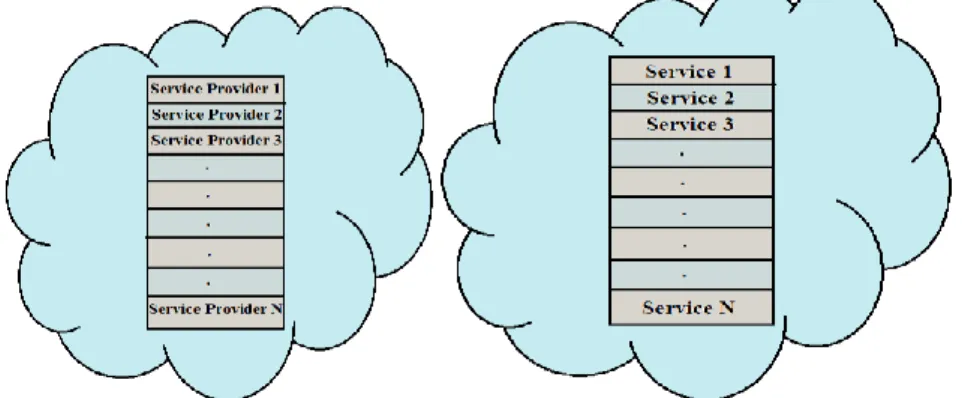
This model is showing the cluster of service providers, Services and modules. Database and application levels’ path will be different here.
July - 2013, pp. 190-196
Fig 2: Different Modules of a Service into the cloud
Fig 3: Relation between various services and clients/companies
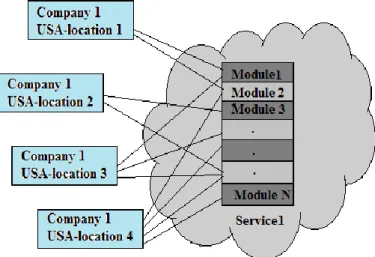
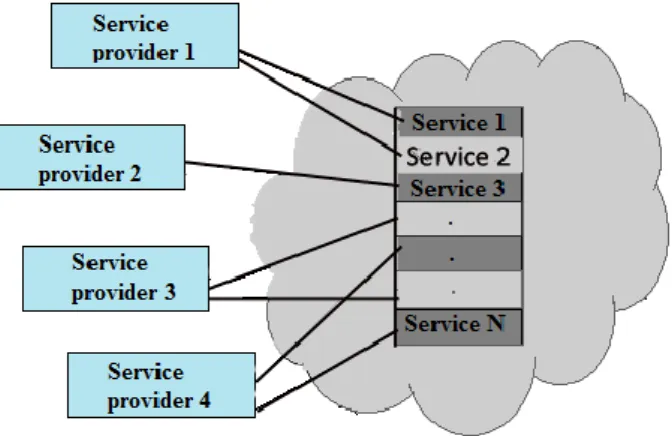
Fig – 3 is representing that different companies will be allowed to use different or same services for fulfilling their needs. In the fig – 4 it is clear that same company from their various locations will be able to use different or same modules. Fig – 5 shows same services can be distributed for various companies and sub branches. It is accessible from different locations also. Fig – 6 is showing that various service providers are sharing the common infrastructure for different services but it is isolated from other services as well as other service providers.
July - 2013, pp. 190-196
Fig 5: Connection between service modules, companies and locations
Fig 6: Relation between service providers and services
July - 2013, pp. 190-196
C. Algorithm
(user = = request) {
fg = select service from user_master where user = e and active = 1;
while ( mysql_fetch_array) {
module = auth_for; }
kg = select * from module_master where M_id= module;
while ( mysql_fetch_array) {
ser = service; }
zg = select * from service_module where sid= ser; while ( mysql_fetch_array) { encrypt = encryption; pvr= provider; } e = encrypt (user); p = encrypt (pass);
if (e = = user && pass = = P) * {
if (e.active = = 1) **{
s = service code;
f = select service from user_master where user = e and active = 1;
if (f > 0 && priority==100) control = 100; ser=authfor;
else if(f > 0) control = 50; ser=authfor;
if(control==50) ***{
k = select * from user_module where ton= ser;
while ( mysql_fetch_array) { activemodule = module; activeip= ip; activedb= storage; id[1] = id; }
z = select * from org_master where orgid= id[1]; while ( mysql_fetch_array)
{
softservice = service;
z = select * from org_master where orgid= id[1]; while ( mysql_fetch_array)
{
softservice = service; activeuser = user; }
km = select * from module_master where service= softservice; ty=0 while ( mysql_fetch_array) { id[ty] = mid; ty++; } for(tt=1;tt<ty;tt++) {
kz= select * from user_module where module= id[tt]; while ( mysql_fetch_array) { Activemodule[tt] = module; Activeip[tt]= ip; Activedb[t]= storage; } } } **} If(onlineuser<activeuser) onlineuser++; * } else terminate connection } activeuser = user; } ***} else {
k = select * from user_module where ton= ser; while ( mysql_fetch_array)
{ id[1] = id; }
July - 2013, pp. 190-196 In this cloud, there a large number of software services (say, service 1, service 2, service 3 and so on). Suppose, one of these services is an ERP and it has different modules – Finance (module 1), HR (module 2), Accounts (module 3) and Marketing (module 4). Now, end-user can choose any of the services including all modules as well as some selective modules as per their requirements. Depending on its exact needs, the organization can purchase the suitable module of the software service. Suppose, an organization X wants to use this service 1 and X has office branches throughout the world including Kolkata, Chennai, Mumbai, New Delhi, Bangalore, Melbourne, New York and others. Different branches of X have different module requirements of the same service (service 1). Suppose, the branch located at Kolkata requires the HR module (module 1), the branch located at Mumbai requires the Accounts module (module 2) whereas the branch located at Melbourne requires the Finance module (module 3) and the branch located at New York requires the Marketing module (module 4). All the different module users are identified by their unique IP addresses. For using these modules, each branch needs to register for the respective module. This entire system functions in such a way that all the use of the Kolkata branch of X cannot be viewed by the Mumbai branch or any other branch of X unless permitted by the cloud system administrator. Like X, several other organizations can use the same software service. On use, the Cloud System produces a detailed Analysis Report of software service use for each and every organization. Administering such a sophisticated cloud involves huge amounts of Infrastructure Cost, Operation Cost and Maintenance Cost. Thus, a small business enterprise cannot afford to use such an expensive web-based system. This cloud offers highly advanced multi- purpose web application software, the functionalities of which include Data Warehousing, Data Mining, Generation of Analytical Reports, etc. According to this model, a single platform offers many software services. According to our SaaS model, every small company can use the same infrastructure and software according to their requirements from their various branches. Not only that, they can choose the software module from their various services as well. We already have given proposed model along with initial identification/authentication of every registered business organization whereas system automatically identifies the business location along with static IP, services, different modules and storage device which is interrelated for every user. For using such a service, a company will be recognized by its unique user. On use, the Cloud System produces a detailed Analysis Report of software service use for each and every organization. To build and administer such a web service is practically too much expensive for a small business organization. In order to purchase and use such service, an organization needs to register as per its own requirements. Due to greatly reduced software expense and infrastructure expense, small organizations using such web service can attain quick phenomenal growth. Hence, the implementation of SaaS is highly beneficial for small to medium organizations. Also to mention, to ensure robustness of this entire cloud system, an authentication table is maintained at the cloud side. This table is showing that which organization is currently using which module and web service. For using a particular module, an organization has to LOG IN to the system with its unique USER ID. This table clearly shows the specific module (s) which already have been authenticated and the specific modules which are been requested for authentication.
VI. CONCLUSIONS
Virtualization technology has found a renewed interest owing to the need for cost-efficient operations, better manageability and increased availability of systems. The most striking feature of this model is the reality that using the same infrastructure, a large number of organizations (cloud service providers) will be able to deploy, operate and manage a large number of services each and this facility greatly reduces the web infrastructure cost of an organization. Such a sophisticated model is beneficial for both the user as well as the cloud service provider. If this model of cloud computing is implemented, worldwide popularity of SaaS can be ensured. This service is totally web based and depends on internet connection. So failure of internet connection simply implies that this service cannot be used. But in this electronic age, since internet connection is affordable for people all over the world, this SaaS will be accessible for users of all parts of the world.
ACKNOWLEDGMENT
I am thankful to my guide Prof. Swapan Swapan Bhattacharya, Dept of CSE, National Institute of Technology, Surathkal, Mangalore, India and Goutam Roy Chowdhury, Chancellor, Techno India University, West Bengal, India for their valuable support. Also I am thankful to my Department for the technical support.
REFERENCES
[1] Buell, K. Sch. of Comput., Inf., & Decision Syst. Eng., Arizona State, Univ., Tempe, AZ, USA, "Transaction Level Economics of Cloud Applications",Services (SERVICES), July,2011 IEEE World Congress.
[2] J G. Fathima Haseen Raihana,"CLOUD ERP – A SOLUTION MODEL",IRACST - International Journal of Computer Science and Information Technology & Security (IJCSITS), ISSN: 2249-9555 Vol. 2, No. 1, 2012. [3] Marinela Mircea and Anca Ioana Andreescu,"Using Cloud Computing in Higher Education: A Strategy to
Improve Agility in the Current Financial Crisis", IBIMA Publishing Communications of the IBIMA http://www.ibimapublishing.com/journals/CIBIMA/cibima.html,Vol. 2011 (2011).
[4] Subashis Biswas,R.Sravanti,Kumari Khushboo,"COST EFFECTIVE CLOUD STRATEGY TO INCORPORATE E-LEARNING SYSTEM IN TELECOM MEDIUM", IEEE National Conference on Paradigm Shift in Education Technology & Content Management, E-TCM 2012.
[5] Suciu,G.Telecommun. & Inf. Technol., Politeh. Univ. of Bucharest, Bucharest, Romania, “Cloud consulting: ERP and communication application integration in open source cloud systems”, IEEE Conference, Nov. 2011.
[6] Hofmann, P. SAP Labs., Palo Alto, CA, USA Woods, D.,” Cloud Computing: The Limits of Public Clouds for Business Applications”, IEEE Conference, Dec. 2011.
July - 2013, pp. 190-196 [7] Xiaoyan Jiang Yong Zhang; Shijun Liu,” A Well-designed SaaS Application Platform Based on Model-driven
Approach”, IEEE Conference, Nov. 2010.
[8] Spiteri,K.J. Luca,C.; Reynolds, .; Wilson, G. ,” Developing a framework for modelling complex business systems
within the cloud”, IEEE Conference, June. 2012.
[9] Amazon Web Services, “Case studies,” Amazon web site, Oct 2012,[Online] Available: http://aws.amazon.com/solutions/case-studies/. Last accessed Oct 2012.
[10] Monika Sharma, Ashwani Mehra, Haresh Jola, Anand Kumar Dr.Madhvendra Misra, Ms.Vijayshri Tiwari “Scope of cloud computing for SMEs in India” JOURNAL OF COMPUTING,ISSUE 5, MAY 2010, ISSN 2151-9617. [11] E. Deelman, G. Singh, M. Livny, J. B. Berriman, and J. Good, “The cost of doing science on the cloud: the
Montage example,” in SC. IEEE/ACM, 2008, p. 50.
[12] Wang, C. Illinois Institute of Technology, Chicago,Wang, Q., Ren, K.,Lou, W., "Towards Secure and Dependable Storage Services in Cloud Computing",Services Computing, IEEE Transactions on May,2011.