Securing CAN-Based Cyber-Physical Systems
ByAbdulmalik Humayed
Submitted to the Department of Electrical Engineering and Computer Science and the Graduate Faculty of the University of Kansas
in partial fulfillment of the requirements for the degree of Doctor of Philosophy
Committee members
Prof.Bo Luo, Chairperson
Prof.Arvin Agah
Prof.Prasad Kulkarni
Prof.Heechul Yun
Prof.Prajna Dhar
The Dissertation Committee for Abdulmalik Humayed certifies that this is the approved version of the following dissertation :
Securing CAN-Based Cyber-Physical Systems
Prof.Bo Luo, Chairperson
Abstract
With the exponential growth of cyber-physical systems (CPSs), new security chal-lenges have emerged. Various vulnerabilities, threats, attacks, and controls have been introduced for the new generation of CPS. However, there lacks a systematic review of the CPS security literature. In particular, the heterogeneity of CPS components and the diversity of CPS systems have made it difficult to study the problem with one gen-eralized model. As the first component of this dissertation, existing research on CPS security is studied and systematized under a unified framework. Smart cars, as a CPS application, were further explored under the proposed framework and new attacks are identified and addressed.
The Control Area Network (CAN bus) is a prevalent serial communication protocol adopted in industrial CPS, especially in small and large vehicles, ships, planes, and even in drones, radar systems, and submarines. Unfortunately, the CAN bus was designed without any security considerations. We then propose and demonstrate a stealthy targeted Denial of Service (DoS) attack against CAN. Experimentation shows that the attack is effective and superior to attacks of the same category due to its stealth-iness and ability to avoid detection from current countermeasures.
Two controls are proposed to defend against various spoofing and DoS attacks on CAN. The first one aims to minimize the attack using a mechanism called ID-Hopping so that CAN arbitration IDs are randomized so an attacker would not be able to target them. ID-Hopping raises the bar for attackers by randomizing the expected patterns in a CAN network. Such randomization hinders an attacker’s ability to launch targeted DoS attacks. Based on the evaluation on the testbed, the randomization mechanism,
ID-Hopping, holds a promising solution for targeted DoS, and reverse engineering CAN IDs, and which CAN networks are most vulnerable. The second countermeasure is a novel CAN firewall that aims to prevent an attacker from launching a plethora of nontraditional attacks on CAN that existing solutions do not adequately address. The firewall is placed between a potential attacker’s node and the rest of the CAN bus. Traffic is controlled bi-directionally between the main bus and the attacker’s side so that only benign traffic can pass to the main bus. This ensures that an attacker cannot arbitrarily inject malicious traffic into the main bus. Demonstration and evaluation of the attack and firewall were conducted by a bit-level analysis, i.e., “Bit banging”, of CAN’s traffic. Results show that the firewall successfully prevents the stealthy targeted DoS attack, as well as, other recent attacks. To evaluate the proposed attack and firewall, a testbed was built that consisted of BeagleBone Black and STM32 Nucleo-144 microcontrollers to simulate real CAN traffic.
Finally, a design of an Intrusion Detection System (IDS) was proposed to complement the firewall. It utilized the proposed firewall to add situational awareness capabilities to the bus’s security posture and detect and react to attacks that might bypass the firewall based on certain rules.
Acknowledgments
I would like to thank all of those who have given me directions, advice, or encouragement. I begin by thanking my adviser and mentor Prof.Bo Luo, who have been patient and wise throughout the long PhD journey. Dr.Luo have pushed me to my limits and made me reach goals that I had not thought were possible.
I would also like to thank the committee members who have given me advice and support, with-out which I would not have been able to realize success. Thank you Prof.Arvin Agah, Prof.Prasad Kulkarni, Prof.Heechul Yun, and Prof.Prajna Dhar.
Thank you my lab mates who have made the journey more enjoyable. Thank you Dr.Lei Yang, Dr.Yuhao Yang, Dr.Meeyoung Park, Hao Xue, Qiaozhi Wang, Chris Seasholtz, and Sana Awan. A special thanks to Saad Adnan for the wonderful help with building the circuits that I used for various experiments. Also thanks for my KU friends who I have greatly enjoyed our scholarly conversations. Thank you Dr.Mohammed Alenazi, Dr.Ali Abushaiba, and Farhad Mahmood.
Huge thanks to my sponsor Jazan University, Saudi Arabia, for their support throughout the PhD journey. In addition, I would like to thank the Saudi Cultural Mission for their support.
I am grateful for people who I met outside KU in conferences and workshops across the US. This includes Dr.Yasser Shoukry at Maryland University, Rob Deker and Karl Heimer from the CyberAuto Challenge, and Robert Leale and Craig Smith from the Car Hacking Village. Also thanks to David Crocket and Eric Evenchick for their valuable email exchanges.
Special thanks to my mentors and colleagues at Grimm Co who I spent one of the most inter-esting and enjoyable summers. Thank you for the Critical Infrastructure’s team: Matt Carpenter, Tim Brom, Aaron Cornelius, and Mitchell Johnson for the incredible advice and skills you have taught me.
My acknowledgment would not be complete without thanking my wonderful family for their infinite support and love. Thank you my parents and siblings for believing in me and supporting me all the way.
patience during my PhD study. Without your support and belief in me, I do not think I could have made it this far. Finally, thank for my three-months-old baby boy, Khalid, who has been a caffeine-free productivity tool. He made me have more appreciation for caffeine-free time and thus increased my productivity immensely in the last three months.
Contents
1 Introduction 1 1.1 Motivation . . . 3 1.2 Thesis Statement . . . 4 1.3 Proposed Solution . . . 4 1.4 Contributions . . . 51.5 List of Related Publications . . . 6
2 Background 8 2.1 Cyber-Physical Systems . . . 8 2.2 CPS Applications . . . 8 2.2.1 ICS . . . 9 2.2.2 Smart Grid . . . 9 2.2.3 Medical Devices . . . 10 2.2.4 Smart Cars . . . 10 2.3 CPS Communications . . . 10 2.3.1 ICS . . . 11 2.3.2 Smart Grid . . . 11 2.3.3 Medical Devices . . . 11 2.3.4 Smart Cars . . . 12 2.4 CPS Perspective . . . 12
2.5 Security in CPS . . . 18
3 Security in CPS 21 3.1 Threats . . . 21
3.1.1 Threat Model . . . 22
3.1.2 ICS Threats . . . 23
3.1.3 Smart Grid Threats . . . 24
3.1.4 Medical Devices Threats . . . 25
3.2 Vulnerabilities . . . 26 3.2.1 Causes of Vulnerabilities . . . 26 3.2.2 Cyber Vulnerabilities . . . 28 3.2.3 Cyber-Physical Vulnerabilities . . . 32 3.2.4 Physical Vulnerabilities . . . 38 3.3 Attacks . . . 39 3.3.1 Cyber Attacks . . . 41 3.3.2 Cyber-Physical Attacks . . . 44 3.3.3 Physical Attacks . . . 46 3.4 Controls . . . 47 3.4.1 General Controls . . . 48 3.4.2 ICS Controls . . . 50
3.4.3 Smart Grid Controls . . . 53
3.4.4 Medical Devices Controls . . . 55
4 Security in Cars 59 4.1 Types of Vehicle Communications . . . 59
4.2 CAN Bus Protocol . . . 59
4.2.1 CAN Subnetworks . . . 60
4.2.3 Types of ECUs . . . 61
4.2.4 ECUs and CAN . . . 62
4.3 Security in Cars . . . 63
4.3.1 Automotive VS. IT Security . . . 63
4.3.2 When is a car considered secure? . . . 63
4.3.3 ECUs modifications for security . . . 64
4.4 Security Threats . . . 64
4.5 Security Vulnerabilities . . . 65
4.5.1 Causes of Vulnerabilities . . . 65
4.5.1.1 More connectivity vs. assumed isolation . . . 65
4.5.1.2 Heterogeneity . . . 66 4.5.1.3 CAN Vulnerabilities . . . 66 4.5.2 Categorization of Vulnerabilities . . . 66 4.5.2.1 Cyber Vulnerabilities . . . 67 4.5.2.2 Cyber-Physical Vulnerabilities . . . 68 4.5.2.3 Physical vulnerabilities . . . 70 4.6 Security Attacks . . . 72 4.6.1 Cyber Attacks . . . 72 4.6.1.1 DoS . . . 72
4.6.1.2 False Data Injection (FDI) . . . 72
4.6.1.3 Privacy invasion . . . 73
4.6.2 Cyber-Physical Attacks . . . 73
4.6.2.1 Malware injection via Bluetooth . . . 73
4.6.2.2 Malware injection via cellular network . . . 73
4.6.2.3 Malware injection via OBD-II . . . 74
4.6.2.4 Bypassing the gateway via OBD-II . . . 74
4.6.2.6 Replay attacks . . . 74
4.6.3 Physical Attacks . . . 76
4.7 Security Controls . . . 76
4.7.1 Defending external threats . . . 77
4.7.2 Unimplemented promising controls . . . 77
4.7.3 Software security . . . 77
4.7.4 Heterogeneity of components . . . 78
4.7.5 Cryptography . . . 78
4.7.5.1 Hardware-Based Cryptography . . . 81
4.7.5.2 Key distribution techniques . . . 82
4.7.6 Redefining trust . . . 82
4.7.7 Restricted critical commands . . . 82
4.7.8 Bluetooth . . . 83
4.7.9 Firewalls . . . 83
4.7.10 Intrusion Detection Systems (IDS) . . . 84
4.7.10.1 Automotive VS. IT IDS . . . 84
4.7.10.2 Centralized VS. Distributed IDS . . . 85
4.7.10.3 Automotive IDS . . . 85
5 Preliminaries 89 5.1 Introduction . . . 89
5.2 CAN Node . . . 90
5.3 Dominant VS. Recessive Bits . . . 91
5.4 CAN Arbitration ID . . . 92
5.5 Error Handling . . . 93
5.5.1 Error Types . . . 93
5.5.1.1 Bit Error . . . 94
5.5.1.3 Stuff Error . . . 94
5.5.1.4 Form Error . . . 94
5.5.1.5 CRC Error . . . 95
5.5.2 Error States . . . 95
5.6 Summary . . . 95
6 The Stealthy Targeted Arbitration Denial Attack 96 6.1 Introduction . . . 96
6.2 Related Work . . . 97
6.2.1 Bus Denial . . . 97
6.2.1.1 Dominant Bits Stream (Bus Denial 1) . . . 98
6.2.1.2 Flooding with 0x0 IDs (Bus Denial 2) . . . 99
6.2.2 ECU Denial . . . 99
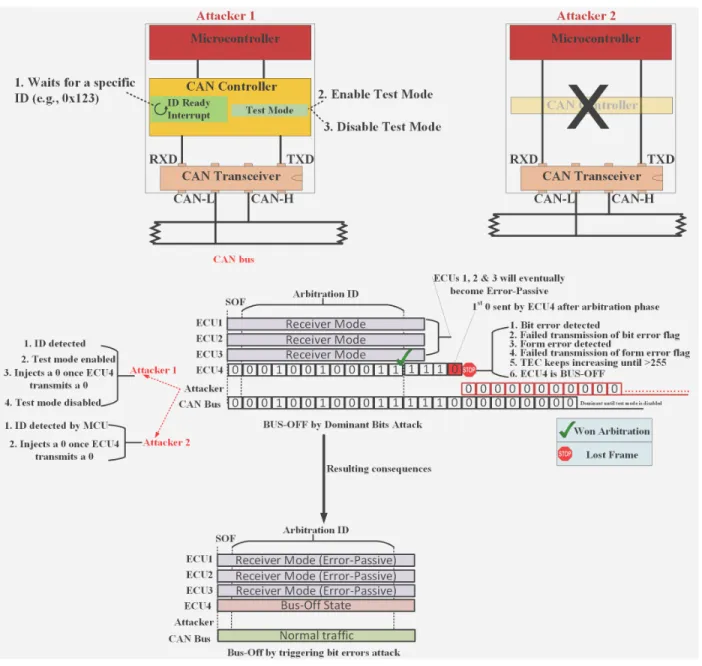
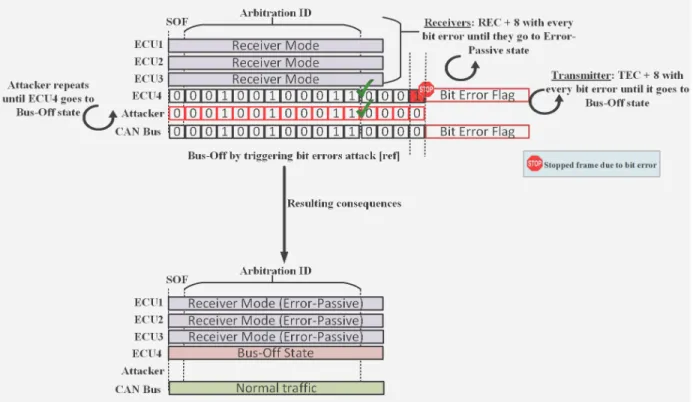
6.2.2.1 CAN Controller’s Misuse (Bus-Off Attack 1) . . . 100
6.2.2.2 Maliciously-Crafted Frames (Bus-Off Attack 2) . . . 100
6.2.2.3 CAN Transceiver-based Denial (Bus-Off Attack 3) . . . 101
6.2.3 Frame Denial . . . 103
6.2.3.1 Prevention . . . 103
6.2.3.2 Interruption . . . 105
6.2.3.3 Impersonation . . . 105
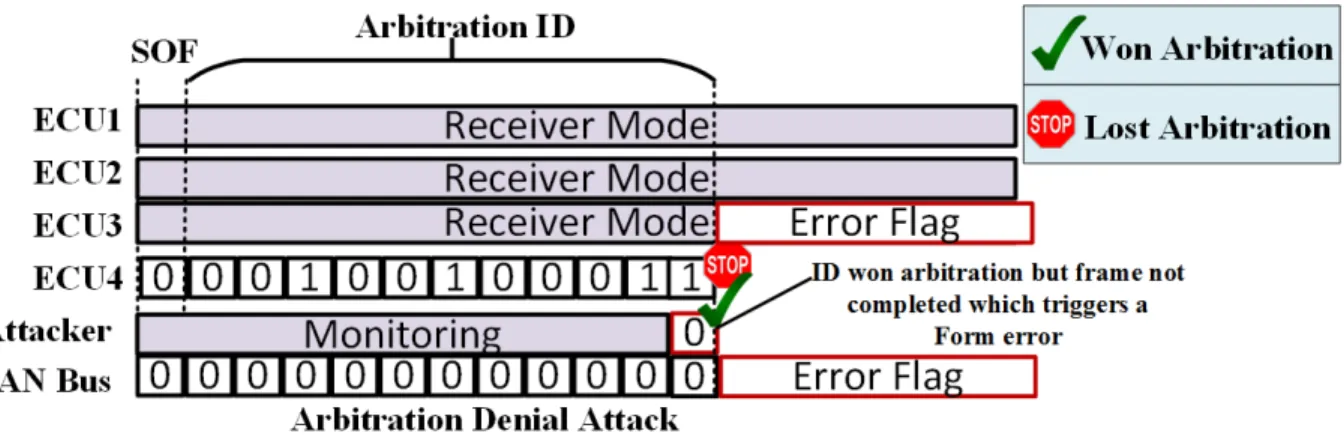
6.2.4 Arbitration Denial . . . 107
6.3 Stealthy Arbitration Denial Attack . . . 108
6.3.1 Threat Model . . . 111
6.3.2 Algorithm . . . 111
6.3.2.1 Bit Position . . . 111
6.3.2.2 Target ID’s Detection and Attacking . . . 112
6.4 Evaluation . . . 113
6.4.1.1 Evaluation Platform . . . 115
6.4.2 Effectiveness Metrics . . . 116
6.4.3 Evaluated Attacks . . . 116
6.4.4 0x0 Arbitration ID . . . 117
6.4.5 Bus-Off Attack Evaluation . . . 118
6.4.6 Arbitration DoS Evaluation . . . 119
6.4.7 Selective Arbitration DoS Evaluation . . . 121
6.5 Summary . . . 122
7 Using ID-Hopping to Defend Against Targeted DoS on CAN 123 7.1 Introduction . . . 123
7.2 Background . . . 125
7.2.1 CAN Protocol . . . 125
7.2.2 Arbitration IDs and ECUs . . . 126
7.3 Related Work . . . 126 7.4 DoS attacks . . . 130 7.4.1 Types of DoS . . . 130 7.4.1.1 Traditional DoS . . . 130 7.4.1.2 Random DoS . . . 130 7.4.1.3 Targeted DoS . . . 131 7.4.2 Attacker Model . . . 131 7.5 ID-Hopping Mechanism . . . 133 7.5.1 Requirements . . . 133 7.5.2 Overview . . . 133 7.5.3 The Algorithm . . . 134
7.5.3.1 Phase One: IDs Generation . . . 136
7.5.3.2 Phase Two: IDs Assignment . . . 137
7.6 Security Analysis . . . 141 7.6.1 Attack Prevention . . . 141 7.6.2 Collision-Free . . . 141 7.6.3 Priority Preservation . . . 141 7.6.4 Protocol-Independent . . . 141 7.6.5 Efficiency . . . 141 7.6.6 Limitations . . . 142
7.6.6.1 Original Frames are intact, except their IDs . . . 142
7.6.6.2 Attacker retrieves the offset . . . 142
7.6.6.3 Potential limited CAN ID space . . . 142
7.7 Evaluation . . . 143
7.8 Summary . . . 144
8 Firewall To Defend Against Denial Attacks on CAN 146 8.1 Introduction . . . 146
8.2 CAN Transceiver-Based Firewall . . . 147
8.2.1 Firewall Architecture . . . 147 8.2.2 Firewall Requirements . . . 148 8.2.2.1 Low Latency . . . 148 8.2.2.2 Low Cost . . . 148 8.2.2.3 Compatibility . . . 149 8.2.3 Firewall Goals . . . 149 8.2.3.1 Bus Denial . . . 149
8.2.3.2 ECU and Frame Denial . . . 149
8.2.3.3 Arbitration Denial . . . 150
8.3 Algorithm . . . 150
8.4 Evaluation . . . 151
8.4.2 Traffic To Attacker (CAN1to CAN2) . . . 153
8.4.3 Traffic From Attacker (CAN2to CAN1) . . . 153
8.4.4 Prevention of Bus Denial . . . 154
8.4.5 Prevention of ECU and Frame Denial . . . 154
8.4.6 Prevention of Arbitration Denial . . . 154
8.4.7 Prevention of The Stealthy Targeted Arbitration Denial . . . 155
8.5 Related Work . . . 156
8.6 Summary . . . 157
9 Firewall-Complementing Intrusion Detection System (IDS) 158 9.1 Introduction . . . 158
9.1.1 IDS Detection Rules . . . 159
9.1.1.1 Bus Denial by Dominant Bits Stream . . . 159
9.1.1.2 Bus Denial by 0x0 ID flooding . . . 159
9.1.1.3 Incomplete Frames Injection . . . 159
9.1.2 IDS and Firewall Integration . . . 160
9.1.2.1 Prevention of Bus Denial by Dominant Bits Stream . . . 160
9.1.2.2 Prevention of Bus Denial by 0x0 ID flooding . . . 161
9.1.2.3 Prevention of Incomplete Frames Injection . . . 162
9.1.3 IDS Architecture . . . 163
9.2 Related Work . . . 164
9.3 Summary . . . 164
10 Conclusions and Future Work 166 10.1 Conclusions . . . 166
10.2 Future Work . . . 170
10.2.1 CPS Applications . . . 170
10.2.3 Evaluation of the IDS . . . 170
10.2.4 Detection of Subtle Attacks . . . 170
10.2.5 Fingerprinting ECUs . . . 171
A BeagleBone Black Configuration 194 A.1 Static IP Configuration . . . 194
A.1.1 Host Machine IP Configuration . . . 194
A.1.2 BBB IP Configuration . . . 195
A.1.3 Connecting to BBBs . . . 195
A.2 CAN Configuration . . . 196
A.2.1 DCAN1 Configuration . . . 196
A.2.2 CAN Transceiver Wiring . . . 196
A.2.3 CAN Interface Configuration . . . 196
A.2.4 SocketCAN Utilities . . . 198
A.2.5 Scripts and Commands . . . 198
A.2.5.1 Start CAN with Error Reporting . . . 198
A.2.5.2 Script for Extracting Errors’ Information . . . 198
A.2.6 CAN Simulation with 2 BBBs . . . 199
A.2.7 DCAN . . . 199
A.2.8 Automatic Retransmission . . . 200
A.2.8.1 Disable Automatic Retransmission . . . 200
A.2.8.2 Show DCAN1 Settings . . . 200
B Programmable Real-Time Units (PRUs) 202 B.1 Download a Customized Image . . . 203
B.2 Load Devicetree Overlays . . . 203
B.3 Configure Pins . . . 203
List of Figures
2.1 CPS abstract model . . . 12
2.2 CPS Aspects . . . 14
2.3 CPS aspects in ICS . . . 15
2.4 CPS aspects in the Smart Grid . . . 16
2.5 CPS aspects in medical devices . . . 17
2.6 CPS aspects in smart cars . . . 18
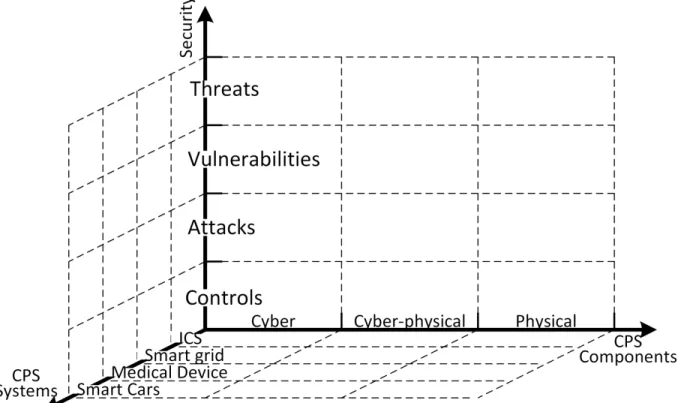
3.1 PS security framework with three orthogonal coordinates: security, CPS compo-nents, and representative CPS systems . . . 58
4.1 CAN Format from [92] . . . 60
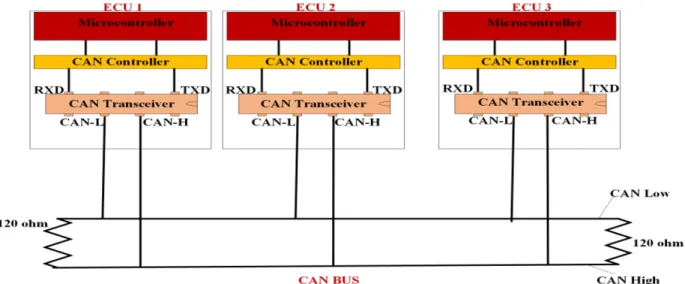
5.1 Components in Typical CAN Nodes . . . 90
5.2 Wiring Diagram for MCP2551 CAN Transceiver . . . 91
5.3 Dominant VS. Recessive Bits . . . 92
5.4 Arbitration Process . . . 93
6.1 Bus Denial Attacks . . . 98
6.2 ECU Bus-Off Attacks 1 & 3 . . . 102
6.3 ECU Bus-Off Attack 2 . . . 103
6.4 Arbitration Denial Attack . . . 108
6.5 Stealthy Arbitration Denial . . . 109
6.7 Bit Position Algorithm . . . 112
6.8 Attack Algorithm Demonstration . . . 113
6.9 Sampling Frames with CANT . . . 115
6.10 Evaluation Platform . . . 116
6.11 Errors During 0x0 ID Flooding Attack . . . 118
6.12 Errors During Bus-Off Attack . . . 119
6.13 Errors During Arbitration DoS Attack . . . 120
6.14 Arbitration DoS Attack on The Scope . . . 121
6.15 Target Frame and Dominant Bit Injection . . . 121
6.16 Errors During Selective DoS Attack . . . 122
7.1 Overview of a Modern In-Vehicle Network . . . 127
7.2 Scenario of a targeted DoS attack . . . 132
7.3 Overview of the network before and after the ID-Hopping takes place . . . 135
7.4 Alternative IDs’ Generation: Case 1 . . . 137
7.5 Alternative IDs’ Generation: Case 2 . . . 138
7.6 Flowchart of the ID-Hopping Algorithm . . . 139
7.7 Testing Platform . . . 143
7.8 Original vs. Alternative IDs . . . 144
8.1 Typical CAN Bus . . . 147
8.2 Firewall Architecture . . . 148
8.3 Firewall Demonstration . . . 150
8.4 Firewall Example . . . 152
8.5 Firewall Forwards Traffic From CAN1 to CAN2 . . . 153
8.6 Firewall Forwards Traffic From CAN2 to CAN1 . . . 153
8.7 Bus-Off Attack with and Without the Firewall . . . 154
8.9 Firewall and The Stealthy Targeted Arbitration Denial . . . 156
9.1 Bus Denial 1 Attack Demonstration . . . 161
9.2 Bus Denial 2 Attack Demonstration . . . 162
9.3 Bus Denial 2 Attack Demonstration . . . 163
9.4 IDS Architecture . . . 164
List of Tables
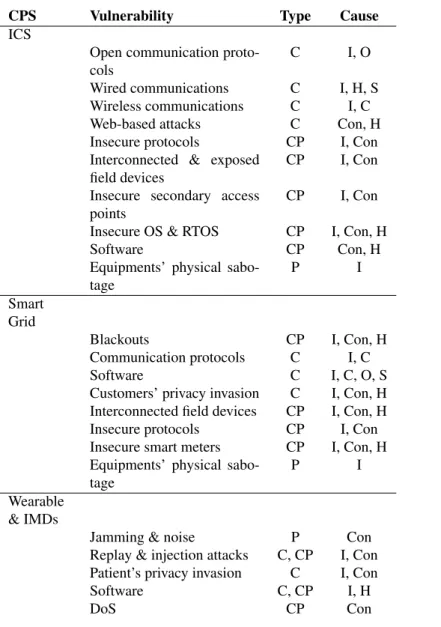
3.1 Summary of vulnerabilities. C: Cyber, CP: Cyber-Physical, P: Physical; I: Isola-tion assumpIsola-tion, C: Connectivity, O: Openness, H: Heterogeneity, S: Many
stake-holders . . . 40
3.2 ICS Cyber-Physical attacks . . . 48
3.3 Smart Grid Cyber-Physical attacks . . . 49
3.4 Medical devices Cyber-Physical attacks . . . 50
4.1 OSI Model VS. CAN bus . . . 61
4.2 Summary of Vulnerabilities . . . 71
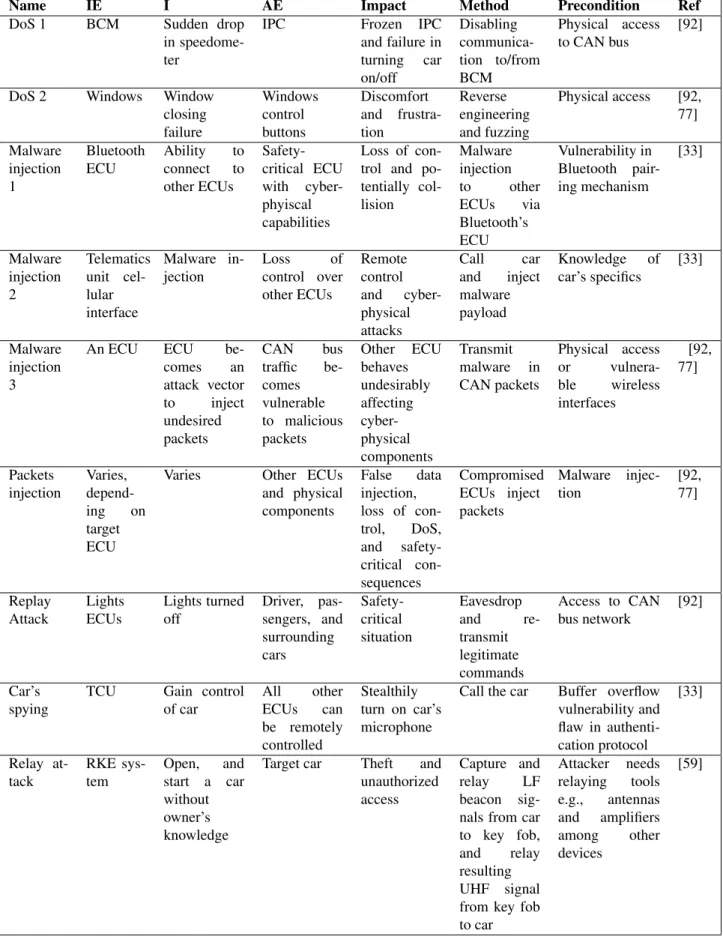
4.3 Smart Cars Cyber-Physical attacks . . . 75
6.1 Bus Denial Attacks . . . 99
6.2 Bus-Off Attacks . . . 104
6.3 Frames Denial Attacks . . . 106
6.4 Impersonation Attacks . . . 107
6.5 Arbitration Denial Attacks . . . 110
6.6 Threat Model Comparison . . . 111
6.7 Summary of the Evaluated Attacks . . . 117
7.1 IDs in ECUs 1 and 2 . . . 126
7.2 ECU1IDs . . . 134
Chapter 1
Introduction
In recent years, exponential growth has been witnessed in the development and deployment of various types of Cyber-Physical Systems (CPS). They have impacted almost all aspects of our daily life; for instance, in electrical power, oil and natural gas distribution, transportation systems, health-care devices, household appliances, and many more. Many of the newly proposed CPS systems are critical for national infrastructure, life support devices, or essential to our daily life. Therefore, they are expected to be free of vulnerabilities and immune to all types of attacks, which, unfortunately, is practically impossible for all real-world systems.
The problem in CPS is the heterogeneity of the building components. CPS are composed of various components. There is different hardware such as sensors, actuators, and embedded systems. There is also a different collection of software products for control and monitoring. The reason this heterogeneity is considered a security problem is that every component can be a contributing factor of a CPS attack. Understanding the current CPS security vulnerabilities, attacks and protection mechanisms will provide us with a better understanding of the security posture of CPS. Consequently, we should be able to point out the limitations of CPS that make them subject to different attacks and devise approaches to defend against security attacks.
In this dissertation, we introduced CPS, and how they are different from both old control sys-tems and IT syssys-tems. Recognizing the difference is key to understanding CPS security problems.
We surveyed four CPS applications: Industrial Control Systems (ICS), Smart Grids, implantable and wearable medical devices, and smart cars. We then investigated the security posture in each application and identified the causes for such problems. Then we propose a cyber-physical frame-work that highlights the correlations among threats, vulnerabilities, attacks, and controls. In addi-tion, we apply the framework to smart cars and show how different attacks evolved by threats that exploited existing vulnerabilities and what countermeasures could be used to prevent them.
After surveying security in CPS, generally, and smart cars, specifically, we recognized the secu-rity vulnerabilities in Controller Area Network (CAN), the popular serial communication protocol used in a plethora of applications ranging from small and large vehicles, to ships and planes, and even in artificial limbs, drones, radar systems, and submarines. CAN was developed in 1986 for automobiles by Robert Bosch to replace the complex point-to-point wiring used in cars at the time. CAN is flexible, efficient, robust, and cost-effective, however, security was not considered at the time it was developed. Therefore, many security attacks have been exploited [32, 92, 38].
In this dissertation, we propose a stealthy targeted denial of service (DoS) attack against CAN. The attack prevents CAN nodes from normal operations in a stealthy and selective manner, in the sense that it cannot be detected with the current solutions because of its seemingly-legitimate behavior. Targeted so that the attack only affects the intended targets while the unintended work normally. This attack is distinguished from proposed attacks due to its stealthiness. Other attacks result in shutting down a CAN node or inducing errors that make the attack stand out. We evaluated the attack by simulating CAN bus traffic using BeableBone Black microcontrollers to simulate CAN node, and a STM32 Nucleo-144 development board as the attacker. The evaluation shows that the attack successfully achieved its goal by preventing CAN nodes selectively and stealthily from a successful transmission. The impact of such an attack could be crucial. CAN is used in safety-critical applications and such an attack could prevent some functions that are life-saving.
To address this attack, among many recent non-traditional attacks, we propose three simultane-ous solutions to improve security in CAN using smart cars as a means of evaluation: ID-Hopping, a CAN Transceiver-based firewall and a firewall-complementing Intrusion Detection System (IDS).
For the ID-Hopping, we propose a memory-efficient and cost-effective mechanism to prevent tar-geted DoS attacks on CAN. The idea is to alter the network’s behavior when an attacker performs a DoS attack against a particular CAN node. The change in behavior results in thwarting the attack’s danger.
In addition, a firewall that is based on a CAN transceiver is proposed to prevent attacks that are not addressed by current countermeasures. Its distinguishing feature is that it monitors and is able to prevent traffic from one or more potentially-malicious ECUs one bit at time, instead of one frame at a time commonly used in conventional firewalls. Using the same evaluation platform, we added another STM32 Nucleo-144 to implement the firewall’s functionality. The evaluation shows the firewall effectiveness against our proposed attack in addition to other recent attacks.
Finally, we propose a novel IDS design that complements the proposed firewall. It aims to detect attacks that the firewall might fall short of preventing due to their seemingly-legitimate nature. Certain attack patterns are recognized by the IDS which then notifies the firewall to prevent them. To the best of our knowledge, the proposed IDS is the first one that detects attacks by bit banging, unlike traditional IDS that perform analyses at the frame level.
1.1
Motivation
We chose smart cars as a representative CPS application. Smart cars have received a tremendous amount of attention recently in academia and the media due to their importance and relevance to our lives and safety [33, 92, 64]. Smart cars are now connected more than ever before, and although connectivity has increased in smart cars, they still heavily rely on legacy protocols, such as CAN, and resource-limited embedded systems. In addition, despite increasingly added safety and com-fort features, such asAdaptive Cruise Control(ACC),Lane Keep Assist,Collision Prevention, and
Comfort Park Assist, smart cars have become vulnerable to remote attacks that could potentially exploit such "safety" and "comfort" features for malicious and potentially safety-critical attacks.
attacks that range from privacy invasion to life-threatening cyber-physical attacks [33, 92, 30, 32, 31]. Most of the proposed solutions focus on cryptographic mechanisms [176, 51, 171, 139], Intrusion Detection Systems (IDS) [96, 127, 154], and redesigning automotive embedded systems and networks [157]. Applying cryptography could be cost-inefficient in such resource-constrained systems. Although proposed IDS mechanism detect attacks, they do not prevent them. Also, most of IDS are anomaly-based that aim to detect attacks based on the frequency of messages. We believe more parameters must be included to detect more subtle attacks. Finally, redesigning the automotive systems, or the introduction of solutions that require redesign, is a very costly approach for manufacturers who already face cost and competition challenges.
1.2
Thesis Statement
CPS are widely ubiquitous and their impact on human lives is increasing. Although aimed at im-proving people’s safety and convenience, CPS could be leveraged to perform malicious activities that would threaten safety and well-being. Taking smart cars as one application of CPS, we ex-amine the current cars’ security from a cyber-physical perspective. This would reveal unexpected safety-related attacks. From such revelations, we plan to draw conclusions on approaches to pre-vent cyber-physical attacks. Therefore, the thesis statement is as follows:
Providing a unified security framework for CPS facilitates understanding security issues, and therefore addressing them. In addition, due to the criticality of CPS applications, the detection and prevention of denial of service (DoS) attacks can greatly improve the overall security posture in such safety-critical applications.
1.3
Proposed Solution
One of the most likely attacks on CAN networks is DoS. An attacker could simply flood the network with a frame that has the highest priority over all other frames. Although devastating, such an attack is easily detected but difficult to prevent. However, a subtle DoS variant is where an
attacker targets a specific CAN node every time it sends a frame. This is considered a targeted DoS attack. We propose ID-Hopping mechanism to prevent such an attack by making all network’s participating computers change their frames IDs in a way that is only understood by legitimate parties. Therefore, an attacker is left confused because the targeted computer does not send the same ID anymore, and thus does not trigger an attack to launch the targeted DoS attack.
Firewalls are commonly used for allowing and denying network traffic based on certain rules. In an automotive context, firewalls do not have the luxury they have in IT systems such as IP addresses and port numbers. Instead, they have various kinds of parameters due to the use of different protocols. We propose an automotive firewall that allows and prevents frames based on rules that take situational-awareness into consideration. For example, the firewall should prevent an attacker from injecting arbitrarily when a CAN node is transmitting. No more than one CAN node is supposed to transmit simultanously with other nodes except during the arbitration phase.
Finally, to complement the work of the firewall, we also propose an IDS that detects attacks that could bypass the firewall. Once an attack is detected, the IDS notifies the firewall which then blocks transmission of the attacking ECU. To evaluate the above mechanisms, we have built a hardware-based simulation environment that consists of four BeagleBone Black (BBB) microcontrollers to simulate regular CAN nodes and two STM32 Nucleo-144 development boards to simulate an attacker’s behavior and implement the firewall’s functionalities.
1.4
Contributions
In this work, our contributions are as follows:
1. Survey security aspects in four common CPS application: ICS, Smart Grid, medical devices, and smart cars.
2. Present potential threat sources to CPS and their motivations.
4. Present a taxonomy that highlights the cyber-physical aspects of security in CPS applica-tions, called "Cyber-Physical Security Framework for CPS."
5. Design and implement an ID hopping algorithm to prevent targeted DoS attacks.
6. Design and implement an automotive a CAN Transceiver-based firewall.
7. Design an Intrusion Detection System to complement the firewall.
8. Evaluate the effectiveness and performance of the proposed ID-Hopping, firewall, and IDS by a hardware-based simulation environment.
1.5
List of Related Publications
1. Abdulmalik Humayedand Bo Luo. CAN Transceiver-Based Firewall to Defend Against DoS on CAN. In submission.
2. Abdulmalik Humayed and Bo Luo. The Stealthy Targeted Arbitration Denial Attack on CAN. In submission.
3. Abdulmalik Humayed, Jingqiang Lin, Fengjun Li, and Bo Luo. Cyber-Physical Systems Security – A Survey. In IEEE Internet of Things Journal - Special Issue on Security and Privacy in Cyber-Physical Systems, Volume: 4 Issue: 6, 2017.
4. Abdulmalik Humayed, and Bo Luo. Using ID-Hopping to Defend Against Targeted DoS on CAN. In International Workshop on Safe Control of Connected and Autonomous Vehicles (SCAV), in conjunction with CPS Week 2017, Pittsburgh, PA, 2017.
5. Abdulmalik Humayed, and Bo Luo. Poster Abstract: Cyber-Physical Security for Smart Cars – Taxonomy of Vulnerabilities, Threats, and Attacks. In 6th ACM/IEEE International Conference on Cyber-Physical Systems (ICCPS), Seattle, WA, 2015 (CPS Week Best Poster Finalist).
6. Abdulmalik Humayed, and Bo Luo. Cyber-Physical Security for Smart Cars – Issues, Survey and Challenges. In 2nd International IFIP Workshop on Emerging Ideas and Trends in Engineering of Cyber-Physical Systems (EITEC), Seattle, WA, 2015.
Chapter 2
Background
2.1
Cyber-Physical Systems
CPS are systems used to monitor and control the physical world. They are perceived as the new generation of embedded control systems such that CPS are networked embedded systems [1]. In addition, systems, where sensor and actuator networks are embedded, are also considered CPS [26]. Because of the reliance on IT systems, CPS could be defined as IT systems that are integrated into applications in the physical world [63]. This integration is a result of the advance-ments in the information and communication technologies (ICT) to enhance interactions with phys-ical processes. All of these definitions highlight the heavy presence of the interactions between the cyber and the physical worlds.
2.2
CPS Applications
An increasing dependence on CPS has been growing in various applications such as energy, trans-portation, military, health-care, and manufacturing. CPS can be called different names, depending on the application using them. For example, a widely used application of CPS is the Supervisory Control and Data Acquisition (SCADA) which is used in Critical Infrastructure (CI) such as the Smart Grid and Industrial Control Systems (ICS). Other examples have emerged in medical
de-vices such as wearable and implantable medical dede-vices. In addition, a network of small control systems are embedded in modern cars to improve fuel efficiency, safety, and convenience.
2.2.1
ICS
ICS refers to the control systems used to enhance the control, monitoring, and production in differ-ent industries such as the electrical grid, nuclear plants, water and sewage systems, and irrigation systems. Sometimes ICS is called Supervisory Control and Data Acquisition (SCADA) or Dis-tributed Control Systems (DCS). For convenience, we will use the term ICS to refer to either of them. In ICS, different controllers with different capabilities communicate to achieve numerous expected goals. One of which is the Programmable Logic Controller (PLC), which is a micropro-cessor that is designed to operate continuously in hostile environments so that human operators find difficulty being present in [97]. This field device is connected to the physical world through sensors and actuators. Usually, it is equipped with wireless and wired communications that satisfy different configurations in different environments. It can also be connected to PC systems in a control center that controls and monitors its operations.
2.2.2
Smart Grid
The Smart Grid is the next generation of power grid that has been used for decades for electricity generation, transmission, and distribution. The smart grid provides several benefits and advanced functionalities. At the national level, it provides enhanced emission control and energy savings. Whereas at the local level, it provides home consumers better control over their energy use that would be beneficial economically and environmentally [113]. The smart grid is comprised of two major components:power applicationandsupporting infrastructure[161]. The power application is where the core functions of the smart grid are provided, that are electricity generation, transmis-sion, and distribution. Whereas the supporting infrastructure is the intelligent component that is mainly concerned with controlling and monitoring the core operations of the smart grid with a set of software, hardware, and communication networks.
2.2.3
Medical Devices
Medical devices have been improved by integrating cyber and physical capabilities to deliver better health care services. We are more interested in medical devices with cyber capabilities that have physical impact on patients. Such devices are either implanted inside the patient’s body, called Implantable Medical Devices (IMDs), or worn by patients, called wearable devices. They are usu-ally equipped with wireless capabilities to allow communication with other devices such as the
programmer, which is needed for updating and reconfiguring the devices. Wearable devices com-municate with each other or with other monitoring or control devices, such as a remote physician’s system or a smartphone [151].
2.2.4
Smart Cars
Smart cars (intelligent cars) are cars that are more environment-friendly, fuel-efficient, safe, and have enhanced entertainment and convenience features. These advancements are made possible by the reliance on a range of 50 to 70 computers networked together, called Electronic Control Units (ECUs). ECUs are responsible for monitoring and controlling various functions such as engine emission control, brake control, entertainment (radio, multimedia players) and comfort features (cruise control and windows opening and closing).
2.3
CPS Communications
Communication technologies vary in CPS applications. Different application use different proto-cols (open and proprietary) and technologies (wired and wireless). Here we give an overview of the most common communication technologies and protocols in each of the four applications.
2.3.1
ICS
Two types of communication protocols are deployed in ICS, one is used for the automation and control such as Modbus, Distributed Network Protocol (DNP3), and the other is for interconnecting ICS control centers, such as Inter-Control Center Protocol (ICCP) [8]. Those protocols are used in addition to the general-purpose protocols such as TCP/IP.
2.3.2
Smart Grid
The networks are of two types: field device communications within substations using Modbus and DNP3, and recently the more advanced protocol, IEC 61850. The other type is control center communications, which rely on the Internet-Control Center Communication Protocol (ICCP).
In addition, smart meters and field devices use wireless communications to send measurements and receive commands from control centers. Smart meters, for example, use short-range frequency signals, e.g. Zigbee, for diagnostics operations by technicians or readings by digital smart readers.
2.3.3
Medical Devices
It is a necessary requirement that IMDs are updated and reconfigured wirelessly so no surgical device extraction is no needed on the patient’s body. Therefore, wireless communication is the most common method of communication in medical devices. Both types rely on different commu-nication protocols and technologies. For example, IMDs use LF signals specified by FCC, called Medical Implant Communication Service (MICS), that make it possible for IMDs and their pro-grammers to communicate. On the other hand, wearable devices rely on another type of wireless communications, that is Body Area Network (BAN). BAN utilizes a number of wireless commu-nication technologies such as Bluetooth and IEEE 802.15.4 (ZigBee) [35].
2.3.4
Smart Cars
All ECUs are connected to a bus network, and the network is divided into several bus subnetworks, each of which consists of a number of interconnected ECUs that perform certain functionalities. An example of such subnetworks are CAN (Controller Area Network), MOST (Media Oriented Systems Transport), LIN (Local Interconnect Network), and FlexRay. Depending on the nature of the tasks expected from each ECU, it is attached to the appropriate subnetwork. These different subnetworks can intercommunicate through gateways.
2.4
CPS Perspective
Fig. 2.1 shows a high-level view of any CPS, where it mainly consists of three parts: communi-cation, computation and control, and monitoring and manipulation. The communication is of two types, wireless or wired, and it could connect CPS with higher-level systems, such as control cen-ters, or with lower-level components in the physical world. The computation and control part is where the intelligence is embedded in the CPS, control commands are sent, and sensed measures are received. The monitoring and manipulation part connects CPS to the physical world through sensors, to monitor physical components, and actuators, to manipulate them.
Figure 2.1: CPS abstract model
A CPS component might have the ability to communicate with control centers or other CPS components. This same component could also contain a sensor, an actuator, or both to connect to the physical world. Each one of these capabilities have different potential security implications that may result from the close interactions of the component’s parts and their capabilities. For example, a CPS component’s communicational and computational parts are not expected to affect
the physical world, and yet might be exploited to cause unexpected attacks with physical conse-quences. Similarly, the physical properties of this component, in addition to the physical properties of the object of interest in the physical world that the CPS controls and monitors, can also cause unexpected attacks that might result in non-physical attacks, such as misleading information sent to a CPS.
This heterogeneity of CPS among components, or within a component itself, results in a lack of understanding of new types of security threats that would exploit such heterogeneity. This urges CPS engineers to incorporate security-aware paradigms that consider the cyber-physical nature of potential attacks. The need to clearly distinguish between such aspects for security analysis and engineering arises. Thus, we view any CPS from three aspects: cyber, physical, and cyber-physical. The cyber aspect considers data computations, communications, and interactions that do not affect the physical world, whereas the cyber-physical aspect consider them when direct interactions with the physical world takes place. The cyber-physical aspect is where the cyber and physical world can connect. In addition, the physical aspect includes any security-related properties of the physical world, a CPS, or its components.
In Fig 2.2, we incorporated this CPS view in the abstract model shown in Fig 2.1. Referring to the Fig 2.2, (1) are the aspects that we consider cyber, whereas (2) are the cyber-physical aspects. Note the dashed line separating (1) and (2) shows how the same component can be considered cyber and cyber-physical at the same time depending on the presence or its the absence of the interaction with the physical world. (4) shows that the physical properties of any part of a CPS system could play a role in security issues. Therefore, we need to include it in the physical aspect. In the following paragraphs, we present how our abstract model can capture the CPS aspects in the following applications: ICS, the Smart Grid, implantable and wearable medical devices, and smart cars. In each figure, we annotate the CPS aspects: (1)cyber, (2)cyber-physical, and (3)physical. This annotation distinguishes between the aspects in such a way that we can relate to it in the analysis of security issues.
Figure 2.2: CPS Aspects
temperature in a chemical plant. The goal is to maintain the temperature within a certain range. If the temperature exceeds a specified threshold, the PLC is notified via a wireless sensor attached to the tank, which in turn, notifies the control center of the undesired temperature change. Alter-natively, in closed-loop settings, the PLC could turn the cooling system on to reduce that tank’s temperature within the desired range.
In this figure, the cyber aspects (1) are the interactions with the PLC such that there is no direct interaction with physical components, such as cooling fans or the tank. This involves any laptops that require direct access to connect directly to the PLC, communications with higher-level environments such as the control center and other remote entities, and the PLC’s wireless interface that could be based on long or short-range frequencies. In addition, cyber-physical aspects (2) are those that connect cyber and physical aspects. The PLC, the actuator, and the sensor, are all cyber-physical aspects due to their direct interactions with the cyber-physical world. The wireless capabilities of the actuator and the sensor are also considered cyber-physical. Finally, the physical aspects are the physical objects that need monitoring and control, i.e. the cooling fans and the tank’s temperature.
Smart Grid. Fig. 2.4 shows a typical scenario in the smart grid, more particularly, highlight-ing the interactions of the smart meters. A smart meter is attached to every house to provide utility companies with more accurate electricity consumption and customers with convenient
ac-Figure 2.3: CPS aspects in ICS
cess to their usage. A smart meter interfaces a house’s appliances and Home Energy Management Systems (HEMS) on the one hand, and interfaces with data collectors on the other. Wireless com-munications are the most common means to communicate with collectors, although wired commu-nications, such as Power Line Communications (PLC), are also available. The meter is equipped with a diagnostics port that relies on short-range wireless interface for convenient access by digital meter readers and diagnostics tools [91]. The smart meter sends the measurements to a collector that aggregates all meters’ data in a designated neighborhood. The collector sends the aggregated data to the distribution control center managed by the utility company. In particular, to the AMI headend server that stores the meters’ data and shares the stored data with the Meter data manage-ment system (MDMS) that manages the data with other systems such as demand response systems, historians, and billing systems. The headend can connect/disconnect services by remotely sending commands to the meters. This feature is a double-edged sword such that it is very efficient way to control services, yet it could be exploited to launch large-scale blackouts by remotely controlling a large number of smart meters.
In Fig. 2.4, we highlight the CPS aspects in the involved components that have some interac-tions with the smart meters. Cyber aspects (1) are in the control center such that it stores smart meters’ data, shares it, analyzes it, and makes informed decisions based on that. The control cen-ter can also have a cyber-physical aspect (2) when connect/disconnect commands are sent by the AMI headend to smart meters. In addition, the cyber-physical aspect (2) is also apparent in the smart meter itself due to its ability to perform cyber operations, such as sending measurements to utility, and physical operations, such as connecting/disconnecting electricity services. Other field devices in the generation, transmission automation, and distribution plants have a high presence
of the cyber-physical aspect due to their close interactions with physical aspects of the smart grid. We can consider those field devices as ICS devices due to the very similar environments to ICS ap-plications. Smart meters are the distinguishing component that differentiate between ICS and the Smart Grid. Home appliances that are connected with smart meters are considered cyber-physical because of the their direct interaction with smart meters. A utility company can use smart meters to control the amount of energy consumed by particular home appliances when needed [133], which is a cyber-physical action (2).
Figure 2.4: CPS aspects in the Smart Grid
Medical Devices. Fig. 2.5 demonstrates two of the most popular IMDs, the insulin pump
and the implantable cardioverter defibrillator (ICD). The insulin pump is used to automatically or manually inject insulin injections for diabetics when needed, whereas the ICS is used to detect rapid heartbeat and response by delivering an electric shock to maintain a normal heartbeat [66]. The insulin pump usually needs another device, called thecontinuous glucose monitor(CGM), to receive blood sugar measurements. Both devices, the insulin pump and the CGM, require small syringes to be injected into a patient’s body. The insulin pump receives measurements of glucose levels from the CGM. Based on the measurements, the pump decides whether the patient needs an insulin dose or not. The CGM sends the measurements through wireless signals to the insulin pump or other devices, such as a remote control or computer. In addition, some insulin pumps can be commanded by a remote control held by a patient or physician.
Figure 2.5: CPS aspects in medical devices
and the communications to the Internet. The cyber-physical aspects (2), on the other hand, are those devices that directly interact with the devices implanted in a patient. A patient is the physical (3) aspect in the context of medical devices. An IMD connects to the hospital by sending measure-ments through an in-home router. In order to reconfigure an ICD, a physical proximity is required to be able to do so using a device called theprogrammer.
Smart Cars. Fig. 2.6 shows the typical architecture of an in-car network. Depending on the nature of the tasks expected from each ECU, it is attached to the appropriate subnetwork. ECUs from different subnetworks can intercommunicate through gateways. In this paper we mainly focus on CAN bus for two reasons: 1) most security issues result from CAN network and 2) it has been required to be deployed in all cars in the U.S. since 2008 [92], thus it is in almost every car around us.
In Fig. 2.6, we annotated ECUs that do not have any interactions with physical components of the cars as cyber (1). Examples of which include the Telematics Control Unit (TCU) and the media player. The TCU has more than a wireless interface that allows advanced capabilities such as remote software updates by car manufacturers, phones pairing, receiving and making calls free of hands. The cyber-physical annotations are for ECUs that can legitimately interact with physical components and affect them, such as the BCM and RKE system. The RKE, for example, receives signals to make a physical impact on the car by locking/unlocking doors. Finally, physical
compo-nents such as the engine or the tires are physical (3).
Figure 2.6: CPS aspects in smart cars
2.5
Security in CPS
Security is usually associated with mechanisms such as cryptography, access control, intrusion detection, and many other IT security solutions. Those mechanisms are very important in secur-ing our information and communication technology’s infrastructure. However, they are inadequate when solely applied to CPS. Different reported attacks on CPS applications show the inadequacy of the sole dependence on these mechanisms. Therefore, IT security solutions should complement security mechanisms that take the interactions between the physical and cyber aspects into con-sideration. In addition, prevention techniques do not address CPS resiliency when it is under an ongoing attack [24].
Security in ICS and Smart Grid. The lack or weakness of security in CPS could be catastrophic depending on the application. For example, if the security of CPS used in a nuclear plant has been compromised, a world-wide threat is the possible consequence. Furthermore, security violations in the Smart Grid could lead to the loss of services to the consumer and financial losses to the utility company. Because of the CPS’s pervasiveness and its wide use in the critical infrastructure in particular, CPS security is of a critical importance. In fact, it is even suggested that ICS is not yet ready to be connected to the Internet [58]. This is due to the insecure communication networks and the vulnerabilities in the deployed control systems.
Security in Medical Devices. Security in medical devices is challenging for a number of reasons. Firstly, medical devices are resource-constrained in terms of memory, computation, communica-tion, and energy. Therefore, adding security mechanisms, that consume such limited resources, to the current devices might be difficult. In addition, replacing devices that have been already implanted into patients’ bodies requires surgery, which might carry potential health risks. Further-more, security could be an obstacle in some emergency situations. For example, a patient might be in a situation that needs immediate intervention by a different health care provider who lacks access to the IMD. The unavailability of the IMD could be very dangerous [67].
Because of the different circumstances surrounding medical devices, the need for defining ap-propriate security goals arises. Halperin et al. [67] initiated the discussion of the security goals in medical devices by extending the standard security goals, confidentiality, integrity, and availabil-ity. Security goals include the authorized entities should be able to access accurate data, identify and configure devices, update software, and maintain the device’s availability; whereas privacy goals include the protection of private information about a device’s existence, type, unique ID, and patient’s identification.
Security in Cars. Car manufacturers strive to come up with a variety of innovative technologies that would satisfy their customers by providing more functionalities and comfort. Typically cars are safe by design, but security, however, is not usually of great concern in the design phase. Safety ensures the car’s ability to function during non-malicious incidents. Security, on the other hand,
has not been a design issue, but has been an add-on feature. The new features in cars require wireless communications and components with physical impacts. These two features alone result in most security vulnerabilities and attacks in smart cars.
Chapter 3
Security in CPS
In this chapter, we then survey the literature on CPS privacy and security under a unified frame-work, which consists of three orthogonal coordinates, as shown in Fig 3.1. First, from security perspective, we follow the well-known taxonomy of threats (Section. 3.1), vulnerabilities (Sec-tion. 3.2), attacks (Sec(Sec-tion. 3.3), and controls (Sec(Sec-tion. 3.4). Next, we discuss each main aspect following the CPS components perspective: cyber, physical, and cyber-physical. For instance, when we survey the attacks, we categorize them into attacks, physical-attacks, and cyber-physical-attacks. Last, from the CPS systems perspective, we explore general CPS features as well as representative systems, in particular, industrial control systems (ICSs), smart grids, medical CPS, and smart cars. Finally, we summarize the key threats, vulnerabilities, attacks and controls in each CPS aspect for each representative CPS system. Since this dissertation’s focus is on smart cars, as a CPS exemplary application, in Chapter. 4, we will introduce smart cars’ security in a dedicated chapter, Chapter. 4, so we can elaborate on the automotive security.
3.1
Threats
Securing CPS bears with it various challenges, one of which is understanding the potential threats [25]. We aim to tackle this challenge by identifying CPS potential threats and shedding light on them from different angles. First we discuss the general threats that almost any CPS application could
be vulnerable to. Then we dive into the specific threats to CPS applications.
Traditionally, in order for a system to be secure, it satisfies the three security requirements: confidentiality, integrity and availability. Due to the different nature of CPS and their direct in-teraction with the physical world, including human and critical environments, safety requirements are crucially important. Here we discuss the threats to both security and safety requirements. We follow the traditional approach in security research by providing a threat model that describes the threats based on a number of factors. Such an approach provides a systematic description of the threats in a way that would be useful for security procedures such as threat modeling and risk assessment.
3.1.1
Threat Model
The knowledge of who/what we protect a CPS against is equally important to the knowledge of the existing vulnerabilities and attack mechanisms. We first need to define what we mean by a
threat. A securitythreatis defined as “a set of circumstances that has the potential to cause loss or harm" [143]. The potential aspect is key in this context, as we discuss potential threats that may not necessarily have occurred, but might. The loss might be in safety measures, confidentiality, integrity, or availability of resources, whereas the harm implies harming people, the environment, or systems. Note that due to the pervasiveness of the CPS applications, people are increasingly becoming a critical asset to protect, in addition to the other assets that are common in security literature.
We identify five factors about every threat: source, target,motive,attack vector, andpotential consequences. Then we elaborate on each one showing the possible types that would be applicable to each factor.
Source. The source of a threat is the initiator of an attack. Threat sources fall into three types: (1) adversarial threats which pose malicious intentions. This type could be an individ-ual, group (criminal groups, terrorists, and hackers), organization (industrial spies, possible com-petitors and customers), state-level groups (hostile nations); (2) accidental threats are threats
that have been caused accidentally or through legitimate CPS components; (3) environmental threats which include natural disasters (floods, earthquakes, and tornadoes), human-caused dis-asters (fires, explosions), and failures of supporting infrastructure (power outage or telecommuni-cations loss) [134, 150, 168, 163, 87, 29, 162].
Target. Targets are CPS applications and their components or users. We will see specific examples for each application.
Motive. CPS attackers usually have one or more reasons to launch an attack: criminal, spying, terroristic, political, or cyberwar [156, 168].
Attack Vector. A threat might perform one type or more of four mechanisms for a successful attack: interception, interruption, modification or fabrication [143]
Consequence. Compromising the CPS’s confidentiality, integrity, availability, privacy, or safety. We investigate the potential threats to the four CPS applications using the proposed threat model. Then we highlight the threats that are specific to each application, with respect to the five factors: source, target, motive, vector, and consequence.
This paradigm of threat analysis provides insight to potential threats from different angles. given the complexity and heterogeneity of CPS, the threats have multi-faceted properties that tra-ditional approaches, such as listing, cannot express. Our approach only highlights the most relevant and feasible threats.
3.1.2
ICS Threats
Criminal Attackers (motive). An attacker whose familiar with the system (source) could ex-ploit wireless capabilities (vector) to remotely control an ICS application and possibly disrupt its operations (consequence).
Financially-motivated customers(motive). A capable customer (source) aiming to reduce a util-ity bill might be able to tamper with physical equipment or inject false data (vector) to misinform the utility (target) causing it to lose financially (consequence) [166].
recon-naissance operations targeting a nation’s critical infrastructure (target) possibly through spreading malware (vector) resulting in confidentiality violations of the critical data (consequence) [115, 125].
Politically-motivated cyberwar (motive). A hostile nation (source) could initiate a cyberwar against another nation (target) by remotely attacking its critical infrastructure, e.g. nuclear and chemical plants, and gas pipelines, by spreading malware or accessing field devices (vector) re-sulting in a plant’s shutdown, sabotaging components, environmental pollution (consequence) [152, 165, 21, 87, 93].
In addition, the weak physical security around remote sensors and actuators can be exploited to affect the ICS desired operations.
Physical threats. An attacker (source) could spoof a sensor that measures the temperature of a particular environment (target) by applying heat or cold to it (vector) resulting in sending misleading false measurements to the control center (consequence).
3.1.3
Smart Grid Threats
Financially-motivated threats (motive). A customer (source) who wants to trick a utility com-pany’s billing system (target) might tamper with smart meters (vector) to reduce the electricity bill (consequence) [148, 114, 113, 121, 11]. Another example of this type of threat is when utility companies (source) might be interested in gathering customers’ private information (target) by ana-lyzing their electricity usage to infer habits and types of house appliances (vector) to sell such infor-mation for advertisement purposes resulting in privacy violation (consequence) [113, 145, 42, 161]. In addition, there is a possible scenario where criminals (source) extort by demanding a ransom (target) in exchange for not taking down a number of smart meters (vector) that might cause a blackout (consequence) [11].
Criminally or financially-motivated attacker (motive). Thieves (source) who aim to physically intrude into or rob a house (target) might be able to infer private information, such as a house inhabitant’s presence, from the communication between the smart meter and the utility company
(vector) in order to perform a successful break in (consequence) [161].
Political threats (motive). A hostile nation (source) might initiate a cyberwar against another country’s national power system (target) by gaining remote access to the smart grid infrastructure (vector) resulting in large scale blackouts, disturbance, or financial losses (consequence) [113].
3.1.4
Medical Devices Threats
Criminal threats (motive). A criminal hacker (source) might aim to harm a patient and affect his/her health condition (target) by using wireless tools to inject or replay commands (vector) in order to change the device’s state and expected operations resulting in an undesired health condition (consequence) [67]. In addition, an attacker (source) might also be able to cause harm (target) by jamming the wireless signals exchanged between medical devices to maintain a stable health condition (vector) resulting in the unavailability of the device and its failure to deliver the expected therapies (consequence) [67, 70, 151].
Spying threats (motive). A hacker (source) aiming to reveal the existence of a disease, a med-ical device, or any other information that a patient considers private (target) by intercepting the communications of a patient’s medial device via wireless hacking tools (vector), which results in a violation of privacy and confidentiality(consequence) [67]. In addition, as the medical devices communicate with the other parties, such as a hospital, a large amount of private data is stored in various locations. This could tempt an attacker (source) with spying motivations (motive) to gain an unauthorized access to such data (target) through penetrating the networks that connect among the involved legitimate parties (vector) resulting in privacy invasion (consequence) [98].
Politically-motivated threats (motive). Cyberwar has a new attack surface by which a hostile nation (source) could target political figures (target) by attacking their medical devices exploiting the devices wireless communications (vector) resulting in a potential critical health condition or eventual death (consequence) [169]. In fact, former U.S. Vice President Dick Cheney had the wireless capabilities disabled in his pacemaker because he was aware of the possible realistic assassination threats [151].
3.2
Vulnerabilities
In this section, we highlight causes of the existing vulnerabilities in CPS that we find consistent in the four applications: ICS, the smart grid, medical devices, and smart cars. Then we identify application-specific vulnerabilities that vary depending on the application. For example, not all smart grid vulnerabilities exist in medical devices and vice versa. Therefore, we need to distin-guish between the generic and the application-specific vulnerabilities, so suitable solutions can be designed accordingly.
In addition, using the abstract CPS model proposed in Sec.2 to classify the vulnerabilities into into three types, according to which CPS aspect a vulnerability appears in: cyber vulnerabilities,
cyber-physical vulnerabilities, andphysical vulnerabilities.
3.2.1
Causes of Vulnerabilities
Isolation assumption. The trend of “security by isolation" has been dominant in most, if not all, CPS applications since their initial design. The focus has been on designing reliable and safe systems, whereas the security has not been of great importance. This is because the systems were supposed to be isolated from the outside world, and therefore, considered secure. For example, in ICS and power grid (before it became “smart"), the security relied on the assumption that systems are isolated from the outside world, and the monitoring and control operations were performed locally [27, 50, 106]. Furthermore, medical devices, such as IMDs, were originally designed to be isolated from networks and other external interactions [67]. In addition, the same isolation assumption is also present in smart cars where the security of the ECUs’ intercommunications relied on their isolation from adversaries [95]. Recent and ongoing advances in CPS applications do not adhere to the isolation assumption, but rather more connectivity has been introduced. The increased connectivity increases the number of access points to cars, thus more attack surfaces arise.
im-proved CPS by adding services that rely on open networks and wireless technologies. For exam-ple, ICS and the smart grid are connected to control centers which are connected to the Internet or some business-related networks. In fact, most ICS attacks have been internal until 2001; after that most of the attacks originate from external sources [21]. This is clearly due to the increase connectivity deployed in ICS. In addition, some field devices are directly connected to the Internet, for faster incident response and more convenience [99, 158]. Medical devices have wireless ca-pabilities for easier reconfiguration and monitoring. Different wireless technologies are deployed for such needs such as LF Bluetooth. Smart cars have more connectivity so they are referred to as “connected cars". This connectedness relies on wireless communications such as Bluetooth, cellular, RFID, and satellite radio communications.
Heterogeneity. CPS consist of components that are usually heterogeneous such as COTS, third party, and proprietary components are integrated to from a CPS application. CPS are almost always multi-vendor systems, and each product has its own security problems. For example, a component might have been manufactured, specified, or implemented by different entities, and eventually integrated by the system deployers. Hence, the building components of CPS are more integrated rather than designed [50]. This integration invites vulnerabilities that exist within each product [9]. For example, one step of the Stuxnet attack was to exploit the default password in Siemens PLC to access a computer running a Windows OS [115]. The internal details of the integrated components are unknown, and thus they may produce unexpected behavior to the deployer. In fact, most of the bugs that led to successful attacks in smart cars, for example, were found at the boundaries of components, where the incorrect assumptions interact.
Many stakeholders. The number of CPS stakeholders is relatively large. This includes manu-facturers, implementors, operators, administrators and consumers. Their activities and privileges differ, and hence need to be properly managed [9]. The large number of stakeholders, as well as the heterogeneous CPS components, require change management. This is another issue that we observe to be somewhat ignored. When changes occur in some CPS components, some coordina-tion is required at some level by the stakeholders. Such changes are replacing hardware, updating
or changing software, and adding new capabilities [106]. Any uncoordinated change might alter the initial assumptions about the CPS security, and therefore violate them and potentially introduce new vulnerabilities.
3.2.2
Cyber Vulnerabilities
ICS Vulnerabilities.
Open communication protocols. ICS reliance on open standards protocols, such as TCP/IP and ICCP, is increasing. This invites these protocols’ vulnerabilities to ICS applications. TCP/IP’s vul-nerabilities have been studied and investigated for many years, but the protocol still has security issues because it was not intended to be secure by design [14, 71]. Another protocol is Remote Pro-cedure Call (RPC), which also has a number of security vulnerabilities, one of which contributed to the well-known Stuxnet [5]. In addition, Inter-Control Center Communications Protocol (ICCP), which interconnects control centers, lacks basic security measures such as encryption and authen-tication [134].
Wired communications. This includes fiber-optic and Ethernet. Ethernet is usually used for local area networks in substations. Because the communication using Ethernet uses the same medium, it is vulnerable to traffic analysis/interception, man-in-the-middle (MITM) attack [81]. An inside attacker, for example, could exploit the privilege of access to the local network and perform ARP spoofing to impersonate legitimate components and possibly inject false data to the traffic or disclose classified information [142, 173]. ICS-CERT [79] highlights ICS’s vulnerability to ARP spoofing, and suggests some appropriate countermeasures.
Wireless communications. Wireless communications are either long-range or short-range. For short-range, they are usually performed within the ICS plant assuming an adversary is not able to get close enough to capture the wireless traffic due to the presence of security personnel. However, the traffic is still vulnerable to be capture, analysis or manipulation by malicious insiders or even a capable-enough outsider [46]. In addition, when employees connect their own, probably unsafe, devices to the ICS wireless network, they expose it to potential threats, so that an attacker could use
their personal computers as an attack vector [82]. In addition, long-range wireless such as cellular, microwave, and satellite are also used in ICS. The security of this type is somewhat absent in the literature and needs investigation. In general, wireless networks are more vulnerable to various attacks, including passive and active eavesdropping, replay attack, unauthorized access and others discussed thoroughly in the literature as in [175, 88].
Web-related vulnerabilities. A web-related vulnerability is SQL injection, where attackers can access databases records without authorization [142, 185]. The database that are connected directly or indirectly to ICS servers, such as SCADA, contain important data such as historical data and users’ information. Furthermore, emails can also contribute to malware spreading to the network. In[129], a number of email-based attacks are shown by experimentation. In addition, gathering security credentials for ICS-connected computers is a very enticing target for attackers interested in gaining access to a secured network. If the employees are not alert and cautious about suspicious emails, they could be spoofed by phishing emails and their credentials are at risk, and the network and the ICS as a whole. Finally, vulnerabilities in Internet-exposed devices that are connected to the local network, such as servers in the control center, employees’ portable devices like laptops, and smartphones might be exploited to perform malicious activities that affect the desired operations of the control devices [28].
Smart grid vulnerabilities. The large scale of the smart grid could result in more vulnerabilities, and make it unrealistic to ensure security everywhere in the grid. The grid’s components now become more accessible in every household, such as smart meters, and hence provide a potential access point to it for malicious attackers [121]. In addition, the smart grid consists of heterogeneous components run by different entities. For example, the generation plant of the grid interacts with the transmission plant, where the transmission, in turn, interacts with the distribution, and finally the distribution delivers the electricity to the end users. Each type of interaction is usually run and administered by different companies, as a result of the deregulation trend [54, 73, 121]. In general, the smart grid has two types of vulnerabilities, one inherited from the existing power system infrastructure; whereas, the other results from the new kind of interactions among utilities