© 2013. Mohamed S. Abdalla & Elsayed E. Hemayed. This is a research/review paper, distributed under the terms of the Creative Commons Attribution-Noncommercial 3.0 Unported License http://creativecommons.org/licenses/by-nc/3.0/), permitting all
Global Journal of Computer Science and Technology
Graphics & Vision
Volume 13 Issue 5 Version 1.0 Year 2013
Type: Double Blind Peer Reviewed International Research Journal Publisher: Global Journals Inc. (USA)
Online ISSN: 0975-4172 & Print ISSN: 0975-4350
Dynamic Hand Gesture Recognition of Arabic Sign Language
using Hand Motion Trajectory Features
By Mohamed S. Abdalla & Elsayed E. Hemayed
Cairo University, Egypt
Abstract -
In this paper we propose a system for dynamic hand gesture recognition of Arabic Sign
Language. The proposed system takes the dynamic gesture (video stream) as input, extracts hand
area and computes hand motion features, then uses these features to recognize the gesture. The
system identifies the hand blob using YCbCr color space to detect skin color of hand. The system
classifies the input pattern based on correlation coefficients matching technique. The significance of
the system is its simplicity and ability to recognize the gestures independent of skin color and
physical structure of the performers. The experiment results show that the gesture recognition rate of
20 different signs, performed by 8 different signers, is 85.67%.
Keywords :
arabic sign language; skin color segmentation; gesture recognition; face detection; hu
moments; correlation coefficients.
GJCST-F Classification:
I.4.m
Dynamic Hand Gesture Recognition of Arabic Sign Language using Hand Motion Trajectory Features
Dynamic Hand Gesture Recognition of Arabic
Sign Language using Hand Motion Trajectory
Features
Mohamed S. Abdallaα & Elsayed E. Hemayedσ Abstract - In this paper we propose a system for dynamic
hand gesture recognition of Arabic Sign Language. The proposed system takes the dynamic gesture (video stream) as input, extracts hand area and computes hand motion features, then uses these features to recognize the gesture. The system identifies the hand blob using YCbCr color space to detect skin color of hand. The system classifies the input pattern based on correlation coefficients matching technique. The significance of the system is its simplicity and ability to recognize the gestures independent of skin color and physical structure of the performers. The experiment results show that the gesture recognition rate of 20 different signs, performed by 8 different signers, is 85.67%.
Keywords : arabic sign language; skin color
segmentation; gesture recognition; face detection; hu moments; correlation coefficients.
I.
I
ntroductiongesture is a form of non-verbal communication made with a part of body, used instead of or in combination with verbal communication. Gestures are ambiguous and incompletely specified. Similar to speech and handwriting, gestures vary from a person to another, and even for the same person between different instances. Arabic Sign Language (ArSL) is a dominant Sign Language of the deaf community in Egypt, and in many other countries of the Arab world. Recognition of the gesture is difficult because of spatial variation and temporal variation among gestures performed by different signers.
Many researches have been conducted to provide appropriate methods and tools to enable deaf people to interact easily and efficiently with regular people. Various sign language recognition systems have been developed by manufacturers around the world to serve these people but they are neither flexible nor cost-effective for the end users who have difficulties communicating in verbal form. Our goal is to help these less fortunate people to mingle in the society. Thus, there is a need for a system that helps in the communication between the deaf and regular hearing people. To realize this system, an efficient gesture recognition method is needed, which recognizes the sign language video stream for particular gesture. Since Authors ασ : Faculty of Engineering, Cairo University.
E-mails : [email protected], [email protected]
sign language is a native language, our research is targeting Arabic sign language (ArSL).
The remainder of this paper is organized as follows; a short survey of related work is presented in Section 2. Our proposed system architecture is explained in Section 3. Followed by Section 4 where we discuss the experimental results. We conclude in Section 5.
II.
R
elatedW
orkHand gesture recognition was firstly proposed by Krueger [1] as a new form of human computer interaction in the middle of the seventies, and there has been a growing interest in it recently. Hand gestures can be classified into two categories: static and dynamic. A static gesture is a particular hand shape and pose, represented by a single image. A dynamic gesture is a moving gesture, represented by a sequence of images. Our approach focuses on the recognition of dynamic gestures.
Many researchers have proposed different methods to recognize hand gestures. Two main approaches were introduced to support these researches; glove-based methods [2], [3] and vision-based methods [4], [5]. The glove vision-based system [6], [2] relies on electromechanical devices. Here the person must wear some sort of wired gloves that are interfaced with many sensors. Vision-based recognition systems do not use special device such as glove, special sensor, or any additional hardware except simple webcam, image processing, and artificial intelligence to recognize and interpret hand gestures [7], [8]. In addition, the user’s motions are not limited comparing with the use of glove. On the other hand, vision based systems have problems such as illumination changes, data clutter and hand occlusion due to hand motion. Several researches in vision-based approaches were introduced to overcome these problems.
The system developed by Hamada et al. [9] introduces a hand shape estimation approach to overcome occlusion by using multi-ocular images using two cameras. Tanibata et al. [10] provided a prototype approach based on feature extraction to solve hand occlusion problem for Japanese sign language recognition. The system developed by Wu et al. [11]
A
Global Journal of Computer Science and Technology Volume XIII Issue V Version I
27 (DDDDDDDD ) Year 013 2 F
color-based image segmentation and non-stationary color-based target tracking using appearance based statistical.
The system developed by Tomasi et al. [12] presented 3D tracking for hand finger spelling motions by using a Real-time combination of 2D image classification and 3D motion interpolation using hand model based statistical. The systemdeveloped by Ye et al. [13] presented classifying manipulative and controlling gestures bycomputing 3D hand appearance using a regionbasedcoarse stereo matching algorithm.
The system developed by Lin et al. [14] presented tracking the articulated hand motion in a video sequence by searching for an optimal motion estimate in a high dimensional configuration space using hand model based statistics. The system developed by Feris et al. [15] proposedan approach to exploit depth discontinuities for finger spelling recognition to differentiate between similarities of some signs by using multi flash camera. The system developed by Barczak et al. [16] presented a real-time hand tracking byappearance based statistics using the Viola-Jonesmethod. This system is implemented only in a restricted single posture (hand palm). The system developed by Zhou et al. [17] presented articulated object (e.g. body/hand postures) recognition using inverted indexing in an image database using local image features hand modelbased statistics. The system developed bySalleh etal. [18] provided a good idea to convert sign language to voice recognition based on feature extraction and HMM from grey scale images. Dreuw [19] investigated the use of appearance based features for the recognition of gestures using video input. He used 1st time derivative of original images thresholded by their skin probability and a camshift tracker. A finger spelling recognition method by using distinctive features of hand shape proposed by Tabata et al. [20] The system developed by Qiong et al. [21] presents detailed description of a real-time hand gesture recognition system using embedded DSPboard and image processing approaches. The system developed by Foong et al. [22] proposed asign to voice system prototype which is capable ofrecognizing hand gestures by transforming digitized images of hand sign language to voice using Neural Network approach. Zabulisy et al. [23] proposed a vision-based hand gesture recognition system for Human-Computer Interaction.
In the system developed by Xin-Yan et al. [5], a method of gesture segmentation from the video image sequence based on monocular vision is presented by skin color and motion cues. The system developed by Paulraj et al. [24] presented a simple sign language recognition system that has beendeveloped using skin color segmentation and Artificial Neural Network. The system developed by Hsieh et al. [25] presented a simpleand fast motion history image based method. In
the system developed by Jiatong et al. [26] the dominant movement direction of matched SURF points in adjacent frames is used to help describing a hand trajectory without detecting and segmenting the hand region. The system developed by Mekala et al. [27] proposed an architecture using the neural networks identification and tracking to translate the signlanguage to a voice/text format. Zaki and Shaheen[28] presented a novel combination of visionbased features in order to enhance the recognition of underlying signs. They used three features; kurtosis position, principal component analysis PCA, and motion chain code. Several systems have been proposed specifically for the Arabic sign language. The system developed by Mohandes [29] introduced aprototype system based on support vector machine (SVM) and an automatic Translation system to translate Arabic Text to Arabic Sign Language. An Arabic sign language translation system on mobile devices was introduced by Halawani [30]. The system developed by Farouk et al. [31] represent a multistage hierarchical algorithm for hand shape recognition using principal component analysis (PCA) as adimensionality reduction and a feature extraction method. Al-Roussan et al. [32] presented anautomatic Arabic sign language recognition system based on hidden Markov models. He used the discrete cosine transform to extract features from the input gestures by representing the imageas a sum of sinusoids of varying magnitudes and frequencies. He used 30 isolated words from the Standard Arabic sign language database where gloves worn by the participants were marked withsix different colors at six different hand regions.
The system developed by Nashwa et al. [33] presented an automatic translation system of gestures of the manual alphabets in the Arabic sign language. Hemayed and Hassanien [34] Dynamic Hand Gesture Recognition of Arabic Sign Language Using Hand Motion Trajectory Features introduced a new Arabic finger spelling technique that uses the edges of a segmented hand gesture as a feature vector and probabilistic neural networks to measure the similarity between thesigns feature vectors.
From the previous survey of related works we find that the vision based approach is widely used for sign language recognition because of it its naturalness and low cost. Pervious works of sign language recognition systems have some constraints; these constraints affect the reliability and flexibility of these systems. There is a still a room for improving the accuracy of recognition systems. Moreover, most pervious works for Arabic sign language (ArSL) recognition systemsdeal with static hand posture.
The proposed system tries to eliminate some of previous systems’ limitations to make the recognition process more practical and reliable invarious conditions
2 Year 013 2 28
Global Journal of Computer Science and Technology Volume XIII Issue V Version I
(DDDDDDDD
)
F
Dynamic Hand Gesture Recognition of Arabic Sign Language using Hand Motion Trajectory Features
and applications. We are addressing mainly dynamic hand gesture of Arabic sign language.
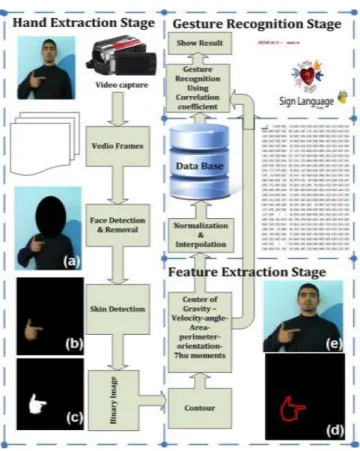
Our Arabic sign language recognition system, as shown in Fig. 1, consists of three main modules; hand extraction, features extraction, and gesture recognition module. The hand extraction module extracts the hand area from the input video stream. The featureextraction module calculates 14 features for the hand motion trajectory. The features of the reference gestures are stored in the system database in the learning phase. Then the object recognition module usescorrelation coefficient to match the features of the input gesture to the stored ones. More details about each module arediscussed in the next sections.
a) The Hand Extraction Module
In this module, the hand area is extracted from the full color image. First the system captures video stream of gesture. From this captured frames wedetect the face using Haar classifier [35]. The detected face location is replaced by a black ellipse to eliminate the confusion between the hand and the face. The system executes accurately even if there are multiple faces in the image. Theprocess of face detection and removal is as shownin Fig. 1(a).
Figure1:Gesture recognition system architecture(a) Face detection and removal,(b) Hand extractionusing
YCbCr skin color detection Algorithm,(c)Hand extraction with binary image,(d) The contourof the hand
blob & (e) The center of gravity
Second, the image is converted into YCbCr colorspace. A skin profile [5] is used to detect the skin
color from the YCbCr image. In orderto detect thehand from the YCbCr color image, we use the Cb and Cr components to define the skin profile. The thresholds are chosen by defining the lower andupper value of Cb skin color [Cb_min, Cb_max], and the lower and upper value of Cr skin colorColor [Cr_min, Cr_max] [36]. The process of skin color detection to extract hand using YCbCr color space is as shown in Fig. 1(b). Then morphologicaloperations (opening followed by dilation)
Global Journal of Computer Science and Technology Volume XIII Issue V Version I
29 (DDDDDDDD ) Year 013 2 F
[2] are used to fill in small disconnected areas. The result of this operation is a binary image that contains connected areas representing the hand blob. Fig. 1(c) shows the binary image, which shows only the hand area as white color in black background.
b) Feature Extraction Module
The output of the hand extraction stage is a binary image, which shows only the hand blob. The hand features extraction subsystem takes this binary image and find the contour shape of the hand blob as shown in Fig. 1(d). From that contour, we calculate 14 features. These features are the center of gravity for that contour (Fig. 1(e)) and then tracking the movement of hand in each frame to calculate the velocity of the hand movement and angle. In addition, the area, perimeter, orientation and 7-Hu moments features for contour shape are calculated. The details of the features calculations are as follows:
i. Center of Gravity, Velocity and Angle Calculations The zeroth and first order moments [37] contain information about the center of gravity (Xc , Yc) of the object, where:
From one frame to the next, the center is moving, say from (X1, Y1) to (X2, Y2). Then the velocity and the angle of the hand motion can be calculated as follows: (1) (2) (3) (4) (5) (6)
Where Ө is the angle and Vx, Vy are the
ii. Area (A)
The area of a contour is the number of pixels inside this contour. The zeroth order momentdescribes the area A of the contour of object.
iii. Perimeter (T)
The perimeter of a contour is the length of curve or boundary of this contour. The contour perimeter of the object is calculated as the sum of lengths of segments between subsequent pointsof boundary.
Where X1,………….., XN is the boundary coordinatelist. iv. Orientation
The second order moments known as the moments of inertia, can be used to determine an important image feature, orientation. In terms of moments, the orientations of the principal axes, Θ, are given by Horn [38]:
v. Seven Hu Moments
Hu [37] defines the seven functions, computed from central moments through order three, that are invariant with respect to object scale, translation and rotation. Therefore, these sevenDynamic Hand Gesture Recognition of Arabic Sign Language Using Hand Motion Trajectory Features functions are good features to describe theobjects.
The same Gestures may vary between performers and even for the same performer between different instances. Neither all the gestures have the same numbers of frames nor have the samestart point. To provide better matching criteria forpattern matching, all the data should be normalized and interpolated. These two processesconvert the original data sets into a new form,which provides better matching criteria. c) The Gesture Recognition Module
There are several pattern recognition techniques used for gesture recognition. In this paper we usecorrelation coefficient [26] technique. Correlation coefficient is a simple statistical method with short processing time and it needs only one referencesample to learn each gesture.
If we have a series of n measurements of A and B written as Ai and Bi where i = 1, 2, ..., n, then the
sample correlation coefficient can be used to estimate the population correlation r between Aand B as follows:
Where and are the sample means of A and B. In our system, A refers to the data set of the input gestures, B refers to the data set of the reference gestures stored in our database, and n is thenumber of frames in each gesture. We calculate the correlation coefficients between the inputgesture and the reference gestures. The correlation coefficient is calculated for eachfeature separately.
2 Year 013 2 30
Global Journal of Computer Science and Technology Volume XIII Issue V Version I
(DDDDDDDD
)
F
Dynamic Hand Gesture Recognition of Arabic Sign Language using Hand Motion Trajectory Features
Then we count, for each gesture, number of correlation coefficient that is greater than a predefined threshold. In our experiments, the used threshold was 0.65. Finally the gesture with the highest count is selected as the matched gesture and its corresponding text is shown to the user.
IV.
R
esults andD
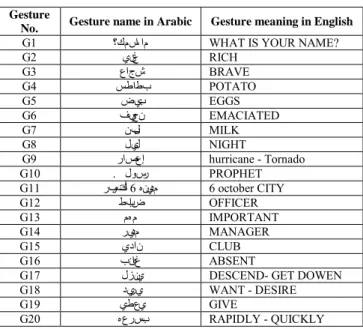
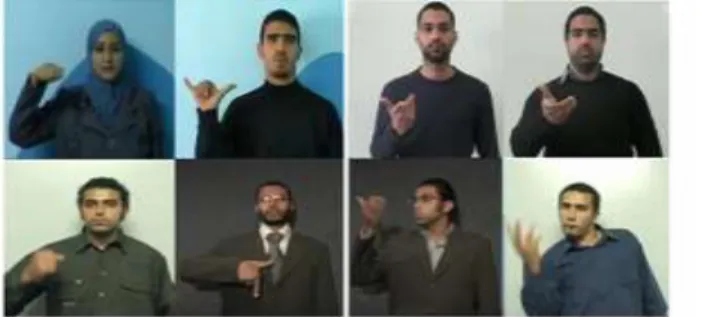
iscussionDue to the unavailability of a dataset for dynamic gestures from Arabic sign language, we had to build our own gestures database. We collected 20 different signs (Table 1) from eight different signers (seven males and one female) at different situations with resolution 720×480, as shown in Fig. 2.
Table 1 :List of Selected Gestures
Gesture
No. Gesture name in Arabic Gesture meaning in English
G1 ؟ﻙﻡﺱﺍ ﺍﻡ WHAT IS YOUR NAME?
G2 ﻱﻥﻍ RICH G3 ﻉﺍﺝﺵ BRAVE G4 ﺱﻁﺍﻁﺏ POTATO G5 ﺽﻱﺏ EGGS G6 ﻑﻱﺡﻥ EMACIATED G7 ﻥﺏﻝ MILK G8 ﻝﻱﻝ NIGHT G9 ﺭﺍﺹﻉﺇ hurricane - Tornado G10 . ﻝﻭﺱﺭ PROPHET G11 ﺭﺏﻭﺕﻙﺃ6 ﻩﻥﻱﺩﻡ 6 october CITY G12 ﻁﺏﺍﺽ OFFICER G13 ﻡﻩﻡ IMPORTANT G14 ﺭﻱﺩﻡ MANAGER G15 ﻱﺩﺍﻥ CLUB G16 ﺏﺉﺍﻍ ABSENT
G17 ﻝﺯﻥﻱ DESCEND- GET DOWEN
G18 ﺩﻱﺭﻱ WANT - DESIRE G19 ﻱﻁﻉﻱ GIVE G20 ﻩﻉﺭﺱﺏ RAPIDLY - QUICKLY (7) (10) (8) (9)
Figure 2:Eight different singers for our Arabic sign language dataset
We collected 63 feature vectors for each gesture. Thus in total our database has 1260 feature vectors. Only 20 gestures were used for training, one
Figure 4:The motion trajectory of gesture 2, 8 and 17. The graph shows the position of the hand’scenter of
gravity at consecutive frames
We also analyzed the misclassification cases to measure the consistency of the proposed system.Fig. 4 shows the motion trajectory of three gestures; No 2, 8 and 17, that our system confuses them. These three gestures are very similar and their motion trajectories are very similar too.Several gestures in the Arabic sign language look similar and could be difficult to a computer visionsystem to differentiate between them.
In another experiment, we apply our system to theRWTH dataset developed and tested by Dreuw[19]. RWTH dataset is a German finger spelling alphabet
Global Journal of Computer Science and Technology Volume XIII Issue V Version I
31 (DDDDDDDD ) Year 013 2 F
from each gesture. The proposed system is implemented on a PC with 2.0GHz CPU and 2G memory running Windows 7. The system is coded by C#, and the OpenCV SDK is used. The overall processing speed was 10-30 frames/Sec. Thus it can be used in a real time interaction.
In our experiment, we measure the discrimination effectiveness of the proposed system by testing the recognition of each sign. Our results indicate that the recognition rate was between 80% and 100% with an average of 85.67%. Fig. 3 shows the similarity matrix between the input and reference gestures. From the shown graph, it is clear that all of the signs have high similarity with its counterpart along the diagonal axis with some minor similarity off the diagonal axis.
Figure 3 :The similarity matrix for our proposed system
database and it contains 35 gestures with video sequences for the signs A to Z and SCH, the German umlauts Ä, Ö, Ü and the numbers from 1 to 5. Dreuw [19] achieved an error rate of 87.1% and was able to improve it to 44%.
Using our proposed system, we were able to achieve a better error rate of 27.6%. It was not possible to compare our work with several available systems, because they differ in many aspects such as the type of data acquisition; direct measurement or vision-based. Even in the vision based approach some systems require the signer to wear colored gloves. Another problem arises from the lack of a common database for the evaluation of sign language recognition systems. Almost all databases used by the different research groups are not publicly available. Additionally, the available databases differ in language, vocabulary size, grammar restriction and selection of signs.
V.
C
onclusionWe proposed a new gesture recognition system that can recognize the dynamic Arabic Sign Language gestures independent of skin color and physical structure of signers. In addition, the Dynamic Hand Gesture Recognition of Arabic Sign Language Using Hand Motion Trajectory Features system works in different places with normal intensity of light. The proposed features, measured from the motion trajectory of the right hand, were able to encode the gesture and to differentiate between 20 different Arabic gestures
collected from eight different signers, with an average recognition rate of 85.67%. The error rate was mainly due to the high similarity between thegestures.
The proposed system was able to improve the error rate in recognizing the difficult RWTHdataset from 44% to 27.6%. In future work we will search for other clues to be able to increase the recognition accuracy especially in case of highly similar gestures. Also, handling gestures that use both hands or interfere with the face will beaddressed in future work.
R
eferencesR
éférencesR
eferencias1. W. Krueger, Artificial Reality II, Addison-Wesley, 1991.
2. F. Wei, C. Xiang, W. Wen-hui, Z. Xu, Y. Ji-hai and V. Lantz, “AMethod of hand gesture recognition based on multiple sensors,” 4thInternational Conference on
IEEE Bioinformatics and Biomedical Engineering, 2010.
3. X. Zhang, X. Chen, Y. Li, V. Lantz, K. Wang, and J. Yang, “A Framework for hand gesture recognition based on accelerometer and EMG sensors,” IEEE Transactions on Systems, Man and Cybernetics— Part A: Systems and Humans, 2011.
4. Y. Quan, “Chinese sign language recognition based on video sequence appearance modeling,” 5th
International Conference on Computer Vision, pp.1441–1448, 2003.
13. G. Ye, J. Corso and G. Hager, “Gesture recognition using 3D appearance and motion features,” In Proceedings of CVPR Workshop on Real-Time Vision for Human Computer Interaction, pp.160– 166,2004.
14. J. Lin, Y. Wu and T. Huang, “3D model-based hand tracking using stochastic direct search method,” In Proceedings of IEEE International Conference on Automatic Face and GestureRecognition, pp.693– 698 2004.
15. R. Feris, M. Turk, R. Raskar, K. Tan and G. Ohashi, “Exploiting depth discontinuities for vision-based finger spelling recognition,”IEEE Proceedings of the Conference on Computer Vision and Pattern Recognition Workshop 10, 2004.
16. A. Barczak, F. Dadgostar and M. Johnson, “Real-time hand tracking using the Viola and Jones method,” In Proceedings of International Conference on Image and Signal Processing, pp. 336–441, 2005.
17. H. Zhou, and T. Huang, “Okapi-Chamfer matching for articulate object recognition,” In Proceedings of International Conference on Computer Vision, pp. 1026–1033, 2005. 2 Year 013 2 32
Global Journal of Computer Science and Technology Volume XIII Issue V Version I
(DDDDDDDD
)
F
Dynamic Hand Gesture Recognition of Arabic Sign Language using Hand Motion Trajectory Features
IEEE Conference on Industrial Electronics and Applications, 2010.
5. C. Xin-yan, L. Hong-fei and Z. Ying-yong, “Gesture segmentation based on monocular vision using skin color and motion cues,” International Conference IEEE Image Analysis and Signal Processing, 2010. 6. D. Sturman and D. Zeltzer, “A Survey of
glove-based input,” IEEE Computer Graphics and Applications 14, pp. 30-39, 1994.
7. S. Mitra, and T. Acharya, “Gesture recognition: A Survey,” IEEE Transactions on Systems, Man, and Cybernetics, Part C: Applications and Reviews 37(3), pp. 311–324, May 2007.
8. Y. Wu and T. Huang, “Vision-based gesture recognition: A Review,” Lecture Notes in Computer Science, Gesture Workshop, 1999.
9. Y. Hamada, N. Shimada and Y. Shirai, “Hand shape estimation using sequence of multi-ocular images based on transition network,” Proceedings of the International Conference on Vision Interface, pp. 161-166, 2002.
10. N. Tanibata, N. Shimada and Y. Shirai, “Extraction of hand features for recognition of sign language words,” The 15th International Conference on Vision Interface, pp. 391–398, 2002.
11. Y. Wu and T. Huang, “Non-stationary color tracking for vision-based human computer interaction.” IEEE Transactions on Neural Networks 13(4), pp. 948– 960, 2002.
12. C. Tomasi, S. Petrov and A. Sastry, “3D tracking = classification + interpolation,” In Proceedings of the
18. N. Salleh, J. Jais, and et al. “Sign language to voice recognition: hand detection techniques for vision-based approach,” In Fourth of International Conference on Multimedia and ICT in Education, pp. 967-972, 2006.
19. P. Dreuw, T. Deselaers, D. Keysers and H. Ney, “Modeling image variability in appearance-based gesture recognition,” In ECCV Workshop on Statistical Methods in Multi-Image and Video Processing, pp. 7-18, 2006.
20. Y. Tabata and T. Kuroda, “Finger spelling recognition using distinctive features of hand shape,” In 7th ICDVRAT with Art Abilitation, pp. 287-292, 2008.
21. Q. Fei, X. Li, T. Wang, X. Zhang and G. Liu, “Real-time hand gesture recognition system based on Q6455 DSP board,” IEEE Global Congress on Intelligent Systems, pp.139-144, 2009.
22. F. OM, L. TJ and S. Wibowo, “Hand gesture recognition: sign to voice system,” International Journal of Electrical, Computer and Systems Engineering, pp. 198-202, 2009.
23. X. Zabulis, H. Baltzakis and A. Argyros, “Vision-based hand gesture recognition for human-computer interaction,” In Stephanidis C editor(s). The Universal Access Handbook - Human Factors and Ergonomics Series. Boca Raton, FL, USA, CRC Press, pp. 1-30, 2009.
24. P. Paulraj, S. Yaacob, M. Shuhanaz and R. Palaniappan, “A Phoneme based sign language recognition system using skin color segmentation,”
IEEE 6th International Colloquium on Signal Processing & Its Applications, 2010.
25. C. Hsieh, D. Liou and D. Lee, “A Real time hand gesture recognition system using motion history image,” IEEE 2nd International Conference on Signal Processing Systems, 2010.
26. J. Bao, A. Song, Y. Guo and H. Tang, “Dynamic hand gesturerecognition based on SURF tracking,” IEEE International Conference on Electric Information and Control Engineering, 2011.
27. P. Mekala, Y. Gao, J. Fan and A. Davari, “Real-time sign Language Recognition based on Neural Network Architecture,” IEEE 43rd Southeastern
Symposium on System Theory (SSST), 2011.
28. M. Zaki, and S. Shaheen, “Sign language recognition using a combination of new vision based features,” Elsevier Pattern Recognition Letters 32, pp.572–577, 2011.
29. M. Mohandes, “Arabic sign language recognition,” In Proceedings of the International Conference on Imaging Science, pp. 25-28 , 2001.
30. S. Halawani, “Arabic sign language translation system on mobile devices,” IJCSNS 8(1), pp.251-256, 2008.
31. M. Farouk, A. Sutherland, and A. Shoukry, “A Multistage hierarchical algorithm for hand shape recognition,” IEEE 13th International Machine Vision
and Image Processing Conference, pp. 105-110, 2009.
32. M. Al-Roussan, K. Assaleh and A. Talaa,: “Video-based signerin dependent arabic sign language recognition using Hidden Markov Models,” Elsevier Applied Soft Computing, pp.990–999, 2009.
33. N. El-Bendary, H.Zawbaa, M. Daoud, A. Hassanien and K. Nakamatsu, “ArSLAT: arabic sign language alphabets translator,”IEEE International Conference on Computer Information Systems and Industrial Management Applications, 2010.
34. E. Hemayed and A. Hassanien, “A Fast edge-based arabic sign language recognition using probabilistic neural network,” CiiT International Journal of Digital Image Processing 3(17), pp.1100-1106, Nov. 2011. 35. P. Viola, and M. Jones, “Robust real-time face
detection,” International Journal of Computer Vision 57(2), pp.137–154, 2004.
36. S. Singh, D. Chauha, M. Vatsa and R. Singh, “A Robust skin color based face detection algorithm,” Tamkang Journal of Science andEngineering 6 (4), pp.227-234, 2003.
37. J. Flusser, T. Suk and B. Zitová, Moments and Moment Invariants in Pattern Recognition, A John Wiley and Sons, 2009.
38. B. Horn, Robot Vision, The MIT Press, 1986.
Global Journal of Computer Science and Technology Volume XIII Issue V Version I
33 (DDDDDDDD ) Year 013 2 F