Expression of Integrin
a
2 Receptor in Human Cord Blood
CD34
1
CD38
2
CD90
1
Stem Cells Engrafting Long-Term in
NOD/SCID-IL2R
c
c
null Mice
W
ANM
ANW
ONG,
aM
IKAELS
IGVARDSSON,
bI
NGBRITTA
˚
STRAND-
GRUNDSTRO¨ M,a,cD
ONNAH
OGGE,
dJ
ONASL
ARSSON,
eH
ONGQ
IAN,
b,fM
ARJAE
KBLOMa,ca
Hematopoietic Stem Cell Laboratory, Department of Laboratory Medicine, Lund University, Lund, Sweden;
bDepartment of Clinical and Experimental Medicine, Link
€
oping University, Link
€
oping, Sweden;
cHematology
Department, Ska˚ne University Hospital, Lund, Sweden;
dTerry Fox Laboratory, BC Cancer Agency, Vancouver,
British Columbia, Canada;
eMolecular Medicine and Gene therapy, Department of Laboratory Medicine, Lund
University, Lund, Sweden;
fDepartment of Medicine, Center for Hematology and Regenerative Medicine,
Karolinska Institute, Stockholm, Sweden
Key Words. Hematopoietic stem cells•Fetal blood•Integrin alpha2•Human
A
BSTRACTHuman hematopoietic stem cells reside in the CD341CD382CD901 population in cord blood and bone marrow. However, this cell fraction is heterogeneous, and the phenotype of the rare primitive stem cells remains poorly defined. We here report that primitive cord blood CD341CD382CD901stem cells, with the ability to recon-stitute NOD/SCID-IL2Rccnull (NSG) mice long-term, at 24 weeks after transplantation, can be prospectively isolated at an increased purity by using integrina2 receptor as an additional stem cell marker. Using a limiting dilution transplantation assay, we found a highly significant enrich-ment of multilineage reconstituting stem cells in the CD341CD382CD901cell fraction expressing the integrin
a2 receptor, with a frequency of 1/29 cells, as compared to a frequency of 1/157 in the corresponding integrin a22
cells. In line with this, long-term reconstituting stem cells within the cord blood CD341CD382 cell population were significantly enriched in the integrin a21 fraction, while stem cells and progenitors reconstituting short-term, at 8–12 weeks, were heterogeneous in integrina2 expression. Global gene expression profiling revealed that the lineage-marker negative (Lin2) CD341CD382CD901CD45RA2 integrin
a21 cell population was molecularly distinct from the integrin a22 cell population and the more mature Lin2CD341CD382CD902CD45RA2cell population. Our findings identify integrin a2 as a novel stem cell marker, which improves prospective isolation of the primitive human hematopoietic stem cells within the CD341CD382CD901 cell population for experimental and therapeutic stem cell applications.STEMCELLS2013;31:360–371
Disclosure of potential conflicts of interest is found at the end of this article.
I
NTRODUCTIONIdentification of cell surface markers expressed in primitive human hematopoietic stem and progenitor cell populations is instrumental for a better characterization of molecular mecha-nisms regulating their functions, as well as for studies on the dysregulated gene expression networks in leukemic stem cells, for development of targeted therapies against leukemias, and for improvement of clinical stem cell transplantation methods. The xenogeneic transplantation into immunodeficient mice followed by analysis of multilineage reconstitution at various time points is currently the best available experimental
method to assess human hematopoietic stem and progenitor cell populations. Human cells repopulating immunodeficient mice can be phenotypically separated into subpopulations with distinct reconstitution characteristics over time. The
CD34þCD38þ progenitors have been shown to repopulate
rapidly but are able to maintain hematopoiesis for a maximum of 8–12 weeks [1–3], whereas the more primitive stem cells
reside in the lineage marker negative (Lin) CD34þCD38
fraction. Essentially two types of stem cells within this cell population give rise to multilineage reconstitution in immuno-deficient mice. The short-term reconstituting stem cells dis-play limited self-renewal potential. They engraft rapidly but produce lymphoid and myeloid progeny only within the first
Author contributions: W.M.W.: conception and design, collection and assembly of data, data analysis and interpretation, manuscript writing, and final approval of the manuscript; M.S.: collection and assembly of data, conception and design, data analysis and interpretation, manuscript writing, and final approval of the manuscript; I.A˚ .-G.: collection and assembly of data and final approval of the manuscript; D.H. and J. L.: provision of study material, data analysis and interpretation, and final approval of the manuscript; H.Q. and M.E.: conception and design, financial support, collection and assembly of data, data analysis and interpretation, manuscript writing, and final approval of the manuscript. H.Q. and M. E. contributed equally to this article.
Correspondence: Marja Ekblom, M.D., Ph.D, Hematopoietic Stem Cell Laboratory, Department of Laboratory Medicine, Lund University, 22184 Lund, Sweden. Tel.: þ46462220804; Fax: þ46462223600; e-mail: [email protected] Received November 30, 2011; accepted for publication October 28, 2012; first published online inSTEMCELLSEXPRESSNovember 16, 2012.VC AlphaMed Press 1066-5099/2012/$30.00/0 doi: 10.1002/stem.1282
12 weeks after transplantation, whereas the more primitive long-term reconstituting stem cells produce myeloid and lymphoid progeny for 5 months or longer [2–4].
In recent years, the non-obese diabetic (NOD)/severe
com-bined immunodeficiency (SCID)-IL2Rccnull (NSG) mouse
strain has been reported as a superior model to assay human he-matopoietic stem cell (HSC) engraftment, allowing functional analysis of limited numbers of cells in phenotypically defined fractions [5, 6]. Because of longer survival, the NSG mouse strain allows a better discrimination of long-term repopulating stem cells from short-term stem cells and progenitors than pre-viously used mouse strains. By using this mouse strain, it was shown that human cord blood stem cells reconstituting newborn
recipients are enriched in CD90þ fraction within the
CD34þCD38 cell population, whereas higher numbers of
CD90cells are required for reconstitution [5, 7].
We have here characterized the expression of integrina2
re-ceptor chain in human cord blood stem and progenitor cells by in vivo transplantation into NSG mice. Integrins are heterodi-meric cell surface receptors consisting of noncovalently
associ-atedaandbsubunits, which regulate essential cell functions,
including transcriptional activation, survival, proliferation, dif-ferentiation, adhesion, and migration in a cell- and
tissue-spe-cific manner [8]. The largest group is formed byb1 integrins,
which contain 12 different a subunits (a1–a11, av). Studies
using gene-deleted mice or function-blocking antibodies have
established the crucial role of the integrins containingb1 chain
for homing of hematopoietic cells to fetal and postnatal
hema-topoietic tissues [9, 10], and the role ofa4,a5, anda6 integrins
for homing or development of hematopoietic cells [11–17].
Recently, integrin a6 receptor has been identified as a
novel stem cell marker [7]. Expression of integrina6 receptor in
cord blood CD34þCD38CD90þ cells enriched stem cells
reconstituting NSG mice long-term to a frequency of 1/10.5. Furthermore, reconstitution in 14%–28% of mice was reported
after single-cell transplantation of LinCD34þCD38CD90þ
CD45RARhodamine 123 (Rho123)lo integrin a6þ cells.
However, while mouse stem cell markers enable prospective isolation of long-term in vivo reconstituting stem cells in a purity of at least 50% [18], additional markers are needed for the identi-fication of human in vivo long-term reconstituting stem cells.
Herein, we have performed limiting dilution
transplanta-tion of cord blood CD34þCD38CD90þ cells in NSG mice
and show that integrin a2 is a novel hematopoietic stem cell
marker, which is expressed in most primitive long-term multi-lineage reconstituting stem cells in human cord blood.
M
ATERIALS ANDM
ETHODSAnalysis and Isolation of Cord Blood Hematopoietic
Stem and Progenitor Cells
Human cord blood cells were obtained from full-term normal deliveries, in accordance with the protocol approved by the Re-gional Ethics Committee, Lund (LU 2010/140) and with written informed consent. Functional assays were performed using freshly isolated cells. Mononuclear cells were isolated by Ficoll-Hypaque (Lymphoprep, Axis-Shield PoC AS, Oslo, Norway) density
gradi-ent cgradi-entrifugation. CD34þand lineage-depleted cells were
iso-lated using magnetic sorting (MACS; Miltenyi Biotec, Bergisch Gladbach, Germany, http://www.miltenyibiotec.com).
Flow Cytometric Analysis and Cell Sorting
Expression analysis of integrin subunits and sorting of cells for functional assays were performed by using the following
human specific monoclonal antibodies (mAb; BD Biosciences, San Jose, CA, http://www.bdbiosciences.com, unless otherwise specified), fluorescein isothiocyanate (FITC) or PerCP-Cy5.5 CD34 (8G12), Allophycocyanin (APC) or PECy7 anti-CD38 (HB7), R-Phycoerythrin (PE) conjugated antibodies
against integrina1-6 chains, CD49a (SR84), CD49b (12F1-H6,
AbD Serotec, Raleigh, NC, or 12F1, BD Biosciences), CD49c (17C6, AbD Serotec), CD49d (9F10), CD49e (IIA1), CD49f
(GoH3) and integrin b1 chain, CD29 (4B7R, AbD Serotec),
APC or FITC anti-CD90 (5E10; FITC anti-CD90: Biolegend, San Diego, CA), biotinylated anti-CD49f (GoH3, eBioscience, San Diego, CA) and streptavidin-APC Alexa Fluor 750 (Invi-trogen, Carlsbad, CA, http://www.invitrogen.com). The cells expressing lineage markers were depleted by magnetic sorting or excluded after staining with PECy5 or Tri-color conjugated antibodies against CD3 (S4.1), CD4 (S3.5), CD7 (CD7-6B7), CD8 (3B5), CD14 (Tu¨K4) (Invitrogen), CD19 (HIB19), CD20 (2H7), CD2 (RPA-2.10), CD10 (HI10a), CD11b (ICRF44), CD56 (B159), CD235a (GA-R2) (BD Biosciences). Pacific Blue anti-CD45RA (MEM-56) was from Invitrogen and eFluor450 anti-CD45RA (HI100) was from eBioscience. Dead cells were excluded by propidium iodide (Invitrogen) or 7-amino-actinomycin D (7AAD; Sigma, St Louis, MO) staining. Background staining was determined using appropriate isotype matched control antibodies. Cells were analyzed by LSRII Flow Cytometer System (BD Biosciences) and FlowJo software (TreeStar Inc., San Carlos, CA) or sorted by FACSAria or FACSDiVa Cell Sorter (BD Biosciences, San Jose, California, USA). Quadrant gates shown in fluorescence-activated cell sorting (FACS) plots were set according to fluorescence-minus-one (FMO) controls using corresponding isotype matched
con-trol antibodies in all analyses, except for CD34þCD38cells,
which were gated as the lowest 5%–10% CD38 cells out of
total CD34þcells [3].
Mouse Transplantation
NOD.Cg-Prkdcscid Il2rgtml Wjl/SzJ (NSG) mice (Jackson
Laboratory, Bar Harbor, ME, http://www.jax.org) were bred and maintained in the germ-free isolators in the animal facil-ity of Lund Universfacil-ity. All animal experiments were approved by the animal ethics committee, Lund University (M 148-09).
NSG mice (8–12 weeks old) were sublethally irradiated
4–24 hours prior transplantation with 300 cGy using a137Cs-c
irradiator. Sex- and age-matched mice were used as recipients in all experimental groups. Cord blood cells were transplanted
together with 1 106 irradiated (1,500 cGy) CD34 cells
from the same donors. The sorted cells were injected intrave-nously into the tail vein or intrafemorally. For intrafemoral injection, an insulin syringe with 30-gauge needle (BD Bio-sciences, San Jose, California, USA) was used to drill a hole in
the right femur, and 10 ll cell suspension was injected into
bone marrow cavity using Hamilton Syringe with 31-gauge needle (Hamilton Bonaduz AG, Bonaduz, GR, Switzerland). One or two mice injected with phosphate-buffered saline (PBS)
or irradiated (1,500 cGy) CD34accessory cells were included
in each experiment as controls. For serial transplantation, high
numbers of cord blood CD34þCD38CD90þintegrina2þor
a2 cells (300 cells per mouse) were intravenously
trans-planted to primary recipients. After 19 weeks, bone marrow cells from one tibia and one femur of primary recipients with high level of human cell reconstitution were injected intrave-nously into secondary recipients.
Bone marrow cells were harvested from femurs and tibias of recipient mice at 8–24 weeks after transplantation and stained with human specific APC conjugated anti-CD45 mAb (HI30, BD Biosciences) for detecting human hematopoietic cells, FITC
(G10F5) mAb (BD Biosciences) for detecting myeloid cells, PE anti-CD19 mAb (HIB19, BD Biosciences, San Jose, California, USA) for detecting lymphoid cells, and PerCP-Cy5.5 anti-CD34 mAb (8G12, BD Biosciences) for detecting progenitor cells. Gates in FACS plots were set according to FMO controls using corresponding isotype antibodies. Engraftment was determined
as positive when a minimum of 0.1% human CD45þ cells,
to-gether with at least 0.025% human CD45þCD15/CD33/
CD66bþ and 0.025% human CD45þCD19þ cells were
detected, with a minimum of 100,000 viable cells collected for analysis [2]. Recently, female NSG mice were reported to be superior in engrafting human HSCs [6]. Therefore, the gender of recipient mice was shown in the results.
For analysis of integrin a2 expression in engrafted stem
and progenitor cell populations, bone marrow cells from femurs, tibias, and iliac crests, obtained from three to four re-cipient mice at 22–23 weeks after transplantation of 50 cord
blood CD34þCD38CD90þintegrina2þcells, were pooled,
depleted of mouse CD45-positive and human lineage-positive cells (Miltenyi Biotec), and treated with ammonium chloride (Stem Cell Technologies, Vancouver, BC, Canada, http:// www.stemcell.com). Expression of human CD45, CD34, CD38, CD90, CD45RA, and CD49b was analyzed by FACS.
Homing Assay
4–24 hours prior injection of cells, NSG mice (8–12 weeks
old) were sublethally irradiated with 300 cGy using a137Cs-c
irradiator. Sex- and age-matched mice were used as recipients in all experimental groups. Fresh lineage-depleted cord blood cells were incubated with azide-free function-blocking mAb
against integrina2 (P1E6) orb1 (P4C10) receptors (Millipore,
Billerica, MA, http://www.millipore.com) or corresponding
isotype matched control antibodies for 30 minutes on ice. 5
105 Lin cord blood cells were injected intravenously into
each mouse. Bone marrow cells from femurs were harvested at 3 hours after injection and stained with mouse-specific FITC anti-CD45.1 mAb (A20), human-specific AlexaFluor 700 anti-CD45 (HI30) and PerCP-Cy55 anti-CD34 mAb (BD Biosciences). The proportion of human stem and progenitor
cells (mCD45.1-hCD45þCD34þ) homed was calculated
based on the assumption that mouse bone marrow cells from two femurs constitute 10% of total marrow cellularity [19].
Methylcellulose Colony Assay
The cells (50–100 cells per well) were resuspended in 100ll
Iscoves’s modified Dulbecco’s medium (PAA, Pasching,
Austria, http://www.paa.at) containing 20% fetal bovine serum
(FBS) (v/v, Sigma), 2 mML-glutamine (PAA), 100 U/ml
peni-cillin-streptomycin (PAA), and 104 M 2-mercaptoethanol
(Sigma) and added into 900 ll Methocult H4435 (Stem Cell
Technologies, Vancouver, BC, Canada). Cultures were plated
in duplicates and maintained at 37C and 5% CO2for 14 days.
Colonies were scored based on morphology and the mean value of the duplicate colonies was calculated.
Long-Term Culture Initiating Cell (LTC-IC) Assay
Test cells (25–50 cells per well) were cultured in 200ll
Mye-locult H5100 (Stem Cell Technologies), 106 M
hydrocorti-sone (Sigma) in Collagen I 96-well microplates (BD Bioscien-ces) on irradiated (8,000 cGy) murine stromal cell lines Sl/Sl and M2-10B4 (5,000 each/well), engineered to express human cytokines KL, IL-3 and G-CSF [20]. The cells were
main-tained at 37C and 5% CO
2for 6 weeks with weekly
half-me-dium change and thereafter plated in Methocult H4435 in duplicates (20% and 80% of the cells from each well). The mean values of the duplicate colonies, assayed after 13–14 days, were calculated.
Microarray Analysis
RNA from LinCD34þCD38CD90þCD45RA integrin
a2þ, LinCD34þCD38 CD90þCD45RA integrin a2,
and LinCD34þCD38CD90CD45RA cells, each sorted
from three independent pooled cord blood samples, was extracted as previously described [21], amplified by two rounds of linear in vitro transcription and labeled according to Affymetrix GeneChip Expression Analysis Technical Manual. Chips were scanned using GeneChipTM Scanner 3000. Human Genome U133 plus 2.0 Chips were normalized by ro-bust multiarray average using invariant set normalization and probe level expression values were calculated using the PM-MM model provided by the DNA-Chip Analyzers (dCHIP) software (www.dchip.org). The cell populations were classi-fied and the variations among these were determined using dCHIP built-in principal component analysis (PCA). The graph for the PCA was made in Microsoft Excel based on dimension values generated from dCHIP analysis.
Statistical Analysis
Statistical differences were evaluated by Mann–Whitney test unless stated otherwise. The difference of the proportion of reconstituted mice between groups was evaluated by Fisher’s exact test. Based on the results from limiting dilution trans-plantation, the frequency of long-term repopulating cells was calculated using L-Calc software (Stem Cell Technologies, Vancouver, BC, Canada), using Poisson statistics and the
method of maximum likelihood. The two-sided p-value was
considered to be significant whenp<.05.
R
ESULTSExpression of Integrins in Cord Blood Stem and
Progenitor Cells
The expression of integrin a1–a6 andb1 chains in cord blood
CD34þCD38 stem and progenitor cells was analyzed by
flow cytometry (Fig. 1 A). While integrin a4, a5, and b1
chains were ubiquitously expressed, integrin a2, a3, and a6
chains were expressed only in a fraction of cells. Specifically,
the integrin a2 receptor was expressed in 33.4% 6 7.2%
(mean6SD,n¼6) of cord blood LinCD34þCD38cells.
LinCD34þCD38 cells can be subdivided according to
CD90 and CD45RA expression into three populations repre-senting different stages in the developmental hierarchy [5]. The primitive stem cells, with the capacity for in vivo
repopu-lation in NSG mice, are enriched in the CD90þCD45RA
fraction, whereas the CD90CD45RAcell fraction contains
a lower frequency of in vivo repopulating cells. The
CD90CD45RAþ fraction contains no in vivo repopulating
activity [5], but instead, multilymphoid progenitors and cells with myeloid and dendritic cell potential [22]. We analyzed
integrina2 expression in these CD90/CD45RA subpopulations
of LinCD34þCD38 cells (Fig. 1B, 1C). The highest
fre-quency of cells expressing integrin a2 was found in the cell
populations enriched for the stem cells, suggesting that the
integrin a2þ cells are upstream of the integrin a2 cells in
the stem cell developmental hierarchy.
The integrin a6 receptor was recently reported as a stem
cell marker in human cord blood hematopoietic cells [7].
Therefore, we analyzed its coexpression with integrin a2
chain in LinCD34þCD38CD90þCD45RA and
LinCD34þCD38CD90CD45RA cells by flow
cytome-try. Notably, the expression of these receptors was only par-tially overlapping (Fig. 1D, 1E), indicating distinct regulation
of the expression of these two receptors in primitive human hematopoietic cells.
Cord Blood In Vivo Short-Term Reconstituting Cells
Reside in Both Integrin
a
2
1
and
a
2
2
Fractions
For analysis of integrin a2 expression in the functionally
defined primitive cord blood stem and progenitor cells,
CD34þCD38 cells with high or low integrina2 expression
(a2þ and a2, respectively) were transplanted into NSG
mice (Fig. 2 A). Reconstitution was assayed by analysis of
human CD45þ cells, myeloid and B-lymphoid lineages, and
CD34þprogenitors in the bone marrow of the recipient mice.
No human engraftment was seen in control mice injected only with PBS (Fig. 2B). At 8–12 weeks after i.v. transplantation
of 300–400 cord blood CD34þCD38 cells, a similar
fre-quency of mice were reconstituted from the CD34þCD38
integrin a2þ as the a2 cells (11/14 and 12/12 mice,
Figure 1. Expression of integrins in human cord blood stem and progenitor cells. (A): Representative fluorescence-activated cell sorting (FACS) analysis showing the expression of integrina1–a6 andb1 chains in cord blood CD34þCD38 cells (open histograms). Shaded histo-grams show the corresponding isotype control stainings.(B):Representative FACS profiles showing viable (PI) CD34þCD38cells gated for lineage-marker negative cells (Lin), CD90 and CD45RA. The expression of integrina2 receptor is shown in the cells gated from the corre-sponding quadrants. (C):The percentage of cells expressing the integrin a2 receptor in CD90/CD45 quadrants of LinCD34þCD38 cells (mean6SD; three independent analyses, each with two to four pooled cord blood samples). *,p<.05; **,p<.01.(D):Representative FACS profiles showing the expression of integrin a2 and a6 receptors in cord blood LinCD34þCD38CD90þCD45RA and LinCD34þCD38CD90-CD45RA cells gated from viable (PI) cells.(E):The percentage of LinCD34þCD38CD90þCD45RA and LinCD34þCD38CD90CD45RAcells expressing integrina6,a2, both or neither receptor (mean6SD; two independent experiments using one to three separate pooled cord blood samples). The numbers in each FACS plot show the percentage of cells in each gate or quadrant. Abbre-viations: FSC, forward scatter; PI, propidium iodide.
respectively). In accordance with this, the levels of human
CD45þ, myeloid, B-lymphocytic, and CD34þ cell chimerism
were similar in both groups, showing that the stem cells and progenitors engrafting NSG mice short-term are
heterogene-ous in the expression of integrina2 receptor (Fig. 2C, 2D).
Cord Blood In Vivo Long-Term Reconstituting Stem
Cells Are Highly Enriched in the Integrin
a
2
1
Fraction
In contrast to short-term engrafting stem cells and progenitors, cord blood long-term reconstituting stem cells within the
CD34þCD38 population, assayed at 16–18 weeks after i.v.
transplantation, were significantly enriched in the integrin
a2þ cell fraction (Fig. 2E, 2F), with 14/15 and 8/15 mice
engrafted with integrin a2þcells and a2 cells, respectively
(*, p < .05; Fisher’s exact test). Accordingly, the levels of
human CD45þas well as myeloid and B-lymphoid chimerism
were significantly higher in mice transplanted with
CD34þCD38 integrin a2þ cells than with the a2 cells.
The difference in CD34þ cell chimerism approached
statisti-cal significance (p¼.064). These findings indicate that within
the CD34þCD38 compartment the long-term engrafting
stem cells are enriched in the integrina2þcell population.
To address the possible effect of the higher proportion of
CD90þ cells in the CD34þCD38 integrin a2þ than a2
fraction for the differences in long-term in vivo reconstitution at 16–18 weeks and to determine the frequencies of integrin Figure 2. Integrina2 expression in cord blood CD34þCD38cells reconstituting NSG mice short term and long-term.(A): Fluorescence-acti-vated cell sorting (FACS) profiles showing gating strategy for the isolation of cord blood CD34þCD38integrina2þanda2cells for in vivo transplantation into NOD/SCID-IL2Rccnull (NSG) mice (red gates). Quadrant gates were set on the basis of fluorescence-minus-one (FMO)
con-trol staining profiles.(B):Representative FACS profiles showing analysis of human cell reconstitution in the bone marrow of NSG mice. The human CD45þcell reconstitution is shown in the left panel. The middle panels show reconstitution of human myeloid (CD45þCD15/CD33/ CD66bþ), B-lymphoid (CD45þCD19þ), and progenitor (CD45þCD34þ) cells in the gated human CD45þcell fraction. The right panel shows the analysis of the control mouse injected with PBS instead of human cells. The gates were set on the basis of FMO control staining profiles. 7AAD, viable cells gated by exclusion of 7AADþdead cells. (C):Bone marrow chimerism of human CD45þ, myeloid, B-lymphoid, and CD34þcells in NSG mice at 8–12 weeks after i.v. transplantation of 300–400 cord blood CD34þCD38integrina2þora2cells.(D):The number of reconstituted mice/total number of mice intravenously transplanted with indicated numbers of cells. The results are from two inde-pendent experiments with pooled cord blood samples.(E):Bone marrow chimerism of human CD45þ, myeloid, B-lymphoid, and CD34þcells in NSG mice at 16–18 weeks after i.v. transplantation of 300 CD34þCD38integrina2þora2cells. *,p<.05.(F):The number of reconsti-tuted mice/total number of mice intravenously transplanted with indicated numbers of CD34þCD38integrina2þora2cells. The difference in the proportion of reconstituted mice between groups was evaluated by Fisher’s exact test. *,p<.05. The results are from two independent experiments with pooled cord blood samples. The horizontal bars show median values. Red and blue dots represent individual female and male recipients, respectively. The numbers in each FACS plot show the percentage of cells in each gate or quadrant. Abbreviations: 7AAD, 7-amino-actinomycin D; CB, cord blood; FSC, forward scatter.
a2þ and a2 long-term reconstituting stem cells within the
CD34þCD38CD90þ cell fraction, we performed limiting
dilution transplantation assay (Fig. 3A–3D). The
CD90þCD45RAþ cell population was only 1.96% 6 2.2%
(mean6SD;n¼6) of LinCD34þCD38cells and
there-fore was not excluded from the CD90þpopulation. Intrabone
transplantation of human cells into immunodeficient mice has
been shown to result in a higher level of reconstitution than i.v. transplantation [23]. Therefore, the cells were transplanted by intrafemoral injection. At 24 weeks post-transplantation,
the proportion of mice reconstituted with the integrin a2þ
cells (11/15) was significantly higher than mice reconstituted
with the integrin a2 cells (6/18), and the estimated
fre-quency of long-term reconstituting stem cells in the integrin Figure 3. Human cord blood CD34þCD38CD90þcells reconstituting NOD/SCID-IL2Rccnull (NSG) mice at 24 weeks after transplantation are
enriched in the integrina2þfraction.(A):Fluorescence-activated cell sorting (FACS) profiles showing gating strategy for the isolation of cord blood viable (7AAD) CD34þCD38CD90þintegrina2þanda2cells (red gates). Quadrant gates were set on the basis of fluorescence-minus-one con-trol staining profiles.(B):Bone marrow chimerism of human CD45þ, myeloid, B-lymphoid, and CD34þcells in NSG mice at 24 weeks after intrafe-moral transplantation of 150 CD34þCD38CD90þintegrina2þora2cells. The horizontal bars show median values. *,p<.05; **,p<.01. Red and blue dots represent individual female and male recipients, respectively.(C):Limiting dilution transplantation of CD34þCD38CD90þintegrin a2þanda2cells (10, 50, or 150 cells per mouse) showing the number of reconstituted mice/number of transplanted mice. The frequency of the long-term reconstituting stem cells (LTR; mean6SEM) and the difference between groups were determined by L-Calc software (**,p<.01). The difference in the proportion of reconstituted mice between groups was evaluated by Fisher’s exact test (*,p<.05). The results are from two inde-pendent experiments with pooled cord blood samples.(D):Representative FACS profiles showing reconstitution in a NSG mouse at 24 weeks after transplantation of 10 cord blood CD34þCD38CD90þintegrina2þcells (upper panels). The lower panel shows FACS analysis of the bone marrow from a control mouse injected with PBS instead of human cells.(E):Representative FACS analysis showing reconstitution at 12 weeks after serial transplantation of cord blood CD34þCD38CD90þintegrina2þcells (upper panels). The lower panels show bone marrow analysis of a trans-planted mouse reconstituted with human CD45þlymphoid cells but not with myeloid cells. The frequency of cells in the CD19CD15/CD33/ CD66bþquadrant is 0.001% of the viable (7AAD) cells in the mouse bone marrow. The numbers in each FACS plot show the percentage of cells in each gate or quadrant. Abbreviations: 7AAD, 7-amino-actinomycin D; CB, cord blood; FSC, forward scatter.
a2þfraction (1/29) was significantly higher than in the
integ-rin a2 subset (1/157) (Fig. 3C). Accordingly, the levels of
human myeloid and CD34þ cell chimerism after
transplanta-tion of 150 CD34þCD38CD90þ cells were significantly
higher in mice which received integrina2þthan integrin a2
cells (Fig. 3B). The estimated frequencies of long-term repopu-lating cells, calculated based on the frequencies from the limiting
dilution assay and FACS analyses of CD34þCD38CD90þ
cells, was 10.662.6 and 1.560.6/1,000 CD34þCD38cells
for integrin a2þ and a2 cells, respectively (mean 6 SD).
Therefore, approximately six seven stem cells within
CD34þCD38CD90þ population reside in the integrin a2þ
fraction. Robust lymphomyeloid engraftment was obtained from
as few as 10 transplanted integrin a2þ cells (Fig. 3D). These
results show that long-term engrafting stem cells within cord
blood CD34þCD38CD90þ cell population are highly
enriched in the fraction expressing integrina2 receptor.
Serial transplantation was only performed from primary recipients with high level of reconstitution. After 12 weeks, reconstitution in secondary recipients was obtained from bone marrow cells one third and 2/2 of primary recipients
trans-planted with integrina2þora2cells, respectively (Fig. 3E,
upper panel). A similar disparity in secondary transfer effi-ciency, with a higher frequency of mice reconstituted from
CD90cells than from the stem cell enriched CD90þfraction
of LinCD34þCD38CD45RAcells, was shown by Notta
et al. [7] but the basis for this remains unknown. With the reconstitution criteria used [2], mice having engraftment of
human CD45þ lymphoid cells only were not considered as
reconstituted from stem cells (Fig. 3E, lower panel). Taken to-gether, our results show that long-term stem cells reside in both
integrina2þanda2cell fractions of CD34þCD38CD90þ
cells, albeit, as shown by limiting dilution transplantation, in a
significantly higher frequency in thea2þcell fraction.
Engraft-ment of human cells could be detected in blood, spleen, and thymus in some mice at 22–23 weeks after intrafemoral
trans-plantation of 50 CD34þCD38CD90þintegrina2þanda2
cells (supporting information Fig. S1), whereas no bone marrow
or blood reconstitution was observed in recipients which received only irradiated CD34- accessory cells (not shown).
The Integrin
a
2 Receptor Expression Is Maintained
in All Reconstituted Lin
2
CD34
1
CD38
2
CD90
1
CD
45RA
2
Cells After Transplantation of CD34
1
CD38
2
CD90
1
Integrin
a
2
1
Cells, While Differentiation
into Lin
2
CD34
1
CD38
2
CD90
2
CD45RA
2
Is
Accompanied by a Loss of Integrin
a
2 in a
Subset of Cells
The expression of integrin a2 in the long-term reconstituted
stem and progenitor cell fractions after intrafemoral
transplan-tation of 50 CD34þCD38CD90þ integrin a2þ cord blood
cells was analyzed by FACS (Fig. 4). As shown previously
[5], the transplanted CD34þCD38CD90þ cells gave rise to
the CD90þCD45RA, as well as the more mature
CD90CD45RAand CD90CD45RAþcell subpopulations
of LinCD34þCD38fraction. Importantly, all reconstituted
LinCD34þCD38CD90þCD45RA primitive cells
expressed the integrin a2 receptor, further supporting the
notion that integrin a2 is a stem cell marker. The engrafted
downstream LinCD34þCD38CD90CD45RA cell
pop-ulation contained both integrin a2þ and a2 cells, showing
that the primitive integrina2þcells give rise to integrina2
stem and progenitor cells during maturation.
The Integrin
a
2 Receptor Is Not Involved in the
Homing of Cord Blood Stem and Progenitor Cells to
Mouse Bone Marrow
Experimental studies using function-blocking antibodies and
gene deletion have established a crucial role for b1 integrins
in homing of hematopoietic stem and progenitor cells to bone
marrow [8]. We therefore studied the role of integrina2 and
b1 receptors in homing of cord blood stem and progenitor
cells into bone marrow of NSG mice using function-blocking
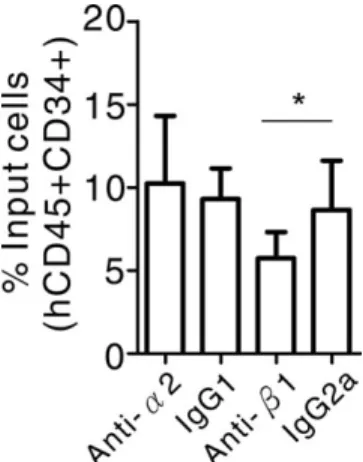
antibodies (Fig. 5). 9%–10% of cord blood CD34þ cells
prein-cubated with isotype control antibodies were recovered in bone Figure 4. The integrina2 receptor expression is maintained in all reconstituted LinCD34þCD38CD90þCD45RAcells after transplanta-tion of CD34þCD38CD90þintegrin a2þ cells, while differentiation into LinCD34þCD38CD90CD45RA cells is accompanied by a loss of integrina2. Fluorescence activated cell sorting (FACS) analysis of integrina2 receptor expression in engrafted hematopoietic stem cells after transplantation of CD34þCD38CD90þintegrina2þcells. Viable (propidium iodide), mouse CD45-marker depleted and human line-age-marker depleted (Lin) human CD45þLinCD34þCD38CD90þCD45RAcells (upper right panel) ubiquitously express integrina2 re-ceptor, while differentiation into the downstream LinCD34þCD38CD90CD45RAcell population (lower right panel) is accompanied by a loss of integrina2 expression in a subset of cells. Representative FACS plots shown are from one of two experiments of pooled bone marrow cells from mice reconstituted at 22–23 weeks after intrafemoral transplantation with 50 CD34þCD38CD90þintegrina2þcells. The numbers in each FACS plot show the percentage of cells in each gate or quadrant. Abbreviations: 7AAD, 7-amino-actinomycin D; FSC, forward scatter.
marrow at 3 hours after i.v. injection. Pretreatment with a
func-tion-blocking antibody against integrina2 chain did not perturb
homing, whereas the anti-integrin b1 antibody significantly (p
<.05) inhibited the homing of cord blood CD34þprogenitors.
This finding, together our results showing equal short-term
reconstitution levels of CD34þCD38 integrina2þ and a2
cells, indicates that the difference in long-term reconstitution experiments is due to the enrichment of primitive long-term
engrafting cells in the integrin a2þ fractions of both
CD34þCD38and CD34þCD38CD90þcell populations.
CD34
1
CD38
2
and CD34
1
CD38
2
CD90
1
integrin
a
2
1
Cell Fractions Are Heterogeneous, Containing
Long-Term Culture Initiating Cell and Committed
Progenitors
Previous studies have shown that committed granulocyte-mac-rophage (CFU-GM), erythroid (BFU-E), mixed (CFU-GEMM),
and total (CFU-C) progenitors reside in the CD34þCD38þbut
also nearly at the same frequency (approximately 70%) in the
CD34þCD38 cell fraction, when analyzed by single cell
methylcellulose culture [24]. Furthermore, single cell cultures have shown a frequency of approximately 30% of CFU-Cs in
both CD90þCD45RA and CD90CD45RA fractions of
CD34þCD38 cells, indicating that these cell populations are
still highly heterogeneous and contain cells at variable stages of differentiation [5]. We therefore assessed the lineage
poten-tial of the integrin a2þ and a2 cord blood cells by in vitro
colony and long-term culture initiating cell (LTC-IC) assays.
Cord blood CD34þCD38CD90þ as well as CD34þCD38
LTC-ICs resided both in integrin a2þ and a2 cell fractions
(Fig. 6A, 6C), although significantly more colonies, the readout
of LTC-IC assay, were derived from integrin a2þ than a2
cells in the CD90þfraction.
Within the cord blood CD34þCD38CD90þ fraction, the
frequency of progenitors with integrina2þanda2phenotypes
was equal (Fig. 6B), while cord blood CD34þCD38 integrin
a2cells gave rise to more colonies than thea2þcells (Fig. 6D).
Taken together, the results from both in vivo and in vitro
func-tional assays show that the cord blood CD34þCD38CD90þ
integrina2þpopulation is still highly heterogeneous, consisting
of cells with variable self-renewal and differentiation capacities.
Lin
2
CD34
1
CD38
2
CD90
1
CD45RA
2
Integrin
a
2
1
Cells Display a Distinct Gene Expression
Pattern from the
a
2
2
Subsets and
Lin
2
CD34
1
CD38
2
CD90
2
CD45RA
2
Cell Fraction
To further investigate the differences between integrin a2þ
anda2– stem and progenitor cells, we analyzed global mRNA
Figure 5. Integrin a2 receptor is not involved in homing of cord blood CD34þ stem and progenitor cells into mouse bone marrow. Homing of human cord blood stem and progenitor cells to NOD/SCID-IL2Rccnull mouse bone marrow was studied after preincubation of
line-age-marker depleted cord blood cells with function-blocking antibodies against integrina2 orb1 receptors or isotype matched control antibod-ies (IgG1 and IgG2a, respectively). Treatment with the anti-integrina2 antibody does not inhibit homing, whereas preincubation with anti-integrinb1antibody significantly inhibits homing of cord blood CD34þ
cells, as compared to the corresponding isotype control antibodies (*,p <.05). The results are from three independent experiments with pooled cord blood samples (7–9 mice per group).
Figure 6. Presence of in vitro assayed LTC-ICs and lineage-committed progenitors in cord blood CD34þCD38and CD34þCD38CD90þ
integrina2þanda2cell fractions. The number of colonies per well obtained in LTC-IC assay of(A)cord blood CD34þCD38CD90þand (C)CD34þCD38integrin a2þanda2 cells. The frequencies of mixed GEMM), erythroid (BFU-E), granulocyte-macrophage (CFU-GM), and total CFU-C progenitors in(B)cord blood CD34þCD38CD90þand(D)CD34þCD38integrina2þanda2cells. The horizontal bars show median values. *,p<.05; **,p<.01; ***,p<.001. All results are from two independent experiments with pooled cord blood sam-ples. Abbreviations: BFU-E, burst forming unit-erythrocyte; CFU-C, colony-forming unit in culture; CFU-GM, CFU-granulocyte and macrophage; CFU-GEMM, CFU-granulocyte, erythrocyte, monocyte and megakaryocyte; LTC-IC, long-term culture initiating cell.
expression profiles from three separate FACS-sorted
populations of LinCD34þCD38CD90þCD45RA
integ-rin a2þ and a2 cells and compared these to the
LinCD34þCD38CD90CD45RA cell fraction reported
to be enriched in multipotent progenitors [5, 25, 26]. The list of twofold differentially expressed genes in each subset is shown in supporting information (Table S1). Importantly, the heat map and PCA (Fig. 7) show that the three individual
integrin a2þ cell populations display a gene expression
pro-file distinct from the corresponding integrina2cell
popula-tions, whereas the integrina2 cell populations appear to be
more closely related to the CD90CD45RA cell
popula-tions. These findings are in agreement with our findings from
in vivo functional assays showing that CD34þCD38CD90þ
integrin a2þ cell population is distinct from the a2 subset
and enriched in the primitive hematopoietic stem cells.
D
ISCUSSIONEarly hematopoietic development proceeds along an organized hierarchical process, initiated by primitive long-term engrafting stem cells, which progressively differentiate into more mature stem cells with a restricted self-renewal potential, multipotent progenitors, and lineage committed progenitors. Transplantation into immunodeficient mice followed by multilineage repopula-tion analysis is currently the best experimental method to assay human hematopoietic stem and progenitor cells. However, stud-ies from different laboratorstud-ies have used different mouse strains, different routes of transplantation, and variable criteria for reconstitution, resulting in highly variable definitions of functional short-term and long-term stem cells [2, 27].
Markers previously reported to identify human hematopoi-etic stem cells include elevated aldehyde dehydrogenase
activ-ity among LinCD34þCD38 cells, by which hematopoietic
stem cells capable of multilineage reconstitution in NOD/SCID
or NOD/SCID-b2m/ mice for 20 weeks or more could be
isolated at a purity of one per 360 cells [2] and low Rho123
retention in LinCD34þCD38cells, by which enrichment to
a frequency of 1 per 30 was reported [28]. However, in the lat-ter study, analysis was performed at 7–10 weeks aflat-ter trans-plantation, and, therefore, included also short-term stem cells and progenitors. Recently, long-term reconstitution in NSG mice was obtained in three of four mice transplanted with 25
LinCD34þCD38CD90þRho 123highcells, and five of eight
mice transplanted with 10 corresponding Rho 123lowcells [7],
and therefore, further studies are needed to address the role of Rho 123 as a human primitive stem cell marker.
Our present findings from in vivo engraftment analysis of
transplanted cord blood CD34þCD38CD90þ cells at 24
weeks after limiting dilution transplantation into NSG mice show a highly significant enrichment of long-term
repopulat-ing stem cells in a fraction expressrepopulat-ing the integrin a2
recep-tor, with a frequency of 1/29, in contrast to the frequency of
1/157 in the corresponding integrina2 negative cell fraction.
In accordance with this, transplantation of cord blood
CD34þCD38cells followed by engraftment analysis at 16–
18 weeks showed a significant enrichment of long-term
repo-pulating cells in the integrin a2þ cell fraction. Furthermore,
analysis of long-term engrafted stem and progenitor cells after
transplantation of CD34þCD38CD90þ integrin a2þ cord
blood cells showed that the most primitive
LinCD34þCD38CD90þCD45RA cell fraction
uni-formly retained the integrin a2 expression, supporting the
notion that integrina2 is a stem cell marker. In contrast, the
more mature engrafted LinCD34þCD38CD90CD45RA
cell population contained both integrina2þand integrina2
cells, indicating that the integrin a2þ cells give rise to
integ-rin a2 cells and reside upstream in the hematopoietic cell
developmental hierarchy.
Recently, limiting dilution intrafemoral transplantation into female NSG mice showed long-term reconstituting stem
cells among cord blood LinCD34þCD38CD90þ
CD45RA cells in a frequency of 1/20, whereas the
fre-quency in the corresponding CD90CD45RA cell fraction
was 1/100 [7], showing in agreement with a previous study [5] that most but not all long-term reconstituting stem cells in
cord blood reside in the LinCD34þCD38CD90þ
CD45RA cell fraction. This recent study by Notta et al.
reported a highly significant enrichment of the long-term
repopulating cells in the integrin a6þ fraction of cord blood
LinCD34þCD38CD90þCD45RA cell fraction with a
frequency of 1/10.5, while the frequency in the corresponding
integrina6fraction was 1/113 [7]. Importantly, we show by
FACS analysis of cord blood LinCD34þCD38CD90þ
CD45RA and LinCD34þCD38CD90CD45RA cells
that the integrina2 anda6 chains in both cell populations are
only partially coexpressed. Consequently, our findings identify
integrin a2 receptor as a novel stem cell marker, which may
improve prospective isolation of the primitive human hemato-poietic stem cells.
Notably, the frequency of long-term reconstituting cells in
the total cord blood CD34þ CD38CD90þ fraction (1/20)
reported by Notta et al. [7] is higher than the frequency of
long-term reconstituting cells in the integrina2þsubset of the
corre-sponding cell fraction (1/29) in our study. In this study, positive
engraftment was defined as>0.1% human CD45þ cells
(sup-porting information Table S1) [7]. However, myeloid cell reconstitution, because of the short life span of granulocytes, is considered to be the best indicator of ongoing stem cell self-renewal [29]. Therefore, we have used the criteria of positive engraftment requiring 0.025% reconstitution of both lymphoid
and myeloid cells [2], in addition to 0.1% human CD45þ
reconstitution. Using these criteria, the number of reconstituted mice was lower than the numbers calculated using the criteria of Notta et al. [7] in both groups, since mice having
engraft-ment of human CD45þlymphoid cells only were not
consid-ered as reconstituted from stem cells in our study.
Gene expression profiling showed that some genes, previ-ously reported to be downregulated (CDK6, CYCLIN C, and IL1RL) or upregulated (C4orf18 and CNKSR3) in cord blood
LinCD34þCD38CD90þ/CD90CD45RA integrin a6þ
cell fractions compared to the multipotent progenitor
cell-enriched LinCD34þCD38CD90CD45RA integrina6
fraction [7], were also correspondingly regulated in the
LinCD34þCD38CD90þCD45RA integrin a2þ cells
compared to the LinCD34þCD38CD90CD45RA cells
in our study. Importantly, the PCA of the gene expression
profiling revealed that within the LinCD34þCD38
frac-tion, CD90þCD45RA integrina2þ cells were distinct from
the CD90þCD45RA integrin a2 cells, whereas the latter
cell population was more closely related to the
CD90CD45RA multipotent progenitor-enriched cell
popu-lation, in full agreement with the results from in vivo trans-plantation assays.
The expression of integrina2 in primitive human
hemato-poietic stem cells is in striking contrast to the findings in mouse hematopoietic stem cells. In mouse bone marrow,
integrin a2 was shown to be partially expressed in Lin/lo
Th-y.1.1loSca-1þc-kitþ and RholoKitþSca-1þCD34-FLT3-
stem-cells. Transplantation of integrin a2hi or a2 cells into
con-genic recipients resulted in long-term engraftment only from
Figure 7. Microarray analysis reveals distinct gene expression pattern of the LinCD34þCD38CD90þCD45RAintegrin a2þcells from integrin a2cells and the LinCD34þCD38CD90CD45RA cells.(A):Heat-map of the expression levels of the 90 genes differentially expressed in LinCD34þCD38CD90þCD45RA integrin a2þ, LinCD34þCD38CD90þCD45RA integrin a2 and LinCD34þCD38CD90CD45RAcells. Clustering shows genes being upregulated or downregulated by twofold (using lower bound of 90% CI) in the CD90þCD45RAintegrin a2þ cells compared to the CD90þCD45RA integrin a2 cells or the CD90CD45RA cells from LinCD34þCD38fraction. Red and green represent upregulation and downregulation of genes, respectively. Data are from three independent FACS-sorted pooled cord blood samples. See supporting information Table S1 for details about the list of the genes.(B):Principal component analysis of the microarray data shows distinct gene expression pattern of the LinCD34þCD38CD90þCD45RAintegrina2þcells from the corresponding integrina2cells and the LinCD34þCD38CD90CD45RAcells. Each dot represents an independent FACS-sorted popula-tion of pooled cord blood cells.
multilineage lymphomyeloid reconstitution only for 4–8 weeks [30, 31].
Integrins regulate multiple cellular processes including transcriptional activation, survival, proliferation, differentia-tion, and migration in a cell- and tissue-specific manner [8].
In this study, the integrin a2 receptor was not found to be
involved in homing of human hematopoietic stem and progen-itor cells to NSG mouse bone marrow. However, its expres-sion in primitive hematopoietic stem cells suggests a role in regulating stem cell functions in the bone marrow niches by binding to its extracellular and cell surface ligands, including collagens, laminins, E-cadherin, and matrix
metalloproteinase-1 [8, 32]. In human leukocytes, expression of integrin a2b1
receptor is associated with activation and migration during
inflammation [32, 33]. In cancer, integrin a2b1 receptor acts
as a metastasis suppressor, regulating tumor cell invasion and
mobilization into circulation [34]. Recently, binding of a2b1
integrin in human T acute lymphoblastic leukemia cells to collagen I was identified as a survival mechanism promoting chemoresistance [35]. Further studies, including experimental
inactivation of integrin a2 gene are needed to investigate its
functional role in normal human hematopoietic stem and pro-genitor cells and leukemic cells.
C
ONCLUSIONOur present findings identify integrina2 as a novel stem cell
marker in human cord blood hematopoietic cells. Specifically,
by using limiting dilution transplantation assay of
CD34þCD38CD90þ cells into NSG mice, we show a
highly significant enrichment of long-term repopulating stem
cells in a fraction expressing the integrin a2 receptor.
Like-wise, transplantation of cord blood CD34þCD38 cells
showed a significant enrichment of long-term repopulating
cells in the integrina2þcell fraction. In agreement with the
functional in vivo transplantation assays, gene expression
profiling of the LinCD34þCD38CD90þCD45RA
integ-rin a2þ and a2 cell populations reveals that integrin a2þ
cells are distinct from the integrin a2 cells, whereas the
integrin a2 cell population appears to be more closely
related to the CD90CD45RA multipotent progenitor
enriched cell population.
Recently, integrina6 chain was reported to be a marker
identi-fying the primitive human cord blood hematopoietic cells [7]. We
here show that integrina2 anda6 receptors are only partially
coex-pressed in cord blood LinCD34þCD38CD90þCD45RA
and LinCD34þCD38CD90CD45RAcells. Our results,
to-gether with the published results, suggest that the most primitive human cord blood long-term reconstituting stem cells may be
enriched in the cell fraction coexpressing integrin a2 and a6
receptors, which should be addressed in further experimental transplantation studies.
A
CKNOWLEDGMENTSThis study was supported by research funding from Swedish Cancer Society (CAN 2010/590), Swedish Research Council (2008-19616-59131-19), Medical Faculty, Lund University, Ska˚ne University Hospital, Gunnar Nilsson Foundation, John
Persson Foundation, Gunnel Bj€ork Foundation, and Georg
Danielsson Foundation to M.E., Swedish Research Council (K2008-77PK-20879-01-2), Swedish Cancer Society (CAN 2009/1589), and Karolinska Institute Wallenberg Institute for Regenerative Medicine to H.Q.
D
ISCLOSURE OFP
OTENTIALC
ONFLICT OFI
NTERESTThe authors indicate no potential conflicts of interest.
R
EFERENCES1 Bhatia M, Wang JC, Kapp U et al. Purification of primitive human he-matopoietic cells capable of repopulating immune-deficient mice. Proc Natl Acad Sci USA 1997;94:5320–5325.
2 Christ O, Lucke K, Imren S et al. Improved purification of hematopoi-etic stem cells based on their elevated aldehyde dehydrogenase activ-ity. Haematologica 2007;92:1165–1172.
3 Hogan CJ, Shpall EJ, Keller G. Differential long-term and multiline-age engraftment potential from subfractions of human CD34þcord blood cells transplanted into NOD/SCID mice. Proc Natl Acad Sci USA 2002;99:413–418.
4 Glimm H, Eisterer W, Lee K et al. Previously undetected human he-matopoietic cell populations with short-term repopulating activity selectively engraft NOD/SCID-beta2 microglobulin-null mice. J Clin Invest 2001;107:199–206.
5 Majeti R, Park CY, Weissman IL. Identification of a hierarchy of mul-tipotent hematopoietic progenitors in human cord blood. Cell Stem Cell 2007;1:635–645.
6 Notta F, Doulatov S, Dick JE. Engraftment of human hematopoietic stem cells is more efficient in female NOD/SCID/IL-2Rgc-null recipi-ents. Blood 2010;115:3704–3707.
7 Notta F, Doulatov S, Laurenti E et al. Isolation of single human he-matopoietic stem cells capable of long-term multilineage engraftment. Science 2011;333:218–221.
8 Sixt M, Bauer M, Lammermann T et al. Beta1 integrins: Zip codes and signaling relay for blood cells. Curr Opin Cell Biol 2006;18: 482–490.
9 Hirsch E, Iglesias A, Potocnik AJ et al. Impaired migration but not differentiation of haematopoietic stem cells in the absence of beta1 integrins. Nature 1996;380:171–175.
10 Potocnik AJ, Brakebusch C, Fassler R. Fetal and adult hematopoietic stem cells require beta1 integrin function for colonizing fetal liver, spleen, and bone marrow. Immunity 2000;12:653–663.
11 Arroyo AG, Yang JT, Rayburn H et al. Differential requirements for alpha4 integrins during fetal and adult hematopoiesis. Cell 1996;85: 997–1008.
12 Arroyo AG, Yang JT, Rayburn H et al. Alpha4 integrins regulate the proliferation/differentiation balance of multilineage hematopoietic pro-genitors in vivo. Immunity 1999;11:555–566.
13 Lapidot T, Dar A, Kollet O. How do stem cells find their way home? Blood 2005;106:1901–1910.
14 Papayannopoulou T, Priestley GV, Nakamoto B et al. Molecular path-ways in bone marrow homing: Dominant role of alpha(4)beta(1) over beta(2)-integrins and selectins. Blood 2001;98:2403–2411.
15 Priestley GV, Scott LM, Ulyanova T et al. Lack of alpha4 integrin expression in stem cells restricts competitive function and self-renewal activity. Blood 2006;107:2959–2967.
16 Qian H, Georges-Labouesse E, Nystrom A et al. Distinct roles of integrins alpha6 and alpha4 in homing of fetal liver hematopoietic stem and progenitor cells. Blood 2007;110:2399–2407.
17 Qian H, Tryggvason K, Jacobsen SE et al. Contribution of alpha6 integrins to hematopoietic stem and progenitor cell homing to bone marrow and collaboration with alpha4 integrins. Blood 2006;107: 3503–3510.
18 Wilson A, Oser GM, Jaworski M et al. Dormant and self-renewing he-matopoietic stem cells and their niches. Ann N Y Acad Sci 2007; 1106:64–75.
19 Colvin GA, Lambert JF, Abedi M et al. Murine marrow cellularity and the concept of stem cell competition: Geographic and quantitative determinants in stem cell biology. Leukemia 2004;18:575–583. 20 Hogge DE, Lansdorp PM, Reid D et al. Enhanced detection,
mainte-nance, and differentiation of primitive human hematopoietic cells in cultures containing murine fibroblasts engineered to produce human
steel factor, interleukin-3, and granulocyte colony-stimulating factor. Blood 1996;88:3765–3773.
21 Qian H, Le Blanc K, Sigvardsson M. Primary mesenchymal stem and progenitor cells from bone marrow lack expression of CD44 protein. J Biol Chem 2012;287:25795–25807.
22 Doulatov S, Notta F, Eppert K et al. Revised map of the human progenitor hierarchy shows the origin of macrophages and dendritic cells in early lymphoid development. Nat Immunol 2010;11: 585–593.
23 Yahata T, Ando K, Sato T et al. A highly sensitive strategy for SCID-repopulating cell assay by direct injection of primitive human hemato-poietic cells into NOD/SCID mice bone marrow. Blood 2003;101: 2905–2913.
24 Manz MG, Miyamoto T, Akashi K et al. Prospective isolation of human clonogenic common myeloid progenitors. Proc Natl Acad Sci USA 2002;99:11872–11877.
25 Goardon N, Marchi E, Atzberger A et al. Coexistence of LMPP-like and GMP-like leukemia stem cells in acute myeloid leukemia. Cancer Cell 2011;19:138–152.
26 Pang WW, Price EA, Sahoo D et al. Human bone marrow hematopoi-etic stem cells are increased in frequency and myeloid-biased with age. Proc Natl Acad Sci USA 2011;108:20012–20017.
27 Park CY, Majeti R, Weissman IL. In vivo evaluation of human hema-topoiesis through xenotransplantation of purified hematopoietic stem cells from umbilical cord blood. Nat Protoc 2008;3:1932–1940.
28 McKenzie JL, Takenaka K, Gan OI et al. Low rhodamine 123 reten-tion identifies long-term human hematopoietic stem cells within the LinCD34þCD38population. Blood 2007;109:543–545.
29 Uchida N, Friera AM, He D et al. Hydroxyurea can be used to increase mouse c-kitþThy-1. 1(lo) Lin/loSca-1(þ) hematopoietic cell number and frequency in cell cycle in vivo. Blood 1997;90: 4354–4362.
30 Benveniste P, Frelin C, Janmohamed S et al. Intermediate-term hema-topoietic stem cells with extended but time-limited reconstitution potential. Cell Stem Cell 2010;6:48–58.
31 Wagers AJ, Weissman IL. Differential expression of alpha2 integrin separates long-term and short-term reconstituting Lin /loThy1.1(lo)c-kitþ Sca-1þ hematopoietic stem cells. Stem Cells 2006;24: 1087–1094.
32 Brakebusch C, Fassler R. beta 1 integrin function in vivo: Adhesion, migration and more. Cancer Metastasis Rev 2005;24:403–411. 33 Zutter MM, Edelson BT. The alpha2beta1 integrin: A novel collectin/
C1q receptor. Immunobiology 2007;212:343–353.
34 Ramirez NE, Zhang Z, Madamanchi A et al. The alphabeta integrin is a metastasis suppressor in mouse models and human cancer. J Clin Invest 2011;121:226–237.
35 Naci D, El Azreq MA, Chetoui N et al. alpha2beta1 integrin promotes chemoresistance against doxorubicin in cancer cells through extracel-lular signal-regulated kinase (ERK). J Biol Chem 2012;287: 17065–17076.