• No results found

An Analysis of the Impact of Continuous Progress Curriculum on Student Achievement

N/A
N/A
Protected

Academic year: 2021

Share "An Analysis of the Impact of Continuous Progress Curriculum on Student Achievement"

Copied!
135
0
0

Loading.... (view fulltext now)

Full text

(1)

Dissertations

Fall 12-2012

An Analysis of the Impact of Continuous Progress

Curriculum on Student Achievement

Jessica LaRae Ladner Taylor

University of Southern Mississippi

Follow this and additional works at:https://aquila.usm.edu/dissertations

Part of theCurriculum and Instruction Commons, and theEducational Leadership Commons

This Dissertation is brought to you for free and open access by The Aquila Digital Community. It has been accepted for inclusion in Dissertations by an authorized administrator of The Aquila Digital Community. For more information, please [email protected].

Recommended Citation

Ladner Taylor, Jessica LaRae, "An Analysis of the Impact of Continuous Progress Curriculum on Student Achievement" (2012). Dissertations. 722.

(2)

CURRICULUM ON STUDENT ACHIEVEMENT

by

Jessica LaRae Ladner Taylor

Abstract of a Dissertation Submitted to the Graduate School

of The University of Southern Mississippi in Partial Fulfillment of the Requirements

for the Degree of Doctor of Philosophy

(3)

CURRICULUM ON STUDENT ACHIEVEMENT by Jessica LaRae Ladner Taylor

December 2012

There has been an emphasis on educators to improve student achievement, particularly in low socioeconomic schools. The latest research encourages educators to use student data to drive instruction. The purpose of this study was to determine if using data to arrange students by academic performance improves academic achievement. A middle school in Mississippi has implemented Continuous Progress Curriculum to group students based on multiple data points. Throughout the school year, data from tests and assignments are analyzed by teachers and administrators. Based on the data, students are moved to the most appropriate performance level that will address the skills and content the student needs to improve academic achievement. The study revealed an increase in student achievement.

(4)

COPYRIGHT BY

JESSICA LARAE LADNER TAYLOR 2012

(5)
(6)

AN ANALYSIS OF THE IMPACT OF CONTINUOUS PROGRESS CURRICULUM ON STUDENT ACHIEVEMENT

by

Jessica LaRae Ladner Taylor A Dissertation

Submitted to the Graduate School of The University of Southern Mississippi in Partial Fulfillment of the Requirements for the Degree of Doctor of Philosophy

Approved: Dr. David Lee________________________ Director Dr. Rose McNeese____________________ Dr. J.T. Johnson______________________ Dr. Frances Karnes____________________ Susan A. Siltanen_____________________ Dean of the Graduate School

(7)

me in my career and education. Also, to my parents, Sam and Marie Ladner, who have instilled work ethics needed to be successful in life.

(8)

at the middle school and the teachers who participated in the study. Also, I would like to thank Jon McCraw and Donnie Gholston for providing support and the knowledge needed to complete course work. I am especially thankful to Dane Aube’ for providing the data and support needed to complete the study of CPC.

Finally, I would like to express my gratitude to Dr. David E. Lee and Dr. J.T. Johnson for encouraging me to continue with the study. I would like to thank Dr. Rose McNeese for providing ideas to improve the study. Also, I want to thank Dr. Frances Karnes for providing the concept of CPC to improve education for all children.

(9)

DEDICATION ………. iii ACKNOWLEDGMENTS ……….... iv LIST OF TABLES ………...… vii CHAPTER I. INTRODUCTION ………1 Background Theoretical Framework Research Questions Research Hypotheses Definition of Terms Delimitations Assumptions Justification Summary

II. REVIEW OF RELATED LITERATURE ………...10

Introduction Concerns Grouping Heterogeneous Grouping Definition History Why Group Types of Grouping Who Promotes Grouping Research of Grouping Assumptions of Grouping Advantages

Disadvantages Legal Issues

Continuous Progress Curriculum Summary

(10)

Research Design Participants Instrumentation

Data Collection Procedures Data Analysis

Summary

IV. ANALYSIS OF DATA ….………. 65

Descriptive Statistics Statistical Tests Qualitative Components Summary V. DISCUSSION ……….. 93 Summary Summary of Procedures Conclusions and Discussions Limitations

Recommendations for Policy and Practice Recommendations for Future Research Summary

APPENDIXES ……….………102 REFERENCES …..……….. 113

(11)

1. Frequencies of Participants’ Demographics (N= 42)………... 68

2. Frequencies of Participants’ Implementation of CPC (N=42)……...….…….….70

3. Descriptive Statistics for Instruction (N= 42)……….………….76

4. Descriptive Statistics for Sixth Grade Math MCT2 Scores (N=262)...…... 79 5. Descriptive Statistics For Sixth Grade Language Arts MCT2 Scores (N=262). ..81 6. Descriptive Statistics for Seventh Grade Math MCT2 Scores (N= 201)……...83 7. Descriptive Statistics for Seventh Grade Language Arts MCT2

Scores (N=201)……….…………...85

8. Descriptive Statistics for Eighth Grade Math MCT2 Scores (N= 189)………….87

9. Descriptive Statistics for Eighth Grade Language Arts MCT2 Scores (N=189)...89 10. Descriptive Strategies for Instructional Strategies (N= 42)………...90

(12)

CHAPTER I INTRODUCTION

Background

Education has always been a concern around the world (Cotton, 2003). According to Walberg and Greenberg (1997), the citizens of the United States have been concerned about student achievement in schools for years. There are two sides to the concern: one side says that students are learning more and doing better on standardized achievement tests, and the other side says students are learning less than they ever did; however both sides agree that academic achievement is too low for one to compete in today’s

technologically advanced society, particularly among the minority and poor students (Chall, 2000).

For the past several decades, achievement tests have shown that student

achievement is on the decline. One of the first indicators that student achievement is too low began as early as 1960; particularly in the 1970s and 1980s, scores on the Scholastic Achievement Tests (SATs) began to decline. Another indicator was the low achievement, particularly among minority and impoverished students on the National Assessment of Educational Process (NAEP) (Chall, 2000).

In response to the low test scores and the public’s concerns about low student achievement, Mississippi, as well as the United States of America, has attempted to address the issue through legislation. Historically, Mississippi established accreditation to improve segregated public high schools in the late 1800s and the turn of the 20th century. In 1926, accreditation in the elementary schools was addressed; and in 1935 there were efforts to accredit African American schools. In 1970, the United States Supreme Court

(13)

ordered all Mississippi schools to desegregate. The order gave the state the freedom to order standards and procedures for the accreditation of schools and placed the

responsibility of enforcing the law on the Mississippi Department of Education. In the 1980s, the Education Reform Act of 1982 was passed. This law demanded performance-based school accreditation, which focused on student mastery and student achievement. The law also changed the accreditation process from voluntary to mandatory. In 1994, legislation placed more importance on student achievement; this was done by requiring more rigorous standards and placing stricter accountability on schools. A performance-based accreditation system was implemented for individual schools and school districts in 1999, which set performance standards for each school in the state. These performances were based on high expectations for students, strong accountability for results, a process to implement accountability, and the development of a Comprehensive Student

Assessment System. Senate Bill 2488, passed in 2002, provided that accreditation levels target individual schools rather than the school districts. Schools failing to meet the accreditation levels would be designated as Priority Schools. Accreditation would be based on meeting an annual growth expectation in student achievement and the

percentage of students scoring basic and proficient. This law placed accountability on the superintendent, principal, teacher, student, and parent (Mississippi Department of

Education, 2003-2004).

In 2002, President George W. Bush signed the No Child Left Behind Act into law. The writers of No Child Left Behind Act combined the requirements of the

Elementary and Secondary Education Act (ESEA) and the Improving America’s Schools Act of 1994 (IASA). The federal government has spent billions of dollars to help schools

(14)

prepare and meet the requirements of NCLB (GAO U.S. Government Accountability Office, 2009). NCLB requires states to develop an accountability system that begins testing students in the third grade through 12th grade. The students are tested regularly in science, reading, writing, and mathematics, and the students must show growth from year to year. Also, the system must desegregate the students’ scores into groups based on race, gender, socioeconomics, special education, English Second Language, and migrant status. Each group must show growth in each tested subject each year and be proficient by 2014. The U.S. Department of Education (2002) stated, “NCLB empower parents, citizens, educators, administrators, and policymakers with data from annual assessments and give parents information about the quality of their children’s schools, the

qualifications of teachers and their children’s progress in key subjects” (Sindelar, 2006, p. 6).

Since the advent of NCLB, educators have had the responsibility of improving student achievement. The use of data to close the achievement gap has become critical, but sorting students by test scores is not going to address student achievement alone (Sindelar, 2006). Educators must use data from tests to evaluate instructional practices and monitor students’ academic progress. The new tests have provided educators with data that indicates what students are learning and if progress is being made toward learning goals. Now that educators have these data, the question of what to do with the information is left unanswered. The U.S. Department of Education has asked schools to use data to guide instruction to address students’ strengths and weaknesses. Using data is a sound way to guide instruction to improve student achievement. Educators can make instructional changes such as prioritizing instructional time, targeting students with skill

(15)

deficits, developing interventions that help students’ continue to progress, judge

effectiveness of lessons, perfect instructional methods, and make school-wide decisions about curriculum changes (U.S. Government Accountability Office, 2009).

Theoretical Framework

This study examined the benefits of grouping or tracking of students based

on performance on multiple assessment instruments using the Continuous Progress Curriculum (CPC). The topic of grouping students by ability has been a controversial issue for almost one 100 years. Research has shown that grouping students on the basis of ability offers little benefit to academic achievement. When compulsory education laws were passed, the one-room classroom school was replaced with separating students into “learning groups” based on those perceived to be slow, bright, or deficient. As

immigrants and Southern Blacks moved into the urban areas of the North, the practice of “learning groups” became standard as an attempt to Americanize the students. Schools were able to socialize and prepare students for employment based on social class

(Ansalone, 2010). For several years, researchers have developed the concept of social capital theory, which is defined as the norms and networks that enable people to act collectively. In other words, social capital is when a person relies on people one can relate to, especially in a time of need (Woolcock & Narayar, 1999). Social capital theory has been used to explain achievement disparities among children (Bassani, 2007). Researcher widely accepted that group diversity can promote creativity and new ideas, but according to recent studies, diverse groups may experience more conflict when compared to a homogeneous group (Paulus & Nijstad, 2003).

(16)

Even though grouping students is a controversial issue in education, tracking is practiced to an extent in every school. For example, gifted and special education students are grouped into classes based on one’s perceived ability (Chall, 2000). In most

elementary, middle, and high schools in the United States, students are grouped by high, average, or low ability in all academic classes. This is known as between-class grouping

and is occasionally used is grouping for some subjects within the school day. Another form of tracking may take place within the classroom. The teacher may homogeneously group students for instructional purposes (Ansalone, 2010). Currently in education, the pendulum is swinging back towards the one-room schoolhouse style of instruction. The nonprofit group Re-Inventing Schools Coalition (RISC) supports grouping students based on performance rather than age level or grade level. RISC states that students should be able to progress through the curriculum based on mastery or performance (McLester, 2011). A more recent method used to group students is the Continuous Process

Curriculum (CPC), which uses student data from assessment to group students based on performance rather than one’s perceived ability (T. Williams, personal

communication, 2010).

In 1931, Turney researched student grouping and found advantages to

homogeneous grouping: teachers are able to individualize instruction, slower learners will more readily participate, and advanced students are not as likely to experience boredom (Ansalone, 2010). Since the 1970s and 1980s, educators have developed curricula based on Piaget’s cognitive development theory. Piaget studied how children developed and learned how to solve problems, and he discovered that not all children develop at the same rate. Vygotsky took the social aspect Piaget’s cognitive development

(17)

theory and further explained that a learner’s social environment will affect the learning taking place. In addition, Vygotsky developed the “zone of proximal development (ZPD). Each person has a ZPD, which is the range of potential learning. The ZPD is still being researched through scaffolding, different types of grouping, and reciprocal teaching (McInerney, 2005).

There are four theoretical assumptions that come with homogeneous grouping; however, there is no research that supports three of the four assumptions. The first assumption is that academic achievement improves when students are homogeneously grouped. Some studies have shown increases in academic achievement for average and above average students, but the studies may have been politically influenced. Also, teachers have higher expectations for higher grouped students, and instructional strategies may be different from lower grouped students. The second assumption is that every group will get a fair and equitable education. Research has shown that homogeneous grouping causes students to be separated according to ethnicity, racial, and socioeconomic lines. Some view homogeneous grouping as an efficient method to prepare students for the appropriate level in the labor market. According to recent research, when immigrant students are compared to native students, immigrant students benefit from homogeneous grouping (Ryabov, 2009). The third assumption is that slower students will have a stigmatism from being in the low group. Waitrowski, Massey, and Wilson, (1982), found in his research that slower students in homogeneous groups had higher self-concept because there were no comparisons to brighter students. The fourth, which is supported by research, is that teachers prefer teaching homogeneous groups because planning for instruction is easier and makes remediation and enrichment possible in the classroom

(18)

(Ansalone, 2010). Recent research of teachers as a social and capital resource has shown a positive impact academic achievement (Schriner, Mullis, & Schlee, 2009). Research in the theory of Learning for Mastery has suggested that student participation in learning increases as instruction improves. The theoretical framework behind Learning for Mastery, which was developed by John B. Carroll, is that all students can master a concept or material if provided with appropriate instruction. Carroll developed a method to determine if a student was a fast or slow learner (Guskey, 1980).

Williams coined the term Continuous Progress Curriculum (CPC). CPC utilizes

student data to organize students for appropriate instruction. Progress monitoring is used throughout the school year to ensure that academic achievement is increasing and to move students to appropriate instruction; in other words, students may start in a basic or low performing group and move to a proficient or average performing group before the end of the school year. Teachers must have resources to instruct each group appropriately (T. Williams, personal communication, April 14, 2011).

Research Questions

In 2007 four elementary schools in Mississippi implemented CPC; and in 2010 CPC was implemented in a Mississippi middle school. Each school is a Title I school with diverse demographics. This study pursued how CPC will disprove the four assumptions associated with homogeneous grouping:

1. Does homogeneous grouping increase academic achievement?

(19)

Research Hypotheses

H01: Using CPC to homogeneously group students increases academic achievement.

H02: Using CPC will improve instruction.

Definition of Terms

Homogeneous grouping- Tracking or the separation of students into ability groups

is a common educational practice in the United States. Tracking may be accomplished either by the separation of students into whole classes of the same ability, within class groupings by the classroom teacher or the separation of students by ability in specific subject areas (Ansalone & Biarora, 2008).

Tracking- parents and students do have some choice in the programs of study.

One should note that students’ changing from one track to another is often difficult because of the prerequisites required for various courses (Bryson & Bentley, 1980).

Heterogeneous grouping- A method of grouping students with varying abilities,

learning styles, backgrounds, and racial and ethnic groups in the same classes or work groups, with an emphasis on challenging curriculum and instruction for all students. Educators who practice heterogeneous grouping believe the diversity in their classes benefits every student and ensures equal access to valued knowledge (Wheelock, 1994).

Delimitations

1. This study is confined itself to students who attended a middle school in Mississippi from 2009-2010 to 2011-2012 school years.

2. This study does not determine if Mississippi students would have met academic growth without being placed in homogeneous grouping.

(20)

3. The study is limited to students who attended a middle school in Mississippi from 2009-2010 to 2011-2012 school year.

4. The study is limited to MCT2 scores. Assumptions

For the purpose of this study, the following assumptions were applied: 1. All of the participants correctly read and understand the survey. 2. All of the participants answered the survey honestly.

Justification

The first purpose of this study was to determine if CPC increases student academic achievement. The potential benefit of this study is to allow administrators to use CPC to group students to improve student academic achievement. Based on existing literature, once a student is placed in a low ability group, there is a very small chance of the student ever moving into a higher ability group.

The second purpose of this study was to determine if teachers prefer to teach other ability groups besides just the advanced students. According to literature, teachers prefer to teach only the advanced students. The potential benefit of the study will help

administrators with planning professional development to train and show teachers strategies to help educate lower performing students.

Summary

Educators will continue to debate the pros and cons of grouping students. Chapter I revealed the concerns of grouping students homogeneously. CPC uses different tactics for grouping students versus the traditional methods of grouping students. Chapter II will

(21)

cite literature that recommends that educators move students to a different group as the individual’s academics improve.

(22)

CHAPTER II

REVIEW OF REALTED LITERATURE Introduction

Benjamin Franklin could not have described the importance of an education better when he said,

Nothing can more effectively contribute to the Cultivation and Improvement of a Country, the Wisdom, Riches, and Strength, Virtue and Piety, the Welfare and Happiness of a People, than a proper Education of youth, by forming their Manners, imbuing their tender Minds with Principles of Rectitude and Morality, (and) instructing them in… all useful Branches of liberal Arts and Science. (Hochschild & Scorvronick, 2003, p. 9)

The United States of America spends more money and involves more people for education than any other government agency. Americans believe an education is the key to living the American dream. The American dream is described as people having enough money to support themselves and their family, the ability to choose their life path, have good interaction with family and friends, have a meaningful career, and feel like one is making positive contributions to society. Ninety percentof Americans believe that “equal opportunity for people regardless of their race, religion, or sex” is necessary for an individual to live the American dream, and almost all of the same believe that

opportunities for people to succeed should be made available to everyone (Hochschild & Scovronick, 2003).

This chapter will discuss the general public’s concerns with education and one of the most debated controversial issues, which is ability grouping. Also, an explanation of

(23)

the historical background behind ability grouping, the types of grouping, the advantages and disadvantages, and legal issues will be provided.

Concerns

Education has always been a concern around the world (Cotton, 2003). According to Walberg and Greenberg (1997), the citizens of the United States have been concerned about student achievement in schools for years. There are two sides to the concern: one side says that students are learning more and doing better on standardized achievement tests, and the other side says students are learning less than they ever did; however, both sides agree that academic achievement is too low for one to compete in today’s

technologically advanced society, particularly among minority and poor students (Chall, 2000).

For the past several decades, achievement tests have shown that student

achievement is on the decline. One of the first indicators that student achievement was too lowbeganas early as 1960, particularly in the 1970s and 1980s when scores on the Scholastic Achievement Tests (SATs) began to decline. Another indicator was the low achievement, particularly among minority and impoverished students, on the National Assessment of Educational Process (NAEP) (Chall, 2000).

Grouping

How should educators assign students to classes to help address the public’s concerns? Many schools have responded by homogeneous grouping students to better address students’ individual needs. One of the hottest debates in education for decades has been homogeneous grouping of students. There have been over 1,000 studies from educators, psychologists, and sociologists on homogeneous grouping (Rogers, 2002).

(24)

According to Ansalone (2001), approximately 60% of elementary schools and 80% of secondary schools use some form of homogeneous grouping (Ansalone & Ming, 2006). The education system in the United States has often been viewed as promoting inequality, particularly for the disadvantaged population (Ansalone & Biafora, 2004). To quote Thomas Jefferson, “nothing is so unequal as the equal treatment of unequal people” (Fiedler, Lange, & Winebrenner, 2002, p. 2).

Heterogeneous Grouping

There are two types of grouping in schools: homogeneous grouping or ability grouping and heterogeneous-grouping or mixed-ability grouping. For the purpose of this research, heterogeneous grouping is defined as:

A method of grouping students with varying abilities, learning styles,

backgrounds, and racial and ethnic groups in the same classes or work groups, with an emphasis on challenging curriculum and instruction for all students. Educators who practice heterogeneous grouping believe the diversity in their classes benefits every student and ensures equal access to valued knowledge. (Wheelock, 1994, p. 76)

Researchers urge schools to use heterogeneous grouping. However, there are some educators who warn of the dangers of teaching a heterogeneous group. A math teacher from California stated:

They have attempted some of this heterogeneous grouping. And they are finding that it is a disaster… . The fast students in the class are the ones that are

controlling the class, in that they have all the answers. And the really slow students in the class are absolutely lost. They have no idea what’s going on. And

(25)

they are causing mayhem in the classrooms… Teachers who have had good control in the classroom in the past are finding that they are ineffective in working with these heterogeneous groupings. (Hochschild & Scovronick, 2003, p. 166) On the other hand, a middle school English teacher preferred a heterogeneous grouped class and stated,

Cooperative learning works better with heterogeneous classes. There’s more to draw from. But, more importantly, we have not just that technique but a number of other techniques and things that we should have been doing for years but kind of gave up when we gave up one-room schoolhouses- peer tutoring, different grouping practices, flexible grouping practices, kids working in pairs. (Hochschild & Scovronick, 2003, p. 166)

Heterogeneous schools have common traits. The school has high expectations with clearly defined outcomes for all students. Schools that utilize homogeneous grouping implement a flexible schedule that allows time for remediation for struggling students. Teachers must use authentic instruction, which is defined as:

A method of alternative instruction that focuses on increasing students’ problem-solving abilities in “real-life” situations. Common features of authentic instruction include an emphasis on developing students’ higher order thinking skills,

increasing their depth of knowledge, connecting class work and subjects to the world, encouraging substantive conversation of issues being studied, and providing needed social supports for student achievement. (Wheelock, 1994, p. 75)

(26)

However, many teachers disagree with heterogeneous grouping because of a lack of experience and training (Yates, 1966).

Homogeneous schools providestructure and support routines that promote individual learning. For example, a team composed of a special education teacher, core curriculum teacher, and other specialists collaborate during the common planning time to develop a lesson that meets the needs of individual students. In homogeneous secondary schools, the counselor works with students to select courses of interest. The College Board published the followingrecommendations for counselors in the publication

Keeping the Options Open

1. Establish a broad-based process in each local school district for determining the particular guidance and counseling need of the students within each school and for planning how best to meet those needs.

2. Developing a program under the leadership of each school principal that emphasizes the importance of the guidance counselor as a monitor and

promoter of student potential as well as a coordinator of the school’s guidance plan.

3. Mounting programs to inform and involve parents and other influential family members in the planning, decision-making, and learning activities of the student.

4. Providing a program of guidance and counseling during the early and middle years of schooling, especially for students who traditionally have not been well-served by the schools. (Wheelock, 1994, p. 50)

(27)

Meeting the needs of high-achieving and low-achieving students in the same classroom seems to be an overwhelming challenge for a teacher. Professional development is necessary to prepare teachers on learning theory, instructional strategies, and classroom techniques to instruct a heterogeneous grouped class (Wheelock, 1994).

Definition

For the purpose of this research, the term homogeneous groupinginstead of will be replaced with the term ability grouping. The terms homogeneous groupingand

tracking are often used interchangeably but are considerably different. The term tracking is described as:

The practice of assigning students at the junior and senior school levels to a specific curriculum such as general, vocational, business, or college preparatory is known as tracking. The assignment may be based on intelligence tests, achievement tests, past performance, teacher judgments, of a combination of these. Tracking is different from the various grouping practices in elementary schools in that parents and students do have some choice in the programs of study. One should note that students’ changing from one track to another is often difficult because of the prerequisites required for various courses. (Bryson & Bentley, 1980)

Homogeneous grouping can take many different forms--- the teacher may form groups within the classroom or students are placed in classes based on ability. For the purpose of this study, the definition of homogeneous grouping used in Ansalone and Biarora’s (2008) study will be used:

Tracking or the separation of students into ability groups is a common

(28)

the separation of students into whole classes of the same ability, within class groupings by the classroom teacher or the separation of students by ability in specific subject areas. (p. 593)

History

The practice of grouping students occurred before the birth of Christ. Students were grouped based on age and gender. During the Grecian era, education varied among the region. The classification of an individual, whether a slave, a woman, or a man, determined the form of education that was offered to the Greeks. For example, women in Athens had limited amounts of education, and women from Sparta were educated to birth children for military purposes. Children in upper classes only and some athletes were allowed to attend privileged schools (Kpinkpin, 2004). During Medieval times (500 through 1400 A.D.), females were allowed to receive an education, depending on the center of the individual’s commitment to religion. The first sign of homogeneous grouping began in 1867 in the Missouri public school system that was known as the Harris Plan, which was in response to the migration of a large number of freed slaves. The practice of homogeneous grouping spread throughout the country as immigrants settled in the United States. As a result, the one-room schoolhouse was replaced with

factory style schools so that immigrants and Blacks could become more Americanized. Researchers began to pressure schools to change the structure when studies showed that immigrant students were dropping out. The school system began to offer tracks for higher education and vocational education for disadvantaged students. In the 1920s in Detroit, Michigan, schools grouping students became more reliable with the introduction of the IQ exam. The practice spread over the next decade into other schools across the country

(29)

(Franklin, 1967). The Civil Rights Act of 1964 stated that separation of educational facilities was “inherently unequal.” Homogeneous grouping became an even more popular effort to segregate students based on race (Ansalone & Biafora, 2008). The general public became concerned with educational equality in the 1970s and 1980s. As a result, many schools discontinued homogeneous grouping. During the 1990s, the general public became concerned with academic achievement, which caused the pendulum to swing back into the direction of homogeneous grouping (Boaler, William, & Brown, 2000).

Why Group

Not all schools provide the same education; some schools provide an excellent education while others are in deplorable conditions. Some students come to school well-fed, clothed, and ready to learn while some students do not. In most schools almost all of the student population is at least second generation Americans while others have recently immigrated to the United States and do not speak any English. Some school districts have an influx of highly qualified teachers while some school districts cannot find someone to place in the classroom. Despite the efforts of state laws to provide equal funding for education, inequalities in spending still exist (Hochschild & Scovronick, 2003). A school’s culture is a determination to use or not to use homogeneous grouping (Hallam, 2002). Despite the amount of research that states homogeneous grouping does not increase student achievement, school systems continue the practice because the average educator is convinced that the strategy is best suited for education and children (Ansalone & Biafora, 2006 ).

(30)

History has shown that there are several reasons for homogeneous grouping. The main reason for grouping is to deal with the large masses of students who possess an array of skills and knowledge, are at different stages of development, and learn at different rates. Logically students should be grouped so that the instruction of a lesson can be more efficient (Slavin, 1987). Students need to develop a realistic view of one’s own ability; therefore, an appropriate scale should be used for comparison (Fiedler et al., 2002).

A study conducted by Galton, Simon, and Croll (1980) discovered that about 70% of teachers use grouping or seating arrangements to manage behavior problems. According to Anderson (1986) a teacher’s classroom management skills and instruction have a greater effect on student achievement than the type of grouping. Teachers must adapt instruction and resources to each group’s needs (Pigford, 1990). According to Marzano (2000), the opportunity to learn (OTL) has the greatest effect on student

achievement.

Types of Grouping

Slavin (1986) described two types of homogeneous grouping: between class and within class (Pigford, 1990). Between-class grouping is defined as the practice of

grouping students with similar abilities into separate classes for the purpose of providing them with instruction targeted to their perceived abilities (Wheelock, 1994). There are different methods that are employed to assign students to the classes. Within class grouping is defined as an alternative to homogeneous grouping; these student groupings are flexible, temporary, skill-specific, and designed to support students’ success in heterogeneous classes that emphasize challenging curricula and instruction (Wheelock,

(31)

1994). Cooperative learning is a strategy used in heterogeneous classrooms as well. Any of the types of grouping can be mixed and matched (Slavin, 1987).

Usually students are assigned to between-class grouping based on achievement, IQ, teacher judgment, and/or ability. This method produces high performing, average performing, or low performing classes. Slavin (1986) identified 14 research studies that found that there is no growth in standardized achievement with this form of

homogeneous grouping. According to Borg (1965) and Flair (1965) found that there is someevidence of academic growth among advanced students (Slavin, 1987). The gifted and talented students showed significant gains in academic achievement when

homogeneously grouped compared to the heterogeneously grouped gifted and talented students (Rogers, 2002).

Regrouping for reading and/or mathematics is another form of between-class grouping. Students are grouped based on achievement and/or ability in reading and mathematics while the other subjects are heterogeneously grouped. This form of grouping has three advantages: (a) reduces the labeling effect, (b) scheduling for two classes is simpler, and (c) students are not grouped on general achievement. Research has shown positive effects on regrouping as long as the instruction targets the students’ performance level. However, Koontz (1961) found no significant gains in achievement if more than two subjects use homogeneous grouping (Slavin, 1987). Regrouping for reading and mathematics has shown significant gains in academic achievement for the gifted and talented students (Rogers, 2002).

Blatchford, Baines, and Kutnick (2002) completed a study on within class grouping in a live or real classroom. The study examined the following: size and

(32)

composition of the group, interactions between group members, the interaction of the teacher and the group, and the connection of the assignment and the curriculum. The study revealed that most groups consisted of four to six members, although there is no evidence to support the reason for the group size. In some instances, students, mostly boys, were unable to work with a group due to special needs or behavior problems. According to Cullingford (1988), groups of three should be avoided because one student will be left out. Many of the groups were assigned based on academic ability. The low achievers, mostly boys, needed attention from the adult who was not the teacher to help manage the group and help with the assignment. On the other hand, the teacher would work with the high-achieving group, mostly girls. Most groups consisted of an equal mix of boys and girls who did not have any friendships between the individuals. Despite the recommendation from Zajac and Hartup (1997) to place friends in the same group for support and cognitive interchange, teachers rarely followed the advice. Most of the assignments were for practice or application of the skill or knowledge to a new area. All of the classes had at least one teacher present and about 50% had a second adult such as a parent volunteer or a student teacher. Collaboration among the students was rare. About 25% of the students interacted with the teacher rather than the group members (Baines, et al., 2002).

The Joplin Plan is a form of regrouping that is closely related to non-graded plans. The Joplin Plan does not take into account grade levels. A reading class may contain third, fourth, and fifth graders. The teacher is allowed more time to spend on direct instruction with students rather than creating within class grouping. Also, the time of

(33)

unsupervised independent work is reduced greatly. Different studies have revealed a positive effect on reading achievement and mathematics achievement (Slavin, 1987).

Educators began grouping students by chronological age after large numbers of students began to enter school. However, teachers noticed that students may be the same age but are at different developmental stages. As a result, schools began nongraded plans, which is a form of between-class grouping (Franklin, 1967; Slavin, 1987). Nongraded plans are basically the same as the Joplin Plan, but they incorporate more subjects and accommodates regrouping within and between classes (Slavin, 1987). The term nongraded is defined as:

Schools or classes that group children together during the primary or elementary school years, without concern for their age or what grade the child is in, such as in, such as first, second, or third grade (not to be confused with the elimination of letter grades). (Wheelock, p. 76)

The teacher or teams of teachers individualize instruction for each student. In situations where true nongraded plans were practiced, studies found positive effects on student achievement (Slavin, 1987).

Gifted classes are a form of between-class ability grouping (Slavin, 1987). Studies consistently show that gifted and talented students benefit academically when homogeneously grouped (Armor, Rossell, & Walberg, 2002). Researchers have always questioned the validity and reliability of assessments used to identify gifted and talented students. Research has shown that minority students are by and large disproportionately represented in 30% to 70% of the gifted and talented programs (Artiles & Zamora-Duram, 1997). In elementary schools, gifted classes are offered for students who are

(34)

classified as gifted and talented. At the secondary level, accelerated classes or advanced courses are offered for gifted and talented students. The studies of the effects of grouping gifted and talented students are inconsistent. Atkinson and O’Connor (1963) found studies that courses for the gifted and talented student have been beneficial. On the other hand, Baldauf (1959), Becker (1963), and Cluff (1964) have not found significant advantages to homogeneously grouping the gifted and talented students (Slavin, 1987). Many of these studies produce unfair results because gifted students were compared to non-gifted students. The students may have had the same IQ but one was not accepted into the gifted program because of some other measure (Slavin, 1987, Fiedler et al., 2002). Some researchers fear that the gifted and talented students will form a superior complex when homogeneously grouped. Educators whowork with gifted and talented students help develop an understanding and promote individual differences. A sense of superiority is enabled when a few gifted and talented students are a part of a

heterogeneous group. According to Feldhusen, Hoover, and Saylor (1990) gifted and talented students’self-esteem is lowered when homogeneously grouped (Fiedler et al., 2002).

Special education classes for students with learning disabilities, emotional disabilities, and mental retardation are a form of between-class ability grouping. The same issues with studies of homogeneously grouping gifted and talented apply to homogeneously grouping special education students. There are a few studies that compare academic achievement of special education students to those in regular classes to special education classes. According to Goldstein, Moss, and Jordan (1966), special education students in special education classes showed the same amount of academic

(35)

achievement compared to special education students placed in regular education. Calhoun and Elliot (1977) found that when mildly retarded students and emotionally disturbed students showed academic growth compared to those placed in a special education class. Generally, studies have proven that special education students benefit when placed in regular education with accommodations and support (Slavin, 1987).

Another form of between-class grouping is departmentalization, which is

normally seen in upper elementary and middle school level. Departmentalization can take different forms- a teacher may teach a single subject to five or six different classes or teach a set of subjects, such as reading and language arts. The teachers are able to focus instruction in the subject of interest. A shortcoming to departmentalization is some students may have a difficult time forming relationships with teachers. Like the other studies of between-class grouping, the results are inconsistent. Jackson (1953) found no evidence that departmentalization in elementary schools and middle school improves student achievement. To support this evidence, a study of self-contained seventh and eighth graders showed academic growth when compared to departmentalized seventh and eighth graders (Slavin, 1987). Some criticism of departmentalization is that deep learning

is interrupted by a bell (Franklin, 1967, p. 231). For departmentalization to be effective, the teacher must know one’s students’ academic needs (Franklin, 1967). One study conducted by Case (1971) showed a positive effect on academic achievement when a group of fifth graders in a new middle school was compared to self-contained elementary school students (Slavin, 1987).

Most individuals remember being in first grade and being placed in a reading group, usually named blue birds, red birds, and so on. This strategy is known as within

(36)

class ability grouping to ameliorate instruction for students’ achievement, ability, and learning rate. Most teachers use within class grouping for reading and mathematics. Good classroom management is essential for within class grouping. Supervision of students working on independent seat work is limited while the teacher is instructing other groups, which can lead to discipline issues in the classroom. Research of within class ability grouping has been restricted to mathematics, which supports the practice. Of the eight studies Slavin (1986) completed on within class ability grouping, one showed of the eight showed to some extent a higher gain for low achievers (median ES= +.65) than the average achievers and high achievers (Slavin, 1987).

A form of within class ability grouping exists for mastery learning (Slavin, 1987). Research in the theory of Learning for Mastery has suggested that student participation in learning increases as instruction improves. The theoretical framework behind Learning for Mastery, which was developed by John B. Carroll, is that all students can master a concept or material if provided with appropriate instruction. Carroll developed a method to determine if a student was a fast or slow learner (Guskey, 2001). The philosophy behind mastery learning is that each student should receive an instructional program that meets the individual’s needs, which would be overwhelming for any teacher (Muse, 1998). There are different forms of mastery learning. The first form is group-based mastery learning. The whole class receives instruction on a lesson and then takes a formative assessment, and the students that score above the set criteria, which is usually 80%, complete enrichment activities while the students who did not meet the criteria receive direct instruction to correct the knowledge and/or skill. Another form of mastery learning is the individualized or continuous-progress form, which is usually used at the

(37)

college level. Students are allowed to take as much time as they need to complete lessons and take tests to cover the objectives of the course. Just like the research on all the other forms of homogeneous grouping, the conclusions are contradictory. Anderson, Scott, and Hutlock (1976) designed a study that compared the effect of traditional instruction to mastery learning in grades one through six. The study revealed that students who received traditional instruction performed better on standardized tests compared to students who received master learning (ES= +.04). The students who received mastery learning performed well on the assessments aligned with the mastery learning lessons. On the flip side, the study conducted by Jones, Monsaas, and Katims (1979) revealed that students that received instruction from a mastery learning reading program showed a small gain in reading comprehension on standardized tests when compared to students who received traditional instruction (ES= +.09) (Slavin, 1987).

Cooperative learning is a form of within class grouping. Cooperative learning is defined as:

A partner- or grouped-based instructional method where students work together on a project or assignment, with an emphasis on cooperation and team learning. The students, who usually have varying abilities and backgrounds, assume well-defined roles as they work to complete the assignment. (Wheelock, 1994, p. 75) The effects on cooperative learning depend on the strategy used to organize the group. There are different methods for organizing cooperative groups. The results of studies on cooperative learning are inconsistent. Some studies show that cooperative learning groups are beneficial in mathematics. However, other studies did not show any student achievement when cooperative learning groups had to complete tasks such as worksheets

(38)

or other products. When heterogeneous cooperative learning groups were used to

complete a task, the grouping did not affect the student achievement, but the nature of the assignment and the rewards were the determining factor (Slavin, 1987).

Who Promotes Grouping

According to Ansalone and Biafora (2008), a study discovered that teachers are the main supporters of between class and within class homogeneous grouping because of the overwhelming task of teaching large classes composed of different academic abilities. Also, teachers are the main decision makers of assigning students into groups. Principals recognize the fact that homogeneous grouping does not improve student achievement, but they continue to employ the practice in an attempt to “save” the better students (Ansalone & Biafora, 2008). Another group of stakeholders that support ability grouping is White parents. In the case of Hearn Independent School District v. State of Texas (2005), the

superintendent dissolved all ability grouping in the school district which caused class assignments to be more racially mixed. As a result of the decision, White parents withdrew their children from school (Hearn Independent School District v. State of

Texas, 2005). According to Payne, (2005) teachers may have difficulty addressing

individual students’ instructional needs in a heterogeneously grouped class; therefore, students should be placed in subgroups by skill for reading and mathematics so that instructional support can be provided. A kindergarten through sixth grade elementary pre-tested every student in mathematics. The students were placed in groups based on skill level. Mathematics was taught at the same hour in every grade level. The students showed academic growth in two years (Payne, 2005).

(39)

Research of Grouping

There are many studies on the effects of grouping students. Despite the fact that there is no prevailing research that supports homogeneous grouping for every subject, schools continue to implement the practice. Slavin (1990) conducted a meta-analysis study of homogeneous grouping at the secondary level where he found no academic achievement for any particular group of students. Slavin (1990) explained the results by stating,

[It] is surprising to find that assignment to the low-ability group is not detrimental to students’ learning. A substantial literature has indicated the low quality of instruction in low groups (e.g. Everston, 1982; Gamoran, 1989; Oakes, 1985) and a related body of research has documented the negative impact of ability grouping on the motivations and self-esteem of students assigned to low groups… Studies contrasting teaching behaviors in high- and low-track classes usually find that the low tracks have a slower pace of instruction and lower time-on-task (e.g.

Everston, 1982; Oakes, 1882). Yet the meaning and impact of these differences are not self-evident. It may be that a slower pace of instruction is appropriate with lower-achieving students, or that a pace is relatively unimportant because a higher pace with lower mastery is essentially equivalent to a lower pace with higher mastery… In this regard, it is important to note that Everston, Sanford, and Emmer (1981) found time-on-task to be lower in extremely heterogeneous junior high classes than in less heterogeneous ones because teachers had difficulty managing the more heterogeneous classes. (Armor et al., 2002, p. 193)

(40)

However, research shows some evidence that homogeneously grouping students for mathematics and reading can be beneficial (Slavin, 1987). Ofsted (1998) saidthat the practice of reassigning students to groups knowing that the placement is not suitable occurs often (Hallam, 2002). A study conducted by Argys, Rees, and Brewer (1996) on homogeneous grouping concluded:

These estimates suggest that detracking schools would create winners and losers. Students currently in below-average classes would benefit, while students in the average and above average classes would be harmed. On net, these estimates suggest that detracking all students currently enrolled in homogeneous classes would produce approximately a 2 percent drop in the average mathematics test score. (Armor et al., 2002, p. 193)

According to Allan (1991), the studies conducted by researchers, especially Slavin, on ability grouping have not been misrepresented and misinterpreted. For example, in many studies gifted and talented students are not a part of the ability grouping. Also, there are individual differences, such as verbal comprehension,

creativity, number factors, memory, induction, deduction, and space factor, to consider in a homogeneous group. One student may be high in verbal comprehension while another student is highly creative (Franklin, 1967). Most researchers address the question of whether ability grouping is the single factor that affects student achievement. The question researchers should be asking is does grouping along with effective instruction have an effect on student achievement (Allan, 1991).

Researchers do offer advice on how to manage homogeneous grouping (Hallam, 2002). Homogeneous grouping assignments should be fluid and assessed regularly

(41)

(Slavin, 1987). If homogeneous grouping is going to be utilized in a school, the

placement of students should be monitored and evaluated periodically. Teachers should monitor every student’s progress regularly and determine if the individual’s placement is appropriate. Students should be moved into the appropriate group that will address the academics of each individual (Hallam, 2002).

According to Marzano (2000),the most important factor that impacts student achievement is a “guaranteed and viable curriculum,” which is defined as time and the opportunity to learn (Marzano, 2003, p. 22). Teachers are expected to cover the content of the curriculum during the available instructional time (Marzano, 2003). The

instructional strategies should target the performance level of the group (Slavin, 1987). The assessments and assignments should enable students to move to higher groups. Every student should have access to the same curriculum and be able to take the same exams as all of the other classmates. However, if a student does not have the capability for

academic achievement, the school should provide the individual with opportunities to show success in other disciplines. Students should be placed in the appropriate group based on the individual’s ability in that particular subject (Hallam, 2002). The grouping should be for the specific skill being taught (Salvin, 1987).

Before a school decides to use homogeneous grouping, the emotional well-being of the student should be considered. Dr. Julia w. Gordon, Director, Child and Youth Study, State Department of Education of New Jersey, said there are four things we need to understand about human processes: (a) the human being as an energy system, (b) perception and learning, (c) emotions, and (d) socialization (Franklin, 1967). Dr. Gordon stated:

(42)

The way we put children together in groups reveals how we regard human beings. Do we believe that human welfare and the welfare of our democratic society are best served by developing to the maximum the potential within each individual? Or do we believe that individuals are expandable. (Franklin, 1967, p. 432) Dr. Gordon does offer advice from the perspective of a behavioral scientist. She listed eight factors that should be considered when grouping students:

1. Grouping should be flexible.

2. Grouping should be in terms of the purpose of the individual child.

3. The basic group with which the child spends most of his day should be as heterogeneous as possible.

4. The number in basic classroom groups should be small enough for face-to- face encounters.

5. The same group of students should remain together for a long enough time to develop a stake in each other’s welfare and growth.

6. Each child should have time alone to strengthen trust in one self.

7. Each child should have opportunity to share what one has with peers and be challenged by them.

8. The position of adults concerned with grouping should be such that the other 9. aspects of grouping may be advanced. (Franklin, 1967, pp. 432-433)

Advantages

Homogeneous grouping makes the planning simpler and the delivery of the instruction more deliberate (Ansalone, 2010). Most teachers view homogeneous grouping as a necessity to target individuals in a classroom of vast, diverse learning

(43)

abilities. Teachers are able to offer remediation to struggling students and provide more challenging work to high-achieving students (Ansalone & Biafora, 2008).

Disadvantages

Homogeneous grouping promotes a separation of race, ethnicity, and socioeconomic lines. Many African American students and Hispanic students are disproportionately placed in low-achieving groups, which are usually characterized as substandard education that is not geared toward high paying careers (Ansalone, 2010). A study by Braddock (1990) showed that a school with a mix of African American students and white students hasa tendency to track more than any other school composed of a different demographic. Another study by Lucas (1999) found the same results when socioeconomic diversity was applied (Berends & Lucas, 2002). Because poor children begin school with less money does not mean that they have less ability to learn

(Hochschild & Scovronick, 2003). Rist (1970) discovered that within the first two days of school, kindergarten students were grouped based on dress, race, and parental

employment. The disadvantaged students were placed in low-achieving groups

(Ansalone, 2010). More recent studies from Haller & Davis (1983) and Haller (1985) found that teachers’ perceptions of students played a role in assigning students into certain groups, but there was no proof that race or socioeconomic status affected the decision process (Rogers, 2002). The advantaged students, who are mostly Caucasian are placed in high-achieving groups that are geared toward preparation of white collar or professional careers (Ansalone, 2010). These studies suggest that socioeconomically disadvantaged students will be denied the American dream because of the injustice of the education system (Hochschild & Scovronick, 2003). The experiment from Holmes and Ahr (1994) supported Slavins (1987, 1990) findings that achievement and self-concept of

(44)

White high-achieving students were unaffected when grouped with low-achieving

African American students who showed signs of growth in achievement (Holmes & Ahr, 1994). However, there are little data collected on classroom segregation in the United States because the desegregation is not reported by schools (Armor et al., 2002). Morgan and McPartland (1981) conducted a study of classroom segregation using data collected by the Office of Civil Rights (OCR) in 1976. The study found that most schools and classrooms were racially balanced because about 66% of the population was Caucasian. However, there was an imbalance at the secondary level and in schools located in the South.

Coleman, Campbell, Hobson, McPartland, and Mood (1966) first studied the differences in academic achievement among students to help understand and explain them. The research revealed that disadvantaged students begin school with small measurable amounts in academic skills when compared to students from traditional homes. However, the achievement gap increases as each school year passes. This dilemma can be blamed on homogeneous grouping (Ansalone & Biofaro, 2004).

Qualitative studies by Fordham and Ogbu (1986), Ogbu (1978, 2003), and Suarez-Orozco (1987) showed that low expectations of schools and minimum effort by minority students contributed to underachievement. According to Marzano’s (2003) research, students play a role in student achievement. Marzano (2003) has identified three student-level factors that affect student achievement which are: (a) home environment, (b) learned intelligence and background knowledge, and (c) motivation.

Common sense tells one that the more intelligence a person has theeasier one can learn (Marzano, 2003). Data from the Iowa Test of Basic Skills (ITBS) show that African

(45)

American students scored lower on reading and mathematics when compared to other racial groups (Holmes & Ahr, 1994). Marzano (2003) provided three action steps to promote acquisition necessary to gain knowledge neededfor academic achievement. The first action step is to expose students to more life experiences, which isvery important for individuals that have limited exposure to life experiences. For example, field trips, if resources are available, if not, mentoring programs or guest speakers are encouraged. The second action step is to implement a school- wide reading program that develops

vocabulary. There are different ways to design a school- wide reading program; however, there are procedures that should be followed:

1. A period of time is set aside during the school day for all students to engage in silent reading.

2. Students are expected to choose appropriate book to read.

3. Reading material is selected outside the reading time unless the teacher takes the class to the library to select reading material.

4. Teachers are encouraged to set aside a secure location in their room for students to leave books.

5. Students are not allowed to sleep or complete homework during reading time. 6. Reading time should not create extra work for teachers in terms of grading or

record keeping (Marzano, 2003, pp. 141-142).

The third action step is to provide direct instruction in vocabulary terms and phrases that related to the content areas (Marzano, 2003).

Research has found that motivation plays a role in student achievement (Marzano, 2003). Ainsworth-Darnell and Downey (1998), Tach and Farkas (2003) used quantitative

(46)

research to examine teacher surveys and they revealed that white students put forth more effort than African American students. On the other hand, Cook and Ludwig (1998), Ferguson (2001), Marks (2000), and Smerdon (1999) used quantitative research to examine student surveys that suggest Caucasian students and African American students exert the same amount of effort in school (Carbonaro, 2005). Martin Covington (1992) explained motivation by stating,

Simply put, motivation deals with the why of behavior: Why for example, do

individuals choose to work on certain tasks and not on others: why do they exhibit

more or less energy in the pursuit of these tasks and why do some people persist

until the task is completed, whereas others give up before they really start, or in some cases pursue more elegant solutions long after perfectly sensible answers have presented themselves? (Marzano, 2003, p. 144)

Marzano (2003) suggested four action steps to help motivate students. The first step is to provide students with feedback on their academic successes. Usually, teachers implement this strategy by giving students pretests and posttests. The second step is to provide students with engaging tasks and activities. Covington (1992) provides examples of using game-like assignments to complete different tasks. The third action step is to provide opportunities for students to design and complete long-term projects. The project will become personal to the students. The fourth action step is to teach students how motivation affects them. Research has shown that when students are taught that their efforts, not ability, have an effect on successes and failures, the problem-solving strategies of the individuals positively increased (Marzano, 2003).

(47)

Schools are unable to control home environment issues. However, the school can provide information to notify parents of techniques to use to promote academic success with their children. According to Parent Teacher Association (1997) the second standard of the National Standards for Parent/Family Involvement Programs encourages schools to promote parenting skills. Marzano (2003) suggested that schools should provide training and support to parents to enhance their communication with their children about school, their supervision of their children, and their ability to communicate expectations to their children within the context of an effective parenting style.

The curriculum and instruction at the lower level is usually boring and does not engage students. Homogeneous grouping develops curriculum inequity. High-achieving groups are exposed to an enriched curriculum that promotes critical thinking, which is denied to low-achieving students (Ansalone, 2010). Slavin (1990) pointed out that the cause and effect for low-achieving students not being exposed to as much curriculum when compared to high-achieving students cannot be determined by previous studies. Slavin stated:

Many studies find that there is less content covered in low-track classes. But is this by its nature an indication of low quality? Might it be that low-track classes need a slower pace of instruction? The whole idea of ability grouping is to provide students with a level and pace of instruction appropriate to their different needs. Similarly, time-on-task is found to be lower in low-track classes. Might it be that low-achieving students are more likely to be off-task no matter where they are? (Armor et al., 2002, p. 193)

(48)

Dr. Walter W. Cook, Dean, School of Education, University of Minnesota, studied homogeneous grouping and heterogeneous grouping. He found that there is heterogeneity to a degree in every homogeneous class. Dr. Cook said:

It is very important to know the limitations of such grouping. The harm resulting from homogeneous grouping is inherent in the assumption that the group is

homogeneous and that instructional material and procedures can be adjusted to the needs of the group as a whole. (Franklin, 1967, p. 431)

According to Marzano (2003), there is a lack of classroom curriculum design, which is usually not addressed by administrators. There are two reasons why classroom curriculum design deserves attention: (a) student achievement may be lost due to

inadequate classroom curriculum design, and (b) research says that classroom curriculum design can be an easy fix with simple suggestions. Marzano recommends five action steps to implement a successful classroom curriculum design:

1. Teachers should identify the important declarative and procedural knowledge in the topics that are to be the focus of instruction.

2. Teachers should present new content multiple times using a variety of input modes.

3. Teachers should make a distinction between those skills and processes students are to master versus those they are not.

4. Teachers should present content in groups or categories that demonstrate the critical features of the content.

5. Teachers should engage students in complex tasks that require addressing content in unique ways. (pp. 116-118)

(49)

Generally, teachers like to teach homogeneous groups. The high-achieving groups are the preferred group that teachers enjoy instructing. Research shows that the more qualified and experienced teachers teach the high-achieving groups. Over time, teachers become discouraged by teaching low-achieving groups (Hallam, 2002). Teachers have low expectations for low-achieving students but high expectations for high-achieving students. Research has proven that teacher expectations do influence student achievement (Ansalone, 2010).

A study conducted on the effects of ability grouping in elementary schools by the Talented Youth Project in 1953 was able to measure a teacher’s effectiveness based on student achievement scores. The research was able to determine that if a teacher was “strong” in one subject then the individual was “strong” in all subjects, and if a teacher was successful with one ability group, then the individual was also successful with the other ability levels. The results found:

1. Some teachers were more successful than others in the general attainment of all pupils across several subjects and across several ability levels.

2. Most teachers were more successful in handling several ability levels in one or two subjects than they were in handling all subjects for a particular ability level.

3. Comparing results in several subjects for the brightest, least difficult for the slowest students was more difficult.

4. Some subjects, such as arithmetic and social studies, were more readily taught with comparable results to several ability levels simultaneously than was a subject such as science. (Franklin, 1967, p. 440)

(50)

The achievement was influenced by the teacher’s instruction and the group differences rather than by the ability grouping (Franklin, 1967).

The following statements were written by fifth grade students who have been homogeneously grouped for most of their school career:

“I am in the low fift Grade I am dom.”

“I happened to be a little smarter than the rest.” (Franklin, 1967, p. 425) During childhood and adolescence, people’s awareness of themselves helps an

individual develop a general concept. There are several parts to an individual’s self-concept, such as social, emotional, and physical self-concepts. Another part of an

individual’s self-concept is academic self-concept, which is how a person perceives one’s own competency. The terms self-concept and self-esteem are closely related but have different meanings. According to Byrne (1988, 1996), self-concept is expansive, which includes an individual’s cognitive and behavioral characteristics, and self-esteem is narrower and includes how an individual evaluates one’s self. An individual forms an academic self-concept by comparing one’s own abilities to others. Therefore, when students are placed in a group that has the same abilities, an individual has a strong frame of reference to make comparisons of one’s abilities and academics. Students who have a low academic self-concept lack the desire to continue learning (Hallam & Ireson, 2003).

Homogeneous grouping may impact a student’s self-concept (Ansalone, 2010). According to Barker-Lunn (1970) and Ireson and Hallam (1999) heterogeneous grouping is healthier for students’ self-concept (Ansalone, 2010). Studies reveal that when students are supported by the teacher and have a sense of belonging to the school, academic achievement increases. Students perception of school may be affected due to being

Figure

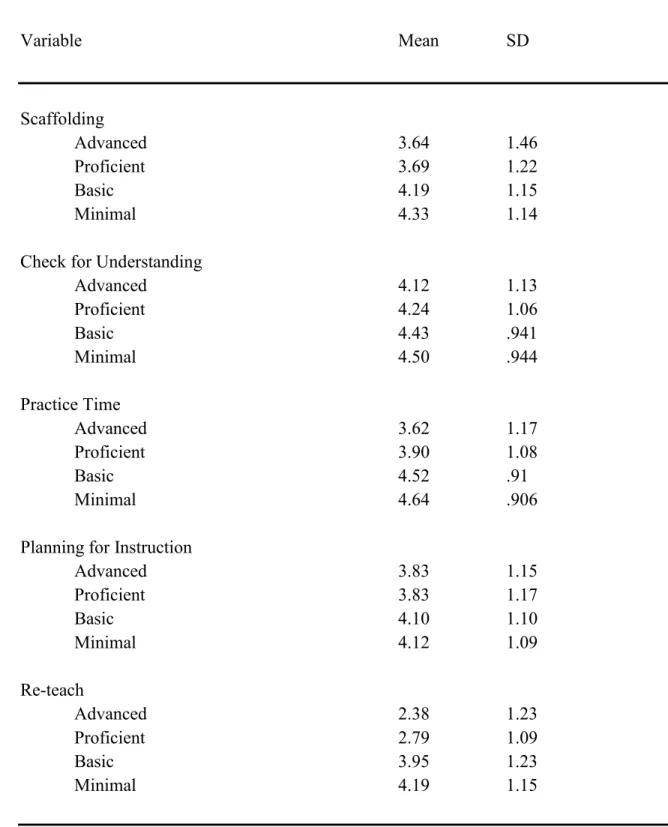
Table 3 (continued).  Variable  Mean    SD  Scaffolding   Advanced  3.64    1.46  Proficient     3.69    1.22  Basic    4.19    1.15  Minimal  4.33    1.14

References

Related documents

activity of trypsin-like enzymes (atle) and gelatinases a and B were studied in the blood plas - ma and extracts from cardiac muscle, cerebral cortex and cerebellum

That would explain both the lower percentage of hail as the most-dominant hydrometeor in the statistics (since at those altitudes likely smaller rimed particles may be dominant)

control access, retrieval, privacy, auditing, and change management rules.  Sharing services include integration, web services, ETL maps, event propagation, and global

(2013), we design opti- mal networks to monitor HFC-134a emissions in California by combining the following three elements: forward atmo- spheric transport simulations of HFC-134a

can be recognised from all so far known members of the subgenus Sun- dodrupeus predominantly by the shape of aedeagus: the combination of narrowly lanceolate median lobe;

On Tenerife, a spectral camera with an objective grating is mounted under an angle of 14 ◦ such that the first-order spectrum of meteors recorded by the zero-order camera is

Hind wing venation: Sc+R, CuA, Pcu, A 1 , and A 2 each with two branches; M and CuP simple; A 1 furcating near to wing middle, other veins furcating in distal half of

Appreciate  providing  more  technical  support  to  hardware