Project-Based Learning Conceptual Framework
for Integrating Soft Skills Among
Students of Technical Colleges
GIMBA DOGARA 1,2, MUHAMMAD SUKRI BIN SAUD2, YUSRI BIN KAMIN 2,
AND MOHD SAFARIN BIN NORDIN 2
1Department of Technical Education, Kaduna State College of Education, Gidan waya 20229, Nigeria
2Department of Technical and Engineering Education, Faculty of Education, Universiti Teknologi Malaysia, Skudai 81310, Malaysia Corresponding author: Gimba Dogara ([email protected])
This work was supported by the Universiti Teknologi Malaysia through the Universiti Teknologi Malaysia Fundamental Research Grant Scheme (FRGS) under Grant 20H77.
ABSTRACT In most professions, the value of soft skills has been recognized and many companies
make decisions on employment and performance assessment based in part on the soft skills of workers. Project-Based Learning (PjBL), in its nature as a pedagogical method, has the capability of harnessing the potential of students in soft skills. The purpose of this study was to develop a PjBL conceptual framework for integrating soft skills among students of technical colleges. The population goal for the study was made up of 372 technical teachers from 22 government technical colleges across the sample area. Considering the heterogeneous complexity of the population from which the survey is extracted, the stratified technique of random sampling was used to choose the 295 participants for the study. Through Confirmatory Factor Analysis (CFA) models the chi-square values, modification indices, and standardized estimates were developed using Analysis Moment of Structures (AMOS). Structural Equation Modeling (SEM) was used to check the model’s causal relationship by the application of AMOS version 20. The study findings revealed PjBL preparation (planning), application, commitment, and assessment techniques each to have a positive significant impact on soft skill improvement among students of technical colleges. On the other hand, the study found that facilitation in project-based learning has a significant yet negative relation to integrating soft skills among students at the technical colleges. Interestingly, the outcome of this research suggests that PjBL in technical colleges will have a substantial positive impact on the integration of soft skills among the students. Based on the finding of the study, the government should provide adequate facilities for appropriate PjBL activities to enhance the integration of soft skills. Technical teachers should employ the PjBL identified elements in the teaching and learning of at technical colleges for effective incorporation of soft skills among the students.
INDEX TERMS Soft skills, technical colleges, project-based learning, technical vocational education and
training.
I. INTRODUCTION
Soft skills, also known as transferable or generic skills have now been regarded to be rudimental to the advancement of graduates’ employability [1]. Soft Skills could be referred to all the skills or competencies that are not directly related to a particular task but are vital in any role because they contribute primarily to the relationships amongst people participating in
The associate editor coordinating the review of this manuscript and approving it for publication was Mervat Adib Bamiah .
an establishment [2]. The enhanced interpersonal relationship through the application of soft skills has the capability of improving the success of an organization [3].
Enhancing the employability of students has therefore continued to draw a great deal of attention from various investors in the education sector and the industry world-wide [2], [3]. As a consequence of globalization and the transformation from production and technology-based econ-omy to a knowledge-based econecon-omy, workers’ demands for skills required in the 21st-century workplace have changed.
The achievement of only technical skills in the graduate career has been reported to be inadequate for graduates to obtain jobs and to be effective at work [4], [5]. Besides that, employers are currently facing difficulties with graduates due to inadequate soft skills such as problem-solving skills, lead-ership, ICT abilities, communication skills, resource manage-ment skills among others [6]–[8]. Hence, in addition to hard skills, graduates ought to acquire soft skills. Consequently, the emphasis now is laid on instructional approaches that encourage learners’ active participation in teaching-learning processes for the incorporation of soft skills.
One of the main challenges of TVET institutions in Nigeria is the development of employable graduates with soft skills that will render indigenous graduates more productive for employers [9]. Regrettably, in Nigeria, technical colleges are accused of making little or no effort to cultivate soft skills among the students, and, as a result, the development of work-ready graduates is rarely possible [10]. Besides, in the study of Ayonmike and Okeke [11], it was found that Nigerian learning institutions mostly emphasized the teaching of tech-nological skills and underrated the importance of soft skills. Many scholars traced the problem to the program’s existing content, which placed more importance on knowledge of technical content to the detriment of soft skills [11]. The statement was verified by [12] who acknowledged that soft skills are not being adequately trained in Nigeria’s technical colleges. Besides that, some researchers suspect educators of adopting teacher-centric teaching methods rather than learner-centric teaching methods [11], [12].
Technical colleges are among the establishments of TVET which are responsible for incorporating knowledge and skills to produce students for the field of work. Therefore, these institutions are meant to help improve students’ oppor-tunities for employment, healthy life, personal prosperity, and socio-economic growth for the nation [13]. A research carried out by Farooq [14] indicated that most technical college graduates do not possess the employability skills required to succeed in a contemporary workforce. In addition, Usoro and Ogbuanya [10] reported that the prominence of graduates from Nigeria’s technical colleges is decreasing rapidly, mainly in terms of soft skills such as; teamwork skills, problem-solving skills, organizational skills, leader-ship skills, knowledge management skills, logical and analyt-ical ability. Among the goals of Nigeria’s technanalyt-ical colleges is to provide training and the required skills for students who will be economically employable or self-reliant [13].
Unfortunately, unemployment in Nigeria is increasing annually with the youth at the most receiving end as a result of inadequate employability skills. In their separate studies, Playfoot and Hall [15] and Intiet al.[16] observed that the disparity between the skills learned by graduates and the skills required in a multifaceted working world of the 21st remain one of the significant reasons for the high unemploy-ment rate among graduates. Therefore, there should be no contention about the fact that this trend of unemployment is the result of constant degree output without productive
skills (soft skills). This, therefore, calls for active teaching and learning methods that effectively develop relevant skills among students.
PjBL is an indispensable teaching approach often described as an excellent substitute for inactive learning and rotary memorization [17], [18]. Project-based learning is an activity-based way of training in which learners develop knowledge and skills by focusing on real, challenging, and complicated problems for a long period of time to explore and react to issues encountered [19]. The traditional method of actively studying and rehearsing out-of-scope material is outdated and not successful in preparing students properly for success in today’s work environment [20]. Project-based learning thus focuses on training learners for a successful life in a knowledge-based environment, in particular in the fields of problem-solving abilities, teamwork skills, com-munication skills, resource management skills and personal skills [21]. Teachers usually present challenges in a PjBL classroom which students need to address the issues together in teams together [21]. Numerous researchers have found that PjBL is highly successful in the following ways: integrating learning with training [22]; cultivating the opportunity to ana-lyze, categorize and develop the expertise and skills required to address realistic scenarios [21]; enhancing leadership abil-ities, listening skills, and coordination and strategic thinking skills [23], [24]; teaching students to be analytical [25].
While teaching for the integration of soft skills, teach-ers must first conceptualize the task or plan, this is more complicated than it sounds [22]. Important PjBL elements to recognize include practical problems, student autonomy, and selection, including a dynamic, detailed process over time, where students ask questions, find and use tools, and advance their approaches [25]. Teachers must then decide the modules; what kits and materials should be accessible to the students? Which elements are to be investigated and discovered by the students? How does an educator reconcile freedom and selection by providing adequate tools without destroying them when engaging students? Where can such resources be found by a student?
Generally, PjBL is believed to be a vital instructional approach that enables students to develop skills necessary for future success and to tackle life’s and the world’s challenges. PjBL remains one of the optimum examples of constructivist-learning. Social constructivist methodologies have been used for learning by educational methods such as collaborative thinking, project-based learning, problem-based learning, and peer-teaching clusters [26]. Learning is transferable, so, because of the transferability of constructivist thinking, students use their knowledge to solve real problems. Students work with their colleagues within the small group in PjBL to solve complex and relevant problems that help develop their understanding, problem-solving, reasoning, communi-cation, and self-evaluation abilities. Based on the construc-tivist view, learning should be structured around events that facilitate the development of knowledge and skills rather than pure information diffusion [27]. Hence, the constructivism
theory formed the theoretical framework for this study.
Aksela and Haatainen [28] conducted a qualitative study to determine active teachers’ views of the advantages and challenges of PjBL so as to use the findings for the promotion of PjBL implementation in the general teaching practice. In the background, data was obtained using e-survey with some open-ended questions. The collected data was analyzed using data-driven content analysis. The study found that students’ learning was enhanced; teamwork and a sense of community at school level were enhanced, and flexibility for their teaching was improved. The teachers, therefore, consider the PjBL’s challenging aspects to include group management, student-related problems, instructor concerns, and collaboration. In the same vein, Pasha [22] conducted a study to develop a PjBL model for integrating soft skills among prospective teachers. The study embraced the prepara-tion, applicaprepara-tion, facilitaprepara-tion, commitment, and assessment as components of activity-based learning which could enhance the soft skills development of students. The outcome of the study points out that the suggested model is effective in integrating the soft skills of potential teachers.
Sadrinaet al.[29] carried out a descriptive study to analyze students’ and supervisors’ views of PjBL at a Malaysian Polytechnic. A survey of 118 respondents represented a pop-ulation of 170 students, and 43 supervisors partook in the analysis. The study considered PjBL knowledge, supervision, collaboration, communication and creativity as elements of PjBL. The result found that the most significant aspects to be considered in PjBL are effective supervision. However, the study also established from the results that some super-visors did not have PjBL competency skills. A new structure for PjBL has been proposed for the Polytechnics in Malaysia, based on the empirical evidence obtained from the study.
The current study adopted the Pasha’s components of the PjBL model that adequately portrayed the characteristics of PjBL for achieving the objectives of enhancing the incorpo-ration of soft skills among technical college students. Besides that, the five criteria (preparation, application, facilitation, commitment, and assessment) were chosen as a necessary starting point for providing students access to high-quality PjBL because they are an essential baseline, but they are not all-encompassing [30]. Preparation (PRP) includes the com-pilation of learning goals, instructional resources, guidance for tasks, evaluation approaches and guidance for academic integrity; ii) Facilitation (FCT) encompasses the assortment of motivation & counselling strategies, creation of online and social networking sites, planning of formal meetings and seminars, assembly of resource personnel, coordination of field research resources, and planning of commonly asked questions; iii) Application (APP) emphasizes on the growth of the soft skills of the participants; iv) Commitment (CMT) includes emotional commitment, continuity of mission, func-tional progression, and the responsibility to accomplish the aim of the group; and v) Assessment (ASM) encompasses individual and group presentation, reports and assessment,
discussion and seminars, logbook and portfolio and partici-pation.
Improvement of informal learning, retention, and examina-tion results as opposed to tradiexamina-tional teaching approaches are the most widely researched subjects of PjBL knowledge [31]. Various kinds of literature on PjBL outcomes and soft skills are accessible from business programmes focused mainly on PjBL pedagogy at the graduate level [32]. In technical and vocational programmes, PjBL evaluations are contained mainly in one course compared to traditional instruction in various regional contexts [33]. On the one hand, Kubiatko and Vaculová [34] found many findings in favour of project-based learning for increasing knowledge retention in graduate pro-grams in Science, Economics and Business compared with traditional instruction [35].
Three other research indicated that students through project-based learning scored lower in the basic sciences or displayed a worse test outcome while the impact size was lim-ited and unreproducible [36]. On the other hand, Oktay and Oktay [37] find a little discrepancy in their study and there is no consensus as proof to justify the superiority of PjBL over conventional approaches of acquiring knowledge and skills. Several reports did not consider that students at PjBL had better developed some cross-curricular abilities than peers taught conventionally. Garnjost and Brown [38] cited the findings of the research on the growth of knowledge-building skills by [39] and conducted ten field studies, eight of which examined the use of project-based learning to determine the relationship between techniques and abilities. According to the authors, the students at PjBL earned lower grades in basic sciences compared to the group under the conventional teaching system, thus the students did not enjoy the usage of PjBL for the constructive learning of the basic concepts.
Incidentally, there is a need to help TVET institutions to develop soft skills among the students through the applica-tion of activity-based instrucapplica-tional methods [40], [41]. The ample literature review showed that there was no significant research aimed at establishing a PjBL framework to inte-grate soft skills among Nigerian technical college students. Hence, the study to develop a PjBL conceptual framework to incorporate soft skills among technical college students. The research is driven by the following objectives: i) to determine PjBL practices suitable for improving the integration of soft skills among technical college students; ii) determine the relationship among the PjBL constructs that formed the struc-tural model, and iii) determine the suitable framework for incorporating soft skills among Technical College students.
The following formulated hypotheses present the expected relationship between the independent and dependent variable of the study: i) There is a significant relationship between preparation and soft skills integration among technical col-lege students; ii) there is a significant relationship between application and soft skills integration among technical col-lege students; iii) there is a significant relationship between facilitation and soft skills integration among technical col-lege students; iv) There is a significant relationship between
commitment and integration of soft skills among students of technical colleges, and; v) there is a significant relationship between assessment and soft skills integration among techni-cal college students.
II. THE METHODOLOGY OF THE STUDY
Technical teachers at technical colleges in the Northwest geographic zone of Nigeria formed the target population for this study. The data collection took place in August 2019 dur-ing the academic session from the aforementioned technical colleges. The population for the study was 372 technical teachers throughout the sample field, drawn out from 22 pub-lic technical colleges. Based on the sample size determination table [42], the correct sample size of 295 participants was chosen. Having acknowledged the varied nature of the pop-ulation from which the sample is derived, stratified random sampling methodology was used to pick the 295 participants for the study. This method was used primarily because of its many benefits over simple random sampling as it provides greater precision than a simple random sample of the same scale [43]. Upon analyzing the completed questionnaires, 250 were held for missing data and other defects, suggesting a response rate of 84.7 percent. Three objectives were devel-oped to guide the study and five hypotheses were tested at 0.05 level of significance.
Technical and vocational education specialists scrutinized the structured questionnaire of 31 items for both face and content validity before it was used to collect data from the respondents. The six exogenous variables: preparation, appli-cation, facilitation, commitment, assessment, and soft skills integration, each contained 5-items of questions with the exception of facilitation construct with 6-items. A 5-point Likert scale type of one to five (1-5), one being the lowest and five being the highest was adopted. Cronbach’s alpha reli-ability technique was used to determine the internal consis-tency of the questionnaire items at 0.87. The survey research design is ideal for this study because data were collected via a questionnaire on the activities required to improve soft skill growth among technical college students. Structural equation modeling (SEM), a multivariate statistical analysis technique that is used to analyze structural relationships was employed using Analysis Moment of Structures (AMOS) version 20 [44]. AMOS used many goodness-of-fit indices between the data and the defined model to derive Maximum Likelihood Estimation (MLE) from a covariance matrix.
Hairet al.[45] proposed a range of goodness-of-fit metrics
for evaluating a hypothesized model that was adopted in this study. The model fit evaluation depended on multiple param-eters, including total misfit as well as relative fit indices. The actual misfit indices included the estimated root mean square error (RMSEA) [45], and the relative performance indices such as the Tucker Lewis index and the cumulative match indexes: CFI, TLI, IFI [46]. Khine [47] noted that a model is acceptable where the indices display (i) the CMIN/df value is between 1 and 5, deemed acceptable or appropriate fit between model and results, (ii) the CFI, IFI and TLI indices
TABLE 1.Initial fitness indexes of latent constructs of the study.
are approximately 1.00, and (iii) the RMSEA index of 0.08 or less suggests a fair error and may be acceptable.
III. DATA ANALYSIS
It is important to determine the measurements of the structures before implementing SEM, in particular, the uni-dimensionality of the scale while the items are in a sep-arate framework [48]. The study obtained and applied the results of exploratory factor analysis (with varimax rota-tion) for the 30 observed variables. The loading factor of each of the 30 indicators was above 0.5 therefore, it was deemed successful and statistically relevant [49]. Babin and Anderson [46] identified loadings such as±0.30=minimal,
±0.40=important and±0.50=essentially substantial using another thumb rule. Furthermore, the validity of the data and the adequacy of the sampling using Kaiser-Meyer-Olkin (KMO) and Bartlett’s test also indicates a KMO value of 0.808 that fits the proposed KMO value of>0.5, while
Bartlett’s test (Chi=5786.575, p<0.05) was found optimal
for a complete variable study [46].
SEM has been used to determine the influence of the exogenous variables on the study’s endogenous variable. SEM was employed in this study because of its advantages of taking a confirmatory approach to data analysis by specifying relationship among variables; its procedures of incorporating both unobserved and observed variables, and its capability of modeling multivariate relations and estimating of direct and indirect effects of variables of the study [47], [50].
A. CONFIRMATORY FACTOR ANALYSIS (CFA)
CFA is a critical part of the SEM calculation process, which is used before designing the structural model in order to ensure the proper fit of the construct [50]. CFA is meant to determine whether the data fit a hypothesized measurement model [51]. So both the original/initial and modified CFAs of the test structures were calculated in this study. The revised CFAs models have been applied since the initial CFAs of the structures did not satisfy the requirements specified. The outcome of the initial CFA fitness indices of all the constructs of the study is presented in table 1.
Table 1 above indicates the outcome of initial CFA fitness indices of all the constructs: Preparation (PRP), Facilita-tion (FCT), ApplicaFacilita-tion (APP), Commitment (CMT), and
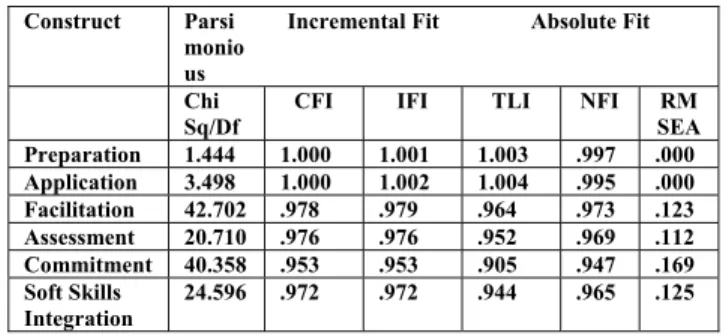
TABLE 2. Modified fitness indexes of latent constructs of the study.
Assessment (AST) and soft skills integration (SSI) of the study. Though before modification, all constructs have CFI, IFI, TLI, and NFI values higher than 9.0, not all constructs have RMSEA values less than 0.80. This implied that Abso-lute fitness for all the constructs has not been achieved. Therefore, it can be inferred that not all the fitness needed for the modeling was attained.
Table 2 displays the outcome of modified CFA fitness indices of all the constructs of the study. The models were revised to boost the indices of modifications in accordance with the criteria of SEM. The redundant items: FCT5, ASM1, CMT2, and SSI1 were deleted, while the items PRP1 and PRP2, APP1 and APP5, FCT1, and FCT3, ASM1 and ASM4 were constrained respectively to resolve the issue. After the modification, all constructs have CFI, IFI, TLI, and NFI (Incremental Fit) values higher than 9.0 and RMSEA (Absolute Fit) values less than 0.80, implying that all fitness necessary in modeling has been attained.
B. HYPOTHESIS MODEL OF RELATIONSHIP BETWEEN THE STUDY CONSTRUCTS
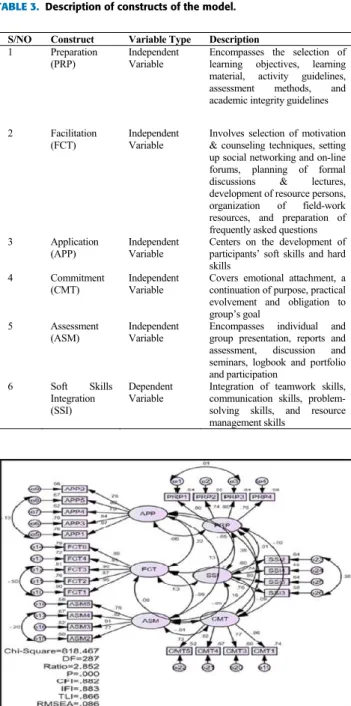
Compared to the structural model, the measurement model reflects an essential stage taken to analyze data efficiently using AMOS [44]. Awang considered the measurement model to be discriminant validity which generally means the construct’s validity. Therefore, in order to ensure the validity of the constructs, the items in each construct must be well-related, such that all the unnecessary items in the constructs should either be erased or constrained for the problematic observed variables. The measurement model encompasses some essential elements of the standards for goodness-of-fit structure. Table 3 defined the constructs involved in the model.
Figure 1 describes the hypothesized initial measurement model (pooled CFA model) of the interaction between the research constructs, project-based learning elements (prepa-ration, application, facilitation, commitment, and assessment) and soft skills integration. For the initial measurement model, the values produced are: Chi-Square=818.467, DF=287, Ratio=2.852, P<001, CFI=.882, IFI=.883, TLI=.886,
RMSEA=.086. Consequently, the model did not satisfy the corresponding goodness of fit criterion based on the values
TABLE 3.Description of constructs of the model.
FIGURE 1. Hypothesized initial measurement model (Pooled CFA) of
association between the constructs of the study.
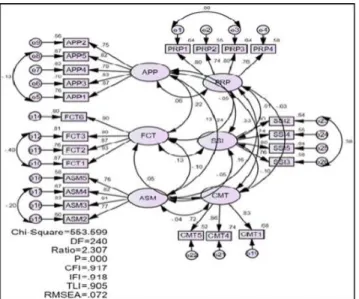
obtained. Therefore, modification was required to upgrade the model to satisfy the specifications of match functionality. The model could be further modified to enhance the qual-ity of fit of the model based on the indexes of modifica-tions (Figure 1). The following values: Chi-Square=553.599, DF=240, Ratio=2.307, P<001, CFI=.917, IFI=.918,
TLI=.905, RMSEA=.072 were achieved after trimming items CMT3 and FCT4 in Figure 2. The specifications obtained in Figure 2 are in accordance with the standards laid down [50], thereby satisfying the corresponding goodness of fit criterion. To test the fit and validity of the measurement model, it has been evaluated through CFA.
FIGURE 2. Hypothesized modified measurement model (Pooled CFA) of association between the constructs of the study.
TABLE 4. Correlation matrix for the constructs of the study.
In order to mitigate the problems of multicollinearity, the discriminant validity of the study latent constructs was tested. Discriminant validity shows to what degree measure-ment model constructs are free of redundant items. Further-more, a model is said to gain discriminant validity when the correlation between exogenous constructs does not surpass 0.85 [52]. According to Babin and Anderson [46], the AVE values in the diagonal axis of the correlation matrix for the constructs of the study should be greater than those in the column and rows in order to obtain discriminant validity. Consequently, as described in Table 4, the discriminant valid-ity of these constructs have been attained.
C. FACTORS LOADINGS, COMPOSITE RELIABILITY, AND AVERAGE VARIANCE EXTRACTED
AVE is the dimension to be calculated which reflects the cumulative total of the variance of the measured variables and is responsible for the significant measurement error of the latent variable [53]. In other terms, AVE is the average amount of variation that a construct is able to describe in the indicators. The CR and AVE of all reflective structures which are obtained by screening the data via exploratory factor analysis (EFA) are presented in table 4. The AVE of all reflective variables is between 0.60-0.81, much greater than 0.50, the suggested value [48]. Additionally, all reflec-tive structures have CR values ranging from 0.85-0.95,
FIGURE 3. Initial structural modeling of the effect of exogenous variable (PjBL) on endogenous variable (soft skills integration).
greater than the recommended value of 0.6 [46], [44] and are thus appropriate for exploratory studies. Accordingly, the measurement model’s outcome described in Table 5 indi-cates that the structures at p<0.05 are statistically important
based on their parameter estimates.
D. HYPOTHESIZED MODEL OF THE EFFECT OF EXOGENOUS (PjBL) VARIABLE ON ENDOGENOUS VARIABLE (SOFT SKILLS)
In accordance with the study hypothesis, mounting the structural model requires the use of structural equation mod-eling techniques to demonstrate the relation between the con-structs. Figure 3 demonstrates the initial structural modeling of the impact of exogenous variables on the endogenous variable. It displays the fitness indices in the model for the latent constructs. However, after reaching the constructs’ reli-ability and validity, the original model has the following val-ues: Chi-Square=756.620, DF=280, Ratio=2.702, P<001,
CFI=.894, IFI=.895, TLI=.877, and RMSEA=.083. Modi-fication of the model has become necessary as it did not fulfill the quality of fit criterion based on the values obtained.
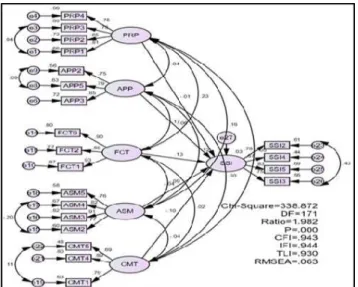
Figure 4 shows the study’s updated structural model. The factor loading must be greater than or equivalent to 0.5 [54] for a newly established scale. Therefore, in accordance with the SEM/AMOS specifications, the model has been updated to improve the goodness of fit indices. To fix the problem, items in a construct with factor loading less than 0.5 were dropped one at a time (starting from the lowest value) until parsimonious unidimensionality was reached. Items with modification indices greater than 15 needed to be deleted or constrained to avoid multicollinearity. Accord-ingly, items APP1, APP4, FCT3, FCT4, and CMT3 were removed in this study, while items CMT1 and CMT 5 were constrained for having values of modification indices more than 15. The following values were obtained after the model’s modification: Chi-Square=338.872, DF=171, Ratio=1.982,
FIGURE 4. Modified structural modeling of the effect of exogenous variable (PjBL) on endogenous variable (soft skills integration).
P<001, CFI=.943, IFI=.944, TLI=.930, RMSEA=.063.
The updated model’s output suggests all of the fit indexes were achieved.
IV. HYPOTHESES TESTING
SEM/AMOS version 20 was used to determine the hypoth-esized relationship between the exogenous variable (PjBL) on the endogenous variable (Soft Skills Integration).
Hairet al. [48] suggested a basic judgment rule for a
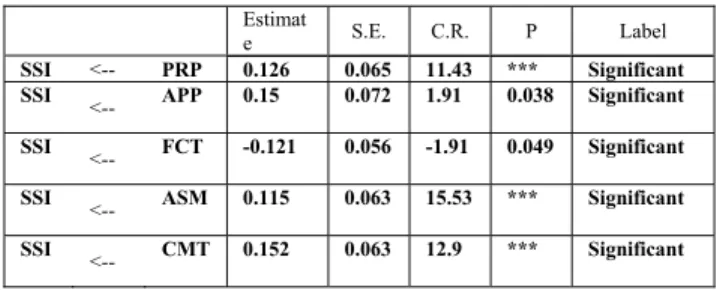
sig-nificant relational relationship such as: (t-value at 1.96 and p-value at 0.05). Therefore, this was used here to determine the importance of the coefficient of the path between exoge-nous and endogeexoge-nous variables. The path analysis outcome indicates that: 1) there is less than 0.001 likelihood of reach-ing an absolute value of a crucial ratio as high as 0.126 as revealed in the AMOS assessments in Table 6. In other terms, there is a significant positive association between the preparation that is inherent in PjBL and the integration of soft skills among students of technical colleges. In the same vein, 2), the likelihood of achieving a crucial ratio at an absolute value as high as 0.150 is less than 0.038, as seen in the AMOS calculations in Table 6; indicating that imple-mentation, a tenet of project-based learning concepts, has a significant positive relationship with the incorporation of soft skills among students at technical colleges. Nevertheless, 3), as seen in Table 6 of the AMOS estimates, the probability of achieving a crucial ratio as high as -0.121 in absolute value is less than 0.049; indicating that facilitation activities in PjBL have a significant yet negative correlation with the incorpo-ration of soft skills among students of technical colleges in Nigeria. However, 4), as seen in the calculations of the AMOS in Table 6, there is less than 0.001 probability of reaching a critical ratio as high as 0. 115 in total value; suggesting that assessment strategies in project-based learning have a significant association with soft skills development among
TABLE 6. Standardized regression weight and its significance in the
model for the whole path.
technical college students. Nevertheless, 5) the probability of achieving a crucial ratio as high as 0.152 in absolute value as shown in the AMOS assessments in Table 6 is less than 0.001; suggesting that there is a significant positive correlation between the commitment activities of students and teachers in PjBL and the integration of soft skills among students of technical colleges in Nigeria.
V. FINDINGS AND DISCUSSION
The relationship between the research variables was deter-mined on the basis of the hypothesis tested, thereby identi-fying the effect of PjBL on the integration of the soft skills among students of technical colleges. The results showed a significant positive correlation between the preparation (planning) in PjBL and the integration of soft skills among students of technical colleges. Diverse projects need different materials and facilities to be used in the process of PjBL. In designing a project, the considerations of the availability of consumables and machine facilities owned by the school are paramount to the successful implementation of PjBL [55]. Therefore, this finding is in agreement with Pasha [22] who asserted that adequate preparation in project-based learning which covers making available the learning materials, activity guidelines, and selection of learning objectives, is critical for the incorporation of soft skills.
The view of the technical teachers on the application in project-based learning was identified from the data anal-ysis as having a significant positive association with the integration of soft skills among technical college students. Application in PjBL provides an opportunity for hand-on training, solving real problems, gainful interaction, and col-laboration/teamwork for the integration of soft skills among students. Consequently, this finding is in line with [56] who asserted that planning an environment in which teamwork can flourish enhances effective teaching and learning for the development of skills.
A significant yet negative association between facilitation in PjBL and the incorporation of soft skills among technical college students in Nigeria has been identified. Facilitation in PjBL involves organization, motivation, and supporting learners toward effective teaching and learning for the devel-opment of skills. The view of the technical teachers in this regard could be perhaps they had most of their experiences
from instructors who had hard time expressing how and why they arrange to practice and appropriate their facilitation in different settings. Besides that, the view of technical teachers in this regard could also be as a result of the cumbersome number of students they managed per class within the study area. One of the general challenges of educational institutions in Nigeria is the inadequacy of infrastructures which has led to an outrageous number of students to be managed in a classroom [57], [58]. This finding supports the assertion by [21] who stated that giving support to a large number of students and monitoring their progress during the process of PjBL is hard, hence, facilitation is usually argued to be extremely complex [59]. This therefore, has the tendency of affecting the efficiency of facilitation in PjBL.
A significant positive association between commitment in PjBL and the integration of soft skills among Technical Col-lege students was discovered. Commitment in PjBL encom-passes emotional attachment, a continuation of purpose, and an obligation to the group’s goal. Teachers’ and students’ commitment to the problem solving of PjBL selected real problems to afford opportunities for students’ zealousness and dedication toward their development of soft skills. This is therefore, in line with the finding of [60] who verified in their research the importance of commitment inherent in PjBL for supporting the learning and motivation of students and teachers towards the incorporation of skills amongst students. In addition, the research showed that the PjBL assessment has a significant positive connection with the growth of soft skills among technical college students. Assessment in PjBL involves individual and group presentations, reports and assignments, discussion and seminars, and logbook and port-folios. Assessment is widely acknowledged by scholars for its effectiveness in enhancing effective teaching and learning among students. The evaluation process of learners’ exertion is crucial, as unevaluated learning causes less motivation, absence of feedback and therefore discourage learners from effective participation. This finding is compatible with the findings of [61], [62] and [63] who affirmed the importance of assessment techniques in the integration of skills in their separate reports. Additionally, Whiteet al.[64] reported that assessment methods are of the most important effects on how students learn, the extent of the study, and how successfully they perform. Obviously, the outcomes of the current study indicate that PjBL will have a significant positive impact on the integration of soft skills among Nigerian students of technical colleges.
VI. CONCLUSION
The aim of this study was to develop a project-based learning conceptual framework for the integration of soft skills among students of technical colleges in Nigeria. CFA methods were employed in the data analysis process. In this case, redundant elements were either deleted or constrained in the model to obtain unidimensionality from the analysis that had been performed for the SEM system. Convergent validity, internal reliability, and constructs reliability of all constructs had been
reached at the end of the operations. Furthermore, based on the correlational values, the model’s discriminating validity has been achieved. In the path analysis, the type of rela-tionship between structures was defined and re-specified to obtain the real significant structural model. The SEM anal-ysis showed that: preparation, application, commitment, and assessment have each a significant positive relationship with the integration of soft skills among technical college students. These findings validate PjBL’s efficacy as an instructional tool for the integration of soft skills among technical and vocational students. The study results would provide cur-riculum designers with the knowledge required to update the technical colleges’ curriculum to accommodate the PjBL ele-ments found important for the successful incorporation of soft skills among the students. Based upon the outcomes of the study: i) Government should provide the adequate enabling environment for appropriate PjBL activities to enhance the integration of soft skills; ii) For effective development of soft skills, technical teachers should employ the PjBL identified elements in the teaching and learning of technical subjects at technical colleges.
REFERENCES
[1] K. Lowden, S. Hall, D. Elliot, and J. Lewin, ‘‘Employers’ perceptions of the employability skills of new graduates,’’ Tech. Rep., 2011.
[2] B. Cimatti, ‘‘Definition, development, assessment of soft skills and their role for the quality of organizations and enterprises,’’Int. J. Qual. Res., vol. 10, no. 1, pp. 97–130, 2016.
[3] M. M. Robles, ‘‘Executive perceptions of the top 10 soft skills needed in Today’s workplace,’’Bus. Commun. Quart., vol. 75, no. 4, pp. 453–465, Dec. 2012.
[4] S. Keller, C. M. Parker, and C. Chan, ‘‘Employability skills: Student perceptions of an IS final year capstone subject,’’Innov. Teach. Learn. Inf. Comput. Sci., vol. 10, no. 2, pp. 4–15, Jun. 2011.
[5] L. Asmaak Shafie and S. Nayan, ‘‘Employability awareness among Malaysian undergraduates,’’ Int. J. Bus. Manage., vol. 5, no. 8, pp. 119–123, 2010.
[6] O. O. Sodipo, ‘‘Employability of tertiary education graduates in Nigeria: Closing the skills gap,’’Glob. J. Hum. Resour. Manag., vol. 2, no. 3, pp. 28–36, 2014.
[7] O. S. Pitan and S. O. Adedeji, ‘‘Skills mismatch among university gradu-ates in the Nigeria labor market,’’US-China Educ. Rev., vol. 1, pp. 90–98, 2012.
[8] A. B. Adebakin, T. O. Ajadi, and S. T. Subair, ‘‘Required and pos-sessed university graduate employability skills: Perceptions of the nigerian employers,’’World J. Edu., vol. 5, no. 2, pp. 115–121, 2015.
[9] J. Itohan Oviawe, ‘‘Bridging skill gap to meet technical, vocational educa-tion and training school-workplace collaboraeduca-tion in the 21st century,’’Int. J. Vocational Edu. Training Res., vol. 3, no. 1, p. 7, 2017.
[10] A. D. Usoro and T. C. Ogbuanya, ‘‘Measures for improving the acquisition of entrepreneurial skills in technology education by the polytechnic stu-dents in the South–South States in Nigeria,’’J. Educ. Social Res., vol. 2, pp. 90–100, Oct. 2012.
[11] C. S. Ayonmike and B. C. Okeke, ‘‘Bridging the skills gap and tackling unemployment of vocational graduates through partnerships in Nigeria,’’ J. Tech. Educ. Train., vol. 8, no. 2, pp. 1–11, 2016.
[12] T. K. Aun, ‘‘Teacher-centred teaching is alive and well,’’Teach. Learn., vol. 15, no. 1, pp. 12–17, 1994.
[13] A. Idris and Y. Mbudai, ‘‘Technical and vocational education: Challenges towards youths empowerment in Kano state-Nigeria,’’J. Tech. Educ. Train., vol. 9, no. 1, pp. 1–12, 2017.
[14] S. Farooq, ‘‘Mismatch between education and occupation: A case study of Pakistani Graduates,’’Pakistan Develop. Rev., vol. 50, no. 4, pp. 531–553, 2011.
[15] J. Playfoot and R. Hall,Effective Education for Employment?: A Global Perspective. London, U.K.: Pearson, Feb. 2009.
[16] M. M. Inti, A. B. A. Latib, and J. O. Oke, ‘‘Confirmatory factor anal-ysis of oral communication’s learning outcomes for integrating generic employability skills into mechanical engineering curriculum in Nigerian polytechnics,’’Int. J. Educ. Found. Manag., vol. 9, no. 1, pp. 146–153, 2015.
[17] T. O’Mahony, ‘‘Project-based learning in control engineering,’’ inProc. IET Irish Signals Syst. Conf. (ISSC), May 2008.
[18] P. J. Goodhew,Teaching Engineering. 2010.
[19] C. E. Hmelo-Silver, ‘‘Problem-based learning: What and how do students learn?’’Educ. Psychol. Rev., vol. 16, no. 3, pp. 235–266, Sep. 2004. [20] S. Ghavifekr, W. Athirah, W. Rosdy, and W. A. W. Teaching, ‘‘Teaching
and learning with technology: Effectiveness of ICT integration in schools,’’ Int. J. Res. Educ. Sci., vol. 1, no. 2, pp. 175–191, 2015.
[21] S. Aldabbus, ‘‘Project-based learning: Implementation & challenges,’’Int. J. Educ. Learn. Dev., vol. 6, no. 3, pp. 71–79, 2018.
[22] S. Pasha, ‘‘An activity based learning model for teaching of soft skills to prospective teachers,’’Pakistan J. Soc. Sci., vol. 36, no. 2, pp. 1265–1279, 2016.
[23] C. G. Schaller and R. Hadgraft, ‘‘Developing student teamwork and com-munication skills using course project-based learning using multi-course project-based learning,’’ inProc. AAEE Conf., Dec. 2013, pp. 1–10. [24] F. Musa, N. Mufti, R. A. Latiff, and M. M. Amin, ‘‘Project-based learning (PjBL): Inculcating soft skills in 21st century workplace,’’Procedia-Social Behav. Sci., vol. 59, pp. 565–573, Oct. 2012.
[25] K. Wey Smola and C. D. Sutton, ‘‘Generational differences: Revisiting generational work values for the new millennium,’’J. Organizational Behav., vol. 23, no. 4, pp. 363–382, Jun. 2002.
[26] M. A. Almulla, ‘‘The efficacy of employing problem-based learning (PBL) approach as a method of facilitating Students’ achievement,’’IEEE Access, vol. 7, pp. 146480–146494, 2019.
[27] S. Oh and D. H. Jonassen, ‘‘Scaffolding online argumentation during problem solving,’’J. Comput. Assist. Learn., vol. 23, no. 2, pp. 95–110, 2007.
[28] M. Aksela and O. Haatainen, ‘‘Project-based learning (pbl) in practise: Active teachers’ views of its’ advantages and challenges,’’ inProc. 5th Int. STEM Educ. Conf., Integr. Educ. Real World, Jan. 2019.
[29] S. Sadrina, R. Mustapha, and M. Ichsan, ‘‘The evaluation of project-based learning in Malaysia: Propose a new framework for polytechnics system,’’ J. Pendidikan Vokasi, vol. 8, no. 2, p. 143, 2018.
[30] M. Bourdeaux, ‘‘Reimagining the role of technology in education,’’ vol. 9, no. 1. 1981.
[31] R. D. B. Rubraca, ‘‘An action research on project-based learning and understanding by design and their effects on the science achievement and attitude of science students,’’ Tech. Rep., Feb. 2018.
[32] A. Wiek, A. Xiong, K. Brundiers, and S. van der Leeuw, ‘‘Integrating problem- and project-based learning into sustainability programs: A case study on the school of sustainability at Arizona state university,’’Int. J. Sustainability Higher Edu., vol. 15, no. 4, pp. 431–449, Aug. 2014. [33] M. A. De La Puente, H. S. Robles, L. G. Acuña, and M. Delgado,
‘‘The effectiveness of project-based learning methodology in an external commerce course: A preliminary analysis for the Colombian Caribbean region,’’J. Econ. Econ. Educ. Res., vol. 19, no. 2, 2018.
[34] M. Kubiatko and I. Vaculová, ‘‘Project-based learning?: Characteristic and the experiences with application in the science subjects,’’Energy Educ. Sci. Technol. B, Soc. Educ. Stud., vol. 3, no. 1, pp. 65–74, 2011.
[35] L. Pjbl, M. K. Noordin, D. F. Ali, A. N. Nasir, and M. R. Pairan, ‘‘Improving knowledge and skills retention for future teachers in technical and vocational education through project-based learning,’’Turkish Online J. Des. Art Commun., pp. 769–780, Dec. 2019.
[36] C. Dann, ‘‘Is project based learning more effective than direct instruc-tion in school science classrooms? An analysis of the empirical research evidence,’’ University of Manitoba Winnipeg, Winnipeg, MB, Canada, Tech. Rep., 2012.
[37] B. Oktay and K. Oktay, ‘‘The effect of project based learning on seventh grade students ’Academic achievement,’’ Int. J. Instr., vol. 10, no. 1, pp. 37–54, 2017.
[38] P. Garnjost and S. M. Brown, ‘‘Undergraduate business students’ percep-tions of learning outcomes in problem based and faculty centered courses,’’ Int. J. Manage. Edu., vol. 16, no. 1, pp. 121–130, Mar. 2018.
[39] M. A. Albanese, ‘‘Problem-based learning?: A review of literature on its outcomes and implementation issues,’’Acad. Med., vol. 1993, pp. 52–81, Feb. 2015.
[40] P. Comyn and C. Paul, ‘‘Integrating core work skills into TVET systems: Six country case studies,’’ Laura Brewer, Tech. Rep., 2015.
[41] M. Wats and D. A. V. College, ‘‘Developing soft skills in students,’’Int. J. Learn., vol. 15, no. 12, Mar. 2019.
[42] R. V. Krejcie and D. W. Morgan, ‘‘Determining sample size for research activities,’’Educ. Psychol. Meas., vol. 30, no. 3, pp. 607–610, Sep. 1970. [43] G. Sharma, ‘‘Pros and cons of different sampling techniques,’’Int. J. Appl.
Res., vol. 3, no. 7, pp. 749–752, 2017.
[44] F. Chan, G. K. Lee, E.-J. Lee, C. Kubota, and C. A. Allen, ‘‘Structural equa-tion modeling in rehabilitaequa-tion counseling research,’’Rehabil. Counseling Bull., vol. 51, no. 1, pp. 44–57, Oct. 2007.
[45] J. F. Hair, Jr., G. T. M. Hult, C. Ringle, and M. Sarstedt,A Primer on Partial Least Squares Structural Equation Modeling (PLS-SEM), 2nd ed. Newbury Park, CA, USA: Sage, May 2016.
[46] B. J. Babin and R. E. Anderson,Multivariate Data Analysis. London, U.K.: Pearson, 2014.
[47] M. S. Khine,Application of Structural Equation Modeling in Educational Research and Practice. Rotterdam, The Netherlands: Sense, 2013. [48] J. F. Hair, M. Sarstedt, T. M. Pieper, and C. M. Ringle, ‘‘The use of
partial least squares structural equation modeling in strategic management research: A review of past practices and recommendations for future appli-cations,’’Long Range Planning, vol. 45, nos. 5–6, pp. 320–340, Oct. 2012. [49] R. Maskey, J. Fei, and H. Nguyen, ‘‘Use of exploratory factor analysis in maritime research,’’Asian J. Shipp. Logist., vol. 34, no. 2, pp. 91–111, 2018.
[50] J. C. F. de Winter, D. Dodou, and P. A. Wieringa, ‘‘Exploratory factor analysis with small sample sizes,’’Multivariate Behav. Res., vol. 44, no. 2, pp. 147–181, Apr. 2009.
[51] J. B. Schreiber, ‘‘Reporting structural equation modeling and confirmatory factor analysis results: A review,’’J. Educ. Res., vol. 99, no. 6, pp. 323–337, 2006.
[52] Z. Awang, W. M. A. Wan Afthanorhan, and M. A. M. Asri, ‘‘Parametric and non parametric approach in structural equation modeling (SEM): The application of bootstrapping,’’Modern Appl. Sci., vol. 9, no. 9, pp. 58–67, 2015.
[53] H. R. Ghulami, M. Rashid, A. B. Hamid, and R. Zakaria, ‘‘Partial least squares modelling of attitudes of students towards learning statistics,’’ J. Qual. Meas. Anal., vol. 10, no. 1, pp. 1–16, 2014.
[54] Z. Awang, ‘‘Validating the measurement model: CFA,’’ Struct. Equ. Model. Using Amos Graf., pp. 54–73, 2014.
[55] N. Jalinus, R. A. Nabawi, and A. Mardin, ‘‘The seven steps of project based learning model to enhance productive competences of vocational students,’’ inProc. Int. Conf. Technol. Vocational Teachers (ICTVT), Jan. 2017.
[56] M. A. West, ‘‘Flourishing in teams: Developing creativity,’’West Sacra-mento, vol. 3442, no. 3, pp. 25–44, 2016.
[57] L. O. Odia and S. I. Omofonmwan, ‘‘Educational system in Nigeria prob-lems and prospects,’’J. Social Sci., vol. 14, no. 1, pp. 85–86, Jan. 2007. [58] S. Akinyemi and O. I. Bassey, ‘‘Planning and funding of higher education
in Nigeria: The challenges,’’Int. Educ. Stud., vol. 5, no. 4, pp. 86–95, 2016. [59] L. Darling-Hammond, L. Flook, C. Cook-Harvey, B. Barron, and D. Osher, ‘‘Implications for educational practice of the science of learning and development,’’Appl. Develop. Sci., vol. 24, no. 2, pp. 97–140, Apr. 2020. [60] M. Chu, S. Tavares, N. Chu, D. Ho, S. Chow, K. Siu, and F. Wong, ‘‘No
title,’’ Tech. Rep., 2012.
[61] I. Tosuncuoglu, ‘‘Importance of assessment in ELT,’’J. Edu. Training Stud., vol. 6, no. 9, p. 163, 2018.
[62] S. Jimaa, ‘‘The impact of assessment on students learning,’’ Procedia-Social Behav. Sci., vol. 28, pp. 718–721, Dec. 2011.
[63] A. Kavlu, ‘‘Project–based learning assessment methods comparison in undergraduate EFL classes,’’Int. J. Soc. Sci. Educ. Stud., vol. 1, no. 4, pp. 47–56, 2016.
[64] R. F. White, R. Campbell, D. Echeverria, S. S. Knox, and P. Janulewicz, ‘‘Assessment of neuropsychological trajectories in longitudinal population-based studies of children,’’J. Epidemiol. Community Health, vol. 63, no. 1, pp. i15–i26, Jan. 2009.
GIMBA DOGARAreceived the bachelor’s degree in technology education from the Federal Univer-sity of Technology Minna, Nigeria, in 2000, and the master’s degree in industrial technical edu-cation from the University of Nigeria, Nsukka, in 2013. He is currently pursuing the Ph.D. degree with the Department of Technical and Engineering Education, Universiti Teknologi Malaysia. Since 2001, he has been a Lecturer with the Department of Technical Education, Kaduna State College of Education, Gidan Waya, Kafanchan. He has published in journals, such as theInternational Journal of Recent Technology and Engineering. His master’s thesis was on employability skills required by polytechnic graduates of building technology in Nigeria.
MUHAMMAD SUKRI BIN SAUDreceived the master’s degree from the University of Wisconsin, USA, in 1998, and the Ph.D. degree from Ohio State University, Columbus, OH, USA, in 2004.
He has been a Lecturer with the Department of Technical and Engineering Education, Faculty of Social Sciences and Humanities, Universiti Teknologi Malaysia, Johor Bahru, Johor.
YUSRI BIN KAMIN received the Bachelor of Technology degree in education and the master’s degree in technical and vocational education from the Universiti Teknologi Malaysia, in 1997 and 2000, respectively, and the Ph.D. degree from La Trobe University, in 2012. He is currently a Senior Lecturer with the Department of Technical and Engineering Education, Faculty of Social Sciences and Humanities, Universiti Teknologi Malaysia, Johor Bahru, Johor.
MOHD SAFARIN BIN NORDIN received the Diploma degree in mechanical engineering (aero-nautical studies), the Bachelor of Technology degree in education (mechanical engineering), the Master of Technical and Vocational Education degree, and the Ph.D. degree in education (techni-cal and vocational) from the Universiti Teknologi Malaysia, in 1991, 1996, 1999, and 2009, respec-tively. He is currently a Lecturer with the Depart-ment of Technical and Engineering Education, Universiti Teknologi Malaysia.