WESTERN SYDNEY UNIVERSITY
Equity Program
Principals:
Policy mediation for equity
Janice A Morrison B.A., Dip. Ed., M.L.M.Ed. (University of Newcastle. N.S.W). M.Ed. (Charles Sturt University, N.S.W)
6/30/2017
A thesis submitted to Western Sydney University in fulfilment of the
requirements for the degree of Doctor of Philosophy
Dedication:
This study is especially dedicated to my family, and my sister Judy, who gave her all to teaching.
Acknowledgements
In undertaking this study, I wanted to reflect on the changing nature of school leadership as my colleagues and I began to experience it in disadvantaged schools in NSW, Australia. I am therefore absolutely indebted to those who made this learning journey possible for me.
I would like to firstly acknowledge my two supervisors, Dr Katina Zammit and Associate Professor Susanne Gannon. Both Katina and Susanne have been instrumental to my completion of this learning journey to complete this thesis. Thank you so much Katina, for your continuing positive support and belief in my ability to complete the study. Thank you for continuing to demand high standards and for ensuring that I didn’t lose my way among the verbiage. Thank you, Susanne for reading endless drafts and providing thoughtful feedback. I was so grateful for the significant amount of time and the really constructive feedback and guidance that you both provided.
Thank you also to all the participants in this project who generously and thoughtfully gave their time to me and this project. In particular, I sincerely thank each of the school principals who reached out in their busy schedules to provide me with generous amounts of their time and the benefit of their insights about school leadership in their current circumstances. This project is about them and I hope in some way, this study is a tribute to their amazing work in schools, even as they are faced with ongoing challenges that continue to test their values, knowledge and skills.
I would also like to thank the School of Education at the Western Sydney University and the Graduate Research School for their support of my candidature. A big thankyou also to everyone in the Western Sydney University School of Education for their generous friendship and positive support throughout my candidature.
Thank you also to my husband, Bruce and my sons, Karl, Evan and Andrew for their unstinting and good-natured willingness to provide thoughtful advice and encouragement throughout the time that I was working on my PhD, as well as their help with the many technical aspects of writing the thesis. Lastly, a thank you to my mother, who continues to support whatever I do, even though I probably puzzle her with these un-ending quests for understanding.
Statement of Authentication
The work presented in this thesis is, to the best of my knowledge and belief, original, except as acknowledged in the text. I therefore declare that I have not submitted this material in whole or in part for a degree at this or any other institution
Jan Morrison: Date: June, 2017
Dr Katina Zammit
Glossary of Acronyms and Abbreviations
A4L Assessment for Learning
ABS Australian Bureau of Statistics
AECG Aboriginal Education Consultative Group
AEO Aboriginal Education Officer
AITSL Australian Institute for Teaching School Leadership (Limited)
AL Accelerated Literacy
AP Assistant Principal
APSTL Australian Professional Standards for Teachers and Leaders
ARIA Accessibility/Remoteness Index of Australia
ATAR Australian Tertiary Admission Rank
BOS Board of Studies NSW
BOSTES Board of Studies Teaching and Educational Standards NSW
BYOD Bring Your Own Device
CESE (NSW Government) Centre for Statistics and Evaluation
CIRES Centre for International Research on Educational Systems
CLO Community Liaison Officer
CS Central School – K-12
DEC Department of Education and Communities NSW
DET Department of Education and Training NSW
D of E Department of Education NSW
DP Deputy Principal
DSP Disadvantaged Schools Program
EMSAD Educational Measurement and School Accountability Directorate
EPAC Employee Performance and Conduct
ESL English Speaking Background
GFC Global Financial Crisis
GTIL Great Teaching: Inspired Learning (policy)
HAT Highly Accomplished Teacher
HSC Higher School Certificate - Year 12 final Certificate
HS High School (7-12)
HT Head Teacher
ICSEA Index of Community Socio-Educational Advantage
IEC Intensive English Centre
ILP Individual Learning Plan
ITPTS Institute of Teachers’ Professional Teaching Standards (NSW)
KLA Key Learning Area
LSLD Local Schools: Local Decisions
LAST Learning Assistance and Support Team
LSES Low Socio- Economic Status
LST Learning Support Team
LBOTE Language Background Other Than English
NAPLAN National Assessment Program in Literacy and Numeracy
NESA NSW Educational Standards Authority
OECD Organisation for Economic Co-operation and Development
PAT Progressive Achievement Tests
P&C Parents and Citizens group
PS Public School (K-6)
PISA Program for International Student Assessment
PLLD Professional Learning and Leadership Directorate
PSP Priority Schools Program
QT Quality Teaching
R2L Reading to Learn
RSD Index of Relative Socio-economic Disadvantage
SBA School Based Apprenticeship
SDO School Development Officer
SEO School Education Officer
SED School Education Director
SIPA Systemic Implications of Pedagogy and Achievement
SMART School Measurement, Assessment and Reporting Toolkit (for NAPLAN data)
SLSO Student Learning and Support Officer
SSLSES Smarter Schools Low SES School Communities National Partnership
TAA Teacher Accrediting Authority
TIMMS Trends in International Mathematics and Science
TTC Trade Training Centre
WWC Working with Children check
Contents
Dedication: 2
Glossary of Acronyms and Abbreviations 6
List of Tables ... 12
List of Figures ... 13
Equity program principals: Policy mediation for equity 14 Abstract 14 Chapter 1 16 Introduction to the Study 16 1.1 Introduction. ... 16
1.2 The Nature of Disadvantage in NSW Schools. ... 17
1.3 Equity Programs in NSW Education. ... 18
1.4 Conceptualising Equity. ... 20
1.5 School Leadership and Changing Expectations of Principals. ... 22
1.6 Interpreting Principals’ Positioning in Policy Discourse: Theoretical Understandings. ... 25
1.7 Research Questions Underpinning the Study. ... 26
1.8 Establishing a niche ... 27
1.8.1 Mediating policy discourses for equity. 28 1.9 Overview of the Thesis. ... 30
Chapter 2 33 Literature Review 33 2.1 Introduction. ... 33
2.2 Neoliberalism and education ... 33
2.2.1 Effective Schools and Effective Principals. 35 2.2.2 Neoliberal governmentalities and equity 36 2.2.3 Neoliberalism and Governmentality in the SSLSES National Partnership. 37 2.2.4 Governmentalities and Discursive Shifts. 38 2.2.5 Governmentalities of Control: Data as evidence. 38 2.3 Leadership in disadvantaged schools ... 39
2.4 Leadership and Quality Teaching ( quality Teaching expl) ... 42
2.5 Conclusion. ... 47
Chapter 3 49 Theoretical Framework: Foucault and Principal Accountabilities 49 3.1 Introduction ... 49
3.2 Foucault, education and educational leadership ... 50
3.4 Discourse and Power/Knowledge ... 53
3.4.1 Power/ Knowledge 55 3.4.2 Disciplinary Power 56 3.5 Governmentality. ... 58
3.6 Counter-Conduct. ... 61
3.7 Governmentality and Resistance. ... 62
3.8 Foucault and Ethics ... 63
3.9 The Subject, Truth Telling and the Self. ... 65
3.10 Micropolitical Leadership and Acumen. ... 66
3.10.1 The Politics of Leadership Acumen. 68 3.11 Limitations of Foucault’s Conceptual Tools. ... 68
3.12 Envisaging Principals’ Subjectivities ... 69
3.12.1 Governmentalities 69
3.13 Conclusion ... 71
Chapter 4 73 Methodology and Design Framework 73 4.1 Introduction ... 73
4.1.1 Research questions 73 4.2 Constructionist Epistemology. ... 74
4.3 Positionality ... 75
4.4 Research Design. ... 76
4.4.1 Phase One: Critical Discourse Analysis of Equity Program Policies 77 4.4.2 Phase Two: Principal Questionnaire 80 4.4.3 Phase Three: Principal Case Studies. 85 4.5 Ethical Considerations ... 91
4.6 Conclusion ... 92
Chapter 5 93 Critical Discourse Analysis of the SSLSES National Partnership 93 5.1 Introduction ... 93
5.2 Discourse Analysis. ... 94
5.2.1 Discourse analysis tools for analysing policy. 95 5.3 Analysis of SSLSES National Partnership Discourse ... 97
5.3.1 Political and social context analysis 98 5.3.2 Analysis of SSLSES National Partnership reforms 104 5.3.3 Analysis of SSLSES information and implementation guides 107 5.4 Leadership of SSLSES National Partnership Reforms ... 114
5.5 Silences about equity in the SSLSES National Partnership ... 115
5.6 Conclusion ... 115
Chapter 6 117 Introduction to Principal Case Studies 117 6.1 Introduction. ... 117
6.2 School Contexts ... 118
6.3 Alison and Cottonwood Central School ... 119
6.4 Stuart and Parkeview Central School. ... 121
6.5 Marjory and North Plains High School. ... 123
6.6 Natalie and High Tops Public School ... 125
6.7 Boyd and Colborne High School ... 126
6.8 Don and Southern Girls High School ... 128
6.9 Conclusion ... 129
Chapter 7 132 Mediation of accountability regimes and marketisation for equity 132 7.1 Introduction ... 132
7.2 Accountabilities at Cottonwood Central ... 133
7.3 Mediating the Market at Cottonwood Central ... 139
7.4 Accountabilities at Parkeview Central (K-12) ... 140
7.5 Mediating the Market at Parkview Central. ... 142
7.6 Accountabilities at North Plains High School ... 143
7.7 Mediating the Market at North Plains High. ... 147
7.8 Accountabilities at High Tops Public school ... 150
7.9 Mediating the Market at High Tops Public. ... 153
7.10 Accountabilities at Colborne High. ... 154
7.11 Mediating the Market at Colborne High ... 158
7.12 Accountabilities at Southern Girls High. ... 160
7.13 Mediating the Market at Southern Girls High ... 163
Chapter 8 172
Mediating Leadership 172
8.1 Introduction ... 172
8.2 Cottonwood Central: Rethinking Leadership ... 173
8.3 Parkeview Central: Rethinking Leadership ... 178
8.4 North Plains High School: Rethinking Leadership ... 180
8.5 High Tops Public School: Rethinking Leadership ... 187
8.6 Colborne High: Rethinking Leadership. ... 189
8.7 Southern Girls High: Rethinking Leadership ... 193
8. 8 Discussion ... 198
Chapter 9 204 Mediating Quality Teaching 204 9.1 Introduction. ... 204
9.2 Pedagogy, Professional Learning and Quality Teaching at Cottonwood Central ... 206
9.3 Pedagogy, Professional Learning and Quality Teaching at Parkeview Central ... 209
9.4 Pedagogy, Professional Learning and Quality Teaching at North Plains High ... 210
9.5 Pedagogy, Professional Learning and Quality Teaching at High Tops Public ... 214
9.6 Pedagogy, Professional Learning and Quality Teaching at Colborne High ... 218
9.8 Pedagogy, Professional Learning and Quality Teaching at Southern Girls High ... 222
9.9 Discussion. ... 226
Chapter 10 231 Conclusion 231 10.1 Neoliberalism, leadership and mediating the SSLSES National Partnership reforms ... 231
10.2 The Discourse model ... 232
10.3 Mediating principals’ practices for equity ... 234
10.4 Foucault’s conceptual tools. ... 235
10.5 Mediation of Accountabilities and Marketisation ... 235
10.6 Mediation of Leadership ... 237
10.7 Mediation of Quality Teaching ... 239
10.8 Limitations of the Research. ... 240
10.9 Contribution of the Study ... 242
10.10 Conclusion and Future Directions ... 243
List of Tables
Table 4.1. Table of documents analysed 77
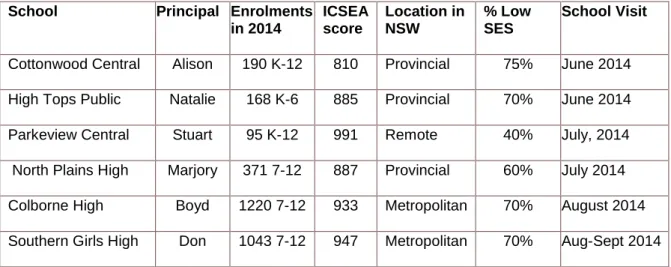
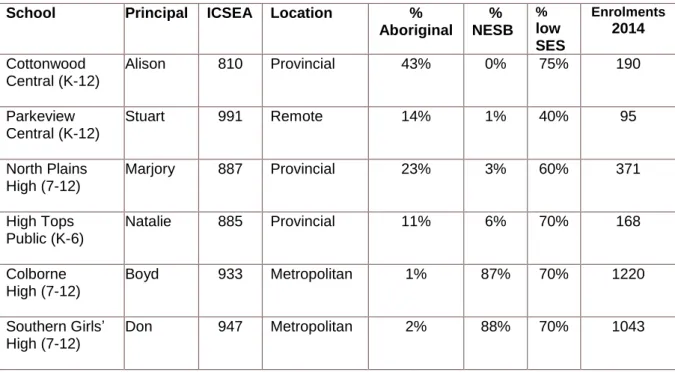
Table 4.2. Table showing Case Study schools and Contextual Data 85
Table 5.1. Table of documents for analysis 96
Table 5.2. Extracts from Rudd’s speech to the Australian Press Club (2008) 101
Table 6.1. Contextual data for each Case Study 117
List of Figures
Figure 3.1. Layers of disciplinary power and governmentalities positioning the principal 69
Figure 3.2. Factors enabling possible mediation 70
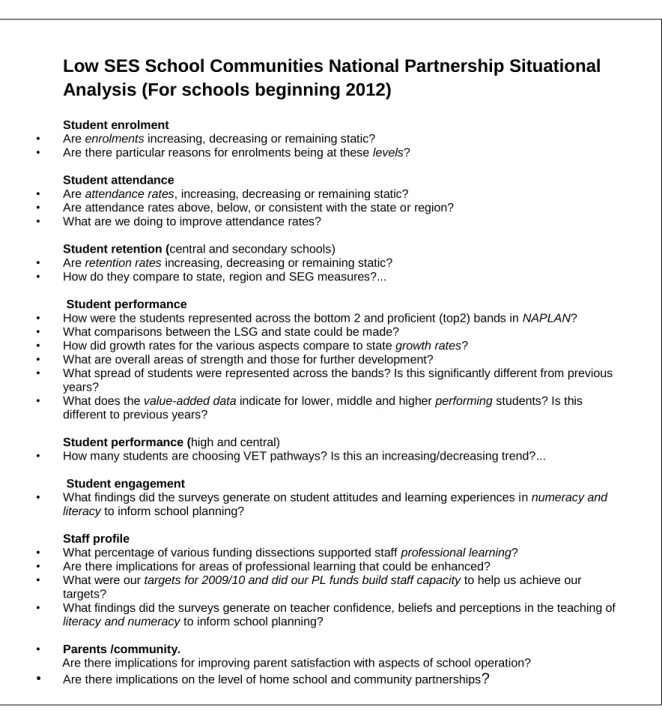
Figure 5.1. Situational analysis template questions for the SSLSES National Partnership
(2009) 110
Figure 5.2. Extracts from the situational analysis questions template (for new schools
with a 2012 start date) (2012) 111
Figure 6.1. (a) Cottonwood Central’s community Gym/Hall; (b) well-resourced Wood
Technology Laboratory; and (c) Hospitality VET area 118
Figure 6.2. (a) Portable primary buildings at Parkeview Central; (b) secondary technology buildings; and (c) Aboriginal artefacts and memorabilia in the Administration
Building 120
Figure 6.3. (a) Newer science buildings at North Plains High; (b) the shared Trade
Training Centre 121
Figure 6.4. (a) Student works on display in corridors at Colborne High; (b) Multicultural
pathway; and (c) Flag Day Celebrations 125
Figure 6.5. (a) Refurbished social spaces for students; (b) redeveloped classrooms with
open learning spaces; and (c) Indigenous Dance Ensemble 126
Figure 6.6. Diagram showing the principal mediation practices when implementing the
Equity program principals: Policy mediation for equity
Abstract
This study investigates the ways in which six principals from a range of government school contexts in NSW, Australia, implemented the Smarter Schools Low SES (SSLSES) School Communities National Partnership program to achieve equity in their schools. After analysing the ways in which principals were made accountable and positioned by policy discourse underpinned by economic rationalist principles, the thesis explores how the six principals mediated policy accountabilities for student equity. Using a number of Foucauldian conceptual lenses, each principal’s practices are examined as they implemented accountability, leadership and quality teaching governmentalities of the policy reforms.
The study is underpinned by constructionist epistemology to better enable an understanding of the complex interrelationships of principals, as enactors, within the contexts of their schools; and as subjects, in interaction with educational policy discourses. Its design is informed by two main methodological approaches comprising a critical policy discourse analysis, and case studies of a sample of six SSLSES National Partnership principals. The policy analysis utilised Gee’s (2005) ‘D’/’d’iscourse concepts. Case study methods utilized semi-structured interviews with each principal and staff and/or community recommended by the principal, together with analysis of relevant artefacts. Data gathered was examined using Foucauldian notions of power, governmentality, resistance, ethics and technologies of the self to investigate how principals negotiated governmentality discourses directing their implementation.
By undertaking the analysis of principals’ practices in selected domains of accountability, leadership and quality teaching, the thesis demonstrates that power relations and governmentality operated on and through principals to create them as disciplined subjects who were largely compliant to specific accountability pressures. This included acceding to standardised testing regimes, entrepreneurialism, and targeted continuous school improvement practices.
However, principals also demonstrated the further capacity for contestation, re-articulation and mediation of a range of other key governmentalities, designed to normalize them, but seen to be at odds with their school community’s priorities, the principal’s own subjectivities and/or their vision for equity. Foucault’s notions about power relations, ethics and resistance were important in the study to show where and how principals operated counter to the conduct
required of them in their local contexts. The study also demonstrated how policy governmentalities can be appropriated in ethical ways to implement reforms for equity. The study’s importance stems from its governmentality approach which demonstrates that in key domains, principals are not only enactors wholly ‘responsibilised’ by policy accountabilities and discourse, but are educational leaders enmeshed within complex histories, with ethical stances and acceding also to the contingencies of their local contexts. They are therefore careful and selective mediators and purveyors of both normalizing and resistant practices and principal-co-producers of complex reform in the education marketplace. Despite disciplining practices of accountability regimes, principals have seized opportunities for agency over equity practices in their complex school contexts.
Chapter 1
Introduction to the Study
The question we need to ask is not whether the schools serving the poorest 10 to 15 per cent of the population have succeeded, but whether the systems of which they form a part have been successful. For, like it or not, the poorest schools serve the whole system…The health of the whole system is reflected in the performance of the poorest schools (Teese, 2007, p. 3).
1.1 Introduction.
Increasingly, economic rationalist approaches to public education are changing the face of education systems and relationships between and within schools in ways which have impacted on the reconfiguration of school leaders and their communities against commonly understood paradigms. Older values of collegiality, community and of equality seem to have given way to the values of the marketplace which celebrates competition, efficiency and self- responsibility (Connell, 2013a). It has been argued by many that these changes constitute a global phenomenon within which the democratic purposes of schooling and equality, in particular, have been subjugated to economic governmentalities (Ball, 2012; Reid, 2010; Rizvi & Lingard, 2010). In NSW public schools, Australia, such changes have been charted since the late 1980’s and are impacting on principals and the ways in which they lead their schools.
To understand the impact of such policy changes on a sample of NSW principals of
disadvantaged1 schools, this study examines the impact of the Smarter School Low SES School
Communities (SSLSES) National Partnership program (2009-14) (COAG, 2009) as an example of a large-scale equity policy. The study is an analysis of how policy governmentalities are constructed at the policy discourse level, and how they are constructed, enacted and mediated by principals at the school level. The study’s importance rests on gaining an understanding of the ways in which principals are positioned as subjects by policy discourses and reflect on their mediation of policy imperatives, for equity, within complex system-wide and local contexts.
1 Note that the term “disadvantaged” is used in the thesis with some reservation given its deficit connotations.
However, I retain it as a descriptor of schools supported by equity programs such as the SSLSES National Partnership program, since this terminology is also reflected in much of the program discourse and is critiqued as part of the thesis.
In this chapter, the research questions posed by the study and associated with the ways in which principals managed large scale equity program policy are introduced. Associated theoretical and empirical propositions contributing to the questions are outlined. These include preliminary thoughts about the nature of equity and its interpretation in Australian schools, current understandings about educational leadership and tensions embedded in equity policy. The chapter will also provide a statement about the contribution this study makes to the field of educational leadership of disadvantaged schools and associated large scale government initiated equity policy implementation. Finally, a brief overview of the research approach will be provided along with an outline of the thesis structure.
1.2 The Nature of Disadvantage in NSW Schools.
Socio-economically and socio-culturally disadvantaged students in Australian schools have long been associated with disparities in student achievement, access to employment, and indicators of well-being. Results in national and international tests such as the National Assessment Program in Literacy and Numeracy (NAPLAN) continue to demonstrate gaps between achievements of Indigenous and socio-economically disadvantaged students and their mainstream counterparts of more than a bandwidth (or the equivalent of at least 2 years’ schooling as shown in Australian Curriculum Assessment and Reporting Authority reports (ACARA, 2016b). Australian Bureau of Statistics (ABS) data continues to reveal unequal participation and transition outcomes into the workforce and further education for disadvantaged and Indigenous groups especially (ABS, 2015; Harrison, 2011). Similarly, in New South Wales schools, high proportions of disadvantaged students do not achieve National Benchmarks in reading and numeracy and large gaps continue between the proportions of disadvantaged and advantaged students achieving in the top bands of the NAPLAN tests. The National Report on NAPLAN results for 2015 and 2016 show ongoing inequities, many of which have changed little since 2008 (ACARA, 2016a). This is despite the implementation of a number of equity programs in NSW schools such as the Priority Schools Programs (PSP) and the National Partnership Agreement on Low Socio-economic Status School Communities (COAG, 2008) and resource based funding allocated under the Resource Allocation Model
(RAM) operating in NSW since 2015. There remain many reasons for disparities and
inequities, associated with students’ and some communities’ economic and socio-cultural status, school system-level factors, and the influence of school leaders and teachers (Lamb, 2015; Teese, 2011).
1.3 Equity Programs in NSW Education.
Education has long been seen as one way to ameliorate disadvantages to attain equality, with the quality of teaching and leadership of schools seen as important (Gannon & Sawyer, 2014; Munns, Sawyer, & Cole, 2013); and equity programs and differentiated resourcing models, instigated in government policy, seen as important in redistributing resources to improve social inclusion and learning opportunities (Lamb, 2015). This is evident in the continuing interest in the concept of needs-based funding recommended by the Review of Funding for Schooling (Gonski et al., 2011), or the more popularly known Gonski Report, which has remained on political agendas since its publication, and is currently subject to further development in the form of Gonski 2.0 (Koziol, 2017). Equity programs embedded in educational policy have had a substantial history in New South Wales and Australian schools. Equity policy has been the province of both Federal and State governments, even though each State has the dominant responsibility for funding government schools in each state. Since the 1970s, when the Whitlam
Federal government (1972-1975) instituted the Disadvantaged Schools Program2 (1971-1997),
government schools serving socio-culturally and socio-economically disadvantaged students have been supported by a range of both Federal and State government initiatives designed to try to mitigate the effects of social and economic background on student achievement and participation in schooling. In New South Wales, disadvantaged schools have been targeted for involvement in such government initiated, large scale equity program initiatives since the 1970’s (Forsey, 2015).
The SSLSES National Partnership program implemented in predominantly NSW government schools was the result of the Council of Australian Governments (COAG) National Partnership Agreements between Federal and State Governments in 2008. It comprised one of a trio of National Partnership programs and was specifically targeted at low SES school communities. It was intended to provide additional support (including significant funding support) through six reform areas to address some of the issues of social and cultural inequity for students. These measures, along with the roll-out of school building construction and laptops for secondary students, formed what the then Rudd-led Federal Government termed an “Education
2 The Disadvantaged Schools (DSP) program was instituted and funded by the Australian Government in all
State education jurisdictions in the 1970’s to provide additional resources for schools catering for socio-economic disadvantage measured in voluntary parent surveys of employment, income, and education levels. It was intended to improve participation and achievement for the poorest 15% of students but did this by means of whole school change initiatives. Australian public schools receive the major part of their funding from state and territory governments. The DSP ran until 1997 but was continued in NSW as the Priority Schools Focus Program with funds supplemented from the NSW Government (Ayres, 2003).
Revolution”. Its goal was to achieve greater productivity based on improved inclusion and participation of socio-economically and socio-culturally disadvantaged students (Rudd, 2008). Controversially, the SSLSES National Partnership was accompanied by the institution of the National Assessment Program in Literacy and Numeracy (NAPLAN) test program and the My School website, both of which were designed to secure and publicise student and school data to enhance competition and inform policy. However, both measures re-narrativised each school’s information, including its socio-economic status (SES), and performance, to sets of easily comparable numbers and graphs (Gorur, 2013; Lingard, 2011). The published data,
which included each school’s Index of Community Socio-Educational Advantage (ICSEA)
scores, exposed each school to close examination, ranking and comparison, designed for greater transparency of information about each school’s performance in specific measures (Gannon, 2013; Lingard, 2011). Each school’s uniqueness and responsiveness has since come under closer scrutiny in ways which rendered them more acceptable to governments, based on selected data. As a result, the My School website and NAPLAN testing has been the subject of ongoing review and critique by Australian governments as well as researchers (Cobbold, 2010; Cook, 2014; Education & Employment Refernces Committee, 2014; Kenway, 2013; Lingard, 2014). Some revisions have been made to the My School website and to the NAPLAN testing regime, but all three regimes continue to exert specific effects, which impact on principals’ practices for equity.
For equity program support to be allocated among NSW schools, relative measures of disadvantage were defined by the Australian and New South Wales governments. These included the ABS Index of Relative Socio-economic Disadvantage (RSD), constructed from the census (2002, 2006), as well as the New South Wales Priority Schools Program Survey of family income, employment and education levels. When the My School Website was developed in 2010, school disadvantage was classified using the ICSEA value. The ICSEA measure has also been the subject of contestation since its creation with critics claiming the ICSEA score provided little information about the quality and depth of a school’s education and that the ‘like-schools’ comparisons were inappropriate (Bonnor, 2011, March 8th; Gorur,
2013). As well as the RSD index, an enrolment of greater than 25% Aboriginal students and
school remoteness as measured by the ABS Accessibility/Remoteness Index of Australia (ARIA) also facilitated school selection for National Partnership programs in NSW (Australian Government, 2011; COAG, 2009).
The SSLSES National Partnership Agreement targeted six reform areas including adoption of best practice performance management; strengthened school accountability; improving the
quality of leadership and teaching; innovation and tailored learning practices; and school community partnerships (COAG, 2009, p. 8). Using the SSLSES National Partnership Program implementation guidelines (Australian Government, Smarter Schools, NSW DET, AIS, & CEC, 2010), principals were to utilise a continuous school improvement model, based on school systems’ analysis evidence, to target specific strategies to improve their school’s performance data. Schools were granted significant additional resources based on per-capita enrolments for three to four years. Schools were also allocated greater autonomy over resource and staff management, with some schools piloting the then NSW Department of Education and Communities (NSW DEC) Local Schools Local Decisions (LSLD) trials over the course of the
SSLSES National Partnership program3. Devolution occurred more widely after the 2012-13
NSW Department of Education restructure with schools attaining greater autonomy over resources through the (Resource Allocation Model) RAMs processes. All central and secondary schools in this study benefitted from similar allocations of RAMS funding after the completion of the SSLSES National Partnership.
1.4 Conceptualising Equity.
The notion of equity has undergone a number of conceptual translations from its earlier social justice ideals, as indicated for instance by Fraser (2007, p. 27) based on “parity of participation” principles. Social justice was seen to be related to a more even redistribution of resources, recognition and representation by Fraser (1995). Its re-conceptualisation has occurred under the increasing influence of economic rationalist agendas underpinning contemporary education policy. Evolving social justice discourses can be seen reflected in “new policy assemblages”, including that of the SSLSES National Partnership policy, with ensuing implications for its current conceptualisation as “equity” (Savage, Sellar, & Gorur, 2013, p. 161). Such re-articulation of equity in terms of changing notions of productivity, investment and performance measures has implications for its enactment in schools and its understanding by principals. Education, however, continues to be seen as an important lever for greater participation and
inclusion in society (Gillard, 2010a, 2010b) and improving equity has been touted as the raison
d’etre for many educational reforms in Australian education, including the SSLSES National Partnership. For education to be equitable for all participants, education systems need to ensure that the experiences, resource inputs, outputs and benefits of education might be experienced fairly by all. However, as evidence from empirical data has shown, the achievement of equity
3 The NSW Department of Education and Communities (NSW DEC) was renamed in approximately 2007-2008
after being known as the NSW Department of Education and Training (NSW DET) in the 1990s. Since 2015, it has been renamed the NSW Department of Education (D of E)
in NSW and Australian education has been elusive, especially given its re-articulation in terms of school performance and competitive marketisation (Cobbold, 2015; Connell, 2013c). Interest in equity program implementation therefore needs to be accompanied by interest in the subtle shifts in its meaning that have occurred in policy discourses as a result of the changing purposes of education in Australia (Cranston, Kimber, Mulford, & Keating, 2010; Lingard, Sellar, & Savage, 2014). While national goals such as the Melbourne Goals of Schooling (MCEETYA, 2008) and subsequent COAG National Partnership Agreements (COAG, 2009) were purported to address the equity needs of schools with excellence through quality teaching, the concept of equity has remained “nebulous” and ill-defined (Savage et al., 2013, p. 161), especially when some have been critical that the centrally corporatized strategies of recent education policy have been at odds with social justice (Savage, 2011).
The conceptualisation of equity at the policy and at school levels is important for an understanding of equity program implementation by principals. The conjunction of marketisation and reform accountabilities with social justice agendas in policy discourse has created different understandings of equity thereby creating tensions at worst, and uncertainty at best, for principals’ policy implementation practices. Issues have been further compounded as social justice principles have evolved to comprise concepts of “productivity” (Gillard, 2008a) and have been reframed as issues of “quality” provision (Pyne, 2014) in educational policy. Analyses of policy discourses have noted that the increasing emphasis on evidence-based and data-driven accountabilities has impacted profoundly on what now counts as an equitable education. Moreover, evidence of equity and achievement has become that suggested by reductionist notions now seen, for instance, in the use of National Assessment Program in Literacy and Numeracy (NAPLAN) scores; classifications against the Index of Community Socio-Educational Advantage (ICSEA) scores on the My School website; and rankings on mediatised league tables as indicators (Gorur, 2013; Lingard et al., 2014).
Therefore, with critical analysts of equity policy discourse increasingly highlighting evolving policy definitions of equity (Singh & Taylor, 2007), it is also necessary to more clearly understand the ideas about equity that principals themselves brought to their translation of
policy into practice. Equity understood discursively by a principal as “equality of access”might
focus on promotion of school competition in the education market place4, and equity
4In this study, even though the word “market” is used, education markets are more accurately described as
‘quasi- markets’ due to the government regulation they require in order to function. The government remains the main provider of funding, policies and regulation which they adjust as needed. In quasi-marketised systems regulations shape and provide oversight of various actors and organisations (Rose, 1999, p.48)
understood in terms of improved test scores would focus on NAPLAN skills development. Equity understood as ‘parity of participation’ may focus on the needs of individual students together with factors which improved engagement and depth of learning.
Equity discourses inherent in both policy and in principals’ discussions are therefore important in this study, as are questions of how school leaders promote equity agendas within the context of their disadvantaged schools in NSW, Australia. The study analyses contextual conditions for, and understandings of, equity in terms of principals’ subjectivities together with their implementation in specific school contexts. The study itself sometimes utilises the terms social justice and equity broadly, to reflect an evolving discourse. The situated meanings of many concepts, including equity, in the SSLSES National Partnership policy discourses reflect a number of conceptual translations associated with changing purposes of schooling.
1.5 School Leadership and Changing Expectations of Principals.
Critical to this study is the examination of principal leadership and management practices in disadvantaged schools within the targeted policy context. Few would contest that school leaders have a significant role in addressing issues of equity and policy implementation in their schools, even if their role has been regarded as secondary to that of teachers in classrooms. But what is generally absent in the research is an unpacking of principals’ practices when implementing equity program policy that aligns policy and practice with individual conceptualisations of equity. While an exploration of the characteristics or traits of the universally ‘successful’ leader could be made, that does not provide a contribution to understandings about the actions principals undertook within their schools, and why they undertook them when implementing equity program policy. This study investigates principals’ practices by probing what enabled, influenced and limited their practices when they implemented the reform agenda in their school context.
Despite this gap in the literature, the educational leadership field in Australia and NSW has continued to be dominated by ‘best practice’ approaches to school effectiveness and school continuous improvement. Many studies have reported such leadership traits where requisite outcomes have been achieved (Dinham, 2008b; Mulford, 2008). Lists of desirable traits and behaviours have been provided, largely drawn from individualist leadership accounts, but with some also describing values-driven practices for social justice (Duignan, 2007; Shahjahan, 2010) . The actions of principals of schools able to align program requirements with their own and their communities’ priorities have also been detailed as desirable to illustrate “what works” across contexts (Robinson, Hohepa, & Lloyd, 2009). Whilst such studies have received policy
makers’ and system-wide attention, they have decontextualized leadership from the broader practices of schooling to sets of one-size-fits-all strategies and skills.
Educational policy proceeds as though school leaders should be responsive to reforms and it is a simple matter to manage educational change according to policy guidelines. Indeed, governmentality processes of the SSLSES National Partnership required many of the principals’ administrative practices to consist of universalised template completion processes (Australian Government et al., 2009, p.6-7) and imposed various accountabilities for reaching reform targets and outcomes. Governmentality technologies are conceptualised by Foucault (2007) to describe the means of securing compliance under various neoliberal and other governing regimes. It is also used in this study to describe the requirements of policy implementation associated with the SSLSES National Partnership program discourses. Required template and table completion seems to imply that a principal’s role requires little more skill than that of technician (Ball, 2015a; Niesche, 2010; Niesche & Haase, 2010). The increasing use of numbers and targets in SSLSES National Partnership program analyses, plans, reports and standards frameworks were similarly built into the policy’s accountability regime thus normalising many implementation strategies and requiring standardised documented and evidence-based responses.
Subsequently, in NSW disadvantaged schools, principals were made responsive to policy reforms by means of accountability for student achievement data, and their leadership skills judged against leadership standards such as the Australian Professional Standards for Principals (APSTL) (AITSL, 2011) and the NSW Institute of Teacher standards (ITPTS) (2004-2012). These standards and their associated discourses emanated from changing views about the purposes of schooling (Cranston, Mulford, Keating, & Reid, 2010; Reid, 2010), and conceptualisations of school leadership articulated against an increasingly corporatized, devolving and marketised view of leaders’ practices. Devolution of management functions under school-based management models increasingly re-defined the role of principals as strategic business managers, accountable for improving school performance on specified indicators, in an increasingly competitive education market place irrespective of student needs (Niesche & Keddie, 2011; Smyth, 2008). Thus, accountability strategies were incorporated into SSLSES National Partnership program implementation guidelines as governmentality mechanisms, designed to normalise practices across schools and facilitate comparisons and competition (Australian Government et al., 2010; NSW DET, 2010).
It is from within a similarly recognisable disadvantaged school context implementing equity program reform that this study has arisen. In one rural NSW disadvantaged school, based on
personal experience as a leader, isolation, unavailable staffing and mandated regional targets in standardized tests, together with increasing administration, exacted heavy tolls on all staff workloads and roles. The enforced targets and accountabilities of the reform program meant that existing positive school narratives offered within the usually supportive community seemed increasingly at odds with targets generated by required data. Despite very strong overall gains and ‘value adding’, the required data remained stubbornly entrenched below the State averages and the more positive school narratives changed. As the usually rich school narratives became subsumed into alternate stories of achievement ‘deficits’, it seemed that the leadership of such a program for equity offered scope for examination of the emerging tensions. Several critical leadership studies have focused on how selected principals have dealt with centralised and rapidly reforming, marketised and audit agendas based on one-size-fits- all expectations for student achievement (Eacott & Norris, 2014; Niesche, 2011, 2015; Niesche & Keddie, 2015; Thomson, 2011; Thomson & Blackmore, 2012). Niesche (2010) and Niesche and Keddie (2015) examined leadership of the SSLSES National Partnership implementation in disadvantaged Queensland schools. These studies have utilised predominantly qualitative work, often mobilising social theory to problematise existing thinking. Studies demonstrate that ‘new ways’ of rethinking leadership can be seen occurring in response to changing educational contexts. Some studies also illuminated several responsive practices through, for example, the constitution of the principal as an “advocacy” leader with respect to student equity needs (Anderson, 2009; Niesche, 2013a, 2013b). Collegial partnerships with researchers to improve reform target areas such as literacy for the SSLSES National Partnership in a Queensland schools cluster have also created an evidence-based cooperative leadership approach to policy implementation (Glasswell, Singh & McNaughton, 2016). Leaders have been able to counter some the effects of technicist discourses with critically re-articulated and reframed “humanist” discourses (Thomson, Hall, & Jones, 2013, pp. 165-167). They have also engaged in counter discourses, resistance and counter-conduct which disrupt and contest at points of tension and ambiguity (Eacott & Wilkinson, 2013; Niesche, 2013a; Niesche & Keddie, 2015).
The importance of a principal’s ability to be “micropolitical” in the interpretation of policy in their school context has been similarly noted (Ryan, 2010, p. 358). In being “micropolitical” the principal can synchronise deep understandings of the intent of policy requirements with socio-political understandings of the local school context. In Comber and Cormack’s (2011) study of principals’ management of newly implemented NAPLAN testing regimes the purpose
of the tests was euphemised as ‘information giving’ for school data transparency, whilst being simultaneously instituted as a ‘performativity’ measure (Ball, 1998).
1.6 Interpreting Principals’ Positioning in Policy Discourse: Theoretical
Understandings.
An examination of the ways in which principals were positioned as leaders of the SSLSES National Partnership reforms was undertaken by means of a critical examination of policy discourses using an analytical framework. In this study, Gee’s (2005) discourse analysis framework has been utilized to identify evolving language-in-use and conceptual constructions of the policy texts to understand the discursive policy scripts influencing practices. Gee’s (2005) framework has been developed from Foucauldian conceptualisations of discourse, so that the relationships among power and knowledge also become apparent in the analysis. In addition to obtaining insights about policy as language-in-use, the study examines the ways in which principals mediate policy implementation for equity, by using Foucault’s conceptual tools (Ball, 2013; Foucault, 1988, 2005, 2007, 2011; Miller & Rose, 2008). The value of examining the discourses of both policy texts and principals’ implementation practices through both discursive and Foucauldian lenses is important for an understanding of the ways in which principals managed the, at times, competing discourses and ensuing tensions impacting on their practices.
Whilst education has been examined by a number of researchers using Foucault’s sociological theories (for example, Ball, 2013 ; Ball, Maguire, Braun, & Hoskins, 2011a; McNicol- Jardine, 2005; Popkewitz & Brennan, 1998; Skourdoumbis, 2014), studies of educational leadership deploying Foucauldian sociological tools in Australian education have been undertaken less frequently until recently, when researchers such as Thomson et al., (2013), Gobby (2013), Niesche and Keddie (2015), Clarke (2012), and Savage (2013a) have published relevant studies. In particular, Niesche (2011, 2013a) has demonstrated how policy discourse and associated surveillance measures have operated to position principals in certain ways and has deployed Foucauldian concepts of power/knowledge and governmentality to describe principals’ work practices in case study schools in Queensland, Australia. Issues of principal subjectivity and ethics have similarly been dominant themes in Niesche and Haase’s (2010) and Niesche and Keddie’s (2015) work. Using Foucauldian conceptual tools, principals’ subjectivities in the face of tighter audit demands can be more fully explored.
Thus, where commitment to equity and inclusivity in educational policy is being challenged by market-based educational policies and where centralised “pedagogical and assessment nooses
[were] being tightened around professional practices” (Lingard & Mills, 2007, p. 235), Foucauldian conceptual tools can contribute to theorising principals’ practices in the face of complex ethical and governmentality tensions. Foucault’s theoretical concepts put to work in understanding empirical research can assist to provide a critical understanding of how principals are enabled to mediate such tensions. However, in this study a Foucaldian approach is not to narrow the researched impact of policy enactment in NSW schools, nor predispose the researcher to specific viewpoints created by specific research epistemologies.
The study also argues that principal’s practices are enacted in complex and varied ways in response to school contexts, as well each principal’s subjectivities. The notion of policy enactment and its accompanying translation into practice has been studied in a number of English schools (Ball, Maguire, & Braun, 2012; Ball, Maguire, Braun, & Hoskins, 2011b) whilst the inclusion of context as an enactment variable was seen as important for demonstrating the complexity of real life policy implementation, by Singh, Heimans and Glasswell (2014) and Keddie (2013). This study therefore acknowledges that schools are complex organic places demanding thoughtful responsive leadership for the specific time and place for policy enactment. It has considered the impact of the applied reality of the SSLSES National Partnership implementation by also considering principals’ subjectivities and by considering the school’s context at the time and place of the policy’s implementation. It has also worked with each principal’s individual interpretation of their policy enactment.
1.7 Research Questions Underpinning the Study.
This study is focused methodologically and conceptually on examining principals’ practices when implementing the SSLSES National Partnership program. Analysis of policy discourses provides the context within which principals were positioned with respect to policy. The study additionally critically engages in a study of educational leadership practices which assists in understanding the complexity of policy implementation for equity in a sample of public school contexts.
Three research questions are the basis of the study:
1. What is the nature and intent of government initiated large scale interventionist
equity programs in New South Wales public schools?
2. How do principals of public schools in New South Wales implement these
3. How do principals mediate large-scale equity programs for equity?
To answer these research questions, this study is underpinned by constructionist epistemology to enable an understanding of the complex interrelationships of principals, as agents or enactors of policy, within the contexts of their schools, and as subjects of policy. Principals operate in interaction with educational policy discourses influencing their practices. The research design is informed by two main methodological approaches comprising a critical policy discourse analysis and six in-depth case studies. Case study methods utilize semi-structured interviews with each principal and staff and/or community recommended by the principal, together with analyses of texts or artefacts seen as relevant in policy implementation. Data gathered is further analysed using Foucauldian notions of power, governmentality, resistance and ethics and technologies of the self to investigate how principals negotiated governmentality discourses directing accountabilities.
The policy analysis develops an understanding of the nature of SSLSES National Partnership policy phase of the study using Gee’s (2005) ideas about ‘D’/‘d’iscourse analysis. Equity program discourse is premised on specific choices of lexical-grammatical language-in-use and evolving ‘D’iscursive constructions of concepts like ‘equity’, ‘quality teaching’, ‘school accountabilities’ and ‘transparency’. Using a Foucauldian approach the study also describes the ways in which principals implemented the SSLSES National Partnership and examines practices for evidence of mediation, resistance and/or compliance.
1.8 Establishing a niche
Much of the research associated with principal leadership has centred around effective school leadership models and continuous school improvement models which have been measured in terms of personnel performance and standardised test indicators. Subsequently, leadership research has often focused on the successful achievement of efficiencies, standards, and compliance in pursuit of the associated productivity agenda; where productivity was defined in terms of economic benefits rather than social. Australian productivity was seen as the way education best served the perceived needs of the whole social system (Rudd, 2008). In the pursuit of measurable evidence of school effectiveness and efficiencies, research studies which engaged with critical approaches have often been ignored by the broader field of educational leadership and leadership standards research. The reliance on performance and audit cultures of the market rationalist models of education has impacted significantly on notions of ‘what counts’ in the field of educational leadership and the ways in which leadership roles have been increasingly normalised (Luke, Green, & Gregory, 2010). As a result, critiques of the dominant
discourses of equity program policy and of school efficiency and effectiveness frameworks have been marginalised.
The further institution of one-size-fits-all targets, national testing (NAPLAN), the My School website, performance management, and personnel competency frameworks associated with the
SSLSES National Partnership have all contributed to ever-expanding performative and
normative expectations of principals’ leadership. This has further fed the proliferation of ‘best practice’ studies and ‘step by step’ procedures which have contributed to sets of competencies and standards deemed suitable for leading school communities to achieve the requisite targets. Given the current negative and plateauing data sets concerning policy analysts such as the Australian Productivity Commission and federal education ministers (Brown & Cook, 2016), there seems some scope for interest in critical leadership studies which deploy additional theoretical tools and empirical evidence to help deconstruct the complex practices of principals implementing equity, quality teaching and performance agendas in school contexts.
Findings from existing critical studies have also suggested the need for research which provides detailed and insightful accounts of the “what” and “why” of principals’ practices especially in disadvantaged contexts. Niesche (2011) and Ball, Maguire and Braun (2012) have argued for further research that provides more detailed accounts of principals’ practices in a more extensive selection of circumstances. Niesche (2011, p. 458) states for instance:
What are still needed in the field of educational leadership and management are more nuanced and diverse accounts of heads’ everyday work and lives to give an understanding of the day to day realities and pressures they face.
Niesche and Keddie (2015) additionally note a need for further engagement in research which deploys the insights provided by theoretical frameworks applied to empirical studies to help generate deeper knowledge about leadership for equity.
1.8.1 Mediating policy discourses for equity.
Of significance also is what principals believe and understand about social justice and equity in disadvantaged schools as their values influence their practices. Equity matters for fulfilment of democratic purposes of schooling and the entitlement every student has for participation and opportunity in both education and society. However, the nature of principals’ understandings has received only scant attention in the research. This study, in examining the reflections in discourses associated with principals’ implementation of the SSLSES National Partnership program provides understandings about principals’ notions of equity and their practices for its achievement. An examination of the ways in which policy discourses have infiltrated
principals’ discourses also assists in this endeavour. The provision of an understanding of the ways in which principals mediated policy expectations for equity as they conceptualised it for their own contexts contributes further to work being done in the field.
Critical studies utilising sociological theorising have begun the work of unpacking much of the complex and nuanced work of principals in disadvantaged schools. Studies examining mediation of complex agendas for equity despite tensions such as Comber and Cormack’s (2011) and Niesche’s (2011, 2013a) studies have demonstrated that principals can and do make complex choices based on circumstances and discourses. The examination of principals’ practices for equity in case studies in diverse contexts in this study is an important extension of their work.
Additionally, critical discourse studies have drawn attention to the importance of language and discourse in social change and as a way of positioning subjects (Gee, 2011; Taylor, 2004). Therefore, this study examines the nature of the SSLSES National Partnership policy discourses to determine the role of language registers in influencing power relationships in policy implementation. Principals prioritise their implementation of the educational policies requiring implementation in schools at any one time, depending on the degree to which compliance is required in the discourse. The conceptual relationship between language form and function helps to identify the ways in which some discursive governmentalities prioritise some responses over others. Whilst various critical discourse tools have been used as a framework for educational policy enquiry and to gather deeper understandings of the role of language in social interactions (Mattheis, 2016; Rodgers, 2011), studies which have combined the discursive role of language-in-use in leadership practice studies are less prevalent. The critical discourse analysis undertaken as part of this research also contributes to understanding relationships between theoretical and empirical policy work (Levinson, Sutton, & Winstead, 2009). In this study, a critical discourse analysis is also helpful in documenting discursive shifts affecting principals’ implementation practices.
Additionally, some Australian researchers, as well as the New South Wales Aboriginal Education Consultative Group (AECG) have expressed concern that deep understandings of the educational needs of Indigenous students, for example, have remained unmet and that school leaders need ways of foregrounding social justice and equity values in practices for schools catering for Indigenous students (Craven, 2011; NSW DET & NSW AECG, 2006 ). It has been argued, similarly, that policy and programs intended to empower Indigenous and socio-economically disadvantaged student learning by means of appropriate pedagogies and curriculum, and in ways which empower local school communities, have become submerged
beneath the ongoing managerial, and deficit rhetoric continuing to operate in Australian schools (NSW DET & NSW AECG, 2006 ; Yunkaporta & McGinty, 2009 ). This study examines some of these concerns by empirically examining the practices of principals for quality pedagogy in schools catering for Indigenous students.
1.9 Overview of the Thesis.
This study provides an understanding of the nature of the SSLSES National Partnership program as an example of a current large-scale equity program and its implementation in disadvantaged schools in New South Wales, Australia. In particular, it examines the practices of principals who implemented the program for equity. It provides additional empirical evidence of the impact of policy on principals’ practices for social justice when impacted by competing centralised, managerial expectations of educational policy discourse. To grapple with the ways in which principals understood and managed tensions emanating from seemingly contradictory educational agendas, the study deployed the theoretical tools of Gee (2005) and those of Foucault’s as selected from works elaborated in detail in Chapter 3.
To situate and present the results of the study, an overview of the thesis is provided. Chapter 2 of the study provides a framework for the study with a review of the literature detailing policy changes underpinning the SSLSES National Partnership program, leadership for equity, and for improving the quality of teaching.
Chapter 3 provides a further overview of the theoretical underpinnings of the thesis by summarising selected concepts of Michel Foucault (1926-1984), such as power/knowledge, discourse, governmentality and ethics used as lenses to help understand principals’ practices in the study. Foucault’s concepts of freedom, ethics and technologies of the self are examined with respect to principal leadership for equity.
Chapter 4 outlines the epistemological basis and methodological approaches used for examining principals’ practices in six case studies. The rationale, sampling methods and data collection methods explain the use of data in an examination of the field. From analysis of the data, the themes of ‘accountability’, ‘leadership’ and ‘pedagogy’ are explicated as key domains for discussion of principals’ mediation of reforms.
Chapter 5 provides a critical discourse analysis of the policy discourses of the SSLSES
National Partnership program predominantly using Gee’s (2005) notions of
‘D’iscourse/‘d’iscourse analysis. The chapter’s purpose is to examine the SSLSES National Partnership policy discourse to see how it may have positioned principals and guided their understandings and practices for program implementation.
Chapter 6 introduces the case study schools and principals to provide some context for chapters 7, 8 and 9 which provide findings across the six case study schools. The findings chapters explore the implementation and mediation of domains of ‘accountability’, ‘leadership’ and ‘quality teaching’ practices in view of each principal’s beliefs about equity.
Chapter 7 is the first of the study’s three findings chapters. This chapter analyses principals’ mediation of accountability and marketisation processes. The chapter analyses each case study in turn, utilising Foucault’s notions of governmentality and disciplinary power to illustrate how each of the principals understood and mediated the accountability discourses in order to manage their school’s positioning in the education marketplace. The chapter examines power relations at a broader systemic and school-based level while successive findings chapters explore the principals’ work on themselves and within their school contexts.
Chapter 8 is the second findings chapter and it discusses each principal’s leadership of the SSLSES National Partnership reforms. This chapter uses Foucault’s notions of governmentality to illustrate how each of the principals is positioned by school leadership and management roles conceptualized in the SSLSES National Partnership. Foucault’s notions are deployed to show how the principals are placed within disciplinary regimes that position them as both subjects and enactors of disciplinary power. The chapter considers the ways in which leadership practices are mediated for equity using ethical considerations. It also considers the principal’s work on themselves at an individual level of analysis. The work of each principal as an ethical subject is examined in view of their equity practices.
Chapter 9 is the last of three findings chapters. It examines principals’ implementation of the SSLSES National Partnership’s concept of quality teaching as ‘pedagogy’. Foucault’s work is used to explore aspects of principals’ work practices and technologies of the self, enacted on school development for ‘quality teaching’ and to manage the evolving concept of the quality ‘teacher’.
Chapter 10 provides the conclusion to the thesis and draws together the answers to research questions. It notes the ways in which the discourses have positioned principals, as enactors and subjects in the reform process. It subsequently summarises principals’ implementation practices in the three domains of ‘accountability’, ‘leadership’ and ‘quality teaching’. Principals’ roles in mediating potentially disruptive strategies is discussed to understand how principals managed equity needs of students using ethical practices. As Foucault (1984, p. 41) described in his conceptualization of governmentality and ethics which underpins examination of principals’ practices in this study:
I intend the concept of governmentality to cover the whole range of practices that constitute, define, organize and instrumentalise the strategies that individuals in their freedom can use in dealing with each other… The basis of all of this is freedom, the relationship of the self to itself and the relationship to the other…I believe that the concept of governmentality makes it possible to bring out the freedom of the subject and its relationship to others- which constitutes the very stuff of ethics.
Chapter 2
Literature Review
It is not the activity of the subject of knowledge that produces a corpus of knowledge, useful or resistant to power, but power/knowledge, the processes and struggles that traverse it, and of which it is made up, that determines the forms and possible domains of knowledge. (Foucault, 1995, p. 28)
2.1 Introduction.
The study investigates tensions and pressures impacting on the principals of schools operating the SSLSES National Partnership program in NSW Australia. In this chapter, the study’s thesis is positioned within the field of selected literature on educational leadership for equity under neoliberal policy imperatives. Thus, evolving conceptualisations of equity, appropriate leadership practices and the use of standards for quality teaching are discussed against relevant literature from the field.
The chapter begins with an analysis of selected literature examining the economic rationalist (neoliberal) policy environment within which the SSLSES National Partnership policy has been constructed in Australia, together with the ways in which equity and social justice have been conceptualised by policy imperatives. In the next section, the nature of school leadership for disadvantaged schools is examined, and then, evolving notions of quality teaching and pedagogy in the literature are discussed. Additionally, the chapter identifies and interweaves literature associated with specific factors emanating from SSLSES National Partnership reforms such as the use of evidence and data, the appropriation of standards to measure quality of teaching, and the impact of the use of the My School website and NAPLAN across each section.
2.2 Neoliberalism and education
This study’s approach is situated among those studies which document and critique the growing hegemony of neoliberalist ideologies and practices adopted by public educational organisations and systems. The study focuses specifically on their impact on principals’ practices in disadvantaged schools selected for the SSLSES National Partnership in NSW, Australia. Neoliberalism is conceptualised in terms of an all-encompassing mode of governance based on economic rationalities which have impacted not only on financial institutions but on every field of activity, even those constructed for public and social benefit (Connell, 2013a). Its impact
encompasses economic policies centred on commodifying service industries, labour and all public assets, including education. Features include a complex but unstable set of global practices rather than a concrete or localised doctrine; now seen to be impacting significantly on social and democratic processes in Westernized economies (Wilkinson & Pickett, 2009; Lingard, 2009).
Neoliberal technologies work by creating productive, enterprising and self-responsible personnel. These features are increasingly applied by policy discourses through governmentality techniques for their potential contribution to educational efficiencies. Performativity has become a key governmentality of the competitive market economy which exposes all personnel to market discipline and re-designs political social and economic relationships (Brown, 2015). At the school level, performativity has required organizations to envisage achievement and performance mainly in terms of measurable and targeted improvements (Ball, 1998).
Education was exposed to neoliberalism in Australia, because many saw advantages in its marketising agendas, especially under the associated contracting taxation regimes of the various national and state governments. In commodifying and exposing educational services to the market and its managerial practices, the emphasis for schools and systems was for increasing effectiveness in reaching specific educational targets and outcomes whilst achieving greater efficiencies in use of funds (Australian Government Productivity Commission, 2012). At the level of the principal’s leadership, evidence of governmentality and requirements for performativity might be seen in the practices and discourses employed. Under neoliberal agendas, attention was more likely to be directed away from programs promoting socio-cultural benefits and democratic purposes of schooling, to those producing the requisite data prescribing the “responsibilised” and calculable student (Savage, 2013a). Policy implementation requiring narrower and targeted evidence of student needs being met through ‘quality’ education has been normalized as the new ‘equity’ (Anagnostopoulos, Lingard, & Sellar, 2016). Understandings of student equity and social justice have been untethered from conceptual definitions such as those of Fraser (2007) which saw social justice understandings as the need for greater parity of ‘input’ of more equal opportunities, representation, and recognition. Principals with an equity or social justice agenda were forced to re-examine their practices and forms of ‘ethical substance’ (Foucault, 1990) in the light of neoliberal performativities in key areas of struggle (Ryan, 2010). An examination of principals’ practices for equity in an accountability regime in Queensland, Australia by Niesche (2013) has noted that principals