
3.3 ICP-PR Bee Brood Working Group – Variability of brood termination rates in
reference to validity criteria and limited effectiveness of method improvement in
honeybee semi-field studies (OECD GD 75)
Bronislawa Szczesniak
1 *, Ed Pilling
2, Sigrun Bocksch
1, Roland Becker
3, Johannes Lückmann
4 1 Eurofins Agroscience Services Ecotox GmbH, 75223 Niefern-Öschelbronn, Germany,[email protected], [email protected] 2 Dow AgroSciences, Oxfordshire, OX14 4RN, UK, [email protected]
3 BASF SE, APD/EE - LI425, 67117 Limburgerhof, Germany, [email protected]
4 RIFCON GmbH, Goldbeckstraße 13, 69493 Hirschberg, Germany, [email protected] * on behalf of the ICP-PR Bee Brood Working Group and in cooperation with the German AG Bienenschutz DOI 10.5073/jka.2018.462.030
Abstract
OECD Guidance Document 75 (2007) outlines a test method to assess effects of plant protection products (PPPs) on honeybee brood under semi-field conditions. The assessment of bee brood development is conducted by mapping cells containing eggs and following their development until emergence. Evaluated parameters are: brood termination rate (BTR), brood compensation index (CI) and brood index (BI). Due to high variability of BTRs within treatments and high control mortality in a number of studies no definite conclusions regarding effects on brood were possible in the past and studies needed to be repeated (Pistorius et al. 2012). To address this variance, effort was taken by ICP-PR and AG Bienenschutz to improve the method by further analyzing current and historical data considering possible influencing factors (Pistorius et al. 2012, Becker et al. 2015) to give recommendations for future testing. The main findings were that reliability of the test method was questionable and that further method improvement and data evaluation was required. Therefore in this paper data evaluation of studies conducted between 2014 and 2017 is carried out and potential key parameters influencing outcome of studies are given.
To evaluate the improvement of the OECD 75 test method following the recommendations from 2015, a data analysis of 86 studies conducted in Germany, France, Spain and US was performed. The mean BTR value in the control group was 30.2% for studies conducted in Germany (mean of 61 studies), 19.4% in France (mean of 3 studies), 41.8% in Spain (mean of 5 studies) and 50.6% in US (mean of 17 studies). Results from Spain and US displayed higher BTRs in control compared to data from Germany. Evaluation of BTRs for Germany displayed only a slight improvement (historical value of 32.9%).
Analysis of data shows a limitation of options to improve the method as no main driver for high variability of BTRs in the control group was found. The cause for low precision may be multifactorial and driven by “caging effect”. There are alternative test methods available to observe bee brood development, without confinement in the tunnels, under field conditions (Oomen et al. (1992), OECD GD 75 field test design). Therefore it is necessary to investigate differences between these open field methods and semi-field testing with regard to routes of exposure, residues in brood and brood mortality, to choose the most reliable and adequate testing method assessing potential effects of PPP on honeybee brood development.
Keywords: OECD GD 75, brood termination rate, semi-field studies
Introduction
OECD GD 75 (2007) was developed to detect adverse effects of plant protection products (PPP) on
honeybee brood under worst-case semi-field conditions, which is necessary especially for
products affecting insect development like insect growth regulators (IGR). The endpoints
measured according to OECD GD 75 are very closely related to the mode of action and the
properties of the PPP. Unfortunately, the results display a high variability limiting the detectability
of small effects in a reliable way. To address this variance, effort was taken by ICP-PR and AG
Bienenschutz to improve the method by further analyzing current and historical data considering
possible influencing factors (Pistorius
et al
. 2012, Becker
et al.
2015) to give recommendations for
future testing. The main findings were that reliability of the test method was questionable and
that further method improvement and data evaluation was required. Therefore in this paper data
evaluation of studies conducted between 2014 and 2017 is carried out and potential key
Material and Methods
To obtain results for data evaluation contract research organizations and companies producing
plant protection products were asked to submit data on control and reference item from
semi-field bee brood studies conducted according to OECD GD 75 and Pistorius
et al.
(2012).
For each colony the following parameters were requested:
•
Brood termination rate (BTR)
•
Day of the year at BFD0 (brood fixing day)
•
Colony strength
•
Number of cells with brood, pollen, nectar/honey at BFD0
•
Number of cells marked at BFD0
•
Number of cells with pollen, nectar/honey on marked and adjacent combs at BFD0
•
Application rate of the reference item (a.i.: fenoxycarb)
•
Number of days in the tunnel before and after application
•
Weather conditions during study: min, max and mean air temperature, mean air
humidity, rainfall
In total data from 86 studies conducted under GLP in Germany, France, Spain and US by BioChem
agrar, Eurofins Agroscience, ibacon, RIFCON, BASF SE, BayerCropscience, Dow AgroSciences, E. I.
duPont de Nemours and Company, FMC and Syngenta were provided. The overview about
number of studies and replicates from each country for control and reference item is given in
Tab.1.
Table 1 Number of semi-field brood studies provided for the evaluation
Country* Number of studies [n] Number of replicates** (tunnels) [n] Control Reference item
Germany 61 243 212
France 3 12 12
Spain 5 19 15
US 17 68 48
*number of studies with mean BTR>50% in control: Germany: 14, Spain: 3, US: 7 **requested parameters were not available for all replicates
All studies were conducted between 2014 and 2017 with exception of 3 studies
conducted in 2009 and 2010 which were not part of data evaluation presented in
Pistorius
et al.
2012 and Becker
et al.
2015. From all requested parameters only BTR
values and the brood fixing date (=BFD0, initial assessment of brood development) were
available for all control and reference item replicates. Due to incompleteness of
provided data, only studies conducted in Germany were taken into consideration. From
61 studies done in Germany, 4 of them were conducted in winter oil seed rape and 57 in
Phacelia tanacetifolia
. From all requested parameters four were identified as potentially
influencing brood development, i.e. colony strength, day of the year at BFD0, total
number of cells containing pollen per colony at BFD0 and weather condition (max. air
temperature and sum of precipitation during exposure). Potential influence on level of
control BTR was evaluated for: day of the year at BFD0 (n=243 colonies), colony strength
at BFD0 (n=182), number of cells containing pollen per colony at BFD0 (n=74), max. air
temperature (n=180) and sum of precipitation during the exposure phase (n=92).
Results of semi-field brood studies conducted in Germany
Brood termination rate
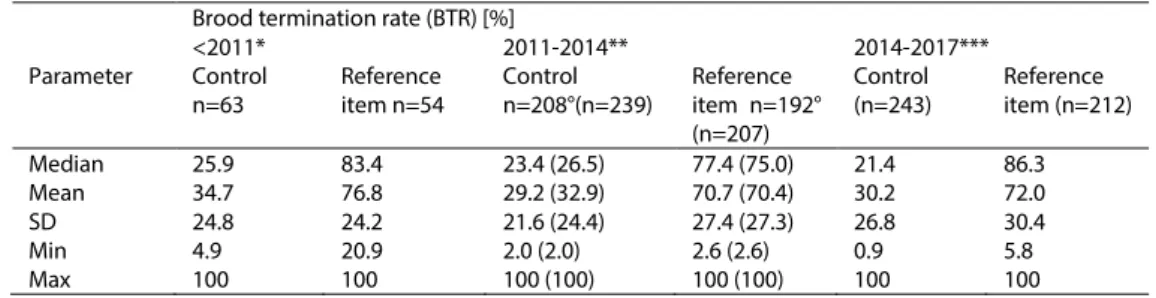
A summary of the current data evaluation on BTRs from studies conducted in Germany is given in
Tab. 2. Additionally, historical data from two evaluations done in the past (Pistorius
et al.
2012,
Becker
et al.
2015) are presented in Tab. 2.
Table 2 Summary of current data evaluation on BTRs including historical data
Parameter
Brood termination rate (BTR) [%]
<2011* 2011-2014** 2014-2017*** Control n=63 Reference item n=54 Control n=208°(n=239) Reference item n=192° (n=207) Control (n=243) Reference item (n=212) Median 25.9 83.4 23.4 (26.5) 77.4 (75.0) 21.4 86.3 Mean 34.7 76.8 29.2 (32.9) 70.7 (70.4) 30.2 72.0 SD 24.8 24.2 21.6 (24.4) 27.4 (27.3) 26.8 30.4 Min 4.9 20.9 2.0 (2.0) 2.6 (2.6) 0.9 5.8 Max 100 100 100 (100) 100 (100) 100 100
n=number of replicates (colonies), *Pistorius et al. 2012, **Becker et al. 2015, ° 8 studies excluded, ***current evaluation
Variability of control BTRs
In the OECD GD 75 there is no validity criterion for brood (eggs) mortality proposed nor requested.
Becker
et al.
(2015) assumed that reliability of the test system is indicated when BTRs are on a low
level. Similar to the evaluation done by Becker
et al.
(2015), the number and distribution of control
replicates with BTRs ≤30% and ≤40% were evaluated and are given in Tab. 3 and Fig. 1. In 55.6% of
the control replicates (studies <2011 and 2011-2014) the BTRs were ≤30%. Current results show
that proportion of replicates with BTRs ≤30% increased to 65.0%. Number of replicates with BTRs
≤40% increased from 70.7% (2011-2014) to 77.0% in the current evaluation. Fig. 1 shows that the
number of replicates with BTRs ≤10% increased and was obtained for 21% of replicates, whereas
the number of replicates with BTRs ≥80% and ≥90% increased to 2.1% and 7.0%, respectively.
Table 3 Proportion of replicates with low and high BTRs including historical valuesProportion of replicates with BTRs % of replicates <2011* 2011-2014** 2014-2017*** Control n=63 Control n=208°(n=239) Control (n=243) ≤30% 55.6 61.5 (55.6) 65.0 ≤40% 68.3 76.9 (70.7) 77.0
n=number of replicates (colonies), *Pistorius et al. 2012, **Becker et al. 2014, ° 8 studies excluded, ***current evaluation
Colony strength at BFD0 in control replicates and its influence on brood development
Colony strength (number of adult bees per colony at BFD0) was compared with BTRs evaluated on the last assessment of brood development. The results are given in Fig. 2.
Figure 2 Colony strength in control [number of adult bees] vs. BTR [%]
Colonies with 5000 to 10000 adult bees and higher, display a slightly higher probability to obtain
lower control BTRs at the end of the study, while in the historical data (Becker
et al.
2015) colonies
with 6,000 to 8,000 bees displayed a higher probability to obtain BTRs ≤ 30% (chi²-test, p=0.019).
Start of the study in the season (day of BFD0)Date of BFD0 was provided for all control replicates. Evaluation was limited to studies conducted
in
Phacelia tanacetifolia
.
No significant correlation was found (y=0.125x + 6.1943, R
2=0.0111). It is assumed that for studies
starting before end of July there is a slightly higher probability to obtain control BTRs≤40% than
for those starting after 1
stof August.
Total number of cells containing pollen per colony at BFD0
Total number of cells containing pollen per colony in control replicates (n=74) at BFD0 was
compared with BTRs evaluated on the last assessment of brood development. No significant
correlation was found: R
2=0.0799 (y=-0.0026x + 35.502).
Weather conditions during exposure phase
For n=180 control replicates maximum air temperature was available and compared with BTRs
evaluated on the last assessment of brood development. No significant correlation was found:
y= 0.5205x + 8.1528, R
2= 0.0212.
For n=92 control replicates sum of precipitation during exposure phase was provided. These
numbers were compared with BTRs at last assessment. No significant correlation was found:
y= - 0.1855x + 28.459, R
2= 0.0526.
Results of semi-field brood studies conducted outside Germany
Since the OECD GD 75 was originally developed and designed for central EU,
Phacelia tanacetifolia
,
Mini-Plus hives and
Apis mellifera carnica
, any implementation and extrapolation of reference data
to other climatic zones, other crops (e.g. buckwheat), other hive sizes and bee species should be
done very carefully and with expert judgement only.
Discussion and conclusion
The main results of the historical data (Becker
et al.,
2015) were confirmed by current evaluation
regarding studies conducted in Germany: no distinct improvement of BTRs was found and a high
variability within the respective studies remains, with still a high proportion of replicates with
control BTR ≥30%. The main driver is still not identified, but most likely driven by the „caging
effect“. It still remains unverified (was not considered in any of the data evaluations) how the
preparation of the hives before initiation of the studies influence their outcome.
Discussion within the ICP-PR working brood group is needed on other existing test methods
assessing bee brood development under field conditions (Oomen
et al.
(1992), OECD GD 75 field
test design). In the colony feeding test design according to Oomen
et al.
(1992) a different route of
exposure and dilution of the residues may occur since the exposure is only via sugar solution and
bees are free-flying, foraging on surrounding crops. In the OECD GD 75 field test design bees may
forage on surrounding crops (realistic exposure in agriculture), but in comparison to the semi-field
test design the worst-case exposure is not given. It is necessary to investigate differences between
these methods and semi-field testing in regards to routes of exposure, residues in brood and
brood mortality to choose the most reliable and adequate testing method assessing potential
effects of PPP on brood development. In addition, interpretation of data and their use for the
evaluation of the risk to honeybees should be reconsidered: in case of high BTRs, the BTRs
obtained in the control may be put in relation to BTRs in reference item treatment. Other
possibility could be prolongation the study over the second brood cycle in case of a strong
„caging effect“. Factors other than brood termination rate may also be more reliable and valuable
endpoints when determining effects on brood development, for example the compensation
index.
The test method (OECD GD 75) is currently the only available possibility to investigate potential
effects of PPP on brood development under semi-field, conditions (realistic worst case) when both,
exposure to treated nectar and pollen are given.
Acknowledgements
Many thanks to Dr. Holger Bargen (Eurofins Agroscience) and to all the contract labs (BioChem
agrar, Eurofins Agroscience, ibacon, RIFCON), and companies (BASF SE, BayerCropscience, Dow
AgroSciences, E. I. duPont de Nemours and Company, FMC and Syngenta) for providing their data
on OECD GD 75 testing.
References
Becker, R.; Lückmann, J.; Pistorius, J. (2015): Effectiveness of method improvements of OECD GD 75 – Evaluation by the ICP-PR Bee Brood Working Group. Julius-Kühn-Archiv, 450, 83-92
Oomen, P. A.; de Ruijter, A.; van der Steen, J. (1992): Method for honeybee brood feeding tests with insect growth-regulating insecticides. – OEPP EPPO Bulletin 22, 613 – 616
Pistorius, J.; Becker, R.; Lückmann, J.; Schur, A.; Barth, M.; Jeker, L.; Schmitzer, S.; von der Ohe, W. (2012): Effectiveness of method improvements to reduce variability of brood termination rate in honey bee brood studies under semi-field conditions. Julius-Kühn-Archiv, 437, 115-120.

![Figure 2 Colony strength in control [number of adult bees] vs. BTR [%]](https://thumb-us.123doks.com/thumbv2/123dok_us/1509496.2702155/4.722.140.573.142.404/figure-colony-strength-control-number-adult-bees-btr.webp)
