Contents lists available atScienceDirect
Information Sciences
journal homepage:www.elsevier.com/locate/insAn interval type-2 fuzzy logic based framework for reputation
management in Peer to Peer e-commerce
Giovanni Acampora
a,∗, Daniyal Alghazzawi
b, Hani Hagras
c, Autilia Vitiello
d Q1aSchool of Science and Technology, Nottingham Trent University, NG8 11NS Nottingham, UK
bFaculty of Computing and Information Technology, King AbdulAziz University, P.O. Box 13154, Jeddah, Saudi Arabia cSchool of Computer Science and Electronic Engineering, University of Essex, CO4 3SQ Colchester, UK
dDepartment of Computer Science, University of Salerno, Fisciano, Salerno 84084, Italy
a r t i c l e
i n f o
Article history: Received 5 May 2015 Revised 19 September 2015 Accepted 11 November 2015 Available online xxx Keywords:Type-2 fuzzy sets E-commerce Trust management
Reputation management systems
a b s t r a c t
During the last two decades, the Internet has changed people’s habits and improved their daily life activities and services. In particular, the emergence of e-commerce provided manufac-tures and vendors with more business opportunities. This allowed customers to benefit from a global, quicker and cheaper shopping environment. However, e-commerce is evolving from a centralised approach, where consumers directly purchase products and services from busi-nesses, to a Peer-to-Peer (P2P) perspective, in which customers buy and sell goods amongst themselves. In P2P scenarios, it is crucial to protect both buyers and sellers (the peers) from being victimised by possible fraud arising from the uncertainties, vagueness and ambiguities that characterise the interactions amongst unknown business entities. For this reason, the so-called reputation models are becoming a key architectural component of any e-commerce portal. These systems are intended to evaluate the basic features of each entity (buyer, seller, goods, etc.) involved in a given trading transaction in order to assess the trust level of the given transaction and minimise fraud. However, in spite of their wide deployment, the rep-utation models need to be enhanced to handle the various sources of uncertainties in order to produce more accurate outputs which will allow to increase the trust and decrease the fraud levels within e-commerce systems. In this paper, we present an interval type-2 fuzzy logic based framework for reputation management in (P2P) e-commerce which is capable of better handling the faced uncertainties. We have carried out various experiments based on eBay®-like transaction datasets which have shown that the proposed type-2 fuzzy logic based
system can provide better performance (in terms of malicious peer detection and exchanged message overhead) when compared to the other well-known and heavily used approaches like the eBay®approach, EigenTrust, PeerTrust as well as the type-1 fuzzy based counterpart
approach.
© 2015 Elsevier Inc. All rights reserved.
1. Introduction
1
The Internet and theWorld Wide Web(WWW) improved the lifestyle of people from all over the World in different aspects of
2
everyday life activities and services. Thanks to mobile network technologies, people can now get access from anywhere and at
3
∗ Corresponding author. Tel.: +44 1158488348; fax: +44 7851919903. Q2
E-mail addresses:[email protected],[email protected](G. Acampora),[email protected](D. Alghazzawi),[email protected]
(H. Hagras),[email protected](A. Vitiello).
http://dx.doi.org/10.1016/j.ins.2015.11.015
0020-0255/© 2015 Elsevier Inc. All rights reserved.
any time to a set of increasing social and economic services enabling a smart and quick exploitation of resources and facilities.
4
One of the most important and fast growing Internet based sectors ise-commercewhich started around 1991 when the Internet
5
was opened to commercial use. Since that date, numerous businesses were launched on websites which employed transaction
6
automation to improve the efficiency and reliability. E-commerce is completely changing the way in which people, customers
7
and/or vendors, perform their negotiations and exchange goods and services. E-commerce can be seen as defining a new
“econ-8
omy” by providing more business opportunities to manufactures and companies. In addition, e-commerce allows customers to
9
benefit from a quicker and cheaper shopping on the Internet.
10
E-commerce started by following theBusiness to Consumer(B2C) paradigm[1]where consumers purchase products and
11
services directly from businesses. This paradigm represents a sort of marketplace for the worldwide exposure of products. In this
12
centralised paradigm, customers are protected from eventual frauds since the quality of the sale service depends only upon the
13
reputationof the seller company that acts as an authority to mediate transaction flows.
14
The recent years are witnessing the evolution of a new e-commerce paradigm calledPeer-to-Peer (P2P)orConsumer to
Con-15
sumer (C2C)[1]in which customers buy and sell among themselves without using a centralised e-commerce authority. The
16
extensive development of this new business paradigm is due to the reduction in costs. Indeed, sellers can post their goods over
17
the Internet cheaply compared to the high rent space in a store and, as a consequence, they can sell with lower prices by
produc-18
ing a financial gain for buyers. However, in such a new business context, it is crucial to protect both buyers and sellers (peers)
19
from being victimised by possible frauds due to the uncertainties, vagueness and ambiguities which characterise the interactions
20
amongst unknown business entities. For this reason, the so-called reputation models aimed at assessing the trust levels of peers
21
during trade transactions are becoming a key architectural component of any e-commerce portal.
22
The main goal of reputation models is to compute and associate a reputation value to each peer by using the
community-23
based opinions in order to allow buyers/sellers to undertake more reliable transactions. Three core components are used to build
24
any reputation system: (1) the trust value that each peer has for another peer involved in at least one transaction with it; (2) the
25
distribution method that propagates these values in the P2P network; (3) the reputation score that each peer aggregates from the
26
trust values gathered from all the peers interacting with it[2]. The quality of a reputation-based P2P trust management system is
27
depending on its capability in performing an accurate and effective identification of malicious peers, and in efficiently reducing
28
the bandwidth usage of the P2P network.
29
Due to the importance of their role in enabling safety in P2P e-commerce paradigm, there has been a fervent development
30
of such systems. In particular, after some first attempts to model reputation concepts as crisp values, recently, the uncertain and
31
imprecise nature of commercial transactions opened the way for promising applications of fuzzy logic theory to this important
32
research area (seeSection 2). Nevertheless, the precise identification of malicious peers and the consequent improvement of
33
safety in trade transactions is far from being completely solved.
34
In this paper, we aim at bridging this gap by introducing a collection of e-commerce trustworthiness metrics starting from
35
which to design an innovative reputation model and its implementation based on the type-2 fuzzy sets theory[3–5]. Different
36
from conventional Mamdani or TSK type-1 fuzzy systems, type-2 fuzzy sets provide additional design degrees of freedom, which
37
can achieve better performance in domains where lots of uncertainties are present[6], such as P2P e-commerce environments.
38
Indeed, thanks to its capability to handle high level of uncertainty, the proposed framework is capable of performing a deep and
39
precise analysis of all the different parameters involved in a given trading transaction and assessing the right reputation value
40
for each peer belonging to a P2P e-commerce system.
41
We have carried out various experiments based on eBay®-like transaction datasets to compare, in an empirical and statistical
42
way, the proposed system with other well-known and widely used approaches, such as the eBay®paradigm (used in the most
43
known e-market platform eBay®), EigenTrust and PeerTrust (which are two of the most cited reputation management systems in
44
P2P environments), as well as, a type-1 fuzzy based approach. As shown by these comparisons, the proposed type-2 fuzzy logic
45
based system yields better performance than state-of-the-art approaches in terms of malicious peer detection and exchanged
46
message overhead.
47
The rest of the paper is organised as follows:Section 2reports a detailed description of the state-of-the-art about the
repu-48
tation management systems;Section 3will present the background knowledge including an overview on the reputation
man-49
agement issues in P2P e-commerce systems and a brief description of type-2 FLSs;Section 4presents the proposed interval
50
type-2 fuzzy logic based framework for reputation management;Section 5presents the experiments and results whileSection 6
51
presents the conclusions and future work.
52
2. Related works
53
Reputation management systems play a crucial role in allowing the existence and efficiency of e-commerce thanks to their
54
capability to defend sellers and customers from on-line frauds. In literature, several paradigms have been proposed with the goal
55
to provide on-line community with even more efficient reputation management systems. The eBay®reputation-based P2P trust
56
management system is the most popular trust-management system and it is a based a user feedback approach[7]that enables
57
eBay®users to evaluate the reputation value of their trading peers, and store these values to a centralised reputation database.
58
EigenTrust[8]is one of the most widely accepted paradigms for reputation management in distributed environments.
Eigen-59
Trust paradigm computes the trust score by summing the satisfactions of the transaction with each peer and then normalises it
60
over all its peers[8]. Then, it calculates the reputation value of a peer by aggregating the trust values assigned to it by other peers,
61
weighted by the reputations of the assigning peers. The trust scores are distributed in the P2P network by using a Distributed
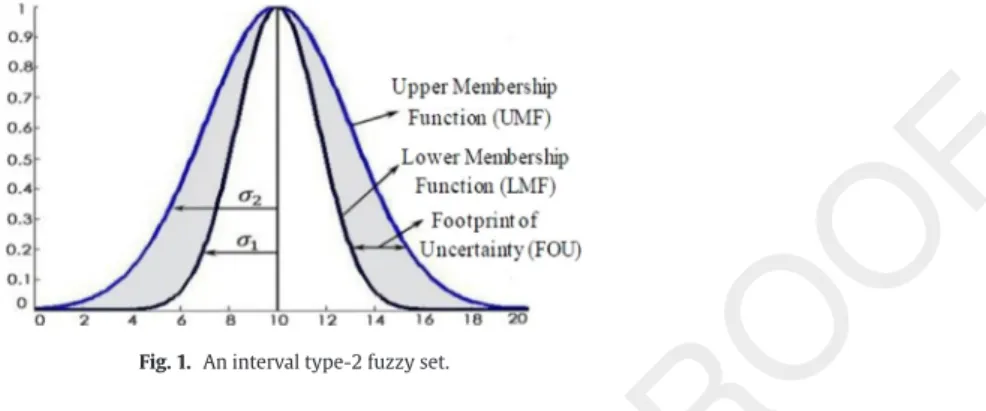
Fig. 1. An interval type-2 fuzzy set.
Hash Table (DHT)-overlay network[9]. In[10], the PeerTrust paradigm was presented to overcome the drawbacks of EigenTrust in
63
controlling the man-in-the-middle attack[11]as it uses overlay for trust propagation and public-key infrastructure for securing
64
remote scores. In addition, the PeerTrust was the first to introduce the concept of feedback creditability to aggregate the global
65
reputation.
66
The above mentioned paradigms have mainly employed crisp logic which cannot easily handle the different uncertainties,
67
vagueness and ambiguities that characterise the interactions occurring amongst unknown business entities in P2P systems
68
(for more details seeSection 3.2). Type-1 fuzzy logic was employed to develop a first fuzzy based reputation system, namely
69
FuzzyTrust[12]. FuzzyTrust works by performing two inference steps: (1) trust score calculation where each peer performs a
70
fuzzy inference on local parameters to generate trust scores towards the other peers and (2) reputation aggregation where each
71
peer performs a weighted aggregation of the trust scores received from all peers to produce a reputation value. The
propaga-72
tion of trust scores is executed by using a Distributed Hash Table (DHT)-overlay network with an architecture similar to that of
73
Chord[13]. As shown by a comparison in terms of malicious peer detection, FuzzyTrust outperforms EigenTrust in malicious peer
74
identification, albeit slightly. In spite of good results provided by FuzzyTrust, it cannot easily handle and model the
uncertain-75
ties present in P2P e-commerce as they employ crisp and precise type-1 fuzzy sets[14](i.e. their Membership Functions (MFs)
76
are supposedly known perfectly) which does not allow for any uncertainties about membership values. As better described in
77
the next section, interval type-2 fuzzy sets[15,16]are characterised by fuzzy membership functions which provide additional
78
degrees of freedom that make it possible to directly model and handle the strong uncertainties present in P2P e-commerce.
79
Starting from this consideration, our proposal is aimed at improving the performance of the state-of-the-art reputation
sys-80
tems in e-commerce context, by exploiting the recognised superiority of type-2 FS in modelling knowledge and processing
81
uncertain information. In the next section, we provide more details about type-2 fuzzy logic and reputation management issues
82
in order to show how the type-2 fuzzy logic can better face reputation management issues with respect to the state-of-the-art
83
approaches.
84
3. Background knowledge
85
This section is devoted to provide a background knowledge of the concepts related to interval type-2 fuzzy logic systems,
86
reputation management in P2P e-commerce and how type-2 fuzzy logic can face reputation management issues.
87
3.1. Brief overview of the interval type-2 fuzzy logic systems
88
Fuzzy set theory was first introduced by Zadeh[17]and has been accepted over years as a methodology for building
sys-89
tems that can deliver satisfactory performance in the face of uncertainty and imprecision[18,19]. However, the same Zadeh[15],
90
recognised that Type-1 Fuzzy Sets (T1 FSs) are able to partially handle the concept of uncertainty, whereas real-world
applica-91
tions are often characterised by multiple sources of strong uncertainty, ambiguity and vagueness[14]. As a consequence, recent
92
years have shown a significant attention in research toward more suitable forms of fuzzy logic[18], such as the Interval Type-2
93
Fuzzy Sets (IT2 FSs) shown inFig. 1. IT2 FSs are considered to be potentially more appropriate in modelling uncertainty, thanks
94
to their capability of providing extra degrees of freedom[18]. This capability is due to the exploitation of a new type offuzzy
95
membership functionwhere the membership value, for each element of the universe of the discourse, is a type-1 fuzzy set and
96
not a crisp value. The use of IT2 FSs to represent the inputs and/or outputs of a Fuzzy Logic System (FLS) leads to the so-called
97
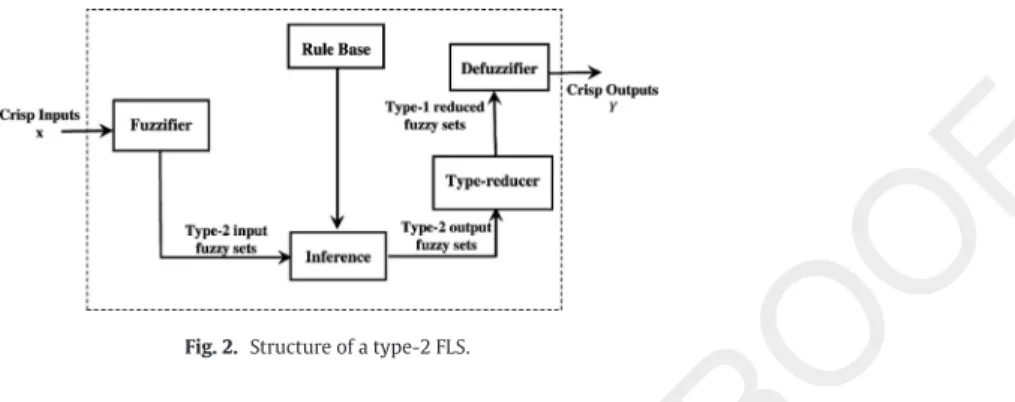
Interval Type-2 Fuzzy Logic Systems (IT2FLSs) (shown inFig. 2).
98
In detail, an IT2 FLS works as follows[14,20]: the crisp inputs are first fuzzified into input type-2 fuzzy sets; singleton
fuzzi-99
fication is usually used in interval type-2 FLS applications due to its simplicity and suitability for embedded processors and real
100
time applications. The input type-2 fuzzy sets then activate the inference engine and the rule base to produce output type-2
101
fuzzy sets. The type-2 FLS rule base remains the same as for the type-1 FLS but its Membership Functions (MFs) are represented
102
by interval type-2 fuzzy sets instead of type-1 fuzzy sets. The inference engine combines the fired rules and gives a mapping
103
from input type-2 fuzzy sets to output type-2 fuzzy sets. The type-2 fuzzy output sets of the inference engine are then processed
104
by the type-reducer which leads to type-1 fuzzy sets called the type-reduced sets. There are different types of type-reduction
Fig. 2. Structure of a type-2 FLS.
methods. In this paper we use the centre of sets type-reduction as it has a reasonable computational complexity that lies between
106
the computationally expensive centroid type-reduction and the simple height and modified height type-reductions which have
107
problems when only one rule fires[14,20]. After the type-reduction process, the type-reduced sets are defuzzified (by taking the
108
average of the type-reduced set) so as to obtain crisp outputs. More information regarding the interval type-2 FLS can be found
109
in[14].
110
Due to their capability to handle with high level of uncertainty, IT2 FLSs have been successfully implemented in many real
111
world applications, including intelligent control[21], time series predictions[22,23], pattern recognition[24], image processing
112
[25], medical diagnosis[26], collision avoidance of autonomous vehicles[27]and many others. In the next section, we show how
113
benefits of the IT2 FLSs can be exploited to address reputation management issues in P2P e-commerce.
114
3.2. Reputation management issues in P2P e-commerce systems
115
In Peer-to-Peer (P2P) systems, peers are both consumers and providers of services. Given that there is no authority to dictate
116
the rules for peer interaction and that interactions often occur among previously unknown parties, peers might maliciously
117
behave and harm others in the system[28]. Therefore, one of the fundamental challenges for the development of open and
118
decentralised P2P systems, is the ability to manage risks that may arise when interacting and collaborating with previously
119
unknown and potentially malicious peers. This challenge, is even more felt in P2P e-commerce systems, where the interaction
120
between unknown parties involves business interests, and, as a consequence of a malicious behaviour, there may be an economic
121
loss or even a fraud. As an example, a malicious buyer may not provide a payment for a received good, whereas, a malicious seller
122
may not send goods which has been paid for.
123
As proved in[29–31], in P2P systems, peers with the capability of reasoning abouttrustcan potentially mitigate the risks
124
caused by malicious behaviours. Hence, the so-calledtrust management systemsplay a crucial role in enabling trading with
125
untrustworthy peers in e-commerce scenarios[32]. The conventional trust management systems[33]are based on access control
126
credentials, i.e., they foresee that peers use credential verification to enable access control to restricted services. Our research
127
work focuses onreputation-based trust management systemswhere service requesters select the relative providers based on
128
their reputation values. This choice is due to the wide applicability of the reputation-based trust management systems to P2P
129
environment where the credential based conventional methods cannot be used because of their dependence to a centralised
130
credential authority[34]. In literature, various definitions have been given for the related but distinct concepts of reputation and
131
trust. One definition of “trust” was cited in[35], where it is considered as“a subjective expectation a partner has about another
132
future behaviour based on the history of their encounters”. This definition treats the trust as a subjective property computed based
133
on the two partners involved in a dyadic encounter. In e-commerce, the partners are peers and an encounter is a trade transaction
134
between them. As for the reputation concept, we consider the definition given by theConcise Oxford English Dictionary[36],
135
which agrees with the social network researcher’s point of view[37], which states:“the reputation is what is generally said or
136
believed about a person’s or thing’s character or standing”. Therefore, in our context, the reputation is the collected and processed
137
information about one former peer’s behaviour, as experienced by all the other ones within the system. Starting from these trust
138
and reputation definitions, it is easy to note that the main tasks of a reputation-based trust management system for a P2P
e-139
commerce environment are enabling peers to rate each other with a trust value, after the completion of a trade transaction and
140
to aggregate these values for a given partner to derive its relative global reputation score. In this scenario, where a peer gives an
141
opinion towards the other ones, another important concept emerges calledcredibilitywhich can be defined as“the expectation
142
that a rating peer has the capability and the willingness to provide a correct opinion towards the other ones”[38].
143
As a result of this discussion, P2P systems for e-commerce need to deal with high levels of uncertainties, vagueness and
144
ambiguities which include:
145
• absence of an authority to dictate the rules for peer interaction and to avoid peers maliciously behave and harm others in
146
the system;
147
• trading transactions occur among unknown parties potentially acting in a malicious way;
148
• use of the reputation value as a credibility score (examples of reputation systems which follow this strategy are EigenTrust
149
[8]and FuzzyTrust[12]). This strategy is not sufficiently accurate, since some peers could behave well sending high quality
goods (in the case they are sellers) or quick payment (in the case they are buyers) and at the same time, provide inaccurate
151
or false opinions;
152
• supply of good trading services by a peer for a while in order to build a good reputation. Then, suddenly, the peer starts
153
cheating buyers or sellers by exploiting that reputation.
154
Due to lots of uncertainties above mentioned, type-2 fuzzy logic results to be the most suitable methodology to efficiently
155
deal with trust, reputation and credibility concepts. For this reason, we propose a new reputation management system based on
156
IT2 FLSs. Indeed, as described above, IT2 FSs provide additional degrees of freedom which can handle the high level of
uncer-157
tainties present in P2P e-commerce environments and provide a more suitable representation of peers’ dynamic characteristics.
158
As shown in the experiment section, the exploitation of IT2 FLSs to face reputation management system issues will result in
159
better performance (in terms of malicious peer detection and exchanged message overhead) when compared to the fuzzy and
160
non fuzzy counterparts. Before giving all details about experiments, in the next section, the proposed system is presented in all
161
its components.
162
4. The proposed type-2 fuzzy logic based reputation management framework for P2P e-commerce
163
This section introduces a type-2 fuzzy logic based reputation management framework which uses a new reputation model
164
defining a set of formal metrics for evaluating the concepts of reputation, trust and credibility in uncertain environments. The
165
framework is arranged in a hierarchical structure of IT2 FLSs. All membership functions and rules of the designed IT2 FLSs are
166
based on subjective opinions from different reputation experts who casted their personal beliefs about trustworthiness in
e-167
commerce. This design strategy is particularly suitable in P2P e-commerce environments where the methods for learning fuzzy
168
membership functions and rules (e.g. genetic algorithms, particle swarm optimisation and so on) are hard to be applied due to
169
the challenge in assembling the training data sets. Precisely, the strong dynamic features characterising P2P e-commerce such
170
as (1) the dynamic behaviour of peers in performing trading transactions, and (2) the fast changes occurring in a P2P network in
171
terms of the number of the peers and relationships among them, make it hard to identify a training dataset which is sufficiently
172
informative and not tied to particular and limited situations. As a consequence, the exploitation of these misleading datasets
173
could lead the conventional learning methods to produce unrealistic rules which violate the e-commerce rules. As an example,
174
automatic learning approaches based on static datasets might not be able to identify evolving malicious peer behaviours such
175
as the oscillatory behaviours consisting in building a good reputation by making a series of transactions involving cheap goods
176
and trying to make a profit through expensive fraudulent transactions. Our framework bridges this gap by introducing a new
177
reputation model taking into account temporal information and its evaluation by means of a type-2 architecture.
178
Hereafter, firstly, we present the new model defining a set of formal metrics for evaluating the concepts of reputation, trust
179
and credibility in uncertain environments and, then, we describe the architecture of the proposed type-2 fuzzy logic based
180
reputation management system and all its components.
181
4.1. New model for reputation management in P2P e-commerce
182
This section introduces an innovative model for reputation management in P2P e-commerce environments. Inspired by the
183
general P2P reputation model presented in[28]and by eBay®vision on feedback concept1, the proposed model is aimed at 184
providing trust and reputation computation with a set of well-defined metrics and dynamic features that will enable the next
185
generation of reputation management frameworks to achieve improved performance in terms of accuracy of malicious peer
186
identification. Due these innovative metrics, the proposed model provides reputation management frameworks with adequate
187
reaction functionalities to address quick changes in peers’ behaviour avoiding malicious situations where peer could provide
188
good trading services for a while, building a good reputation, and then suddenly start cheating buyers or sellers by exploiting
189
that reputation. As a consequence, this approach will enable a more efficient identification of very sly malicious peers such as
190
the hypocritical and oscillatory ones (seeSection 5.2).
191
In order to achieve these goals, the proposed model for reputation management in P2P e-commerce focuses on three main
192
principles:
193
1. trust and reputation evolve over time being sensitive to new experiences;
194
2. the sensitivity to new experiences should not be dependent on old ones;
195
3. the past experiences should not be ignored.
196
The first principle means that trust and reputation do not decay over time if there are no new experiences, i.e., trade
transac-197
tions. Hence, positive experiences may lead to an increase of trust and reputation value, while negative ones may decrease such
198
values.
199
The sensitivity of trust and reputation values to new experiences is essential to capture the changes in peers behaviour.
200
Indeed, even if a peer has shown a trustworthy behaviour for a period of time, it should still be possible to detect and decrease its
201
reputation if it suddenly starts exhibiting malicious behaviour[28]. In order to enforce this principle, it is necessary to provide
202
the independence of this sensitivity to new experiences from the old ones (second principle). In our model, this leads to consider
203
three kinds of trust denoted asTransaction Trust,Historical TrustandOverall Trust(seeTable 1). In order to keep the independence
204
Table 1
Definitions of different kinds of the trust. Trust typology Definition
Transaction Trust The trust that a peer has towards another one by considering only the newest transaction that occurred between them. Historical Trust The trust that a peer has towards another one before the last transaction between them.
Overall Trust The trust computed by a peer towards another one by considering all transactions that occurred between them.
Table 2
Metrics influencing transaction trust.
Metric Definition
Metrics used by a buyer
Goods Quality The quality assessed by the buyer about the received goods. Delivery Time The amount of time required to receive goods.
Seller Communication Quality The quality assessed by the buyer about the seller’s readiness and availability at communicating. Shipping Service Reliability The objective reliability provided through the shipping service used by the seller.
Metrics used by a seller
Payment Time The amount of the time required to receive buyer’s payment
Payment Method Reliability The objective reliability provided by the payment method used by the buyer.
Buyer Communication Quality The quality assessed by the seller about the buyer’s readiness and availability at communicating.
Table 3
Factors influencing the overall trust.
Metric Definition
Historical Trust Date It represents the date when the historical trust value was computed. This factor allows to discriminate between new and old experiences and to give more relevance to the transaction trust.
Last Transaction Amount
It represents the price of the goods involved in the last transaction between two peers. This factor supports the detection of oscillatory behaviours (i.e. behaviours characterised by a lot of honest and cheap transactions and a few malicious and expensive ones).
of new experiences from old ones, the proposed model computes the transaction trust by only considering metrics that do not
205
depend upon trading transactions occurred in the past. In particular, the used metrics are inspired from eBay®vision and differs
206
according to the role of peers (sellers or buyers). The complete list is reported inTable 2.
207
However, even if new experiences are considered more important than the old ones since they represent the current
be-208
haviour of a peer, past experiences cannot be ignored at all (third principle). Indeed, old experiences can be used to re-establish
209
peer trustworthiness after recovering from an intrusion attack which affected its reputation[28]. Moreover, the consideration
210
of past experiences is relevant to detect possible peer oscillatory behaviours consisting in building a good reputation by making
211
a series of transactions involving cheap goods and, consecutively, trying to make a profit through expensive fraudulent
transac-212
tions. Due to the relevance of past experiences, as aforementioned, the proposed model considers the so-called historical trust.
213
In detail, the proposed model expects a peer to compute the overall trust value towards another one by aggregating historical
214
and transaction trusts. This aggregation takes into account the factors reported inTable 3.
215
Apart from discussing the trust concepts, the proposed model defines also which factors are involved in the reputation
com-216
putation. In detail, a peer computes its own reputation by means of the aggregation of overall trusts received by other peers
217
involved in transactions with it. For sake of simplicity, from now on, we will denote astarget peer, the one which takes care of
218
computing its own reputation, and ascommentator peer, the one which sends its opinion (overall trust value) over a target peer
219
which was involved in a transaction with it2. Like for trust concept, the computation of the reputation considers the new expe-220
riences more important than old ones. As a consequence, overall trusts received in more recent period have more weight in the
221
reputation aggregation step. Moreover, since multiple interactions between peers allow a more accurate evaluation, also overall
222
trusts computed on a greater number of transactions have more weight in the aggregation step. Finally, in order to support the
223
detection of oscillatory behaviours, the reputation aggregation is influenced by average amount of goods involved in the
trans-224
actions between the target peer and commentator ones. However, the factor which mostly affects the reputation aggregation
225
step is the credibility of commentator peers. By concluding, in the reputation aggregation step, each weight associated with a
226
received overall trust is influenced by the metrics reported inTable 4.
227
As described in the next section, the defined model for reputation management in e-commerce scenarios has been
imple-228
mented in a reputation management system based on a type-2 fuzzy sets-based architecture. In particular, we focus on this
229
2It is important to point out that such distinction is made only for the ease of exposition, since a peer may act simultaneously both as target and as
Table 4
Factors influencing weights associated to the overall trust.
Q3
Metric Definition
Credibility The willingness of the commentator peer to provide a correct opinion towards the target one. Opinion Date The date when the commentator user computed the overall trust value for the target one.
Opinion Scope The number of transactions on which the commentator user computed the overall trust value for the target one.
Average Amount The average price of goods involved in the transactions, on which the commentator user computed the overall trust value for the target one.
Fig. 3. The architecture of the proposed reputation management system.
emergent fuzzy theory, since type-2 fuzzy sets may succeed to model the uncertain and imprecise nature of trust and reputation
230
concepts by imitating human reasoning more efficiently than type-1 fuzzy sets.
231
4.2. The interval type-2 fuzzy architecture for reputation management
232
The proposed interval type-2 fuzzy system for reputation management works by using a hierarchical and incremental
ap-233
proach where the values related to trust concepts, defined by the aforementioned model, are computed in order to aggregate a
234
final reputation value for each peer involved in trading transactions. In particular, a transaction trust value is computed after a
235
trading transaction is completed between two peersP1 andP2, to enableP1 to assess how good was the behaviour ofP2 in that
236
transaction, and vice versa.P1, then computes an overall trust,T12, to assess how good was the behaviour ofP2 in all trading
237
transactions made withP2. In the same wayP2 computes an overall trust value,T21, to assess how good was the behaviour of
238
P1 in past transactions made withP2. Finally,P1 sends the valueT12toP2 in order to enableP2 to aggregate this value with
239
other overall trust values coming from other peers to finally compute its reputation. By the same way,P2 sendsT21toP1. In
240
order to make the aggregation step more reliable, our architecture uses a novel credibility concept to assure the authenticity
241
of information exchanged by peers. In order to perform all the aforementioned computations, each peer is equipped with the
242
type-2 fuzzy architecture shown inFig. 3which is composed of the following modules:Trust Computation Module,Reputation
243
Aggregation Module,Credibility Computation ModuleandTrusted E-commerce Database.
244
TheTrust Computation Subsystemis used by a peer (acting as commentator peer) to evaluate the level of trustiness over
245
another one (in this case acting as target peer) with whom it has just closed a trade transaction. It is implemented through a
246
hierarchical Interval Type-2 Fuzzy Logic Systems (IT2FLSs) which computes, at the low level, the transaction trust value and, at
247
the top level, the overall trust value over the peer with whom it has just closed the transaction.
248
TheReputation Aggregation Subsystemis used by a target peer to compute its own reputation (representing the final output of
249
the proposed type-2 fuzzy set based reputation management framework). In order to compute such value, a target peer performs
250
a weighted aggregation of overall trust values received by peers which have been involved in at least a transaction with it. The
251
weights used in the computation are calculated through an IT2 FLS. Once computed a real value representing own reputation,
252
the target peer is classified malicious if this value is labelled with the linguistic termLowof the fuzzy variableReputation(see
253
Fig. 5(g)).
254
TheCredibility Computation Moduleis used by a target peer to update the credibility value of all its commentator peers (peers
255
which have been involved in at least a transaction with it and have sent it their overall trust values over it). This updating is always
256
performed after a transaction between the target peer and any commentator peer. The credibility value for a commentator peer is
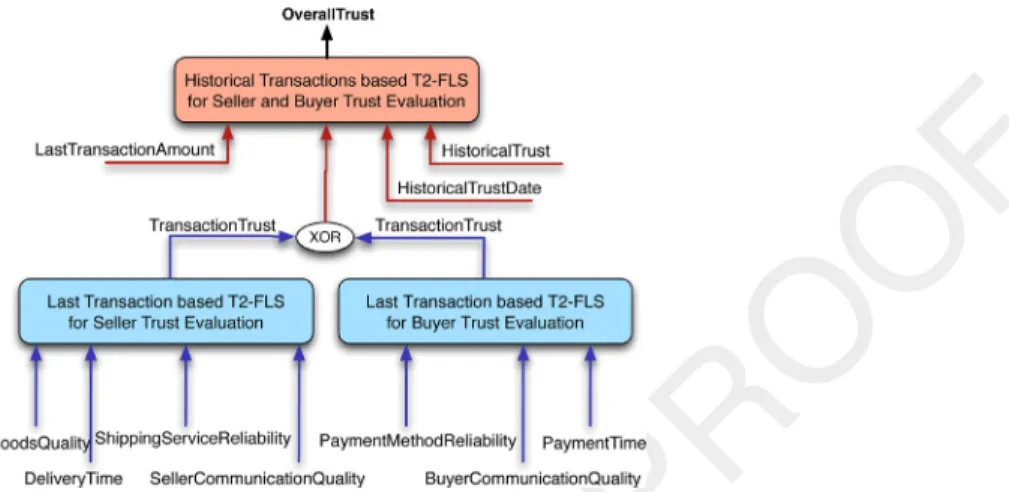
Fig. 4.The hierarchical type-2 fuzzy system composing the trust computation subsystem.
based on the reputation value of the target peer just computed. In detail, the credibility value of a commentator peer is increased
258
if its opinion (overall trust value) over the target peer is near to the new computed reputation for the target peer, decreased vice
259
versa.
260
TheTrusted E-commerce Databaseis used to locally store a set of data necessary for the computations performed by the other
261
modules. In short, these data are closed in four tables:buyer transaction tablecontains data related to transactions where the
262
peer acts as buyer;seller transaction tablecontains data related to transactions where the peer acts as seller;assigned trust table
263
contains data related to overall trust values computed over the other peers;received trust valuecontains data related to overall
264
trust values received by the other peers.
265
Hereafter, more details about the architecture modules and the interactions among them are given.
266
4.2.1. Trust Computation Subsystem
267
The Trust Computation Subsystem is used by a peer (acting as commentator peer) to evaluate the level of trustiness over
268
another one (in this case acting as target peer) with whom it has just closed a trade transaction. Such subsystem is implemented
269
through a hierarchical IT2FLSs which computes the trust values according to the above mentioned e-commerce trust model. The
270
hierarchical IT2FLSs is composed of two levels (seeFig. 4): the lower one is used to compute the trust value over the target peer
271
by considering only information related to the last transaction occurred with it (the transaction trust), whereas, the top one is
272
used to refine the trust value computed by the lower layer by using a set of information related to all transactions made with the
273
target peer (the overall trust).
274
The lower level uses different information, depending on whether the commentator peer is evaluating a target peer that has
275
acted as seller or buyer in the last transaction. According to the proposed e-commerce reputation model, when the target peer
276
acts as seller, the lower level IT2FLS will have four input variables, namedGoods Quality,Deliverity Time,Seller Communication
277
QualityandShipping Service Reliabilityand an output one namedTransaction Trust. The input variables reflect the metrics used by
278
a buyer reported in theTable 2.
279
The rule base3of the lower IT2FLS for a seller peer is composed from 108 rules which were inspired by the paradigm where 280
the higher the quality of goods and the shorter the delivery time and the higher the seller communication quality and the higher
281
the shipping service reliability, the higher is the value of the transaction trust. When the target peer acts as buyer in the last
282
transaction, the lower layer IT2FLS will have different inputs (reflecting the metrics used by a seller reported in theTable 2)
283
which arePayment Time,Buyer Communication QualityandPayment Method Reliability. The rule base4of the lower IT2FLS for a 284
buyer peer is composed of 36 rules which were inspired by the paradigm where the higher the buyer communication quality
285
and the higher the payment method reliability and the shorter the payment time, the higher is the value of the transaction trust.
286
The top level IT2FLS of the hierarchical type-2 FLS has four input variables namedLast Transaction Amount,Transaction Trust,
287
Historical TrustandHistorical Trust Date, and one output variable representing the overall trust denoted by the variableOverall
288
Trust. In detail, the variablesLast Transaction AmountandHistorical Trust Datereflects the metrics reported in theTable 3, whereas,
289
the variableTransaction Trustrepresents the output of the lower level of the designed hierarchical type-2 fuzzy system. Finally,
290
the variableHistorical Trustrepresents the trust value calculated by the commentator peer over the target one before the last
291
transaction occurred. The rule base5of the top level IT2FLC is composed from 225 rules which were inspired by the paradigms: 292
(1) the higher the amount of the last transaction, the higher is the importance of the transaction trust value; (2) the newer the
293
date of the historical trust and the higher is the importance of the historical trust value.
294
3http://old.di.unisa.it/dottorandi/avitiello/research/Type-2FuzzyControllerXBuyerTrust.xlsx. 4http://old.di.unisa.it/dottorandi/avitiello/research/Type-2FuzzyControllerXSellerTrust.xlsx. 5http://old.di.unisa.it/dottorandi/avitiello/research/Type-2FuzzyControllerXTopTrust.xlsx.
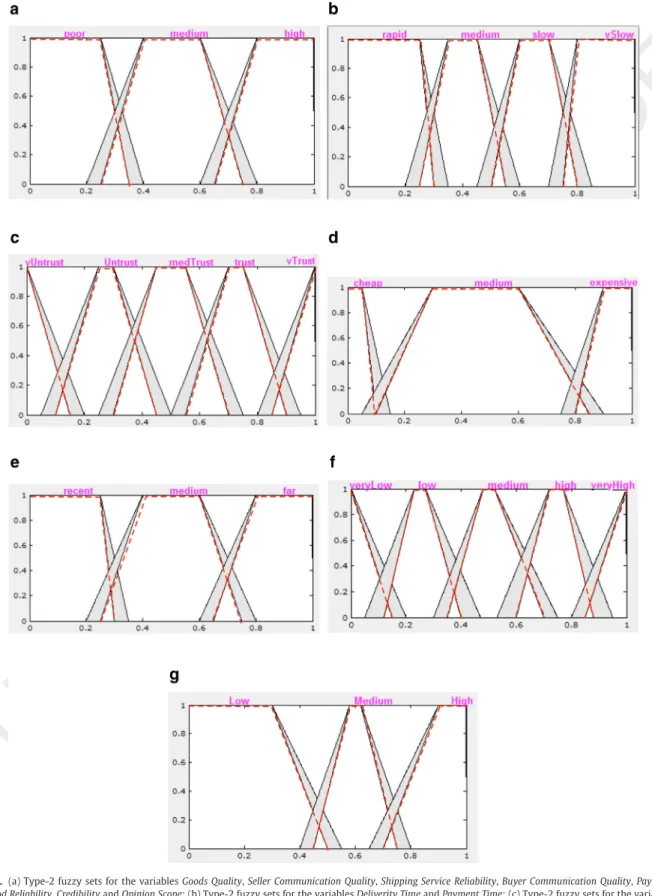
Fig. 5.(a) Type-2 fuzzy sets for the variablesGoods Quality,Seller Communication Quality,Shipping Service Reliability,Buyer Communication Quality,Payment Method Reliability,CredibilityandOpinion Scope; (b) Type-2 fuzzy sets for the variablesDeliverity TimeandPayment Time; (c) Type-2 fuzzy sets for the variables
Transaction Trust,Historical TrustandOverall Trust; (d) Type-2 fuzzy sets for the variablesLast Transaction AmountandAverage Amount; (e) Type-2 fuzzy sets for the variablesHistorical Trust DateandOpinion Date; (f) Type-2 fuzzy sets for the variableWeight; (g) Fuzzy sets for the linguistic variableReputation. The dotted lines represent the shape of type-1 fuzzy sets used in experimental results section. Seehttp://old.di.unisa.it/dottorandi/avitiello/research/Type-2FuzzyVariables.xlsx
Fig. 6.The IT2FLS aimed at computing the weight for each commentator peer.
All of type-2 FS memberships of the designed hierarchical IT2 FLS are displayed inFig. 5. All of type-2 FS memberships
295
and the related FOUs have been designed by means of a strong interaction with some experts in the field of security in P2P
296
systems which allowed us to perfectly tune our reputation system in order to strongly overcome the performance of current
297
systems. In particular, all of type-2 FS memberships have been modelled by means of trapezoidal fuzzy sets because this shape
298
is more suitable for representing the expert knowledge provided in terms of a collection of intervals. As for inference engine
299
details, all the IT2FLSs used in this paper useminoperator for implication,min–maxoperator for composition, the centre of
300
sets type-reduction[39]and the defuzzification is obtained by taking the average of the type-reduced sets produced from
301
type-reduction[40].
302
4.2.2. Reputation Aggregation Subsystem
303
The Reputation Aggregation Subsystem is used by a peer to compute its own reputation value which is a real number within
304
the interval [0,1], where 1 represents the highest reputation value. In order to compute such value, a target peer considers the
305
overall trust values provided by all the peers which have been involved in a transaction with it. In particular, this subsystem is
306
composed of three components where the first component is devoted to performing a weighted aggregation of received trust
307
values, the second component is aimed at computing a weight for each received trust value and the third component is
intro-308
duced to support a semantic interpretation of the computed reputation value. The first module calculates the reputation valueR
309
through the following formula:
310 R= N i=1trusti∗wi N i=1wi (1) whereNis the number of commentator peers which have completed a transaction with the target peer, both with the role
311
of buyer and seller;trustiis the overall trust value computed over the target peer by the commentator onei; and finally,wi
312
is the weight representing how much the target peer weights the overall trust valuetrustiprovided by theith commentator
313
peer. In order to compute the valueswi,a target peer uses the second module of the reputation aggregation subsystem which
314
is an IT2FLS (shown inFig. 6). According to the metrics reported in theTable 4, this IT2FLS has four input variables, which are
315
Credibility,Opinion Date,Opinion Scope,Average Amount, and returns the output weight (represented by the variableWeight).
316
Fig. 5(a) shows type-2 fuzzy sets for the variablesCredibilityandOpinion Scope, whereas,Figs. 5(d) and (e) show, respectively,
317
type-2 fuzzy sets for the variableAverage Amountand the variableOpinion Date. The interval type-2 fuzzy sets representing the
318
output variableWeightare displayed inFig. 5(f). In this IT2FLS, the rule base6is composed of 81 rules inspired from paradigm 319
where the higher the credibility and the newer the date and the higher the number of involved transactions and the higher the
320
average amount, the higher is the value of the weight.
321
Once a reputation value is computed, characterising what is a good/bad reputation is non trivial[41]. The third component of
322
the aggregation reputation subsystem is aimed at accomplishing this task through the exploitation of a linguistic variable, named
323
Reputation(seeFig. 5(g)), defined by expert knowledge. In detail, the third component of the aggregation reputation subsystem
324
is devoted to fuzzify the real reputation value computed by the first component of the same subsystem in order to determine
325
the badness of peer behaviours. In particular, the proposed system considers a peer as malicious when it is labelled with theLow
326
linguistic term.
327
4.2.3. Credibility Computation Subsystem
328
The Credibility Computation Subsystem is used by a target peer to update the credibility value of all the other peers which
329
have been involved in at least a transaction with it. Many reputation systems (e.g. EigenTrust[8], FuzzyTrust[12]) use the
repu-330
tation value as a credibility one. However, this strategy is not sufficiently accurate, since some peers could behave well sending
331
high quality goods, in the case they are sellers, or quick payment, in the case they are buyers, and, at the same time, provide
332
inaccurate or false opinions. Therefore, we consider each peer characterised by reputation and credibility values as concepts
333
disjointed between them.
334
In the proposed system, the target peer performs the updating of credibility of commentator peers after each transaction, by
335
considering its new reputation value according to the approach presented in[42]. Initially, each peer which joins the network is
336
assigned a neutral credibility value of 0.5 (the range of credibility value is [0, 1]). Then, such value of credibility is increased or
337
decreased depending on the accuracy of its own opinion (overall trust value) over a target peer. More precisely, the credibility
338
value is increased if the degree of closeness between the given opinion and the new computed reputation for the target peer lies
339
within a tolerance value
, otherwise it is decreased. Formally, this subsystem computes theCredibility Value(CR) as shown in
340
Eq. (2):
341
CR=
CRold+Inc·e−2·error·1+(10·(CR1
old−0,5))2 if
|
error|
≤CRold−Dec·CR4old if
|
error|
>(2) whereCRoldis the current credibility value of the peer,erroris the difference between the given opinion and the new computed
342
reputation,
is the tolerance value,Incis the maximal possible increment andDecis the maximal possible decrement. In
par-343
ticular, in the proposed system, we setIncto 0.05 andDecto 0.2. The choice to setDec>Incis derived from human perception,
344
according to which it is harder to gain credibility than to loose it[43]. As for the variable
, it is set to 0.3 because such value
345
causes a peer to move between two different trust levels (represented by fuzzy sets inFig. 5(c)). Therefore, the system we
pro-346
pose tolerates an error which does not lead to a change in the overall trust level of a peer. After computing the new credibility
347
value for all the commentator peers, the target peer sends these values to the corresponding ones which store them.
348
4.2.4. Trusted E-commerce Database
349
The information used by the Trust Computation Module, the Reputation Aggregation Module and the Credibility Computation
350
Module are stored into four tables held by each peer. In detail, they are:
351
• thebuyer transaction tablewhich contains information about transactions where the peer was the buyer. Therefore, this table
352
contains a record for each transaction where the peer buys a good. In particular, the fields named Delivery Time, Shipping
353
Service Reliability, Seller Communication Quality and Goods Quality are used as input to the lower IT2FLS used for seller
354
evaluation in the Trust Computation Module, whereas, the field Amount is used as input for the top IT2FLS of the Trust
355
Computation Module;
356
• theseller transaction tablewhich contains information about transaction where the peer was the seller. Therefore, this table
357
contains a record for each transaction where the peer sells a good. In particular, the fields named Payment Time, Payment
358
Method Reliability and Buyer Communication Quality are used as input to the lower IT2FLS used for buyer evaluation in
359
the the Trust Computation Module, whereas, the field Amount is used as input for the top IT2FLS of the Trust Computation
360
Module;
361
• theassigned trust tablewhich contains information about trust values computed over the other peers. Therefore, this table
362
contains a record for each peer with which one has been involved in a transaction. In particular, the fields named Trust value
363
and Date are used as input for the top IT2FLS of the Trust Computation Module, respectively, for the variables Historical
364
Trust and Historical Trust Date. Moreover, the fields named Trust value and Date are updated after the execution of the Trust
365
Computation Module. In detail, the value of the Trust field is updated with the overall trust value, instead, the value of the
366
Date field is updated with the date of the executed computation;
367
• thereceived trust tablewhich contains information about the overall trust received by the commentator peers. Therefore,
368
this table contains a record for each peer with which one has been involved in a transaction. In particular, the fields named
369
Credibility, Opinion Date, Opinion Scope and Average Amount are used as input to the IT2FLS of the Reputation Aggregation
370
Module in order to compute weights for commentator peers, whereas, the values of the field Trust value are the overall trust
371
values used in theEq. (1). It is worth noting that all information contained in a record of this table does not change until the
372
execution of a new transaction with the commentator peer belonging to the record, except for the credibility value, which is
373
sent by each commentator peer after each transaction involving the target peer.
374
Table 5reports the description of each field contained in these tables in a detailed way. Moreover, each peer keeps track of its
375
own reputation value and its own credibility.
376
4.2.5. The proposed type-2 fuzzy logic based reputation system at work
377
In this section, we analyse the functioning of the proposed reputation management system after a transaction between a
378
sellerSand a buyerB. For sake of exposition simplicity, let us considerSas the target peer and the set
(
S)
={
P1,P2, . . . ,Pn}
,379
withn=
|
(
S)
|
,as the group of the peers which have been involved in at least a transaction withS. Therefore, each peerC∈ 380(S) and the buyerBact as commentator peers. The task of computation of the reputation value for target peerS, involves the
381
activities shown inFig. 7. The same mechanism affects the peerBafter the performed transaction with the peerSby assuming
382
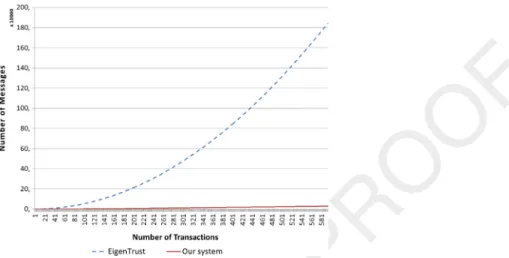
the role of “target peer”. By analysing the message overhead, after each transaction, the number of exchanged messages is the
383
sum of the number of exchanged messages by peersSandBwhich is strongly influenced by the number of peers belonging to
384
the set
(different for the peersAandB).
385
A comparison of the proposed reputation management system with the state-of-the-art approaches in terms of exchanged
386
messages is reported in the next section, after an evaluation of the proposed reputation management system in terms of detection
387
rate of the malicious peers.
388
5. Experiments and results
389
In this section, we will report various experiments which were conducted to illustrate the benefits of the proposed system in
390
detecting malicious peers and reducing the usage of bandwidth in P2P networks. We have compared the performance yielded by
Table 5
Scheme of tables stored by each peer. Field name Description
Buyer transaction table
Id Transaction Identifier of the transaction Seller Peer providing the goods Amount Price of the goods
Delivery Time Time which has been needed to receive the goods Shipping Service Reliability Reliability of the used shipping service
Seller Communication Quality Availability at communicating of the peer providing the goods Goods Quality Quality of the purchased goods
Seller transaction table
Id Transaction Identifier of the transaction Buyer Peer who buys the goods Amount Price of the goods
Payment Time Time which has been necessary to receive the payment Payment Method Reliability Reliability of the used payment method
Buyer Communication Quality Availability at communicating of the peer buying the goods
Assigned trust table
Peer Peer receiving the trust value Trust value The given opinion over the peer
Date Date in which the trust value has been computed and sent to the peer
Received trust table
Peer Commentator peer providing the trust value Credibility Credibility value of the peer providing the trust value Trust value The received opinion
Opinion Date Date in which the trust value has been received Opinion Scope Number of transactions performed with the peer
Average Amount Average price of the goods involved in the transactions performed with the peer
the proposed system with state-of-the-art paradigms, including: (1) the reputation management system used by the most known
392
e-market P2P platform, eBay®, (2) one of the most cited reputation management systems in P2P environments, EigenTrust[8],
393
(3) one of the most cited reputation management systems in e-commerce P2P environments, PeerTrust[10], and (4) a version of
394
the proposed reputation system based on conventional type-1 fuzzy sets. In the carried out experiments, the compared systems
395
are executed in a simulated P2P environment based on Intel®CoreTMi5-2410M, 2.3 GHz CPU and 4 GB of RAM.
396
In the following section, we will present the datasets used to perform the planned experimental sessions.Section 5.2shows
397
the effectiveness of our proposal by highlighting and reporting its capability of detecting malicious peers in terms of absolute
398
precision and recall.Section 5.3reports comparisons between the proposed system and the state-of-the-art reputation
manage-399
ment systems; these comparisons have been conducted in terms of percentage of detected malicious peers, number of frauds
400
occurred in a simulated scenario based on eBay®auctions, and message overhead.
401
5.1. The employed datasets
402
In spite of the large number of research activities accomplished in the reputation management area, no consolidated and
403
public datasets are available to perform unified and replicable experiments. As a consequence, a large dataset has been
cre-404
ated by downloading real eBay®transactions from eBay®databases through the eBay®SDK7. This dataset contains the last 100 405
transactions performed by each of the sellers belonging to a specific Italian category of goods, i.e., the data storage devices. This
406
dataset is composed of about 5000 transactions, occurring in the period from February to July 2013, whereas, the number of
407
peers (including sellers and buyers) is 4503. In order to evaluate the proposed system in different situations involving a different
408
number of peers, we built three new datasets, referred to asdataset1,dataset2anddataset3, which respectively include the 10%,
409
50% and 100% of transactions contained in the original dataset. Therefore, these new datasets are, respectively, composed of 490,
410
2307 and 4503 peers. We have augmenteddataset1,dataset2anddataset3with different percentages of malicious peers involved
411
in different malicious transactions. As described in[44], malicious peers are those that both misbehave and lie in providing their
412
feedbacks values. In particular, in our context, malicious peers misbehave by making, as buyers, late or no payments, and, as
413
sellers, delivering bad-quality goods or not delivering them at all[12]. In literature, the most studied malicious behaviours are
414
known asNaive,Discriminatory,HypocriticalandOscillatory[45]which can be explained as follows:
415
• Naive: the malicious peer always misbehaves and gives unfairly low recommendations about the others[46];
416
• Discriminatory: the malicious peer selects a group of victims and always misbehaves with them[8,46]. Besides, it gives unfairly
417
low recommendations about victims. For other peers, it behaves as a good one;
418
Fig. 7.The activity diagram related to the reputation computation by the sellerSafter a transaction with the buyerB.
• Hypocritical: the malicious peer misbehaves and gives unfairly low recommendation withxpercent probability[8,47]. In
419
other times, it behaves as a good peer;
420
• Oscillatory: the malicious peer builds its own high reputation by being good for a long time period, during which, it
per-421
forms transactions characterised by small amounts of money. Then, it behaves as a naive peer for a short period of time by
422
performing transactions characterised by large amounts of money. After the malicious period, it becomes a good peer again.
423
Each artificial malicious transaction involves a good peer, already present in the original dataset, with a synthetic malicious
424
peer. The new datasets are namedMaliciousDataset_X_Y, whereX=1,2,3 represents the starting dataset, i.e,dataset1,dataset2
425
ordataset3, andY=5,10,20 is the percentage of added malicious peers, i.e, 5%, 10% and 20%. The number of synthetic Naive,
426
Discriminatory, Hypocritical and Oscillatory peers within each dataset is the same. In particular, by considering malicious peer
427
definition, Hypocritical peers have been created by consideringxequal to 25%, 50%, or 75%, Discriminatory buyers have been
428
created by considering as victims the 10% of all sellers, whereas, Discriminatory sellers select only 1% of all buyers as victims.
429
Table 6shows the details of the number of peers involved in all planned experimental sessions.
430
Hereafter, the details about the performed experiments are given.
Table 6
Number of peers characterising the datasets used by all planned experimental sessions.
Dataset name Number of peers
MaliciousDataset_1_5 514 MaliciousDataset_1_10 538 MaliciousDataset_1_20 587 MaliciousDataset_2_5 2411 MaliciousDataset_2_10 2537 MaliciousDataset_2_20 2768 MaliciousDataset_3_5 4727 MaliciousDataset_3_10 4952 MaliciousDataset_3_20 5403 Table 7
PrecisionmaliciousandRecallmaliciousof the proposed reputation system.
Dataset name Precisionmalicious Recallmalicious MaliciousDataset_1_5 0.82 0.92 MaliciousDataset_1_10 0.81 0.88 MaliciousDataset_1_20 0.82 0.88 MaliciousDataset_2_5 0.99 0.83 MaliciousDataset_2_10 0.88 0.86 MaliciousDataset_2_20 0.89 0.85 MaliciousDataset_3_5 0.89 0.84 MaliciousDataset_3_10 0.89 0.84 MaliciousDataset_3_20 0.87 0.87 Average 0.87 0.86
5.2. Evaluation of the proposed reputation management system
432
In this section, we analyse the capability of the proposed reputation management system in detecting malicious peers. As
433
described inSection 4.2.2, our system considers a peer as malicious when it is characterised by a reputation value labelled with
434
theLowlinguistic term. The performance of our system is measured through the use of two well-established metrics, namely
435
PrecisionandRecall. Precisely, in reputation scenario, precision and recall are defined as follows:
436 Precisionmalicious= t p t p+f p (3) 437 Recallmalicious= t p t p+f n (4)
wheretpis the number oftrue positives, i.e., the number of malicious peers which are correctly identified as malicious,fpis the
438
number offalse positives, i.e., the number of good peers that are identified as malicious, andfnis the number of thefalse negatives,
439
i.e., the number of malicious peers that are wrongly identified as good peers. The valuestp,fpandfnhave been computed by
440
applying the proposed reputation management system to a dataset of trading transactions performed in a past interval time
441
in order to label each peer, involved in those transactions, as malicious or not malicious; successively, for each peer, the label
442
computed by the reputation management system (malicious, not malicious) is compared with the real nature of the same peer
443
(malicious, not malicious) in the original dataset. The result of these comparisons determines the value oftp,fpandfn.
444
Table 7shows thePrecisionmaliciousandRecallmaliciousvalues obtained by the proposed reputation management system by
445
considering all created malicious datasets.Table 8shows the detection rate (which is computed using theRecallmalicious) in
446
percentage for each kind of malicious peer by considering the same nine datasets.
447
As shown in theTable 7, the proposed system yields good performance, being characterised by an averagePrecisionmalicious
448
equals to 0.87 and an averageRecallmaliciousequals to 0.86.
449
5.3. Comparative study with the state-of-the-art paradigms
450
In this section, we compare of the proposed system with EigenTrust, PeerTrust and the eBay®feedback reputation
manage-451
ment system as well as type-1 its fuzzy counterpart. In particular, among PeerTrust variants, we consider PeerTrust PSM since
452
it represents the most performing variant as described in[10]. The comparison is carried out by considering three experimental
453
sessions. Firstly, we perform a statistical comparative study based on the malicious peer detection rate measured in terms of
454
PrecisionmaliciousandRecallmalicious(seeEqs. 3and4, respectively). Secondly, we perform a comparative study evaluating the
num-455
ber of frauds occurred in a simulated operative scenario based on eBay®auctions. Finally, we perform an efficiency comparison
456
in terms of message overhead. Hereafter, the details about the three experimental sessions are given.
Table 8
Percentage of detection for each kind of malicious peer.
Dataset name Kind of malicious peer Percentage (%)
MaliciousDataset_1_5 Naive 100 Discriminatory 100 Hypocritical 66.70 Oscillatory 100 MaliciousDataset_1_10 Naive 92.30 Discriminatory 92.30 Hypocritical 63.60 Oscillatory 100.00 MaliciousDataset_1_20 Naive 100 Discriminatory 95.80 Hypocritical 70.80 Oscillatory 83.30 MaliciousDataset_2_5 Naive 100 Discriminatory 82.10 Hypocritical 64.30 Oscillatory 82.10 MaliciousDataset_2_10 Naive 100 Discriminatory 98.30 Hypocritical 66.70 Oscillatory 77.20 MaliciousDataset_2_20 Naive 99.10 Discriminatory 99.10 Hypocritical 63.50 Oscillatory 77.40 MaliciousDataset_3_5 Naive 100 Discriminatory 98.20 Hypocritical 65.50 Oscillatory 70.90 MaliciousDataset_3_10 Naive 100 Discriminatory 100 Hypocritical 65.20 Oscillatory 70.50 MaliciousDataset_3_20 Naive 100 Discriminatory 99.60 Hypocritical 64.90 Oscillatory 84.80 Table 9
Strategies to detect malicious peers adopted by the compared reputation management systems. Reputation management
system
Strategy
eBay® A peer is malicious when it is characterised by a negative feedback score.
EigenTrust Due to its probabilistic interpretation of reputation, a peer is malicious when it is characterised by a global trust value less than 1/N, whereNis the number of peers in the network.
PeerTrust A peer is malicious when it is characterised by a global trust value less than or equal to 1−mrate,wheremraterepresents the average number of malicious transactions made by each malicious peer.
Type-1 FLS A peer is malicious when it is characterised by a reputation value labelled with theLowlinguistic term. Our system A peer is malicious when it is characterised by a reputation value labelled with theLowlinguistic term.
5.3.1. Comparison in terms of malicious peer detection rate
458
In this section, we show the results of the comparison between the proposed system and the other paradigms in terms of
459
precision and recall in the detection of malicious peer.
460
Precision and recall generally vary inversely; that is, as precision increases, recall generally decreases, and vice versa. For this
461
reason, it can be very difficult to achieve high recall and high precision simultaneously[48]. As shown in this section through an
462
empirical comparison followed by a statistical test, the proposed system improves state-of-the-art because it is able to yield high
463
recall without losing in precision.
464
In order to perform our comparison, it is necessary to highlight how each compared algorithms detect a malicious peer.
465
Table 9summarises the strategy used by each compared reputation management system to detect malicious peer. It is possible
466
to note that, different from our system and the type-1 FLS, eBay®feedback system, PeerTrust and EigenTrust do not provide a
467
formal method for identifying malicious peers, but they just compute a peer ranking based on their reputation value.
468
InTables 10and11, we show the malicious peer detection rate obtained for the compared systems on the nine aforementioned
469
datasets in terms ofPrecisionmaliciousandRecallmalicious, respectively.