USERS-CENTRIC ADAPTIVE LEARNING SYSTEM BASED
ON INTERVAL TYPE-2 FUZZY LOGIC FOR MASSIVELY
CROWDED E-LEARNING PLATFORMS
Khalid Almohammadi1, Hani Hagras1, Daniyal Alghazzawi2, Ghadah Aldabbagh1
1The Computational Intelligence Centre, School of Computer Science and Electronic Engineering
University of Essex, Colchester, UK
2Information Systems Department, Faculty of Computing and Information Technology
King Abdulaziz University, Jeddah, Saudi Arabia
3Computer Science Department, Faculty of Computing and Information Technology
King Abdulaziz University, Jeddah, Saudi Arabia
Abstract
Technological advancements within the educational sector and online learning promoted portable data-based adaptive techniques to influence the developments within transfor-mative learning and enhancing the learning experience. However, many common adap-tive educational systems tend to focus on adopting learning content that revolves around pre-black box learner modelling and teaching models that depend on the ideas of a few experts. Such views might be characterized by various sources of uncertainty about the learner response evaluation with adaptive educational system, linked to learner reception of instruction. High linguistic uncertainty levels in e-learning settings result in different user interpretations and responses to the same techniques, words, or terms according to their plans, cognition, pre-knowledge, and motivation levels. Hence, adaptive teaching models must be targeted to individual learners’ needs. Thus, developing a teaching model based on the knowledge of how learners interact with the learning environment in readable and interpretable white box models is critical in the guidance of the adaptation approach for learners’ needs as well as understanding the way learning is achieved.
This paper presents a novel interval type-2 fuzzy logic-based system which is capa-ble of identifying learners’ preferred learning strategies and knowledge delivery needs that revolves around characteristics of learners and the existing knowledge level in gen-erating an adaptive learning environment. We have conducted a large scale evaluation of the proposed system via real-word experiments on 1458 students within a massively crowded e-learning platform. Such evaluations have shown the proposed interval type-2 fuzzy logic system’s capability of handling the encountered uncertainties which enabled to achieve superior performance with regard to better completion and success rates as well as enhanced learning compared to the non-adaptive systems, adaptive system versions led by the teacher, and type-1-based fuzzy based counterparts.
Keywords:Type-2 Fuzzy Logic systems, e-learning, intelligent learning environments
10.1515/jaiscr-2016-0008
Brought to you by | Periodicals Section, Albert Sloman Libr. Authenticated Download Date | 12/13/16 4:06 PM
1 Introduction
Achieving student satisfaction and improving academic performance are the core objectives of ed-ucation systems. Therefore, obtaining a precise and comprehensive understanding of the needs of every student based on their distinctive attributes, such as level of knowledge, learning style, and level of en-gagement is highly important. This is needed that teaching content, styles and strategies can be effec-tively adapted to suit every student. In the context of traditional classroom instruction, it is extremely difficult for teachers to know the main cause of low satisfaction, engagement and outcomes among the students, which makes it difficult for teachers to find solutions that facilitate the improvement of stu-dents’ performance and attention while learning [1]. The occurrence of this problem can be at-tributed to the different levels of knowledge and motivation among students as well as the charac-teristics of teaching style and content adopted by teachers [1]. The different attributes wielded by students and the class size constrain the degree to which a teacher can adapt the learning environment to ideally suit all students simultaneously [1]. With smaller class sizes, it becomes easier for teachers to focus on the needs of every student, hence enhanc-ing the accuracy of learnenhanc-ing as well as the ability of teachers to evaluate the attributes of all students [1]. Myriad studies have concluded that one-to-one teaching fosters better learning outcomes, motiva-tion and engagement levels [2], [3], [4]. However, it is basically impossible to espouse such an instruc-tional style as a substantial component of teaching within traditional utilitarian classes.
Recently, e-learning courses have seen in-creased growth and popularity. There are over 30 million higher education students who take classes online, 50% of whom reside in the US. In the year 2011, it was revealed that around 16.1 million US students take at least one class online. This number is predicted to rise to around 41 million by 2016 [5]. Based on these statistics, it is evident that e-learning has become increasingly essential and has turned into a key method through which higher ed-ucation is provided [6]. However, e-learning envi-ronments also have numerous challenges. Some of these challenges are similar to those of conventional classes, especially with regard to lack of interaction.
Traditionally, e-learning courses were delivered us-ing learnus-ing management systems that provided the educational content using the same structure and composition for all students [7], [8]. Because stu-dents have different attributes, this became a chal-lenge because it hindered performance and engage-ment levels among students. In a bid to counter this challenge, adaptive educational learning tech-nologies and environments are utilized [1]. Because adaptive learning systems provide instructional ma-terial based on the specific needs and preferences of each student, these systems have the ability to im-prove performance among students, and this has led to increased interest in such learning systems [8], [9].
There are several factors that impinge on the learning requirements and preferences among stu-dents, such as personality attributes, learning styles, motivation, knowledge level, attention span and goals [7]. These factors can be evaluated so as to make the instructional process adaptive through initiatives such as improving the manner in which content is presented and the sequencing of informa-tional materials so that the needs of every student are catered to, thus helping them improve their per-formance as well as their completion rate for the course [10]. Thus, automatic and continuous learn-ing preferred knowledge delivery needs and prefer-ences for students are important factors for obtain-ing higher student learnobtain-ing outcomes, motivation and satisfaction. Our work also seeks to investi-gate how higher and precise adaption of the learning environment can obtain better outcomes and higher completion rate that results from the precision of the learned model.
The efficiency of adaptive educational systems is contingent on the mechanism applied in the collection of information with regard to students’ learning needs as well as on the manner in which this information is processed to tailor adaptive learning environments [8]. However, how can we make sure of high precision in evaluating students’ needs and knowledge level for provision of the op-timal and precise adaptive course content?
This question is critical due to several sources of uncertainty in how accurately students’ re-sponses are assessed by adaptive educational meth-ods as well as the corresponding uncertainties as-sociated with how the resulting instruction to the
1 Introduction
Achieving student satisfaction and improving academic performance are the core objectives of ed-ucation systems. Therefore, obtaining a precise and comprehensive understanding of the needs of every student based on their distinctive attributes, such as level of knowledge, learning style, and level of en-gagement is highly important. This is needed that teaching content, styles and strategies can be effec-tively adapted to suit every student. In the context of traditional classroom instruction, it is extremely difficult for teachers to know the main cause of low satisfaction, engagement and outcomes among the students, which makes it difficult for teachers to find solutions that facilitate the improvement of stu-dents’ performance and attention while learning [1]. The occurrence of this problem can be at-tributed to the different levels of knowledge and motivation among students as well as the charac-teristics of teaching style and content adopted by teachers [1]. The different attributes wielded by students and the class size constrain the degree to which a teacher can adapt the learning environment to ideally suit all students simultaneously [1]. With smaller class sizes, it becomes easier for teachers to focus on the needs of every student, hence enhanc-ing the accuracy of learnenhanc-ing as well as the ability of teachers to evaluate the attributes of all students [1]. Myriad studies have concluded that one-to-one teaching fosters better learning outcomes, motiva-tion and engagement levels [2], [3], [4]. However, it is basically impossible to espouse such an instruc-tional style as a substantial component of teaching within traditional utilitarian classes.
Recently, e-learning courses have seen in-creased growth and popularity. There are over 30 million higher education students who take classes online, 50% of whom reside in the US. In the year 2011, it was revealed that around 16.1 million US students take at least one class online. This number is predicted to rise to around 41 million by 2016 [5]. Based on these statistics, it is evident that e-learning has become increasingly essential and has turned into a key method through which higher ed-ucation is provided [6]. However, e-learning envi-ronments also have numerous challenges. Some of these challenges are similar to those of conventional classes, especially with regard to lack of interaction.
Traditionally, e-learning courses were delivered us-ing learnus-ing management systems that provided the educational content using the same structure and composition for all students [7], [8]. Because stu-dents have different attributes, this became a chal-lenge because it hindered performance and engage-ment levels among students. In a bid to counter this challenge, adaptive educational learning tech-nologies and environments are utilized [1]. Because adaptive learning systems provide instructional ma-terial based on the specific needs and preferences of each student, these systems have the ability to im-prove performance among students, and this has led to increased interest in such learning systems [8], [9].
There are several factors that impinge on the learning requirements and preferences among stu-dents, such as personality attributes, learning styles, motivation, knowledge level, attention span and goals [7]. These factors can be evaluated so as to make the instructional process adaptive through initiatives such as improving the manner in which content is presented and the sequencing of informa-tional materials so that the needs of every student are catered to, thus helping them improve their per-formance as well as their completion rate for the course [10]. Thus, automatic and continuous learn-ing preferred knowledge delivery needs and prefer-ences for students are important factors for obtain-ing higher student learnobtain-ing outcomes, motivation and satisfaction. Our work also seeks to investi-gate how higher and precise adaption of the learning environment can obtain better outcomes and higher completion rate that results from the precision of the learned model.
The efficiency of adaptive educational systems is contingent on the mechanism applied in the collection of information with regard to students’ learning needs as well as on the manner in which this information is processed to tailor adaptive learning environments [8]. However, how can we make sure of high precision in evaluating students’ needs and knowledge level for provision of the op-timal and precise adaptive course content?
This question is critical due to several sources of uncertainty in how accurately students’ re-sponses are assessed by adaptive educational meth-ods as well as the corresponding uncertainties as-sociated with how the resulting instruction to the
student is actually understood and received. How-ever, most of the exiting adaptive e-learning sys-tems rely upon the ideas and knowledge of a few experts to guide the adaption process. As men-tioned above, such views might be characterized by various uncertainty sources, particularly in the way learners’ responses can be evaluated accurately through the suggested adaptive educational system, and the “corresponding uncertainties” linked to the way the emerging instruction toward the learner is received and understood. In e-learning settings, high linguistic uncertainty levels exist, whereby learners may arrive at interpretations and act upon the same techniques, words, or terms (for exam-ple, preferred learning strategy, study time length or course difficulty) in different ways depending on their plans, cognition, pre-knowledge and motiva-tion levels [11]. Therefore, one adaptive teaching model, even when accompanied by designers’ and experts’ knowledge, might not serve all learners’ needs. To tackle the uncertainty that may inhibit the advancement of an efficient learning context, it is suggested that all adaptive educational systems should incorporate a flexible Artificial Intelligence (AI) method [11].
There are several AI-based approaches that have been implemented with the aim of achieving an efficient adaptive educational system. However, most of the AI approaches that have been imple-mented are not capable of learning from the be-havioural tendencies of the user so as to generate easy to read and understand white box models ca-pable of dealing with these uncertainties. Fuzzy logic systems are reputed for their ability to gen-erate white box models that are capable of dealing with high-level uncertainties. Nonetheless, most fuzzy logic systems use type-1 fuzzy logic whose capability of dealing with an uncertainty is based on precise type-1 fuzzy sets [12]. On the contrary, interval type-2 fuzzy logic systems are capable of dealing with uncertainty using interval type-2 fuzzy sets that are inclusive of a footprint of uncertainty (FOU), the purpose of which is to augment the de-gree of freedom so as to improve the system’s abil-ity to deal with high-level uncertainties [12].
In this paper, a system that is based on type-2 fuzzy logic is presented. The system has the ability of learning the preferred knowledge delivery needs of users with regard to their attributes, hence
gen-erating an adaptive learning environment. The de-velopment of the type-2 fuzzy model is based on data collected from several students who have dif-ferent aptitudes and needs. The model was then implemented to enhance the delivery of knowledge to different students based on their individual at-tributes and knowledge levels. This paper will explain the manner in which the system can cus-tomize the learning environments so as to improve the delivery of knowledge to students of different attributes, which can, in turn, improve student per-formance, motivation and engagement level. The system proposed in this paper has the ability to con-tinuously learn, respond, and adapt to the needs of every student. As a result, it can be implemented in online courses to deliver adaptive education con-tent to students with varying needs. The proposed system was tested using various real-world experi-ments within a massively crowded e-learning plat-form that involved 1458 students from King Abdu-laziz University. The experiments showed that the proposed system has a better capability of dealing with the uncertainties and improving performance and course completion rate in comparison with non-adaptive systems, non-adaptive system versions led by the instructors, as well as type-1-based fuzzy logic systems counterparts.
The paper is organized as follows: Section 2 presents a brief overview on some AI techniques that are employed for adaptive educational systems. In section 3, an overview on type-2 fuzzy logic sys-tems is provided. Section 4 provides an overview on the application of fuzzy logic systems to educa-tion and e-learning platforms. Seceduca-tion 5 presents the proposed users-centric adaptive Learning Sys-tem based on Interval Type-2 Fuzzy logic SysSys-tem (IT2FLS) for massively crowded E-learning plat-forms. Section 6 presents the experiments and re-sults while the conclusions and future work are pre-sented in Section 7.
2 A Brief Overview on Some AI
techniques that are Employed for
Adaptive Educational Systems
The ability of AI approaches to learn and repli-cate the decision-making process espoused by stu-dents makes them valuable tools in adaptive
edu-Brought to you by | Periodicals Section, Albert Sloman Libr. Authenticated Download Date | 12/13/16 4:06 PM
84
Khalid Almohammadi, Hani Hagras, Daniyal Alghazzawi, Ghadah Aldabbaghcational systems [13]. There are various AI tech-niques that have been used in adaptive educational systems such as fuzzy logic, Bayesian networks, neural network and hidden Markov models. There are various ways through which AI approaches are used in adaptive educational systems. For exam-ple, in some systems the core focus is to examine and assess students’ characteristics so as to generate profiles of the students with the intention of eval-uating their overall level of knowledge [10], [14], [15], [16], [17], [18], [19]. AI approaches are also used to facilitate the diagnostic processes’ comple-tion so that course content can be adjusted to cater to the needs of every student [15], [16], [20], [21], [22], and [23]. However, some AI approaches, such as hidden Markov models, Bayesian networks, and neural networks are black box models which have a knowledge problem that makes them incapable of establishing human behaviour frameworks that are transparent and easy to analyze. Another limita-tion of these approaches is that they need the rep-etition of long iterative learning methods during the amendment of the framework, which is particularly challenging because the e-learning process is ever changing and dynamic [15].
3 A Brief Overview of Type-2
Fuzzy Logic Systems
As illustrated in Figure 1a, the interval type-2 fuzzy logic system (FLS) utilizes interval type-2 fuzzy sets (e.g., the type-2 fuzzy set illustrated in Figure 1b) in the representation of the inputs and outputs. The third dimension values in the interval type-2 fuzzy sets are all equal to one. Unlike the general type-2 FLS, computation is simplified when an in-terval type-2 FLS is used [12].
The functioning of the interval type-2 FLS is as follows: the first step is to fuzzify the crisp inputs into input type-2 fuzzy sets. The ease and suitabil-ity of singleton fuzzification makes it preferable for interval type-2 FLS. Afterwards, the inference en-gine and the rule base are activated by the input type-2 fuzzy sets and this leads to the generation of output 2 fuzzy sets. The 1 and type-2 FLS rule base are the same but the membership functions (MFs) of the type-2 FLS are represented by interval type-2 fuzzy sets in the place of type-1 fuzzy sets. The fired rules are combined by the
in-ference engine, which then gives a mapping from input 2 to output 2 fuzzy sets. The type-reducer then processes the type-2 fuzzy output and combines the output sets to execute centroid calcu-lations to produce type-1 fuzzy sets that are referred to as type-reduced sets. Type-reduction can be exe-cuted using various methods, but this paper focuses on the centre of sets type-reduction because of its reasonable complexity of computations [12]. Type-reduction is then followed by defuzzification of the type-reduced sets so that the crisp outputs can be obtained. A detailed and comprehensive coverage of interval type-2 FLS can be found in [12].
Figure 1. (a) Structure of the type-2 FLS [25], (b) An interval type-2 fuzzy set
The shaded area in Figure 1b) is labelled as Footprint of Uncertainty (FOU) which is bounded by lower membership function A˜(x) and an upper membership function A˜(x)[12]. Thus an interval type-2 fuzzy set is written as follows:
˜ A= ∫ x∈X[ ∫ u∈[A˜(x),A˜(x)] 1/u ]/x (1)
approaches is that they need the repetition of long iterative learning methods during
the amendment of the framework, which is particularly challenging because the
e-learning process is ever changing and dynamic [15].
3.
A Brief Overview of Type
-
2 Fuzzy Logic Systems
As illustrated in Fig. 1a, the interval type-2 fuzzy logic system (FLS) utilizes interval
type-2 fuzzy sets (e.g., the type-2 fuzzy set illustrated in Fig. 1b) in the representation
of the inputs and outputs. The third dimension values in the interval type-2 fuzzy sets
are all equal to one. Unlike the general type-2 FLS, computation is simplified when an
interval type-2 FLS is used [12].
(a) (b)
Fig. 1. (a) Structure of the type-2 FLS [25], (b) An interval type-2 fuzzy set.
The functioning of the interval type-2 FLS is as follows: the first step is to fuzzify
the crisp inputs into input type-2 fuzzy sets. The ease and suitability of singleton
fuzzification makes it preferable for interval type-2 FLS. Afterwards, the inference
engine and the rule base are activated by the input type-2 fuzzy sets and this leads to
Upper Membership Function (UMF)Fuzzifier Defuzzifier
Type-Reducer
Type-2 output fuzzy sets Rule Base Inference Engine Type-1 reduced fuzzy Type-2 input fuzzy Crisp Outputs Crisp Inputs Lower Membership Function (LMF) Footprint of uncertainty
approaches is that they need the repetition of long iterative learning methods during the amendment of the framework, which is particularly challenging because the e-learning process is ever changing and dynamic [15].
3. A Brief Overview of Type-2 Fuzzy Logic Systems
As illustrated in Fig. 1a, the interval type-2 fuzzy logic system (FLS) utilizes interval type-2 fuzzy sets (e.g., the type-2 fuzzy set illustrated in Fig. 1b) in the representation of the inputs and outputs. The third dimension values in the interval type-2 fuzzy sets are all equal to one. Unlike the general type-2 FLS, computation is simplified when an interval type-2 FLS is used [12].
(a) (b)
Fig. 1. (a) Structure of the type-2 FLS [25], (b) An interval type-2 fuzzy set.
The functioning of the interval type-2 FLS is as follows: the first step is to fuzzify the crisp inputs into input type-2 fuzzy sets. The ease and suitability of singleton fuzzification makes it preferable for interval type-2 FLS. Afterwards, the inference engine and the rule base are activated by the input type-2 fuzzy sets and this leads to Upper Membership Function (UMF) Fuzzifier Defuzzifier
Type-Reducer
Type-2 output fuzzy sets Rule Base Inference Engine Type-1 reduced fuzzy Type-2 input fuzzy Crisp Outputs Crisp Inputs Lower Membership Function (LMF) Footprint of uncertainty
the amendment of the framework, which is particularly challenging because the
e-learning process is ever changing and dynamic [15].
3.
A Brief Overview of Type
-
2 Fuzzy Logic Systems
As illustrated in Fig. 1a, the interval type-2 fuzzy logic system (FLS) utilizes interval
type-2 fuzzy sets (e.g., the type-2 fuzzy set illustrated in Fig. 1b) in the representation
of the inputs and outputs. The third dimension values in the interval type-2 fuzzy sets
are all equal to one. Unlike the general type-2 FLS, computation is simplified when an
interval type-2 FLS is used [12].
(a) (b)
Fig. 1. (a) Structure of the type-2 FLS [25], (b) An interval type-2 fuzzy set.
The functioning of the interval type-2 FLS is as follows: the first step is to fuzzify
the crisp inputs into input type-2 fuzzy sets. The ease and suitability of singleton
fuzzification makes it preferable for interval type-2 FLS. Afterwards, the inference
engine and the rule base are activated by the input type-2 fuzzy sets and this leads to
Upper Membership Function (UMF)Fuzzifier Defuzzifier
Type-Reducer
Type-2 output fuzzy sets Rule Base Inference Engine Type-1 reduced fuzzy Type-2 input fuzzy Crisp Outputs Crisp Inputs Lower Membership Function (LMF) Footprint of uncertainty
cational systems [13]. There are various AI tech-niques that have been used in adaptive educational systems such as fuzzy logic, Bayesian networks, neural network and hidden Markov models. There are various ways through which AI approaches are used in adaptive educational systems. For exam-ple, in some systems the core focus is to examine and assess students’ characteristics so as to generate profiles of the students with the intention of eval-uating their overall level of knowledge [10], [14], [15], [16], [17], [18], [19]. AI approaches are also used to facilitate the diagnostic processes’ comple-tion so that course content can be adjusted to cater to the needs of every student [15], [16], [20], [21], [22], and [23]. However, some AI approaches, such as hidden Markov models, Bayesian networks, and neural networks are black box models which have a knowledge problem that makes them incapable of establishing human behaviour frameworks that are transparent and easy to analyze. Another limita-tion of these approaches is that they need the rep-etition of long iterative learning methods during the amendment of the framework, which is particularly challenging because the e-learning process is ever changing and dynamic [15].
3 A Brief Overview of Type-2
Fuzzy Logic Systems
As illustrated in Figure 1a, the interval type-2 fuzzy logic system (FLS) utilizes interval type-2 fuzzy sets (e.g., the type-2 fuzzy set illustrated in Figure 1b) in the representation of the inputs and outputs. The third dimension values in the interval type-2 fuzzy sets are all equal to one. Unlike the general type-2 FLS, computation is simplified when an in-terval type-2 FLS is used [12].
The functioning of the interval type-2 FLS is as follows: the first step is to fuzzify the crisp inputs into input type-2 fuzzy sets. The ease and suitabil-ity of singleton fuzzification makes it preferable for interval type-2 FLS. Afterwards, the inference en-gine and the rule base are activated by the input type-2 fuzzy sets and this leads to the generation of output 2 fuzzy sets. The 1 and type-2 FLS rule base are the same but the membership functions (MFs) of the type-2 FLS are represented by interval type-2 fuzzy sets in the place of type-1 fuzzy sets. The fired rules are combined by the
in-ference engine, which then gives a mapping from input 2 to output 2 fuzzy sets. The type-reducer then processes the type-2 fuzzy output and combines the output sets to execute centroid calcu-lations to produce type-1 fuzzy sets that are referred to as type-reduced sets. Type-reduction can be exe-cuted using various methods, but this paper focuses on the centre of sets type-reduction because of its reasonable complexity of computations [12]. Type-reduction is then followed by defuzzification of the type-reduced sets so that the crisp outputs can be obtained. A detailed and comprehensive coverage of interval type-2 FLS can be found in [12].
Figure 1. (a) Structure of the type-2 FLS [25], (b) An interval type-2 fuzzy set
The shaded area in Figure 1b) is labelled as Footprint of Uncertainty (FOU) which is bounded by lower membership function A˜(x) and an upper membership function A˜(x)[12]. Thus an interval type-2 fuzzy set is written as follows:
˜ A= ∫ x∈X[ ∫ u∈[A˜(x),A˜(x)] 1/u ]/x (1)
4 Brief overview on the Application
of Fuzzy Logic Systems in
Educa-tion and E-learning Platforms
A FLS can be implemented to facilitate the forma-tion of a summary of the students’ preferences per-taining to knowledge acquisition and understanding [11]. A FLS-based framework that is geared to-wards customization facilitates easy reasoning for both the users and designers, which in turn eases the process of content comprehension as well as system amendments [25], [26]. In addition, FLSs can also be used in the examination and assessment of learn-ing and knowledge outcomes [17], [18], [19], [27]. Consequently, as previous studies established [17], [18], [19], [27], FLSs can be designed to facilitate the evaluation of task objectives and multiple cri-teria. However, FLSs are rarely used for the adap-tive presentation of educational materials. In [20], a profiling system that uses a multi-agent approach for the creation of fuzzy models for content and stu-dents is done on the basis of a dynamic plan that is defined in advance for one individual. The develop-ment of this framework was done using profile ab-straction, whereby a comparison of student-centred learning tasks, such as the topic, and the time spent on the topic, was conducted.
The creation of the content framework was done based on the fuzzy links between the subjects and the individuals’ level of knowledge (these links were referred to as prerequisite relations). The pre-requisite relations were used in the determination of the most appropriate learning plan (i.e., the order in which an individual should examine issues [20]). However, the estimation of student behaviours in this study was achieved using criterion links be-tween the knowledge of the student and the top-ics, so as to come up with a dynamically grounded learning plan for the learners. In [20], students’ needs were not learned automatically. In addition, the system in [20] did not have the adaptation fea-tures of a continuous learning approach that can fa-cilitate easy amendments of the frameworks to suit the continuously evolving student preferences. Fur-thermore, to the best of our knowledge no studies have delved into the implementation of type-2 fuzzy approaches in adaptive learning educational envi-ronments.
5 The
Proposed
User-Centric
Adaptive Learning System Based
on Interval Type-2 Fuzzy logic
for Massively Crowded
E-learning Platforms
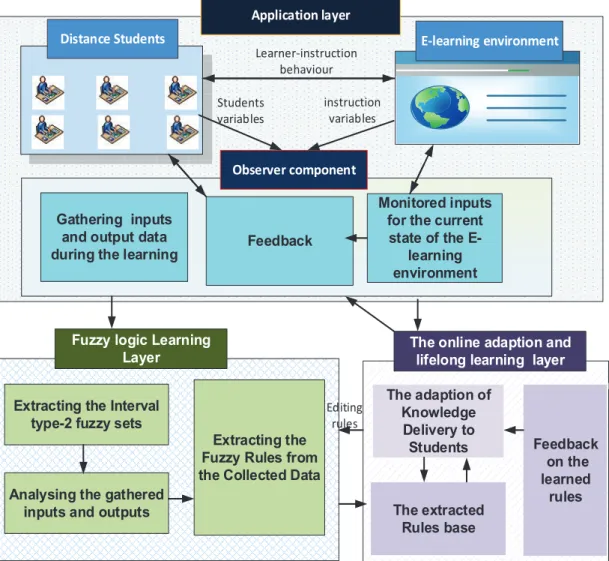
The objective of our proposed interval type-2 fuzzy logic, is to acquire knowledge about and dovetail several instructional variables, such as the suited current level of difficulty of the content along with the required time for learned content that has the ability to tackle the present condition of different learners’ variables according to their present knowl-edge level and characteristics. The proposed envi-ronment will start its work flow at the application layer where the e-learning environments (course contents) and learners get to interact with each other.
First, this layer solely concentrates on specify-ing the required instructional variables needed to learn the outputs of the learning environment that are parallel with the learner variables or the in-puts. Next, this layer will install a system of ac-tive recording and supervision of the specified data in relation to the teaching-learning behaviors (i.e., outputs and inputs of the system) generally seen in online learning environments. To generate system-learned rules, a layer of learning fuzzy rules will then receive those inputs and outputs. This layer aims at first extracting interval type-2 fuzzy sets in relation to system output and input on the basis of creating type-2 fuzzy sets and method centering on methodology detailed in [28], [29], [30], [31], out of a sample of respondents (30 students in the case of the conducted experiments) for managing lin-guistic uncertainty. Having gathered data (one week is needed in the case of conducting experiments) and accumulated the fuzzy sets, the system will en-ter the state of building fuzzy rules with the purpose of detailing the most required instructional actions having the satisfactory present conditions of student capabilities and characteristics based on an unsu-pervised one-pass approach, as motivated through [32], [33], [34].
Finally, the adaption layer will be utilized; this is where the students’ current learning inputs states are taken and given suitable outputs to accomplish their learning tasks. Our proposed environment will
Brought to you by | Periodicals Section, Albert Sloman Libr. Authenticated Download Date | 12/13/16 4:06 PM
further enable the online adaption and enhancement of rules in this layer. This facilitates long-term learning due to the changing of the performance, capabilities, delivery instructional preferences and needs of the students. The advocated environment comprises the following three layers (as shown in Figure 2) which will be explained in the following subsections.
1. Application Layer
2. The Fuzzy Rules Learning Layer
3. The Online Adaption and Lifelong Learning Layer
5.1 Application Layer
The main purpose of this layer is to first specify the learners’ variables, which are the inputs accord-ing to the system outputs; these are related to the content or instructional variables to be learned. In-structional variables could be the suitable learning content difficulty level and time needed, along with the preferred learning style and method of knowl-edge acquisition. These variables promote the stu-dent learning level that matches the current learner variables, which include the student’s current level of knowledge and other personal characteristics re-lated to the adaptation process, making it more per-sonalized.
5.1.1 The Observer Component
Student data are first collected and captured by eval-uating the students’ knowledge delivery require-ments with the preferred learning style, alongside the characteristics of the online learning environ-ment. Significantly, the data (present outputs and inputs) will be actively recorded upon the change of the knowledge delivery needs or characteris-tics. Therefore, a descriptive model of the students’ knowledge delivery needs and characteristics is cre-ated and learned by our system; this is achieved through the data gathered, generating a set of multi-input and output data pairs, which take the follow-ing form [32], [33], [34]:
x(t);y(t) (t= 1,2, . . .,N), (2) where N is recognized as the number of data instances,x(t)∈ Rn, andy(t)∈ Rk. The impact of
the input variabley= (y1, . . . ,yk)Tupon thek
out-put knowledge delivery variablesx= (x1, . . . ,xn)T
are explained by the rules that are extracted by our system. With specific consideration of the exper-iments conducted within the online learning en-vironment, seven student characteristics’ variables were utilized for the inputs, and 4 knowledge de-livery needs (which will be detailed later) variables were utilized for the outputs. A correlating model of the inputs and outputs is achieved by the estab-lished fuzzy rules without requiring a mathematical model. Therefore, individual rules can be adapted online, affecting only certain aspects of the descrip-tive model created and learned by the proposed sys-tem.
5.2 The Fuzzy Rules Learning Layer
5.2.1 Extracting the Interval Type-2 Fuzzy Sets Categorization of collected data input and output is essential through specific functions of fuzzy mem-bership. In this way, input and output values are quantified and converted into linguistic labels such as high, very high, low and very low. The details of the implemented approach are found in [28], [29], [30], [31] and cause the creation of the FOU and a type-2 fuzzy set, where several type-1 fuzzy sets are embedded to signify the individual perceptions of every student regarding a specific linguistic label that elaborates requirements, preferences and fea-tures. Consequently, different students’ opinions regarding the modelling of words will be combined by FOU generated from type-2 fuzzy sets, and the uncertainties will also be managed.
The applied approach accumulates data via ask-ing questions to the respondents regardask-ing their per-spectives on the linguistic labels, by which the type-1 fuzzy sets will be generated. Following this stage, utilizing the approach of [28], [29], [30], [31], the 2 fuzzy sets are constructed where the type-1 fuzzy sets (representing the students’ individual preferences) are combined, resulting in the FOU of the type-2 fuzzy set, which represents the given word. By applying the representation theorem [12], [28], [29], [30], [31] the calculation of each interval type-2 fuzzy set ˜Aswill be:
˜ As= n ∪ i=1 Ai (3)
further enable the online adaption and enhancement of rules in this layer. This facilitates long-term learning due to the changing of the performance, capabilities, delivery instructional preferences and needs of the students. The advocated environment comprises the following three layers (as shown in Figure 2) which will be explained in the following subsections.
1. Application Layer
2. The Fuzzy Rules Learning Layer
3. The Online Adaption and Lifelong Learning Layer
5.1 Application Layer
The main purpose of this layer is to first specify the learners’ variables, which are the inputs accord-ing to the system outputs; these are related to the content or instructional variables to be learned. In-structional variables could be the suitable learning content difficulty level and time needed, along with the preferred learning style and method of knowl-edge acquisition. These variables promote the stu-dent learning level that matches the current learner variables, which include the student’s current level of knowledge and other personal characteristics re-lated to the adaptation process, making it more per-sonalized.
5.1.1 The Observer Component
Student data are first collected and captured by eval-uating the students’ knowledge delivery require-ments with the preferred learning style, alongside the characteristics of the online learning environ-ment. Significantly, the data (present outputs and inputs) will be actively recorded upon the change of the knowledge delivery needs or characteris-tics. Therefore, a descriptive model of the students’ knowledge delivery needs and characteristics is cre-ated and learned by our system; this is achieved through the data gathered, generating a set of multi-input and output data pairs, which take the follow-ing form [32], [33], [34]:
x(t);y(t) (t= 1,2, . . .,N), (2) where N is recognized as the number of data instances,x(t)∈ Rn, andy(t)∈ Rk. The impact of
the input variabley= (y1, . . . ,yk)Tupon thek
out-put knowledge delivery variablesx= (x1, . . . ,xn)T
are explained by the rules that are extracted by our system. With specific consideration of the exper-iments conducted within the online learning en-vironment, seven student characteristics’ variables were utilized for the inputs, and 4 knowledge de-livery needs (which will be detailed later) variables were utilized for the outputs. A correlating model of the inputs and outputs is achieved by the estab-lished fuzzy rules without requiring a mathematical model. Therefore, individual rules can be adapted online, affecting only certain aspects of the descrip-tive model created and learned by the proposed sys-tem.
5.2 The Fuzzy Rules Learning Layer
5.2.1 Extracting the Interval Type-2 Fuzzy Sets Categorization of collected data input and output is essential through specific functions of fuzzy mem-bership. In this way, input and output values are quantified and converted into linguistic labels such as high, very high, low and very low. The details of the implemented approach are found in [28], [29], [30], [31] and cause the creation of the FOU and a type-2 fuzzy set, where several type-1 fuzzy sets are embedded to signify the individual perceptions of every student regarding a specific linguistic label that elaborates requirements, preferences and fea-tures. Consequently, different students’ opinions regarding the modelling of words will be combined by FOU generated from type-2 fuzzy sets, and the uncertainties will also be managed.
The applied approach accumulates data via ask-ing questions to the respondents regardask-ing their per-spectives on the linguistic labels, by which the type-1 fuzzy sets will be generated. Following this stage, utilizing the approach of [28], [29], [30], [31], the 2 fuzzy sets are constructed where the type-1 fuzzy sets (representing the students’ individual preferences) are combined, resulting in the FOU of the type-2 fuzzy set, which represents the given word. By applying the representation theorem [12], [28], [29], [30], [31] the calculation of each interval type-2 fuzzy set ˜Aswill be:
˜ As= n ∪ i=1 Ai (3)
Figure 2. An overview on the proposed users-centric adaptive Learning System based on Interval Type-2 Fuzzy logic for massively crowded E-learning platforms
Fuzzy Analyser
Fuzzy logic Learning Layer
Application layer
Observer component
Monitored inputs for the current
state of the E-learning environment
Analysing the gathered inputs and outputs Extracting the Interval
type-2 fuzzy sets
Extracting the Fuzzy Rules from the Collected Data Gathering inputs
and output data during the learning
The extracted Rules base The adaption of Knowledge Delivery to Students Distance Students Students variables Learner-instruction behaviour instruction variables E-learning environment
The online adaption and lifelong learning layer
Feedback on the learned rules Editing rules Feedback
Fig. 2. An overview on the proposed users-centric adaptive Learning System based on Interval Type-2 Fuzzy logic for massively crowded E-learning platforms
5.1 Application Layer
The main purpose of this layer is to first specify the learners’ variables, which are the
inputs according to the system outputs; these are related to the content or instructional
variables to be learned. Instructional variables could be the suitable learning content
difficulty level and time needed, along with the preferred learning style and method of
knowledge acquisition. These variables promote the student learning level that
matches the current learner variables, which include the s
tudent’s current level of
Brought to you by | Periodicals Section, Albert Sloman Libr. Authenticated Download Date | 12/13/16 4:06 PM
Here,ith type-1 fuzzy set and∪is an operation
of aggression [28], [29], [30], [31] embedded in the reference ofAi. Approximations of lower MF
˜ A(x)
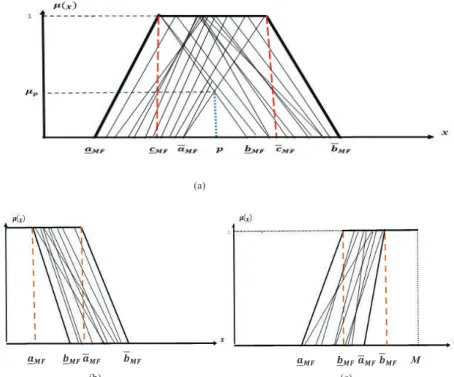
of ˜Asand upper MFA˜(x)serve as the basis of gen-erating the process of ˜A .This will depend on the shape of the embedded type-1 fuzzy sets and the FOU model, which is to be generated for ˜As. In our system, we use interior FOU models and right and left shoulder MFs (shown in Figure 3a, Figure 3b and Figure 3c) for the upper and lower MF pa-rameters from all the embedded non-symmetric tri-angular type-1 MFs. As shown in Figure 3a, the re-sulting interior interval type-2 fuzzy set is described by parametersaMF,cMF, cMF,andbMF denoting a
trapezoidal upper MF and parametersaMF andbMF
for a non-symmetric triangular lower MF, with an intersection point(p,p) [28], [29], [30], [31]. The
calculating processes for these parameters are de-tailed below.
The steps given below are required for upper MFA˜(x):
1. aMF and bMF should be found out equal with
the minimumamin
MFof all left-end pointsaiMF and
maximum bmax
MFof all right-end pointsbiMF [28],
[29], [30], [31], respectively, for (x) =0.
2. cMF,cMF should be calculated corresponding to
the type-1 MFs with maximum and minimum centres for (x) =1.
3. Approximate the upper MF A˜(x) by connect-ing the followconnect-ing points with straight lines: (aMF,0),(cMF,1), (cMF,1), and(bMF,0). The
result is a trapezoidal upper MF, as depicted in Figure 3a.
The lower MFA˜(x)is approximated through the fol-lowing steps:
1. aMF and bMF should be calculated equal with the maximumamax
MFof all left-end pointsaiMFand
minimumbmin
MF of all right-end pointsbiMF [28],
[29], [30], [31].
2. The formulas below are to be used for comput-ing the intersection point(p,p):
p=bMF(cMF−aMF) +aMF(bMF −cMF) (cMF−aMF) + (bMF−cMF) (4)
p= (bMF −p)
(bMF −cMF) (5)
An approximation of the lower MFA˜(x)is to be ex-ecuted by linking the points of (aMF,0) ,(aMF,0),
(p,p),(bMF,0) and(bMF,0) through a direct line.
As depicted in Figure 3a, which is a triangle lower MF.
The method adopted for computing the FOU for the right and left shoulder is similar to that described in [28], [29], [30], [31]. The com-putation of the upper MF A˜(x) that concerns the left shoulder (referred to in Figure 3b) requires joining of the points (0,1), (aMF,1), (bMF,0),
and (bMF,0) with straight lines. The
com-putation of the lower MFA˜(x) requires join-ing of the points(0,1), (aMF,1), (bMF,0) and
(bMF,0) with straight lines. Likewise, as is
shown in Figure 3c, the estimation of MF ˜
A(x) that concerns the right shoulder
re-quires joining of the points (aMF,0), (bMF,1),
and (M,1) with straight lines. The
approxima-tion of the lower MFA˜(x) requires joining of the points(aMF,0), (aMF,0),(bMF,1), and(M,1) with
straight lines [28], [29], [30] and [31].
5.2.2 Extracting the Fuzzy Rule from the Col-lected Data
To extract the rules that delineate the individual be-haviours, data collected from the output or input and the generation of interval type-2 fuzzy sets are combined with each other. An improved approach of the Wang-Mendel method is the basis of the ap-plied method of rule extraction [32], [33] and [34].
Several rules of multiple-input–multiple-output are extracted via the proposed type-2 fuzzy system and are recognized as explaining the association betweenx= (x1, . . . ,xn)T andy= (y1, . . . ,yk)T,
adopting the following form:
IF x1is ˜Al1. . .andxnis ˜AlnTHEN y1isB˜l1 (6) l=1,2, . . . .,M,
Here,Mandlrepresent the number of rules and the index of the rules, respectively.
There are particular explanations ofVi interval type-2 fuzzy sets ˜Aqs , q=1, . . . ,Vithat correspond
to each input xs, having s= 1,2, . . . .,n. There
are also explanations of Vo interval type-2 fuzzy sets Bhc , h = 1, . . . ,Vo that correspond to each
Here,ith type-1 fuzzy set and∪is an operation
of aggression [28], [29], [30], [31] embedded in the reference ofAi. Approximations of lower MF
˜ A(x)
of ˜Asand upper MFA˜(x)serve as the basis of gen-erating the process of ˜A .This will depend on the shape of the embedded type-1 fuzzy sets and the FOU model, which is to be generated for ˜As. In our system, we use interior FOU models and right and left shoulder MFs (shown in Figure 3a, Figure 3b and Figure 3c) for the upper and lower MF pa-rameters from all the embedded non-symmetric tri-angular type-1 MFs. As shown in Figure 3a, the re-sulting interior interval type-2 fuzzy set is described by parametersaMF,cMF,cMF,andbMF denoting a
trapezoidal upper MF and parametersaMF andbMF
for a non-symmetric triangular lower MF, with an intersection point(p,p) [28], [29], [30], [31]. The
calculating processes for these parameters are de-tailed below.
The steps given below are required for upper MFA˜(x):
1. aMF and bMF should be found out equal with
the minimumamin
MFof all left-end pointsaiMF and
maximum bmax
MFof all right-end pointsbiMF [28],
[29], [30], [31], respectively, for (x) =0.
2. cMF,cMFshould be calculated corresponding to
the type-1 MFs with maximum and minimum centres for (x) =1.
3. Approximate the upper MF A˜(x) by connect-ing the followconnect-ing points with straight lines: (aMF,0),(cMF,1), (cMF,1), and(bMF,0). The
result is a trapezoidal upper MF, as depicted in Figure 3a.
The lower MFA˜(x)is approximated through the fol-lowing steps:
1. aMF and bMF should be calculated equal with the maximumamax
MFof all left-end pointsaiMFand
minimumbmin
MF of all right-end pointsbiMF [28],
[29], [30], [31].
2. The formulas below are to be used for comput-ing the intersection point(p,p):
p=bMF(cMF−aMF) +aMF(bMF −cMF) (cMF−aMF) + (bMF−cMF) (4)
p= (bMF −p)
(bMF −cMF) (5)
An approximation of the lower MFA˜(x)is to be ex-ecuted by linking the points of (aMF,0) ,(aMF,0),
(p,p),(bMF,0)and(bMF,0) through a direct line.
As depicted in Figure 3a, which is a triangle lower MF.
The method adopted for computing the FOU for the right and left shoulder is similar to that described in [28], [29], [30], [31]. The com-putation of the upper MF A˜(x) that concerns the left shoulder (referred to in Figure 3b) requires joining of the points (0,1), (aMF,1), (bMF,0),
and (bMF,0) with straight lines. The
com-putation of the lower MFA˜(x) requires join-ing of the points (0,1), (aMF,1), (bMF,0) and
(bMF,0) with straight lines. Likewise, as is
shown in Figure 3c, the estimation of MF ˜
A(x) that concerns the right shoulder
re-quires joining of the points (aMF,0), (bMF,1),
and (M,1) with straight lines. The
approxima-tion of the lower MFA˜(x) requires joining of the points(aMF,0), (aMF,0),(bMF,1), and(M,1) with
straight lines [28], [29], [30] and [31].
5.2.2 Extracting the Fuzzy Rule from the Col-lected Data
To extract the rules that delineate the individual be-haviours, data collected from the output or input and the generation of interval type-2 fuzzy sets are combined with each other. An improved approach of the Wang-Mendel method is the basis of the ap-plied method of rule extraction [32], [33] and [34].
Several rules of multiple-input–multiple-output are extracted via the proposed type-2 fuzzy system and are recognized as explaining the association betweenx= (x1, . . . ,xn)T andy= (y1, . . . ,yk)T,
adopting the following form:
IF x1is ˜Al1. . .andxnis ˜AlnTHEN y1isB˜l1 (6) l=1,2, . . . .,M,
Here,Mandlrepresent the number of rules and the index of the rules, respectively.
There are particular explanations ofVi interval type-2 fuzzy sets ˜Aqs , q=1, . . . ,Vithat correspond
to each input xs, having s =1,2, . . . .,n. There
are also explanations of Vo interval type-2 fuzzy sets Bhc , h = 1, . . . ,Vo that correspond to each
output yc, wherec=1,2, . . . .,k.
Figure 3. (a) An interior type-2 MF embedding the different type-1 fuzzy sets, (b) left shoulder type-2 MF embedding the different type-1 fuzzy sets, (c) right shoulder type-2 MF embedding the different type-1
fuzzy sets [28], [29], [30], [31] The attempt to explain and summarize the
fol-lowing representation of the approach should con-sist of rules with a single output whose demonstra-tion owes to the relative simplicity of the method in the case of expanding the rules that engage several outputs. The stages of rule extraction are explained below.
Stage 1: In case of a pair of fixed input–output data (x(t);;y(t)) from the dataset(t=1,2, ...,N), the computations of the values for upper and lower membership areA˜q s ( x(t) s ) andA˜q s ( x(t) s ) , correspond-ing to each fuzzy set ˜Aqs , q=1, . . . ,Vi and each
in-put variables(s=1, ...,n). Findq∗ ∈ {1, . . . ,Vi} such that [32], [33], and [34]:
cg ˜ Aqs∗ ( x(st) ) ≥cgA˜q s ( x(st) ) (7) For all q = 1,...,Vi,cgA˜q s ( x(st) )
is the centre of grav-ity of the interval membership of ˜Aqsatx(st), as can
be seen below [12]: cg ˜ Aqs ( x(st) ) = 1 2 [ ˜ Aqs ( x(st) ) + A˜qs ( x(st) ) (8) The following rule will be referred to as the rule generated by (x(t);;y(t)) [32], [33] and [34]: IFx1is ˜Aq ∗(t) 1 andxnis ˜Aq ∗(t) n THENyis centeredat y(t) (9)
For all of the input variablesxs, there are
Vitype-2 fuzzy sets ˜Aqs, which enable a greater
num-ber of potential rules equal toVn
i. However, when
considering the dataset, there will be the generation of those rules among theVn
i possibilities that show
a dominant region comprising a minimum of one data point.
At this stage, one rule is created, and this rule corresponds to every concerned pair of input– output data, including the selected fuzzy set, in terms of achieving a higher membership value at the data point. More importantly, it has been cho-sen to serve the IF element of the rule. However, this version of the rule is not the final version of the rule, which will be calculated in the subsequent step. Particularly, the rule weight is computed as the following [32], [33], and [34]:
wi(t)=
∏
ns=1 cg
˜
Aqs(xs(t)) (10)
The rulewi(t)weight can be defined as the mea-surement of the strength of the pointsx(t)belonging to the fuzzy region that the entire rule encompasses. Stage 2:The first stage is repeated in this stage for all the data pointsN from 1 and ndata gener-ated rules are obtained by it, as in eq. (9) form. Due to various similar examples contained in a number
(b) (c)
Fig. 3. (a) An interior type-2 MF embedding the different type-1 fuzzy sets, (b) left shoulder type-2 MF embedding the different type-1 fuzzy sets (c) Right shoulder type-2 MF embedding the different type-1 fuzzy sets [28], [29], [30], [31].
5.2.2 Extracting the Fuzzy Rule from the Collected Data
To extract the rules that delineate the individual behaviours, data collected from the output or input and the generation of interval type-2 fuzzy sets are combined with each other. An improved approach of the Wang-Mendel method is the basis of the applied method of rule extraction [32], [33] and [34].
Several rules of multiple-input–multiple-output are extracted via the proposed type-2 fuzzy system and are recognized as explaining the association between
𝑥𝑥 = (𝑥𝑥1, . . . , 𝑥𝑥𝑛𝑛)𝑇𝑇 and 𝑦𝑦 = (𝑦𝑦1, . . . , 𝑦𝑦𝑘𝑘)𝑇𝑇, adopting the following form:
(a)
𝒂𝒂𝑴𝑴𝑴𝑴 𝒃𝒃𝑴𝑴𝑴𝑴 𝒂𝒂𝑴𝑴𝑴𝑴 𝒃𝒃𝑴𝑴𝑴𝑴
𝒂𝒂𝑴𝑴𝑴𝑴 𝒃𝒃𝑴𝑴𝑴𝑴 𝒂𝒂𝑴𝑴𝑴𝑴 𝒃𝒃𝑴𝑴𝑴𝑴 M
Brought to you by | Periodicals Section, Albert Sloman Libr. Authenticated Download Date | 12/13/16 4:06 PM
of data points, multiple rules are created in Stage 1 with similar IF parts and their accumulation evolv-ing from a sevolv-ingle rule. Therefore, two groups are formed for rules N comprising similar IF parts in each group. If the number of such groups is as-sumed to beM, then the presence ofNl rules in the group can be implied, hence [32], [33] and [34]:
IF x1is ˜Al1. . .andxnis ˜AlnTHENyis centeredat y(t l u)
(11) Here, the group index l comprises u =
1, . . . ,N and tul. The following calculation is the
weighted average of all involved rules in the con-flict group [32], [33] and [34]:
av(l)=∑Nlu=1y(t l u)wi(tul) ∑Nl u=1wi(t l u) (12)
A single rule is formed from these Nl rules, for which the following format is utilized [32], [33], and [34]:
IF x1is ˜Al1. . .andxnis ˜AlnTHENyis ˜Bl (13)
where the output fuzzy set ˜Blis selected on the basis
of the following among theVooutput interval type-2 fuzzy sets ˜Bl, . . . , B˜Vo .Find Bh∗ such that [32],
[33] and [34]: cg ˜ Bh∗ ( av(l))≥ cg ˜ Bh ( av(l)) (14) forh=1,2. . . ,Vo ˜
Bl is chosen due to theBh∗, wherecg ˜
Bh is the
cen-tre of gravity of the interval membership of ˜Bh at av(l)as illustrated in Equation (8).
Therefore, we can conclude that our system controls input–output data pairs with numerous out-puts. Regarding the number of outputs related to every rule, Step 1 can be called distinctive, whereas straightforward expansion aimed at facili-tating rules while covering numerous outputs is pro-vided by Step 2, as the calculation details are given in the repetition of the Eq. (12-14).
5.3 The Online Adaption and Lifelong Learning Layer
5.3.1 The customization of knowledge delivery to students
The fuzzy rules extracted through the collected in-put and outin-put data of students and the extracted
membership functions facilitate the proposed sys-tem for establishing and learning the characteris-tics and requirements of knowledge delivery to stu-dents. Then, the system will be in a position to make changes to the online learning environment with particular consideration to the needs and pref-erences of the students. The system response is triggered through the monitoring of student vari-ables, which cause an impact to be felt by the on-line learning environment, especially in regard to the learned approximation of students’ individual needs and preferences.
Our proposed type-2 fuzzy logic adaptive envi-ronment works as follows:
– The crisp inputs which encompass the charac-teristics of the student (detailed in the e-learning environment) are fuzzified into the input interval type-2 fuzzy sets (singleton fuzzification). – The inference engine and rule base are activated,
which creates the output (student requirements) type-2 fuzzy sets.
– The inference engine outputs are processed by type-reduction to produce type-reduced sets. – The type-reduced type-1 fuzzy outputs are then
defuzzified to create crisp outputs.
– The crisp outputs are then fed to the outputs. 5.3.2 The adaptive online lifelong learning
mechanism for dynamically updating content selection and display for users It is important for the suggested system to enable the modification to the changing needs and con-stantly expand the knowledge level of the students by giving them the ability to modify their learning needs and preferences. Then the system can modify its rules or apply new ones accordingly. In case of a given inputs, no rules fire from the rule base (i.e. the rule’s firing strength in Eq. (10)wi(t)=0), the system will record the system input and will cap-ture the user preferred knowledge delivery to cre-ate a rule which can cover this uncovered input sta-tus. Therefore, the system will integrate new rules when the state of the online learning environment monitored at that time is indeterminate according to the present rules in the rules base (i.e. where
of data points, multiple rules are created in Stage 1 with similar IF parts and their accumulation evolv-ing from a sevolv-ingle rule. Therefore, two groups are formed for rules N comprising similar IF parts in each group. If the number of such groups is as-sumed to beM, then the presence ofNl rules in the group can be implied, hence [32], [33] and [34]:
IF x1is ˜Al1. . .andxnis ˜AlnTHENyis centeredat y(t l u)
(11) Here, the group index l comprises u =
1, . . . ,N and tul. The following calculation is the
weighted average of all involved rules in the con-flict group [32], [33] and [34]:
av(l)=∑Nlu=1y(t l u)wi(tlu) ∑Nl u=1wi(t l u) (12)
A single rule is formed from these Nl rules, for which the following format is utilized [32], [33], and [34]:
IF x1is ˜Al1. . .andxnis ˜AlnTHENyis ˜Bl (13)
where the output fuzzy set ˜Blis selected on the basis
of the following among theVooutput interval type-2 fuzzy sets ˜Bl, . . . , B˜Vo .Find Bh∗ such that [32],
[33] and [34]: cg ˜ Bh∗ ( av(l))≥ cg ˜ Bh ( av(l)) (14) forh=1,2. . . ,Vo ˜
Bl is chosen due to theBh∗, wherecg ˜
Bh is the
cen-tre of gravity of the interval membership of ˜Bh at av(l)as illustrated in Equation (8).
Therefore, we can conclude that our system controls input–output data pairs with numerous out-puts. Regarding the number of outputs related to every rule, Step 1 can be called distinctive, whereas straightforward expansion aimed at facili-tating rules while covering numerous outputs is pro-vided by Step 2, as the calculation details are given in the repetition of the Eq. (12-14).
5.3 The Online Adaption and Lifelong Learning Layer
5.3.1 The customization of knowledge delivery to students
The fuzzy rules extracted through the collected in-put and outin-put data of students and the extracted
membership functions facilitate the proposed sys-tem for establishing and learning the characteris-tics and requirements of knowledge delivery to stu-dents. Then, the system will be in a position to make changes to the online learning environment with particular consideration to the needs and pref-erences of the students. The system response is triggered through the monitoring of student vari-ables, which cause an impact to be felt by the on-line learning environment, especially in regard to the learned approximation of students’ individual needs and preferences.
Our proposed type-2 fuzzy logic adaptive envi-ronment works as follows:
– The crisp inputs which encompass the charac-teristics of the student (detailed in the e-learning environment) are fuzzified into the input interval type-2 fuzzy sets (singleton fuzzification). – The inference engine and rule base are activated,
which creates the output (student requirements) type-2 fuzzy sets.
– The inference engine outputs are processed by type-reduction to produce type-reduced sets. – The type-reduced type-1 fuzzy outputs are then
defuzzified to create crisp outputs.
– The crisp outputs are then fed to the outputs. 5.3.2 The adaptive online lifelong learning
mechanism for dynamically updating content selection and display for users It is important for the suggested system to enable the modification to the changing needs and con-stantly expand the knowledge level of the students by giving them the ability to modify their learning needs and preferences. Then the system can modify its rules or apply new ones accordingly. In case of a given inputs, no rules fire from the rule base (i.e. the rule’s firing strength in Eq. (10)wi(t)=0), the system will record the system input and will cap-ture the user preferred knowledge delivery to cre-ate a rule which can cover this uncovered input sta-tus. Therefore, the system will integrate new rules when the state of the online learning environment monitored at that time is indeterminate according to the present rules in the rules base (i.e. where
none of the present rules are fired). In such an in-stance, new rules will be devised and added by the system, whereby the antecedent sets highlight the online environment’s present input states, with the consequent fuzzy sets reliant on the current state of knowledge delivery needs and preferences. For all of the input parametersxsthe fuzzy sets that provide membership values, wherecgA˜hc(x
(t′)
s )>0 are
identi-fied. As a result, this creates a number of identified fuzzy set(s), in the form of a grid, for each input parameter. From such a grid, there is the construc-tion of new rules based on all individual combina-tions of successive input fuzzy sets. The consequent fuzzy set that provides the greatest value of mem-bership to the student defined knowledge delivery needs (yc)is accordingly chosen to act as the gener-ated rule consequent. The resulting fuzzy sets can be established through conducting a computation of the output interval memberships’ centre of gravity [32], [33] and [34]: cg ˜ Bh∗ c (yc)≥ cg ˜ Bhc(yc) (15)
For h= 1, ...,W the ˜Bc is chosen as ˜Bhc∗,
wherec= 1, ...,k. This enables the gradual adding of new rules to the rule base.
In case the user makes a change of preference or needs the knowledge delivery at a given input status, the fired rules will be selected and the conse-quent rules will be changed (if more than two users signal the same knowledge delivery preference and need), as shown by Eq. (15). Therefore, the fired rules are adapted to more suitably reflect the up-dated knowledge delivery requirements of the stu-dents, considering the present state of the online learning environment. The system proposed in this paper adopts life-long learning through facilitating the adaptation of rules according to the dynamic students delivery needs, which notably change over time based on students expanding knowledge and needs in regard to the state of the online learning environment. Owing to the system flexibility, the fuzzy logic model learned initially may be effort-lessly expanded in order to make changes to both new and existing rules. These fuzzy rules enable a large range of values for all parameters (input and output) to be captured, which in turn enables the continuation of the generation of rules, even when the online learning environment gradually changes.
6 Experiment and Results
Various real-world experiments were conducted within a massively crowded elearning platform en-compassing 1,458 students from King Abdulaziz University in Saudi Arabia. To perform the experi-ments, we customized the online learning platform to teach the Microsoft Excel and PowerPoint mod-ules approved by King Abdulaziz University. This platform was used as a test bed for the proposed systems. Twelve learning units in Excel and nine learning units in PowerPoint were designed, each containing different lessons. A full explanation of each of these learning units was taken from the ap-proved course structure and contents from King Ab-dulaziz University, as shown in Figures 4 and 5.
Each lesson included the following five main features (see Figure 6): A text explanation of the course content, demonstration through which stu-dents can see a practical application, practical ex-ercise, a video from the lecturer and an assessment exercise. The details and screen captures of these features is detailed below.
1. A text explanation of the course content from the lesson was compiled into PowerPoint slides. This explanation was designed for each lesson and was taken from the approved course content of King Abdulaziz University, such as the lesson for creating a pie chart and line chart, as shown in Figure 7.
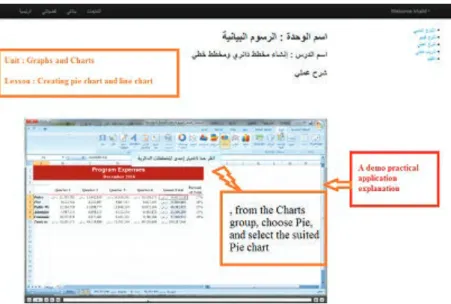
2. Demonstration through which students can see a practical application of what they have learned from the lesson. This is shown in Figure 8, where the steps for creating a pie chart are demonstrated to the students with explanation such as “First, we first select the range of cells. Then by clicking the Insert tab, from the Charts group, choose Pie, and select the suited Pie chart,” This is shown in the following figure (Figure 8).
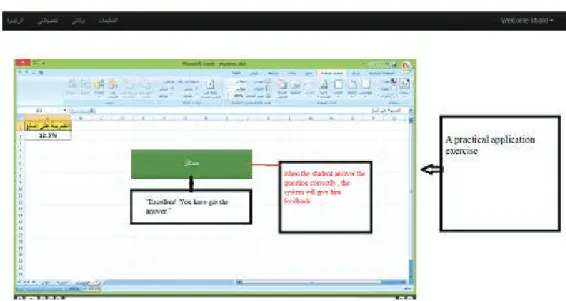
3. Practical exercise through which students can work on developing specific skills related to the lesson. When students respond incorrectly, the system provides hints for the correct answer, such as in the case of the lesson “Changing the Sheet Direction.” For this lesson, the students are required to change the direction of the page from right to left. They should first click on the Brought to you by | Periodicals Section, Albert Sloman Libr.
Authenticated Download Date | 12/13/16 4:06 PM
Figure 4. The main interface of the developed online learning system
Figure 5. The learning units designed for both Excel and PowerPoint
Figure 4. The main interface of the developed online learning system
Figure 5. The learning units designed for both Excel and PowerPoint
Figure 6. The main lesson interface
Figure 7. Text explanation interface for creating the pie chart lesson
Figure 8. Practical demo showing the steps for creating the pie chart lesson
Figure 9. Practical exercise showing the steps for changing the chart direction (when students respond incorrectly)
Brought to you by | Periodicals Section, Albert Sloman Libr. Authenticated Download Date | 12/13/16 4:06 PM
![Figure 1. (a) Structure of the type-2 FLS [25], (b) An interval type-2 fuzzy set](https://thumb-us.123doks.com/thumbv2/123dok_us/11002816.2987796/4.892.465.775.413.957/figure-structure-type-fls-interval-type-fuzzy-set.webp)