Innovating the
development of Work
Focussed Learning in
higher education
Stephen Powell
Portfolio of evidence submitted in partial fulfillment of the
requirements of the University of Bolton for the degree of
Doctor of Philosophy on the basis of practice.
May 2013
This work is licensed under the Creative Commons Attribution 2.0 UK: England & Wales License. To view a copy of this license, visit
Table of Contents
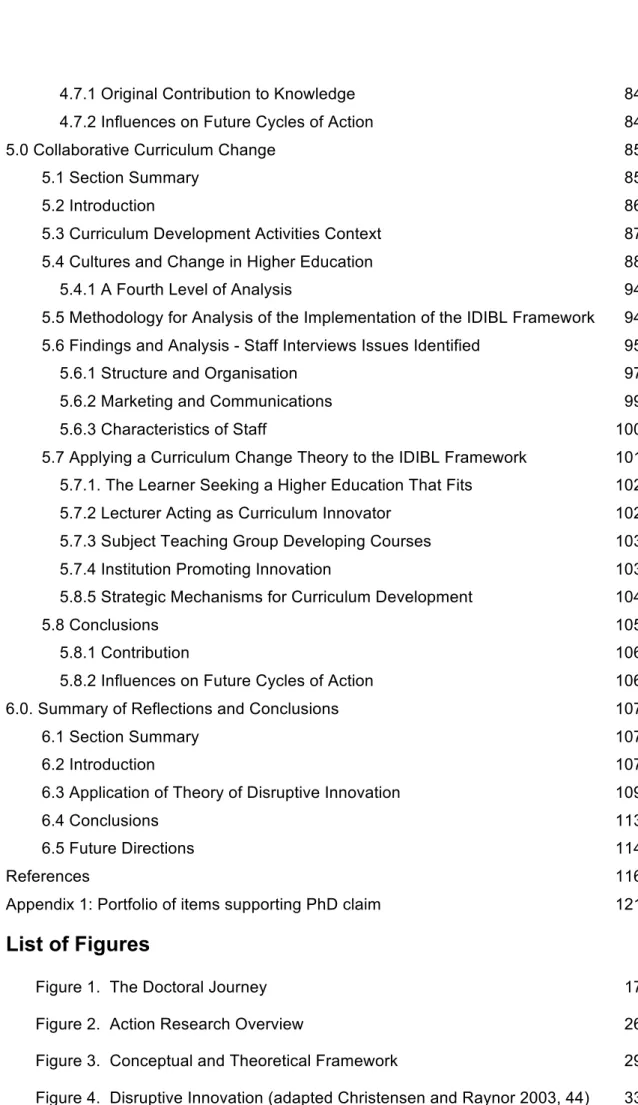
Table of Contents 2
List of Figures 4
List of Tables 5
Acknowledgements 6
Candidates Declaration Form 7
Prologue 8
Abstract 12
1.0 Introduction 13
1.1 Section Summary 13
1.2 Approach of PhD by Practice 13
1.3 My Original Contribution to Knowledge 15
1.4 Background 16
1.4.1 My Employment 16
1.4.2 My Motivation 16
1.5 Context and Narrative 16
1.6 Methodological Approach 17
1.6.1 My Practice 18
1.6.2 Overarching Inquiry Strategy 18
1.6.3 Locating my Inquiry Paradigm 19
1.6.4 Constructing my PhD Claim 22
1.7 Basis of my Claim 23
1.7.1 Ten Years of Action Research 25
1.8 Organisation of PhD Sections 27
2.0 Conceptual and Theoretical Framework 29
2.1 Section Summary 29
2.2 Conceptual and Theoretical Framework 29
2.2.1 Organisation of Teaching 30
2.2.2 Innovative Curriculum Design 31
2.2.3 Collaborative Curriculum Change 31
2.2.4 Radical Curriculum Innovation 32
2.2.4.1 Theory of Disruptive Innovation 32
2.2.4.2 Sustaining Innovations 33
2.2.4.3 Disruptive Innovations 34
2.2.4.4 Application of Disruptive Innovation Theory 35
2.3 Application of Concepts and Theories to Practice 37
3.1 Section Summary 39
3.2 Introduction 41
3.3 Teachers and Online Distance Learning 41
3.4 Ultraversity Project Background 42
3.4.1 The Model of Work Focussed Learning 43
3.5 Teaching Practice 44
3.5.1 Ultraversity Teaching Practice 44
3.5.1.1 Activity Design 45
3.5.1.2 Facilitating the Online Community of Inquiry 47
3.5.1.3 Distribution of Teaching Effort 48
3.6 Reflection on Productivity Arrangements in Higher Education 49
3.6.1 Contracts of Employment 50
3.6.2 Measures of Productivity 51
3.6.3 Management and Organisation 52
3.6.3.1 New Managerialism 52
3.6.3.2 Ultraversity Management and Organisation 54
3.7 Conclusions 56
3.7.1 Original Contribution to Knowledge 57
3.7.2 Influences on Future Cycles of Action 58
4.0 Innovative Curriculum Design 59
4.1 Section Summary 59
4.2 Introduction 60
4.3 The IDIBL Framework 61
4.3.1 Philosophical Position 62
4.3.1 Curriculum 63
4.3.2 Adaptation of the IDIBL Framework 67
4.3.3 Use of the IDIBL Framework 67
4.4 Pedagogic Approach 68
4.4.1 Student Support 68
4.4.2 Personalisation 68
4.4.3 Assessment 69
4.5 Evaluation of the IDIBL Framework 70
4.5.1 Methodology 70
4.5.2 Staff and the Framework 71
4.5.3 Marketing the Framework to Employers and Students 72
4.6 The Cybernetic Viewpoint 74
4.7.1 Original Contribution to Knowledge 84
4.7.2 Influences on Future Cycles of Action 84
5.0 Collaborative Curriculum Change 85
5.1 Section Summary 85
5.2 Introduction 86
5.3 Curriculum Development Activities Context 87
5.4 Cultures and Change in Higher Education 88
5.4.1 A Fourth Level of Analysis 94
5.5 Methodology for Analysis of the Implementation of the IDIBL Framework 94
5.6 Findings and Analysis - Staff Interviews Issues Identified 95
5.6.1 Structure and Organisation 97
5.6.2 Marketing and Communications 99
5.6.3 Characteristics of Staff 100
5.7 Applying a Curriculum Change Theory to the IDIBL Framework 101
5.7.1. The Learner Seeking a Higher Education That Fits 102
5.7.2 Lecturer Acting as Curriculum Innovator 102
5.7.3 Subject Teaching Group Developing Courses 103
5.7.4 Institution Promoting Innovation 103
5.8.5 Strategic Mechanisms for Curriculum Development 104
5.8 Conclusions 105
5.8.1 Contribution 106
5.8.2 Influences on Future Cycles of Action 106
6.0. Summary of Reflections and Conclusions 107
6.1 Section Summary 107
6.2 Introduction 107
6.3 Application of Theory of Disruptive Innovation 109
6.4 Conclusions 113
6.5 Future Directions 114
References 116
Appendix 1: Portfolio of items supporting PhD claim 121
List of Figures
Figure 1. The Doctoral Journey 17
Figure 2. Action Research Overview 26
Figure 3. Conceptual and Theoretical Framework 29
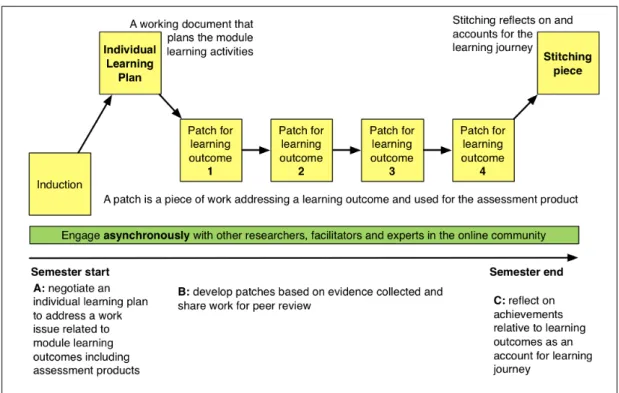
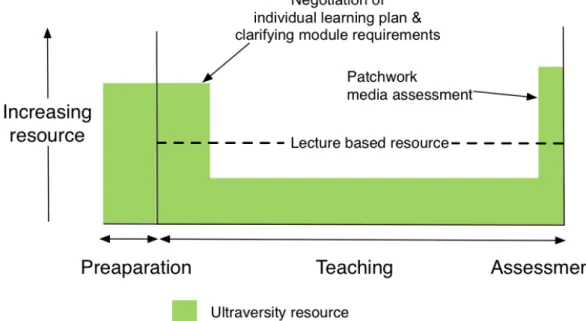
Figure 5. Patchwork-media Approach 46 Figure 6. Schematic Representation of Teaching Resource 49
Figure 7. IDIBL Modules [P23 p8] 63
Figure 8. System in Focus – IDIBL Designed Course (After Beer 1985, 27) 75 Figure 9. Ultraversity as a Disruptive Innovation 112
List of Tables
Table 1. My Role, Practice, and Project Context 24
Table 2. Significant Aspects of Practice 1 40
Table 3. Significant Aspects of Practice 2 60
Table 4. Framework Learning Objectives [P25 p4-5] 65
Table 5. Learning Outcomes and Assessment Criteria 66
Table 6. Analysis of Requisite Variety 80
Table 7. Proposal to Match Variety Issues Related to Teaching 83 Table 8. Significant Aspects of Practice 3 86
Table 9. Analyses of the Implementation of IDIBL Framework using Trowler 92
Table 10. Summary of Categories of Response 96
Table 11. Strategic Choices for Innovative Curriculum Development 105 Table 12. Business Model Analysis of Key Functions of Taught Programmes 110
Acknowledgements
The ideas presented in this thesis have been developed through my work with a large number of people over the past 10 years and I am very grateful to them for the many conversations I have had.
In particular, I would like to thank the team who worked on the Ultraversity project and Stephen Heppell for the fantastic opportunity to lead the project.
Oleg Liber provided me with an opportunity to take the ideas developed by the Ultraversity project a stage further. I thank him for this and for the introduction he gave me to Cybernetics and the Viable Systems Model.
I would like to thank Richard Millwood who has been a co-conspirator on projects that make up this thesis and a supervisor whilst writing it up. I would also like to thank Dai Griffiths for his supervisory work knocking this document into shape, and Bill Oliver for introducing me to Disruptive Innovation!
Lastly, thanks to Joy for proof reading and for giving me the support and time to write this work up.
Prologue
This section outlines my work and life experience that has shaped my beliefs about learning and teaching.
My years before work can be summarised succinctly as a rural upbringing,
educated in a small village primary school followed by a Comprehensive School. This had recently changed from a Secondary Modern School in the old Tripartite System of Eleven Plus examinations. Reflecting back, with a few notable
exceptions, this was for the most part an educationally barren experience. On completion of my A Levels at Goole Grammar School, I studied Geology at the then named City of London Polytechnic.
My working life started out in the oil fields of the North Sea working as a ‘mud logger’ in line with my degree in Geology. This was a short and personally
unrewarding episode in my career and resulted in my swapping the oil industry for civil engineering, again making use of my first degree, but this time as a
geotechnical engineer. Over a three-year period, I had an enjoyable time and learned at lot about the civil engineering business. However, for some reason this was not satisfying enough and I felt drawn towards working with people in a
developmental or educational role. I think, in part, this was a reaction to my own educational experiences that resulted in me wanting to contribute to giving other people better educational opportunities in life. Without wishing to sound too grand, I believe that educational opportunity is a right for all.
As a way of making a change, I gained my teaching qualification in 1992 and set forth as an enthusiastic geography teacher at the Sowerby Bridge High School. The key lesson of the first year of my teaching career taught me how ineffective some schools could be. However, in 1993, I joined Brooke Weston City
Technology College (CTC) in Corby, an initiative by the then Secretary of State for Education, Kenneth Baker, to ‘transform’ the education system to make schools more like the workplace. It was not a philosophical decision to join a CTC, at the time it was an initiative that was very politically charged; for me it was about job security. However, it turned out to be the single most important formative experience in the development of my values and beliefs around learning and teaching.
During this period I became convinced of the following learning, teaching and assessment aphorisms:
1. from the perspective of the educational institution, the most effective way of organising and delivering education is by using team teaching approaches;
2. learning designs can describe a process that allows for differentiation through outcomes rather than through setting of students by ability for constraining inputs;
3. effective feedback should include the formal and informal, self, peer, and teacher evaluation;
4. with the support of teachers, learners can, from an early age, identify their own personal learning trajectory.
These ideas have informed the subsequent work that forms the basis of my PhD claim.
Being a new school, the Principal of the CTC was able to establish a strong ethos amongst students and staff alike, and embed teaching practices that included team teaching, inquiry based learning, differentiation through outcome, and the use of emerging Information and Communication Technologies (ICT) to underpin these approaches. To set this in context, the school was designed for flexible group working and, from 1993 was equipped at a high ratio throughout with Macintosh LC III (Performa 450) computers boasting colour monitors and the integrated ClarisWorks 2.0 productivity applications. In 1996, this was followed by the arrival of Internet connectivity that allowed access to resources on the World Wide Web. All of this had a big impact on my thinking about learning and
education and the affordances that ICT offered by way of allowing a greater range of ways for learners to achieve. Around this time, I began a part time Masters in Education at the University of Leicester. Reflecting back, this was the start of a process of moving my perception as teaching as a craft to a more informed and research led theoretical understanding.
In August 1998, another important milestone marking development in my
professional life came when I joined the Tesco SchoolNet 2000 project, run by the Ultralab research unit at Anglia Polytechnic University (APU), through a
secondment from the CTC. The job itself required me to support schools in the East Midlands in getting school children to undertake inquiries, linked to the National Curriculum and then publish them on the web through a form based interface – not dissimilar to the now familiar blog.
As this project drew to a close in December 1999, I was fortunate to be employed by APU in the Ultralab on the Talking Heads project, as a part of the establishment of the National College for School Leadership (NCSL). It proved successful in offering new forms of frequent access to knowledge for headteachers and senior managers in schools who, because of their busy schedules, were unable to readily make use of face-to-face courses that would have met their changing needs. My role in this was initially as an online facilitator of communities, and then as one of the project managers where I had a strategic input, including negotiating with the NCSL on a wide variety of online initiatives and coordinating the activities of the facilitation team of around 20 people until the end of 2003.
This was my first experience of working in online communities to support learners, who were educational professionals, on both formal programmes and in non-formal communities. The enduring memory of this experience was the difficulty in making the potential value of online communities a reality. The exception being when there was a clear purpose and requirement to participate or where there was a high profile event and limited activities.
These reflections were sharpened by the continuation of my Masters at Anglia Ruskin University, culminating in 2004 with a dissertation, presented online, which was, ‘An enquiry through personal experience into new technology and an
alternative approach to MA dissertation’. This was based on my work-practice at the time and provided a starting point for the central premise of my PhD thesis that, ‘work can form the basis for learning, which can then be accredited by Higher Education’.
What followed were three other significant projects that form the basis of my claim for PhD by Practice between January 2004 and July 2012. My motivation for undertaking the PhD was that I wanted to gather my experiences of projects in different contexts into a credible body of thought, that has been critically evaluated
and reflected upon. This is to consolidate my knowledge and prepare me for a continuing professional and academic career.
Abstract
This thesis presents my practice as an action researcher in higher education (HE) over a ten-year period, developing courses for students who were unable to take advantage of the existing provision in the institutions in which I worked. The
knowledge I gained and practices that I developed contributed to a series of cycles of action research and the conclusions I draw at the end of the thesis are used to propose a further cycle. The curricula that I developed and delivered were
designed for students who had a strong commitment to their work and wanted to improve it, but at the same time wanted to gain academic qualifications; the central premise behind this work being that, ‘work can form the basis for learning, which can then be accredited by higher education’. Although study was based around the work that a student did, their employer had no formal relationship with the university offering the courses. Students were attracted to a package that offered personalised and flexible learning at a cost that was affordable to them. The contributions to knowledge that I make relate to the organisation of teaching, the nature of the innovative curriculum design and the collaborative curriculum change processes carried out. Using this approach, learners make improvements in their work context to gain academic credit from the scholarly practices they have applied to inform and evaluate their activities. The findings suggest that a
curriculum design using a teaching and learning strategy based on action-inquiry, delivered entirely online, can be successful in enabling students to work full-time and gain academic credit at a full time rate. However, the results also revealed that there are significant institutional barriers that need to be overcome to implement such a curriculum design that is radically different in having a non-traditional curriculum and unique ways of working. The key recommendation from this body of work is that radical curriculum innovations in HE are more likely to be successful if a separate business unit is established with control over its own capability development. By having control over processes, staffing, and a
technical systems infrastructure, a separate business unit is able to respond to the new and different demands placed on it, developing its own culture and identity that fit with a new business model.
1.0 Introduction
1.1 Section SummaryThis section first explains the approach of Doctor of Philosophy (PhD) on the basis of practice including some of the methodological challenges it brings. I briefly outline my original contribution to knowledge that forms the basis for my claim for a PhD on the basis of practice with the title, ‘Innovating in the development of Work Focussed Learning in higher education’. The background to my practice is given, followed by a description of the context and narrative of my work and employment. I explain and justify my methodological approach and the basis of my claim for an original contribution to knowledge is introduced, and the further sections of my submission are outlined.
1.2 Approach of PhD by Practice
My choice of the PhD by Practice route was made possible by the validation in 2008 of Regulations and Procedures governing the award of the degrees of Doctor of Philosophy by Practice at the University of Bolton. The university is not alone in adopting new approaches; there is sector-wide interest in the development of new forms of doctorate as institutions seek to respond to external pressures for change by developing new routes and provision, albeit with slow sector-wide adoption (Park 2005, 201-202). Costley and Leicester (2011) review different types of PhD for professionals and identify different examples as work-based doctorates with particular characteristics:
Candidate-driven, emerges from context-based concerns, effects professional development for the candidate, and uses an (action-oriented) research perspective to create practical development and change (ibid., 259).
The above description could be applied equally well to the model of Work Focussed Learning that has been at the heart of my work in developing new courses. The learner in their work context is the starting point and it is they who identify their action-oriented learning needs that form the curriculum, rather than an academic discipline or professional subject.
Costley and Lester refer to a study based on a leading provider of work-based doctorates that examined the characteristics of the projects undertaken by students and from this identify four types. The fourth fits well with a PhD on the basis of practice:
A fourth group of outputs (18%) were essentially syntheses, taking collections of substantial work that ranged from closely-related projects to outputs over a substantial part of career [sic], and reflecting on them to produce material for dissemination or with which to take forward a development or agenda (2011, 262-263).
My own doctoral practice is summarised well by the above quote. In practical terms, the approach I took has involved me in assembling my past ten years of research and scholarly practice into a portfolio, and with this accompanying commentary I am seeking to bring coherence to the body of work. The portfolio includes peer-reviewed papers, internal documents, project reports and a reflective journal maintained as a blogs. In my claim, portfolio elements are identified by square brackets with a reference to the portfolio and page number thus, [P5 p33].
It is my intention that this PhD submission, based on my portfolio, is reflective and scholarly in nature to address the UoB criteria for PhD by practice in that it,
“contextualises, analyses and discusses the portfolio and sets out the case for it to be considered an original and independent contribution to knowledge“ (UoB 2008, 3). The regulations require a minimum of 10,000 words for this form of PhD. This thesis has around 30,000, and it should be considered along with the portfolio of work that accompanies it.
I wish to make clear at the outset that in authoring my claim I encountered a significant methodological challenge that is probably inherent in all PhDs by Practice where the work was collaborative in nature. This difficulty lies in the identification of the extent of the contribution that I can claim to have made, and the nature of practice that makes, “an original and substantial contribution to knowledge” (ibid., 2), as they include contributions that were mine alone, as well as those that were shared and developed in collaboration with others. To partially address this, in the portfolio I have identified a percentage of the work that was
mine and have agreed this with my collaborators. Another complication is that in some cases contributions were theoretical in nature, and in other cases resulted in the development of innovative practice.
1.3 My Original Contribution to Knowledge
My contributions to knowledge are explained and developed in chapters 3-7 of my thesis, which include, a description of my work practices that they are based upon. These are outlined in Section 1.7. It is probably helpful to outline my contribution at the outset:
1. conceptual development of new working practices in higher education that delivered the model of Work Focussed Learning. This was developed through my work on the Ultraversity project, and is discussed in Section 3, Organisation of Teaching;
2. the IDIBL Framework as a strategic mechanism to bring about cross institutional adoption of the model of Work Focussed Learning. This was developed through my work on the IDIBL project, and is discussed in Section 4, Innovative Curriculum Design;
3. cybernetic analysis of the pedagogy of the model of Work Focussed Learning in delivering a personalised curriculum. This was developed through my work on the IDIBL project, and is discussed in Section 4, Innovative Curriculum Design;
4. critical analysis of institutional barriers to adoption of the model of Work Focussed Learning. This was developed through my work on the IDIBL project and is discussed in Section 5, Collaborative Curriculum Change; and
5. critical analysis of the challenges faced by radical curriculum innovation in higher education developed as a synthesis of the above contributions and is discussed in Section 6, Summary of Conclusions and Reflection.
In contribution 5, I am seeking to understand systemic change in complex human systems – why is it so hard? This is the culmination of this phase of my
professional practice and is addressed in the concluding Section 6, Summary of Reflection and Conclusions.
1.4 Background
The background to my PhD by practice is outlined, including my recent
employment history, motivation for undertaking this work, and the context and narrative that shows the progression between the projects I have worked on.
1.4.1 My Employment
I am currently employed as reader in Inquiry-based Learning in the Institute for Educational Cybernetics (IEC) at the University of Bolton. I have held this post since August 2007. Prior to that I was employed at Anglia Ruskin University (ARU) between January 2000 and December 2006, working in the Ultralab research unit. My practice as an innovator in higher education (HE) spans these two institutions over the nine years from 2003 to the present. Both of these institutions have strong traditions of innovative curriculum developments for undergraduate provision, with ARU at the forefront of developing approaches to negotiated, practice-oriented curricula in the workplace through initiatives such as the ASSET programme (Dann 1990, 53; Winter and Maisch 1996).
1.4.2 My Motivation
In the work I have undertaken, my concern has been to develop new approaches in HE to meet the needs of learners not attended to or catered for. This general interest in providing educational opportunities has its roots in my teaching career in secondary schools, and is further informed by a belief that opportunity for education and personal growth is a right for all, as explained in the Prologue. Personally, I have been fortunate to be able to align my work with my values, and when the opportunity arose to develop these values in HE, I decided to pursue it. 1.5 Context and Narrative
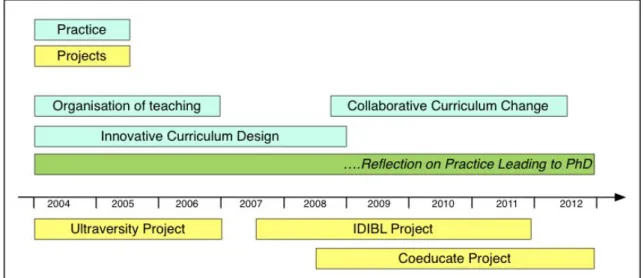
A chronology of the three curriculum development, action research projects and the aspects of my practice that were developed in them are shown by Figure 1, The Doctoral Journey. Although there is some correlation between the practice aspects and individual projects, there is also significant overlap between theory, and reflective practice that is consistently present throughout each cycle of action research, each being informed by, and building on the preceding. The common
thread running through the projects is the proposition that, ‘work can form the basis for learning, which can then be accredited by Higher Education’. This applies to the work of the projects and the creation of this PhD submission.
Figure 1. The Doctoral Journey
This submission constitutes for me a cycle of reflection and a planning opportunity for my career next steps. In alignment with the action research approach I have pursued, for dissemination purposes, I have chosen to publish my PhD as a website. This approach has allowed me to ‘walk-the-talk’ by using an action research approach in my own work as the basis for my submission, in much the same way that projects I have worked on require learners to use an action research approach for their study.
Throughout this practice, I have often worked with like-minded others who
challenged and debated not only the design of Work Focussed Learning, but also the development processes employed to achieve it and bring about a change in the system. This constituted a double-loop learning in my action research (Argyris and Schon 1978, 2-3) - hence the key verb in the title ‘innovating’ applies not only to the courses developed, but increasingly and consciously to the development processes applied to effect change.
1.6 Methodological Approach
My academic practice is described and my overall inquiry strategy set out, and this is followed by and explanation of how I constructed my PhD claim.
1.6.1 My Practice
The methodological approach for my PhD by professional practice has evolved as my academic practice has matured. In 2003, my experience of academic research was limited, and consequently I had contributed to only a few academic papers. At that time, I would describe myself as consciously working in a critically reflective way within a constructivist paradigm where the credibility of my interpretations to others and myself was the most important factor in my work. Over time, my competency as a researcher developed. I gained a Masters in Education that required significant engagement with methodological considerations. As I became the lead author for peer reviewed papers, the range of research methods for collecting data and research strategies that I used broadened. I took a pragmatic approach selecting the research tools and strategies to address the task at hand, taking the stance of the qualitative researcher as bricoleur (Denzin and Lincoln 2005, 4-5). My portfolio of publications in peer-reviewed journals, weblog entries, other published documents, conference presentations and reports demonstrate this.
1.6.2 Overarching Inquiry Strategy
In undertaking my work, I have been guided by the principles of action research (AR) as described by Kurt Lewin in a paper in 1946, Action Research and Minority Problems (Lewin 1973, 205-6), who gave momentum to the pivotal idea of
planning cyclical interventions for improvement. This is based on initial fact finding around an idea, planning an overall strategy and identifying first steps, taking action and then evaluating the outcomes, and using this to inform modifications to the overall plan and informing next steps. In particular, in relation to my work practice, I subscribe to the notion that, “Research that produces nothing but books will not suffice” (ibid., 203). The action research approach has provided me with a way of establishing coherence in my work over time, with each new cycle of
activity informing the planning of the next and so on.
I also subscribe to the idea that AR should be embarked upon as a “systematic enquiry undertaken to improve a social situation, then made public.” (McNiff and Whitehead 2009, 11), and this is evidenced by the online publication of this PhD claim. As a qualitative researcher, it is incumbent on me to make clear my own
values that are a part and parcel of the research I have undertaken, determining the actions I took and colouring my evaluation of them. In the Prologue to my submission, these are further outlined and explained.
For the purpose of my thesis it is also my aim to develop theory, and the validity of the action research I have undertaken comes, in part, from the extensive collection and analysis of qualitative data including online surveys, questionnaires and semi-structured interviews that I have carried out as part of my work, but most
importantly through the shared development of knowledge with critical
collaborators. Throughout the period I have maintained an online reflective journal to note critical incidents for subsequent reflection and analysis. Reference to action research will be found throughout the portfolio accompanying this claim in relation to my practice and the curriculum that I designed for learners as students in HE. The implications of this approach are discussed below.
1.6.3 Locating my Inquiry Paradigm
Guba and Lincoln (1994,108), use three questions to identify the ‘basic beliefs’ that underpin different inquiry paradigms:
1. The ontological question. What is the form and nature of reality and, therefore, what is there that can be known about it?
2. The epistemological question. What is the nature of the relationship between the knower or would-be knower and what can be known?
3. The methodological question. How can the inquirer (would-be knower) go about finding out whatever he or she believes can be known?
Based on these questions, Guba and Lincoln (ibid.) identify four paradigms:
positivism; postpositivism; critical theory; and constructivism. In 2005 (195), based on the work of Heron and Reason (1997, 274-294), Guba and Lincoln adopted inquiry into their schema as a fifth paradigm. It is this inquiry paradigm that I identify as most relevant to the action-oriented work and research that I have undertaken. However, as pointed out by both sets of authors, there is much commonalty with the basic beliefs of the constructivist paradigm. Guba and
who follow new paradigms, those that are non-positivist and further that these paradigms are beginning to "interbreed".
In aligning myself with a particular inquiry paradigm, I am bound in my thesis to explain its relevance to the particular approach to research that I have undertaken. The implications of this for the nature of my contribution to knowledge are
discussed below using the three questions identified by Guba and Lincoln as well as a fourth question of axiology, or values, added by Heron and Reason as part of their characterisation of an inquiry paradigm. I address each of these questions in turn.
1. “Ontology: participative reality - subjective-objective reality, co-created by mind and given cosmos.” (Heron and Reason 1997, 289). I subscribe to the belief that it is our active participation in the world that, “is the ground of our being and knowing“ (ibid., 276), and that our understanding of this interaction is framed by our own prior experience. Thus, I believe that we learn and come to know through a process of ‘negotiation of meaning’ and that those I have worked with, give validity to knowledge created through their criticality and sense making of their actions. Although for the purpose of my thesis I am bound to express my knowing using propositional
language.
2. “Epistemology: critical subjectivity in participatory transaction with cosmos; extended epistemology of experimental, propositional, and practical
knowing; co-created findings” (Ibid., 276). Heron and Reason (ibid., 280-283) identify for ways in which we articulate what we know about the world “experiential, presentational, propositional, and practical”. Their key
argument is the importance of us recognising the interrelationships between the different ways of knowing and how at a given point in time, the way in which we know something. Their view of knowledge places the practical that is ‘knowing how to do something’, as the most substantial way of knowing, as it expresses itself by using the other three forms. As an action researcher, it is this ability to bring about positive change that had driven my work, and I would argue that my claim demonstrates this combination of forms of knowledge in that the nature of my original contribution to
knowledge (portfolio section 1.3) was: developed from my experience; is presented through the artefacts in my portfolio, informed through the use of existing concepts and theories as well as making its own theoretical
contribution to understanding curriculum design, curriculum change, and the organisation of teaching; and its value and significance is manifest through the practical actions I have taken with others. The evidence of the quality of this knowledge is demonstrated by the impact that transformed participants (teachers and students) experiences of higher education where it continues to be developed, refines and accumulated. I believe that in my thesis, I demonstrate the intrinsically collaborative nature of the work I have undertaken.
3. “Methodology: political participation in collaborative action inquiry; primacy of the practical; use of language grounded in shared experiential context.” (Ibid.) There are many different approaches to action research. Broadly, I would argue that the work I have undertaken is best described as
Cooperative Inquiry (Heron and Reason 2006, 144-152), although no one model was slavishly followed “grounded in our experience, expressed through our stories and images, understood through theories which make sense to us, and expressed in worthwhile action in our lives” (Ibid., 149). At its heart, Cooperative Inquiry recognises an approach where people with similar concerns work together to make sense of their world, develop
creative ways of considering problems and learn how to bring about change in things that they want to do better. Heron and Reason (ibid.) identify two participatory principles: epistemic participation, “propositional knowledge that is the outcome of the research is grounded by the researchers in their own experiential knowledge”; and political participation, “research subjects have the basic human right to participate fully in designing the research that intends to gather knowledge about them.” This approach rejects the
division of practitioner and researcher into different roles. Instead, it sees inquiry as social process that is emancipatory in that it tries to remove limiting constraints on those who participate as both researchers and themselves as the subject of the research. In the three projects that form the basis of my thesis, from the outset it was made clear that they were to
follow an action research approach and that anyone who chose to join in did so on an equal footing with the existing project team, co-owning the inquiry being undertaken.
4. “Axiology: practical knowing how to flourish with a balance of autonomy, co-operation and hierarchy in a culture is an end in itself, is intrinsically
valuable” (Ibid.). Heron and Reason (1997, 288) express their view of axiology through a spiritual lens. However, for me the significant purpose of inquiry is a very practical one that is to engage in society to support the development of capabilities in those who are less able to take ownership and control of their own circumstances to develop the agency to so do.
1.6.4 Constructing my PhD Claim
In this submission, I attempt to demonstrate the achievements in my practice, and how this contributes to knowledge by generating explanatory theories and models. This is done with the aim of understanding what happened to inform future cycles of my action and as a source of inspiration for others.
In testing that the claims for knowledge stand up to scrutiny, I have extended the questions below, from McNiff and Whitehead (2009), as a robust set of criteria to help me judge the quality, validity and effectiveness of my submission:
1. is the development of my practice clearly explained? 2. am I confident in the interpretations I arrive at?
3. are my explanations grounded in literature and thereby convincing to others? and
4. have I made an original contribution to knowledge and practice? Winter, Griffiths and Green (2000) suggest criteria, based on an empirical study, on "how to produce and judge practice-based PhDs", motivated by their
observation of the development and growth of practice-based doctorates and the challenge this posed for assessment. A minimum set of high level criteria are suggested for a practice based PhD:
1. be a report of work others would want to read;
3. carry the reader into complex realms, and inform and educate him/her; 4. be sufficiently speculative or original to command respectful peer
attention. (ibid., 36)
In addition, they indicate in a more prosaic additional list developed from their own experience:
1. contains innovative insights into practice;
2. of value to help other practitioners improve their performance; 3. shows clear evidence of professional development and innovation; 4. contains evocative, detailed description of a very high level of
professional creativity, sensitivity and responsibility;
5. articulates clearly the relationship between the research role and the practitioner role. (ibid., 32).
I suggest that these and similar criteria would be valuable to readers of this PhD claim when considering its worth.
1.7 Basis of my Claim
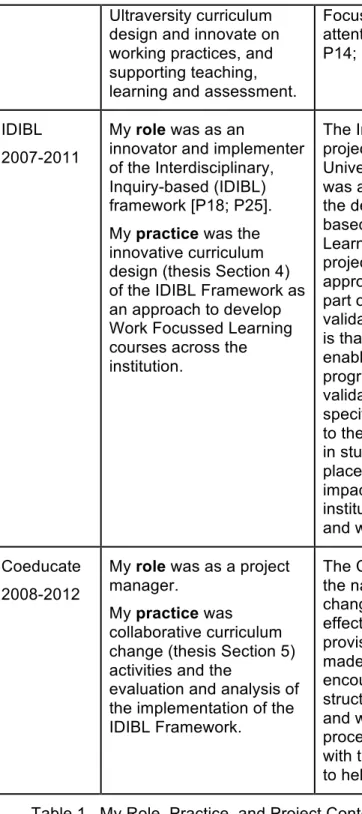
Three action research projects are outlined in Table 1 along with a brief
description of my role in the projects and the practice that I developed that forms the basis of my PhD claim.
Project title My role and practice Project context Ultraversity
2003-2006
My role was as the director of the Ultraversity project leading a
multidisciplinary team of 24 [P3; P4]. This included learning facilitators, software and media developers, and administrative support staff.
My practice was
managing the academic team (thesis Section 3) using an action research approach. This approach helped the team respond effectively to the
The Ultraversity project was established to develop a new model for undergraduate HE to “reach the people that normal residential universities can’t” [P1]. To do this, a particular set of pedagogical and
organisational arrangements were made: the course was delivered entirely online; day-to-day work is the focus of students learning, rather than a subject or academic disciplines; and the use of the action-inquiry process for teaching and learning. This approach makes it possible to work full-time and also gain academic credit at a full-time rate. The impact of this work came through the BA (Hons.) Learning, Technology and Research degree programme that graduated 140 students in its first full cohort [P16]. This approach later became labelled as Work
Ultraversity curriculum design and innovate on working practices, and supporting teaching, learning and assessment.
Focussed Learning [P20], attracting media attention as ‘something’ different in HE [P7; P14; P15].
IDIBL 2007-2011
My role was as an
innovator and implementer of the Interdisciplinary, Inquiry-based (IDIBL) framework [P18; P25]. My practice was the innovative curriculum design (thesis Section 4) of the IDIBL Framework as an approach to develop Work Focussed Learning courses across the institution.
The Interdisciplinary Inquiry-based Learning project (IDIBL) was developed at the
University of Bolton, and funded internally. It was an institution wide change initiative for the development of new programmes that are based on the ideas of Work Focussed
Learning developed by the Ultraversity project. A description of the pedagogical approach including module descriptions as part of a framework was developed and validated. The significance of this approach is that it offers a change mechanism that enables the agile development of new
programmes in different faculties re-using the validation documentation including module specifications. In addition, it offers a solution to the problem of managing the wide variety in student needs who are studying in the work place [P21 p70; P23 p7; P33 p266-272]. The impact of this work has been felt across the institution as a stimulus to new programmes and ways of thinking about curriculum design. Coeducate
2008-2012
My role was as a project manager.
My practice was collaborative curriculum change (thesis Section 5) activities and the
evaluation and analysis of the implementation of the IDIBL Framework.
The Coeducate Project sought to understand the nature of curriculum innovation and change across the university to improve the effectiveness and efficiency in developing provision. The need for such a project was made apparent by the IDIBL project, which encountered numerous barriers including structural, business processes, and culture and ways of working. The work included process redesign and staff capability building with the deployment of supportive technology to help achieve this.
Table 1. My Role, Practice, and Project Context
As I reflected on the different cycles of my practice as a part of the PhD application process, I have identified particular aspects of the work that I have undertaken, that I believe are original contributions to knowledge, and offer significant
opportunity for further analysis and reflection for my PhD submission. These are discussed in Sections 3, 4 and 5 of this thesis.
1.7.1 Ten Years of Action Research
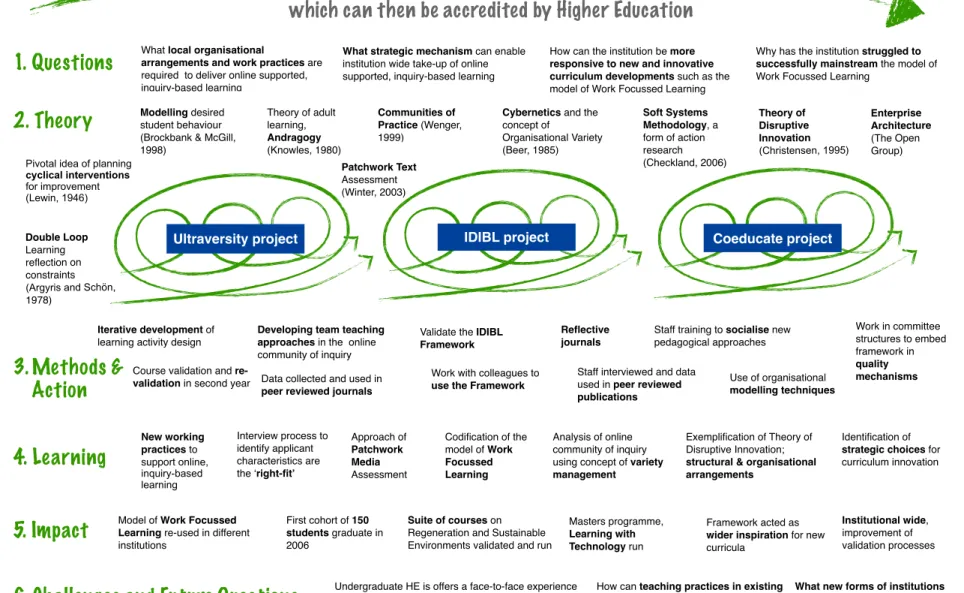
Figure 2 gives an action research overview of my inquiry over a ten-year period under the umbrella concept of work forming the basis for learning that can be accredited by higher education. It seeks to make the connections between the questions that drove the cycles of inquiry, indicate the propositional forms of knowledge that were used to support the planning and identifying the different types of learning or knowledge developed from the results and impacts of the actions and methods deployed. It is partial in nature, but is designed to make concrete the scope of the inquiry I have undertaken and point to the challenges and future challenges for the type of curriculum innovation I have developed.
Figure 2. Action Research Overview Interview process to identify applicant characteristics are the ‘right-fit’ Exemplification of Theory of Disruptive Innovation; structural & organisational arrangements
Analysis of online community of inquiry using concept of variety management New working practices to support online, inquiry-based learning Identification of strategic choices for curriculum innovation Codification of the model of Work Focussed Learning
4. Learning
Approach of Patchwork Media Assessment5. Impact
First cohort of students graduate in 150 2006Suite of courses on Regeneration and Sustainable Environments validated and run
Institutional wide, improvement of validation processes Framework acted as
wider inspiration for new curricula
Model of Work Focussed Learning re-used in different institutions
Masters programme, Learning with Technology run Validate the IDIBL
Framework
3. Methods &
Action
Course validation and re-validation in second year Iterative development of learning activity design
Staff training to socialise new pedagogical approaches
Use of organisational modelling techniques Data collected and used in
peer reviewed journals
Staff interviewed and data used in peer reviewed publications Work with colleagues to
use the Framework
Work in committee structures to embed framework in quality mechanisms Developing team teaching
approaches in the online community of inquiry
Reflective journals Action Research Overview
Work can form the basis for learning,
which can then be accredited by Higher Education
1. Questions
What arrangements and work practiceslocal organisational are required to deliver online supported, inquiry-based learningHow can the institution be more responsiveto new and innovative curriculum developments such as the model of Work Focussed Learning Whatstrategic mechanism can enable
institution wide take-up of online supported, inquiry-based learning
Why has the institution struggled to successfully mainstream the model of Work Focussed Learning
6. Challenges and Future Questions....
What new forms of institutions are required to effectively operate radically new approaches to HE How can teaching practices in existingHEI be modernised to capitalise on the opportunities of new technologies Undergraduate HE is offers a face-to-face experience
built around disciplines and subject specialisms & existing staff and students value and prefer this
Cybernetics and the concept of
Organisational Variety (Beer, 1985)
Coeducate project Ultraversity project
2. Theory
Modelling desired student behaviour (Brockbank & McGill, 1998) Patchwork Text Assessment (Winter, 2003) Double Loop Learning reflection on constraints (Argyris and Schön, 1978)Pivotal idea of planning cyclical interventions for improvement (Lewin, 1946) Theory of adult learning, Andragogy (Knowles, 1980) Soft Systems Methodology, a form of action research (Checkland, 2006) Communities of Practice (Wenger, 1999) Enterprise Architecture (The Open Group) Theory of Disruptive Innovation (Christensen, 1995) IDIBL project
1.8 Organisation of PhD Sections
The PhD by practice route is in its infancy at the University of Bolton and as such there are few models to emulate. I have, therefore devised my own ‘architecture’ that meets the requirements of the regulations. I have briefly outlined the different sections below to indicate their purpose.
Prologue. A description of my journey from school teacher to Higher education curriculum developer. This section gives a pen portrait of myself to help the reader understand my motivation and experiences of learning and work.
Abstract. An outline of the thesis including context, methodology and findings.
Section 1 - Introduction. In this section, I give an overview of my thesis and prepare the ground for the reader to understand the following sections that make up the substantive part of my claim.
Section 2 - Conceptual and Theoretical Framework. In this section, I explain the key concepts that I have used to identify and reflect upon my practice and indicate the key theories that contribute to an explanation and understanding of them and how my work practice is tied together.
Section 3 - Organisation of Teaching. In this section, I reflect on the teaching practices and productivity arrangements developed to support the model of Work Focussed Learning in the Ultraversity project from the perspective of the manager of the academic team. To guide the development of an original contribution to knowledge, I have reflected on the question, what are the organisational
implications for higher education institutions seeking to develop online, distance, learning? This led to contribution 1, identified on page 9.
Section 4 - Innovative Curriculum Design. In this section, I describe the IDIBL Framework and apply cybernetic thinking to analyse its pedagogical and
organisational characteristics and evaluate it as an approach to organsiational wide curriculum development. To guide the development of an original
institutional wide curriculum change? This led to contribution 2 and 3 identified on page 9.
Section 5 - Collaborative Curriculum Change. In this section, I identify the challenges faced when seeking to implement radically new curriculum in existing departments through my practice in collaborative curriculum change, supporting colleagues to develop their own programmes using the IDIBL Framework. To guide the development of an original contribution to knowledge, I have reflected on the question, what were the challenges when implementing radical curriculum innovation through the IDIBL Framework? This led to contribution 4, identified on page 9.
Section 6 - Summary of Conclusions and Reflection. This section draws together the previous sections and offers some explanations about why some practice was more successful than others and how to set up the conditions for radical and disruptive innovations. To guide the development of an original contribution to knowledge, I have reflected on the question, what are the strategic choices when implementing radical curriculum innovation in higher education? This led to contribution 5, identified on page 9.
2.0 Conceptual and Theoretical Framework
2.1 Section Summary
This section identifies the concepts and theories that have informed my reflections, analysis and evaluation of my work selected for this claim. They were identified through a process of reflection in the writing up of my claim, are introduced here as an overview, and are revisited in subsequent sections where I apply them to my practice.
2.2 Conceptual and Theoretical Framework
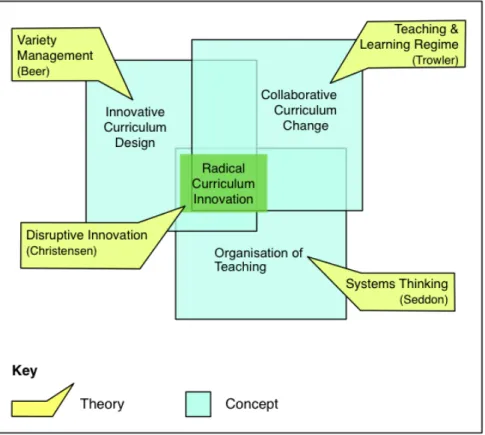
Figure 3 is an illustrative diagram showing the concepts (blue) with related key theoretical approaches and authors (yellow) that have been most valuable to me in identifying my original contribution to knowledge and practice innovating on Work Focussed Learning in higher education (HE). Although theoretical approaches are attributed to a particular concept, they are not restricted to a particular cycle of action research. These concepts and theories are introduced in turn.
2.2.1 Organisation of Teaching
In my role as the Ultraversity Project Manager (thesis table 1, 21-22), I had the opportunity to establish a new approach to the organisation of the delivery of a degree programme that used the model of Work Focussed Learning [P20 p97; P21 p66]. This is the focus of my first original contribution to knowledge: the conceptual development of new working practices in HE that delivered the model of Work Focussed Learning.
In practical terms, managing the Ultraversity project using an action research (AR) approach meant that choices about the organisation of teaching for the model of Work Focussed Learning was shared with those undertaking the work of teaching and supporting the students.
Although not known to me when I adopted an AR approach, there is a relationship to systems thinking which was introduced to me when I joined the Institute for Educational Cybernetics in 2007. Flood (2007, 117-143) highlights this
connection; he makes the point that thinking in terms of whole systems develops the basis on which to undertake action research. This requires an understanding about the inherent complexity of social systems brought about by individual interpretations and the relationships between different parts of a system rather than seeing ‘problems’ in isolation that can be directly controlled. Modelling of a situation to a useful level of generalisation is a tool of systems thinking that is of great help to action researchers.
Reflecting on my experience managing the Ultraversity project, I have found Seddon’s analysis informative, particularly his critique of ‘deliverology’ (2008, 108-120), as an approach to the improvement of the public services, championed by Sir Michael Barber when head of the Blair governments Delivery Unit.
Deliverology is founded on the idea that hierarchical target setting and monitoring, a command and control approach, leads to improvements. It is argued by Seddon, and I agree, that command and control is detached from the reality of the context in which the work is being undertaken resulting in poor decision making, and contributing to ineffective organisations (ibid., 70-71).
2.2.2 Innovative Curriculum Design
In my role as curriculum innovator and implementer of curriculum design (thesis table 1, 21-22), I led the development of a strategic mechanism in the IDIBL Framework [P23] designed to bring about cross-institutional adoption of the model of Work Focussed Learning. This is the focus of my second and third original contribution to knowledge: a strategic mechanism to bring about cross institutional adoption of the model of Work Focussed Learning; and a cybernetic analysis of the pedagogy of the model of Work Focussed Learning in delivering a
personalised curriculum.
The concept of Variety Management is important in Cybernetic analysis and is used as a way of thinking about the complexity of a system. This idea as applied to the regulation of complex systems was developed by Ashby and applied to the management of organisational structures by Stafford Beer (1985) in his Viable System Model (VSM) for control between different parts of a system and its environment, constituting feedback loops.
An analysis of the pedagogy of the model of Work Focussed Learning, using the cybernetic concept of variety, illustrates how the curriculum design addressed the challenge of how to personalise a curriculum for the complexity exhibited by numbers of diverse learners, within limited resource constraints.
I use these ideas in Section 4, IDIBL Project - A Cybernetic Analysis of a University-wide Curriculum Innovation.
2.2.3 Collaborative Curriculum Change
In my role as a project manager, I sought to bring about collaborative curriculum change using the IDIBL Framework (thesis table 1, 21-22). I undertook an analysis of institutional barriers to adoption of the model of Work Focussed Learning through reflecting on this experience, and through gathering empirical evidence from colleagues. This is the focus of my fourth original contribution to knowledge: critical analysis of institutional barriers to adoption of the model of Work Focussed Learning.
The change process that has been at the forefront of my practice has been informed by Communities of Practice (Wenger 1999), which is based on the idea that negotiation of meaning and reification of terminology are the heart of the
development of a community with a shared practice, and within a common domain. More recently, I have better understood this dimension through the idea of
Teaching & Learning Regimes (Trowler 2008, 61-114) in HE, where the subject group level is identified as the common enterprise around which individuals and groups coalesce and where change can happen. This is explored in Section 5, Coeducate Project - The Challenge of Radical Curriculum Innovation in Higher Education.
2.2.4 Radical Curriculum Innovation
In Section 6, Summary of Conclusions and Reflections, I apply the theory of Disruptive Innovation (Bower and Christensen 1995) as a lens to consider my work in curriculum development, and undertake an analysis of the challenges that may be faced by a radical curriculum innovation in HE at an organisational level. I invite the reader to view the sections of the PhD through this lens by introducing their theory here. This is the focus of my fifth original contribution to knowledge: critical analysis of the challenges faced by radical curriculum innovation in higher education.
2.2.4.1 Theory of Disruptive Innovation
In their work on business innovation, Bower and Christensen (1995, 45-49) identify the dimensions of time and performance as being key to explaining the take-up of innovations, and these are used as the axis of the chart in Figure 4. In their early work the term technology is used but is replaced by innovation, typically a
combination of technology and a new business model that exploits it and its potential for rapid further development, and hence ‘disruptive innovation’ is the term I shall use.
Figure 4. Disruptive Innovation (adapted Christensen and Raynor 2003, 44)
For the purpose of this thesis, Figure 3 is a synthesis and simplification of several charts that are used to explain the theory of disruptive innovation. For a particular context, there will be a complex relationship between customers, the performance characteristics of products and services in particular market segments, and the capabilities of organisations operating or seeking to operate in those markets, and these will change over time. For example, what is one organisations’ sustaining innovation may be for a different organisation a disruptive one. As customers’ circumstances change, the performance characteristics that attract them to one product or another may also change.
Bower and Christensen make a distinction between ‘sustaining’ and ‘disruptive’ innovations, and these are explained below.
2.2.4.2 Sustaining Innovations
Sustaining innovations are typically incremental, but may be radical innovations that enhance an existing product or service along a performance trajectory that meets the demanding requirements of existing, mainstream, and in particular, top end customers who are prepared to pay for better performance.
Christensen and Roth (2004, 9) identify two classes of existing customers for whom sustaining innovations impact, “undershot customers, for whom existing products and services are not good enough, and overshot customers, for whom existing products and services are more than good enough”. In Figure 3, the dotted line represents average customer needs, gradually increasing over time, while the dashed line represents the improving performance of the product or service over time, typically at a faster rate than the average needs of the customers, and above or below the dashed line different customers will be overshot or undershot depending upon their particular needs relative to the performance of the product or service. For example, at a particular snapshot in time, the yellow shaded area represents the top end customers who are constantly demanding better performance and, as valued customers, act as force for product performance improvement; these are undershot customers. The sustaining innovation will typically attempt to close the gap between the product’s current performance and their demands. On the other hand, some customers, would be paying for performance in a product that is more than they can utilise, and may be happy to compromise on the performance for a more usable or reduced cost product that meets their particular needs; these are overshot customers represented by the green shaded area.
2.2.4.3 Disruptive Innovations
Disruptive innovations by contrast do not attempt to bring better products to established customers. Instead, they combine a new technology that has the potential to evolve rapidly, with an innovative business model. This brings a new value proposition to the market with new performance characteristics that appeal to a different set of consumers or meets the needs of existing customers for
established products or services but in a different way. In Figure 3, these currently unserved or nonconsuming customers are represented by the blue shading. However, if over time the new performance characteristics improve sufficiently to meet the needs of existing customers who are overshot by their existing suppliers products, then a disruptive innovation can be identified that attracts customers represented by the green shading.
However, over time, as the performance of these new products and/or services undergoes rapid improvement, they come to offer performances that go beyond meeting the needs of the incumbents’ low end customers, and increasingly attract their mainstream and may even, eventually, come to meet those of their top end customers as well (Bower and Christensen 1995, 44).
2.2.4.4 Application of Disruptive Innovation Theory
The motivating question that Christensen’s theory addresses is how is it that well run market leading companies (the incumbents) that listen to their customers, innovate accordingly, have good marketing and are financially well managed, can still be overthrown by upstart new companies (the disruptive innovators) - even though they are aware of them and can see what they are doing.
The initial reaction of current market leaders to an emerging disruptive innovation is that the product or service is inferior to their offering and if it attracts any of their customers, they are their least profitable low-end customers and so can be
ignored. However, as the disruption continues to improve and begins to attract more of their overshot customer base, the market leaders still fail to react,
retreating further into their top-end and most profitable but now shrinking customer base. So the question still remains: why do they not respond before it is too late? According to the disruptive innovation theory, derived from observation of many cases drawn from different fields, the reason why market leaders can be
overthrown by these new upstarts is that they have strong inbuilt filters that weed out any innovation proposals that do not directly enhance the current products or services they offer to their existing markets - they do not fit the elements of the existing business model (Johnson, Christensen, and Kagerman 2008, 3-5):
1. the customer value proposition that meets a customers need to do something;
2. profit formula for the creation of value for the company itself; 3. resources required to deliver the customer value proposition; and 4. established business processes.
The filters are not only the application of economic arguments and analysis of business models, but are also cultural in the broader sense of incumbent employees wanting to further develop rather than abandon their existing
knowledge and skills, and processes and practices. Indeed, the arguments used when applying the filters are couched in terms of looking after the interests of established customers based on sound market research, supported by well prepared business cases, and are thus hard to argue against as exemplars of good business practice. In addition, from a financial perspective, disruptive innovations, “look financially unattractive to established companies” (Bower and Christensen 1995, 47) as their potential revenues and profit margins are relatively small. However, the incumbents’ existing cost structures, required to support and innovate existing products, are high and enhancing innovations are justified by the premium prices that their most demanding top end customers are prepared to pay. Any disruptive innovations that manage to escape the inbuilt filters are quickly deprived of the resources needed to get to new markets, in favour of more ‘important’ existing products and markets:
Innovations that conform to the business model are more readily funded. Organizations sometimes reject an innovation that emerges to address a new need in the market, but doesn’t fit these four elements of the business model. But the organization more frequently co-opts such innovations by forcing them to conform to the business model in order to get funded. When this happens - funding only flows to innovations that sustain or fit the business model - the organization loses its ability to respond to fundamental changes in the markets that it serves. This is what has happened to many universities (Christensen, et al.., 2011, 32). The conclusion that Bower and Christensen (1995, 52) reach is that in the cases where a company has succeeded in introducing a disruptive innovation, it has been done by setting up an independent organisation.
It is therefore, a difficult task to distinguish a disruptive innovation from a
sustaining or potentially sustaining innovation until one has the benefit of hindsight. Often the same technology development can be used to achieve both ends, so a
new technology alone, even with potential, does not provide a sufficient decision criterion. Bower and Christensen suggest two questions:
1. does the innovation meet the needs of a new set of customers? and 2. does it have a lower profit margin than existing products?
A last note of caution offered is that once a disruptive innovation is established the temptation is to merge the innovation back into the parent organisation, but this should be resisted to avoid the resulting clashes about which model gets
resources at the expense of the other.
It is arguable that technologies that make online, distance learning possible are a potential enabler for disruptive innovations in the educational field (Christensen, et al., 2011, 3). However, it is not simply a matter of technology but the overall ‘package’, which is offered to a customer, that creates a sustaining or disruptive innovation.
The model of Work Focussed Learning using Internet technologies combined with a different pedagogical and business model, by creating a new offer to
non-consuming customers and potentially to overshot customers also, arguably provides a example of a disruptive innovation in HE.
2.3 Application of Concepts and Theories to Practice
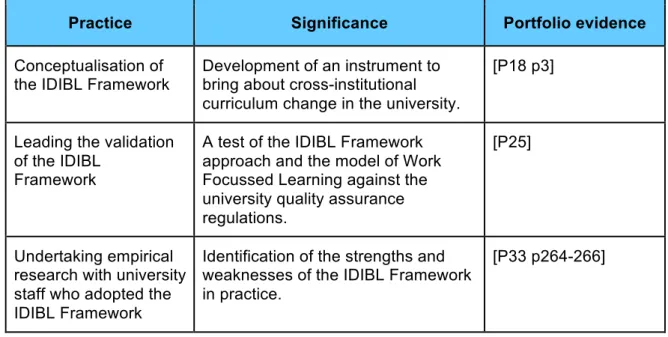
In identifying concepts and theories to apply to the past ten years of my work, there are inevitably choices to be made about what is selected and how it is presented. Through reflecting on my practice, I identified the most significant aspects, which are presented in a table at the beginning of Sections 3, 4 and 5 along with a portfolio reference.
The key concepts and theories discussed above are applied to my practice to bring coherence, explanation and meaningfulness. In each section I will:
1. set out the analysis that initiated my action; 2. describe my practice and the actions I took;
3. apply concepts and theories to support my analysis; 4. evaluate and critically reflect on my practice;
5. set out my original contribution to knowledge; and 6. identify influences on future cycles of action.
3.0 Organisation of Teaching
3.1 Section Summary
This section presents my conceptual analysis of the organisation of the teaching practices for delivery of the undergraduate degree programme developed through the Ultraversity project, the BA (Hons) Learning, Technology, and Research. I later named the approach developed as the model of Work Focussed Learning.
It was recognised at the outset of the Ultraversity project, and included by myself in the project plan as an aim, that to make the Ultraversity project a success, it would be necessary to, “Research new forms of organisation and work practice for teaching, administration, and support staff to change the practice of undergraduate higher education.” [P3 p1]. In my role as the director of the Ultraversity project, I responded to this analysis by establishing an action research (AR) strategy to inquire into the organisation of teaching.
In constructing this section of my claim, I have analysed and reflected upon my working practices around the Ultraversity in terms of the organisational
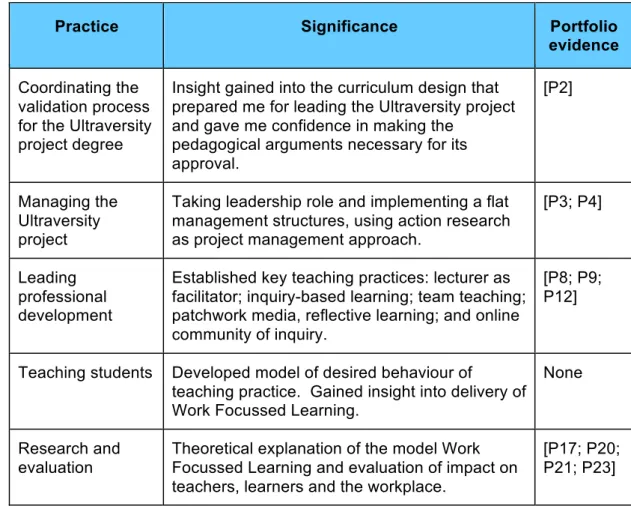
implications for HEIs seeking to develop online, distance, learning. Table 3 highlights the significant aspects of my practice and links this to my portfolio of evidence.
Practice Significance Portfolio evidence
Coordinating the validation process for the Ultraversity project degree
Insight gained into the curriculum design that prepared me for leading the Ultraversity project and gave me confidence in making the
pedagogical arguments necessary for its approval.
[P2]
Managing the Ultraversity project
Taking leadership role and implementing a flat management structures, using action research as project management approach.
[P3; P4]
Leading professional development
Established key teaching practices: lecturer as facilitator; inquiry-based learning; team teaching; patchwork media, reflective learning; and online community of inquiry.
[P8; P9; P12]
Teaching students Developed model of desired behaviour of
teaching practice. Gained insight into delivery of Work Focussed Learning.
None
Research and evaluation
Theoretical explanation of the model Work Focussed Learning and evaluation of impact on teachers, learners and the workplace.
[P17; P20; P21; P23] Table 2. Significant Aspects of Practice 1
In this section I will introduce the concept of productivity arrangements for teaching staff and explain why it is particularly significant for the development of Online Distance Learning (ODL). I will then explain the background to the Ultraversity project and the model of Work Focussed Learning. Next I explain the teaching practices developed and then I reflect on the Ultraversity productivity
arrangements. In conclusion, I identify my contribution to knowledge and argue that new ways of working and productivity measures are required for supporting ODL if there is to be large-scale development of provision.
3.2 Introduction
Productivity arrangements for teaching staff in higher education (HE) are based largely on a model of delivery that assumes face-to-face campus-based activities, organised autonomously at departmental level. For many higher education
institutions (HEI’s) there is now pressure to develop new markets; this increasingly includes approaches that require teachers to support students fully, or partially, through ODL.
In 1990 the University and College Union (2011) negotiated a national contract of employment between the higher education teaching unions and HEI’s. Barrett and Barrett (2009, 10) argue that in post 1992 UK universities this has over time,
“created a legacy of embedded practices” that are now the starting point for management of academic workloads (MAW), which for them are about efficiency, university objectives and equitable workloads (Barrett and Barrett 2009, 3).
Taking a wider viewpoint, I use the term ‘productivity arrangement’ to mean the package of organisational measures that determine how teaching teams can respond to the pedagogical model they are using to assure course quality and to maintain a financially viable provision. These include contracts of employment, measures of productivity and the management and organisation of teaching teams. I argue that the legacy of embedded practices identified by Barrett and Barrett, has a significant impact on innovation in productivity arrangements.
3.3 Teachers and Online Distance Learning
Developments in ODL that offer students collaborative and social approaches to learning at a time and place convenient for them requires new ways of working for teachers in HE; as identified by White et al., (2010, 46) there is less focus on delivering content and more emphasis on facilitating learning.
There are many explanations put forward for barriers to the development of ODL. One issue is the lack of incentives for, and capability of, academics to develop online approaches that are often perceived as involving extra workload while