in Teaching and Learning, 8(2), 108-117.
________________________________________________________________________ Aaron Richmond is an Associate Professor, and Lynn Conrad is a student; they are both in the Department of Psychology at Metropolitan State University of Denver. Aaron Richmond can be reached [email protected].
Do Thinking Styles Predict
Academic Performance of Online Learning?
Aaron S. Richmond & Lynn Conrad
Metropolitan State University of Denver
The growing number of higher education students who are educated in online learning environments necessitates the study of thinking styles and learning environments. This study sought to investigate online student’s thinking styles and how those styles may affect academic performance in an online class. One hundred and eighty seven online college students were administered the Sternberg Wagner Thinking Style Inventory (TSI) and measured on their online academic performance. Similar with past research, we found that those student’s internal and hierarchical scores positively predicted online course GPA and anarchic and legislative style scores negatively predicted online course GPA. The results of this study imply that the thinking styles can be implemented and a useful tool in the online learning environment.
Keywords:
thinking styles, instructional design,
online learning
The prevalence of online and distance education opportunities has increased exponentially over recent years (Liu, 2007). In higher education settings, internet based online courses are the fastest growing area of distance education (Weinstein, 1997). The rapid growth of online courses at higher education institutions combined with mixed research regarding the efficacy of online courses results in an increased need for research on learner outcomes for these courses (Dutton, Dutton, & Perry, 1999; Maddux, Ewing-Taylor, & Johnson, 2002; Thiele, 2003). Researchers have suggested that student thinking styles may contribute to student success in online education (Gadt-Johnson & Price, 2000; Maddux et al., 2002; Papanikolaou, Mabbott, Bull, & Grigoriadou, 2006; Richmond & Cummings, 2005; Richmond, Krank, & Cummings, 2006; Thiele, 2003). Additionally, at the college level students are likely aware of their own individual thinking style and have the opportunity to choose whether to take courses online or in a traditional classroom setting (Liu, 2007). Differences in the two learning environments may affect the students’ choice of online or traditional face-to-face classes. Therefore, we sought to investigate the impact individual thinking styles had on academic performance of students taking an online class.
LITERATURE REVIEW
While there is some debate regarding individual differences in cognitive style, researchers in this area suggest that style and ability are different constructs that may be equally important in student learning and success (Kolb, 1984; Papanikolaou et al., 2006; Russel, 1999; Saade, He, & Kira, 2007; Sternberg, 1997). Interest in styles, according to Sternberg (1997), developed in response to the belief that ability provides only a portion of the explanation for individual differences in performance. It has been suggested that both thinking and learning style models, as presented by Sternberg and Kolb respectively, should be considered in school settings (Russel, 1999). Individual differences in cognitive style (i.e. thinking style) may be important in understanding the factors, aside from intelligence and ability that contribute to student success in different instructional environments (i.e., online learning).
STERNBERG’S THINKING STYLES
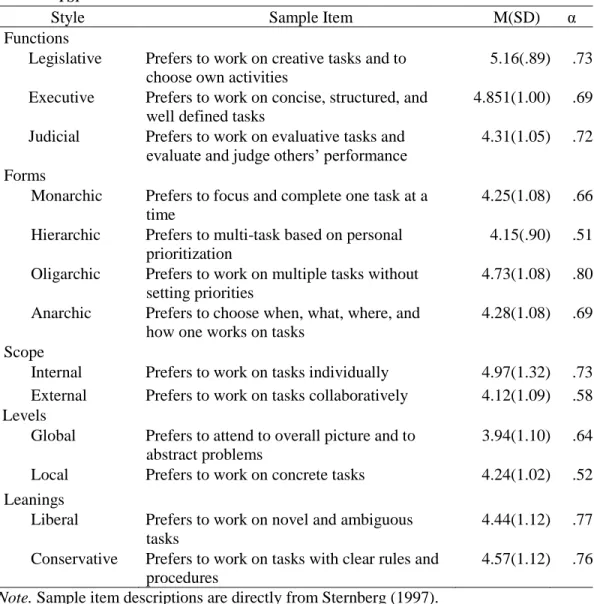
Sternberg (1997) proposed the theory of thinking styles in order to consider individual differences in the way people think. Sternberg’s theory is comprised of five categories (i.e., Functions, Forms, Levels, Scope, and Leanings) containing a distribution of 13 characteristics (i.e., Legislative, Executive, Judicial, Monarchic, Hierarchic, Oligarchic, Anarchic, Global, Local, Internal, External, Liberal, and Conservative) disbursed within each of the five categories. Each of the five categories and 13 characteristics make up Sternberg’s Theory of Mental Self-Government. See Table 2 for examples of each of the 13 styles and below for a detailed description of the five categories and their respective characteristics.
Functions. The functions category includes three fundamental thinking styles (Sternberg, 1997). Legislative thinkers are self-supporting people who choose to accomplish tasks independently. Executive thinkers tend to follow established rules and systems. Judicial thinkers are commonly critical and test the validity of pre-established rules and systems.
Forms. In Sternberg’s (1997) theory, the forms category is comprised of four modes that describe the manner in which individuals approach the environment and the challenges it presents. The Monarchic individual is a focused problem-solver described by Sternberg (1997, p. 22) as being ―single-minded and driven.‖ On the other hand, individuals who set priorities and understand that not all goals can be attained are considered Hierarchic. Oligarchic individuals can multi-task and may struggle with organizing priorities. Finally, anarchic individuals are motivated by specific needs and choose not to go along with established systems, and instead create their own (Sternberg, 1997).
Levels. Sternberg (1997) describes levels as the medium or degree of engagement an individual desires in an activity. In essence this was Sternberg’s way of accounting for motivation within his theory of mental self-government. Individuals with a Global level are apt to take on poorly defined abstract problems. Local individuals, in contrast, focus on well-defined problems, possibly losing sight of the larger issues.
Scope. The first stylistic variable is scope. Scope describes two personalities types (Sternberg, 1997): (a) Internal individuals are introspective and prefer to work independently as opposed to working as a part of a group, and (b) External individuals work well in groups and prefer to work with others.
Leanings. Considered a second stylistic variable, leaning describes the personality traits that clarify the methods and rules individuals use in problem solving (Sternberg,
1997). There are two types of leanings: liberal people question procedures and rules and go beyond them to solve problems while conservative people choose to follow existing rules and often prefer to solve problems in highly structured environments (Sternberg, 1997).
While it is important to discuss the composite of thinking styles outlined by Sternberg (1997) it is of more importance to assess the research conducted on thinking styles in the academic setting.
RESEARCH ON THINKING STYLES
Thinking styles have been studied in various educational settings and investigating different academic outcomes. Grigorenko and Sternberg (1997) suggest that thinking styles significantly add to abilities as a tool for predicting academic achievement. Specifically, results from a high school sample indicate that legislative and judicial styles were both significant predictors of achievement on analytical tasks and judicial and executive styles predicted performance on creative tasks (judicial positively and executive negatively). Additional results from studies of secondary students’ thinking styles also indicated a relationship between thinking style and student learning (Cano-Garcia & Hughes, 2000; Sternberg & Zhang, 2001) as well as domain specificity in the role of thinking styles and student learning (Russel, 1999). In several studies by Zhang and colleagues (see Bernardo, Zhang, & Callueng, 2002; Zhang, 2001, 2002, 2004; Zhang & Sternberg, 1998) academic performance was significantly associated with specific thinking styles. Zhang and Sternberg (1998) found that the thinking styles of hierarchical, internal, judicial, conservative, and global positively predicted academic performance among Hong Kong University students and that local, legislative, liberal, and external style negatively predicted academic performance. Supporting much of this research Zhang’s (2001) study observed the internal and hierarchic thinking styles positively contributed to academic performance and external, executive, local, liberal, judicial, and legislative thinking styles negatively contributed to the prediction of academic performance in Hong Kong University students. Furthermore, Zhang (2002) found that among US university students, their self-reported GPA was negatively predicted by liberal and global thinking styles while the conservative thinking style positively predicted self-reported GPA. In Zhang’s (2004) study, hierarchic, monarchic, and judicial, positively contributed to academic performance. Although, none of the above described studies investigated thinking styles in online education, the results do suggest that thinking styles may be predictors of academic performance in the online learning environment.
Even though thinking styles have been applied to educational settings in several studies (e.g., Grigorenko & Sternberg, 1997; Sternberg, 1994; Sternberg & Grigorenko, 1993, 1995; Sternberg & Zhant, 1998; Zhang, 2001, 2002, 2004), little research on thinking styles has been applied to online classes. Richmond et al. (2006) used the TSI (Sternberg, 1997) to determine that there were disproportionately more Hierarchic and
Legislative thinkers enrolled in online courses than would be expected. They did not,
however, consider whether or not thinking style predicted academic success in online classes.
PURPOSE OF STUDY
Based on the previous literature and the lack of specific research on thinking styles in online education, our study attempted to provide a unique contribution to the literature by filling the apparent gap in the research and improving on past studies in several ways.
First, while past research has established thinking styles as predictors of student learning and academic success (Cano-Garcia & Hughes, 2000; Grigorenko & Sternberg, 1997; Sternberg & Zhang, 2001; Zhang, 2001, 2002, 2004), there is an evident gap in the research by the fact that none of the studies addressed the unique learning environment of online education. Second, a few of the studies conducted analyses on the less valid use of self-reported GPAs (viz., Zhang, 2002). Third, many studies sampled foreign populations and high-school students (viz., Cano-Garcia & Hughes, 2000; Sternberg & Zhang, 2001; Zhang, 2001, 2004; Zhang & Sternberg, 1998) that makes it difficult to generalize to US higher education populations. Fourth, most of the prior research has focused on domain general relationships (viz., Bernardo et al., 2002; Camp-Garcoa & Huges, 2000; Grigorenko & Sternber, 1997; Zhang 2002), with the lack of research on domain specific content areas. Zhang (2004) asserts ―Carefully designed investigations need to be conducted to examine the domain specificity of thinking styles with respect to their unique contributions to academic performance.‖ (p. 365) Thus, we choose to investigate the relationship between thinking styles and academic performance in psychology. Based on the gaps in past research, we posited the following research question: What characteristics of thinking styles as measured in Sternberg’s Thinking Style Inventory (TSI) are predictive of student’s academic performance in online courses?
METHOD PARTICIPANTS
One hundred and eighty seven students recruited from seven separate lower and upper division psychology classes in two small liberal arts universities and one state university participated in this study.They completed the surveys for partial course credit. As illustrated in Table 1, there was a wide variety of gender, number of online courses completed (range was 0-15 courses), academic majors, and years of education (range was 12-19 years of education).
Table1. Descriptive Statistics for Demographic Variable
Variables Frequency (%)
Major
Science & Math 45(24%)
Social Science 41(22%) Education 53(28%) Other 48(26%) Course Type Lower Division 100(53%) Upper Division 87(47%) Gender Female 144(77%) Male 43(23%) Years of Education M = 14.72 SD =1.18
Number of Online Courses Completed M = 1.84 SD = 1.91
GPA M = 2.71 SD = .96
MEASURES
A demographic survey was used to assess the standard demographic information for the participants. Responses to the demographic survey were used in order to accurately
describe the participants in the study. Measurements of gender, number of online classes completed, education level, and class type was collected. See Table 1 for an illustration of demographic data.
In order to assess preferred thinking styles, participants completed an online version of the TSI (Sternberg & Wagner, 1991). The TSI contains eight statements for each of the 13 thinking style characteristics (e.g. Legislative function) for a total of 104 statements. Each statement, such as ―If I work on a project, I like to plan what to do and how to do it‖ (indicating Legislative style) is followed by a 1-7 point Likert rating scale rating how well the description fits their preference with 7 indicating Extremely well and 1 indicating Not at all well (Sternberg, 1997). Scores were averaged over each of the 13 characteristics for each participant. The 13 scales in the measure (relating to the thinking style characteristics) are reported to have high internal-consistency reliabilities (see Sternberg, 1997). See Table 2 for descriptive data.
Table 2. Sample Questions, Means, Standard Deviations, and Reliability Statistics for the TSI
Style Sample Item M(SD) α
Functions
Legislative Prefers to work on creative tasks and to choose own activities
5.16(.89) .73 Executive Prefers to work on concise, structured, and
well defined tasks
4.851(1.00) .69 Judicial Prefers to work on evaluative tasks and
evaluate and judge others’ performance
4.31(1.05) .72 Forms
Monarchic Prefers to focus and complete one task at a time
4.25(1.08) .66 Hierarchic Prefers to multi-task based on personal
prioritization
4.15(.90) .51 Oligarchic Prefers to work on multiple tasks without
setting priorities
4.73(1.08) .80 Anarchic Prefers to choose when, what, where, and
how one works on tasks
4.28(1.08) .69 Scope
Internal Prefers to work on tasks individually 4.97(1.32) .73 External Prefers to work on tasks collaboratively 4.12(1.09) .58 Levels
Global Prefers to attend to overall picture and to abstract problems
3.94(1.10) .64
Local Prefers to work on concrete tasks 4.24(1.02) .52
Leanings
Liberal Prefers to work on novel and ambiguous tasks
4.44(1.12) .77 Conservative Prefers to work on tasks with clear rules and
procedures
4.57(1.12) .76
Note. Sample item descriptions are directly from Sternberg (1997).
Online course grade-point-average (GPA) was also collected. Consistent with past research, class GPA was chosen as a measure of academic success for the present study (Cano-Garcia & Hughes, 2000). These scores ranged from 1.75-4.00 and were collected
via the online instructors after the conclusion of the course. See Table 2 for descriptive data.
PROCEDURE
As an exit survey to the course, students in online classes were administered the two surveys via their course internet web site. First, participants completed the demographic questionnaire, and then the TSI. Participants completed the measures and return them to their instructor electronically. Both surveys were counterbalanced. On average, participants completed the two surveys in 42 minutes. Shortly after the course was concluded, the student’s instructor anonymously provided each participant’s online GPA.
RESULTS
Predata screening procedures were conducted using the procedures described by Mertler and Vanatta (2002). Data was screened for significant outliers, violations of assumed normality and homoscedasticity. Using the Box’s M Test and the Kolmogorov-Smirnov Test, the 13 independent variables (TSI) and one dependent variable (GPA) were tested for normality. No violations of statistical assumptions were found.
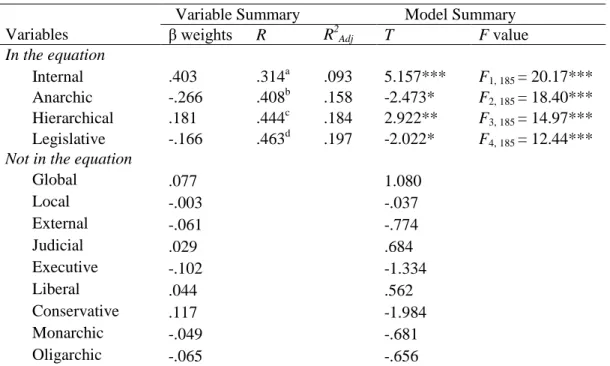
Table 3. Summary of Stepwise Multiple Regression of TSI as Predictors of GPA
In order to assess the ability of TSI scores (see Table 2 for summary scores) to predict GPA, one stepwise multiple linear regression analyses was conducted (see Table 3 for regression coefficients). The analysis produced four significant models. The fourth model, which accounted for the most variance, indicates that the overall model significantly predicted scores GPA, R2=.463, R2Adj =.197, F(4, 182)=12.44, p< .001. A
Variable Summary Model Summary
Variables β weights R R2Adj T F value
In the equation
Internal .403 .314a .093 5.157*** F1, 185 = 20.17***
Anarchic -.266 .408b .158 -2.473* F2, 185 = 18.40***
Hierarchical .181 .444c .184 2.922** F3, 185 = 14.97*** Legislative -.166 .463d .197 -2.022* F4, 185 = 12.44*** Not in the equation
Global .077 1.080 Local -.003 -.037 External -.061 -.774 Judicial .029 .684 Executive -.102 -1.334 Liberal .044 .562 Conservative .117 -1.984 Monarchic -.049 -.681 Oligarchic -.065 -.656
Note. (*) = p < .05, (**) = p < .01(***) = p < .001; Constant B =2.112. aPredictors in the
model: (constant), internal scope; bPredictors in the model: (constant), internal scope, anarchic; cPredictors in the model: (constant), internal scope, anarchic, hierarchic; d
summary of regression coefficients for the three significant regression analyses are presented in Table 3. As illustrated in Table 3, scores on the internal and hierarchical thinking styles positively predicted GPA and scores on the legislative and anarchic thinking styles negatively predicted GPA.
DISCUSSION
The goal of this study was to identify thinking styles (as defined by the Theory of Mental Self-Government, Sternberg, 1997) predicted academic performance in domain specific (psychology) online courses. Our results suggest the TSI is a useful tool in predicting academic performance in online learning (20% of the variance was explained). Even though our study investigated the predictive ability of the TSI in online learning environment, our results were consistent with past research conducted in face-to-face classrooms. Consistent with Sternberg and Zhang (1998), Zhang (2004) and Bernardo et al. (2002), we found that academic performance was positively predicted by the hierarchical style. Zhang (2001) suggested that hierarchic thinkers tend to work with a sense of priority and in an online learning environment students need to prioritize and self-motivate to be successful. Additionally, we found that the internal style also positively predicted academic performance (consistent with Cano-Garcia & Hughes, 2000; Sternberg & Zhang, 1998; Zhang, 2001). Students who prefer the internal style tend to like to work by themselves and we believe that the online learning environment lends itself to this preference and therefore the students succeed. Also consistent with several studies (e.g., Cano-Garcia & Hughes, 2000; Sternberg & Zhang, 1998; Zhang, 2001), we found the legislative style was a negative predictor of academic performance. As Sternberg (1997) stated ―…legislative people like to do things their own way. They like creating, formulating, and planning things….they tend to like to make their own rules.‖ (p. 30). For many online classes, this style is not supported. Typically, online courses are highly structured, require rigid due dates, very little room for creativity, allow very little say in the educational process, and require strong self-regulated abilities (Richmond et al., 2006). Thus, the environment acts against these types of students to succeed academically (Richmond et al., 2006).
Inconsistent with past research (Grigorenko & Sternberg, 1997; Zhang, 2001; 2004), we did not find that the judicial and monarchic styles predicted academic performance. This may make sense because in the online learning environment, students are often responsible for balancing many tasks. Thus, students who prefer to only focus on one task at a time (i.e., monarchic thinkers) may not significantly contribute to performance. Furthermore, the judicial style may not have been a significant predictor because we did not specifically look at types of tasks. That is Grigorenko and Sternberg (1997) found that the judicial style only predicted creative task performance. Another inconsistency was that we did not find the external style to be a positive predictor of academic performance (Cano-Garcia & Hughes, 2000), nor a negative predictor of academic performance (Zhang & Sternberg, 1998). We postulate that this is because the classes in this study had very little collaborative work required for the course. As such, external thinkers prefer to work and environment that is collaborative. Considering some of these inconsistencies, there appears that more research is needed to investigate why these discrepancies occur in online learning.
Surprisingly, much of the past research has not found the anarchic style to predict academic performance. Then, why was this style a negative predictor of academic performance in our study? Considering the environment of online learning, this finding seems to make the most logical sense. Anarchic thinkers tend to be antisocial, take a random approach to problem-solving, are unorganized, highly creative, and have
difficulty setting priorities (Sternberg, 1997). Logically, these characteristics are not helpful in higher education, much less, online higher education where the normal and unique demands of learning are magnified. Consequently, students tend to do poorly academically or even drop-out (Sternberg, 1997).
INSTRUCTIONAL IMPLICATIONS
Based on findings of this study, several instructional implications can be drawn as a reference for instructors who design and teach online courses. First, Analysis is the first stage of the ADDIE instructional design model (Analysis, Design, Development
Implementation, and Education), and learner assessment is one of the critical tasks at this
stage (Gagne, Wager, Golas, & Keller, 2005; Smith & Ragan, 2005). This study clearly suggests that identifying learners’ thinking styles is one necessary component of learner assessment especially in the design of an online learning environment, and TSI could be used for data collection. The identified thinking styles also add in depth information to learners’ need assessment, which will lead to the decisions in the next stage—Design.
Second, at a basic level, instructional decisions can be suggested for each of the four significant predictive thinking styles individually. Hierarchic thinkers would benefit if the instructor provides clear course structure, map of knowledge contents, and both linear and nonlinear coursework schedules and due dates, so they can make a reasonable plan, and set the priorities for their learning. For learners with internal thinking style, as they are introspective and prefer to work individually rather than working as a part of a group, it can be of help if course materials and assignments are provided with an approach of dynamic design, leaving enough rooms for learners’ individual work, even in group projects, to encourage and support their preferred style. Hierarchic and internal thinking styles are two predictors that positively influence the learning performance, so we have suggested design strategies and activities that positively emphasize the features of these two thinking styles.
Legislative and anarchic thinking styles are two predictors that negatively contribute to learning performance; therefore, we would have some suggestions for design and instructions that may balance the negative influences of these thinking styles. For legislative thinkers who are self-supporting learners and who choose to accomplish tasks independently, the instructor may design project-based and problem-solving based assignments in certain education settings that allow learners to creatively choose and focus on their interest and meanwhile require collaborations with others. For anarchic individuals who are motivated by specific needs and choose not to go along with established systems, and instead create their own, again, an approach of dynamic design would fit. In the design of learning activities, assignments, or even evaluations, an instructor can provide more options of formats, themes, procedures, and contexts. In this way, the course could meet learners’ special needs and provide a scope for their self-constructed system.
Third, at a more comprehensive level, after thinking styles are identified from a group, there are several additional considerations for the decisions of online learning instructional design: (a) the instructor needs to analyze the distribution of the thirteen thinking styles in this group before making instructional decisions; (b) most of the time, the thinking styles in a group varies among several main styles, therefore, the issue is how an instructor should design the online learning that meets the needs from learners with different thinking styles in a more balanced and comprehensive way; and (c) to what extent the characteristics of each major thinking styles in the group should be considered in the design of specific materials, activities, or assignments.
LIMITATIONS, FUTURE RESEARCH AND CONCLUSIONS
Although we found strong predictors of academic performance in online performance there are a few improvements, which could be made. First, we only used one measure of academic performance. Future studies may aggregate data based on assignment and assessment type to investigate whether certain thinking styles predict various types of educational assessments (e.g., legislative = projects and portfolios). Second, an increased sample size we make our results more robust. We had 187 students where over 300 students would be ideal. And finally, we did not include a comparison of face-to-face sample from which to assess whether our results are completely unique to the online learning environment. To provide a more detailed picture of the intricacies of thinking styles in online pedagogy, more research is needed.
Although thinking styles may not be the educational panacea, incorporating sound evidence-based pedagogical practices such as thinking styles research should be considered when designing an online course.
REFERENCES
Bernardo, A. B., Zhang, L-F., & Callueng, C. M. (2002). Thinking styles and academic achievement among Filipino students. The Journal of Genetic Psychology, 163.
I149-163. doi: 10.1080/00221320209598674
Cano-Garcia, F., & Hughes, E. H. (2000). Learning and thinking styles: An analysis of their interrelationship and influence on academic achievement. Educational
Psychology, 20(4), 413-430. doi:10.1080/713663755
Dutton, J., Dutton, M., & Perry, J. (1999). Do online students perform as well as lecture students? Journal of Engineering Education, 90(1), 131-136.
Gadt-Johnson, C., & Price, G. (2000) Comparing students with high and low preference for tactile learning. Education, 120, 581-585.
Gagne, R. M., Wager, W. W., Golas, K. C., & Keller, J. M. (2005). Principles of
Instructinal Design (Fifth Ed.). Belmont, CA: Thomson Wadsworth.
Grigorenko, E. L., & Sternberg, R. J. (1997). Styles of thinking, abilities, and academic performance. Exceptional Children, 63(3), 295-312.
Kolb, D. A. (1984). Experiential learning: Experience as the source of learning and
development. Englewood Cliffs, NJ: Prentice Hall.
Liu, S. (2007). A comparative study of learning styles between online and traditional students. Journal of Educational Computing Research, 37(1), 41-63. doi: 10.2190/TJ34-6U66-8L72-2825
Maddux, C. D., Ewing-Taylor, J., & Johnson, D. L. (Eds.) (2002). Distance education:
Issues and concerns. New York: The Haworth Press.
Papanikolaou, K. A., Mabbott, A., Bull, S., & Grigoriadou, M. (2006). Designing learner-controlled educational interactions based on learning/cognitive style and learning behavior. Interacting with Computers, 18, 356-394. http://dx.doi.org/10.1016/
j.intcom.2005.11.003
Richmond, A. S., Krank, H. M., & Cummings, R. (2006). A brief research report: Thinking styles of online distance education students. International Journal of
Technology in Teaching and Learning, 2(1). 58-64.
Richmond, A. S., & Cummings, R. (2005). Implementing Kolb’s learning styles into online distance education. International Journal of Technology in Teaching and
Learning. 1(1), 45-54.
Russel, T. L. (1999). The no difference phenomenon. Raleigh, NC: North Carolina State University.
Saadé, R. G., He, X., & Kira, D. (2007). Exploring dimensions to online learning.
Computers in Human Behavior, 23, 1721-1739. http://dx.doi.org/10.1016/j.chb.2005.
10.002
Smith, P. L., & Ragan, T. J. (2005). Instructional Design (Third Ed.). Hoboken, NJ: John Wiley & Sons.
Sternberg, R. J. (1997). Thinking styles. Cambridge, UK: Cambridge University Press. Sternberg, R. J., & Grigorenko, E. L. (1993). Thinking styles and the gifted. Roeper
Review, 16(2), 122-130
Sternberg, R. J., & Grigorenko, E. L. (1995). Styles of thinking in school. European
Journal for High Ability, 6(2), 1-18.
Sternberg, R. J., & Wagner, R. K. (1991). MSG Thinking Styles Inventory. Unpublished manual.
Sternberg, R. J., & Zhang, L-F. (Eds.) (2001). Perspectives on thinking, learning, and
cognitive styles. The educational psychology series. (pp. 197-226). Mahwah, NJ:
Lawrence Erlbaum.
Sternberg, R. J., & Zhang, L-F. (2005). Styles of thinking as a basis of differentiated instruction. Theory into Practice, 44(3), 245–253.doi: 10.1207/s15430421tip4403_9 Thiele, J. E. (2003). Learning patterns of online students. Journal of Nursing Education,
42(8), 364-367.
Weinstein, P. (1997). Education goes the distance. Technology and Learning, 17(8), 24-25.
Zhang, L-F. (2001). Do thinking styles contribute to academic achievement beyond self-rated abilities? Journal of Psychology, 135(6), 621-637. doi: 10.1080/002239801096 03724
Zhang, L-F. (2002). Thinking styles: Their relationships with modes of thinking and academic performance. Educational Psychology, 22(3), 331-348. doi: 10.1080/01443410220138557
Zhang, L-F. (2004). Revisiting the predictive power of thinking styles for academic performance. Journal of Psychology, 138(4), 351-370. doi:10.3200/JRLP.138.4.351-370
Zhang, L-F., & Sternberg, R. J. (1998). Thinking styles, abilities, and academic achievement among Hong Kong University students. Educational Research Journal, 13(1), 41-62.