This item was submitted to Loughborough’s Institutional Repository by the
author and is made available under the following Creative Commons Licence
conditions.
For the full text of this licence, please go to:
http://creativecommons.org/licenses/by-nc-nd/2.5/
Abstract
The paper presents the initial findings of a research project investigating the concept of creativity in design and technology in the lower secondary phase of secondary schooling in the UK. The research is based on the hypothesis that creativity in design and technology is not a spontaneous, sustained process for many pupils in the early years of secondary schooling and that teachers can play a major role in enhancing creativity in their children’s classroom activities. The key research question is ‘to what extent is it possible to teach creativity in design and technology classrooms?’.
The paper explores briefly the concept of creativity and identifies a three-feature model of creativity to be used in the study. It presents an analysis of the findings of interviews with four professional designers against this model to explore how their practice might inform and contribute to the development of pupils’ creativity in classroom practice
Keywords
creativity, designers, professionals, design, technology, secondary
Introduction
The concept of ‘creativity’ within an educational context has become a major issue in recent years in the UK. The report ‘All Our Futures: Creativity, Culture and Education’ (Robinson, 1999) argues that a national strategy for creative and cultural education is essential to unlock the potential of every young person. In addition, UK government initiatives have emphasised the need to develop creativity across the curriculum (DfEE/QCA, 1999).
Research
This paper is based on current research into the concept of developing creativity within the context of design and technology teaching and learning in the lower secondary phase (11–14 years) in England. The term ‘creativity’ rather than ‘innovation’ is used to reflect a psychological view of creativity at a personal level rather than innovation as used in the world of business at an organisational level (Sternberg and Lubart, 1999). The focus of the research reflects a particular interest of the researcher in the early years of the secondary phase. Personal experience of primary and secondary classroom practice has noted children’s work in design and technology tends to become more restricted and less original as they move into secondary schooling. An observation backed by classroom studies in the United States by Sternberg (1997) and UK research indicating discontinuity in the type of activities and the pupils’ experience of design and technology between these phases (Kimbell et al, 1995).
The hypothesis of the research is that ‘responding creatively to the demands of designing and making in the design and technology curriculum is not a spontaneous, sustained process for many pupils in the early years of secondary schooling yet it is possible for teachers to play a major role in enhancing creativity in their pupils’ classroom activities’. The study is concerned with the creativity of the ordinary rather than the extraordinary person within a domain of application, design and technology, and does not involve quantitative measurement of creativity, which appears to be in line with the thinking of Craft et al (2001). The key research question is ‘to what extent is it possible to teach creativity in design and
technology classrooms?’
What can we learn about creativity from the
practice of professional designers to inform design
and technology classroom practice?
This paper presents a research model for creativity based on the initial literature search, which will be used to analyse data from interviews with four professional designers to identify key issues of
relevance in their practice and to assess their potential for informing classroom practice. This research will be followed by a school-based case study not
presented in this paper. The final aspect of the study will be to identify the techniques and strategies that can be used by the teacher to enhance and develop their pupils’ creativity.
Defining creativity
Providing a simple definition and clear criteria for creativity has caused problems. At the simple level it has been defined as the ability to produce new knowledge (Dacey and Lennon, 1998), with a more complex view that creativity is a puzzle, a paradox, a mystery but essentially it is as a novel combination of ideas and should include value (Boden, 1994). Others have seen creativity as a messy and confusing subject, bringing something to life that was not there before. (de Bono, 1992)
Yet it can be argued that creativity is even more sophisticated and based on a range of factors. Some writers view creativity as a process or system, a way in which self-organising systems integrate new information used with old structures, patterns, concepts and perceptions (de Bono, 1992). It is the achievement of something remarkable and new, something that transforms and changes a field of endeavour in a significant way.
There appear to be levels of creativity. Big creativity is when something of enduring value is contributed to an existing field of knowledge, which transforms it. Small creativity is more humble, though perhaps equally valuable, activity giving a fresh and lively interpretation to any endeavour. (Feldman et al, 1994). A three-form view of creativity includes ‘combinational’ creativity producing novel, unfamiliar or improbable
combinations of familiar ideas. Two more complex forms include ‘exploratory’ creativity when a person, without breaking any rules, comes up with something not radically different. The other is ‘transformational’ creativity when a person explores and changes or removes one or more of the rules and creates something radically new in the field of knowledge, domain or ‘conceptual space’. (Boden, 2001)
Other definitions of creativity include the concept of a ‘process’ or ‘system’ but emphasise the product. Creativity is defined as characteristics reserved for products that are seen as novel within a domain, but are ultimately recognised as acceptable within an appropriate community. Judgements of originality or creativity of the product can only be made by
knowledgeable members of the field, though the field may be old or newly constituted (Gardner, 1993). A similar stance describes a product as creative when it is a) novel and b) appropriate (Sternberg and Lubbart, 1995). Sternberg and Lubart (1999) combines process with
product and defines creativity as the ability to produce
work that is both novel e.g. original, unexpected and appropriate, that is useful and adaptive taking into account task constraints. Other writers have included additional factors in their definitions. Creativity has been defined in terms of mapping, exploring and transforming conceptual spaces or styles of thinking in a range of areas of knowledge, or modelled in
computational terms. (Boden, 1994)
A crucial factor within the equation of creativity, and one that has fascinated people since the Greeks, is the
person involved in the creative process and producing
the creative work or product. There have been many studies to identify the key characteristics of a creative person, including a psychological life study of Charles Darwin and scientific creativity by Gruber (1974). Gardner (1993) sees intelligence as the key to success in solving problems. He is concerned with the cognitive characteristics of the creative person who solves problems, makes products or asks new questions within a domain that are initially considered to be unusual but become acceptable within at least one cultural group.
Amabile (1983, 1996) introduced two important factors into the equation when, as a social
psychologist, she highlighted the impact of specific
social factors and intrinsic motivation on creativity. A
conceptual definition for creativity sees two essential elements. ‘A product or a response will be judged as creative to the extent that a) it is both a novel and appropriate, useful, correct or valuable response to the task at hand, and b) the task is heuristic rather than algorithmic.’ (Amabile, 1996: 35)
Creativity, defined in educational reports in the UK, incorporates the views of the above writers. It is seen as ‘imaginative activities fashioned so as to produce outcomes that are original and of value’, and in more recent writing, ‘imaginative processes with outcomes that are original and of value’ (Robinson, 1999: 29; 2001: 118). However, recent writers have begun to address the key criteria essential for creativity. Jupp et
al (2001) see the real meaning of creativity as a set of
qualities which can be found in individuals, teams, organisations and whole communities. They argue that creativity can be systematically learned and rigorously assessed.
Developing a three feature model for research into creativity
Research into creativity has tended to focus on one or
other of the components and elements of creativity outlined above which, it can be argued, does not appreciate the whole picture and can distort findings. More recent studies on creativity hypothesise that multiple components must converge for creativity to occur (Amabile, 1983, 1996; Csikszebtmihalyi, 1990, 1996; Feldman et al, 1994; Gardner, 1993; Gruber, 1989; Sternberg and Lubart 1995, 1999). There appear to be four essential elements of creativity, the person, the product, the domain and the situation,
environment and context. A three-feature model for creativity has been constructed for the research project based on this approach. The model consists of:
• domain relevant features – a set of practices associated with an area of knowledge (Boden, 1991, 1994, 2001; Csikszebtmihalyi, 1990, 1996; Feldman et al, 1994)
• creativity-relevant features – influencing, controlling the direction and progress of the process (Guildford, 1950; Gardner, 1983, 1993; Amabile, 1983, 1996; Boden, 1991, 1994, 2001; Csikszebtmihalyi, 1988, 1990, 1996; Sternberg and Lubart, 1995; de Bono, 1990; Dacey and Lennon, 1998)
• social, environmental features – macro/micro environmental, social and cultural issues (Amabile, 1983, 1996; Csikszebtmihalyi, 1990, 1996; Sternberg and Lubart, 1995; Dacey and Lennon, 1998).
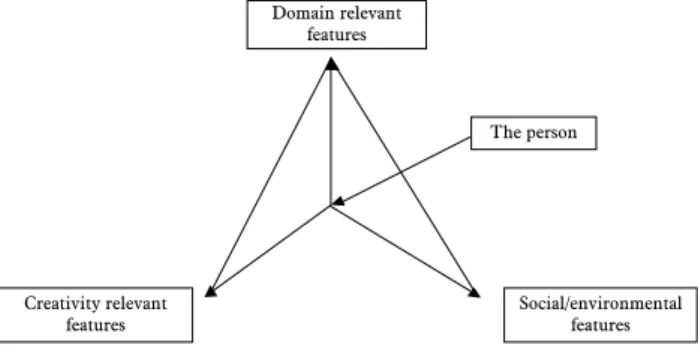
The element of ‘person’, or pupils in the classroom, is central to the model, which reflects the influences of the three features on the creativity of the child. It is important to recognise that these features will interact with one another. One way to show this is to represent each feature as a vector making a contribution to creativity. The length of the vector will indicate the significance of its contribution. If each feature makes an equivalent contribution then the envelope of the three vector will be an equilateral triangle. If the features make differing contributions the envelope shape will change accordingly. This is illustrated in Figure 1.
Figure 1: Three feature model of factors influencing the creativity of the person.
Interviews with professional designers
Four professional designers (a graphic, textile, food technologist and an electronic designer) were
interviewed for the research project. The format of the interviews was based on the above model. A series of questions were developed under each feature and used to guide the interview. The context of the research was explained to each interviewee and they were asked to reflect on creativity through recent experiences or a project in their work place.
Results
Appendix 1 and Appendix 2 contain detailed mapping of each of the interviews of the graphic, textile, food and electronic designers against the three-feature model for creativity. The key issues arising from the interviews are summarised under the three headings of domain features, process relevant features and social/environmental features.
Domain features – set of practices associated with an area
of knowledge
• Conceptual creativity was developed both in the initial stages and throughout the process e.g. context, originality of interpretation,
transformation and changing of ideas through modification.
• Stimulation of ideas was through primary sources e.g. experiences from visits, artists, general public, designers, archives, nature, frescos plus secondary sources e.g. books. Internet, CDs etc. Individuals often played an important role in the initial ideas.
• Aesthetic creativity was developed through taste, smell, appearance, sound, image, form, texture, colour, complexity/simplicity in product development.
• Technical creativity was present as the knowledge and technical skills to make something as well as having the ‘ideas’ e.g. graphic techniques, knowledge of fabrics and foods, dyes and chemicals and electronics. • Constructional creativity was noted through the
‘making’ skills to combine ideas with technologies, make prototypes and deal with manufacturing in the factory processes. Some of the designers focused on the designing stages for the prototype and passed the manufacturing to others in the team. However, knowledge of this process was needed and the designers retained an overview.
Process relevant features – influencing, controlling the
direction and progress of the process
• Creative problem solving was the key heuristic process, with creativity possible, and desirable, throughout the process. Only a very small percentage (3-5%) of product development was
Domain relevant features The person Creativity relevant features Social/environmental features
‘blue sky’ i.e. totally original. Experimenting and seeing things happen gave the designer a ‘buzz’, as did seeing the final product on the shelf.
• Customer-led product development was the norm in commercial and industrial practices. • A structured, cyclical process was found which
was well organised and not ‘scatty’. There was a clearly defined process including initial concept development, investigating, experimenting, trying things out, working it through in a sketch book, going to the print room and translating paper into the print process, sampling an idea or concept and making decisions. Following the initial concept development, ideas were
generated and developed throughout the process. Teamwork was considered important.
• Organisation, e.g. time management, was essential. The process was structured i.e. using time-out, the summer holiday for developing the initial concept and setting deadlines, especially in the early stages of the project.
• ‘Dwell time’ and space was present for reflection and incubation of ideas, time out for the
designers to think and develop their own ideas. • Personal features mentioned included the
thought that certain people have talents more suited to research and development.
Characteristics included motivation, self-supporting, self-directed, interest, drive, awareness of the needs of others, an ability to work as a team, meet deadlines and openness to ideas and suggestions.
Social/environmental features – macro/micro, social,
cultural
• Education and experience was very important as professional designers have areas of expertise. • A secure environment was necessary to enable
designers to be confident and take risks. Teamwork played an important role in this. • Creativity was hindered by critical peers, the
need to meet customer requirements and the costs of large commercial production.
• Creativity was assisted by the use of strategies and approaches to deal with uncertainty and insecurity.
• An ability to transfer knowledge and skills was important e.g. industry to education, across traditional subject areas.
• An ability to organise space and resources was noted e.g. for working effectively.
• An ability to deal with/handle life was required e.g. combine demands, handle conflicts, constraints and pressure of work.
Conclusions and recommendations
There are a number of factors where the activities of
the professional designer, with reference to creativity, can inform classroom practice. These include:
• the development of conceptual originality for professional designers in the early stages of a project through original interpretations of a real-life context with the use of both primary and secondary stimuli. Teachers should consider the range of strategies and techniques pupils could use in the early stages and throughout their projects, including making connections, modelling, spatial mapping, original research, and observation.
• the development of aesthetic creativity is a key issue and includes being aware of shape, appearance, colour, taste, form and texture. Pupils should be aware of, and able to use, their personal senses through observation and experimentation.
• technical creativity, including knowledge of materials and components, is essential for successful, creative product design and development
• constructional creativity is not always a key issue for professional designers, as other people may complete this aspect. However, designing is a complete process and knowledge of
‘constructional’ aspects are essential both for designers and pupils if the product is to be made successfully.
• creative, heuristic problem solving is a cyclical process. Professional designers organised and managed this process carefully with ‘dwell’ time for ideas to incubate and develop. Teachers need to plan projects and activities in design and technology to take these issues into account • professional designers work effectively in
customer-led product development. Pupils work within the constraints of a National Curriculum and the ethos of individual schools, but these should not be reasons for uncreative work. Reasonable constraints can be used constructively and be made intellectually demanding by the teacher with opportunities for original outcomes in the pupil’s work
• Personal characteristics appear to play an important role for professionals and their ability to work creatively. These include the ability to be self-motivated, able to concentrate and be open to new ideas. Some pupils will naturally have these characteristics but teachers need to consider how they can help all pupils develop such traits. • Professional designers have specific areas of
expertise and work as specialists in a team, as compared with individual pupils in the lower secondary school who are generally expected to complete the full process. There should be opportunities for pupils to work in ‘design teams’ in the lower secondary curriculum.
• Social influences such as relevant education and expertise are considered important by designers, though this may not have been through formal education. Teachers have a vital role to play in developing such expertise through explicit teaching.
• Security, the ability to communicate and work as part of a team are key factors for the professional designer. A supportive, well-organised physical and social environment in the classroom would help give pupils confidence to take risks and deal with uncertainty.
• An ability to handle conflicting demands, transfer knowledge and skills and manage space and time are important for designers. All key issues to consider for the teacher and pupil in the classroom.
It would appear when considering creativity that there is a relationship between the activities of professional designers and classroom practice, though a direct comparison in all aspects of designing for adults and children is not desirable. Each of the converging features of the model used for the analysis play an important role in developing creativity. Lack of knowledge and skills in a domain, an unsound process or a poor social and physical environment will all affect, to some degree, the ability of designers and pupils to be creative. A key factor arising from the interviews appears to be the importance of the role of the teacher in planning and managing the curriculum and learning environment to enable the pupils to develop their potential creativity.
References
Amabile, T. (1983) The Social Psychology of Creativity, New York: Springer-Verlag
Amabile, T. (1996) Creativity in Context: Update to the social psychology of creativity, West View Press
Boden, M. (1991) The Creative Mind: Myths and Mechanisms, Basic Books
Boden, M. (1994) Dimensions of Creativity, Bradford Books Boden, M. (2001) ‘Creativity and Knowledge’, in Craft, A., Jeffrey, B. and Leibling, M. Creativity in Education, London: Continuum
Craft, A., Jeffrey, B. and Leibling, M. (2001) Creativity in Education, London: Continuum
Csikszentmihalyi, M. (1990) Flow: The psychology of optimal experience, New York: HarperCollins Csikszentmihalyi, M. (1996) Creativity: Flow and the Psychology of Discovery and Invention, HarperPerennial Csikszentmihalyi, M. (1999) ‘Implications for a Systems Perceptive for the Study of Creativity’, in Sternberg, R. (Ed)
Handbook of Creativity, Cambridge: Cambridge University Press
Dacey, J. and Lennon, K. (1998) Understanding Creativity, San Francisco: Jossey-Bass
de Bono, E. (1992) Serious Creativity, London: HarperCollins Business
DfEE/QCA (1999) Design and Technology: The National
Curriculum for England, London: HMSO
Feldman, D., Csikszentmihalyi, M. and Gardner, H. (1994)
Changing the World: A Framework for the Study of Creativity, Praeger: West Point Connecticut
Gardner, H. (1983) Frames of Mind, USA: Basic Books Gardner, H. (1993) Multiple Intelligences, USA: Basic Books
Gruber, H. (1974) Darwin on Man, New York: Dutton Guildford, J.P. (1950) ‘Creativity’, in American Psychology
5: 444–454
Jupp, R., Fairly, C. and Bentley, T. (2001) What Learning Needs: The challenge for a creative nation, London: Design Council and Demos
Kimbell, R., Stables, K. and Green, R. (1995) ‘D&T from 5 to 16 – a continuous experience?’, in The Journal of the Design and Technology Association, Design and Technology Teaching, Vol 28, No 1, Stoke-on-Trent: Trentam Books
Robinson, K. (1999) All our Futures: Creativity, culture and education, London: DfEE
Robinson, K. (2001) Out of our Minds: Learning to be creative, Oxford: Capstone Publishing Ltd
Sternberg, R. (1997) Thinking Styles, Cambridge: Cambridge University Press
Sternberg, R. and Lubart, T. (1995) Defying the Crowd: Cultivating creativity in a culture of conformity, New York: Free Press
Sternberg, R. and Lubart T. (1999) ‘The Concept of Creativity: Prospects and paradigms’, in Sternberg R, (Ed)
Handbook of Creativity, Cambridge: Cambridge University Press
158
Appendix 1: Mapping of the graphic and textile designer’s interviews against the three-feature model.
Domain features set of practices associated with an area of knowledge (Boben, 1991, 1994, 2001; Csikszentmihalyi, 1990, 1996; Feldman et al, 1994) Process relevant features influencing, controlling direction/progress of the process (Amabile, 1983, 1996; Boden 1991, 1994, 2001, Csikszebtmihalyi, 1990, 1996, 1999; de Bono,1990, Gardner, 1983, 1993, Gruber 1988; Guildford, 1950, Sternberg & Lubart 1995, Dacey & Lennon, 1998) Social/environmental features macro/micro, social, cultural, (Amabile, 1983, 1996; Boden, 2001, Csikszebtmihalyi, 1990, 1996, Dacey and Lennon, 1998, Sternberg and Lubart, 1995 Graphic designer
• Conceptual ideas gained though stimulus gained from a visit to St James Park to walk around look at and listen to nannies, ducks, swans, lamp standards, metal fences around the grass and then draw, sketch what is observed. Looking at travel guides, web sites.
• Aesthetic features e.g. appearance, sound, form highlighted.
• Technical abilities including communicating ideas and thoughts through graphic techniques given high priority.
• Original research is vital.
• Creative problem solving, the need for originality of interpretation i.e. novel and appropriate and working in a heuristic manner considered to be key issues within the context of client requirements.
• Some clients are very clear what they want e.g. an agency for nannies, others want a leaflet designed and need to be shown what is possible e.g. the brief defined.
• Need for a clearly defined process with an organised, timed structure. Ideas need to be taken back to the clients as pictures, colours and typeface. • Professional designers have areas of
expertise, procedures; designing is well organised, not ‘scatty’.
Investigating, developing ideas and making decisions were all important. • Need for ‘dwell time’ for reflection and
incubation of ideas emphasised • Personal qualities required were an
awareness of the needs of others and openness to ideas and suggestions. • Relevant experiences sometimes
against the odds, but not formal education, a key issue.
• Need for security to counteract the fear of not coming up with suitable ideas highlighted.
• Need for strategies and approaches to deal with this considered important.
Textiles designer
• Conceptual originality of interpretation e.g. ‘alchemy though pushing the boundaries on chemical reactions’. • Primary sources used for stimulation e.g.
artists, designers, archives, frescos. • A need to transform/change ideas
emphasised e.g. the use of limited number of colours but that the overlap produces a wider range.
• Aesthetic features a high priority
including image, shape, appearance, form, colour, texture, complexity/simplicity e.g. layering and ageing and worn plaster. • Technical features important e.g.
knowledge of fabrics, dyes and chemicals. • Creative problem solving e.g.
investigating, experimenting, and trying things out emphasised. Ideas generated and developed throughout the process i.e. initial designing – coming up with a concept, sampling an idea or concept, working it through in a sketch book, going to the print room and translate the paper into the print process.
Experimenting and seeing things
‘happen’ gives a buzz, selling the vision to others, production.
• Need to open your mind, not just
producing finished things but experiment with the materials and fabrics and finding out their capabilities.
• Time management considered important i.e. the use the summer holiday and setting a deadline, especially in the early stages of the project.
• Need to remember that new ideas sometimes arise unexpectedly by chance • Important personal features included
self-motivation, self-supportive, self-directed, interest, and drive.
• Personal characteristics e.g. the ability to overcome a crisis in life were important e.g. car crash, personal problems, e.g. dyslexia.
• The ability to transfer knowledge and skills e.g. industry to education. • Ability to organise space and resources,
combine demands, handle conflicts e.g. time constraints and pressure of work.
Appendix 2: Mapping the food and electronic designer’s interviews against the three-feature model.
Domain features
set of practices associated with an area of knowledge (Boben, 1991, 1994, 2001; Csikszentmihalyi, 1990, 1996; Feldman et al, 1994) Process relevant features influencing, controlling direction/progress of the process (Amabile, 1983, 1996; Boden 1991, 1994, 2001, Csikszebtmihalyi, 1990, 1996, 1998; de Bono,1990, Gardner, 1983, 1993, Gruber 1988; Guildford, 1950, Sternberg and Lubart 1995, Dacey & Lennon, 1998) Social/environmental features macro/micro, social, cultural, (Amabile, 1983, 1996; Boden, 2001, Csikszebtmihalyi, 1990, 1996, Dacey and Lennon, 1998, Sternberg and Lubart 1995) Food technologist
• Conceptual creativity developed in the initial stages of the process by the marketing and sales team.
• Emphasis on ‘technical creativity’ in customer-led food product
development and during processes manufacture in the factory.
• Aesthetic creativity was related to the use of ‘taste/testing panels’ and packaging of the product – carried out by a separate design agency and marketing group.
• Problem solving process included bench development, modifying and changing the recipe in the ‘non-product soft plant’ stage followed by production trials.
• Process is cyclical - if the product is found to be too soft or too tough because it is not scaled up correctly, it returns to the ‘bench development’ stage for redevelopment and re-tasting etc. • It was common to develop a product
within the constraints of the customer’s brief and a target group. Only 3–5% of food products in any given year are new or ‘blue sky’ products.
• Time for reflection was not noted as a key issue, though this is implied by the need for modification through the process.
• Ability to work within the context of the needs of others, to deadlines and as a team were considered very
important.
• Expertise from a relevant educational and work background highlighted. • Risk taking determined by meeting
customer’s requirements and the costs of setting up large commercial
production.
• Judgement of whether a product is creative was based on customer acceptability, though seeing a product on supermarket shelves for the first time did give a ‘buzz’.
Electronics designer
• Best new concepts came from working on new ideas alongside existing products. Key issue was to combine the technology with the ideas otherwise the technology would become out of date.
• Technical aspects given high priority e.g. the need for creative technical skills to make something as well as having the ‘ideas’.
• Suggested that scientists and engineers tended to think in lists and had to be taught how to ‘mind map’ or brainstorm ideas.
• Aesthetics as key issue not referred to. • Problem solving was the key process – example of a project given where the ‘vision’ was from one person but a team developed the project.
• Ideas may be trialed in laboratory but this is expensive and sometimes they never materialise.
• Time and self-management were considered important and the need for ‘time out’ and space for the engineers to think through ideas on their own. • Projects run by companies such as Rolls
Royce to help develop a ‘creative’ culture in their workforce were discussed – suggested that this strategy should be explored. Emphasised that creativity happens throughout the process and that engineers need time to think.
• Considered that critical peers can restrict risk taking and the development of creative ideas.
• Thought that certain people have talents more suited to research and development.
• Relevant education and experience considered to be very important. • Thought that willingness to take risks
was hindered by criticism in general. Teamwork was considered to create a secure, ‘fantastic’ atmosphere. • Ability to transfer knowledge into
different situations and contexts e.g. use physics, was considered very valuable.