Anatomy, Function, and Relevance to Disease
RANDYL. BUCKNER,a,b,c,d,eJESSICAR. ANDREWS-HANNA,a,b,cANDDANIELL. SCHACTERa
aDepartment of Psychology, Harvard University, Cambridge, Massachusetts, USA bCenter for Brain Science, Harvard University, Cambridge, Massachusetts, USA cAthinoula A. Martinos Center for Biomedical Imaging, Massachusetts General Hospital,
Boston, Massachusetts, USA
dDepartment of Radiology, Harvard Medical School, Boston, Massachusetts, USA eHoward Hughes Medical Institute, Chevy Chase, Maryland 20815, USA
Thirty years of brain imaging research has converged to define the brain’s default network—a novel and only recently appreciated brain system that participates in internal modes of cog-nition. Here we synthesize past observations to provide strong evidence that the default net-work is a specific, anatomically defined brain system preferentially active when individuals are not focused on the external environment. Analysis of connectional anatomy in the monkey sup-ports the presence of an interconnected brain system. Providing insight into function, the default network is active when individuals are engaged in internally focused tasks including autobio-graphical memory retrieval, envisioning the future, and conceiving the perspectives of oth-ers. Probing the functional anatomy of the network in detail reveals that it is best understood as multiple interacting subsystems. The medial temporal lobe subsystem provides informa-tion from prior experiences in the form of memories and associainforma-tions that are the building blocks of mental simulation. The medial prefrontal subsystem facilitates the flexible use of this information during the construction of self-relevant mental simulations. These two sub-systems converge on important nodes of integration including the posterior cingulate cortex. The implications of these functional and anatomical observations are discussed in relation to possible adaptive roles of the default network for using past experiences to plan for the fu-ture, navigate social interactions, and maximize the utility of moments when we are not oth-erwise engaged by the external world. We conclude by discussing the relevance of the default network for understanding mental disorders including autism, schizophrenia, and Alzheimer’s disease.
Key words: default mode; default system; default network; fMRI; PET; hippocampus; memory; schizophrenia; Alzheimer
Introduction
A common observation in brain imaging research is that a specific set of brain regions—referred to as the default network—is engaged when individuals are left to think to themselves undisturbed (Shulman et al. 1997, Mazoyer et al. 2001, Raichle et al. 2001). Prob-ing this phenomenon further reveals that other kinds of situations, beyond freethinking, engage the default net-work. For example, remembering the past, envisioning
Address for correspondence: Dr. Randy Buckner, Harvard University, William James Hall, 33 Kirkland Drive, Cambridge, MA 02148.
future events, and considering the thoughts and per-spectives of other people all activate multiple regions within the default network (Buckner & Carroll 2007). These observations prompt one to ask such questions as: What do these tasks and spontaneous cognition share in common? and what is the significance of this network to adaptive function? The default net-work is also disrupted in autism, schizophrenia, and Alzheimer’s disease, further encouraging one to con-sider how the functions of the default network might be important to understanding diseases of the mind (e.g., Lustig et al. 2003, Greicius et al. 2004, Kennedy et al. 2006, Bluhm et al. 2007).
Motivated by these questions, we provide a com-prehensive review and synthesis of findings about the
Ann. N.Y. Acad. Sci. 1124: 1–38 (2008).!C 2008 New York Academy of Sciences.
brain’s default network. This review covers both ba-sic science and clinical observations, with its content organized across five sections. We begin with a brief history of our understanding of the default network (section I). Next, a detailed analysis of the anatomy of the default network is provided including evidence from humans and monkeys (section II). The follow-ing sections concern the role of the default network in spontaneous cognition, as commonly occurs in passive task settings (section III), as well as its functions in active task settings (section IV). While recognizing alterna-tive possibilities, we hypothesize that the fundamental function of the default network is to facilitate flexi-ble self-relevant mental explorations—simulations— that provide a means to anticipate and evaluate up-coming events before they happen. The final section of the review discusses emerging evidence that relates the default network to cognitive disorders, including the possibility that activity in the default network aug-ments a metabolic cascade that is conducive to the development of Alzheimer’s disease (section V).
I. A Brief History
The discovery of the brain’s default network was entirely accidental. Evidence for the default network began accumulating when researchers first measured brain activity in humans during undirected mental states. Even though no early studies were explicitly de-signed to explore such unconstrained states, relevant data were nonetheless acquired because of the com-mon practice of using rest or other types of passive conditions as an experimental control. These stud-ies revealed that activity in specific brain regions in-creased during passive control states as compared to most goal-directed tasks. In almost all cases, the explo-ration of activity during the control states occurred as an afterthought—as part of reviews and meta-analyses performed subsequent to the original reports, which focused on the goal-directed tasks.
Early Observations
A clue that brain activity persists during undirected mentation emerged from early studies of cerebral metabolism. It was already known by the late 19th century that mental activity modulated local blood flow (James 1890). Louis Sokoloff and colleagues (1955) used the Kety-Schmidt nitrous oxide technique (Kety & Schmidt 1948) to ask whether cerebral metabolism changes globally when one goes from a quiet rest state to performing a challenging arithmetic problem—a task that demands focused cognitive effort. To their surprise, metabolism remained constant. While not
FIGURE 1. An early image of regional cerebral blood flow (rCBF) at rest made by David Ingvar and colleagues using the nitrous oxide technique. The image shows data av-eraged over eight individuals to reveal a “hyperfrontal” ac-tivity pattern that Ingvar proposed reflected “spontaneous, conscious mentation” (Ingvar 1979). Ingvar’s ideas antici-pate many of the themes discussed in this review (see Ingvar 1974, 1979, 1985).
their initial conclusion, the unchanged global rate of metabolism suggests that the rest state contains persistent brain activity that is as vigorous as that when individuals solve externally administered math problems.
The Swedish brain physiologist David Ingvar was the first to aggregate imaging findings from rest task states and note the importance of consistent, region-ally specific activity patterns (Ingvar 1974, 1979, 1985). Using the xenon 133 inhalation technique to measure regional cerebral blood flow (rCBF), Ingvar and his colleagues observed that frontal activity reached high levels during rest states (FIG. 1). To explain this
unex-pected phenomenon, Ingvar proposed that the “hy-perfrontal” pattern of activity corresponded “to undi-rected, spontaneous, conscious mentation, the ‘brain work,’ which we carry out when left alone undisturbed” (Ingvar 1974). Two lasting insights emerged from Ing-var’s work. First, echoing ideas of Hans Berger (1931), his work established that the brain is not idle when left undirected. Rather, brain activity persists in the ab-sence of external task direction. Second, Ingvar’s ob-servations suggested that increased activity during rest is localized to specific brain regions that prominently include prefrontal cortex.
The Era of Task-Induced Deactivation
Ingvar’s ideas about resting brain activity remained largely unexplored for the next decade until positron emission tomography (PET) methods for brain imag-ing gained prominence. PET had finer resolution and
sensitivity to deep-brain structures than earlier meth-ods and, owing to the development of isotopes with short half-lives (Raichle 1987), typical PET studies in-cluded many task and control conditions for compar-ison. By the mid-1990s several dozen imaging studies were completed that examined perception, language, attention, and memory. Scans of rest-state brain ac-tivitya were often acquired across these studies for a control comparison, and researchers began routinely noticing brain regions more active in the passive con-trol conditions than the active target tasks—what at the time was referred to as “deactivation.”
The term “deactivation” was used because analyses and image visualization were referenced to the target, experimental task. Within this nomenclature, regions
relativelymore active in the target condition (e.g., read-ing, classifying pictures) compared to the control task (e.g., passive fixation, rest) were labeled “activations”; regions less active in the target condition than the con-trol were labeled “deactivations.” Deactivations were present and often the most robust effect in many early PET studies. One form of deactivation for which early interest emerged was activity reductions in unattended sensory modalities because of its theoretical relevance to mechanisms of attention (e.g., Haxby et al. 1994, Kawashima et al. 1994, Buckner et al. 1996). A second form of commonly observed deactivation was along the frontal and posterior midline during active, as com-pared to passive, task conditions. There was no initial explanation for these mysterious midline deactivations (e.g., Ghatan et al. 1995, Baker et al. 1996).
A particularly informative early study was con-ducted while exploring brain regions supporting episodic memory. Confronted with the difficult issue of defining a baseline state for an autobiographical mem-ory task, Andreasen and colleagues (1995) explored the possibility that spontaneous cognition makes an important contribution to rest states. Much like other studies at the time, the researchers included a rest dition as a baseline for comparison to their target con-ditions. However, unlike other contemporary studies, they hypothesized that autobiographical memory (the experimental target of the study) inherently involves in-ternally directed cognition, much like the spontaneous cognition that occurs during “rest” states. For this rea-son, Andreasen and colleagues explored both the rest
aPET and functional MRI (fMRI) both measure neural activity indi-rectly through local vascular (blood flow) changes that accompany neu-ronal activity. PET is sensitive to changes in blood flow directly (Raichle 1987). fMRI is sensitive to changes in oxygen concentration in the blood which tracks blood flow (Heeger and Ress 2002). For simplicity, we refer to these methods as measuring brain activity in this review.
and memory tasks referenced to a third control con-dition that involved neither rest nor episodic memory. Their results showed that similar brain regions were engaged during rest and memory as compared to the nonmemory control. In addition, to better understand the cognitive processes associated with the rest state, they informally asked their participants to subjectively describe their mental experiences.
Two insights originated from this work that fore-shadow much of the present review’s content. First, Andreasen et al. (1995) noted that the resting state “is in fact quite vigorous and consists of a mixture of freely wandering past recollection, future plans, and other personal thoughts and experiences.” Second, the analysis of brain activity during the rest state revealed prefrontal midline regions as well as a distinct poste-rior pattern that included the posteposte-rior cingulate and retrosplenial cortex. As later studies would confirm, these regions are central components of the core brain system that is consistently activated in humans during undirected mental states.
Broad awareness of the common regions that be-come active during passive task states emerged with a pair of meta-analyses that pooled extensive data to reveal the functional anatomy of unconstrained cogni-tion. In the first study, Shulman and colleagues (1997) conducted meta-analysis of task-induced deactivations to explicitly determine if there were common brain re-gions active during undirected (passive) mental states. They pooled data from 132 normal adults for which an active task (word reading, active stimulus classification, etc.) could be directly compared to a passive task that presented the same visual words or pictures but con-tained no directed task goals. Using a similar approach, Mazoyer et al. (2001) aggregated data across 63 nor-mal adults that included both visually and aurally cued active tasks as compared to passive rest conditions.
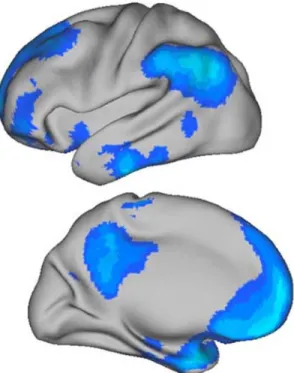
These two analyses revealed a remarkably consis-tent set of brain regions that were more active during passive task conditions than during numerous goal-directed task conditions (spanning both verbal and nonverbal domains and visual and auditory condi-tions). The results of the Shulman et al. (1997) meta-analysis are shown in FIGURE2. This image displays
the full cortical extent of the brain’s default network. The broad generality of the rest activity pattern across so many diverse studies reinforced the intriguing pos-sibility that a common set of cognitive processes was used spontaneously during the passive-task states. Mo-tivated by this idea, Mazoyer et al. (2001) explored the content of spontaneous thought by asking partici-pants to describe their musings following the scanned rest periods. Paralleling the informal observations by
FIGURE 2. The brain’s default network was originally identified in a meta-analysis that mapped brain regions more active in passive as compared to active tasks (of-ten referred to as task-induced deactivation). The displayed positron emission tomography (PET) data include nine stud-ies (132 participants) from Shulman et al. (1997; rean-alyzed in Buckner et al. 2005). Images show the me-dial and lateral surface of the left hemisphere using a population-averaged surface representation to take into ac-count between-subject variability in sulcal anatomy (Van Es-sen 2005). Blue repreEs-sents regions most active in passive task settings.
Ingvar and Andreasen et al., they noted that the im-aged rest state is associated with lively mental activity that includes “generation and manipulation of men-tal images, reminiscence of past experiences based on episodic memory, and making plans” and further noted that the subjects of their study “preferentially reported autobiographical episodes.”
Emergence of the Default Network as Its Own Research Area
The definitive recent event in the explication of the default network came with the a series of publi-cations by Raichle, Gusnard, and colleagues (Raichle et al. 2001, Gusnard & Raichle 2001, Gusnard et al. 2001). A dominant theme in the field during the pre-vious decade concerned how to define an appropriate baseline condition for neuroimaging studies. This focus on the baseline state was central to the evolving con-cept of a default network. Many argued that passive
conditions were simply too unconstrained to be useful as control states. Richard Frackowiak summarized this widely held concern: “To call a ‘free-wheeling’ state, or even a state where you are fixating on a cross and dreaming about anything you like, a ‘control’ state, is to my mind quite wrong” (Frackowiak 1991). (For recent discussion of this ongoing debate see Morcom and Fletcher 2007, Buckner & Vincent 2007, Raichle & Snyder 2007). As a result of this uneasiness in inter-preting passive task conditions, beyond the few earlier studies mentioned, there was a general trend not to thoroughly report or discuss the meaning of rest state activity.
Raichle, Gusnard, and colleagues reversed this trend dramatically with three papers in 2001 (Raichle et al. 2001, Gusnard & Raichle 2001, Gusnard et al. 2001). Their papers directly considered the empirical and theoretical implications of defining baseline states and what the specific pattern of activity in the default net-work might represent. Several lasting consequences on the study of the default network emerged. First, they distinguished between various forms of task-induced deactivation and separated deactivations defining the default network from other forms of deactivation (in-cluding attenuation of activity in unattended sensory areas). Second, they compiled a considerable array of findings that drew attention to the specific anatomic regions linked to the default network and what their presence might suggest about its function. A key in-sight was that the medial prefrontal regions consistently identified as part of the default network are associated with self-referential processing (Gusnard et al. 2001, Gusnard & Raichle 2001). Most importantly, the pa-pers brought to the forefront the exploration of the default network as its own area of study (including pro-viding its name, which, as of late 2007, has appeared as a keyword in 237 articles). Our use of the label “default network” in this review stems directly from their label-ing the baseline rest condition as the “default mode.”b Their reviews made clear that the default network is to be studied as a fundamental neurobiological system with physiological and cognitive properties that distin-guish it from other systems.
The default network is a brain system much like the motor system or the visual system. It contains a set of interacting brain areas that are tightly functionally
bReferences to the default mode appear in the literature on cognition prior to the introduction of the concept as an explanation for neural and metabolic phenomena. Giambra (1995), for example, noted that “Task-unrelated images and thoughts may represent the normal default mode of operation of the self-aware.” Thus, the concept of a default mode is converged upon from both cognitive and neurobiological perspectives.
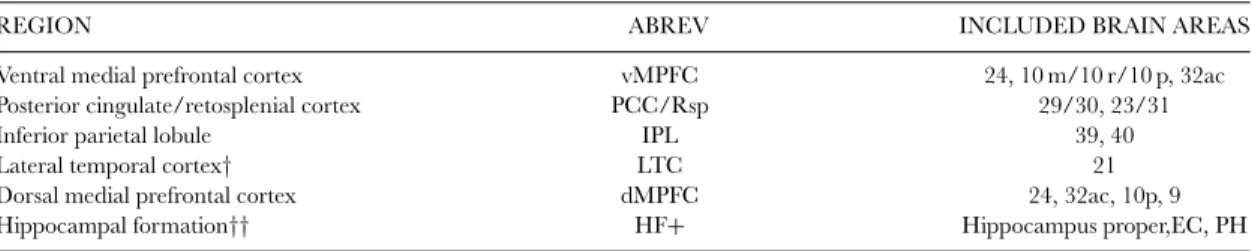
TABLE 1. Core regions associated with the brain’s default network
REGION ABREV INCLUDED BRAIN AREAS
Ventral medial prefrontal cortex vMPFC 24, 10 m/10 r/10 p, 32ac
Posterior cingulate/retosplenial cortex PCC/Rsp 29/30, 23/31
Inferior parietal lobule IPL 39, 40
Lateral temporal cortex† LTC 21
Dorsal medial prefrontal cortex dMPFC 24, 32ac, 10p, 9
Hippocampal formation†† HF+ Hippocampus proper,EC, PH
Notes: Region, abbreviation, and approximate area labels for the core regions associated with the default network in humans. Labels correspond to those originally used by Brodmann for humans with updates by Petrides and Pandya (1994), Vogt et al. (1995), Morris et al. (2000), and ¨Ong¨ur et al. (2003). Labels should be considered approximate because of the uncertain boundaries of the areas and the activation patterns.†LTC is particularly poorly characterized in humans and is therefore the most tentative estimate.††HF+ includes entorhinal cortex (EC) and surrounding cortex (e.g., parahippocampal cortex; PH).
connected and distinct from other systems within the brain. In the remainder of this review, we define the default network in more detail, speculate on its func-tion both during passive and active cognitive states, and evaluate accumulating data that suggest that un-derstanding the default network has important clinical implications for brain disease.
II. Anatomy of the Default Network
The anatomy of the brain’s default network has been characterized using multiple approaches. The default network was originally identified by its consistent ac-tivity increases during passive task states as compared to a wide range of active tasks (e.g., Shulman et al. 1997, Mazoyer et al. 2001, FIG. 2). A more recent
ap-proach that identifies brain systems via intrinsic activity correlations (e.g., Biswal et al. 1995) has also revealed a similar estimate of the anatomy of the default net-work (Greicius et al. 2003, 2004). More broadly, the default network is hypothesized to represent a brain system (or closely interacting subsystems) involving anatomically connected and interacting brain areas. Thus, its architecture should be critically informed by studies of connectional anatomy from nonhuman pri-mates and other relevant sources of neurobiological data.
In this section, we review the multiple approaches to defining the default network and consider the spe-cific anatomy that arises from these approaches in the context of architectonic and connectional anatomy in the monkey. We highlight two observations. First, all neuroimaging approaches converge on a similar es-timate of the anatomy of the default network that is largely consistent with available information about connectional anatomy (TABLE1). Second, the
intrin-sic architecture of the default network suggests that it
comprises multiple interacting hubs and subsystems. These anatomic observations provide the foundation on which the upcoming sections explore the functions of the default network.
Blocked Task-Induced Deactivation
Because PET imaging requires about a minute of data accumulation to construct a stable image, the brain’s default network was initially characterized us-ing blocked task paradigms. Within these paradigms, extended epochs of active and passive tasks were com-pared to one another. During these epochs brain ac-tivity was averaged over blocks of multiple sequential task trials—hence the label “blocked.” Shulman et al. (1997) and Mazoyer et al. (2001) published two semi-nal meta-asemi-nalyses based on blocked PET methods to identify brain regions consistently more active during passive tasks as compared to a wide range of active tasks. Tasks spanned verbal and nonverbal domains (Shulman et al. 1997) and auditory and visual modal-ities (Mazoyer et al. 2001). In total, data from 195 subjects were aggregated across 18 studies in the two meta-analyses.
FIGURE2 displays the original data of Shulman et al.
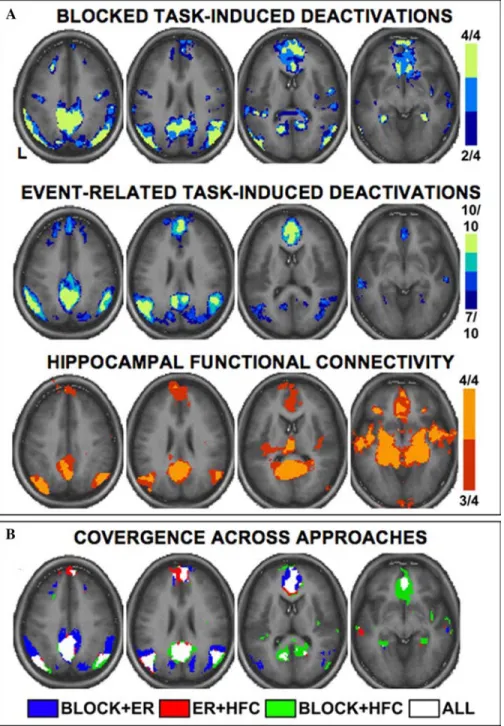
visualized on the cortical surface to illustrate the topog-raphy of the default network; the data from Mazoyer et al. (not shown) are highly similar. FIGURE3 shows
a third meta-analysis of blocked task data from a se-ries of 4 fMRI data sets from 92 young-adult subjects (Shannon 2006). In this meta-analysis of fMRI data, the passive tasks were all visual fixation and the active tasks involved making semantic decisions on visually presented words (data from Gold & Buckner 2002, Lustig & Buckner 2004). Across all the variations, a consistent set of regions increases activity during pas-sive tasks when individuals are left undirected to think to themselves.
FIGURE 3. The brain’s default network is converged upon by multiple, distinct fMRI approaches. (A)Each row of images shows a different fMRI approach for defining the default network: blocked task-induced deactivation (top row), event-related task-induced deactivation (middle row), and functional connectivity with the hippocampal formation (bottom row). Within each approach, the maps represent a meta-analysis of multiple data sets thereby providing a conservative estimate of the default network (see text). Colors reflect the number of data sets showing a significant effect within each image (color scales to the right).(B)The convergence across approaches reveals the core regions within the default network (legend at the bottom). Z labels correspond to the transverse level in the atlas of Talairach and Tournoux (1988). Left is plotted on the left. Adapted from Shannon (2006).
Event-Related, Task-Induced Deactivation
An alternative to defining the anatomy of the de-fault network based on blocked tasks is to perform a similar analysis on individual task events. Rapid event-related fMRI makes possible such an analysis by pre-senting task trials at randomly jittered time intervals, typically 2 to 10 seconds apart. The reason to perform such an analysis is the possibility that extended epochs are required to elicit activity during passive epochs, as might be the case if blocked task-induced deactivations arise from slowly evolving signals or sustained task sets that are not modulated on a rapid time frame (e.g., Dosenbach et al. 2006).
FIGURE3 illustrates the results of a meta-analysis of
studies from Shannon (2006) that uses event-related fMRI data to define the default network. In total, data from 49 subjects were pooled for this analysis. The data are based on semantic and phonological classifi-cation tasks from Kirchhoff et al. (2005; n=28) as well as a second sample of event-related data that also in-volved semantic classification (Shannon 2006; n=21). As can be appreciated visually, the default network de-fined based on event-related data is highly similar to that previously reported using blocked data. Thus, the differential activity in the default network between pas-sive and active task states can emerge rapidly, on the order of seconds or less.
Functional Connectivity Analysis
A final approach to defining the functional anatomy of the default network is based on the measurement of the brain’s intrinsic activity. At all levels of the ner-vous system from individual neurons (Tsodyks et al. 1999) and cortical columns (Arieli et al. 1995) to whole-brain systems (Biswal et al. 1995, De Luca et al. 2006), there exists spontaneous activity that tracks the func-tional and anatomic organization of the brain. The patterns of spontaneous activity are believed to re-flect direct and indirect anatomic connectivity (Vincent et al. 2007a) although additional contributions may arise from spontaneous cognitive processes (as will be described in a later section). In humans, low-frequency, spontaneous correlations are detectable across the brain with fMRI and can be used to characterize the intrinsic architecture of large-scale brain systems, an approach often referred to as functional connec-tivity MRI (Biswal et al. 1995, Haughton & Biswal 1998; see Fox & Raichle 2007 for a recent review). Motor (Biswal et al. 1995), visual (Nir et al. 2006), auditory (Hunter et al. 2006), and attention (Fox et al. 2006) systems have been characterized using func-tional connectivity analysis (see also De Luca et al. 2006).
Greicius and colleagues (2003, 2004) used such an analysis to map the brain’s default network (see also Fox et al. 2005, Fransson 2005, Damoiseaux et al. 2006, Vincent et al. 2006). Functional connectivity analysis is particularly informative because it provides a means to assess locations of interacting brain regions within the default network in a manner that is independent of task-induced deactivation. In their initial studies, Greicius et al. measured spontaneous activity from the posterior cingulate cortex, a core region in the default network, and showed that activity levels in the remain-ing distributed regions of the system are all correlated together. Their map of the default network, based on intrinsic functional correlations, is remarkably similar to that originally generated by Shulman et al. (1997) based on PET deactivations.
An important further observation from analyses of intrinsic activity is that the default network includes the hippocampus and adjacent areas in the medial temporal lobe that are associated with episodic mem-ory function (Greicius et al. 2004). In fact, many of the major neocortical regions constituting the default network can be revealed by placing a seed region in the hippocampal formation and mapping those corti-cal regions that show spontaneous correlation (Vincent et al. 2006). FIGURE3 shows a map of the default
net-work as generated from intrinsic functional correla-tions with the hippocampal formation in four inde-pendent data sets.
Convergence across Approaches for Defining the Default Network
Is there convergence between the three distinct ap-proaches for defining the anatomy of the default net-work described above? To answer this question, the overlap among the multiple methods for defining de-fault network anatomy is displayed on the bottom panel of FIGURE3. The convergence reveals that the default
network comprises a distributed set of regions that includes association cortex and spares sensory and motor cortex. In particular, medial prefrontal cortex (MPFC), posterior cingulate cortex/retrosplenial cor-tex (PCC/Rsp), and the inferior parietal lobule (IPL) show nearly complete convergence across the 18 data sets.
Several more specific observations are apparent from this analysis of overlap. First, the hippocampal formation (HF) is shown to be involved in the de-fault network regardless of which approach is used (task-induced deactivation or functional connectivity analysis) but, relative to the robust posterior mid-line and prefrontal regions, the HF is less promi-nent using the approach of task-induced deactivations.
FIGURE 4. The default network in the monkey defined using functional connectivity analysis. A seed was placed in the posterior midline (indicated by asterisk) and the regions showing correlated activity were mapped. The left image shows the medial surface, the middle image a transverse section through parietal cortex, and the right image a coronal section through the hippocampal formation. Left is plotted on the left. Adapted from Vincent et al. (2007a).
Second, multiple default network regions are function-ally correlated with the HF, reinforcing the notion that the medial temporal lobe is included in the network. Overlap is not perfect, however, with some indications of more extensive recruitment during passive cogni-tive states, including both in posterior parietal cortex and in prefrontal cortex. These details will be shown to be informative when subsystems within the default network are discussed. Third, lateral temporal cortex (LTC) extending into the temporal pole is consistently observed across approaches but, like the HF, is less robust. Together these observations tentatively define the core anatomical components of the default network (TABLE1).
Insights from Comparative Anatomy
Important insights into the organization of human brain systems have been provided by comparative stud-ies in the monkey. Vincent et al. (2007a) recently used functional connectivity analysis to show that the major default network regions in posterior cortex have pu-tative monkey homologues including PCC/Rsp, IPL, and the HF (FIG. 4, see also Rilling et al. 2007). In
addition, architectonic maps reveal many similarities between human and monkey anatomy in the vicinity of the default network (e.g., Petrides & Pandya 1994, Morris et al. 2000, ¨Ong¨ur & Price 2000, Vogt et al. 2001). Motivated by these recent observations, we pro-vide here a detailed analysis of the architectonics and connectional anatomy of the default network, while recognizing that there may be fundamental differences in humans. As a means to simplify our analysis, we fo-cus on areas that fall within PCC/Rsp and MPFC and their anatomic relationships with other cortical regions
and the HF. Potentially important subcortical connec-tions, such as to the striatal reward pathway and the amygdala, are not covered. Even with this simplifica-tion, the details of the anatomy are complex and one is immediately confronted with the observation that each of the activated regions, as defined based on human functional neuroimaging data, extends across multiple brain areas that have distinct architecture and connec-tivity. Progress will require significantly more detailed analysis of the anatomic extent and locations of default network regions in humans. Nonetheless, using avail-able data we provide an initial analysis of the anatomy recognizing that it is provisional and incomplete.
Posterior cingulate cortex (PCC) and restrosple-nial cortex (Rsp) have been extensively studied in the macaque monkey and recently so with focus on di-rect comparison to human anatomy (e.g., Morris et al. 2000, Vogt et al. 2001). The PCC and Rsp fall along the posterior midline and exist within a region that contains at least three contiguous, but distinct, sets of areas: Rsp (areas 29/30), PCC (areas 23/31), and pre-cuneus (area 7m). Rsp is just posterior to the corpus callosum and, in humans, extends along the ventral bank of the cingulate gyrus (Morris et al. 2000, Vogt et al. 2001). In macaques, Rsp is much smaller and does not encroach onto the cingulate gyrus (Morris et al. 1999, Kobayashi & Amaral 2000). Just poste-rior to Rsp, along the main portion of the cingulate gyrus, is PCC. The precuneus, a region often cited as being involved in the default network, comprises the posterior and dorsal portion of the medial parietal lobe and includes area 7m (Cavanna & Trimble 2006, Parvizi et al. 2006). As an ensemble, these three struc-tures are sometimes referred to as “posteriomedial
cortex,” and each structure is interconnected with the others (e.g., Parvizi et al. 2006, Kobayashi & Amaral 2003).
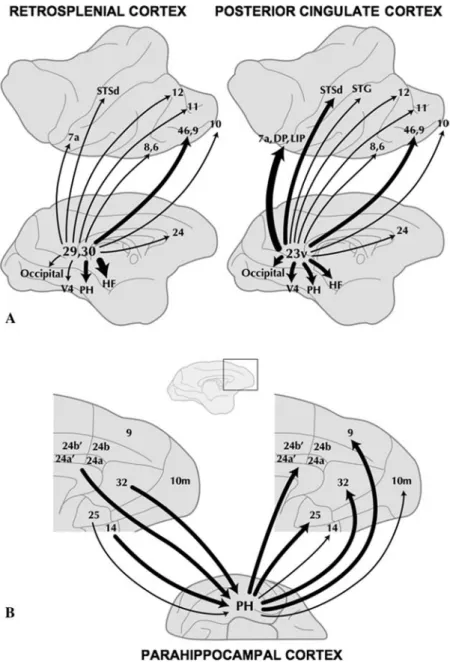
The predominant extrinsic connections to and from the posteriomedial cortex differ by area. Collectively, the connections are widespread and, much like other association areas, are consistent with a role in infor-mation integration. Specifically, Rsp is heavily inter-connected with the HF and parahippocampal cortex, receiving nearly 40% of its extrinsic input from the me-dial temporal lobe (Kobayashi & Amaral 2003, see also Suzuki & Amaral 1994, Morris et al. 1999). Rsp also projects back to the medial temporal lobe as well as prominently to multiple prefrontal regions (Kobayashi & Amaral 2007, FIG. 5). PCC area 23 has reciprocal
connections with the medial temporal lobe and robust connections with prefrontal cortex and parietal cortex area 7a—an area at or near the putative homologue of the human default network region IPL (Kobayashi & Amaral 2003, 2007, FIG. 5). The medial temporal lobe
also has modest, but consistent, connections with area 7a (Suzuki & Amaral 1994, Clower et al. 2001, Lavenex et al. 2002). Thus, PCC/Rsp provides a key hub for overlapping connections between themselves, the me-dial temporal lobe, and IPL—three of the distributed regions that constitute the major posterior extent of the default network.
An unresolved issue is whether the lateral projection zone of PCC/Rsp is restricted to area 7a in humans or extends to areas 39/40. Macaque PCC has recipro-cal projections to superior temporal sulcus (STS) and the superior temporal gyrus (STG; see also Kobayashi & Amaral 2003). Analysis of the default network in macaques provides indication that the network’s lat-eral extent includes STG (Vincent et al. 2007a). Com-plicating the picture, IPL is greatly expanded in hu-mans, including areas 39/40 (Culham & Kanwisher 2001, Simon et al. 2002, Orban et al. 2006) that are closely localized to the lateral parietal region identified by human neuroimaging as being within the default network (see Caspers et al. 2006). A recent analysis of cortical expansion between the macaque and human brain based on mapping of 23 presumed homologies revealed that IPL is among the regions of greatest in-crease (Van Essen & Dieker 2007). Thus, these lateral parietal and temporo-parietal areas, which are not as well characterized as PCC/Rsp, are extremely interest-ing in light of their anatomic connections, involvement in the default network, and potential evolutionary ex-pansion in humans.
The connectional anatomy of area 7m in the pre-cuneus is difficult to understand in relation to the default network even though it is often included in
the default network. One possibility is that area 7m is simply not a component of the default network. Ref-erences to precuneus in the neuroimaging literature are often used loosely to label the general region that includes PCC area 29/30. Precuneus area 7m pre-dominantly connects with occipital and parietal areas linked to visual processing and frontal areas associated with motor planning (Cavada & Goldman-Rakic 1989, Leichnetz 2001). Moreover, medial temporal lobe re-gions that have extensive projections to PCC and Rsp show minimal connections to area 7m. Connections do exist between area 7m and the PCC, which may be the basis for the extensive activation patterns some-times observed along the posterior midline, but we suspect that area 7m is not a core component of the network.
Reinforcing this impression, close examination of the many maps that define the human default net-work in this review shows that the posterior medial extent of the network usually does not encroach on the edge of the parietal midline (where area 7m is located, Scheperjans et al. 2007). This boundary is labeled ex-plicitly in FIGURE7 by an asterisk. The middle panel
of FIGURE18 shows a particularly clear example of the
separation between task-induced deactivation of PCC and its dissociation from the region at or near area 7m. Another example of dissociation between the default network and area 7m can be found in Vogeley et al. (2004; their Figure 2A versus 2B). For all these reasons, we provisionally conclude that area 7m in precuneus is not part of the default network.
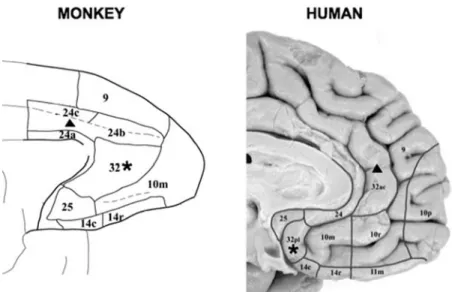
The second hub of the default network, MPFC, en-compasses a set of areas that lie along the frontal mid-line (Petrides & Pandya 1994, ¨Ong¨ur & Price 2000). Human MPFC is greatly expanded relative to the mon-key ( ¨Ong¨ur et al. 2003, FIG. 6). Two differences are
no-table. First, macaque area 32 is pushed ventrally and rostrally in humans to below the corpus callosum (la-beled by ¨Ong¨ur et al. as area 32pl in the human based on Brodmann’s original labeling of this area in mon-key as the “prelimbic area”). Human area 32ac cor-responds to Brodmann’s dorsal “anterior cingulate” area. Second, human area 10 is quite large and fol-lows the rostral path of anterior cingulate areas 24 and 32ac much like typical activation of MPFC in the default network. This is relevant because commonly referenced maps based on classic architectonic analy-ses restrict this area to frontalpolar cortex (e.g., Petrides & Pandya 1994). Some evidence suggests that area 10 is disproportionately expanded in humans even when contrasted to great apes, suggesting specialization during recent hominid evolution (Semendeferi et al. 2001).
FIGURE 5. Monkey anatomy suggests that the default network includes multiple, distinct association areas, each of which is connected to other areas within the network. Illustrated are two examples of output (efferent) and input (afferent) connections for posterior cingulate/retrosplenial cortex (PCC/Rsp) and parahippocampal cortex (PH).(A)Output connections from Rsp (areas 29 and 30) and PCC (area 23) are displayed. Lines show connections to distributed areas; thickness represents the connection strength. Rsp and PCC are heavily connected with the medial temporal lobe (HF, hippocampal formation; PH, parahippocampal cortex), the inferior parietal lobule (IPL) extending into superior temporal gyrus (STG), and prefrontal cortex (PFC). Numbers in the diagram indicate brain areas. Adapted from Kobayashi and Amaral (2007).(B)Input and output connections to and from PH to medial prefrontal cortex (MPFC) are displayed. Adapted from Kondo et al. (2005).
Given these details, MPFC activation within the default network is estimated to encompass human areas 10 (10 m, 10 r, and 10 p), anterior cingu-late (area 24/32ac), and area 9 in prefrontal cor-tex. The closest homologues to these areas in the
monkey—the medial prefrontal network—show re-ciprocal connections with the PCC, Rsp, STG, HF, and the perirhinal/parahippocampal cortex; sen-sory inputs are nearly absent (Barbas et al. 1999, Price 2007). These connectivity patterns closely
FIGURE 6. Architectonic areas within medial prefrontal cortex (MPFC) are illustrated for the monkey and human. The human MPFC is greatly expanded relative to the macaque monkey. This expansion is depicted by the triangle and asterisk that plot putative homologous areas between species based on
¨
Ong¨ur et al. (2003). Area 32 in the macaque is homologous with area 32pl in the human. Area 24c is expanded and homologous to the caudal part of area 32ac in human. The MPFC region activated within the human default network likely corresponds to frontalpolar cortex and its rostral expansion (areas 10m, 10r, and 10p), anterior cingulate (areas 24 and 32ac), and the rostral portion of prefrontal area 9. Because of differences in functional properties, we sometimes differentiate in this review between dorsal and ventral portions of MPFC (dMPFC and vMPFC). Adapted with permission from ¨Ong¨ur et al. (2003).
parallel areas implicated as components of the default network.
At the broadest level, an important principle emerges from considering these anatomic details: the default network is not made up of a single monosynap-tically connected brain system. Rather, the architec-ture reveals a series of interconnected subsystems that converge on key “hubs,” in particular the PCC, that are connected with the medial temporal lobe memory system. In the next section, we explore evidence for these subsystems from functional connectivity analysis in humans.
The Default Network Comprises Interacting Subsystems
The default network comprises a set of brain regions that are coactivated during passive task states, show in-trinsic functional correlation with one another, and are connected via direct and indirect anatomic projections as estimated from comparison to monkey anatomy. However, there is also clear evidence that the brain regions within the default network contribute special-ized functions that are organspecial-ized into subsystems that converge on hubs.
One way to gain further insight into the organiza-tion of the default network is through detailed
anal-ysis of the functional correlations between regions. FIGURE7 plots maps of the intrinsic correlations
as-sociated with three separate seed regions within the default network in humans: the hippocampal forma-tion including a porforma-tion of parahippocampal cortex (HF+), dMPFC, and vMPFC. The hubs—PCC/Rsp, vMPFC, and IPL—are revealed as the regions showing complete overlap across the maps. HF+forms a sub-system that is distinct from other major components of default network including the dMPFC: both are strongly linked to the core hubs of the default network but not to each other. We suspect further analyses will reveal more subtle organizational properties. Of note, the map of the default network’s hubs and subsystems shown in FIGURE7 bears a striking resemblance to the
original map of Shulman et al. (1997, FIG. 2) and
up-dates the description of the network to show that it comprises at least two interacting subsystems.
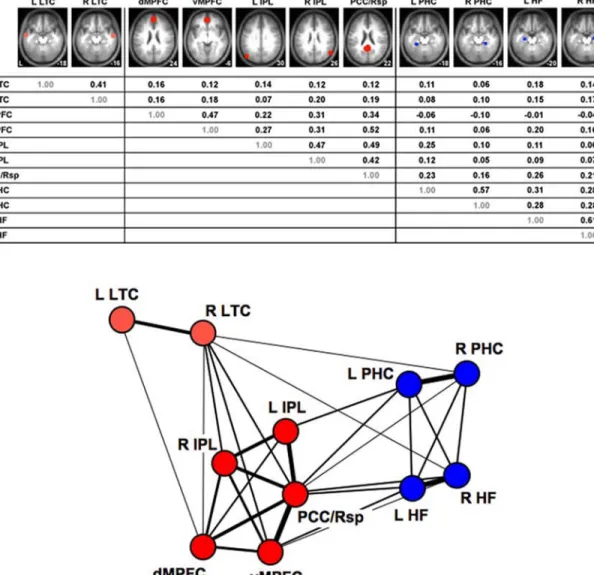
Normative estimates of the correlation strengths between regions within the default network are pro-vided in FIGURE8. The bottom panel of FIGURE8
is a graph analytic visualization of the correlation strengths using a spring-embedding algorithm to clus-ter strongly correlated regions near each other and po-sition weakly correlated regions away from each other. This graphical representation illustrates the separation
FIGURE 7. Hubs and subsystems within the default net-work are mapped using functional connectivity analysis. This map was produced by seeding three separate re-gions (dMPFC, vMPFC, HF+) and plotting the overlap of the functional correlations across the three regions (legend is at bottom; threshold for each map is r=.07). Data are high-resolution rest data (2mm voxels) from 40 participants (mean age=22 years; 16 male) collected at 3-Tesla using a 12-channel head coil (data from Andrews-Hanna et al. 2007b). Three observations are notable. First, the com-bined map is remarkably similar to the original estimate of the default network from PET task-induced deactivation (see FIG. 2). Second, PCC/Rsp, IPL, and vMPFC represent
anatomic hubs in the default network to which all other re-gions are correlated. Third, dMPFC and HF+, which are both strongly correlated with the hub regions, are not cor-related with each other, indicating that they are part of dis-tinct subsystems. A further interesting feature is that area 7m within the precuneus (indicated by asterisk) is not part of the default network. The black line near the asterisk represents the approximate boundary between areas 7m and 23/31 (estimated boundary based on Vogt & Laureys 2005).
of the medial temporal lobe subsystem. The analysis also reveals that the medial temporal subsystem is less strongly associated with the core of the default net-work that is centered on MPFC and PCC. However, it is important to note that the correlational strengths associated with the medial temporal lobe are gener-ally weaker than those observed for the distributed neocortical regions. As shown in FIGURE3, the most
robust correlations linked to the medial temporal lobe overlap the default network. It is presently unclear
how to interpret the quantitatively lower overall lev-els of correlations associated with the medial temporal lobe. Functional understanding of the default network should seek to explain both the distinct contributions of the interacting subsystems and the role of their close interaction. Of interest, infants do not show the struc-tured interactions between the default network regions, suggesting that the network develops in toddlers or chil-dren (Fransson et al. 2007). At the other end of the age spectrum, it has recently been shown that advanced aging is associated with disrupted correlations across large-scale brain networks including the default net-work (Andrews-Hanna et al. 2007a, Damoiseaux et al. in press). Thus, the correlation strengths presented in FIGURE8 are only representative of normal young
adults. An interesting topic for future research will be to understand the developmental course of the default network as well as the functional implications of its late life disruption.
Vascular and Other Alternative Explanations for the Anatomy of the Default Network
Given the reproducibility of the specific anatomy of the default network, an important question to ask is whether the pattern can be accounted for by some al-ternative explanation that is not linked to neural archi-tecture. One possibility is that the observed anatomy reflects a vascular pattern—either draining veins, a global form of “blood stealing” whereby active regions achieve blood flow increases at the expense of nearby regions, or some other poorly understood mechanism of vascular regulation. The methods that have revealed the default network are based on hemodynamic mea-sures of blood flow that are indirectly linked to neu-ral activity (Raichle 1987, Heeger & Ress 2002). This issue is particularly relevant for analyses based on in-trinsic correlations because slow fluctuations in vascu-lar properties track breathing as well as oscillations in intracranial pressure. Wise et al. (2004) recently measured fMRI correlations with the slow fluctua-tions in the partial pressure of end-tidal carbon diox-ide that accompany breathing. Their results convinc-ingly demonstrate correlated, spatially specific fMRI responses suggesting that fMRI patterns can reflect vascular responses to breathing (see also Birn et al. 2006). While the spatial patterns associated with res-piration do not closely resemble the default network, the results of Wise and colleagues are a reminder that a vascular account should be explored further.
One reason to be skeptical of a vascular ac-count is that the default network is also identified using measures of resting glucose metabolism. In a
FIGURE 8. (top) Functional correlation strengths are listed for multiple regions within the default network. Each of the regions is displayed on top with the strengths of the region-to-region correlations indicated below (r-values were computed using procedures identical to Vincent et al. 2006). Regions are plotted on the averaged anatomy of the participant group (MNI/ICBM152 atlas with Z coordinates displayed). (bottom) The regions of the default network are graphically represented with lines depicting correlation strengths. The positioning of nodes is based on a spring-embedding algorithm that positions correlated nodes near each other. The structure of the default network has a core set of regions (red) that are all correlated with each other. LTC is distant because of its weaker correlation with the other structures. The medial temporal lobe subsystem (blue) includes both the hippocampal formation (HF) and parahippocampal cortex (PHC). This subsystem is correlated with key hubs of the default network including PCC/Rsp, vMPFC, and IPL. The dMPFC is negatively correlated with the medial temporal lobe subsystem suggesting functional dissociation. Graph analytic visualization provided by Alexander Cohen and Steven Petersen.
particularly informative study, Vogt and colleagues (2006) used [18F]flourodeoxyglucose (FDG) PET to
explore anatomy associated with the default net-work. Critically, FDG-PET measures neuronal activ-ity through glucose metabolism independent of
vas-cular coupling. Vogt et al. first defined regions within the PCC (ventral PCC and dorsal PCC) and Rsp in postmortem human tissue samples. They then mea-sured resting state glucose metabolism in each of these regions across 163 healthy adults and correlated the
obtained values across the brain to yield metabolism-based maps of functional correlation. A quite remark-able pattern emerged: ventral PCC showed correlation with the main components of the default network in-cluding vMPFC and IPL (see their Figure 7, panel B). Moreover, this pattern was preferential to ventral PCC, suggesting that the posterior hub of the default network may be even more circumscribed than the fMRI data suggest, which have implicated the broader region in-cluding dorsal PCC and Rsp. Directly relevant to the question of whether a vascular explanation can ac-count for the default network’s anatomy, these results were obtained without relying on vascular coupling.
Glucose Metabolism and the Oxygen Extraction Fraction
Metabolic properties of the default network also set the network apart from other brain systems (Raichle et al. 2001). In particular, regions within the default network show disproportionately high resting glucose metabolism relative to other brain regions as mea-sured using FDG-PET (e.g., Minoshima et al. 1997, Gusnard & Raichle 2001, see FIG. 17) as well as high
regional blood flow (Raichle et al. 2001). For example, Minoshima et al. (1997, see their Figure 1) mapped resting glucose metabolism in healthy older adults ref-erenced to the pons, allowing visualization of regional variation across the cortex. Along the midline, normal-ized glucose metabolism in PCC was about 20% higher than in most other brain regions. However, high glu-cose metabolism was not selective only to the default network—a region at or near primary visual cortex also showed high resting metabolism. To our knowl-edge, there has been no systematic investigation of rest-ing glucose metabolism within default network regions as contrasted to regions outside the network; however, all reported exploratory maps of glucose metabolism converge on the observation that the posterior mid-line near PCC is a region of disproportionately high metabolism (e.g., Minoshima et al. 1997, Figure 1, Gus-nard & Raichle 2001, Figure 1). Intriguingly, the re-gions within the default network that show high resting metabolism are also those affected in Alzheimer’s dis-ease, something that will be discussed extensively in the final section of this review. To foreshadow this fi-nal discussion, the possibility will be raised that high levels of baseline activity and metabolism (glycolysis) in the default network are conducive to the forma-tion of pathology associated with Alzheimer’s disease (Buckner et al. 2005).
A second metabolic property that has been explored in connection with the default network is regional oxy-gen utilization. In their seminal paper that drew
at-tention to the default network, Raichle et al. (2001) mapped the ratio of oxygen used locally to oxygen de-livered by blood flow. This ratio, referred to as the oxy-gen extraction fraction (OEF), decreases during height-ened neural activity because the increased flow of blood into a region exceeds oxygen use (see Raichle & Mintun 2006). Raichle and colleagues (2001) hypoth-esized that an absolute physiological baseline could be shown to exist if OEF remained constant during passive (rest) task states, suggesting that task-induced deactivations within the default network are physiolog-ically dissimilar from other forms of transient neuronal activity increase. While an intriguing possibility, there are several observations that suggest OEF within the default network does change at rest. First, OEF de-creases were noted by Raichle et al. (2001) in several default network regions at rest when each was tested individually at thep<0.05 level of statistical
signifi-cance. Second, regional variation in OEF across the default network was correlated from one data set to the next (r=.89) indicating systematic modulation; a constant OEF across regions would show zero corre-lation from one data set to the next. The moducorre-lation was quantitatively small, however, with OEF values of most regions falling within 5 to 10% of the other regions. Further exploration will be required to deter-mine if there is an absolute metabolic state that defines a baseline within the default network or whether there are meaningful variations across regions. In the next section, we will specifically explore the possibility that the special properties that arise in the default network associate with its role in spontaneous cognition during freethinking.
III. Spontaneous Cognition Human beings spend nearly all of their time in some kind of mental activity, and much of the time their activity con-sists not of ordered thought but of bits and snatches of in-ner experience: daydreams, reveries, wandering interior monologues, vivid imagery, and dreams. These desultory concoctions, sometimes unobtrusive but often moving, contribute a great deal to the style and flavor of being human. Their very humanness lends them great intrinsic interest; but beyond that, surely so prominent a set of activities cannot be functionless. (Klinger 1971 p. 347)
A shared human experience is our active inter-nal mental life. Left without an immediate task that demands full attention, our minds wander jumping from one passing thought to next—what William James (1890) called the “stream of consciousness.” We muse about past happenings, envision possible future events, and lapse into ideations about worlds that are far from
our immediate surroundings. In lay terms, these are the mental processes that make up fantasy, imagina-tion, daydreams, and thought. A central issue for our present purposes is to understand to what degree, if any, the default network mediates these forms of spon-taneous cognition. The observation that the default network is most active during passive cognitive states, when thought is directed toward internal channels, encourages serious consideration of the possibility that the default networkisthe core brain system associated with spontaneous cognition, and further that people have a strong tendency to engage the default network during moments when they are not otherwise occupied by external tasks. In considering the relationship be-tween the default network and spontaneous cognition, it is worth beginning with a short review of spontaneous cognition itself.
Descriptions of human nature have alluded to the prominence of private mental experience since the classical period. In a whimsical description, Plato por-trayed Socrates as “capable of standing all day in the market place lost in thought and oblivious of the ex-ternal world,” leading Aristophanes to coin the phrase “his head is in the clouds” (Singer 1966). Experimental study of internal mental life originated within the psy-chological movement of introspection in the late 19th century. Developed by Wilhelm Wundt and continued by the American psychologist Edward Titchener, in-trospective methods required participants to describe the contents of their internal mental experience. The premise of introspection was that conscious elements and attributes are sufficient to describe the mind. The focus on behaviorism during much of the 20th century, which emphasized measurement of the external factors that control behavior, caused a marked decline in the study of thought in mainstream science. The behavior-ists rejected the methods of introspection because they relied on subjective report leading to a global “morato-rium on the study of inner experience” (Klinger 1971). The dark ages of spontaneous cognition ended in 1966 with a seminal publication by Jerome Singer that described an extensive empirical research program on the topic of daydreaming (see also Antrobus et al. 1970, Klinger 1971, Singer 1974). Several important advances emerged from this work. First, behavioral instruments were developed for the measurement of spontaneous cognition that correlated with such fac-tors as individual differences in cognition, physiological measures and eye movements, and were also predic-tive of response patterns on varied tasks (e.g., Singer & Schonbar 1961, Singer et al. 1963, Antrobus et al. 1966, Antrobus 1968, Antrobus et al. 1970). Second, spontaneous cognition was observed to be quite
com-mon: 96% of individuals report daydreaming daily. Moreover, the contents of daydreams were found to include everything from mundane recounts of recent happenings to plans and expectations about the future. Finally, this work emphasized that spontaneous cogni-tion is healthy and adaptive, and not simply a set of dis-tracting processes or fantasies. Singer (1966), Antrobus et al. (1966) and later Klinger (1971) specifically sug-gested that internal mental activity is important for anticipating and planning the future. We will return to this important idea later.
In the past decade, the study of spontaneous cogni-tion has built upon these foundacogni-tions and introduced novel experimental approaches to explore the content of people’s internal mental states (see Smallwood & Schooler 2006 for review). Critical to understanding the relationship between the default network and spon-taneous cognition, measures of sampled thoughts track default network activity. Moreover, individual differ-ences in tendencies to engage spontaneous cognitive processes parallel differences in default network activ-ity. In the following section, we review these findings and discuss their implications.
Stimulus-Independent Thoughts
A number of brain imaging studies have explored stimulus-independent thoughts (SITs).cSITs are oper-ationally defined as thoughts about something other than events originating from the environment; they are covert and not directed toward performance of the task at hand. The most common method for measuring SITs involves periodically probing trained participants to indicate whether they are experiencing a SIT. Care is taken to minimize the intrusiveness of the probe, al-though a limitation of this approach is that the probe nonetheless does interfere with the SIT, most typically to terminate its occurrence (Giambra 1995). Antrobus and colleagues (1966, 1968, 1970) showed that SITs occur quite pervasively—during both resting epochs and also during the performance of concurrent tasks. Even under heavy loads of external information, most individuals still report the presence of some SITs al-though the number of SITs correlates inversely with the demands of the external task.
cVarious labels have been used in the reviewed papers to describe self-reported thought content including task-irrelevant thoughts (Antrobus et al. 1966), stimulus-independent thoughts (SITs, Antrobus et al. 1970, Teasdale et al. 1995), task-unrelated thoughts (TUTs, Giambra 1989), and task-unrelated images and thoughts (TUITs, Giambra 1995). For simplic-ity, we use the term “stimulus-independent thoughts” or SITs throughout the text.
Extending from these behavioral observations, sev-eral imaging studies have correlated the number of reported SITs with brain activity. In an early study, McGuire et al. (1996) demonstrated that the frequency of SITs estimated following various PET scans cor-related with MPFC activity. Following a similar ap-proach, Binder and colleagues (Binder et al. 1999, McKiernan et al. 2003, 2006) conducted two fMRI studies that explored the relationship between SITs and brain activity. In both studies they measured brain ac-tivity during rest and various tasks using typical fMRI procedures. Then, within a mock scanning environ-ment, they had participants perform the same tasks while periodically probing for the presence of SITs. This procedure allowed them to sort the fMRI tasks based on their propensity to elicit SITs. The first study (Binder et al. 1999) revealed that rest, as compared to an externally oriented tone detection task, was as-sociated with both increased default network activity, and nearly six times more SITs. The second study parametrically varied task difficulty across six separate tasks such that the easiest task (easy to detect target, slow presentation rate) produced about twice as many SITs as the most difficult task (McKiernan et al. 2003, 2006). Referenced to rest, there was a strong corre-lation between SITs and activity within the default network.
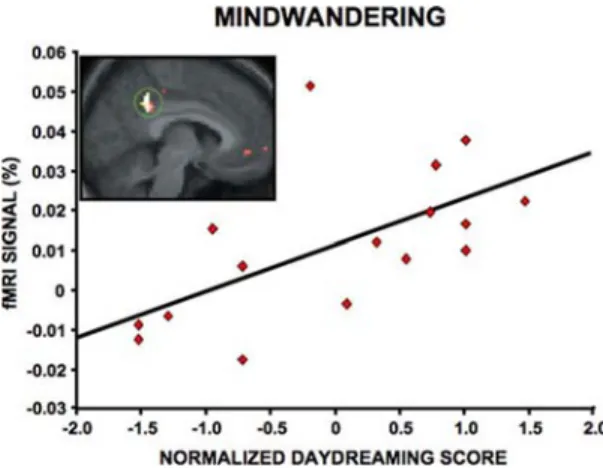
Mason et al. (2007) recently extended these ap-proaches to study individual differences. Like the ear-lier work, they measured the propensity of rest and task states to elicit SITs. Task demands were manipulated using practice: a practiced variant of the task (low de-mands, many SITs) was compared with a novel variant (high demands, few SITs). The researchers replicated the work of Binder and colleagues by showing that de-fault network regions, including MPFC and PCC/Rsp, tracked the different task states in proportion to the numbers of produced SITs. To ascertain who among their group was more likely to produce SITs, they ad-ministered a daydreaming questionnaire adopted from Singer and Antrobus (1972) that assessed general ten-dencies to engage in internal cognition (e.g., Do you daydream at work? When you have time on your hands do you daydream?). There was a strong correlation in regional default network activity with the partici-pant’s daydreaming tendencies (FIG. 9). Those
individ-uals who showed the greatest default network activity during the practiced task condition were self-described daydreamers.
Taken collectively, these findings converge to suggest that task contexts that encourage SIT production show the greatest default network activity; furthermore, in-dividuals who daydream most show increased default
FIGURE 9. The default network is most active in indi-viduals who report frequent mindwandering, suggesting a functional role in spontaneous cognition. Activity estimates are plotted for 16 subjects from PCC/Rsp (region shown in insert) from a task contrast conducive to encouraging mind-wandering. The activity within this region is significantly correlated with individual self-reports of daydreaming ob-tained outside the scanner. Adapted from data published in Mason et al. (2007).
network activity, at least when placed in a conducive experimental setting.
Momentary Lapses in Attention
An idea that emerges repeatedly in the study of inter-nal mental activity is that there is competition between resources for internal modes of cognition and focus on the external world (Antrobus et al. 1966, 1970, Teasdale et al. 1995). In discussing forms of attention, William James (1890) wrote “When absorbed in in-tellectual attention we become so inattentive to outer things as to be ‘absent-minded,’ ‘abstracted,’ or ‘dis-traits.’ All revery or concentrated meditation is apt to throw us into this state” (pp. 418–419). In any given task context, there must be assignment of priorities for attending to external or internal channels of informa-tion, which in turn will have consequences for task per-formance (Singer 1966, Smallwood & Schooler 2006). When an external task is performed, focus on internal mental content will likely lead to mistakes or slowed performance on the immediate task at hand. Several studies have explored interactions between external attention and activity within the default network.
In one investigation, Greicius and Menon (2004) studied the dynamics of activity within the default net-work while people were presented blocks of external visual and auditory stimuli. They first showed that spontaneous activity correlations across regions within the default network continued during the stimulus blocks. The implication of this observation is that
spontaneous activity within the default network per-sists through both experimental and rest epochs. They further observed evidence for competition between sensory processing and spontaneous default network fluctuations: sensory-evoked responses were attenu-ated in those individuals who showed the strongest spontaneous activity correlations within the default network.
Momentary lapses in external attention were ex-plored directly by Weissman and colleagues (2006) during a demanding perceptual task. Lapses in atten-tion were defined as occurring when participants were slow to respond. Two observations were made. First, just prior to a lapse in attention, activity within brain regions associated with control of attention was di-minished, including dorsal anterior cingulate and pre-frontal cortex. Second, during the lapse of attention itself, activity within the default network was increased prominently in the PCC/Rsp. These findings suggest that transient lapses in the control of attention may lead to a shift in attention from the external world to internal mentation.
A related observation was made in the context of memory encoding by Otten and Rugg (2001). Brain ac-tivity was measured in two studies during the inciden-tal encoding of words. The researchers found that in-creased activity in the posterior midline near PCC/Rsp and lateral parietal regions near IPL, among other re-gions, predicted which words would be later forgotten. This observation is consistent with the possibility that transient activity increases in the default network mark those trials on which the memorizers were distracted from their primary task, perhaps lapsing into private channels of thought.
Recently Li et al. (2007) tackled this possibility across two studies using a go/no-go paradigm. In their task, cues signaling participants to make speeded responses were intermixed with infrequent stop signals that man-dated the responses should be withheld. Errors oc-curred when participants responded to stop signals. Exploring brain activity on the trials that preceded er-rors revealed that regions within the default network (MPFC and PCC/Rsp, but not IPL) augmented activ-ity just prior to errors, an effect replicated in a second study. While again correlational, these data suggest that when the default network is active, lapses in fo-cused external attention occur in ways that affect task performance.
However not all studies have found such relation-ships. Hahn et al. (2007), for example, noted that fast responses in a target-detection task were associated with increased default network activity (see Figure 3 in Hahn et al. 2007). Gilbert et al. (2006, 2007)
hy-pothesized that the default network is associated with a broadly tuned form of outward attention (“watch-fulness”). This idea, as will be discussed more ex-tensively in the upcoming section, is reminiscent of Shulman and colleagues’ (1997) suggestion that the default network participates in monitoring the ex-ternal environment. While difficult to reconcile with the studies discussed earlier, the hypothesis put for-ward by Gilbert and colleagues is a reminder that ev-idence to date is limited and correlational, and fur-ther that opposing possibilities should be carefully explored. Thus, while an accumulating set of obser-vations suggest that mindwandering is linked to in-creased activity in regions within the default network, further exploration is warranted to determine if the system is directly supporting the processes underlying the stimulus-independent thoughts that accompany mindwandering.
Spontaneous Activity Dynamics
The default network spontaneously exhibits slow waxing and waning of activity during rest that is corre-lated across its distributed regions (Greicius et al. 2003, Fox et al. 2005, Fransson 2005, Damoiseaux et al. 2006, Vincent et al. 2006). FIGURE10 illustrates this
ro-bust phenomenon for a 5-minute epoch during which a young adult passively viewed a small fixation crosshair. As can be seen, activity within MPFC and PCC/Rsp— two of the most prominent components of the default network—spontaneously modulates over time. Criti-cally, these two regions, which are anatomically distant from one another and supplied by separate vascular territories, show strong correlation, thereby indicating that the fMRI-measured activity swings arise from co-ordinated neural activity and not from measurement noise. The presence of fluctuations at rest—when SITs are at their peak—raises the question of whether these unprompted modulations reflect individual thoughts and musings (e.g., Greicius & Menon 2004, Fox et al. 2005, Fransson 2006). In a particularly thoughtful ap-proach to this question, Fransson (2006) showed that correlated spontaneous activity within the default net-work attenuates when people perform a concurrent de-manding cognitive task (see also Shannon et al. 2006). Such forms of tasks are known to reduce the frequency of SITs as discussed above (Antrobus et al. 1966, 1970).
While these observations are intriguing, there are several reasons to be cautious of presuming a sim-ple relationship between spontaneous low-frequency activity modulations and cognitive processes (see Vincent et al. 2006, Fox & Raichle 2007). First,
FIGURE 10. Regions within the default network spontaneously increase and decrease activity in a correlated manner. This is illustrated by plotting fMRI signal for two of the regions within the default network (PCC/Rsp and MPFC) as an individual rests in an awake state. Note that the activity slowly drifts about 2% and also that these intrinsic fluctuations are strongly correlated between the two regions. However, similar spontaneous correlations are observed between regions in other brain systems bringing into question whether this particular phenomenon is linked selectively to functional properties of the default network, such as spontaneous cognition. Adapted from data published in Fox et al. (2005).
spontaneous activity simultaneously exists in numer-ous brain systems including primary sensory and mo-tor systems. It is not selectively observed in higher-order brain systems. Rather, spontaneous activity is pervasive (e.g., see De Luca et al. 2006). Second, spon-taneous activity persists during sleep (Fukunaga et al. 2006, Horovitz et al. 2007) and under deep anesthe-sia verified by concurrently acquired burst-suppression electroencepholographic (EEG) patterns (Vincent et al. 2007a). Third, spontaneous activity is associated with extremely slow fluctuations that are slower than would be expected for cognitive events—less than one cy-cle every 10 seconds (Cordes et al. 2001, De Luca et al. 2006). Thus, while a considerable amount of data converges on the possibility that default network ac-tivity is associated with various forms of thought, the specific phenomenon of intrinsic low-frequency fluctu-ations may be incidentally related to immediate spon-taneous thoughts (Vincent et al. 2006, Raichle 2006, Buckner & Vincent 2007). An intermediate possibility is that spontaneous activity fluctuations measured dur-ing rest may reflectbothintrinsic low-level physiological processes that persist unrelated to conscious mental ac-tivity and also spontaneous cognitive events that come to dominate mental content when people are awake and disengaged from their external environments. An interesting future pursuit will be to disentangle these phenomena that are typically concurrent in awake states.
IV. Functions of the Default Network
A unique challenge for understanding the functions of the brain’s default network is that the system is most active in passive settings and during tasks that direct attention away from external stimuli. This property in-forms us that contributions of the default network are suspended or reduced during commonly used active tasks but, unfortunately, tells us little about what the system does do. Two sources of data currently provide information about function. First, while most directed tasks cause task-induced deactivation within the net-work, there are an accumulating number of tasks that have been shown to elicit increased activity within the default network relative to other tasks. The properties that are common across these tasks provide some in-sight into function. Second, the specific anatomy of the default network constrains functional possibilities. For example, the default network does not include primary sensory or motor areas but does include areas associ-ated with the medial temporal lobe memory system.
In this section, we explore two possible functions of the network, while recognizing that it is too soon to rule out various alternatives. One possibility is that the de-fault network directly supports internal mentation that is largely detached from the external world. Within this possibility, the default network plays a role in construct-ing dynamic mental simulations based on personal past experiences such as used during remembering,