Functional Encryption Based Approaches for Practical
Privacy-Preserving Machine Learning
by
Runhua Xu
M.S. in Computer Science, Beihang University, China, 2014
B.E. in Software Engineering, Northwestern Polytechnical
University, China, 2011
Submitted to the Graduate Faculty of
the School of Computing and Information in partial fulfillment
of the requirements for the degree of
Doctor of Philosophy
University of Pittsburgh
2020
UNIVERSITY OF PITTSBURGH
SCHOOL OF COMPUTING AND INFORMATION
This dissertation was presented by
Runhua Xu
It was defended on August 3rd 2020 and approved by
Dr. James Joshi, School of Computing and Information, University of Pittsburgh Dr. Prashant Krishnamurthy, School of Computing and Information, University of Pittsburgh
Dr. Balaji Palanisamy, School of Computing and Information, University of Pittsburgh Dr. Nathalie Baracaldo, IBM Almaden Research Center
Copyright cby Runhua Xu 2020
Functional Encryption Based Approaches for Practical Privacy-Preserving Machine Learning
Runhua Xu, PhD University of Pittsburgh, 2020
Machine learning (ML) is increasingly being used in a wide variety of application domains. However, deploying ML solutions poses a significant challenge because of increasing privacy concerns, and require-ments imposed by privacy-related regulations. To tackle serious privacy concerns in ML-based applications, significant recent research efforts have focused on developing privacy-preserving ML (PPML) approaches by integrating into ML pipeline existing anonymization mechanisms or emerging privacy protection approaches such as differential privacy, secure computation, and other architectural frameworks. While promising, ex-isting secure computation based approaches, however, have significant computational efficiency issues and hence, are not practical.
In this dissertation, we address several challenges related to PPML and propose practical secure com-putation based approaches to solve them. We consider both two-tier cloud-based and three-tier hybrid cloud-edge based PPML architectures and address both emerging deep learning models and federated learn-ing approaches. The proposed approaches enable us to outsource data or update a locally trained model in a privacy-preserving manner by employing computation over encrypted datasets or local models. Our pro-posed secure computation solutions are based on functional encryption (FE) techniques. Evaluation of the proposed approaches shows that they are efficient and more practical than existing approaches, and provide strong privacy guarantees. We also address issues related to the trustworthiness of various entities within the proposed PPML infrastructures. This includes a third-party authority (TPA) which plays a critical role in the proposed FE-based PPML solutions, and cloud service providers. To ensure that such entities can be trusted, we propose a transparency and accountability framework using blockchain. We show that the proposed transparency framework is effective and guarantees security properties. Experimental evaluation shows that the proposed framework is efficient.
Table of Contents
Preface . . . x
1.0 Introduction. . . 1
1.1 Motivation and Challenges . . . 2
1.2 Overview of Research Tasks . . . 5
1.2.1 Practical Secure Computation in a Two-Tier PPML System . . . 6
1.2.2 Practical Secure Computing for Three-Tier PPML System . . . 7
1.2.3 Trustworthy Infrastructure for Secure Computation . . . 7
1.3 Summary and Dissertation Outline . . . 8
2.0 Literature Review . . . 9
2.1 Affected Phases of Privacy-Preserving Approaches . . . 9
2.1.1 Privacy-Preserving Training . . . 10
2.1.2 Privacy-Preserving Inference . . . 12
2.2 Design Principle of Privacy-Preserving Approaches . . . 13
2.2.1 Data Publishing Based Approaches . . . 13
2.2.2 Data Processing Based Approaches . . . 15
2.2.3 Architecture Based Approaches . . . 20
2.2.4 Hybrid Approaches . . . 22
2.3 Transparent and Trustworthy Infrastructure . . . 22
2.4 Summary and Discussion . . . 23
3.0 Privacy-Preserving Federated Learning using Secure Computing . . . 24
3.1 HybridAlpha: An Efficient Secure Computing Approach for Horizontal PPFL . . . 25
3.1.1 Background and Motivation . . . 25
3.1.2 Hybrid-AlphaFramework . . . 27
3.1.3 Security and Privacy Analysis . . . 31
3.1.4 Experimental Evaluation . . . 32
3.2 FedV: PPFL over Vertically Partitioned Data . . . 38
3.2.1 Background and Motivation . . . 38
3.2.2 FedV Framework . . . 41
3.2.3 Security and Privacy Analysis . . . 49
3.2.4 Experimental Evaluation . . . 50
3.3 Summary and Discussion . . . 56
4.1 NN-EMD: Training Neural Networks using Encrypted Multi-Sourced Datasets . . . 59
4.1.1 Background and Motivation . . . 59
4.1.2 Overview ofNN-EMD . . . 60
4.1.3 Threat Model and Assumptions . . . 61
4.1.4 Secure Computation Approaches . . . 61
4.1.5 NN-EMD Training . . . 63
4.2 Security and Privacy Analysis . . . 66
4.2.1 Security of Underlying Cryptosystems . . . 66
4.2.2 Privacy Analysis . . . 67
4.3 Experimental Evaluation . . . 68
4.3.1 Experimental Setup . . . 68
4.3.2 Experimental Results . . . 69
4.4 Summary and Discussion . . . 71
5.0 Practical Secure Aggregation in Edge Computing . . . 73
5.1 Threshold Functional Encryption Scheme . . . 75
5.1.1 Motivation for TFE . . . 75
5.1.2 Definition of TFE . . . 75
5.1.3 Threshold FE Scheme for Functionality of Multi-Client Inner-Product . . . 76
5.2 CryptoEdge Platform . . . 79
5.2.1 Overview ofCryptoEdge . . . 79
5.2.2 CryptoEdge-SA: Secure Aggregation at the Edge . . . 80
5.2.3 CryptoEdge-PPFL: Privacy-Preserving FL at the Edge . . . 82
5.3 Security and Privacy Analysis . . . 84
5.3.1 Security Evaluation . . . 84
5.3.2 Privacy Analysis . . . 86
5.4 Experimental Evaluation . . . 86
5.4.1 Experimental Setup . . . 87
5.4.2 Experimental Results . . . 87
5.5 Summary and Discussion . . . 89
6.0 Transparent and Trustworthy Secure Computation Infrastructure using Blockchain . 90 6.1 Transparency Framework . . . 91
6.1.1 Overview of the Framework . . . 91
6.1.2 Threat Model . . . 92
6.1.3 Framework Details . . . 93
6.2 Analysis of Security, Privacy and Trustworthiness . . . 98
6.2.2 Privacy Guarantee . . . 99
6.2.3 Trustworthiness Goal . . . 100
6.3 Experimental Evaluation . . . 100
6.3.1 Implementation and Setup . . . 100
6.3.2 Experiment Results . . . 103
6.4 Summary and Discussion . . . 103
7.0 Conclusion and Future Research . . . 104
7.1 Conclusion . . . 104
7.2 Future Research . . . 105
Appendix A. Functional Encryption . . . 107
A.1 Definitions . . . 107
A.1.1 Functionality . . . 107
A.1.2 Functional Encryption Scheme . . . 107
A.1.3 The Decisional Diffie-Hellman Assumption . . . 108
A.1.4 Security of Functional Encryption . . . 108
A.2 Single-Client FE for Functionality of Inner-Product . . . 108
A.3 Multi-Client FE for Functionality of Inner-Product . . . 109
Appendix B. Differential Privacy . . . 111
B.1 Differential Privacy . . . 111
B.2 Noise Reduction through SMC . . . 112
Appendix C. Appendix of FedV . . . 113
C.1 Specific Analysis of Lemma 1 . . . 113
C.1.1 Linear models inFedV . . . 113
C.1.2 Generalized linear models inFedV . . . 114
C.2 Secure Loss Computation inFedV . . . 116
List of Tables
2.1 Representative proposal of privacy-preserving machine learning systems . . . 10
2.2 Example of the AND-garbled gate table . . . 17
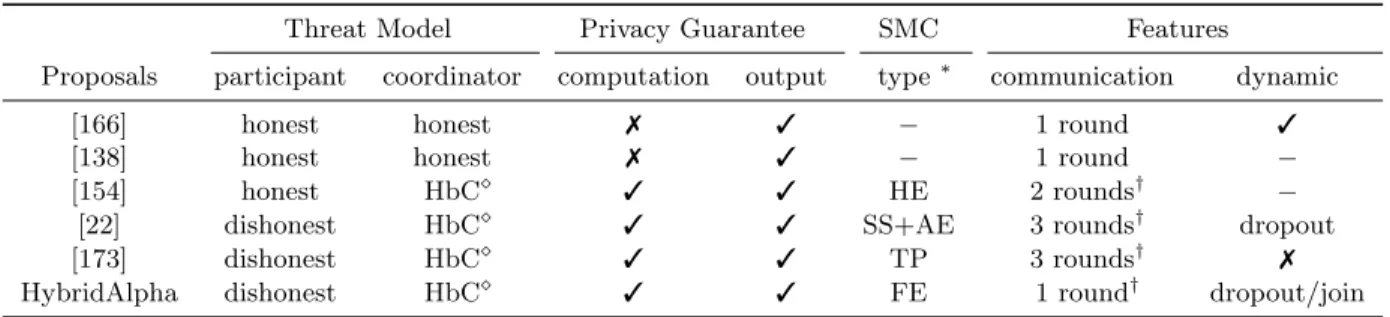
3.1 Comparison of privacy-preserving approaches in horizontal FL framework . . . 26
3.2 The number of crypto-related operations required for each solution. . . 34
3.3 The impact of precision on computation time of three SMC approaches. . . 36
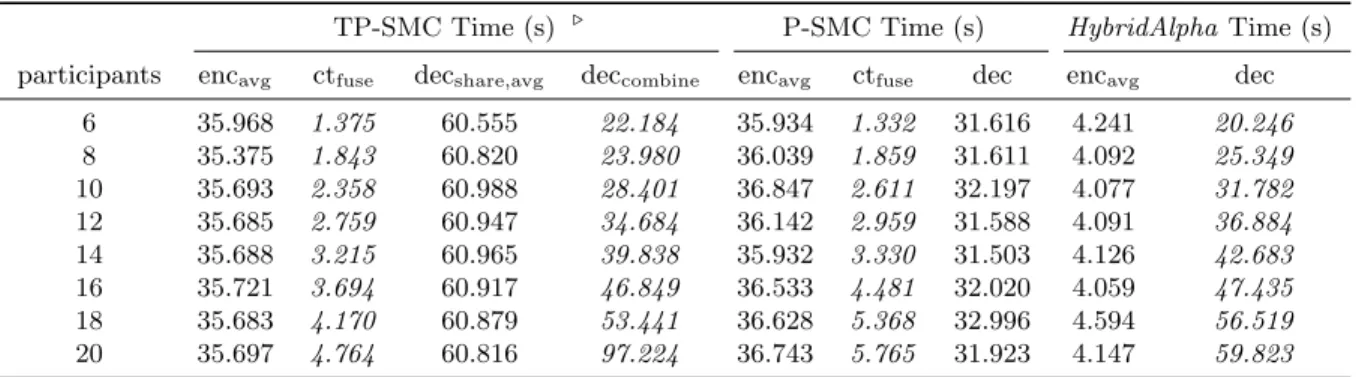
3.4 The impact of participant numbers on computation time of three SMC approaches. . . 36
3.5 Impact of threshold for TP-SMC on computation time. . . 36
3.6 The number of required crypto-related communication for each iteration in the VFL. . . 51
3.7 Dataset description in the experimental evaluation. . . 52
4.1 Comparison of representative privacy-preserving approaches in deep learning . . . 58
4.2 Comparison of time cost for training one mini-batch . . . 69
4.3 Training time cost of one mini-batch of different network architectures . . . 70
4.4 Time cost for different data source numbers in client-server setting . . . 72
List of Figures
1.1 Two typical architectures of PPML systems. . . 2
1.2 Overview of research tasks in this dissertation. . . 5
2.1 Several typical architectures adopted in existing PPML systems. . . 20
3.1 General architecture of federated learning . . . 25
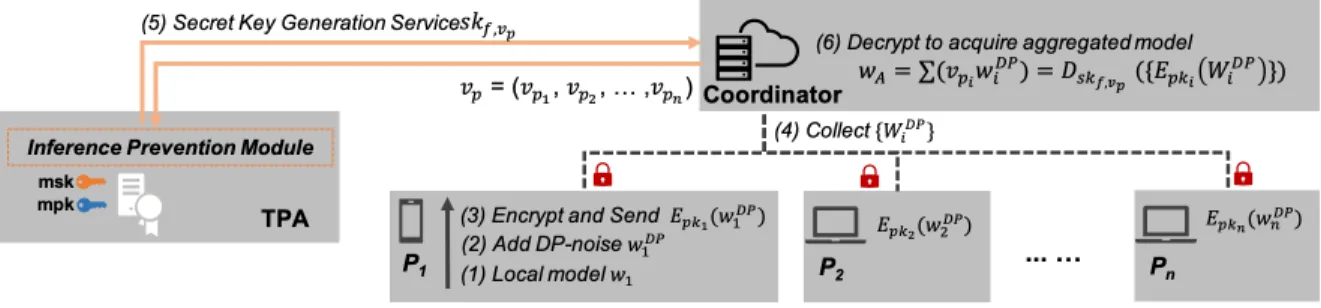
3.2 Overview ofHybridAlpha framework . . . 27
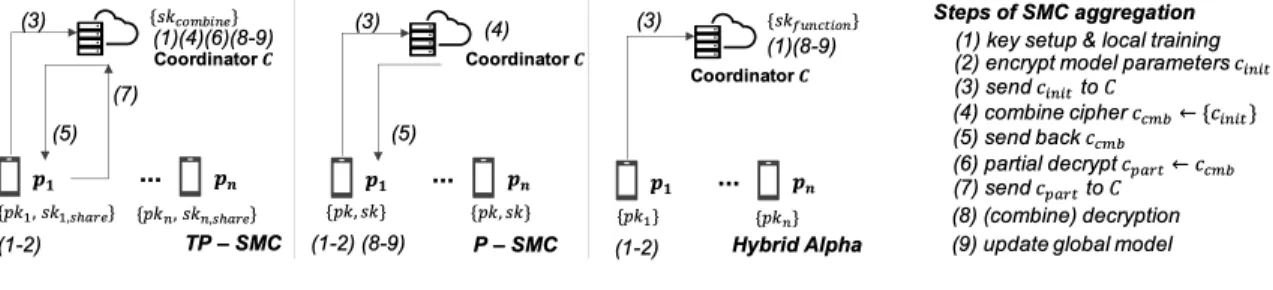
3.3 Illustration of aggregation via different crypto-based SMC solutions. . . 33
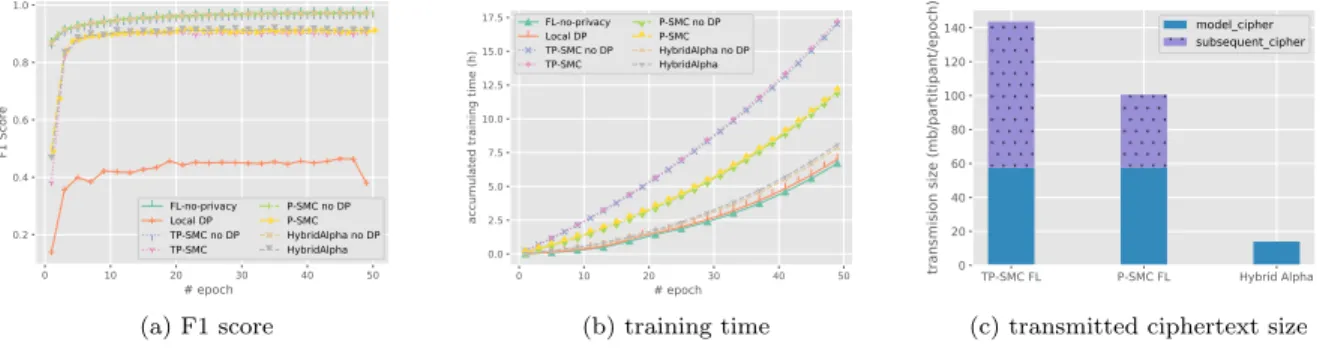
3.4 Performance comparison in model accuracy, time efficiency and data transmission. . . 37
3.5 Comparison of secure aggregation communications via different approaches . . . 41
3.6 Overview of theFedV . . . 42
3.7 Illustration of theFedV-SecGrad protocol. . . 45
3.8 Comparison of model accuracy and training time in LR model in two-participant setting. . . 53
3.9 Decomposition of training time inFedV and contrasted VFL baseline. . . 53
3.10 Comparison of the size of total data transmitted of training LR model over various datasets. 54 3.11 Performance ofFedV over various ML models and the comparison. . . 55
3.12 Impact of number of participants on the performance of the FedV framework. . . 55
4.1 Overview of the proposedNN-EMD framework. . . 60
4.2 Illustration of secure two-party computation approaches . . . 61
4.3 Description of secure two-party horizontally partitioned computation protocol. . . 62
4.4 Description of secure two-party vertically partitioned computation protocol. . . 63
4.5 Model accuracy of NN-EMD and impact of encoding precision and hidden layers . . . 71
5.1 Illustration of the three-tierCryptoEdge platform. . . 74
5.2 Illustration of various types of secure aggregation scenarios supported by theCryptoEdge . . 80
5.3 Illustration of privacy-preserving FL inCryptoEdge . . . 83
5.4 Performance comparison between weightedCryptoEdge-SAandThreshold Paillier-SA . . . . 88
5.5 Performance comparison of PPFL inCryptoEdge,Threshold Paillier and HybridAlpha . . . . 88
6.1 Overview of the transparency framework . . . 91
6.2 Illustration of four phases of transparency framework in a FE-based scenario . . . 97
Preface
This dissertation could not have been possible without the help and support of many people over the years. I would like to express my deep gratitude to many people who have been indispensable in my journey of Ph.D. training. First and foremost, I am deeply thankful to my advisor Dr. James Joshi for his supervision. He has been patiently mentoring me and supporting my research work, enriching my academic activities, and expanding my academic vision. I would like to thank the dissertation committee members, Dr. Prashant Krishnamurthy, Dr. Balaji Palanisamy, and Dr. Nathalie Baracaldo for their invaluable feedback and insightful suggestions on my dissertation work. Part of this dissertation work was done while I was interning at theIBM Almaden Research Center, and here I also would like to express my deep gratitude to and acknowledge the support and help of the team members ofAI Security and Privacy Solutions, Dr. Yi Zhou, Dr. Ali Anwar, and Dr. Heiko Ludwig. In particular, I am especially grateful to my internship mentor, Dr. Nathalie Baracaldo for her continuous guidance and support. I am also grateful for and acknowledge the support of the National Science Foundation (NSF) grants (DGE #1438809 and OAC #1642117) that helped me pursue my Ph.D. studies.
Great thanks also go to my fellow colleagues atLERSAIS and theSchool of Computing and Information, and my friends in Pittsburgh, for all the happy times during these years. I also would like to express my endless gratitude to my family, Shan, Xiang, Juan, Xia, Xian, whose love and support have always been the cornerstone in pursuit of my dreams. Last but not least, I am very grateful for the fundamental education and training in the past several years that prepared me to continue my Ph.D. degree here at Pitt.
1.0 Introduction
Machine learning (ML) is increasingly being applied in a wide variety of application domains. Especially, emerging deep neural networks (DNN) (a.k.a, deep learning (DL)) models have shown significant model accuracy and performance improvement in many application areas such as computer vision, natural language processing, speech, or audio recognition, etc., [105, 76, 147]. Federated learning (FL) (a.k.a collaborative learning) is another emerging ML technique that enables training a high-quality centralized model while training data remains distributed over multiple decentralized devices [120, 100]. FL has shown its promise in various application domains including healthcare, vehicular networks, and smart manufacturing, [188, 155, 82]. Although these models have shown huge success in the AI-powered or ML-driven applications, they still face several challenges such as (i) lack of powerful computational resources, and (ii) availability of huge volumes of available data to be used for training ML models. For example, a well-performing deep neural networks model relies on a huge volume of training data and high-powered computational resources to support both the training and inference phases.
To address the need of powerful computing resources with higher performance CPUs and GPUs, larger memory storage, etc., existing commercial ML-related infrastructure service providers such as Amazon, Microsoft, Google, and IBM have devoted significant amounts of their efforts toward buildinginfrastructure as a service (IaaS) or machine learning as a service (MLaaS) platforms with appropriate rental fees for clients that do not have such powerful computing resources. Clients can employ such an ML-related IaaS to manage and train their ML models and provide data analytics and prediction services in their applications or to their customers directly.
Another key challenge is the availability of data to train ML models. With larger training datasets, we have a possibility of training ML models that have better accuracy. Hence, there is a need for collecting large volumes of data potentially from multiple sources. However, the collection and use of datasets raise serious privacy concerns because of privacy-sensitive information they may contain, as is evident from recent data breaches [150, 176]. An adversary may also be able to infer private information from an ML model; for instance, the adversary may infer that a patient’s data has been included in the training of an HIV-related ML model (a.k.a, the membership inference attack [167, 19, 90, 110, 130]). Furthermore, existing regulations such as the Health Insurance Portability and Accountability Act (HIPPA) and more recent ones such as the European General Data Protection Regulation (GDPR), Cybersecurity Law of China, New York SHIELD Act, California Consumer Privacy Act (CCPA), etc., place various restrictions on the availability and use of privacy-sensitive data. Such privacy concerns and regulatory restrictions pose a significant challenge in training a well-performing ML model and can hinder the use of ML models for real-world applications.
To tackle the increasing privacy concerns related to using ML in applications where users’ privacy-sensitive data such as electronic health/medical records, location information, etc., are stored and processed,
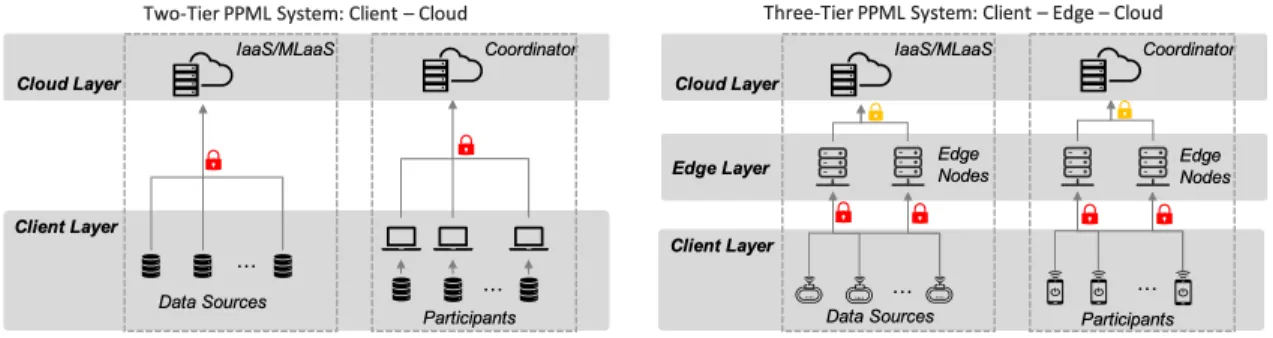
Figure 1.1: Two typical architectures of PPML systems.
it is important to devise well-designed privacy-preserving machine learning (PPML) approaches. Towards this, there are significant efforts focused on PPML research that aims at integrating existing anonymization mechanisms or newly designed privacy-preserving approaches and ML. Further discussion on existing related work is presented in Chapter 2. Existing privacy-preserving approaches have been proposed to address some of these privacy issues, and integrated into ML approaches; however, these approaches still have their own limitations. For instance, integration of differential privacy in ML models has been shown to lead to potential loss of model [1]. Similarly, the use of general secure multi-party computation (garbled circuits-based) approaches incurs high communication overhead because of large volumes of intermediate data such as garbled tables of circuit-gates that need to be transmitted during the execution of the protocols [151].
In this dissertation, we explore secure computing approaches and show that they are promising for generating PPML models with privacy guarantees. Towards this, we propose efficient and practical PPML approaches based onfunctional encryption techniques. In these proposed approaches, data is protected using encryption and computational ML tasks are carried out over such encrypted data. We also explore the issues related to the trustworthiness of the proposed PPML infrastructure and propose our solutions.
In the rest of the chapter, we first discuss the motivation and challenges for the proposed research and outline the key research tasks.
1.1 Motivation and Challenges
Early research related to PPML can be traced back to privacy-preserving data mining research several years ago, as discussed and analyzed in [9, 114]. PPML is currently an active area of research because of (i) rapid developments in ML research, including in DNN or federated learning (FL), and their increasing adoption in applications; and (ii) significant privacy concerns users have with regards to the use of ML models, and accompanying stricter privacy protection regulations and acts, which restrict the use of
privacy-sensitive data for training ML models. In addition, there also has been significant progress in privacy research that has produced various privacy protection approaches that can be used to address PPML challenges.
To tackle increasing privacy concerns of deploying ML techniques, more recent research work on PPML is being proposed from broader research communities of machine learning, distributed systems, security, and privacy. In this dissertation, we mainly focus on secure computation techniques - a fundamental component in PPML systems - to allow a third-party to acquire the result of a computation (e.g., the trained model) over privacy-sensitive data without disclosing private information to the third-party. In particular, we use functional encryption techniques as the underlying cryptographic framework to address PPML challenges by considering various ML approaches (mainly DNN and FL) and architectures (i.e., two-tier and three-tier PPML-enabled systems as depicted in Figure 1.1) as follows:
Two-Tier PPML Architecture. A two-tier PPML architecture includes a cloud layer containing IaaS, MLaaS or coordinating servers, and a client layer including participants that are primarily data sources and/or those who own data as well as partial computational resources. In general, the raw data or the locally trained model is protected by a cryptography scheme and the subsequent processes like aggregate computation and training computation are carried over the encrypted data or model parameters. Here we focus on two areas of ML.
Privacy-Preserving Federated Learning: FL has been shown as a promising architectural ML approach that enables collaborative training of models among multiple participants - under the orchestration of a coordinator - without sharing any of their raw training data. FL can thus provide basic privacy protection as data remains local to users’ own domains. To enhance privacy guarantee, additional privacy-preserving approaches such as differential privacy (DP) and secure multi-party computation (SMC) are being integrated within an FL framework to protect each participant’s model updates. However, integrating a DP mechanism in ML can introduce some loss in utility (i.e., reduces the accuracy of a trained ML model), while integrating SMC techniques in ML can introduce significant communication or computational overheads. The main challenge here is how to enhance privacy guarantees for FL while taking into account model accuracy, communication efficiency, training efficiency, and support of dynamic participants, etc.. In particular, we propose to address the following key research questions in this dissertation:
• How to provide enhanced privacy protection in FL to protect each participant’s model updates while providing acceptable model accuracy?
• How to ensure that privacy-preserving approaches support efficient aggregation with regards to compu-tational and communication overheads?
• How to ensure that such an approach can support a group of participants that provide datasets, where each participant is able to join or leave the group even during the learning phase?
• How to ensure that a privacy-preserving approach incorporates various data partitioning cases, where each participant may only have a part of horizontally and/or a vertically partitioned dataset.
Privacy-Preserving Deep Neural Networks: Training DNN models require high-performance computing re-sources; however, such machines are not available for most enterprises, especially, the small-scale businesses. Thus, existing ML-relatedIaaSsare employed to train ML models to enhance their businesses. However, such services do not appropriately address privacy concerns associated with processing of the privacy-sensitive data. Here, the main challenge is how to enhance privacy protection in an existing two-tier IaaS-based architecture using appropriate privacy-preserving approaches; in particular, such an approach should pro-vide protection of privacy-sensitive data through the use of a cryptosystem, and training of an ML model is done over encrypted data. To be specific, the following key research questions will be addressed in this dissertation:
• How can we train a DNN over encrypted privacy-sensitive data? We note that most of the existing similar approaches only work in the inference phase of an ML model in a third-party IaaS;
• While training such a privacy-preserving DNN model, how can we ensure it is efficient with regards to training time and communication overheads so as to make it practically deployable?
• How can we ensure that such a privacy-preserving technique is scalable with regards to including multiple data sources, and multiple cloud services while considering various dataset partitioning cases?
Three-Tier PPML Architecture. A three-tier PPML includes a cloud layer and a client layer as in the two-layer PPML architecture, but it additionally contains an edge layer including several edge nodes that can preprocess data sent by the devices (e.g., sensors or mobile devices) in the client layer in a privacy-preserving manner. Similar to the two-tier PPML system, the raw data or the local ML models are also protected by some crypto schemes. The preprocessing at the edge and final processing at the cloud are both done over the encrypted data. The three-tier PPML architecture tries to take advantage of the recently emerging promising edge computing paradigm where edge nodes are placed closer to mobile devices or sensors so as to deliver highly responsive and scalable cloud services, and to provide preprocessing services in the Internet of Things (IoT) ecosystem. However, such a three-tier architecture brings new challenges. In particular, we propose to address the following key issues in this dissertation:
• In contrast to cloud data centers where cloud servers are managed through strict and regularized policies, edge nodes may not have the same degree of regulatory and monitoring oversight. Thus, edge nodes may not be as trusted as the cloud data centers; so an appropriate privacy protection mechanism is needed to ensure privacy leakage is prevented at the edge layer.
• Existing crypto-based secure computation techniques are not applicable in such a three-tier edge com-puting architecture. In particular, existing homomorphic encryption (HE) based PPML approaches are computationally inefficient to be deployed at the edge layer of IoT devices with limited capabilities. While more efficient functional encryption (FE) based PPML has been proposed in the literature, they have not been aimed at such three-tier edge computing-based architecture, so they cannot be directly employed. In essence, compared to general-purpose garbled-circuits based secure computation approaches, emerging
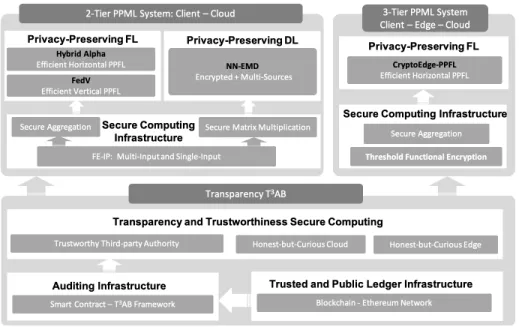
Figure 1.2: Overview of research tasks in this dissertation.
crypto-based secure computation techniques (i.e., computing over the encrypted data) have been shown to be more promising in terms of achieving a strong privacy guarantee as the data is protected by an encryption algorithm. Further, it is easier to integrate them with other types of approaches to form a customized hybrid approach. Our proposed secure computation based approaches in this dissertation are essentially hybrid in nature based FE techniques.
Another critical issue is the trustworthiness of various entities involved in PPML. For instance, an IaaS
server is a coordinating server discussed above, which is assumed to be honest-but-curious. In addition,
edge nodes in a three-tier ML architecture may also be semi-trusted. Besides, part of crypto-based secure computation approaches rely on a critical component, namely, thethird-party authority (TPA), that needs to befully trusted. However, for practical deployment of PPML such trust assumptions (e.g., fully trusted TPA) can be a problem. Thus, mechanisms are needed to remove such trust assumptions and ensure that all the entities arehonest and can be trusted during the training or inference phases of a PPML approach.
1.2 Overview of Research Tasks
In this dissertation, as illustrated in Figure 1.2, we carry out the following four research tasks: (i) development of an efficient and secure aggregation technique for privacy-preserving FL frameworks and an efficient secure computation approach for privacy-preserving DNN models over an encrypted local model or
raw datasets in a two-tier PPML architecture; (ii) design of an efficient secure aggregation technique for training FL models in three-tier PPML architecture to leverage the benefits of edge layer; (iii) construction of mechanisms to make secure computation based PPML infrastructures as proposed in the tasks (i) and (ii) more transparent to increase its trust. We present an overview of proposed research tasks below.
1.2.1 Practical Secure Computation in a Two-Tier PPML System
For two-tier PPML architecture, we focus on practical secure computation techniques for privacy pre-serving FL (PPFL) and privacy-prepre-serving DNN (PPDNN).
Efficient Secure Aggregation in PPFL. In FL, there are severalparticipants each training its own ML model locally based on its own local training dataset. A coordinator helps to coordinate and aggregate the model update parameters from eachparticipant to generate a more accurate global model. To prevent inference attacks where anhonest-but-curious coordinator may infer private information from a local model uploaded by a participant, a secure aggregate computation approach is needed to protect the privacy of each participant’s local model. However, existing secure aggregate computation approaches have limitations in terms of computational efficiency or complex protocol interactions. To address these issues, in this research task, we propose secure aggregation approaches that improve the efficiency of a PPFL framework while providing a strong privacy guarantee. Based on the types of partitioning of datasets, we divide the research task into two sub-tasks:
• Development of a secure aggregate computation approach for horizontal PPFL: A horizontal FLis one where datasets are horizontally partitioned, i.e., each participant has a complete set of features of each sample in its training dataset, and hence each participant is able to train a complete local model inde-pendently. We propose a new secure aggregate computation approach for horizontal PPFL that improves efficiency over existing approaches while protecting the privacy of each participant’s local model. • Development of a secure aggregate computation approach for vertical PPFL: A vertical FL represents
federated learning over vertically partitioned datasets, where each participant has a partial set of features of each sample in its training dataset. As a result, each participant is able to train only a “partial” local model instead of a complete one independently and the aggregation operation is not as straightforward as in a horizontal PPFL. In this sub-task, we propose a vertical PPFL approach that addresses the challenge of computing over these “partial” models efficiently.
Efficient Secure Computation in PPDNN. We propose several secure computation approaches for PPDNN to support computational tasks related to training a DNN model over an encrypted dataset using a client-server or a client-cloud architecture. In such a case, a client that has privacy-sensitive data but limited computational resources can train a DNN model by employing a third-party IaaS without leaking its privacy-sensitive data. Existing secure computation approaches, such as ones based on homomorphic encryption [129], that can be used to support training a DNN model over encrypted data have efficiency
problems, making it difficult for practical deployment. In this task, we propose an innovative approach to construct secure computation protocols based on a functional encryption family. The proposed privacy-preserving approach supports both the training and the inference phases of a DNN model. In particular, our proposed PPDNN supports training neural networks over encrypted datasets from multiple sources. In the above-mentioned two-tierclient-cloudorclient-server architecture, the third-party ML-related IaaS platform is responsible for training the DNNs, while the clients provide their encrypted privacy-sensitive training datasets. As we know, the performance of a DNN model relies on the size of a training dataset. In general, a single client or data source may not be able to provide an adequate amount of training data. In this task, we develop an efficient secure computation approach that supports training DNNs over multiple encrypted datasets from multiple data sources, where each dataset may be partitioned vertically or horizontally.
1.2.2 Practical Secure Computing for Three-Tier PPML System
In this dissertation, we also propose a secure aggregation approach applicable for a three-tier PPML architecture that leverages the benefits of emerging edge computing paradigm to support a broader set of applications. In particular, such a system includes the following entities:
• IoT devices that can easily encrypt raw data;
• untrusted orsemi-trusted edge nodes that have the capability of processing encrypted data (i.e., partially decrypt the encrypted raw data) without learning any privacy-sensitive information from the encrypted data;
• a cloud data center that can construct the final aggregation results, but still cannot learn any privacy-sensitive information.
We propose a three-tier PPML framework that includes a novel and efficient secure computation approach to support practical secure aggregation over encrypted data at the edge. In general, the cloud center can specify a random number of edge nodes to collaborativelypreprocess the encrypted data where the processed data is still in ciphertext form, without leaking any information to the edge nodes. Then the cloud can decrypt the preprocessed ciphertexts to compose the final aggregation results in plaintext. The proposed secure computation approach can dramatically reduce the overall decryption time and save computational resources for the cloud, as the edge nodes are allowed to do some preprocessing over the encrypted data. Our proposed three-tier PPML framework is based a novel threshold functional encryption (TFE) scheme.
1.2.3 Trustworthy Infrastructure for Secure Computation
In this dissertation, we also propose an approach to build a trustworthy infrastructure for the above-mentioned proposed secure computation approaches. As introduced in research tasks 2 and 3, the proposed secure computation solutions are based on a functional encryption family that relies on a third-party au-thority (TPA) that is responsible for providing key services such as initializing and distributing public-key
parameters, and generating functional private keys. The proposed approach assumes that TPA is fully trusted, but for practical deployment of such approaches simply trusting the TPA is not adequate. Besides, the IaaS platform and the coordinator are also assumed to be honest-but-curious, which is a common as-sumption in most PPML frameworks. It is also critical that we have mechanisms in place to ensure that all these entities indeed behave honestly or can be trusted. Towards this, we propose a transparency framework to ensure that the TPA infrastructure is trustworthy. The proposed transparency approach ensures that the operations of these entities are monitored and audited by participants based on the logged pieces of information.
1.3 Summary and Dissertation Outline
In this chapter, we have presented the background, motivation, and challenges related to secure compu-tation based PPML. We have also overviewed the research tasks carried out as part of this dissercompu-tation to address the PPML challenges identified.
The outline of this dissertation is as follows: In Chapter 2, we present a literature review related to the proposed tasks. We present the proposed secure computing approaches for PPML in Chapter 3, and for training DNNs using encrypted multi-sourced datasets in Chapter 4. In Chapter 5, we present the pro-posed solution for practical secure aggregation issues in edge-enabled architecture. We present the propro-posed transparency framework using blockchain in Chapter 6. In Chapter 7 we present conclusions and future work.
2.0 Literature Review
In this chapter, we present a literature review of related work in privacy-preserving machine learning (PPML) that are related to our proposed approaches. We discuss several representative PPML solutions proposed in the literature, as summarized in Table 2.1, from three dimensions: affected phase of an ML pipeline and design goals. In general, privacy-preserving techniques such as differential privacy and vari-ous types of secure computation techniques have most commonly been employed for PPML. Furthermore, recently proposed secure computation approaches for PPML that rely on emerging cryptosystems such as homomorphic encryption and functional encryption have shown promise for achieving strong privacy guar-antees. More detailed discussion is presented in the rest of the chapter.
2.1 Affected Phases of Privacy-Preserving Approaches
Typical phases of an ML system includeproduction phaseandconsumption phase. The production phase mainly focuses on how to train an ML model using the collected training data or local model update from the data producer, while the consumption phase works on how to consume those trained models, such as making use of inference service. So existing privacy-preserving machine learning solutions targetprivacy-preserving training,privacy-preserving inference, or both.
From the perspective of computation, there is no strict boundary between a privacy-preserving training and a privacy-preserving inference as computation in the inference procedure could be viewed as a simplified version of training procedure without training labels [54]. For instance, the training phase of a neural network model could be viewed as a process where a set of data is continuously fed into the designed network for multiple training epochs, while the inference phase could be treated as one epoch of computation for one data sample to generate a prediction label. Formally, given a set of training samples (xxx1, y1), ...,(xxxn, yn), where xxxi ∈ Rm, yi ∈ R, the goal of a MM model (for simplicity, assume a linear model) is to learn a fit function denoted as
fwww,b(xxx) =www|xxx+b, (2.1) wherewww∈Rmis a set of model parameters, andbis the intercept. To find proper model parameters, usually, we need to minimize the regularized training error given by
E(www, b) = 1 n n X i=1 L(yi, f(xxxi)) +αR(www), (2.2) whereL(·) is a loss function that measures model fit andR(·) is a regularization term (a.k.a. penalty) that penalizes model complexity; α is a non-negative hyperparameter that controls the regularization strength. Regardless of various choices ofL(·) andR(·), stochastic gradient descent (SGG) is a common optimization
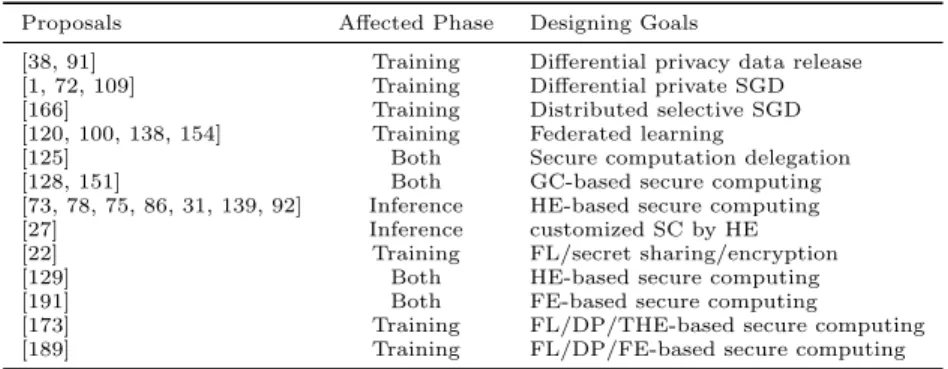
Table 2.1: Representative proposal of privacy-preserving machine learning systems
Proposals Affected Phase Designing Goals
[38, 91] Training Differential privacy data release
[1, 72, 109] Training Differential private SGD
[166] Training Distributed selective SGD
[120, 100, 138, 154] Training Federated learning
[125] Both Secure computation delegation
[128, 151] Both GC-based secure computing
[73, 78, 75, 86, 31, 139, 92] Inference HE-based secure computing
[27] Inference customized SC by HE
[22] Training FL/secret sharing/encryption
[129] Both HE-based secure computing
[191] Both FE-based secure computing
[173] Training FL/DP/THE-based secure computing
[189] Training FL/DP/FE-based secure computing
method for unconstrained optimization problems as discussed above. A simple SGD method needs toiterate
over the training samples and for each sample it needs to update the model parameters according to the following update rule
w
ww←www−η∇wwwE←www−η[α∇wwwR+∇wwwL] (2.3)
b←b−η∇bE←b−η[α∇bR+∇bL] (2.4) where η is the learning rate which controls the step-size in the parameter space. Given a trained model (wwwtrained, btrained), the goal of the inference phase is to predict a label ˆy with target samplexxxas follows:
ˆ
y←fwwwtrained,btrained(xxx) (2.5) In general, the task of privacy-preserving training is more challenging than the task of privacy-preserving in-ference. Most of the existing privacy-preserving training solutions indicate the inclusion of privacy-preserving inference even though they may not explicitly state that.
2.1.1 Privacy-Preserving Training
The goal of a privacy-preserving training is to prevent the leakage of privacy sensitive information in
training data. Essentially, the key factors related to training are data and computation, and consequently, existing proposed approaches try to tackle the challenge of privacy-preserving training from the following two aspects: (i) how to distill/filter the training data such that the processed data includes less or no privacy-sensitive information; or (ii) how to process or compute over the training data in a privacy-preserving manner.
From the perspective ofdata, existing privacy-preserving training approaches either (i) adopt traditional anonymization mechanisms such as k-anonymity[171],l-diversity[118] andt-closeness [111] to remove iden-tifier and quasi-ideniden-tifier information in the training data before sending it out for training, or (ii) employ
-differential privacy [59, 62, 61] mechanism to add privacy budget (noise) into the dataset to avoid leakage of private information against a set statistical queries.
For instance, the approach proposed in [67] tries to provide k-anonymity for data mining algorithms, while the approaches proposed in [107, 98] focus on the utility metric and provide a suite of anonymization algorithms to produce an anonymous view based on ML workloads. On the other hand, recently, differential privacy mechanism has shown its promise in emerging deep learning models that rely on training on a large dataset. For example, the early work in [1] proposes a differentially private stochastic gradient descent (often abbreviated SGD) approach to train a privacy-preserving DL model. The approach proposed in [121] demonstrates that it is possible to train large recurrent language models with user-level differential privacy guarantees with only a negligible cost in predictive accuracy. Parameter-transfer based meta-learning (i.e., applications including few-shot learning, federated learning, and reinforcement learning) often requires task-owners to share model parameters, because of which privacy leakage becomes possible. Proposed approaches for privacy-preserving meta-learning such as in [72, 189] try to tackle the problem of private information leakage in FL by employing an algorithm to achieve client-sided differential privacy. The method proposed in [109] formalizes the notion of task-global differential privacy and proposes a differentially private algorithm for gradient-based parameter transfer that satisfies the privacy requirement while retaining provable transfer learning guarantees in convex settings.
Emerging area of secure computation over encrypted data in the cryptography community is showing another promising approach to protecting the privacy of training data. Unlike a traditional anonymization technique or a differential privacy mechanism that aims at protecting against inference or de-anonymization attacks, such as those demonstrated in [183, 146, 167, 144], wherein an adversary may have additional background knowledge, the encryption based approaches can provide strong privacy guarantees, referred to asconfidential-level privacy in this chapter; these approaches have received more and more attention in recent studies such as in [173, 191, 189, 69, 83, 39, 73, 31, 129]; in these approaches, the training data or the shared model updates are protected by cryptosystems.
From the perspective ofcomputation, existing privacy-preserving training approaches are also correspond-ingly divided into two approaches: (i) cases where the training data is processed by traditional anonymiza-tion mechanisms or differential privacy mechanism; in such cases, computaanonymiza-tion involved in training is as normal as in non-PPML model training; (ii) cases where the training data is protected via cryptosystems to achieve a confidential-level privacy; here, the privacy-preserving (i.e., referred to as crypto-based) training computation is more complex compared to that in normal non-PPML model training. Crypto-based train-ing approaches rely on recently proposed cryptographic schemes, mainly, homomorphic encryption schemes [70, 175, 28, 119, 6] and functional encryption schemes [25, 74, 4, 14, 13, 2, 3]. Unlike in a normal training process, it is worth noting that there is an extra step -data conversion - in crypto-based training approaches because most of these cryptosystems are built on the integer group while most of the training data is in floating-point number format, especially, after normalization. Note that normalization is a very common
preprocessing method in most of ML approaches [189, 191, 83, 129]. The data conversion step includes a pair of encoding and decoding operations. The encoding step is commonly adopted to convert the floating-point numbers into integers so that the training data can be encrypted and then used in a crypto-based training. On the contrary, the decoding step is applied to the trained model or the result of crypto-based training to recover the floating-point numbers. Obviously, the data conversion procedure indicates that there is a potential precision loss during a crypto-based training. We will discuss the details of the potential impact of data conversion step in Section 2.2.
2.1.2 Privacy-Preserving Inference
Several existing PPML approaches that focus on privacy-preserving training indicate that the proposed solution may also support privacy-preserving inference, as illustrated in [128, 151, 125, 191, 129]. We also observe that most of the proposals that apply cryptographic approaches mainly use homomorphic encryption and its related schemes, such as in [73, 78, 75, 86, 31, 139, 92, 27]. These approaches only target the inference phase, as these cryptosystems are not efficient enough to be applied in the training phase as it involves complex and massive computation.
Part of privacy-preserving inference approaches also focus on the privacy-preserving model query or publication; in this case, a model user is separate from a model owner. And a key concern here is how to prevent adversaries (i.e., a curious model user) from inferring private information of the model owner from the model itself, in particular, when an adversary has been allowed to iteratively query the inference service. To address these issues, a naive privacy-preserving solution is to limit the number of queries for a model user.
In addition to these, existing prevention methods can be categorize into three approaches:
• a private aggregation of teacher ensembles (PATE) approach [136, 138], wherein the knowledge of an ensemble of “teacher” models is transferred to a “student” model, with intuitive privacy provided by training teachers on disjoint datasets and strong privacy guaranteed by noisy aggregation of teachers’ answers;
• model transformation approach such as MiniONN [115], where an existing model is transformed into an oblivious neural network supporting privacy prediction with reasonable efficiency;
• model compression approach, especially, applied in emerging DL models with a large set of model param-eters, where knowledge distillation methods [88, 143] are adopted to compress the trained DL models. Even though the main goal of knowledge distillation is to reduce the size of a DL model, such a method also brings additional privacy-preserving features [137, 178]. Intuitively, the distillation procedure not only removes the redundant information in a model but also reduces the probability that an adversary can infer potential private information in the model through iterative queries.
2.2 Design Principle of Privacy-Preserving Approaches
In this section, we discuss privacy-preserving approaches in a more fine-grained manner, namely, the design principles used in these approaches; here, we focus how these approaches tackle the following issues: • How is privacy-sensitive data released?
• How is privacy-sensitive data processed?
• Does a PPML architecture prevent the disclosure of private information?
Correspondingly, we introduce the following four types of the privacy-preserving approaches: (i) data pub-lishing based approaches; (ii) data processing based approaches; (iii) architecture-based approaches; and (iv) hybrid approaches that may combine or integrate previous approaches.
2.2.1 Data Publishing Based Approaches
In general, a data publishing based privacy-preserving approach includes the following: • De-identification-based Approaches that partiallyremove the identifiers in the raw data; • Perturbation-based Approaches that partiallyperturb the statistical result of the raw data; • Crypto-based Approaches that totallyencrypt the raw data.
De-identification-based Approaches: De-identification based approaches essentially remove some in-formation that can lead to identification. Here, techniques such as k-anonymity[171], l-diversity[118] and
t-closeness [111] are applied to the raw privacy-sensitive data to remove privacy-sensitive information so as to protect from potential inference attacks. Specifically, a k-anonymity mechanism can ensure that the information for each person contained in the released dataset cannot be distinguished from at leastk-1 other individuals whose information is also released in the dataset. To achieve that,k-anonymity approaches define
identifiers andquasi-identifiers for each data attribute, and then remove the identifiers and partially hide thequasi-identifiers information. The l-diversity mechanism introduces the concept ofequivalence classes, where an equivalence class satisfies l-diversity if there are at leastl “well-represented” values for a sensitive attribute. A dataset satisfiesl-diversity if every equivalence class of the dataset satisfiesl-diversity [171, 118]. Essentially, as an extension of the k-anonymity mechanism, l-diversity mechanism reduces the granularity of the data representation and additionally maintain the diversity of sensitive fields by adopting techniques like generalization and suppression such that given any records it can be mapped to at least k−1 other records in the dataset. t-closeness is further refinement of l-diversity by introducing additional restriction on the distribution value over anequivalence class. An equivalence class satisfies t-closeness if the distance between the distribution of a sensitive attribute in this class and the distribution of all attributes in the whole dataset is no more than a thresholdt. Similarly, a dataset satisfiest-closeness if all equivalence classes satisfyt-closeness.
Perturbation-based Approaches: Perturbation based approaches mainly refer to using-differential pri-vacy techniques [59, 62, 61]. As per [60, 62], differential privacy can be defined as follows: a randomized mechanismM:D → Rwith domainDand rangeRsatisfies (, δ)-differential privacyif for any two adjacent inputd, d0 ∈ Dand for any subset of outputsS⊆ R, it holds that
Pr[M(d)∈S]≤e·Pr[M(d0)∈S] +δ (2.6) The additive term δ allows for the possibility that plain -differential privacy is broken with probability δ
(which is preferably smaller than 1/|d|). Usually, a paradigm of an approximating a deterministic function
f :D → Rwith a differentially private mechanism is viaadditive noise calibrated to function’s sensitivity
Sf, which is defined as the maximum of the absolute distance|f(d)−f(d
0
)|. The representative and common additive noise mechanisms for real-valued functions are Laplace mechanism and Gaussian mechanism defined, respectively, as follows: MGauss(d;f, , δ) =f(d) +N(µ, σ2) =f(d) +N(0, 2 ln(1.25/δ) 2 ·S 2 f) (2.7)
MLap(d;f, ) =f(d) +Lap(µ, b) =f(d) +Lap(0, Sf2
) (2.8)
Typical uses of differential privacy enabled PPML i along two directions: (i) directly adopting above-mentioned additive noise mechanism on the raw dataset in the case of publishing data, as illustrated in [38, 91]; or (ii) transforming the original training method into differentially private training method so that the trained model has -differential privacy guarantee in the case of publishing model, as illustrated in [1, 72, 109].
Sketching is an approximate and simple approach for data stream summary, by building a probabilistic data structure that serves as a frequency table of events, like counting Bloom filters. Recent theoretical advances [7, 123] have shown that differential privacy is achievable on sketches with additional modifications. For instance, the work in [16] focuses on the privacy-preserving collaborative filtering, a popular technique for a recommendation system, by using sketching techniques to implicitly provide the differential privacy guarantees by taking advantage of the inherent randomness of the data structure used. Most recent work as reported in [113] proposes a novel sketch-based framework for distributed learning; this approach involves compressing the transmitted messages via sketches to simultaneously achieve communication efficiency and provable privacy benefits.
In summary, traditional anonymization mechanisms and differential privacy mechanisms are designed to tackle general data publishing problems. More recently, differential privacy has been widely adopted in privacy-preserving DL and privacy-preserving FL approaches, such as in [1, 121, 72, 109, 173, 189]. Furthermore, differential privacy shows its promise in helping generate synthetic data [59, 94, 172] and emerging generative adversarial networks (GANs) [187, 65].
Cryptography-based Approaches: The third approach mainly refers to cryptography based techniques that totally obfuscate the raw data to achieve a stronger privacy guarantee (i.e., confidential-level
pri-vacy) compared to the traditional anonymization mechanisms and differential privacy mechanisms. Existing cryptographic approaches for data publishing for the purpose of training an ML can be seen along the following two directions: (i) applying traditional symmetric encryption schemes such as AES, which is as-sociated with garbled-circuits based secure multi-party computation protocols [127, 180, 142]; (ii) applying emerging cryptosystems such as homomorphic encryption schemes [70, 175, 28, 119, 6] or functional en-cryption schemes [25, 74, 4, 14, 13, 2, 3]. These include necessary algorithms to carry out computation over encrypted data; here, only a party with the issued key is able to acquire the computation results. The typical PPML approaches such as thos proposed in [151, 149] could be classified to the first direc-tion of the crypto-based data publishing approach, while more and more recent works such as proposed in [173, 191, 189, 69, 83, 39, 73, 31, 129] focus on the direction (ii).
Essentially, crypto-based data publishing approaches cannot work independently and usually are associ-ated with relassoci-ated secure computation approaches, as it is expected to let the data receiver only learn the data processing result rather than the original data. These crypto-based approaches provide a promising candidate for data publishing, but the emphasis of crypto-based approaches is on computation over the encrypted data. More details related to that will be presented in the next section.
2.2.2 Data Processing Based Approaches
Based on different data/model publishing methods, data processing approaches can be as follows: normal training and training using secure computation. As discussed in Section 2.2.1, if the data is published using traditional anonymization or differential privacy mechanisms the training process is similar to that in non-PPML. Here, by privacy-preserving data processing based approach we mainly refer to the secure computation based approach that can be adopted in both training and inference phases.
Secure computation problems and the corresponding solutions were initially proposed by Andrew Yao in 1982 in a garbled-circuits protocol for two-party computation [192]. The primary goal of secure computation is to enable two or more parties to evaluate an arbitrary function over both their inputs without revealing anything to either party except for the output of the function. These secure computation approaches could be basic secure two-party computation (2PC) or more general secure multi-party computation (MPC) for multiple parties. These protocols include two types of security guarantees considering different adversarial models: semi-honest (passive) security and malicious (active) security. We refer the reader to [49, 84] for more details related to secure multi-party computation.
Here, we discuss existing secure computation techniques that have been used in PPML from the per-spective of the underlying designed principle. In general, these secure computation techniques include the following: (i) pairwise blinding using perturbation or dining cryptographer networks (DC-net) or (verifiable) secret sharing; (ii) garbled-circuits with oblivious transfer; and (iii) emerging cryptographic schemes.
Pairwise Blinding based Approaches: One category of secure computation approach is the pairwise blinding using perturbation techniques, where the private values are blinded/masked with randomized values.
One type of perturbation is additive perturbation. For instance, in a generic additive perturbation based privacy-preserving summation [156] - a function-specific (i.e., the aggregation function) secure multi-party computation - the coordinator gives its input x0 by adding a randomized perturbation r, and then each
participant adds its inputxionx0+rand passes the result to the next participant. Finally, the coordinator
acquiresPx
i+rand removes its randomized perturbationrto acquire the aggregated result. Another type of perturbation in pairwise blinding is multiplicative perturbation where the random projection or random rotation techniques are used to perturb the values. Besides, anonymous communication could also be the candidate method in the pairwise blinding based approaches. For example, DC-nets [34] or mix-nets [35] is a class of anonymous communication network, where a single participant at a time can send an anonymous message, which can be viewed as a restricted case of secure aggregation. Adopting DC-nets or mix-nets, a trusted coordinator can collect input from each party in an anonymous manner and then compute the function results, which provides some privacy-preserving feature because the coordinator cannot learn the source of each function input. Furthermore, secret sharing techniques can also be adopted in pairwise blinding based secure computation approaches. For instance, suppose that the coordinator is issued a randomized secret s, and each participant is issued secret sharing si to integrate into its input xi as a perturbation. Then, the coordinator can aggregatePx
i by removing the recovered secrets.
In short, most pairwise blinding based approaches can be viewed as a lightweight approach compared to other secure computation related approaches. As illustrated in existing proposals [9, 96, 96, 29, 56, 22], these classes of secure computing approaches are mostly adopted in traditional data mining area [9, 96] and have not been used much in recently proposed PPML approaches. Specifically, approaches proposed in [29, 56] focus on the k-means clustering machine learning algorithms. The solution in [29] proposes two types of pairwise blinding methods, namely, a division protocol and a random value protocol to perform two-party division and to sample uniformly at random from an unknown domain size. The approach proposed in [56] utilizes additive secret sharing as a cryptographic primitive to implement a secure multiparty computation protocol to do privacy-preserving clustering. The approach proposed in [22] employs at-of-nsecret sharing scheme with additional decisional Diffie–Hellman(DDH) based key agreement and authenticated encryption to construct a protocol for securely computing sums of vectors with low communication overhead, robustness to failures, which requires only one server with limited trust.
Garbled Circuits based Approaches: Garbled-circuits and oblivious transfer techniques constitute an-other type of foundation to build secure computation solutions. For simplicity, we use the garbled-circuits based 2PC protocol as an example to illustrate that. The basic idea is that one party (a.k.a, the garbled-circuitgenerator) prepares a circuit computing function that includes garbled gates that are encrypted via traditional symmetric encryption scheme such as AES, and then the other party (a.k.a, the garbled-circuit
evaluator) obliviously computes the output of the circuit without learning any intermediate information. Specifically, the functionf is transferred to a Boolean circuit composed of huge amounts of different types of garbled gates (e.g., AND-gate, OR-gate, and XOR-gate). Suppose that an AND-gategAND is associated
Table 2.2: Example of the AND-garbled gate table
bi bj gAND(bi, bj) garbled output permuted garbled output
0 0 0 Ew0 i,w0j(w 0 k) ⇒ Ew0 i,wj0(w 0 k) 1 0 0 Ew1 i,w0j(w 0 k) ⇒ Ew1 i,wj0(w 1 k) 0 1 0 Ew0 i,w1j(w 0 k) ⇒ Ew0 i,wj1(w 0 k) 1 1 1 Ew1 i,w1j(w 1 k) ⇒ Ew1 i,wj1(w 0 k)
with two input wiresi andj, and one output wirek. The generator first generates two cryptographic keys for each input wire, denoted as wi0, w1i, w0j, w1j, where the superscript represents the the encoded input bits (e.g.,wi0encodes 0-bit input of wirei, whilewi1encodes 1-bit input of wirei). For inputs databi, bj∈ {0,1}, thegenerator computes the ciphertext asEsymmetric.E(k)
wbii ,wjbj(w
gAND(bi,bj)
k ), and Table 2.2 presents the gate table in detail. Then, the evaluator is able to acquire its input wire associated keys w0
j, wj1 with its input
bj ∈ {0,1}without revealing that input to thegenerator using the 1-of-2 oblivious transfer (OT) technique. With the input associated keywbj and the received permuted garbled table, theevaluator is able to decrypt the corresponding ciphertext to acquire the outputwg
AND(b i,bj)
k without learning the input of thegenerator. Finally, these different types of garbled gates can compose any function that can be used in the secure computation protocols.
Even though garbled-circuits based 2PC and MPC problems have been there for several decades, the security community is still working on improving its efficiency and practicality [127, 18, 179, 180, 97]. The garbled-circuits based 2PC or MPC have been recently adopted to address the challenge of secure computation issues in popular machine learning algorithms, even complex DL models [69, 128, 115, 151, 32]. Chameleon [149] combines the best aspects of generic secure function evaluation protocols where linear operations are achieved by additive secret sharing values and nonlinear operations are implemented by garbled-circuit protocols. Based on the efficient mixed 2PC proposed in [55], similar to the Chameleon framework,ABY3in [126] proposes a design and implementation of a general framework for PPML and use it to obtain new solutions for different ML algorithms in a three-server model wherein data owners secretly share their data among three servers that train and evaluate models on the joint data using three-party computation. Based on Yao’s garbled-circuits, DeepSecure [151] presents a secure DL framework that is built upon automated design, efficient logic synthesis, and optimization methodologies. Recently proposed QUOTIENT [8] is a new method for discretized training of DNNs along with a customized 2PC protocol. EzPC [32] is another type of 2PC framework that generates efficient 2PC protocols from high-level, easy-to-write programs, where the proposed compiler can generate protocols that combine both arithmetic and boolean circuits for better performance.
Even though these garbled-circuits based solutions can provide provably secure and show its promise in training phase rather than just inference phase in deep neural networks without relying on the non-colluding
two or three servers as illustrated in [151, 8], the obvious limitation of the garbled-circuits based solutions is the size of the data transmission. As illustrated in Table 2.2, for a simple computation on two input bits such as bi∧bj, it involves transferring four ciphertexts and additional oblivious transmission for the key, where the size of each ciphertext and keys depends on the adopted symmetric encryption algorithm. Considering the complex computation functions in ML, the size of transmitted data will explode significantly.
Emerging Cryptographic based Approaches: Emerging cryptogahic approaches such as homomorphic encryption and functional encryption that support computation over the ciphertext provide other approaches toward building secure multi-party computation approaches for PPML systems. Emerging cryptography based secure computation also provides strong privacy guarantees like the garbled-circuits based approaches providing confidentiality-level security. However, unlike the garbled-circuits based secure protocols that involve huge amounts of transmitted data, these emerging cryptosystem based approaches only need to transfer the encrypted data instead of the data-encoded garbled-circuits, and related keys via oblivious transfer technique. Here, we briefly introduce homomorphic encryption schemes [70, 175, 28, 119, 6] and
functional encryption schemes [25, 74, 4, 14, 13, 2, 3] that are mainly employed in existing PPML proposals [191, 80, 133, 47, 73, 31, 129, 117, 31].
Homomorphic Encryption is a form of cryptosystem with an additional evaluation capability for computing over ciphertexts without access to the private secret key, in which the result of operations over the ciphertexts, when decrypted, matches the result of operations as if they have been performed on the original plaintext. Some typical types of HE arepartially homomorphic, somewhat homomorphic,leveled fully homomorphic, andfullyhomomorphic encryption according to the capability of performing different classes of computations. Unlike a traditional encryption scheme that includes three main algorithms: key generation (Gen), encryption (Enc), and decryption (Dec), an HE scheme also has an extra evaluation (Eval) algorithm. Formally, an HE schemeEHE includes the above four algorithms such that
EHE.Decsk(EHE.Evalpk(f,EHE.Encpk(m1), ...,EHE.Encpk(mn))) =f(m1, ..., mn), (2.9) where {m1, ..., mn} is a set of messages to be protected, pk and skare the key pairs generated by the key
generation algorithm. Based on our observation, we present several commonly adopted HE implementations used in PPML solutions. The Paillier cryptosystem [135] is an additive partially homomorphic encryption system, where given the message mi and mj, the Paillier system EHEPaillier satisfies the equation (2.9) such
that EPaillier
HE .Enc(mi)· EHEPaillier.Enc(mj) = EHEPaillier.Enc(mi+mj). HElib [79] implemented several typical fully homomorphic encryption schemes such as in [28, 40, 170, 71] with applied optimization techniques like bootstrapping, smart-vercauteren, and approximate number. SEAL [124] is another HE library that allows additions and multiplications to be performed on encrypted integers or real numbers. Other operations, such as encrypted comparison, sorting, or regular expressions, are in most cases not feasible to be done over encrypted data using this technology.
The approach proposed in [80] makes use of homomorphic encryption in constructing a protocol for regression analysis, while the approach proposed in [133] focuses on privacy-preserving ridge regression on
millions of records by combining both homomorphic encryption and garbled-circuits. The approach proposed in [47] provides a computationally secure two-party protocol based on additive homomorphic encryption that substitutes the trusted initializer. Recent work in [41] tries to evaluate the possibility of homomorphic encryption to fully implement its program in ML applications by addressing both the issue of comparison and selection/jump operations.
CryptoNets proposed in [73] tries to apply neural networks to encrypted data by employing a leveled homomorphic encryption scheme to the training data, which allows adding and multiplying encrypted mes-sages; but it requires that one knows in advance the complexity of the arithmetic circuit. Unlike the potential ineffectiveness issue for DNNs in CryptoNets, the proposed approach in [31] combines the original ideas of Cryptonets’ solution with the batch normalization principle for a classification problem. Besides, the ap-proach proposed in [129] uses the open-source FHE toolkit HElib for DNN training using a stochastic gradient descent training method. Several recent proposals as in [50, 117, 87] focus on the same problem but with different optimization approaches to increase efficiency as well as model accuracy.
Functional Encryption is another form of cryptosystem that also supports computation over a ciphertext. Typically, an FEEFEincludes four algorithms: setup, key generation, encryption and decryption algorithms,
such that
EFE.Decskf(EFE.Encpk(m1), ...,EFE.Encpk(mn)) =f(m1, ..., mn), (2.10) where the setup algorithm creates a public keypkand a master secret keymsk, and key generation algorithm usesmskto generate a new functional private keyskf associated with functionalityf. Those two algorithms usually are run by a trusted third-party authority. At this moment, there is a lack of well-known libraries for FE like the HElib and SEAL libraries for the HE. Existing construction of functional encryption schemes for general functionality, such as recently proposed constructions in [74, 24, 182, 68, 30, 108], only focus on the theoretical feasibility or functionality existence. Only a few recently proposed works such as in [4, 5, 10, 20] focus on the simple and applicable FE, but the functionality is limited to the inner-products.
As presented above, the main similarity between FE and HE is that both support computation over a ciphertext. At a high-level, the main difference between functional encryption and the homomorphic encryp-tion is that given an arbitrary funcencryp-tion f(·), the homomorphic encryption allows computing an encrypted result of f(x) from an encryptedx, whereas the functional encryption allows to computea plaintext result of f(x) from an encryptedx[12]. Intuitively, a function computation party in a HE scheme (i.e. the eval-uation party) can only contribute its computational resources to obtain the encrypted function result, but cannot learn the function result unless it has the secret key, while the function computation party in the FE scheme (i.e., usually, the decryption party) can obtain the function result with the issued functional private key. Besides, except for several most recently proposed decentralized FE schemes [43, 3, 42], the classic FE schemes rely on a trusted third-party authority to provide a key service such as issuing a functional private key associated with a specific functionality.
Figure 2.1: Several typical architectures adopted in existing PPML systems.
for secure computation for PPML, recently proposed FE-based PPML solutions such as in [189, 191, 153] also show its promise in terms of its efficiency and practicality. The approach proposed in [153] provides a practical framework for performing partially encrypted and privacy-preserving predictions that combines adversarial training and functional encryption. Our earlier proposed approach such as in [191] presents a CryptoNN framework that supports training a neural network model over encrypted data by using FE to construct a secure computation mechanism. An approach we have proposed as part of this dissertation (presented in Chapter 3.1), [189] focuses on PPFL by utilizing FE to construct a secure aggregation protocol to protect each participant’s input in PPFL.
Remark - Impact of Encoding: Unlike in anonymized or differentially private PPML training, where the training data or trained model is in the format of floating-point numbers, the secure computation approaches using crypto-based PPML training data should be in integer format. As a result, there is typically a procedure to convert the training data into integer format before secure computation operations and then recover the computational result back into the floating-point numbers. Due to this procedure, an issue related to crypto-based secure computation is how to decide the encoding degree and what would the impact of the encoding precision be. As partially illustrated in [191, 189], the encoding issue is a trade-off problem; i.e., a higher encoding precision indicates a higher model accuracy, whereas a higher encoding precision denotes more computational time (i.e., more training time).
2.2.3 Architecture Based Approaches
Recently, architecture based approaches have also been shown to be promising for PPML, although there is no generic paradigm for architecture-based approaches. As depicted in Figure 2.1, we present four typical architectural approaches as examples to illustrate how privacy can be guaranteed for ML models.
Delegation based ML Architecture. It is a classic architecture that gives the parties with limited compu-tational resources the capability to create and use ML models. With additional secure techniques or proper trust assumptions, a delegation-based architecture can also provide a privacy-preserving feature for ML. For