Discovering Colocation Patterns from
Spatial Data Sets: A General Approach
Yan Huang,
Member,
IEEE Computer Society, Shashi Shekhar,
Fellow,
IEEE Computer Society, and
Hui Xiong,
Student Member,
IEEE Computer Society
Abstract—Given a collection of Boolean spatial features, the colocation pattern discovery process finds the subsets of features frequently located together. For example, the analysis of an ecology data set may reveal symbiotic species. The spatial colocation rule problem is different from the association rule problem since there is no natural notion of transactions in spatial data sets which are embedded in continuous geographic space. In this paper, we provide a transaction-free approach to mine colocation patterns by using the concept of proximity neighborhood. A new interest measure, a participation index, is also proposed for spatial colocation patterns. The participation index is used as the measure of prevalence of a colocation for two reasons. First, this measure is closely related to thecross-Kfunction, which is often used as a statistical measure of interaction among pairs of spatial features. Second, it also possesses an antimonotone property which can be exploited for computational efficiency. Furthermore, we design an algorithm to discover colocation patterns. This algorithm includes a novel multiresolution pruning technique. Finally, experimental results are provided to show the strength of the algorithm and design decisions related to performance tuning.
Index Terms—Colocation patterns, spatial association rules, participation index.
æ
1
I
NTRODUCTIONC
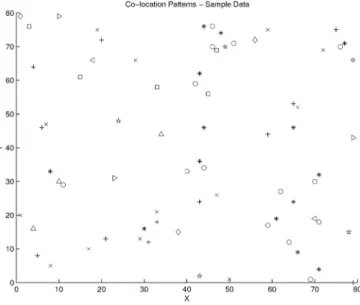
OLOCATIONpatterns represent subsets of Boolean spatial features whose instances are often located in close geographic proximity. Fig. 1 shows a data set consisting of instances of several Boolean spatial features, each repre-sented by a distinct shape. A careful review reveals two colocation patterns, i.e., {‘+,’ ‘’} and {‘o,’ ‘*’}. Real-world examples of colocation patterns include symbiotic species, e.g., the Nile Crocodile and Egyptian Plover in ecology. Boolean spatial features describe the presence or absence of geographic object types at different locations in a two-dimensional or three-two-dimensional metric space, such as the surface of the earth. Examples of Boolean spatial features include plant species, animal species, road types, cancers, crime, and business types.Colocation rules are models to infer the presence of spatial features in the neighborhood of instances of other spatial features. For example, “Nile Crocodiles! Egyptian Plover” predicts the presence of Egyptian Plover birds in areas with Nile Crocodiles.
We formalize the colocation rule mining problem as follows: Given 1) a set T of K spatial feature types T ¼ ff1; f2;. . .; fKg and their instancesI¼ fi1; i2;. . .; iNg, each ii2 I is a vector < instance-id, spatial feature type, location >, where location 2 spatial framework S and 2) a neighbor relation R over instances in I, efficiently
find all the colocated spatial features in the form of subsets of features or rules.
1.1 Related Work
Approaches to discovering colocation rules in the literature can be categorized into two classes, namely, spatial statistics and data mining approaches. Spatial statistics-based approaches use measures of spatial correlation to character-ize the relationship between different types of spatial features. Measures of spatial correlation include the cross-K function with Monte Carlo simulation [6], mean nearest-neighbor distance, and spatial regression models [5]. Computing spatial correlation measures for all possible colocation patterns can be computationally expensive due to the exponential number of candidate subsets given a large collection of spatial Boolean features.
Data mining approaches can be further divided into a clustering-based map overlay approach and association rule-based approaches. A clustering-based map overlay approach [9], [8] treats every spatial attribute as a map layer and considers spatial clusters (regions) of point-data in each layer as candidates for mining associations. GivenXandY
as sets of layers, a clustered spatial association rule is defined as X)YðCS; CC%Þ, forXTY ¼ ;, where CS is the clustered support, defined as the ratio of the area of the cluster (region) that satisfies bothXandY to the total area of the study regionS, andCC%is the clustered confidence, which can be interpreted as CC% of areas of clusters (regions) ofXintersect with areas of clusters (regions) ofY. Association rule-based approaches can be divided into transaction-based approaches and distance-based ap-proaches. Transaction-based approaches focus on defining transactions over space so that an Apriori-like algorithm [2] can be used. Transactions over space can be defined by a reference-feature centric model [12]. Under this model, transactions are created around instances of one user-specified spatial feature. The association rules are derived using the Apriori [2] algorithm. The rules found are all . Y. Huang is with the Department of Computer Science and Engineering,
University of North Texas, PO Box 311366, Denton, TX 76203. E-mail: [email protected].
. S. Shekhar and H. Xiong are with the Department of Computer Science and Engineering, University of Minnesota, 200 Union Street SE, Minneapolis, MN 55455. E-mail: {Shekhar, huix}@cs.umn.edu.
Manuscript received 26 Aug. 2002; revised 19 June 2003; accepted 27 Apr. 2004.
For information on obtaining reprints of this article, please send e-mail to: [email protected], and reference IEEECS Log Number 117191.
related to the reference feature. However, generalizing this paradigm to the case where no reference feature is specified is nontrivial. Also, defining transactions around locations of instances of all features may yield duplicate counts for many candidate associations.
A distance-based approach was proposed concurrently by Morimoto [15] and Shekhar and Huang [19]. Morimoto defined distance-based patterns called k-neighboring class sets. In his work, the number of instances for each pattern is used as the prevalence measure, which does not possess an antimonotone property by nature. However, Morimoto used a nonoverlapping instance constraint to get the antimonotone property for this measure. In contrast, we developed an event centric model, which does away with the nonoverlapping instance constraint. We also defined a new prevalence measure called the participation index. This measure possesses the desirable antimonotone property. A more detailed comparison of these two works is presented in Section 6.
1.2 Contributions
This paper extends our work [19] on the event centric model and makes the following contributions. First, we refine the definition of distance-based spatial colocation patterns by providing an interest measure called the participation index. This measure not only possesses a desirable antimonotone property for efficiently identifying colocation patterns, but also allows for formalizing the correctness and completeness of the proposed algorithm. Furthermore, we show the relationship between the participation index and a spatial statistics interest measure, the cross-K function. More specifically, we show that the participation index is an upper-bound of the cross-K function. Second, we provide an algorithm to discover colocation patterns from spatial point data sets. This algorithm includes a novel multi-resolution filter, which exploits the spatial autocorrelation property of spatial data to effectively reduce the search space. An experimental evaluation on both synthetic and real-world NASA climate data sets is provided to compare alternative choices for key design decisions.
1.3 Outline and Scope
Section 2 describes our approach for modeling colocation patterns. Section 3 proposes a family of algorithms to mine colocation patterns. We show the relationship between the participation index and an estimator of the cross-K function and provide an analysis of the algorithms in the area of correctness, completeness, and computational efficiency in Section 4. In Section 5, we present the experimental setup and results. Section 6 provides a comparison between our work and the work by Morimoto [15]. Finally, in Section 7, we present the conclusion and future work.
This paper does not address issues related to the edge effects or the choice of the neighborhood size and interest measure thresholds. Quantitative association, e.g., ðA; AÞ and quantitative association rules, e.g., (A)A), are beyond the scope of this paper.
2
O
URA
PPROACH FORM
ODELINGC
OLOCATIONP
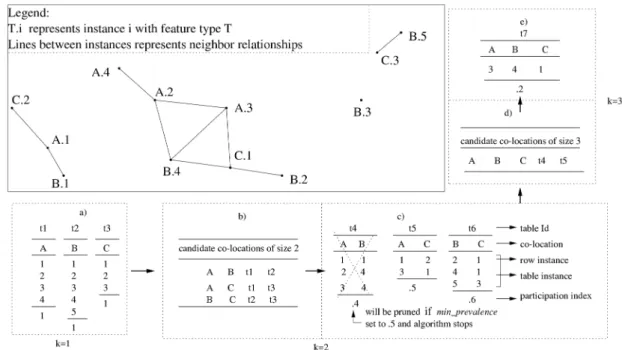
ATTERNSThis section defines the event centric model, our approach to modeling colocation patterns. We use Fig. 2 as an example spatial data set to illustrate the model. In the figure, each instance is uniquely identified byT :i, whereT
is the spatial feature type andiis the unique id inside each spatial feature type. For example, B:2 represents the instance 2 of spatial featureB. Two instances are connected by edges if they have a spatial neighbor relationship.
A colocation is a subset of Boolean spatial features. A
colocation ruleis of the form:c1)c2ðp; cpÞ, wherec1andc2 are colocations,c1Tc2¼ ;,pis a number representing the prevalence measure, and cp is a number measuring conditional probability.
An important concept in the event centric model is proximity neighborhood. Given a reflexive and symmetric neighbor relation R over a set S of instances, a R-proximity neighborhood is a set IS of instances that form a clique [4] under the relationR. The definition of neighbor relation R is an input and should be based on the semantics of the application domains. The neighbor relation R may be defined using spatial relationships (e.g., connected, adjacent [1]), metric rela-tionships (e.g., Euclidean distance [15]), or a combination (e.g., shortest-path distance in a graph such as a road-map). The R-proximity neighborhood concept is different from the neighborhood concept in topology [14] since some supersets of a R-proximity neighborhood may not qualify to be R-proximity neighborhoods.
TwoR-proximityneighborhoodsI1andI2areR-reachable to each other if I1SI2 is a R-proximity neighborhood. A R-proximityneighborhoodI is arow instance(denoted by
row instanceðcÞ) of a colocationcifIcontains instances of all the features in c and no proper subset of I does so. For example, fA:3; B:4; C:1g is a row instance of colocation fA; B; Cg in the spatial data set shown in Fig. 2. But, fA:2; A:3; B:4; C:1g is not a row instance of colocation fA; B; Cgbecause its proper subsetfA:3; B:4; C:1gcontains instances of all features infA; B; Cg. In another example, fA:2; A:4gis not a row instance of colocationfAgbecause its proper subsetfA:2g(orfA:4g) contains instances of all the features in fAg. The table instance,table instanceðcÞ, of a colocationcis the collection of all row instances ofc. In Fig. 2, Fig. 1. Colocation patterns illustration.
t1, t2, t3, t4, t5, t6, and t7 represent table instances. For instance,t5¼ ffA:1;C:2g;fA:3;C:1gg is a table instance of the colocationfA;Cg.
The participation ratio prðc; fiÞ for feature type fi in a size-k colocationc¼ ff1;. . .; fkgis the fraction of instances of featurefiR-reachableto some row instance of colocation
c ffig. The participation index piðcÞ of a colocation c¼ ff1;. . .; fkg is minki¼1fprðc; fiÞg. The participation index is used as the measure of prevalence of a colocation for two reasons. First, the participation index is closely related to the cross-K function [16], [17] which is often used as a statistical measure of interaction among pairs of spatial features. Second, it also possesses an antimonotone prop-erty which can be exploited for computational efficiency. The participation ratio can be computed as
fiðjtable instanceðcÞj
jtable instanceðfiÞj ;
whereis the relational projection operation with duplication elimination. For example, in Fig. 2, row instances of colocation fA; BgareffA:1; B:1g;fA:2; B:4g;fA:3; B:4gg. Only two (B:1 andB:4) out of five instances of spatial featureBparticipate in colocation fA; Bg. So,prðfA; Bg; BÞ ¼2=5¼0:4. Similarly,
prðfA; Bg; AÞ is 0.75. The participation indexpiðfA; BgÞ ¼ minð0:75;0:4Þ ¼0:4.
The conditional probability cpðc1)c2Þ of a colocation rulec1)c2is the fraction of row instances ofc1R-reachable to some row instance ofc2. It is computed as
jc1ðtable instanceðfc1
S
c2gÞÞj jtable instanceðfc1gÞj
;
whereis the relational projection operation with duplica-tion eliminaduplica-tion. For example, in the colocaduplica-tion ruleA)C
in Fig. 2, the conditional probability of this rule is equal to jAðtable instanceðfASCgÞÞj
jtable instanceðfAgÞ ¼ 2 4¼50%:
3
C
OLOCATIONM
ININGA
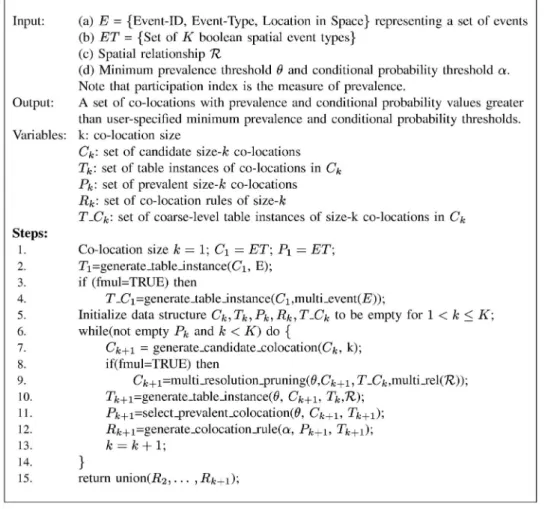
LGORITHMIn this section, we introduce a colocation mining algorithm. Note that the prevalence measure used in Fig. 3 is the participation index and that a colocation pattern is prevalent if the values of its participation index is above a user specified threshold.
As shown in Fig. 3, the algorithm takes a set ET of spatial event types, a setEof event instances, user-defined functions representing spatial neighborhood relationships as well as thresholds for interest measures, i.e., prevalence and conditional probability. The algorithm outputs a set of prevalent colocation rules with the values of the interest measures above the user defined thresholds.
The initialization steps (i.e., steps 1 and 2 in Fig. 3) assign starting values to various data structures used in the algorithm. We note that the value of the participation index is 1 for all colocations of size 1. In other words, all colocations of size 1 are prevalent and there is no need for either the computation of a prevalence measure or pre-valence-based filtering. Thus, the set C1 of candidate colocations of size 1 as well as the set P1 of prevalent colocations of size 1 are initialized toET, the set of event types. The setT1 of table instances of size 1 colocation is created by sorting the set E of event instances by event types. If a multiresolution pruning step is desired, the set of events are discretized into coarse level instances. The set
T C1 of coarse-level table instances of size 1 colocations is generated by sorting the coarse-level event instances by event types.
The proposed algorithms for mining colocation rules iteratively perform four basic tasks, namely, generation of candidate colocations, generation of table instances of candidate colocations, pruning, and generation of coloca-tion rules. These tasks are carried out inside a loop iterating over the size of the colocations. Iterations start with size 2 since our definition of prevalence measure allows no pruning for colocations of size 1.
3.1 Generation of Candidate Colocations
We could rely on a combinatorial approach and use
apriori gen [2] to generate sizekþ1candidate colocations from sizekprevalent colocations.
Theapriori-genfunction takes as argumentPk, the set of
all prevalent size k colocations. The function works as follows: First, in thejoinstep, we joinPkwithPk. This step is specified in a SQL-like syntax as follows:
insert intoCkþ1
selectp:f1,p:f2;. . .,p:fk,q:fk,p:table instance id, q:table instance id
fromPk p,Pk q
wherep:f1¼q:f1,. . .,p:fk1¼q:fk1,p:fk < q:fk;
Next, in the prunestep, we delete all colocationsc2Ck
such that some sizek1subset ofcis not inPk:
forallcolocationc2Ckþ1do
forallsizek1subsetssofcdo if(s=2Pk),then deletecfromCkþ1;
Note that the column fi of Pk refers to the i feature of colocations in tablePkand the column table_instance_id of tablePkrefers to table instances of appropriate colocations.
3.2 Generation of Table Instances of Candidate Colocations
Computation for generating sizekþ1candidate colocations can be expressed as the following join query:
forallcolocationc2Ckþ1
insert intoTc/*Tc is the table instance of
colocationc*/
selectp:instance1,p:instance2,. . .,p:instancek, q:instancek
fromc:table instance id1p,c:table instance id2 q
wherep:instance1¼q:instance1,. . .,
p:instancek1¼q:instancek1, (p:instancek, q:instancekÞ 2 R;
end;
The query takes the size kþ1 candidate colocation set
Ckþ1and table instances of the sizekprevalent colocations as arguments and works as follows:c:table instance id1and c:table instance id2 specify the table instances of the two colocations joined inapriori gento producec. Here, a sort-merge join is preferred because the table instances of each iteration can be kept sorted for the next iteration. This follows from a similar property ofapriori-gen[2]. Sort order is based on an ordering of the set of feature types to order feature types in a colocation to form the sort-field. Finally, all colocations with empty table instances will be eliminated fromCkþ1.
The join computation for generating table instances has two constraints, a spatial neighbor relationship constraint ((p:instancek; q:instancekÞ 2 R) and a combinatorial dis-tinct event-type constraint (p:instance1¼ q:instance1;. . .; p:instancek1¼q:instancek1Þ. We examine three strate-gies for computing this join: a geometric strategy, a Fig. 3. Overview of the algorithms.
combinatorial strategy, and a hybrid strategy. These are described in forthcoming sections. Exploration of other join strategies is beyond the scope of this paper but we may explore such strategies in future work.
Geometric Approach. The geometric approach can be implemented by neighborhood relationship-based spatial joins of table instances of prevalent colocations of size k
with table instance sets of prevalent colocations of size 1. In practice, spatial join operations are divided into a filter step and a refinement step [18] to efficiently process complex spatial data types such as point collections in a row instance. In the filter step, the spatial objects are represented by simpler approximations such as the MBR—Minimum Bounding Rectangle. There are several well-known algo-rithms, such as plane sweep [3], space partition [11], and tree matching [13], which can then be used for computing the spatial join of MBRs using the overlap relationship; the answers from this test form the candidate solution set. In the refinement step, the exact geometry of each element from the candidate set and the exact spatial predicates are examined along with the combinatorial predicate to obtain the final result.
Combinatorial Approach.The combinatorial join predi-cate (i.e.,p:instance1¼q:instance1; p:instance2¼q:instance2; . . .; p:instancek1¼q:instancek1Þ can be processed effi-ciently using a sort-merge join strategy [10] since the set of feature types is ordered and tablesc:table instance id1 and c:table instance id2 are sorted. The resulting tuples are checked for the spatial condition ((p:instancek; q:instancekÞ 2 R) to get the row-instance in the result. In Fig. 2, table 4 of colocationfA; Bgand table 5 of colocationfA; Cgare joined to produce the table instance of colocation fA; B; Cgbecause colocation fA; Bg and colocation fA; Cg were joined in
apriori_gen to produce colocationfA; B; Cgin the previous
step. In the example, row instancef3;4gof table 4 and row instancef3;1gof table 5 are joined to generate row instance f3;4;1gof colocationfA; B; Cg(table 7). Row instancef1;1gof table 4 and row instancef1;2gof table 5 fail to generate row instancef1;1;2gof colocationfA; B; Cgbecause instance 1 of
Band instance 2 ofCare not neighbors.
Hybrid Approach.The hybrid approach chooses the more promising of the spatial and combinatorial approaches in each iteration. In our experiment, it picks the spatial approach to generate table instances for colocation patterns of size 2 and the combinatorial approach for generating table instances for colocation patterns of size 3 or more.
3.3 Pruning
Candidate colocations can be pruned using the given threshold on the prevalence measure. In addition, multi-resolution pruning can be used for spatial data set with strong autocorrelation [6], i.e., where instances tend to be located near each other.
Prevalence-Based Pruning.We first calculate the parti-cipation indexes for all candidate colocations in Tkþ1. Computation of the participation indexes can be accom-plished by keeping a bitmap of size cardinality (fi) for each featurefi of colocationc. One scan of the table instance ofc
will be enough to put 1s in the corresponding bits in each bitmap. By summarizing the total number of 1s (pfi) in each
bitmap, we obtain the participation ratio of each featurefi
(divide pfi byj instance offij). In Fig. 2c, to calculate the
participation index for colocation fA; Bg, we need to calculate the participation ratios for Aand Bin colocation
fA; Bg. BitmapbA¼ ð0;0;0;0Þof size four forAand bitmap
bB¼ ð0;0;0;0;0Þ of size 5 for B are initialized to zeros. Scanning of table 4 will result in bA ¼ ð1;1;1;0Þ and
bB¼ ð1;0;0;1;0Þ. Three out of four instances of A(i.e., 1, 2, and 3) participate in colocationfA; Bg, so the participa-tion ratio forAis .75. Similarly, the participation ratio forB
is .4. Therefore, the participation index isminf:75; :4g ¼:4. After the participation indexes are determined, preva-lence-based pruning is carried out and nonprevalent colocations are deleted from the candidate prevalent colocation sets. For each remaining prevalent colocationc
after prevalence-based pruning, we keep a counter to specify the cardinality of the table instance of c. All the table instances of the prevalent colocations in this iteration will be kept for generation of the prevalent colocations of sizekþ2and discarded after the next iteration.
Multiresolution Pruning. Multiresolution pruning is learned on a summary of spatial data at a coarse resolution using a disjoint partitioning, e.g., pagination imposed by leaves of a spatial index or a grid. A new neighbor relation-shipRcon partitions is derived from relationshipRso that
two partitions areRneighbors if any two instances from each of the two partitions are R neighbors. We combine all instances of a spatial feature f in each partition s in the partitioning as a new coarse instance< s; f; m > in the coarse space, wherem is the number of instances of spatial point featurefin cells. For each candidate colocation generated by
apriori gen, we generate its coarse table instance using new coarse instances, new neighbor relationshipRc, and its coarse
participation index based on the coarse table instance. Multiresolution pruning eliminates a colocation if its coarse participation indexes fall below the threshold, because coarse participation never underestimates the participation index, as shown in Section 4.2.
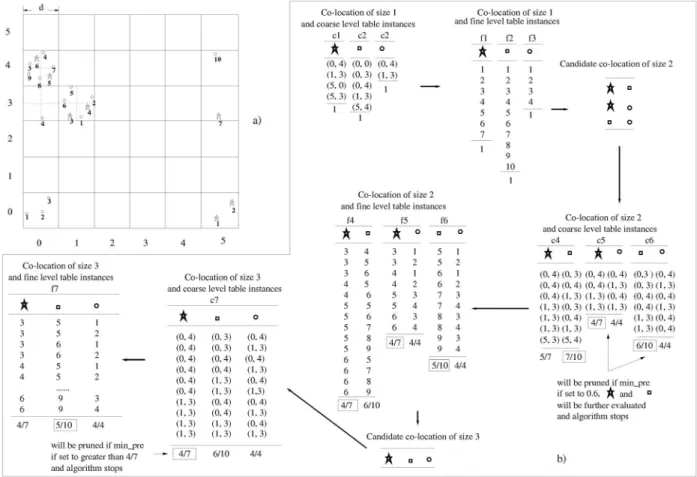
We now illustrate multiresolution pruning by using a simple recti-linear grid for simplicity. In Fig. 4a, different shapes represent different point spatial feature types. Every instance has a unique ID in its spatial feature type and is labeled below it in the figure. Two instances are defined as neighbors if they are in a commonddsquare. A grid with uniform cell size d is superimposed on the data set. Cells (i,j) refer to cells with an x-axis index of i and a y-axis index of j. In this grid, two cells are coarse-neighbors if their centers are in a common square of size dd, which imposes an 8-neighborhood (North, South, East, West, North East, North West, South East, South West) on the cells. For example, cell-pairs fð0;3Þ;ð0;4ÞÞ;ðð0;3Þ;ð1;3Þg and fð0;4Þ;ð1;3Þg illustrate neighbors. This coarse-neighborhood definition guarantees that two cells are neighbors if there exists a pair of points from each of the two cells which are neighbors in the original data set. The process of multiresolution pruning is shown as follows.
First, we generate coarse table instances of candidate colocations of sizekþ1by joining the coarse table instances with the coarse-neighbor relationships.
Next, we calculate the participation indexes for all candidate colocations based on the coarse table instances. For each spatial featurefi, we add up all the counts of point instances in each coarse instance with 1s in its corresponding bitmap (pfi) and divide this by j instance offij to get the
coarse-participation ratio of featurefi. For example, in Fig. 4a, coarse prðð?;Þ; ?Þ ¼4=7 since there are two coarse row instances off?;g, each containing two fine-grain instances of
? and a total of seven fine-grain instances of ?. Similarly, coarseprðf?;g;Þ ¼4=4¼1, yielding coarse participation indexpiðf?;gÞ ¼minð4=7;4=4Þ ¼4=7. Fig. 4b shows coarse table instances of colocations {*,ut}, {*,}, and {ut,}. If the threshold for prevalence is set to 0.6, then colocationc5andc6 can be pruned by multiresolution pruning. We also note that the sizes of coarse table instances are smaller than the sizes of table instances at fine resolution. This shows the possibility of computation cost saving via multiresolution pruning for clustered data sets. Finally, the examples in Fig. 4b show that the coarse participation ratios and participation indexes never underestimate the true participation indexes of the original data set.
3.4 Generating Colocation Rules
The generate_colocation_rule function generates all the colocation rules with the user defined conditional prob-ability thresholdfrom the prevalent colocations and their table instances. The conditional probability of a colocation rulec1)c2in the event centric model is the probability of c1 reachable to aR-proximityneighborhood containing all the features inc2. It can be calculated as:
jc1ðtable instanceðc1
S
c2ÞÞj jtable instanceðc1Þj
;
whereis a projection operation with duplication elimina-tion. Bitmaps or other data structures can be used for efficient computation using the same strategies for pre-valence-based pruning.
4
A
NALYSIS OF THEC
OLOCATIONM
ININGA
LGORITHMSHere, we analyze the colocation mining algorithms in the areas of statistical interpretation of colocation patterns, completeness, correctness, and computational complexity.
4.1 Statistical Interpretation of the Colocation Patterns
In spatial statistics [6], interest measures such as thecross-K
function, a generalization of Ripley’s K-function [16], [17] (and variations such as theL-functionandGfunction) are used to identify colocated spatial feature types. Thecross-K
function KðhÞ for binary spatial features is defined as follows:
KijðhÞ ¼j1E½number of typejinstances within distance hof a randomly chosen typeiinstance;
where j is the density (number per unit area) of type j
instances andhis the distance. Without edge effects [7], the cross-K-function could be estimated by: KKij^ ðhÞ ¼ 1
ijW
P
k
P
lIhðdðik; jlÞÞ, where dðik; jlÞ is the distance between the kthinstance of typeiand thelthinstance of typej,Ihis the indicator function assuming value 1 if the distance between instanceikandjldðik; jlÞ h, and value 0 otherwise, andW
is the area of the study region. jKKij^ ðhÞ estimates the expected number of typejinstances within distancehof a typeiinstances. The variance of thecross-Kfunction can be estimated by Monte Carlo simulation [6], in general, and by Fig. 4. Colocation miner algorithm with multiresolution pruning illustration.
a close form equation under special circumstances [6]. In Fig. 5, the cross-K functions of the two pairs of spatial features, i.e., {‘+,’ ‘’} and {‘o,’ ‘*’}, are well above the spatial complete randomness curve y¼h2, while the cross-Kfunctions of the other random two pairs of spatial features, i.e., {‘*,’ ‘’} and {‘*,’ ‘+’}, are very close to complete spatial randomness. This figure does not show the confidence band.
We compare the participation index with the cross-K
function in an attempt to provide an independent method for evaluating colocation patterns. In particular, we explore the correctness of colocations using the following character-ization of the relationship between thecross-Kfunction and colocations.
Lemma 1.Participation indexpiðfA; BgÞfor colocationfA; Bg
is an upper-bound onKK^ABABðhÞ
W , whereKABKAB^ ðhÞis the estimation of
the cross-K function of colocation fA; Bg for a proximity
neighborhood defined by distanceh, andW is the total area
of the region.
Proof.From the definition of the participation index and the definition ofcross-Kfunction, we have
piðfA; BgÞ ¼
min jAðtable instanceðA; BÞÞj jAj ; jBðtable instanceðA; BÞÞj jBj and ^ KAB KABðhÞ W ¼ 1 W 1 ABW X k X l IhðdðAk; BlÞÞ ¼jtable instanceðA; BÞj jAj jBj : We need to show only that
jAðtable instanceðA; BÞÞj jAj jtable instanceðA; BÞj jAj jBj and jBðtable instanceðA; BÞÞj jBj jtable instanceðA; BÞj jAj jBj : To prove the first inequality, we need to show only that jAðtable instanceðfA; BgÞÞj j
table instanceðfA;BgÞj
jBj . This is
obvious because the total number of instances ofAwith at least one instance of typeBnearby (left side) is always greater or equal to the average number of instances of type A around an instance of type B (right side). The second inequality could be proved in a similar manner.tu
Lemma 2.The table instancetable instanceðfA; BgÞof a binary
colocation fA; Bg has enough information to compute the
estimator KK^ABABðhÞ
W of the cross-K function for h¼d, where
distanceddefines the proximity neighborhood.
Proof.Since ^ KAB KABðhÞ W ¼ 1 W 1 ABW X k X l IhðdðAk; BlÞÞ ¼jtable instanceðA; BÞj jAj jBj ;
this lemma holds. tu
Lemma 1 may be used to establish the correctness of colocation rules with respect to the threshold defined by
^ K KABðhÞ
W , and Lemma 2 may be used to establish the colocation
miner as an algorithm to efficiently compute KKAB^ for selected colocations, particularly when the multiresolution filter is effective. We are at present aware of only the use of thecross-K function to characterize pairwise spatial inter-actions. We plan to explore spatial statistics research literature to look for measures of spatial interaction among more than two features and compare those measures to the participation index.
4.2 Completeness and Correctness
Lemma 3: Antimonotone.The participation ratio and partici-pation index are antimonotone (monotonically nonincreasing) as the size of the colocation increases.
Proof. The participation ratio is antimonotonic because a spatial feature instance that participates in a row instance of a colocationcalso participates in a row instance of a colocationc0, wherec0c. The participation index is also antimonotonic because 1) the participation ratio is antimonotonic and 2) pi c[fkþ1 ¼minkþ1 i¼1 pr c [ fkþ1; fi n o mink i¼1 pr c [ fkþ1; fi n o mink i¼1fprðc; fiÞg ¼piðcÞ: u t
Lemma 4. The coarse participation index computed by multi-resolution pruning never underestimates the participation indexes of the original data set. The candidate colocation set found is a superset of the prevalent colocation set on the original data set.
Proof. When colocation size = 1, the value of the coarse participation index and the true participation index is 1, so Lemma 4 is trivially true. Suppose Lemma 4 is true for colocations size = k. Let us consider the case that Fig. 5. Ripley’s Cross-K Function.
colocation size is equal to kþ1. For each candidate colocationc of sizekþ1generated from the apriori_gen by joining c1 and c2 of size k, we generate its coarse instance table by joining the coarse instance tables ofc1 andc2. Because Lemma 4 is true for colocations of sizek, the candidate colocation set of sizekfound is a superset of the prevalent colocation set on the original data set. Thus,c1andc2are in the candidate colocation set in the previous iteration and their coarse level table instances are available to be joined to produce the coarse level table instance of c. The table join to produce the coarse table instance ofchas the following property: IfRðp1; p2Þ is in the original data set, then coarse Rcðcell c
1; cell c2Þ will be in the coarse-level data set given p12c1 and p22c2. When we calculate the coarse participation index, any spatial feature instance which participates in the colocation in the original data set will contribute to the counts during the coarse participation ratio calcula-tion. So, the coarse participation ratios never under-estimate the true participation ratios, implying that the coarse participation index never underestimates the true participation index and that the pruning will not eliminate any truly prevalent colocation. Thus, the candidate colocation set after multiresolution pruning is a superset of the prevalent colocation set on the
original data set. tu
Lemma 5: Completeness. The Colocation Miner algorithm is complete.
Proof. The schema level pruning using apriori_gen is complete due to the monotonicity of the participation index as proved in Lemma 3. Then, we prove that the join of the table instances ofc1andc2to produce the table instance of c is complete. According to the proximity neighborhood definition, any subset of a proximity neighborhood is a proximity neighborhood too. For any instance I¼ fi1;. . .; ikþ1g of colocation c, subsets I1¼ fi1;. . .; ikg and I2¼ fi1;. . .; ik1; ikþ1g are neighbor-hoods,ik andikþ1 are neighbors, andI1 andI2 are row instances of C1 and C2, respectively. Joining I1 and I2 will produceI. Enumeration of the subsets of each of the prevalent colocations ensures that no spatial colocation rules with both high prevalence and high conditional probabilities are missed. We then prove that multi-resolution pruning does not affect completeness. By Lemma 4, the colocation set found is a superset of the prevalent colocation set on the original data set. Thus, multiresolution pruning does not falsely eliminate any
prevalent colocation. tu
Lemma 6: Correctness.The Colocation Miner is correct.
Proof. We will show only that the row instance of each colocation is correct, as that will imply the correctness of the participation index values and that of each colocation meeting the user specified threshold. An instance I1¼ fi1;1;. . .; i1;kg of c1¼ ff1;. . .; fkþ1g and an instanceI2¼ fi2;1;. . .; i2;kgof c2¼ ff1;. . .; fk1; fkþ1gis joined to pro-duce an instanceInew¼ fi1;1;. . .; i1;k; i2;kgofc¼ ff1;. . .; fkþ1gif: 1) all elements ofI1andI2are the same excepti1;k
andi2;k; 2)i1;kandi2;kare neighbors. The schema ofInewis
apparently c, and elements in Inew are in a proximity neighborhood becauseI1is a proximity neighborhood and i2;kis a neighbor of every element ofI1. tu
4.3 Computational Complexity Analysis
This section examines the strategies for generating candi-date colocations, the evaluation of the multiresolution pruning strategy, and the effect of noise. First, there are two basic strategies for generating table instances of candidate colocations, namely, the geometric approach and the combinatorial approach. For generating size-2 colocations, the combinatorial approach ends up being the nest-loop join strategy with an asymptotic complexity of
OðN2Þ, while the geometric approach has the CPU cost1of
OðNlogNþMÞ, whereNis the total number of instances of all features and M is the number os intersections. When the data set is sparse, the cost of the combinatorial approach will be much higher. However, when generating table instances of colocations of size 3 or more, the combinatorial approach becomes cheaper than the geometric approach. This is due to its exploitation of the sort-merge join strategy while keeping each table instance sorted. In a hybrid approach, we pick the cheaper of the two basic strategies in each iteration to achieve the best overall cost.
Second, let us compare the cost of theColocation Miner algorithm with and without the multiresolution pruning step. LetTmcmðkÞandTcmðkÞrepresent the costs of iteration
k of the Colocation Mineralgorithm with and without the multiresolution pruning.
TmcmðkÞ ¼Tapriori genðCðprev;kÞÞþTpruneðCðcand;kþ1Þ;grid dataÞ þTpruneðCðsub cand;kþ1Þ;dataÞ
TcmðkÞ ¼Tapriori genðCðprev;kÞÞþTpruneðCðcand;kþ1Þ;dataÞ:
ð1Þ
In (1),Tapriori genðCðprev;kÞÞrepresents the cost ofapriori_gen based on the prevalent colocation set of size k. Here, resolution is not relevant since apriori_gen works on the spatial feature level only.TpruneðCðcand;kþ1Þ;grid dataÞrepresents the cost for multiresolution pruning on the coarse level data set in iteration k. After coarse-level pruning, we only need to search the leftover subset of the original data set.
TpruneðCðsub cand;kþ1Þ;dataÞ represents the cost for fine level instance pruning on the leftover subsets of the original data set. In addition,TpruneðCðcand;kþ1Þ;dataÞ represents the cost for fine level instance pruning on the original data set in iteration k.
The bulk of time is consumed in generating table instances and calculating the participation indexes; thus, the ratio can be simplified as:
TmcmðkÞ
TcmðkÞ
TpruneðCðcand;kþ1Þ;grid dataÞþTpruneðCðsub cand;kþ1Þ;dataÞ
TpruneðCðcand;kþ1Þ;dataÞ
:
ð2Þ Furthermore, we assume that the average time to generate a table instance in the original data set isTorigðkÞfor iteration k and the average time to generate a table instance in the grid data set isTgridðkÞ for iterationk. The number of candidate colocations generated by the apriori_gen is jCkþ1j and the number of candidate colocations after the coarse instance level pruning isjCk0þ1j, (2) can be written as:
1. The I/O costs of the geometric approach and the combinatorial approach are similar.
TmcmðkÞ TcmðkÞ jCkþ1j TgridðkÞ þ jCk0þ1j TorigðkÞ jCkþ1j TorigðkÞ ¼TgridðkÞ TorigðkÞþ jC0kþ1j jCkþ1j : ð3Þ
The first term of the ratio is controlled by the “clumpiness” (the average number of instances of the spatial features per grid cell) of the locations of spatial features. The second term is controlled by the filtering efficiency of the coarse instance level pruning. When the locations of spatial features are clustered, the sizes of the fine level table instances are much greater than the sizes of the coarse level table instances and the time needed to generate fine level table instances is greater than the time needed to generate coarse level table instances. In our experiments, as described in the next section, we use the parametermclump, which controls the number of instances clumping together for each spatial feature, to evaluate the first term, and we use the parameter moverlap, which represents the possible false candidate ratios, to evaluate the second term. From the formula, we can see that the colocation miner with multiresolution pruning is likely to be more efficient than the colocation miner without multi-resolution pruning when the locations of spatial features are clustered and the false candidate ratio is high.
5
E
XPERIMENTALP
ERFORMANCEE
VALUATIONFig. 6 describes the experimental setup to evaluate the impact of design decisions on the relative performance of the colocation miner algorithm. We evaluated the perfor-mance of the algorithms with synthetic and real-world NASA climate data sets. Synthetic data sets are generated using a methodology similar to methodologies used to evaluate algorithms for mining association rules [2]. Synthetic data sets allow better control towards studying the effects of interesting parameters.
A data-flow diagram of the data generation process is shown in Fig. 6. The process began with the generation of core colocation subsets of spatial features. To generate a subset of features, we first chose the size of the subset from a Poisson distribution with mean (1). Then, a set of features for this core colocation pattern was randomly chosen. For each core colocation, moverlap maximal colocations were generated by appending one more spatial feature to a core colocation. The larger moverlap is, the more false candidate
apriori_gengenerates. The size of each table instance of each
colocation was chosen from another Poisson distribution with mean 2. Next, we generated the set of proximity neighborhoods for colocations instances using the size of their table instances from the previous step. mclump point locations for each feature in the colocation were embedded inside a proximity neighborhood of sized. The locations of proximity neighborhoods were chosen at random in the overall spatial framework. For simplicity, the shape of the overall spatial framework was a rectangle of sizeD1D2 and the size of each proximity neighborhood wasdd. The final step involved adding noise. The model for noise used two parameters, namely, the ratio of noise featuresrnoise f
and the number of noise instancespnoise n. Noise was added by generating a set of instances of features from a set of noise features disjoint with the features involving genera-tion of core colocagenera-tions and placing the instances at random locations in the global spatial framework.
The real-world NASA climate data used in our experi-ments contain monthly measureexperi-ments of various monthly numeric climate variables, e.g., precipitation and sea surface temperature, over a period of 12 years, starting in January 1982. Events, such as drought, wet, and hot, are defined via statistical thresholding using mean and standard deviation as detailed in [20].
Our experiments were performed on a Sun Ultra 10 workstation with a 440 MHz CPU and 128 Mbytes memory running the SunOS 5.7 operating system.
5.1 Comparing Strategies for Generating Table Instances
In this section, we compare the geometric, the combinator-ial, and the hybrid strategies using synthetic and real-world NASA climate data sets. The synthetic data set, generated using parameter values in column C1 of Table 1, used a rectangle spatial framework of size 106106, a square proximity neighborhood of size1010, an average coloca-tion size of 5, an average table instance size of 50 when
mclump¼1, a noise feature ratio of 0.5, a noise number of 50,000, and an overlapping degree of 1.
Fig. 7a shows the execution times for the three candidates with the prevalence threshold set to 0.9. In the figure, the first column reports the execution time needed to discover colocations of size 2. As can be seen, the geometric strategy is faster than the combinatorial strategy for generating size-2 colocations. Spatial-join data structures help the geometric algorithm in this step. Also, the remaining columns in Fig. 7a report the total execution Fig. 6. Experimental setup and design.
time to discover all the colocations as well as the time to discover colocations of size 3 or more, given prevalent colocations of size 2. In these cases, the combinatorial algorithm is orders of magnitude faster than the geometric algorithm. A sort-merge join strategy (e.g., apriori-gen [2]) helps the combinatorial algorithm. The hybrid strategy uses the geometric algorithm for discovering prevalent coloca-tions of size 2 and the combinatorial algorithm for discovering larger colocations. Thus, it is expected to achieve the best overall performance.
Similar trends were also observed for the NASA climate event data set, as shown in Fig. 7b. In this experiment, the prevalence threshold is set to 0.3 and the grid size is 4 by 4. All events are extracted at the threshold 1.5 using Z-score transformation.
5.2 Effect of the Filter
The effect of the multiresolution pruning filter was evaluated with spatial data sets generated using parameter values shown in column C2 of Table 1. We used a
rectangular spatial framework of size2501;000, a square proximity neighborhood of size1010, an average coloca-tion size of 5, an average table instance size of 50 when
mclump¼1 a noise feature ratio of 0.5, a noise number of 1000, a core colocation size of 4, and an overlapping degree of 1. Spatial framework sizes were proportional to the total number of instances to avoid unexpected patterns created by overcrowding of instances. The overlapping degree (moverlap) was set from 2 to 8 and the clumpiness measure
(mclump) was set from 5 to 20 to generate other data sets. We ran theColocation Miner with and without multiresolution pruning on these data sets. Prevalence thresholds were set to the estimation of the actual prevalences from the generation of the data sets.
Fig. 8 summarizes the performance gain by using multiresolution pruning. The x-axis represents the overlap degree, which controls the false candidates generated by
apriori_gen in the first figure or the “clumpiness” of
locations of instances of spatial feature type in the second figure. The y-axis represents the ratio of runtime of the TABLE 1
Parameters Used to Generate the Synthetic Data
Fig. 7. (a) Relative performance of geometric, combinatorial, and hybrid algorithms on the synthetic data set. (b) Relative performance of geometric, combinatorial, and hybrid algorithms on the NASA climate data set.
Colocation Miner without multiresolution pruning to the runtime with multiresolution pruning. The results show that, as the degree of overlap and the number of false candidates increase, the running time is reduced by a factor of 1 to 4.5.
Fig. 9 summarizes the ratio of the computation time for multiresolution pruning and for prevalence-based pruning. The x-axis represents the overlap degree or the “clumpi-ness” of the locations of each feature type. The overhead of multiresolution pruning as a fraction of prevalence-based pruning decreases when the degree of overlap or clumpi-ness increases. Clumpiclumpi-ness affects the overhead, reducing it from 0.45 to 0.1.
5.3 Effect of Noise
The base data set, generated using parameter values in column C1 of Table 1, used a rectangle spatial framework of size 106106, a square proximity neighborhood of size 1010, an average colocation size of 5, an average table instance size of 50 whenmclump¼1, a noise feature ratio of 0.5, a noise number of 50,000, and an overlapping degree of
1. Then, we increased the noise instances up to 800,000 and measured the performance, as shown in Fig. 10. The execution time for discovering colocations of size 2 and 3+ are shown in the figure. The results show that noise level affects the execution time to discover colocations of size 2, but does not affect the execution time to discover larger colocations given colocations of size 2. In other words, noise is filtered out during the determination of colocations of size 2.
6
D
ISCUSSIONIn this section, we present a detailed comparison of our approach with the closest related work [15] for pattern semantics and algorithmic ideas.
. Pattern Semantics. Morimoto [15] defined distance-based patterns called k-neighboring class sets. In this work, the number of instances for a pattern is used as its prevalence measure. However, this measure may not possess an antimonotone property if the instances overlap; that is, the number of instances Fig. 8. Filter time ratio by (a) overlap degree and by (b) clumpiness degree,
may increase with the increase of the pattern size. For example, in Fig. 11, there are two overlapping instances: {“2,” “8”} and {“1,” “8”} of the set {square, triangle}. These two instances share one common instance {“8”} of the triangle feature. Indeed, there is only one instance of the triangle feature. In other words, the number of instances of the set {square, triangle} is greater than the number of instance of its subset {triangle}. To deal with this issue, Morimoto [15] used the following constraint to get the antimonotone property.
“any point object must belong to only one instance of a k-neighboring class set.”
As shown in Fig. 11, with this constraint, only one instance {2, 8} is specified for the 2-neighboring class set {square, triangle}. However, this constraint may lead to the following difficulty as described in [15].
“Instances of k-neighboring class set for k > 2 may (be) different depending on the order of the class as added into the class set. Therefore, the support value of a k-neighboring class set for k> 2 may be slightly different.”
Our approach does not need the constraint of “any point object must belong to only one instance” since we do not use the number of instances for a pattern as its prevalence measure. We propose the participa-tion index as the prevalence measure, which
possesses a desirable antimonotone property. A unique subset of colocation patterns can be specified using a threshold on the participation index without consideration of algorithmic details such as the order of examination of instances of a colocation. In addition, the correctness and completeness of colocation mining algorithms can be defined using the participation index.
. Algorithmic Ideas. We have noted that a direct performance comparison of our algorithm with the algorithm by Morimoto [15] is not very meaningful due to the difference in the prevalence measure and, thus, the set of identified patterns. Nonetheless, we provide a comparison of the algorithmic ideas now. Morimoto [15] provided an iterative algorithm for mining neighboring class sets with kþ1 features from those with k features. In his algorithm, a nearest neighbor based spatial join was applied in each iteration. More specifically, a geometric techni-que, a Voronoi diagram, was used to take advantage of the restriction that “any point object must belong to only one instance of a k-neighboring class set.” This algorithm considers a pure geometric join approach. In contrast, our colocation mining algo-rithm considers a combinatorial join approach in addition to a pure geometric join approach to generate size k+1 colocation patterns from size-k colocation patterns. Our experimental results show that a hybrid of geometric and combinatorial methods results in lower computation cost than either a pure geometric approach or pure combina-torial approach. In addition, we apply a multi-resolution filter to exploit the spatial autocorrelation property of spatial data for effectively reducing the search space.
7
C
ONCLUSION ANDF
UTUREW
ORKIn this paper, we formalized the colocation problem and showed the similarities and differences between the colocation rules problem and the classic association rules problem as well as the difficulties in using traditional measures (e.g., support, confidence) created by implicit, overlapping and potentially infinite transactions in spatial data sets. We proposed the notion of user-specified proximity neighborhoods in place of transactions to specify groups of items and defined interest measures that are Fig. 10. Noise effect on the colocation miner.
Fig. 11. A spatial data set with three features represented by circle, square, and triangle. This sample data set is from Morimoto’s paper [15]. In total, there are eight instances for three features. An edge connects two instances if the distance between these two instances is less than the distance threshold.
robust in the face of potentially infinite overlapping proximity neighborhoods. A key observation was that some properties of proximity neighborhood cliques obey the downward inclusion property necessary for a priori-based rule mining. The cardinality of table instances does not obey this property but the proposed participation index does, allowing interactive pruning. In addition, the participation index has a spatial statistical interpretation as an upper-bound on thecross-K function, a classical spatial statistical measure of association for binary spatial features. In contrast, related approaches [12], [15] have not provided spatial statistical interpretations of their results.
The Colocation Miner, an algorithm for mining colocation patterns, was presented and analyzed for correctness, completeness, and computation cost. Design decisions in the proposed algorithm were evaluated using theoretical and experimental methods. Empirical evaluation shows that the geometric strategy performs much better than the combinatorial strategy when generating size-2 colocations; however, it becomes slower when generating colocations with more than two features. The hybrid strategy integrates the best features of the above two approaches. Furthermore, when the locations of the features tend to be spatially clustered, which is often true for spatial data due to spatial-autocorrelation, the computation cost of the colocation miner can be significantly reduced with a multiresolution filter.
Several questions remain open. First, the choice of neighbor relation R does impact the performance of the proposed algorithms. We plan to examine statistical methods, e.g., interinstance distance histograms, to develop guidelines for the selection of R. Second, the colocation mining problem should be investigated to account for extended spatial data types, such as line segments and polygons. Also, we considered only Boolean features here. In the real world, the features can be categorical and continuous. There is a need to extend the colocation mining framework to handle continuous features. Third, we plan to evaluate the impact of multiresolution filtering on overall performance of the proposed algorithms using real world data sets which exhibit strong spatial autocorrelation. Finally, if locations of features change over time, it is possible for us to identify some spatiotemporal association patterns. Quantitative association, e.g., (A,A), and quanti-tative association rules, e.g., (A)A), may also be explored in the future.
A
CKNOWLEDGMENTSThe authors would like to thank Raymod T. Ng (University of British Columbia, Canada), Jiawei Han (Simon Fraser University, Canada), James Lesage, and Sucharita Gopal (Boston University) for valuable insights. They also would like to thank C.T. Lu, Weili Wu, and Pusheng Zhang (University of Minnesota) for their valuable feedback. They are grateful to Kim Koffolt for her timely and detailed feedback that helped to improve the readability of this paper.
R
EFERENCES[1] Open GIS Consortium, Inc., http://www.opengis.org, 2004.
[2] R. Agarwal and R. Srikant, “Fast Algorithms for Mining
Association Rules,”Proc. 20th Int’l Conf. Very Large Data Bases, 1994.
[3] L. Arge, O. Procopiuc, S. Ramaswamy, T. Suel, and J. Vitter, “Scalable Sweeping-Based Spatial Join,”Proc. Int’l Conf.Very Large Databases,1998.
[4] C. Berge,Graphs and Hypergraphs.American Elsevier, 1976.
[5] Y. Chou, Exploring Spatial Analysis in Geographic Information System.Onward Press, 1997.
[6] N.A.C. Cressie,Statistics for Spatial Data.Wiley and Sons, 1991.
[7] P. Dixon, “Ripley’sK Function,” http://www.stat.iastate.edu/ preprint/articles/2001-18.pdf, Dec. 2001.
[8] V. Estivill-Castro and I. Lee, “Data Mining Techniques for Autonomous Exploration of Large Volumes of Geo-Referenced Crime Data,”Proc. Sixth Int’l Conf. Geocomputation,2001.
[9] V. Estivill-Castro and A. Murray, “Discovering Associations in Spatial Data—An Efficient Medoid Based Approach,”Proc. Second Pacific-Asia Conf. Knowledge Discovery and Data Mining,1998.
[10] G. Graefe, “Sort-Merge-Join: An Idea Whose Time has (h)
Passed?”Proc. IEEE Conf. Data Eng.,1994.
[11] D. J. DeWitt and J.M. Patel, “Partition Based Spatial-Merge Join,” Proc. ACM SIGMOD Conf. Management of Data,June 1996.
[12] K. Koperski and J. Han, “Discovery of Spatial Association Rules in Geographic Information Databases,” Proc. Fourth Int’l Symp. Spatial Databases,1995.
[13] S.T. Leutenegger and M.A. Lopez, “The Effect of Buffering on the Performance of R-Trees,”Proc. Int’l Conf. Data Eng.,1998.
[14] S. Lipschutz,Schaum’s Outline of General Topology.McGraw-Hill Trade, 1968.
[15] Y. Morimoto, “Mining Frequent Neighboring Class Sets in Spatial Databases,” Proc. ACM SIGKDD Int’l Conf. Knowledge Discovery and Data Mining,2001.
[16] B.D. Ripley, “The Second-Order Analysis of Stationary Point Process,”J. Applied Probability,vol. 13, pp. 255-266, 1976.
[17] B.D. Ripley, “Modelling Spatial Patterns,”J. Royal Statistical Soc. Series B,vol. 39, pp. 172-192, 1977.
[18] S. Shekhar and S. Chawla,Spatial Databases: A Tour.Prentice Hall, 2003.
[19] S. Shekhar and Y. Huang, “Colocation Rules Mining: A Summary of Results,” Proc. Seventh Int’l Symp. Spatio-Temporal Databases, 2001.
[20] P. Tan, M. Steinbac, V. Kumar, C. Potter, and S. Klooster, “Finding Spatio-Temporal Patterns in Earth Science Data,” Proc. KDD Workshop Temporal Data Mining,2001.
Yan Huangreceived the BS degree in computer science from Peking University, Beijing, China, in July 1997 and the PhD degree in computer science from University of Minnesota, Twin-Cities, Minnesota, in July 2003. She is currently an assistant professor in the Computer Science and Engineering Department at the University of North Texas, Denton, Texas. Her research interests include databases, spatial databases, data mining, and geographic information sys-tems (GIS). She is a member of IEEE Computer Society and ACM SIGMOD.
Shashi Shekharreceived the BTech degree in computer science from the Indian Institute of Technology, Kanpur, India, in 1985, the MS degree in business administration, and the PhD degree in computer science from the University of California at Berkeley, in 1989. He is currently a professor of computer science at the Uni-versity of Minnesota, Minneapolis. His research interests include spatial databases, spatial data mining, geographic and information systems (GIS), and intelligent transportation systems. He is a coauthor of a textbook on spatial databases (Prentice Hall, 2003) and has published more than 100 research papers in peer-reviewed journals, books, conferences, and workshops. He is a coeditor-in-chief of Geo-Informatica: An International Journal on Advances of Computer Science for GIS, and has served on the editorial boards ofIEEE Transactions on Knowledge and Data Engineeringas well as the IEEE-CS Computer Science & Engineering Practice Board. He also served as a program cochair of the ACM International Workshop on Advances in Geographic Information Systems, 1996. He is serving as a member of the mapping science committee of the National Research Council National Academy of Sciences (2004-2006) and has served as a member of the Board of Directors of the University Consortium on GIS (2003-2004). Dr. Shekhar is a fellow of the IEEE Computer Society and a member of the ACM.
Hui Xiongreceived the BE degree in automa-tion from the University of Science and Technol-ogy of China, Hefei, in 1995, and the MS degree in computer science from the National University of Singapore, in 2000. He is currently a PhD candidate in the Department of Computer Science and Engineering at the University of Minnesota, Minneapolis. His research interests include data mining, spatial databases, geo-graphic and information systems, and statistical computing. He is a student member of the IEEE Computer Society and the ACM.
. For more information on this or any other computing topic, please visit our Digital Library atwww.computer.org/publications/dlib.