A flexible approach to distributed data anonymization
Florian Kohlmayer
a,⇑,1, Fabian Prasser
a,1, Claudia Eckert
b, Klaus A. Kuhn
a aTechnische Universität München, University Medical Center (MRI), Ismaninger Strasse 22, 81675 München, Germany b
Technische Universität München, Department of Computer Science, Boltzmannstrasse 3, 85748 Garching bei München, Germany
a r t i c l e
i n f o
Article history:
Received 27 August 2013 Available online 12 December 2013 Keywords:
Personal data protection Distribution
Privacy Anonymization Commutative encryption Secure multi-party computing SMC
a b s t r a c t
Sensitive biomedical data is often collected from distributed sources, involving different information systems and different organizational units. Local autonomy and legal reasons lead to the need of privacy preserving integration concepts. In this article, we focus on anonymization, which plays an important role for the re-use of clinical data and for the sharing of research data. We present a flexible solution for anonymizing distributed data in the semi-honest model. Prior to the anonymization procedure, an encrypted global view of the dataset is constructed by means of a secure multi-party computing (SMC) protocol. This global representation can then be anonymized. Our approach is not limited to specific anonymization algorithms but provides pre- and postprocessing for a broad spectrum of algorithms and many privacy criteria. We present an extensive analytical and experimental evaluation and discuss which types of methods and criteria are supported. Our prototype demonstrates the approach by imple-mentingk-anonymity,‘-diversity,t-closeness andd-presence with a globally optimal de-identification method in horizontally and vertically distributed setups. The experiments show that our method provides highly competitive performance and offers a practical and flexible solution for anonymizing dis-tributed biomedical datasets.
Ó2013 Elsevier Inc. All rights reserved.
1. Introduction
Collaboration and data sharing have become core elements of biomedical research. Examples are international projects like the International Cancer Genome Consortium ICGC with its goal to ‘‘make the data available to the entire research community’’[1], and BBMRI-LPC aiming ‘‘to help scientists to have better access to large European studies on health’’[2]. Also, from the perspective of public funders, sharing of research data has become a request, and princi-ples of sharing have been formulated[3,4]. Besides the interna-tional projects mentioned above, there are research projects on national, regional, and institutional levels, which collect, integrate, and share data.
The process of managing data from collection to analyses and also to sharing can be illustrated by different phases[5]. Research data is collected and managed, which may be accompanied by fur-ther processes, such as quality assurance. Sharing is initiated by allowing other researchers to get an overview over available data which fit their research objectives. Typically, access to core data is limited, and data access committees are involved before data use agreements (DUAs) are signed and data is released. Then, this data is integrated and used for new analyses.
There is a growing understanding of risks related to data shar-ing: disclosure of sensitive biomedical data may lead to harm for individuals, especially when different sources are available for link-age (for an overview see[6]). Basically, national laws and regula-tions, such as the HIPAA Privacy Rule[7], as well as international regulations, such as the European Directive on Data Protection [8], mandate stringent protection of personal data. In recent years, there has been extensive work on ethical, legal, social/societal is-sues (ELSI) of biomedical and genomic research and on data sharing, e.g.,[9,10], which we will not further address in this article.
Anonymization is an important privacy measure when releasing and sharing sensitive datasets. As an important example, the HIPAA Privacy Rule has defined concrete measures to prevent re-identification. These include methods of statistical disclosure con-trol. Basically, fuzziness is introduced to a degree which balances remaining semantics and usability against risk reduction. K-ano-nymityis a well known and understood privacy criterion, focusing onquasi-identifiers. These are attributes that are required for anal-yses but are associated with a high risk of reidentification. A data-set is k-anonymous if each data item cannot be distinguished from at leastk1 other data items regarding the quasi-identifiers[11]. Introducing k-anonymity is a measure against linkage attacks which may lead to identity disclosure when accessible data is com-bined with an attackers background knowledge[12].
Data is often collected from distributed sources, involving dif-ferent types of data, difdif-ferent information systems, and difdif-ferent organizational units. Pseudonymity is another privacy measure of 1532-0464/$ - see front matterÓ2013 Elsevier Inc. All rights reserved.
http://dx.doi.org/10.1016/j.jbi.2013.12.002 ⇑Corresponding author.
E-mail address:fl[email protected](F. Kohlmayer). 1 These authors contributed equally to this work.
Contents lists available atScienceDirect
Journal of Biomedical Informatics
relevance, which leads to distribution. Here, directly identifying data is separated from medical data, and the links between identi-fiers and corresponding pseudonyms are secretly kept by a honest broker [13]. In general, data can be distributed vertically or horizontally. The former means that different sites hold different subsets of the attributes for a common set of individuals, so pseu-donymity is a typical example. The latter means that different sites hold data with the same set of attributes for different individuals, for example, data for individuals in their region. Health services re-search is an example where integration of horizontally distributed data is needed, and disclosure has to be prevented.
In this article, we will focus on anonymization of datasets which are horizontally or vertically distributed. Existing approaches have focused on limited sets of privacy criteria, which in practice must of-ten be combined with further criteria to prevent uninof-tended disclo-sure of sensitive data. In most cases, specific algorithms were implemented which employ specific types of data transformations and search strategies. In contrast, we see are requirement for flexi-ble solutions which allow the implementation of a broad spectrum of methods. Here, we agree with[14,15], that the suitability of meth-ods depends on use cases. As efficient generic solutions do not exist, and as many approaches have unclear performance characteristics, we will also address performance questions. They are of relevance in situations which require near real-time updates, e.g. when the course of an infectious disease is analyzed over different areas.
1.1. Contributions
We will present a flexible and efficient approach to distributed data anonymization in the semi-honest model. It is based upon a secure multi-party computing (SMC) protocol, which constructs an encrypted global view out of horizontally or vertically distrib-uted datasets. To this global view a broad spectrum of anonymiza-tion algorithms and privacy criteria can be applied. Thus, centralized versions of a large number of data anonymization algo-rithms are supported, and we will provide a detailed overview in the discussion. We will show the flexibility of our solution by anonymizing data with a broad spectrum of privacy criteria, including k-anonymity, ‘-diversity, t-closeness and d-presence, using a globally optimal data anonymization algorithm. Most re-lated approaches in the distributed setting implement heuristic methods, as their coding models result in large search spaces. While it has been shown that these heuristics combined with, e.g., local recoding, can outperform optimal algorithms using sin-gle-dimensional global recoding in terms of data quality, we chose such an algorithm as these have said to be very well suited for the biomedical domain[14].
We present an extensive analytical and experimental evalua-tion of our soluevalua-tion and show that it offers highly competitive exe-cution times. The performance of our approach can be accurately estimated with a model that only depends on basic data character-istics. Our protocol relaxes the guarantees of traditional secure multiparty computations by exchanging non-anonymized – but encrypted – subsets of the data. We present effective means to lower privacy risks and discuss a trade-off between privacy, data quality and efficiency. Together with estimates derived from our model, this can be utilized to tailor our method to project specific requirements.
2. Background
2.1. Centralized anonymization algorithms
A typical approach for anonymization is to introduce fuzziness. In this work, we focus on the most common transformation
methods: generalization and suppression. For an overview of fur-ther techniques, such as perturbation or permutation, the inter-ested reader is referred to[16].
Generalization is often implemented with generalization
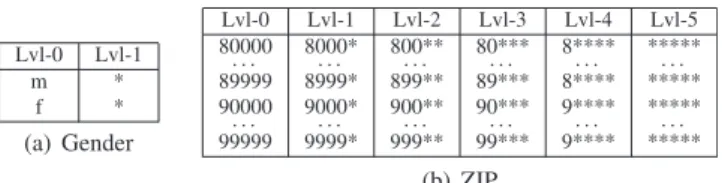
hierarchies. These are transformation rules that allow to iteratively generalize the values of an attribute. Tabular representations of example hierarchies for the categorical attributeGenderwith two generalization levels and the discrete numerical attributeZIPwith six generalization levels are shown inFig. 1. Generalization hierar-chies are well suited for transforming categorical attributes and discrete numeric attributes. They can also be used for quasi-iden-tifiers that are continuous numerical attributes. One solution is to formulate transformation rules as functions that dynamically create generalization hierarchies for the values of an attribute in a specific dataset. A more detailed discussion of how such quasi-identifiers can be handled with our method is given in Section6.5.
Suppressionis a special kind of generalization, in which a data item is completely suppressed.
Many anonymization algorithms use the rules encoded in gen-eralization hierarchies to transform a dataset. Depending on the type of transformations applied, this results in differently large search spaces. Some algorithms implement local recoding, while others implementglobal recoding[17]. The former means that dif-ferent rules can be applied to equal data items, whereas the latter means that the same rule is applied. When single-dimensional recodingis implemented, the data items are values of an individual column, whereasmulti-dimensional recodingmeans that data items are combinations of values from different columns, e.g., complete tuples[17]. Multidimensional global recoding means that the same rule is always applied to equal tuples. From the perspective of a single attribute, this results in local recoding of its values.
The method of generalization can be distinguished into
full-do-main generalization or subtree generalization [16]. The former
means that the entire domain of a data item is transformed to a more general domain (i.e., level) of its generalization hierarchy [18]. The latter means that different generalization levels can be applied to different subsets of data items from the same domain.
Generalization-based techniques are sometimes distinguished by whether they arehierarchy-basedorpartition-based[17]. Parti-tion-based algorithms are often used for continuous numerical attributes and require the existence of a total order on the data items. They generalize data items by partitioning them into ranges. Hierarchy-based approaches are often used for categorical and dis-crete numeric attributes and require the existence of generaliza-tion hierarchies.
We will now present a short overview of a broad spectrum of state-of-the-art anonymization algorithms. Apart from some restrictions, most of them are supported by our approach. A de-tailed discussion is presented in Section6.2.
Optimal data anonymization algorithms often implement hier-archy-based global recoding with single-dimensional full-domain generalization to reduce the size of the search space. As this is a restrictive coding model that potentially results in much loss of information, suppression is added as a multi-dimensional global recoding technique. As a result, outliers are removed from the dataset as long as the total number of suppressed tuples remains
Fig. 1.Exemplary tabular generalization hierarchies (Lvl = level, m = male, f = female).
under a given threshold. This significantly reduces the need for generalization to enforce the given privacy criteria. Examples in-cludeIncognito[19],OLA[14]orFlash[20].
Dataflyis an early algorithm that solves the k-anonymity prob-lem with a greedy search strategy [21]. It implements single-dimensional full-domain global recoding and uses the size of the domain of an attribute as a heuristic for selecting the next attribute to generalize.
Approaches that implement subtree-based generalization have to deal with much larger search spaces and most of them therefore implement heuristic strategies.Attribute Utility Motivated
k-Anony-mization (AUM) is a hierarchy-based approach proposed
specifi-cally for biomedical data [22]. It uses multi-dimensional global recoding and implements a heuristic search process. Top-Down Specialization is also a heuristic algorithm that uses hierarchy-and subtree-based generalization with single-dimensional global recoding[23].Mondrian[24]is a partition-based heuristic search strategy that uses multi-dimensional global recoding.
Clustering algorithms implement local recoding and many are hierarchy-based. The approaches from[25,26]and the Sequential Clustering Algorithmfrom[15]use information derived from gener-alization hierarchies as distance measures, while the algorithm from [27] additionally uses generalization graphs that are built automatically.
2.2. Privacy criteria
Various extensions of the k-anonymity criterion exist. Many aim at preventing an attacker from learning sensitive information about data subjects from ak-anonymized dataset. The most well-known ones are‘-diversity[28]andt-closeness[29].LKC-privacy has been proposed in work on distributed data anonymization and is a relaxed abstraction ofk-anonymity and‘-diversity[30]. Moreover, thed-presence criterion aims at preventing attackers from inferring the presence of an individuals’ tuple in a dataset [31].
Some less wide-spread privacy criteria also exist. ð
a
;kÞ -Ano-nymity[32]andp-sensitivek-anonymity[33] aim at preventing attackers from performing linkage attacks and from learning sensi-tive associations at the same time, while ðk;eÞ-anonymity [34] aims at protecting sensitive numeric attributes.ð;mÞ-Anonymity [35] was proposed to protect sensitive numeric attributes from proximity breaches. Such breaches allow attackers to learn that a sensitive value falls in a certain interval with high probability.ð
;dÞk-Dissimilarity has been presented in[36]as a generalization of such criteria and is thus a generic criterion for protecting data-sets against general proximity breaches.m-Invariance[37]aims at enabling the privacy-preserving re-release of data.A criterion specific to distributed data anonymization is‘ -site-diversity. Here, it is required that at least‘different parties con-tribute a tuple to each equivalence class. The aim is to protect the privacy of the sites, i.e., to prevent attackers from learning which site has contributed which data[38].
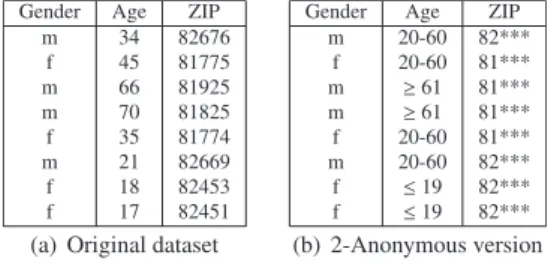
In our examples we focus onk-anonymity but, depending on which types of attributes from a dataset are incorporated into this view, a multitude of the aforementioned privacy criteria can be en-forced. A detailed discussion of this matter is presented in Sec-tion6.3. An example dataset and a 2-anonymous representation are shown inFig. 2. The transformation has been performed utiliz-ing sutiliz-ingle-dimensional full-domain global recodutiliz-ing with the hier-archies fromFig. 1.
2.3. Distributed data
Without loss of generality, we assume that the data is stored in one table, where A¼ fa1;. . .;acg is a set of c attributes and
T¼ ft1;. . .;trgis a set ofrtuples over these attributes. The data
is distributed amongstnparties,P¼ fp1;. . .;png. In general, data can be distributed horizontally or vertically.Horizontal distribution
means that the parties involved collect data with the same data-base schema, but the data entries are from different data subjects, i.e., that pi manages the tuples Tpi¼ ftxj16x6rg where Tpy\Tpx¼£for 16y;x6nandy–x.Vertical distributionmeans that the parties collect data for the same subjects, but each party manages different attributes in different schemata, i.e., that pi manages the attributes Api¼ faxj16x6cg where Apy\Apx¼£ for 16y;x6nandy–x. In case of vertical distribution, the rela-tionships between tuples in different subsets are represented by acommon tuple identifier. A hybrid setup allows for arbitrary com-binations of vertical and horizontal distribution.
3. Materials 3.1. Basic methods
Jurczyk and Xiong [38] have described three different basic methods of anonymizing distributed data. The
integrate-and-anonymizemethod is the simplest approach[30]. Here, the data
is first integrated at a trusted party and then anonymized. As the trusted party temporarily maintains a non-anonymized global dataset, this approach is not feasible for many scenarios. For example, the existence of a trusted party can often not be guaran-teed. Moreover, the scientific sharing of non-anonymized individ-ual-level health data requires data use agreements (DUAs), and it must be covered by informed consents, which is not always the case or feasible.
The basic idea ofanonymize-and-integrate methods is to first anonymize all local data subsets and then integrate them into a global dataset[30]. In case of horizontal data distribution, this tends to have a negative impact on data quality. For example, enforcing local k-anonymity can lead to more information loss than enforcing globalk-anonymity. If data is distributed vertically, the integration of the locally anonymous datasets can result in global non-anonymous datasets. If, e.g., new columns are added to ak-anonymized dataset, the result will in most cases not be
k-anonymous anymore. A workaround is to compute an anony-mized version of one local dataset and send information about the resulting equivalence classes (in terms of sets of tuple identifi-ers) to the other parties. These must then generalize their datasets to such a degree that the integrated version maintains the initial equivalence classes.
Virtual anonymizationis implemented by constructing aSecure
Multiparty Computing(SMC) protocol which exposes only
anony-mized data to all parties. The basic idea of SMC is thatnparties, each of with defines an inputxiwith 16i6n, compute a function
fðx1;x2;. . .xnÞin such a way that each party only gets to know its
own input and the result. In general, this approach is computation-ally more complex than the others but guarantees to preserve the privacy of all subjects.
3.2. Security models
The SMC paradigm can be based upon three different scenarios [39]. We quickly covered the scenario involving a trusted third partyin the previous section and found that it is not applicable in our context. Thesemi-honestmodel is a common scenario, which is sometimes also calledhonest-but-curious. Here it is assumed that all parties adhere to the protocol but try to extract additional infor-mation from temporary results and their own input. The model only covers attackers that participate in the computation (insiders). On the other hand of the spectrum, themaliciousmodel defines no restrictions for participants.
3.3. Commutative encryption
SMC protocols are often implemented with commutative encryption. The basic idea is to encrypt data in an order-indepen-dent manner, i.e., the order of consecutive encryption and decryption operations with different cryptographic keys does not affect the result. LetE1ðxÞ;. . .;EnðxÞbe a set of encryption functions
andD1ðxÞ;. . .;DnðxÞbe a set of associated decryption functions, i.e.,
DiðEiðxÞÞ ¼x for all 16i6n. The functions are commutative if
EiðEjðxÞÞ ¼EjðEiðxÞÞ for all 16i;j6n. It follows that
DiðEiðEjðxÞÞÞ ¼DiðEjðEiðxÞÞÞ ¼EjðxÞ, i.e., arbitrary permutations of a set of cryptographic operations yield the same result. In this work, we use a deterministic encryption algorithm, which means that the same plaintext always results in the same ciphertext.
3.4. Distributed anonymization algorithms
Several methods for anonymizing distributed data have been proposed in the literature. In this section we focus on approaches that implement the virtual anonymization methodology.
An algorithm-independent approach for k-anonymizing verti-cally distributed data with a secure set intersection method has been described in[40]. The protocol starts with all parties commu-tatively encrypting the common tuple identifiers. Each party itera-tively transforms its local data subset and builds sets of common tuple identifiers that fall into one group. The sets of identifiers from all parties are then intersected. A transformation is globally anon-ymous when all intersections contain at least k common tuple identifiers. For secure set intersection, the authors use a protocol based on probabilistic homomorphic encryption[41].
Mohammed et al. propose a distributed implementation of Top-Down Specializationtok-anonymize vertically distributed datasets [42]. The algorithm starts with a maximally generalized dataset. In each step, one party is selected that specializes its attributes in the global dataset as far as the dataset remains anonymous. This specialized dataset is then passed to the next party, which again specializes its attributes. The process halts when no further spe-cialization is possible without violating the privacy criterion. As a result, the protocol only exchanges anonymized versions of a dataset. The party which is to anonymize its subset in each step is selected greedily based on a heuristic score that measures infor-mation loss by means of a dataset’s entropy. The optimal party for each iteration is determined by distributing the dataset to all par-ties and selecting the party whose transformation results in the minimal score.
The work from[42]was extended for horizontally distributed health data in[30]. In this variant, the parties select a supervisor that collects a representative tuple and the sizes from all groups of quasi-identifiers, so calledcount statistics, from all parties. This allows to globally evaluate the anonymity criterion by matching the tuples and accumulating the counts with the secure summa-tion protocol proposed in[43]. Analogously to the vertical scenario, the solution space is traversed with a greedy heuristic.
In[38]a distributed implementation ofMondrianfor the hori-zontal setup is presented. It implements the same algorithm with secure primitives, i.e., privacy-preserving summation, minimum, maximum and median operators. The secure minimum and maxi-mum protocol enables a master party to guide the anonymization process, while the secure median operator is used to distribute information about the next generalization. The privacy criterion is evaluated using the secure summation protocol.
In[44]a distributed implementation of theSequential Clustering
Algorithmis presented. The approach uses SMC primitives: secure
summation and secure logical and. To calculate the number of elements in a given cluster and for measuring the induced informa-tion loss the approach uses the summainforma-tion protocol. To generalize a distributed cluster, the secure protocol for the logical and opera-tor is utilized.
Zhong et al. proposed a protocol for extracting a k-anonymous subset out of distributed datasets[45]. As the approach is not gen-eralization-based and only extracts a subset of the data, we do not further consider it in this work.
4. Methods
In this section we present our novel method for computing an anonymized and integrated dataset. We first describe our protocol, followed by examples for vertically and horizontally distributed data to clarify the approach. A description of implementation de-tails, followed by a model of the protocol closes the section.
4.1. Prerequisites and assumptions
As our method is based on generalization hierarchies, we as-sume that such hierarchies have been constructed prior to its execution. In case of continuous variables, hierarchies can also be expressed as functions that are executed on the local data subsets. These functions must be designed in a way that the rules generated for equal values are consistent amongst the different subsets. An example would be to incrementally reduce the precision of numeric values in the range½0;1by one digit. For the sake of clar-ity, we use discrete variables in our examples and assume that the generalization hierarchies have been materialized prior to execut-ing our protocol. We assume that all hierarchies are known by all parties prior to the anonymization process. In practice, the integra-tion of distributed data will most likely lead to consistency problems. We assume that data integration and cleanup has hap-pened before starting the protocol and that no consistency prob-lems remain. We assume that the relationships between tuples in vertical subsets are represented by a common tuple identifier
(TID) and that horizontal subsets do not overlap. Similar to most approaches, we assume a semi-honest security model and the exis-tence of secure communication channels (e.g.,SSL/TLSconnections with certificates) to protect the protocol against external attackers. Moreover, we assume a multi-way negotiation of cryptographic algorithms and parameters prior to the execution of the protocol. This includes the deterministic and commutative encryption algo-rithm and its parameters, such as key and block sizes. Finally, we assume that each party has generated a set of random keys, one for each of its attributes. We will present a discussion of the pre-requisites in Section 6.5and outline extensions of our approach that relax these assumptions.
4.2. Overview
When anonymizing data, four different types of attributes are typically distinguished. Obviously identifying attributes (e.g., names) are removed from the dataset. This is done by the
participants prior to the anonymization process.Quasi-identifying
attributes are generalized, whilesensitiveattributes are preserved as-is and it is made sure that they fulfill privacy criteria such as ‘-diversity or t-closeness. Insensitive attributes pose no privacy threat and they are thus preserved as-is. For the sake of simplicity, we handle insensitive attributes analogously to quasi-identifying and sensitive attributes in our protocol.
The basic idea of our method is to encrypt quasi-identifying and sensitive attributes in a way that allows performing anonymiza-tion processes on the encrypted representaanonymiza-tion. To this end, firstly, an encrypted global view of the dataset and the generalization hierarchies is constructed. The cryptographic functions are deter-ministic, meaning that the same plaintext always results in the same ciphertext. Secondly, an anonymization algorithm is applied to the encrypted representation of the dataset using the encrypted generalization hierarchies. This is possible, because the same cryp-tographic operations are applied to the dataset and the generaliza-tion hierarchies. Finally, the anonymized encrypted dataset is decrypted, yielding an integrated and anonymized representation of the input datasets.
The integration phase is different for the horizontal and vertical scenario. In the horizontal setup, permutation is employed to pvent privacy threats and duplicate generalization rules must be re-moved. In the vertical scenario, the encrypted dataset is sorted by the tuple identifiers, which are then removed.
4.3. Protocol
In our method, the parties are ordered in a closed circle, i.e., the right neighbor ofpiis defined asp1þðimodnÞ. The data subset
main-tained bypiis denoted bydi. An example setup with three parties is shown inFig. 3. Our protocol implements two different types of communication patterns, which we call sequential round robin
(SRR) andparallel round robin(PRR). As can be seen inFig. 3, one party, e.g., p1, initiates an SRR phase by sending a data packet, e.g.,d1, to its right (R-SRR) or left (L-SRR) neighbor. This party pro-cesses the packet and passes it onto its right or left neighbor. The process halts aftern1 steps, when the neighbor of the initiating party receives the data packet. In contrast, a PRR is initiated simul-taneously by all parties and each packet is passed along the circle until the neighbor of the originating party received and processed the packet. For example,p3first processes its own data (d3), then receives and processes the data fromp2, and finally the data from
p1.
When compared to each other, PRR phases are more efficient that SRR phases because they are parallelized. Synchronization points are only required at the end of each phase, where the parties have to wait until all messages have been processed by all parties. L-PRR and R-PRR as well as L-SRR and R-SRR respectively are only different in the direction in which the data is passed through the ring. This distinguishing is necessary, because encryption and inte-gration have to be implemented with opposite directions. One of
the parties acts as a master which receives and anonymizes the integrated view of the dataset.
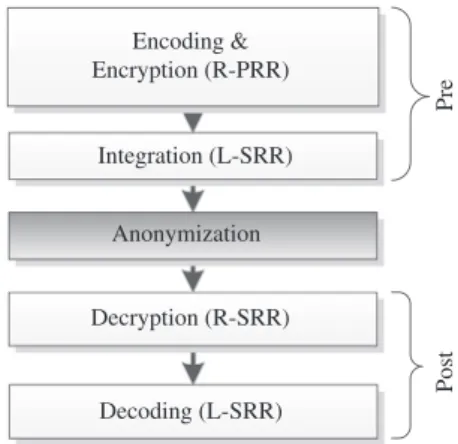
Before the encryption phase, each party extracts the relevant subsets of the global generalization hierarchies according to the lo-cal domain of each of its quasi-identifiers. As a result, the lolo-cal hierarchies only reflect generalization rules for the values con-tained in the local data subset. The preprocessing phase of our protocol, where an encrypted global dataset is constructed, can be divided into two sub-phases. During the first sub-phase (encryption) all local data subsets and corresponding generalization hierarchies are commutatively encrypted by all parties in a right-parallel round robin phase. As is shown inFig. 4, the preprocessing phase ends with an integration phase where in a left-sequential round robin manner the local data subsets and hierarchies of each party are integrated (integration). As the generalization hierarchies are encrypted analogously to the data, the resulting rules can be applied to the encrypted dataset which can thus be anonymized during theanonymizationphase. Thepostprocessingphase consists of decrypting the anonymized dataset by all parties in a sequential round robin phase (decryption).
4.3.1. Encryption
First, a R-PRR phase is utilized to commutatively and determin-istically encrypt all data by all parties. Each party uses its keys to encrypt its data subset. The hierarchies are encrypted analogously, utilizing the key assigned to the attribute to which the hierarchy is to be applied. As the encryption function is deterministic, the same plaintext always results in the same ciphertext. As each column is encrypted with a different key, the same plaintexts from different columns result in different ciphertexts. Each party then sends all data to its right neighbor, which applies the same process.
The encryption phase halts, when each party holds a version of the data from its left neighbor that has been commutatively en-crypted by all parties. In case of vertical data distribution, the par-ties now sort the data subsets according to the lexicographical order induced by the encrypted tuple identifiers. These identifiers can now be removed, as the order of the data items is sufficient to integrate the different subsets.
4.3.2. Integration
The integration phase is initiated by the left neighbor of the master party, e.g.,p3. It implements a sequential round robin phase in the opposite direction of the encryption phase.P3sends the fully encrypted data fromp1 back to its left neighbor,p2, which inte-grates the data with the fully encrypted data fromp3, and sends it top1, which again integrates it with its fully encrypted data from
p2. In case of vertical data distribution, the subsets are integrated by concatenating the columns and in case of horizontal data distri-bution, the subsets are integrated by concatenating the rows. In the latter scenario, generalization hierarchies for the same attributes from different parties must also be merged. In this context, dupli-cate rules must be eliminated, which result if two or more parties Fig. 3.Three partiesp1;p2;p3and their datad1;d2;d3.
Pre Post Encryption (R-PRR) Anonymization Decryption (R-SRR) Integration (L-SRR)
R-PRR = Right-parallel round robin L/R-SRR = Left/Right- sequential round robin Fig. 4.Anonymizing distributed data.
share the same data item and thus included the same generaliza-tion rule into their local hierarchies. Conflicts cannot occur, as hier-archies are defined globally (cf. Section 6.5). The process halts when the master party receives an encrypted global view of the dataset together with the encrypted generalization hierarchies.
4.3.3. Anonymization
In this phase the integrated and encrypted dataset is anony-mized using a centralized anonymization algorithm and the en-crypted generalization hierarchies. This is possible, because the generalization process is only a substitution of values with more generalized ones. As the semantic information is hidden in the en-crypted generalization hierarchies, there is no need to know the plaintext values. Many of the previously presented algorithms and criteria are supported. More details will be given in Sections 6.2 and 6.3. The phase results in an encrypted anonymous dataset.
4.3.4. Decryption
During the postprocessing phase the anonymous encrypted dataset is decrypted in a sequential round robin phase initiated by the master party. To this end, the party decrypts the dataset with its private set of keys and sends it to its right neighbor. This process is repeated until the left neighbor of the master receives an unencrypted anonymized version of the global dataset.
4.3.5. Random permutation
Similar to other approaches, e.g.,[38,44], our protocol relaxes the privacy guarantees of traditional multi-party computations, where no information, except the result can be obtained by partic-ipants. Additional information is of course only available to the parties executing the protocol, and not to external entities. In our protocol, the parties process non-anonymized data subsets that are encrypted by some or all parties. As the data are encrypted deterministically on a cell level, the parties could extract statistical patterns from these representations. These patterns could be used to identify the subset of the integrated data that has been contrib-uted by the party, which potentially allows to infer information about data from the other participants. To prevent this, each party shuffles the rows of the processed data subset randomly before sending it to the next party during the encryption phase. As a re-sult, information about the order of the data items is removed and the construction of patterns is prevented. A collection of data distributions is still possible and these could be used for frequency attacks. See Section 6.1 for a more detailed discussion and countermeasures.
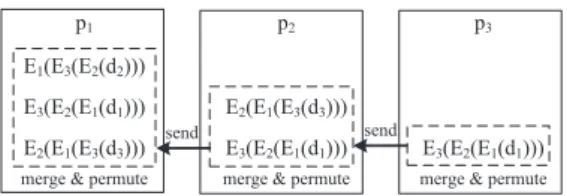
The protocol is designed in a way in which the master party is the only party that ever receives a fully encrypted version of its own data. At this point the master party’s data has been randomly merged with as many other subsets as possible (n2), as can be seen from the example inFig. 5.P3sends the encrypted data from
p1top2, which randomly merges (i.e., merges and permutes) these data with the data fromp3and sends it top1. Whenp1receives its own subset it has thus been randomly merged with the data from
p3. Analogously to the encryption process, data is randomly per-muted during the decryption phase to prevent the mapping of local subsets to the anonymized global view.
4.4. Examples
Each party maintains one key for each attribute. We denote the TID with 1 and order the attributes according to their position in Fig. 1, i.e.,Gender = 2,Age = 3andZIP = 4. For example,E23ð45Þ de-notes thatp2encrypts age 45 with its respective key for attribute number 3.
4.4.1. Vertical distribution
In the following section, we present an example that anonymiz-es a vertically distributed version of the data from Fig. 2. As is shown in Fig. 6, we assume three parties, from whichp1 stores the attributeZIP,p2stores the attributeAgeandp3stores the
attri-bute Gender. Hierarchies for the example data are sketched in
Fig. 1. The hierarchy forGender is held byp3 and the hierarchy forZIPis held byp1. We focus on one party,p2, in the remainder of this section.
Firstly,p2generates random keys for each of the columns and commutatively encrypts the tuple identifiers and the payload. The result is shown inFig. 7. Now the data is permuted randomly and sent to the right neighbor,p3in our example. Analogously,p2 receives the encrypted data fromp1. It encrypts the data, randomly permutes it and sends it top3.
Secondly, when the encryption phase has terminated, the left neighbor of the master, p3 in our example, starts the integration process. It sorts the data fromp1according to the encrypted TIDs, removes them and sends the data to p2, which applies the same process and merges the subsets. This process is sketched in Fig. 8. As a result,p1receives a global view of the encrypted data-set. As is shown for the sake of clarity, all values in one column have been encrypted by the parties in the same order, but the orderings differ between columns.
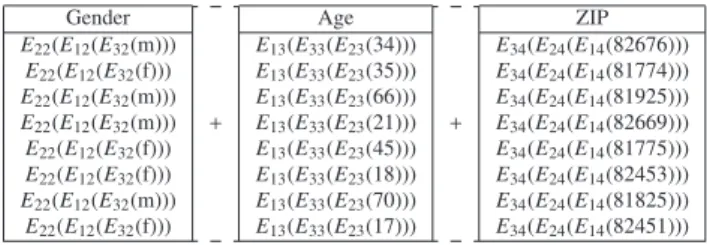
Thirdly,p1enforces a privacy criterion. In our example we as-sume 2-anonymity, as is shown inFig. 9. During the anonymization process p1 finds the optimal solution by replacing the encrypted values forAgewith the values of the encrypted generalization hier-archy on level one and by replacing the values forZIPwith the cor-responding values on level three. The attributeGendercan be left ungeneralized.
Finally, after the decryption phase, which is initiated byp1;p3 holds an unencrypted anonymized version of the global dataset. The result equals the data that would have resulted from Fig. 5.Integrating horizontally distributed data.
Fig. 6.Distribution of example data amongst three parties.
anonymizing the dataset at a trusted third party, i.e., the data from Fig. 1in Section2.2.
4.4.2. Horizontal distribution
In the following section, we present an example that anonymiz-es a horizontally distributed version of the data fromFig. 6in Sec-tion2.2. As is shown inFig. 10, we again assume three parties, from whichp1andp2store three tuples whilep3stores two tuples.
The set of relevant local generalization rules extracted from the global generalization hierarchies for the data subset of p1 are shown inFig. 11.
Each party again generates a set of random keys and encrypts all columns and generalization hierarchies with the associated keys. The encrypted subset from partyp1in our example is shown inFig. 12.
Next, the resulting data is sent to the right neighbor.p1sends its data top2, which encrypts it with its own set of secret keys and sends it top3. Whenp3receives the data originating fromp1it en-crypts and permutes it and sends it back top2.P2randomly com-bines the data from p3 with its own data and sends it to p1 which again randomly combines it with its own data.p1now holds a global view of the encrypted dataset, as is shown inFig. 13. In contrast to the vertical scenario, the order in which values have been encrypted is now different within each column but consistent within each row. Note that this difference is only emphasized for the sake of clarity and is not relevant when executing the protocol due to the use of commutative encryption.
The encrypted global generalization hierarchies are an integra-tion of local generalizaintegra-tion hierarchies. As can be seen from the example inFig. 14the order of which values have been encrypted is different between rows but consistent within each row. This is due to the fact that the individual generalization rules originate from different local hierarchies. In our example, the first rule is from the local hierarchy ofp1and the second rule fromp2.
Anonymization and decryption are applied analogously to the vertical scenario and yield the same result as anonymizing the data at a trusted third party.
4.5. Implementation details
For evaluating our approach, we developed a prototype based on the Java platform. For data exchange, we employ dictionary compression and represent all data as two-dimensional arrays of structural information and associated dictionaries. As is shown in Fig. 15, each dictionary contains a set of values that can be refer-enced by means of row indexes.
In our method the same set of keys will be used for encrypting several plaintexts. When choosing a commutative encryption algo-rithm, it is therefore important to make sure that the method is not vulnerable in such a scenario. For example, using a simple XOR ci-pher would be unsafe, as (part of) the key could be reconstructed Fig. 8.Integrating the global encrypted dataset.
Fig. 9.2-anonymized encrypted dataset.
Fig. 10.Exemplary horizontal data distribution.
Fig. 11.Hierarchies for the horizontal subset ofp1.
Fig. 12.Encrypted data subset fromp1.
from knowing the ciphertext for a known plaintext. Our require-ments for an encryption algorithm are the same as in[46].
In our prototype we use a variant of the Pohlig–Hellman Cipher (see Section 16.2 in [47]). Instead of its classic implementation based on modular exponentiation, we use a variant based on multiplications on elliptic curves. The advantage of Elliptic Curve Cryptography (ECC) is that it requires smaller bit lengths to achieve security levels comparable to standard methods. We use the 192 bit elliptic curve prime192v1, which is standardized in ANSI X9.62 [48], resulting in a key and block size of 192 bits. The security level is comparable to 1536 bit RSA encryption but with increased performance and reduced data volumes [49]. Crypto-graphic operations are implemented with the GNU Multiple Precision Arithmetic Library[50]. The encryption process is multi-threaded and each thread handles a distinct set of data items.
We make sure that all values have a constant plaintext length, which allows to encrypt a data item with only one application of ECC-Pohlig–Hellmann. To this end, each party maintains a secret dictionary that maps its data items to 160 bit SHA-1 hash values. The encoding of plaintext data items as hash values is performed transparently during the encryption phase. For decoding the data, we implement an additional sequential phase in which each party replaces the hash values with the actual data items. The protocol implemented by our prototype is shown inFig. 16.
4.6. Modeling the protocol
In this section, we present means to estimate the execution times and the exchanged data volumes for our algorithms. The overall execution times are dominated by the time needed for cryptographic operations and data exchange, which are thus the only operations considered in our model. We denote the number of parties withn, the number of rows in the global dataset withr
and the number of columns withc. The total number of distinct values in the global dataset is denoted withd. We assume a homo-geneous setup in which each machine can execute a commutative cryptographic operation in timeMcand the machines can commu-nicate with a bandwidth ofMb. Commutatively encrypted values are assumed to have a bit length ofLc. The global dataset can be represented by an array of size cr for structural information and a dictionary of sizedfor data elements. Each element in the structural array is assumed to have a bit length ofLa. For the scope of this article, we assume equal data distribution in our analysis. In the horizontal case each party holds the same number of rowsr
n, columnscand distinct valuesd, extracted from the global dataset. In the vertical setup, we assume that each party has the same num-ber of columnsc
n, rowsrand that the distinct values of the global dataset are equally distributed, i.e. each party hasd
ndistinct values. The formulas can be extended to cover heterogeneous setups and unequal data distributions.
4.6.1. Cryptographic operations
During the encryption phase, the workload is parallelized amongst all parties. The execution time is therefore determined by the workload for one party. In case of vertical data distribution, each party holds r distinct tuple identifiers and d
n distinct data items. Each party must encrypt the data from all parties, resulting in a total ofev¼n ðrþdnÞcommutative encryptions. In case of hor-izontal data distribution, each party performseh¼nd commuta-tive encryptions. As the data is already integrated in the decryption phase, there is no difference for horizontal or vertical distribution. Decryption is a sequential phase in which each party must decrypt all data items, i.e.,dvh¼nd. In summary, the execution time for
cryptographic operations can be estimated with
tc
v¼ ðevþdvhÞ Mc in the vertical setup andtch¼ ðehþdvhÞ Mc in the horizontal setup.
4.6.2. Exchanged data volumes
The number of messages exchanged in each of the four phases can be calculated based on the communication pattern, which is independent of data distribution. During phase one, each data sub-set is sent ton1 parties, resulting inf1
v¼fh1¼n ðn1Þmessage exchanges. In the second phase the data subsets are integrated iteratively, which we model as one message being sentn1 times, another message being sentn2 times and so on. This results in
f2
v ¼fh2¼n
ðn1Þ
2 message exchanges. During phases three and four, each message is sentf34
v ¼fh34¼n1 times, as each message is sent to all parties apart from the originator.
In the first phase of the vertical scenario, each party holds a data subset of size s1
v¼ ðncþ1Þ rLaþ ðdnþrÞ Lc, as each party is assumed to holdc
ncolumns and an additional column with tuple identifiers andd
ndistinct attribute values plusrtuple identifiers. The data held by each party in the second phase equals the data
from the first phase without tuple identifiers, i.e.,
s2
v¼ncrLaþ d
nLc. In the first and second phase of the horizontal
scenario each party holds a data subset of size
s12
h ¼rncLaþdLc, as each party is assumed to holdddistinct val-ues. In the third and fourth phase, each message contains a repre-sentation of the global dictionary compressed dataset, regardless of
data distribution. This can be estimated with
s34
v ¼s34h ¼crLaþdLc. Fig. 14.Global encrypted hierarchy forGender.
Fig. 15.Dictionary compressed dataset fromFig. 2.
Pre Post Encoding & Encryption (R-PRR) Anonymization Integration (L-SRR) Decoding (L-SRR) Decryption (R-SRR)
In summary, the data exchanged in the vertical scenario can be estimated withdv¼fv1s1vþfv2s2vþ2fv34s34v, while the data
vol-ume in the horizontal scenario can be estimated with
dh¼fh1s12h þfh2s12h þ2fh34s34h . The time needed for data transfer can thus be estimated bytd
h¼dhMbandtdv¼dvMbrespectively.
5. Results
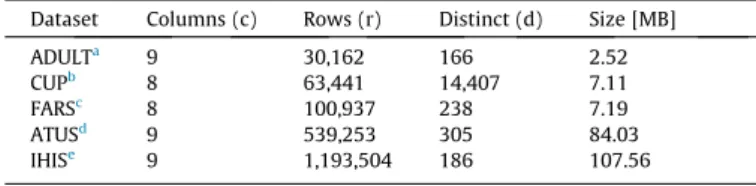
For our evaluation we used five real-world datasets, most of which have already been utilized for assessing previous work on data anonymization. The datasets include the an excerpt of the 1994 US census database (ADULT), KDD Cup 1998 data (CUP), NHTSA crash statistics (FARS), the American Time Use Survey (ATUS) and the Integrated Health Interview Series (IHIS). The ADULT dataset serves as a de facto standard for the evaluation of anonymization algorithms. An overview over the datasets is shown inTable 1. They cover a wide spectrum, ranging from about 30 k to 1.2 M rows (2.52 MB to 107.56 MB) consisting of eight or nine qua-si-identifiers, from which we also chose a sensitive attribute. The associated generalization hierarchies feature between two and six levels, resulting in search spaces between 12,960 (ADULT) and 45,000 (CUP) transformations.
5.1. Analytical evaluation
In this section, we present estimates for our testbed, which can execute roughlyMc¼3000 cryptographic operations per second. The network provides a net bandwidth ofMb¼88;000;000 bit/s (Fast Ethernet). Each entry of the structural array requires
La¼32 bits. The encrypted values have a size ofLc¼192 bits. We compare these estimates with execution times for applying common privacy criteria, which were obtained with the ARX
Anonymization Framework[51]that implements the optimal data
anonymization algorithm presented in [20]. As privacy criteria, we chose 5-anonymity, recursive-(4,3)-diversity, 0.2-closeness with hierarchical Earth-Mover’s-Distance and (0.05, 0.15)-pres-ence of 10% random samples as research subsets.t-Closeness and d-presence where combined with 5-anonymity. We decided to in-clude numbers for an optimal anonymization algorithm, as this shows the ability of our approach to efficiently implement such algorithms in a distributed setting. We also chose a broad spec-trum of privacy criteria to demonstrate the flexibility of our ap-proach. We setk¼5 as this represents a rough upper bound, i.e., the execution times will decrease with increasing values, and the parameter is typically used in the healthcare domain. All anonymi-zations were performed with a 3% suppression rate, which is again a typical parameter.
Table 2shows estimated execution times for our protocol with two (2P) or three parties (3P). Note that the estimates only depend on the number of parties and basic statistics about the dataset. It can be seen that, in case of vertical distribution, the execution times of the pre- and postprocessing phase are about one
magnitude higher than the execution times of the anonymization phase. It can also be seen that the execution times for two parties are lower than the execution times for three parties. This is due to the fact that in this case the costs are dominated by the number of tuple identifiers, which grows linearly with the number of parties. For the different datasets the execution times increase linearly with the number of rows. In case of horizontal data distribution, the execution times of the pre- and postprocessing phase are roughly equivalent to the anonymization phase. Here, the com-plexity of the former phase is dominated by the number of distinct values in the dataset. This is also represented in the execution times for the CUP dataset, where, due to the large number of distinct values, the pre- and postprocessing phase is about one magnitude slower than the anonymization phase. Generally, our method adds a notable overhead in case of vertical distribution and an almost negligible overhead in case of horizontal distribution.
5.2. Experimental evaluation
Our testbed consisted of three desktop machines, each of which was equipped with a quad-core 3.1 GHz Intel Core i5 CPU running a 64-bit Linux 3.2.0 kernel and a 64-bit Sun JVM (1.7.0). The ma-chines were connected with a Fast Ethernet switch (100 Mbit/s).
5.2.1. Execution times
Fig. 17 shows the summarized execution times for pre- and postprocessing all datasets with two (2P) and three parties (3P). It can be seen that the estimates from the previous section closely resemble actual execution times. In 13 out of 20 cases our esti-mates are off by only 1–2 s. In four cases they are of by 5–10 s and in three cases they are off by 20–50 s. The latter three cases correspond to overall times of 10 to 20 min.
In the vertical scenario, the execution times range from 21 s (ADULT) to 13.2 min (IHIS) with two parties. With three parties the execution times increase by roughly a factor of 1.5, i.e., 31 s for the ADULT dataset and 19.8 min for IHIS. When datasets have a constant number of distinct data values, the execution times scale linearly with the number of rows, as the tuple identifiers in each subset define the cryptographic overhead. As the CUP dataset contains significantly more distinct data items than the other data-sets it stands out.
In the horizontal scenario, performance increases significantly. Here, execution times are much more strongly influenced by the total number of distinct data values per dataset. As a result the CUP dataset, which has the highest number of distinct data items, and the IHIS dataset, which has the highest number of rows, re-quire almost the same processing time. When datasets have a con-stant number of distinct data items, the overall execution times are dominated by exchanging data over the network. The total execu-tion time ranges from 1 s for the ADULT dataset with two parties to 30 s for the CUP dataset with three parties. The differences between executing the protocol with two or three parties range be-tween a factor of 2.0 for ADULT and 0.73 for the CUP dataset.
Fig. 18 shows how these execution times are distributed amongst the four phases of the protocol. In the vertical scenario, times are dominated by the encryption phase, wherencolumns with unique tuple identifiers have to be encrypted in paralleln
times (between 84% for CUP and roughly 98% for the other data-sets). In the horizontal scenario, times are less influenced by cryp-tographic operations but by data exchange. As a result, integration, decryption and decoding contribute a significant share of the over-all times. The CUP dataset is the only exception, because it contains the most distinct values which increases the cryptographic workload. When comparing the execution with two parties to the execution with three parties, there is a slight decrease in the Table 1
Evaluation datasets.
Dataset Columns (c) Rows (r) Distinct (d) Size [MB] ADULTa 9 30,162 166 2.52 CUPb 8 63,441 14,407 7.11 FARSc 8 100,937 238 7.19 ATUSd 9 539,253 305 84.03 IHISe 9 1,193,504 186 107.56 a http://archive.ics.uci.edu/ml/datasets/adult. b http://kdd.ics.uci.edu/databases/kddcup98/kddcup98.html. c http://www-fars.nhtsa.dot.gov/main/index.aspx. d http://atusdata.org/index.shtml. e http://www.ihis.us/.
contribution of encryption and decryption to the overall execution times. The reason is that the exchanged data volumes increase with the number of parties.
5.2.2. Exchanged data volumes
Fig. 19depicts the total transferred data volumes for all config-urations. It can be seen that data volumes range from 4 MB for the ADULT dataset with two parties in the horizontal scenario to 690 MB for the IHIS dataset with three parties in the vertical setup. Data volumes in the vertical scenario are roughly two times the volumes from the horizontal scenario. This is not directly related to the overall performance, as the execution times of the vertical scenario are dominated by cryptographic operations, whereas the execution times of the horizontal scenario are dominated by data exchange. In the vertical setup, most data is exchanged during the encryption phase, because packet volumes are mostly deter-mined by the number of tuple identifiers. These are dropped before the integration phase. In the horizontal setup, the data volumes of the encryption, integration and decoding phases are roughly equiv-alent. This shows that they are dominated by the structural arrays, as dictionary compression is differently efficient in these three phases due to data distribution.
5.2.3. Information loss
In this section, we compare the information loss of our ap-proach with two baseline techniques: anonymize-and-integrate of horizontally and vertically distributed data. Again, we use an
optimal anonymization algorithm with global recoding and tuple suppression as an example. In the horizontal case, the local data subsets are anonymized and then integrated into a global dataset [30]. In the vertical scenario, one local dataset is anonymized and the others are generalized to such a degree that an integrated ver-sion maintains the initial equivalence classes (see Section 3.1). Both techniques are an interesting baseline, as they are straightfor-ward methods for privacy-preserving anonymization of distributed data. Regarding data distribution, we use the same configurations as in the previous sections. We restrict the comparison tok -ano-nymity andl-diversity, ast-closeness andd-presence cannot easily be implemented with these approaches.
The results are given inTable 3. It shows the information loss of our approach relative to the information loss of the baseline tech-niques. Information loss was measured with the non-uniform entropy metric[14]. As can be seen, our approach enables a signif-icant and consistent increase in data quality, with loss of informa-tion being reduced by up to 87% (fork-anonymizing the vertically distributed CUP dataset with three parties). Two trends are obvi-ous. First, the decrease in information loss enabled by our approach is stronger in 85% of cases when comparing the vertical scenario to the horizontal scenario. Second, the decrease in information loss enabled by our approach is stronger in 75% of cases when compar-ing the setups with three parties to the setups with two parties. Note that in the horizontal scenario, the baseline technique imple-ments local recoding, as different generalization strategies can be applied to different horizontal subsets.
Table 2
Estimated times for pre- and postprocessing [s] vs. measured times for anonymization [s].
Dataset 2P – vertical 3P – vertical 2P – horizontal 3P – horizontal k-Anonymity ‘-Diversity t-Closeness d-Presence
ADULT 21 32 1 1 1 1 1 1 CUP 58 85 20 31 1 3 6 1 FARS 69 105 1 3 3 3 3 1 ATUS 369 560 7 13 41 25 18 3 IHIS 816 1239 14 28 92 119 101 39 0 200 400 600 800 1000 1200 1400 P2 P3 P2 P3 P2 P3 P2 P3 P2 P3 Ex ecution times [s] 21 31 64 95 68 103 361 540 787 1190 IHIS ATUS FARS CUP ADULT
(a) Vertical distribution
0 5 10 15 20 25 30 35 40 P2 P3 P2 P3 P2 P3 P2 P3 P2 P3 1 2 22 30 2 3 9 14 18 29 IHIS ATUS FARS CUP ADULT (b) Horizontal distribution Fig. 17.Absolute execution times for different data distributions.
0 20 40 60 80 100 P2 P3 P2 P3 P2 P3 P2 P3 P2 P3 Ex ecution times [%] IHIS ATUS FARS CUP ADULT
(a) Vertical distribution
0 20 40 60 80 100 P2 P3 P2 P3 P2 P3 P2 P3 P2 P3 IHIS ATUS FARS CUP ADULT (b) Horizontal distribution Fig. 18.Relative execution times for different data distributions.
6. Discussion
We will first discuss threats and countermeasures, describing how our approach implements a trade-off between privacy, data quality and efficiency. We will then present a comparison with previous work and justify the preconditions for and assumptions of our method.
6.1. Threats and countermeasures
Our approach relaxes the privacy guarantees of traditional SMC protocols. In this section we discuss to which extent the additional information leaked by our protocol could be used by participants to compromise the privacy of other parties. We then present coun-termeasures to mitigate these threats.
An obvious threat results from parties re-identifying their own encrypted contribution to the overall dataset. This allows learning the ciphertext for known plaintext values. In case of horizontal dis-tribution, this knowledge could be used to decode values from other parties during the integration phase, if they share a common attribute value. In case of vertical distribution, the re-identification of own tuples could be used to infer additional information by knowing which other (encrypted) vertical subsets of tuples are associated.
Two countermeasures exist against this threat. First, the permu-tation of tuples as described in Section4.3.5prevents the construc-tion of detailed patterns that contain informaconstruc-tion about the order of data items. Second, the associated scheme for merging the data-sets makes sure that only the master party is able to see an en-crypted version of its own data. If this is not deemed sufficient, an additional party that does not hold or encrypt any data itself can replace the master and integrate and anonymize the data. This completely prevents this threat.
A remaining threat comes from frequency attacks, a susceptibil-ity to which lies in the nature of deterministic (not semantically se-cure) encryption schemes necessary for our approach. Here, an attacker could try to guess the values of an attribute and their dis-tribution and match these with the disdis-tribution of the encrypted values. Again, this potentially allows the decryption of encrypted attribute values. The susceptibility of individual attributes to this
attack depends on their characteristics, e.g., distribution in the dataset and availability of knowledge about their distribution in specific populations. An in-depth study of frequency attacks is out of the scope of this work, but they have extensively been stud-ied in literature on order-preserving encryption schemes, e.g., [52,53].
Two countermeasures exist against frequency attacks. First, they can to some extent be mitigated by employing pregeneraliza-tion. Second, a very widespread countermeasure consists of Data Use Agreements (DUAs). They are a common measure before ac-cess to restricted data is granted, and their use is essential for HIP-AAs limited dataset [54]. Often they are combined with partial anonymization. DUAs are contracts defining rights and duties, and they are typically used when complete anonymity would re-strict data quality in an unacceptable way.
Pregeneralization can be applied as a technical measure for attributes which have a high risk of being susceptible to frequency attacks. This means that attributes in local datasets are pregeneral-ized before the anonymization process, which coarsens their distri-butions and thus makes frequency attacks more difficult. When implementing globally optimal algorithms, as in our example, it can be seen from the comparison with baseline techniques in the previous section that the margins of pregeneralization that can be applied while still yielding an increased data utility are often very high. For these algorithms, pregeneralization leads to a new search space, and it can simply be thought of as defining minimal generalization levels for the according attributes. It is important to note that such algorithms still guarantee to find an optimal solu-tion within this new search space, but that this solusolu-tion might re-sult in higher information loss than without pregeneralization. Our experiments showed that reducing the local datasets’ entropy, i.e., the number of distinct data values, can result in a significant speedup. Therefore, pregeneralization offers a trade-off between privacy, data quality and efficiency.
The described threats become more severe when a malicious security model is assumed. In this case, the master party could provide manipulated data as input, which is specifically designed to be susceptible to frequency attacks. The provision of manipu-lated input data cannot be prevented in general and is also not taken into account by other work on anonymizing distributed data 0 100 200 300 400 500 600 700 800 P2 P3 P2 P3 P2 P3 P2 P3 P2 P3 T ransferred Data [MB] 7 18 18 43 23 56 127 312 282 690 IHIS ATUS FARS CUP ADULT
(a) Vertical distribution
0 100 200 300 400 500 600 700 800 P2 P3 P2 P3 P2 P3 P2 P3 P2 P3 4 8 12 25 12 24 72 143 160 316 IHIS ATUS FARS CUP ADULT (b) Horizontal distribution Fig. 19.Data exchanged for different data distributions.
Table 3
Information loss of a globally optimal algorithm compared to baseline techniques [%].
Dataset k-Anonymity ‘-Diversity
2P – vertical 3P – vertical 2P – horizontal 3P – horizontal 2P – vertical 3P – vertical 2P – horizontal 3P – horizontal
ADULT 50 45 92 97 76 65 70 68
CUP 15 13 43 32 87 70 65 55
FARS 62 60 89 98 79 79 89 85
ATUS 40 39 79 85 64 65 82 92
in a malicious setting, e.g.,[55]. Moreover, the master party could skip the anonymization phase and return a non-anonymized ver-sion of the dataset, which would then be decrypted. This could be prevented by either distributing the encrypted dataset to all parties and anonymizing them independently, or by introducing multiple additional parties for this purpose. The results of these independent anonymizations can then be compared to ensure cor-rectness. The malicious scenario is highly unlikely, as in biomedical research regulatory frameworks and contracts are employed to prevent such situations. Moreover, the biomedical domain is very aware of security problems and therefore state-of-the-art IT secu-rity measures are generally applied to prevent external attackers from compromising IT systems.
6.2. Supported algorithms
Although we used a globally optimal full-domain anonymiza-tion algorithm in our examples, our method can be used to imple-ment many algorithms. Most of the methods presented in Section 2.1 are supported, but there are some restrictions that we will discuss in this section.
Compatible algorithms need to be hierarchy-based or able to build the required generalization structures out of the encrypted data items. This is true for all algorithms from our overview, except forMondrian[24], as this is a partitioning-based algorithm that re-quires a total-order on the data items. Unfortunately, such an order cannot be provided for the encrypted data items resulting from our method. The automatic building of generalization graphs in[27] can be implemented with our method. Our approach also supports all of the presented clustering algorithms, as these implement distance metrics based on generalization hierarchies. When gener-alizing data, some algorithms implement generalization-based methods and partition-based methods for continuous attributes, e.g.,[15,23], from which only the former can be used in our meth-od. If continuous variables are assumed to be quasi-identifiers, generalization hierarchies must be provided (see Section6.5).
The method presented in this article is the first to enable effi-cient implementations of many algorithms in a distributed setting, including heuristic algorithms, e.g.,[23], clustering algorithms, e.g., [15], globally-optimal methods, e.g.,[20]and domain-specific solu-tions, e.g.,[22].
6.3. Supported privacy criteria
Our approach supports most of the privacy criteria presented in Section2.2. The only limitation is that criteria must not require cal-culations on the non-encrypted data items, e.g., computations of differences between numerical values. A semantic comparison is still possible by using information from generalization hierarchies. For this reason, our method does not support privacy criteria that are specifically targeted against numeric attributes. This in-cludest-closeness for numerical attributes, but all other variants are supported. Analogously,ðk;eÞ-anonymity[34]andð
;mÞ -ano-nymity[35]are not supported.In its current form, our method does not support‘ -site-diver-sity, as implementing it would require maintaining information about which site contributed which data item. This countervails our efforts to hide this information from the participants as dis-cussed in Section6.1.
ð
;dÞk-Dissimilarity is a generic privacy principle that allows for arbitrary distance metrics. TheVariational Distance, which is used as an example in the paper, can be implemented with our method. To our knowledge, our approach is the first to provide support for such a broad spectrum of privacy criteria in a distributed setting. In our prototype we implemented k-anonymity, recursive-ðc;lÞ -diversity,t-closeness with hierarchical Earth-Mover’s-Distance aswell asd-presence with explicit world knowledge. Moreover, we support the following criteria from Section 2.2: LKC-privacy,
ð
a
;kÞ-anonymity, p-sensitive k-anonymity, ð;dÞk-dissimilarity andm-invariance.6.4. Comparison with previous work
In this section, we compare our approach with previous work on distributed data anonymization. We discuss the algorithms pre-sented in Section3.4, which are distributed variants of the algo-rithms presented in Section2.1. In the following, we denote the implementation of Distributed k-Anonymityfrom[40]with DkAv, the distributed implementation ofMondrianfrom[38]with Mon-drianh, the implementation ofTop Down Specializationfor vertically distributed data from[42]withTDSvand the variant for horizon-tally distributed data from[30]withTDShand the distributed ver-sion of theSequential Clustering Algorithmfrom[44]withSCAhv.
Our work implements a mixture of all methods from the design space. It employs theintegrate-and-anonymize methodology, but with encrypted data subsets. These are built by a SMC protocol resembling the virtual anonymization method. The trade-off be-tween privacy and data quality implements the
anonymize-and-integrate design alternative. In our evaluation, we have already
shown that our approach outperforms baseline techniques imple-menting the anonymize-and-integrate method in terms of data utility and flexibility. Distributed data anonymization algorithms provide support for different de-identification methods, privacy criteria and setups:
Our approach supports an arbitrary number of parties. This is true for all other approaches, apart fromDkAv.
Similar to DkAv and SCAhv our approach supports global and local recoding, whileMondrianh, TDSh and TDSvonly support global recoding.
DkAv,TDShandTDSvprovide perfect privacy, while our approach andMondrianhas well asSCAhvdo not.
Similar toSCAhv our method supports vertically and horizon-tally distributed data.TDShandMondrianhonly support the hor-izontal setup, whileDkAvand TDSvonly support the vertical setup.
The approaches also differ in the implemented privacy criteria.
DkAv is the only algorithm-independent competitor. In the paper, the authors investigate only k-anonymity and as the approach is based on intersecting equivalence classes using tuple identifiers it is, e.g., not suitable for implementing cluster-ing algorithms. The papers proposcluster-ingTDSv andSCAhv provide information onk-anonymity and‘-diversity, while Mondrianh implementsk-anonymity and‘-site-diversity andTDSh imple-ments LKC-privacy, which implies support for k-anonymity and‘-diversity. To which degree other privacy criteria are sup-ported by these approaches needs further investigations. Our method supports a much broader spectrum of criteria as dis-cussed in the previous section. In this paper, we have imple-mentedk-anonymity,‘-diversity,t-closeness andd-presence. In the remainder of this section, we compare the performance of our approach to previous solutions. Note that our approach is not a distributed data anonymization algorithm but a pre- and postpro-cessing scheme. Although it enables the implementation of centralized versions of anonymization algorithms in distributed settings, this does not necessarily imply that such an implementa-tion will be faster than a dedicated distributed variant, if such a variant exists.
As no implementations ofDkAv,Mondrianh,TDSv,TDShorSCAhv are available, we base our comparison on hardware-independent measures or analytical models as for as possible. As a last resort,