Article
1
Development and Implementation of Reasonable
2
Accommodation in Employment for Persons with
3
Chronic Health Issues: An Exploratory Study in
4
Slovenia
5
Aleksandra Tabaj 1, Dare S. Kovačič 1, Črtomir Bitenc 1, and Valentina Brecelj 1
6
1 University Rehabilitation Institute Republic of Slovenia; Development Centre for Vocational
7
Rehabilitation; [email protected]; [email protected]; [email protected];
8
9
* Correspondence: [email protected] Tel.: +386 275, [email protected] Tel.: +386
1-475-8-10
188
11
Abstract: Employment implies economic independence, social inclusion, non-discrimination and
12
impacts people’s life in areas beyond work. Therefore, for persons with disabilities (PwD), that
13
include persons with chronic diseases (PwCD), equal employment opportunities must be provided
14
and reasonable accommodation (RA) in employment carefully designed. The objectives of this study
15
done in Slovenia were: (i) to translate and adapt RA Factor Survey (RAFS; Dong et al., 2010); (ii) to
16
examine psychometric properties of its expanded Slovenian modification Aspects of RA survey
17
(ARAS); (iii) to find out the views of professionals in the field by ARAS; (iv) to present Slovenian
18
model of employment rehabilitation concerning PwD and PwCD. ARAS was developed with the
19
collaboration of professionals performing focus groups, it consists of three parts Influencing factors,
20
Contents areas and Barriers with 78 items. Data were collected from 140 professionals and
21
underwent descriptive statistics and factor analysis. The results showed that the key factors for RA
22
implementation are attitude and support of employer/organization. Other important factors are
23
employee and his/her employment, the conditions to implement RA, and the awareness of
24
employee and work environment. ARAS might be used as a framework to assist in the development,
25
improvement, and implementation of RA in practice. This is discussed in the broader context of
26
equal opportunities for employment of PwD including PwCD and the welfare model in Slovenia.
27
Keywords: reasonable accommodation; employment; vocational/employment rehabilitation;
28
persons with health issues; persons with disabilities; persons with chronic diseases
29
30
1. Introduction
31
The Preamble to the Convention on the Rights of Persons with Disabilities (CRPD) stresses that
32
“disability results from the interaction between persons with impairments and attitudinal and
33
environmental barriers that hinder their full and effective participation in society on an equal basis
34
with others” [1]. World Health Organization (WHO) [2] and the International Classification of
35
Functioning, Disability and Health (ICF) [3] start from the same conceptualization of functioning and
36
disability as a dynamic interaction between health conditions and contextual factors, both personal
37
and environmental. Disability itself is defined by the presence of a health condition issue in a
38
hindering environment and is a common issue in all societies. As Leonardi et al. [4] stated, this
39
biopsychosocial model - originating from holistic concepts of health and from Engel’s seminal paper
40
on the need for a new medical model in 1977 [5] - represents a workable compromise between medical
41
and social models. Disability is the umbrella term for impairments, activity limitations and
42
participation restrictions, referring to the negative aspects of the interaction between an individual
43
(with a health condition issue) and that individual’s contextual factors (environmental and personal
44
factors) [3, 4]. Adopting the definition of disability as an interaction means that it is not only an
45
attribute of the person, that changing other factors may change the extent of disability and that
46
improving social participation can be made by reducing or eliminating the barriers hindering PwD
47
in their day-to-day lives.
48
Apart from its toll in personal sphere disability brings numerous social/societal consequences.
49
Long-term health problems contribute to a greater risk of income poverty, social exclusion, severe
50
material deprivation, and lower work intensity [6]; furthermore, persons with longstanding health
51
problem face higher rates of unemployment and inactivity [7]. As the UN Commission for Social
52
Development stated, the position of PwD on the labour market worldwide is still not satisfactory.
53
Among factors, such as access to education, entrepreneurship possibilities, and non-discrimination,
54
which influence their opportunities on the labour market RA is one of most important [8]. In many
55
cases, exclusion from the labour market is more a consequence of barriers in the environment than
56
limitations connected with PwD/PwCD.
57
Furthermore, there is an increasing number of PwD/PwCD. In the WHO report on Disability [2]
58
(p. 29) it is estimated by two studies (the World Health Survey and the Global Burden of Disease),
59
that within the adult population PwD represent between 15.6% and 19.4% respectively, and between
60
2.2% and 3.8% experience a severe disability. It means that estimated number of people in the world
61
experiencing disability is staggering one billion and that up to 200 million have significant difficulties
62
in functioning. A large part of this population with disability suffers from non-communicable chronic
63
diseases (CD), such as diabetes, cardiovascular diseases (heart disease and stroke), mental and
64
neurological disorders, cancer, and respiratory illnesses, which altogether are estimated to account
65
for 66.5% of all years lived with disability in low-income and middle-income countries [2]. They also
66
accounted for 63% of 57 million deaths that occurred globally in 2008 [9]. European Disability
67
Strategy 2010-2020 estimates that “one in six people in the European Union has a disability that
68
ranges from mild to severe, making around 80 million who are often prevented from taking part fully
69
in society and the economy because of environmental and attitudinal barriers” [3] (p. 3).
70
Unfortunately, these rates of disability are increasing due to population aging and increases in
71
chronic health conditions.
72
In European countries there are different welfare systems in place to deal with this problem. The
73
EU funded Pathways project [10] compared strategies and legislation in several EU countries, finding
74
many differences. Mapping the policies, systems, and services facilitating inclusion of PwCD has
75
revealed that in some countries people from this group are considered to be a part of the group of
76
PwD [10]. In many cases, persons with chronic health problems are eligible for specialised support
77
in employment only if their condition is recognized as a “disability” or has a negative impact on their
78
work ability, depending on national and regional regulations [10]. As most of the EU countries,
79
Slovenia has a legislative framework against discrimination based on disability and provides support
80
to PwD only for those with a legal “disability status”. Anyway, PwD, including PwCD, belong to a
81
large vulnerable group in the open labour market. Since having chances to be employed and at work
82
represents a major part of social inclusion and non-discrimination impacting on people’s life also on
83
areas beyond work, their equal employment opportunities must be regulated and a reasonable
84
accommodation in employment carefully designed.
85
The term ‘reasonable accommodation’ (RA) in employment is now used more often than the
86
previous, similar, but more constricted term ‘workplace adaptation’ or ‘work adjustment’. The basic
87
European Union legislation for RA is the Directive on Equal Treatment in Employment and
88
Occupation [11]. RA is defined as appropriate measures by employers - where needed in a particular
89
case - to enable a person with a disability to have access to, participate in, or advance in employment,
90
or to undergo training, unless such measures would impose a disproportionate burden on the
91
employer. It encompasses job restructuring, part-time or modified work schedules, reassignment to
92
a vacant position, acquisition or modification of equipment or devices, appropriate adjustment or
93
modifications of examinations, training materials or policies, the provision of qualified readers or
94
interpreters, and other similar accommodations for individuals with disabilities. Typology of RA
95
includes several contents – from technical solutions, organizational arrangements, provisions of
assistance, qualification measures, and awareness-raising measures [12]. These strategies should
97
enable PwD the enjoyment or exercise on an equal basis with others of all human rights and
98
fundamental freedoms.
99
Several models of factors and components of the RA process have been proposed. Dong,
100
MacDonald-Wilson and Fabian [13] listed: willingness to request RA (Baldridge & Veiga, 2001),
101
workplace reactions to RA (Cleveland, Barnes-Farrell, & Ratz, 1997), co-worker fairness judgments
102
about RA (Colella, 2001), outcomes of RA such as satisfaction (Balser & Harris, 2008) and predictors
103
of receiving RA (Balser, 2007). Despite these, there was (and still is) a lack of a wider theoretical model
104
and an empirically supported list of factors related to the demand and provision of RAs in the
105
workplace. That is why Dong et al. [13] conceived a comprehensive theoretically and empirically
106
based list and survey questionnaire on RA, the “Reasonable Accommodation Factor Survey” (RAFS)
107
consisting of 52 items grouped into eight factors: Employer and organizational support, Employee
108
competence in RA, Employee demographic characteristics, Workplace impact, Workplace structure
109
and resources, Employee work record, RA characteristics and Nature of disabilities.
110
This paper focuses on the issue of more inclusive and healthy workplaces and especially on
111
factors of RA for PwD including PwCD. The objectives of the study are (1) to translate, adapt (also
112
expand, if needed) the RAFS [13]; (2) to examine its psychometric properties and after establishing
113
their adequacy form Slovenian modification, later named Aspects of RA Survey (ARAS); (3) to
114
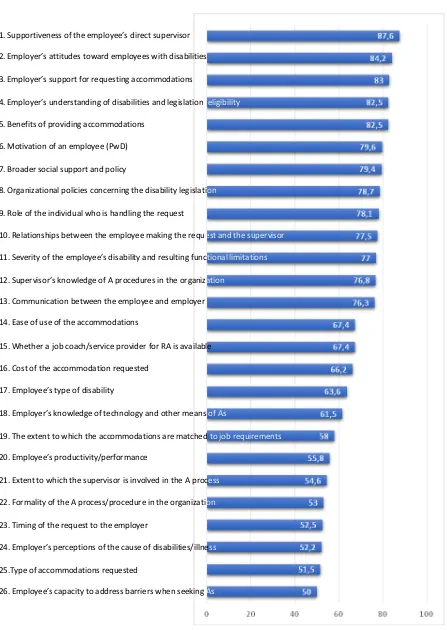
explore the views of professionals (providers of vocational rehabilitation services from the
115
Employment Service of Slovenia and the Pension and Disability Insurance Institute of Slovenia) by
116
use of ARAS on factors influencing RA, contents areas of RA and barriers, and (4) to present the
117
context of the instrument’s contents and professionals’ views - Slovenian model of reintegration of
118
PwD and PwCD to work in the frame of welfare system. By constructing and applying ARAS on
119
large group of professionals we aimed to get enough empirically validated data to make a sound
120
structure and list all the key aspects of RA that can provide a framework to assist in the development
121
and implementation of RA for PwD in practice. This is discussed in the broader context of equal
122
opportunities for employment of PwD and PwCD and the situation in Europe, using Slovenia as a
123
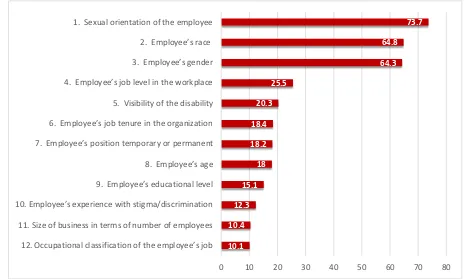
case model.
124
2. Materials and Methods
125
2.1. Design and Procedure
126
This study is an observational and exploratory research using a mixed methods approach [14].
127
In line with the objectives, the first phase of the study used a qualitative focus group method; in the
128
second and third phase, a quantitative analysis of data collected within the survey was performed;
129
fourth phase consisted of description and discussion of Slovenian model of reintegration to work.
130
In a preparatory part of first phase the translation of the original USA study and survey
131
questionnaire RAFS to Slovenian language and back in English was carried out to check for accuracy.
132
The resulting Slovenian version was tested for consistency and comprehensibility within a small
133
sample of professionals. In the qualitative research phase we developed a working form of the survey
134
questionnaire, suitable for Slovenian setting, by means of four focus groups with 28 professionals.
135
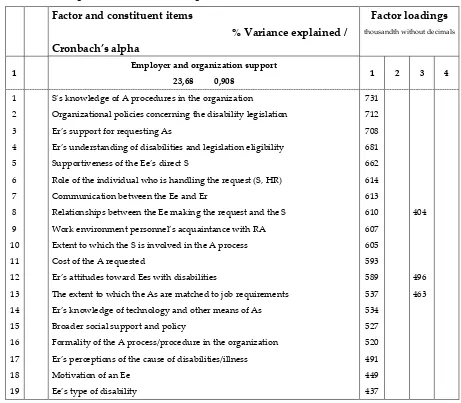
After research objectives were explained to participants of the focus groups, they were asked to
136
provide feedback on the importance of each item of the questionnaire. The following questions
137
guided the discussion: (i) Is the specified question in the questionnaire important and appropriate
138
for RA of PwD in Slovenia? (ii) Is the translation appropriate? (iii) Do you think that we could delete
139
or add one or more items about specific Slovenian conditions? The duration of the discussions in the
140
focus groups was around 2 hours per group. In these discussions it became apparent that there are a
141
few new items and aspects to cover. Most of these new items formed two new parts of the preliminary
142
survey questionnaire, later titled Contents Areas of RA and Barriers to RA. After having reached a
143
sufficient agreement on contents and extent was reached, the final working form of survey
144
questionnaire was established.
In the quantitative second and third research phase all professional workers, working in
146
vocational/employment rehabilitation in Slovenia were encouraged to respond to the survey
147
questionnaire. Their responses to individual items on respective scales underwent descriptive and
148
analytical (factor analysis) statistics. After testing their psychometric properties and establishing their
149
adequacy, the obtained results were considered as valid indices of their views on RA.
150
2.2. Participants
151
Participants in the initial four focus groups were 28 professional workers (gender: 71,4% female
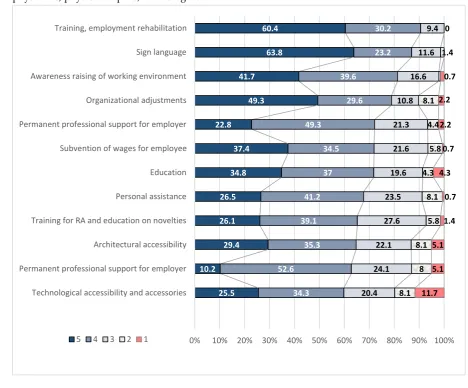
152
and 28,6% male; age: M = 45,1 years, SD = 12,1; working in the field: M = 10,9 years, SD = 7,9),
153
employed as service providers of vocational rehabilitation at Employment Service of Slovenia and at
154
Pension and Disability Insurance Institute of Slovenia. In the subsequent phase, the final version of
155
survey questionnaire was completed by 140 professionals (gender: 82% female and 18% male; age: M
156
= 43,1 years, SD = 10,6 years; working in the field: M = 7,9 years, SD = 7,3) in vocational rehabilitation
157
(providers of vocational rehabilitation at Employment Service of Slovenia and at Pension and
158
Disability Insurance Institute of Slovenia). The number of respondents represent 70% of all
159
professionals in the field in Slovenia. Most of them were psychologists (18,2%), social workers
160
(17,9%), occupational therapists (15,7%) and physicians (15%). It was intended to include PwD
161
(employees) and employers, but because of limited financial resources, only professional workers
162
participated.
163
2.3. Materials
164
The main instrument for data gathering was based on RAFS [13]. On the basis of review of
165
literature and suggestions from focus groups of professionals, the RAFS was adapted and expanded
166
from originally 52 to 78 items grouped in a tripartite survey questionnaire “Aspects of Reasonable
167
Accommodation Survey” (ARAS), containing parts: Factors influencing RA, Contents Areas of RA
168
and Barriers to RA parts.
169
The first part of ARAS on Factors influencing RA (modification of RAFS – RAFSm) was adopted
170
from RAFS [13]. Some of its items are: Benefits of providing accommodations, Communication
171
between the employee and employer, Employee’s creativity in identifying accommodations,
172
Employer’s attitudes toward employees with disabilities, Overall resources of the organization (e.g.
173
size, profitability), Type of accommodations requested etc. In three items mentioning American
174
Disability Act (ADA) it was changed to adequate Slovenian legislation act. After discussions in the
175
focus groups, three new items were added to original 52 RAFS items: Motivation of an employee,
176
Work environment personnel’s acquaintance with RA and Broader social support and policy
177
(concerning the Ministry of Labour, Pension and Disability Insurance Institute and Disability Fund).
178
All items are presented in Appendix.
179
The second part of ARAS - Content Areas of RA (CRA) - was designed on the basis of the focus
180
groups' discussions about which contents do belong to the field of RA and which do not. Finally, 12
181
different areas of RA were identified: Education, Permanent professional support for employer,
182
Training and vocational/employment rehabilitation, Awareness raising for the work environment,
183
Permanent professional support for employee, Subvention of wage for employee, Training for RA
184
and education on novelties, Personal assistance, Architectural accessibility, Technological
185
accessibility and technical accessories, Sign language, Organizational adjustments: part-time work,
186
appropriate workplace.
187
The third part of ARAS - Barriers to RA (BRA) - consists of 11 items on possible barriers that
188
might represent bigger or smaller issues in the process of RA; these are: Duration of procedures,
189
Adequacy of procedures, Financial resources, Administrative burden for employers, Prejudices and
190
discrimination, Encouraging and informing on potential accommodation, Organizational culture,
191
Quickly accessible information, Reactions of employers, Information on stakeholders’ procedures,
192
The motivation of PwD for work.
Responses to all items were made on 5-point Likert-type scales. Wordings of questions and
194
scales were: for RAFSm: How important were the items below in your decision to request or provide
195
a reasonable accommodation? 1 = not at all, doesn’t belong, 2 = a little, 3 = medium, 4 = very, 5 =
196
most, essentially; for CRA: To what extent do areas in the list belong to reasonable accommodation?
197
1 = not at all, 2 = somewhat, 3 = medium, 4 = mainly, 5 = fully, completely; for BRA: To what extent
198
do factors in the list present difficulties and barriers in reasonable accommodation procedures? 1 =
199
not at all, 2 = somewhat, 3 = medium, 4 = considerably, a lot, 5 = extremely, completely.
200
2.4. Data Analysis
201
The data gathered from the survey questionnaires were analysed using Microsoft Excel and IBM
202
SPSS Statistics, version 20.0.The main part of data analysis were descriptive statistics – frequencies,
203
proportions, ranks – of ratings on scales used to present the views of professionals on different
204
aspects of RA. To test the construct validity and obtain empirical latent categories exploratory factor
205
analysis with principal axis factoring was applied.Argumentation for this statistical procedure is
206
provided in Discussion. Before this, basic preconditions, tested by Kaiser–Meyer–Olkin measure of
207
sampling adequacy (KMOmsa) and Bartlett’s test of sphericity (Bts), were fulfilled [15]. When factor
208
analysis revealed medium or high correlations between factors, showing their interdependency, we
209
used oblique rotation [16]. Finally, in order to test the internal consistency and reliability of key
210
factors, Cronbach’s alpha coefficients were calculated.
211
3. Results
212
3.1. Adaptation and expansion of RAFS into ARAS
213
In the first qualitative research phase, a working form of comprehensive survey questionnaire,
214
adaptation and expansion of RAFS [13], suited to Slovenian setting, by assistance of four focus groups
215
with 28 professionals in the field was constructed. Discussions in focus groups resulted in three new
216
items in the first part of the questionnaire and two new parts of questionnaire. Aspects of Reasonable
217
Accommodation Survey (ARAS), as the whole tripartite instrument is named, contains: Factors
218
influencing RA (modification of RAFS or RAFSm, 52 original + 3 new = 55 items), Contents Areas of
219
RA (CRA, 12 items) and Barriers to RA (BRA, 11 items) with altogether 78 items (26 new) and
220
corresponding 5-point scales for assessment of their relevance. It is described also in section 2.3 on
221
Materials, while all items are presented in Appendix. In the subsequent phase the ARAS was
222
completed by 140 professionals and the obtained data were subjected to further quantitative analysis.
223
3.2. Factors influencing RA (RAFSm)
224
3.2.1. RAFSm Frequency distribution of responses to items
225
Frequency distributions of answers, i.e. ratings of item’s relevance and importance from 1 –‘not
226
at all relevant’ to 5 – ‘essentially relevant’ for 55 items on first part of ARAS RAFSm are most
227
informative. Items, ordered from highest 87,6% to 50% cumulative percentage of ratings 4 and 5
228
(Figure 1), i.e. from most frequently very/essentially important items reveal: First, items about
229
employer’s role are on the first four positions from 87,6% to 82,5% of all responses and also ranking
230
on positions 9, 12, 18, 21, 24 which means that in the perspective of professionals employer’s or
231
supervisor’s attitude and supportiveness is essential for successful accommodation to work. Second,
232
though other groupings are not so obvious, employee’s (PwD’s) characteristics as motivation,
233
severity and type of disability, productivity, and capacity to address barriers (ranks 6, 11, 17, 20, 26
234
with 79,6% to 50% of all responses) together with items on relationship and communication between
235
employee and employer (ranks 11 and 13 with around 77% of all responses) are second in relevance.
236
Third, items on benefits, ease of use, cost, matching and type of accommodation (ranks 5, 14-16, 19,
237
25 with 82,5% to 51,5% of all responses) and items on immediate and broader environment (ranks 7,
238
8, 22 from 79,4% to 53%) form the third group regarding importance. Detailed results are in Figure 1.
240
Figure 1. RAFSm items most frequently rated as most/essentially (5) or very (4) important ordered by
241
percentage of respondents (N = 140; A = accommodation)
242
1. Supportiveness of the employee’s direct supervisor
2. Employer’s attitudes toward employees with disabilities
3. Employer’s support for requesting accommodations
4. Employer’s understanding of disabilities and legislation eligibility
5. Benefits of providing accommodations
6. Motivation of an employee (PwD)
7. Broader social support and policy
8. Organizational policies concerning the disability legislation
9. Role of the individual who is handling the request
10. Relationships between the employee making the requestand the supervisor
11. Severity of the employee’s disability and resulting functional limitations
12. Supervisor’s knowledge of A procedures in the organization
13. Communication between the employee and employer
14. Ease of use of the accommodations
15. Whether a job coach/service provider for RA is available
16. Cost of the accommodation requested
17. Employee’s type of disability
18. Employer’s knowledge of technology and other means of As
19. The extent to which the accommodations are matched to job requirements
20. Employee’s productivity/performance
21. Extent to which the supervisor is involved in the A process
22. Formality of the A process/procedure in the organization
23. Timing of the request to the employer
24. Employer’s perceptions of the cause of disabilities/illness
25.Type of accommodations requested
On the other side is the rank order of items assessed as not at all important for RA. It is obvious
243
that here employee has a special position, all first ten ranks are about some her/his characteristics.
244
Three of them, sexual orientation, race and gender are especially not important considering 73,7% to
245
64,3% agreement of respondents. Next five items with 25,5% to 18% of all responses have relatively
246
high percentage, while altogether 12 items were rated by at least of 10% of respondents as not at all
247
important, they are presented in the Table 1. Agreement on nonimportance of these features mean
248
that professionals are aware and careful about equality of persons in their treatment. A matter of
249
discussion is if this also means that first three items are not necessary.
250
251
Figure 2. RAFSm items most frequently rated as not at all important (1) ordered by percentage of
252
respondents (N = 140)
253
3.2.2. RAFSm factor analysis
254
In the USA study, the researchers decided for an eight factors solution [13]: Employer and
255
organizational support, Employee competence in RA, Employee demographic characteristics,
256
Workplace impact, Workplace structure and resources, Employee work record, RA characteristics
257
and Nature of disabilities. As some of them refer to the same stakeholder, we decided to set a smaller
258
number of dominant factors. Communality values [16] and Cattell’s graph of eigenvalues (scree plot)
259
[15] supported this decision and so a lower factors solution was chosen. Due to the fact, that the factor
260
analysis revealed a medium-high correlation between first and third factor, which was also
261
supported by factor transformation matrix, we decided to use oblique rotation for dependent factors
262
[16]. Finally, a four factors solution was most adequate. Factors were interpreted as Employer and
263
organizational support, Characteristics of employee and his employment, Implementation of
264
reasonable accommodation, and Awareness of employee and work environment. Reliability, tested
265
with Cronbach’s alpha test, showed acceptable results with over 0,75 for all of them, the first and
266
second factors’ reliability being even higher than 0,90. Obtained factors, their constituent items,
267
proportions of total variance and Cronbach’s alphas are presented in Table 1.
268
The first factor comprises items referring mostly to the employer (Supervisor’s knowledge of
269
accommodation procedures in the organization, Employer’s support, Employer’s policy, and
270
Technological knowledge of the employer etc.; altogether 19 items). The second factor encompassed
271
10.1 10.4 12.3
15.1 18 18.2 18.4 20.3
25.5
64.3 64.8
73.7
0 10 20 30 40 50 60 70 80
mainly characteristics of employee (Vocation, Education, Job level, Type of disability,
272
Communication skills etc.; 16 items). The third factor included items linked to RA (Endurance of
273
accommodation, Ease of use, Type of accommodations requested etc.; 9 items). The fourth factor was
274
interpreted as Awareness of employee and work environment for recognition of RA (Capacity to
275
address barriers when seeking accommodations, Knowledge of RA procedures in the organization,
276
Feedback of co-workers, etc.; 8 items). Together they explain 44% of the variance. Factor loadings on
277
three items (Employee’s productivity/performance, Benefits of providing accommodations, Severity
278
of the employee’s disability and resulting functional limitations) were less than criterion value 0,40
279
and were omitted from the Table 1. This means that professional workers don’t associate them (or
280
the association is very low) with the obtained factors. The factors are not completely clear, e.g. items
281
Motivation of an employee and Employee’s type of disability are part (albeit ranking low) of first
282
factor Employer and organizational support, though primarily logically associated with an employee,
283
but surely employee’s motivation and nature of disability are among most important issues for an
284
employer. Thirteen items were loaded (more than criterion 0,40) by two factors concurrently, one
285
(Employee’s communication skills in requesting accommodations) even on three. This reveals
286
interactive nature of many procedures and characteristics in the process of RA, some of them
287
(Relationship between employee and employer, Employee’s communication skills, Employer’s
288
attitudes toward employee PwD) have inherently relational meaning.
289
Table 1. Factors, percentage of variance explained, Cronbach’s alpha, constituent items and their
290
factor loadings (≥ 0,400; three items loadings were less and are omitted from the table)
291
Factor and constituent items
%
Variance explained /
Cronbach’s alpha
Factor loadings
thousandth without decimals1 Employer and organization support
23,68 0,908 1 2 3 4
1
2
3
4
5
6
7
8
9
10
11
12
13
14
15
16
17
18
19
S’s knowledge of A procedures in the organization
Organizational policies concerning the disability legislation
Er’s support for requesting As
Er’s understanding of disabilities and legislation eligibility
Supportiveness of the Ee’s direct S
Role of the individual who is handling the request (S, HR)
Communication between the Ee and Er
Relationships between the Ee making the request and the S
Work environment personnel’s acquaintance with RA
Extent to which the S is involved in the A process
Cost of the A requested
Er’s attitudes toward Ees with disabilities
The extent to which the As are matched to job requirements
Er’s knowledge of technology and other means of As
Broader social support and policy
Formality of the A process/procedure in the organization
Er’s perceptions of the cause of disabilities/illness
Motivation of an Ee
Ee’s type of disability
731
712
708
681
662
614
613
610
607
605
593
589
537
534
527
520
491
449
437
404
496
2 Characteristics of employee and his employment 10,61 0,912
20 21 22 23 24 25 26 27 28 29 30 31 32 33 34 35 1 2 3 4 5 6 7 8 9 10 11 12 13 14 15 16
Ee’s job level (managerial/entry level) in the workplace
Ee’s educational level
Ee’s age
Whether the Ee’s position is temporary or permanent
Occupational classification of the Ee’s job
Ee’s job tenure (years) in the organization
Size of business in terms of number of Ees
Overall resources of the organization (e. g, size, profitability)
Type of business
Phase of the employment process when seeking As
Ee’s communication skills in requesting As
Visibility of the disability
Ee’s race
Ee’s gender
Physical size of the workplace where the Ee is located
Sexual orientation of the Ee
459 445 433 782 747 717 695 665 643 639 602 581 581 569 549 545 519 480 451 445
3 Implementation of RA 5,35 0,859
36 37 38 39 40 42 43 44 1 2 3 4 5 6 7 8 9
Scope and intensity of the A
Duration of the A
Perceived fairness of the A by co-workers
Timing of the request to the Er
Whether a job coach/service provider for RA is available
Structural modifications necessary to provide As
Ease of use of the As
Type of As requested
Urgency of the A request
427 494 456 417 441 790 751 675 627 606 575 564 551 545
4 Awareness of employee and work environment 4,60 0,751
45 46 47 48 49 50 51 52 1 2 3 4 5 6 7 8
Ee’s capacity to address barriers when seeking As
Ee’s knowledge of RA procedures in the organization
Co-workers’ reactions to As provided
Supportiveness of co-workers with regard to the request
Ee’s experience with stigma or discrimination
Ee’s creativity in identifying As
Ee’s perception of the benefits and risks with RA
Ee’s awareness and knowledge of the disability legislation and RAs
476 614 544 530 493 474 465 425 405 Factor loadings are presented as thousandth without decimal point. Some items are shortened and
292
acronyms are used: A – accommodation, RA – reasonable accommodation, Ee – employee (PwD), Er
293
– employer, S – supervisor.
294
3.3. Contents of reasonable accommodation (CRA)
296
3.3.1. CRA frequency distribution of responses to items
297
With the CRA ARAS questionnaire we tried to find out which (and to what extent) areas of
298
subsystems and services are considered as a part of RA by professionals. All areas collected in the
299
first phase of the study were assessed as an important part of RA (at least rating 3) by 80% of
300
respondents. (see Figure 3). This was expected because they were assembled on the basis of
301
importance for RA. More informative is their order and proportions of ratings. Four areas (Training
302
and vocational/employment rehabilitation, Sign language, Awareness raising for the work
303
environment, and Organizational adjustments: part-time work, appropriate workplace) were
304
assessed as belonging completely or mainly (ratings 5 and 4) to RA by more than three quarters (75%)
305
of professionals, and the rest seven areas were assessed as such by at least 60% of them (the eighth
306
reached 59,8%). Generally Training and vocational/employment rehabilitation, was seen as the core
307
part of the RA because it comprises many interventions, which are complex, individually PwD
308
oriented and performed by different professionals such as psychologists, occupational therapists,
309
physicians, physiotherapists, technologists.
310
311
Figure 3. Contents areas of RA (CRA) items and their percentage of ratings from belongs completely
312
(5) to doesn't belong / not at all (1) ordered vertically by joint percentage of ratings 5 and 4 (N = 140)
313
Sign language, its teaching, learning, knowing and using was in 87% rated as, fully or partly
314
belong to RA. Its high rank reflects the importance of the well-established means to fulfil the essential
315
human need for communication that is blocked in PwD, who cannot talk or hear for different reasons.
316
25.5 10.2
29.4 26.1 26.5
34.8 37.4 22.8
49.3 41.7
63.8 60.4
34.3 52.6
35.3 39.1
41.2 37 34.5 49.3
29.6 39.6
23.2 30.2
20.4 24.1
22.1 27.6
23.5 19.6
21.6 21.3 10.8
16.6 11.6
9.4
8.1 8 8.1
5.8 8.1 4.3
5.8 4.4 8.1
0.7 1.4
0
11.7 5.1 5.1
1.4 0.7 4.3
0.7 2.2 2.2
0% 10% 20% 30% 40% 50% 60% 70% 80% 90% 100% Technological accessibility and accessories
Permanent professional support for employer Architectural accessibility Training for RA and education on novelties Personal assistance Education Subvention of wages for employee Permanent professional support for employer Organizational adjustments Awareness raising of working environment Sign language Training, employment rehabilitation
3.3.2. CRA factor analysis
317
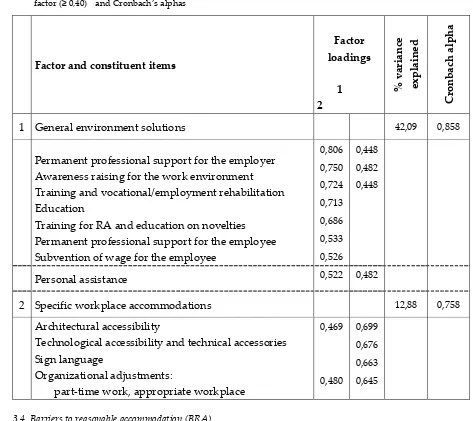
CRA data were also subjected to factor analysis in which considering contents and Cattell’s
318
graph of eigenvalues a two-factor solution was chosen and their reliability indices Cronbach’s alphas
319
were high enough (see Table 2). The first factor was interpreted as General environment solutions (or
320
Joint supported environment solutions), the second was named Specific workplace accommodations,
321
and together they explain 55% (42% and 13%) of the variance. Six items (Permanent professional
322
support for the employer, Awareness raising for the work environment etc.) were loaded on both
323
factors above criterion value (≥ 0,40) probably because both specific and general measures are needed
324
for successful RA. Item Personal assistance has nearly equal loadings for the same reason: it is general
325
systemic and specific, verbatim very personal; perhaps the fact that it is a current topic and also one
326
of the latest acts in Slovenian legislation had its impact.
327
Table 2. Contents of RA (CRA) factors, their constituent items, percentage of variance explained by
328
factor (≥ 0,40) and Cronbach’s alphas
329
Factor and constituent items
Factor
loadings
1
2
% var
iance
explai
n
ed
C
ronb
ach al
ph
a
1 General environment solutions
42,09 0,858Permanent professional support for the employer
Awareness raising for the work environment
Training and vocational/employment rehabilitation
Education
Training for RA and education on novelties
Permanent professional support for the employee
Subvention of wage for the employee
0,806
0,750
0,724
0,713
0,686
0,533
0,526
0,448
0,482
0,448
Personal assistance
0,522 0,4822 Specific workplace accommodations
12,88 0,758Architectural accessibility
Technological accessibility and technical accessories
Sign language
Organizational adjustments:
part-time work, appropriate workplace
0,469
0,480
0,699
0,676
0,663
0,645
3.4. Barriers to reasonable accommodation (BRA)
330
3.4.1. BRA frequency distribution of responses to items
331
For more in-depth analysis on barriers and facilitations in the process of RA we used the third
332
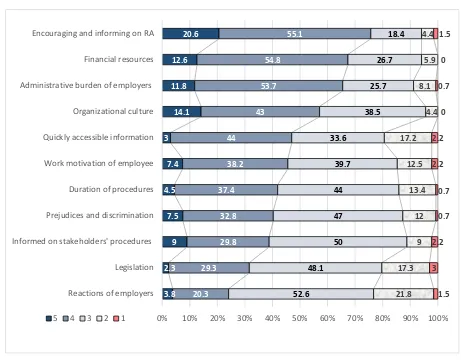
part of ARAS, BRA. Percentage of answers from completely (5), considerably (4), medium (3),
333
somewhat (2) to no barrier at all (1) is shown in Figure 3.
336
Figure 4 Barriers to RA (BRA) items and their percentage of ratings from complete barrier (5) to no
337
barrier (1), ordered vertically by joint percentage of ratings 5 and 4 from the greatest to the least barrier
338
(N = 140)
339
As shown in Figure 4, the main possible barriers are (insufficient) Encouraging and information
340
on RA (75,7%), Financial resources (67,4%), Administrative burden for employers (65,5%) and
341
Organizational culture (57,1%). Other barriers on the list are rated as complete and big barrier under
342
50%. If we take into account also rating medium (3), all of the barriers are at least of medium
343
importance for more than 75% of respondents.
344
3.4.2. BRA factor analysis
345
The KMO test and Bartlett’s test of sphericity confirmed that factor analysis could be done.
346
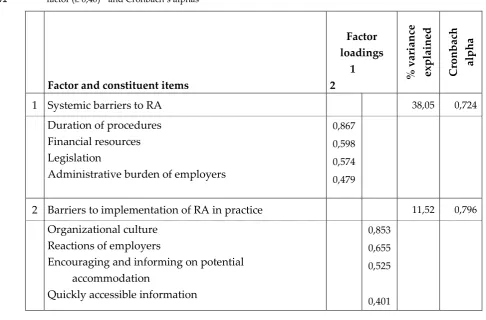
Testing of internal consistency, i.e. reliability, with Cronbach’s alpha gave acceptable results. A two
-347
factor solution, each factor with four items, was considered as most adequate (see Table 3). The first
348
factor encompasses Systemic barriers (Duration of procedures, Financial resources, Legislation, and
349
Administrative burden of employers), while the second factor contains Barriers to implementation in
350
practice (Organizational culture, Reactions of employers, Encouraging and informing on potential
351
accommodation, and Quickly accessible information). Together they explain nearly 50% of the
352
variance. Three items (Work motivation of employee, Prejudices and discrimination, Information on
353
stakeholders’ procedures) were omitted because of their low loading. This doesn’t mean that they
354
cannot figure as significant barrier, percentages of professionals rating them complete or considerable
355
barrier (ratings 4 and 5) were from 35,6% to 40,3%. They just didn’t fit into obtained factors as other
356
items, and similarly happened in the three-factor solution. Especially item Employee’s work
357
motivation stayed somehow floating, probably not because of nonimportance, but because one of the
358
factors in previous selection of PwD for RA procedure was their (enough) high motivation.
359
3.8 2.3 9 7.5 4.5
7.4 3
14.1 11.8
12.6 20.6
20.3 29.3
29.8 32.8 37.4
38.2 44
43 53.7
54.8 55.1
52.6 48.1
50 47 44 39.7 33.6
38.5 25.7
26.7 18.4
21.8 17.3
9 12 13.4 12.5 17.2
4.4 8.1
5.9 4.4
1.5 3 2.2
0.7 0.7 2.2 2.2 0 0.7
0 1.5
0% 10% 20% 30% 40% 50% 60% 70% 80% 90% 100% Reactions of employers
Legislation Informed on stakeholders' procedures
Prejudices and discrimination Duration of procedures Work motivation of employee Quickly accessible information Organizational culture Administrative burden of employers
Financial resources Encouraging and informing on RA
Table 3. Barriers to RA (BRA) factors, their constituent items, percentage of variance explained by
360
factor (≥ 0,40) and Cronbach’s alphas
361
Factor and constituent items
Factor
loadings
1
2
% var
iance
explai
n
ed
C
ronb
ach
al
ph
a
1 Systemic barriers to RA
38,05 0,724Duration of procedures
Financial resources
Legislation
Administrative burden of employers
0,867
0,598
0,574
0,479
2 Barriers to implementation of RA in practice
11,52 0,796Organizational culture
Reactions of employers
Encouraging and informing on potential
accommodation
Quickly accessible information
0,853
0,655
0,525
0,401
4. Discussion
362
4.1. A tool and a survey - Aspects and factors of reasonable accommodation in the study
363
In order to get valid information on state of the art of RA in employment for PwD we needed a
364
special, proven, valid and reliable tool. However, in Slovenia, as a relatively small country with two
365
million inhabitants and native speakers, specific legislation and welfare system, there was no such a
366
specific instrument on the market. We had to set out to form provisional and solid questionnaire,
367
which was quite a challenge to develop. Finally, we decided to develop a survey questionnaire on
368
the basis of USA instrument RAFS [13], made the translation, adaptation and expansion into tripartite
369
survey questionnaire Aspects of reasonable accommodation (ARAS) and applied it as a survey
370
instrument with a kind help of professionals in the field as respondents.
371
The first topic to discuss is validity, reliability and usefulness of ARAS. ARAS contains: Factors
372
influencing RA (RAFSm, 55 (52 original + 3 new) items, 4 factors Employer and organizational
373
support, Characteristics of employee and his employment, Implementation of RA, Awareness of
374
employee and work environment), Contents Areas of RA (CRA, 12 new items, 2 factors General
375
environment solutions, Specific workplace accommodations) and Barriers to RA (BRA, 11 new items,
376
2 factors Systemic barriers to RA, Barriers to implementation of RA in practice) with altogether 78
377
items (26 new). All factors had adequate reliability to do exploratory factor analysis which confirmed
378
the basic constructs. We believe that since original RAFS and ARAS were carefully and expertly
379
constructed on the basis of relevant literature, focus groups of professionals in the field, pilot testing
380
of the instrument, contents and statistical analyses (factors, Cronbach’s alpha), there are enough
381
reasons for the conclusion that ARAS is valid and reliable. It is though still an instrument in
382
development: it could probably be shorter, some items (e.g. those with very high ‘not important’
383
response) could be omitted, CRA items could be integrated with first part RAFSm, versions for PwD
384
and employers could be formed, wording of items and questions more precise etc. However, as
already said, we think it provides a trustworthy and clear picture of the RA dimensions in Slovenian
386
settings.
387
There is a controversy regarding the use of factor analysis and other higher level parametric
388
statistic procedures in such cases because in the strict sense basic metric level of Likert-type scale is
389
ordinal. On the other hand, a considerable part of psychometricians allow use of parametric statistics
390
in certain cases (adequate sample size of subjects and items, nearly normal distribution), and some
391
experts (after simulated trials) conclude that parametric statistics tend to give “the right answer” even
392
when statistical assumptions—such as a normal distribution of data—are violated [17], and so
393
consider them as more robust than nonparametric statistics [17, 18]. Besides, many studies in
394
psychology, social sciences and medicine with such scales, (including our starting-point study [13])
395
applied parametric statistics, such as factor analysis or some other type of multivariate analysis, in
396
past decades. When a studied variable is described by a number of items experts suggest using the
397
Cronbach alpha or Kappa test or factor analysis technique to provide evidence that the components
398
of the scale are sufficiently intercorrelated and that the grouped items measure the underlying
399
variable [18]. Considering all this argumentation we used factor analysis (and other already cited
400
statistic procedures) in order to test construct validity and compare obtained factors to basic inferred
401
categories and to factors in the USA study [13].
402
Results of Slovenian survey confirm that conceptualising and implementing RA is a
403
multidimensional or multifactorial process with employer and organization (their attitude,
404
understanding and support) as the crucial factor for RA implementation - from the perspective of
405
professionals in the field. Of course, all other aspects and factors are necessary to be taken into
406
account: characteristics of an employee (including type and severity of disability) and his
407
employment, RA implementation possibilities, and awareness of employee and work environment.
408
Frequency distributions of responses to items show that items on the role of employer or supervisor
409
are most frequently (up to 87% of responses) rated as essentially or very relevant by the professionals
410
concerned. The importance of employee, features of accommodation and immediate and broader
411
environment is also evident in frequency and high ratings, but there is clearly a difference between
412
them and items on employer’s features. Factor analysis results indicate the same direction: among
413
four factors obtained the factor Employer and organizational support covers the highest percentage
414
of explained variance (nearly 24%), more than the other three together. So, this importance of
415
employer tells us how much special effort, intervention and goodwill is expected (but not always
416
formally regulated or prescribed) from this stakeholder, and finally, it also reveals power relations.
417
It is noteworthy that on the opposite side of relevance scale from essentially, most or very important
418
to not important all, the first ten ranked items are about employee (especially characteristics sexual
419
orientation, race and gender). This shows professionals’ principled care for PwD’s (i.e. employee or
420
candidate) equality but also her/his weak position in the situation when in need for help, support and
421
guidance on personal and social participation level. The study of practices of providing RA for PwD
422
in the workplace, consisting of 24 company case studies across Europe in 2008, yielded similar
423
findings: commitment of management, involvement of the staff, clear responsibility, adopted
424
regulations (for example work trials for PwD) are besides external factors (provision of
425
services/expertise, case assessment and consultation of experts, financial support, and flexible public
426
support) key to successful accommodation [12].
427
This basic social aspect may be a part of an important concept, the social capital. It is defined in
428
brief as cultural (norms, values, confidence) and structural (formal and informal human relations)
429
frames of social functioning [19] (p. 220) and is clearly present within the factors, for example in the
430
items: Support of employer for application, Communication between employer and employee, Views
431
of the employer towards employees, Recognition of equality between employees, Feedbacks of
co-432
workers etc. The whole fourth factor Awareness of employee and work environment and its items
433
can be identified as a social dimension and treated as a factor of social capital. We estimate that
434
around 18% (10 out of 55) of items in the first part of the ARAS and altogether 24% (19 out of all 78
435
items) can be recognized as social capital questions. These items are crucial for the dimension of
436
antidiscrimination and equality and form the basis for many procedures which are needed for RA.
As presented, the results of the USA study [13] are different from ours (see section 3.2 and Table
438
4 beneath). First, in our version three items were added as were also 12 CRA items and 11 BRA items.
439
BRA was formed to enable more in-depth analysis of frequent problem about barriers (and
440
facilitators) in the process of RA. Experiences in working with PwD showed that even though they
441
do have the right to RA, they anyhow stumble upon many different obstacles, which lead us to
442
include this aspect. Second, obtained factors somewhat differ in contents and definitely differ in
443
number (USA: 8; Slovenia: 4). Our position is, that smaller number of factors, which are merging a
444
higher number of variables (items) can more adequately explain the process of RA. Perhaps smaller
445
number of higher order factors in the original study [13] would reveal similar factor structure and
446
perhaps in practice ‘creative’ combinations could be useful. Third, the difference between these
447
studies is in the relationship of dependence between factors in Slovenian research, while USA
448
research found independent factors, perhaps also due to the previous point. Fourth, in their study a
449
principal component analysis was applied, while we used factor analysis (with principal axis
450
factoring and oblique rotation). There are some significant differences between both methods [15] (p.
451
638) - »…only factor analysis can estimate the underlying factors, and it relies on various assumptions
452
for these estimations to be accurate. The principal component analysis is concerned only with
453
establishing which linear components exist within the data and how a particular variable might
454
contribute to that component”. So, besides obvious cultural, social and economic differences, the
455
choice of statistical analyses might also have its influence. Fifth, we present descriptive frequency
456
distributions with the percentage of each item ratings, which gives clearer and concrete information
457
on what aspects are really relevant. Finally, unfortunately in our study only professionals’ responses
458
were collected; other stakeholders (employees (PwD) and employers) could not be included up to
459
now due to financial shortcomings.
460
The study reveals that RA request, planning and implementation is a dynamic,
461
multidimensional and multifactorial process. It depends on PwD or employee, employer,
462
organization and extended social and physical environment (including policies, subsystems and
463
services). It consists of important underlying constructs that showed up as factors in both, in our and
464
in the USA study. In Table 4 these three types of constructs, one theoretical and two empirical are
465
presented. They are in fact very similar, somewhere overlapping and more or less abstracted, while
466
individual items from studies are of course more concrete and perhaps clearer. It is important that all
467
of them are considered in practice and theory including research.
Table 4. Comparison between theoretical inferred categories, USA study factors, Slovenian study
470
factors, (●--● link, in brackets number of constituent items)
471
Theoretical categories
Factors USA
(Dong et al., 2010)
Factors
Slovenia
(this
study)
Employee
Person with disability
(PwD)
Employee competence in RA (7)
Employee demographic
characteristics (4)
Employee work record (7)
Nature of disabilities (3)
Characteristics of employee
and his employment (16)
Employer
Supervisor
Employer and organizational
support (10)
Employer and organization
support (19)
Interaction employer
–
employee
–
co-workers
Awareness of employee
and work environment (8).
Environment
Immediate workplace
Workplace impact (9)
Workplace structure and
resources (6)
Environment
social
organizational
Reasonable
accommodation (RA)
RA characteristics (6)
Implementation of RA (9)
Related to this line of discussion and deliberation is the wider use of results of the study. Though
472
labelled as descriptive and observational, its results and particularly RAFS or ARAS were also
473
intended to serve as a basis for a framework or a starting point in the practice of RA. The first function
474
of ARAS was as an instrument for gathering information. Its second function arises from the
475
conclusion that ARAS items and factors represent main aspects or categories of RA that must be taken
in to account in planning RA. So, ARAS can also be applied as a tool that helps to establish, organize,
477
implement, assess and improve RA.
478
There are of course several limitations of the study. First, ARAS is a preliminary form of the
479
survey questionnaire, with a comprehensive list of important items on the base of well-established
480
RAFS and professionals’ suggestions and assessment. It has good content validity and internal
481
reliability (moderate to high Cronbach’s alphas) and it can help us to get valuable information.
482
However, we do not consider it has a status of a perfect survey questionnaire, because the complete
483
construction procedure with replicated content adequacy assessment, complete item analysis (and
484
selection), criterion validation etc. was not performed yet. Thus, it is an instrument in development
485
and one of the next projects might be to develop a final version - though it would very probably differ
486
only in details. The second limitation is that only professionals in the field were respondents; other
487
stakeholders – employees (PwD and/or PwCD) and employers – were not included. Originally the
488
plan was to include them, but there were not enough financial resources to cover this part of our
489
research.
490
The strength of the study is a high number of professionals in the field participating in the first
491
phase (28) and especially in the second quantitative phase (140) which means that 14% and later even
492
70% of all experts in Slovenia collaborated in the project. This gives us confidence in the validity and
493
applicability of results. It is also one of the first studies of this kind in the area in Slovenia, and we
494
hope the research will be continued.
495
4.2. Equal opportunities of RA for PwD including PwCD – The Slovenian model
496
Several studies [20–22] emphasize the importance of RA or workplace adjustment for
497
employment of PwD or those with health problems. Our study results emphasise three key factors in
498
RA: employer, employee, and environment. What should be done to take into account these factors
499
in real life? The findings from Pathways project imply many suggestions for successful
500
implementation of RA: “better coordination between healthcare and employment should be in place
501
in order to ensure a better understanding of the relationship between work and chronic
502
diseases” [10] (p. 8); “employers need to be informed about specific health-related need of workers
503
in terms of work adjustment and overall inclusion in the labour force” [10] (p. 8); “Policies and
504
systems should focus on the greater involvement of employers” [1] (p. 10); “their cooperation is vital,
505
and there is a need for developing strong, innovative, and consistent strategies for ensuring their
506
commitment” [10] (p. 10); “health professionals should be trained to provide work-related advice to
507
PwCD to facilitate a quick return to work” [10] (p. 8). On the other hand, “lack of awareness was a
508
[major] barrier for the implementation of strategies targeting to assist and support employers and
509
create facilitative workplaces (e.g. the provision of RAs)” [23] (p. 66). In another part of Pathways
510
project focusing on recommendations targeting to create facilitative labour markets and/or
511
workplaces, the availability of RA, based on individual functioning, received the highest number of
512
“very important” responses from both groups of stakeholders, national and European [24].
513
In most European countries there are no legal frameworks explicitly covering the employment
514
integration of PwCD [10]. Therefore, in some countries they are largely covered by legislation for
515
PwD. EU Member States adopted different approaches in response to the requirement for RA –
516
differences occur among others regarding where in legal acts and how the provisions are stipulated
517
as well as the further specification of the terms reasonable accommodation and disproportionate
518
burden and the role of the public sector [12]. They are all offering grants or subsidies to employers to
519
provide RA, yet the mechanisms differs greatly across EU. Also, definitions and elaborations of RA
520
as well as of disproportionate burden on the employer are unclear, heterogeneous and difficult to
521
compare between the Member States. Despite the need for further research, economic analysis and
522
evaluation, evidence suggests that investments in RA are cost beneficial and provide a return in terms
523
of increased productivity and reduced absenteeism [25]. Since the number of persons with CD
524
(PwCDs) in Europe and worldwide is continuously growing, all the countries should move towards
525
developing solutions for this problem and ensure equal conditions and policy-level strategies for the
526
inclusion of PwCDs in employment.