2805241776
Linear and nonlinear instability
of shear driven liquid films
Paul Caporn
P h. D. Thesis
1998
D ep artm en t of hlathem atics
U niversity College London
ProQuest Number: 10010135
All rights reserved
INFORMATION TO ALL USERS
The quality of this reproduction is dependent upon the quality of the copy submitted.
In the unlikely event that the author did not send a complete manuscript
and there are missing pages, these will be noted. Also, if material had to be removed,
a note will indicate the deletion.
uest.
ProQuest 10010135
Published by ProQuest LLC(2016). Copyright of the Dissertation is held by the Author.
All rights reserved.
This work is protected against unauthorized copying under Title 17, United States Code.
Microform Edition © ProQuest LLC.
ProQuest LLC
789 East Eisenhower Parkway
P.O. Box 1346
A c k n o w le d g e m e n ts
F irs t and fo re m o st I w o u ld like to express the deepest g ra titu d e to th e best S upervi sors I could have wished fo r, D rs Sergei T im o s h in and R o b e rt Bowles. W ith o u t y o u r tim e , patience and good h u m o u r none o f th is w ould have been possible. I w ould also lik e to th a n k P ro f. F ra n k S m ith fo r g ivin g me the o p p o rtu n ity to do a P h. D , P ro f. Susan B ro w n and D r T o m A lle n fo r th e ir interest in m y w o rk.
To a ll th e m a th e m a tic a l su p p o rt team , th a n k you, especially to P a u l, Simon and R ich a rd fo r keeping th e com puters at bay, and the basics backup boys in th e p o stg ra d ro o m (yo u k n o w w ho you are). To aU the m any friends w ho have been such good com pany over th e la st few years: Look w h a t Pve been up to !
F in a lly , M u m and D a d , T H A N K Y O U . I f i t h a d n ’t been fo r y o u r co n sta n t s u p p o rt th ro u g h e v e ry th in g I w o u ld n ’t be w h a t I am today. I owe you e v e ry th in g .
A b s t r a c t
T he g overning equations fo r a h igh Reynolds num ber flo w in a b o u n d a ry la ye r over a film coated w a ll are derived fro m the fu ll tw o dim ensional N avier Stokes equations o f m o tio n fo r a tw o flu id flo w . N u m e rica l studies o f th e p ro p e rtie s o f th e base flo w and its s ta b ility are described fo r the case o f th e flo w over an isolated surface roughness on an o therw ise fla t surface. In ve stig a tio n s o f b o th short and lo n g obstacles are u n d e rta ke n in term s o f th e flo w in a viscous-inviscid in te ra c tio n region.
A n in v e s tig a tio n o f s tro n g ly no n -lin e a r v o rte x wave in te ra c tio n in a la m in a r b o u n d a ry layer w ith tw o pairs o f obUque waves is carried o u t. F or a p a rtic u la r choice o f flo w param eters a resonance is fo u n d U nking the tw o pairs o f waves, and the governing am pU tude equatio n fo r the leading o rder d istu rb a n ce is derived and in ve stig a te d .
W ave-am pU tude equations are derived fo r the non-Unear m o d u la tio n o f ToUmien- SchUchting (T S ) ty p e disturbances at high R eynolds num bers. A n in v e s tig a tio n o f th e in s ta b iU ty o f R eynolds-stress generated m ean flo w to short w aveleng th secondary disturbances is carried o u t. A regim e w ith Unear T S /c a p iU a ry wave resonance is exam ined and the governing am pUtude equatio n fo r non-Unear wave in te ra c tio n is derived. T w o in te rm e d ia ry regimes are also studied.
T h e Unear in s ta b iU ty o f high Reynolds n um ber b o u n d a ry layer flo w over a film - coated waU is stu d ie d b o th num ericaUy and analyticaU y fo r th e p racticaU y im p o rta n t U m it o f h ig h film viscosity. We exam ine th e various instabiU ties present and re la te th e m to th e in s ta b iU ty classifications o f B e n ja m in (1963) and L a n d a h l (1962).
C ontents
1 I n t r o d u c t i o n 7
1.1 T h e dim ensiona l governing e q u a tio n s ... 15
2 F lo w o v e r a s u rfa c e m o u n t e d o b s ta c le 18 2.1 Blasius b o u n d a ry layer on a film -co a te d w a l l ... 19
2.2 T rip le deck on a waU m o u n te d o b s ta c le ... 21
2.3 B o u n d a ry layer on elongated o b s ta c le s ... 23
2.3.1 T he num e rica l m e t h o d ... 25
2.3.2 Results ... 29
2.4 In v is c id in s ta b ilitie s in film -co a te d f l o w s ... 30
2.4.1 T he long-w ave in s ta b ility ... 31
2.4.2 R ayleigh-w ave in s ta b ility ... 32
2.4.3 T he nu m e rica l R ayleigh in s ta b ility c a lc u la tio n ... 36
2.4.4 N u m e rica l results fo r i n s t a b ilit y ... 38
2.4.5 A p a rtic u la r tw o -flu id f l o w ... 39
2.5 T h e condensed flo w p r o b le m ... 40
2.5.1 T he nu m e rica l m e t h o d ... 41
2.5.2 Results fo r condensed f l o w ... 43
2.6 Tables and figures ... 45
3 V o r t e x - w a v e in t e r a c t io n in a t w o - f lu id f lo w 63 3.1 I n t r o d u c t io n ... 63
C O N T E N T S
3.1.2 A sufficient c o n d itio n fo r re s o n a n c e ... 67
3.2 V W I w ith tw o pairs o f waves... 69
3.2.1 T h e core flo w ... 69
3.2.2 T h e b u ffe r la y e r... 71
3.2.3 T h e viscous in te rfa c ia l l a y e r s ... 76
3.2.4 T h e viscous Stokes layer on th e w a l l ... 78
3.3 T h e a m p litu d e e q u a tio n s ... 79
A A p p e n d ix A : T h e C ritic a l l a y e r ... 86
3.2 Tables and figures ... 91
4 N o n lin e a r s h o r t - w a v e T S i n s t a b i l i t y 98 4.1 T h e trip le -d e c k equations and s c a lin g s ... 100
4.1.1 T h e in s ta b ih ty scalings ... 102
4.2 S h o rt scale disturbances. T h e in v iscid r e g io n s ... 104
4.2.1 T h e viscous Stokes layer on th e w a l l ... 109
4.2.2 T he in te rfa c ia l viscous l a y e r ... 110
4.2.3 T h e am pUtude e q u a t io n ... I l l 4.3 S o lu tio n p ro p e rtie s and secondary in s ta b iU tie s ... 114
4.3.1 In te rm e d ia te secondary d is tu r b a n c e s ... 115
4.3.2 In s ta b iU ty o f weak p rim a ry w a v e s ... 116
4.3.3 W eak surface t e n s io n ... 118
4.4 N onUnear TS-capiU ary wave re s o n a n c e ... 120
4.4.1 D e riv a tio n o f the am pU tude e q u a tio n ... 120
4.4.2 A n a lysis o f the am pU tude e q u a t io n ... 124
4.5 T h e near resonant r e g im e s ... 128
4.5.1 T h e firs t near-resonant regim e ... 128
4.5.2 T h e viscous diffu sio n la y e r ... 131
4.5.3 T h e in te rfa c ia l viscous l a y e r ... 132
4.5.4 T h e am pU tude e q u a t io n ... 133
C O N T E N T S
4.5.6 T he flo w e x p a n s io n s ... 137
4.5.7 T he in te rfa c ia l viscous l a y e r s ... 140
4.5.8 T h e a m p litu d e e q u a t io n ... 141
4.6 C o n clu d in g rem arks ... 146
4.4 Figures ... 148
5 I n s t a b i l i t y o f f lo w o n a v e r y v is c o u s f i l m 161 5.1 I n t r o d u c t io n ... 161
5.2 T h e p ro b le m f o r m u l a t i o n ... 163
5.3 T h e th ic k in v is c id film l i m i t ... 167
5.4 T h e n u m e rica l s o lu t io n ... 170
5.4.1 Long-w ave lim it ... 171
5.5 T h e th in - film lim it case ... 174
5.5.1 TS in s ta b ility on a viscous th in f i l m ... 174
5.5.2 T h in film s o f sm aller v is c o s ity ... 177
5.6 D is c u s s io n ... 181
5.7 Figures ... 184
C h a p te r 1
In trod u ction
The effect o f th in liq u id film coatings in a high R eynolds n u m b e r b o u n d a ry layer flow on b o th sep a ra tio n and tra n s itio n to turb u le n ce is a pro b le m o f great p ra c tic a l im p o rta n c e in m a n y real life situ a tio n s . These include th e flo w over ra in w e tte d planes and cars, th e de-icing o f plane wings and th e use o f lu b ric a n ts in m any engineering a p p lica tio n s. We begin th is Thesis w ith a b rie f review o f some o f th e developm ents in th e relevant theories fo r homogeneous flows before exa m in in g the specific role o f a film and th e a lte ra tio n s its presence entails.
C h a p te r 1: In tro d u c tio n
fo r a lm o st a ll a p p lic a tio n s , by G o ld ste in (1948), at the p o in t o f flo w reversal, and hence se p a ra tio n , v ia w h a t became kn o w n as a G oldstein s in g u la rity in th e slope o f b o th th e skin fr ic tio n on the b o d y surface and the b o u n d a ry layer displacem ent. A new th e o ry was re q u ire d to cope w ith separation. T h is was p ro vid e d by a tr ip le deck scheme, a v is c o u s /in v is c id in te ra c tio n th e o ry w hich allowed fo r an unspecified pressure g ra d ie n t, as developed by S tew artson & W illia m s (1969), N e ila n d (1969), M essiter (1 9 7 0 ), S tew artson (1970). T h e th e o ry spht the b o u n d a ry layer in to tw o so-called decks w ith a n o n lin e a r viscous low er deck on th e b o d y surface d riv e n b y an e x te rn a l in d u ce d pressure and a ro ta tio n a l in viscid m a in deck, w hich rem ains la rg e ly passive, s h ifte d v ia th e displacem ent caused by the low er deck. A th ir d ’p o te n tia l- fio w ’ u p p e r deck com pleted the d e scrip tio n , w ith the lo ca l displacem ent fro m the low er deck a ffe c tin g th e induced lo c a l pressure, o f th e order o f the slope o f the stre a m lines in th e b o u n d a ry layer, and hence affecting the low er deck. T h is ’in te ra c tiv e ’ approach avoids th e fa ilu re o f th e classical th e o ry due to the unspecified pressure g ra d ie n t, and hence u n kn o w n displacem ent. The th e o ry also does n o t depend on a p a rtic u la r set o f w a ll b o u n d a ry c o n d itio n s, w hich makes it applicable to a w ide range o f d iffe re n t pro b le m s e.g. flows over b lu ff bodies, plates w ith a lo ca l w a ll roughness o r flow s w ith w alls c o n ta in in g flu id in je ctio n s. For weak d is to rtio n s , flo w separa tio n leads to a fu lly viscous eddy and re -a tta c h m e n t fu rth e r dow nstream w ith in the trip le -d e c k region. L a rg e r d is to rtio n s lead to global (breakaw ay) sep a ra tio n w ith the viscous shear la y e r centering around an algebraic curve o f increasing distance fro m the b o d y d o w n stre a m o f th e separation p o in t, see Sychev (1972), M essiter (1975), S m ith (1977). T h e re are however some p a rtic u la r cases in w hich classical b o u n d a ry layer th e o ry is stiU applicable, as in th e m a rg in a l separation regim e exam ined in R uban (1 9 8 1 ), com plem ented by a lo c a l in te ra c tiv e s tru c tu re in R u b a n (1982) and S tew artson, S m ith & K aups (1982) o r in th e condensed flo w o f S m ith & D aniels (1981). A d e ta ile d re vie w o f these issues can be found in M essiter (1979) and S m ith (1982).
C h a p te r 1: In tro d u c tio n
T h e second im p o rta n t to p ic o f research relevant to th is Thesis is on th e in s ta b ilit y o f flu id flows to in fln ite s im a l disturbances and the tra n s itio n o f la m in a r flo w to tu rb u le n c e . In s ta b ility th e o ry developed fro m a need to u n d e rsta n d w h y m ost h ig h speed flow s are o f a tu rb u le n t ra th e r then la m in a r n a tu re . W it h aU th e early w orks based on an in v is c id tre a tm e n t, i t has its beginnings in th e a n a ly tic a l studies o f H e lm h o ltz , K e lv in and L o rd R ayleigh and in the e x p e rim e n ta l w o rk o f R eynolds. T h is in s ta b ility th e o ry fo r in v iscid waves was extended to include th e effects o f v is co sity in th e w orks o f O rr, Som m erfeld, T a ylo r, P ra n d tl, ToUmien and S chlichting. T h e reader is re fe rre d to D ra z in & Reid (1981) fo r a review o f th e e a rly th e o ry. ToUm ien and S ch lich tin g showed th a t viscous effects could p ro v id e th e m echanism fo r in s ta b iU ty , an essentiaUy counter in tu itiv e effect. AU these theories were based on Unear a p p ro x im a tio n s , and i t was n o t u n til L anda u (1944), in a q u ite general p o s tu la tio n , th a t a nonUnear theory, now term ed w eakly nonUnear, was proposed. L a n d a u ’s ideas were confirm ed in an e xa m in a tio n o f plane paraUel flow s by S tu a rt (1960) and W a tso n (1960), and these firs t three a u th o rs lend th e ir nam e to th e ty p ic a l L a n d a u -S tu a rt-W a ts o n am pUtude e q uatio n governing w e a kly nonUnear in s ta b iU ty waves. I t oh (1974), w ho derived the same fo rm o f e q u a tio n fo r th e B la sius la ye r, and m a n y subsequent w orks were aU appUed to flows at fin ite R eynolds num bers w here th e effects o f th e flo w non-paraUeUsm are non-negUgible. S m ith (1979a,b ) began m ore rigorous investigatio ns o f th e Unear and nonUnear in s ta b iU ty o f b o u n d a ry -la y e r flow s, a t large Reynolds num bers, by pla cin g th e base flo w and disturbance s w ith in th e trip le -d e c k scaUngs (an account o f earUer a s y m p to tic ap proaches to th e viscous-flow in s ta b iU ty is given in L in (1 9 5 5 )). M a n y o th e r h igh R eynolds n u m b e r studies foUowed, exa m in in g a w ide v a rie ty o f in s ta b iU ty m echa nism s and d is tu rb a n c e scaUngs (see review articles by S m ith (1993), HaU (1990), C ow ley & W u (1 9 9 3 )).
C h a p te r 1: In tro d u c tio n
10
th e wave d istu rb a n ce and the p ro p o rtio n o f the 3D v o rte x in the m ean flo w . W hen th e v o rte x p a rt o f th e flo w was sim p ly a sm all co rre ctio n to th e m ean p ro file th e in te r actions w ith th e disturbances were te rm e d w eakly n o n lin e a r, w h ils t those w here th e v o rte x com prised th e e n tire mean flo w were term ed s tro n g ly n o n lin e a r. In te ra c tio n s w ith sm a ll disturbance s o f the m in im u m m a g n itu d e to in s tig a te n o n -lin e a r in te ra c tio n s , were in v e stig a te d fo r b o th in viscid R ayleigh and viscous T o U m ien-S chlichting (T S ) waves b y HaU & S m ith (1988, 1989, 1990), S m ith & W a lto n (1989), B lackaby (1991), S m ith & B lennerhassett (1992) fo r ’w e a k ly ’ non-Unear in te ra c tio n s , and by S m ith & W a lto n (1989) W a lto n & S m ith (1992), HaU & S m ith (1991), Seddougui & Bassom (1991) fo r ’s tro n g ly ’ non-Unear in te ra c tio n s . T h e w o rk o f HaU & S m ith (1991), a s tu d y o f b o th compressible and incom pressible flow s, reUed on th e exis tence o f a s a tu ra te d n e u tra l wave at some upstream p o s itio n , a t w h ich th e in te ra c tio n was in itia te d w ith th e v o rte x then developing dow nstream in o rd e r to keep th e wave n e u tra l. B ro w n et al. (1993) studied sh o rte r scale events fo r th e in itia tio n o f th is be h a v io u r in th e incom pressible case fo r R ayleigh waves, a lth o u g h stiU w ith an a b ru p t s ta rt to th e in te ra c tio n . S m ith , B ro w n & B ro w n (1993) exam ined even sh o rte r scale events, w ith th e v o rte x /w a v e in te ra c tio n o ccu rrin g chiefly th ro u g h th e ju m p in transverse shear stress across a c ritic a l layer. T h e y derived a w ave-am pU tude e q u a tio n g overning the wave disturbance and fo u n d various solu tio n s fo r th e d ow n stream b e h a v io u r in c lu d in g wave decay, a fin ite -d is ta n c e w ave-am pU tude b lo w -u p and p e rio d ic so lu tio n s, w hich th e y conjectured were m ore Ukely to occur th a n the d o w n stre a m m a tc h to a constant wave am pU tude required by B ro w n et al. (1993), HaU & S m ith (1991).
C h a p te r 1: In tro d u c tio n
11
a n a ly tic solutions and showed th a t a lin e a r p ro file in th e w a te r and B lasius p ro file in th e a ir are reasonable base-flow profiles fo r in s ta b ility calculation s. C ow a rd & H a ll (1996), in a s tu d y o f th e s ta b ility o f th in coatings o f w a te r on a porous w a ll in a ir flo w , co n stru cte d s im ila rity solutions fo r th e base profiles, m ade possible th ro u g h the w a ll c o n d itio n . We could n o t fin d o th e r works w h ich exam ined th e fo rm o f base profiles fo r b o u n d a ry layers w ith th in liq u id film coatings, and in C h a p te r 1 we aim to shed some lig h t, c o m p u ta tio n a lly , on th e b e h a vio u r and shape o f possible base flows.
C h a p te r 1: In tro d u c tio n
12
problem s was given by B e n ja m in (1960, 1963) and L a n d a h l (1962) w h o a tte m p te d a physical e x p la n a tio n o f in s ta b ilitie s based on energy levels. T h e y categorized three d iffe re n t in s ta b ilitie s appearing in flow s w ith fle xib le boundaries re fe rrin g to these as Class A , Class B and K e lv in -H e lm h o ltz (K - H ) waves. T h e fir s t o f these, the Class A in s ta b ility , w h ich includes T oU m ien-S chlichting waves m o d ifie d b y the fle x ib le b o u n d a ry, is destabiUzed b y d issip a tive forces. T h e y d e m o n stra te d , v ia the energy consideratio ns, th a t an essentiaUy cou n te r in tu itiv e destabiU za tion, w ith the wave g ro w th accom panied by a tra n s fe r o f energy fro m th e wave to th e m a in flo w , is present in th e system . T he Class B in s ta b iU ty on th e o th e r hand is stabiUzed by the d issip a tive forces and grows v ia an energy tra n s fe r fro m th e m ean flo w to th e wave, a m o re in tu itiv e m echanism . T h e fin a l class, the K -H in s ta b iU ty is d rive n by v e lo c ity d is c o n tin u itie s. C lassifica tio n in these papers is based u p o n n e a r-n e u tra l calcu la tio n s and we aim in th is Thesis to v e rify the general classifications by d ire ct c o m p u ta tio n o f th e instabiU ties.
M o re recent in s ta b iU ty studies in v o lv in g tw o phase flows in clu d e those m ade by H ooper & B o y d (1986), M o rla n d & S affm an & Yuen (1991), S h rira (1 9 9 3 ), M o rla n d & S affm an (1993), C ow ard & HaU (1996) and T im o s h in (1997). S h rira (1993) ex am ined insta b iU tie s o f disturbances fo u n d in deep w a te r w ith a c u rre n t and a free surface, w h ils t M o rla n d & Saffm an (1993) carried o u t Unear s ta b iU ty analysis o f an in viscid p a ra lle l a ir flo w over w a te r and m ade n u m e rica l com parisons, fin d in g fa ir agreem ent w ith th e a n a ly tic s o lu tio n o f M iles (1957). C ow ard & H a ll (1996) studied the th re e -d im e n sio n a l flo w over a porous fla t p la te , w ith su ctio n o r b lo w in g chosen to m a in ta in a co nstant low er flu id d e p th . T h e ir sta b iU ty analysis showed, as in H ooper and B o y d (1986), th a t d is c o n tin u itie s in the visco sity a n d /o r d e n sity o f th e tw o im m is c ib le flu id s g re a tly enhanced in sta b iU ty. T im o s h in (1997) exam ined Unear instabiU ties w ith in the trip le -d e c k fo rm u la tio n o f a tw o -flu id flo w in c lu d in g th e case o f a ve ry viscous film and derived g ro w th rates fo r TS and in te rfa c ia l waves.
C h a p te r 1: In tro d u c tio n
13
1977). T h is effect is due to the ju m p in shears across th e viscous layers s u rro u n d in g th e in te rfa c e as opposed to a s h ift in velocities due to viscous layers on solid boundaries. D ore (1976, 1977) in c o rp o ra te d o u te r viscous layers a b o u t th e in te rfa cial layers, based on th e double b o u n d a ry layer theories developed by R ile y (1965) and S tu a rt (1966), th ro u g h w h ich th e induced m ean flo w is diffused. T h e effect o f th is s tro n g e r m ean flo w on the wave in s ta b ility is fe lt th ro u g h in te ra c tio n s at a low er o rd e r th a n those w ith w a ll induced m ean flow . A second flu id also allows fo r reso n a n t in te ra c tio n s between the various in s ta b ifltie s th a t m ay be present such as those classified b y B e n ja m in -L a n d a h l, o u tlin e d above. One such case is studied in A k yla s (1982), A k y la s & B enney (1982) w ho id e n tify a resonance between ’a ir ’ (Class A ) and ’w a te r’ (Class B ) modes in the case o f w in d on deep w a te r.
W e see th e n th a t th e s tu d y o f b o u n d a ry layers w ith th in film s is a com plex and fa s c in a tin g fie ld , w ith very lit t le k n o w n a b o u t th e effect o f film s on separation, along w ith th e a p p a re n tly s tro n g effect on s ta b ility provoked by th e presence o f an interface.
C h a p te r 1: In tro d u c tio n
14
base flo w developm ent. T h is provides an im p o rta n t in sig h t in to th e role o f a film in th e onset o f se p a ra tio n , an area w hich up to now has received scant a tte n tio n to th is a u th o r ’s best know ledge. A s ta b ility analysis is th e n carried o u t on the calculated p rofiles.
In C h a p te r 3 we in ve stig a te w e a kly-n o n lin e a r v o rte x /in v is c id wave in te ra c tio n s , in th e e a rly stages o f tra n s itio n fo r a tw o flu id flo w , based on th e single flu id s tu d y o f S m ith , B ro w n & B ro w n (1993). B y u tiliz in g th e assum ptions o f a p a ra lle l flo w and a base p ro file co nsisting o f tw o constant shears in o u r region o f study, we o b ta in wave- a m p litu d e equatio ns governing th e e v o lu tio n o f tw o pairs o f oblique waves tra v e llin g w ith id e n tic a l phase speed. We show th a t the n o n lin e a r developm ent o f th is flo w can lead to fin ite -d is ta n c e b lo w -u p o f th e wave disturbances. In the case o f non-resonant waves we show th a t th e am p h tu d e equations s im p lify to those derived in S m ith , B ro w n & B ro w n (1993).
T h e s ta b ility o f n o n lin e a r ToU m ien-S chlichting (T S ) waves is studied w ith in a trip le -d e c k fra m e w o rk in C h a p te r 4, an extension o f the lin e a r analysis o f T im o s h in (1997). In a w e a kly n o n -lin e a r analysis, th e te m p o ra l e vo lu tio n o f tw o dim ensional disturbance s is m o defied v ia an a m p litu d e e v o lu tio n equatio n coupled w ith equations gove rn in g th e R eynolds stress induced m ean flo w . A tw o fo ld in v e s tig a tio n o f b o th th e s ta b ility o f th e m uch altered mean flo w to R ayleigh scale disturbances and the developm ent o f th e wave d isturbance is carried o u t. T h e a m p litu d e e q u a tio n is fo u n d to co n ta in a s in g u la rity centered around a specific c o m b in a tio n o f the surface tension, g ra v ity , d e n s ity ra tio s and film thickness. A close analysis is p e rfo rm e d w ith in th is p a ra m e te r space and a resonant s tru c tu re fo u n d w ith m agnified disturbance a m p litu d e s. T h is n o n -lin e a r resonance is d ire c tly re la te d to the lin e a r resonance between g ro w in g TS and decaying c a p illa ry waves o u tlin e d in T im o s h in (1997). A fu ll in v e s tig a tio n o f th e p ro p e rtie s o f the governing a m p litu d e equ a tio n is carried o u t, w ith th e n o n lin e a rity appea rin g in an unusual diff'e rentiated fo rm . T h e properties o f th e a m p litu d e equations are q u ite disparate and tw o fu rth e r in te rm e d ia te regimes are stu d ie d , g iv in g a f u ll account o f the possible distu rb a n ce developm ent schemes.
ayleigh-C h a p te r 1: T h e dim ensiona l gove rn in g equations
15
scale s ta b ility p ro p e rtie s o f flo w over a very viscous fllm in C h a p te r 5. T h e d iffe r ent classes o f in s ta b ility suggested by B e njam in (1960,1963) and L a n d a h l (1962) are show n to be present as d iffe re n t lim its o f ou r general fo rm u la tio n , and we d e m o n s tra te th a t various cases studied previously, (e.g. K e lv in -H e lm h o ltz , ToUmien- S ch lich tin g , M ile s, c a p illa ry /T S wave resonance) are aU co n tin u o u sly lin k e d in the p a ra m e te r space stu d ie d here.
We begin o u r in v e s tig a tio n by o u tlin in g the dim ensional governing equations and b o u n d a ry c o n d itio n s fo r tw o -flu id flows w hich we w ill use th ro u g h o u t th is s tu d y w ith th e specific n o n -d im e n sio n a liza tio n s given at th e s ta rt o f each chapter.
1.1
T h e dim ensional governing equations
T h e tw o flu id flow s stu d ie d in th is thesis are governed by the incom pressible N avier- Stokes equatio ns. W e deflne z *, y* to be the dim ensional coordinates p a ra lle l and n o rm a l to th e flo w d ire c tio n and z* to be the spanwise coo rd in a te p e rp e n d ic u la r to æ* in th e plane ?/* = 0. T h e n u f , v f , w f , p f represent th e stream w ise, n o rm a l and cross-flow velocities and the pressure respectively, w ith the superscripts + / — d e n o tin g th e regions above o r below the interface separating the tw o flu id s at y* = /♦ (x + , z*, f* ) . A ll th e flows stu d ie d take place w ith in a b o u n d a ry layer w h ich develops over a surface defined b y ?/* = h * ( z * ) , placed in the flo w . T he density and viscosity o f the flu id in th e fllm are denoted by p " , p~ and in th e m a in b o u n d a ry layer flu id b y p ^ , p j". W it h p* representing the dim ensional g ra v ita tio n a l acceleration, the gove rn in g equations are
± / a2„.,± a2„„±
D w ^ —1 d p f p f f w:
C h a p te r 1: T h e dim ensional g overning equations
16
T he b o u n d a ry co n d itio n s fo r these equations are fir s tly those o f no slip on the surface, c o n tin u ity in the stream wise and spanwise velocities at th e in te rfa ce and th e k in e m a tic c o n d itio n a t the interface
u~ = v~ = 0 , a t (1.1.2)
j } 3-t y* — Z*, t * ) ; (1.1.3)
where th e m a te ria l d e riva tive is defined by D f D t ^ = d/dt^, - \ - u f d / d x ^ + +
w ^ d j d z ^ . Secondly, at th e interface, defined by ?/* = / * , between th e tw o flu id s the e q u a tio n
l a . n ] t - H7* = 0 at 2/* = (1-1-4)
m ust be satisfied, where a is the stress tensor, 7* is th e surface tension, th e square brackets [] denote a ju m p across the interface,
1
d‘^ f , l d x l1
d^f,/dz^R i ( i + ( 0 / . / a x . ) 2 ) 3 / 2 ’ Æ2 { i + { d f . / d z , y f / ^ ’
are the ra d ii o f c u rv a tu re , and n is the u n it n o rm a l to th e in te rfa ce given by (1.1.5)
We w rite th e u n it ta n g e n t vectors to n as
C h a p te r 1: T he dim ensional g overning equations
17
and, ta k in g th e dot p ro d u c t o f (1.1.4) w ith t^ * , t^ , n , respectively we o b ta in three in te rfa c ia l ju m p condition s
- B ,
( dv^
d x ^ )
d h d u
_
n
dz^ dx^
(
ÊA
dz^ \ 9 y .
- B ,
f i
-d f * dx^ dz^
1
]
/ J
= 0 (1.1.9)
d f * dz^
% % \
dz^ dx^, dx ^
( du^ f df^ \ ^
dv^
dw^ f
^
dx^ \ d x ^ - 2 ^ B . +
U C / Z ^
^
^
dz^. \ ^ d z t )=
0
(
1
.
1
.
10
)
J \
+7#
+
=
0 (1.1.11)
(1 + ( a A / ^ z , ) 2 ) 3 / 2 (1 + ( a A / a z , )2) " / \
where square brackets in d ica te a ju m p across the interface, p aram eters in th e b o u n d a ry layer and film are denoted by + / — respectively (a d iffe re n t n o ta tio n is used in chapter 2 fo r these layers) and
I ( du^ d v ^ \ I f d v ^ dw^
18
C h a p te r 2
Flow over a surface m ou n ted
ob stacle
In th is ch a p te r we n u m e ric a lly tackle the flo w w ith in a b o u n d a ry la ye r on a w a ll, fo r homogeneous flows and fo r those w ith a th in film co a tin g on th e w a ll. T h e aim s here are to prepare the g ro u n d fo r e xa m in a tio n o f fllm coated flow s in th e subsequent chapters. F irs t and forem ost we provide a re a lis tic m odel fo r th e base flo w , w h ich we w ill use fo r a ll th e subsequent w o rk. Secondly we in ve stig a te th e effects o f a c e rta in prescribed w a ll roughness on the base flo w , and the fo rm o f th e s in g u la ritie s w h ich we expect to fin d in th e b o u n d a ry layer so lu tio n w hen the pressure on th e b o u n d a ry layer and in th e film is given. We show th a t fo r a ll cases considered th e s in g u la ritie s are always due to zero w a ll shear, as fo u n d in th e w orks o f G o ld s te in (1 9 4 8 ), S tew artso n , S m ith & K aups (1982), R uban (1981,1982) ra th e r th a n to flo w reversal in the m id d le o f the flo w region as in Sychev (1980), E U io tt, S m ith & C ow ley (1983), T im o s h in (1996). O u r fin a l aim in th is chapter is to in ve stig a te th e d e s ta b iliz in g effect o f th e waU roughness, o r indeed o f any o th e r m echanism w h ic h affects co nstant shear profiles in th in film s . We fin d in viscid in s ta b ih ty w h ich is s tro n g ly influence d by th e p ro p e rtie s o f the interface.
C h a p te r 2: B lasius b o u n d a ry la y e r on a h lm -co a te d w a ll
19
arise w hen th e w a ll roughness is long com pared to th e tr ip le deck. In §2.5 we also exam ine th e opposite lim itin g case o f sh o rte r obstacles, leading to a condensed flo w fo rm u la tio n . T h e second regim e is irre le va n t to the base flo w in v e s tig a tio n , w hich is one o f th e p rim a ry interests in th is chapter, b u t is a lo g ic a l a n a ly tic c o m p lim e n t to th e s o lu tio n we derive fo r the longer obstacle, re q u irin g o n ly a s tra ig h tfo rw a rd change in th e p ro b le m fo rm u la tio n . A n analysis o f th e sin g le -flu id trip le -d e c k p ro b lem fo r obstacles in b o th these lim its and o f those on th e trip le -d e c k scale is given by, fo r exam ple. S m ith , B rig h to n , Jackson, H u n t (1981); see also a review a rtic le by S m ith (1982).
2.1
B lasius boundary layer on a film -coated wall
In the fo llo w in g chapters th e in ve stig a tio n s u tiliz e an in it ia l u n p e rtu rb e d up stre a m flo w consisting o f piecewise lin e a r profiles in th e n e a r-w a ll p a rt o f th e b o u n d a ry layer. In th is section we o u tlin e the general assum ptions and scalings we wiU use fo r ta c k lin g film coated flow s, in c lu d in g the base flo w profiles. Once th e fo rm o f base flow has been ve rifie d , th e fo llo w in g subsection o utlines th e trip le -d e c k scalings used to exam ine flo w over a w a ll m ounted obstacle.
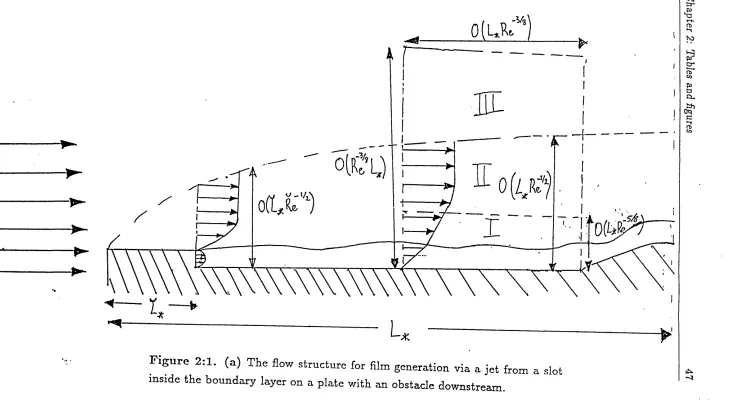
We assume th e flo w to be tw o -d im e n sio n a l and, fu rth e r, th a t a t th e leading edge o f a fla t p la te in a u n ifo rm stream a b o u n d a ry layer on a surface is generated in w hich we have steady, incom pressible p la n a r flo w . D o w n stre a m o f th e leading edge we have a film generated by a slo t, in the fo rm o f a je t; see fig 2 :1(a ). G ra v ity and surface ten sio n are in clu d e d in th e p ro b le m fo rm u la tio n fo r th e base flo w ca lculation s, a lth o u g h th e y are discarded in th e n u m e rica l in v e s tig a tio n la te r as in a re la te d w o rk by Nelson et al. (1995).
coef-C h a p te r 2: Blasius b o u n d a ry layer on a film -co a te d w a ll
20
fic ie n t 7 = 7* / / ) j ^ T h e non-dim ensionalized stream w ise and n o rm a l ve lo c ity com ponents are u, v, we take x, y as the b o u n d a ry layer coordinates p a ra lle l and n o r m a l to th e flo w , w ith z * = 2 * ( z -f 1), y* = W ith p th e n o n-dim en sional pressure and / the in te rfa ce p o s itio n between the tw o flu id s , ta ke n in itia lly to be a , th e h eight o f the slo t, th e governing equations become
f -»■ ï + f -»■
<-^1
w here we deflne = 1, i/+ = 1, p~ = p * ~/ = f/* — Th e a p p ro p ria te b o u n d a ry co n d itio n s are
y -> 0 0 = 1, (2.1.3)
j D /
= U , = V = — = p
3/ = / : ' D r a y (2.1.4)
p+ - p - = j f î i - { p - - l ) f / F r ,
y = 0 : u “ =: 0, 7; “ = 0, (2.1.5) X = 0 : u'^ = Ub, = J y { à - ÿ), ; f = à (2.1.6)
where Ub = Ub{v — à) is the Blasius p ro file , J is a constant m easuring th e stre n g th o f th e je t and th e shape o f the interface is described by y = f { x ) .
C h a p te r 2: T rip le deck on
a
w a ll m o unted obstacle21
w ith th e m ain b o u n d a ry layer gro w in g like and th e in te rfa c ia l shear in th e b o u n d a ry layer decreasing like w ith the film flo w d rive n by th e applied in te rfa c ia l shear. I f Ÿg is the mass flu x at th e slot, given by th e value o f th e stream fu n c tio n Ÿ a t th e in te rfa ce , so th a t u~ = d ' ^ f d y , th e n th e stream w ise velocities and in te rfa c e p o s itio n in th e region y ~ are given b y
w here \ b = d U B l d y { 0 ) , and the b o u n d a ry layer flo w approaches th e B lasius p ro file d o w n stre a m in the region y x ~ ^ / ^ ~ 1. B y a lte rin g Ÿg , e ith e r v ia th e size o f th e in je c tio n slot o r the speed o f th e je t, we can set th e fllm thickness d o w n stre a m . A t z 1 th e fllm forgets about th e specific source. T h is allows us to p e rfo rm th e trip le -d e c k analysis a t a s ta tio n A* dow nstream in the n e x t section, w h ich requires a fllm o f thickness 0 ( E e “ ^/®), in te rm s o f th e lo ca l Reynolds n um ber (see fig 2 : l( a ) ) , i f
V “ ly/8 3/8__3/8
we have a flu x o f 0(TZe L j A* ). Hence we m ay assume fo r aU o u r subsequent analysis th a t o u r p redeterm ine d in itia l lo ca l base p ro file consisting o f tw o constant shears can be o b ta in e d , o r is indeed ty p ic a l, in a tw o flu id system . O th e r mechanisms can be tre a te d in a s im ila r fashion, fo r exam ple in je c tio n th ro u g h a porous w a ll, c f C ow a rd & H a ll (1996).
2.2
Triple deck on a wall m ounted ob stacle
In th is subsection we o u tlin e th e scalings used to in ve stig a te th e flo w w ith in a b o u n d a ry la ye r w h ich develops over a lo c a l surface roughness defined by %/* = h * ( z * ) , see fig 2 ;2 (a ). W e quote the rescalings used fo r a short-scale analysis o f flo w over a fla t p la te , w h ic h lead to th e trip le -d e c k equations fo r fllm coated flow s, as derived by T im o s h in (1997), Tsao et al. (1996) fro m th e fu ll N avier-S tokes equations. A fte r n o n -d im e n sio n a lizin g we p e rfo rm a P ra n d tl s h ift, in tro d u c in g th e surface shape in to th e p ro b le m .
C h a p te r 2: T rip le deck on a w a ll m o u n te d obstacle
22
to th e lo c a l p o in t o f in v e s tig a tio n (ta ke n to be the centre o f an obstacle on th e w a ll la te r in th is section), w ith corresponding R eynolds n u m b e r Re = ( > 1),
Froude n um ber F r — and surface tension coefficient 7 = 7* //) + T he
non-dim ensionalized te m p o ra l and s p a tia l co-ordinates, velocities, pressures and in terface shape are denoted by f, x , ÿ, û, v, p and / , W it h à d e n o tin g th e u n p e r tu rb e d in te rfa ce p o s itio n up stre a m fro m th e area under in v e s tig a tio n , we rescale to the trip le -d e c k variables in the viscous sublayer (zone I in fig 2 : l( a ) )
û , v , p , x , ÿ , i , à , f =
€ ^ (A + )-^ /7 , (2.2.1)
w ith €o = y representing the lo ca l n o rm a l co o rd in a te in th e viscous sublayer, and A+ d e n o tin g th e shear o f th e upper pro file . W e w rite p"*" = 1, z/"*" = 1, p “ =
p^ T! P * ^ ■> and defining y = h ( x ) to be th e non-d im e n sio n a l w a ll shape apply a P ra n d tl s h ift to the trip le -d e c k equations,
y = Y / i( x ) , V =■ V u——. (2.2.2) T his leaves us w ith
and th e a p p ro p ria te b o u n d a ry co n d itio n s are
y ^ 00 u'^ = Y + a( - 1) + A ( x ) -1- h { x ) -j- o ( l ) , (2.2.5)
y = 0 u~ = 0, v~ = 0, (2.2.6)
u + = Y - a + U , , ^ (2.2.7)
u~ = \ ~ Y
where A“ = Ug = a \ ~ and th e shape o f th e in te rfa ce is described by
C h a p te r 2: B o u n d a ry la ye r on elongated obstacles
23
•p’*’ ~ P — l { f x x + hxx) — {p — 1 ) ( / + h ) l F r (2.2.9)
w here 7 = F r = are th e rescaled surface tension coeffi
cient and Froude n u m b e r respectively. F in a lly the in te ra c tio n c o n d itio n fo r subsonic flows com pletes th e tr ip le deck fo rm u la tio n ,
=
(
2
.
2
.
10
)
^ 7-00 3 - 5
2.3
B oun d ary layer on elon gated ob stacles
F rom now one in th is C h a p te r we exam ine th e steady case, d j d t = 0. T he firs t step now is to rescale th e p ro b le m ta k in g th e le n g th o f th e hu m p L as o u r ty p ic a l le n g th scale. W e consider lo n g hum ps w ith T 1 on th e tr ip le deck scale. T he procedure is s im ila r to th a t used in S m ith , B rig h to n , Jackson, H u n t (1981). W e take
y ~ Z f 3 ,
T h e n fro m th e balance ~ p ^ and, fro m (2.2.10) we know A ~ zp"*", we have
A L s .
We exam ine no w hum ps w ith a h e ig h t scale /i ~ T s ^ as we w a n t a c o n trib u tio n
{ A - \ - h ) 0 { L ^ ) i.e. A = - h - \ - 0 { L ï ) . T h is height produces a nonlin e a r response in th e viscous la y e r w ith th e induced pressure p ro p o rtio n a l to th e slope o f the obstacle
h / L .
To keep th e in te rfa c ia l effects in th e analysis we m ust ensure th a t th e fllm rem ains w ith in th e viscous sublayer so we ta ke
a ~ / ~ T 3 => f <. h. (2.3.1)
F in a lly in o rd e r to keep surface te n sio n and g ra v ita tio n a l effects in th e p ro b le m fo rm u la tio n we ta ke
C h a p te r 2: B o u n d a ry la y e r on elongated obstacles
24
In accordance w ith th e estim ates above we in tro d u c e new variables,
Y = X = L x ,
f = h = L ^ / % a = L ^ / %
7 = X7, Ft = ^ , A = - L ' ^ h [ x ) + L~^ À { x ) . (2.3.3)
T h e flo w scheme is show n in flg 2 :2 (a ) and th e governing equations expressed in the new variables are
w ith th e b o u n d a ry c o n d itio n s
ÿ 00 : Ü + = ÿ - â y U , + À { x ) + o { l ) , (2.3.6)
ÿ = 0 : û~ = 0, v~ = 0, (2.3.7)
x - > - o o f (2.3.8)
u - = X~y,
and also a t ÿ = f { x )
S+ = « - , 5 + = î - = ü ± / î ( x ) , ^ = (2.3.9)
p+ - p - = j h î - h { p - - 1)1 Ft, (2.3.10) (2.3.11)
7T X - S
T h e re is no pressure/ displacem en t re la tio n now w ith the in te ra c tio n c o n d itio n re placed b y a given pressure re la te d to th e surface roughness.
F o r c o m p u ta tio n a l purposes th e pressure-hum p shape re la tio n (2,3.11) is r e w r it te n ta k in g F o u rie r tra n s fo rm s ,
/
oo _C h a p te r 2: B o u n d a ry la y e r on elongated obstacles
25
so th a t
^ ^ / e'kc I I 3 ^ { h{ x) ) ] dk. (2.3.13)
dx I'K y_oo
F or th e pressure g ra d ie n t in the film th e re la tio n (2.3.10) can be d iffe re n tia te d and th e d e riva tive s o f h c a lcu la te d e x p lic itly fo r a chosen roughness.
2.3.1
T h e num erical m eth o d
N u m e ric a l s o lu tio n s are o b ta in e d to th e problem s setup in §2.1 and §2.3, by m a rch in g in th e a p p ro p ria te c o -o rd in a te x o r ï , using ite ra tio n s at each stream w ise s ta tio n . We o u th n e th e n u m e ric a l m e th o d in term s o f the variables in §2.3, however the rescalings ta k e th e same fo rm fo r b o th problem s, replacing aU variables x , . . . w ith X , ... and s e ttin g h = 0, w ith the o n ly difference in n u m e rica l representations being th e fa r-fie ld b o u n d a ry con d itio n s.
To c o n s tru c t th e a c tu a l so lu tio n we rescale the n o rm a l co o rd in a te in the film and m ake a fu r th e r P r a n d tl sh ift in th e b o u n d a ry layer w ith respect to th e u n kn o w n in te rfa c e p o s itio n . In th e b o u n d a ry -la y e r equations (2.3.4), (2.3.5) we w rite
(7+ = V + = Ü+ — ü " ^ ^ ( x ) , X = X, (2.3.1.1a)
P + = p + ,
r + = ÿ - / ( x ) ,
F = f,
(2.3.1.1b)
w h ich yields th e e quatio ns, vaHd fo r > 0,
^ + . « P .3 .1 .3 )
w ith b o u n d a ry c o n d itio n s
y + - o o : U+ = Y + + U , - â + À { X ) + F ( X ) + o { l ) (2.3.1.4)
r + = 0 : 7 + = 0 (2.3.1.5)
X - 0 0 : U + = Y + + U „ F (2 .3 .1 .6 )
C h a p te r 2: B o u n d a ry la y e r on elongated obstacles
26
T h e film re g io n is m apped o n to th e fin ite s trip 0 <
Y~
< 1 using a change o f variables suggested b y D r J. W . E llio tt ( p riva te c o m m u n ica tio n ), We w riteY~
= , X = X,U~
— (2.3.1.7a )f { ^ )
V - = V ~
P-=r,
F = f ,
(2.3.1.7b)w h ich give th e equations
and b o u n d a ry c o n d itio n s
Y ~ = 0 : U - = V ~ = 0,
(2.3.1.10 )y - = 1 : y - = 0, (2.3.1.11 )
X - ^ - o o :
U
=UsY~.
(2.3.1.12 )T h e in te rfa c ia l c o n d itio n s o f c o n tin u ity o f ta n g e n tia l v e lo c ity and n o rm a l ve lo city, th e ju m p in pressures and shears and the viscous-inviscid in te ra c tio n c o n d itio n , w h ich becomes a given pressure re la tio n , are th e n expressed as
u + { Y + = 0) = u - { Y - = 1), ^ ( y + = 0) = ^ ^ ( y - = i ) , (2.3.1.13)
y + ( y + = 0) =
V - { Y ~
= 1) = 0, (2.3.1.14 )d P + d P - _ d ? H { p - - l ) d B
d X d X ' d X ^ Ft d X ' (2.3.1.15 )
P + = - - r (2.3.1.16 )
7T / __ — 00 X — S
where h [ x ) = H { X ) .
C h a p te r 2: B o u n d a ry la y e r on elongated obstacles
27
0. T h e o n ly differences, fo r nu m e rica l purposes, are the b o u n d a ry c o n d itio n s , (2.1.3), (2.1.6), w h ich become
00 : £/■+ -^ 1, (2.3.1.17)
X = 0 : U-^ = Ub( Y + ) , U ~ = J Y - ( l - Y - ) , F = a (2.3.1.18)
w here J = d?J.
A th re e -p o in t b a ckw a rd difference is used fo r derivatives and a tw o -p o in t c e n tra l difference fo r th e n o rm a l d ire c tio n :
d i { X ) U { X ) - A i { X - A X ) -h i { X - 2 A X )
d X 2 A X
a e ( y ± ) ^ ( y ± -h A y ± ) - ^ ( y ± - A y ± )
(2.3.1.19)
(2.3.1.20)
5 y ± 2A y ±
w here ^ is a re p re se n ta tive fu n c tio n .
P ro v id e d th e so lu tio n is know n at X — 2 A X and X — A X the m o m e n tu m equa tio n s a t th e n e xt X - s ta tio n are w r itte n in the fo rm
= d f (2.3.1.2 1)
w ith th e coefficients given by
— P A T T - _ O T T - P
V - ^ A Y - jy- _ 3 U - ^ A Y - 2 u
-“1 -
-
2 AX
+
(2-3-l-22a)
V T ^ A y
-9 - (2.3 .1 .2 2 b )
. . ,2 / 1 d P - u f
d - = ( A y - ) ^ ^
,
y . + ^ A y + ^ 3 [ f t ^ A y + ^y - + P A y +
^
2
^
C h a p te r 2: B o u n d a ry la y e r on elongated obstacles
28
where the superscripts p, 2 ,1 and su b scrip t j represent, respectively, th e p re d ic to r value fo r th e cu rre n t X - s ta tio n , the value at the X — A X and a t X — 2 A X and the p o sitio n . O m ittin g references to th e specific flu id layer, to ca lcu la te th e new values fo r U, V, F , th e fu n c tio n is w r itte n in the fo rm
U j ^ i = P j U j + qj (2.3.1.23) w hich upon s u b s titu tio n in to (2.3.1.21 ) gives
^
From th e b o u n d a ry co n d itio n s, (2.3.1.10 ), (2 .3 .1 .4 ), along w ith th e c o n d itio n o f c o n tin u ity in at the in te rfa ce we fin d
Pj max- - 1 ~ ^ j m a x - - l ~ — 0, U}' = U^nt’ (2.3.1.25) For the p ro b le m in b o u n d a ry layer flo w in §2.1 the fa r-fie ld co n d itio n s re q u ire
P^Tnax+-l ~ (2.3.1.26a)
and fo r th e trip le deck p ro b le m described in §2.3 we have
^ ^ a x + - l “ ^t ma x +- l ~ > (2.3.1.26 b)
where th e subscripts j m a x ~ ^ , j m a x ~ , i n t refer to values being ta ke n a t th e fin a l points in Y + , Y " and a t th e in te rfa ce , respectively. is th e n fo u n d usin g th e in com pre ssib ility condition s (2 .3 .1 .9 ), (2.3.1.3) w hich have also been discretized using the tw o- and th re e -p o in t difference fo rm s (2.3.1.19 ), (2.3.1.20).
To begin th e so lu tio n procedure, guesses are m ade fo r th e in te rfa c ia l ve lo c ity and p o s itio n Uint, F at th e new X —s ta tio n , to g e th e r w ith a p re d ic te d v e lo city d is trib u tio n across th e flo w . T h e n the re la tio n s (2.3.1.21) -(2 .3 .1 .2 5 ) w ith the a p p ro p ria te fa r-h e ld c o n d itio n , (2.3.1.26a) or (2.3.1.26 b) are used to calculate the ’c o rre c to r’ velocities T h is procedure is carried o u t w ith th re e pairs o f in itia l guesses fo r th e in te rfa c ia l speeds and p o sitions. T w o fu n c tio n s representing in te rfa c ia l b o u n d a ry co n d itio n s, A and B defined as
C h a p te r 2: B o u n d a ry la y e r on elongated obstacles
29
are used to ca lculate c o rre c to r values fo r Uint, F w ith tw o -p o in t N e w to n ite ra tio n s aim ed a t s a tis fy in g th e co n d itio n s A = 0, J9 = 0 and th e w hole procedure is ite ra te d u n til a convergence c rite rio n ,
A U < €
iA F C e i ,
(2.3.1.28)
is satisfied, w here ei is a chosen tole ra n ce , ty p ic a lly o f 0 (10“ ®).
2.3.2
R esu lts
H a vin g estabhshed a credible m odel fo r th e tw o -flu id flo w , w ith in th e film and fo r a com parable d e p th w ith in th e b o u n d a ry la ye r flu id , we lo o k at th e various param eters w h ich influence th e onset o f the G o ld s te in s in g u la rity /flo w b re a kd o w n fo r flo w over an obstacle. F or th e purposes o f th e n u m e rica l calculation s th e obstacle was defined to be
H { X ) = hoe~^^, -o o < X < oo.
(2.3.2.1)
T h e firs t and m ost obvious p a ra m e te r is /iq, the h u m p size coefficient. The v e lo c ity p ro file in th e film can be w r itte n in the fo rm
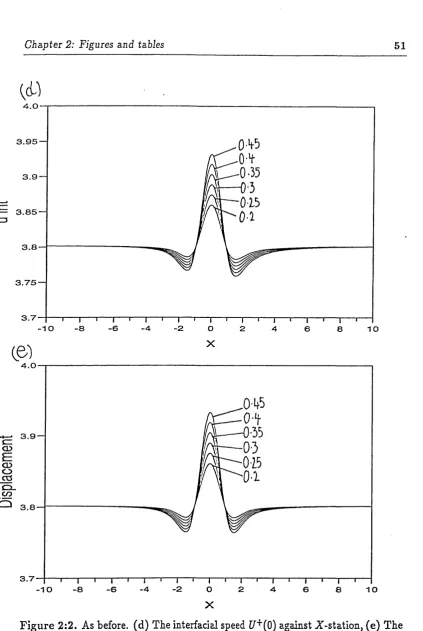
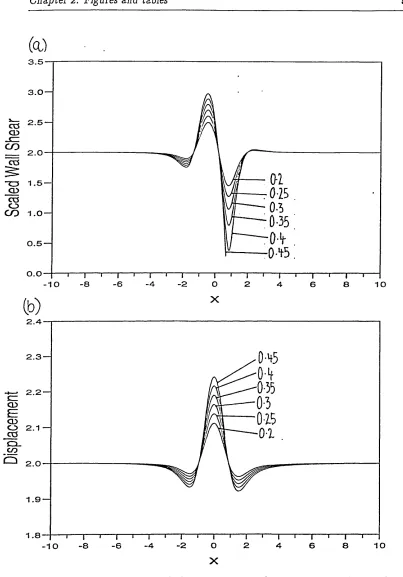
U ~ = X ~ Y ~ + h o t / - , (2.3.2.2) and since th e flo w breaks dow n w here d U ~ I d Y ~ —> 0, we expect th e he ig h t Hq to be im p o r ta n t, especially close to th e w a ll where the c o rre c tio n Ü~ is h ke ly to have its greatest influence. L o o k in g at o u r figures 2:2 and 2:3 we see th a t th e slope o f the skin fr ic tio n approaches th e G oldstein s in g u la rity , th ro u g h th e m a rg in a l s in g u la rity where d U ~ / d Y ~ {0) —> 0, as th e obstacle h e ig h t, |/io|, is increased. G raphs o f th e co m p a ra tiv e h u m p effects are shown in figs 2:2(b )-(e ), fo r a system o f w a te r in the film and an equal m ix tu re o f sihcone o il V 2 and 1 -2 -3 -4 -te tra h yd ro n a p h ta le n e in the b o u n d a ry la ye r, w ith th e param eters ta ke n fro m P ouhquen, C hom az & H uerre (1994) as an exam ple o f a real d y n a m ic a l system , and in Figs 2 :3 (a ),(b ) fo r a homogeneous system . T h e o th e r fa c to rs w h ich can affect th e onset o f th e m a rg in a l s in g u la rity are,
Chapter
2: In v is c id in s ta b ilitie s in film -c o a te d fiows30
S ta rtin g w ith th e effect o f th e d e n sity ra tio s on flo w separation , i t was found th a t i f th e film flu id is less dense th a n th a t in th e b o u n d a ry layer th e n separation is re ta rd e d , w h ils t denser film s cause sep a ra tio n fo r sm aller obstacles. T h is is because the shear is reduced in a denser film flu id and vice versa and so a film co a tin g o f a less dense flu id w ill cause an o therw ise separating flo w to re m a in a ttached .
In tro d u c tio n o f surface tension in to th e system appears to enhance flo w reversal as does an increased g ra v ita tio n a l influence, F r ^ oo. As w ith density, less viscous flu id s in th e film do n o t cause separated flow s fo r th e same obstacle h eight as the equivale nt hom ogeneous system , w h ils t m ore viscous fluids in th e film have the o p posite effect, enhancing separation .
T h e fin a l p a ra m e te r, th e no n -d im e n sio n a l film thickness, does n o t appear to affect th e b e h a v io u r o f th e system in te rm s o f flo w reversal, at least n o t fo r the chosen values o f â, a lth o u g h i t m u st be rem em bered th a t th e a ssum ption has been m ade in th e scaling o f th e p ro b le m th a t th e film thickness rem ains w ith in th e viscous sublayer o f th e tr ip le deck fo rm u la tio n . N o in te rn a l separation o f th e ty p e fo u n d in Sychev (1 9 8 0 ), E llio t t , S m ith , C ow ley (1993), T im o s h in (1996) was encountered in th e cases s tu d ie d here, w ith aU failu re s o f th e n u m e rica l m e th o d , i.e. th e occurrence o f sin g u la ritie s , b eing caused by zero waU shear.
Leavin g se p a ra tio n aside, and c o n c e n tra tin g on flow s whose stream w ise v e lo city profiles r e tu rn to th e ir o rig in a l lin e a r fo rm fa r dow nstream , we tu r n to th e graphs o f the displacem ent fu n c tio n À { x ) and th e skin fr ic tio n fo r a given obstacle and tw o flu id system . Figs 2 :2 (b ),(e ) and 2 :3 (a ),(b ) show in te rva ls o f x w ith decreasing w a ll shear b u t increased displacem ent and hence th e lik e lih o o d o f in fle x io n p o in ts developing in th e v e lo c ity p ro file s fig 2 :4 (a ),(b ), w h ich w ill fa c ilita te R ayleigh in s ta b ility . T h is w in be exam ined in th e n e x t section.
2.4
Inviscid in stab ilities in film -coated fiows
C h a p te r 2: In v is c id in s ta b ilitie s in film -c o a te d fiow s
31
layer flo w over an obstacle on th e trip le -d e c k scale, w ith L representing the obstacle le n g th , th e n th e new d is tu rb a n c e lengthscale scale is ta ke n as
P ^ ^ R e ~ < < < 2 '/ ^ (2.4.1) i.e. sh o rt com pared to th e tr ip le deck scale b u t a t least as lo n g as the c h a ra cte ristic
R ayleigh scale F ir s t we exam ine th e case <C fro m w h ich
we o b ta in a long-w ave (in te rm s o f the film thickness) in te g ra l co n d itio n fo r the d istu rb a n ce phase speed c. We th e n exam ine disturbances w ith = R e ~ î L ^ ^ ^ ,
v a ria tio n s o f th e pressure te rm in y th e n affect th e flo w and in s ta b ih ty is governed b y th e f u ll in v is c id R a yle ig h e q u a tio n .
We begin w ith an a n a ly tic a l e x a m in a tio n o f b o th regim es, solving fo r a s lig h tly p e rtu rb e d tw o shear stream w ise lin e a r v e lo c ity p ro file , such as th a t generated by the flo w over a sh a llo w obstacle, to o b ta in th e d istu rb a n ce g ro w th ra te expHcitly. T h e results are th e n com pared w ith those o b ta in e d n u m e ric a lly using a discrete ite ra tiv e m e th o d fo r th e f u ll R a yle ig h p ro b le m , as o u th n e d in a subsequent section, on th e profiles c a lcu la te d in §2.3.2.
2.4.1
T h e long-w ave in sta b ility
We in tro d u c e sm a ll te m p o ra l and s p a tia l wave p e rtu rb u rb a tio n s , 0(<?), to th e veloc itie s and pressure fields and define the wave as
E = exp i k ( æ — -— t (2.4.1.1) W it h th e g o v e rn in g equatio ns given by (2 .3 .4 )-(2 .3 .1 1 ) we w rite th e velocities and pressure as
= U ^ { ÿ ) + 6 { ü f E + c . c . ) + ... (2.4.1.2)
= ... H—-— E -{- c.c.) + ... (2.4.1.3)
Li n V
6 { p f E C . C . ) + ... (2.4.1.4) w h ich lead to th e re la tio n
C h a p te r 2: In v is c id in s ta b ilitie s in him -co a te d hows
32
T h e b o u n d a ry co n d itio n s a t the w a ll, in fin ity and an in te rfa c ia l c o n d itio n re la tin g th e n o rm a l v e lo c ity and pressure in th e film to th a t in the b o u n d a ry la ye r com plete th e p ro b le m fo rm u la tio n :
V (2/ = 0) = 0 , - g ^ i y = 00) = 0 (2.4.1.6)
and at y = f
( [ , . _ , ) ( ( W - 1" * - ‘ K . ) I . # . , .
\ - p ' K B r t f . - - ( y - /
w here 7 = 7/ Z ^ . W e solve th is and fin d a general s o lu tio n in the fo rm
5+ = Q t { U + - c) £ - 0) (2 4.1.8)
^ 1
V - = Q - ( U - - c) ^ _ _ dg + Q ^ { U - - c) (2.4.1.9)
T h e b o u n d a ry c o n d itio n s (2 .4 .1 .6 ) force = 0, Q2 = 0, fro m th e in te rfa c ia l
c o n d itio n (2 .4 .1 .7 ) we o b ta in th e re la tio n
Q Z = P ~ Q ï - ^ T c ’ (2.4.1.10)
and th e n o rm a liz a tio n c o n d itio n V i ( f ) = 1 gives
Q l — ~ Jo { U ~ — (2.4.1.11)
C o n tin u ity o f v a t th e in te rfa ce th e n gives th e dispersion re la tio n
2.4.2
R ayleigh -w ave in sta b ility
C h a p te r 2: In v is c id in s ta b ilitie s in film -c o a te d flows
33
We s ta rt by ta k in g an a n a ly tic a p p ro x im a tio n to the stream w ise base v e lo c ity profiles U ( ÿ ) in (2.4 .1.2), w r itin g th e m as piecewise-hnear profiles w ith a sm a ll co r re c tio n 0 ( e ) , here p ro p o rtio n a l to base flo w d e parture fro m lin e a rity and hence th e hum p size ho, where d <C e <C 1. A s im ila r analysis applies to th e enhanced m ean flo w profiles exam ined in C h a p te r 4. W e also expand th e in te rfa c ia l p o s itio n in powers o f e, and w rite
(7+ = ÿ - â + U , + eG+( ÿ) , (2.4.2.1)
U ~ = A - ÿ + e G - ( ÿ ) , (2 ,4 .2 .2 )
f — c - j - c f i .
(2.4.2.3)
Here d is th e u n p e rtu rb e d in te rfa ce p o s itio n , A“ = l / p ~ , U a = A“ a a n d we n o rm a lize the flo w such th a t at th e in te rfa ce û ^ ( ÿ — f ) = Ug -{■ e.
T he shortened lengthscale, com pared w ith th a t o f §2.4.1, leads to th e fuU in v is c id R ayleigh equ a tio n fo r th e n o rm a l velocities v ^ ,
(Cr± - c )(ü ± J - k ^ v * ) = U ÿ ÿ ^ v f (2.4.2.4)
w ith b o u n d a ry co n d itio n s
v ~ ( y = 0) = 0 , v ' ^ (ÿ = 00) = 0. (2.4.2.5)
E x p a n d in g v i and c in powers o f e
Vi = Vq "b •••> c = cq "1“ eci -j- ..., (2.4.2.6)
and, s u b s titu tin g in to (2.4.2.4), we fin d the solutions
= (2.4.2.T )
We take these solu tio n s, w h ich satisfy th e b o u n d a ry co n d itio n s (2 .4 .2 .5 ) and p u t th e m in to th e in te rfa c ia l c o n d itio n (2.4.1.7). L in e a riz in g and ta k in g te rm s 0 ( 1 ) gives a dispersion re la tio n fo r th e leading order phase speed c q,
C h a p te r 2: In v is c id in s ta b ilitie s in film -c o a te d flows
34
w h ich has th e so lu tio n
1 - p A ± \ / ( l - p - A - ) ^ + 4 7*3(1 + p - cothfcS ) /o . o 01
2 fc (l + p - c o t h i 5 ) ■ ^
We n ote th a t, fo r a ll p o sitive wavenum bers
k, cq is
real. In p a rtic u la r in th e case o f no surface te n sio nC o = U. o r C o = ! 7 , + ^ ' (2.4.2.10)
T h e g ro w th ra te w ill be fo u n d fro m c i. T h e n e xt o rder te rm s, 0 ( e ) , in (2 .4 .2 .4 ) give
(£1± - c o ) ( v 4 - - 1 : V ± ) = Fo±, (2.4.2.11 )
and we lo o k fo r a so lu tio n o f th e fo rm V- ^{ ÿ ) = F ^ { ÿ ) V ^ { ÿ ) . T h e s o lu tio n now depends on th e p o s itio n o f a c ritic a l layer w h ich fo rm s at ÿ = ÿc w here U{ ÿc) = cq.
We w ill fir s t pursue the case o f a c ritic a l layer in the film . We have fo r ÿ < ÿc,
V f = Vo / ; ^ V ; (2.4.2.12 )
fo r ÿ > ÿc,
= V
r
A I r
+ Vr
^ d y + h v , - , (2.4.2.13)dye V
q[dye
^
^0
J
dye: V
q•• G +,Vq^ '
0
ÿ - â + u ,
,
^
.0
w here th e 6i ’s are constants o f in te g ra tio n . T he so lu tio n fo r V { ' contains a te rm o f the fo rm
V f
=
B { ÿ - ÿc)liL\ÿ - ÿc \ - \ -...,
(2.4.2.15)
and as ÿ —> ÿc
C h a p te r 2: In v is c id in s ta b ilitie s in film -c o a te d flows
35
so B = G ^ ÿ { ÿ c ) V ^ { ÿ c ) l ^ ~ and ÿc = c q/ \ ~ . T h e ju m p in th e d e riv a tiv e o f the
n o rm a l v e lo c ity across th e c ritic a l layer is p ro p o rtio n a l to th e lo g a rith m ic te rm in (2 .4 .2 .1 5 ),
y { ÿ { v t ) - y i ÿ i ÿ c ) = (2.4.2.17) w here ÿ f denotes th e lim it value taken as y ÿc above o r below th e c ritic a l layer. T h e re m a in in g b o u n d a ry condition s are th e n o rm a liz a tio n (2 .4 .1 .6 ) a t th e in te rfa ce , th e c o n tin u ity in th e n o rm a l v e lo c ity across the c ritic a l layer, i.e.
F ± ( a ) = -/iV o $ (â ), V f (
5
+ ) = V f ( ÿ f ), (2.4.2 .18)and th e pressure ju m p across the in te rfa ce w r itte n as (2.4.1.7).
O u r a im is to fin d th e im a g in a ry p a rt o f Ci so we need co n ce n tra te o n ly on th e im a g in a ry p a rts o f th e re la tio n s (2.4.2.18). S olving fo r Vi,- using th e b o u n d a ry c o n d itio n s (2 .4 .2 .1 7 ), (2.4.2.18 ), s u b s titu tin g in to (2 .4 .1 .7 ), and ta k in g th e im a g in a ry te rm s 0 (e) we fin d
^ ^ _____________f>_(t^ » -C o )V G j,j,(ÿ c )s in h ^ fc ÿ c _____________ (2.4.2.19 )
X~ sinh k a[ { Ug — co)^A:(sinh A:â + p~ cosh A:â) — sinh k à )
In th e case o f th e c ritic a l layer o c c u rrin g in the b o u n d a ry la ye r we fin d
{Us - co)^7rO ^(ÿc)e^(°"^=)
Cli = 7— T T T :---— --- r-7T I---ITTTT^. ., , , 2
(sinh k{yc - a) + cosh k{yc - a ) ) { k { l + p~ c o thka){Ua - cq) - 7/2^)
(2.4.2.20)
T a k in g th e lo n g wave lim it A; —> 0, th e im a g in a ry p a rt o f th e co m p le x wave speed is given b y th e fo rm u la
C i i i f < a, (2.4.2.21)
C l i ~ ' ^1 i f > a. (2.4.2.22)
p a ^
W e see th a t p o s itiv e c u rv a tu re a t th e c ritic a l h e ig h t ÿ = ÿc provokes in s ta b ility i f
C h a p te r 2: In v is c id in s ta b ilitie s in h lm -co a te d Sows
36
We also exam ine the sh o rt wave h m it A; oo o f (2.4.2.19 ), (2 .4 .2 .2 0 ) to see i f in s ta b ility persists. For b o th th e case o f th e c ritic a l la ye r in th e film and th e c ritic a l layer in th e b o u n d a ry la ye r flo w we see th a t surface tension becomes th e d o m in a n t effect fo r s h o rt waves and the d istu rb a n ce is s tro n g ly stabihzed. I f th e re is no surface tension c ^ —^ O'*' as A: —> oo.
2.4.3
T h e num erical R ayleigh in sta b ility calculation
Here we solve th e p ro b le m n u m e ric a lly fo r th e b o u n d a ry la ye r and film flows w ith b o u n d a ry c o n d itio n s (2 .4 .1 .6 ), (2 .4 .1 .7 ) w ith th e v e lo c ity p ro file , ü ^ , and in te rfa c ia l p o s itio n / ca lcu la te d using th e n u m e ric a l m e th o d o f §2.3.1. O u r n u m e ric a l m e th o d uses th e in v is c id R ayleigh e q u a tio n (2.4.2.4) re w ritte n w ith th e second o rd e r deriva tiv e in th e n o rm a l v e lo c ity in a c e n tra l difference fo rm ,
+ a j V p + v g t i = 0, (2.4.3.1)
where
a j = - { 2 + j , (2,4.3.2)
w ith th e base v e lo c ity profiles w r itte n in term s o f th e o rig in a l v e rtic a l co -o rd in a te
ÿ, subscripts j correspond ing to th e discrete ÿ p o s itio n and prim es d e n o tin g d iffe r e n tia tio n w ith respect to ÿ. We w rite
= P i (2.4.3.3)
w hich, u p o n s u b s titu tio n in to (2 .4 .3 .1 ), gives us the fo rm u la e
P ? + i - p f + a f ’
±
w ith th e b o u n d a ry co n d itio n s (2 .4 .1 .6 ), (2.4.1.7) re q u irin g
Q2 — P t ~ ^m a x + ~ (2.4.3.5)