PERFORMANCE MODELING AND RESOURCE
MANAGEMENT FOR MAPREDUCE APPLICATIONS
Zhuoyao Zhang
A DISSERTATIONin
Computer and Information Science
Presented to the Faculties of the University of Pennsylvania in Partial Fulfillment of the Requirements for the Degree of Doctor of Philosophy
2014
Boon Thau Loo Associate Professor,
Computer and Information Science Supervisor of Dissertation
Insup Lee
Cecilia Fitler Moore Professor, Computer and Information Science
Co-Supervisor of Dissertation
Val Tannen
Professor, Computer and Information Science Graduate Group Chairperson
Dissertation Committee
Zachary Ives (Chair), Associate Professor, Computer and Information Science Susan Davidson, Weiss Professor, Computer and Information Science Andreas Haeberlen, Raj and Neera Singh Assistant Professor, Computer and
Information Science
MAPREDUCE APPLICATIONS COPYRIGHT
2014 Zhuoyao Zhang
From the first day I joined the Ph.D program in Penn, I have spent five fruit-ful years in this group until finally, my research work comes into this dissertation. Here, I would like to express my deepest gratitude to my advisor, my collabora-tors, my friends and family and other individuals who support me through these years. Without their help, it is not possible for me to go this far.
First of all, I would like to thank my advisors, Professor Boon Thau Loo and Insup Lee who offered me the opportunity to pursue graduate studies at Penn and guided me through my research work. Insup provided me great support during my early years by exposing me to different research areas through our discussions. He also introduced me the work of real-time system which later helps me form the initial idea of my dissertation work. Boon have been extremely supportive through each step during my study. He gave me valuable advice on shaping my research directions, refining theoretical approaches as well as on technical details like designing experiments and analyzing results. He is also a great mentor who is open minded and willing to encourage students exploring new ideas, so that I could have freedom to choose research topics I am interested. I have learned from him not only the research skill, but also the importance of collaboration, passion about work, self-discipline and life balancing.
Next, I would like to thank Dr. Lucy Cherkasova who is my mentor during my internship in HP Labs. We worked together for two summers and have been kept collaborating remotely for more than two years. It was an exciting and fruitful working experience, during this time period, we have published papers on several conferences, workshops and journals. We filed two patents and presented our
work in different occasions. All this could be achieved without her help. Lucy is especially patient and considerate in mentoring my research work as well as other aspects in my Ph.D life. I remember she walked through every page of my slides in preparing my talk and rehearsal multiple times with me even for internal presentations and that really helps me to clear my thoughts and is especially useful when I need to explain my works to other researchers later. The time we spent in HP Labs has been one of the most precious pieces of memory in my life.
I would also like to thank my collaborators. Among them, I would like to first thank Dr. Godfrey Tan who I worked with in my first project on job scheduling in large-scale distributed systems and encouraged me a lot during my first years as a Ph.D student. Dr. Linh T.X. Phan who is now a research assistant profes-sor in Penn has a profound influence on my early research. She first brought the idea to introduce theories from real-time system into the parallel data processing platform which inspired me for my later works. I was also fortunate enough to col-laborate with many other individuals from different places. Saumya Jain and Qi Zheng who were Penn graduate students and worked with me on several projects. I appreciate a lot for their help in system implementation and experiments. Ab-hishek Verma and Feng Yan are my collaborators during my summer intern and we worked together on MapReduce related problems from whom I have learnt a lot about Hadoop system. I also had a great time work with other students in the group such as Sanchit Aggarwal, Yang Li and Harjot Gill, who broadened my horizon, and enabled me to explore different types of problems outside my core research area.
This dissertation benefited from many great suggestions provided by my the-sis committee members, professor Zachary Ives who is also my WPE-II committee chair, professor Susan Davidson and Andreas Haeberlen who provided me valu-able advise through the write up.
In addition, I have to thank members from the NetDB group: Wenchao Zhou, Changbin Liu, Anduo Wang, Mengmeng Liu, Alex Gurney and Ling Ding, all of them have given me great suggestions in preparing my WPE-II writing and
would like to give my special thanks to Mike Felker for helping me go through many tedious details of administrative tasks, and also to Cheryl Hickey and many other wonderful staff who make my life much easier.
Besides my research work, I want to thank my friends that colors my life after work. Special thanks to my best friend Lin Shao who listened to me and stayed with me through my hard times. My current and previous roommates: Qi Zhang, Jie Li, Xiang Yang, Weiyu Zhang, Yanfei Wang, Jiechang Hou, Matt Malloy, Han-jun Xiao, Yang Wu for those memorable times we shared together. Also friends I made these years: Zhuowei Bao, Chen Chen, Naobo Chen, Jian Chang, Qing D-uan, Pengfei Huang, Zhihao Jiang, Dong Ling, Gang Song, Shaohui Wang, Meng Xu, Zhepeng Yan, Yifei Yuan, Mingchen Zhao, Jianzhou Zhao and many others.
My research was funded in part by the following funding agencies and sources: NSF CNS-1117185, CNS-1040672, CNS-0834524, CNS-0845552, IIS-0812270 and ARO grant W911NF-11-1-0403.
Last but not least, I dedicate this dissertation to my parents, Yongting Zhang and Xunjian Liu for their selfless love. They have made great sacrifice to support my study abroad and my dreams. In the past five years, I spent very little time with them which I believe has made their life much more difficult especially I am the only child in the family, but they never complied a word about that. It would worth everything if this dissertation could bring them proud and comfort.
ABSTRACT
PERFORMANCE MODELING AND RESOURCE MANAGEMENT FOR MAPREDUCE APPLICATIONS
Zhuoyao Zhang Boon Thau Loo
Insup Lee
Big Data analytics is increasingly performed using the MapReduce paradigm and its open-source implementation Hadoop as a platform choice. Many applica-tions associated with live business intelligence are written as complex data analy-sis programs defined by directed acyclic graphs of MapReduce jobs. An increasing number of these applications have additional requirements for completion time guarantees. The advent of cloud computing brings a competitive alternative solu-tion for data analytic problems while it also introduces new challenges in provi-sioning clusters that provide best cost-performance trade-offs.
In this dissertation, we aim to develop a performance evaluation framework that enables automatic resource management for MapReduce applications in achiev-ing different optimization goals. It consists of the followachiev-ing components: (1) a performance modeling framework that estimates the completion time of a given MapReduce application when executed on a Hadoop cluster according to its in-put data sets, the job settings and the amount of allocated resources for processing it; (2) a resource allocation strategy for deadline-driven MapReduce applications that automatically tailors and controls the resource allocation on a shared Hadoop cluster to different applications to achieve their (soft) deadlines; (3) a simulator-based solution to the resource provision problem in public cloud environment that guides the users to determine the types and amount of resources that should lease from the service provider for achieving different goals; (4) an optimization strategy to automatically determine the optimal job settings within a MapReduce applica-tion for efficient execuapplica-tion and resource usage. We validate the accuracy, efficien-cy, and performance benefits of the proposed framework using a set of realistic MapReduce applications on both private cluster and public cloud environment.
Contents viii
1 Introduction 1
1.1 Motivation . . . 2
1.2 Contributions of the dissertation . . . 3
1.2.1 Contribution 1: performance modeling framework for MapRe-duce applications . . . 4
1.2.2 Contribution 2: resource allocation for deadline-driven MapRe-duce applications . . . 5
1.2.3 Contribution 3: resource provision in public cloud environ-ment . . . 6
1.2.4 Contribution 4: performance optimization for MapReduce applications . . . 7
1.3 Overview of dissertation . . . 8
2 Background 10 2.1 MapReduce framework . . . 10
2.2 Pig programs . . . 12
3 Performance Modeling Framework 15 3.1 Platform performance model . . . 17
3.1.1 Profiling MapReduce phases . . . 17
3.1.2 Microbenchmarks . . . 21
3.1.4 Accuracy of the platform performance model . . . 27
3.2 MapReduce job model . . . 31
3.2.1 Estimate task durations within a job . . . 32
3.2.2 Performance model for a single MapReduce job . . . 34
3.2.3 Accuracy of the MapReduce job model . . . 36
3.3 MapReduce workflow peformance model . . . 45
3.3.1 Estimate input data size through the worklfow . . . 45
3.3.2 Modeling MapReduce workflows with sequential jobs . . . . 47
3.3.3 Modeling MapReduce workflows with concurrent jobs . . . . 53
3.4 Model sensitivity . . . 59
3.4.1 Impact of sample data size . . . 59
3.4.2 Impact of input data on the map function performance . . . . 61
3.4.3 Impact of data skew in reduce stage . . . 62
3.4.4 Variability of job profiles in public cloud environment . . . 64
3.5 Conclusion . . . 66
4 Resource Management for MapReduce Applications 68 4.1 Deadline-driven resource allocation on shared Hadoop cluster . . . . 69
4.1.1 Resource allocation for single MapReduce job . . . 70
4.1.2 Resource allocation for MapReduce workflows: a basic ap-proach . . . 71
4.1.3 Schedule concurrent jobs within a workflow . . . 75
4.1.4 Resource allocation for MapReduce workflows: a refined ap-proach . . . 80
4.1.5 Deadline-driven job scheduler . . . 84
4.2 Resource provisioning in public cloud environment . . . 88
4.2.1 Solution framework . . . 90
4.2.2 Resource provision for homogeneous cluster . . . 97
4.2.3 Resource provision for heterogeneous cluster . . . 105
5.1 Motivation . . . 116
5.1.1 Why not use best practices? . . . 117
5.2 Problem definition and the solution outline . . . 119
5.2.1 Two optimization strategies . . . 121
5.3 Evaluation results . . . 125
5.3.1 Experimental workloads . . . 126
5.3.2 Performance optimization benefits . . . 127
5.3.3 Performance benefits of the optimization strategies . . . 129
5.4 Conclusion . . . 131
6 Related Work 133 6.1 Performance model for MapReduce applications . . . 133
6.2 Resource management for MapReduce jobs . . . 136
6.3 MapReduce performance optimizations . . . 140
7 Conclusion 142 7.1 Summary . . . 142
7.2 Future work . . . 143
List of Tables
3.1 Relative error distribution . . . 29
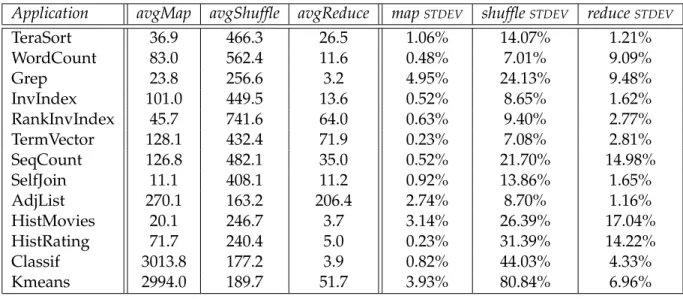
3.2 Application characteristics. . . 38
3.3 UPenn cluster description. . . 40
3.4 EC2 Testbed description. . . 41
3.5 Job profiles ofAdjliston UPenn cluster. . . 44
3.6 Job profiles ofWordCounton UPenn cluster. . . 44
3.7 Processing time per record forKMeanswith different number of initial centroids. 62 3.8 Measured and predicted completion times forKMmeans . . . 63
3.9 Job profiles on the EC2 cluster with small instances (time in sec) . . . 66
3.10 Job profiles on the EC2 cluster with medium instances (time in sec) . . . 66
3.11 Job profiles on the EC2 cluster with large instances (time in sec) . . . 67
4.1 CPU types used by different EC2 instances. . . 90
4.2 Application characteristics. . . 110
4.3 Cluster provisioning results for workloadW1. . . 112
4.4 Cluster provisioning results for workloadW2. . . 112
4.5 Cluster provisioning results for workloadW3. . . 112
5.1 Notation Summary . . . 122
1.1 Overview of the dissertation . . . 8
2.1 Architecture of MapReduce framework . . . 11
2.2 Example of a Pig program’ execution plan represented as a DAG of MapRe-duce jobs. . . 13
3.1 Ensemble of Models. . . 16
3.2 MapReduce Processing Pipeline. . . 17
3.3 A fragment of a platform profile forreadandcollectphases. . . 23
3.4 Benchmark results. . . 26
3.5 Shuffle phase model for Hadoop where each JVM (slot) configured with 2GB of memory. . . 27
3.6 CDF of prediction error. . . 28
3.7 Validating the accuracy of the platform performance model on thesmall 5-node test cluster. . . 30
3.8 Validating the accuracy of platform performance model on the large 66-node production cluster. . . 30
3.9 MapReduce Performance Model. . . 32
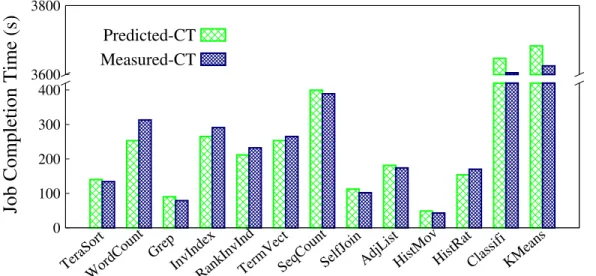
3.10 Predicted vs. measured completion times of 13 applications on thesmall 5-node test cluster. . . 39
3.11 Predicted vs. measured completion times of 13 applications (with a large input dataset) on thelarge 66-node production cluster. . . 39
3.12 Predicting the job completion time in the UPenn cluster. . . 42
3.14 A special case of jobs with a single reduce task: their possible executions on the
heterogeneous EC2 cluster. . . 44
3.15 Predicted and measured completion time for PigMix with 128x64 slots. . . 49
3.16 Predicted and measured completion time for PigMix with 64x64 slots. . . 50
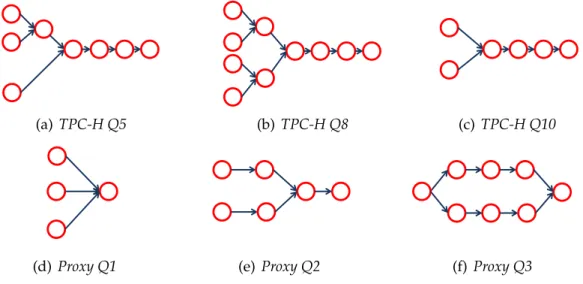
3.17 DAGs of Pig programs in the TPC-H and HP Labs Proxy query sets. . . 50
3.18 Predicted and measured completion time for TPC-H and Proxy queries execut-ed with 128x64 slots. . . 52
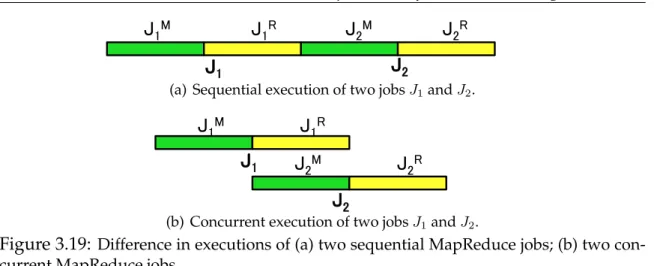
3.19 Difference in executions of (a) two sequential MapReduce jobs; (b) two concur-rent MapReduce jobs. . . 54
3.20 Execution of Concurrent Jobs . . . 56
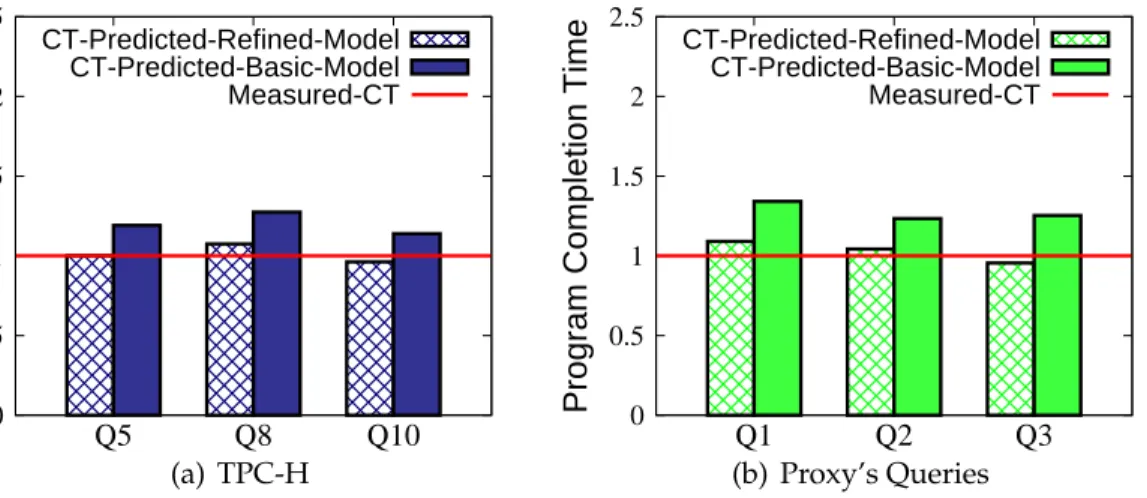
3.21 Predicted completion times usingbasicvsrefinedmodels (128x64 slots). . . 57
3.22 Predicted completion times usingbasicvsrefinedmodels (32x64 slots). . . 58
3.23 Predicted completion time using linear extrapolation (128x64 slots). . . 59
3.24 Impact of sample data size on completion time estimates . . . 60
3.25 Profile forTPC-H Q10with different input data size (scale factor). . . 61
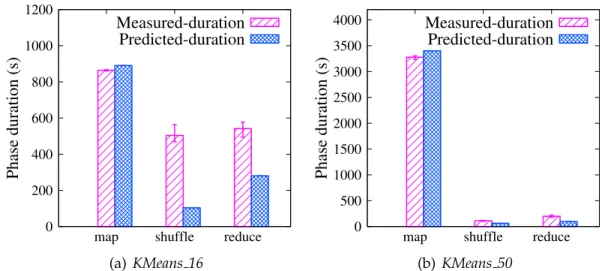
3.26 Predicted vs measured stage durations forKMeans application with different number of reduce tasks (i.e.,K = 16andK = 50). . . 64
4.1 Resource allocations satisfy a given deadline . . . 71
4.2 PigMix executed with the estimated resources: do we meet deadlines? . . . 74
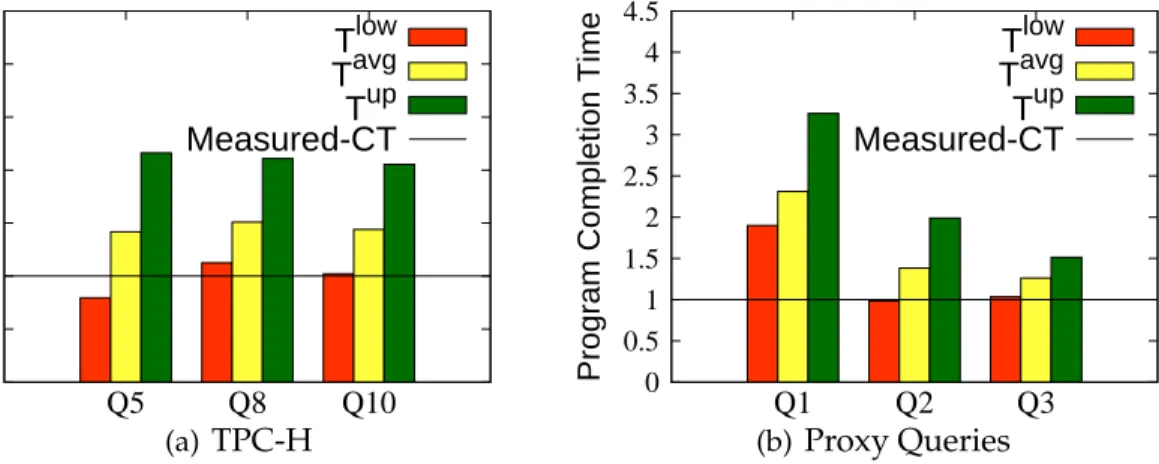
4.3 TPC-H/Proxy queries with the estimated resources: do we meet deadlines? . . 75
4.4 Impact of concurrent job scheduling on their completion time. . . 76
4.5 Example of Johnson’s Algorithm. . . 78
4.6 Measured completion times for different schedules of concurrent jobs in TPC-H queries. . . 79
4.7 Measured completion times for different schedules of concurrent jobs in Proxy queries. . . 80
4.8 Resource allocation estimates for an optimized Pig program. . . 81
4.9 TPC-H Queries: efficiency of resource allocations withrefinedapproach. . . 84
4.10 Proxy’s Queries: efficiency of resource allocations withrefinedapproach. . . 84
stances. . . 89
4.13 Simulator. . . 93
4.14 Simulator validation. . . 96
4.15 Solution Outline. . . 97
4.16 Job completion times on different EC2-based Hadoop clusters. . . 101
4.17 Normalized completion times on different EC2-based clusters. . . 101
4.18 Analysis ofW1on the three platforms. . . 102
4.19 Analysis ofW2on the three platforms. . . 104
4.20 Possible benefits with heterogeneous cluster. . . 105
4.21 Performance versus cost trade-offs for different applications. . . 106
4.22 Performance versus cost trade-offs for different workloads. . . 111
5.1 Motivating Examples. . . 117
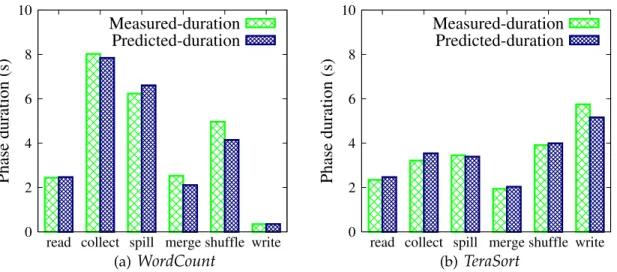
5.2 Effect of reduce task settings for processing the same job with different input dataset sizes. . . 118
5.3 Effect of reduce task settings when only a fraction of resources is available. . . 119
5.4 Example workflow with 3 sequential jobs . . . 120
5.5 Example of the local optimization strategy . . . 123
5.6 MapReduce workflows for TPC-H and Proxy queries. . . 126
5.7 Workflow model validation forTPC-H Q1andTPC-H Q19. . . 128
5.8 Local and global optimization strategies: resource usage with differentw increase thresholds. . . 129
5.9 Local and global optimization strategies: resource usage withw increase=10% while processing different size input datasets. . . 130
Chapter 1
Introduction
Data-intensive analytic applications have become core to the functions of the mod-ern enterprises. Large companies like Google, Facebook, and LinkedIn are pro-cessing and analyzing Terabytes of data every day. These data analytic tasks range from business intelligent analytics [29], social network connection analysis [16], to more advanced scientific data analysis and machine learning applications [89] and the amount of data produced daily is exploding [15].
The enterprises and organizations are experiencing a paradigm shift towards large-scale data intensive computing. Many of them are increasingly using the MapReduce paradigm [21] and its open-source implementation Hadoop [72] as a platform choice for theirBig Dataanalysis as it offers a simple and powerful frame-work for processing large data sets on distributed systems: the program logic is simply expressed by the mapand reducefunctions and the MapReduce execution engine will automatically execute the application in parallel on a set of nodes, co-ordinate their executions and handle failures transparently.
For more complex data analytics, several projects, such as Pig [26], Hive [63], Scope [17], and Dryad [32] provide high-level SQL-like abstractions on top of MapReduce engines to raise the level of abstraction for processing large data sets. These frameworks allow data analysts to specify complex analytic tasks without directly writing map and reduce functions and will compile the specified program automatically intodirected acyclic graphs(DAGs) of MapReduce jobs which we re-ferred to as MapReduce workflows.
1.1
Motivation
Though first introduced for batch-oriented workloads, there is recently an emerg-ing technological trend to shift towards usemerg-ing MapReduce and the frameworks on top of it in support oflatency-sensitiveapplications, e.g., personalized recommen-dations [19], advertisement placement [18], real-time web indexing [24] etc. These applications are typically a part of an elaborate business pipeline, and have to pro-duce results by a certain deadline. There is a need for a mechanism that could automatically tailor and control resource allocations for different applications in shared MapReduce clusters to achieve their (soft) deadlines. Unfortunately, the existing Hadoop implementation does not support resource management for such latency sensitive applications.
On the other hand, the advent of cloud computing provides a new delivery model with virtually unlimited resources. It allows the customers to deploy their Hadoop clusters by leasing computing and storage resources offered by the cloud providers. One of the open questions in such environments is to determine the right resource provision strategy i.e. the choice and the amount of resources that a user should lease from the service providers to achieve performance goals for their MapReduce applications. Moreover, instead of a fixed capital investment that made up-front as for original private cluster, cloud providers offer a more cost-efficient option for many users in a ”pay-as-you-go” fashion, i.e., the customers only pay for the time they used the rented resources. As a result, the monetary cost for executing the user’s workloads becomes another optimization goal which should be considered in making the cluster provision decision.
The solutions to the above problems rely on a profound understanding of the relationship between the execution performance of a given MapReduce applica-tion and the amount of resources available for processing it. Currently, there is a lack of performance models that could accurately predict the completion time for a given MapReduce application according to its input dataset(s), the job settings and the amount of allocated resources. It is especially challenging to develop such
1.2. Contributions of the dissertation
performance model because of nondeterminism during the execution due to the interference of applications in a shared cluster, the non-uniform data distribution and the heterogeneity of the hardware.
Based on the above motivation, the goal of this dissertation is therefore to develop a performance evaluation framework that enables automatic resource management for MapReduce applications in achieving different optimization goals. Towards developing such performance evaluation framework, we need to address the following challenges:
• Automation: The desired framework should automatically control the re-source management with minimal manual interventions and work seamless-ly with the Hadoop distribution.
• Accuracy: The desired framework should be sufficiently accurate in predict-ing the application completion time or required amount of resources even with the presence of system nondeterminism.
• Efficiency: The desired framework should be efficient and able to provide timely response in support of latency sensitive applications in online envi-ronment.
• Generality: The desired framework should be applied to different applica-tions, e.g., complex MapReduce workflows and Hadoop clusters, e.g., het-erogeneous cluster that consists of different type of hardwares.
1.2
Contributions of the dissertation
In this dissertation, we aim to develop a performance evaluation framework that enables automatic resource management for MapReduce applications in achiev-ing different optimization goals. The techniques we use combine of mathematical analysis, benchmarking, simulation, implementation, deployments and empirical measurements on both private cluster and public cloud platform. We focus on Hadoop – the most widely used open source implementation of MapReduce plat-form and the Pig framework [26] – a popular and widely-adopted system built on
Hadoop for expressing a broad variety of data analysis tasks to build our model. While the results provided in this dissertation are based on the Hadoop and Pig experience, we believe that the proposed models and resource management strate-gies are general and can be applied for application executed on similar frameworks such as Hive and Dryad.
A more detailed description about the contributions of this dissertation is pre-sented as follows.
1.2.1
Contribution 1: performance modeling framework for
MapReduce applications
Problem: To enable resource management for MapReduce applications, the first challenging problem is to understand the relationship between the performance and the amount of resource available for executing the application. It requires a performance model which is able to estimate the completion time of a given MapReduce application according to different amount of computing resources. The estimated completion time also depends on the performance of the platform hardware, the input data sets, the job settings and could be affected by the per-formance uncertainty caused by resource contention on a shared cluster. While there have been some research efforts [45, 28, 64, 66] towards developing perfor-mance models for MapReduce jobs, these techniques either rely on simplified as-sumptions or do not apply to complex applications that are expressed as a DAG of MapReduce jobs.
Solution: To solve the problem, we build a performance modeling framework [82, 86, 85, 88] which can accurately predict the completion time of a given applica-tion that consists of single or a DAG of MapReduce jobs according to its input dataset(s), the job settings and the amount of allocated resources. It consists of an ensemble of performance models that orchestrate the performance prediction at different system and applications levels which are:
1.2. Contributions of the dissertation
• Aplatform performance modelthat estimates a phase duration as a function of
processed data at the Hadoop level.
• AMapReduce job modelthat is used to predict a single MapReduce job
execu-tion time as a funcexecu-tion of allocated resources.
• Aworkflow performance modelthat combines all parts together for evaluating
the completion time of complex application which represented as a DAG of MapReduce jobs.
1.2.2
Contribution 2: resource allocation for deadline-driven
MapReduce applications
Problem: In the enterprise setting, users would benefit from sharing Hadoop clusters and consolidating diverse applications over the same datasets. With the trend towards using MapReduce for latency sensitive applications, there is a chal-lenge to automatically tailor and control resource allocations on such shared clus-ters for different applications to achieve their (soft) deadlines. The existing Hadoop implementation does not support resource management for those applications: The original scheduler employed in Hadoop is a simple FIFO scheduling policy that assigns all available resource to each job according to their submission time. The Fair scheduler [8] and Capacity scheduler [2] introduced later try to share the cluster resource among the running jobs either according to the job size or parti-tioned resource pool, but none of them aims to provide resource allocation in order to satisfy the completion time requirement for the applications.
Solution: We solve this problem using our deadline-driven resource allocation strategy based on our performance modeling framework [87, 85, 88]. Once we are able to estimate the application completion time according to the resource alloca-tion, we could also solve the related problem that is to estimate the appropriate amount of resources required for completing an application with a given (soft) deadline. We first propose a simplebasicapproach which works efficiently for ap-plications with single or sequential jobs, and then propose arefinedapproach that
works for more complex applications that contain both sequential and concurren-t jobs. Towards solving concurren-this problem, we also opconcurren-timize an applicaconcurren-tion execuconcurren-tion by enforcing the optimal schedule of its concurrent jobs. Such optimization helps reducing the total completion time, and more importantly, it eliminates possible non-determinism of concurrent jobs’ execution in the workflow, and therefore, en-ables a more accurate performance and resource requirement prediction.
1.2.3
Contribution 3: resource provision in public cloud
environment
Problem: In contract to the private cluster, the advent of cloud computing pro-vides an attractive alternative option to customers for provisioning a suitable size Hadoop cluster, consuming resources as a service, executing the MapReduce work-load, and paying for the time these resources were used. One of the open questions in such environments is the choice of types and amount of resources that a user should lease from the service provider for optimizing both the performance and cost objectives. Specifically, the problem we are trying to solve in the dissertation is: given a workload, determine a Hadoop cluster(s) configuration (i.e., the num-ber and types of VMs, and the job schedule) that provides best cost/performance trade-offs: i) minimizing the cost (budget) while achieving a given makespan tar-get, or ii) minimizing the achievable jobs makespan for a given budget.
Solution: We offer a simulation-based framework for solving this problem [84, 83]. We first extract job profiles by executing the workloads on different (interest-ed) platforms. Then, for each platform and a given Hadoop cluster size, we deter-mine the optimized MapReduce job schedule i.e., the execution order of the jobs in the workloads. After that, our event based MapReduce simulator will take the job profiles and the schedules as inputs and output the simulated makespan/costs for executing the workloads. We first provide our solution for homogeneous clusters by iterating through all the possible choices to determine the optimal one. We then
1.2. Contributions of the dissertation
extend the approach for a heterogeneous solution that consists of sub-clusters of different types.
1.2.4
Contribution 4: performance optimization for MapReduce
applications
Problem: Optimizing the execution efficiency of MapReduce jobs is an open chal-lenge and has been studied from different perspectives [75, 28, 46, 71,?, 79]. In this dissertation, we focus on improving the execution performance for MapReduce applications by automatically tuning the job settings. i.e, the number of reduce tasks in each job as such parameter could significantly impact the total comple-tion time as well as the resource usage. Determining the right number of reduce tasks is non-trivial: it depends on the input sizes of the job, on the Hadoop cluster size, and the amount of resources available for processing this job. This problem is more complicated for applications defined as MapReduce workflows given the data dependency of the jobs: the output of the previous job becomes the input of the next job, as a result, the job settings of the previous job could also have an impact on the map execution of the next job so as the entire completion time. Cur-rently, it is solely the user’s responsibility to configure the number of reduce tasks for each MapReduce job within the application. Such manual, experience based configuration probably leads to inefficient results.
Solution: Based on our performance modeling framework, we provide an au-tomatic way for guiding the user efforts of tuning the reduce task settings in a MapReduce application while achieving different performance objectives [80, 81]. It contains two strategies for analyzing the performance trade-offs, i.e., to optimize the completion time while minimize the resource usage for its execution: alocal op-timization that searches for trade-offs at a job level, and aglobaloptimization that makes the trade-off decisions at the workflow level.
1.3
Overview of dissertation
Hadoop cluster
Performance modeling framework (Chapter 3)
Platform performance model MapReduce job model Workflow performance model
Resource management (Chapter 4) Performance optimization with optimal job settings (Chapter 5)
Input data Workflow structure Job profiles Completion time target
Deadline-driven resource allocation
Resource provision in public cloud
Resource allocation Job settings
Figure 1.1: Overview of the dissertation
Figure 1.1 presents an overview of our solution framework which shows the different components within the system and their connections. The rest of this dissertation is organized as follows: we first start by introducing the background on the MapReduce framework, its open source implementation Hadoop and the Pig system built on top of it in Chapter 2.
In Chapter 3, we introduce the performance modeling framework with a de-tailed description on each consisting performance model and demonstrate that the framework can accurately estimate the completion time of a given MapReduce application according to its input data sets and the amount of allocated resources. In Chapter 4, we propose our resource management solutions by first intro-ducing our resource allocation strategy for supporting multiple latency sensitive MapReduce applications executed on a shared Hadoop cluster. After that, we pro-vide our resource provisioning strategy for guiding the user to select the platform
1.3. Overview of dissertation
from public cloud providers that provides the best cost/performance trade-offs for a given MapReduce workload.
In Chapter 5, we introduce our optimization strategy for MapReduce applica-tions through tuning the job settings for better performance and resource usage. We propose both a local and a global optimization algorithms that applies on the job and workflow level respectively.
Chapter 6 describes the related work on performance modeling, resource man-agement and optimization for MapReduce related platforms. Chapter 7 sum-maries the dissertation work and proposes a few directions for future research work.
Background
This chapter provides a basic background on the MapReduce framework [20, 21] and its open source implementation Hadoop [9, 72] as well as a framework built on top of it: the Pig system [26] that offers a higher-level abstraction for expressing more complex analytic tasks using SQL-style constructs.
2.1
MapReduce framework
The MapReduce framework was first introduced by Google [21] and is now wide-ly used in large-scale data processing on distributed clusters. In the MapReduce model, computation is expressed as two functions: map and reduce. The map function takes an input pair and produces a list of intermediate key/value pairs. The intermediate values associated with the same keyk2are grouped together and then passed to the reduce function. The reduce function takes intermediate keyk2 with a list of values and processes them to form a new list of values.
map(k1, v1) → list(k2, v2)
reduce(k2, list(v2)) → list(v3)
MapReduce jobs are executed across multiple machines: the map stage is par-titioned into map tasks and the reduce stage is partitioned into reduce tasks. The underlying system automatically execute these map and reduce tasks in parallel
2.1. MapReduce framework
on distributed clusters. The scheduling of tasks in MapReduce is performed by a master node which manages a number of worker nodes in the cluster.
Figure 2.1 shows a high level description of the MapReduce architecture. In the map stage, each map task processes a logical split of input data (typically stored in a distributed file system such as HDFS), applies the user-defined map function, and generates the intermediate set of key/value pairs. In the reduce stage, each reduce task fetches its partition of intermediate key/value pairs from all the map tasks and merges the data with the same key. After that, it applies the user-defined reduce function to produce the aggregate values and then write the results back to HDFS.
< key, value>
map map map<Key, list(V)>
reduce reduce split1 split2 split3Figure 2.1: Architecture of MapReduce framework
Hadoop [9, 72] is an open source implementation of the MapReduce frame-work and has been widely used in many companies such as Yahoo!, Facebook, LinkedIn etc. In Hadoop, the cluster is constructed to contain a master node called the JobTracker while the other node are called worker node. Each worker node in the cluster is configured with a fixed number of map and reduce slots which represent the resource unit for processing the map and reduce tasks.
The worker nodes periodically connect to the JobTracker to report its current status and the available slots. The JobTracker decides the next job to execute based on the reported information and according to a scheduling policy. The popular job schedulers include FIFO, Fair [77], and Capacity scheduler [2]. The assignment
of tasks to slots is done in a greedy way: assign a task from the selected job im-mediately whenever a worker reports to have a free slot. If the number of tasks belonging to a MapReduce job is greater than the total number of slots available for processing the job, the task assignment will take multiple rounds, which we
callwaves.
Optionally, a Hadoop job could define a combiner function that aggregates the map outputs. It takes a key and a subset of associated values and produces a single value. The combiner function is useful when it efficiently reduces the amount of data that need to be transferred to the reduce tasks.
The Hadoop implementation also includescountersfor recording timing infor-mation such as start and finish timestamps of the tasks or the number of bytes read and written by each task. These counters are sent by the worker nodes to the master periodically with each heartbeat and are written to logs after the job is completed.
2.2
Pig programs
The Hadoop Pig system [26] which is among the similar projects such as Hive [63], Scope [17], and Dryad [32], aims to raise the level of abstraction for processing large datasets using Hadoop. It provides high-level SQL-like abstractions on top of MapReduce engines that enable data analysts to specify complex analytics tasks without directly writing Map and Reduce functions. The current Pig system is made up of the following two main components:
• The language, called Pig Latin, that combines high-level declarative style of
SQL and the low-level procedural programming of MapReduce. A Pig pro-gram is similar to specifying a query execution plan: it represent a sequence of steps, where each one carries a single data transformation using a high-level data manipulation constructs, likefilter,group,join, etc. In this way, the Pig program encodes a set of explicit dataflows.
2.2. Pig programs
• The execution environment to run Pig programs. The Pig system takes a Pig
Latin program as input, compiles it into a DAG of MapReduce jobs, and co-ordinates their execution on a given Hadoop cluster. Pig relies on underlying Hadoop execution engine for scalability and fault-tolerance properties. The following specification shows a simple example of a Pig program. It de-scribes a task that operates over a table URLs that stores data with the three
at-tributes: (url, category, pagerank). This program identifies for eachcategory theurlwith the highestpagerankin thatcategory.
URLs =load’dataset’ as (url, category, pagerank); groups =groupURLs by category;
result =foreachgroups generate group, max(URLs.pagerank); storeresult into ’myOutput’
The example Pig program is compiled into a single MapReduce job. Typically, Pig programs are more complex, and can be compiled into an execution plan con-sisting of several stages of MapReduce jobs, some of which can run concurrently. The structure of the execution plan can be represented by a DAG of MapReduce jobs that could contain both concurrent and sequential branches. Figure 2.2 shows a possible DAG of five MapReduce jobs{j1, j2, j3, j4, j5}, where each node repre-sents a MapReduce job, and the edges between the nodes representdata dependen-ciesbetween jobs.
J1
J2
J3
J4
J5 J6
Figure 2.2: Example of a Pig program’ execution plan represented as a DAG of MapReduce jobs.
To execute the plan, the Pig engine first submits all the readyjobs (i.e., the jobs that do not have data dependencies on the other jobs) to Hadoop. After Hadoop
has processed these jobs, the Pig system deletes them and the corresponding edges from the processing DAG, and identifies and submits the next set of ready jobs. This process continues until all the jobs are completed. In this way, the Pig engine partitions the DAG into multiple stages, each containing one or more independent MapReduce jobs that can be executed concurrently. Note that for stages with con-current jobs, there is no specifically defined ordering in which the jobs are going to be executed by Hadoop. For example, the DAG shown in Figure 2.2 is partitioned into the following four stages for processing:
• first stage: {j1, j2}; • second stage: {j3, j4}; • third stage: {j5}; • fourth stage:{j6}.
Chapter 3
Performance Modeling Framework
In this chapter, we introduce a performance modeling framework that aims to es-timate the MapReduce application completion time as a function of the allocated resource, the input data sets and the job settings. The intuition of our work comes from two parts:
• We observe that the executions of map and reduce tasks consist of specific, well-defined data processing phases. Only map and reduce functions are custom and their computations are user-defined for different MapReduce jobs. The executions of the remaining phases are generic, i.e., the logic of these phases is defined by the Hadoop processing framework. The execution time of each generic phase depends mostly on the amount of data processed by the phase and the I/O performance of underlying Hadoop cluster.
• In MapReduce environments, many production jobs are run periodically on new data. For example, Facebook, Yahoo!, and eBay process terabytes of data and event logs per day on their Hadoop clusters for spam detection, business intelligence and different types of optimization. We can extract a representative job profile that reflects the performance characteristics of the customized map and reduce functions and use the job profiles to predict the future execution of the same applications when executed on a different set of input data.
Specifically, the modeling framework consists ofthreeperformance models that orchestrates the prediction of the application completion time at different system and applications levels. Figure 3.1 outlines the ensemble of performance models designed for evaluating the application completion time.
Figure 3.1: Ensemble of Models.
Chapter 3.1 first describes a platform performance model that estimates a gener-ic phase duration as a function of processed data on a given Hadoop cluster. With the information of the input dataset(s) and the job settings, we could estimate the amount of data processed by each job (and the tasks within the job) in the appli-cation. Based on the estimated data flowing through each phases, we are able to predict the duration for generic phases by applying the derived platform perfor-mance model. To estimate the duration of the customized map and reduce phases, we extracted a compact job profile that captures the performance of the map and reduce functions and use it to approximate their durations according to the num-ber of records processed by those functions. Once we estimated the duration of all phases, the map and reduce task durations can be estimated as the sum of the phase durations that belong to the task.
After that, Chapter 3.2 presents a MapReduce job model that is used to predict execution time of MapReduce application that contains single job according to the map (reduce) task durations and the amount of allocated resources (i.e., number of map and reduce slots). Finally, Chapter 3.3 present the workflow performance
3.1. Platform performance model
model that combines all parts together for evaluating the completion time for com-plex MapReduce workflows.
3.1
Platform performance model
We first describe our benchmarking approach for building a MapReduce platform model that aims to predicting the completion time of different MapReduce phases as a function of processed data. We use a set of microbenchmarks to profile generic phases of the MapReduce processing pipeline of a small given Hadoop cluster. Based on the benchmark results, we then derive an accurate platform performance model of a given cluster. The advantage of our approach includes
• Generality: The platform performance model is derived once for the given cluster, and then can be reused for characterizing performance of generic phases of different applications.
• Scalability: We derive the model using a small test cluster and then use it for the larger production cluster with the same hardware. The benchmarking process is performed without interfering the production cluster.
3.1.1
Profiling MapReduce phases
Figure 3.2: MapReduce Processing Pipeline.
As showed in Figure 3.2, the execution of each map (reduce) task is comprised of a specific, well-defined sequence of processing phases.
For each map task, it first reads a split of the input data from the Hadoop dis-tributed file system (HDFS) (readphase), applies the user-defined map function, and generates the intermediate set of key/value pairs (readphase). The map task then buffers the map outputs and sorts and spills the data into disk once the in-termediate data grows beyond certain threshold (collect andspillphase). After all the input data are processed, the map task merges the spilled data and partitions them for different reduce tasks according to a partition function (mergephase).
For each reduce task, it first fetches its partition of intermediate key/value pairs from all the map tasks and sort/merges the data with the same key (shufflephase). After that, it applies the user-defined reduce function to the merged value list to produce the aggregate results (reducephase). Finally, the reduce outputs are writ-ten back to HDFS (writephase).
Note, that only map and reduce phases with customized map and reduce func-tions execute the user-defined pieces of code. The execution of the remaining phas-es aregeneric(i.e., the logic of these phases is defined by Hadoop code), and their durations depend mostly on the amount of data flowing through a phase and the I/O performance of the underlying Hadoop cluster. Our goal is therefore to de-rive aplatform performance modelthat predicts a duration of each generic phase on a given Hadoop cluster platform as a function of processed data.
In order to accomplish this, we run a set of microbenchmarks that create dif-ferent amounts of data for processing per map (reduce) tasks and for processing by their phases. We profile the duration of each generic phase during the task exe-cution and derive a function that defines a phase performance as a function of the processed data from the collected measurements.
For map tasks, we profile the following generic phases:
• Readphase – a map task typically reads a block (e.g., 64 MB) from the Hadoop distributed file system (HDFS). However, written data files might be of arbi-trary size, e.g., 70 MB. In this case, there will be two blocks: one of 64 MB and the second of 6 MB, and therefore, map tasks might read files of varying
3.1. Platform performance model
sizes. We measure the duration of the read phase as well as the amount of data read by the map task.
• Collect phase – this generic phase follows the execution of the map phase
with a user-defined map function. We measure the time it takes to buffer map phase outputs into memory and the amount of generated intermediate data.
• Spillphase – we measure the time taken to locally sort the intermediate data
and partition them for the different reduce tasks, applying the combiner if available, and then writing the intermediate data to local disk.
• Merge phase – we measure the time for merging different spill files into a
single spill file for each destined reduce task.
For reduce tasks, we profile the following generic phases:
• Shufflephase – we measure the time taken to transfer intermediate data from
map tasks to the reduce tasks and merge-sort them together. We combine the shuffle and sort phases because in the Hadoop implementation, these two sub-phases are interleaved. The processing time of this phase depends on the amount of intermediate data destined for each reduce task and the Hadoop configuration parameters. In our testbed, each JVM (i.e., a map/reduce s-lot) is allocated 700 MB of RAM. Hadoop sets a limit (∼46% of the allocated memory) for in-memory sort buffer. The portions of shuffled data are merge-sorted in memory, and a spill file (∼320 MB) is written to disk. After all the data is shuffled, Hadoop merge-sorts first 10 spilled files and writes them in the new sorted file. Then it merge-sorts next 10 files and writes them in the next new sorted file. At the end, it merge-sorts these new sorted files. Thus, we can expect a different scaling function for a duration of the shuffle phase when the size of intermediate data per reduce task is larger than3.2 GB in our Hadoop cluster as the merge-sorts process need to scan the entire output data multiple times when merging more than 10 on disk files. For a different
Hadoop cluster, this threshold can be similarly determined from the cluster configuration parameters.
• Write phase – this phase follows the execution of the reduce phase that
ex-ecutes a custom reduce function. We measure the amount of time taken to write the reduce output to HDFS.
Note, that in platform profiling we do not include phases with user-defined map and reduce functions. However, we do need to profile these custom map and reduce phases for modeling the execution of given MapReduce applications:
• Map(Reduce) phase – we measure a duration of the entire map (reduce)
func-tion and the number of processed records. We normalize this execufunc-tion time to estimate a processing time per record.
Apart from the phases described above, each executed task has a constant over-head for setting and cleaning up. We account for these overover-heads separately for each task.
For accurate performance modeling, it is desirable to minimize the overheads introduced by the additional monitoring and profiling technique. There are two different approaches for implementing phase profiling.
• Counter based profiling:The current Hadoop implementation includes several
countersto record information such as the number of bytes read and written.
We modified the Hadoop code by adding counters that measure durations of the six generic phases to the existing counter reporting mechanism. We can activate the subset of desirable counters in the Hadoop configuration for collecting the set of required measurements.
• Dynamic instrumentation based profiling: We also implemented the alternative
profiling tool inspired by Starfish [28] approach based onBTrace– a dynam-ic instrumentation tool for Java [7]. This approach does have a special ap-peal for production Hadoop clusters because it has a zero overhead when monitoring is turned off. However, in general, the dynamic instrumentation
3.1. Platform performance model
overhead is significantly higher compared to adding new Hadoop counters directly in the source code.
For building the platform performance mode, we execute a set of microbench-marks (described in Chapter 3.1.2) and measure the durations of six generic exe-cution phases for processing different amount of data:read, collect, spill,andmerge
phases for the map task execution, andshuffleand writephases in the reduce task processing. This profiling is done on a small test cluster (5-nodes in our experi-ments) with the same hardware and configuration as the production cluster. While for these experiments both profiling approaches can be used, the Hadoop counter-based approach is preferable due to its simplicity and low overhead, and that the modified Hadoop version can be easily deployed in this test environment.
For predicting the completion time for a particular MapReduce job, we needs additional measurements that characterize the execution of user-defined map and reduce functions of a given job. For profiling the map and reduce phases of the given MapReduce jobs in the production cluster we apply our alternative profiling tool that is based onBTraceapproach. Remember, this approach does not require Hadoop or application changes, and can be switched on for profiling a targeted MapReduce job of interest. Since we only profile map and reduce phase executions the extra overhead is relatively small.
3.1.2
Microbenchmarks
We generate and perform a set of parameterizable microbenchmarks to character-ize execution times of generic phases for processing different data amounts on a given Hadoop cluster by varying the following parameters:
• Input size per map task (Minp): This parameter controls the size of the input
read by each map task. Therefore, it helps to profile theReadphase durations for processing different amount of data.
• Map selectivity (Msel): this parameter defines the ratio of the map output to
map function, and therefore directly affects theCollect, SpillandMergephase durations in the map task. Map output determines the overall amount of da-ta produced for processing by the reduce da-tasks, and therefore impacting the amount of data proceeded byShuffleandReducephases and their durations.
• Number of map tasks Nmap: This parameter helps to expedite generating the
large amount of intermediate data per reduce task.
• Number of reduce tasks Nred: This parameter helps to control the number of
reduce tasks to expedite the training set generation with the large amount of intermediate data per reduce task.
Thus, each microbenchmarkM Biis parameterized as
M Bi = (Miinp, M sel i , N map i , N red i ).
Each created benchmark uses input data consisting of 100 byte key/value pairs generated with TeraGen [1], a Hadoop utility for generating synthetic data. The map function simply emits the input records according to the specified map selec-tivity for this benchmark. The reduce function is defined as the identity function. Most of our benchmarks consist of a specified (fixed) number of map and reduce tasks. For example, we generate benchmarks with 40 map and 40 reduce tasks each for execution in our small cluster deployments with 5 worker nodes. We run benchmarks with the following parameters: Minp={2MB, 4MB, 8MB, 16MB,
32MB, 64MB}; Msel={0.2, 0.6, 1.0, 1.4, 1.8}. For each value of Minp and Msel, a
new benchmark is executed. We also use benchmarks that generate special ranges of intermediate data per reduce task for accurate characterization of the shuffle phase. These benchmarks are defined byNmap={20,30,...,150,160};Minp = 64M B,
Msel= 5.0andNred= 5which result in different intermediate data size per reduce
tasks ranging from 1 GB to 12 GB.
We generate the platform profile by running a set of our microbenchmarks on the small 5-node test cluster that is similar to a given production Hadoop cluster. We gather durations of generic phases and the amount of processed data for all
3.1. Platform performance model
executed map and reduce tasks. A set of these measurements defines theplatform profile that is later used as the training data for aplatform performance model:
• Map task processing: in the collected platform profiles, we denote the
mea-surements for phase durations and the amount of processed data for read,
collect, spill,andmergephases as(Dur1, Data1),(Dur2, Data2),(Dur3, Data3),
and(Dur4, Data4)respectively.
• Reduce task processing: in the collected platform profiles, we denote phase
du-rations and the amount of processed data forshuffleandwriteas(Dur5, Data5)
and(Dur6, Data6)respectively.
Figure 3.3 shows a small fragment of a collected platform profile as a result of executing the microbenchmarking set. There are six tables in the platform profile, one for each phase. Figure 3.3 shows fragments forreadandcollect phases. There are multiple map and reduce tasks that process the same amount of data in each microbenchmark. This is why there are multiple measurements in the profile for processing the same data amount.
Row Data Read
number MB msec
j Data1 Dur1
1 16 2010
2 16 2020
... ... ...
Row Data Collect
number MB msec
j Data2 Dur2
1 8 1210
2 8 1350
... ... ...
Figure 3.3: A fragment of a platform profile forreadandcollectphases.
3.1.3
Platform modeling
Now, we describe how to create aplatform performance model MP haseswhich
char-acterizes the phase execution as a function of processed data. To accomplish this goal, we need to find the relationships between the amount of processed data and durations of different execution phases using the set of collected measurements. Therefore, we buildsixsubmodelsM1, M2, ..., M5,andM6 that define the relation-ships forread, collect, spill, merge, shuffle,andwriterespectively of a given Hadoop
cluster. To derive these submodels, we use the collected platform profile (see Fig-ure 3.3).
Below, we explain how to build a submodel Mi, where 1 ≤ i ≤ 6. By using
measurements from the collected platform profiles, we form a set of equations which express a phase duration as a linear function of processed data. Let Dataji be the amount of processed data in the rowj of platform profile withKrows. Let Durji be the duration of the corresponding phase in the same row j. Then, using linear regression, we solve the following sets of equations (for eachi= 1,2,· · · ,6):
Ai+Bi·Dataji =Dur
j
i, where j = 1,2,· · · , K (3.1)
To solve for(Ai, Bi), one can choose a regression method from a variety of known
methods in the literature (a popular method for solving such a set of equations is a non-negative Least Squares Regression). With ordinary least squares regression, a few bad outliers can significantly impact the model accuracy, because it is based on minimizing the overall absolute error across multiple equations in the set. To decrease the impact of occasional bad measurements and to improve the overall model accuracy, we employ robust linear regression [30]. (which is typically used to avoid a negative impact of a small number of outliers).
Let( ˆAi,Bˆi)denote a solution for the equation set (1). ThenMi = ( ˆAi,Bˆi)is the
submodel that defines the duration of execution phaseias a function of processed data. Theplatform performance model isMP hases= (M1, M2, ..., M5, M6).
For the shuffle phase, according to the discussion in Chapter 3.1.1, we expect that there will be different behavior when it processes data smaller/larger than around 3.2 GB and thus better be approximated by a piece-wise linear function comprised of two linear functions: one for processing up to 3.2 GB of intermediate data per reduce task, and the second segment for processing the datasets larger than 3.2 GB.
We derived the platform performance model by executing the set of our mi-crobenchmarks on a small 5-nodes clusters and collecting the corresponding phase durations. Each machine has four AMD 2.39GHz cores, 8 GB RAM and two
160G-3.1. Platform performance model
B hard disks. We used Hadoop 0.20.2 with additional two machines dedicated as the JobTracker and the NameNode. Each working node is configured with 2 map and 1 reduce slots. The file system block size is set to 64MB. The replication level is set to 3. We disabled speculative execution since it did not lead to significant improvements in our experiments.
Figure 3.4 shows the relationships between the amount of processed data and the execution durations of different phases for a given Hadoop cluster. It reflects the platform profile for six generic execution phases: read, collect, spill, and merge
phases of the map task execution, andshuffleandwritephases in the reduce task. Each graph has a collection of dots that represent phase duration measurements (Y-axes) of the profiled map (reduce) tasks as a function of processed data (X-axes). The red line on the graph shows the linear regression solution that serves as a model for the phase. As we can see (visually) the linear regression provides a good solution for five out of six phases. As it was expected, the shuffle phase is better approximated by a linear piece-wise function comprised of two linear functions.
To validate whether our explanation on the shuffle phase behavior is correc-t, we perform a set of additional experiments. We configured each JVM (i.e., a map/reduce slot) with 2 GB RAM (compared to JVM with 700 MB of RAM used in previous experiments). As we explained earlier, Hadoop sets a limit (∼46% of the allocated memory) for in-memory sort buffer. The portions of shuffled data are merge-sorted in memory, and a spill file (in the new case, ∼900 MB) is writ-ten to disk. After all the data is shuffled, Hadoop merge-sorts first 10 spilled files and writes them in the new sorted file. Then it merge-sorts next 10 files and writes them in the next new sorted file. Finally, at the end, it merge-sorts these new sorted files. Thus, we can expect that in the new configuration the shuffle performance is significantly different for processing intermediate data large than 9 GB. Figure 3.5 indeed confirms our conjecture: shuffle performance changes for processing inter-mediate data large than 9 GB. Indeed, the shuffle phase performance is affected by the JVM memory size settings, and its performance can be more accurately ap-proximated by a linear piece-wise function.
● ● ● ● ● ● ● ● ● ● ● ● ● ● ● ● ● ● ● ● ● ● ● ● ● ● ● ● ● ● ● ● ● ● ● ● ● ● ● ● ● ● ● ● ● ● ● ● ● ● ● ● ● ● ● ● ● ● ● ● ● ● ● ● ● ● ● ● ● ● ● ● ● ● ● ● ● ● ● ● ● ● ● ● ● ● ● ● ● ● ● ● ● ● ● ● ● ● ● ● ● ● ● ● ● ● ● ● ● ● ● ● ● ● ● ● ● ● ● ● ● ● ● ● ● ● ● ● ● ● ● ● ● ● ● ● ● ● ● ● ● ● ● ● ● ● ● ● ● ● ● ● ● ● ● ● ● ● ● ● ● ● ● ● ● ● ● ● ● ● ● ● ● ● ● ● ● ● ● ● ● ● ● ● ● ● ● ● ● ● ● ● ● ● ● ● ● ● ● ●●●●●●●● ● ● ● ● ● ● ● ● ● ● ● ● ● ● ● ● ● ● ● ● ● ● ● ● ● ● ● ● ● ● ● ● ● ● ● ● ● ● ● ● ● ● ● ● ● ● ● ● ● ● ● ● ● ● ● ● ● ● ● ● ● ● ● ● ● ● ● ● ● ● ● ● ● ● ● ● ● ● ● ● ● ● ● ● ● ● ● ● ● ● ● ● ● ● ● ● ● ● ● ● ● ● ● ● ● ● ● ● ● ● ● ● ● ● ● ● ● ● ● ● ● ● ● ● ● ● ● ● ● ● ● ● ● ● ● ● ● ● ● ● ● ● ● ● ● ● ● ● ● ● ● ● ● ● ● ● ● ● ● ● ● ● ● ● ● ● ● ● ● ● ● ● ● ● ● ● ● ● ● ● ● ● ● ● ● ● ● ● ● ● ● ● ●● ● ● ● ● ● ● ● ● ● ● ● ● ● ● ● ● ● ● ● ● ● ● ● ● ● ● ● ● ● ● ● ● ● ● ● ● ● ● ● ● ● ● ● ● ● ● ● ● ● ● ● ● ● ● ● ● ● ● ● ● ● ● ● ● ● ● ● ● ● ● ● ● ● ● ● ● ● ● ● ● ● ● ● ● ● ● ● ● ● ● ● ● ● ● ● ● ● ● ● ● ● ● ● ● ● ● ● ● ● ● ● ● ● ● ● ● ● ● ● ● ● ● ● ● ● ● ● ● ● ● ● ● ● ● ● ● ● ● ● ● ● ● ● ● ● ● ● ● ● ● ● ● ● ● ● ● ● ● ● ● ● ● ● ● ● ● ● ● ● ● ● ● ● ● ● ● ● ● ● ● ● ● ● ● ● ● ● ● ● ● ● ● ● ● ● ● ● ● ● ● ● ● ● ● ● ● ● ● ● ● ● ● ● ● ● ● ● ● ● ● ● ● ● ● ● ● ● ● ● ● ● ● ● ● ● ● ● ● ● ● ● ● ● ● ● ● ● ● ● ● ● ● ● ● ● ● ● ● ● ● ● ● ● ● ● ● ● ● ● ● ● ● ● ● ● ● ● ● ● ● ● ● ● ● ● ● ● ● ● ● ● ● ● ● ● ● ● ● ● ● ● ● ● ● ● ● ● ● ● ● ● ● ● ● ● ● ● ● ● ● ● ● ● ● ● ● ● ● ● ● ● ● ● ● ● ● ● ● ● ● ● ● ● ● ● ● ● ● ● ● ● ● ● ● ● ● ● ● ● ● ● ● ● ● ● ● ● ● ● ● ● ● ● ● ● ● ● ● ● ● ● ● ● ● ● ● ● ● ● ● ● ● ● ● ● ● ● ● ● ● ● ● ● ● ● ● ● ● ● ● ● ● ● ● ● ● ● ● ● ● ● ● ● ● ● ● ● ● ● ● ● ● ● ● ● ● ● ● ● ● ● ● ● ● ● ● ● ● ● ● ● ● ● ● ● ● ● ● ● ● ● ● ● ● ● ● ● ● ● ● ● ● ● ● ● ● ● ● ● ● ● ● ● ● ● ● ● ● ● ● ● ● ● ● ● ● ● ● ● ● ● ● ● ● ● ● ● ● ● ● ● ● ● ● ● ● ● ● ● ● ● ● ● ● ● ● ● ● ● ● ● ● ● ● ● ● ● ● ● ● ● ● ● ● ● ● ● ● ● ● ● ● ● ● ● ● ● ● ● ● ● ● ● ● ● ● ● ● ● ● ● ● ● ● ● ● ● ● ● ● ● ● ● ● ● ● ● ● ● ● ● ● ● ● ● ● ● ● ● ● ● ● ● ● ● ● ● ● ● ● ● ● ● ● ● ● ● ● ● ● ● ● ● ● ● ● ● ● ● ● ● ● ● ● ● ● ● ● ● ● ● ● ● ● ● ● ● ● ● ● ● ● ● ● ● ● ● ● ● ● ● ● ● ● ● ● ● ● ● ● ● ● ● ● ● ● ● ● ● ● ● ● ● ● ● ● ● ● ● ● ● ● ● ● ● ● ● ● ● ● ● ● ● ● ● ● ● ● ● ● ● ● ● ● ● ● ● ● ● ● ● ● ● ● ● ● ● ● ● ● ● ● ● ● ● ● ● ● ● ● ● ● ● ● ● ● ● ● ● ● ● ● ● ● ● ● ● ● ● ● ● ● ● ● ● ● ● ● ● ● ● ● ● ● ● ● ● ● ● ● ● ● ● ● ● ● ● ● ● ● ● ● ● ● ● ● ● ● ● ● ● ● ● ● ● ● ● ● ● ● ● ● ● ● ● ● ● ● ● ● ● ● ● ● ● ● ● ● ● ● ● ● ● ● ● ● ● ● ● ● ● ● ● ● ● ● ● ● ● ● ● ● ● ● ● ● ● ● ● ● ● ● ● ● ● ● ● ● ● ● ● ● ● ● ● ● ● ● ● ● ● ● ● ● ● ● ● ● ● ● ● ● ● ● ● ● ● ● ● ● ● ● ● ● ● ● ● ● ● ● ● ● ● ● ● ● ● ● ● ● ● ● ● ● ● ● ● ● ● ● ● ● ● ● ● ● ● ● ● ● ● ● ● ● ● ● ● ● ● ● ● ● ● ● ● ● ● ● ● ● ● ● ● ● ● ● ● ● ● ● ● ● ● ● ● ● ● ● ● ● ● ● ● ● ● ● ● ● ● ● ● ● ● ● ● ● ● ● ● 0 10 20 30 40 50 60 0 1000 2000 3000 4000 Data Size (MB)
Read Phase Dur
ation (ms) (a) read ● ● ● ● ● ● ● ● ● ● ● ● ● ● ● ● ● ● ● ● ● ● ● ● ● ● ● ● ● ● ● ● ● ● ● ● ● ● ● ● ● ● ● ● ● ● ● ● ● ● ● ● ● ● ● ● ● ● ● ● ● ● ● ● ● ● ● ● ● ● ● ● ● ● ● ● ● ● ● ● ● ● ● ● ● ● ● ● ● ● ● ● ● ● ● ● ● ● ● ● ● ● ● ● ● ● ● ● ● ● ● ● ● ● ● ● ● ● ● ● ● ● ● ● ● ● ● ● ● ● ● ● ● ● ● ● ● ● ● ● ● ● ● ● ● ● ● ● ● ● ● ● ● ● ● ● ● ● ● ● ● ● ● ● ● ● ● ● ● ● ● ● ● ● ● ● ● ● ● ● ● ● ● ● ● ● ● ● ● ● ● ● ● ● ● ● ● ● ● ● ● ● ● ● ● ● ● ● ● ● ● ● ● ● ● ● ● ● ● ● ● ● ● ● ● ● ● ● ● ● ● ● ● ● ● ● ● ● ● ● ● ● ● ● ● ● ● ● ● ● ● ● ● ● ● ● ● ● ● ● ● ● ● ● ● ● ● ● ● ● ● ● ● ● ● ● ● ● ● ● ● ● ● ● ● ● ● ● ● ● ● ● ● ● ● ● ● ● ● ● ● ● ● ● ● ● ● ● ● ● ● ● ● ● ● ● ● ● ● ● ● ● ● ● ● ● ● ● ● ● ● ● ● ● ● ● ● ● ● ● ● ● ● ● ● ● ● ● ● ● ● ● ● ● ● ● ● ● ● ● ● ● ● ● ● ● ● ● ● ● ● ● ● ● ● ● ● ● ● ● ● ● ● ● ● ● ● ● ● ● ● ● ● ● ● ● ● ● ● ● ● ● ● ● ● ● ● ● ● ● ● ● ● ● ● ● ● ● ● ● ● ● ● ● ● ● ● ● ● ● ● ● ● ● ● ● ● ● ● ● ● ● ● ● ● ● ● ● ● ● ● ● ● ● ● ● ● ● ● ● ● ● ● ● ● ● ● ● ● ● ● ● ● ● ● ● ● ● ● ● ● ● ● ● ● ● ● ● ● ● ● ● ● ● ● ● ● ● ● ● ● ● ● ● ● ● ● ● ● ● ● ● ● ● ● ● ● ● ● ● ● ● ● ● ● ● ● ● ● ● ● ● ● ● ● ● ● ● ● ● ● ● ● ● ● ● ● ● ● ● ● ● ● ● ● ● ● ● ● ● ● ● ● ● ● ● ● ● ● ● ● ● ● ● ● ● ● ● ● ● ● ● ● ● ● ● ● ● ● ● ● ● ● ● ● ● ● ● ● ● 20 40 60 80 100 120 2000 4000 6000 8000 Data Size (MB)
Collect Phase Dur
ation (ms) (b) collect ● ● ● ● ● ● ● ● ● ● ● ● ● ● ● ● ● ● ● ● ● ● ● ● ● ● ● ● ● ● ● ● ● ● ● ● ● ● ● ● ● ● ● ● ● ● ● ● ● ● ● ● ● ● ● ● ● ● ● ● ● ● ● ● ● ● ● ● ● ● ● ● ● ● ● ● ● ● ● ● ● ● ● ● ● ● ● ● ● ● ● ● ● ● ● ● ● ● ● ● ● ● ● ● ● ● ● ● ● ● ● ● ● ● ● ● ● ● ● ● ● ● ● ● ● ● ● ● ● ● ● ● ● ● ● ● ● ● ● ● ● ● ● ● ● ● ● ● ● ● ● ● ● ● ● ● ● ● ● ● ● ● ● ● ● ● ● ● ● ● ● ● ● ● ● ● ● ● ● ● ● ● ● ● ● ● ● ● ● ● ● ● ● ● ● ● ● ● ● ● ● ● ● ● ● ● ● ● ● ● ● ● ● ● ● ● ● ● ● ● ● ● ● ● ● ● ● ● ● ● ● ● ● ● ● ● ● ● ● ● ● ● ● ● ● ● ● ● ● ● ● ● ● ● ● ● ● ● ● ● ● ● ● ● ● ● ● ● ● ● ● ● ● ● ● ● ● ● ● ●● ● ● ● ● ● ● ● ● ● ● ● ● ● ● ● ● ● ● ● ● ● ● ● ● ● ● ● ● ● ● ● ● ● ● ● ● ● ● ● ● ● ● ● ● ● ● ● ● ● ● ● ● ● ● ● ● ● ● ● ● ● ● ● ● ● ● ● ● ● ● ● ● ● ● ● ● ● ● ● ● ● ● ● ● ● ● ● ● ● ● ● ● ● ● ● ● ● ● ● ● ● ● ● ● ● ● ● ● ● ● ● ● ● ● ● ● ● ● ● ● ● ● ● ● ● ● ● ● ● ● ● ● ● ● ● ● ● ● ● ● ● ● ● ● ● ● ● ● ● ● ● ● ● ● ● ● ● ● ● ● ● ● ● ● ● ● ● ● ● ● ● ● ● ● ● ● ● ● ● ● ● ● ● ● ● ● ● ● ● ● ● ● ● ● ● ● ● ● ● ● ● ● ● ● ● ● ● ● ● ● ● ● ● ● ● ● ● ● ● ● ● ● ● ● ● ● ● ● ● ● ● ● ● ● ● ● ● ● ● ● ● ● ● ● ● ● ● ● ● ● ● ● ● ● ● ● ● ● ● ● ● ● ● ● ● ● ● ● ● ● ● ● ● ● ● ● ● ● ●● ● ● ● ● ● ● ● ● ● ● ● ● ● ● ● ● ● ● ● ● ● ● ● ● ● ● ● ● ● ● ● ● ● ● ● ● ● ● ● ● ● ● ● ● ● ● ● ● ● ● ● ● ● ● ● ● ● ● ● ● ● ● ● ● ● ● ● ● ● ● ● ● ● ● ● ● ● ● ● ● ● ● ● ● ● ● ● ● ● ● ● ● ● ● ● ● ● ● ● ● ● ● ● ● ● ● ● ● ● ● ● ● ● ● ● ● ● ● ● ● ● ● ● ● ● ● ● ● ● ● ● ● ● ● ● ● ● ● ● ● ● ● ● ● ● ● ● ● ● ● ● ● ● ● ● ● ● ● ● ● ● ● ● ● ● ● ● ● ● ● ● ● ● ● ● ● ● ● ● ● ● ● ● ● ● ● ● ● ● ● ● ● ● ● ● ● ● ● ● ● ● ● ● ● ● ● ● ● ● ● ● ● ● ● ● ● ● ● ● ● ● ● ● ● ● ● ● ● ● ● ● ● ● ● ● ● ● ● ● ● ● ● ● ● ● ● ● ● ● ● ● ● ● ● ● ● ● ● ● ● ● ● ● ● ● ● ● ● ● ● ● ● ● ● ● ● ● ● ● ● ● ● ● ● ● ● ● ● ● ● ● ● ● ● ● ● ● ● ● ● ● ● ● ● ● ● ● ● ● ● ● ● ● ● ● ● ● ● ● ● ● ● ● ● ● ● ● ● ● ● ● ● ● ● ● ● ● ● ● ● ● ● ● ● ● ● ● ● ● ● ● ● ● ● ● ● ● ● ● ● ● ● ● ● ● ● ● ● ● ● ● ● ● ● ● ● ● ● ● ● ● ● ● ● ● ● ● ● ● ● ● ● ● ● ● ● ● ● ● ● ● ● ● ● ● ● ● ● ● ● ● ● ● ● ● ● ● ● ● ● �