FILE SYSTEMS AND STORAGE
Ming Chen is a PhD candidate in computer science at Stony Brook University. His research interests include file systems, storage systems, and cloud computing. He is working together with Professor Erez Zadok in building storage systems using NFS and cloud services.
Dean Hildebrand manages the Cloud Storage Software team at the IBM Almaden Research Center and is a recognized expert in the field of distributed and parallel file systems. He has authored numerous scientific publications, created over 28 patents, and chaired and sat on the program committee of numerous conferences. Hildebrand pioneered pNFS, demonstrating the feasibility of providing standard and scalable access to any file system. He received a BSc in computer science from the University of British Columbia in 1998 and a PhD in computer science from the University of Michigan in 2007. [email protected]
Geoff Kuenning spent 15 years working as a programmer before changing directions and joining academia. Today he teaches computer science at Harvey Mudd College in Claremont, CA, where he has developed a reputation for insisting that students write readable software, not just working code. When not teaching or improving his own programs, he can often be found trying—and usually failing—to conquer nearby Mount Baldy on a bicycle. [email protected].
N
FSv4.1, the latest version of the NFS protocol, has improvements
in correctness, security, maintainability, scalability, and cross-OS
interoperability. To help system administrators decide whether or
not to adopt NFSv4.1 in production systems, we conducted a comprehensive
performance comparison between NFSv3 and NFSv4.1 on Linux. We found
NFSv4.1 to be stable and its performance to be comparable to NFSv3. Our
new (and sometimes surprising) observations and analysis cast light on the
dark alleys of NFS performance on Linux.
The Network File System (NFS) is an IETF-standardized protocol to provide transparent file-based access to data on remote hosts. NFS is a highly popular network-storage solution, and it is widely supported in OSes, including FreeBSD, Linux, Solaris, and Windows. NFS deployments continue to increase thanks to faster networks and the proliferation of virtu-alization. NFS is also playing a major role in today’s cloud era by hosting VM disk images in public clouds and providing file services in cloud storage gateways.
The continuous evolution of NFS has contributed to its success. The first published version, NFSv2, operates on UDP and limits file sizes to 2 GB. NFSv3 added TCP support, 64-bit file sizes and offsets, and performance enhancements such as asynchronous writes and
READDIRPLUS.
The latest version, NFSv4.1, includes additional items such as (1) easier deployment with one single well-known port (2049) that handles all operations, including locking, quota manage-ment, and mounting; (2) operation coalescing via COMPOUND procedures; (3) stronger security
using RPCSEC_GSS; (4) correct handling of retransmitted non-idempotent operations with
sessions and Exactly-Once Semantics (EOS); (5) advanced client-side caching using delega-tions; and (6) better scalability and more parallelism with pNFS [3].
We investigated NFSv4.1’s performance to help people decide whether to take advantage of its improvements and new features in production. For that, we thoroughly evaluated Linux’s NFSv4.1 implementation by comparing it to NFSv3, the still-popular older version [5], in a wide range of environments using representative workloads.
Our study has four major contributions:
◆
◆ a demonstration that NFSv4.1 can reach up to 1177 MB/s throughput in 10 GbE networks
with 0.2–40 ms latency while ensuring fairness to multiple clients;
◆
◆ a comprehensive performance comparison of NFSv3 and NFSv4.1 in low- and high-latency
networks, using a wide variety of micro- and macro-workloads;
◆
◆ a deep analysis of the performance effect of NFSv4.1’s unique features (statefulness,
ses-sions, delegations, etc.); and
◆
◆ fixes to Linux’s NFSv4.1 implementation that improve its performance by up to 11x.
Is NFSv4.1 Ready for Prime Time?
M I N G C H E N , D E A N H I L D E B R A N D , G E O F F K U E N N I N G , S O U J A N Y A S H A N K A R A N A R A Y A N A , B H A R A T S I N G H , A N D E R E Z Z A D O K
FILE SYSTEMS AND STORAGE
Methodology
Hardware Configuration
Server & Clients CPU
Memory NIC
Dell PowerEdge R710 (1 server, 5 clients) Six-core Intel Xeon X5650, 2.66 GHz 64 GB Intel 82599 10 GbE Server Disk RAID Controller Disks Read Throughput RAID-0 Dell PERC 6/i
Eight Intel DC S2700 (200 GB) SSDs 860 MB/s Network Switch Jumbo Frames MTU TCP Segmentation Offload Round-Trip Time TCP Throughput Dell PowerConnect 8024F Enabled 9000 bytes Enabled 0.2 ms (ping) 9.88 Gb/s (iperf) Software Settings Linux Distribution Kernel Version Server File System
CentOS 7.0.1406 3.14.17
ext4
Network Settings NFS Implementation NFS Server Export Options
NFSD Threads
tcp_slot_table_entries
NFS Client Settings rsize & wsize
actimeo
Linux in-kernel Default (sync set) 32
128 1MB 60
NFS Security Settings Default (no
RPCSEC_GSS
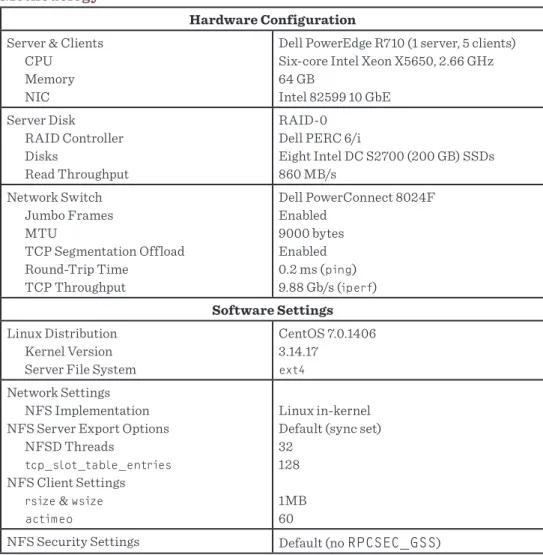
)Table 1: Details of the experimental setup
Our experimental testbed consists of six identical machines (one server and five clients). Table 1 gives details of the hardware and software configuration.
We developed Benchmaster, a benchmarking framework that launches workloads on multiple clients concurrently. Benchmaster also collects system statistics using tools such as iostat
and vmstat, and by reading procfs entries. /proc/self/mountstats provides particularly
useful per-procedure details, including request and byte counts, accumulated queueing time, and accumulated round-trip time.
Bharat Singh is a graduate student in computer science at Stony Brook University. Before that he worked at NetApp developing storage solutions. His research interests include file and storage systems. He is working with Professor Erez Zadok in building high performance storage systems using NFS.
Soujanya Shankaranarayana earned her master’s degree from Stony Brook University in 2014 and was advised by Professor Erez Zadok. She is presently working at Tintri Inc., a Bay Area storage startup. Her research interests involve NFS, distributed storage, and storage solutions for virtualized environments. In addition to academic research experience, she also has industry experience in distributed systems and storage systems.
Erez Zadok received a PhD in computer science from Columbia University in 2001. He directs the File Systems and Storage Lab (FSL) at the Computer Science Department at Stony Brook University, where he joined as faculty in 2001. His current research interests include file systems and storage, operating systems, energy efficiency, performance and benchmarking, security, and networking. He received the SUNY Chancellor’s Award for Excellence in Teaching, the US National Science Foundation (NSF) CAREER Award, two NetApp Faculty awards, and two IBM Faculty awards. [email protected]
FILE SYSTEMS AND STORAGE
Is NFSv4.1 Ready for Prime Time?
We ran our tests long enough to ensure stable results, usually five minutes. We repeated each test at least three times, and computed the 95% confidence interval for the mean. Unless otherwise noted, we plot the mean of all runs’ results, with the half-widths of the confidence intervals shown as error bars. To evaluate NFS performance over short- and long-distance net-works, we injected delays ranging from 1 ms to 40 ms (Internet latency within New York State) using netem at the client side.
For brevity, we call the network without extra delay “zero-delay,” and the network with nms injected delay as “n ms-delay.”
Major Results
We organize our major results around several questions that might arise when considering whether to adopt NFSv4.1. We hope our answers will help system administrators make well-informed deployment decisions.
Is NFSv4.1 Ready for Production?
Throughout our study, Linux’s NFSv4.1 implementation func-tioned well and finished all workloads smoothly. This was true for three different kernel versions: 2.6.32, 3.12.0, and 3.14.17 (only the 3.14.17 results are shown here). We believe NFSv4.1’s implementation to be stable, considering the wide scope and high intensity of our tests, which included dozens of micro- and macro-workloads, involved as many as 2560 threads, and reached throughput up to 1177 MB/s.
For data-intensive workloads that operate on one big NFS file, NFSv4.1 performed almost the same as the simpler NFSv3 while providing extra features. Both NFSv3 and NFSv4.1 were able to easily saturate the 10 GbE network, although we needed to enlarge the maximum TCP buffer sizes (i.e., rmem_max and wmem_max) when the network latency was long.
For metadata-intensive workloads that operate on many small files and directories, our early results showed vast differences between NFSv3 and NFSv4.1. Figure 1 shows one such result, where NFSv4.1 (the bottom curve at time 0) performed 24x
better after that. By looking at mountstats data and tracing the
kernel with SystemTap, we found that NFSv4.1’s poor early per-formance was due to a system bug. We fixed that with a patch [6], resulting in the upper curve (marked with triangles) in Figure 1. The performance jump at about 40 seconds was because of a new feature called delegations, on which we will elaborate later. For the rest of the article, we will report results of the patched NFSv4.1 instead of the vanilla version.
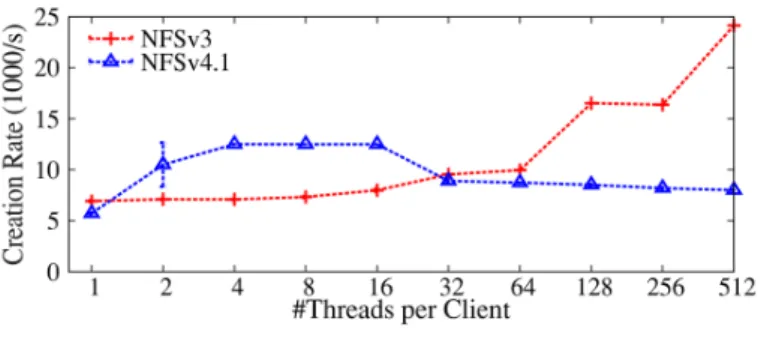
After the bug fix, NFSv4.1 performed close (slightly better or worse) to NFSv3 for most metadata-intensive workloads, but with exceptions in extreme settings. For example, with 512 threads per client, NFSv4.1 created small files 2.9xfaster or 3x slower depending on the network latency.
Generally speaking, we think NFSv4.1 is almost ready for production deployment. It functioned well in our comprehensive and intense tests, although with a few performance issues in the metadata-intensive tests. However, the performance bug we found was easy to uncover, and its fix was also straightforward, suggesting that NFSv4.1 is not yet widely deployed; otherwise, these issues would already have been corrected. We argue that it is time for NFS users to at least start testing NFSv4.1 for pro-duction workloads.
Are You Affected by Hash-Cast?
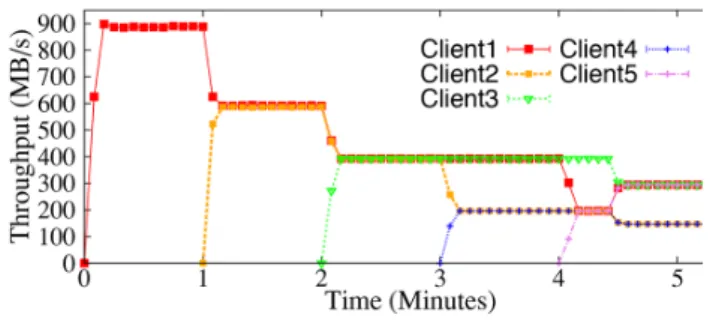
Hash-Cast is a networking problem we discovered during our study; it affects not only NFS but any systems hosting concur-rent data-intensive TCP flows. In our test of a sequential read workload, we frequently observed a winner-loser pattern among the clients, for both NFSv3 and NFSv4.1, exhibiting the follow-ing three traits: (1) the clients formed two clusters, one with high throughput (winners) and one with low throughput (losers); (2) often, the winners’ throughput was approximately double that of the losers; and (3) no client was consistently a winner or a loser; a winner in one experiment might became a loser in another. Initially, we suspected that the winner-loser pattern was caused by the order in which the clients launched the workload. To test
Figure 1: Aggregate throughput of five clients reading 10,000 4 KB files with 16 threads in a 10 ms-delay network (log10)
Figure 2: Sequential-read throughputs of individual clients when they were launched one after the other at an interval of one minute (results of one run of experiments)
FILE SYSTEMS AND STORAGE
Is NFSv4.1 Ready for Prime Time?
clients in a controlled order, one additional client every minute. However, the results disproved any correlation between experi-ment launch order and winners. Figure 2 shows that Client2 started second but ended up as a loser, whereas Client5 started last but became a winner. Figure 2 also shows that the winners had about twice the throughput of the losers. We repeated this experiment multiple times and found no correlation between a client’s start order and its chance of being a winner or loser. By tracing the server’s networking stack, we discovered that the winner-loser pattern is caused by the server’s use of its multi-queue network interface card (NIC). Every NIC has a physical transmit queue (tx-queue) holding outbound packets, and a
physical receive queue (rx-queue) tracking empty buffers for
inbound packets [7]. Many modern NICs have multiple sets of
tx-queues and rx-queues to allow networking to scale with the
number of CPU cores, and to facilitate better NIC virtualization [7]. Linux uses hashing to decide which tx-queue to use for each
outbound packet. However, not all packets are hashed; instead, each TCP socket has a field recording the tx-queue the last
packet was forwarded to. If a socket has any outstanding packets in the recorded tx-queue, its next packet is also placed in that
queue. This approach allows TCP to avoid generating out-of-order packets by placing packet n on a long queue and n+1 on a shorter one. However, a side effect is that for highly active TCP flows that always have outbound packets in the queue, the hash-ing is effectively done per-flow rather than per-packet.
The winner-loser pattern is caused by uneven hashing of TCP flows to tx-queues. In our experiments, the server had five flows
(one per client) and a NIC with six tx-queues. If two flows were
hashed into one tx-queue and the rest into three others, then
the two flows sharing a tx-queue got half the throughput of the
other three because all tx-queues were transmitting at the same
rate. We call this phenomenon (i.e., hashing unevenness causing a winner-loser pattern of throughput) Hash-Cast (see Figure 3). Hash-Cast explains the performance anomalies illustrated in Figure 2. First, Client1, Client2, and Client3 were hashed into
tx3, tx0, and tx2, respectively. Then, Client4 was hashed into tx0, which Client2 was already using. Later, Client5 was hashed
into tx3, which Client1 was already using. However, at 270
sec-onds, Client5’s tx-queue drained and it was rehashed into tx5.
At the experiment’s end, Client1, Client3, and Client5 were using
tx3, tx2, and tx5, respectively, while Client2 and Client4 shared tx0. Hash-Cast also explains why the losers usually got half the
throughputs of the winners: the {0,0,1,1,1,2} distribution has the highest probability, around 69%.
To eliminate hashing unfairness, we used only a single tx-queue
and then configured tc qdisc to use Stochastic Fair
Queue-ing (SFQ), which achieves fairness by hashQueue-ing flows to many software queues and sends packets from those queues in a round-robin manner. Most importantly, SFQ used 127 software queues so that hash collisions were much less probable compared to using only six. To further alleviate the effect of collisions, we set SFQ’s hashing perturbation rate to 10 seconds, so that the mapping from TCP flows to software queues changed every 10 seconds.
Note that using a single tx-queue with SFQ did not reduce the
aggregate network throughput compared to using multiple tx-queues without SFQ. We measured only negligible performance
differences between these two configurations. We found that many of Linux’s queueing disciplines assume a single tx-queue
and could not be configured to use multiple ones. Thus, it might be desirable to use just one tx-queue in many systems, not just
NFS servers. We have also found Hash-Cast to be related to Bufferbloat [2].
Does Statefulness Make NFSv4.1 Slow?
The biggest difference that distinguishes NFSv4.1 from NFSv3 is statefulness. Both NFSv2 and NFSv3 were designed to be stateless (i.e., the server does not maintain clients’ states). A stateless server is easy to implement, but it precludes stateful tasks such as mounting, file locking, quota management, etc. Consequently, NFSv2/v3 pushed these tasks onto standalone services running on separate (and sometimes ad hoc) ports, causing maintenance problems (especially when clients need to access these ports through firewalls). Being stateful, NFSv4.1 can consolidate all its services to run on single well-known port 2049, which simplifies configuration and maintenance. However, a stateful protocol introduces overhead messages to maintain state. We ran tests to characterize this overhead. Our tests validated that the stateful NFSv4.1 is more talkative than NFSv3. Figure 4 shows the number of requests made by NFSv4.1 and NFSv3 when we ran the Filebench File-Server workload for five minutes. For both the zero and 10 ms-latency networks, NFSv4.1 achieved lower throughput than NFSv3 despite making more requests. In other words, NFSv4.1 needs more communication with the server per file operation. In Fig-ure 4, more than one third of NFSv4.1’s requests are OPEN and CLOSE, which are used to maintain states. We also observed in
FILE SYSTEMS AND STORAGE
Is NFSv4.1 Ready for Prime Time?
other tests (particularly with a single thread and high network latency) that NFSv4.1’s performance was hurt by its verbosity. Verbosity is the result of NFSv4.1’s stateful nature. To combat that effect, NFSv4.1 provides compound procedures, which can pack multiple NFS operations into one RPC. Unfortunately, com-pounds are not very effective: most contain only 2–4 often trivial operations (e.g., SEQUENCE, PUTFH, and GETFH), and applications
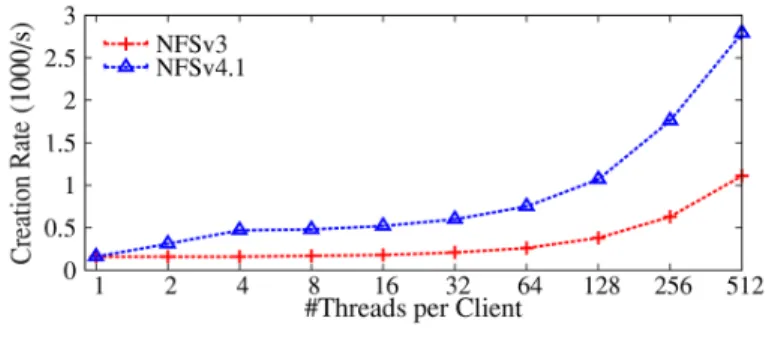
currently have no ability to generate their own compounds. We believe that implementing effective compounds is difficult for two reasons: (1) the POSIX API dictates a synchronous program-ming model: issue one system call, wait, check the result, and only then issue the next call; (2) without transaction support, failure handling in multi-operation compounds is difficult. Nevertheless, statefulness also helps performance. Figure 5 shows the speed of creating empty files in the 10 ms-delay network: NFSv4.1 increasingly outperformed NFSv3 as the number of threads grew. This is because of NFSv4.1’s asynchro-nous RPC calls, which allow the networking layer (TCP Nagle) to coalesce multiple RPC messages. Sending fewer but larger messages is faster than sending many small ones, so NFSv4.1 achieved higher performance. Because NFSv3 is stateless, all its metadata-mutating operations have to be synchronous; other-wise a server crash might lose data. NFSv4.1, however, is stateful and can perform metadata-mutating operations asynchronously because it can restore states properly in case of server crashes.
What Is the Impact of Sessions?
Sessions are a major feature of NFSv4.1; they offer Exactly-Once Semantics (EOS). To work around network outages, NFS has evolved from UDP-only (NFSv2), to both-UDP-and-TCP (NFSv3), and now to TCP-only (NFSv4.1). However, using TCP does not solve all problems. Should a TCP connection be completely disrupted, RPC requests and replies might be lost and need to be retried once another connection is established.
received and executed by the server, (2) its reply to the client got lost, and (3) the client retried after reconnecting. This causes problems for non-idempotent operations such as rename.
To solve this problem, an NFS server has a Duplicate Requests/ Reply Cache (DRC), which saves the replies of executed requests. If the server finds a duplicate in the DRC, it simply resends the cached reply without re-executing the request. However, when serving an older client, the server cannot know how many replies might be lost, because clients do not acknowledge them. This means that the DRC is effectively unbounded in size.
NFSv4.1’s sessions solve the problem by bounding the number of unacknowledged replies. The server assigns each session a num-ber of slots, each of which allows one outstanding request. By reusing a session slot, a client implicitly acknowledges that the reply to the previous request using that slot has been received. Thus, the DRC size is bounded by the total number of session slots, making it feasible to keep DRC in persistent storage: for example, a small amount of NVRAM, which is necessary to achieve EOS in the face of crashes.
However, if a client runs out of slots (i.e., has reached the maxi-mum number of concurrent requests the server allows), it has to wait until one becomes available, which happens when the client receives a reply for any of its outstanding requests. In our tests, we observed that the lack of session slots can affect NFSv4.1’s performance. In Figure 6, session slots became a bottleneck when the thread count increased above 64, and thus NFSv4.1 performed worse than NFSv3. Note that the number of session slots is a dynamic value negotiated between the client and server. However, Linux has a hard limit of 160 on the number of slots per session.
How Much Does Delegation Help?
A key new feature of NFSv4.1 is delegation, a client-side caching mechanism that allows cached data to be used without lengthy revalidation. Caching is essential to good performance, but in distributed systems like NFS it creates consistency problems. NFS clients need to revalidate their cache to avoid reading stale
Figure 4: Number of NFS requests made by the File Server workload. Each NFSv4.1 operation represents a compound procedure. For clarity, we omit trivial and rare operations in the same compound (e.g., PUTFH, SEQUENCE, etc.).
FILE SYSTEMS AND STORAGE
Is NFSv4.1 Ready for Prime Time?
data. In practice, revalidation happens often, causing extra server load and adding delay in high-latency networks. In NFSv4.1, the cost of cache validation is reduced by letting a server delegate a file to a particular client for a limited time. While holding the delegation, a client need not revalidate the file’s attributes or contents. If any other clients want to perform conflicting operations, the server can recall the delegation using
callbacks. Delegations are based on the observation that file sharing is infrequent and rarely concurrent [4]. Thus, they boost performance most of the time, but can hurt performance in the presence of concurrent and conflicting file sharing.
We studied read delegations (which are the only type currently supported in the Linux kernel). In Linux, a read delegation is granted if (1) the back channel to the client is working, (2) the client is opening the file with O_RDONLY, and (3) the file is not
open for write by any client. The benefits of delegations appear in Figure 1, where they helped NFSv4.1 read small files around 172x faster than NFSv3. In Figure 1, NFSv4.1 was simply
read-ing from the local cache without any server communication at all, whereas NFSv3 had to send repeated GETATTRs for cache
revalidation.
Read delegations can also improve the performance of file lock-ing. We quantified the improvement by pre-allocating 1000 4 KB files in a shared NFS directory. Each client repeatedly opened each file, locked it, read the entire file, and then unlocked it. After ten repetitions the client moved to the next file.
Table 2 shows the number of operations performed by NFSv3 and by NFSv4.1 with and without delegation. Only NFSv4.1 shows OPENs and CLOSEs because only NFSv4.1 is stateful.
When delegations were on, NFSv4.1 used only 1000 OPENs even
though each client opened each file ten times. This is because each client obtained a delegation on the first OPEN; the
follow-ing nine were performed locally. Note that NFSv4.1 did not use any LOCKs or LOCKUs because, with delegations, locks were also
processed locally.
Without a delegation (NFSv3 and NFSv4.1 with delegations off in Table 2), each application read incurred an expensive NFS
READ operation even though the same reads were repeated ten
times. Repeated reads were not served from the client-side cache because of file locking, which forces the client to invalidate the cache [1].
Another major difference among the columns in Table 2 was the number of GETATTRs. In the absence of delegations, GETAT-TRs were used for two purposes: to revalidate the cache upon file
open, and to update file metadata upon read. The latter GETATTRs
were needed because the locking preceding the read invalidated both the data and metadata caches for the locked file.
In total, delegations cut the number of NFSv4.1 operations by over 29x (from 88 K to 3 K). This enabled the original stateful
and “chattier” NFSv4.1 (with extra OPEN, CLOSE, and FREE_ STATEID calls) to finish the same workload using only 5% of the
requests used by NFSv3. These reductions translate to a 6–193x
speedup in networks with 0–10 ms latency.
Nevertheless, users should be aware of delegation conflicts, which incur expensive cost. We tested delegation conflicts by opening a delegated file with O_RDWR from another client and
observed that the open was delayed for as long as 100 ms because the NFS server needed to recall outstanding delegations upon conflicts.
We have also observed that read delegations alone are sometimes not enough to significantly boost performance because writes quickly became the bottleneck, and the overall performance was
Operation NFSv3 deleg. offNFSv4.1 NFSv4.1 deleg. on
OPEN 0 10,001 1000 READ 10,000 10,000 1000 CLOSE 0 10,001 1000 ACCESS 10,003 9003 3 GETATTR 19,003 19,002 1 LOCK 10,000 10,000 0 LOCKU 10,000 10,000 0 LOOKUP 1002 2 2 FREE_STATEID 0 10,000 0 TOTAL 60,008 88,009 3009
Table 2: NFS operations performed by each client for NFSv3 and NFSv4.1 (with and without delegations). Each NFSv4.1 operation represents a compound procedure. For clarity, we omit trivial and rare operations in the same compound (e.g., PUTFH, SEQUENCE, FSINFO). NFSv3’s LOCK and
LOCKU (i.e., unlock) come from the Network Lock Manager (NLM).
FILE SYSTEMS AND STORAGE
Is NFSv4.1 Ready for Prime Time?
thus limited. This finding calls for further investigation into how delegations can improve write performance.
Conclusions
We have presented a comprehensive performance benchmarking of NFSv4.1 by comparing it to NFSv3. Our study found that: 1. Linux’s NFSv4.1 implementation is stable but suffers from
some performance issues.
2. NFSv4.1 is more talkative than NFSv3 because of statefulness, which hurts NFSv4.1’s performance and makes it slower in low-latency networks (e.g., LANs).
3. In high-latency networks (e.g., WANs), however, NFSv4.1 performed comparably to and even better than NFSv3, since NFSv4.1’s statefulness permits higher concurrency through asynchronous RPC calls.
4. NFSv4.1 sessions can improve correctness while reducing the server’s resource usage, but the number of session slots can be a scalability bottleneck for highly threaded applications.
5. NFSv4.1’s read delegations can effectively avoid cache revali-dation and improve performance, especially for applications using file locks, but delegation conflicts can incur a delay of at least 100 ms.
6. Multi-queue NICs suffer from the Hash-Cast problem and can cause unfairness among not only NFS clients but any data-intensive TCP flows.
Due to space limits, we have presented only the major findings and have omitted some details in explanation; please refer to our SIGMETRICS paper [1] for more results and further details.
Limitations and Future Work
Our study focused only on the performance of NFSv4.1; other aspects such as security (RPCSEC_GSS) and scalability (pNFS) should be interesting subjects to study in the future. Most of our workloads did not share files among clients. Because sharing is infrequent in the real world [4], it is critical that any sharing be representative. Finally, a different NFSv4.1 implementation than the Linux one might (and probably would) produce different results.
Acknowledgments
We thank Lakshay Akula, Vasily Tarasov, Arun Olappamanna Vasudevan, and Ksenia Zakirova for their help in this study. This work was made possible in part thanks to NSF awards CNS-1223239, CNS-1251137, and CNS-1302246.
References
[1] M. Chen, D. Hildebrand, G. Kuenning, S. Shankaranarayana, B. Singh, and E. Zadok, “Newer Is Sometimes Better: An Evaluation of NFSv4.1,” in
Proceedings of the SIGMETRICS
2015
, Portland, OR, June 2015, ACM. Forthcoming.[2] M. Chen, D. Hildebrand, G. Kuenning, S. Shankaranarayana, V. Tarasov, A. Vasudevan, E. Zadok, and K. Zakirova, “Linux NFSv4.1 Performance under a Microscope,” Technical Report FSL-14-02, Stony Brook University, August 2014.
[3] D. Hildebrand and P. Honeyman, “Exporting Storage Systems in a Scalable Manner with pNFS,” in
Proceedings of
MSST
, Monterey, CA, 2005, IEEE.[4] A. Leung, S. Pasupathy, G. Goodson, and E. Miller, “Measurement and Analysis of Large-Scale Network File System Workloads,” in
Proceedings of the USENIX Annual
Technical Conference
, Boston, MA, June 2008, pp. 213–226. [5] A. McDonald, “The Background to NFSv4.1,”;login:
, vol. 37, no. 1, February 2012, pp. 28–35.[6] NFS: avoid nfs_wait_on_seqid() for NFSv4.1: http://www. spinics.net/lists/linux-nfs/msg47514.html.
[7] Scott Rixner, “Network Virtualization: Breaking the Performance Barrier,”
Queue
, vol. 6, no. 1, January 2008, pp. 36–37 ff.The USENIX Store
is Open for Business!
www.usenix.org/store
Want to buy a subscription to
;login:,
the latest short topics book,
a USENIX or conference shirt, or the box set from last year’s
work-shop? Now you can, via the
USENIX Store!
Head over to
www.usenix.org/store
and check out the collection
of t-shirts, video box sets,
;login:
magazines, short topics books,
and other USENIX and LISA gear. USENIX and LISA SIG members
save, so make sure your membership is up to date.