J
ÜRGENJ
UNGS
OME
R
EFLECTIONS ON THE
B
ASIC
C
ONCEPTUALISATION OF A
R
ESOURCE
M
ODELLING
L
ANGUAGE
FOR
B
USINESS
P
ROCESS
M
ODELLING
-
C
ONCEPTS
,
R
EQUIREMENTS AND
O
PEN
R
ESEARCH
Q
UESTIONS
June 2003
Die Arbeitsberichte des Instituts für
Wirtschaftsinformatik dienen der Darstellung vorläufiger Ergebnisse, die i.d.R. noch für spätere Veröffentlichungen überarbeitet werden. Die Autoren sind deshalb für kritische Hinweise dankbar.
All rights reserved. No part of this report may be reproduced by any means, or translated.
Arbeitsberichte des Instituts für
Wirtschaftsinformatik
Herausgegeben von / Edited by:
Prof. Dr. Ulrich Frank
Prof. Dr. J. Felix Hampe
Prof. Dr. Klaus G. Troitzsch
Bezugsquelle / Source of Supply: Institut für Wirtschaftsinformatik Universität Koblenz-Landau Universitätsstraße 1 56070 Koblenz Tel.: 0261-287-2520 Fax: 0261-287-2521 Email: [email protected] WWW: http://www.uni-koblenz.de/~iwi
Anschrift der Verfasser
Address of the authors:
Dipl. Inform. Jürgen Jung
Institut für Wirtschaftsinformatik
Universität Koblenz-Landau
Universitätsstraße 1
D-56070 Koblenz
The "Arbeitsberichte des Instituts für Wirtschaftsinformatik" comprise preliminary results which will usually be revised for subsequent publications. Critical comments would be
appreciated by the authors.
Alle Rechte vorbehalten. Insbesondere die der Übersetzung, des Nachdruckes, des Vortrags, der Entnahme von Abbildungen und Tabellen - auch bei nur auszugsweiser Verwertung.
Abstract
This research report presents an overview of some basic ideas regarding the conceptualisation of a resource description language for business process modelling. This language is an extension to an existing process modelling language — MEMO-OrgML. The basic conceptualisation comprises basic resource types and their mutual relations. It aims to satisfy the needs of different user types and abstractions. The language will be applicable by domain experts and offer domain specific resources and resource types for various domains by offering adequate abstraction on resources. A specialised resource modelling language fosters the reuse of common concepts and as-sures the integrity of a business process model. The current version of this report has to be regarded as a first draft regarding general concepts of a re-source modelling language, requirements and —most of all— open research questions.
Contents
1 Introduction 6
1.1 Process Modelling . . . 6
1.2 MEMO and Resource Modelling . . . 10
1.3 Levels of Abstraction . . . 11
2 Resource-Types 13 2.1 Basic Meta-Model of Resource Types . . . 14
2.2 Information Types . . . 16
2.3 Media Types . . . 18
2.4 Software Types . . . 22
3 Resources 24 3.1 Basic Resources . . . 24
3.2 Resources and Types . . . 25
3.3 Variants . . . 27
4 Accounting of Resources 28 5 Interfaces to other MEMO-Languages 31 5.1 Human Resources . . . 32
5.2 Allocation of Resources . . . 34
6 Support Types 35 6.1 Financial Values . . . 36
6.2 Quantities . . . 38
7 Example: Information Resources 38
List of Figures
1 Levels of Abstraction . . . 12
2 Basic Resource Types . . . 15
3 Information Resource Types . . . 17
4 Media Resource Types . . . 20
5 Software Types . . . 23
6 Type, Resource and Instance . . . 25
7 Basic Resources . . . 26
8 Resources and corresponding Resource Types . . . 27
9 Variant of a Resource . . . 28
10 Basic Accounting . . . 29
11 Assignment of Accounting Information to Resources and Types 30 12 Human Resources assigned to Organisational Units . . . 33
13 Resource Allocation Analysis Pattern by Fowler . . . 35
14 Support Types: Finance and Measure . . . 37
1
Introduction
This research report presents a work in progress at the IS Research Institute at the University of Koblenz (Germany). It describes the conceptualisation of a resource modelling language as an extension to an existing process
modelling language developed by the research group Enterprise Modelling
at the IS Research Institute. The resource modelling language aims to add language features for the specification of resources on a domain-specific level and offers formal criteria for a further mapping to IT-related resources and the development of a corporate information system.
In well established process modelling languages, business processes and
their relationships only describe what has to be done. Resources assigned
to processes specify who (human resources or autonomous machinery) has
to work on the process and what (e.g. machinery, tools, expedients) will
be needed. Modelling of resources will enrich the semantic expressiveness of conventional business process models. Additionally, the resource model might be integrated with existing object-models or other models describing
an organisation. This integration1 is a key issue for the design of an
in-tegrated business process language. It offers domain-specific concepts and ensures the integrity of a model regarding resources. The different MEMO languages base on an object-oriented approach. They are specified by a meta-model and share common abstractions in an underlying object model. Despite the importance of the elaboration of an object-oriented approach as a basis for the resource modelling language, this report only describes basic ideas for the conceptualisation of such a language. The conceptualisa-tion mainly comprises some resource-related concepts, requirements for the modelling of resources and open research questions. It focusses on domain-specific aspects and abstracts from a formal base for the integration of re-sources into MEMO as long as the concepts are far from being precise enough for an adequate integration into the MEMO meta-model.
1.1
Process Modelling
The analysis, representation and management of knowledge about an organ-isation and its processes has always been very important [25]. A lot of work has been done on the development and evaluation of ontologies for process modelling [39, 40, 41, 42, 43, 44, 18], the specification of process modelling 1Especially the relationships between entities (objects) of a resource model and objects of an object model are nor discussed within this report. Nonetheless, such information might enrich the semantic expressiveness of an organisational model. But this report only focusses on the basic conceptualisation of a resource modelling language and prescinds —by now– from the formal specification of the integration of the resource modelling language into object models.
languages [8, 30, 37, 1] as well as on business process modelling methods and concepts [20, 32]. Business process models can be used for different kinds of purposes:
• Documentation of processes of an organisation to foster communication
[12, 30]
• Analysis of business processes [8, 4, 36]
• Simulation of processes [2]
• Support for business process re-engineering [6, 30]
• Generation of workflow schemata [6, 30]
• Software development of process-oriented applications [12, 35, 34, 32, 6]
The documentation of an organisation’s processes (as well as other organ-isational aspects like its structure or strategy) fosters communication with new employees or external consultants [12, 30]. Business process models represent a common medium for the communication of domain experts and
novices. They offer domain level concepts2 and enable a broader
distribu-tion of knowledge among other business-related people with different skills and knowledge of an organisation.
The analysis of business processes relies on a relatively detailed description of process models and according concepts. Depending on the analysis’ pur-pose, a modelling language has to offer language features for the modelling of the facts which are in its scope. Analysis might for example support the detection of weaknesses in existing processes [8, 4, 36]. Appropriate language features provided by a process modelling language support the
determination of media clashes3, unnecessary processes4 or potentials for
further optimisations. Nevertheless, the potential for further optimisations relies on the degree of formal description of the business process model. De-pending on identified weaknesses, a business process re-engineering might be applicable [6, 30].
Simulation supports the detection of weaknesses of a business process model [2] as well as analysis. In contrast to analysis, simulation does not rely on structural properties of a business process. Simulation generally al-lows the prototypical execution of previously designed processes on the basis of concrete entities. Depending on the process and the selected entities, a prototypical execution of a certain process can be started and observed by the designer. A simulation usually allows the observation of a processes 2In contrast to other modelling purposes and languages, the level of abstraction is very high with respect to the degree of formalisation.
3If different kinds of media are included.
execution depending on given input parameters. It is in some extend more powerful with respect to expressiveness than a static analysis. Simulation can focus on aspects of a model which have not been considered in advance. Hence, simulation enables the detection of additional properties by the ob-servation of the behavior of a process. It also shows unknown properties and restrictions regarding a new business process. Simulation depends on a prototypical instantiations of a process model5. Typical instances of objects and their values (e.g. a specific processing time or accounting information) are added to the model and the execution of a process can be observed. Depending on the objectives, business process re-engineering supports the redesign of processes with respect to weaknesses identified by an analysis or a simulation [6, 30].
Business process models might also be a preliminary stage for an infor-mation system’s (IS) design. A workflow-management-system (WfMS) or a newly developed software system are alternatives for such an IS [12, 35, 34, 32, 6]. The distinction between a workflow schema and a software system is the level of coding. Workflow schemata can usually directly derived from a process-model. Process types are mapped to atomic workflows and resources are are assigned accordingly. This is because of the predefined semantics of WfMS. A workflow s only described by its processes and associated appli-cations. Hence, the applicability of such systems is restricted to classical computer-supported processes. The extend of these capabilities is usually determined by the WfMS. In contrast to this, the development of a new information system does not depend on the limitations of a given workflow
framework6. Such a system is usually build using low-level programming
languages and domain-specific frameworks.
Resources are essential for the modelling of processes [33]. Processes
and their relationships only describe what has to be done. Resources
as-signed to processes specifywho has to work on the process andwhat will be
needed. Resource are usually not available in an unlimited manner [29, 33]. Modelling resources offers the opportunity for the determination of the ef-ficiency of a process according to economic aspects. Hence, the usage of scarce resources has to be taken into account for the analysis or simula-tion of processes as well as for the development of a workflow applicasimula-tion or an information system. Bottlenecks resulting from scarce resources can be identified and supported by alternative resource which may replace the original resource in case of a failure. But, the quality of analysis, simulation, and system development depend on the conceptual power of the resource 5The prototypical instantiation of a process model means the mapping of a conceptual process model to a simulation model with additional properties of an instance. Such an instance might correspond to the instance of a process and an instances of associated entities as well.
modelling language. Hence, such a language should offer:
• domain specific concepts to be (re-)used by domain experts
• semantically rich resource types including integrity constraints
• support for analysis and simulation
• potential for the further development of information systems 7
Many process modelling languages have been developed in the last years. Some of them also include the specification of resources on different lev-els of abstraction. Petri-nets offer a formal language for the specification of processes [2]. In classical Place/Transition-Nets, resources (i.e. their states) can only be modelled by a subnet. Higher-level Petri-nets offer an extended expressiveness by using tuples as markings (instead of anonymous markings like classical Petri-nets) [2]. Oberweis developed a language based on Petri-nets but using complex relations as markings [30]. Nonetheless, these approaches offer only a few language features for the descriptions of
resources. Even worse, the concept of a resource8 itself usually does not
exist explicitly. Also Scheer’s event-driven process chains (EPC) do not in-clude specific resources [34, 35, 36]. All entities participating on a business process have to be modelled by an entity-relationship-diagram (ERD). The current version of the Unified Modelling Language (UML) provides facilities for business process modelling [3, 26, 9]. Like in all previously presented ap-proaches, resources are not a specific language feature and have to be added by the user.
This paper presents some basic ideas on the development of a resource specification language for business processes and relates to a current work in progress. The resource modelling language aims to satisfy the needs of different user types. The language has to be applicable by domain experts and offer domain specific resources and resource types for various domains by offering adequate abstractions on resources. This resource modelling lan-guage is an extension to an existing process modelling lanlan-guage — OrgML (Organisation Modelling Language) — which is part of an integrated enter-prise modelling method MEMO (Multi-Perspective Enterenter-prise MOdelling) [12].
7The potential for the development of information systems might be realised in the computer-supported generation of schemas for workflow management systems or the ability for requirements engineering or domain analysis for with respect to software development.
1.2
MEMO and Resource Modelling
MEMO is a method for modelling organisations on different levels of abstrac-tion and from different perspectives. MEMO has been initiated by Ulrich Frank and is the main research topic of the research group ’Enterprise Mod-elling’ at the University of Koblenz. MEMO includes several languages for modelling static, functional and dynamic aspects of an enterprise. One of these languages is the MEMO-OrgML, which supports modelling of organi-sational structures and processes. Resource modelling has not been subject of the first conceptualisation of the MEMO-OrgML. Our first approach for modelling resources with MEMO-OrgML is presented here.
A resource modelling language supports the domain-specific usage of re-source-types. A predefined resource modelling language might guarantee the integrity of the usage of resources in specific process types. Domain-specific circumstances might result in a restriction of the usage of specific resources. Also the usage of one resource might result in the usage of other resources. Hence, dependencies between different resources — and resource types as well — should be specified and support an adequate allocation of resources to given processes. Reuse of resource descriptions should be supported by given language features and the reusability of already defined resources. An extensive library of given resources and types supports the reuse of previ-ously specified concepts. Furthermore, resource-specific language features for the modelling of resources allow for the reuse of resource-dependent properties of given resources.
Generally speaking, a proper conceptualisation of a resource modelling
language and related resources9 fosters a proper application and
specifica-tion of resources. Integrity of the usage of resources and resource type might be assured by the reuse of given resource types. A resource modelling lan-guage should offer domain-specific concepts for the description of resources used in a business process model. Such a language implies two benefits. Firstly, it supports the reuse of already defined concepts. Resources and their corresponding properties do not have to be modelled explicitly and can, therefore, be reused. Secondly, the usage of a resource modelling lan-guage helps to ensure integrity constraints. Those constraints are given by the conceptualisation of a resource modelling language. The proper ap-plication of hereby related language features fosters the appropriateness of resource models for given business process models.
1.3
Levels of Abstraction
Many everyday terms are ambiguous with respect to their level of
abstrac-tion10. The term ’resource’ might be interpreted as resource type (i.e. a
resource class11) or equally likely as an instance of resource type (e.g. an existing database server in the corporate network). Furthermore, a resource class can be looked at from an intensional or an extensional point-of-view. The intensional interpretation of a class corresponds to a template for the
specification of instances. A class named Person defines the attributes
firstname, lastname and dateOfBirth for all persons. This template is
used to instantiate new person-instances of the class Person. By contrast, the class extension is a set of objects with common properties. Ambiguities of interpretations have to be avoided in the context of business process mod-elling for formal analysis, simulation or software development. Furthermore, additional aspects of resource classification in a process modelling language have to be taken into account. Such aspects are illustrated by example of
a PDA12 in Figure 113. The resource modelling language concepts are at
present described by OML-diagrams14 regarding to a future meta-model.
Instances of types in the meta-model are resource types such as the PDA
in Figure 115. The resource type PDA may be classified from a technical
or economic point of view. Technical aspects are model, processor speed, and size of the main memory. These aspects determine the restrictions of usage for such a resource type in a definite context. Economic properties of a PDA resource type address cost of operation and maintenance of a spe-cific instance in a business process. Those aspects are described at different levels of abstraction by the same resource type.
An initialised resource type ’Compaq iPaq H3660’ is an instance of the
resource type PDA and can in turn also have instances (like an iPaq with
the serial number 4775348 at the bottom of Figure 1). Consequently, we have a multi-level type-instance-relationship for the description of PDAs in a resource model. This relationship, however, is hard to handle in the context of business process modelling. Common object-oriented programming lan-10The terms might also be interpreted accordingly. Different perspectives and individual back-grounds can lead to various interpretations of the same term. Not only the levels of abstractions result in ambiguities but also the personal context of a developer.
11The terms ’type’ and ’class’ are used synonymously within this paper.
12The abbreviation stands for Personal Digital Assistant and describes a pocket-sized mobile computer.
13Meta-models in MEMO are described by the MEMO-OML —the MEMO Object Modelling
Language. The notation of the object models used within this report does not reflect the original
OML notation. The notation is rather leant against the UML notation but corresponds to
concepts of the OML. 14using the UML notation
Type
Initialized Type
Specialized Type
Concrete Instance
Level of Abstraction Example
Resource Type
Concrete Resource Type
Specialized Resource Type
Concrete Resource Instance
1,1 0,* PDA modelName: iPaq H3660 processorSpeed: 206 mainMemory: 64 Variant Extension of a Concrete Resource SmartPhone mobileNetwork String PDA modelName String processorSpeed Integer mainMemory Integer Modelling Language Resource_Type name String Feature_Type name String type String Meta PDA bluetooth: true PDA Class (extensional) Focus on Sets PDA description String number Integer costs Float modelName String processorSpeed Integer mainMemory Integer modelName: iPaq H3860 processorSpeed: 206 mainMemory: 64 bluetooth: true modelName: iPaq H3860 processorSpeed: 206 mainMemory: 64 serialNumber: 4775348 Type Initialized Type Specialized Type Concrete Instance
Level of Abstraction Example
Resource Type
Concrete Resource Type
Specialized Resource Type
Concrete Resource Instance
1,1 0,* PDA modelName: iPaq H3660 processorSpeed: 206 mainMemory: 64 Variant Extension of a Concrete Resource SmartPhone mobileNetwork String PDA modelName String processorSpeed Integer mainMemory Integer Modelling Language Resource_Type name String Feature_Type name String type String Meta PDA bluetooth: true PDA Class (extensional) Focus on Sets PDA description String number Integer costs Float modelName String processorSpeed Integer mainMemory Integer modelName: iPaq H3860 processorSpeed: 206 mainMemory: 64 bluetooth: true modelName: iPaq H3860 processorSpeed: 206 mainMemory: 64 serialNumber: 4775348
Figure 1: Levels of Abstraction
guages only offer a flat class-instance-relationship. Therefore, type-instance relationships of resource models can hardly be mapped directly to the pro-gramming language’s concepts.
To make things even more complex it is not clear whether special PDAs (e.g. a SmartPhone) are subtypes or instances of the PDA resource type. On the one hand, they may be regarded as subtypes because they have an additional features compared to standard PDAs. This feature is the build-in mobile telecommunication facility. On the other hand, a SmartPhone is of the resource type PDA because it might be a variant of an existing PDA with an additional mobile telecommunication facility (built-in or attached). Conceptual modelling usually prescinds from concrete objects and change-able aspects. Hence, only a processes type is favored in conceptual models. Despite this fact, modelling of instances might be appropriate in certain situations:
• The modelling of —anonymous but separately identifiable— instances
pro-cesses. Such a relationship may be of the kind: The resource (instance) used in process A is also required in process B. Such a resource might be referred to by its unique identification but remains anonymous on a conceptual level.
• A prototypical instance in a process model reflects representative
pro-perty-values of a resource type. Such representative values may de-pend on average values, user defined parameters or other user-defined aspects16. Costs for the usage of a resource are usually attached to the concrete resource instance and differ between instances. Hence, costs can hardly be assigned to resource types in conceptual modelling. But average costs of a certain resource type might be assigned to a proto-typical instance which is used for formal analysis and simulation. • Concrete instances might be required for the illustration of the current
state of an organisation’s information system. The first step of business process reengineering is the modelling of existing business processes. This model includes processes and resources as they are at the moment. This might also include specific resources like special servers, relevant machinery, or technical engineers, which are hard to compensate. Depending on the modelling purpose, the modelling of types and instances might be supported by a resource modelling language. A user does not have to specify instantiated resources but he might get the opportunity to do so. The specification of concrete resources can result in a huge set of lan-guage features but it might support the adequate description of instances —if needed. Whenever the precise description of resources is required, a lan-guage should offer adequate lanlan-guage features. Such a lanlan-guage should also support different perspectives (technical and economic). Furthermore, dif-ferent levels of abstraction have to be available with respect to type-instance-relationships. We will present our first approach for resource modelling in the following section. This approach will cover many of the discussed as-pects.
2
Resource-Types
The foundation of the resource modelling language is the meta-model for the specification of resources and their types. The current version of the core of this language is presented in figure 2. The purpose of this meta-model is the 16Additional —user-defined— attributes might be added to the simulation. Such attributes reflect additional properties required for the simulation but which are not an inherent part of the domain model itself. Examples for such properties (and associated values) are estimated costs or average computing time.
description of abstract resources on a conceptual level. Resources are seen from the perspective of a domain expert, who deals with existing resource types assigned to business processes. Accounting aspects are excluded and will be discussed in section 4. The core resource modelling language aims to offer domain-specific resource types like machinery, raw material, staff qualification, and their respective types.
2.1
Basic Meta-Model of Resource Types
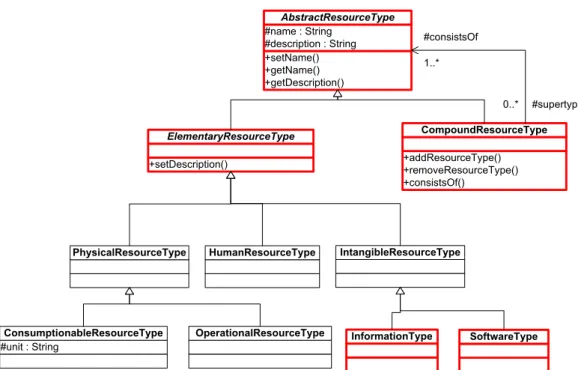
At the top level of the class hierarchy of the meta-model we distinguish be-tween compound and elementary resources types. A compound resource type is an abstract resource type, which is composed of other abstract resource types. Hence, a compound resource type may consist of several elementary or compound resource types. Elementary resource types are specialised to human, physical, and intangible resource types. A human resource type corresponds to an organisational unit or a role filled by a person. Physical resource types comprise all tangible objects used within a business process. The classification of these resource types correlates to their economic differentiation between operational and consumptionable re-sources(cf. [7]). Media don’t seem to fit in this classification. Consequently, they are put into a different category. In our first approach, subtypes of physical resource types are resource types, which
• are used for the completion of a process and are still available
after-wards (OperationalResourceType)
• are consumed by the completion of a process (ConsumptionableResourceType),
or
• store information (MediumType).
Operational resource types are physical resource types, which are used within a process and are still available after its completion. Examples are machinery, tools, and vehicles. They are all used for processing but remain available. In contrast, consumable resource types are a prerequisite for a process and are transformed during the execution of a process. Raw and operational material as well as spare parts are used by a business process and are transformed to a (partial) product. They (individually) will not be available for other processes. Information containing media does not fit the differentiation between operational and consumable resource type. A medium or its information might be out-of-date after a process or it might be a prerequisite for subsequent processes. Intangible resource types represent all resource types, which are neither physical nor human. Two subtypes have
+setName() +getName() +getDescription() #name : String #description : String AbstractResourceType +addResourceType() +removeResourceType() +consistsOf() CompoundResourceType #consistsOf 1..* #supertype 0..* +setDescription() ElementaryResourceType HumanResourceType PhysicalResourceType IntangibleResourceType #unit : String
ConsumptionableResourceType OperationalResourceType InformationType SoftwareType
Figure 2: Basic Resource Types
been identified up to now - information and software17. They can not exist
on their own, because they need a medium for representation - persistent or for transmission.
Open Research Questions: The basic classification as presented above has to be evaluated in future projects. It is mainly correlated to classical differentiations found in the German literature on resources18. Such a division into resources which can be used as a tool within a process or are consumed by the execution of a process seems to be inappropriate for media. A medium might be a reusable storage for information (e.g. a tape) or a one-way representation for data (e.g. a hardcopy). Future research has to provide experiences on the appropriateness of such a distinction.
17Further specifications of information and software might be put into concrete shapes by other components of MEMO – say the object model. An object model migght formally describe the structure and semantics of information. Again, these aspects are left out by the hereby described resource modelling language.
18In fact, many authors discuss so called Produktionsfaktoren (production factors) which mainly correspond to our notion of resources.
Besides this, resources might be distinguished by their activeness within a process. Hence, they might be active or passive. Active resources are autonomously capable for the achievement of the goals of a process. Ex-amples for active resources are humans or autonomous machinery. They react on triggers and can coordinate the execution of a process depending on previously defined rules. Passive resources are not able to act without the coordination of an active resource. They are only tools, which are used by active resources. The distinction between those kinds of activity seem to be ambiguous. Is a running (email-)server process active19 or passive20? Is an employee active21 or passive22? Such a classification only allows the concrete application to a given organisation. The general applicability has to be examined in different projects and environments.
Generally speaking, the hereby given conceptualisation only reflects some basic thought, basing on a small fraction of literature. It has to be evaluated in practice and requires a general inspection regarding current publications. So far, the basic conceptualisation reflects our first ideas and will be im-proved by further research. Such research will clarify the adequateness of the focus on classical economic features or the power of additional concepts related to information systems.
2.2
Information Types
Information types correspond to different kinds of information within an organisation [5]. Information types might be specific document types like order, assembly list, and invoice [23]. An information type —respectively the structure of the information it describes— might for example reflect guidelines, regulations, and directions for business processes. All these kinds
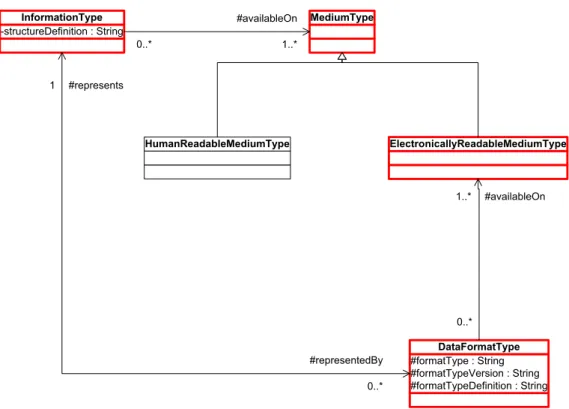
of information are covered byInformationTypein the meta-model in figure
3.
An information type is defined by its structure, as described by the fol-lowing examples:
• An invoice consists of a date, sender, receiver, and several positions.
• A guideline is structured by its document, the corresponding
applica-bility, and its contents.
An information type’s structure is encapsulated by the attributestructureDefinition23.
19It can handle incoming emails on its own.
20It requires the assistance of a human operator in case of a failure. 21He can act on his own.
22The role of sick employee needs to be filled by a substitute employee.
-structureDefinition : String InformationType MediumType 0..* #availableOn 1..* ElectronicallyReadableMediumType HumanReadableMediumType #formatType : String #formatTypeVersion : String #formatTypeDefinition : String DataFormatType #represents 1 #representedBy 0..* #availableOn 1..* 0..*
Figure 3: Information Resource Types
This definition is independent of a concrete data definition. Every informa-tion might be structured by a formal data definiinforma-tion but need not to be. Consequently, the structure definition of an information type is independent of a formal data definition. Such a data definition might be an XML-DTD, an SQL table definition or another structure definition language. If there is a formal structure definition, it might be assigned to the information type24.
There has to be drawn a clear boundary between an information’s format and its medium. The medium format specifies the structure a document whereas the medium contains such information. Therefore, a medium is a can be made using natural language or being given in a formal language. Examples for useful formal languages are the Extended Bacchus-Naur-Form (EBNF) or IT-related document defini-tion languages like —for example— XML (eXtensible Markup Language) and SGML (Structured Generalised Markup Language).
24With respect to a pure object-oriented approach, the specification of documents using an object-oriented description might be suitable. Such an approach will be fostered by the hereby designed resource modelling language. Consequently, features can be mapped to an object-oriented model —specified by the OML. Nevertheless, we would like to emphasise the usage of general document-related languages, such as SGML or XML.
carrier for information. We distinguish between human and electronically readable media. A human readable medium corresponds to a representation for human readers, like a paper-based hardcopy or a screen output. Elec-tronically readable media are those kinds of media, which allow a comput-erised processing of information. Storage of information on an electronically readable medium is only allowed if a data-format for this information exists.
Open Research Questions: The distinction between software and
informationis motivated by the role of such anintangibleresource. Software represents an active kind of an intangible resource. It acts as an active resource with respect to the execution of a program. Information is therefore a passive intangible resource. Information might be used as a regulation for the further processing of data. It is not quite clear at the moment whether the distinction between software and information is of any use. Further research has to be done.
2.3
Media Types
Information types represent a non-physical type of resource. Every infor-mation type has to be stored on a medium representing the according in-formation. We would like to distinguish between human and electronically
media in this paper25. Regarding media clashes, the distinction between
human and electronically readable media is of a very importance. Human readable media correspond to all documents which offer an adequate rep-resentation of information to a human reader. Examples for such kinds of documents are a printed invoice, a paper-based product catalog or any kind of paper-based documents. These documents are presented in a way that they will be readable by humans and support further processing by humans. Electronically readable media are those which are based on an IT-system and allow a further processing by an information system.
This distinction is only a first attempt for the representation of different kinds of media in the context of the examination and detection of media clashes. Information itself is not restricted to humans or information sys-tems (i.e. its readability or interpretability). Different usages by humans or computers only depend on the representation of information. Printed documents are easy to read by an employee but cannot be interpreted by a
computer26. The distinction between human and electronically readable
me-25This distinction is our first approach regarding the handling of media clashes. With respect to a closer notion to media clashes, such a clash refers to the change of one medium to another. But, a media clash might not only refer to the change of a medium. It might also reflect to the transition between different data format types.
dia might be not very convincing, because the set of electronic media and
human readable documents27 are certainly not disjoint. Some media are
only readable by humans and others only by computer-based information systems. A fraction of media represents a basis for human or computerised processing. The projection of data on a display bases on electronically in-formation but results in a human readable representation (a computer can only read and interpret such information only by additional technological facilities). Also the digitalisation of printed documents may foster a comput-erised processing. But, the transformation of information from one medium to another results in effort to be done by an employee.
Generally speaking, an information type does not change its readability with respect to human readers or information systems. All kind of readabil-ity might be reduced to the media containing an information. The medium types determines the kind of reader: human readable media are restricted to the processing by humans and electronically readable media to information systems. Examples for human readable media are every kind of representa-tion which maps formal structures of informarepresenta-tion types to a representarepresenta-tion adequate to a human readable medium. Human readable media might be a paper-based hardcopy or the on-screen representation of an information type. Electronically readable media correspond to an information systems containing a structured representation of information. Both representations base on the same type of information and its corresponding structure as presented in paragraph 3. The same kind of information might be repre-sented on a human or electronically readable medium. Differences usually depend on the kind of media. Main goal of the differentiation of human and electronically readable media is the recognition of media clashes.
The conceptualisation of media types for the resource modelling language
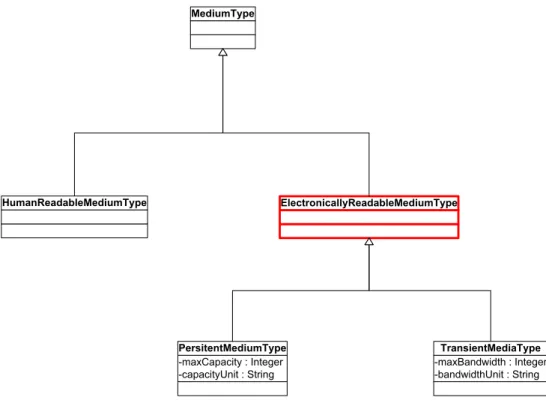
for the MEMO-OrgML is displayed in figure 4. The classHumanReadableMediumType
comprises all media readable by humans but not by automated information
systems. This includes media-types like printed documents. ElectronicallyMediumType
comprises all kinds of media which are readable by information system com-ponents. We hereby separate persistent and transient media. Persistent
media act as a storage for information types. Information is stored on
the medium and will be available at any time for discovery. A transient medium acts as a transportation channel between different persistent me-dia. In general, a transient medium is acts as an transportation channel between persistent media.
Again, the modelling of media mainly addresses the representation and additional process for the scanning and revision of a document. Such a task can only be done by a human resource and implies additional expenditure of human capital. The abbreviation OCR stands forOptical Character Recognition.
MediumType ElectronicallyReadableMediumType HumanReadableMediumType -maxCapacity : Integer -capacityUnit : String PersitentMediumType -maxBandwidth : Integer -bandwidthUnit : String TransientMediaType
Figure 4: Media Resource Types
detection of media clashes. Such a media clash is not characterised by a transformation of information but by the change of different kind of media.
Open Research Questions: Our notion of media clashes bases on the transition between different kinds of media. Nevertheless, media clashes might also correlate to semantic clashes between different data format types. Despite the fact, that media clashes are basing on changes between different media, similar clashes might also be identified between different format rep-resentations. Focussing on human and electronically readable media covers only one aspect of media clashes. Additionally, frictions in format types reflect the same kind of clashes. Hence, media clashes might not be re-duced to given media but might also contain data formats. We currently only address the detection of media clashes with respect to different
me-dia types28 and therefore omit semantic clashes caused by different data
formats. Language features for the explicit modelling of human and elec-tronically readable media might support this. Nevertheless, this approach 28For example hard-disk in contrast to paper-based documents.
has two intrinsic disadvantages:
• The distinction between human and electronically readable media is
often not clear. Paper-based documents are rather readable by a hu-man but might also be digitalised and transformed into an electronic
document. Current OCR-technologies29 improve the quality of the
electronic document by converting the digital bitmap into an modifi-able text.
• Semantic differences between different document or format types are
not covered by this approach. They usually result in equal problems like clashes based on media.
The current conceptualisation of the resource modelling language contains only the explicit modelling of media. This first —but restricted— concep-tualisation will be evaluated in future research. Results of this research will point out the advantages and/or the inadequateness of the general distinc-tion between human and electronically media.
Also the distinction between persistent and transient media reflects only an experimental approach for the classification of media. The basic idea be-hind such an approach is, that persistent media represent a durable storage for information. In contrast to this transient media do not store informa-tion permanently, but hold them for a short period of time. Informainforma-tion is only contained on a transient medium as long at is delivered to its des-tination (equally a persistent storage). Examples for transient media are transportation channels like local area network connections or long range data transmission infrastructures. Information is only contained in such a medium for the purpose of delivering it from its origin to its destination. Part of such a transportation process might also be the buffering of data on some nodes which are part of the transportation system. The basic idea
behind the reflections on network channels30 is, that they can be regarded
as media but they do not store information permanently. Similar concepts can be found beyond information systems: Goods (physical products) are moved from a source (e.g. a manufacturer) to a specific destination (e.g. a wholesaler). Those goods are actually not stored31but they have a given lo-cation and the transportation process usually takes time. Regarding to both —data transmission over a network connection or the forwarding of physi-cal products— the transportation process tainted with the consumption of 29Optical Character Recognition
30and equally like transient media 31like in a warehouse
time32, costs33 and different locations. Therefore, we treat transportation channels in our first approach as medium —especially a transient medium. Further research will prove our assumptions or constitute them as useless.
2.4
Software Types
Software is a special kind of an intangible resource34. Like information,
soft-ware is not a physical entity and depends on a containing physical medium . Such a medium can be physical data medium (e.g. floppy disk, CD-ROM), a hard disk drive of a computer on which the software is installed, or the main memory of a computer on which the software is running. A software-type is an abstract classification of different kinds of software35.
Compared to information, software supports the execution of tasks. An information-type mainly consists of a static structure description. Infor-mation is an instance of an inforInfor-mation-type containing a specific content satisfying the structure definition of its type. Functional aspects are not described by an information-type but by a software-type. Software is some kind of an active intangible resource which supports the processing of infor-mation and business tasks.
The basic meta-model of the software-type and its associated
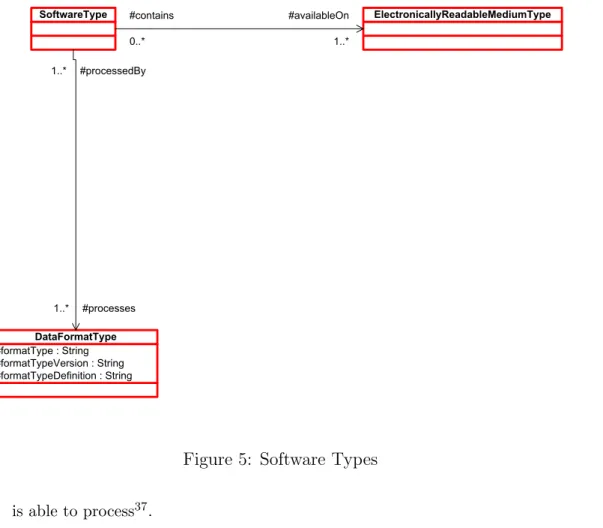
resource-types is presented in figure 5. A SoftwareType is able to process
elec-tronically readable document-types (i.e. information-types of a specific
DataFormatType) and relies on an electronically readable medium. The
data-format-type consists of a character-string expressing the name of the format-type, the version of the format-type, and the structural definition of the format-type. The first two attributes identify the kind of the data for-mat and the last one contains the structure-definition basing on the kind of the data format. For example a text-document of a specific format-type of
is characterised by its formatType (Microsoft Word), formatTypeVersion
(Word 97), and itsformatTypeDefinition(structure of Word documents).
Hence, a SoftwareType is associated with every available format-type36 it
32Data transmission is very fast in contrast to transport of physical object. But nonetheless, there is some amount of time spent for the transportation.
33The transportation of information and goods as well is correlated to some amount of money. 34refer paragraph 2
35Examples for software-types are database management system, text-processor, application-server, or data-warehousing-software.
36A modeller should always associate only known and appropriate format types with a software package. Approriate format types corresponds to alls formats which fits the semantic level of an application. As a worst case, a text editor might be used for the editing of any file —neglecting the data type. Nevertheless, we emphasize the usage of a specialized editors for the modification of different data objects.
SoftwareType ElectronicallyReadableMediumType #formatType : String #formatTypeVersion : String #formatTypeDefinition : String DataFormatType #contains 0..* #availableOn 1..* #processedBy 1..* #processes 1..*
Figure 5: Software Types
is able to process37.
Software depends on the availability of a data medium. This relation is
modelled by the association betweenSoftwareTypeandElectronicallyMediumType
in figure 5. Note, that this association only addresses the availability of software on a medium. The installation of software on a computer and the availability as active resource (i.e. the software running on a computer) is not covered by this specification. This aspect will be covered in future versions of the resource modelling language.
Open Research Questions: The classification of software as an in-tangible resource seems to be odd in the context of knowledge-management. Intangible resources are usually not describable by a formal language; but, software is. Classical intangible resources are knowledge, qualification or 37This rather vague example bases on the assumption, that only the textual information of MS-Word document is of a certain relevance. Embedded figures and spread-sheets are left out. They only represent information (or just their representation) originally not included in the document —but associated with it.
human experience. Those aspects are hard to describe with any given lan-guage. In contrast to this, software is written in a programming lanlan-guage.
But, software itself depends on a storage medium38 and can only be
ex-ecuted by a given computer platform39. From our point-of-view, it is not
clear wether software is intangible or not. Ongoing evaluation of the concep-tualisation of the resource modelling language and its practical application will show advantages and limitations of this approach.
3
Resources
Resource-types represent general properties of resources which are needed for the execution of business process. Examples for general resource-types are trucks, computers, a DBMS, and consultants. These resource-type do not consider specific products manufactured or distributed by a dedicated company or a specific incarnation of a product type. A resource represents a dedicated instance of a specific resource type. A truck produced by a specific manufacturer is a vehicle resource of a truck type. A DBMS distributed by a software manufacturer is of the type DBMS.
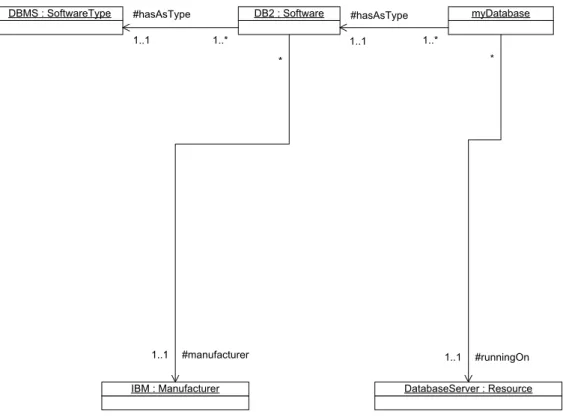
An example for different levels of abstractions of a database-management-system is presented in figure 6. A database-management-database-management-system is a
gen-eral resource-type (DBMS:SoftwareType). Such a type only expresses the
need for a software-type for the management of persistent data. A con-crete resource is represented by IBM’s database-management-system DB/2
(DB2:Software). The resource type of this DBMS is SoftwareType. DB/2
is an instance of a DBMS distributed by IBM. A specific instance of DB/2
running on a dedicated machine is represented bymyDatabase.
With respect to conceptual modelling concrete instances of specific types (like the single installation of a specific DB/2-license) will be neglected. We will only discuss resources and resource-types. Resource-types have already been considered in paragraph 2. Hence, this section will deal with resources.
3.1
Basic Resources
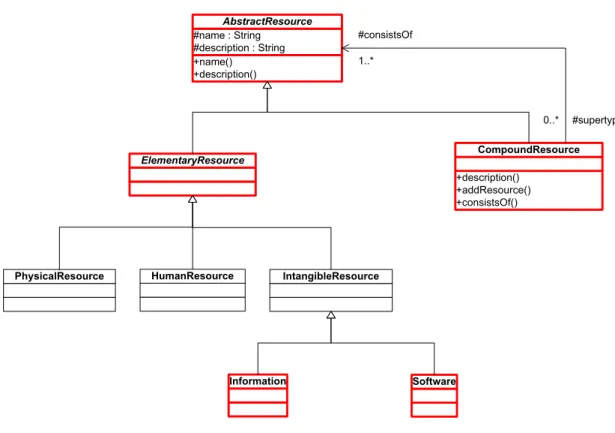
The conceptualisation of basic resources according to resources types (as discussed in section 2) is presented in figure 7. The hierarchy of resources is equivalent to the one of resource types in figure 2.
Resource types specify properties of kinds of resources and abstract from 38For example a persistent medium like a hard-disk or a CD-ROM.
39A given software-package can only be executed on a specified operating system running on a given processor architecture.
myDatabase DBMS : SoftwareType #hasAsType DB2 : Software
1..1 1..* #hasAsType 1..1 1..* IBM : Manufacturer * #manufacturer 1..1 DatabaseServer : Resource * #runningOn 1..1
Figure 6: Type, Resource and Instance
concrete resources. In addition to this, resources represent concrete products (in a manner of resources).
3.2
Resources and Types
Regarding to different levels of abstraction, resources can be viewed from several points of view. A resource might be a seen as a resource type (e.g. database server), a resource (Oracle) or a concrete resource instance (a specific Oracle DBMS license or installation). The relationship between
resources and their corresponding types is established by a hasAsType
-relationship. Examples for intangible resources are given in Figure 8. An installed program with an assigned license number is related to a software type, represented by the name and version of the software package by the
hasAsType-relation. Also information such as the instance of an invoice is
+name() +description() #name : String #description : String AbstractResource +description() +addResource() +consistsOf() CompoundResource ElementaryResource #consistsOf 1..* #supertyp 0..*
PhysicalResource HumanResource IntangibleResource
Information Software
Figure 7: Basic Resources
Open Research Questions: The semantics of thehasAsType -relation-ship has to be specified by the resource modelling language. The need for this specification has already be identified as a conclusion from the different levels of abstraction presented in section 1.3. But, the way of specifying such a relation has not yet been elaborated. On the one hand, such a relation offers the flexibility for the description of resources on different levels of
abstractions40. On the other hand, it raises the complexity of a resource
modelling language by the provision of several interrelated concepts. It has to be checked wether a suitable complexity will be needed and how it can be hidden from the user of the language. An accurate specification of the language or specially designed user interfaces seem to be a possibility for the encapsulation of specific complex language features.
40Such levels might comprise resource types, resources and resource instances as outlined in section 1.3
#productName : String #productVersion : String SoftwareType #licenseNumber : String Software 0..* #hasAsType 1..1 Information InformationType 0..* #hasAsType 1..1 +description() +addResource() +consistsOf() CompoundResource +description() +addResourceType() +consistsOf() CompoundResourceType 0..* #hasAsType 1..1
Figure 8: Resources and corresponding Resource Types
3.3
Variants
A variant of a resource represents a variation from the original resource. It mainly conforms to the original resource but adds some extensions and a slight difference in its name.
Example: The original resource is a scanner-model produced by a specific manufacturer (let us call it Hewlett-Packard). The same scanner type might be distributed with an additional equipment for the digitalisation of dias under a modified product name. Hence, both products base on the same scanner type and differ only in the additional equipment and the slightly modified product name. Most of the technical specification like resolution, scanning speed, physical dimension are equal to both products because they rely on the same basic product type. Differences are only caused by an additional feature (the equipment for the digitalisation of slides, which might also be attached to the original product as an option) causing an extended scope of delivery and a modified product name.
ElementaryResource ElementaryResourceType ResourceVariant 0..* #hasAsType 1..1 «delegate»
Figure 9: Variant of a Resource
The consideration of variant as an extension to already available resources is presented in figure 9. A specific elementar resource (ElementarResource)
has an associated type (ElementarResourceType) and might have some
variants. Such a variant (ResourceVariant) might add some features to
the elementar resource and change its product name. Generally speaking, a variant adds some additional information to an existing resource. Most information is adopted by a variant and extended by additional information. Usually the product name is modified with respect to the changes.
Such an extension of a resource leads to the interpretation that a variant is equal to a known resource type (with respect to some additions). Most properties of the resource and the variant are the same.
4
Accounting of Resources
From an economic point-of-view, resources are usually associated with costs of their corresponding usage within a business process. The way in which
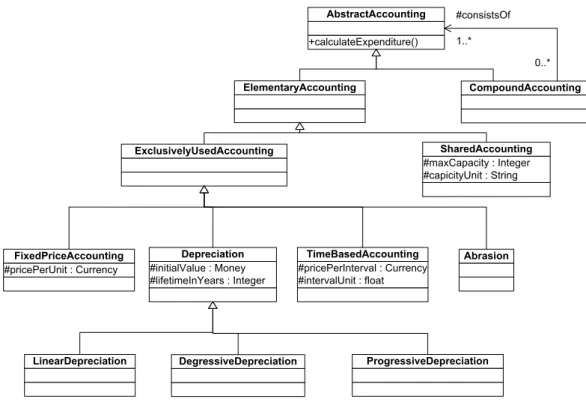
resources are allocated to tasks is very important to the efficiency of a work-flow. Hence, a resource modelling language has to consider economic aspects of the resource usage. Regarding different business processes and resource types, costs can be determined differently. A differentiation of costs for any kind of resources is given in figure 10.
+calculateExpenditure() AbstractAccounting CompoundAccounting ElementaryAccounting #consistsOf 1..* 0..* #maxCapacity : Integer #capicityUnit : String SharedAccounting ExclusivelyUsedAccounting #pricePerUnit : Currency FixedPriceAccounting #pricePerInterval : Currency #intervalUnit : float TimeBasedAccounting Abrasion #initialValue : Money #lifetimeInYears : Integer Depreciation
LinearDepreciation DegressiveDepreciation ProgressiveDepreciation
Figure 10: Basic Accounting
A resource can at any given time be used within several processes or just one. If it is shared between processes its availability is restricted by a maximum capacity; represented by a capacity unit and an upper bound of numbers of that unit. The usage of such resources in different processes has to be specified by the amount of units required for that specific process. A database server is an example for a shared resource. The work load of a database server is often specified by a maximum number of simultane-ous transactions. Thus, the capacity unit is ’transaction’ and the maximal capacity is the highest number of transactions at a given point of time.
Costs of exclusively used resources can be interpreted differently - depend-ing on the kind of resource use (see 11). Resources are accounted for on a fixed price per unit or on a time base. Another possibility is the assignment
of abrasion or depreciation for the use of a resource. Fixed prices usually form the calculation base for spare parts as well as operational and raw material. Some staff and machinery may also be calculated for by fixed price. Additionally, those resource types are characterised by their abrasion or depreciation, while used for a process. Hence, the kind of accounting is orthogonal to the type of a resource.
ElementaryAccounting ElementaryResourceType «delegate» ElementaryResource «delegate» +description() +addResourceType() +consistsOf() CompoundResourceType +description() +addResource() +consistsOf() CompoundResource CompoundAccounting «delegate» «delegate»
Figure 11: Assignment of Accounting Information to Resources and Types
As stated in section 1.3, resources can be seen from different points-of-view. The basic framework for the specification of resources and resource types follows a conceptional point-of-view and economic features were de-ferred for the moment. The core problem lies in different kinds of classifica-tion of resources. Two major typing schemes discussed in this paper are the conceptual and the economic classification. There are other kinds of classifi-cation like availability, quality, or responsibility. Hence, we should consider a multiple classification of resources and resource types. Additionally, the economic classification of a resource might change in time or between dif-ferent business processes. A fixed-price calculated resource of one specific process might be accounted on a time base in another process. In conse-quence, the classification from an economic point-of-view can be dynamic.
Odell discusses multiple and dynamic classification in [31].
Different perspectives for the classification of resources in the resource modelling language are realised by a concept calleddelegation41. Taivalsaari defines delegation as follows:
Delegationis a general-purposesharing mechanism. It requires
the presence of the [...] self-reference, and operates by forwarding
messages from one object to another without changing the
self-reference. [38, page 66]
Taivalsaari’s point-of-view is obviously influenced by object-oriented pro-gramming languages. He explains delegation as forwarding messages and refers to the self-reference. But, the core of its definition addresses a general sharing mechanism of different concepts (abstractions) which are conceptu-ally unified in one object. This object might fill different roles, depending on the context.
The primary classification of resources bases on a domain expert perspec-tive as presented in Basic Meta-Model of the Resource Specification Frame-work. Other perspectives - such as accounting - are attached to resources by delegation (see Figure 11). Delegation means, that a resource might satisfy a certain perspective by playing a special role. The role of an elementary resource type (ElementaryResourceType in Figure 11) is represented by an elementary accounting. This elementary accounting encapsulates all eco-nomic properties of a resource and replaces the resource in every ecoeco-nomic context. All non-economic aspects of a resource within an economic context are represented by the resource (type) itself. Hence, the elementary account-ing represents a resource whenever accountaccount-ing properties are requested and delegates all other inquiries to the resource itself.
5
Interfaces to other MEMO-Languages
The major objective of this paper is the specification of a conceptually ad-equate resource specification language. Hence, the core business lies in a semantically adequate evaluation of resource types and their mapping to an appropriate language. Nonetheless, this language will be integrated into the existing modelling language MEMO-OrgML. Therefore, the resource modelling language has to consider existing language features of the exist-ing organisation modellexist-ing language. These aspects will be considered by 41The concept of delegation is presented in [14] from a conceptual point of view. The authors also propose a prototypical implementation in Smalltalk.
the definition of the assignment of resources to organisational units ( see paragraph 5.1) and processes (paragraph 5.2).
5.1
Human Resources
Organisational structures can be expressed by well-established organisa-tional charts. Such a chart contains organisaorganisa-tional units and their rela-tionships. There are —at least— two different types of relationships:
• aggregation
• authority
An aggregation relationship describes the composition of organisational units to a composed unit. Hence, all subunits of a composed organisation unit are parts of it. An organisational unit which cannot be decomposed is called a position. A position might be filled by a specific employee. From this point-of-view, positions represent abstract members42of an organisation and an organisational unit is some kind of grouping of these members. Su-perior aggregated units are transitively composed of other aggregated units
(e.g. groups, departments, and divisions). Authority relationships define
superior-subordinate-relationships. Not the aggregation of organisational units but superior units are modelled. Superior units are authorised to give orders to subsidiaries and have generally to be involved in decision making processes. Following such an approach for organisational charts, organisa-tional units with subsidiaries can be represented by persons, too. Addition-ally, both approaches can be used simultaneously within one organisational chart.
Obviously, organisational units represent human resources for the tasks
an organisation has to do. Those tasks can be mapped to processes of
a business process model. Organisational units (especially those filled by staff member) can be associated with resources the same way. The specifi-cation of organisational structures is usually not a core feature of resource modelling. Hence, a resource modelling language may not include an organi-sation structure language (like organiorgani-sational charts). But it should support the usage of such a language by adequate interfaces. The MEMO-OrgML already includes a language for organisation structures. Consequently, the resource modelling language will not include its own organisation structure modelling language but an interface to the existing one.
42The term ’abstract member’ is used to emphasise, that a position must not be directly correlated to a specific person. In fact, a position keeps constant over time while the person filling a position might change.
+name() +description() #name : String #description : String AbstractOrganizationalUnit +addSubOrdinate() +subordinates() CompoundOrganizationalUnit #subunits 1..* #superunit 0..1 Position ResourceOrganisationConnector #linkedBy 0..* #filledBy 1..1 HumanResourceType #actsAs 1..1 #linkedBy 0..1
Figure 12: Human Resources assigned to Organisational Units
A first approach to the integration of the resource modelling language and organisation modelling language of MEMO-OrgML is presented in figure 12. Organisation structures are regarded on a very abstract level. An
organ-isational unit (AbstractOrganisationalUnit) is either a composed unit
(CompoundOrganisationalUnit) or a position. Each composed unit
con-sists of one or several other organisational units. A position does not have any subunits. A human resource type is assigned to a member of the
organi-sation by a special linking object of the type (ResourceOrganisationConnector).
This connector represents an interface between the concept ofHumanResourceType
of the resource modelling language and an associated organisational unit.
Open Research Questions: This very first approach for the mapping of resources to organisational units (and vice versa) only indicates the future integration of resource and organisation modelling in MEMO-OrgML. As far as the language for the description of organisation structures has not been specified in detail, we assume the simple conceptualisation as presented in 12. Further changes will not affect the resource modelling language but only the classRole.
5.2
Allocation of Resources
A single business process only describes what has to be done on a business object (a physical product or an information object). Additionally the
as-signment of resources to a process specifies the subject (who or what will
work on an object) and what additional objects (i.e. passive resources) are needed. But the assignment of resources or resource types to a business process is more than a simple attachment of a resource to a process. Fur-thermore, the extend of the usage of a resource in a corresponding process has to be defined.
One approach for the allocation of resources to processes43is described by
Fowler’s Resource Allocation Analysis Pattern [10]. This pattern (refer to
figure 13 ) introduces an abstraction called Resource Allocation that
speci-fies the amount of a resource’s usage in a business process. This abstraction
is represented by the class ResourceAllocation in figure 13. A resource
allocation is differentiated by a general and a specific resource allocation. A general resource allocation may only be applied to a resource type and a specific resource allocation to a resource. Specific resource allocations are
specialised to TemporalResource and Consumable. Consumable resources
are used up by the execution of a process. They will consequently not be available after the process’ termination. Generally speaking, consumable resources are consumed by a process. Temporal resources are used for the execution of a process but will be available afterwards (except of attrition).
Resource types are specialised toConsumableTypeand AssetType—
accord-ingly. A temporal resource allocation only corresponds to an asset which is
of the type AssetType. A holding corresponds to a consumable allocation
as well.
The resource allocation pattern by Fowler promises a valuable approach for the specification of a resource’s usage within a process. It separates aspects of a specific usage from the concrete resource itself. Also the anno-tation of an adequate quantity and the specification of periods for time-based allocated resources introduces a valuable approach.
But some aspects of this pattern are not convincingly elaborated. The dif-ferentiation between resource and resource types only addresses the usage and the booking of a resource. It is not clear at the moment whether this differentiation fits to our perspectives on instances and types. Quantities for the resource allocation are only discussed on abstract level by Fowler. He does not specify concrete types of quantities for different kinds of us-ages of resources. The usage of a resource is only restrictively reducible to quantity-based and time-based allocations. Additional factors as attrition or depreciation (refer to 4) have to taken into account. Hence, basic ideas of 43Other approaches have to be identified and evaluated in future.
ResourceType ConsumableType AssetType ResourceAllocation GeneralResourceAllocation SpecificResourceAllocation 1 0..* TemporalResource Consumable Quantity TimePeriod 0..* 1 Constraint: If resource type is an asset type then quantity must have time units
0..* 0..1 Holding Asset 1..1 0..* 0..* 0..* 1..1 0..* 1..1 0..*
Figure 13: Resource Allocation Analysis Pattern by Fowler
the resource allocation pattern seem to be a valuable foundation of resources in the MEMO process-modelling language. But additional observations on this pattern and the evaluation of other resource allocation techniques will be needed.
6
Support Types
Additional supporting types, which are not used in the context of resource
modelling only, are presented in this section. Those types are used for
the specification of resources and resource types in the context of this re-search report. A financial amount44(refer to section 4) describes the amount of money spent for the usage of a resource for the execution of a specific process. Also weights and measures (as discussed in section 6.2) are pro-vided in the resource modelling language on a semantic adequate level of abstraction. Furthermore, those types are not only relevant for resources 44represented by a finacial value
and resource types. Financial values might also be valuable for other kinds of applications within different contexts. A money-representing type like the financial-value-type is also applicable to product catalogs, accounting systems, or data-warehousing applications. Also Weights and measures are relevant in a huge set of software systems. Hence, those types are designed to be used in the resource modelling language but their design is as general as possible that they can be (re-)used in other contexts, too.
6.1
Financial Values
A financial value45 describes – in the context of this resource modelling
language – the amount of money spent on the usage of a specific resource for the execution of a certain (business) process. The kind of accounting of a resource (type) assigned to a process is specified by an accounting type as presented in section 4. Independent of the accounting type, one important parameter of the accounting calculation is of the kind of financial value. The
result of an accounting calculation is of the typeFinancialValue, too.
A financial value is characterised by an amount of money and the currency of this money. From an object-oriented point-of-view, a financial value con-sists of an amount, a currency and a set of methods applicable to a financial value. The methods define operations, which are provided by a financial value. Those operations include arithmetic (add and subtract) and boolean (isEqual, isSmaller, and isBigger) operations as well as conversion services (conversion to another currency). A proposal for the conceptualisation of a financial value type is displayed in the class diagram in figure 14.
Every financial value is characterised by a monetary amount and a
cur-rency. The amount is of the type Decimal with a precision of two digits
after the decimal point. The currency of a financial value is assigned by an
associated object of the class Currency. This annotation of the currency
defines the real monetary value of an amount.
Some desirable functions on financial values address arithmetic opera-tions, boolean comparison, and conversion. The class diagram in figure 14
displays some examples of such functions. The methodsadd andsubtract
support the addition and subtraction of one financial value to/from another. Especially different currencies have to be taken into account by such an addi-tion/subtraction. Hence, amounts of financial values of different currencies
have to be converted to one common currency. Regarding the methodsadd
and subtract, the common currency and the currency of the result is the
one of the receiver of the message.
+add(in aMoney : FinancialValue) : FinancialValue +subtract(in aMoney : FinancialValue) : FinancialValue +isEqual(in aMoney : FinancialValue) : boolean +isSmaller(in aMoney : FinancialValue) : boolean +isBigger(in aMoney : FinancialValue) : boolean +convertToCurrency() : FinancialValue -amount : Decimal
FinancialValue
+exchangeRateTo(in foreignCurrency : Currency) : Decimal -currencyName :