Lam, P., Au Yeung, M. Y. M., & McNaught, C. (2007). Balancing online and in-class activities using the Learning Activity Management System (LAMS). In C. Montgomerie & J. Seale (Eds.), ED-MEDIA 2007 (pp. 3603–3612). Proceedings of the 19th annual World Conference on Educational Multimedia, Hypermedia & Telecommunications, Vancouver, Canada, 25–29 June. Chesapeake VA: Association for the Advancement of Computers in Education.
Balancing Online and In-class Activities Using the Learning Activity
Management System (LAMS)
Paul Lam
Centre for Learning Enhancement And Research The Chinese University of Hong Kong
[email protected] Mary Y. M. Au Yeung School of Pharmacy
The Chinese University of Hong Kong [email protected]
Carmel McNaught
Centre for Learning Enhancement And Research The Chinese University of Hong Kong
Abstract: Many classroom activities are sequential and structured and teachers are used
to this kind of learning design. However, online learning environments are often disorderly and uncontrolled, and offered to students as a free smorgasbord. The paper describes a bridge between the two learning environments through the use of a web-based learning activity management system (LAMS). In the two cases described in the paper structured, flexible web-based tasks are provided which can be used both for online self-study and in a classroom setting. The study has found preliminary evidence of success in gaining the acceptance of students and teachers for the ideas of adding control to online learning activities while adding flexibility to classroom teaching. Obstacles and challenges have been recorded in the two cases and are converted into practical ideas for improvement.
Learning Activities in the ‘Two Worlds’
Teachers’ use of technology often concentrates on the use of simple functions with the web being seen as a convenient storage house for easy distribution of course materials to students (McNaught et al., 2006). More complex and interactive eLearning strategies are not frequently employed. The many success stories about innovative eLearning strategies in the literature are often cases of pioneering teachers who are ‘early adopters’ (Rogers, 1995). There are undoubtedly a number of factors behind this lack of enthusiasm for teachers to integrate eLearning strategies into their classroom practice. One reason might be the big contrast between the learning environments in these two modes of learning: the learning activities in a classroom are sequential and structured, often using some form of lesson plan, while online learning sites often resemble a relatively unstructured and uncontrolled smorgasbord of resources and activities that can be done in any sequence. Even if the eLearning activities are sequenced, they are often “content-based, single-learner, self-paced learning objects” (Dalziel, 2003, p. 593). Hence, in many traditional classroom-based courses, online components are regarded as additional self-learning resources and not integral to the course.
There are advantages and disadvantages of both approaches (low and high structure) to arranging learning activities. Azevedo, Guthrie and Seibert (2004), for example, advocated that self-regulated learning facilitates the development
of active learning habits. Learners work through a cyclical and iterative learning process when they need to choose their own learning paths through a number of online learning activities; this might support the development of skills associated with planning, monitoring and reflection on learning. Cagiltay, Yildirim and Aksu (2006) also pointed out that online flexible learning framed within a social-constructivist approach can emphasize individualized instruction and student-centred learning. Moreover, learners have varied learning styles and they tend to appreciate different types of learning materials, exercises and other activities. A flexible online learning environment allows learners to choose a learning path that matches their own learning preferences.
The experience of many teachers, however, indicates that fixed learning paths and a controlled learning environment for students still have significant value. Teachers may be concerned about students’ capacity to make informed learning choices. Very often there are core learning experiences that teachers think are essential to students’ comprehension of certain concepts and they want students to acquire the necessary experiences in an effective manner. There may also be weaker students who need more guidance. Oliver and Oliphant (1998), for example, compared the effect on learning of two eLearning packages that were both on the same topic. One of the packages adopted a more controlled design with pre-set learning tasks, while the other had a high degree of user freedom. The researchers observed that in the less controlled learning context there were many students “consciously overlooking important principles or, when learning the principles, misunderstanding the concepts behind them” (p. 70). Ishiyame and Hartlaub (2003) looked at learner choices across an entire programme with a focus on the relationship between how a major is structured and students’ learning outcomes. They found that a structured and focused curriculum was related to higher levels of abstract reasoning being developed by students. Programmes that allowed a great flexibility in course selection by students sometimes failed to guarantee that students had core learning experiences. Of course, teachers’ own pedagogical beliefs markedly influence the learning designs they use. Bain and McNaught (2006) studied the way 22 Australian academics used technology in teaching and learning and mapped a number complex, yet interpretable, relationship patterns between teachers’ beliefs and practices. In this study, it was striking that, no matter what pedagogical stance teachers had, they all strived to achieve some coherence in the learning designs they adopted.
It is our contention that many teachers might value eLearning activities that have a degree of structure that is closer to the structure of a conventional classroom. This is perhaps one incentive behind the creation of the eLearning tool, Learning Activity Management System (LAMS). LAMS is open source software developed at Macquarie University in Australia. As pointed out by Dalziel (2003), the originator of the tool, LAMS is metaphorically the lesson plan for
eLearning activities. LAMS (http://www.lamsfoundation.org/) is an easy-to-use authoring and delivery system
designed to support collaborative online learning activities. LAMS has at least the following characteristics:
It provides educators with a highly intuitive visual authoring environment. The building of sequences involves
easy drag-and-drop actions.
It creates sequences of learning activities, rather than isolated learning objects or online exercises.
It supports activity sequences that involve multiple types of activities.
The activities are group-oriented. They do not only include activities that mainly involve computer–student
interactions (e.g. quizzes), but also those that encourage social interactions (e.g. forums, and peer-reviewing of assignments or journals).
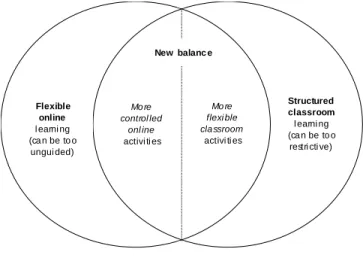
In our view, LAMS can enhance the teaching and learning environment of traditional courses through manipulating the amount of control teachers have over the learning activities. This can be done in two ways which, at least at first glance, are quite different with each other. The sequenced LAMS activities can be used not only to structure out-of-class online learning activities; they are also useful in ‘destructuring’ in-out-of-class activities. To a certain extent, it allows for a new balance between flexible and controlled learning (Figure 1).
While disorganized eLearning objects may offer little learning support, the introduction of the sequenced activities provides more guidance over what and how students can learn. Feedback can be given in timely places as well. Individual students, however, still maintain a certain degree of flexibility over the exact method they use to complete each of the activities. For example, they may be allowed to pick their choices from a reading list, and they can use their own styles of reading when completing online reading exercises. In doing exercises, individual students may schedule the work differently and they may employ strategies that suit themselves.
While traditional classroom activities may be too structured and restrictive, the new balance allows a range of flexibility to be introduced to these activities. For example, when a sequence of online activities (probably mixed with face-to-face activities as well) is done in class, students can complete these tasks at their own pace. Instead of a single teacher–class interaction in class (which limits every student to study at the same pace), there could be numerous, simultaneous teacher–student, computer–student, and even student–student interactions going on in class, without interfering with each other.
New balanc e Flexible online l earni ng (ca n be to o ungui ded) Mo re control led onl ine activi ti es Mo re flexi ble cla ssroom activi ti es Structured classroom l earni ng (ca n be to o restri cti ve)
Figure 1: New balance for flexible and structured learning
Details of the Study
LAMS has been set up at The Chinese University of Hong Kong (LAMS@CUHK: http://www.cuhk.edu.hk/clear/lams) with the support of the ‘Support for innovative eLearning strategies’ project which aims to explore recent innovations in teaching and learning technology. LAMS is not positioned as a full-scale learning management platform for general-purpose teaching and learning at the University. Instead, it is provided to individual teachers who wanted to use the tool on a small scale in the hope that more can be learned about the technical and pedagogical strengths and weaknesses of LAMS. The lessons learnt in the project will inform the University in making decisions about the future directions of eLearning support.
The paper reports two trials in the 2005–06 academic year to use LAMS in authentic teaching and learning settings. LAMS version 1 was set up and used throughout the first term of 2005–06. The materials used in Case 1 of our study were built of this version of the tool. LAMS version 2 was installed to replace version 1 at the beginning of the second term of the year and Case 2 was built with this tool.
The two cases corresponded to the two aspects of our model: Case 1 focused on giving the teacher more control over online learning activities, while Case 2 aimed to make the classroom learning more flexible. The two cases are a pilot test of the tool and the pedagogical implications it has for eLearning in classroom practice.
Evaluation was an integral feature of the use of the LAMS sequences in the two cases. The strategies used were student surveys and the teachers’ reflections on the experiences. In Case 1, 28 of the 32 students in the class returned the survey and the response rate was 87.5%. In Case 2, 10 students (out of 32) completed the end-of-sequence survey, with the response rate being 31%. The low response rate of the second case was largely due to the lengthy sequence and the fact that only 10 students were able to reach the online survey upon the end of the session. This point will be taken up in the Discussion section.
Case 1: more control over the online learning activities
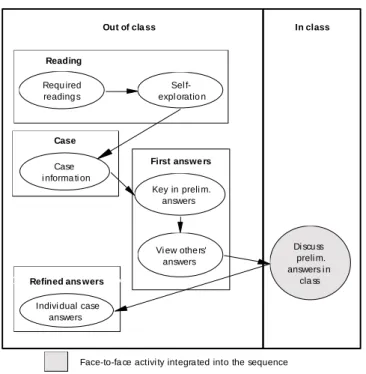
The first case was web-enhanced case-based activity in a postgraduate pharmacy course with the requirement for the students to go through detailed and diverse procedures. Figure 2 shows the flow of a typical online case-based exercise sequence in the course. The online activities were varied: web searching, reading of online resources,
quizzes and group discussions. Many of the eLearning activities were carried out as out-of-class exercises but students’ performance was closely monitored by the teacher and contributed to course grades.
Case Requ ired reading s Sel f-expl oratio n Case i nforma ti on Key in preli m. answers Vi ew othe rs' answers Di scu ss preli m. answers i n cla ss
Out of cla ss In class
Reading
First answe rs
Face-to-fa ce activi ty integra ted into the sequence Indivi dual case
answers
Refined ans wers
Figure 2: The controlled online case-based activities (mainly out of class) in case 1
The teacher compiled six case activities around six different patients having different illnesses such as glaucoma, osteoarthritis, rheumatoid arthritis and asthma. Students needed to inspect the symptoms of the patients described in the cases and then work out appropriate prescriptions. Students formed six groups; each group was responsible for one case though they could participate in all case discussions.
The activity sequence in LAMS allowed the activities to become more structured in the following manner. Some
of the suggested readings were online resources and the links to the resources were placed in the LAMS sequence. Students went from the LAMS sequence to these resources, finished the reading and when they felt that they were fully prepared for the next activity, they clicked the ‘next’ button on the sequence to proceed. The students then read the case materials and the associated questions. Clicking ‘next’ on the page would lead them to the answer input page where they keyed in their preliminary answers. After submitting the answer they were presented with the answers collected so far by the system on the same questions written by their peers. The sequence was finished here. Teacher retrieved students’ answers also through the same system. The topic was further discussed in class, with the various answers being compared and contrasted. Students then rethought about their own solutions. They had a chance to read the online case and discussion again before they submitted their final answers.
The teacher believed that the designed learning path that consisted of dedicated reading, discussions and reflections would enable students to have a clearer understanding of the issues. Time limitation made it impossible for all the case activities to be held in class. But without the higher level of control now made possible by LAMS, she was not sure whether students would take the trouble to actually go through the complete desired learning path. The teacher had a number of expectations.
Controlled and monitored eLearning activities: The teacher wanted to have higher control of students’ out-of-class learning experiences through the use of eLearning technologies.
Higher engagement in tasks: The tasks should extensively enrich students’ learning experiences.
Higher learning outcomes: The students were expected to 1) gain better understanding of the concepts and theories taught in the lectures, 2) learn to apply these concepts and theories in real cases, and 3) learn important thinking and learning skills as well as acquire appropriate professional attitudes.
Case 2: more flexibility for in-class activities
The teacher in Case 2 taught a postgraduate course on computer applications in English language teaching and learning. One important theme concerned the use of the latest teaching and learning technology. The teacher actually wanted the students to have hands-on experience with LAMS. By the end of the 2½-hour session, students were expected to learn the basic operations of LAMS, and the short assignment focused on the creation of simple learning objects using the tool.
The session was held in a computer laboratory in which each student was provided with the access to one computer. In the arrangement adopted with previous software, the teacher would demonstrate a few of the functions of the software, and then students would follow suit and work on their own computers. When most of the students had completed the steps required, the teacher would go on to demonstrate another set of functions, followed by students’ practice. The cycle continued until the basic functions were demonstrated and practiced. The teacher, however, found this method quite restrictive mainly because the students had a big range of IT skills and worked at very different paces. Some students had to wait while others were still struggling with the previous procedures. Most of these slower students, however, also were not engaged meaningfully because they were waiting for the teacher to reach them.
The teacher thought that if the learning sequence could be turned into a self-learning package which could be viewed by the students as many times as they liked, many of the students’ problems in class could be solved without needing to consult the teacher. Then, the teacher’s time could be better spent on the most needy students. Moreover, students who could work fast could engage themselves with the more advanced tasks. The progress of learning would not need to be uniform and restricted by the less ready students. The teacher thus had an interesting strategy of supporting students to learn LAMS through LAMS. The activity sequence of LAMS in this case thus allowed the in-class activities to be flexible and less structured.
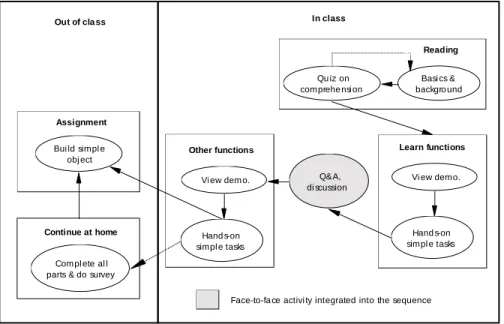
Figure 3 shows the flow of the session and how the online LAMS sequence was interlaced with a face-to-face activity in class. The diagram also shows that the online LAMS sequence was mainly used as an in-class learning tool in this case. In this sequence, most of the reading, watching video clips of the demonstrations of functions, and students’ actual practice in using the software were all done online.
Out of cla ss In class
Reading
Face-to-fa ce activi ty integrated into the sequence Vi ew demo. Hand s-on simpl e tasks Learn functions Q&A, di scussion Assignment Bui ld simpl e obj ect Compl ete al l parts & do survey
Qu iz on comprehe nsi on Basi cs & backgro und Vi ew demo. Hand s-on simpl e tasks Other functions Continue at home
Figure 3: the flexible online hands-on activities (mainly in class) for case 2
LAMS assisted the actual running of the tasks in the following way. Firstly, there was basic information about the background and objectives of LAMS. A simple quiz followed the reading activity. But if students failed in this simple quiz, they would be directed back to the reading task again. There were then recorded demonstrations of a few related functions (e.g. the creation of simple sequence, inviting students to attend the sequence, the monitoring
of a sequence, etc.). After each of these sets of demonstrations, students were asked to switch to the actual software to do some tasks. Upon finishing the tasks, students returned to the sequence at the relevant point and input the results as required to demonstrate that they had actually finished that specific stage of learning.
Figure 4: The ‘Harry Potter Map’ in LAMS showing the positions of individual students’ (body shapes on the map) in the learning sequence in real time
The teacher did not need to cater for individual students’ problems as much as in the traditional arrangement as he saw that many of the students could find their own solutions through watching the demonstration again if needed. The teacher could now even monitor the progress of the individual students through the ‘monitoring’ function provided by LAMS. The tool provided a ‘map’ view in which the students were pictured graphically as figures moving along the learning path (Figure 4). This map was jokingly referred to as the ‘Harry Potter Map’ (able to view the world with the aid of an invisibility cloak). The teacher realized who was lagging behind and directed his attention towards those students.
There was a face-to-face discussion after about half of the activities were completed. The faster students enjoyed a break before the discussion if they had reached the point early. The discussion involved clarifications of some technical points but was also about the potential uses of the tool in different settings. After the discussion the rest of the demonstrations and hands-on tasks followed. Students who were slow were encouraged (but not required) to continue to go through the sequence at home. The assignment at the end was the creation of a more complex learning object as a LAMS sequence at home.
The benefits the teacher expected the learning sequence to achieve thus included:
Variety in learning activities: allowing students to get access to a variety of interactive learning activities.
Enhanced learning: maximizing learning so that both the fast and slow learners could understand the basic concepts and procedures as required.
Findings
Case 1
Opinions of the students on the sequenced online case-based activities were by and large very positive. They were particularly confirmatory regarding the level of guidance the sequence had given them for finishing the case. Their
score of the question There was enough guidance in the case material to help me complete the tasks reached an
average of 3.93 (on a 5-point Likert scale, 1 being strongly disagree and 5 being strongly agree) as more than 89% of the respondents either agreed or strongly agreed with the statement. They also commented highly on the learning outcomes of the online cases. Their ratings to the statements regarding whether the tasks had facilitated the learning
of the key concepts and theories (I can learn the key concepts of the subject effectively through completing
case-based tasks), and the application of these concepts into real-life situation (I learn how to apply the theories and/or concepts in this course to real-life situations through the cases) reached 4.25 (96% agreed or strongly agreed), and 3.93 (86% agreed or strongly agreed) respectively.
Students liked the fact that the controlled sequence had allowed them to read and even to comment on each other’s answers to the cases. As mentioned before, it was the teacher’s intention to promote thinking on the students’ part through their interactions with each other. This objective seemed to be met. Out of the 20 remarks collected in the
open-ended question Which components of the case-based activity do you like best? more than half of them (11)
focused on the chance to discuss the case with peers. For example, they mentioned “discussions of cases so that we can learn from each other”, “comment on other groups. Since we can learn more from the others”, and “critique of other groups’ answers. Let us know how the others did” (wording slightly adjusted for readability).
The other objective of the teacher – to extend the learning experiences of the students to out-of-class time through
online learning activities – was also met. On the open-ended question about the advantages of the case-based
activity, one of the most common themes mentioned was the new possibilities for flexible time management through using the web-based tool. There were students’ remarks such as “the case-based activity encouraged the participation of every one. It also makes one understand more and have sufficient time to understand the concept”, “we had enough time to digest the material, group interactions”, and “more time was spent in discussing cases as the other classes usually run out of time when they discuss about the cases” (wording slightly adjusted for readability). The other higher-level learning objectives, however, were less effectively fulfilled. Students, for example, did not feel strongly positive about the effect of the activities on enhancing their confidence in playing the professional role (I feel confident now that I can effectively play the professional roles in the field). The score of this item was 3.07, with only about 39% of the respondents either agreed or strongly agreed to the statement. The activities were also
not very efficient in enhancing the learning skills such as self-study (my self-study skills have improved),
group-working (I have learnt how to contribute to decision-making in groups), and critical thinking (I am now more able to
make critical comments on the work of others). The score of these items were 3.36 (54% agreed or strongly agreed), 3.43 (50% agreed or strongly agreed), and 3.50 (57% agreed or strongly agreed) respectively. To a certain extent, the conservative replies of the students in these aspects reflected that these higher-level outcomes concerning skills and attitudes may be too demanding for the case-based activities in their present context: isolated instances of teaching and learning innovations in a single course.
Complaints were noted on technical and procedural difficulties. Ten out of the 19 comments received in the open-ended question asking for ideas of improvement were related to the usability of LAMS. For example, a few students had trouble opening the sequence, perhaps because of some required browser plug-ins were missing. They remarked that we should “ensure better stability in loading LAMS”. Many of the students did not like the fact that finished steps in a sequence could not be revisited: “LAMS is not user-friendly enough. It does not allow students to go through the materials again”, and “LAMS is troublesome, since we cannot go back after clicking ‘finish’. A few of the students disliked the fact that students could not change their login passwords. As for the teacher, the lack of the
time-release functions in LAMS version 1had also caused some difficulty. The teacher and the support people had
to remember to manually open and close each of the six cases (12 dates to remember!). [The teacher in this case used LAMS version 1. A time-release function is provided in LAMS version 2.]
Many suggestions for improvement related to enriching the case stories (e.g. providing more real hospital cases of different natures) and/or information related to the case situation. These comments showed clearly that the successful implementation of online learning strategies depends on both good technical and pedagogical planning. Case 2
Opinions of the students on the sequenced activities in Case 2 were also by and large very positive. Two simple questions were asked at the end of the session, using the ‘survey’ feature integrated into the LAMS sequence. Ten of the students (out of 32) reached that survey by the end of the session. Their replies to the usefulness of the LAMS sequence in teaching them the basics of the tool were very positive. The score reached 4.6 on a 5-point Likert scale
(100% agreed or strongly agreed) in the statement The session today was helpful in letting me use the basics of
LAMS. As the course was about eLearning and the students were either pre- or in-service school teachers, they were
asked whether LAMS could be a useful tool to use in their own settings. LAMS was regarded as having high
potential in this aspect. The score of the statement I saw a high potential that LAMS can be used to assist the
teaching of English in my present or future classes reached 4.1 with 7 out of the 10 respondents ticking either strongly agreed or agreed to it.
The fact that 22 students were not able to complete the sequence on time reflected at least two points. Firstly, it represented a lesson design problem. The teacher was new in using LAMS and had no idea how many online learning activities could be included in a session. As a result, he included too many. Because of a similar reason, the sequence had a structure that tended to be too complicated. The researcher consulted Johnny Ly, the general manager of LAMS International, on this matter and he commented that expert users of the tool would have broken down the many steps into a number of sequences rather than squeezing them into one. The cost of this very heavy sequence structure was that many of the functions took more time to download, to activate and to respond. For example, it took the teacher nearly one minute to generate the ‘Harry Potter Map’ for the class. The generation of the progress bars for the individuals took even much longer. Students also found the learning activities slow. The second point that could be generalized is that there was indeed a big range of IT readiness of the students. The ‘Harry Potter Map’ screen capture in Figure 4 shows that while ten had actually completed all the tasks, another 15 or so were still at the third quarter of the sequence, and there were a few students seriously lagging behind.
This second point in fact echoed the original purpose of the teacher to use LAMS to cater for more flexible learning in the classroom. Students really need this freedom of learning speed even in classroom activities. If not, many of the faster learners will be bored and the slower students will not be able to follow an inflexible traditional demonstration hands-on session. On the contrary, the teacher found most of the students were able to engage in the online learning activities in this case. The teacher was able to identify the weakest students and give them more timely and individualized assistance. The teacher also found the face-to-face discussion held in the middle of the session very meaningful. As more students had effectively engaged in the tasks, more students actively participated in the class discussion – something that is not the norm in the Hong Kong context.
The students were asked what they liked and disliked in the sequence-end survey as well. Students liked having many diverse elements in the sequence. They named the preferred elements as, for example, the video clips, the forum, the quizzes, the ability to learn the progress of their classmates, and the strictly sequential (no-skipping) nature of the activities. This seems to justify the teacher’s intention in grouping a diverse set of learning activities in the sequence: on the one hand, to allow students to go through a rich learning experience and, on the other hand, to allow students who have different preferences and learning styles benefit from a wide selection of materials and tasks.
As for the least liked parts, technical and procedural problems were also the most commonly mentioned problem. Six remarks were collected. Three of them were about the slow speed. As mentioned, the heavily structured sequence might be one cause. The fact that all 32 students plus one teacher assessed this resource-demanding sequence from the LAMS server put some burden to the server. The three other comments concerned the poor quality of the video clips. Strictly speaking, this was not related to LAMS but was related to the inexperience of the teacher in preparing videos with an effective educational purpose.
Discussion
Success
The two cases seemed to provide evidence that the possibility of a more controlled online learning environment and a less controlled classroom environment can be both provided through the employment of tools such as LAMS that can sequence and manage web-based learning activities. The results of both cases seemed to show that, first of all, teachers can conceptually understand the benefits of the new approaches, and how they can contribute to the current misalignment between online and classroom learning environments. Secondly, the pedagogical ideas can be relatively accurately implemented through LAMS. In Case 1, the resulted sequence did impose the reading-view-case-answer-discussion sequence even in an online mode. In the second case, the sequence successfully converted the teachers’ lesson design into a series of diverse interactive tasks that allowed students to proceed at their own pace. Thirdly, students to a certain extent acknowledged the achievement of some of the learning benefits, and appreciated the new online and classroom learning environments now aided by the new tool. Students’ feedback on the learning outcomes they gained and their feeling towards the web-assisted learning activities were generally very promising. Lastly, even the teachers were by and large satisfied with the new arrangements and the effects on teaching and learning they observed. In Case 1, the teacher observed meaningful discussion and high engagement in the tasks. In Case 2, the teacher also perceived student engagement in the activities and he was particularly pleased to have had the chance to target his efforts towards assisting the students in need without sacrificing the rest of the class.
Challenges
However, there seemed to be a number of drawbacks that have considerably diminished some of the expected benefits. Obviously, there are challenges on the technical side. Both students and teachers feel that quite a number of the features in LAMS can be improved. For example, it seems that many students do value the opportunity of being allowed to re-attempt or revisit previously completed activities. Pedagogically, it is also a valid point of view since learning is commonly composed of many forward and backward steps as learners construct ideas, are challenged, and then go back to reconstruct knowledge in an iterative process. Other areas that can be improved include the student management processes (creation and assignment of student ID and password); and the scalability of the system (the handling of complex sequences by a large number of students simultaneously).
Apart from technical concerns, there are also challenges on the human side. Teachers are not used to the creation of sequenced online learning activities. In Case 1, the teacher found building the sequenced activities difficult, although LAMS has employed a graphical interface which actually shows a sequence in an easy-to-understand flowchart. The creation of a sequence is basically done through drag-and-drop actions that move the various components and linkages between the components to their appropriate places. Despite the user-friendly interface, the teacher still requested help from the technical support people for the creation of all six of the case-based exercises. This might be because building sequences of learning activities is in itself a highly advanced development compared with many of the other more common educational uses of the web, such as uploading resources or participating in online discussions. The training required in order to support teachers compile and develop the learning sequences was greatly underestimated.
Also, successful learning sequences require quality learning content which can sometimes be very challenging to teachers and can be outside the skill sets they possess. In Case 1, for example, the sequences were benefited a great deal by the quality of the background readings, the case story and the information associated with the case. In Case 2, the effectiveness of the web-based demonstrations requires well-planned, well-filmed, and well-explained video clips, which are not easily produced by most teachers without assistance. In short, the effective use of the learning sequences as either out-of-class or in-class learning activities demand detailed preparation on the part of the teachers and additional support being provided for them. This requires a significant amount of time and effort.
Conclusion
The paper has explained the need of a bridge that can transform, on the one hand, largely disorderly online resources and activities into more controlled learning sequences and, on the other hand, the highly structured learning activities in a traditional classroom into tasks that are more flexible and allow students’ to self-explore and proceed at varied speeds. The bridge is able to mix the two originally very different learning designs into a hybrid mode of learning design in which there seems to be the advantages of both flexible and structured learning. More importantly, the bridge may inspire and attract teachers
The two cases described in the paper have provided, first of all, real examples that illustrate the kind of changes that can be possible to the learning designs using the new tool and, secondly, preliminary evidence of success – in gaining the acceptance of the students and teachers, in adding control to online learning activities while adding flexibility to classroom teaching, and in gaining some of the learning benefits originally planned. All this tends to indicate that further investigation and trials are certainly worthwhile. There are also obstacles and challenges in using the innovation in actual settings, and they have been converted into practical ideas for improvements such as better preparation and support being provided for both teachers and students.
References
Azevedo, R., Guthrie, J. T., & Seibert, D. (2004). The role of self-regulated learning in fostering students’
conceptual understanding of complex systems with hypermedia. Journal of Educational Computing
Research, 30(1), 87–111.
Bain, J. D., & McNaught, C. (2006). How academics use technology in teaching and learning: Understanding the
relationship between beliefs and practice. Journal of Computer Assisted Learning, 22(2), 99–113.
Cagiltay, N. E., Yildirim, S., & Aksu, M. (2006). Students’ preferences on web-based instruction: Linear or
non-linear. Educational Technology & Society, 9(3), 122–136. Retrieved April 4, 2007, from
http://www.ifets.info/journals/9_3/11.pdf
Dalziel, J. (2003). Implementing learning design: The learning activity management system (LAMS). In G. Crisp, D. Thiele, I. Scholten, S. Barker & J. Baron (Eds.), Interact, Integrate, Impact (pp. 593–596), Proceedings of the 20th Annual Conference of the Australasian Society for Computers in Learning in Tertiary Education. Adelaide, 7–10 Decembe. Retrieved April 4, 2007, from
http://www.ascilite.org.au/conferences/adelaide03/docs/pdf/593.pdf
Ishiyama, J., & Hartlaub, S. (2003). Sequential or flexible? The impact of differently structured political science
majors on the development of student reasoning. PSOnline, 83–86. Retrieved April 4, 2007, from
http://www.apsanet.org/imgtest/SequentialorFlexible-Ishiyama.pdf
McNaught, C., Lam, P., Keing, C., & Cheng, K. F. (2006). Improving eLearning support and infrastructure: An
evidence-based approach. In J. O’Donoghue (Ed.). Technology supported learning and teaching: A staff
perspective (pp. 70–89). Hershey, PA: Information Science Publishing.
Oliver, A. W., & Oliphant, J. (1998). Comparing two learning strategies implemented within a CAL program. Retrieved April 4, 2007, from
http://www.herts.ac.uk/ltdu/about/who_we_are/andrew/papers/CELTIC.DOC
Rogers, E. M. (1995). Diffusion of innovations (4th ed.), New York: Free Press.